
John 11:42

Greek (Tischendorf 8th ed.) John 11:42 appears in the Greek New Testament. The text above is from the Tischendorf 8th edition. Each word links to its Strong’s number and a concise gloss. Click any word for its full Thayer’s Greek Lexicon entry.
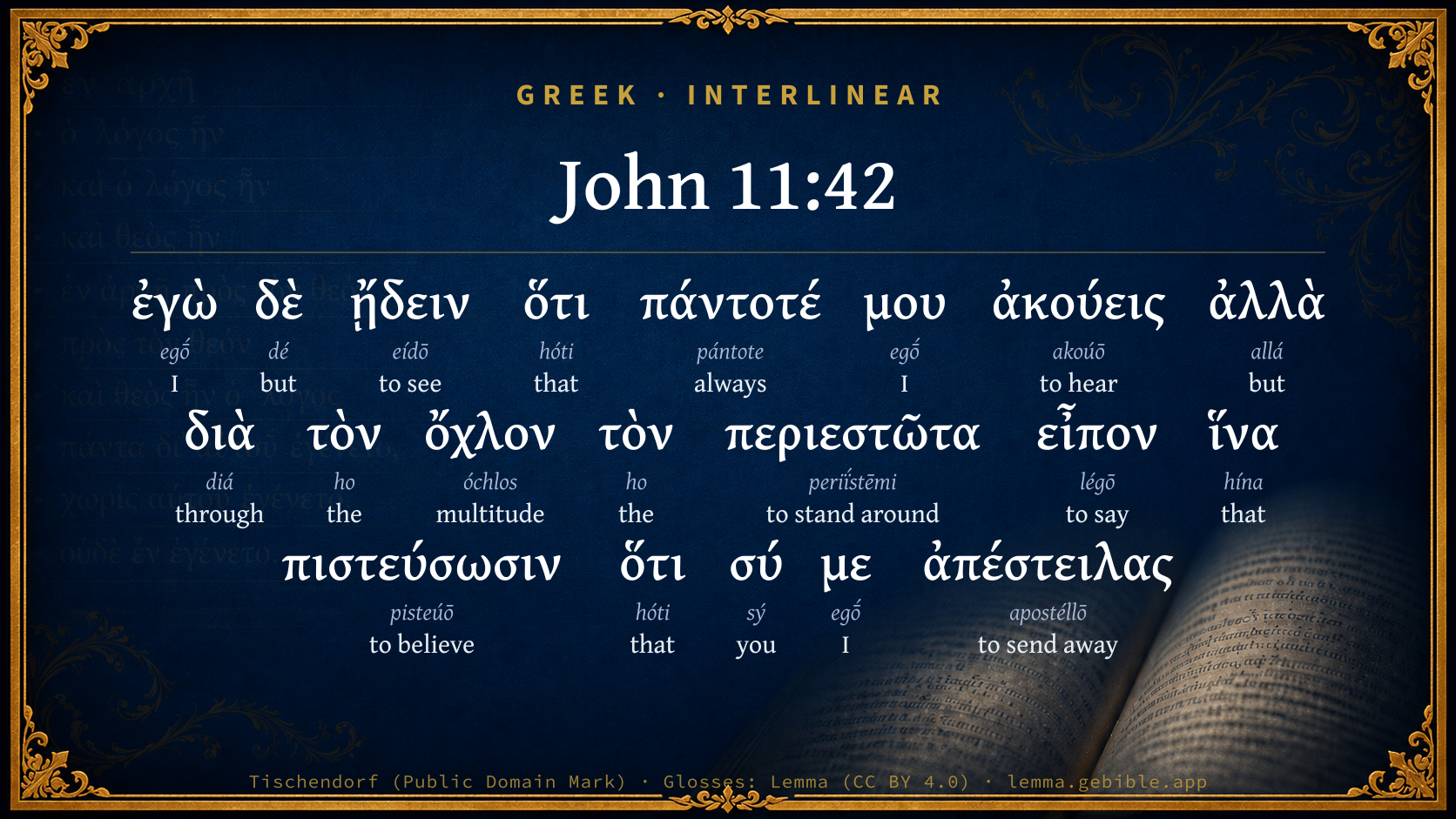
Download image
Cite this verse

John 11:42 (World English Bible). Public Domain. Lemma interlinear Bible study tool, https://lemma.gebible.app/v/john/11/42.

Show BibTeX & RIS
BibTeX
RIS
English Translation
I know that you always listen to me, but because of the multitude that stands around I said this, that they may believe that you sent me."
World English Bible · Public Domain
Highlights
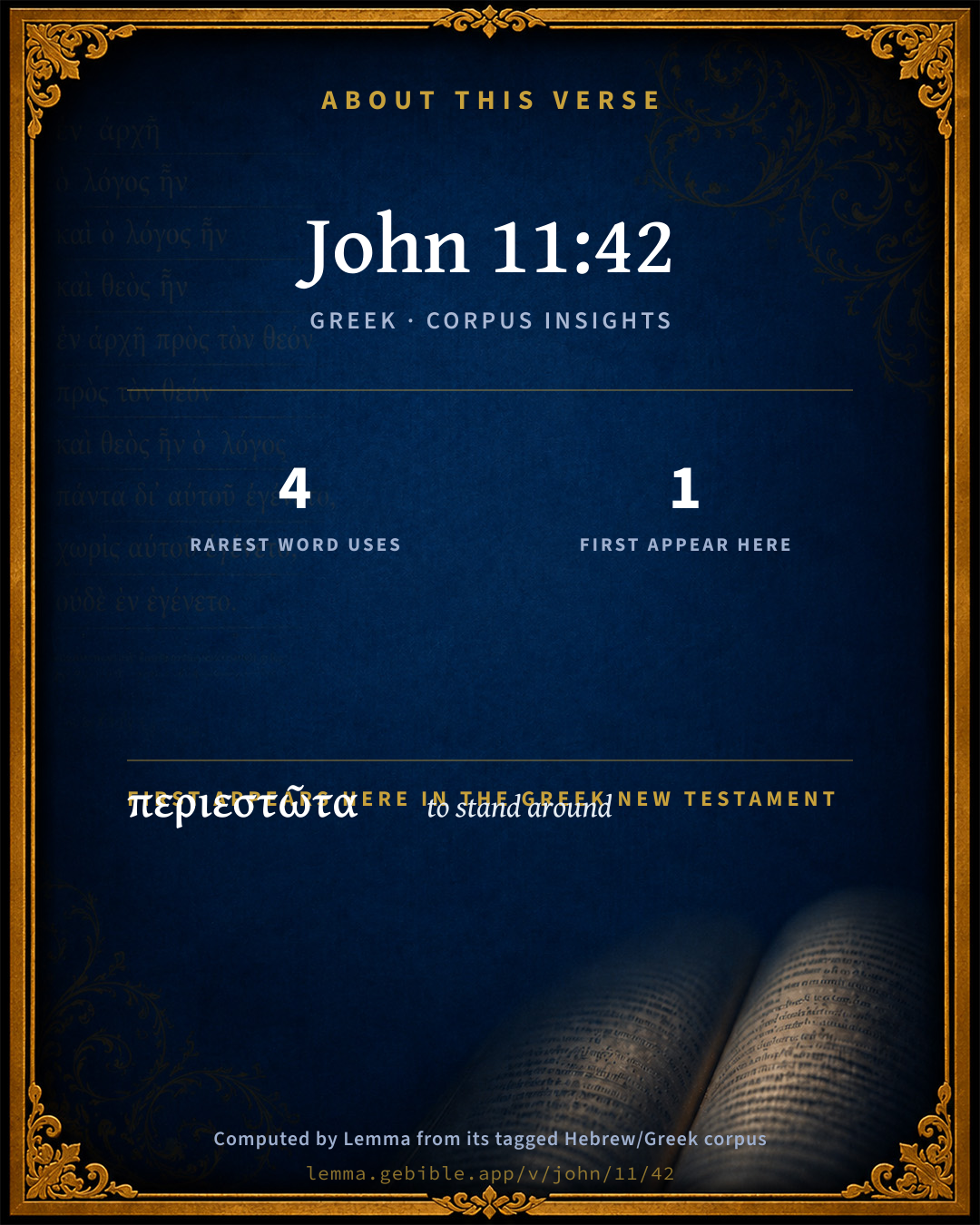
  • 1 first appearance in the Greek New Testament
Full analysis ↓
Download a study sheet

One document with this verse’s original text, its word-by-word gloss line, the meaning frame, cross-references with their text, attributed commentary, and full source and license credits — printable, and it pastes into notes with its structure intact.

This verse Autodidact and up

Study sheet (.html) Plain text (.txt)

A passage Seminary Student

Up to 50 verses in one chapter. A passage sheet keeps up to 6 commentary sources and 12 cross-references per verse, in the order this page ranks them, and says so on the sheet whenever that leaves anything out. Ask for a single verse and you get the Autodidact verse sheet above.

Everything on this page stays free to read, with no account — the sheet is a download of what is already on screen, not access to it.

Want to remove ads? Support Godless Engineer
Compare translations 3

The same verse in 3 English versions, stacked beneath the original-language interlinear above. Click any original word for its lexicon entry.

Each is an independent rendering of the whole verse — the interlinear is not word-aligned to these translations.

Highlighted words mark where these versions differ — a whole-verse word diff, not a word-by-word alignment.

  • World English Bible Public Domain
    I know that you always listen to me, but because of the multitude that stands around I said this, that they may believe that you sent me."
  • King James Version Public Domain
    And I knew that thou hearest me always: but because of the people which stand by I said it, that they may believe that thou hast sent me.
  • unfoldingWord Literal Text CC BY-SA 4.0
    Now I have known that you always hear, but because of the crowd that is standing around I spoke, so that they may believe that you sent me.”

unfoldingWord Literal Text — © unfoldingWord, licensed CC BY-SA 4.0. Word-aligned USFM3 via Door43 (git.door43.org/unfoldingWord/en_ult).

Versions to compare (up to 4)

3 of 4 selected

Show all 19 translations

Every available English version of this verse, each an independent rendering of the whole verse.

  • World English Bible Public Domain
    I know that you always listen to me, but because of the multitude that stands around I said this, that they may believe that you sent me."
  • Berean Standard Bible Public Domain
    I knew that You always hear Me, but I say this for the benefit of the people standing here, so they may believe that You sent Me.”
  • Majority Standard Bible Public Domain
    I knew that You always hear Me, but I say this for the benefit of the people standing here, so they may believe that You sent Me.”
  • King James Version Public Domain
    And I knew that thou hearest me always: but because of the people which stand by I said it, that they may believe that thou hast sent me.
  • American Standard Version (1901) Public Domain
    And I knew that thou hearest me always: but because of the multitude that standeth around I said it, that they may believe that thou didst send me.
  • Revised Version (1885) Public Domain
    And I knew that thou hearest me always: but because of the multitude which standeth around I said it, that they may believe that thou didst send me.
  • Geneva Bible (1599) Public Domain
    I knowe that thou hearest me alwayes, but because of the people that stand by, I said it, that they may beleeue, that thou hast sent me.
  • Douay-Rheims (1899) Public Domain
    And I knew that thou hearest me always; but because of the people who stand about have I said it, that they may believe that thou hast sent me.
  • Young's Literal Translation Public Domain
    and I knew that Thou always dost hear me, but, because of the multitude that is standing by, I said `it', that they may believe that Thou didst send me.'
  • Literal Standard Version CC BY-SA 4.0
    and I knew that You always hear Me, but because of the multitude that is standing by, I said [it], that they may believe that You sent Me.”
  • Unlocked Literal Bible CC BY-SA 4.0
    I knew that you always listen to me, but it is because of the crowd that is standing around me that I said this, so that they may believe that you have sent me.”
  • unfoldingWord Literal Text CC BY-SA 4.0
    Now I have known that you always hear, but because of the crowd that is standing around I spoke, so that they may believe that you sent me.”
  • Darby Bible Public Domain
    but I knew that thou always hearest me; but on account of the crowd who stand around I have said [it], that they may believe that thou hast sent me.
  • World Messianic Bible Public Domain
    I know that you always listen to me, but because of the multitude standing around I said this, that they may believe that you sent me.”
  • Webster's Bible Public Domain
    And I knew that thou hearest me always: but because of the people who stand by, I said it, that they may believe that thou hast sent me.
  • Free Bible Version CC BY-SA 4.0
    I know you always listen to me. I said this because of the crowd standing here so that they will believe that you sent me.”
  • Bible in Basic English Public Domain
    I was certain that your ears are at all times open to me, but I said it because of these who are here, so that they may see that you sent me.
  • Text-Critical English NT CC BY 4.0
    I know that yoʋ always hear me, but I say this for the benefit of the crowd that is standing here, so that they may believe that yoʋ sent me.”
  • Tyndale New Testament (1534) Public Domain
    I wot that thou hearest me all wayes: but because of the people that stonde by I sayde it that they maye beleve that thou hast sent me.

Literal Standard Version (2020), Covenant Press — licensed CC BY-SA 4.0. Text via the HelloAO Bible API (eBible.org). Unlocked Literal Bible (unfoldingWord) — licensed CC BY-SA 4.0. Text via the HelloAO Bible API (eBible.org). unfoldingWord Literal Text — © unfoldingWord, licensed CC BY-SA 4.0. Word-aligned USFM3 via Door43 (git.door43.org/unfoldingWord/en_ult). Free Bible Version, Dr. Jonathan Gallagher — licensed CC BY-SA 4.0. Text via the HelloAO Bible API (eBible.org).

Word by word

More ways to search: Search by grammar → Find every occurrence → Compare this word →

Practice this passage: Drill this verse → Learn its vocabulary →

περιεστῶτα
periḯstēmi
G4026
“to stand around”
Verb, Perfect, Active, Participle, Accusative, Singular, Masculine
Part of Speech
Verb
Tense
Perfect
Voice
Active
Mood
Participle
Case
Accusative
Number
Singular
Gender
Masculine
Full Thayer's Definition

Origin: from G4012 and G2476

TDNT: None

1. to place around one 2. to stand around a. to turn one's self about for the purpose of avoiding something b. to avoid, shun
  1. ἐγὼ egṓ G1473 “I” Personal pronoun, 1st person, Nominative, Singular
  2. δὲ dé G1161 “but” Conjunction
  3. ᾔδειν eídō G1492 “to see” Verb, Pluperfect, Active, Indicative, 1st person, Singular
  4. ὅτι hóti G3754 “that” Conjunction
  5. πάντοτέ pántote G3842 “always” Adverb
  6. μου egṓ G1473 “I” Personal pronoun, 1st person, Genitive, Singular
  7. ἀκούεις akoúō G191 “to hear” Verb, Present, Active, Indicative, 2nd person, Singular
  8. ἀλλὰ allá G235 “but” Conjunction
  9. διὰ diá G1223 “through” Preposition
  10. τὸν ho G3588 “the” Article, Accusative, Singular, Masculine
  11. ὄχλον óchlos G3793 “multitude” Noun, Accusative, Singular, Masculine
  12. τὸν ho G3588 “the” Article, Accusative, Singular, Masculine
  13. εἶπον légō G3004 “to say” Verb, Aorist, Active, Indicative, 1st person, Singular
  14. ἵνα hína G2443 “that” Conjunction
  15. πιστεύσωσιν pisteúō G4100 “to believe” Verb, Aorist, Active, Subjunctive, 3rd person, Plural
  16. ὅτι hóti G3754 “that” Conjunction
  17. σύ sý G4771 “you” Personal pronoun, 2nd person, Nominative, Singular
  18. με egṓ G1473 “I” Personal pronoun, 1st person, Accusative, Singular
  19. ἀπέστειλας apostéllō G649 “to send away” Verb, Aorist, Active, Indicative, 2nd person, Singular

About this verse

These counts appear in no published source. They are computed here, from the morphology-tagged text and Lemma’s own curated glosses. What Lemma adds →

20
words
16
distinct lemmas
Gospels
section

Notable vocabulary

The rarest word here is περιεστῶτα to stand around G4026 — appearing just 4 times in the whole Greek New Testament.

First appearance in Scripture

This word makes its first canonical appearance in the Greek New Testament here:

  • περιεστῶτα to stand around G4026

Shared distinctive vocabulary

περιεστῶτα to stand around G4026 occurs in 4 verses of the Greek New Testament. Also found in:
Repetition

Words recur within this verse:

Cross-references

24

Topical passages linked to John 11:42 in the Treasury of Scripture Knowledge — connected by theme and wording, ordered by reader-vote popularity; previews shown in the World English Bible.

  • John 3:17 For God didn't send his Son into the world to judge the world, but that the world should be saved through him.
  • John 17:21 that they may all be one; even as you, Father, are in me, and I in you, that they also may be one in us; that the world may believe that you sent me.
  • Hebrews 7:25 Therefore he is also able to save to the uttermost those who draw near to God through him, seeing he ever lives to make intercession for them.
  • 1 John 4:14 We have seen and testify that the Father has sent the Son as the Savior of the world.
  • Matthew 26:53 Or do you think that I couldn't ask my Father, and he would even now send me more than twelve legions of angels?
  • John 7:28–29 Jesus therefore cried out in the temple, teaching and saying, "You both know me, and know where I am from. I have not come of myself, but he who sent me is true, whom you don't know.
  • John 11:22 Even now I know that, whatever you ask of God, God will give you."
  • John 12:27–30 "Now my soul is troubled. What shall I say? 'Father, save me from this time?' But for this cause I came to this time.
  • John 17:8 for the words which you have given me I have given to them, and they received them, and knew for sure that I came forth from you, and they have believed that you sent me.
  • John 17:25 Righteous Father, the world hasn't known you, but I knew you; and these knew that you sent me.
  • John 20:31 but these are written, that you may believe that Jesus is the Christ, the Son of God, and that believing you may have life in his name.
  • Romans 8:3 For what the law couldn't do, in that it was weak through the flesh, God did, sending his own Son in the likeness of sinful flesh and for sin, he condemned sin in the flesh;
  • Hebrews 5:7 He, in the days of his flesh, having offered up prayers and petitions with strong crying and tears to him who was able to save him from death, and having been heard for his godly fear,
  • 1 John 4:9–10 By this was God's love revealed in us, that God has sent his one and only Son into the world that we might live through him.
  • Matthew 12:22–24 Then one possessed by a demon, blind and mute, was brought to him and he healed him, so that the blind and mute man both spoke and saw.
  • John 6:38–40 For I have come down from heaven, not to do my own will, but the will of him who sent me.
  • John 8:16 Even if I do judge, my judgment is true, for I am not alone, but I am with the Father who sent me.
  • John 8:29 He who sent me is with me. The Father hasn't left me alone, for I always do the things that are pleasing to him."
  • John 8:42 Therefore Jesus said to them, "If God were your Father, you would love me, for I came out and have come from God. For I haven't come of myself, but he sent me.
  • John 9:24–34 So they called the man who was blind a second time, and said to him, "Give glory to God. We know that this man is a sinner."
  • John 10:36–38 Do you say of him whom the Father sanctified and sent into the world, 'You blaspheme,' because I said, 'I am the Son of God?'
  • John 11:31 Then the Jews who were with her in the house, and were consoling her, when they saw Mary, that she rose up quickly and went out, followed her, saying, "She is going to the tomb to weep there."
  • John 11:45–50 Therefore many of the Jews, who came to Mary and saw what Jesus did, believed in him.
  • Galatians 4:4 But when the fullness of the time came, God sent out his Son, born to a woman, born under the law,

Cross-references courtesy of OpenBible.info (CC BY 4.0).

Commentary

Notes on John 11:42 from classic Christian and Jewish commentators (each source and its license shown beneath its notes). The classic Christian expositions comment on the surrounding passage and are grouped to its opening verse, so a note may address several verses; the Jewish commentaries on the Tanakh (Rashi and others) are per-verse, so they appear only where the commentator wrote on this verse.

Lemma curates 59 commentaries, every one of them public domain or Creative Commons licensed, each selected and text-cleaned for this edition rather than reprinted as found. About our sources →

Bengel's Gnomon

Johann Albrecht Bengel

Joh 11:42. Ἐγώ, I) Jesus seems to have made this declaration after some pause.—ᾔδειν, I knew) Jesus shows to the people, that He returned thanks to the Father, not as though it were for something new to Himself, and such as He had not experienced before. The filial intimacy of Jesus in relation to the Father was far too great, to admit of being fully expressed by speech among men.—πάντοτε, always) even after the death of Lazarus.—ἀκούεις, Thou hearest) The Father, when hearkening to Him, replied sometimes by a voice from above, but generally by a most immediate effecting [of the Son’s desire].—εἶπον, I said) this, and gave thanks. So εἴρηκα, I have said [“I have called you friends,” Engl. Vers.], ch. Joh 15:15, of something that had been just said.[303][303] ἵνα πιστεύσωσιν, that they may believe) Such was the result, ver. 45.—V. g.

Bengel's Gnomon of the New Testament — English translation (T&T Clark, Edinburgh, 1860) — public domain. Text from a community e-Sword module.

International Critical Commentary

42. ἐγὼ δὲ ᾔδειν κτλ., “But I knew that thou hearest me always.” This is a phase of Jesus’ consciousness of Himself as in unique relation with the Father, which appears all through the Fourth Gospel, and which is most explicitly stated in the words ἐγὼ καὶ ὁ πατὴρ ἕν ἐσμεν (10:30).

We examine, first, the rec. reading ἀλλὰ διὰ τὸν ὄχλον τὸν περιεστῶτα εἶπον, “but for the sake of the crowd standing round, I said it”; i.e. He said aloud εὐχαριστῶ σοι ὅτι ἤκουσάς μου, not merely because of thankfulness to His Father for an answer to His prayer (for of this He had been sure), but because He wished the bystanders to appreciate the true secret of His power. The prayer of Elijah, “Hear me, O Lord, that this people may know that thou art God” (1Ki 18:37), is not a true parallel, for Elijah had not the certainty of his prayer being answered as he wished, that Jesus had. See, however, 12:30, where Jesus is represented as saying that the voice from heaven was not for His sake, but for the sake of the wondering crowd; and cf. 17:13. ἵνα πιστεύσωσιν ὅτι σύ με ἀπέστειλας, “that they might believe (cf. 17:8, 21) that thou hast sent me.” This, according to the rec. text, was the purpose with which Jesus had uttered aloud His thanksgiving and His assurance that the Father always heard Him, sc. that He might fix the attention of the bystanders upon His claim, that He was “sent” by the Father (see on 3:17; and cf. 6:29). For the reiterated claim, σύ με ἀπέστειλας, cf. 17:8, 18, 21, 23, 25. It is difficult to accept the rec. text as exactly representing the motive behind the words εὐχαριστῶ σοι ὅτι ἤκουσάς μου. Without the addition of v. 42, these words commend themselves to every reader as a sublime expression of thankfulness. But v. 42 represents them as having been uttered in order to impress the crowd. Perhaps we might take v. 42 as a comment or interpretative gloss of the evangelist rather than as a saying of Jesus.1

Probably, however, the rec. text is corrupt. In one uncial (Θ) there is a variant reading which we take to represent the original, viz.: διὰ τὸν ὄχλον τὸν παρεστῶτά μοι ποιῶ, ἵνα κτλ.

First, παρεστῶτα is read not only by Θ and the allied cursive 28, but also by 235 and the ninth-century uncial Λ. Further, the Vulgate G has adstantem, not circumstantem (which is the usual rendering of the rec. περιεστῶτα). Again, περιϊστάναι is never used by Jn. elsewhere, and in N.T. only at Act 25:7 “to surround him” (used transitively), and at 2Ti 2:16, Tit 3:9 “to shun”; while Jn. has παρεστηκώς at 18:22 and παρεστῶτα at 19:26. For παρίστημι followed by a dative (as in παρεστῶτά μοι), cf. Act 1:10, Act 9:39, Act 27:23. On all grounds, παρεστῶτά μοι, “standing by me,” is preferable to περιεστῶτα, “standing round,” which would be a unique instance in the N.T. of this intransitive sense.

Secondly, the reading of Θ, μοιποιω, might readily be corrupted into the rec. ειπον; and the verb ποιῶ gives us a meaning as unexceptionable as εἶπον is difficult. At 5:36 Jesus says τὰ ἔργα ἃ ποιῶ μαρτυρεῖ περὶ ἐμοῦ ὅτι ὁ πατήρ με ἀπέσταλκεν (cf. also 10:25, 38). And so here, reading ποιῶ, we translate “because of the multitude standing by I do it, that they may believe that thou didst send me.” There is thus no intimation that the thanksgiving of Jesus in v. 41 was uttered only to impress the bystanders. The words of v. 41 were the inmost expression of His personal life. Rather in v. 42 does He speak of the purpose with which He is about to perform the sign that will convince the onlookers of His Divine mission.

The only authority, as it seems, corroborating ποιῶ, the reading of Θ, is the Armenian version, which, for the widely attested “I said it,” gives “I do it.” This appears also in two Armenian MSS. of Ephraem’s Commentary on Tatian’s Diatessaron,1 as well as in a homily on the Raising of Lazarus ascribed to Hippolytus, part of which is extant only in Armenian.2 The text of Θ (whose home is in the neighbour-hood of Armenia) has been thought to show special affinities to the Armenian version;3 and it is possible that “I do it” in Joh 11:42 has been taken over by an Armenian (or Georgian4) scribe from the version with which he was most familiar, not only in Θ, but in Ephraem’s Commentary and in the Hippolytus homily. If this be so, the reading ποιῶ has its roots in the Armenian version, the sources of which are imperfectly known.

It has been shown5 that the Armenian version of the Gospels rests in part on the Old Syriac. In this instance, however, the Syriac gives no support to ποιῶ, the Armenian deserting the Syriac here as in other instances;6 and it is probable that here some Greek authority is behind the Armenian vulgate.

The attestation of παρεστῶτά μοι ποιῶ is undoubtedly weak, but the phrase could so readily be corrupted into περιεστῶτα εἶπον (which has the non-Johannine περιεστῶτα as well as the disconcerting εἶπον), that παρεστῶτά μοι ποιῶ has been adopted in this edition as probably the original Greek.

International Critical Commentary — older volumes (1896–1929), various authors — public domain. Text from a community e-Sword module.

Jamieson, Fausset & Brown

Robert Jamieson, A. R. Fausset & David Brown

And--rather, "Yet."

I knew that thou hearest me always, but because of the people that stand by I said it, that they might believe that thou hast sent me--Instead of praying now, He simply gives thanks for answer to prayer offered ere He left Perea, and adds that His doing even this, in the audience of the people, was not from any doubt of the prevalency of His prayers in any case, but to show the people that He did nothing without His Father, but all by direct communication with Him.

Jamieson, Fausset & Brown — Commentary Critical and Explanatory on the Whole Bible (1871) — public domain (CC PDM 1.0). Text via the HelloAO Bible API.

John Calvin's Commentaries

42. And I knew that thou hearest me always. This is an anticipation, lest any one should think that he did not stand so high in favor with the Father, as to be able easily to perform as many miracles as he chose. He means, therefore, that there is so great an agreement between him and the Father, that the Father refuses him nothing; and even that he had no need to pray, because he only executed what he knew that the Father had enjoined; but in order that men may be more fully assured that this is truly a divine work, for this reason he called on the name of the Father. It will perhaps be objected, Why then did he not raise all the dead? The reply is easy. A certain fixed limit was assigned to miracles by the purpose of God, so far as he knew to be sufficient for confirming the Gospel.

John Calvin's Commentaries (1540-1563) — public domain. Text from the Calvin Translation Society English edition (1840s-50s) via the Christian Classics Ethereal Library (ccel.org). Calvin's coverage is partial (roughly two-thirds of the Bible); uncommented books and verses are honest gaps, never fabricated. The 19th-century editor's footnotes and remarks are omitted so the notes are faithfully Calvin's own voice.

Ellicott's Commentary for English Readers

(42) And I knew that thou hearest me always.—The meaning depends upon the emphatic position of the pronoun, “I, for My part, knew.” “It is not for My own sake that I speak these words.” This union of the will of the Father and the Son, by which every prayer of the Son was an expression of the will of the Father, and every work of the Father was in harmony with the will of the Son, was not exceptional, but the law of His human life. There is ever the consciousness, “I and My Father are one” (Joh_10:30).

But because of the people which stand by I said it.—Better, because of the multitude. He had before instructed the disciples and the sisters. He would instruct the multitude also, so that to them this “miracle” may be more than a wonder, and may teach them that He is sent of God. (Comp. Notes on Joh_9:29; Joh_9:31; Joh_10:21.)

That which He said must be the words “I thank Thee that Thou hast heard Me.” Some have referred them to the words of Joh_11:4, but this is in itself improbable, and is besides excluded by the reference to the multitude.

That they may believe that thou hast sent me.—The pronoun is again emphatic. His words mean “That Thou and none beside Thee.” They had ascribed the sight given to the blind to deceit, or the work of a demon. This sign is preceded by a thanksgiving to the God of heaven in the presence of them all. It is a solemn appeal, proving His divinity at once by the confidence in which He utters it, and by the answer which Heaven gives to it.

A Bible Commentary for English Readers, edited by Charles John Ellicott (1878–1897) — public domain. Text from a community e-Sword module.

The Cambridge Bible for Schools and Colleges

gen. ed. J. J. S. Perowne

42. And I knew] Better, But I knew, ‘I’ being very emphatic. This verse is added to prevent misunderstanding: no one must suppose from this act of thanksgiving that there are any prayers of the Son which the Father does not hear.

I said it] i.e. I said the words ‘I thank Thee, &c.’

that thou hast sent me] Or, didst send Me. ‘Thou’ is emphatic; ‘Thou and no one else.’

The Cambridge Bible for Schools and Colleges (gen. ed. J. J. S. Perowne; Cambridge University Press, 1878–1918) — public domain. Text from a community e-Sword module.

John Gill's Exposition

And I knew that thou hearest me always,.... Which was not only a support to the faith of Christ, as man, but is also to his people, whose advocate, intercessor, and mediator he is.

But because of the people which stand by, I said it; that he was heard, and always heard by God; and, therefore must have great interest in his affection, and knowledge of his will; yea, their wills must be the same:

that they may believe that thou hast sent me: for if he had not sent him, he would never have heard him in anything, and much less in everything; wherefore this was a full proof, and clear evidence of his divine mission.

John Gill's Exposition of the Whole Bible (1746–1763) — public domain (CC PDM 1.0). Text via the HelloAO Bible API.

Trapp's Complete Commentary

John Trapp

42 And I knew that thou hearest me always: but because of the people which stand by I said it, that they may believe that thou hast sent me.

Ver. 42. And I knew that thou hearest me always] And he always liveth to make intercession for his; who therefore may boldly believe, that they shall want nothing that is good for them, since he is "All in all" with the Father, and may have what he will. In any strait go but to God, and cry as he did, Conqueror tibi lachrymis Iesus Christi, I lament to you by the tear of Jesus Christ, and doubt not of a gracious return of thy prayer.

John Trapp, A Commentary or Exposition upon All the Books of the Old and New Testament (1647–1656) — public domain. Text from a community e-Sword module.

Albert Barnes' Notes on the Bible

And I knew - “As for me. So far as I am concerned. I had no anxiety, no doubt as to myself, that I should always be heard; but the particular ground of gratitude is the benefit that will result to those who are witnesses.” Jesus never prayed in vain. He never attempted to work a miracle in vain; and in all his miracles the ground of his joy was, not that he was to be praised or honored, but that others were to be benefited and God glorified.

Albert Barnes' Notes on the Bible (1834–1885) — public domain. Text from a community e-Sword/MySword module.

Matthew Poole's English Annotations

I know that thou always willest those things which I will; and I will nothing but what thou willest, and hast sent me to do in the world; so as in these things it is impossible but that thou shouldest always be ready to grant what I ask of thee; nay, there is no need of my asking. I only give thee thanks for the people’s sake, who here stand by; who believe thee to be the true God, and to have an Almighty power; but will not as yet believe that I am thy Son, by thee sent into the world, and that I do the works which I do in thee and from thee. We read of many miracles wrought by Christ without any prayer first put up to his Father, Mat 8:3; 9:6; Mar 5:41; 9:25; Luk 7:14, using only an authoritative word; nor need he have used any here, but only for the further conviction of the people that he was sent of God, that God whom they owned as their God: he prayeth and giveth thanks to God before them all.

Matthew Poole's English Annotations on the Holy Bible (1683–1685) — public domain. Text from a community e-Sword/MySword module.

Whedon's Commentary on the Bible

Daniel D. Whedon

42. Because of the people… I said it—Said what? The I thank thee of the previous verse. That thank was not a prayer, but an acknowledgment of previously heard prayer. That thank was uttered not purely for God’s sake, nor for Jesus’s sake, but also for the hearers’ sake. So is all social and public vocal prayer. In the very act of audible prayer the minister teaches the congregation what are their wants and the proper subjects of their prayer. So that there is rightly a preaching even in the public praying. Otherwise all prayer might be purely mental. Clarke supposes the audible prayer to God was intended to show that the miracle was not by Satanic power but truly divine.

Daniel D. Whedon (gen. ed.), Commentary on the Old and New Testaments (1874–1909) — public domain. Text from a community e-Sword module.

The Pulpit Commentary

And I knew that thou hearest me always, but because of the multitude which standeth around I said it, that they may believe that thou didst send me. This great utterance declares all the intimate relation which subsists between the Father of all and the Son in Jesus. A continuous absolute communion is ever going on between heaven and earth in the heart of Jesus. His consciousness of the Father is a door opened in heaven. Alas! these words have been a stumbling-block to many; have suggested to Baur the idea of a "show-prayer," and to Weisse a "deceptive prayer" (schaugebet), and to Strauss that they were introduced into a later but in-authentic narrative of the second century to establish the Divinity of Christ. The simple fact is that the words are not "petition" at all, but they are spoken thought and Divine communion, graciously unveiled for the advantage of the disciples. They are built upon the wonderful assurance which had been repeatedly given by our Lord of his union with and association in unique Personality with the Father. We see Joh_16:29-31 that the profound desire occupying the heart of Jesus was that his disciples, first of all, should know that he came out from God, and almost with pathetic eagerness he asks them, "Do ye now believe?" But in Joh_17:21 he shows that his wishes were not limited to the faith of disciples, but extended to the production of a like conviction in the kosmov . Here he says, after a pause, "I know that thou art hearing me always." There is no surprise in the discovery that Lazarus was as he really is. Christ"s own prayers are always heard, even those in Gethsemane and on the cross. (cf. Heb_5:7, eisakousyei thv eulabeiav) I said it for the multitude that standeth around. The use of oclon periestwta rather than Ioudaiouv reveals the genuine language of our Lord rather than that of the evangelist. To what does he refer, what saying has he uttered for the sake of this miscellaneous group? Surely to the great declaration, "I thank thee that thou heardest me." His reason for the audible utterance of his gratitude is, "That they may believe that thou didst send me." If he had not uttered this thanksgiving, the multitude would have glorified him rather than his Father, nor would they have learned, as now they may, that he came forth from God.

The Pulpit Commentary (1880–1919), ed. H.D.M. Spence-Jones & Joseph S. Exell — public domain. Text from a community e-Sword module.

Cambridge Greek Testament for Schools and Colleges

42. ἐγὼ δὲ ᾔδειν. But I (whatever doubts others may have had) knew. No one must suppose from this act of thanksgiving that there are any prayers of the Son which the Father does not hear.

διὰ τ. ὄχλον. Shewing that others were present besides ‘the Jews’ who had come to condole. Εἶπον, I said the words, εὐχαρίστω σοι κ.τ.λ. His confidence in thanking God for a result not yet apparent proved His intimacy with God.

ὅτι σύ. That Thou, and no one else: σύ is emphatic. see on Joh 20:21.

Cambridge Greek Testament for Schools and Colleges (Cambridge University Press, 1896; 21 vols, various authors incl. Carr, Maclear, Plummer, Farrar, Lumby, Moule, M. R. James, Simcox) — public domain. Text from a community e-Sword module.

Alford’s Greek Testament

Henry Alford

42.] In the filial relation of the Lord Jesus to the Father, all power is given to Him: the Son can do nothing of Himself:—and during His humiliation on earth, these acts of power were done by Him, not by that glory of His own which He had laid aside, but by the mighty working of the Father in Him, and in answer to His prayer: the difference between Him and us in this respect being, that His prayer was always heard,—even (Heb 5:7) that in Gethsemane. And this ἤκουσάς μου He states here for the benefit of the standers-by, that they might know the truth of His repeated assertions of His mission from the Father. At the same time He guards this, ver. 42, from future misconstruction, as though He had no more power than men who pray, by ἐγὼ δὲ ᾔδειν ὅτι πάντοτέ μου ἀκούεις, ‘because Thou and I are One.’

When He prayed, does not appear. Probably in Peræa, before the declaration in ver. 4.

Henry Alford, The Greek Testament (1849–1861) — public domain. Text from a community e-Sword module.

Vincent's Word Studies in the New Testament

Marvin R. Vincent

The people [τον οχλον] . In view of the distinction which John habitually makes between the Jews and the multitude, the use of the latter term here is noticeable, since Jews occurs at vv. 19, 31, 36. It would seem to indicate that a miscellaneous crowd had gathered. Rev., the multitude. See on 1 19.

Marvin R. Vincent, Word Studies in the New Testament (1887–1900) — public domain. Text from a community e-Sword/MySword module.

Lesson kit

Teaching starters — assembled from the data on this page, not authored interpretation. Every prompt links to the verse data it draws on. Edit before teaching.

John, in the Gospels, opens this verse with 20 words (16 distinct Greek lemmas). Its most distinctive word is periḯstēmi (“to stand around”). A historical commentator’s framing appears above. Read the whole chapter for the surrounding context.

Discussion questions

  1. How does “to stand around” (periḯstēmi) shape what this verse is saying?
  2. This is the first place “to stand around” appears in Scripture (first appears here). What does its debut here establish?
  3. How does Acts 25:7, which shares the word «to stand around», read alongside this verse?
  4. What does the repetition of “I” (3× in this one verse) do in this verse?
  5. The translations on this page render this verse differently — a whole-verse word diff, not a word-by-word alignment. What might account for the different wordings?
  6. Compare how Bengel's Gnomon and International Critical Commentary read this verse. Where do they agree or differ?

Things to notice

  • 1 word makes its first canonical appearance in Scripture here.
  • These translations choose different wording for 19 words in this verse.
  • “I” occurs 3× in this single verse.
  • 16 distinct Greek lemmas span 20 words in this verse.

Reading settings

Reading text

Shown beneath each verse's original-language words.

Old Testament
Old Testament edition

Read the OT as the Masoretic Hebrew (MT) or the Greek Septuagint (LXX).

English shown for the Greek Septuagint (in the Hebrew ↔ Greek comparison).

Comparing translations? Open the Compare panel on any verse page to stack up to four side by side.