Genesis 31:27

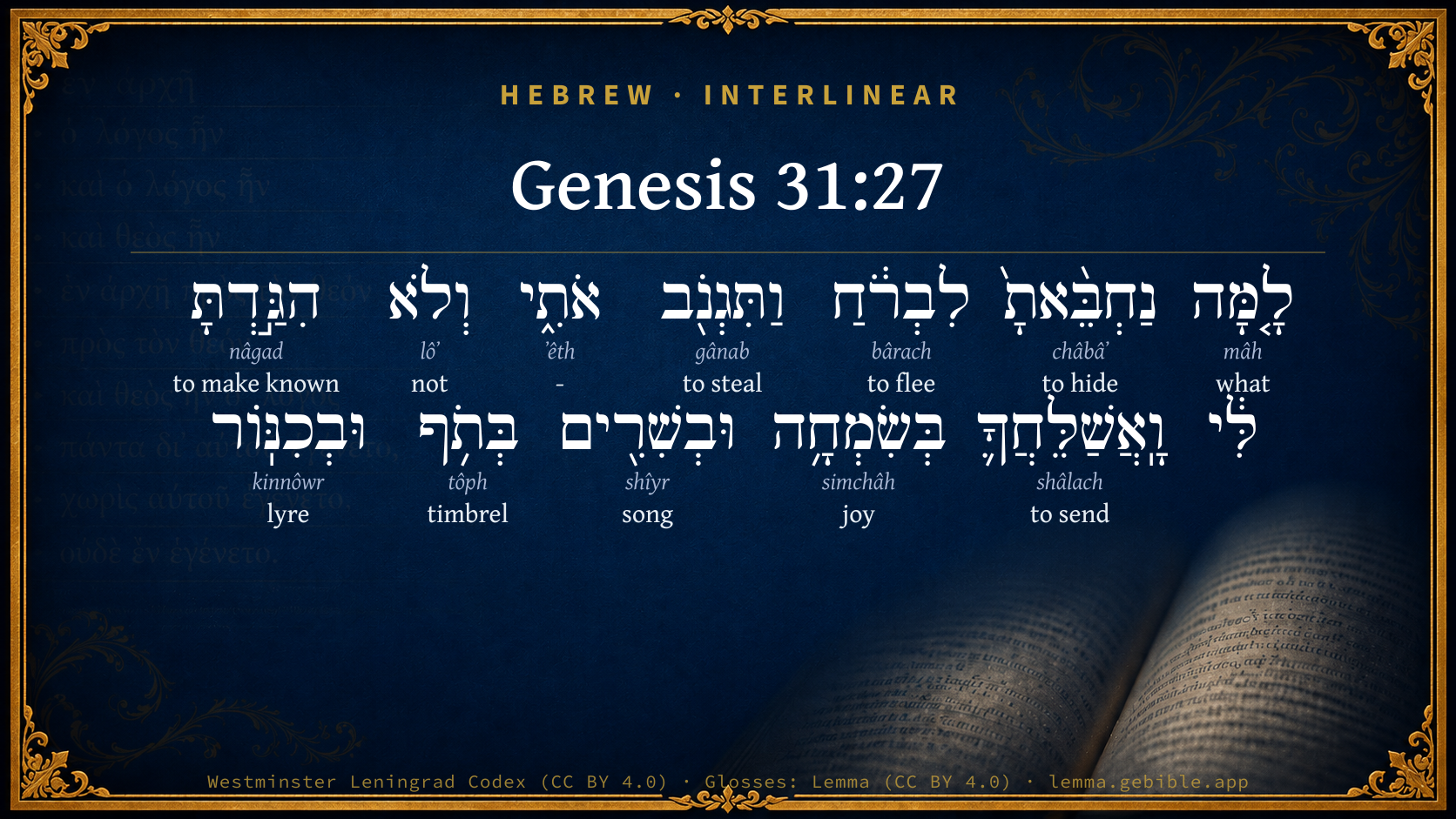
Hebrew (Westminster Leningrad Codex) Genesis 31:27 appears in the Hebrew Old Testament. The text above is from the Westminster Leningrad Codex. Each word links to its Strong’s number, a concise gloss, and parsing drawn from the Open Scriptures Hebrew Bible morphology. Click any word for its full Brown-Driver-Briggs (BDB) entry.
Download image
Cite this verse

Genesis 31:27 (World English Bible). Public Domain. Lemma interlinear Bible study tool, https://lemma.gebible.app/v/genesis/31/27.

Show BibTeX & RIS
BibTeX
RIS
English Translation
Why did you flee secretly, and deceive me, and didn't tell me, that I might have sent you away with mirth and with songs, with tambourine and with harp;
World English Bible · Public Domain
Highlights
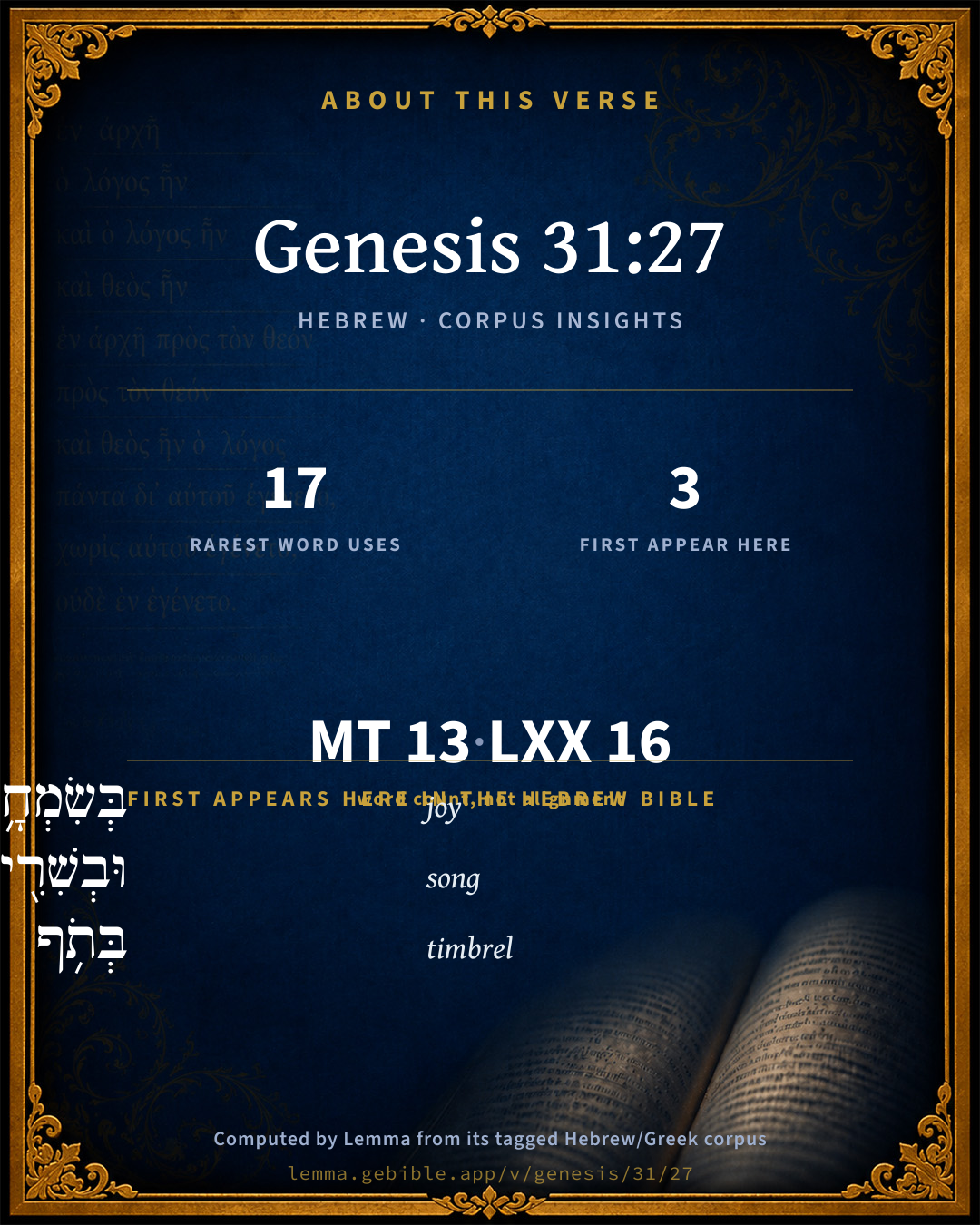
  • 3 first appearances in the Hebrew Bible
Full analysis ↓
Download a study sheet

One document with this verse’s original text, its word-by-word gloss line, the meaning frame, cross-references with their text, attributed commentary, and full source and license credits — printable, and it pastes into notes with its structure intact.

This verse Autodidact and up

Study sheet (.html) Plain text (.txt)

A passage Seminary Student

Up to 50 verses in one chapter. A passage sheet keeps up to 6 commentary sources and 12 cross-references per verse, in the order this page ranks them, and says so on the sheet whenever that leaves anything out. Ask for a single verse and you get the Autodidact verse sheet above.

Everything on this page stays free to read, with no account — the sheet is a download of what is already on screen, not access to it.

Want to remove ads? Support Godless Engineer
Compare translations 3

The same verse in 3 English versions, stacked beneath the original-language interlinear above. Click any original word for its lexicon entry.

Each is an independent rendering of the whole verse — the interlinear is not word-aligned to these translations.

Highlighted words mark where these versions differ — a whole-verse word diff, not a word-by-word alignment.

  • World English Bible Public Domain
    Why did you flee secretly, and deceive me, and didn't tell me, that I might have sent you away with mirth and with songs, with tambourine and with harp;
  • King James Version Public Domain
    Wherefore didst thou flee away secretly, and steal away from me; and didst not tell me, that I might have sent thee away with mirth, and with songs, with tabret, and with harp?
  • unfoldingWord Literal Text CC BY-SA 4.0
    Why did you secretly flee and deceive me and not tell me? For I would have sent you with joy and with songs, with tambourine and with lyre!

unfoldingWord Literal Text — © unfoldingWord, licensed CC BY-SA 4.0. Word-aligned USFM3 via Door43 (git.door43.org/unfoldingWord/en_ult).

Versions to compare (up to 4)

3 of 4 selected

Show all 18 translations

Every available English version of this verse, each an independent rendering of the whole verse.

  • World English Bible Public Domain
    Why did you flee secretly, and deceive me, and didn't tell me, that I might have sent you away with mirth and with songs, with tambourine and with harp;
  • Berean Standard Bible Public Domain
    Why did you run away secretly and deceive me, without even telling me? I would have sent you away with joy and singing, with tambourines and harps.
  • Majority Standard Bible Public Domain
    Why did you run away secretly and deceive me, without even telling me? I would have sent you away with joy and singing, with tambourines and harps.
  • King James Version Public Domain
    Wherefore didst thou flee away secretly, and steal away from me; and didst not tell me, that I might have sent thee away with mirth, and with songs, with tabret, and with harp?
  • American Standard Version (1901) Public Domain
    Wherefore didst thou flee secretly, and steal away from me, and didst not tell me, that I might have sent thee away with mirth and with songs, with tabret and with harp;
  • Revised Version (1885) Public Domain
    Wherefore didst thou flee secretly, and steal away from me; and didst not tell me, that I might have sent thee away with mirth and with songs, with tabret and with harp;
  • Geneva Bible (1599) Public Domain
    Wherfore diddest thou flie so secretly and steale away from me, and diddest not tel me, that I might haue sent thee foorth with mirth and with songs, with timbrel and with harpe?
  • Douay-Rheims (1899) Public Domain
    Why wouldst thou run away privately and not acquaint me, that I might have brought thee on the way with joy, and with songs, and with timbrels, and with harps?
  • Young's Literal Translation Public Domain
    Why hast thou hidden thyself to flee, and deceivest me, and hast not declared to me, and I send thee away with joy and with songs, with tabret and with harp,
  • Literal Standard Version CC BY-SA 4.0
    Why have you hidden yourself to flee, and deceive me, and have not declared to me, and I send you away with joy and with songs, with tambourine and with harp,
  • Unlocked Literal Bible CC BY-SA 4.0
    Why did you flee secretly and trick me and did not tell me? I would have sent you away with celebration and with songs, with tambourine and with harps.
  • unfoldingWord Literal Text CC BY-SA 4.0
    Why did you secretly flee and deceive me and not tell me? For I would have sent you with joy and with songs, with tambourine and with lyre!
  • Darby Bible Public Domain
    Why didst thou flee away covertly, and steal away from me, and didst not tell me, that I might have conducted thee with mirth and with songs, with tambour and with harp;
  • World Messianic Bible Public Domain
    Why did you flee secretly, and deceive me, and didn’t tell me, that I might have sent you away with mirth and with songs, with tambourine and with harp;
  • Webster's Bible Public Domain
    Why didst thou flee away secretly, and steal away from me, and didst not tell me, that I might have sent thee away with mirth, and with songs, with tabret, and with harp?
  • Free Bible Version CC BY-SA 4.0
    Why did you run away in secret, trying to trick me? Why didn't you come and tell me? I would have given you a good send-off, a celebration with singing and the music of tambourines and lyres.
  • Bible in Basic English Public Domain
    Why did you make a secret of your flight, not giving me word of it, so that I might have sent you away with joy and songs, with melody and music?
  • JPS Tanakh (1917) Public Domain
    Wherefore didst thou flee secretly, and outwit me; and didst not tell me, that I might have sent thee away with mirth and with songs, with tabret and with harp;

Literal Standard Version (2020), Covenant Press — licensed CC BY-SA 4.0. Text via the HelloAO Bible API (eBible.org). Unlocked Literal Bible (unfoldingWord) — licensed CC BY-SA 4.0. Text via the HelloAO Bible API (eBible.org). unfoldingWord Literal Text — © unfoldingWord, licensed CC BY-SA 4.0. Word-aligned USFM3 via Door43 (git.door43.org/unfoldingWord/en_ult). Free Bible Version, Dr. Jonathan Gallagher — licensed CC BY-SA 4.0. Text via the HelloAO Bible API (eBible.org).

Word by word

More ways to search: Search by grammar → Find every occurrence → Compare this word →

Practice this passage: Drill this verse → Learn its vocabulary →

בְּתֹ֥ף
tôph
H8596
“in/at · timbrel”
Preposition + Noun, Common, Masculine, Singular, Absolute
Part of Speech
Preposition + Noun
Type
Common
Gender
Masculine
Number
Singular
State
Absolute
Full BDB Definition

Origin: from H8608 contracted

TWOT: 2536a

timbrel, tambourine
  1. לָ֤מָּה mâh H4100 “to/for · what” Preposition + Particle, Interrogative
  2. נַחְבֵּ֨אתָ֙ châbâʼ H2244 “to hide” Verb, Niphal, Perfect, 2nd Person, Masculine, Singular
  3. לִבְרֹ֔חַ bârach H1272 “to flee” Preposition + Verb, Qal, Infinitive Construct
  4. וַתִּגְנֹ֖ב gânab H1589 “and · to steal” Conjunction + Verb, Qal, Sequential Imperfect, 2nd Person, Masculine, Singular
  5. אֹתִ֑י ʼêth H853 “- · me” Particle, Direct Object + Suffix, Personal, 1st Person, Common, Singular
  6. וְלֹא lôʼ H3808 “and · not” Conjunction + Particle, Negative
  7. הִגַּ֣דְתָּ nâgad H5046 “to make known” Verb, Hiphil, Perfect, 2nd Person, Masculine, Singular
  8. וָֽאֲשַׁלֵּחֲךָ֛ shâlach H7971 “and · to send · you” Conjunction + Verb, Piel, Imperfect, 1st Person, Common, Singular + Suffix, Personal, 2nd Person, Masculine, Singular
  9. בְּשִׂמְחָ֥ה simchâh H8057 “in/at · joy” Preposition + Noun, Common, Feminine, Singular, Absolute
  10. וּבְשִׁרִ֖ים shîyr H7892 “and · in/at · songs” Conjunction + Preposition + Noun, Common, Both, Plural, Absolute
  11. וּבְכִנּֽוֹר kinnôwr H3658 “and · in/at · lyre” Conjunction + Preposition + Noun, Common, Masculine, Singular, Absolute

About this verse

These counts appear in no published source. They are computed here, from the morphology-tagged text and Lemma’s own curated glosses. What Lemma adds →

13
words
12
distinct lemmas
Pentateuch
section

Notable vocabulary

The rarest word here is בְּתֹ֥ף timbrel H8596 — appearing just 17 times in the whole Hebrew Bible.

First appearance in Scripture

These words make their first canonical appearance in the Hebrew Bible here:

  • בְּשִׂמְחָ֥ה joy H8057
  • וּבְשִׁרִ֖ים song H7892
  • בְּתֹ֥ף timbrel H8596

Shared distinctive vocabulary

בְּתֹ֥ף timbrel H8596 occurs in 16 verses of the Hebrew Bible. Also found in:

Grammatical profile

  • 5 verbs
  • 4 nouns
  • 1 preposition
  • 3 particles

Verb forms

  • נַחְבֵּ֨אתָ֙ Niphal · Perfect
  • לִבְרֹ֔חַ Qal · Infinitive Construct
  • וַתִּגְנֹ֖ב Qal · Sequential Imperfect
  • הִגַּ֣דְתָּ Hiphil · Perfect
  • וָֽאֲשַׁלֵּחֲךָ֛ Piel · Imperfect

Hebrew & Septuagint length

In English translation the verse runs 29 words from the Hebrew and 21 from the Septuagint (LXX English) — closely comparable.

A rough comparison of the two English renderings, which tokenize alike — not a word-level alignment.

Word counts can differ between the Hebrew and the Greek without any difference in meaning — e.g. the Hebrew direct-object marker אֵת has no separate Greek word, and Greek often adds the article ὁ.

In the original languages it is 13 Hebrew tokens and 16 Greek tokens — but the two are counted differently (Hebrew bundles its prefixes and suffixes into one token; the Greek is in lemma form), so that isn’t a like-for-like length.

Cross-references

9

Topical passages linked to Genesis 31:27 in the Treasury of Scripture Knowledge — connected by theme and wording, ordered by reader-vote popularity; previews shown in the World English Bible.

  • Exodus 15:20 Miriam the prophetess, the sister of Aaron, took a tambourine in her hand; and all the women went out after her with tambourines and with dances.
  • Genesis 4:21 His brother's name was Jubal, who was the father of all who handle the harp and pipe.
  • Genesis 24:59–60 They sent away Rebekah, their sister, with her nurse, Abraham's servant, and his men.
  • Genesis 31:3–5 Yahweh said to Jacob, "Return to the land of your fathers, and to your relatives, and I will be with you."
  • Genesis 31:20–21 Jacob deceived Laban the Syrian, in that he didn't tell him that he was running away.
  • Genesis 31:31 Jacob answered Laban, "Because I was afraid, for I said, 'Lest you should take your daughters from me by force.'
  • Judges 6:27 Then Gideon took ten men of his servants, and did as Yahweh had spoken to him: and it happened, because he feared his father's household and the men of the city, so that he could not do it by day, that he did it by night.
  • Job 21:11–14 They send forth their little ones like a flock. Their children dance.
  • Proverbs 26:23–26 Like silver dross on an earthen vessel Are the lips of a fervent one with an evil heart.

Cross-references courtesy of OpenBible.info (CC BY 4.0).

Hebrew and Greek witnesses Masoretic Hebrew ↔ Greek Septuagint

The same verse in the two great witnesses to the Old Testament, shown verse-for-verse.

These are two independent witnesses, not word-aligned to each other, and the Septuagint is shown in lemma (dictionary) form.

Hebrew Genesis 31:27 Masoretic · Westminster Leningrad Codex

לָ֤מָּה נַחְבֵּ֨אתָ֙ לִבְרֹ֔חַ וַתִּגְנֹ֖ב אֹתִ֑י וְלֹא הִגַּ֣דְתָּ לִּ֔י וָֽאֲשַׁלֵּחֲךָ֛ בְּשִׂמְחָ֥ה וּבְשִׁרִ֖ים בְּתֹ֥ף וּבְכִנּֽוֹר

Why did you flee secretly, and deceive me, and didn't tell me, that I might have sent you away with mirth and with songs, with tambourine and with harp;

World English Bible · Public Domain

Greek LXX Genesis 31:27 Septuagint · lemma form

καί εἰ ἀναἀγγέλλω ἐγώ ἐκ ἀποστέλλω ἄν σύ μετά εὐφροσύνη καί μετά μουσικός τύμπανον καί κιθάρα

Whereas if you had told me, I would have sent you away with mirth, and with songs, and timbrels, and harp.

LXX2012 (modern English Septuagint) · Public Domain

Hebrew: Westminster Leningrad Codex (CC BY 4.0). Greek: Septuagint (public domain); English from LXX2012 (modern English Septuagint) (Public Domain). How the Septuagint differs from the Hebrew →

Targum (Aramaic paraphrase)

2

The Targum is the ancient Jewish Aramaic paraphrase of the Hebrew Scriptures — an interpretive translation, not the Hebrew text itself. Onkelos (literal) and Pseudo-Jonathan (expansive) render the Torah, and Jonathan the Prophets. Coverage is partial: where no permissively-licensed English translation exists for a verse, only the Aramaic is shown. This is verse-level text, not a word-by-word alignment to the Hebrew.

  1. Targum Onkelos Torah (Genesis–Deuteronomy)
    לְמָה אִטְמַרְתָּ לְמֵיזַל וְכַסֵּיתָא מִנִּי וְלָא חַוֵּיתָא לִי וְשַׁלָּחִתָּךְ פּוֹן בְּחֶדְוָא וּבְתוּשְׁבְּחָן בְּתוּפִּין וּבְכִנָּרִין

    (no public-domain English translation for this verse)

    Targum Onkelos — Aramaic: “Onkelos Genesis” (public domain); “Onkelos Exodus” (public domain); “Onkelos Leviticus” (public domain); “Onkelos Numbers” (public domain); “Onkelos Deuteronomy” (public domain). English: “Sefaria Community Translation” (CC0 1.0 (public-domain dedication)); “J.W. Etheridge. The Targums of Onkelos and Jonathan Ben Uzziel on the Pentateuch. London: Longmans, Green, 1862” (public domain). Text via Sefaria.

  2. Targum Pseudo-Jonathan Torah (Genesis–Deuteronomy)
    לְמָא אִיטְמַרְתְּ לְמֵיזַל וְגָנַבְתְּ דַעְתִּי וְלָא תָנֵית לִי וְאִילוּ תָנֵיתָא לִי שְׁלַחְתִּיךְ פּוֹן בְּחֶדְוָוא וּבְתוּשְׁבְּחָן בְּתוּפִּין וּבְכִינָרִין

    Why didst thou hide from me that thou wouldst go, and steal my knowledge, and not tell me? For if thou hadst told me, I would have sent thee away with mirth, and with hymns, and with tambourines, and with harps.

    Targum Pseudo-Jonathan — Aramaic: “Targum Jonathan on Genesis” (public domain); “Targum Jonathan on Exodus” (public domain); “Targum Jonathan on Leviticus” (public domain); “Targum Jonathan on Numbers” (public domain); “Targum Jonathan on Deuteronomy” (public domain). English: “The Targum of Jonathan ben Uzziel, trans. J. W. Etheridge, London, 1862” (public domain). Text via Sefaria.

Commentary

Notes on Genesis 31:27 from classic Christian and Jewish commentators (each source and its license shown beneath its notes). The classic Christian expositions comment on the surrounding passage and are grouped to its opening verse, so a note may address several verses; the Jewish commentaries on the Tanakh (Rashi and others) are per-verse, so they appear only where the commentator wrote on this verse.

Lemma curates 59 commentaries, every one of them public domain or Creative Commons licensed, each selected and text-cleaned for this edition rather than reprinted as found. About our sources →

Trapp's Complete Commentary

John Trapp

Gen 31:27 Wherefore didst thou flee away secretly, and steal away from me; and didst not tell me, that I might have sent thee away with mirth, and with songs, with tabret, and with harp?

Ver. 27. That I might have sent thee away with mirth.] A likely matter! but it is the hypocrite’s best now, to say the best. He durst do no other; for God had overawed him, and put his hook into his nostrils. Hypocrites are likened to "bulrushes," {Isa 58:5} which are green and smooth; and he is curious to a miracle, that can find a knot in them; but within is nothing but a useless and spongy pith. Compared they are also to "vipers," {Mat 3:7} that are painted, as it were, without, but poisonful within: they have their teeth also buried in their gums, saith Pliny, so that one would think them to be harmless beasts, and that they could not bite. So hypocrites seem most innocent. Who would have thought otherwise of Laban, that had not known him, considering his dispute here with Jacob, his protests, afterwards, of deep and dear love to his daughters, and lastly, his attestation and taking God to witness for their good usage, and his heap of stones to witness (together with his heap of words to small purpose), calling it first Jegar-sahadutha, as a witness betwixt man and man; and then Mizpeh, as a watch-tower or witness between God and man? Who could take Laban for less now, than a loving father, yea, and an honest man? But, as the historian {a} saith of another, so may we of him; Palam compositus pudor, intus summa adipiscendi libido . All this was but blanched hypocrisy, and coloured covetousness, as St Paul calls it. {1Th 2:5}

“ Astutam vapido servat sub pectore vulpem .” - Pers.

{a} Tacit., De Sejano.

John Trapp, A Commentary or Exposition upon All the Books of the Old and New Testament (1647–1656) — public domain. Text from a community e-Sword module.

Joseph Benson's Commentary

Gen 31:27. I might have sent thee away with mirth and with songs — Not as Rebekah was sent away out of the same family above one hundred and twenty years before, with prayers and blessings, but with sport and merriment; which was a sign that religion was much decayed in the family.

Joseph Benson's Commentary on the Old and New Testaments (1811–1818) — public domain. Text from a community e-Sword module.

Adam Clarke's Commentary

Verse 27. I might have sent thee away with mirth] בשמחה, besimchah, with rejoicing, making a feast or entertainment on the occasion; and with songs, beshirim, odes either in the praise of God, or to commemorate the splendid acts of their ancestors; with tabret, bethoph, the tympanum used in the east to the present day, and there called [Arabic] diff, a thin broad wooden hoop, with parchment extended over one end of it, to which are attached small pieces of brass, tin, c., which make a jingling noise it is held in the air with one hand, and beat on with the fingers of the other. It appears to have been precisely the same with that which is called the tambourine and which is frequently to be met with in our streets. And with harp, בכנור bekinnor, a sort of stringed instrument, a lute or harp; probably the same as the Greek κινυρα kinura, a harp; the name being evidently borrowed from the Hebrew. These four things seem to include all that was used in those primitive times, as expressive of gladness and satisfaction on the most joyous occasions.

Adam Clarke's Commentary on the Bible (1810–1826) — public domain. Text from a community e-Sword/MySword module.

The Cambridge Bible for Schools and Colleges

gen. ed. J. J. S. Perowne

27. steal away from me] Heb. didst steal me; cf. Gen_31:20.

sent thee away] The same word as in Gen_12:20, “And they brought him on the way.” The suggestion of a musical accompaniment is rhetorical. The “tabret” (tôph) is the “timbrel” or “tambourine.”

The Cambridge Bible for Schools and Colleges (gen. ed. J. J. S. Perowne; Cambridge University Press, 1878–1918) — public domain. Text from a community e-Sword module.

John Gill's Exposition

It is in the power of my hand to do you hurt,.... Jacob and his family, wives, children, and servants, who were not able to stand against Laban and the men he brought with him; and so the Jerusalem Targum paraphrases it,"I have an army and a multitude;''a large force, which Jacob could not withstand: or, "my hand could have been for a god" (h) to me: you could have no more escaped it, or got out of it, or withstood me, than you could God himself: such an opinion had he of his superior power and strength, and that this would have been the case:

but the God of your father spoke unto me yesternight; the night past, or the other night, some very little time ago, since he came from home at least: by his father he means either his father Isaac, or his grandfather Abraham, whose God the Lord was, and who came to Laban and told him who he was. This serves to strengthen the opinion that Laban was an idolater, and adhered to the gods of his grandfather Terah, from whom Abraham departed, and which Laban may have respect to; intimating that he abode by the religion of his ancestors at a greater remove than Jacob's: however, though he does not call him his God, he had some awe and reverence of him, and was influenced by his speech to him:

saying, take heed that thou spake not to Jacob either good or bad: this, though greatly to Jacob's honour, and against Laban's interest, yet his conscience would not allow him to keep it a secret; though, doubtless, his view was to show his superior power to Jacob, had he not been restrained by Jacob's God.

(h) "esset mihi pro deo manus mea", Schmidt.

John Gill's Exposition of the Whole Bible (1746–1763) — public domain (CC PDM 1.0). Text via the HelloAO Bible API.

Whedon's Commentary on the Bible

Daniel D. Whedon

27. I might have sent thee away with mirth — His previous conduct had given no hopes of any such kind treatment, as Jacob freely intimates, when he comes to respond.

Daniel D. Whedon (gen. ed.), Commentary on the Old and New Testaments (1874–1909) — public domain. Text from a community e-Sword module.

John Wesley's Explanatory Notes

I might have sent thee away with mirth and with songs, with tabret and with harp - Not as Rebekah was sent away out of the same family above one hundred and twenty years before, with prayers and blessings, but with sport and merriment; which was a sign that religion was much decayed in the family.

John Wesley, Explanatory Notes Upon the Whole Bible (1754–1765) — public domain. Text via the GEBible commentary corpus.

Keil & Delitzsch

C. F. Keil & F. Delitzsch

"So I might have conducted thee with mirth and songs, with tabret and harp," i.e., have sent thee away with a parting feast.

Gen 31:28

עשׂו: an old form of the infinitive for עשׂות as in Gen 48:11; Gen 50:20.

Keil & Delitzsch — Biblical Commentary on the Old Testament (1861–1891) — public domain (CC PDM 1.0). Text via the HelloAO Bible API. (Old Testament only.)

Rashi

Rabbi Shlomo Yitzchaki (Rashi)

ותגנב אתי — means thou didst steal away my mind (as in Genesis 5:26).

Rashi on the Tanakh — English translations: “The Judaica Press complete Tanach with Rashi, translated by A. J. Rosenberg” (CC BY 4.0); “Pentateuch with Rashi's commentary by M. Rosenbaum and A.M. Silbermann, 1929-1934” (public domain); “The Metsudah Tanach series, Lakewood, N.J” (CC BY 4.0); and “The Book of Joshua, Metsudah Publications, 1997” (CC BY 4.0). Text via Sefaria.

Radak

Rabbi David Kimhi (Radak)

למה נחבאת, why did you hide it from me, and,

ותגנוב אותי, and you misled me,

ואשלחך, had you informed me I would have let you go in joy.

Radak on the Tanakh — English translations: “Sefaria Community Translation” (CC0 1.0 (public-domain dedication)); “Eliyahu Munk, HaChut Hameshulash” (CC BY 4.0); “Rabbi Mike Feuer, Jerusalem Anthology” (CC BY 4.0); and “R. David Kimhi on the first book of Psalms, Translated by R.G. Finch, London, 1919” (public domain). Text via Sefaria.

Lesson kit

Teaching starters — assembled from the data on this page, not authored interpretation. Every prompt links to the verse data it draws on. Edit before teaching.

Genesis, in the Pentateuch, opens this verse with 13 words (12 distinct Hebrew lemmas). Its most distinctive word is tôph (“timbrel”). A historical commentator’s framing appears above. Read the whole chapter for the surrounding context.

Discussion questions

  1. How does “timbrel” (tôph) shape what this verse is saying?
  2. 3 words make their first appearance in Scripture here. What does this debut establish?
  3. How does Exodus 15:20, which shares the word «timbrel», read alongside this verse?
  4. These translations render this verse differently; the difference is in the English rendering, not the original. What questions does that raise?
  5. «נַחְבֵּ֨אתָ֙» is a Niphal Perfect verb. How does that grammatical form shape the action described?
  6. Compare how Trapp's Complete Commentary and Joseph Benson's Commentary read this verse. Where do they agree or differ?

Things to notice

Reading settings

Reading text

Shown beneath each verse's original-language words.

Old Testament
Old Testament edition

Read the OT as the Masoretic Hebrew (MT) or the Greek Septuagint (LXX).

English shown for the Greek Septuagint (in the Hebrew ↔ Greek comparison).

Comparing translations? Open the Compare panel on any verse page to stack up to four side by side.