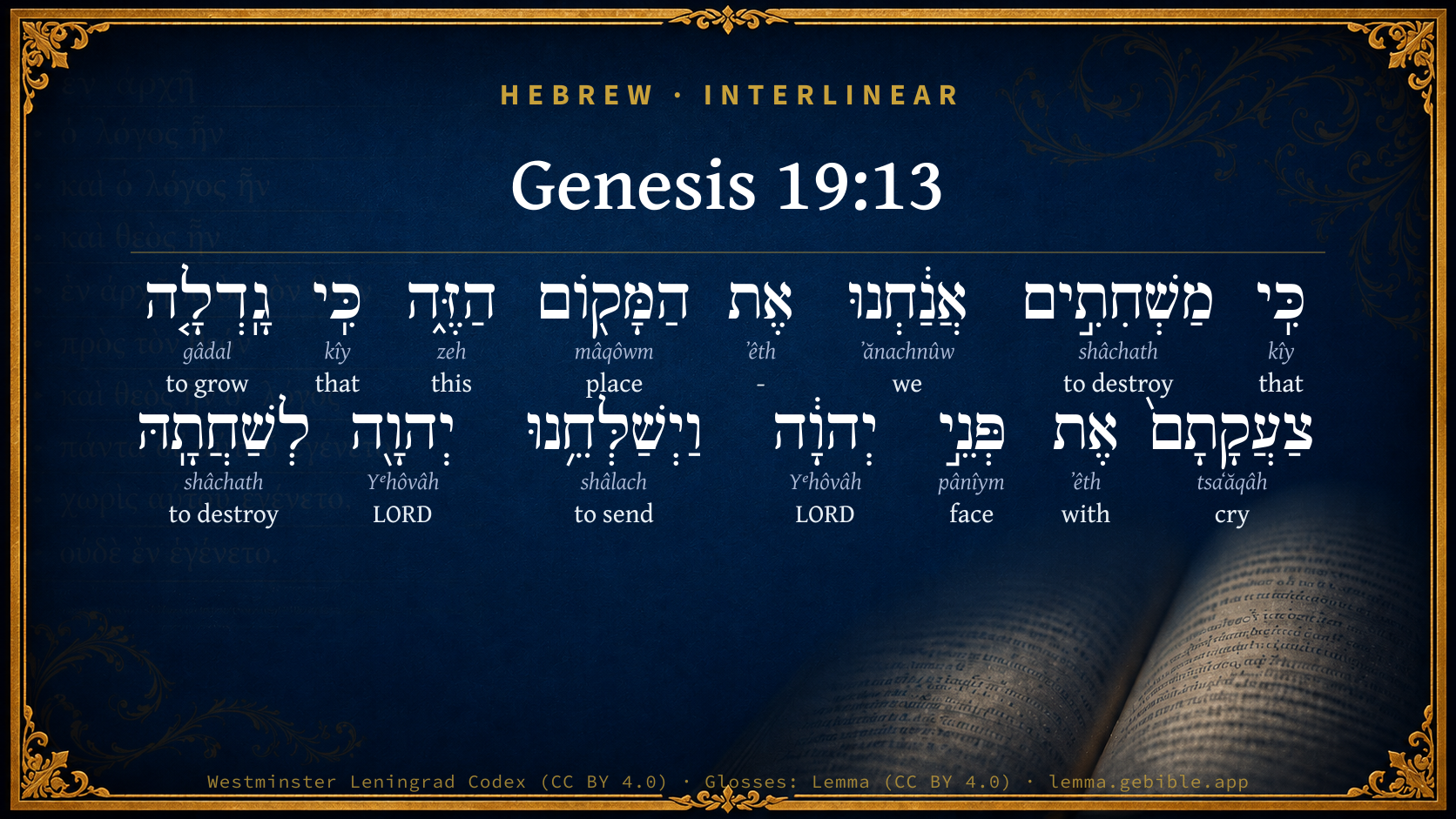
Genesis 19:13

Hebrew (Westminster Leningrad Codex) Genesis 19:13 appears in the Hebrew Old Testament. The text above is from the Westminster Leningrad Codex. Each word links to its Strong’s number, a concise gloss, and parsing drawn from the Open Scriptures Hebrew Bible morphology. Click any word for its full Brown-Driver-Briggs (BDB) entry.
Download image
Cite this verse

Genesis 19:13 (World English Bible). Public Domain. Lemma interlinear Bible study tool, https://lemma.gebible.app/v/genesis/19/13.

Show BibTeX & RIS
BibTeX
RIS
English Translation
for we will destroy this place, because the cry of them is grown great before Yahweh. Yahweh has sent us to destroy it."
World English Bible · Public Domain
Download a study sheet

One document with this verse’s original text, its word-by-word gloss line, the meaning frame, cross-references with their text, attributed commentary, and full source and license credits — printable, and it pastes into notes with its structure intact.

This verse Autodidact and up

Study sheet (.html) Plain text (.txt)

A passage Seminary Student

Up to 50 verses in one chapter. A passage sheet keeps up to 6 commentary sources and 12 cross-references per verse, in the order this page ranks them, and says so on the sheet whenever that leaves anything out. Ask for a single verse and you get the Autodidact verse sheet above.

Everything on this page stays free to read, with no account — the sheet is a download of what is already on screen, not access to it.

Want to remove ads? Support Godless Engineer
Compare translations 3

The same verse in 3 English versions, stacked beneath the original-language interlinear above. Click any original word for its lexicon entry.

Each is an independent rendering of the whole verse — the interlinear is not word-aligned to these translations.

Highlighted words mark where these versions differ — a whole-verse word diff, not a word-by-word alignment.

  • World English Bible Public Domain
    for we will destroy this place, because the cry of them is grown great before Yahweh. Yahweh has sent us to destroy it."
  • King James Version Public Domain
    For we will destroy this place, because the cry of them is waxen great before the face of the LORD; and the LORD hath sent us to destroy it.
  • unfoldingWord Literal Text CC BY-SA 4.0
    because we are destroying this place. For their outcry before Yahweh great, so Yahweh has sent us to destroy it.”

unfoldingWord Literal Text — © unfoldingWord, licensed CC BY-SA 4.0. Word-aligned USFM3 via Door43 (git.door43.org/unfoldingWord/en_ult).

Versions to compare (up to 4)

3 of 4 selected

Show all 18 translations

Every available English version of this verse, each an independent rendering of the whole verse.

  • World English Bible Public Domain
    for we will destroy this place, because the cry of them is grown great before Yahweh. Yahweh has sent us to destroy it."
  • Berean Standard Bible Public Domain
    because we are about to destroy this place. For the outcry to the LORD against its people is so great that He has sent us to destroy it.”
  • Majority Standard Bible Public Domain
    because we are about to destroy this place. For the outcry to the LORD against its people is so great that He has sent us to destroy it.”
  • King James Version Public Domain
    For we will destroy this place, because the cry of them is waxen great before the face of the LORD; and the LORD hath sent us to destroy it.
  • American Standard Version (1901) Public Domain
    for we will destroy this place, because the cry of them is waxed great before Jehovah: and Jehovah hath sent us to destroy it.
  • Revised Version (1885) Public Domain
    for we will destroy this place, because the cry of them is waxen great before the LORD; and the LORD hath sent us to destroy it.
  • Geneva Bible (1599) Public Domain
    For we will destroy this place, because the crye of them is great before the Lord, and the Lord hath sent vs to destroy it.
  • Douay-Rheims (1899) Public Domain
    For we will destroy this place, because their cry is grown loud before the Lord, who hath sent us to destroy them.
  • Young's Literal Translation Public Domain
    for we are destroying this place, for their cry hath been great `before' the face of Jehovah, and Jehovah doth send us to destroy it.'
  • Literal Standard Version CC BY-SA 4.0
    for we are destroying this place, for their cry has been great [before] the face of YHWH, and YHWH does send us to destroy it.”
  • Unlocked Literal Bible CC BY-SA 4.0
    For we are about to destroy this place, because the accusations against it before Yahweh have become so loud that he has sent us to destroy it.”
  • unfoldingWord Literal Text CC BY-SA 4.0
    because we are destroying this place. For their outcry before Yahweh great, so Yahweh has sent us to destroy it.”
  • Darby Bible Public Domain
    For we are going to destroy this place, because the cry of them is great before Jehovah, and Jehovah has sent us to destroy it.
  • World Messianic Bible Public Domain
    for we will destroy this place, because the outcry against them has grown so great before the LORD that the LORD has sent us to destroy it.”
  • Webster's Bible Public Domain
    For we will destroy this place, because the cry of them has become great before the face of the LORD; and the LORD hath sent us to destroy it.
  • Free Bible Version CC BY-SA 4.0
    because we are about to destroy this place. The complaints that have reached the Lord about its people have become so bad that he has sent us to destroy it.”
  • Bible in Basic English Public Domain
    For we are about to send destruction on this place, because a great outcry against them has come to the ears of the Lord; and the Lord has sent us to put an end to the town.
  • JPS Tanakh (1917) Public Domain
    for we will destroy this place, because the cry of them is waxed great before the LORD; and the LORD hath sent us to destroy it.'

Literal Standard Version (2020), Covenant Press — licensed CC BY-SA 4.0. Text via the HelloAO Bible API (eBible.org). Unlocked Literal Bible (unfoldingWord) — licensed CC BY-SA 4.0. Text via the HelloAO Bible API (eBible.org). unfoldingWord Literal Text — © unfoldingWord, licensed CC BY-SA 4.0. Word-aligned USFM3 via Door43 (git.door43.org/unfoldingWord/en_ult). Free Bible Version, Dr. Jonathan Gallagher — licensed CC BY-SA 4.0. Text via the HelloAO Bible API (eBible.org).

Word by word

More ways to search: Search by grammar → Find every occurrence → Compare this word →

Practice this passage: Drill this verse → Learn its vocabulary →

צַעֲקָתָם֙
tsaʻăqâh
H6818
“cry · their”
Noun, Common, Feminine, Singular, Construct + Suffix, Personal, 3rd Person, Masculine, Plural
Part of Speech
Noun
Type
Common
Gender
Feminine
Number
Singular
State
Construct
Full BDB Definition

Origin: from H6817

TWOT: 1947a

cry, outcry - outcry (against) - cry of distress (especially as heard by God)
  1. כִּֽי kîy H3588 “that” Conjunction
  2. מַשְׁחִתִ֣ים shâchath H7843 “destroying” Verb, Hiphil, Participle Active, Masculine, Plural, Absolute
  3. אֲנַ֔חְנוּ ʼănachnûw H587 “we” Pronoun, Personal, 1st Person, Common, Plural
  4. אֶת ʼêth H853 “-” Particle, Direct Object
  5. הַמָּק֖וֹם mâqôwm H4725 “the · place” Particle, Definite Article + Noun, Common, Masculine, Singular, Absolute
  6. הַזֶּ֑ה zeh H2088 “the · this” Particle, Definite Article + Pronoun, Demonstrative, Masculine, Singular
  7. כִּֽי kîy H3588 “that” Conjunction
  8. גָֽדְלָ֤ה gâdal H1431 “to grow” Verb, Qal, Perfect, 3rd Person, Feminine, Singular
  9. אֶת ʼêth H854 “with” Preposition
  10. פְּנֵ֣י pânîym H6440 “face(s) of” Noun, Common, Both, Plural, Construct
  11. יְהוָ֔ה Yᵉhôvâh H3068 “LORD” Noun, Proper
  12. וַיְשַׁלְּחֵ֥נוּ shâlach H7971 “and · to send · us” Conjunction + Verb, Piel, Sequential Imperfect, 3rd Person, Masculine, Singular + Suffix, Personal, 1st Person, Common, Plural
  13. יְהוָ֖ה Yᵉhôvâh H3068 “LORD” Noun, Proper
  14. לְשַׁחֲתָֽהּ shâchath H7843 “to destroy · her” Preposition + Verb, Piel, Infinitive Construct + Suffix, Personal, 3rd Person, Feminine, Singular

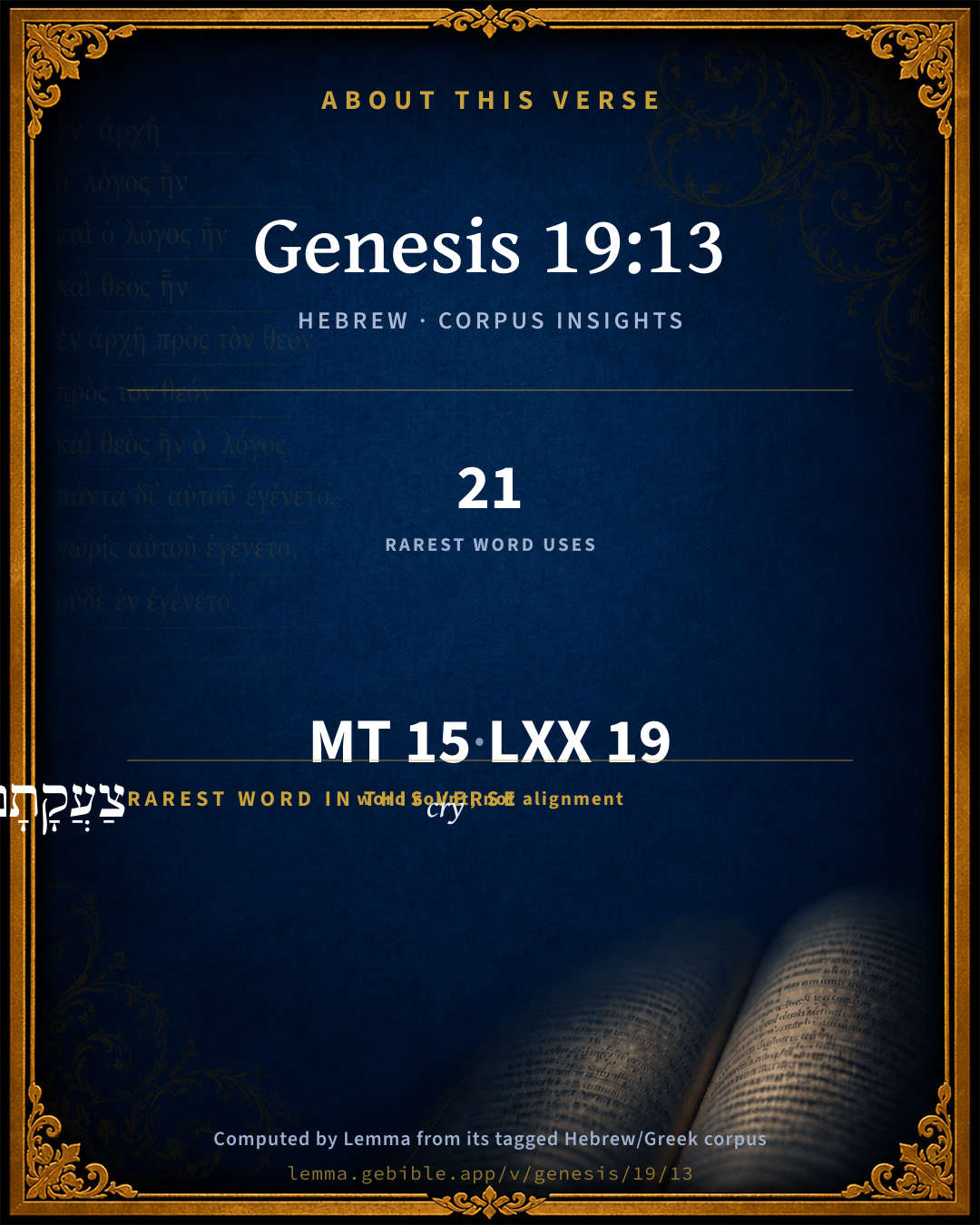
About this verse

These counts appear in no published source. They are computed here, from the morphology-tagged text and Lemma’s own curated glosses. What Lemma adds →

15
words
12
distinct lemmas
Pentateuch
section

Notable vocabulary

The rarest word here is צַעֲקָתָם֙ cry H6818 — appearing just 21 times in the whole Hebrew Bible.

Shared distinctive vocabulary

צַעֲקָתָם֙ cry H6818 occurs in 20 verses of the Hebrew Bible. Also found in:

Grammatical profile

  • 4 verbs
  • 5 nouns
  • 2 pronouns
  • 1 preposition
  • 2 conjunctions
  • 1 particle

Verb forms

  • מַשְׁחִתִ֣ים Hiphil · Participle Active
  • גָֽדְלָ֤ה Qal · Perfect
  • וַיְשַׁלְּחֵ֥נוּ Piel · Sequential Imperfect
  • לְשַׁחֲתָֽהּ Piel · Infinitive Construct

Repetition

Words recur within this verse — often emphatic in Hebrew:

  • מַשְׁחִתִ֣ים to destroy H7843 ×2
  • יְהוָ֔ה LORD H3068 ×2
  • כִּֽי that H3588 ×2

Hebrew & Septuagint length

In English translation the verse runs 23 words from the Hebrew and 27 from the Septuagint (LXX English) — closely comparable.

A rough comparison of the two English renderings, which tokenize alike — not a word-level alignment.

Word counts can differ between the Hebrew and the Greek without any difference in meaning — e.g. the Hebrew direct-object marker אֵת has no separate Greek word, and Greek often adds the article ὁ.

In the original languages it is 15 Hebrew tokens and 19 Greek tokens — but the two are counted differently (Hebrew bundles its prefixes and suffixes into one token; the Greek is in lemma form), so that isn’t a like-for-like length.

Cross-references

15

Topical passages linked to Genesis 19:13 in the Treasury of Scripture Knowledge — connected by theme and wording, ordered by reader-vote popularity; previews shown in the World English Bible.

  • Genesis 18:20 Yahweh said, "Because the cry of Sodom and Gomorrah is great, and because their sin is very grievous,
  • Matthew 13:49–50 So will it be in the end of the world. The angels will come forth, and separate the wicked from among the righteous,
  • Acts 12:23 Immediately an angel of the Lord struck him, because he didn't give God the glory, and he was eaten by worms and died.
  • Jude 1:7 Even as Sodom and Gomorrah, and the cities around them, having, in the same way as these, given themselves over to sexual immorality and gone after strange flesh, are set forth as an example, suffering the punishment of eternal fire.
  • Revelation 16:1–12 I heard a loud voice out of the temple, saying to the seven angels, "Go and pour out the seven bowls of the wrath of God on the earth!"
  • Matthew 13:41–42 The Son of Man will send out his angels, and they will gather out of his Kingdom all things that cause stumbling, and those who do iniquity,
  • Romans 3:8–9 Why not (as we are slanderously reported, and as some affirm that we say), "Let us do evil, that good may come?" Those who say so are justly condemned.
  • James 5:4 Behold, the wages of the laborers who mowed your fields, which you have kept back by fraud, cry out, and the cries of those who reaped have entered into the ears of the Lord of Hosts.
  • Genesis 13:13 Now the men of Sodom were exceedingly wicked and sinners against Yahweh.
  • 1 Chronicles 21:15–16 God sent an angel to Jerusalem to destroy it: and as he was about to destroy, Yahweh saw, and he repented him of the evil, and said to the destroying angel, It is enough; now stay your hand. The angel of Yahweh was standing by the threshing floor of Ornan the Jebusite.
  • Psalms 11:5–6 Yahweh examines the righteous, But the wicked and him who loves violence his soul hates.
  • Isaiah 3:11 Woe to the wicked! Disaster is upon them; For the deeds of his hands will be paid back to him.
  • Isaiah 36:10 Am I now come up without Yahweh against this land to destroy it? Yahweh said to me, Go up against this land, and destroy it.
  • Isaiah 37:36 The angel of Yahweh went forth, and struck in the camp of the Assyrians one hundred and eighty-five thousand; and when men arose early in the morning, behold, these were all dead bodies.
  • Ezekiel 9:5–6 To the others he said in my hearing, Go you through the city after him, and strike: don't let your eye spare, neither have you pity;

Cross-references courtesy of OpenBible.info (CC BY 4.0).

Hebrew and Greek witnesses Masoretic Hebrew ↔ Greek Septuagint

The same verse in the two great witnesses to the Old Testament, shown verse-for-verse.

These are two independent witnesses, not word-aligned to each other, and the Septuagint is shown in lemma (dictionary) form.

Hebrew Genesis 19:13 Masoretic · Westminster Leningrad Codex

כִּֽי מַשְׁחִתִ֣ים אֲנַ֔חְנוּ אֶת הַמָּק֖וֹם הַזֶּ֑ה כִּֽי גָֽדְלָ֤ה צַעֲקָתָם֙ אֶת פְּנֵ֣י יְהוָ֔ה וַיְשַׁלְּחֵ֥נוּ יְהוָ֖ה לְשַׁחֲתָֽהּ

for we will destroy this place, because the cry of them is grown great before Yahweh. Yahweh has sent us to destroy it."

World English Bible · Public Domain

Greek LXX Genesis 19:13 Septuagint · lemma form

ὅτι ἀποὀλλύω ἐγώ ὁ τόπος οὗτος ὅτι ὑψόω ὁ κραυγή αὐτός ἐναντίον κύριος καί ἀποστέλλω ἐγώ κύριος ἐκτρίβω αὐτός

For we are going to destroy this place; for their cry has been raised up before the Lord, and the Lord has sent us to destroy it.

LXX2012 (modern English Septuagint) · Public Domain

Hebrew: Westminster Leningrad Codex (CC BY 4.0). Greek: Septuagint (public domain); English from LXX2012 (modern English Septuagint) (Public Domain). How the Septuagint differs from the Hebrew →

Targum (Aramaic paraphrase)

2

The Targum is the ancient Jewish Aramaic paraphrase of the Hebrew Scriptures — an interpretive translation, not the Hebrew text itself. Onkelos (literal) and Pseudo-Jonathan (expansive) render the Torah, and Jonathan the Prophets. Coverage is partial: where no permissively-licensed English translation exists for a verse, only the Aramaic is shown. This is verse-level text, not a word-by-word alignment to the Hebrew.

  1. Targum Onkelos Torah (Genesis–Deuteronomy)
    אֲרֵי מְחַבְּלִין אֲנַחְנָא יָת אַתְרָא הָדֵין אֲרֵי סְגִיאַת קְבִלְתְּהוֹן קֳדָם יְיָ וְשַׁלְּחָנָא יְיָ לְחַבָּלוּתַהּ

    (no public-domain English translation for this verse)

    Targum Onkelos — Aramaic: “Onkelos Genesis” (public domain); “Onkelos Exodus” (public domain); “Onkelos Leviticus” (public domain); “Onkelos Numbers” (public domain); “Onkelos Deuteronomy” (public domain). English: “Sefaria Community Translation” (CC0 1.0 (public-domain dedication)); “J.W. Etheridge. The Targums of Onkelos and Jonathan Ben Uzziel on the Pentateuch. London: Longmans, Green, 1862” (public domain). Text via Sefaria.

  2. Targum Pseudo-Jonathan Torah (Genesis–Deuteronomy)
    אֲרוּם מְחַבְּלִין אֲנַחֲנָא יַת אַתְרָא הָדֵין אֲרוּם סַגִיאַת קְבֵילְתְּהוֹן קֳדָם יְיָ וְשַׁדְרָנָא יְיָ לְחַבְּלוּתָהּ

    {for we are about to destroy this place,} for the cry of it before the Lord is great, and the Lord hath sent us to destroy it.

    Targum Pseudo-Jonathan — Aramaic: “Targum Jonathan on Genesis” (public domain); “Targum Jonathan on Exodus” (public domain); “Targum Jonathan on Leviticus” (public domain); “Targum Jonathan on Numbers” (public domain); “Targum Jonathan on Deuteronomy” (public domain). English: “The Targum of Jonathan ben Uzziel, trans. J. W. Etheridge, London, 1862” (public domain). Text via Sefaria.

Commentary

Notes on Genesis 19:13 from classic Christian and Jewish commentators (each source and its license shown beneath its notes). The classic Christian expositions comment on the surrounding passage and are grouped to its opening verse, so a note may address several verses; the Jewish commentaries on the Tanakh (Rashi and others) are per-verse, so they appear only where the commentator wrote on this verse.

Lemma curates 59 commentaries, every one of them public domain or Creative Commons licensed, each selected and text-cleaned for this edition rather than reprinted as found. About our sources →

Trapp's Complete Commentary

John Trapp

Gen 19:13 For we will destroy this place, because the cry of them is waxen great before the face of the LORD; and the LORD hath sent us to destroy it.

Ver. 13. For we will destroy this place.] Even the good angels are God’s executioners. And the first execution they did in the world, that we read of, was upon these filthy Sodomites. So will it be, likely, at the last day. And St Peter seems to say as much. {2Pe 2:9} The Lord reserves the unjust to the day of judgment, to be punished, "but chiefly them that walk after the flesh, in the lust of uncleanness." Mark that chiefly.

John Trapp, A Commentary or Exposition upon All the Books of the Old and New Testament (1647–1656) — public domain. Text from a community e-Sword module.

Joseph Benson's Commentary

Gen 19:13. We will destroy this place — The holy angels are ministers of God’s wrath for the destruction of sinners, as well as of his mercy for the preservation and deliverance of his people.

Joseph Benson's Commentary on the Old and New Testaments (1811–1818) — public domain. Text from a community e-Sword module.

Geneva Bible (1599)

Geneva Bible translators

This proveth that the Angels are ministers, as well to execute God’s wrath, as to declare his favor.

Geneva Bible (1599) marginal notes — public domain. Text via Bolls.life.

John Calvin's Commentaries

13. The Lord has sent us to destroy it. This place teaches us, that the angels are the ministers of God’s wrath, as well as of his grace. Nor does it form any objection to this statement, that elsewhere the latter service is peculiarly ascribed to holy angels: as when the Apostle says, they were appointed for the salvation of those whom God had adopted as sons. (Hebrews 1:14.) And the Scripture, in various places, testifies, that the guardianship of the pious is committed to them, (Psalm 91:11;) while, on the other hand, it declares that God executes his judgments by reprobate angels. (Psalm 78:49.) For it must be maintained, that God causes his elect angels to preside over those judgments which he executes by means of the reprobate. For it would be absurd to attribute to devils, the honor of presiding over the judgments of God, since they do not yield him voluntary obedience; but rather, while raging contumaciously against him, are yet reluctantly compelled to become his executioners. Let us therefore know, that it is not foreign to the office of elect angels, to descend armed for the purpose of executing Divine vengeance and of inflicting punishment. As the angel of the Lord destroyed, in one night, the army of Sennacherib which besieged Jerusalem, (2 Kings 19:35;) so also the angel of the Lord appeared to David with his drawn sword, when the pestilence was raging against the people. (2 Samuel 24:16.) But, as I have before said, the angels repeat what they had previously said to Abraham, concerning the cry of Sodomy that they may the more urgently impel Lot, by a detestation of the place, to take his flight, and may induce him by the fear of the wrath of God, to seek for safety.

John Calvin's Commentaries (1540-1563) — public domain. Text from the Calvin Translation Society English edition (1840s-50s) via the Christian Classics Ethereal Library (ccel.org). Calvin's coverage is partial (roughly two-thirds of the Bible); uncommented books and verses are honest gaps, never fabricated. The 19th-century editor's footnotes and remarks are omitted so the notes are faithfully Calvin's own voice.

The Cambridge Bible for Schools and Colleges

gen. ed. J. J. S. Perowne

13. we will destroy] See Gen_19:24.

the cry of them] i.e. the cry against the people of Sodom; see note on Gen_18:20.

the Lord hath sent us] Defining the position of the men in this and the previous chapter, as distinct from, and messengers of, Jehovah.

The Cambridge Bible for Schools and Colleges (gen. ed. J. J. S. Perowne; Cambridge University Press, 1878–1918) — public domain. Text from a community e-Sword module.

John Gill's Exposition

For we will destroy this place,.... Or "we are destroying it" (p), are about to do it, and will quickly and immediately do it:

because the cry of them is waxen great before the face of the Lord; the cry of the sins of the inhabitants of it, which were many, and openly, and daringly committed, and reached to heaven, and called for immediate vengeance and punishment:

and the Lord hath sent us to destroy it; by which they discovered themselves to be angels, and what their business was, to destroy Sodom; and which confutes the notion of the Jews, that they were sent on different errands; whereas it is clear from hence, these two were sent to do one and the same thing; See Gill on Gen 18:2.

(p) "disperdentes nos", Montanus; "nos perdituri mox sumus", Junius & Tremellius, Piscator; so Drusius, Schmidt.

John Gill's Exposition of the Whole Bible (1746–1763) — public domain (CC PDM 1.0). Text via the HelloAO Bible API.

Whedon's Commentary on the Bible

Daniel D. Whedon

13. We will destroy this place — Now they announce themselves as ministers of wrath to Sodom.

Daniel D. Whedon (gen. ed.), Commentary on the Old and New Testaments (1874–1909) — public domain. Text from a community e-Sword module.

John Wesley's Explanatory Notes

We will destroy this place - The holy angels are ministers of God's wrath for the destruction of sinners, as well as of his mercy for the preservation and deliverance of his people.

John Wesley, Explanatory Notes Upon the Whole Bible (1754–1765) — public domain. Text via the GEBible commentary corpus.

Radak

Rabbi David Kimhi (Radak)

כי משחיתים.... כי גדלה צעקתם, the outcry to G’d by the victims of the cruelties of the Sodomites has become too great. In this construction the pronoun ending has been appended to the subject as well as to the predicate, just as in Isaiah 56,7 ושמחתים בבית תפלתי it has been appended to the predicate or in Isaiah 38,1 שמעתי את תפלתך where it has been appended to the subject.

לשחתה, to destroy the town, seeing the town is part of the larger region described as המקום previously.

Radak on the Tanakh — English translations: “Sefaria Community Translation” (CC0 1.0 (public-domain dedication)); “Eliyahu Munk, HaChut Hameshulash” (CC BY 4.0); “Rabbi Mike Feuer, Jerusalem Anthology” (CC BY 4.0); and “R. David Kimhi on the first book of Psalms, Translated by R.G. Finch, London, 1919” (public domain). Text via Sefaria.

Lesson kit

Teaching starters — assembled from the data on this page, not authored interpretation. Every prompt links to the verse data it draws on. Edit before teaching.

Genesis, in the Pentateuch, opens this verse with 15 words (12 distinct Hebrew lemmas). Its most distinctive word is tsaʻăqâh (“cry”). A historical commentator’s framing appears above. Read the whole chapter for the surrounding context.

Discussion questions

  1. How does “cry” (tsaʻăqâh) shape what this verse is saying?
  2. Genesis 18:21 shares the word «cry» with this verse. How do the two illuminate each other?
  3. “to destroy” occurs 2× in this one verse. What is the effect of the repetition?
  4. These translations render this verse differently. What is at stake in choosing one wording over another?
  5. The verb «מַשְׁחִתִ֣ים» is Hiphil Participle Active. How does its form color the action?
  6. Reading how Trapp's Complete Commentary and Joseph Benson's Commentary read this verse, where do the two commentators agree and where do they part?

Things to notice

Reading settings

Reading text

Shown beneath each verse's original-language words.

Old Testament
Old Testament edition

Read the OT as the Masoretic Hebrew (MT) or the Greek Septuagint (LXX).

English shown for the Greek Septuagint (in the Hebrew ↔ Greek comparison).

Comparing translations? Open the Compare panel on any verse page to stack up to four side by side.