Genesis 37:13

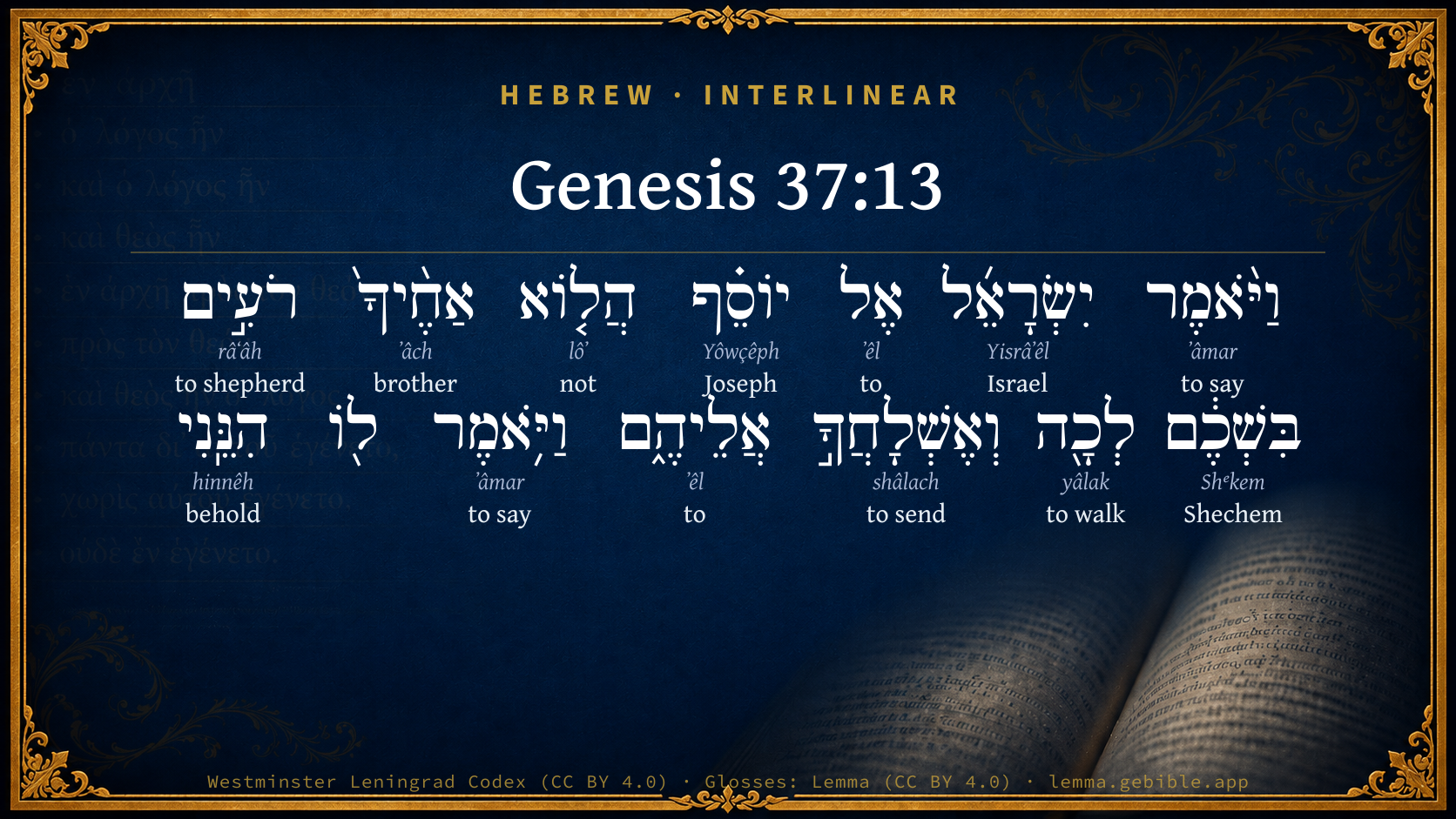
Hebrew (Westminster Leningrad Codex) Genesis 37:13 appears in the Hebrew Old Testament. The text above is from the Westminster Leningrad Codex. Each word links to its Strong’s number, a concise gloss, and parsing drawn from the Open Scriptures Hebrew Bible morphology. Click any word for its full Brown-Driver-Briggs (BDB) entry.
Download image
Cite this verse

Genesis 37:13 (World English Bible). Public Domain. Lemma interlinear Bible study tool, https://lemma.gebible.app/v/genesis/37/13.

Show BibTeX & RIS
BibTeX
RIS
English Translation
Israel said to Joseph, "Aren't your brothers feeding the flock in Shechem? Come, and I will send you to them." He said to him, "Here I am."
World English Bible · Public Domain
Download a study sheet

One document with this verse’s original text, its word-by-word gloss line, the meaning frame, cross-references with their text, attributed commentary, and full source and license credits — printable, and it pastes into notes with its structure intact.

This verse Autodidact and up

Study sheet (.html) Plain text (.txt)

A passage Seminary Student

Up to 50 verses in one chapter. A passage sheet keeps up to 6 commentary sources and 12 cross-references per verse, in the order this page ranks them, and says so on the sheet whenever that leaves anything out. Ask for a single verse and you get the Autodidact verse sheet above.

Everything on this page stays free to read, with no account — the sheet is a download of what is already on screen, not access to it.

Want to remove ads? Support Godless Engineer
Compare translations 3

The same verse in 3 English versions, stacked beneath the original-language interlinear above. Click any original word for its lexicon entry.

Each is an independent rendering of the whole verse — the interlinear is not word-aligned to these translations.

Highlighted words mark where these versions differ — a whole-verse word diff, not a word-by-word alignment.

  • World English Bible Public Domain
    Israel said to Joseph, "Aren't your brothers feeding the flock in Shechem? Come, and I will send you to them." He said to him, "Here I am."
  • King James Version Public Domain
    And Israel said unto Joseph, Do not thy brethren feed the flock in Shechem? come, and I will send thee unto them. And he said to him, Here am I.
  • unfoldingWord Literal Text CC BY-SA 4.0
    And Israel said to Joseph, “Are not your brothers shepherding near Shechem? Come and I will send you to them.” And he said to him, “Behold me.”

unfoldingWord Literal Text — © unfoldingWord, licensed CC BY-SA 4.0. Word-aligned USFM3 via Door43 (git.door43.org/unfoldingWord/en_ult).

Versions to compare (up to 4)

3 of 4 selected

Show all 18 translations

Every available English version of this verse, each an independent rendering of the whole verse.

  • World English Bible Public Domain
    Israel said to Joseph, "Aren't your brothers feeding the flock in Shechem? Come, and I will send you to them." He said to him, "Here I am."
  • Berean Standard Bible Public Domain
    Israel said to him, “Are not your brothers pasturing the flocks at Shechem? Get ready; I am sending you to them.” “I am ready,” Joseph replied.
  • Majority Standard Bible Public Domain
    Israel said to him, “Are not your brothers pasturing the flocks at Shechem? Get ready; I am sending you to them.” “I am ready,” Joseph replied.
  • King James Version Public Domain
    And Israel said unto Joseph, Do not thy brethren feed the flock in Shechem? come, and I will send thee unto them. And he said to him, Here am I.
  • American Standard Version (1901) Public Domain
    And Israel said unto Joseph, Are not thy brethren feeding the flock in Shechem? Come, and I will send thee unto them. And he said to him, Here am I.
  • Revised Version (1885) Public Domain
    And Israel said unto Joseph, Do not thy brethren feed the flock in Shechem? come, and I will send thee unto them. And he said to him, Here am I.
  • Geneva Bible (1599) Public Domain
    And Israel said vnto Ioseph, Doe not thy brethren keepe in Shechem? come and I will send thee to them.
  • Douay-Rheims (1899) Public Domain
    Israel said to him: Thy brethren feed the sheep in Sichem: come, I will send thee to them. And when he answered:
  • Young's Literal Translation Public Domain
    and Israel saith unto Joseph, `Are not thy brethren feeding in Shechem? come, and I send thee unto them;' and he saith to him, `Here `am' I;'
  • Literal Standard Version CC BY-SA 4.0
    and Israel says to Joseph, “Are your brothers not feeding in Shechem? Come, and I send you to them”; and he says to him, “Here I [am]”;
  • Unlocked Literal Bible CC BY-SA 4.0
    Israel said to Joseph, “Are not your brothers tending the flock in Shechem? Come, and I will send you to them.” Joseph said to him, “I am ready.”
  • unfoldingWord Literal Text CC BY-SA 4.0
    And Israel said to Joseph, “Are not your brothers shepherding near Shechem? Come and I will send you to them.” And he said to him, “Behold me.”
  • Darby Bible Public Domain
    And Israel said to Joseph, Do not thy brethren feed [the flock] at Shechem? Come, that I may send thee to them. And he said to him, Here am I.
  • World Messianic Bible Public Domain
    Israel said to Joseph, “Aren’t your brothers feeding the flock in Shechem? Come, and I will send you to them.” He said to him, “Here I am.”
  • Webster's Bible Public Domain
    And Israel said to Joseph, Do not thy brethren feed the flock in Shechem? Come, and I will send thee to them. And he said to him, Here am I.
  • Free Bible Version CC BY-SA 4.0
    Israel told Joseph, “Your brothers are looking after the sheep near Shechem. Get ready because I want you to go and see them.” “I'll do it,” Joseph replied.
  • Bible in Basic English Public Domain
    And Israel said to Joseph, Are not your brothers with the flock in Shechem? come, I will send you to them. And he said to him, Here am I.
  • JPS Tanakh (1917) Public Domain
    And Israel said unto Joseph: 'Do not thy brethren feed the flock in Shechem? come, and I will send thee unto them.' And he said to him: 'Here am I.'

Literal Standard Version (2020), Covenant Press — licensed CC BY-SA 4.0. Text via the HelloAO Bible API (eBible.org). Unlocked Literal Bible (unfoldingWord) — licensed CC BY-SA 4.0. Text via the HelloAO Bible API (eBible.org). unfoldingWord Literal Text — © unfoldingWord, licensed CC BY-SA 4.0. Word-aligned USFM3 via Door43 (git.door43.org/unfoldingWord/en_ult). Free Bible Version, Dr. Jonathan Gallagher — licensed CC BY-SA 4.0. Text via the HelloAO Bible API (eBible.org).

Word by word

More ways to search: Search by grammar → Find every occurrence → Compare this word →

Practice this passage: Drill this verse → Learn its vocabulary →

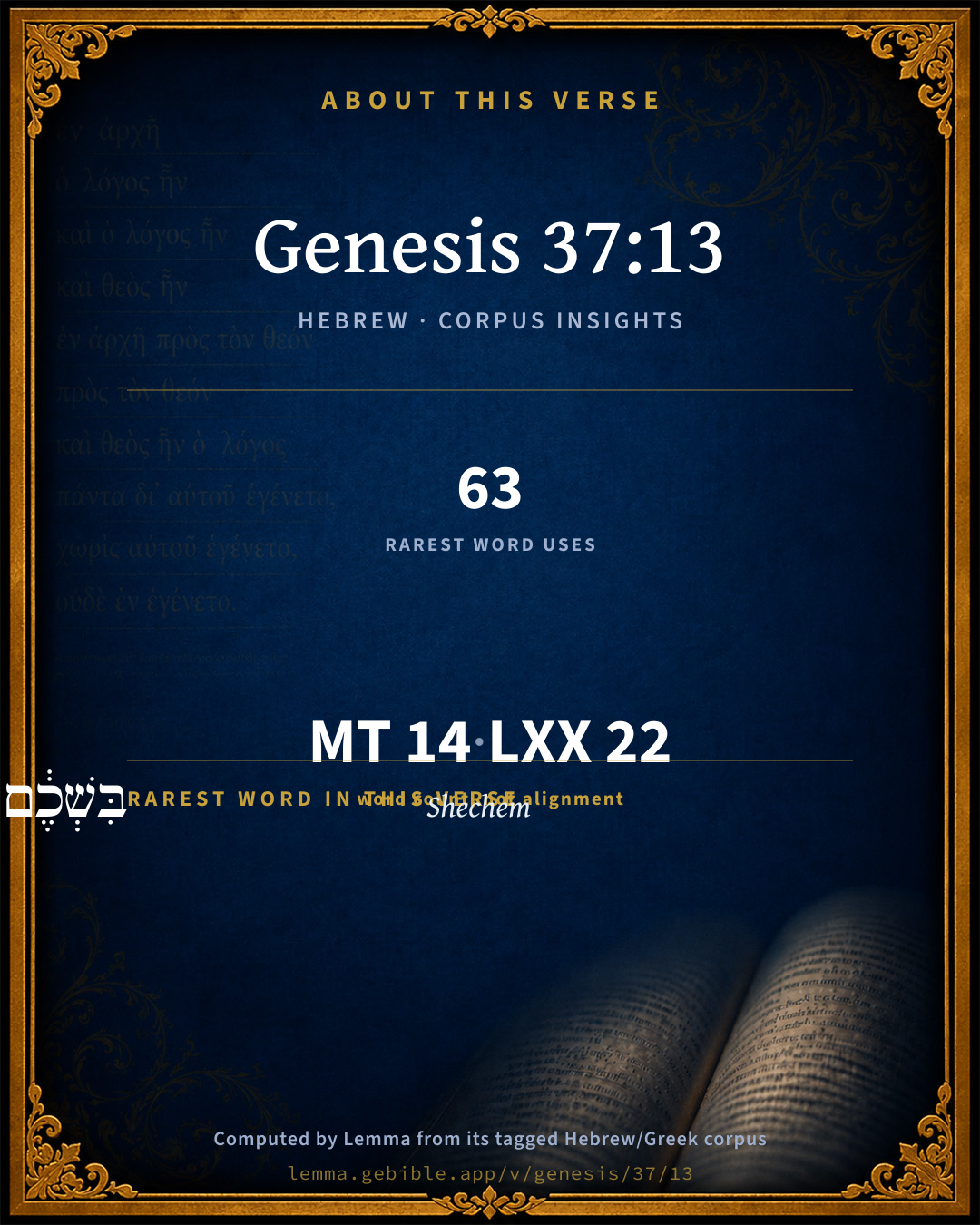
בִּשְׁכֶ֔ם
Shᵉkem
H7927
“in/at · Shechem”
Preposition + Noun, Proper
Part of Speech
Preposition + Noun
Type
Proper
Full BDB Definition

Origin: the same as H7926

TWOT: 2386b

Shechem = "back" or " shoulder" - son of Hamor, the chieftain of the Hivites at Shechem at the time of Jacob's arrival (noun proper masculine) - a city in Manasseh; located in a valley between Mount Ebal and Mount Gerizim, 34 miles (54 kilometers) north of Jerusalem and 7 miles (noun proper locative)
  1. וַיֹּ֨אמֶר ʼâmar H559 “and · to say” Conjunction + Verb, Qal, Sequential Imperfect, 3rd Person, Masculine, Singular
  2. יִשְׂרָאֵ֜ל Yisrâʼêl H3478 “Israel” Noun, Proper
  3. אֶל ʼêl H413 “to” Preposition
  4. יוֹסֵ֗ף Yôwçêph H3130 “Joseph” Noun, Proper
  5. הֲל֤וֹא lôʼ H3808 “not” Particle, Interrogative + Particle, Negative
  6. אַחֶ֨יךָ֙ ʼâch H251 “brothers · your” Noun, Common, Masculine, Plural, Construct + Suffix, Personal, 2nd Person, Masculine, Singular
  7. רֹעִ֣ים râʻâh H7462 “shepherding” Verb, Qal, Participle Active, Masculine, Plural, Absolute
  8. לְכָ֖ה yâlak H3212 “walk” Verb, Qal, Imperative, 2nd Person, Masculine, Singular + Suffix, h
  9. וְאֶשְׁלָחֲךָ֣ shâlach H7971 “and · to send · you” Conjunction + Verb, Qal, Imperfect, 1st Person, Common, Singular + Suffix, Personal, 2nd Person, Masculine, Singular
  10. אֲלֵיהֶ֑ם ʼêl H413 “to · them” Preposition + Suffix, Personal, 3rd Person, Masculine, Plural
  11. וַיֹּ֥אמֶר ʼâmar H559 “and · to say” Conjunction + Verb, Qal, Sequential Imperfect, 3rd Person, Masculine, Singular
  12. הִנֵּֽנִי hinnêh H2009 “behold · me” Particle, Demonstrative + Suffix, Personal, 1st Person, Common, Singular

About this verse

These counts appear in no published source. They are computed here, from the morphology-tagged text and Lemma’s own curated glosses. What Lemma adds →

14
words
11
distinct lemmas
Pentateuch
section

Grammatical profile

  • 5 verbs
  • 4 nouns
  • 3 prepositions
  • 2 particles

Verb forms

  • וַיֹּ֨אמֶר Qal · Sequential Imperfect
  • רֹעִ֣ים Qal · Participle Active
  • לְכָ֖ה Qal · Imperative
  • וְאֶשְׁלָחֲךָ֣ Qal · Imperfect
  • וַיֹּ֥אמֶר Qal · Sequential Imperfect

Repetition

Words recur within this verse — often emphatic in Hebrew:

  • וַיֹּ֨אמֶר to say H559 ×2
  • אֶל to H413 ×2

Hebrew & Septuagint length

In English translation the verse runs 27 words from the Hebrew and 30 from the Septuagint (LXX English) — closely comparable.

A rough comparison of the two English renderings, which tokenize alike — not a word-level alignment.

Word counts can differ between the Hebrew and the Greek without any difference in meaning — e.g. the Hebrew direct-object marker אֵת has no separate Greek word, and Greek often adds the article ὁ.

In the original languages it is 14 Hebrew tokens and 22 Greek tokens — but the two are counted differently (Hebrew bundles its prefixes and suffixes into one token; the Greek is in lemma form), so that isn’t a like-for-like length.

Cross-references

10

Topical passages linked to Genesis 37:13 in the Treasury of Scripture Knowledge — connected by theme and wording, ordered by reader-vote popularity; previews shown in the World English Bible.

  • Ephesians 6:1–3 Children, obey your parents in the Lord, for this is right.
  • Genesis 22:1 It happened after these things, that God tested Abraham, and said to him, "Abraham!" He said, "Here I am."
  • Genesis 27:1 It happened, that when Isaac was old, and his eyes were dim, so that he could not see, he called Esau his elder son, and said to him, "My son?" He said to him, "Here I am."
  • Genesis 27:18 He came to his father, and said, "My father?" He said, "Here I am. Who are you, my son?"
  • 1 Samuel 3:4–6 that Yahweh called Samuel; and he said, Here am I.
  • 1 Samuel 3:8 Yahweh called Samuel again the third time. He arose and went to Eli, and said, Here am I; for you called me. Eli perceived that Yahweh had called the child.
  • 1 Samuel 3:16 Then Eli called Samuel, and said, Samuel, my son. He said, Here am I.
  • 1 Samuel 17:17–20 Jesse said to David his son, Take now for your brothers an ephah of this parched grain, and these ten loaves, and carry [them] quickly to the camp to your brothers;
  • Matthew 10:16 "Behold, I send you out as sheep in the midst of wolves. Therefore be wise as serpents, and harmless as doves.
  • Luke 20:13 The lord of the vineyard said, 'What shall I do? I will send my beloved son. It may be that seeing him, they will respect him.'

Cross-references courtesy of OpenBible.info (CC BY 4.0).

Hebrew and Greek witnesses Masoretic Hebrew ↔ Greek Septuagint

The same verse in the two great witnesses to the Old Testament, shown verse-for-verse.

These are two independent witnesses, not word-aligned to each other, and the Septuagint is shown in lemma (dictionary) form.

Hebrew Genesis 37:13 Masoretic · Westminster Leningrad Codex

וַיֹּ֨אמֶר יִשְׂרָאֵ֜ל אֶל יוֹסֵ֗ף הֲל֤וֹא אַחֶ֨יךָ֙ רֹעִ֣ים בִּשְׁכֶ֔ם לְכָ֖ה וְאֶשְׁלָחֲךָ֣ אֲלֵיהֶ֑ם וַיֹּ֥אמֶר ל֖וֹ הִנֵּֽנִי

Israel said to Joseph, "Aren't your brothers feeding the flock in Shechem? Come, and I will send you to them." He said to him, "Here I am."

World English Bible · Public Domain

Greek LXX Genesis 37:13 Septuagint · lemma form

καί εἶπον ἰσραήλ πρός ιωσηφ οὐ ὁ ἀδελφός σύ ποιμαίνω ἐν συχεμ δεῦρο ἀποστέλλω σύ πρός αὐτός εἶπον δέ αὐτός ἰδού ἐγώ

And Israel said to Joseph, Do not your brethren feed their flock in Sychem? Come, I will send you to them; and he said to him, Behold, I am here.

LXX2012 (modern English Septuagint) · Public Domain

Hebrew: Westminster Leningrad Codex (CC BY 4.0). Greek: Septuagint (public domain); English from LXX2012 (modern English Septuagint) (Public Domain). How the Septuagint differs from the Hebrew →

Targum (Aramaic paraphrase)

2

The Targum is the ancient Jewish Aramaic paraphrase of the Hebrew Scriptures — an interpretive translation, not the Hebrew text itself. Onkelos (literal) and Pseudo-Jonathan (expansive) render the Torah, and Jonathan the Prophets. Coverage is partial: where no permissively-licensed English translation exists for a verse, only the Aramaic is shown. This is verse-level text, not a word-by-word alignment to the Hebrew.

  1. Targum Onkelos Torah (Genesis–Deuteronomy)
    וַאֲמַר יִשְׂרָאֵל לְיוֹסֵף הֲלָא אַחָיךְ רָעָן בִּשְׁכֶם אֱתָא וְאֶשְׁלְחִנָּךְ לְוָתְהוֹן וַאֲמַר לֵהּ הָא אֲנָא

    (no public-domain English translation for this verse)

    Targum Onkelos — Aramaic: “Onkelos Genesis” (public domain); “Onkelos Exodus” (public domain); “Onkelos Leviticus” (public domain); “Onkelos Numbers” (public domain); “Onkelos Deuteronomy” (public domain). English: “Sefaria Community Translation” (CC0 1.0 (public-domain dedication)); “J.W. Etheridge. The Targums of Onkelos and Jonathan Ben Uzziel on the Pentateuch. London: Longmans, Green, 1862” (public domain). Text via Sefaria.

  2. Targum Pseudo-Jonathan Torah (Genesis–Deuteronomy)
    וַהֲוָה לִזְמַן יוֹמִין וַאֲמַר יִשְרָאֵל לְיוֹסֵף הֲלָא אָחָךְ רָעָן בִּשְׁכֶם וּדְחֵיל דִילְמָא יֵיתוּן חִיוָאֵי וְיִמְחִינוּן עַל עֵיסַק דִי מְחוֹ יַת חֲמוֹר וְיַת שְׁכֶם וְיַת יַתְבֵי קַרְתָּא אִיתָא כְּדוֹן וַאֲשַׁלְחִינָךְ לְוַתְהוֹן וַאֲמַר לֵיהּ הָא נָא

    And it was at the time of days that Israel said to Joseph, Do not thy brethren feed in Shekem? But I am afraid lest the Hivaee come and smite them, because they smote Hamor and Shekem and the inhabitants of the city. Come now; and I will send thee to them And he said, Behold me.

    Targum Pseudo-Jonathan — Aramaic: “Targum Jonathan on Genesis” (public domain); “Targum Jonathan on Exodus” (public domain); “Targum Jonathan on Leviticus” (public domain); “Targum Jonathan on Numbers” (public domain); “Targum Jonathan on Deuteronomy” (public domain). English: “The Targum of Jonathan ben Uzziel, trans. J. W. Etheridge, London, 1862” (public domain). Text via Sefaria.

Commentary

Notes on Genesis 37:13 from classic Christian and Jewish commentators (each source and its license shown beneath its notes). The classic Christian expositions comment on the surrounding passage and are grouped to its opening verse, so a note may address several verses; the Jewish commentaries on the Tanakh (Rashi and others) are per-verse, so they appear only where the commentator wrote on this verse.

Lemma curates 59 commentaries, every one of them public domain or Creative Commons licensed, each selected and text-cleaned for this edition rather than reprinted as found. About our sources →

Trapp's Complete Commentary

John Trapp

Gen 37:13 And Israel said unto Joseph, Do not thy brethren feed [the flock] in Shechem? come, and I will send thee unto them. And he said to him, Here [am I].

Ver. 13. And he said to him, Here am I.] "Children obey your parents," - quorum divina est dignitas, saith Chrysostom: our parents are Yεοι εφεστιοι, saith another; and Philo, for this maketh the fifth commandment a part of the first table, "for this is right." {Eph 6:1} Blind nature saw it to be so. For it is not fit, saith the philosopher, to cross the gods, a man’s own father, and his tutor or teacher. {a}

{a} Mη καλον κρινειν εναντια τοις Yεοις, πατρι, και Dαδασκαλω. - Aristot., Rhetor.

John Trapp, A Commentary or Exposition upon All the Books of the Old and New Testament (1647–1656) — public domain. Text from a community e-Sword module.

Jamieson, Fausset & Brown

Robert Jamieson, A. R. Fausset & David Brown

Israel said, . . . Do not thy brethren feed the flock in Shechem?--Anxious to learn how his sons were doing in their distant encampment, Jacob despatched Joseph; and the youth, accepting the mission with alacrity, left the vale of Hebron, sought them at Shechem, heard of them from a man in "the field" (the wide and richly cultivated plain of Esdraelon), and found that they had left that neighborhood for Dothan, probably being compelled by the detestation in which, from the horrid massacre, their name was held.

Jamieson, Fausset & Brown — Commentary Critical and Explanatory on the Whole Bible (1871) — public domain (CC PDM 1.0). Text via the HelloAO Bible API.

John Gill's Exposition

And he said to him, go, I pray thee,.... Or "now" (k), directly, immediately, which is more agreeable to the authority of a father:

see whether it be well with thy brethren, and well with the flocks; it having been many days, and perhaps months, since he had heard anything of them; and the rather Jacob might be under a concern for them, because of the danger they were exposed to from the neighbouring tribes and nations of the Canaanites, on account of their having some time ago destroyed the Shechemites; so the Targum of Jonathan, paraphrasing on the preceding part, makes Jacob to say,"I am afraid, lest the Horites should come and smite them, because of their smiting Hamor and Shechem, and the inhabitants of that city; come, and I will send thee, &c."

and bring me word again; of their welfare, and of the state of their flocks:

so he sent him out of the vale of Hebron: the same with the plains of Mamre near the city of Hebron, which was built on a hill:

and he came to Shechem: after he had travelled sixty miles.

(k) "nunc", Pagninus, Montanus, Junius & Tremellius, Piscator, Drusius.

John Gill's Exposition of the Whole Bible (1746–1763) — public domain (CC PDM 1.0). Text via the HelloAO Bible API.

Haydock's Catholic Bible Commentary

In Sichem. About ninety miles off. The town had not probably been as yet rebuilt. Jacob had a field there, and the country was free for any one to feed their flocks. It was customary to drive them to a distance. (Calmet)

George Leo Haydock (1774–1849), Haydock's Catholic Family Bible and Commentary, 1859 edition — public domain. Excludes Psalms (Douay-Rheims chapter numbering differs from Protestant) and Deuterocanonical books (Catholic canon only).

Matthew Poole's English Annotations

1729

Having kept him for some time at home, and supposing that length of time had cooled their heats, and worn out their hatred, he now sends him to them.

Matthew Poole's English Annotations on the Holy Bible (1683–1685) — public domain. Text from a community e-Sword/MySword module.

The Pulpit Commentary

And Israel (vide Gen_32:28 Gen_35:10) said unto Joseph, Do not thy brethren feed the flock (literally, Are not thy brethren shepherding?) in Shechem? come, and I will send thee unto them. Either he was solicitous of the safety of his sons while in the vicinity of Shechem (Lawson), or he hoped to effect a reconciliation between them and Joseph (Candlish). And he (i.e. Joseph, in response to this invitation, expressed a willingness to undertake a mission to his brethren, and) said to him, Here am I

The Pulpit Commentary (1880–1919), ed. H.D.M. Spence-Jones & Joseph S. Exell — public domain. Text from a community e-Sword module.

Rashi

Rabbi Shlomo Yitzchaki (Rashi)

הנני HERE AM I — An expression denoting humility and readiness: he was zealous to perform his father’s bidding, although he was aware that his brothers hated him (Genesis Rabbah 84:13).

Rashi on the Tanakh — English translations: “The Judaica Press complete Tanach with Rashi, translated by A. J. Rosenberg” (CC BY 4.0); “Pentateuch with Rashi's commentary by M. Rosenbaum and A.M. Silbermann, 1929-1934” (public domain); “The Metsudah Tanach series, Lakewood, N.J” (CC BY 4.0); and “The Book of Joshua, Metsudah Publications, 1997” (CC BY 4.0). Text via Sefaria.

Radak

Rabbi David Kimhi (Radak)

ויאמר...הלא אחיך, don’t you know that your brothers are in Shechem, tending flocks?

הנני; he was not afraid of his brothers even though they hated him, for he thought that their awe of their father was greater than their desire to harm him. His father also did not think that the brothers posed a threat to his favourite son. Surely, if he had even entertained the slightest concern about the brothers harming Joseph, he would never have sent him on this mission. This entire matter was engineered by G’d Who knows the evil machinations of man in order that this would become the external cause of the patriarchs, i.e. their descendants to descend to Egypt and to fulfill the prophecy G’d had already told Avraham about in chapter 15.

Radak on the Tanakh — English translations: “Sefaria Community Translation” (CC0 1.0 (public-domain dedication)); “Eliyahu Munk, HaChut Hameshulash” (CC BY 4.0); “Rabbi Mike Feuer, Jerusalem Anthology” (CC BY 4.0); and “R. David Kimhi on the first book of Psalms, Translated by R.G. Finch, London, 1919” (public domain). Text via Sefaria.

Lesson kit

Teaching starters — assembled from the data on this page, not authored interpretation. Every prompt links to the verse data it draws on. Edit before teaching.

Genesis, in the Pentateuch, opens this verse with 14 words (11 distinct Hebrew lemmas). Its most distinctive word is Shᵉkem (“Shechem”). A historical commentator’s framing appears above. Read the whole chapter for the surrounding context.

Discussion questions

  1. What does “Shechem” (Shᵉkem) contribute to the verse as a whole?
  2. Ephesians 6:1–3 shares this passage’s theme. How do the two illuminate each other?
  3. “to say” occurs 2× in this one verse. What is the effect of the repetition?
  4. The translations on this page render this verse differently — a whole-verse word diff, not a word-by-word alignment. What might account for the different wordings?
  5. The verb «וַיֹּ֨אמֶר» is Qal Sequential Imperfect. How does its form color the action?
  6. Reading how Trapp's Complete Commentary and Jamieson, Fausset & Brown read this verse, where do the two commentators agree and where do they part?

Things to notice

Reading settings

Reading text

Shown beneath each verse's original-language words.

Old Testament
Old Testament edition

Read the OT as the Masoretic Hebrew (MT) or the Greek Septuagint (LXX).

English shown for the Greek Septuagint (in the Hebrew ↔ Greek comparison).

Comparing translations? Open the Compare panel on any verse page to stack up to four side by side.