
Luke 10:3

Greek (Tischendorf 8th ed.) Luke 10:3 appears in the Greek New Testament. The text above is from the Tischendorf 8th edition. Each word links to its Strong’s number and a concise gloss. Click any word for its full Thayer’s Greek Lexicon entry.
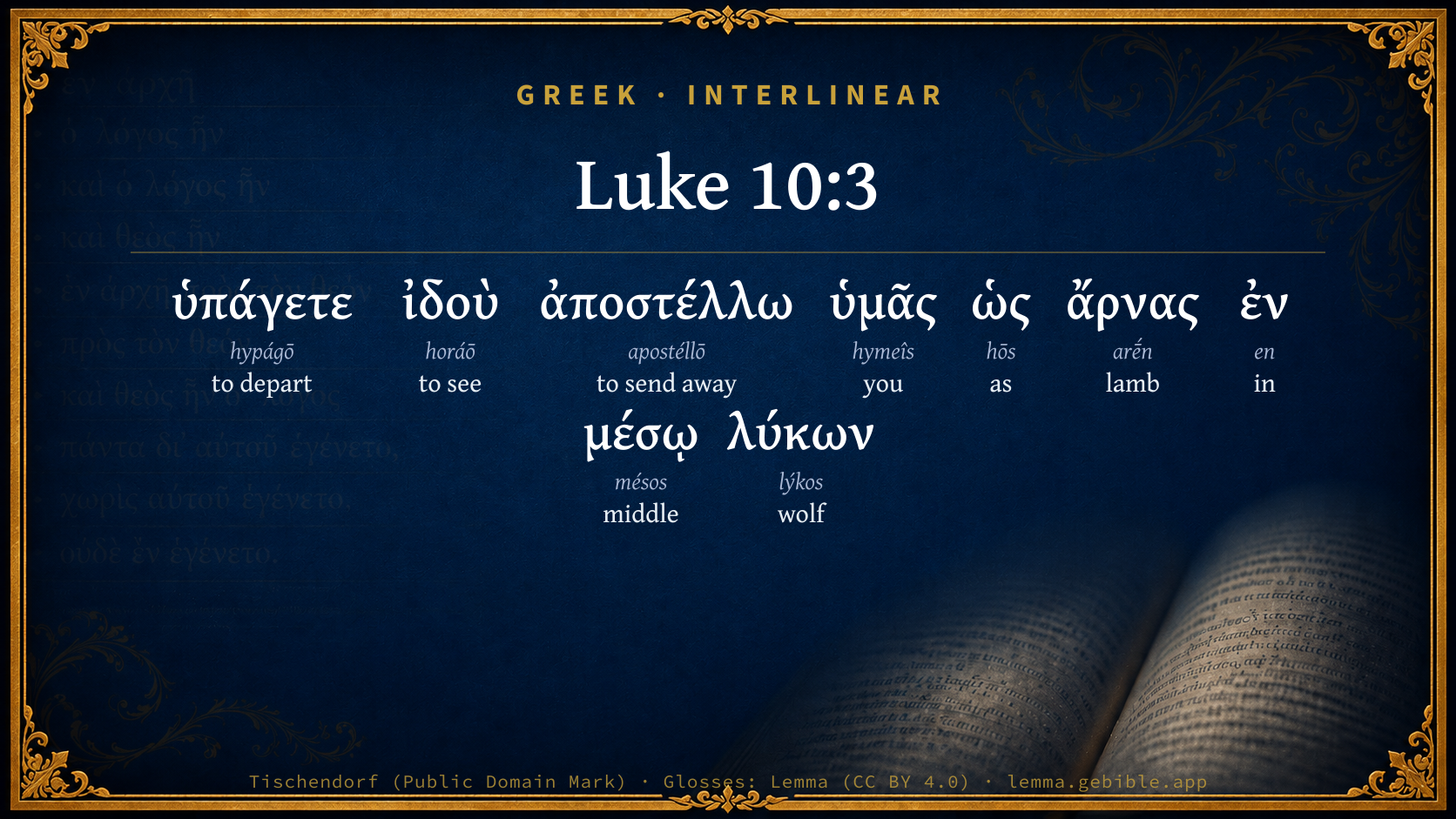
Download image
Cite this verse

Luke 10:3 (World English Bible). Public Domain. Lemma interlinear Bible study tool, https://lemma.gebible.app/v/luke/10/3.

Show BibTeX & RIS
BibTeX
RIS
English Translation
Go your ways. Behold, I send you out as lambs among wolves.
World English Bible · Public Domain
Highlights
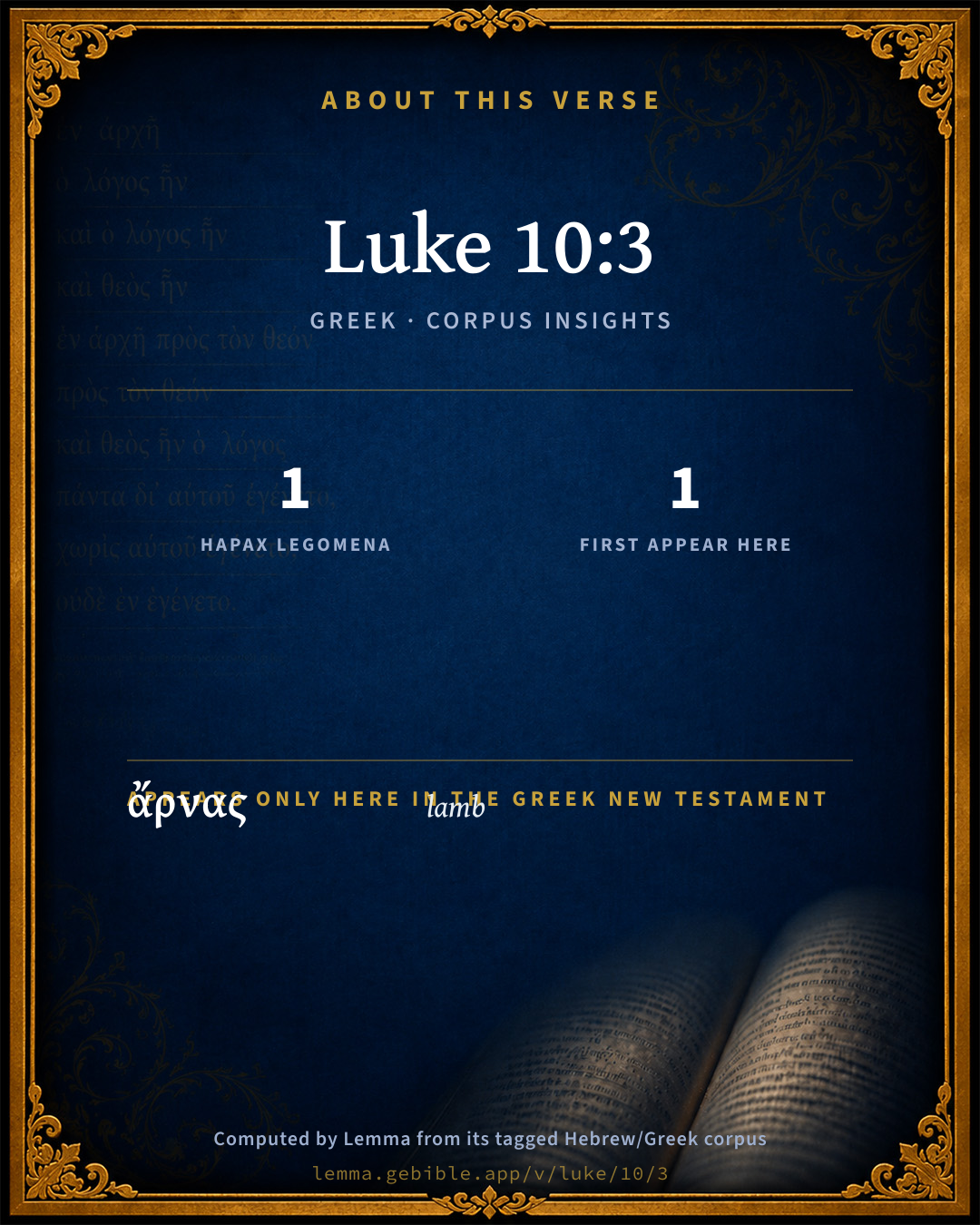
  • 1 hapax legomenon — only here in the Greek New Testament
  • 1 first appearance in the Greek New Testament
Full analysis ↓
Download a study sheet

One document with this verse’s original text, its word-by-word gloss line, the meaning frame, cross-references with their text, attributed commentary, and full source and license credits — printable, and it pastes into notes with its structure intact.

This verse Autodidact and up

Study sheet (.html) Plain text (.txt)

A passage Seminary Student

Up to 50 verses in one chapter. A passage sheet keeps up to 6 commentary sources and 12 cross-references per verse, in the order this page ranks them, and says so on the sheet whenever that leaves anything out. Ask for a single verse and you get the Autodidact verse sheet above.

Everything on this page stays free to read, with no account — the sheet is a download of what is already on screen, not access to it.

Want to remove ads? Support Godless Engineer
Compare translations 3

The same verse in 3 English versions, stacked beneath the original-language interlinear above. Click any original word for its lexicon entry.

Each is an independent rendering of the whole verse — the interlinear is not word-aligned to these translations.

Highlighted words mark where these versions differ — a whole-verse word diff, not a word-by-word alignment.

  • World English Bible Public Domain
    Go your ways. Behold, I send you out as lambs among wolves.
  • King James Version Public Domain
    Go your ways: behold, I send you forth as lambs among wolves.
  • unfoldingWord Literal Text CC BY-SA 4.0
    Go. Behold, I send you out as lambs in the midst of wolves.

unfoldingWord Literal Text — © unfoldingWord, licensed CC BY-SA 4.0. Word-aligned USFM3 via Door43 (git.door43.org/unfoldingWord/en_ult).

Versions to compare (up to 4)

3 of 4 selected

Show all 19 translations

Every available English version of this verse, each an independent rendering of the whole verse.

  • World English Bible Public Domain
    Go your ways. Behold, I send you out as lambs among wolves.
  • Berean Standard Bible Public Domain
    Go! I am sending you out like lambs among wolves.
  • Majority Standard Bible Public Domain
    Go! I am sending you out like lambs among wolves.
  • King James Version Public Domain
    Go your ways: behold, I send you forth as lambs among wolves.
  • American Standard Version (1901) Public Domain
    Go your ways; behold, I send you forth as lambs in the midst of wolves.
  • Revised Version (1885) Public Domain
    Go your ways: behold, I send you forth as lambs in the midst of wolves.
  • Geneva Bible (1599) Public Domain
    Goe your wayes: beholde, I send you foorth as lambes among wolues.
  • Douay-Rheims (1899) Public Domain
    Go: Behold I send you as lambs among wolves.
  • Young's Literal Translation Public Domain
    `Go away; lo, I send you forth as lambs in the midst of wolves;
  • Literal Standard Version CC BY-SA 4.0
    Go away; behold, I send you forth as lambs in the midst of wolves;
  • Unlocked Literal Bible CC BY-SA 4.0
    Go on your way. See, I send you out as lambs in the midst of wolves.
  • unfoldingWord Literal Text CC BY-SA 4.0
    Go. Behold, I send you out as lambs in the midst of wolves.
  • Darby Bible Public Domain
    Go: behold *I* send you forth as lambs in the midst of wolves.
  • World Messianic Bible Public Domain
    Go your ways. Behold, I send you out as lambs among wolves.
  • Webster's Bible Public Domain
    Go: behold, I send you forth as lambs among wolves.
  • Free Bible Version CC BY-SA 4.0
    So get on your way: I'm sending you like sheep among wolves.
  • Bible in Basic English Public Domain
    Go on your way: see, I send you out like lambs among wolves.
  • Text-Critical English NT CC BY 4.0
    Now go on your way. Behold, I am sending you out like lambs in the midst of wolves.
  • Tyndale New Testament (1534) Public Domain
    Goo youre wayes: beholde I sende you forthe as lambes amonge wolves.

Literal Standard Version (2020), Covenant Press — licensed CC BY-SA 4.0. Text via the HelloAO Bible API (eBible.org). Unlocked Literal Bible (unfoldingWord) — licensed CC BY-SA 4.0. Text via the HelloAO Bible API (eBible.org). unfoldingWord Literal Text — © unfoldingWord, licensed CC BY-SA 4.0. Word-aligned USFM3 via Door43 (git.door43.org/unfoldingWord/en_ult). Free Bible Version, Dr. Jonathan Gallagher — licensed CC BY-SA 4.0. Text via the HelloAO Bible API (eBible.org).

Word by word

More ways to search: Search by grammar → Find every occurrence → Compare this word →

Practice this passage: Drill this verse → Learn its vocabulary →

About this verse

These counts appear in no published source. They are computed here, from the morphology-tagged text and Lemma’s own curated glosses. What Lemma adds →

9
words
9
distinct lemmas
Gospels
section

Notable vocabulary

1 hapax legomenon — a word that appears only here in the entire Greek New Testament:

  • ἄρνας lamb G704

First appearance in Scripture

This word makes its first canonical appearance in the Greek New Testament here:

  • ἄρνας lamb G704

Shared distinctive vocabulary

λύκων wolf G3074 occurs in 5 verses of the Greek New Testament. Also found in:
Cross-references

13

Topical passages linked to Luke 10:3 in the Treasury of Scripture Knowledge — connected by theme and wording, ordered by reader-vote popularity; previews shown in the World English Bible.

  • Matthew 10:16 "Behold, I send you out as sheep in the midst of wolves. Therefore be wise as serpents, and harmless as doves.
  • Acts 20:29 For I know that after my departure, vicious wolves will enter in among you, not sparing the flock.
  • Ezekiel 2:3–6 He said to me, Son of man, I send you to the children of Israel, to nations that are rebellious, which have rebelled against me: they and their fathers have transgressed against me even to this very day.
  • John 15:20 Remember the word that I said to you: 'A servant is not greater than his lord.' If they persecuted me, they will also persecute you. If they kept my word, they will keep yours also.
  • Matthew 10:22 You will be hated by all men for my name's sake, but he who endures to the end will be saved.
  • John 10:12 He who is a hired hand, and not a shepherd, who doesn't own the sheep, sees the wolf coming, leaves the sheep, and flees. The wolf snatches the sheep, and scatters them.
  • John 16:2 They will put you out of the synagogues. Yes, the time comes that whoever kills you will think that he offers service to God.
  • Zephaniah 3:3 Her princes in the midst of her are roaring lions. Her judges are evening wolves. They leave nothing until the next day.
  • Matthew 7:15 "Beware of false prophets, who come to you in sheep's clothing, but inwardly are ravening wolves.
  • Psalms 22:12–16 Many bulls have surrounded me. Strong bulls of Bashan have encircled me.
  • Psalms 22:21 Save me from the lion's mouth; Yes, from the horns of the wild oxen you have answered me.
  • Acts 9:2 and asked for letters from him to the synagogues of Damascus, that if he found any who were of the Way, whether men or women, he might bring them bound to Jerusalem.
  • Acts 9:16 For I will show him how many things he must suffer for my name's sake."

Cross-references courtesy of OpenBible.info (CC BY 4.0).

Commentary

Notes on Luke 10:3 from classic Christian and Jewish commentators (each source and its license shown beneath its notes). The classic Christian expositions comment on the surrounding passage and are grouped to its opening verse, so a note may address several verses; the Jewish commentaries on the Tanakh (Rashi and others) are per-verse, so they appear only where the commentator wrote on this verse.

Lemma curates 59 commentaries, every one of them public domain or Creative Commons licensed, each selected and text-cleaned for this edition rather than reprinted as found. About our sources →

The Biblical Illustrator

Joseph S. Exell

Luk_10:3

As lambs among wolves

Counsels of prudence

I.

THE NATURE OF PRUDENCE. In general, it is a discerning and employing the most proper means of obtaining those ends, which we propose to ourselves. It is an important branch of prudence to avoid faults. One false step sometimes ruins, or, however, greatly embarrasses and retards a good design. Prudence likewise supposeth the main-raining of innocence and integrity. We may not neglect our duty to avoid danger.

II. THE NECESSITY, GROUNDS, AND REASONS OF PRUDENCE. These are chiefly the wickedness and the weakness of men. Good men, therefore, are obliged to be upon their guard, and make use of some methods of defence and security. Nay, if there were no bad men, yet there would be need of prudent behaviour, because some who have not much reflection or experience are apt to put wrong constructions upon harmless actions. A great part of prudence lies in denying ourselves, so as to keep some way within the limits of virtue.

III. SOME RULES AND DIRECTIONS concerning a prudent conduct, with regard to our words and actions.

1. The first rule of prudence I lay down is this, that we should endeavour to know ourselves. He that knows not himself may undertake designs he is not fit for, and can never accomplish, in which he must, therefore, necessarily meet with disappointment.

2. Endeavour to know other men. It is a point of charity to hope the best of every man, and of prudence to fear the worst.

3. Watch, and embrace opportunities.

4. Advise with those who are able to give you good counsel.

5. Restrain and govern your affections. (T. Lardner.)

A lamb among wolves

One of the most conspicuous instances of moral courage which history affords is the following: The veteran Stilicho had conquered Alaric and his Goths. The Romans invite the hero and his ward--a stupid, cowardly boy, the Emperor Honorius--to gladiatorial games in honour of the victory. The empire has been Christian for a hundred years, yet these infamous and brutalizing shows still continue. They are defended with all sorts of devils sophistry. The games begin; the tall, strong men enter the arena; the tragic cry echoes through the amphitheatre, Ave Caesar, moritari te salutamus! the swords are drawn, and in an instants signal will be bathed in blood. At that very moment down leaps into the arena a rude, ignorant monk. The gladiators shall not fight, he exclaims. Are you going to thank God by shedding innocent blood? A yell of execration rises from these 80,000 spectators. Who is this wretch that dares to set himself up as knowing better than we do? Pelt him! Cut him down! Stones are hurled at him; the gladiators run him through with their swords; he falls dead, and his body is kicked aside, and the games go on, and the people--Christians and all--shout applause. Aye, they go on, and the people shout, for the last time. Their eyes are opened; their sophistry is at an end; the blood of a martyr is on their souls. Shame stops for ever the massacre of gladiators; and because one poor, ignorant hermit has moral courage, one more habitual crime was wiped away from the annals of the world. (Arch deacon Farrar.)

The Biblical Illustrator, edited by Joseph S. Exell (c. 1880s–1900s) — public domain. Text from a community e-Sword module.

Joseph Benson's Commentary

Luk 10:3-4. I send you forth as lambs, &c. — As so many defenceless lambs, in the midst of ravenous and cruel wolves. Carry neither purse nor scrip, &c. — See notes on Mat 10:9-10; Mat 10:16. Salute no man by the way — Let not matters of mere compliment detain you, but make all the haste you possibly can. The salutations usual among the Jews took up much time. But these had so much work to do in so short a space, that they had not a moment to spare.

Joseph Benson's Commentary on the Old and New Testaments (1811–1818) — public domain. Text from a community e-Sword module.

Tyndale Open Study Notes

Tyndale Open Resources

10:3 lambs among wolves: Jesus’ followers are not to dominate others, but to sacrifice themselves for the benefit of others. This makes them vulnerable (see Jer 5:6; Ezek 22:27; Hab 1:8; Zeph 3:3), but the Good Shepherd (Ps 23:1) protects them from the wolves.

Tyndale Open Study Notes — © Tyndale Open Resources, licensed CC BY-SA 4.0. Text via the HelloAO Bible API.

Bengel's Gnomon

Johann Albrecht Bengel

Luk 10:3. Ἄρνας, lambs) So the Seventy are called; but the twelve apostles, sheep, Mat 10:16. [He gave to both a safe-conduct, as it is termed, by the words, Behold, I send you.—V. g.]

Bengel's Gnomon of the New Testament — English translation (T&T Clark, Edinburgh, 1860) — public domain. Text from a community e-Sword module.

Meyer's Critical & Exegetical Commentary

Heinrich August Wilhelm Meyer

Luk_10:3. See on Mat_10:16, where πρόβατα appears. A different form of the tradition, not to be explained as though Jesus called the Twelve πρόβατα as being τελειοτέρους (Euthymius Zigabenus). Comp. Joh_21:15-17.

Meyer — Critical and Exegetical Commentary on the New Testament — English translation by Peter Christie, edited by Frederick Crombie (T&T Clark, 1880) — public domain. Text from a community e-Sword module.

Expositor's Greek Testament

ed. W. Robertson Nicoll

Luk 10:3 . ὑπάγετε , go , whither? Mt.’s version of the instructions to the Twelve says: not to Samaria, but to the lost sheep of Israel only; this omitted by Lk. with the one word, “go,” retained. ὡς ἄρνας , etc., as lambs among wolves; sheep ( πρόβατα ) in Mat 10:16 ; pathetic hint as to the helplessness of the agents and the risks they run; not imaginary, as the recent experience at the Samaritan village shows.

The Expositor's Greek Testament, edited by W. Robertson Nicoll (1897–1910) — public domain. Text from a community e-Sword module.

Geneva Bible (1599)

Geneva Bible translators

The faithful ministers of the word are in this world as lambs among wolves: but if they be diligent to do their duty, he that sent them will also preserve them.

Geneva Bible (1599) marginal notes — public domain. Text via Bolls.life.

Jamieson, Fausset & Brown

Robert Jamieson, A. R. Fausset & David Brown

(See on Mat 10:7-16).

Jamieson, Fausset & Brown — Commentary Critical and Explanatory on the Whole Bible (1871) — public domain (CC PDM 1.0). Text via the HelloAO Bible API.

Adam Clarke's Commentary

Verse 3. Lambs among wolves.] See Clarke on Mt 10:16.

Adam Clarke's Commentary on the Bible (1810–1826) — public domain. Text from a community e-Sword/MySword module.

Ellicott's Commentary for English Readers

(3) As lambs among wolves.—See Note on Mat_10:16.

A Bible Commentary for English Readers, edited by Charles John Ellicott (1878–1897) — public domain. Text from a community e-Sword module.

The Cambridge Bible for Schools and Colleges

gen. ed. J. J. S. Perowne

3. as lambs] ‘as sheep,’ Mat_10:16 (of the Twelve). The slight variation must not be pressed. The impression meant to be conveyed is merely that of simplicity and defencelessness. A tradition, as old as Clemens Romanus, tells us that St Peter had asked (on the previous occasion), ‘But how then if the wolves should tear the lambs?’ and that Jesus replied, ‘Let not the lambs fear the wolves when the lambs are once dead,’ and added the words in Mat_10:28. There is no reason to doubt this interesting tradition, which may rank as one of the most certain of the ‘unwritten sayings’ (agrapha dogmata) of our Lord.

The Cambridge Bible for Schools and Colleges (gen. ed. J. J. S. Perowne; Cambridge University Press, 1878–1918) — public domain. Text from a community e-Sword module.

John Gill's Exposition

Go your ways,.... Into all the villages, towns, cities, and places, where he directed them to go, to make ready for him.

Behold, I send you forth as lambs among wolves; as harmless, innocent, profitable, and defenceless creatures, among spiteful, malicious, cunning, and cruel men; See Gill on Mat 10:16.

John Gill's Exposition of the Whole Bible (1746–1763) — public domain (CC PDM 1.0). Text via the HelloAO Bible API.

Trapp's Complete Commentary

John Trapp

3 Go your ways: behold, I send you forth as lambs among wolves.

Ver. 3. Go your ways] Christ had no sooner bidden them pray, but he answers their prayers. When we bid our children ask us for this or that, it is because we mean to give it to them.

As lambs among wolves] Sed sollicitudo pastoris boni effici ut lupi in agnos audere nil possint saith Ambrose. The care of the good shepherd is the safety of the flock.

John Trapp, A Commentary or Exposition upon All the Books of the Old and New Testament (1647–1656) — public domain. Text from a community e-Sword module.

Albert Barnes' Notes on the Bible

See the notes at Mat 10:16.

Albert Barnes' Notes on the Bible (1834–1885) — public domain. Text from a community e-Sword/MySword module.

Matthew Poole's English Annotations

We met with these instructions before, and opened them in our notes. See Poole on "Mat 10:9", See Poole on "Mat 10:10" and See Poole on "Mat 10:16", only there we had not those words,

and salute no man by the way. The meaning of that is no more than, make all possible speed: see 2Ki 4:29.

Matthew Poole's English Annotations on the Holy Bible (1683–1685) — public domain. Text from a community e-Sword/MySword module.

Whedon's Commentary on the Bible

Daniel D. Whedon

3. Go your ways—Take your various routes. This address to the Seventy is much on the model of that to the twelve in Matthew 10. It has, however, no limitation to the house of Israel, or prohibition from Samaria. On the other hand, the powers are less extensive, and the prediction of persecutions is briefer.

Daniel D. Whedon (gen. ed.), Commentary on the Old and New Testaments (1874–1909) — public domain. Text from a community e-Sword module.

The Pulpit Commentary

Go your ways: behold, I send you forth as lambs among wolves. These first missionaries were to go forth unarmed and unprovided. They were to be a type of the strange, seemingly weak Christian preachers of the next two hundred years, before whose simple words and unarmed presence the great system of paganism was to go down. One of the rare but beautiful traditional sayings of the Lord is referred to the first occasion of his speaking the words of this third verse. Peter is said to have asked him, "But how, then, if the wolves tear the lambs?" And the Lord said, "Let not the lambs fear the wolves, when the lambs are once dead;" and then added again the words of Mat_10:28, "Fear not them which kill the body," etc.

The Pulpit Commentary (1880–1919), ed. H.D.M. Spence-Jones & Joseph S. Exell — public domain. Text from a community e-Sword module.

John Wesley's Explanatory Notes

Matt. x, 16.

John Wesley, Explanatory Notes Upon the Whole Bible (1754–1765) — public domain. Text via the GEBible commentary corpus.

Scofield Reference Notes

C. I. Scofield

Go your

(See Scofield "Mat 10:16"). The same remark is applicable here.

The Scofield Reference Bible (1917 edition), notes by C. I. Scofield — public domain. Text from a community e-Sword module.

Kretzmann's Popular Commentary

Paul E. Kretzmann

The first instructions:

v. 3. Go your ways; behold, I send you forth as lambs among wolves.

v. 4. Carry neither purse, nor scrip, nor shoes; and salute no man by the way,

v. 5 And into whatsoever house ye enter, first say, Peace be to this house.

v. 6. And if. the son of peace be there, your peace shall rest upon it; if not, it shall turn to you again.

v. 7. And in the same house remain, eating- and drinking such, things as they give; for the laborer is worthy of his hire. Go not from house to house.

Throughout the instructions the note is sounded: It is the business of the King; and the business of the King requireth haste. In general, these marching orders do not differ from those given to the apostles, for the circumstances were practically the same. The order was to go; but the Lord frankly tells them that their position would resemble that of lambs in the midst of wolves. They should know from the start that their helplessness was absolute, so far as their own strength was concerned. The enemies that would arise to combat them would be so much mightier than they that with might of theirs could naught be done; their one trust should be the Lord and His protection. They were not to carry a purse, since money should not be found on them; they were not to follow the methods of the itinerant prophets and have a beggar’s sack on the shoulder; they should not even take sandals with them, the heavy sandals used for journeys. They should not indulge in the circumstantial Oriental salutations, during which, for example, the inferior stood still until the superior had passed by; they should be intent exclusively upon their business. Theirs was to be a house mission, and with the greeting of peace, as the first words spoken, they should enter into every house. If anyone were living there that fitted the attribute "son of peace," a person of uprightness and benevolence, a true Israelite, then their peace should and would rest upon such a person; but in the opposite event, the blessing of the peace would return to him that uttered it. In any case the good wish would not be lost. True Christian courtesy is never in vain, for even if the intended recipient chooses to be unpleasant and grouchy, there is always the satisfaction of having shown politeness. A kind word costs nothing, and may bring rich interest. Incidentally, the seventy should not scout around from house to house, looking for the best boarding-place, but should remain in the house where they first entered. And there they should eat and drink the meat and drink which belonged to the people of the house as though it were their own. For, Christ says, the laborer is worthy of his hire; their food and keep was their hire, it belonged to them of right for work done, 1Co 9:11-14.

Paul E. Kretzmann, Popular Commentary of the Bible (1921–1924) — public domain. Text from a community e-Sword module.

Burkitt's Expository Notes on the New Testament

William Burkitt

Our Saviour, 1. Arms his disciples against the difficulties, dangers, and discouragements which they might meet with in the course of their ministry, by telling them, that he sent them forth as lambs among wolves; thereby intimating, that the enemies of the gospel have as great an inclination, from their malicious nature, to devour and destroy the ministers of Christ, as wolves have from their natural temper to devour lambs: Behold, I send you forth as lambs among wolves.

2. Our Saviour directs them in this their first expedition to preach the gospel, to commit themselves to the gracious care and good providence of God, both for provision and protection: Carry neither purse, nor scrip, nor staff, says St. Matthew; as if he had said, trust God with the care of your lives, rely upon his providence both for protection and provision: yet must we take notice, that this was only a temporary command, given to the disciples for this particular journey, which they were quickly to despatch; for in the general, Christ allows his ministers as well as others, to exercise a prudent and provident care for themselves and their families.

And as it is the ministers’ duty to trust God in the use of prudential means for their maintenance, so it is the people’s duty to take care for their ministers’ comfortable subsistence. The workman is worthy of his meat, says our Saviour; that is, of all necessary supplies: he is worthy of a comfortable, subsistence, and, where it may be had, of an honorable maintenance.

William Burkitt's Expository Notes on the New Testament (1700–1703) — public domain. Text from a community e-Sword module.

The People's New Testament

B. W. Johnson

3–12. Go your ways. The instructions to the seventy are in substance the same as those given to the twelve in Matthew, chapter 10. See notes on there. Matthew is fuller. Luke adds:

Salute no man by the way. The Jewish salutations were very formal, hypocritical, and consumed much time. It is said that it often required from one to three hours to complete these formal salutations. The disciples were not to consume thus their precious time, nor did the Savior wish them to go through with foolish and insincere forms.

Peace be to this house. The usual form of blessing when entering a house as a guest.

Son of peace. One who is worthy of such a blessing and hospitality receives the messengers of the Lord.

B. W. Johnson's The People's New Testament with Notes (1889–1891) — public domain. Electronic text from the Christian Classics Ethereal Library (CCEL) ThML edition.

unfoldingWord translationNotes

Door43 World Missions Community

Go on your way

"Go to the cities" or "Go to the people"

I send you out as lambs in the midst of wolves

Wolves attack and kill sheep. This metaphor therefore means that there are people who would attempt to harm the disciples that Jesus is sending out. The names of other animals could be substituted. AT: "when I send you out, people will want to harm you, as wolves attack sheep" (See: Simile)

Do not carry a money bag, or a traveler's bag, or sandals

"Do not take with you a bag, a traveler's bag, or sandals"

greet no one on the road

"do not greet anyone on the road." Jesus was emphasizing that they should go quickly to the towns and do this work. He was not telling them to be rude.

translationWords

lamb

wolf

sandal

unfoldingWord translationNotes — © Distant Shores Media and the Door43 World Missions Community, licensed CC BY-SA 4.0. Source: git.door43.org/Door43/en_tn.

Cambridge Greek Testament for Schools and Colleges

3. ὑπάγετε. For this word, which occurs frequently in the other Synoptists, St Luke generally substitutes the more classical πορεύεσθαι.

ὡς ἄρνας. Comp. ‘As sheep,’ Mat 10:16 (of the Twelve). The slight variation must not be pressed as though it meant that the 12 were τελειοτέρους (Euthym.). The impression meant to be conveyed is merely that of simplicity and defencelessness. A tradition, as old as Clemens Romanus, tells us that St Peter had asked (on the previous occasion), ‘But how then if the wolves should tear the lambs?’ and that Jesus replied, ‘Let not the lambs fear the wolves when the lambs are once dead,’ and added the words in Mat 10:28. There is no reason to doubt this interesting tradition, which may rank as one of the most certain of the ‘unwritten sayings’ (ἄγραφα δόγματα) of our Lord.

Cambridge Greek Testament for Schools and Colleges (Cambridge University Press, 1896; 21 vols, various authors incl. Carr, Maclear, Plummer, Farrar, Lumby, Moule, M. R. James, Simcox) — public domain. Text from a community e-Sword module.

International Critical Commentary

3. ἰδοὺ ἀποστέλλω ὑμᾶς, κ.τ.λ.. The same is said to the Twelve, with πρόβατα for ἄρνας (Mat 10:16).1 For ἀποστέλλω see on 4:18. In the ancient homily wrongly attributed to Clement of Rome (Lft., Clement, ii. p. 219) we have the following: λέγει γὰρ ὁ Κύριος Ἔσεσθε ὡς ἀρνία ἐν μέσῳ λύκων· ἀποκριθεὶς δὲ ὁ Πέτρος αὐτῷ λέγει· Ἐὰν οὖν διασπαράξωσιν οἱ λύκοι τὰ ἀρνία; εἶπεν ὁ Ἰησοῦς τῷ Πέτρῳ· Μὴ φοβείσθωσαν τὰ ἀρνία τοὺς λύκους μετὰ τὸ ἀποθανεῖν αὐτά. Then follows a loose quotation of Mat 10:28 or Luk 12:4, Luk 12:5. See A. Resch, Agrapha, Texte u. Untersuch. v. 4, p. 377, 1889.

International Critical Commentary — older volumes (1896–1929), various authors — public domain. Text from a community e-Sword module.

Vincent's Word Studies in the New Testament

Marvin R. Vincent

I send forth [αποστελλω] . See on Mt 10:2.

Marvin R. Vincent, Word Studies in the New Testament (1887–1900) — public domain. Text from a community e-Sword/MySword module.

Godet's Commentaries

Frédéric Louis Godet

Vers. 3, 4.—“Go your ways; behold, I send you forth as lambs among wolves. Carry neither purse, nor scrip, nor shoes: and salute no man by the way.” They are to set out just as they are, weak and utterly unprovided. The first characteristic of the messengers of Jesus is confidence. Jesus, who gives them their mission (ἐγώ is certainly authentic), charges Himself with the task of defending them and of providing for their wants.—῾Υποδήματα, change of sandals; this is proved by the verb βαστάζειν, to carry a burden.

It is difficult to understand the object of the last words. Are they meant to indicate haste, as in 2Ki 4:29? But the journey of Jesus Himself has nothing hurried about it. Does He mean to forbid them, as some have thought, to seek the favour of men? But the words by the way would be superfluous. Jesus rather means that they must travel like men absorbed by one supreme interest, which will not permit them to lose their time in idle ceremonies. It is well known how complicated and tedious eastern salutations are. The domestic hearth is the place where they are to deliver their message. A tranquillity reigns there which is appropriate to so serious a subject. The following verses readily fall in with this idea.

Frédéric Louis Godet — Commentaries on Luke, John, Romans, and 1 Corinthians — English translation (T&T Clark, Edinburgh, 1870s–1890s) — public domain. Text from a community e-Sword module.

Lesson kit

Teaching starters — assembled from the data on this page, not authored interpretation. Every prompt links to the verse data it draws on. Edit before teaching.

Luke, in the Gospels, opens this verse with 9 words (9 distinct Greek lemmas). Its most distinctive word is arḗn (“lamb”). A historical commentator’s framing appears above. Read the whole chapter for the surrounding context.

Discussion questions

  1. What does “lamb” (arḗn) contribute to the verse as a whole?
  2. 1 word here appears nowhere else in the Greek New Testament. Why might the author reach for such rare wording?
  3. This is the first place “lamb” appears in Scripture (first appears here). What does its debut here establish?
  4. How does Matthew 7:15, which shares the word «wolf», read alongside this verse?
  5. These translations render this verse differently. What is at stake in choosing one wording over another?
  6. Compare how The Biblical Illustrator and Joseph Benson's Commentary read this verse. Where do they agree or differ?

Things to notice

  • 1 word in this verse appears nowhere else in the Greek New Testament.
  • 1 word makes its first canonical appearance in Scripture here.
  • These translations choose different wording for 5 words in this verse.
  • 9 distinct Greek lemmas span 9 words in this verse.

Reading settings

Reading text

Shown beneath each verse's original-language words.

Old Testament
Old Testament edition

Read the OT as the Masoretic Hebrew (MT) or the Greek Septuagint (LXX).

English shown for the Greek Septuagint (in the Hebrew ↔ Greek comparison).

Comparing translations? Open the Compare panel on any verse page to stack up to four side by side.