John 5:33

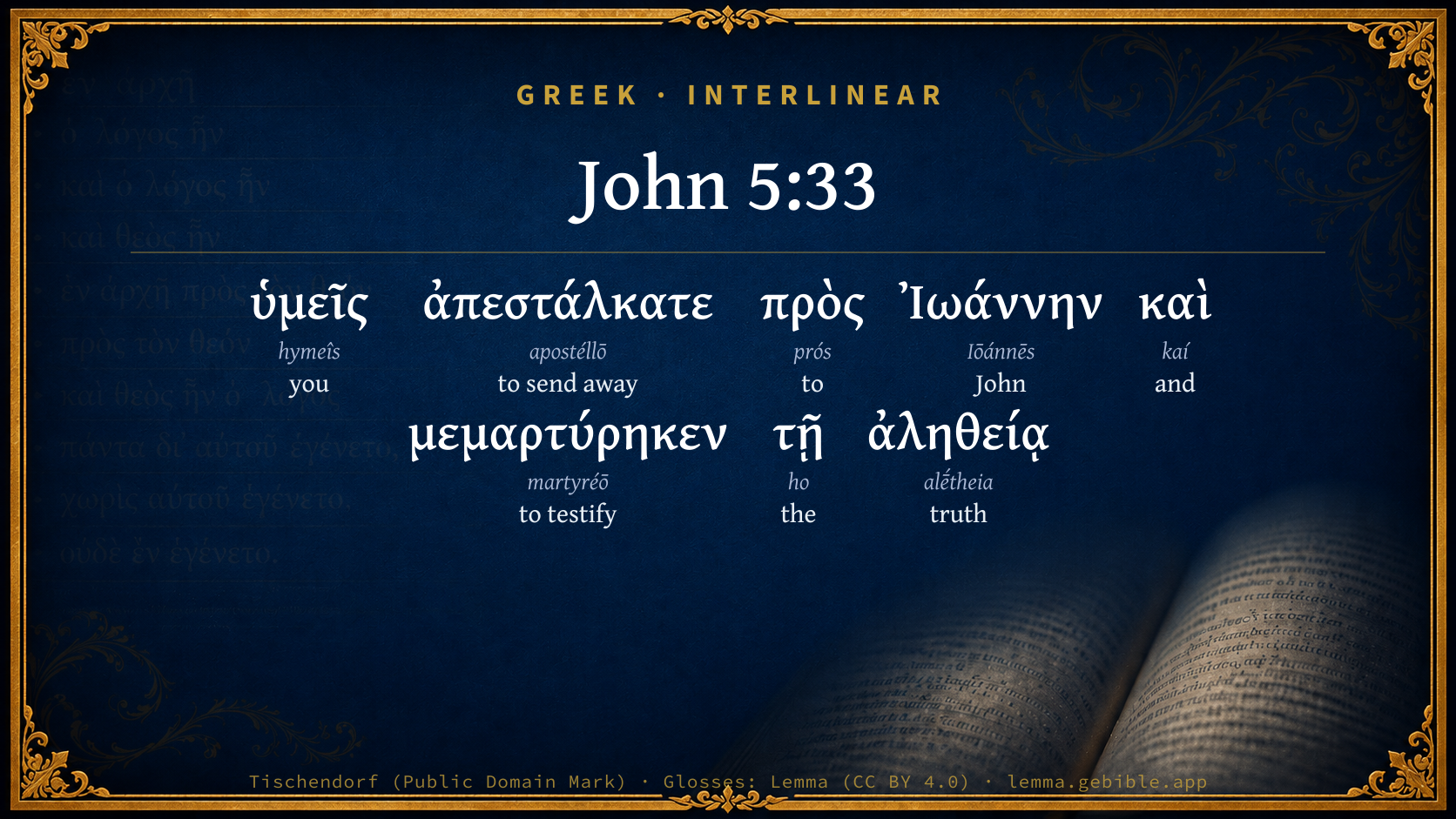
Greek (Tischendorf 8th ed.) John 5:33 appears in the Greek New Testament. The text above is from the Tischendorf 8th edition. Each word links to its Strong’s number and a concise gloss. Click any word for its full Thayer’s Greek Lexicon entry.
Download image
Cite this verse

John 5:33 (World English Bible). Public Domain. Lemma interlinear Bible study tool, https://lemma.gebible.app/v/john/5/33.

Show BibTeX & RIS
BibTeX
RIS
English Translation
You have sent to John, and he has testified to the truth.
World English Bible · Public Domain
Download a study sheet

One document with this verse’s original text, its word-by-word gloss line, the meaning frame, cross-references with their text, attributed commentary, and full source and license credits — printable, and it pastes into notes with its structure intact.

This verse Autodidact and up

Study sheet (.html) Plain text (.txt)

A passage Seminary Student

Up to 50 verses in one chapter. A passage sheet keeps up to 6 commentary sources and 12 cross-references per verse, in the order this page ranks them, and says so on the sheet whenever that leaves anything out. Ask for a single verse and you get the Autodidact verse sheet above.

Everything on this page stays free to read, with no account — the sheet is a download of what is already on screen, not access to it.

Want to remove ads? Support Godless Engineer
Compare translations 3

The same verse in 3 English versions, stacked beneath the original-language interlinear above. Click any original word for its lexicon entry.

Each is an independent rendering of the whole verse — the interlinear is not word-aligned to these translations.

Highlighted words mark where these versions differ — a whole-verse word diff, not a word-by-word alignment.

  • World English Bible Public Domain
    You have sent to John, and he has testified to the truth.
  • King James Version Public Domain
    Ye sent unto John, and he bare witness unto the truth.
  • unfoldingWord Literal Text CC BY-SA 4.0
    You have sent to John, and he has testified to the truth.

unfoldingWord Literal Text — © unfoldingWord, licensed CC BY-SA 4.0. Word-aligned USFM3 via Door43 (git.door43.org/unfoldingWord/en_ult).

Versions to compare (up to 4)

3 of 4 selected

Show all 19 translations

Every available English version of this verse, each an independent rendering of the whole verse.

  • World English Bible Public Domain
    You have sent to John, and he has testified to the truth.
  • Berean Standard Bible Public Domain
    You have sent to John, and he has testified to the truth.
  • Majority Standard Bible Public Domain
    You have sent to John, and he has testified to the truth.
  • King James Version Public Domain
    Ye sent unto John, and he bare witness unto the truth.
  • American Standard Version (1901) Public Domain
    Ye have sent unto John, and he hath borne witness unto the truth.
  • Revised Version (1885) Public Domain
    Ye have sent unto John, and he hath borne witness unto the truth.
  • Geneva Bible (1599) Public Domain
    Ye sent vnto Iohn, and he bare witnesse vnto the trueth.
  • Douay-Rheims (1899) Public Domain
    You sent to John, and he gave testimony to the truth.
  • Young's Literal Translation Public Domain
    ye have sent unto John, and he hath testified to the truth.
  • Literal Standard Version CC BY-SA 4.0
    you have sent to John, and he has testified to the truth.
  • Unlocked Literal Bible CC BY-SA 4.0
    You have sent to John, and he has testified the truth.
  • unfoldingWord Literal Text CC BY-SA 4.0
    You have sent to John, and he has testified to the truth.
  • Darby Bible Public Domain
    Ye have sent unto John, and he has borne witness to the truth.
  • World Messianic Bible Public Domain
    You have sent to Yochanan, and he has testified to the truth.
  • Webster's Bible Public Domain
    Ye sent to John, and he testified to the truth.
  • Free Bible Version CC BY-SA 4.0
    You asked John about me, and he told the truth,
  • Bible in Basic English Public Domain
    You sent to John and he gave true witness.
  • Text-Critical English NT CC BY 4.0
    You have sent to John, and he has testified to the truth.
  • Tyndale New Testament (1534) Public Domain
    Ye sent vnto Iohn and he bare witnes vnto the truthe.

Literal Standard Version (2020), Covenant Press — licensed CC BY-SA 4.0. Text via the HelloAO Bible API (eBible.org). Unlocked Literal Bible (unfoldingWord) — licensed CC BY-SA 4.0. Text via the HelloAO Bible API (eBible.org). unfoldingWord Literal Text — © unfoldingWord, licensed CC BY-SA 4.0. Word-aligned USFM3 via Door43 (git.door43.org/unfoldingWord/en_ult). Free Bible Version, Dr. Jonathan Gallagher — licensed CC BY-SA 4.0. Text via the HelloAO Bible API (eBible.org).

Word by word

More ways to search: Search by grammar → Find every occurrence → Compare this word →

Practice this passage: Drill this verse → Learn its vocabulary →

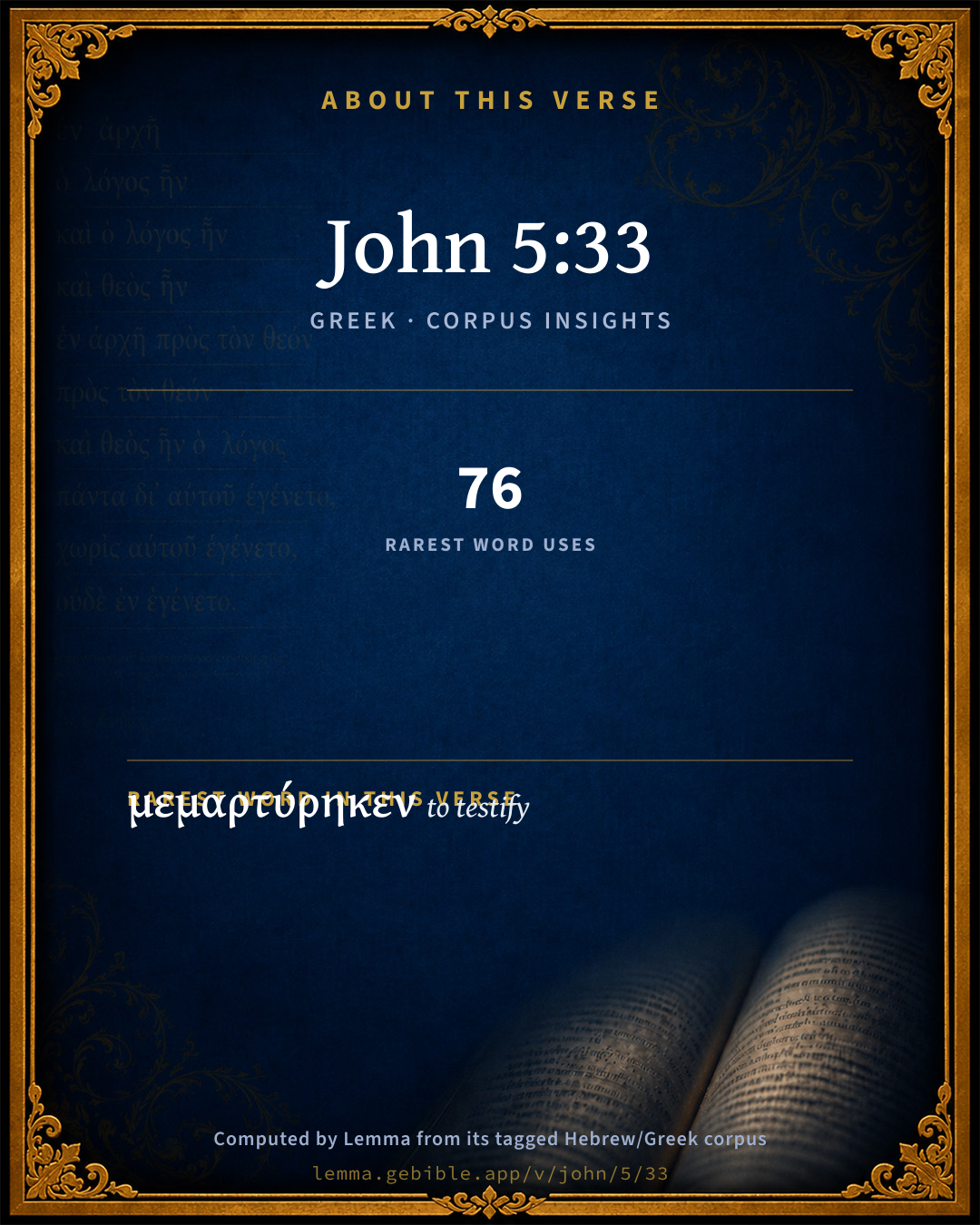
About this verse

These counts appear in no published source. They are computed here, from the morphology-tagged text and Lemma’s own curated glosses. What Lemma adds →

8
words
8
distinct lemmas
Gospels
section

Cross-references

4

Topical passages linked to John 5:33 in the Treasury of Scripture Knowledge — connected by theme and wording, ordered by reader-vote popularity; previews shown in the World English Bible.

  • John 1:6–8 There came a man, sent from God, whose name was John.
  • John 1:15–27 John testified about him. He cried out, saying, "This was he of whom I said, 'He who comes after me has surpassed me, for he was before me.'"
  • John 1:29–34 The next day, he saw Jesus coming to him, and said, "Behold, the Lamb of God, who takes away the sin of the world!
  • John 3:26–36 They came to John, and said to him, "Rabbi, he who was with you beyond the Jordan, to whom you have testified, behold, the same baptizes, and everyone is coming to him."

Cross-references courtesy of OpenBible.info (CC BY 4.0).

Commentary

Notes on John 5:33 from classic Christian and Jewish commentators (each source and its license shown beneath its notes). The classic Christian expositions comment on the surrounding passage and are grouped to its opening verse, so a note may address several verses; the Jewish commentaries on the Tanakh (Rashi and others) are per-verse, so they appear only where the commentator wrote on this verse.

Lemma curates 59 commentaries, every one of them public domain or Creative Commons licensed, each selected and text-cleaned for this edition rather than reprinted as found. About our sources →

Tyndale Open Study Notes

Tyndale Open Resources

5:33-35 Jesus’ second witness was John the Baptist, who pointed to Jesus as Messiah (1:29-34).

Tyndale Open Study Notes — © Tyndale Open Resources, licensed CC BY-SA 4.0. Text via the HelloAO Bible API.

Bengel's Gnomon

Johann Albrecht Bengel

Joh 5:33. Ὑμεῖς, ye) He shows how the Jews labour to fix their hopes anywhere, rather than on Christ Himself. I. Ye, saith He, having surmised that John is the Messiah, have sent to him, inquiring as to the truth: and truly John, when that opportunity was afforded him, bore witness to the truth, that not he, but I am the Messiah: but, etc. II. Ye, the same persons, think that you have in the Scriptures eternal life, and that nothing more is needed: on this account you are wont to search them; and not without good reason; for indeed they are they which testify of Me: but, etc. Here the Lord approves the things worthy of approval, both concerning John, and concerning the Scriptures; but He shows, that error and abuse on the part of the Jews were mixed up therewith; and He openly testifies, that His own authority, and that of His Father, is of itself greater, whereas the testimony of John and of the Scripture concerning Himself, the Christ, is only a subsidiary thing. The similar form of both paragraphs is to be observed:

Joh 5:33, etc.

Joh 5:39, etc.

ye:

ye:

and he bare witness:

and … which testify

but I … [Joh 5:34]:

[I] … honour [ver. 41]

but:

but … [Joh 5:42]

ye were willing for a season [Joh 5:35].

ye will not [Joh 5:40: answering to “ye receive Me not,” Joh 5:43].

Nor is the paragraph as to Moses, Joh 5:45-47, dissimilar in construction: Ye have your hope placed in Moses: but this very person is on My side against you.

Bengel's Gnomon of the New Testament — English translation (T&T Clark, Edinburgh, 1860) — public domain. Text from a community e-Sword module.

Meyer's Critical & Exegetical Commentary

Heinrich August Wilhelm Meyer

Joh_5:33-34. That witness, whose testimony you have yourselves elicited, John the Baptist, I do not accept, because it is a human testimony; I mention him for your salvation (not for my advantage), because ye have not appreciated him according to his high calling (Joh_5:35); the witness which I have is greater, etc. Joh_5:36.

ὑμεῖς] you, on your part.

μεμαρτ. τῇ ἀληθ.] Joh_1:19 ff. All that he said was testimony in favour of the truth; for the state of the case (with reference particularly to what he said of the Messiah) was as he testified.

ἐγὼ δὲ] but I on my part.

τὴν μαρτυρίαν] the witness in question, which is to tell for me. This I cannot receive from any man. Jesus will not avail Himself of any human witness in this matter; He puts it away from Him. Accordingly, λαμβ. τ. μαρτυρίαν, just as in Joh_3:11; Joh_3:32, is to be taken of the acceptance, not indeed believing acceptance, but acceptance as proof, conformably with the context. Others, unnecessarily deviating from Johns usage, I borrow (Lücke), I strive after, or lay hold of (B. Crusius, comp. Beza, Grotius), I snatch (de Wette).

ἵνα ὑμεῖς σωθῆτε] for your advantage, that you on your part (in opposition to any personal interest) may attain to salvation. They should take to heart the remembrance of the Baptists testimony (ταῦτα λέγω), and thus be roused to faith, and become partakers of the Messiahs redemption; vestra res agitur, Bengel.

Meyer — Critical and Exegetical Commentary on the New Testament — English translation by Peter Christie, edited by Frederick Crombie (T&T Clark, 1880) — public domain. Text from a community e-Sword module.

Expositor's Greek Testament

ed. W. Robertson Nicoll

Joh 5:33 . Before exhibiting the Father’s testimony Jesus meets them on their own ground: ὑμεῖς , ye yourselves, ἀπεστάλκατε πρὸς Ἰωάννην , sent, by the deputation mentioned chap. 1, to John; which they would not have done had they not thought him trustworthy (Euthymius). The perfect is used, indicating that the result continued; as the perfect μεμαρτύρηκε indicates that “the testimony preserves its value notwithstanding the disappearance of the witness”. τῇ ἀληθείᾳ to the truth, especially of the Messianic dignity of Jesus.

The Expositor's Greek Testament, edited by W. Robertson Nicoll (1897–1910) — public domain. Text from a community e-Sword module.

Godet's Commentaries

Frédéric Louis Godet

Vv. 33-35. “Ye have sent unto John, and he hath borne witness unto the truth. 34. But the witness which I receive, is not from man; and what I say unto you here, is to the end that ye may be saved. 35. He was the lamp that burneth and shineth; and ye were willing to rejoice for a season in his light.”

The testimony of John the Baptist had made so much noise that Jesus might suppose that, at the moment when He was saying: “I have another witness,” every one would think of that personage. Jesus rejects this supposition, but does so while calling attention to the fact that, from His hearers’ standpoint, the testimony of John should certainly be regarded as valid; for it was they themselves who had called it forth (an allusion to the deputation, Joh 1:19 ff.). The word you, ὑμεῖς, at the beginning of the verse, places the hearers in contrast to Jesus, who does not ask for human testimonies and contents himself with being able to allege that of the Father. The perfect μεμαρτύρηκε, hath borne witness, declares that the testimony of John preserves its value notwithstanding the disappearance of the witness (Joh 5:35 : he was, etc.). On this truth to which John bore witness, comp. Joh 1:20; Joh 1:27; Joh 1:29. The ἐγὼ δέ, but I, of Joh 5:34 forms an antithesis to the you of Joh 5:33.

This human testimony which they demanded, is not that by which Jesus supports the truth of His own, even though it was favorable to Him. But does Jesus regard the testimony of John the Baptist as purely human? Some interpreters escape the difficulty by translating οὐ λαμβάνω in the sense: “I do not seek” or “I am not ambitious of.” This is to strain the meaning of the expression, which merely means: I do not make use of it. It is enough if we take account of the article τήν before the word testimony; “the testimony,” means here: “that of which I have need, the only one which I would allege as confirmation of my own.” John’s testimony was designed to direct their eyes to the light; but, when once the light had appeared, it gave place to the direct testimony of God Himself. That testimony was, indeed, the fruit of a revelation; but, as Keil says, this inspiration, passing through human lips, might be called in question. Nevertheless, Jesus recalls, in passing, this testimony of John. It is the care which He has for their souls, which does not permit Him to pass it over in silence: “If I recall it, it is to the end that you (ὑμεῖς) may profit by it unto salvation. It is, then, for you, not for me.”

The 35th verse expresses the transitory character of the appearance of John the Baptist. John was not the light, the sun (Joh 1:8); but he was the torch, lighted by God for giving light before the day came. The article the before the word torch has been explained in many ways. Bengel finds here an allusion to Sir 48:1 : “the word (of Elijah)shone as a torch.” Luthardt believes that John is compared to the well-known torch-bearer, who ordinarily preceded the bridegroom in the marriage feasts. Meyer, Weiss, Keil, understand: the true torch which is designed to show the path. Perhaps there is an allusion to that single light which was lighted at night to illumine the house (Mar 4:21). We might see in the two epithets: which burneth and shineth, only this one idea: which is consumed in shining. But it is more simple to find here the two conditions of the usefulness of the light: to be lighted and not to be covered (Weiss). The imperfect ἦν, was, proves that, at the moment when Jesus was speaking, the light was already covered. For there is evidently an allusion in this past tense to the imprisonment of John the Baptist. The second part of the verse: Ye were willing ...., continues the figure. Jesus compares the Jews to children who, instead of making use of the precious moments during which the light shines, do nothing but frolic in its brightness. To rejoice is contrasted with to be saved, Joh 5:34. It wasimpossible better to characterize the vain and puerile curiosity, with which the people were infatuated by an appearance so extraordinary. Comp. Luk 7:24 : “What went ye out into the wilderness to see?” Weiss thinks that Jesus meant to indicate the hopes which had at first been excited in the rulers by this appearance. Can this be in accordance with Luk 7:30?— ᾿Ηθελήσατε : you pleased yourselves with ...

Frédéric Louis Godet — Commentaries on Luke, John, Romans, and 1 Corinthians — English translation (T&T Clark, Edinburgh, 1870s–1890s) — public domain. Text from a community e-Sword module.

Geneva Bible (1599)

Geneva Bible translators

Christ is declared to be the only Savior by John’s voice, and infinite miracles, and by the testimonies of all the Prophets. But the world notwithstanding being addicted to false prophets, and desirous to seem religious, seeth none of all these things.

Geneva Bible (1599) marginal notes — public domain. Text via Bolls.life.

Jamieson, Fausset & Brown

Robert Jamieson, A. R. Fausset & David Brown

Ye sent unto John--(See Joh 1:19, &c.).

receive not testimony . . . from man--that is, depend not on human testimony.

but . . . that ye might be saved--"I refer to him merely to aid your salvation."

Jamieson, Fausset & Brown — Commentary Critical and Explanatory on the Whole Bible (1871) — public domain (CC PDM 1.0). Text via the HelloAO Bible API.

Adam Clarke's Commentary

Verse 33. Ye sent unto John] I am not without human testimony of the most respectable kind:-Ye sent to John, and he bare witness. There are several circumstances in John's character which render his testimony unexceptionable.

1. He is consulted by the very enemies of Christ, as a very holy and extraordinary man.

2. He is perfectly free from all self-interest, having declined making the least advantage by his own reputation.

3. He is sincere, undaunted, and so averse from all kinds of flattery that he reproves Herod at the hazard of his liberty and life.

4. He was so far from being solicited by Christ to give his testimony that he had not even seen him when he gave it. See Joh 1:19-28.

Adam Clarke's Commentary on the Bible (1810–1826) — public domain. Text from a community e-Sword/MySword module.

John Calvin's Commentaries

33. You sent to John. Before producing the testimony of God, he presses them with the answer of John, from which they could not honorably withhold their belief. For of what use was it to send to him, if they did not intend to abide by his words? They send to him as a Prophet of God, and thus they pretend that his word will be regarded by them as an oracle. Now, though this implies another admission in their favor, still Christ openly brings against them this charge, that nothing but their own malice hinders them from believing. And, therefore, we see that this circumstance is highly appropriate to the matter in hand, namely, that they sent to John, and — as if their motive had been a desire to learn — inquired at him who was the Messiah, and yet paid no attention to his reply.

John Calvin's Commentaries (1540-1563) — public domain. Text from the Calvin Translation Society English edition (1840s-50s) via the Christian Classics Ethereal Library (ccel.org). Calvin's coverage is partial (roughly two-thirds of the Bible); uncommented books and verses are honest gaps, never fabricated. The 19th-century editor's footnotes and remarks are omitted so the notes are faithfully Calvin's own voice.

Ellicott's Commentary for English Readers

(33) Ye sent . . .—Both verbs are perfects. Better, therefore, Ye have sent; He hath borne witness. The pronoun “ye” is emphatically opposed to the “I” of the following verse. They sought human witness. He had witness which was divine. The object of John’s mission was to bear witness of the Light (Joh_1:7), and this he did to them (Joh_1:19 et seq.)

A Bible Commentary for English Readers, edited by Charles John Ellicott (1878–1897) — public domain. Text from a community e-Sword module.

The Cambridge Bible for Schools and Colleges

gen. ed. J. J. S. Perowne

33. Ye sent unto John, and he bare witness] Better, Ye have sent unto John, and he hath borne witness. ‘What ye have heard from him is true; but I do not accept it, for I need not the testimony of man. I mention it for your sakes, not My own. If ye believe John ye will believe Me and be saved.’ ‘Ye’ and ‘I’ in these two verses (33, 34) are in emphatic opposition.

The Cambridge Bible for Schools and Colleges (gen. ed. J. J. S. Perowne; Cambridge University Press, 1878–1918) — public domain. Text from a community e-Sword module.

John Gill's Exposition

Ye sent unto John,.... The sanhedrim at Jerusalem made a deputation of priests and Levites to him, to know who he was, whether the Messiah, or Elias, or that prophet, Joh 1:19. Now had they not looked upon him, from what they knew of him, or from the character they had of him, as a faithful witness, they would never have shown him so much respect, and have been at so much pains, and charge, as to send such a body of men so far unto him, as from Jerusalem to beyond Jordan; which circumstance our Lord improves in favour of this evidence he produces:

and he bare witness unto the truth; to Christ, who is the truth itself; and to the truth of his person, and office; to his dignity, and eternity, as being before him, though coming after him; and to his divine sonship, the thing now in debate, declaring, that he was the Son of God; and to his office, as Mediator, pointing to him as the Lamb of God, who, by his blood, and sacrifice, takes away the sins of men. The Ethiopic version reads by way of interrogation, "did not you send unto John?" &c.

John Gill's Exposition of the Whole Bible (1746–1763) — public domain (CC PDM 1.0). Text via the HelloAO Bible API.

Trapp's Complete Commentary

John Trapp

33 Ye sent unto John, and he bare witness unto the truth.

Ver. 33. Ye sent unto John] As unto an oracle: but when his answer pleased you not, you rejected it, of mere obstinace and malice to my person and office. There is an odious unthankfulness in unbelief: for it rebelleth against the light, rejecteth the medicine, refuseth to be reformed, hateth to be healed. Wine is a strong remedy against hemlock; yet mingled with it, doubleth the force of the poison. So it is with the Word of life when mingled with unbelief.

John Trapp, A Commentary or Exposition upon All the Books of the Old and New Testament (1647–1656) — public domain. Text from a community e-Sword module.

Albert Barnes' Notes on the Bible

Ye sent unto John - See Joh 1:19.

He bare witness ... - See Joh 1:26, Joh 1:29, Joh 1:36. This testimony of John ought to have satisfied them. John was an eminent man; many of the Pharisees believed on him; he was candid, unambitious, sincere, and his evidence was impartial. On this Jesus might have rested the proof that he was the Messiah, but he was willing, also, to adduce evidence of a higher order.

Albert Barnes' Notes on the Bible (1834–1885) — public domain. Text from a community e-Sword/MySword module.

Matthew Poole's English Annotations

Ye sent priests and Levites from Jerusalem to John, Joh 1:29; he was a man of reputation among you, for all the people judged him a prophet; and he had an interest in Herod’s court:

he bare witness (he doth not say to me, but) to the truth.

Matthew Poole's English Annotations on the Holy Bible (1683–1685) — public domain. Text from a community e-Sword/MySword module.

Whedon's Commentary on the Bible

Daniel D. Whedon

33. Ye sent unto John—Our Lord quotes John, first, as a witness whose testimony they have once acknowledged. Here is an argument from their concession.

He bare witness—You were ready to take his assurance that he was Messiah; but lo! he balked you by testifying to me.

Daniel D. Whedon (gen. ed.), Commentary on the Old and New Testaments (1874–1909) — public domain. Text from a community e-Sword module.

The Pulpit Commentary

Vers. 33-35. (b) The temporary witness of John.

Ye have sent to John, and he hath borne witness to the truth. The sending to John was probably a reference to the official transaction described in Joh_1:19. This is not the "other" whom he referred to, for in the next clause he made solemn disclaimer of resting his claim upon John or upon any individual man. The witness of the forerunner was a true one. The function of the prophet is to bear witness to the Light, to strip off the veils which hide it, to call attention to its most solemn realities, to quicken vision, to stimulate conscience, to disturb apathy, to discern the coming and prepare the way of the Lord, (see Joh_1:4, Joh_1:5, notes) He was not the Light; but he did call attention to a testimony immeasurably more precious than any word proceeding merely from human lips. The testimonies of John, both before and after he came into contact with Christ, were very wonderful and were adapted to exert and did produce a deep impression upon the people for a time; but by themselves they would not have given sufficient ratification to the Lord"s words. We may welcome still all Johannine, ministerial testimonies to the Lord. but the power of God himself must assert itself to the inner consciousness bet, re any man receives the gospel. No mere human testimony to such claims as these rises to the dignity of the occasion. Unless the Father"s witness can be discerned, supreme, convincing, and final, John"s witness would be insufficient. It may arrest attention, it may impress the apathetic, it may overawe the gainsayers; but it is not final, nor does it leave the hearers without excuse. All the rhetoric, all the threatening, all the irony, of Elijah would have failed if the fire of the Lord had not fallen to consume the sacrifice.

The Pulpit Commentary (1880–1919), ed. H.D.M. Spence-Jones & Joseph S. Exell — public domain. Text from a community e-Sword module.

John Wesley's Explanatory Notes

He bare testimony - That I am the Christ.

John Wesley, Explanatory Notes Upon the Whole Bible (1754–1765) — public domain. Text via the GEBible commentary corpus.

Burkitt's Expository Notes on the New Testament

William Burkitt

The second testimony to prove Christ to be the Messias, was that of John the Baptist. We read, Joh 1:19 how the Jews were sent to enquire of him, whether he were the Christ, or not; and he denied it, and pointed at Jesus, saying, Behold the Lamb of God; yet would not the Jews abide by this testimony of John concerning the Messias. Nevertheless, says Christ, I receive not testimony from John; that is, "John by his testimony added nothing to me; I was what I was, and I am what I am, before John testified of me, and since."

Learn hence, That the divinity of Christ’s person, and the verity of his doctrine, needs no man’s testimony for the confirmation of it, being sufficiently confirmed by Christ’s own authority, and his Father’s testimony; I receive nothing from man; that is, "I need it not, I desire it not upon my own account, but upon yours only, that upon the credit of John’s testimony ye might believe in me, and be saved by me; These things I say, that ye might be saved.

William Burkitt's Expository Notes on the New Testament (1700–1703) — public domain. Text from a community e-Sword module.

The People's New Testament

B. W. Johnson

33. Ye sent to John. See 1:19–38.

B. W. Johnson's The People's New Testament with Notes (1889–1891) — public domain. Electronic text from the Christian Classics Ethereal Library (CCEL) ThML edition.

unfoldingWord translationNotes

Door43 World Missions Community

the testimony that I receive is not from man

"I do not need people's testimony"

that you might be saved

You can translate this in an active form. AT: "so God can save you" (See: Active or Passive)

John was a lamp that was burning and shining, and you were willing to rejoice in his light for a while

Here "lamp" and "light" are metaphors. John taught the people about God and this was like a lamp shining its light into the dark. AT: "John taught you about God and this was like a lamp shining its light. And for a while what John said made you happy" (See: Metaphor)

translationWords

John (the Baptist)

testimony

true

receive

save

lamp

joy

unfoldingWord translationNotes — © Distant Shores Media and the Door43 World Missions Community, licensed CC BY-SA 4.0. Source: git.door43.org/Door43/en_tn.

Cambridge Greek Testament for Schools and Colleges

33. ἀπεστάλκ.… μεμαρτ. Ye have sent unto J., and he hath borne witness. The perfects express the abiding results of past actions. ‘What ye have heard from him is true; but I do not accept it; the testimony which I accept comes not from man. I mention it for your sakes, not My own. If ye believe John ye will believe Me and be saved.’ ‘Ye’ and ‘I’ in these two verses (33, 34) are in emphatic opposition. Note the article before μαρτυρίαν.

Cambridge Greek Testament for Schools and Colleges (Cambridge University Press, 1896; 21 vols, various authors incl. Carr, Maclear, Plummer, Farrar, Lumby, Moule, M. R. James, Simcox) — public domain. Text from a community e-Sword module.

Alford’s Greek Testament

Henry Alford

33.] See ch. 1:19. The connexion is,—another testifies of Me (ver. 32)—‘not John only, although he, when sent to, did certainly testify to the truth; for’ &c.

τῇ ἀληθείᾳ, not merely (Grot.) “modeste dictum;”—but necessarily. ἐμοί would have been asserting what the next verse denies.

Henry Alford, The Greek Testament (1849–1861) — public domain. Text from a community e-Sword module.

International Critical Commentary

33. ὑμεῖς ἀπεστάλκατε πρὸς Ἰωάνην, “Ye sent to John” (cf. 1:19), and his witness was trustworthy, καὶ μεμαρτύρηκεν τῇ ἀληθείᾳ, as was the purpose of his mission (1:7), a purpose which was also that of the mission of Jesus Himself (18:37).

International Critical Commentary — older volumes (1896–1929), various authors — public domain. Text from a community e-Sword module.

Vincent's Word Studies in the New Testament

Marvin R. Vincent

Ye sent. Rev., rightly, have sent. The perfect tense, with allusion to something abiding in its results. Similarly, bare witness should be hath born. Note the expressed ye [υμεις] , emphatically marking the contrast between the human testimony which the Jews demanded, and the divine testimony on which Jesus relies (ver. 34).

Marvin R. Vincent, Word Studies in the New Testament (1887–1900) — public domain. Text from a community e-Sword/MySword module.

Lesson kit

Teaching starters — assembled from the data on this page, not authored interpretation. Every prompt links to the verse data it draws on. Edit before teaching.

John, in the Gospels, opens this verse with 8 words (8 distinct Greek lemmas). Its most distinctive word is martyréō (“to testify”). A historical commentator’s framing appears above. Read the whole chapter for the surrounding context.

Discussion questions

  1. The word martyréō carries the sense “to testify.” How does it shape the verse?
  2. John 1:6–8 shares this passage’s theme. How do the two illuminate each other?
  3. The translations on this page render this verse differently — a whole-verse word diff, not a word-by-word alignment. What might account for the different wordings?
  4. Reading how Tyndale Open Study Notes and Bengel's Gnomon read this verse, where do the two commentators agree and where do they part?

Things to notice

Reading settings

Reading text

Shown beneath each verse's original-language words.

Old Testament
Old Testament edition

Read the OT as the Masoretic Hebrew (MT) or the Greek Septuagint (LXX).

English shown for the Greek Septuagint (in the Hebrew ↔ Greek comparison).

Comparing translations? Open the Compare panel on any verse page to stack up to four side by side.