
Genesis 32:19

Hebrew (Westminster Leningrad Codex) Genesis 32:19 appears in the Hebrew Old Testament. The text above is from the Westminster Leningrad Codex. Each word links to its Strong’s number, a concise gloss, and parsing drawn from the Open Scriptures Hebrew Bible morphology. Click any word for its full Brown-Driver-Briggs (BDB) entry.
Download image
Cite this verse

Genesis 32:19 (World English Bible). Public Domain. Lemma interlinear Bible study tool, https://lemma.gebible.app/v/genesis/32/19.

Show BibTeX & RIS
BibTeX
RIS
English Translation
He commanded also the second, and the third, and all that followed the herds, saying, "This is how you shall speak to Esau, when you find him.
World English Bible · Public Domain
Download a study sheet

One document with this verse’s original text, its word-by-word gloss line, the meaning frame, cross-references with their text, attributed commentary, and full source and license credits — printable, and it pastes into notes with its structure intact.

This verse Autodidact and up

Study sheet (.html) Plain text (.txt)

A passage Seminary Student

Up to 50 verses in one chapter. A passage sheet keeps up to 6 commentary sources and 12 cross-references per verse, in the order this page ranks them, and says so on the sheet whenever that leaves anything out. Ask for a single verse and you get the Autodidact verse sheet above.

Everything on this page stays free to read, with no account — the sheet is a download of what is already on screen, not access to it.

Want to remove ads? Support Godless Engineer
Compare translations 3

The same verse in 3 English versions, stacked beneath the original-language interlinear above. Click any original word for its lexicon entry.

Each is an independent rendering of the whole verse — the interlinear is not word-aligned to these translations.

Highlighted words mark where these versions differ — a whole-verse word diff, not a word-by-word alignment.

  • World English Bible Public Domain
    He commanded also the second, and the third, and all that followed the herds, saying, "This is how you shall speak to Esau, when you find him.
  • King James Version Public Domain
    And so commanded he the second, and the third, and all that followed the droves, saying, On this manner shall ye speak unto Esau, when ye find him.
  • unfoldingWord Literal Text CC BY-SA 4.0
    Then he also commanded the second, also the third, also all who followed behind the herds, saying, “Say the same thing to Esau when you find him.

unfoldingWord Literal Text — © unfoldingWord, licensed CC BY-SA 4.0. Word-aligned USFM3 via Door43 (git.door43.org/unfoldingWord/en_ult).

Versions to compare (up to 4)

3 of 4 selected

Show all 18 translations

Every available English version of this verse, each an independent rendering of the whole verse.

  • World English Bible Public Domain
    He commanded also the second, and the third, and all that followed the herds, saying, "This is how you shall speak to Esau, when you find him.
  • Berean Standard Bible Public Domain
    He also instructed the second, the third, and all those following behind the herds: “When you meet Esau, you are to say the same thing to him.
  • Majority Standard Bible Public Domain
    He also instructed the second, the third, and all those following behind the herds: “When you meet Esau, you are to say the same thing to him.
  • King James Version Public Domain
    And so commanded he the second, and the third, and all that followed the droves, saying, On this manner shall ye speak unto Esau, when ye find him.
  • American Standard Version (1901) Public Domain
    And he commanded also the second, and the third, and all that followed the droves, saying, On this manner shall ye speak unto Esau, when ye find him;
  • Revised Version (1885) Public Domain
    And he commanded also the second, and the third, and all that followed the droves, saying, On this manner shall ye speak unto Esau, when ye find him;
  • Geneva Bible (1599) Public Domain
    So likewise commanded he the seconde and the thirde, and all that followed the droues, saying, After this maner, ye shall speake vnto Esau, when ye finde him.
  • Douay-Rheims (1899) Public Domain
    In like manner he commanded the second and the third, and all that followed with the droves, saying: Speak ye the same words to Esau, when ye find him.
  • Young's Literal Translation Public Domain
    And he commandeth also the second, also the third, also all who are going after the droves, saying, `According to this manner do ye speak unto Esau in your finding him,
  • Literal Standard Version CC BY-SA 4.0
    And he commands also the second, also the third, also all who are going after the droves, saying, “According to this manner do you speak to Esau in your finding him,
  • Unlocked Literal Bible CC BY-SA 4.0
    Jacob also gave instructions to the second group, the third, and all the men who followed the herds. He said, “You will say the same thing to Esau when you meet him.
  • unfoldingWord Literal Text CC BY-SA 4.0
    Then he also commanded the second, also the third, also all who followed behind the herds, saying, “Say the same thing to Esau when you find him.
  • Darby Bible Public Domain
    And so commanded he the second, and the third, and all that followed the droves, saying, According to this word shall ye speak to Esau when ye find him.
  • World Messianic Bible Public Domain
    He commanded also the second, and the third, and all that followed the herds, saying, “This is how you shall speak to Esau, when you find him.
  • Webster's Bible Public Domain
    And so he commanded the second, and the third, and all that followed the droves, saying, In this manner shall ye speak to Esau, when ye find him.
  • Free Bible Version CC BY-SA 4.0
    He gave the same instructions to those with the second and third and all the subsequent herds, telling them, “This is what you are to say to Esau when he meets you.
  • Bible in Basic English Public Domain
    And he gave the same orders to the second and the third and to all those who were with the herds, saying, This is what you are to say to Esau when you see him;
  • JPS Tanakh (1917) Public Domain
    (32-20) And he commanded also the second, and the third, and all that followed the droves, saying: 'In this manner shall ye speak unto Esau, when ye find him;

Literal Standard Version (2020), Covenant Press — licensed CC BY-SA 4.0. Text via the HelloAO Bible API (eBible.org). Unlocked Literal Bible (unfoldingWord) — licensed CC BY-SA 4.0. Text via the HelloAO Bible API (eBible.org). unfoldingWord Literal Text — © unfoldingWord, licensed CC BY-SA 4.0. Word-aligned USFM3 via Door43 (git.door43.org/unfoldingWord/en_ult). Free Bible Version, Dr. Jonathan Gallagher — licensed CC BY-SA 4.0. Text via the HelloAO Bible API (eBible.org).

Word by word

More ways to search: Search by grammar → Find every occurrence → Compare this word →

Practice this passage: Drill this verse → Learn its vocabulary →

הָעֲדָרִ֖ים
ʻêder
H5739
“the · flocks”
Particle, Definite Article + Noun, Common, Masculine, Plural, Absolute
Part of Speech
Particle + Noun
Type
Common
Gender
Masculine
Number
Plural
State
Absolute
Full BDB Definition

Origin: from H5737

TWOT: 1572a

flock, herd - flock - herds, flocks and herds
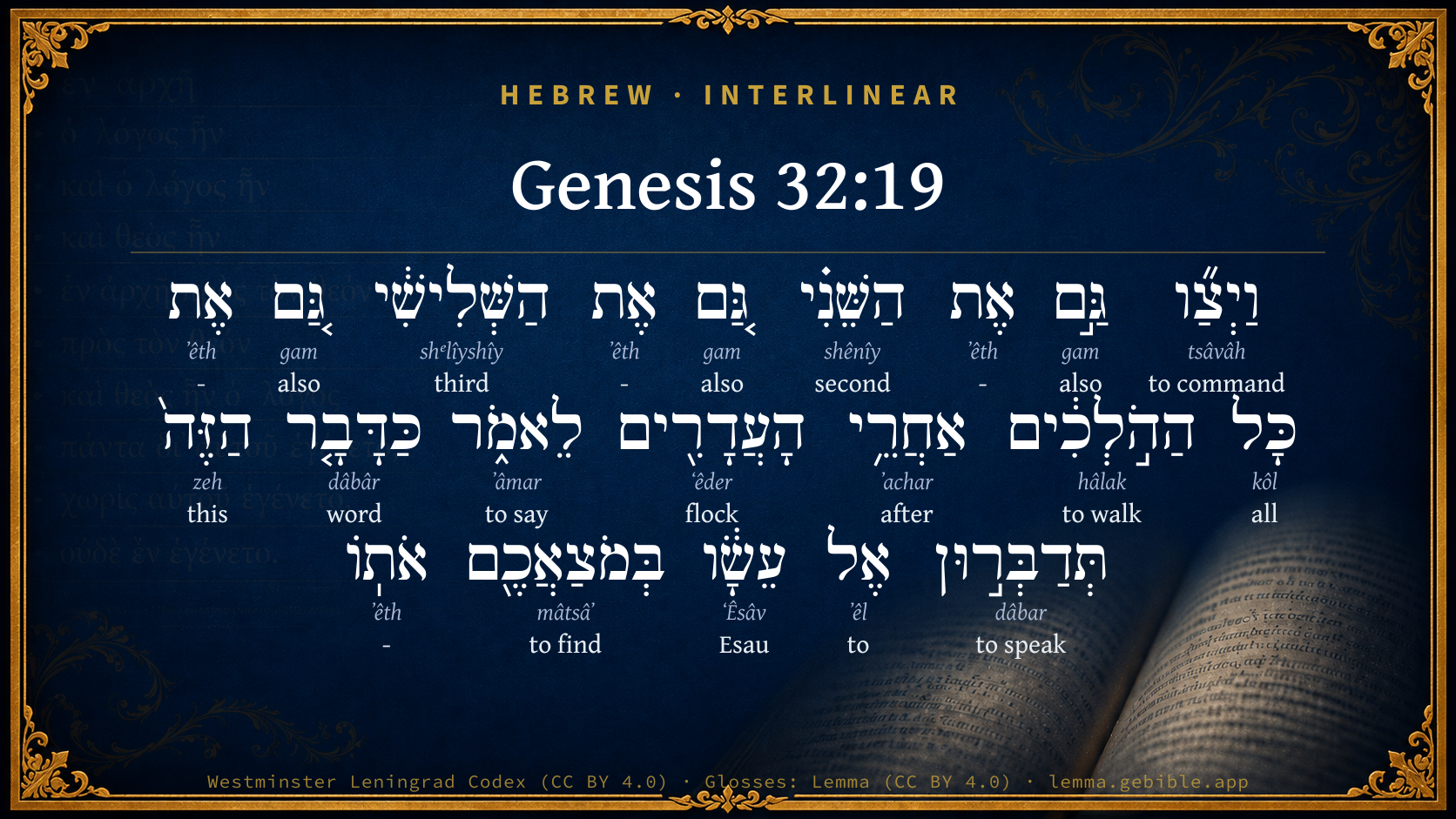
  1. וַיְצַ֞ו tsâvâh H6680 “and · to command” Conjunction + Verb, Piel, Sequential Imperfect, 3rd Person, Masculine, Singular
  2. גַּ֣ם gam H1571 “also” Particle, Accusative
  3. אֶת ʼêth H853 “-” Particle, Direct Object
  4. הַשֵּׁנִ֗י shênîy H8145 “the · second” Particle, Definite Article + Adjective, Ordinal number, Masculine, Singular, Absolute
  5. גַּ֚ם gam H1571 “also” Particle, Accusative
  6. אֶת ʼêth H853 “-” Particle, Direct Object
  7. הַשְּׁלִישִׁ֔י shᵉlîyshîy H7992 “the · third” Particle, Definite Article + Adjective, Ordinal number, Masculine, Singular, Absolute
  8. גַּ֚ם gam H1571 “also” Particle, Accusative
  9. אֶת ʼêth H853 “-” Particle, Direct Object
  10. כָּל kôl H3605 “all of” Noun, Common, Masculine, Singular, Construct
  11. הַהֹ֣לְכִ֔ים hâlak H1980 “the · walking” Particle, Definite Article + Verb, Qal, Participle Active, Masculine, Plural, Absolute
  12. אַחֲרֵ֥י ʼachar H310 “after” Preposition
  13. לֵאמֹ֑ר ʼâmar H559 “to say” Preposition + Verb, Qal, Infinitive Construct
  14. כַּדָּבָ֤ר dâbâr H1697 “like/as the · word” Preposition, Determined + Noun, Common, Masculine, Singular, Absolute
  15. הַזֶּה֙ zeh H2088 “the · this” Particle, Definite Article + Pronoun, Demonstrative, Masculine, Singular
  16. תְּדַבְּר֣וּן dâbar H1696 “to speak” Verb, Piel, Imperfect, 2nd Person, Masculine, Plural + Suffix, n
  17. אֶל ʼêl H413 “to” Preposition
  18. עֵשָׂ֔ו ʻÊsâv H6215 “Esau” Noun, Proper
  19. בְּמֹצַאֲכֶ֖ם mâtsâʼ H4672 “in/at · to find · you” Preposition + Verb, Qal, Infinitive Construct + Suffix, Personal, 2nd Person, Masculine, Plural
  20. אֹתֽוֹ ʼêth H853 “- · him” Particle, Direct Object + Suffix, Personal, 3rd Person, Masculine, Singular

About this verse

These counts appear in no published source. They are computed here, from the morphology-tagged text and Lemma’s own curated glosses. What Lemma adds →

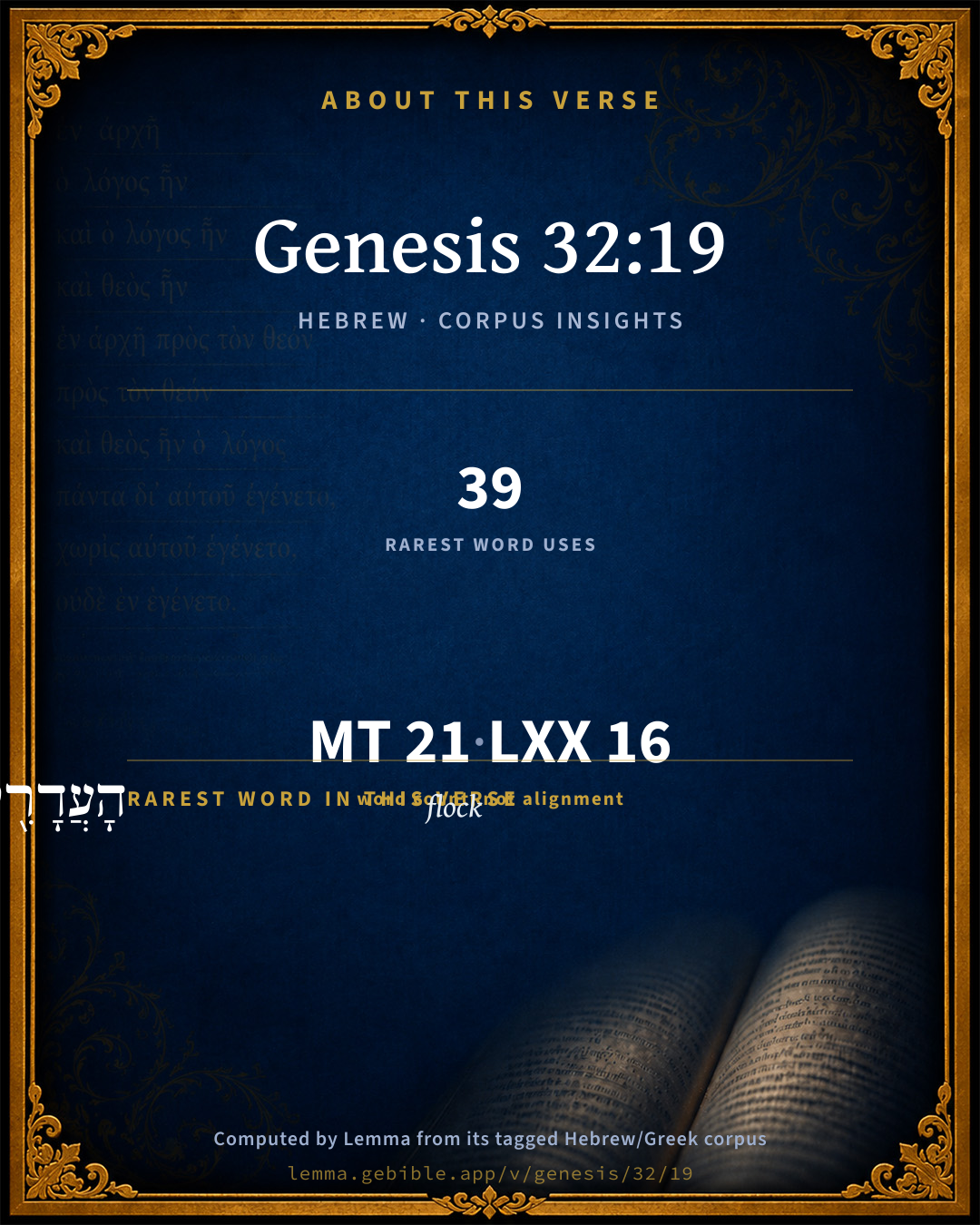
21
words
16
distinct lemmas
Pentateuch
section

Shared distinctive vocabulary

הָעֲדָרִ֖ים flock H5739 occurs in 34 verses of the Hebrew Bible. Also found in:

Grammatical profile

  • 5 verbs
  • 4 nouns
  • 2 adjectives
  • 1 pronoun
  • 2 prepositions
  • 7 particles

Verb forms

  • וַיְצַ֞ו Piel · Sequential Imperfect
  • הַהֹ֣לְכִ֔ים Qal · Participle Active
  • לֵאמֹ֑ר Qal · Infinitive Construct
  • תְּדַבְּר֣וּן Piel · Imperfect
  • בְּמֹצַאֲכֶ֖ם Qal · Infinitive Construct

Repetition

A word recurs within this verse — often emphatic in Hebrew:

  • גַּ֣ם also H1571 ×3

Hebrew & Septuagint length

In English translation the verse runs 27 words from the Hebrew and 31 from the Septuagint (LXX English) — closely comparable.

A rough comparison of the two English renderings, which tokenize alike — not a word-level alignment.

Word counts can differ between the Hebrew and the Greek without any difference in meaning — e.g. the Hebrew direct-object marker אֵת has no separate Greek word, and Greek often adds the article ὁ.

In the original languages it is 21 Hebrew tokens and 16 Greek tokens — but the two are counted differently (Hebrew bundles its prefixes and suffixes into one token; the Greek is in lemma form), so that isn’t a like-for-like length.

Hebrew and Greek witnesses Masoretic Hebrew ↔ Greek Septuagint

The same verse in the two great witnesses to the Old Testament, shown verse-for-verse.

These are two independent witnesses, not word-aligned to each other, and the Septuagint is shown in lemma (dictionary) form.

Hebrew Genesis 32:19 Masoretic · Westminster Leningrad Codex

וַיְצַ֞ו גַּ֣ם אֶת הַשֵּׁנִ֗י גַּ֚ם אֶת הַשְּׁלִישִׁ֔י גַּ֚ם אֶת כָּל הַהֹ֣לְכִ֔ים אַחֲרֵ֥י הָעֲדָרִ֖ים לֵאמֹ֑ר כַּדָּבָ֤ר הַזֶּה֙ תְּדַבְּר֣וּן אֶל עֵשָׂ֔ו בְּמֹצַאֲכֶ֖ם אֹתֽוֹ

He commanded also the second, and the third, and all that followed the herds, saying, "This is how you shall speak to Esau, when you find him.

World English Bible · Public Domain

Greek LXX Genesis 32:19 Septuagint · lemma form

εἶπον ὁ παῖς σύ ἰακώβ δῶρον ἀποστέλλω ὁ κύριος ἐγώ ησαυ καί ἰδού αὐτός ὀπίσω ἐγώ

And he charged the first and the second and the third, and all that went before him after these flocks, saying, Thus shall you⌃ speak to Esau when you⌃ find him;

LXX2012 (modern English Septuagint) · Public Domain

Hebrew: Westminster Leningrad Codex (CC BY 4.0). Greek: Septuagint (public domain); English from LXX2012 (modern English Septuagint) (Public Domain). How the Septuagint differs from the Hebrew →

Targum (Aramaic paraphrase)

2

The Targum is the ancient Jewish Aramaic paraphrase of the Hebrew Scriptures — an interpretive translation, not the Hebrew text itself. Onkelos (literal) and Pseudo-Jonathan (expansive) render the Torah, and Jonathan the Prophets. Coverage is partial: where no permissively-licensed English translation exists for a verse, only the Aramaic is shown. This is verse-level text, not a word-by-word alignment to the Hebrew.

  1. Targum Onkelos Torah (Genesis–Deuteronomy)
    וְתֵימַר לְעַבְדָךְ לְיַעֲקֹב תִּקְרֻבְתָּא הִיא דִמְשַׁלְּחָא לְרִבּוֹנִי לְעֵשָׂו וְהָא אַף הוּא אָתֵי בַתְרָנָא

    (no public-domain English translation for this verse)

    Targum Onkelos — Aramaic: “Onkelos Genesis” (public domain); “Onkelos Exodus” (public domain); “Onkelos Leviticus” (public domain); “Onkelos Numbers” (public domain); “Onkelos Deuteronomy” (public domain). English: “Sefaria Community Translation” (CC0 1.0 (public-domain dedication)); “J.W. Etheridge. The Targums of Onkelos and Jonathan Ben Uzziel on the Pentateuch. London: Longmans, Green, 1862” (public domain). Text via Sefaria.

  2. Targum Pseudo-Jonathan Torah (Genesis–Deuteronomy)
    וְתֵימַר לְעַבְדָךְ לְיַעֲקב דוֹרוֹן הוּא דְמִשְׁתַּלְחָא לְרִבּוֹנִי לְעֵשָו וְהָא אוּף הוּא אָתֵי בַּתְרָן

    Thou shalt say it is a gift of thy servant Jakob, which he sends to my lord Esau, and, behold, he also cometh after us.

    Targum Pseudo-Jonathan — Aramaic: “Targum Jonathan on Genesis” (public domain); “Targum Jonathan on Exodus” (public domain); “Targum Jonathan on Leviticus” (public domain); “Targum Jonathan on Numbers” (public domain); “Targum Jonathan on Deuteronomy” (public domain). English: “The Targum of Jonathan ben Uzziel, trans. J. W. Etheridge, London, 1862” (public domain). Text via Sefaria.

Commentary

Notes on Genesis 32:19 from classic Christian and Jewish commentators (each source and its license shown beneath its notes). The classic Christian expositions comment on the surrounding passage and are grouped to its opening verse, so a note may address several verses; the Jewish commentaries on the Tanakh (Rashi and others) are per-verse, so they appear only where the commentator wrote on this verse.

Lemma curates 59 commentaries, every one of them public domain or Creative Commons licensed, each selected and text-cleaned for this edition rather than reprinted as found. About our sources →

John Gill's Exposition

And so commanded he the second and third,.... Those who had the care of the second and third droves, he ordered them to say the same things, and in the same words as he had the first:

and all that followed the droves; either all that were with the principal driver; that if any of them should happen to be interrogated first, they might know what to answer; or those that followed the other droves, besides the three mentioned, which countenances Aben Ezra's notion of five droves, before observed:

saying, on this manner shall you speak to Esau, when you find him; that is, when they met him and perceived it was he that put questions to them.

John Gill's Exposition of the Whole Bible (1746–1763) — public domain (CC PDM 1.0). Text via the HelloAO Bible API.

unfoldingWord translationNotes

Door43 World Missions Community

gave instructions to the second group

"commanded the second group"

You must also say, 'Your servant Jacob

Possible meanings are 1) "You will say also, 'Your servant Jacob'" or 2) "You will say, 'Also, Your servant Jacob.'"

I will appease him

"I will calm him down" or "I will make his anger go away"

he will receive me

"he will welcome me kindly"

So the gifts went on ahead of him

Here "gifts" stands for the servants taking the gifts. (See: Metonymy)

He himself stayed

Here "himself" emphasizes that Jacob did not go with the servants. (See: Reflexive Pronouns)

translationWords

Jacob

flocks

Esau

servant

gift

unfoldingWord translationNotes — © Distant Shores Media and the Door43 World Missions Community, licensed CC BY-SA 4.0. Source: git.door43.org/Door43/en_tn.

Rashi

Rabbi Shlomo Yitzchaki (Rashi)

ואמרת לעבדך ליעקב THEN SHALT THOU SAY THEY ARE THY SERVANT JACOB’S — You shall answer the first question first and the last question last, saying:”In reply to what you have asked”, “Whose art thou?”, “I belong to thy servant Jacob” — and it should be rendered in the Targum דעבדך דיעקב belonging to your servant, belonging to Jacob” —and in reply to what you have asked, “And whose are these before thee?” “It is a present sent etc.”

והנה גם הוא AND, BEHOLD, ALSO HE IS BEHIND US — The word “he” refers to Jacob.

Rashi on the Tanakh — English translations: “The Judaica Press complete Tanach with Rashi, translated by A. J. Rosenberg” (CC BY 4.0); “Pentateuch with Rashi's commentary by M. Rosenbaum and A.M. Silbermann, 1929-1934” (public domain); “The Metsudah Tanach series, Lakewood, N.J” (CC BY 4.0); and “The Book of Joshua, Metsudah Publications, 1997” (CC BY 4.0). Text via Sefaria.

Lesson kit

Teaching starters — assembled from the data on this page, not authored interpretation. Every prompt links to the verse data it draws on. Edit before teaching.

Genesis, in the Pentateuch, opens this verse with 21 words (16 distinct Hebrew lemmas). Its most distinctive word is ʻêder (“flock”). A historical commentator’s framing appears above. Read the whole chapter for the surrounding context.

Discussion questions

  1. The word ʻêder carries the sense “flock.” How does it shape the verse?
  2. How does Genesis 29:2, which shares the word «flock», read alongside this verse?
  3. What does the repetition of “also” (3× in this one verse) do in this verse?
  4. These translations render this verse differently; the difference is in the English rendering, not the original. What questions does that raise?
  5. «וַיְצַ֞ו» is a Piel Sequential Imperfect verb. How does that grammatical form shape the action described?
  6. Compare how John Gill's Exposition and unfoldingWord translationNotes read this verse. Where do they agree or differ?

Things to notice

Reading settings

Reading text

Shown beneath each verse's original-language words.

Old Testament
Old Testament edition

Read the OT as the Masoretic Hebrew (MT) or the Greek Septuagint (LXX).

English shown for the Greek Septuagint (in the Hebrew ↔ Greek comparison).

Comparing translations? Open the Compare panel on any verse page to stack up to four side by side.