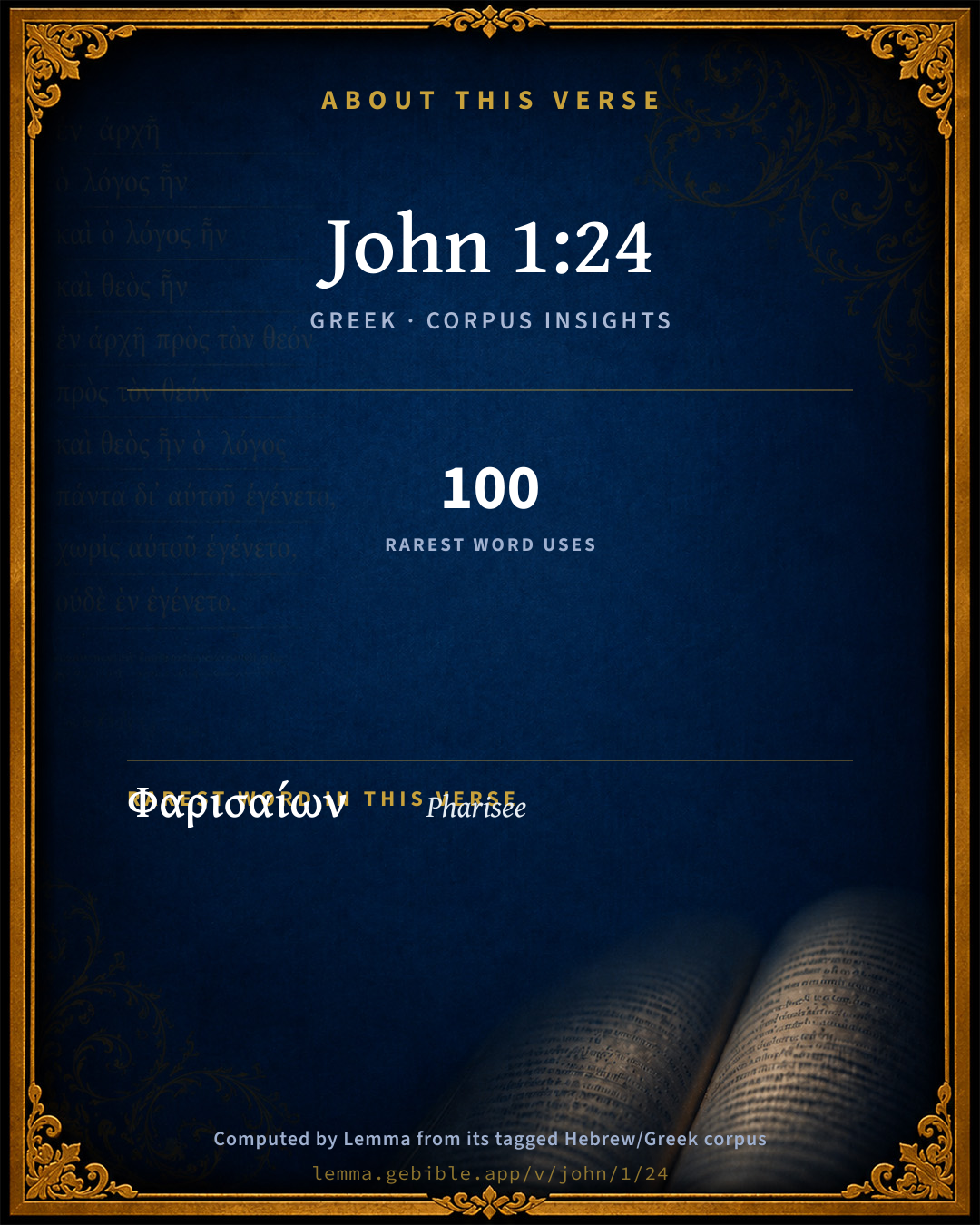
John 1:24

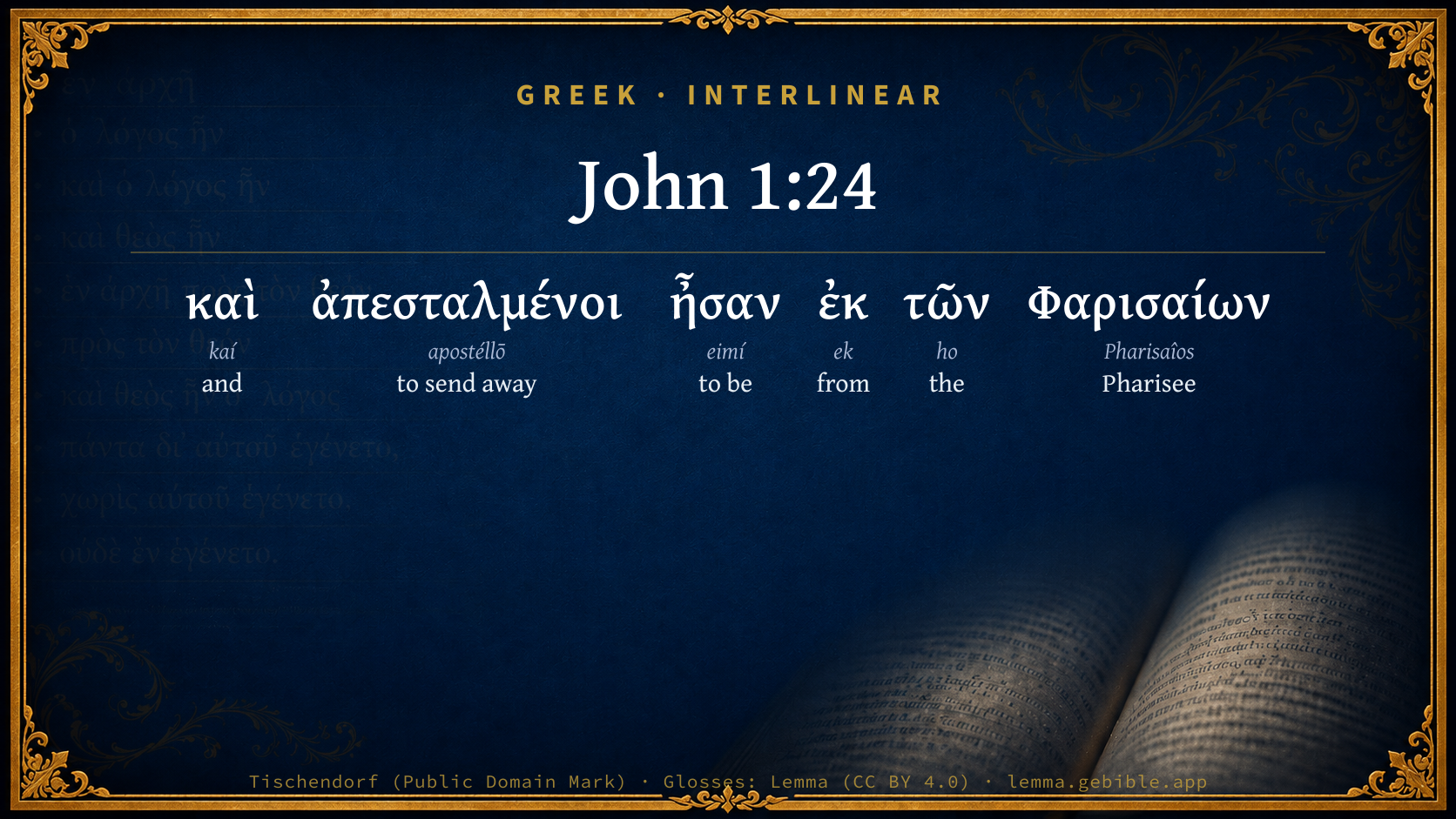
Greek (Tischendorf 8th ed.) John 1:24 appears in the Greek New Testament. The text above is from the Tischendorf 8th edition. Each word links to its Strong’s number and a concise gloss. Click any word for its full Thayer’s Greek Lexicon entry.
Download image
Cite this verse

John 1:24 (World English Bible). Public Domain. Lemma interlinear Bible study tool, https://lemma.gebible.app/v/john/1/24.

Show BibTeX & RIS
BibTeX
RIS
English Translation
The ones who had been sent were from the Pharisees.
World English Bible · Public Domain
Download a study sheet

One document with this verse’s original text, its word-by-word gloss line, the meaning frame, cross-references with their text, attributed commentary, and full source and license credits — printable, and it pastes into notes with its structure intact.

This verse Autodidact and up

Study sheet (.html) Plain text (.txt)

A passage Seminary Student

Up to 50 verses in one chapter. A passage sheet keeps up to 6 commentary sources and 12 cross-references per verse, in the order this page ranks them, and says so on the sheet whenever that leaves anything out. Ask for a single verse and you get the Autodidact verse sheet above.

Everything on this page stays free to read, with no account — the sheet is a download of what is already on screen, not access to it.

Want to remove ads? Support Godless Engineer
Compare translations 3

The same verse in 3 English versions, stacked beneath the original-language interlinear above. Click any original word for its lexicon entry.

Each is an independent rendering of the whole verse — the interlinear is not word-aligned to these translations.

Highlighted words mark where these versions differ — a whole-verse word diff, not a word-by-word alignment.

  • World English Bible Public Domain
    The ones who had been sent were from the Pharisees.
  • King James Version Public Domain
    And they which were sent were of the Pharisees.
  • unfoldingWord Literal Text CC BY-SA 4.0
    And the ones that had been sent were from the Pharisees,

unfoldingWord Literal Text — © unfoldingWord, licensed CC BY-SA 4.0. Word-aligned USFM3 via Door43 (git.door43.org/unfoldingWord/en_ult).

Versions to compare (up to 4)

3 of 4 selected

Show all 19 translations

Every available English version of this verse, each an independent rendering of the whole verse.

  • World English Bible Public Domain
    The ones who had been sent were from the Pharisees.
  • Berean Standard Bible Public Domain
    Then the Pharisees who had been sent
  • Majority Standard Bible Public Domain
    Then those whom the Pharisees had sent
  • King James Version Public Domain
    And they which were sent were of the Pharisees.
  • American Standard Version (1901) Public Domain
    And they had been sent from the Pharisees.
  • Revised Version (1885) Public Domain
    And they had been sent from the Pharisees.
  • Geneva Bible (1599) Public Domain
    Nowe they which were sent, were of the Pharises.
  • Douay-Rheims (1899) Public Domain
    And they that were sent, were of the Pharisees.
  • Young's Literal Translation Public Domain
    And those sent were of the Pharisees,
  • Literal Standard Version CC BY-SA 4.0
    And those sent were of the Pharisees,
  • Unlocked Literal Bible CC BY-SA 4.0
    Now some from the Pharisees were sent,
  • unfoldingWord Literal Text CC BY-SA 4.0
    And the ones that had been sent were from the Pharisees,
  • Darby Bible Public Domain
    And they were sent from among the Pharisees.
  • World Messianic Bible Public Domain
    The ones who had been sent were from the Pharisees.
  • Webster's Bible Public Domain
    And they who were sent were of the Pharisees.
  • Free Bible Version CC BY-SA 4.0
    The priests and Levites sent by the Pharisees
  • Bible in Basic English Public Domain
    Those who had been sent came from the Pharisees.
  • Text-Critical English NT CC BY 4.0
    (Now those who had been sent were from the Pharisees.)
  • Tyndale New Testament (1534) Public Domain
    And they which were sent were of the pharises.

Literal Standard Version (2020), Covenant Press — licensed CC BY-SA 4.0. Text via the HelloAO Bible API (eBible.org). Unlocked Literal Bible (unfoldingWord) — licensed CC BY-SA 4.0. Text via the HelloAO Bible API (eBible.org). unfoldingWord Literal Text — © unfoldingWord, licensed CC BY-SA 4.0. Word-aligned USFM3 via Door43 (git.door43.org/unfoldingWord/en_ult). Free Bible Version, Dr. Jonathan Gallagher — licensed CC BY-SA 4.0. Text via the HelloAO Bible API (eBible.org).

Word by word

More ways to search: Search by grammar → Find every occurrence → Compare this word →

Practice this passage: Drill this verse → Learn its vocabulary →

Φαρισαίων
Pharisaîos
G5330
“Pharisee”
Noun, Genitive, Plural, Masculine
Part of Speech
Noun
Case
Genitive
Number
Plural
Gender
Masculine
Full Thayer's Definition

Origin: of hebrew origin cf G6567

TDNT: 09:11,1

1. A sect that seems to have started after the Jewish exile. In addition to OT books the Pharisees recognised in oral tradition a standard of belief and life. They sought for distinction and praise by outward observance of external rites and by outward forms of piety, and such as ceremonial washings, fastings, prayers, and alms giving; and, comparatively negligent of genuine piety, they prided themselves on their fancied good works. They held strenuously to a belief in the existence of good and evil angels, and to the expectation of a Messiah; and they cherished the hope that the dead, after a preliminary experience either of reward or of penalty in Hades, would be recalled to life by him, and be requited each according to his individual deeds. In opposition to the usurped dominion of the Herods and the rule of the Romans, they stoutly upheld the theocracy and their country's cause, and possessed great influence with the common people. According to Josephus they numbered more than 6000. They were bitter enemies of Jesus and his cause; and were in turn severely rebuked by him for their avarice, ambition, hollow reliance on outward works, and affection of piety in order to gain popularity.
  1. καὶ kaí G2532 “and” Conjunction
  2. ἀπεσταλμένοι apostéllō G649 “to send away” Verb, Perfect, Passive, Participle, Nominative, Plural, Masculine
  3. ἦσαν eimí G1510 “to be” Verb, Imperfect, Active, Indicative, 3rd person, Plural
  4. ἐκ ek G1537 “from” Preposition
  5. τῶν ho G3588 “the” Article, Genitive, Plural, Masculine

About this verse

These counts appear in no published source. They are computed here, from the morphology-tagged text and Lemma’s own curated glosses. What Lemma adds →

6
words
6
distinct lemmas
Gospels
section

Cross-references

11

Topical passages linked to John 1:24 in the Treasury of Scripture Knowledge — connected by theme and wording, ordered by reader-vote popularity; previews shown in the World English Bible.

  • Matthew 23:13–15 "Woe to you, scribes and Pharisees, hypocrites! For you devour widows' houses, and as a pretense you make long prayers. Therefore you will receive greater condemnation.
  • Luke 11:39–44 The Lord said to him, "Now you Pharisees cleanse the outside of the cup and of the platter, but your inward part is full of extortion and wickedness.
  • Luke 11:53 As he said these things to them, the scribes and the Pharisees began to be terribly angry, and to draw many things out of him;
  • Luke 7:30 But the Pharisees and the lawyers rejected the counsel of God, not being baptized by him themselves.
  • Luke 16:14 The Pharisees, who were lovers of money, also heard all these things, and they scoffed at him.
  • John 3:1–2 Now there was a man of the Pharisees named Nicodemus, a ruler of the Jews.
  • Matthew 23:26 You blind Pharisee, first clean the inside of the cup and of the platter, that the outside of it may become clean also.
  • John 7:47–49 The Pharisees therefore answered them, "You aren't also led astray, are you?
  • Acts 23:8 For the Sadducees say that there is no resurrection, nor angel, nor spirit; but the Pharisees confess all of these.
  • Acts 26:5 having known me from the first, if they are willing to testify, that after the strictest sect of our religion I lived a Pharisee.
  • Philippians 3:5–6 circumcised the eighth day, of the stock of Israel, of the tribe of Benjamin, a Hebrew of Hebrews; concerning the law, a Pharisee;

Cross-references courtesy of OpenBible.info (CC BY 4.0).

Commentary

Notes on John 1:24 from classic Christian and Jewish commentators (each source and its license shown beneath its notes). The classic Christian expositions comment on the surrounding passage and are grouped to its opening verse, so a note may address several verses; the Jewish commentaries on the Tanakh (Rashi and others) are per-verse, so they appear only where the commentator wrote on this verse.

Lemma curates 59 commentaries, every one of them public domain or Creative Commons licensed, each selected and text-cleaned for this edition rather than reprinted as found. About our sources →

The Biblical Illustrator

Joseph S. Exell

Joh_1:24-27

They which were sent were of the Pharisees

The question of the Pharisees

1.

It is an evidence of a sick and corrupt Church when corrupt men are entrusted with most grave and weighty employments in it; for so was it with the Church of the Jews when they which were sent were of the Pharisees.

2. Corrupt men are more ready to jangle and lie at wait for advantages than to embrace the truth of God delivered by His servants; for these Pharisees take no notice of what He had said from Isaiah, nor seek to be further cleared in it, but think they have an advantage of him, that he should presume to baptize. Why baptizest thou, then, if thou be not that Christ? etc.

3. It was an uncontroverted truth, both among friends and foes, in the Jewish Church, that at the coming of the Messiah there should be some changes in the way of religion and an institution of new ordinances; for the Pharisees have nothing to say against his baptism if he were Christ, or Elias, or the prophet: their only objection is, Why baptizest thou, then, if thou he not? And Johns answer, I baptize, but there standeth One among you, etc., importeth that he being Christs forerunner, who was now come into the world, it was lawful for him to administer this sacrament.

4. Ministers ought to arrogate no more unto themselves than to be ministers and dispensers of the external means of word and sacraments, leaving the glory and efficacy thereof unto Christ entirely; and people ought so to be affected in coming to these ordinances. Therefore saith John, I baptize with water, not denying that Christ also baptized with water, nor yet denying that baptism administered by him was accompanied with grace and the Spirit of God; but he only compareth his person and office with Christs, and showeth that whatever grace came by the sacrament administered by him, yet he was not the giver of it, but Christ only, who had appointed him to dispense the outward seal.

5. Christ may be among a people, and yet they who reckon themselves very high in the Church neither see Him nor know Him; for saith John, there standeth One whom ye know not.

6. It is the duty of ministers, and will be the care of such as are faithful and zealous, to exalt and commend Christ at all occasions, that men may fall in love with Him. Therefore doth John again repeat his doctrine, He it is, etc.

7. The more high employment and the eminent gifts men have, and the more ready men are to esteem of them, the more will they abase themselves, if they be truly gracious, and be affected with the excellency of Christ; for it is John, the greatest among them that are born of women, and so much esteemed among the Jews, and the forerunner of Christ, who thus abaseth himself. He is preferred before me, whose shoes latchet I am not worthy to unloose.

8. Albeit Christ, of free grace, do honour men with eminent employments under Him, and particularly ministers of the gospel. Yet such as know Christ and themselves well will not only see that they are unworthy of the high employments they have, but even to do the basest service to Him; for John saith not, I am unworthy to be His forerunner, though employed in that service, but whose shoes latchet I am not worthy to unloose, which was a mean and base office. (G. Hutcheson.)

The Pharisees

represented the Judaism of the Post-Exilian era. Originally purists as well as legalists, they strove to carry out in practice the ideal of legal life set up by the scribes. Hence they were denominated Perushim, Pharisees or Separatists. First mentioned by Josephus under Jonathan and Hyrcanus, high priests about B.C. 145-150. In the time of Christ they had so far degenerated from their primitive piety as to make the essence of religion consist in ceremonial observance--an apostacy which drew down upon them the exposures, rebukes, and denunciations of Jesus. They were ultra-conservatives in Israel, the champions of orthodox literalism, and who accordingly watched everywhere with inquisitorial severity to see that the theocratic order was preserved intact, not merely as to ritual, but also with respect to the competence of office and doctrine (Joh_9:13; Joh_7:47-48; Joh_12:42). (T. Whitelaw, D. D.)

The Biblical Illustrator, edited by Joseph S. Exell (c. 1880s–1900s) — public domain. Text from a community e-Sword module.

Joseph Benson's Commentary

Joh 1:24-28. They which were sent were of the Pharisees — Who were peculiarly tenacious of old customs, and jealous of any innovations, (except those brought in by their own scribes,) unless the innovator had unquestionable proofs of divine authority. Add to this, the decisions of the Pharisees were held by the common people as infallible. And, as their sect had declared that only proselytes were to be baptized, on this account also they found fault with John for baptizing; saying, Why baptizest thou then — Without any commission from the sanhedrim; and not only heathen, (who were always baptized before they were admitted to circumcision,) but Jews also? if thou be not that Christ, nor Elias, &c. — The Jews, it seems, had conceived an opinion that they were all to be baptized when the Messiah came, either by himself, or by some of his retinue, because it was said, (Zec 13:1,) In that day there shall be a fountain opened to the house of David, &c., for sin and for uncleanness. They thought that John’s altering, in this manner, their institutions, was an exercise of authority which, by his own confession, did not belong to him. John answered, I baptize you with water — To prepare you for the Messiah; I call you to repentance and amendment of life, and admit the penitent to my baptism, to represent to you that reformation of conduct and purity of heart which are requisite, in order to the reception of him. Hereby also John showed, that Jews as well as Gentiles must be proselytes to Christ; and that the former, as well as the latter, stood in need of being washed from their sins. I baptize you: but observe, it is with water only, which cannot cleanse you from your sins, as the washing predicted by Zechariah will do. But there standeth one among you, &c. — That more efficacious baptism will be dispensed unto you by the Messiah, who is at present among you, though you do not know him, because he has not manifested himself. He coming after me is preferred before me, whose shoes, &c. — Besides, in dignity the Messiah is infinitely my superior, for I am not worthy to be his servant, or to do him the meanest offices. These things were done in Bethabara, where John was baptizing — Consequently, in the presence of a great multitude of people. The word, Bethabara, signifies, the house of passage. It lay near that part of the river which was miraculously dried up, that the Israelites, under the command of Joshua, might pass over into Canaan. See Jos 3:6, and Jdg 12:6.

Joseph Benson's Commentary on the Old and New Testaments (1811–1818) — public domain. Text from a community e-Sword module.

Tyndale Open Study Notes

Tyndale Open Resources

1:24 The Pharisees were deeply devoted to the Scriptures and earnestly desired a righteous life. They also believed in the coming Messiah, which explains their inquiries here. Some Pharisees became believers in Jesus (Acts 15:5), including the apostle Paul (Acts 26:5; Phil 3:5).

Tyndale Open Study Notes — © Tyndale Open Resources, licensed CC BY-SA 4.0. Text via the HelloAO Bible API.

Bengel's Gnomon

Johann Albrecht Bengel

Joh 1:24. Ἐκ τῶν φαρισαίων, of the Pharisees) who made a great point of Jewish baptism; and acknowledged the baptism of John to be a thing of great moment, not to be administered except by one having a Divine mission. The evangelist is wont to set down certain, as it were, parentheses, as to causes, as to place, as to occasions, as to ends, as to effects, as to hindrances, of things, actions and speeches, and similar decisions, by means of which the subjects, which are in hand, may the more clearly be understood, Joh 1:28; Joh 1:45; Joh 3:24; Joh 4:8; Joh 6:4; Joh 7:5; Joh 7:39; Joh 8:20; Joh 8:27; Joh 9:14; Joh 9:22; Joh 10:22-23; Joh 11:13; Joh 11:30; Joh 12:33.

Bengel's Gnomon of the New Testament — English translation (T&T Clark, Edinburgh, 1860) — public domain. Text from a community e-Sword module.

Meyer's Critical & Exegetical Commentary

Heinrich August Wilhelm Meyer

Joh_1:24 ff. The inquiry, which proceeds still further, finds a pragmatic issue in pharisaic style (for the Sanhedrim had chosen their deputies from this learned, orthodox, and crafty party). From their strict scholastic standing-point, they could allow (οὖν) so thoroughly reformatory an innovation as that of baptism (see on Mat_3:5), considering its connection with Messiahs kingdom, only to the definite personalities of the Messiah, Elias, or the promised prophet, and not to a man with so vague a call as that which the Baptist from Isa_40:3 ascribed to himself,a passage which the Pharisees had not thought of explaining in a Messianic sense, and were not accustomed so to apply it in their schools. Hence the parenthetical remark just here inserted: And they that were sent belonged to the Pharisees,a statement, therefore, which points forwards, and does not serve as a supplementary explanation of the hostile spirit of the question (Euthymius Zigabenus, Lücke, and most others).

The reply corresponds to what the Baptist had said of himself in Joh_1:23, that he was appointed to prepare the way for the Messiah. His baptism, consequently, was not the baptism of the Spirit, which was reserved for the Messiah (Joh_1:33), but a baptism of water, yet without the elementum coeleste; there was already standing, however, in their midst the far greater One, to whom this preparatory baptism pointed. The first clause of the verse, ἐγὼ βαπτ. ἐν ὕδατι, implies, therefore, that by his baptism he does not lay claim to anything that belongs to the Messiah (the baptism of the Spirit); and this portion refers to the εἰ σὺ οὐκ εἶ ὁ Χριστός of Joh_1:25. The second clause, however, μέσος, etc., implies that this preliminary baptism of his had now the justification, owing to his relation to the Messiah, of a divinely ordained necessity (Joh_1:23); since the Messiah, unknown indeed to them, already stood in their midst, and consequently what they allowed to Elias, or the prophet, dare not be left unperformed on his part; and this part of his answer refers to the οὐδὲ Ἠλίας οὐδὲ ὁ προφήτης in Joh_1:25. Thus the question τί οὖν βαπτίζεις is answered by a twofold reason. There is much that is inappropriate in the remarks of expositors, who have not sufficiently attended to the connection: e.g., De Wette overlooks the appropriateness of the answer to the Elias question; Tholuck contents himself with an appeal to the laconic-comma style of the Baptist; and Brückner thinks that John wished to give no definite answer, but yet to indicate his relation to the Messiah, and the fact of his pointing to Him; while Bäumlein holds that the antithetical clause, ὃς βαπτίσει ἐν πνεύμ. ἁγ., which was already intended to be here inserted, was forgotten, owing to the intervening sentences; and finally, Hilgenfeld, after comparing together Matthew and Luke, deduces the unhistorical character of the narrative. Heracleon already was even of opinion that John did not answer according to the question asked of him, but as he αὐτὸς ἐβούλετο. In answer to him, Origen.

ἐγώ] has the emphasis of an antithesis to the higher Baptizer (μέσος δὲ, etc.), not to ὑμεῖς (Godet). Next to this, the stress lies on ἐν ὕδατι. This is the element (see on Mat_3:11) in which his baptism was performed. This otherwise superfluous addition has a limiting force, and hence is important.

μέσος without the spurious δὲ is all the more emphatic; see on Joh_1:17. The emphasizing of the antithesis, however, has brought this μέσος] to the front, because it was the manifestation of the Messiah, already taking place in the very midst of the Jews, which justified John in baptizing. Had the Messiah been still far off, that baptism would have lacked its divine necessity; He was, however, standing in their midst, i.e. ἀναμεμιγμένος τότε τῷ λαῷ (Euthymius Zigabenus).

ὃν ὑμεῖς οὐκ οἴδατε] reveals the reason why they could question as they had done in Joh_1:25. The emphasis is on ὑμεῖς, as always (against Tholuck); here in contrast with the knowledge which he himself had (see on Joh_1:28, note) of the manifested Messiah: you on your part, you people, have the Messiah among you, and know Him not (that is, as the Messiah). In Joh_1:27, after rejecting the words αὐτός ἐστιν and ὃς ἔμπροσ. μου γέγονεν (see the critical notes), there remains only ὁ ὀπίσω μου ἐρχόμενος (Joh_1:15), and that in fact as the subject of μέσος ἕστηκεν, which subject then receives the designation of its superiority over the Baptist in the οὗ ἐγὼ οὐκ εἰμὶ ἄξιος, κ.τ.λ. Concerning this designation, see on Mat_3:11.

ἐγώ] I for my part.

ἄξιος ἵνα] worthy that I should loose; ἵνα introduces the purpose of the ἀξιότης. Comp. ἱκανὸς ἵνα, Mat_8:8, Luk_7:6.

αὐτοῦ] placed first for emphasis, and corresponding to the ἐγώ. On αὐτοῦ after οὗ, see Winer, p. 140 [E. T. p. 184]. Τούτου would have been still more emphatic.

Meyer — Critical and Exegetical Commentary on the New Testament — English translation by Peter Christie, edited by Frederick Crombie (T&T Clark, 1880) — public domain. Text from a community e-Sword module.

Expositor's Greek Testament

ed. W. Robertson Nicoll

Joh 1:24 . καὶ ἀπεσταλμένοι ἦσαν ἐκ τῶν Φαρισαίων . This gives us the meaning “And they had been sent from,” which is not so congruous with the context as “And they who were sent were of the Pharisees”; because apparently this clause was inserted to explain the following question (Joh 1:25 ): τί οὖν βαπτίζεις … ὁ προφήτης ; Founding on Zec 13:1 , “In that day there shall be a fountain opened for sin and for uncleanness,” and on Eze 36:25 , “then will I sprinkle clean water upon you,” they expected a general purification before the coming of the Messiah. Hence their question. If John was not the Messiah, nor the prophet, nor Elias in close connection with the Messiah, why did he baptise? Lightfoot ( Hor. Heb. , p. 965) quotes from Kiddushin “Elias venit ad immundos distinguendum et ad purificandum”. See also Ammonius and Beza quoted in Lampe. In reply to this objection of the Pharisees (Joh 1:26 ) John says: ἐγὼ βαπτίζω … τοῦ ὑποδήματος , “I for my part baptise with water”; the emphatic “I” leading us to expect mention of another with whom a contrast is drawn. This contrast is further signified by the mention of the element of the baptism, ἐν ὕδατι ; a merely symbolic element, but also the element by baptism in which preparation for the Messiah was to be made. And John’s administration of this precursory baptism is justified by the fact he immediately states, μέσος ὑμῶν στήκει ὃν ὑμεῖς οὐκ οἴδατε . Had they been aware of this presence ( ὑμεῖς emphatic) as John was aware of it, they could not have challenged the baptism of John, because it was the divinely appointed preparation for the Messiah’s advent. This scarcely amounts to what Lampe calls it, “nova exprobratio ignorantiae Pharisaeorum” (Isa 42:19 ; Isa 29:14 ), because as yet they had had no opportunity of knowing the Christ. μέσος ὑμῶν . There is no reason why the words should not be taken strictly. So Euthymius, ἦν γὰρ ὁ Χριστὸς ἀναμεμιγμένος τότε τῷ λαῷ . ὀπίσω μου ἐρχόμενος , denoting the immediate arrival of the Messiah and John’s close connection with Him. He is further described relatively to John as inconceivably exalted above him, οὗ οὐκ εἰμὶ … ὑποδήματος . The grammatical form admitting both the relative and pers. pronoun is Hebraistic. ἄξιος ἵνα also stands instead of the classical construction with the infinitive. Talmudists quote the saying: “Every service which a servant will perform for his master, a disciple will do for his Rabbi, except loosing his sandal thong”.

The Expositor's Greek Testament, edited by W. Robertson Nicoll (1897–1910) — public domain. Text from a community e-Sword module.

Godet's Commentaries

Frédéric Louis Godet

Ver. 24. “And those who were sent were of the Pharisees.”

We translate according to the T. R., which is in conformity with the majority of the Mjj., with the Mnn., and with the greater part of the Vss. According to this reading, the participle ἀπεσταλμενοι, sent, is defined by the article οἱ, the; it is the subject of the sentence. The design of this remark added here by John is easily understood; it is to explain the question which is to follow. John likes to supply in this way, as a narrative progresses, the circumstances, omitted at first, which serve gradually to explain it; comp. Joh 1:41; Joh 1:45; Joh 4:30; Joh 9:14; Joh 11:5; Joh 11:18; Joh 13:23, etc. The Pharisees were the ultra conservatives in Israel; no one could have been shocked more than they by the innovation which John the Baptist had taken it upon himself to make in introducing baptism. Lustrations undoubtedly formed a part of the Jewish worship. It is even maintained that the pagan proselytes were subjected to a complete bath, on occasion of their passing over to Judaism. But the application of this symbol of entire pollution to the members of the theocratic people was so strange an innovation, that it must have awakened in the highest degree the susceptibility of the authorities who were guardians of the rites, and very particularly that of the party most attached to tradition. The Pharisaic element also was the main one in the deputation which the Sanhedrim had chosen.

We see how skillfully the plan of the examination had been laid; first of all, the question relative to the mission; then, that which concerned the rite; for the latter depended on the former. Nothing can be more simple than the course of the narrative, as thus understood. This mode of explaining the intention of the remark in Joh 1:24 appears to me more natural than that of Weiss and Keil, according to which John would thereby characterize the spirit of unbelief which animated the interrogators of the Baptist. The fact of their unbelief not being noticed in the narrative, did not demand explanation. Opposed to the reading of the T. R. there is another supported by the Alexandrian authorities and by Origen, and adopted by Tischendorf, and Westcott and Hort, which rejects the article οἱ before ἀπεσταλμένοι; the meaning is: “and they had been sent from the Pharisees,” or, as Origen understood it: “and there were persons sent (come) from the Pharisees,” as if the question were of another deputation than that of Joh 1:19. Neither the one nor the other of these meanings is possible. For the Pharisees did not form an officially constituted body, from which a proceeding like this which is here spoken of could have started. The Alexandrian reading is, therefore, indefensible, as, in this instance, Weiss and Keil themselves acknowledge. It is, probably, as is so frequently the case, an arbitrary correction by Origen, to serve his false interpretation of this whole passage, from the end of the Prologue. Weiss and Keil see here a mere case of negligence of a copyist arising from the preceding καί, in which the οἱ was lost. But how many similar errors should we not have, in that case, in the New Testament!

Frédéric Louis Godet — Commentaries on Luke, John, Romans, and 1 Corinthians — English translation (T&T Clark, Edinburgh, 1870s–1890s) — public domain. Text from a community e-Sword module.

Geneva Bible (1599)

Geneva Bible translators

Christ is the author of baptism, and not John: and therefore the force thereof consisteth not in John, who is the minister, but wholly in Christ the Lord.

Geneva Bible (1599) marginal notes — public domain. Text via Bolls.life.

John Calvin's Commentaries

24. Were of the Pharisees. He says that they were Pharisees, who at that time held the highest rank in the Church; and he says so in order to inform us, that they were not some contemptible persons of the order of the Levites, but men clothed with authority. This is the reason why they raise a question about his baptism. Ordinary ministers would have been satisfied with any kind of answer; but those men, because they cannot draw from John what they desired, accuse him of rashness for venturing to introduce a new religious observance.

John Calvin's Commentaries (1540-1563) — public domain. Text from the Calvin Translation Society English edition (1840s-50s) via the Christian Classics Ethereal Library (ccel.org). Calvin's coverage is partial (roughly two-thirds of the Bible); uncommented books and verses are honest gaps, never fabricated. The 19th-century editor's footnotes and remarks are omitted so the notes are faithfully Calvin's own voice.

Ellicott's Commentary for English Readers

(24) They which were sent.—The best MSS. omit the relative, and the verse thus becomes, “And they had been sent from the Pharisees.” (For account of the Pharisees, see Note on Mat_3:7.) The statement is made to explain the question which follows, but it should be observed that in this Gospel, where the Sadducees are nowhere mentioned, the term “Pharisees” seems to be used almost in the sense of “Sanhedrin.” (Comp. Joh_4:1; Joh_8:3; Joh_11:46; Joh_11:57.)

A Bible Commentary for English Readers, edited by Charles John Ellicott (1878–1897) — public domain. Text from a community e-Sword module.

The Cambridge Bible for Schools and Colleges

gen. ed. J. J. S. Perowne

24. And they which, &c.] Perhaps the better reading is, and there had been sent some of the Pharisees. S. John mentions neither Sadducees nor Herodians; only the Pharisees, the sect most opposed to Christ, is remembered by the Evangelist who had gone furthest from Judaism.

The Cambridge Bible for Schools and Colleges (gen. ed. J. J. S. Perowne; Cambridge University Press, 1878–1918) — public domain. Text from a community e-Sword module.

John Gill's Exposition

And they which were sent were of the Pharisees. Who were the straitest sect of religion among the Jews; were very zealous of the traditions of the elders, and professed an expectation of the Messiah; and were famous in the nation for their knowledge and learning, as well as for their devotion and sanctity: and many of them were in the sanhedrim, as appears from Joh 3:1; see Gill on Mat 3:7.

.

John 1:25

joh 1:25

joh 1:25

joh 1:25And they asked him, and said unto him,.... They put a question, by saying to him,

why baptizest thou then, if thou be not that Christ, nor Elias, neither that prophet? since he denied that he was the Messiah, or Elias that was to come before the Messiah, according to the expectation of the Jews, or that prophet, or a prophet, they demand by what authority he introduced a new rite and ordinance among them, which they had never been used to; for though there were divers washings or baptisms among them, enjoined by the law of Moses in certain cases, and others which obtained by tradition, as the immersion of themselves after they had been at market, and of cups, pots, brazen vessels, and tables, yet nothing of this kind that John administered: and as for the baptism of proselytes, it seems to be of a later date than this, and had no manner of likeness to it. The ordinance John administered was such, as they apprehended that no one ought to practise, unless he was the Messiah, or his forerunner, or some eminent prophet; they insist upon it therefore, that since he denied he was either of these, that he would show his credentials, and what commission he had from God to baptize; or they suggest he was liable to be called to an account by their sanhedrim, and be condemned as a false prophet, or an innovator in religious affairs. From hence it appears, that the Jews expected that baptism would be administered in the times of the Messiah, and his forerunner; but from whence they had this notion, it is not easy to say, whether from Zac 13:1 as Grotius, or from Eze 36:25 as Lightfoot; nor do they speak contemptibly of it, but rather consider it as a very solemn affair, to be performed only by great personages: and this may teach modern ones to think and speak more respectfully of this ordinance than they do, who have given themselves great liberties, and have treated it with much contempt and virulence; calling it by the names of uncleanness, abomination, filthy water, and a devoting of persons to Satan (z): likewise, it is clear from hence, that they expected that this ordinance would be first administered by some person of very great note, either some very famous prophet, as Elias, whom they looked for before the coming of the Messiah, or else the Messiah himself, and not by a common teacher, or any ordinary person; wherefore this rite, as performed by John, could have no likeness with any thing that was in common use among them: besides, it was expressly done in the name of the Messiah, Act 19:5 therefore they conclude he, or his forerunner, must be come; and that John must be one, or other of them, otherwise, why did he administer it? and it is also evident from hence, that no such practice had obtained before among them, or they would not have been alarmed at it, as they were; nor would they have troubled themselves to have sent after John, and inquire of him who he was, that should practise in this manner,

(z) Vet. Nizzachon, p. 56, 62, 64, 70, 74, 77, 148, 191, 193.

John Gill's Exposition of the Whole Bible (1746–1763) — public domain (CC PDM 1.0). Text via the HelloAO Bible API.

Trapp's Complete Commentary

John Trapp

24 And they which were sent were of the Pharisees.

Ver. 24. Were of the Pharisees] Men of renown in the congregation, for more authority’ sake: and such as by their office were to inquire into new doctrines and their authors.

John Trapp, A Commentary or Exposition upon All the Books of the Old and New Testament (1647–1656) — public domain. Text from a community e-Sword module.

Albert Barnes' Notes on the Bible

Were of the Pharisees - For an account of this sect, see the notes at Mat 3:7. Why they are particularly mentioned is not certainly known. Many of the “Sadducees” came to his baptism Mat 3:7, but it seems that they did not join in sending to him to know what was the design of John. This circumstance is one of those incidental and delicate allusions which would occur to no impostor in forging a book, and which show that the writers of the New Testament were honest men and knew what they affirmed. Because:

The Pharisees composed a great part of the Sanhedrin, Act 23:6. It is probable that a deputation from the Sanhedrin would be of that party. The Pharisees were very tenacious of rites and customs, of traditions and ceremonies. They observed many. They believed that they were lawful, Mar 7:3-4. Of course, they believed that those rites might be increased, but they did not suppose that it could be done except by the authority of a prophet or of the Messiah. When, therefore, John came “baptizing” - adding a rite to be observed by his followers - baptizing not only Gentiles, but also Jews - the question was whether he had authority to institute a new rite; whether it was to be received among the ceremonies of religion. In this question the Sadducees felt no interest, for they rejected all such rites at once; but the Pharisees thought it was worth inquiry, and it was a question on which they felt themselves specially called on to act as the guardians of the ceremonies of religion.

Albert Barnes' Notes on the Bible (1834–1885) — public domain. Text from a community e-Sword/MySword module.

Matthew Poole's English Annotations

Who these Pharisees were hath been before explained in our notes on Mat 3:7. They were of the strictest sect of the Jewish religion, Act 26:5. The greatest part of their councils was made up of those of this sect, as may be learned from Act 23:1-10. They were the men most zealous for and tenacious of the Jewish rites; and would allow nothing to be added to the Jewish worship to what they had received concerning it, either from the law of God, or the traditions of the elders.

Matthew Poole's English Annotations on the Holy Bible (1683–1685) — public domain. Text from a community e-Sword/MySword module.

Whedon's Commentary on the Bible

Daniel D. Whedon

24. Were of the Pharisees—Who held most strenuously that no prophet, after Moses, had a right to introduce any new sacred usage, rite, or ceremony among the Mosaic institutions, except the arrived Messiah himself. The question then in the following verse, Why baptizest thou then? was a very peremptory one.

Daniel D. Whedon (gen. ed.), Commentary on the Old and New Testaments (1874–1909) — public domain. Text from a community e-Sword module.

The Pulpit Commentary

And they had been sent from the Pharisees, which amounts to the same thing as "they which were sent were of the Pharisees," and it is after the manner of John to introduce explanatory, retrospective comment, which may throw light on what follows. (vers. 41, Joh_4:30 Joh_11:5) The oun of the following verse shows that we have still to do with the same deputation. The Pharisees were accustomed to lustral rites, but had legal points to make as to the authority of any man who dared to impose them upon the sacred nation, and especially on their own section, which made its special boast of ceremonial exactitude and purity. They might justify an old prophet, or the Elijah of Malachi, and still more the Christ himself, should he call men to baptismal cleansing. But the dim mysterious "voice in the wilderness," even if John could prove his words, had no such prescriptive claim. The Pharisaic priests and Levites would take strong views on the baptismal question, and even exalt it into a more eminent place in their thoughts than the fundamental question, "Art thou the very Christ?" The same confusion of essential and accidental elements of religious truth and life was not confined to old Pharisees.

The Pulpit Commentary (1880–1919), ed. H.D.M. Spence-Jones & Joseph S. Exell — public domain. Text from a community e-Sword module.

John Wesley's Explanatory Notes

They who were sent were of the Pharisees - Who were peculiarly tenacious of old customs, and jealous of any innovation (except those brought in by their own scribes) unless the innovator had unquestionable proofs of Divine authority.

John Wesley, Explanatory Notes Upon the Whole Bible (1754–1765) — public domain. Text via the GEBible commentary corpus.

Kretzmann's Popular Commentary

Paul E. Kretzmann

The question concerning John’s baptism:

v. 24. And they which were sent were of the Pharisees.

v. 25. And they asked him and said unto him, Why baptizest thou then, if thou be not that Christ, nor Elias, neither that prophet?

v. 26. John answered them, saying, I baptize with water; but there standeth One among you whom ye know not;

v. 27. He it is, who, coming after me, is preferred before me, whose shoe’s latchet I am not worthy to unloose.

v. 28. These things were done in Bethabara, beyond Jordan, where John was baptizing.

The sect of the Pharisees was very strict in the observance of all rules and regulations concerning worship and the proprieties of service. The testimony of John relating to his specific work did not interest them, but the authority for his baptizing was a matter of much concern to them. The Jewish leaders of Jerusalem knew nothing of this man’s work; he had not asked their sanction. And so the delegates challenge his right to baptize, since by his own confession he is neither Christ, nor Elijah, nor that prophet. Since the answer to the question of the Pharisees was included in the passage from Isaiah, John was content with the opportunity of pointing to Jesus, and thus fulfilling his work. He puts himself and his baptism into deliberate contrast with Christ, and the baptism which Christ would employ in due time. John baptized with water. Through the water of baptism he confirmed and sealed his preaching unto repentance. He admonished the people of Israel that they were in need of a cleansing from sins. Those that were baptized by John confessed their sins. But still the baptism of John, though a means of grace, was of a preparatory nature; it pointed forward to the fulfillment of the redemption in Christ. And the Messiah was even then in the world, He was living in the midst of the Jewish people, though as yet unknown to them. He was the one that was after John in point of time, but in reality, and by virtue of His person and office, He surpassed His herald. And well John knew this, for he did not consider himself worthy of unlacing the straps of His sandals, and thus of performing the work of a slave for the Master. There was an unbridgeable abyss between divinity and humanity, between God and man. These things took place on the eastern side of the river Jordan, in a village or valley called Bethabara, at a ford which enabled travelers to cross over into Batanea. Note: John’s example in confessing Christ before the enemies of true salvation should encourage the Christians of all times to stand up courageously for Christ.

Paul E. Kretzmann, Popular Commentary of the Bible (1921–1924) — public domain. Text from a community e-Sword module.

The People's New Testament

B. W. Johnson

24. Were of the Pharisees. See notes on Matt. 3:7.

B. W. Johnson's The People's New Testament with Notes (1889–1891) — public domain. Electronic text from the Christian Classics Ethereal Library (CCEL) ThML edition.

unfoldingWord translationNotes

Door43 World Missions Community

Now some from the Pharisees

This is background information about the people who questioned John. (See: Background Information)

translationWords

Pharisee

baptize

Christ

Elijah

unfoldingWord translationNotes — © Distant Shores Media and the Door43 World Missions Community, licensed CC BY-SA 4.0. Source: git.door43.org/Door43/en_tn.

Cambridge Greek Testament for Schools and Colleges

24. ἀπεσταλμένοι ἦσαν. The οἱ before the participle is of doubtful authority. Omitting it, we translate And they had been sent from the Pharisees, or better (as we have ἐκ and not παρά), and there had been sent (some) of the Pharisees. For this use of ἐκ τῶν comp. Joh 7:40, Joh 16:17; 2Jn 1:4; Rev 2:10. We are not to understand a fresh deputation, as the οὖν in the next verse shews. It was precisely the Pharisees who would be jealous about innovations in religious rites. S. John mentions neither Sadducees nor Herodians. Only the sect most opposed to Christ is remembered by the Evangelist who had gone furthest from Judaism.

Cambridge Greek Testament for Schools and Colleges (Cambridge University Press, 1896; 21 vols, various authors incl. Carr, Maclear, Plummer, Farrar, Lumby, Moule, M. R. James, Simcox) — public domain. Text from a community e-Sword module.

Alford’s Greek Testament

Henry Alford

24.] The reason of this explanation being added is not very clear. Lücke, with whom De Wette agrees, refers it to the apparent hostility of the next enquiry: but I confess I cannot see that it is more hostile than the preceding. Luthardt thinks that it imports, there were some ἀπεσταλμένοι present, who belonged to the sect of the Pharisees (ἦσαν δὲ καὶ ἐκ τῶν Φαρ. ἀπεσταλμένοι), which the words will hardly bear: see below. Might it not be to throw light on their question about baptizing, as the Pharisees were the most precise about all ceremonies, lustrations, &c.? Origen makes this a new deputation: but he is plainly wrong: see the οὖν below. Euthymius gives another reason yet: ἐπεσημήνατο καὶ τὴν αἵρεσιν αὐτῶν, ἐμφαίνων τὸ περίεργον τούτων καὶ σκολιόν.

Abandoning the οἱ (see var. readd.), we must render, And they (i.e. the whole deputation) were (or had been) sent by the Pharisees; which will make it more probable that the explanation refers to the nature of the following question. ἀποστέλλομαι … ἐκ has occurred above, ver. 19, which gives additional probability to the reading of the text.

Henry Alford, The Greek Testament (1849–1861) — public domain. Text from a community e-Sword module.

International Critical Commentary

24. The rec. text (so NWΘ) inserts οἱ before ἀπεσταλμένοι, i.e. “And certain had been sent from among the Pharisees,” as distinct from the questioners of v. 19. But οἱ is omitted by א*A*BC*L; and we must render “And they,” i.e. the priests and Levites of v. 19, “had been sent from the Pharisees.” And, in fact, v. 25 shows that the argument is carried on from v. 21.

The Pharisees (mentioned again 4:1, 7:45, 8:13, 9:13, 11:46, 12:19, 42) were the true representatives of the old Jewish spirit (see on v. 19). Strictly conservative, they were intolerant of all innovation, whether of doctrine or ritual, and the baptizing ministry of John aroused their suspicions. See on 7:32.

International Critical Commentary — older volumes (1896–1929), various authors — public domain. Text from a community e-Sword module.

Lesson kit

Teaching starters — assembled from the data on this page, not authored interpretation. Every prompt links to the verse data it draws on. Edit before teaching.

John, in the Gospels, opens this verse with 6 words (6 distinct Greek lemmas). Its most distinctive word is Pharisaîos (“Pharisee”). A historical commentator’s framing appears above. Read the whole chapter for the surrounding context.

Discussion questions

  1. The word Pharisaîos carries the sense “Pharisee.” How does it shape the verse?
  2. Matthew 23:13–15 shares this passage’s theme. How do the two illuminate each other?
  3. The translations on this page render this verse differently — a whole-verse word diff, not a word-by-word alignment. What might account for the different wordings?
  4. Reading how The Biblical Illustrator and Joseph Benson's Commentary read this verse, where do the two commentators agree and where do they part?

Things to notice

Reading settings

Reading text

Shown beneath each verse's original-language words.

Old Testament
Old Testament edition

Read the OT as the Masoretic Hebrew (MT) or the Greek Septuagint (LXX).

English shown for the Greek Septuagint (in the Hebrew ↔ Greek comparison).

Comparing translations? Open the Compare panel on any verse page to stack up to four side by side.