2 Timothy 4:12

Greek (Tischendorf 8th ed.) 2 Timothy 4:12 appears in the Greek New Testament. The text above is from the Tischendorf 8th edition. Each word links to its Strong’s number and a concise gloss. Click any word for its full Thayer’s Greek Lexicon entry.
Download image
Cite this verse

2 Timothy 4:12 (World English Bible). Public Domain. Lemma interlinear Bible study tool, https://lemma.gebible.app/v/2-timothy/4/12.

Show BibTeX & RIS
BibTeX
RIS
English Translation
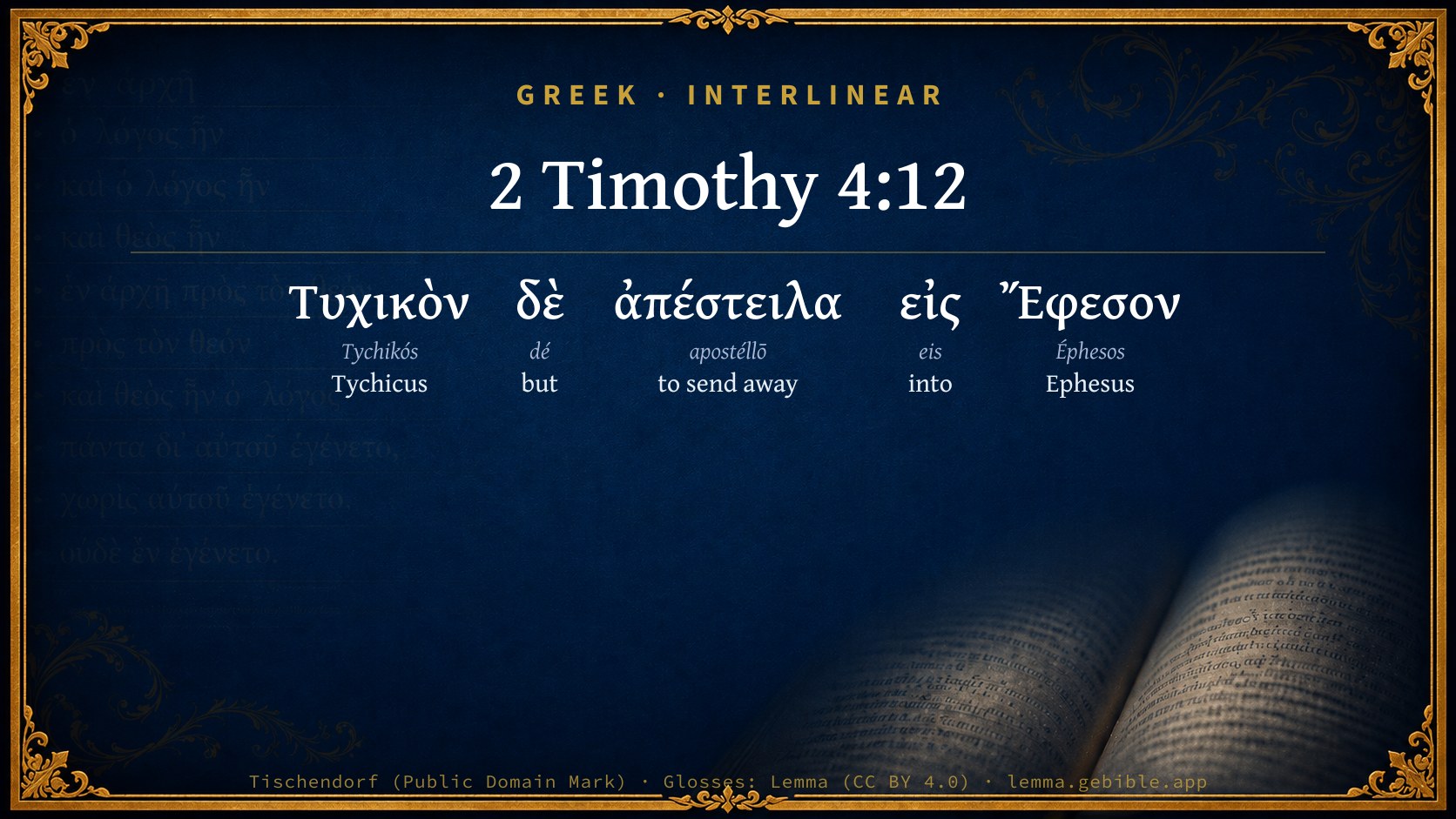
But I sent Tychicus to Ephesus.
World English Bible · Public Domain
Download a study sheet

One document with this verse’s original text, its word-by-word gloss line, the meaning frame, cross-references with their text, attributed commentary, and full source and license credits — printable, and it pastes into notes with its structure intact.

This verse Autodidact and up

Study sheet (.html) Plain text (.txt)

A passage Seminary Student

Up to 50 verses in one chapter. A passage sheet keeps up to 6 commentary sources and 12 cross-references per verse, in the order this page ranks them, and says so on the sheet whenever that leaves anything out. Ask for a single verse and you get the Autodidact verse sheet above.

Everything on this page stays free to read, with no account — the sheet is a download of what is already on screen, not access to it.

Want to remove ads? Support Godless Engineer
Compare translations 3

The same verse in 3 English versions, stacked beneath the original-language interlinear above. Click any original word for its lexicon entry.

Each is an independent rendering of the whole verse — the interlinear is not word-aligned to these translations.

Highlighted words mark where these versions differ — a whole-verse word diff, not a word-by-word alignment.

  • World English Bible Public Domain
    But I sent Tychicus to Ephesus.
  • King James Version Public Domain
    And Tychicus have I sent to Ephesus.
  • unfoldingWord Literal Text CC BY-SA 4.0
    But I sent Tychicus to Ephesus.

unfoldingWord Literal Text — © unfoldingWord, licensed CC BY-SA 4.0. Word-aligned USFM3 via Door43 (git.door43.org/unfoldingWord/en_ult).

Versions to compare (up to 4)

3 of 4 selected

Show all 19 translations

Every available English version of this verse, each an independent rendering of the whole verse.

  • World English Bible Public Domain
    But I sent Tychicus to Ephesus.
  • Berean Standard Bible Public Domain
    Tychicus, however, I have sent to Ephesus.
  • Majority Standard Bible Public Domain
    Tychicus, however, I have sent to Ephesus.
  • King James Version Public Domain
    And Tychicus have I sent to Ephesus.
  • American Standard Version (1901) Public Domain
    But Tychicus I sent to Ephesus.
  • Revised Version (1885) Public Domain
    But Tychicus I sent to Ephesus.
  • Geneva Bible (1599) Public Domain
    And Tychicus haue I sent to Ephesus.
  • Douay-Rheims (1899) Public Domain
    But Tychicus I have sent to Ephesus.
  • Young's Literal Translation Public Domain
    and Tychicus I sent to Ephesus;
  • Literal Standard Version CC BY-SA 4.0
    and I sent Tychicus to Ephesus;
  • Unlocked Literal Bible CC BY-SA 4.0
    Tychicus I sent to Ephesus.
  • unfoldingWord Literal Text CC BY-SA 4.0
    But I sent Tychicus to Ephesus.
  • Darby Bible Public Domain
    But Tychicus I have sent to Ephesus.
  • World Messianic Bible Public Domain
    But I sent Tychicus to Ephesus.
  • Webster's Bible Public Domain
    And Tychicus have I sent to Ephesus.
  • Free Bible Version CC BY-SA 4.0
    I sent Tychicus to Ephesus.
  • Bible in Basic English Public Domain
    Tychicus I sent to Ephesus.
  • Text-Critical English NT CC BY 4.0
    Tychicus I have sent to Ephesus.
  • Tyndale New Testament (1534) Public Domain
    And Tichicus have I sent to Ephesus.

Literal Standard Version (2020), Covenant Press — licensed CC BY-SA 4.0. Text via the HelloAO Bible API (eBible.org). Unlocked Literal Bible (unfoldingWord) — licensed CC BY-SA 4.0. Text via the HelloAO Bible API (eBible.org). unfoldingWord Literal Text — © unfoldingWord, licensed CC BY-SA 4.0. Word-aligned USFM3 via Door43 (git.door43.org/unfoldingWord/en_ult). Free Bible Version, Dr. Jonathan Gallagher — licensed CC BY-SA 4.0. Text via the HelloAO Bible API (eBible.org).

Word by word

More ways to search: Search by grammar → Find every occurrence → Compare this word →

Practice this passage: Drill this verse → Learn its vocabulary →

About this verse

These counts appear in no published source. They are computed here, from the morphology-tagged text and Lemma’s own curated glosses. What Lemma adds →

5
words
5
distinct lemmas
Pauline Epistles
section

Notable vocabulary

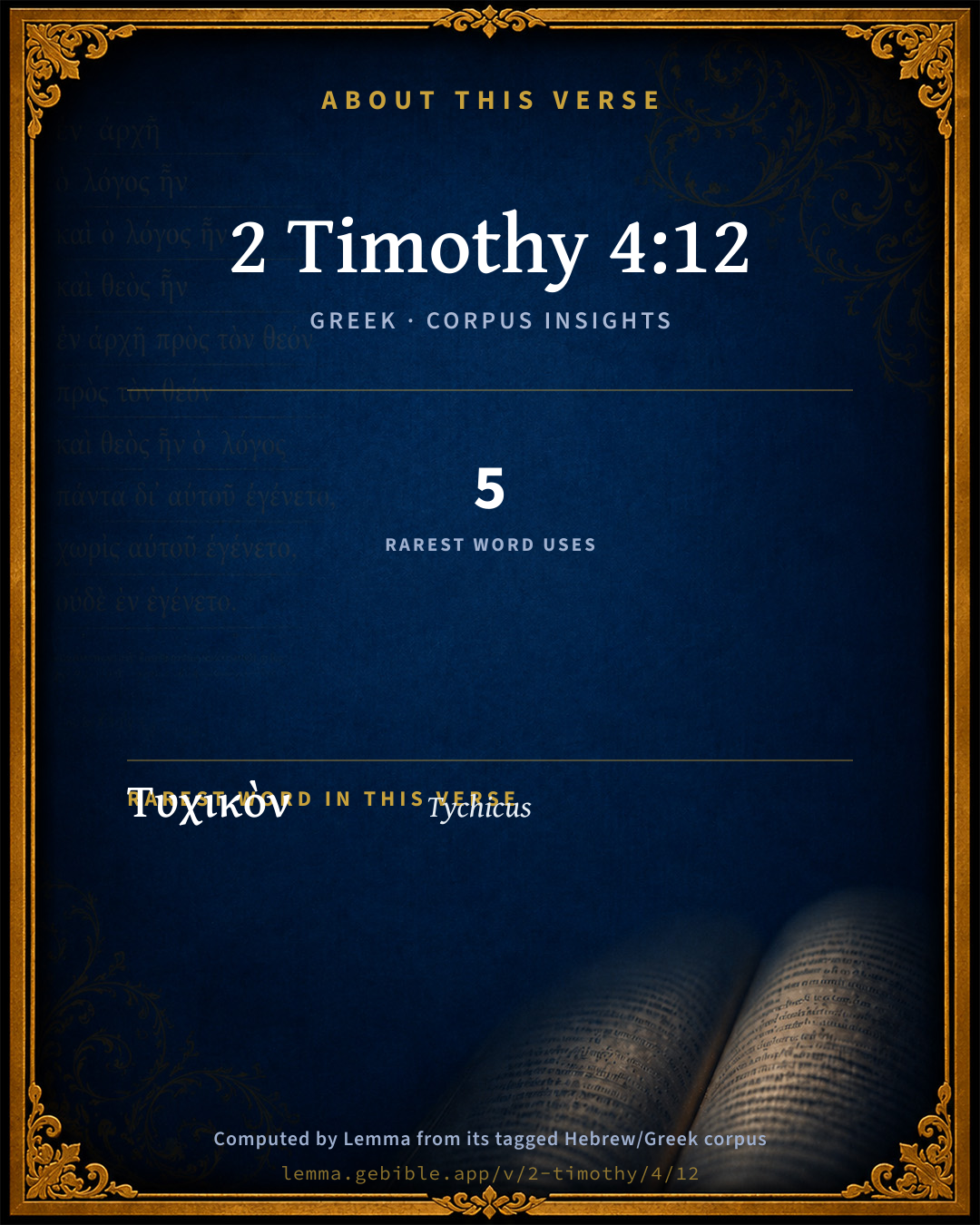
The rarest word here is Τυχικὸν Tychicus G5190 — appearing just 5 times in the whole Greek New Testament.

Shared distinctive vocabulary

Τυχικὸν Tychicus G5190 occurs in 5 verses of the Greek New Testament. Also found in:

Cross-references

7

Topical passages linked to 2 Timothy 4:12 in the Treasury of Scripture Knowledge — connected by theme and wording, ordered by reader-vote popularity; previews shown in the World English Bible.

  • Acts 20:4 These accompanied him as far as Asia: Sopater of Beroea; Aristarchus and Secundus of the Thessalonians; Gaius of Derbe; Timothy; and Tychicus and Trophimus of Asia.
  • Ephesians 6:21 But that you also may know my affairs, how I am doing, Tychicus, the beloved brother and faithful servant in the Lord, will make known to you all things;
  • Colossians 4:7 All my affairs will be made known to you by Tychicus, the beloved brother, faithful servant, and fellow bondservant in the Lord.
  • Titus 3:12 When I send Artemas to you, or Tychicus, be diligent to come to me to Nicopolis, for I have determined to winter there.
  • Acts 20:16–17 For Paul had determined to sail past Ephesus, that he might not have to spend time in Asia; for he was hastening, if it were possible for him, to be in Jerusalem on the day of Pentecost.
  • Acts 20:25 Now, behold, I know that you all, among whom I went about preaching the Kingdom of God, will see my face no more.
  • 1 Timothy 1:3 As I exhorted you to stay at Ephesus when I was going into Macedonia, that you might charge certain men not to teach a different doctrine,

Cross-references courtesy of OpenBible.info (CC BY 4.0).

Commentary

Notes on 2 Timothy 4:12 from classic Christian and Jewish commentators (each source and its license shown beneath its notes). The classic Christian expositions comment on the surrounding passage and are grouped to its opening verse, so a note may address several verses; the Jewish commentaries on the Tanakh (Rashi and others) are per-verse, so they appear only where the commentator wrote on this verse.

Lemma curates 59 commentaries, every one of them public domain or Creative Commons licensed, each selected and text-cleaned for this edition rather than reprinted as found. About our sources →

Tyndale Open Study Notes

Tyndale Open Resources

4:12 Tychicus was apparently a Greek (implied in Col 4:7-8, 10-11) from Asia Minor (see also Acts 20:4; Eph 6:21-22; Col 4:7-8; Titus 3:12). He was possibly going to Ephesus to deliver the present letter and take over for Timothy (assuming that Timothy was in Ephesus; see study notes on 2 Tim 4:13, 19).

Tyndale Open Study Notes — © Tyndale Open Resources, licensed CC BY-SA 4.0. Text via the HelloAO Bible API.

Bengel's Gnomon

Johann Albrecht Bengel

2Ti 4:12. Τυχικὸν, Tychicus) whom Timothy might set over the Church [in his own absence when going to Paul]; but Paul leaves this to himself [without even suggesting that he should do so]: comp. Tit 3:12.

Bengel's Gnomon of the New Testament — English translation (T&T Clark, Edinburgh, 1860) — public domain. Text from a community e-Sword module.

Meyer's Critical & Exegetical Commentary

Heinrich August Wilhelm Meyer

2Ti_4:12. Τύχικον δὲ ἀπέστειλα εἰς Ἔφεσον] Tychicus was in Greece with Paul on the third missionary journey, and preceded him to Troas, Act_20:4-5. According to Col_4:7 and Eph_6:21, Paul sent him from Rome to Asia Minor. Otto thinks that this was the occasion mentioned here, and tries to prove it particularly by an interpretation of the passages quoted from the Epistles to the Colossians and the Ephesians. There are, however, well-founded objections to his theory. The facts are such, the two occasions on which he was sent can obviously not be identical.

εἰς Ἔφεσον] Paul here mentions Ephesus as the place to which he had sent Tychicus; but we cannot infer from this, as Theodoret and de Wette infer, that Timothy had not at that time lived in Ephesus.

The reason why he was sent is not given. Possibly it was to convey this epistle (Wieseler); but not probably, for in such a case Paul would have certainly written πρὸς σέ (Tit_3:12; Wiesinger).

Meyer — Critical and Exegetical Commentary on the New Testament — English translation by Peter Christie, edited by Frederick Crombie (T&T Clark, 1880) — public domain. Text from a community e-Sword module.

Expositor's Greek Testament

ed. W. Robertson Nicoll

2Ti 4:12 . Τυχικὸν δέ , κ . τ . λ .: The δέ does not involve a comparison of Tychicus with Mark, as both εὔχρηστοι (so Ell.); but rather distinguishes the cause of Tychicus’ absence from that of the others. Demas had forsaken the apostle; and Crescens and Titus had gone , perhaps on their own initiative; Tychicus had been sent away by St. Paul himself. For Tychicus, see Act 20:4 , Eph 6:21-22 , Col 4:7-8 , Tit 3:12 ; and the art. in Hastings’ D. B .

εἰς Ἔφσον : If the emphasis in the clause lies on ἀπέστειλα , as has been just suggested, the difficulty of harmonising εἰς Ἔφεσον with the common belief that Timothy was himself in chief authority in the Church at Ephesus is somewhat mitigated. St. Paul had mentioned the places to which Demas, etc., had gone; and even on the supposition that St. Paul knew that Tychicus was with Timothy, he could not say, “I sent away Tychicus” without completing the sentence by adding the destination. This explanation must be adopted, if we suppose with Ell. that Tychicus was the bearer of First Timothy . If he were the bearer of Second Timothy , ἀπέστειλα can be plausibly explained as the epistolary aorist. On the other hand, there is no reason why we should assume that Timothy was at Ephesus at this time. Other local references, e.g. , 2Ti 1:15 ; 2Ti 1:18 , and 2Ti 4:13 are quite consistent with a belief that he was not actually in that city. Perhaps “Do the work of an evangelist” (2Ti 4:5 ) is an indication that he was itinerating.

The Expositor's Greek Testament, edited by W. Robertson Nicoll (1897–1910) — public domain. Text from a community e-Sword module.

Jamieson, Fausset & Brown

Robert Jamieson, A. R. Fausset & David Brown

And--Greek, "But." Thou art to come to me, but Tychicus I have sent to Ephesus to supply thy place (if thou so willest it) in presiding over the Church there in thy absence (compare Tit 3:12). It is possible Tychicus was the bearer of this Epistle, though the omission of "to thee" is rather against this view.

Jamieson, Fausset & Brown — Commentary Critical and Explanatory on the Whole Bible (1871) — public domain (CC PDM 1.0). Text via the HelloAO Bible API.

Adam Clarke's Commentary

Verse 12. Tychicus have I sent to Ephesus.] For this person, see Ac 20:4; Eph 6:21; Col 4:7. It is rather strange that the apostle should say, I have sent Tychicus to Ephesus, if Timothy was at Ephesus at this time; but it is probable that Tychicus had been sent to Ephesus some time before this, and therefore the apostle might say, though writing now to Ephesus, Tychicus have I sent, &c.

Adam Clarke's Commentary on the Bible (1810–1826) — public domain. Text from a community e-Sword/MySword module.

Ellicott's Commentary for English Readers

(12) And Tychicus have I sent to Ephesus.—Instead of “and,” the Greek particle here should be rendered “but Tychicus.” “This ‘but’ appears to refer to a suppressed thought, suggested by the concluding portion of the last (11th) verse: bring Mark. I need one who is profitable (or serviceable) for the ministry. I had one in Tychicus, but he is gone” (Ellicott). Neither the period of Tychicus’ journey nor its object is alluded to here. It probably took place some time, however, before the sending of this Epistle to Timothy. Tychicus was evidently one of the trusted companions of St. Paul. He had been with him, we know, on his third missionary journey, and had, during St. Paul’s first Roman imprisonment, some six or seven years before, been charged with a mission by his master to Ephesus. In Eph_6:21 he is called a beloved brother and a faithful minister in the Lord. (See, too, Col_4:7, where he is spoken of in similar terms.) On the city of Ephesus, see Note on 1Ti_1:3. It has been, with considerable probability, suggested that Tychicus had been the bearer of the first Epistle to Timothy. Between the writing of these two letters, we know, no great interval could have elapsed.

A Bible Commentary for English Readers, edited by Charles John Ellicott (1878–1897) — public domain. Text from a community e-Sword module.

The Cambridge Bible for Schools and Colleges

gen. ed. J. J. S. Perowne

12. Tychicus] The accent of the word shews it to be formed from the noun for ‘chance’; as with us a common surname is Chance.

Tychicus, a native of proconsular Asia (Act_20:4), went with St Paul on the third missionary journey to Jerusalem, perhaps as a delegate from his own Church; was with him towards the close of the first imprisonment at Rome (Col_4:7); after the release was again with him on the way to Nicopolis (Tit_3:12); and now just before his death is sent to Ephesus. From St Paul’s reference to him in Col_4:7 as his ‘beloved brother and faithful minister’ we see the naturalness of his going on with the Apostle and St Luke to Rome.

have I sent] Rightly, if we take the tense (as is most probable) to be the epistolary aorist. Instances of this in St Paul are 2Co_8:18; 2Co_8:22; 2Co_9:3, Gal_6:11, Eph_6:22, Col_4:8, Php_2:25; Php_2:28, Phm_1:11. St Paul then is sending Tychicus with this letter to take Timothy’s place at Ephesus; he had therefore finally decided to send Artemas, not Tychicus, to Crete when he wanted to have Titus with him, Tit_3:12. See Introduction, pp. 43, 44.

The Cambridge Bible for Schools and Colleges (gen. ed. J. J. S. Perowne; Cambridge University Press, 1878–1918) — public domain. Text from a community e-Sword module.

John Gill's Exposition

Alexander the coppersmith did me much evil,.... This seems to be the same person that was at Ephesus in the tumult, when the apostle was there, Act 20:33 and whom he afterwards delivered to Satan, along with Hymenaeus, for blasphemy, Ti1 1:20. It was very likely he had lately been at Rome, though now returned to Ephesus, and had done great injury to the apostle's character, and had reproached and reviled him as a man of bad principles and practices; his business is mentioned, to distinguish him from any other of that name, and to show the insolence of the man, that though he was an illiterate person, and in such a mean station of life, yet took upon him to resist the apostle and his doctrine.

The Lord reward him according to his works; which may be considered either as an imprecation upon him, as knowing him to be a wicked blasphemer, and a reprobate person; and which arose, not from private resentment, and on account of the private injury he had done to him; but from a pure zeal for the glory of God, and the honour of his name, without mingling his own spirit and passions with it: or as a prophecy, or declaration of what would be; and so the Alexandrian copy, and the Vulgate Latin and Syriac versions, read, "the Lord will render to him", &c.

John Gill's Exposition of the Whole Bible (1746–1763) — public domain (CC PDM 1.0). Text via the HelloAO Bible API.

Trapp's Complete Commentary

John Trapp

12 And Tychicus have I sent to Ephesus.

Ver. 12. Tychicus have I sent] For what end, see Eph 6:22. {See Trapp on "Eph 6:22"}

John Trapp, A Commentary or Exposition upon All the Books of the Old and New Testament (1647–1656) — public domain. Text from a community e-Sword module.

Albert Barnes' Notes on the Bible

And Tychicus - See Act 20:4. In Eph 6:21, Paul calls him “a beloved brother, and faithful minister in the Lord.” But it may be asked why he did not retain him with him, or why should he have sent him away, and then call Timothy to him? The probability is, that he had sent him before he had seen reason to apprehend that he would be put to death; and now, feeling the need of a friend to be with him, he sent to Timothy, rather than to him, because Tychicus had been employed to perform some service which he could not well leave, and because Paul wished to give some some special instructions to Timothy before he died.

Have I sent to Ephesus - Why, is not certainly known; compare Intro. Section 2.

Albert Barnes' Notes on the Bible (1834–1885) — public domain. Text from a community e-Sword/MySword module.

Haydock's Catholic Bible Commentary

Tychicus. Theodoret and some others have inferred from this verse, that Timothy was not at Ephesus at this time; otherwise St. Paul would have here said, I have sent Tychicus to thee. Timothy, in quality of bishop of Ephesus, had the inspection of the whole province of Asia; hence St. Paul might have presumed, that Tychicus would not be able to find him in that city. But these reasons do not appear sufficiently convincing. Tychicus might have been the bearer of this epistle; then St. Paul might say, I have sent him to carry it. Or St. Paul might have sent him before, and here tells Timothy of it; because, on account of the distance of Rome from Ephesus, he might not have yet heard of his arrival. Mention has been made of Tychicus before, Acts. xx. 4.; Ephesians vi. 71.; Colossians iv. 70. (Calmet)

George Leo Haydock (1774–1849), Haydock's Catholic Family Bible and Commentary, 1859 edition — public domain. Excludes Psalms (Douay-Rheims chapter numbering differs from Protestant) and Deuterocanonical books (Catholic canon only).

Matthew Poole's English Annotations

I have given order to Tychius to come to Ephesus in thy absence.

Matthew Poole's English Annotations on the Holy Bible (1683–1685) — public domain. Text from a community e-Sword/MySword module.

Whedon's Commentary on the Bible

Daniel D. Whedon

12. Tychicus… sent—This verse is the strong proof adduced to show that Timothy was not at Ephesus when this epistle was written to him. To obviate the objection Alford would emphasize sent, and make Paul assure Timothy that Tychicus did not leave him voluntarily, but by command. And we may also suggest the query, How was it certain that in those days of uncertain travel he should arrive where he was sent? Or how should Paul be so sure that he had arrived as to make him omit the mention of the sending? Perhaps he might have written less concisely: “I sent Tychicus to fill your place at Ephesus, and hope you have seen him.” There are, indeed, many suppositions that would explain the case, but, from absence of documents, no one that we know to be the true one.

Daniel D. Whedon (gen. ed.), Commentary on the Old and New Testaments (1874–1909) — public domain. Text from a community e-Sword module.

The Pulpit Commentary

But for and, A.V; sent for have sent, A.V Tychicus was with St. Paul when he wrote the Epistle to the Colossians, (Col_4:7) as was also Timothy. (Col_1:1) The presence of Luke, Timothy, Tychicus, Mark, with Paul now, as then, is remarkable (see ver. 10, note). I sent to Ephesus. Theodoret (quoted by Alford, "Proleg. to 2 Timothy," ch. 9. sect. 1) says, "It is plain from this that St. Timothy was not at this time living at Ephesus, but somewhere else." And that certainly is the natural inference at first sight. But Bishop Ellicott suggests the possibility of Tychicus being the bearer of the First Epistle to Timothy, written not very long before, and this being merely an allusion to that well known fact. Another and more probable idea is that he was the bearer of this Epistle, that the object of his mission, like that of Artemas, (Tit_3:12) was to take Timothy"s place at Ephesus during Timothy"s absence at Rome, and that he is thus mentioned in the Epistle in order to commend him to the reverent regard of the Ephesian Church (Wordsworth). It is argued against this that prov se would have been the more natural expression after the analogy of Col_4:7 and Tit_3:12. But this objection would be removed if we suppose that the Epistle was sent by another hand, and that it was very possible that Timothy might have started for Rome before Tychicus could arrive at Ephesus. He might have orders to visit Corinth or Macedonia on his way. (For the arguments for and against Timothy being at Ephesus at this time, see Alford"s "Proleg.," as above.)

The Pulpit Commentary (1880–1919), ed. H.D.M. Spence-Jones & Joseph S. Exell — public domain. Text from a community e-Sword module.

Fairbairn on Ezekiel, Jonah & the Pastoral Epistles

Patrick Fairbairn

Ver. 12. But Tychicus I sent to Ephesus—not and I did so, for in the δὲ there is plainly a certain adversative meaning, though it may be regarded as of the slighter kind. If connected with what immediately precedes, it may have respect to a thought not unlikely to arise in the mind of Timothy when asked to bring Mark with him: Haven’t you Tychicus? But I had occasion to despatch him to Ephesus—for what specific purpose is not said. There must have been some urgent business to attend to when he was sent at such a time; and it seems to imply that Timothy himself was not now there. He appears to have been also sent, during Paul’s first imprisonment, with special greetings and friendly communications to Ephesus and Colosse (Eph 6:21; Col 4:7).

Patrick Fairbairn — An Exposition of Ezekiel (1851), Jonah (1849), and The Pastoral Epistles (1874) — public domain. Text from a community e-Sword module.

The People's New Testament

B. W. Johnson

12. Tychicus have I sent to Ephesus. He probably carried this letter and was to supply Timothy's place. Tychicus is named several times (Acts 20:4; Titus 3:12 and in the last chapters of Colossians and Ephesians).

B. W. Johnson's The People's New Testament with Notes (1889–1891) — public domain. Electronic text from the Christian Classics Ethereal Library (CCEL) ThML edition.

Cambridge Greek Testament for Schools and Colleges

12. Τυχικὸν δὲ ἀπέστειλα εἰς Ἔφεσον. Tychicus (an Ἀσιανός, Act 20:4) comes before us several times as a trusted emissary of St Paul. Towards the close of Paul’s third missionary journey he preceded Paul to Troas (Act 20:4). We hear of him again as the bearer of the letters to Colossae (Col 4:7-8, where he is described as ὁ ἀγαπητὸς ἀδελφὸς καὶ πιστὸς διάκονος καὶ σύνδουλος ἐν Κυρίῳ) and to “the Ephesians” (Eph 6:21), which were written during St Paul’s first captivity at Rome. In Tit 3:12 the possibility of his being sent by Paul to Crete is mentioned. And now we learn that among St Paul’s last official acts was the sending Tychicus to Ephesus, probably either as the bearer of this second Ep. to Timothy (for ἀπέστειλα may well be an epistolary aorist; cp. Col 4:8), or to take Timothy’s place during his projected visit to Rome to cheer the Apostle’s last days. Either motive for this mission of Tychicus is plausible; neither is certain. But even if both be excluded, there is nothing in the remark ‘I sent Tychicus to Ephesus’ which can fairly require the inference that Timothy was not at Ephesus at the time of writing. St Paul is explaining how it was that of all his intimate friends only Luke is with him, and among others he mentions that Tychicus has gone to Ephesus, an observation not at all inconsistent (though some have found it so) with the fact that the letter is being sent to Timothy at Ephesus.

Cambridge Greek Testament for Schools and Colleges (Cambridge University Press, 1896; 21 vols, various authors incl. Carr, Maclear, Plummer, Farrar, Lumby, Moule, M. R. James, Simcox) — public domain. Text from a community e-Sword module.

International Critical Commentary

12. Τυχικόν] of Asia (Act 20:4) the companion of the first imprisonment, sent with Ephesians and Colossians, Eph 6:21, Col 4:7, and by later tradition bishop of Colophonia or of Chalcedon (Menologion, Dec. 9). This statement would have come more naturally after 10: perhaps the writer had forgotten it for a moment and now adds it, cf. 1Co 1:16; or it may imply that Tychicus is being sent to take Timothy’s place at Ephesus, cf. Tit 3:12.

International Critical Commentary — older volumes (1896–1929), various authors — public domain. Text from a community e-Sword module.

Vincent's Word Studies in the New Testament

Marvin R. Vincent

Tychicus. A comparatively uncommon name in N. T., but found in inscriptions of Asia Minor and on Asiatic coins. He is mentioned Act 20:4, 5; Eph 6:21; Col 4:7. In Act 20:4 he is described as a native of proconsular Asia.

2Ti 4:18The cloak [φελονην] . 145 Hesychius, however, explains as a glwssokomon, originally a case for keeping the mouthpieces of wind - instruments; thence, generally, Glwssokomon is the word for the disciples ' treasury - chest (bag, Jas 12:6). Also a box for transporting or preserving parchments. Specimens have been found at Herculaneum. In LXX, 2Sa 6:11, the ark of the Lord (but the reading varies) : in 2Ch 24:8, the chest placed by order of Joash at the gate of the temple, to receive contributions for its repair. Joseph. Ant 6:1, 2, of the coffer into which the jewels of gold were put for a trespass - offering when the ark was sent back (1Sa 6:8). Phrynicus 146 defines it as "a receptacle for books, clothes, silver, or anything else." Failonhv or fainolhv a wrapper of parchments, was translated figuratively in Latin by toga or paenula "a cloak," sometimes of leather; also the wrapping which a shopkeeper put round fish or olives; also the parchment cover for papyrus rolls. Accordingly it is claimed that Timothy is here bidden to bring, not a cloak, but a roll - case. So the Syriac Version. There seems to be no sufficient reason for abandoning the translation of A. V.

Carpus. Not mentioned elsewhere.

The books [βιβλια] . Biblov or, biblion was the term most widely used by the Greeks for book or volume. The usual derivation is from, bublov the Egyptian papyrus. Comp. Lat. liber "the inner bark of a tree," also "book." 147 Pliny (Nat. Hist. 13 11) says that the pith of the papyrus plant was cut in slices and laid in rows, over which other rows were laid crosswise, and the whole was massed by pressure. The name for the blank papyrus sheets was carthv [χηαρτα] paper. See on 2 John 12. Timothy is here requested to bring some papyrus documents which are distinguished from the vellum manuscripts.

Parchments [μεμβρανας] . N. T. o. Manuscripts written on parchment or vellum. Strictly speaking, veilum was made from the skins of young calves and the common parchment from those of sheep, goats, or antelopes. It was a more durable material than papyrus and more expensive. The Latin name was membrana, and also pergamena or pergamina, from Pergamum in Mysia where it was extensively manufactured, and from which it was introduced into Greece. As to the character and contents of these documents which Timothy is requested to bring, we are of course entirely ignorant. 148

Marvin R. Vincent, Word Studies in the New Testament (1887–1900) — public domain. Text from a community e-Sword/MySword module.

Lesson kit

Teaching starters — assembled from the data on this page, not authored interpretation. Every prompt links to the verse data it draws on. Edit before teaching.

2 Timothy, in the Pauline Epistles, opens this verse with 5 words (5 distinct Greek lemmas). Its most distinctive word is Tychikós (“Tychicus”). A historical commentator’s framing appears above. Read the whole chapter for the surrounding context.

Discussion questions

  1. How does “Tychicus” (Tychikós) shape what this verse is saying?
  2. How does Acts 20:4, which shares the word «Tychicus», read alongside this verse?
  3. These translations render this verse differently; the difference is in the English rendering, not the original. What questions does that raise?
  4. Compare how Tyndale Open Study Notes and Bengel's Gnomon read this verse. Where do they agree or differ?

Things to notice

Reading settings

Reading text

Shown beneath each verse's original-language words.

Old Testament
Old Testament edition

Read the OT as the Masoretic Hebrew (MT) or the Greek Septuagint (LXX).

English shown for the Greek Septuagint (in the Hebrew ↔ Greek comparison).

Comparing translations? Open the Compare panel on any verse page to stack up to four side by side.