
Mark 14:13

Greek (Tischendorf 8th ed.) Mark 14:13 appears in the Greek New Testament. The text above is from the Tischendorf 8th edition. Each word links to its Strong’s number and a concise gloss. Click any word for its full Thayer’s Greek Lexicon entry.
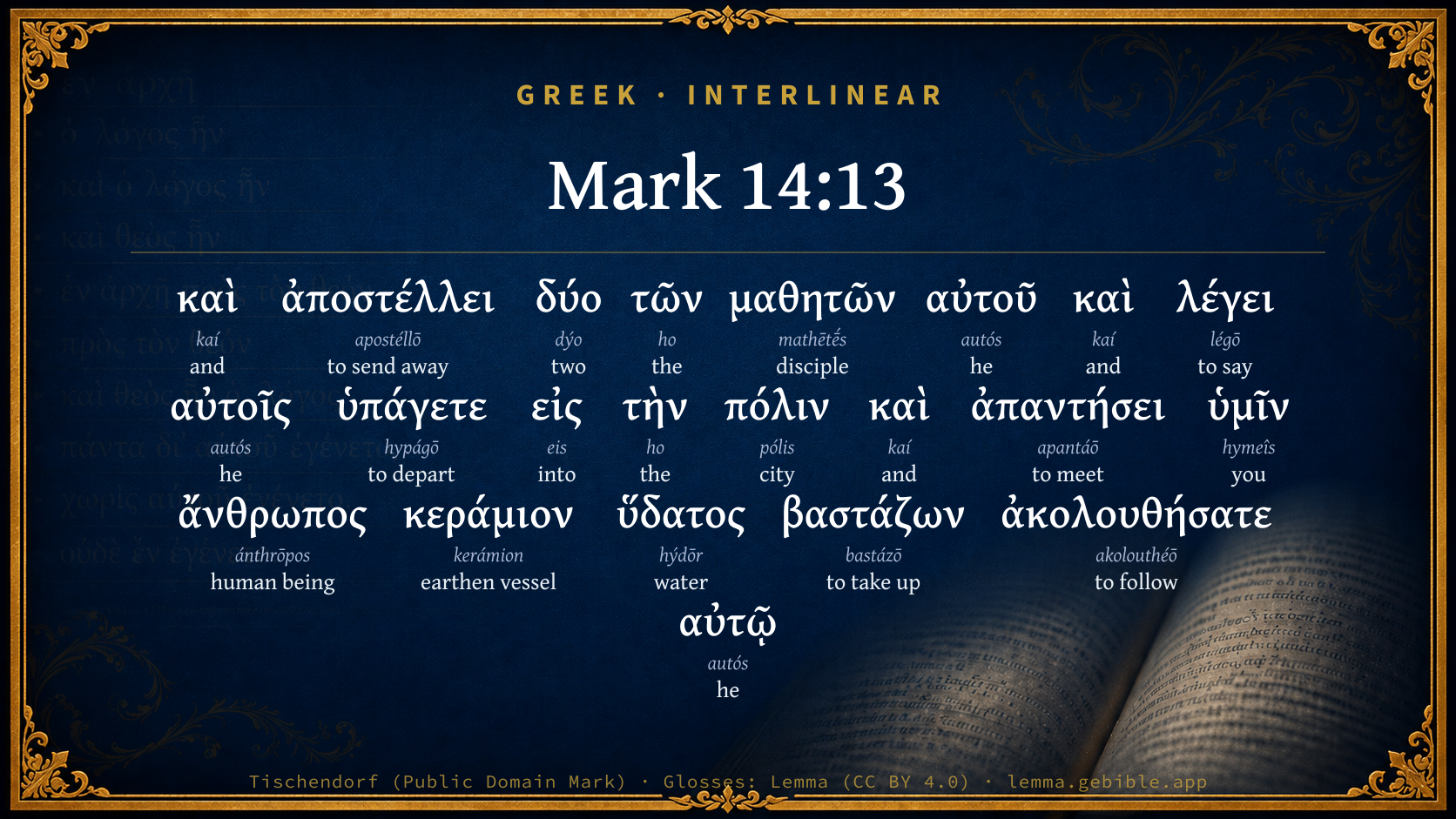
Download image
Cite this verse

Mark 14:13 (World English Bible). Public Domain. Lemma interlinear Bible study tool, https://lemma.gebible.app/v/mark/14/13.

Show BibTeX & RIS
BibTeX
RIS
English Translation
He sent two of his disciples, and said to them, "Go into the city, and there you will meet a man carrying a pitcher of water. Follow him,
World English Bible · Public Domain
Highlights
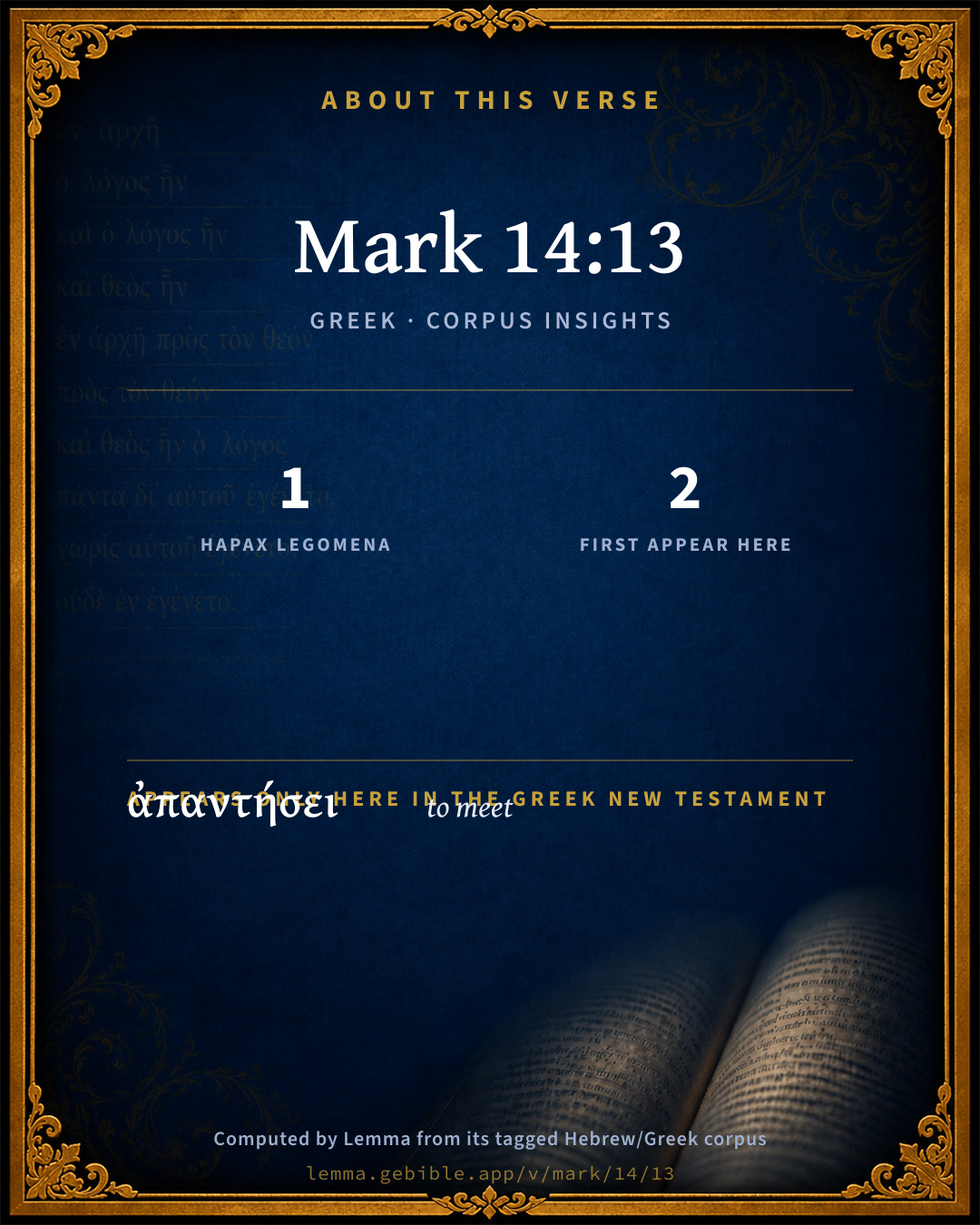
  • 1 hapax legomenon — only here in the Greek New Testament
  • 2 first appearances in the Greek New Testament
Full analysis ↓
Download a study sheet

One document with this verse’s original text, its word-by-word gloss line, the meaning frame, cross-references with their text, attributed commentary, and full source and license credits — printable, and it pastes into notes with its structure intact.

This verse Autodidact and up

Study sheet (.html) Plain text (.txt)

A passage Seminary Student

Up to 50 verses in one chapter. A passage sheet keeps up to 6 commentary sources and 12 cross-references per verse, in the order this page ranks them, and says so on the sheet whenever that leaves anything out. Ask for a single verse and you get the Autodidact verse sheet above.

Everything on this page stays free to read, with no account — the sheet is a download of what is already on screen, not access to it.

Want to remove ads? Support Godless Engineer
Compare translations 3

The same verse in 3 English versions, stacked beneath the original-language interlinear above. Click any original word for its lexicon entry.

Each is an independent rendering of the whole verse — the interlinear is not word-aligned to these translations.

Highlighted words mark where these versions differ — a whole-verse word diff, not a word-by-word alignment.

  • World English Bible Public Domain
    He sent two of his disciples, and said to them, "Go into the city, and there you will meet a man carrying a pitcher of water. Follow him,
  • King James Version Public Domain
    And he sendeth forth two of his disciples, and saith unto them, Go ye into the city, and there shall meet you a man bearing a pitcher of water: follow him.
  • unfoldingWord Literal Text CC BY-SA 4.0
    And he sends two of his disciples and says to them, “Go into the city, and a man carrying a pitcher of water will meet you. Follow him.

unfoldingWord Literal Text — © unfoldingWord, licensed CC BY-SA 4.0. Word-aligned USFM3 via Door43 (git.door43.org/unfoldingWord/en_ult).

Versions to compare (up to 4)

3 of 4 selected

Show all 19 translations

Every available English version of this verse, each an independent rendering of the whole verse.

  • World English Bible Public Domain
    He sent two of his disciples, and said to them, "Go into the city, and there you will meet a man carrying a pitcher of water. Follow him,
  • Berean Standard Bible Public Domain
    So He sent two of His disciples and told them, “Go into the city, and a man carrying a jug of water will meet you. Follow him,
  • Majority Standard Bible Public Domain
    So He sent two of His disciples and told them, “Go into the city, and a man carrying a jug of water will meet you. Follow him,
  • King James Version Public Domain
    And he sendeth forth two of his disciples, and saith unto them, Go ye into the city, and there shall meet you a man bearing a pitcher of water: follow him.
  • American Standard Version (1901) Public Domain
    And he sendeth two of his disciples, and saith unto them, Go into the city, and there shall meet you a man bearing a pitcher of water: follow him;
  • Revised Version (1885) Public Domain
    And he sendeth two of his disciples, and saith unto them, Go into the city, and there shall meet you a man bearing a pitcher of water: follow him;
  • Geneva Bible (1599) Public Domain
    Then hee sent foorth two of his disciples, and sayde vnto them, Goe yee into the citie, and there shall a man meete you bearing a pitcher of water: follow him.
  • Douay-Rheims (1899) Public Domain
    And he sendeth two of his disciples, and saith to them: Go ye into the city; and there shall meet you a man carrying a pitcher of water, follow him;
  • Young's Literal Translation Public Domain
    And he sendeth forth two of his disciples, and saith to them, `Go ye away to the city, and there shall meet you a man bearing a pitcher of water, follow him;
  • Literal Standard Version CC BY-SA 4.0
    And He sends forth two of His disciples and says to them, “Go away into the city, and there a man carrying a pitcher of water will meet you, follow him;
  • Unlocked Literal Bible CC BY-SA 4.0
    He sent two of his disciples and said to them, “Go into the city, and a man bearing a pitcher of water will meet you. Follow him.
  • unfoldingWord Literal Text CC BY-SA 4.0
    And he sends two of his disciples and says to them, “Go into the city, and a man carrying a pitcher of water will meet you. Follow him.
  • Darby Bible Public Domain
    And he sends two of his disciples, and says to them, Go into the city, and a man shall meet you carrying a pitcher of water; follow him.
  • World Messianic Bible Public Domain
    He sent two of his disciples and said to them, “Go into the city, and there a man carrying a pitcher of water will meet you. Follow him,
  • Webster's Bible Public Domain
    And he sendeth two of his disciples, and saith to them, Go ye into the city, and there shall meet you a man bearing a pitcher of water: follow him.
  • Free Bible Version CC BY-SA 4.0
    He sent two of his disciples, telling them, “Go into the city and there you'll meet a man carrying a water pot. Follow him,
  • Bible in Basic English Public Domain
    And he sent two of his disciples, and said to them, Go into the town, and there will come to you a man with a vessel of water: go after him;
  • Text-Critical English NT CC BY 4.0
    So he sent two of his disciples and said to them, “Go into the city, and a man carrying a jug of water will meet you. Follow him.
  • Tyndale New Testament (1534) Public Domain
    And he sent forth two of his disciples and sayde vnto them: Goo ye into the cyte and ther shall a man mete you beringe a pitcher of water folowe him.

Literal Standard Version (2020), Covenant Press — licensed CC BY-SA 4.0. Text via the HelloAO Bible API (eBible.org). Unlocked Literal Bible (unfoldingWord) — licensed CC BY-SA 4.0. Text via the HelloAO Bible API (eBible.org). unfoldingWord Literal Text — © unfoldingWord, licensed CC BY-SA 4.0. Word-aligned USFM3 via Door43 (git.door43.org/unfoldingWord/en_ult). Free Bible Version, Dr. Jonathan Gallagher — licensed CC BY-SA 4.0. Text via the HelloAO Bible API (eBible.org).

Word by word

More ways to search: Search by grammar → Find every occurrence → Compare this word →

Practice this passage: Drill this verse → Learn its vocabulary →

ἀπαντήσει
apantáō
G528
“to meet”
Verb, Future, Active, Indicative, 3rd person, Singular
Part of Speech
Verb
Tense
Future
Voice
Active
Mood
Indicative
Person
3rd person
Number
Singular
Full Thayer's Definition

Origin: from G575 and a derivative of G473

TDNT: None

1. to go to meet, to meet a. in a military sense: a hostile meeting
  1. καὶ kaí G2532 “and” Conjunction
  2. ἀποστέλλει apostéllō G649 “to send away” Verb, Present, Active, Indicative, 3rd person, Singular
  3. δύο dýo G1417 “two” Adjective, Numeral (indeclinable)
  4. τῶν ho G3588 “the” Article, Genitive, Plural, Masculine
  5. μαθητῶν mathētḗs G3101 “disciple” Noun, Genitive, Plural, Masculine
  6. αὐτοῦ autós G846 “he” Personal pronoun, Genitive, Singular, Masculine
  7. καὶ kaí G2532 “and” Conjunction
  8. λέγει légō G3004 “to say” Verb, Present, Active, Indicative, 3rd person, Singular
  9. αὐτοῖς autós G846 “he” Personal pronoun, Dative, Plural, Masculine
  10. ὑπάγετε hypágō G5217 “to depart” Verb, Present, Active, Imperative, 2nd person, Plural
  11. εἰς eis G1519 “into” Preposition
  12. τὴν ho G3588 “the” Article, Accusative, Singular, Feminine
  13. πόλιν pólis G4172 “city” Noun, Accusative, Singular, Feminine
  14. καὶ kaí G2532 “and” Conjunction
  15. ὑμῖν hymeîs G5210 “you” Personal pronoun, 2nd person, Dative, Plural
  16. ἄνθρωπος ánthrōpos G444 “human being” Noun, Nominative, Singular, Masculine
  17. κεράμιον kerámion G2765 “earthen vessel” Noun, Accusative, Singular, Neuter
  18. ὕδατος hýdōr G5204 “water” Noun, Genitive, Singular, Neuter
  19. βαστάζων bastázō G941 “to take up” Verb, Present, Active, Participle, Nominative, Singular, Masculine
  20. ἀκολουθήσατε akolouthéō G190 “to follow” Verb, Aorist, Active, Imperative, 2nd person, Plural
  21. αὐτῷ autós G846 “he” Personal pronoun, Dative, Singular, Masculine

About this verse

These counts appear in no published source. They are computed here, from the morphology-tagged text and Lemma’s own curated glosses. What Lemma adds →

22
words
17
distinct lemmas
Gospels
section

Notable vocabulary

1 hapax legomenon — a word that appears only here in the entire Greek New Testament:

  • ἀπαντήσει to meet G528

First appearance in Scripture

These words make their first canonical appearance in the Greek New Testament here:

  • ἀπαντήσει to meet G528
  • κεράμιον earthen vessel G2765

Shared distinctive vocabulary

κεράμιον earthen vessel G2765 occurs in 2 verses of the Greek New Testament. Also found in:
Repetition

Words recur within this verse:

  • καὶ and G2532 ×3
  • αὐτοῦ he G846 ×3
  • τῶν the G3588 ×2

Cross-references

8

Topical passages linked to Mark 14:13 in the Treasury of Scripture Knowledge — connected by theme and wording, ordered by reader-vote popularity; previews shown in the World English Bible.

  • Matthew 26:18–19 He said, "Go into the city to a certain person, and tell him, 'The Teacher says, "My time is at hand. I will keep the Passover at your house with my disciples."'"
  • Luke 22:10–13 He said to them, "Behold, when you have entered into the city, a man carrying a pitcher of water will meet you. Follow him into the house which he enters.
  • Matthew 8:9 For I am also a man under authority, having under myself soldiers. I tell this one, 'Go,' and he goes; and tell another, 'Come,' and he comes; and tell my servant, 'Do this,' and he does it."
  • Mark 11:2–3 and said to them, "Go your way into the village that is opposite you. Immediately as you enter into it, you will find a young donkey tied, on which no one has sat. Untie him, and bring him.
  • Luke 19:30–33 saying, "Go your way into the village on the other side, in which, as you enter, you will find a colt tied, whereon no man ever yet sat. Untie it, and bring it.
  • John 15:14 You are my friends, if you do whatever I command you.
  • Hebrews 4:13 There is no creature that is hidden from his sight, but all things are naked and laid open before the eyes of him with whom we have to do.
  • Hebrews 5:9 Having been made perfect, he became to all of those who obey him the author of eternal salvation,

Cross-references courtesy of OpenBible.info (CC BY 4.0).

Commentary

Notes on Mark 14:13 from classic Christian and Jewish commentators (each source and its license shown beneath its notes). The classic Christian expositions comment on the surrounding passage and are grouped to its opening verse, so a note may address several verses; the Jewish commentaries on the Tanakh (Rashi and others) are per-verse, so they appear only where the commentator wrote on this verse.

Lemma curates 59 commentaries, every one of them public domain or Creative Commons licensed, each selected and text-cleaned for this edition rather than reprinted as found. About our sources →

The Biblical Illustrator

Joseph S. Exell

Mar_14:13; Mar_14:15

Go ye into the city.

The finding the guest chamber

We might expect that Christ, knowing to how great effort the faith of His followers was about to be called, would, in His compassionate earnestness for their welfare, keep their faith in exercise up to the moment of the dreaded separation. He would find or make occasions for trying and testing the principles which were soon to be brought to so stern a proof. Did He do this? And how did He do it? We regard the circumstances which are now under review, those connected with the finding the guest chamber in which the last supper might be eaten, as an evidence and illustration of Christs exercising the faith of His disciples. Was it not exercising the faith of Peter and John-for these, the more distinguished of the disciples, were employed on the errand-to send them into the city with such strange and desultory directions? There were so many chances, if the word may be used, against the guest chamber being found through the circuitous method prescribed by our Lord, that we could not have wondered had Peter and John showed reluctance to obey His command. And we do not doubt that what are called the chances were purposely multiplied by Christ to make the finding the room seem more improbable, and therefore to give faith the greater exercise. Again, there would have been risk enough of mistake or repulse in accosting the man with the pitcher; but this man was only to be followed; and he might stop at many houses before he reached the right. But Christ would not be more explicit, because, in proportion as He had been more explicit, there would have been less exercise for faith. And if you imagine that, after all, it was no great demand on the faith of Peter and John that they should go on so vague an errand-for that much did not hinge on their finding the right place, and they had but to return if anything went wrong-we are altogether at issue with you. There was something that looked degrading and ignoble in the errand, which required more courage and fortitude than to undertake some signal enterprise. And the apparent meanness of an employment will often try faith more than its apparent difficulty; the exposure to ridicule and contempt will require greater moral nerve than the exposure to danger and death. We believe that it is very frequently ordered that faith should be disciplined and nurtured for its hardest endurances, and its highest achievements, through exposure to petty inconveniences, collisions with mere rudeness, the obloquy of the proud, the sneer of the supercilious, and the incivility of the ignorant. Nowhere is faith so well disciplined as in humble occupations; it grows great through little tasks, and may be more exercised by being left to the menial business of a servant than by being summoned to the lofty standing of a leader. And we do earnestly desire of you to bear this in mind; for men, who are not appointed to great achievements and endurances, are very apt to feel as though there were not enough in the trials and duties of a lowly station for the nurture and exercise of high Christian graces. Whereas, if it were by merely following a man bearing a pitcher of water that apostles were trained for the worst onsets of evil, there may be no such school for the producing strong faith as that in which the lessons are of the most everyday kind. But there is more than this to be said in regard of the complicated way in which Christ directed His disciples to the guest chamber where He had determined to eat the last supper. He was not only exercising the faith of the disciples by sending them on an errand which seemed unnecessarily intricate, and to involve great exposure to insult and repulse-He was giving strung evidence of His thorough acquaintance with everything that was to happen, and of His power over the minds whether of strangers or of friends. You must consider it as a prophecy on the part of Christ that the man would be met bearing a pitcher of water. It was a prophecy which seemed to take delight in putting difficulties in the way of its own precise accomplishment. It would not have been accomplished by the mere finding the house-it would have been defeated had the house been found through any other means than the meeting the man, or had the man been discovered through any other sign than the pitcher of water; yea, and it would have been defeated, defeated in the details, which were given, as it might have seemed, with such unnecessary and perilous minuteness, if the master of the house had made the least objection, or if it had not been an upper room which he showed the disciples; or if that room had not been large; or if it had not been furnished and prepared. And whatever tended to prove to the disciples their Masters thorough acquaintance with every future contingency, ought to have tended to the preparing them for the approaching days of disaster and separation. Besides, it was beautifully adapted to the circumstances of the disciples that Christ showed that His foreknowledge extended to trifles. These disciples were likely to imagine that, being poor and mean persons, they should be overlooked by Christ when separated from them, and, perhaps, exalted to glory. But that His eye was threading the crowded thoroughfares of the city, that it was noting a servant with a pitcher of water, observing accurately when this servant left his masters house, when he reached the well, and when he would be at a particular spot on his way back-this was not merely foreknowledge; this was foreknowledge applying itself to the insignificant and unknown. Then, again, observe that whatever power was here put forth by Christ was put forth without His being in contact with the party on whom it was exerted. Christ acted, that is, upon parties who were at a distance from Him, thus giving incontrovertible proof that His visible presence was not necessary in order to the exercise of His power. What a comfort should this have been to the disciples. It is easy to imagine how, when His death was near at hand, Christ might have wrought miracles and uttered prophecies more august in their character. He might have darkened the air with portents and prodigies, but there would not have been in these gorgeous or appalling displays the sort of evidence which was needed by disquieted and dispirited men. But to ourselves, who are looking for the guest chamber, not as the place where the Paschal lamb may be eaten, but as that where Christ is to give of His own body and blood, the pitcher of water may well serve as a memento that it is baptism which admits us into Christian privileges; that they who find a place at the supper of the Lord must have met the man with the water, and have followed that man-must have been presented to the minister of the Church, and have received from Him the initiatory sacrament, and then have submitted meekly to the guidance of the Church, till introduced to those deeper recesses of the sanctuary where Christ spreads His rich banquet for such as call upon His name. Thus may there have been, in the directions for finding the guest chamber, a standing intimation of the process through which should be sought an entrance to that upper room, where Christ and His members shall finally sit down, that they may eat together at the marriage supper. (H. Melvill, B. D.)

Providential meetings

There are no chance meetings in this world. They all are providential. They are in Gods plan. On many of them great possibilities hinge. You enter a railroad car, and take your seat among strangers. A proffered courtesy brings you into conversation with a fellow traveller. An acquaintance is the result. Years of helpful Christian co-work follow in the train of that first meeting. You visit a place of winter resort for health seekers. At the dinner table you meet a man unknown to you until then. An entire change in the aim and conduct of his life is one consequence of that meeting; and his labours for good may be far more effective than yours in your whole lifetime. You look in upon a celebrated preparatory school, where two hundred young men are at their studies. One face impresses you. Your meeting with him affects your course and his for all time, and involves the interests of a multitude. Your meeting of another young man in a Sunday school where you are present only for that one session has more influence over his life than all other agencies combined-and scarcely less over yours. You may even meet on the street one whom you wished not to see, one whom at that moment you were seeking to avoid; and as a result more lives than one are affected in all their human course, and in their highest spiritual interests. All these illustrations are real incidents; and there are thousands like them. It behooves us to consider well our duty in every meeting with another. We can fail to improve our opportunity and lose a blessing. We can fill our place just then, and have reason to rejoice eternally that we did so. Lord, what wilt thou have me to do-when next I meet one whom thou hast planned for me to see? (Sunday School Times.)

The Masters question

The Master saith! Has the charm of the Masters name vanished in these latter days? Are we, men and women of the nineteenth century, children of a modern life and civilization which is ever extending itself with feverish restlessness and painful throes of new birth, are we grown familiar with strange voices, with forces unknown in that ancient world, and those ancient days spent under the blue Syrian sky; are we become superior to the claims, the force, the beauty, and the authority of a great personal life? Have we relegated Jesus of Nazareth merely to a place, however great, in the development of history? Is He merely the product of social forces and political and historical traditions? The Master saith! Being dead, doth He yet speak; yet so as through the faint vibrations of memory-of memory which grows weaker as the ages roll behind us into the eternity of the past; or is it a living voice still which I hear-a voice which no results of time can shake with the tremulousness of age? Do not our own hearts-we who have become disciples, we who, constrained by a force which we could not resist, have exclaimed, Master, Thou art the Christ who hast conquered me, Thou art the Christ who hast died for me-do not our own hearts passionately exclaim, He liveth still to make intercession for us, and to rule us with the supremacy of perfect love? Will ye also admit the Master within? Will ye hear Him? Will ye let Him talk with you? This night, as a disciple of the Lord Jesus Christ, I bring the word to you also: The Master saith! The voices of all His disciples are but weak echoes of the mightier and abiding voice which is His. The Master saith! But where? Hath His voice a local habitation and a name? Doth He reach me through the channel of my senses, or how doth He touch my living spirit? It is here that the Master saith!-even now. These poor temples of ours, they are for the most part but shapeless structures of stone and lime, yet they are clothed with the spiritual and unfading beauty of a Divine guest chamber; a voice which is not my voice overpowers my struggling will, subdues by gentle and beautiful processes my efforts to make my own will my law and arbiter of duty, and speaks through me. And most of all is it of infinite moment to know that there is one called Master, and who does speak. This is what I need to know and feel. In Jesus of Nazareth life and duty are reconciled. In Him I recognize the Master whom I need. To Him, in whom gentleness was so perfectly blended with strength, I come, craving to touch but the hem of His garment, contented in that I have seen my Lord. The Master saith! If His voice is the voice of an authority, sublimely enforced through self-denial, patience, gentleness, suffering, and death, why should I crave more? Shall I not say, It is enough; He calleth me, and I must answer? He bids me arise, and I must arise. For me the highest virtue is obedience, for it is the Master who saith. (J. Vickery.)

The Biblical Illustrator, edited by Joseph S. Exell (c. 1880s–1900s) — public domain. Text from a community e-Sword module.

Tyndale Open Study Notes

Tyndale Open Resources

14:13-15 Jesus’ instructions to the disciples are similar to those of 11:2-6, suggesting that Jesus had prearranged a place for eating the Passover and Last Supper with his disciples. Jesus’ careful preparations for this meal emphasize its importance. The two disciples were to prepare the Passover meal, which included the lamb (which had to be slaughtered, skinned, cleaned, and roasted over an open fire), unleavened bread, a bowl of salt water, bitter herbs, and a bowl of a fruit puree, or kharosheth. Enough wine mixed with water was needed so that Jesus and the disciples could each drink four cups to celebrate God’s fourfold blessing (Exod 6:6-7).

Tyndale Open Study Notes — © Tyndale Open Resources, licensed CC BY-SA 4.0. Text via the HelloAO Bible API.

Bengel's Gnomon

Johann Albrecht Bengel

Mar 14:13. Ἀπαντήσει, there shall meet) A wonderful sign: 1) that a person is about to meet them: 2) that person a man: 3) that man alone: 4) that too, immediately: 5) he should be bearing a vessel: 6) and that vessel, one of earthenware [κεράμιον]: 7) and containing water: 8) and that, too, going to the house which the disciples were looking for [It was in deep humiliation, even like as an ordinary Israelite, that Christ ate the Passover Lamb; wherefore He put forth His glory into exercise in the preparation for it.—V. g.]

Bengel's Gnomon of the New Testament — English translation (T&T Clark, Edinburgh, 1860) — public domain. Text from a community e-Sword module.

Expositor's Greek Testament

ed. W. Robertson Nicoll

Mar 14:13 . δύο : more exact than Mt.; of course all the disciples would not be sent on such an errand. Lk. names the two. ὑπάγετε , etc.: the instructions in Mk. are sufficient to guide the messengers. Mt.’s πρὸς τὸν δεῖνα is manifestly too vague, and could not have been spoken by Jesus. ἄνθρωπος : water-carrying was generally the occupation of women; hence a man performing the office would be more noticeable. κεράμιον (neuter of adjective κεράμιος , earthen), an earthen pitcher, here and in Luk 22:10 .

The Expositor's Greek Testament, edited by W. Robertson Nicoll (1897–1910) — public domain. Text from a community e-Sword module.

Adam Clarke's Commentary

Verse 13. Bearing a pitcher of water] How correct is the foreknowledge of Jesus Christ! Even the minutest circumstances are comprehended by it! An honest employment, howsoever mean, is worthy the attention of God; and even a man bearing a pitcher of water is marked in all his steps, and is an object of the merciful regards of the Most High. This man was employed in carrying home the water which was to be used for baking the unleavened bread on the following day; for on that day it was not lawful to carry any: hence they were obliged to fetch it on the preceding evening.

Adam Clarke's Commentary on the Bible (1810–1826) — public domain. Text from a community e-Sword/MySword module.

Ellicott's Commentary for English Readers

(13) And he sendeth forth two of his disciples.—The number is given by St. Mark; the names, Peter and John, by St. Luke only. The sign of the pitcher of water is common to both Gospels, but not to St. Matthew.

A Bible Commentary for English Readers, edited by Charles John Ellicott (1878–1897) — public domain. Text from a community e-Sword module.

The Cambridge Bible for Schools and Colleges

gen. ed. J. J. S. Perowne

13. he sendeth forth two of his disciples] The Apostles Peter and John (Luk_22:8).

and there shall meet you] Observe the minuteness of the directions and of the predictions as to the events which would happen. It is the same mysterious minuteness which distinguishes the preparations for the Triumphal Entry.

a man] It was generally the task of women to carry water. Amongst the thousands at Jerusalem they would notice this man carrying an earthen jar of water drawn from one of the fountains. We need not conclude, because it was a slave’s employment to do this (Deu_29:11; Jos_9:21), that he was a slave. The Apostles were to follow him to whatever house he entered.

The Cambridge Bible for Schools and Colleges (gen. ed. J. J. S. Perowne; Cambridge University Press, 1878–1918) — public domain. Text from a community e-Sword module.

John Gill's Exposition

And he sendeth forth two of his disciples,.... Peter and John, as appears from Luk 22:8;

and saith unto them, go ye into the city; the city of Jerusalem; for there only the passover might be eaten, Deu 26:2;

and there shall meet you a man bearing a pitcher of water; a servant of the master of the house that was sent for water, to mix with the wine, at the passover:

follow him; into the house to which he goes.

John Gill's Exposition of the Whole Bible (1746–1763) — public domain (CC PDM 1.0). Text via the HelloAO Bible API.

Trapp's Complete Commentary

John Trapp

13 And he sendeth forth two of his disciples, and saith unto them, Go ye into the city, and there shall meet you a man bearing a pitcher of water: follow him.

Ver. 13. {See Trapp on "Mat 26:17"} {See Trapp on "Mat 26:18"}

John Trapp, A Commentary or Exposition upon All the Books of the Old and New Testament (1647–1656) — public domain. Text from a community e-Sword module.

Whedon's Commentary on the Bible

Daniel D. Whedon

13. Meet you a man — As the apostles enter the city from the east the water carrier with his filled pitcher is returning home from the west. Hence Dr. Barclay well argues that the tradition which places the coenaculum or last supper on the western part of Zion is incorrect. The two apostles having passed through the temple grounds, and crossed the great bridge, would not proceed far before they would meet him bringing his jar of fresh water from Gibon or Etham.

Daniel D. Whedon (gen. ed.), Commentary on the Old and New Testaments (1874–1909) — public domain. Text from a community e-Sword module.

The Pulpit Commentary

And he sendeth two of his disciples. St. Luke (Luk_22:8) informs us that these two were Peter and John. It is characteristic of St. Mark"s Gospel throughout that Peter is never mentioned oftener than is necessary. Go into the city, and there shall meet you a man bearing a pitcher of water. The bearing of the pitcher of water was not without its meaning. It was a solemn religious act preparatory to the Passover. This man bearing a pitcher of water was not the master or owner of the house. The owner is distinguished afterwards by the name oikodespothv , or "goodman of the house." The owner must, therefore, have been a man of some substance, and probably a friend if not a disciple of our Lord. Tradition says that this was the house of John whose surname was Mark; and that it was in this house that the disciples were assembled on the evening of our Lord"s resurrection, and where, also, they received the miraculous gifts of the Holy Spirit, on the day of Pentecost. It was to this house that Peter betook himself when he was delivered by the angel out of prison. Hence it was known, as one of the earliest places of Christian worship, by the name of "Coenaculum Sion; "and here was built a church, called the Church of Sion. It was the oldest church in Jerusalem, and was called by St. Cyril, "the upper church of the apostles." (See Joseph Mode, p. 322.)

The Pulpit Commentary (1880–1919), ed. H.D.M. Spence-Jones & Joseph S. Exell — public domain. Text from a community e-Sword module.

John Wesley's Explanatory Notes

Go into the city, and there shall meet you a man - It was highly seasonable for our Lord to give them this additional proof both of his knowing all things, and of his influence over the minds of men.

John Wesley, Explanatory Notes Upon the Whole Bible (1754–1765) — public domain. Text via the GEBible commentary corpus.

Cambridge Greek Testament for Schools and Colleges

13. ἀποστέλλει δύο. See on Mar 11:1. Lk. tells us that the pair were Peter and John, probably the oldest and youngest of the Twelve, certainly two that had been specially selected on previous occasions. Neither here, nor at the Supper, is there mention of a lamb, and it is very improbable that there was one. If the hypothesis that Christ anticipated the time for celebrating the Passover is correct, the disciples could not get the priests to kill the lamb before the time. Moreover, the whole company ought to be present in the Temple at the killing of the lamb (Exo 12:4-6), and two disciples would not suffice for this. Above all, there would be no need of a typical lamb, when the true Paschal lamb was present, ready to be offered, but not yet slain.

Ὑπάγετε εἰς τ. πόλιν. This shows that they are outside Jerusalem, perhaps at Bethany.

ἀπαντήσει ὑμῖν ἄνθρωπος. This remarkable detail is omitted in Mt.’s very abbreviated narrative. The man’s carrying water shows that he was a servant, not the owner, who is in the house (Mar 14:14). Slaves or women fetched water for the household (Deu 29:11; Jos 9:21-27; Joh 4:7). That this was the master of the house drawing water on 13th Nisan for making the leaven, is a useless suggestion; no evidence as to the day can be got from a servant fetching water. As in the case of the colt (Mar 11:2-3), there is room for doubt whether our Lord had arranged matters beforehand or not. It might have been agreed that the man carrying water should be ready to meet the disciples. But this is not the impression which the narratives give us. Apparently Christ had arranged with the owner that the Paschal meal should take place at his house; but His telling the disciples that they would meet one of this man’s servants, and that by following this servant they would find the house, is evidently regarded as supernatural prescience. If there had been any desire to invent a sign of supernatural prescience, our Lord would have been made to predict something more remarkable than a man carrying a pitcher.

Vulg. is again capricious; here it has laguenam aquae bajulans; in Lk. amphoram aquae portans, the Greek being the same. So also in what follows; here Ubi est refectio? in Lk. Ubi est diversorium?

Cambridge Greek Testament for Schools and Colleges (Cambridge University Press, 1896; 21 vols, various authors incl. Carr, Maclear, Plummer, Farrar, Lumby, Moule, M. R. James, Simcox) — public domain. Text from a community e-Sword module.

International Critical Commentary

13. δύο τῶν ἀποστόλων—Luk 22:8 names Peter and John as the two. κεράμιον—Etymologically, this word denotes any earthenware vessel, but in use, it is restricted to a jar or pitcher. It is a question, whether this sign of a man bearing a jar of water on his head had been prearranged between Jesus and the οἰκοδεσπότης, or whether this is an instance of Jesus’ supernatural knowledge of events. The manner of narration seems to imply that the evangelist meant us to understand the latter. There can be little doubt that the rest of the matter had been arranged with the host.

International Critical Commentary — older volumes (1896–1929), various authors — public domain. Text from a community e-Sword module.

Vincent's Word Studies in the New Testament

Marvin R. Vincent

A man. A slave probably, whose business it was to draw water. See Deu 19:11.

Pitcher. Of earthenware : keramion from keramov potter 's clay.

Marvin R. Vincent, Word Studies in the New Testament (1887–1900) — public domain. Text from a community e-Sword/MySword module.

Lesson kit

Teaching starters — assembled from the data on this page, not authored interpretation. Every prompt links to the verse data it draws on. Edit before teaching.

Mark, in the Gospels, opens this verse with 22 words (17 distinct Greek lemmas). Its most distinctive word is apantáō (“to meet”). A historical commentator’s framing appears above. Read the whole chapter for the surrounding context.

Discussion questions

  1. What does “to meet” (apantáō) contribute to the verse as a whole?
  2. This verse holds 1 word here found nowhere else in the Greek New Testament. What might the rare word draw attention to?
  3. 2 words here appear for the first time in Scripture. What is being introduced at this debut?
  4. Luke 22:10 shares the word «earthen vessel» with this verse. How do the two illuminate each other?
  5. “and” occurs 3× in this one verse. What is the effect of the repetition?
  6. These translations render this verse differently. What is at stake in choosing one wording over another?
  7. Reading how The Biblical Illustrator and Tyndale Open Study Notes read this verse, where do the two commentators agree and where do they part?

Things to notice

  • 1 word in this verse appears nowhere else in the Greek New Testament.
  • 2 words make their first canonical appearance in Scripture here.
  • These translations choose different wording for 11 words in this verse.
  • “and” occurs 3× in this single verse.
  • 17 distinct Greek lemmas span 22 words in this verse.

Reading settings

Reading text

Shown beneath each verse's original-language words.

Old Testament
Old Testament edition

Read the OT as the Masoretic Hebrew (MT) or the Greek Septuagint (LXX).

English shown for the Greek Septuagint (in the Hebrew ↔ Greek comparison).

Comparing translations? Open the Compare panel on any verse page to stack up to four side by side.