Luke 19:29

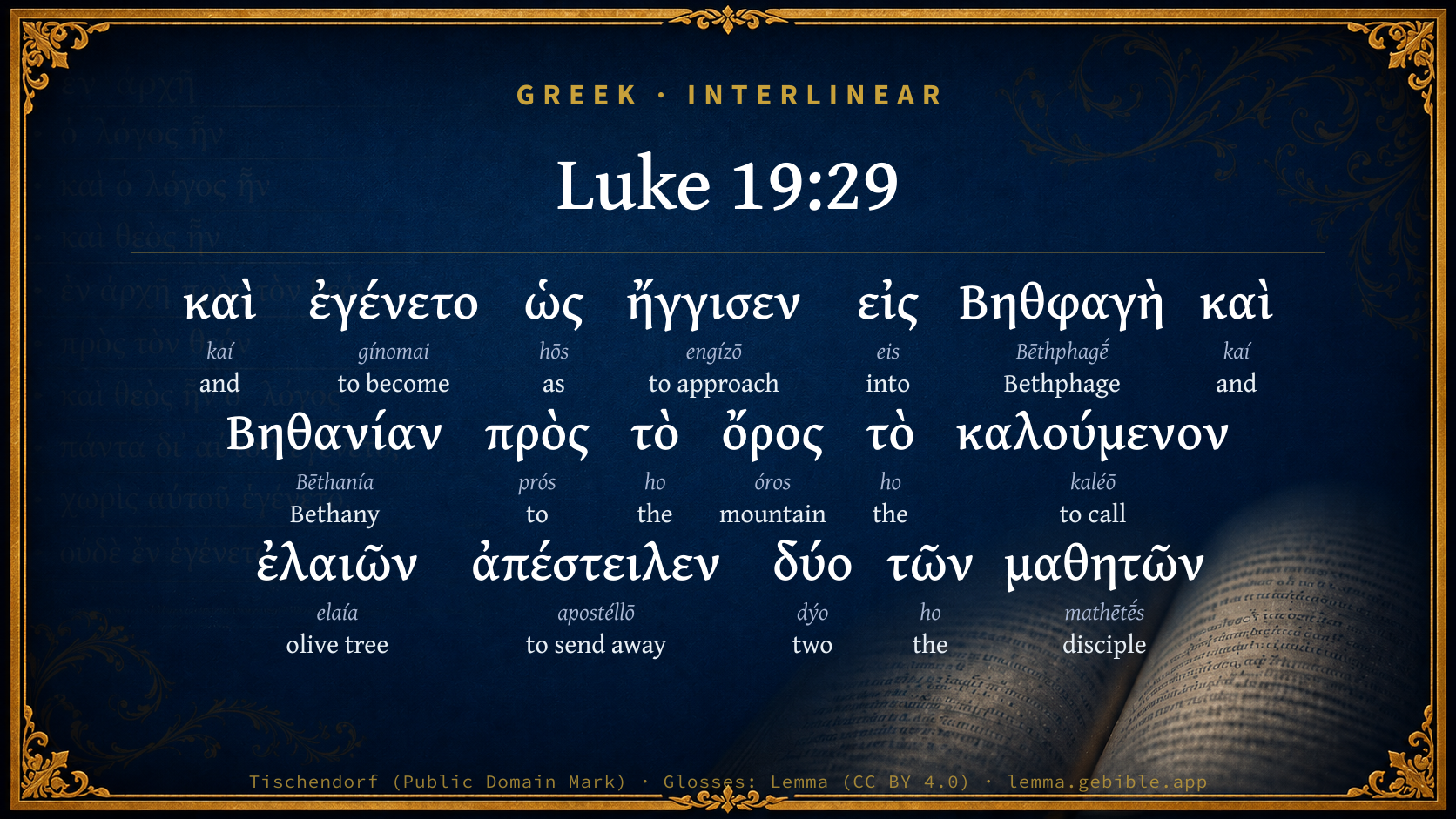
Greek (Tischendorf 8th ed.) Luke 19:29 appears in the Greek New Testament. The text above is from the Tischendorf 8th edition. Each word links to its Strong’s number and a concise gloss. Click any word for its full Thayer’s Greek Lexicon entry.
Download image
Cite this verse

Luke 19:29 (World English Bible). Public Domain. Lemma interlinear Bible study tool, https://lemma.gebible.app/v/luke/19/29.

Show BibTeX & RIS
BibTeX
RIS
English Translation
It happened, when he drew near to Bethsphage and Bethany, at the mountain that is called Olivet, he sent two of his disciples,
World English Bible · Public Domain
Download a study sheet

One document with this verse’s original text, its word-by-word gloss line, the meaning frame, cross-references with their text, attributed commentary, and full source and license credits — printable, and it pastes into notes with its structure intact.

This verse Autodidact and up

Study sheet (.html) Plain text (.txt)

A passage Seminary Student

Up to 50 verses in one chapter. A passage sheet keeps up to 6 commentary sources and 12 cross-references per verse, in the order this page ranks them, and says so on the sheet whenever that leaves anything out. Ask for a single verse and you get the Autodidact verse sheet above.

Everything on this page stays free to read, with no account — the sheet is a download of what is already on screen, not access to it.

Want to remove ads? Support Godless Engineer
Compare translations 3

The same verse in 3 English versions, stacked beneath the original-language interlinear above. Click any original word for its lexicon entry.

Each is an independent rendering of the whole verse — the interlinear is not word-aligned to these translations.

Highlighted words mark where these versions differ — a whole-verse word diff, not a word-by-word alignment.

  • World English Bible Public Domain
    It happened, when he drew near to Bethsphage and Bethany, at the mountain that is called Olivet, he sent two of his disciples,
  • King James Version Public Domain
    And it came to pass, when he was come nigh to Bethphage and Bethany, at the mount called the mount of Olives, he sent two of his disciples,
  • unfoldingWord Literal Text CC BY-SA 4.0
    And it happened that, when he had come near to Bethphage and Bethany, to the mount called of Olives, he sent two of the disciples,

unfoldingWord Literal Text — © unfoldingWord, licensed CC BY-SA 4.0. Word-aligned USFM3 via Door43 (git.door43.org/unfoldingWord/en_ult).

Versions to compare (up to 4)

3 of 4 selected

Show all 19 translations

Every available English version of this verse, each an independent rendering of the whole verse.

  • World English Bible Public Domain
    It happened, when he drew near to Bethsphage and Bethany, at the mountain that is called Olivet, he sent two of his disciples,
  • Berean Standard Bible Public Domain
    As He approached Bethphage and Bethany at the Mount of Olives, He sent out two of His disciples,
  • Majority Standard Bible Public Domain
    As He approached Bethphage and Bethany at the Mount of Olives, He sent out two of His disciples,
  • King James Version Public Domain
    And it came to pass, when he was come nigh to Bethphage and Bethany, at the mount called the mount of Olives, he sent two of his disciples,
  • American Standard Version (1901) Public Domain
    And it came to pass, when he drew nigh unto Bethphage and Bethany, at the mount that is called Olivet, he sent two of the disciples,
  • Revised Version (1885) Public Domain
    And it came to pass, when he drew nigh unto Bethphage and Bethany, at the mount that is called the mount of Olives, he sent two of the disciples,
  • Geneva Bible (1599) Public Domain
    And it came to passe, when hee was come neere to Bethphage, and Bethania, besides the mount which is called the mount of Oliues, he sent two of his disciples,
  • Douay-Rheims (1899) Public Domain
    And it came to pass, when he was come nigh to Bethphage and Bethania, unto the mount called Olivet, he sent two of his disciples,
  • Young's Literal Translation Public Domain
    And it came to pass, as he came nigh to Bethphage and Bethany, unto the mount called of the Olives, he sent two of his disciples,
  • Literal Standard Version CC BY-SA 4.0
    And it came to pass, as He came near to Bethphage and Bethany, to that called the Mount of Olives, He sent two of His disciples,
  • Unlocked Literal Bible CC BY-SA 4.0
    It came about that when he came near to Bethphage and Bethany, to the hill that is called Olivet, he sent two of the disciples,
  • unfoldingWord Literal Text CC BY-SA 4.0
    And it happened that, when he had come near to Bethphage and Bethany, to the mount called of Olives, he sent two of the disciples,
  • Darby Bible Public Domain
    And it came to pass as he drew near to Bethphage and Bethany at the mountain called [the mount] of Olives, he sent two of his disciples,
  • World Messianic Bible Public Domain
    When he came near to Bethsphage and Bethany, at the mountain that is called Olivet, he sent two of his disciples,
  • Webster's Bible Public Domain
    And it came to pass, when he had come nigh to Bethphage and Bethany, at the mount called the mount of Olives, he sent two of his disciples,
  • Free Bible Version CC BY-SA 4.0
    As he approached Bethphage and Bethany on the Mount of Olives, he sent two disciples, telling them:
  • Bible in Basic English Public Domain
    And it came about that when he got near Beth-phage and Bethany by the mountain which is named the Mountain of Olives, he sent two of the disciples,
  • Text-Critical English NT CC BY 4.0
    As he drew near to Bethsphage and Bethany, at the mount called Olivet, he sent two of his disciples ahead,
  • Tyndale New Testament (1534) Public Domain
    And it fortuned when he was come nye to Bethphage and Bethany besydes moute olivete he sent two of his disciples

Literal Standard Version (2020), Covenant Press — licensed CC BY-SA 4.0. Text via the HelloAO Bible API (eBible.org). Unlocked Literal Bible (unfoldingWord) — licensed CC BY-SA 4.0. Text via the HelloAO Bible API (eBible.org). unfoldingWord Literal Text — © unfoldingWord, licensed CC BY-SA 4.0. Word-aligned USFM3 via Door43 (git.door43.org/unfoldingWord/en_ult). Free Bible Version, Dr. Jonathan Gallagher — licensed CC BY-SA 4.0. Text via the HelloAO Bible API (eBible.org).

Word by word

More ways to search: Search by grammar → Find every occurrence → Compare this word →

Practice this passage: Drill this verse → Learn its vocabulary →

Βηθφαγὴ
Bēthphagḗ
G967
“Bethphage”
Noun, Proper, indeclinable
Part of Speech
Noun · Proper, indeclinable
Full Thayer's Definition

Origin: of Aramaic origin cf G1004 and G6291

TDNT: None

Bethphage = "house of unripe figs" 1. the name of a hamlet between Jericho and Jerusalem, close to Bethany
  1. καὶ kaí G2532 “and” Conjunction
  2. ἐγένετο gínomai G1096 “to become” Verb, Aorist, Middle deponent, Indicative, 3rd person, Singular
  3. ὡς hōs G5613 “as” Adverb
  4. ἤγγισεν engízō G1448 “to approach” Verb, Aorist, Active, Indicative, 3rd person, Singular
  5. εἰς eis G1519 “into” Preposition
  6. καὶ kaí G2532 “and” Conjunction
  7. Βηθανίαν Bēthanía G963 “Bethany” Noun, Accusative, Singular, Feminine
  8. πρὸς prós G4314 “to” Preposition
  9. τὸ ho G3588 “the” Article, Accusative, Singular, Neuter
  10. ὄρος óros G3735 “mountain” Noun, Accusative, Singular, Neuter
  11. τὸ ho G3588 “the” Article, Accusative, Singular, Neuter
  12. καλούμενον kaléō G2564 “to call” Verb, Present, Passive, Participle, Accusative, Singular, Neuter
  13. ἐλαιῶν elaía G1636 “olive tree” Noun, Genitive, Plural, Feminine
  14. ἀπέστειλεν apostéllō G649 “to send away” Verb, Aorist, Active, Indicative, 3rd person, Singular
  15. δύο dýo G1417 “two” Adjective, Numeral (indeclinable)
  16. τῶν ho G3588 “the” Article, Genitive, Plural, Masculine
  17. μαθητῶν mathētḗs G3101 “disciple” Noun, Genitive, Plural, Masculine

About this verse

These counts appear in no published source. They are computed here, from the morphology-tagged text and Lemma’s own curated glosses. What Lemma adds →

18
words
15
distinct lemmas
Gospels
section

Notable vocabulary

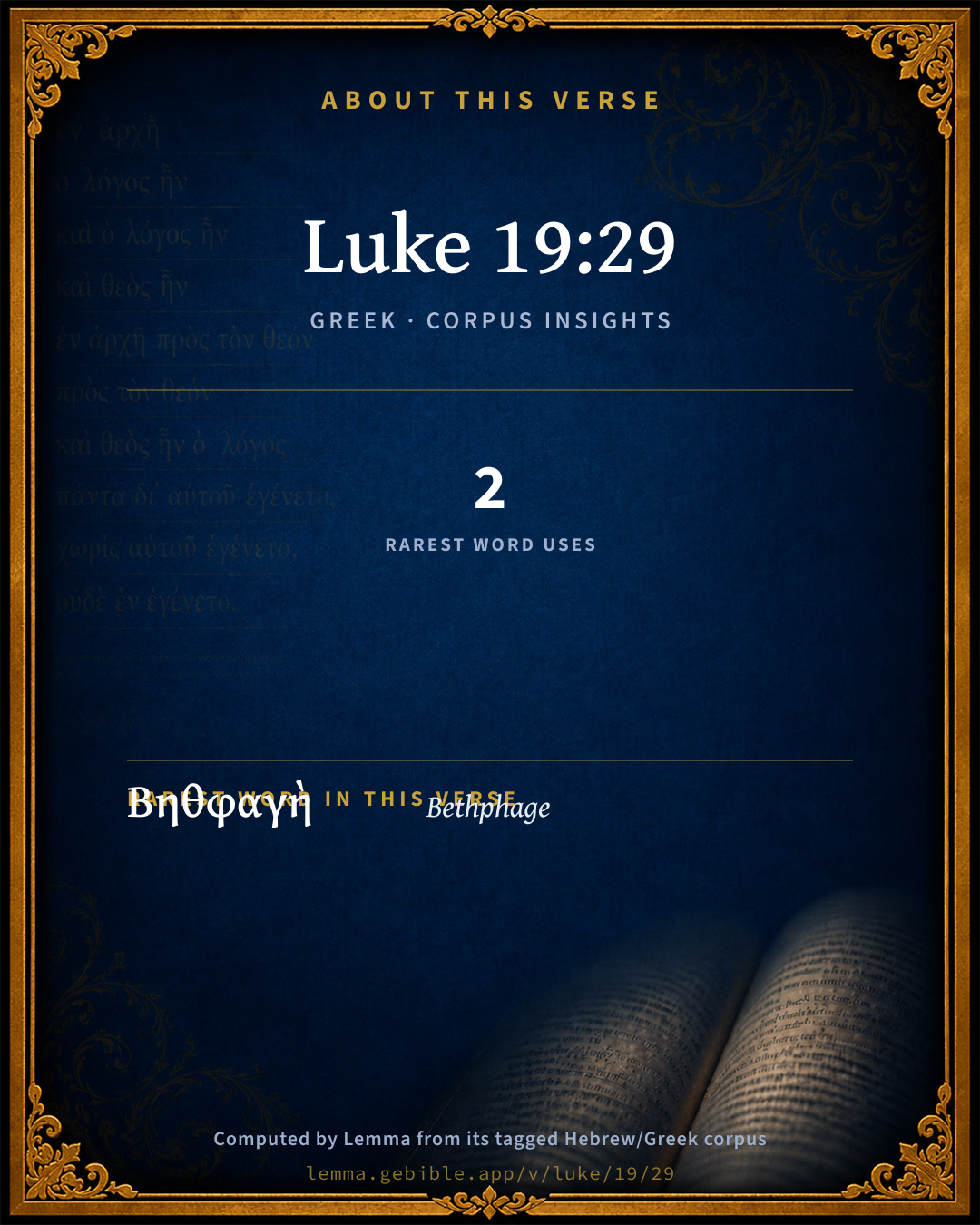
The rarest word here is Βηθφαγὴ Bethphage G967 — appearing just 2 times in the whole Greek New Testament.

Shared distinctive vocabulary

Βηθφαγὴ Bethphage G967 occurs in 2 verses of the Greek New Testament. Also found in:

Repetition

Words recur within this verse:

Cross-references

10

Topical passages linked to Luke 19:29 in the Treasury of Scripture Knowledge — connected by theme and wording, ordered by reader-vote popularity; previews shown in the World English Bible.

  • Matthew 21:1–11 When they drew near to Jerusalem, and came to Bethsphage, to the Mount of Olives, then Jesus sent two disciples,
  • Matthew 21:17 He left them, and went out of the city to Bethany, and lodged there.
  • Acts 1:12 Then they returned to Jerusalem from the mountain called Olivet, which is near Jerusalem, a Sabbath day's journey away.
  • Zechariah 14:4 His feet will stand in that day on the Mount of Olives, which is before Jerusalem on the east; and the Mount of Olives will be split in two, from east to west, making a very great valley. Half of the mountain will move toward the north, and half of it toward the south.
  • Mark 11:1–11 When they drew near to Jerusalem, to Bethsphage and Bethany, at the Mount of Olives, he sent two of his disciples,
  • Luke 19:37 As he was now getting near, at the descent of the Mount of Olives, the whole multitude of the disciples began to rejoice and praise God with a loud voice for all the mighty works which they had seen,
  • Luke 21:37 Every day Jesus was teaching in the temple, and every night he would go out and spend the night on the mountain that is called Olivet.
  • Luke 22:39 He came out, and went, as his custom was, to the Mount of Olives. His disciples also followed him.
  • Luke 24:50 He led them out as far as Bethany, and he lifted up his hands, and blessed them.
  • John 12:12–16 On the next day a great multitude had come to the feast. When they heard that Jesus was coming to Jerusalem,

Cross-references courtesy of OpenBible.info (CC BY 4.0).

Commentary

Notes on Luke 19:29 from classic Christian and Jewish commentators (each source and its license shown beneath its notes). The classic Christian expositions comment on the surrounding passage and are grouped to its opening verse, so a note may address several verses; the Jewish commentaries on the Tanakh (Rashi and others) are per-verse, so they appear only where the commentator wrote on this verse.

Lemma curates 59 commentaries, every one of them public domain or Creative Commons licensed, each selected and text-cleaned for this edition rather than reprinted as found. About our sources →

Godbey's Commentary on the New Testament

William B. Godbey

TRIUMPHANT ENTRY

Joh 12:12-19; Mat 21:1-11; Mat 21:14-17; Luk 19:29-44; Mar 11:1-11. John: “On the morrow a great multitude, having come to the feast, hearing that Jesus comes into Jerusalem, took the branches of the palm-trees, and came out to meet Him, and continued to cry out, Hosanna! Blessed is He that cometh in the name of the Lord, the King of Israel!” Having arrived at Bethany Sunday evening, and lodged at the house of Mary, Martha, and Lazarus, on Monday morning Jesus goes to Jerusalem, over Mount Olivet, as the road then led. Now it goes around it, south of the summit.

Mark: “When they draw near to Jerusalem, to Bethphage and Bethany, near to the Mount of Olives, He sends forth two of His disciples, and says to them, Go ye into the village which is opposite you, and going into it, you will immediately find a colt tied, on which no one of men has sat. And if any one may say to you, Why do you do this? say that the Lord has need of him, and immediately he will send him hither. They departed, and found the colt tied at the door without, on the crossing of two roads, and they are loosing him; and certain ones of those standing there began to say to them, What are you doing, loosing the colt? And they said to them as Jesus commanded. And they led the colt to Jesus, and cast their garments on him, and He sat on him.” I made a specialty of pursuing this old road over the mountain which Jesus traveled on this notable occasion. Bethphage is about half-way from Bethany to the summit, on the mountain slope. From this place, in the journey, Jesus sent the two disciples, whose names are not given, with orders to go into a village on the mountain in full view, and bring to Him the young donkey, which had never been mounted. Matthew says they brought the mother along with the colt. Those donkeys have wonderful strength, utterly out of proportion to their size, which is quite diminutive. They are much used in the Holy Land, really more than any other domestic animal, the camel ranking next, and being used for all heavy burdens. Some get confused in the statement of Matthew that “He sat on them,” thinking that He rode both of the donkeys, which is untrue, as “them” does not refer to the animals, but to the clothes which they laid on the young animal, and on which Jesus sat. Why did Jesus ride the donkey? Why not a horse? The reason is very obvious. The horse is the symbol of war, being always used in battle; while the donkey, too slow for war, is the universal symbol of peace, and consequently the appropriate animal for the Prince of Peace to ride. Again, the donkey symbolizes humility, as he is the poor man’s animal, eating about as much as a sheep, hardy enough to live in the desert, and so small and tough that he can climb a mountain like a goat. Jesus came, the first time, in His humiliation, homeless and friendless, riding into Jerusalem on the donkey. He will come the second time in His glory, riding on a white cloud.

John: “Jesus, having found the young donkey, sat on him, as has been written, Fear not, daughter of Zion; behold, thy King cometh, sitting upon the colt of the donkey.” (Zec 9:9) That is certainly a very beautiful prophecy. As Jerusalem occupies the summit of Mount Zion, the application is clear and unmistakable.

Mark: “And many strew their garments in the way; and others cut down the branches from the trees, and continued to strew them in the way. Those going before and those following alter continued to shout, saying, Hosanna! Blessed is He that cometh in the name of the Lord! Blessed is the kingdom coming in the name of our father David I Hosanna in the highest!” Luke says: “He, drawing nigh to the descension of the Mount of Olives, the whole multitude of His disciples, rejoicing, began to praise God with a loud voice for all the miracles which they had seen.” After the gushing, Oriental style of saluting kings and conquerors, they threw down their garments for Him to ride over them, demonstrative of their perfect submission to His authority, and at the same time they strew His way with palm-leaves, which are so majestic and beautiful in Oriental climates, and vividly symbolic of royalty, conquest, and victory. They had waited three years for that wonderful hour, and now feel sure that the desideratum for which they had prayed, sighed, and cried to God so long is fast culminating into a glorious reality; and when they reach Jerusalem, they are very sanguine that He will be crowned King of the Jews. At that time there were no factories, and clothing was so scarce and costly, comparatively with our day, that we can hardly estimate the sacrifice which they so cheerfully and gladly made in throwing down the best apparel they had, in the dusty road, for the donkey to tread upon. O they are so glad to hail Him King of the Jews, little dreaming that this grand ovation was but a scintillation of the oncoming glory of the triumphant entry of King Jesus into Jerusalem on the white cloud, symbolized by the white donkey, when the mighty host of angels and glorified saints will accompany Him. Thus they witnessed an exultant prelibation of the grandest triumph in the history of redemption, when our Lord shall descend from heaven on the throne of His glory, accompanied by the celestial millions. The perfect submission they manifested by casting their garments beneath the tread of the donkey, and the royal triumphs emblemized by the palm-leaves strewn in the Conqueror’s path, and the joyous shout of the appreciative disciples, “Blessed is He that cometh in the name of the Lord! Glory in the highest!” O what a grand adumbration of our Lord’s triumphant return on the throne of His millennial glory, to girdle the globe with peace, righteousness, holiness, and victory! Satan will be chained and imprisoned; the six-thousand-year weekdays of toil, temptation, conflict, and suffering under the dark reign of Satan will be fled and gone, and the bright Sabbath of Eden return in millennial glories,

“Undimmed by sorrow, unhurt by time;”

the earth, exultant from the long winter of sin and oppression, will again leap into the life of perpetual springtime; and sterility, wintry storms, wasting tempests, will retreat forever before the glorious Sun of righteousness, rising on all the world, with healing in His wings, dissipating forever the long, dismal night of sin, and girdling the globe witch God’s hallowed millennial day. As the happy years roll on, the people will forget the awful suffering, conflict, and desolation of bygone ages. This shouting multitude caught a glimpse of the oncoming victory, and thought the long-prayed-for triumph had actually come. But it receded away, leaving bright memories which have inspired the saints in all subsequent ages. While we contemplate this symbolic adumbration of our Lord’s coming glory, let us all thank God and take courage, remembering that we are eighteen hundred and sixty-seven years nearer that glorious hour when the triumphant coming of our King shall not only verify the prophecies, but triumphantly fulfill the thrilling symbolism of this memorable occasion.

Joh 12:16. “And His disciples did not at first understand these things; but when Jesus was glorified, then they remembered that these things had been written in reference to Him, and they did them to Him.” When the Holy Ghost descended on them at Pentecost, sanctifying and flooding them with light on the precious Word, then they were able to tightly divide the Word of Truth, and separate the prophecies — some appertaining to His first coming, in humiliation; and others to His glorious coming in triumph. At the time of this public entry into Jerusalem, they were awfully disappointed, because He rendered Himself invisible and passed out of their hands when they came to crown Him King; but the Pentecostal baptism, which followed the glorification of Jesus, gave light on all these mysteries and filled them with joy.

“Then the multitude, being with Him, continued to testify that He called Lazarus out of the tomb, and raised him up from the dead.” Lazarus was then with Him, one of His loving disciples, and also a host of people who had actually witnessed that wonderful miracle, regarded as the greatest of our Savior’s ministry. Therefore the multitude came to Him because they heard that He had performed this miracle.

“Then the Pharisees said to one another, You see that you profit nothing. Behold, the world has gone after Him.” This grand ovation which Jesus received, along with the popular excitement over the resurrection of Lazarus, stirred the gall of the Pharisees and the higher clergy to the very bottom.

Luk 19:39 “And certain ones of the Pharisees from the crowd said to Him, “Teacher, rebuke Thy disciples.” Dead religion can’t stand hallelujah meetings. They are literal torture to dead professors and dry-bone preachers. “Responding, He said to them, I say unto you, that if they must keep silent, the rocks will shout.” We see that the Lord believes in shouting meetings. This was a more noisy time than you ever witnessed at a holiness camp, and yet the Lord rebuked no one for fanaticism, but commended the whole affair. The Lord is going to be praised with “a loud voice.” If the Churches will not do it, He will convert the drunkards and harlots, though their hearts be hard as stone, till they will shout His praises. The rocks did cry out the next Friday, when He hung on the cross, and they were rent with the earthquake shock.

“And when He drew nigh, seeing the city, He wept over it, saying, If thou hadst known, even in this thy day, the things appertaining to thy peace; but now they are hidden from thine eyes. Because the days shall come upon thee, and thine enemies will throw a blockade around thee, and encompass thee in a circle, and they will press thee on all sides; they will slay thee and thy children in thee, and will not leave in thee stone upon stone, because thou hast not known the time of thy visitation.” On the very spot, descending Mount Olivet, here referred to, where Jesus poured forth gushing tears, weeping over the city, we have a most conspicuous view of all Jerusalem. Christian money has built a beautiful, snowy-white stone church-edifice on that very spot. It is called “The Church of Jesus Weeping.” His omniscient eye saw the great and formidable Roman armies coiled round the city, like a huge boa-constrictor, cutting off all ingress and egress, dooming the inmates to famine, which, along with the sword, slew them so rapidly that interment was impossible. Consequently the pestilential exhalations, from the putrefying corpses, produced an awful pestilence, which swept its withering epidemic through the air, actually competing with the sword and famine by heaping the city with mountains of the dead. Josephus says the horrors of the siege actually beggared all possible description, Jesus, with immortal eyes, seeing the future like the present, gazes on these awful and shocking tragedies, while His pure, tender, unfallen human heart gives way to profoundest pity and lacerating sympathy, till His eyes flood with gushing tears. Only four days intervening till the bloody scene of Calvary is to seal the doom of that devoted city, and expedite the righteous judgments of the Almighty, the Holy Spirit, as we here see from the words of Jesus, having already been grieved away, while hell, with its black legions, has come to the front.

Mar 11:11. “Jesus came into Jerusalem, and into the temple; and looking round upon all things, the hour already being late, went out to Bethany with the twelve.” You must not forget that “temple,” in these Scriptures, simply means the Holy Campus, which is said now to contain thirty-five acres, with many valuable buildings on it, and more then than now; for none but the priests were admitted into the temple proper. Jesus, with His apostles, had lodged in Bethany the preceding night, and now goes back and lodges there Monday night. If He had lodged in the city, there is no doubt but His enemies would have attacked Him. Having lodged Sunday and Monday nights in Bethany, Tuesday and Wednesday nights in some of the villages on Mount Olivet, He remained in the city Thursday night, being arrested by His enemies at midnight.

Mat 21:10. “Jesus having come into Jerusalem, the whole city was stirred, saying, Who is this?” We do not wonder at the excitement and the inquiry which had been produced by an entrance so exceedingly demonstrative. Besides the native population, multitudes have already arrived in the city, that they may prepare for the oncoming Passover. As the children of Abraham, the most enterprising people in the world in all ages, had gone away into all the cities of the known world, there to sojourn and accumulate wealth, therefore to the great annual Passover they came from the ends of the earth. “And the multitudes continued to say, This is Jesus, the Prophet, from Nazareth of Galilee. The blind and the lame were coming to Him in the temple, and He healed them.” Many of them are there now. O how they thronged me, last November and December. begging for contributions, which I was only delighted to give, of course, in small value! Jerusalem this day is a practical Bible looking-glass. O what a glory when the blind and the lame all crowded around Him there in the great Temple Campus, and on their sightless eyeballs He poured the light of day, and made the lame to leap for joy!

“And the high priests and scribes, seeing the wonderful things which He did, and the children in the temple, crying, Hosanna to the Son of David, got mad, and said to Him, Do you hear what they are saying? And Jesus says to them, Yes; have you not read that out of the mouth of babes and sucklings Thou hast perfected praise?” (Psa 8:3.) We still see that Jesus believes in noisy meetings — none too young and none too old to shout aloud the praises of God. It made these big preachers and Church officers very mad; and they still get mad when you get up a sweeping holiness revival, and they hear the people praising the Lord with a loud voice, with no exception of age, sex, race, sect, or color.

William B. Godbey, Commentary on the New Testament (1896–1900) — public domain. Text from a community e-Sword module.

Tyndale Open Study Notes

Tyndale Open Resources

19:29 Bethany was on the eastern slope of the Mount of Olives, two miles east of Jerusalem; it was the home of Lazarus and his sisters, Mary and Martha (John 11:1, 18; 12:1; see Luke 10:38). The location of Bethphage is uncertain, but it was probably near Bethany on the same road from Jericho. • The Mount of Olives overlooks Jerusalem from the east and has significance at the return of Christ (see Acts 1:11; Zech 14:4).

Tyndale Open Study Notes — © Tyndale Open Resources, licensed CC BY-SA 4.0. Text via the HelloAO Bible API.

Bengel's Gnomon

Johann Albrecht Bengel

Luk 19:29. Ὡς, as) [when]. The several points of time in His journey are accurately noted. So in Luk 19:36-37; Luk 19:41; Luk 19:45.—Ἐλαιῶν, of Olives) See Luk 19:37.

Bengel's Gnomon of the New Testament — English translation (T&T Clark, Edinburgh, 1860) — public domain. Text from a community e-Sword module.

Meyer's Critical & Exegetical Commentary

Heinrich August Wilhelm Meyer

Luk_19:29-38. See on Mat_21:1-9; Mar_11:1-10. Luke follows Mark, yet not without something peculiar to himself towards the end. With Fritzsche, ad Marc. p. 794 f., Lachmann, and Tischendorf, we must certainly place the accent thus on the word ἐλαιών, olive-grove, olivetum; not as though, if it were ἐλαιῶν, the article would in itself be necessary (after ἐλαι. ὄρος would have to be repeated), but because Luke, when he designates the mountain as the Mount of Olives, constantly has the article (Luk_19:37; Luk_22:39); but besides, in Act_1:12, where he likewise adds καλούμ., he undoubtedly uses the form ἐλαιών as a name. Hence, at Luk_21:37 also, ἐλαιών is to be written. Comp. Joseph. Antt. vii. 9. 2 : διὰ τοῦ ἐλαιῶνος ὄρους. On the nominative, in respect of a verb of naming, see Lobeck, ad Phryn. p. 517; Fritzsche, l.c.; Bernhardy, p. 66.

Luk_19:31. ὅτι] because, an answer to διὰ τί.

Luk_19:33. οἱ κύριοι] the actual possessor and those belonging to him.

Luk_19:35. ἑαυτῶν] they use their own upper garments for a riding cushion in their reverence and love for the Lord. So ἑαυτῶν serves for a vivid colouring of the narrative.

Luk_19:37. ἐγγίζοντος … πρὸς τῇ καταβ.] πρός, not of the movement whither (de Wette), but a pregnant union of the direction (ἐγγίζ.) with the where (when He approached at the declivity). See generally, Kühner II. p. 316. In Homer πρός is often found thus with the dative.

ἤρξαντο] for this was only the last station of the Messiahs entry.

τῶν μαθητῶν] in the wider sense.

εἶδον] for all the Messianic mighty works which they, as companions of Jesus, had seen.

Luk_19:38. ἐν ὀνόμ. κ.] belongs to ἐρχόμ., according to a frequent transposition. See Bornemann, Schol. p. 121 f.; Kühner, ad Xen. Anab. iv. 2. 18. Comp. Luk_23:48.

εἰρήνη κ.τ.λ.] The thought that with God is salvation (which He is now purposing to communicate by means of the Messiah), and He is praised (for it) in the height (by the angels, comp. Luk_2:14), is expressed in a hymnic form by the parallelism: Salvation is in the heaven, and glory in the highest. Luke gives the acclamation, according to a tradition, which had avoided the Hebrew Hosanna.

Meyer — Critical and Exegetical Commentary on the New Testament — English translation by Peter Christie, edited by Frederick Crombie (T&T Clark, 1880) — public domain. Text from a community e-Sword module.

Expositor's Greek Testament

ed. W. Robertson Nicoll

Luk 19:29-38 . The triumphal entry into Jerusalem (Mat 20:1-11 , Mar 11:1-11 ). Βηθφαγὴ . Following Lightfoot and Renan, Godet regards this as the name not of a village but of a suburban district included for passover purposes in the holy city, pilgrims to the feast finding quarters in it. The reference to the two places Bethphage and Bethany is obscure and confusing. ἐλαιῶν , commentators dispute whether the word should be accentuated thus, making it genitive plural of ἐλαία , or ἐλαιών , making it nominative singular of a name for the place = Olivetum, olive grove. W. and H [154] print it with the circumflex accent, and Field ( Ot. Nor. ) and Hahn take the same view.

[154] Westcott and Hort.

The Expositor's Greek Testament, edited by W. Robertson Nicoll (1897–1910) — public domain. Text from a community e-Sword module.

Geneva Bible (1599)

Geneva Bible translators

Christ showeth in his own person, that his kingdom is not of this world.

Geneva Bible (1599) marginal notes — public domain. Text via Bolls.life.

Jamieson, Fausset & Brown

Robert Jamieson, A. R. Fausset & David Brown

CHRIST'S TRIUMPHANT ENTRY INTO JERUSALEM AND TEARS OVER IT. (Luke 19:28-44)

Bethphage--"house of figs," a village which with Bethany lay along the further side of Mount Olivet, east of Jerusalem.

Jamieson, Fausset & Brown — Commentary Critical and Explanatory on the Whole Bible (1871) — public domain (CC PDM 1.0). Text via the HelloAO Bible API.

Adam Clarke's Commentary

Verse 29. - 38. See this triumphal entry into Jerusalem explained at large on Mt 21:1-11, and Mr 11:1-10.

Adam Clarke's Commentary on the Bible (1810–1826) — public domain. Text from a community e-Sword/MySword module.

Ellicott's Commentary for English Readers

(29-38) When he was come nigh to Bethphage and Bethany.—On the general narrative, see Notes on Mat_21:1-11; Mar_11:1-11. In details we note (1) that St. Luke unites the “Bethphage” of St. Matthew with the “Bethany” of St. Mark; (2) that, as a stranger to Judæa, he speaks of the “mountain that was called the Mount of Olives. Possibly, indeed, both here and in Luk_21:37, as certainly in Act_1:12, he uses the Greek equivalent for Olivet (the Latin Olivetum, or “place of Olives”) as a proper name. The absence of the article before the Greek for “Olives,” and the accentuation of the words in many MSS., seem decisive in favour of this view.

A Bible Commentary for English Readers, edited by Charles John Ellicott (1878–1897) — public domain. Text from a community e-Sword module.

The Cambridge Bible for Schools and Colleges

gen. ed. J. J. S. Perowne

29-40. The Triumphal Entry into Jerusalem.

29. Bethphage] The site is not identified, but it seems to have been regarded as a suburb of Jerusalem. The name means House of (unripe) Figs.

and Bethany] Perhaps the House of Dates, but this is very uncertain. The mention of Bethany after Bethphage is surprising. Here, however, St Luke omits the supper in the house of ‘Simon the leper’ (Mat_26:6-13; Mar_14:3-9; Joh_12:1-19) and the anointing of Jesus by Mary of Bethany. Jesus arrived at Bethany before sunset on Friday, Nisan 8 (March 31, A. D. 30), and therefore before the Sabbath began. Here the throng of Galilaean pilgrims would leave Him to go to their friends in Jerusalem, or to make booths for themselves in the valley of the Kidron and on the slopes of Olivet. The Sabbath was spent in quiet. The supper was in the evening, otherwise the Jews could not have come from Jerusalem, as the distance exceeded a Sabbath day’s journey. It was on the next morning (Palm Sunday) that our Lord started for Jerusalem. His stay at Bethany may have been due to friendship, or may have been dictated by prudence. It was the brooding over the imagined loss of the value of the precious ointment —an assault of Satan at the weakest point—which first drove Judas to his secret interview with the Sadducean priests.

two of his disciples] The minute touch of description in Mar_11:4 has led to the conjecture that Peter was one of these two.

The Cambridge Bible for Schools and Colleges (gen. ed. J. J. S. Perowne; Cambridge University Press, 1878–1918) — public domain. Text from a community e-Sword module.

John Gill's Exposition

Saying, go ye into the village over against you,.... What village this was, is not said by any of the evangelists; it seems to be either Bethany, or Nob; and rather the latter, since the village of Bethany was fifteen furlongs, or near two miles from Jerusalem, Joh 11:18 and therefore must have been passed by Christ; whereas the tract called Bethany, at the Mount of Olives where Christ now was, was but a sabbath day's journey, or about a mile, Luk 24:50 compared with Act 1:12. See Gill on Mat 21:2.

in the which at your entering ye shall find a colt tied: in Mat 21:2 it is said, an ass, and a colt with her; which agrees with the prophecy in Zac 9:9 and which, no doubt, was matter of fact: nor does Mark and Luke contradict it, though they do not express it:

whereon yet never man sat, loose him, and bring him hither; for it seems that Christ stayed at the above place, until the disciples went and fetched it.

John Gill's Exposition of the Whole Bible (1746–1763) — public domain (CC PDM 1.0). Text via the HelloAO Bible API.

Trapp's Complete Commentary

John Trapp

29 And it came to pass, when he was come nigh to Bethphage and Bethany, at the mount called the mount of Olives, he sent two of his disciples,

Ver. 29. Bethphage and Bethany] Bethphage was one mile out of Jerusalem, Bethany two.

John Trapp, A Commentary or Exposition upon All the Books of the Old and New Testament (1647–1656) — public domain. Text from a community e-Sword module.

Matthew Poole's English Annotations

See Poole on "Mat 21:1", and following verses to Mat 21:6. See Poole on "Mar 11:1", and following verses to Mar 11:6. We have discoursed there of Bethphage and Bethany, and whatever occurs in this history needing any explication.

Matthew Poole's English Annotations on the Holy Bible (1683–1685) — public domain. Text from a community e-Sword/MySword module.

The Pulpit Commentary

And it came to pass, when he was come nigh to Bethphage and Bethany. Bethphage is never mentioned in the Old Testament, but in the Talmud we find it specified in some interesting ceremonial directions. It was evidently an outlying suburb of Jerusalem. Bethphage, which lay between the city and Bethany, was by the rabbis legally counted as part of Jerusalem. Bethany signifies" House of Dates," no doubt so called from its palm trees. Bethphage, "House of Green Figs," from its fig-orchards. The modern Bethany is known as El-Azarieh or Lazarieh, the name attaching to its connection with the history of Lazarus.

The Pulpit Commentary (1880–1919), ed. H.D.M. Spence-Jones & Joseph S. Exell — public domain. Text from a community e-Sword module.

John Wesley's Explanatory Notes

He drew nigh to the place where the borders of Bethphage and Bethany met, which was at the foot of the Mount of Olives. Matt. xxi, 1; Mark xi, 1.

John Wesley, Explanatory Notes Upon the Whole Bible (1754–1765) — public domain. Text via the GEBible commentary corpus.

McGarvey & Pendleton's Commentaries

J. W. McGarvey

J. W. McGarvey's The Fourfold Gospel [CV. Jesus' Entry into Jerusalem].

CV. JESUS' TRIUMPHAL ENTRY INTO JERUSALEM. (From Bethany to Jerusalem and back, Sunday, April 2, A. D. 30.) aMATT. XXI. 1-12, 14-17; bMARK XI. 1-11; cLUKE XIX. 29-44; dJOHN XII. 12-19.

c29 And d12 On the morrow [after the feast in the house of Simon the leper] cit came to pass, when he he drew nigh unto Bethphage and Bethany, at the mount that is called Olivet, a1 And when they came nigh unto [572] Jerusalem, and came unto Bethphage unto { bat athe mount of Olives [The name, Bethphage, is said to mean house of figs, but the derivation is disputed. Canon Cook and others think that the region on the eastern slope of Olivet was called Bethphage, and that Bethany was located in it. If it was a village, all trace of it has long since vanished, and it is not worth while to give the guesses and surmises of commentators as to its location. But it was evidently near Bethany], then Jesus sent { bsendeth two of his cthe disciples, b2 and saith a2 saying unto them, cGo your way into the village [probably Bethphage, for Jesus started from Bethany] athat is over against you, band straightway as ye enter into it, aye shall find an ass tied, and a colt btied, awith her: bwhereon no man ever sat; loose him, athem, band bring him. athem unto me. [Numerous Scripture references show that the ass was held in high estimation in the East. The sons of the judges used them, and David's mule was used at the coronation of Solomon ( Jdg_10:4, 1Ki_1:33). It is specifically stated that no man had ever sat upon this colt, for if the colt had been used by men it would have been unfit for sacred purposes-- Num_19:2, Deu_21:3, 1Sa_6:7.] 3 And if any one say aught unto you, 31; cAnd if any one ask you, bsay unto you, Why do ye this? cWhy do ye loose him? thus shall ye say, The Lord hath need of him. athem; band straightway he will send him. athem. bback hither. [The owner of the ass was no doubt a disciple or well-wisher of Jesus, and therefore readily consented to respond to the Master's need. Such a well-wisher might readily be found in a multitude ready to lay their garments in the road to honor Christ. The words "send him back" are usually construed to be a promise on the part of Christ that he would return the colt when through with him. But such a promise seems rather out of keeping with the dignity of the occasion. We prefer to construe the words as referring to the movements of Christ's two messengers from the neighborhood of Bethany to Bethphage and back again, or to a backward [573] movement along the caravan's line of march.] a4 Now this is come to pass, that it might be fulfilled which was spoken through the prophet, saying, 5 Tell ye the daughter of Zion [the poetical name for the city of Jerusalem], Behold, thy King cometh unto thee, Meek, and riding upon an ass, And upon a colt the foal of an ass. [The prophecy is a combination of Isa_62:11, Zec_9:9. This is the only instance in which Jesus rode. He entered in meekness, for the ass was a symbol of peace as the horse was of war ( Job_39:19-25), but there was nothing degrading about riding such a beast. The Eastern ass is smaller, but livelier, and better framed than the specimens found in our country. They constituted a chief asset in the property of the wealthy-- Gen_12:16, Gen_30:43, Job_42:12, 1Ch_27:30, 1Ki_1:38.] 6 And the disciples { cthey that were sent away, aand did even as Jesus appointed them, cand found even as he had said unto them ba colt tied at the door without in the open street [the streets being narrow, one would very seldom see an ass tied in one]; and they loose him. c33 And as they were loosing the colt, bcertain of them that stood there cthe owners thereof said unto them, Why loose ye the colt? bWhat do ye, loosing the colt? 6 And they said unto them even as Jesus had said: and they let them go. 7 And they bring abrought the ass, and the colt, chim bunto Jesus, aand put on them their garments [The garments were the loose cloaks worn over the tunics or shirts. This cloak survives in the abba or hyke of the modern Arab. The unbroken colt would of course have no saddle, and these loyal disciples lent their cloaks to supply the deficiency, and to do Jesus royal honor. Compare the enthronement of Jehu ( 2Ki_9:13). They prepared both beasts, not knowing which he would choose to ride]; cand they threw bcast ctheir garments upon the colt, and set Jesus thereon. aand he sat thereon. bupon him. da great multitude that had come to the feast, when they heard that Jesus was coming to [574] Jerusalem, 13 took the branches of the palm trees, and went forth to meet him [Palm-trees were never abundant in Palestine, but there were many around Jericho, through which city these Galilean pilgrims had so recently come. They were date palms, the leaves of which were often ten feet in length. They are now comparatively rare, but are found in the plains of Philistia. The palm branch is emblematic of triumph and victory-- Lev_23:40, Rev_7:9; I. Macc. xiii. 51; II. Macc. x. 7], and cried out, Hosanna: Blessed i is he that cometh in the name of the Lord, even the King of Israel [The shouting appears to have been started by those who came out of Jerusalem; it is evident, therefore, that the apostles who were approaching the city with Jesus had nothing to do with inciting this praise.] 14 And Jesus having found a young ass, sat thereon; as it is written, 15 Fear not, daughter of Zion: behold, thy King cometh, sitting on an ass's colt. 16 These things understood not his disciples at the first: but when Jesus was glorified, then remembered they that these things were written of him, and that they had done these things unto him. [The apostles were not conscious that the prophecies were being fulfilled nor did they understand that Jesus was approaching a heavenly rather than an earthly coronation. But after Jesus was glorified, their understandings were spiritually illuminated ( Joh_16:13). They not only remembered the prophecy, but saw in what sense it was that Jesus was king, and how badly mistaken they had been when they expected him to antagonize the Romans. The greatness of her king would have removed all cause for fear if Jerusalem had but accepted him.] 17 The multitude therefore that was with him when he called Lazarus out of the tomb, and raised him from the dead, bare witness. [The two parts of the miracle--the calling and the raising--are both mentioned as alike impressive, sublime, and wonderful.] 18 For this cause also the multitude went and met him, for that they heard that he had done this sign. [It is evident from this that the testimony of those who [575] witnessed the raising of Lazarus had enthused the pilgrims in Jerusalem and had sent a large band of them forth charged with that ardent admiration which produced the shouting of the triumphal entry.] 19 The Pharisees therefore said among themselves, Behold how ye prevail nothing: lo, the world is gone after him. [Again, as at Joh_11:47-49, we notice the self-confessed impotency of the Pharisees, but the Sadducees, under the determined and more resolute leadership of Caiaphas, did not participate in this despair. The Pharisees speak of the world as if its acquisition by Jesus was their loss.] c36 And as he went, athe most part of the multitude bmany [Matthew would have us know that the demonstration was no small affair, but was well-nigh universal. Josephus estimates that the number present at one passover was three million, or about one-half the population of Judæa and Galilee. The language of the Pharisees in 1Co_1:26.] c37 And as he was now drawing nigh, even at the descent of the mount of Olives, the whole multitude of the disciples began to rejoice and praise God with a loud voice for all the mighty works which they had seen [John has shown us just above that the raising of Lazarus was most prominent in their thoughts]; a9 The multitudes that went before him, and that followed [Jesus approached the city leading a multitude of pilgrims, and we have seen from John's account above that another multitude came out of the city to meet him: Jesus approached the city between two great multitudes.] cried, saying, bHosanna [This is the Greek form or spelling of two Hebrew words, Hoshiah-na, which means, Save now, or, Save, I pray, na being a particle of entreaty added to imperatives. The two words are taken from Psa_118:25, which was recognized as the Messianic Psalm. The shout "Hosanna" was customarily used at the feast of the tabernacles and the other festivals. It was a shout of exaltation about equivalent to "Salvation"]; aHosanna to the Son of David [see Psa_118:26]; cblessed is the King that cometh in the name of the Lord: b10 blessed is the kingdom that cometh, the kingdom of our father David: cpeace in heaven, and glory in the highest. aHosanna in the highest. [This phrase is taken to mean in the highest degree or highest strains or in the highest heavens. It is likely they were calling upon heaven to participate in glorifying and to ratify their shouts of salvation. The Evangelists give us the various cries of the multitude, for they did not all cry one thing. The cries, if seriously construed, were a fore-recognition of the Messiahship of Jesus, but popular cries are soon caught up and are as fickle as the impulses which beget them. But the public recognition of the Messiahship of Jesus gave [577] weight to the accusation made by Simon Peter on the day of Pentecost that they had slain the Messiah-- Act_2:36. Comp. Act_3:14, Act_3:15.] c39 And some of the Pharisees from the multitude [not a committee sent from Jerusalem for that purpose] said unto him, Teacher, rebuke thy disciples. [It is possible that these may have been moved with an honest fear that the enthusiasm of the people would call down the vengeance of the Romans ( Joh_11:48), but it is more likely that they were prompted solely by envy.] 40 And he answered and said, I tell you that, if these shall hold their peace, the stones will cry out. [The expression is probably proverbial ( Hab_2:11). The meaning is that the occasion of the great King's visit to his city ( Mat_5:35) was so momentous that, if man withheld his praise, inanimate nature would lend its acclamations.] 41 And when he drew nigh, he saw the city and wept over it, 42 saying, If thou hadst known in this day, even thou, the things which belong unto peace! but now they are hid from thine eyes. [The summit of Olivet is two hundred feet higher than the nearest part of the city of Jerusalem and a hundred feet higher than its farthest part, so that the Lord looked upon the whole of it as one looks upon an open book. As he looked upon it he realized the difference between what his coming might mean to it and what it did mean to it; between the love and gratitude which his coming should have incited and the hatred and violence which it did incite; between the forgiveness, blessing and peace which he desired to bring it and the judgment, wrath and destruction which were coming upon it. The vision of it all excited strong emotion, and the verb used does not indicate silent tears, but audible sobbing and lamentation. The day then passing was among the last before the crucifixion, which would present to the Jews a strong motive for repentance. Had Jerusalem hearkened unto Jesus then, he would have saved her from that self-exaltation which proved her ruin. But bigotry and prejudice blinded her eyes.] 43 For the days shall come upon thee, when thine enemies shall cast up a bank about thee, and compass thee round, [578] and keep thee in on every side. [from where Jesus then stood he could see the houses which were to be thrown down, he could locate the embankments which would be built, and he could trace almost every foot of the line of the wall by which Titus in his anger girdled the city when his embankments were burned--Jos. Wars V. 6. 2, 11. 4-6, 12. 1, 2], 44 and shall dash thee to the ground, and thy children within thee [the city is figuratively spoken of as a mother, and her citizens as her children]; and they shall not leave in thee one stone upon another; because thou knewest not the time of thy visitation. [The term "visitation" usually refers to a season of judgment, but here, as elsewhere also ( Exo_4:31), it means a season of grace. To not leave one stone upon another is a proverbial expression descriptive of a complete demotion, but in the overthrow of Jerusalem it was well-nigh literally fulfilled. Thus, while the people rejoiced in the present triumph, the prophetic eye and ear of our Lord beheld the judgments which were coming upon the city, heard the bitter cry of the starved defenders during the siege, the screams of the crucified left to perish upon their crosses after its capture, all ending in the final silence of desolation when not one stone was left upon another.] b11 And he entered into Jerusalem [his route led him down the steep face of Olivet, past Gethsemane, across the stone bridge which spans the Kedron, and up the slope of Moriah to the eastern gate of the city], a10 And when he was come into Jerusalem, all the city was stirred, saying, Who is this? 11 And the multitude said, This is the prophet Jesus, from Nazareth of Galilee. 12 And Jesus entered into the temple of God [here Matthew tells of the cleansing of the temple, which evidently occurred the next day], 14 And the blind and the lame came to him in the temple; and he healed them. 15 But when the chief priests and scribes saw the wonderful things that he did, and the children that were crying in the temple and saying, Hosanna to the Son of David; they were sore displeased, 16 and said unto him, Hearest thou what [579] these say? And Jesus saith unto them, Yea; did ye never read [ Psa_8:2 as rendered by the LXX.], Out of the mouth of babes and sucklings thou hast perfected praise? [Matthew mingles this scene with events which apparently occurred on Monday, but the enthusiasm and the Hosanna cry evidently belonged to the triumphant Sunday. The presence of our Lord in the temple should, indeed, have been heralded with joy, for as that was the day in which the paschal lamb was presented and set apart, it was fitting that Christ our passover should be presented there amidst rejoicing.] band when he had looked round about upon all things, it being now eventide. [a general expression covering the period both before and after sunset], ahe left them, and went forth out of the city bunto Bethany with the twelve aand lodged there. [Having inspected the temple as his Father's house, Jesus withdrew from it, for in the present state of rancor which fermented within his enemies it was not safe for him to spend the night within Jerusalem.]

[FFG 572-580]

J. W. McGarvey (with Philip Y. Pendleton), Commentaries on the New Testament (The Fourfold Gospel, 1914; Acts; and the epistles) — public domain. Text from a community e-Sword/MySword module.

unfoldingWord translationNotes

Door43 World Missions Community

General Information:

Jesus approaches Jerusalem.

It came about that

This phrase is used here to mark the beginning of a new event. If your language has a way for doing this, you could consider using it here. (See: Introduction of a New Event)

when he came near

The word "he" refers to Jesus. His disciples were also traveling with him.

Bethphage

Bethphage was (and still is) a village on the Mount of Olives, which is across the Kidron Valley from Jerusalem. (See: How to Translate Names)

the hill that is called Olivet

"the hill that is called the Mount of Olives" or "the hill that is called 'Olive Tree Mountain'"

a colt

"a young donkey" or "a young riding animal"

that has never been ridden

This can be stated in active form. AT: "that no one has ever ridden" (See: Active or Passive)

If anyone asks you ... need of it

Jesus tells the disciples how to answer a question that has not yet been asked. However, people in the village will soon ask the question. (See: Hypothetical Situations)

If anyone asks you, 'Why are you untying it?' say

The inner quote can also be translated as an indirect quote. AT: "If any one asks you why you are untying it, say" (See: Quotes Within Quotes and Direct and Indirect Quotations)

translationWords

Bethany

Mount of Olives

disciple

lord

unfoldingWord translationNotes — © Distant Shores Media and the Door43 World Missions Community, licensed CC BY-SA 4.0. Source: git.door43.org/Door43/en_tn.

Cambridge Greek Testament for Schools and Colleges

29–40. THE TRIUMPHAL ENTRY INTO JERUSALEM

29. ἐλαιών. See note.

29. Βηθφαγή. The site is not identified, but it seems to have been regarded as a suburb of Jerusalem. The name means House of (unripe) Figs.

καὶ Βηθανίαν. Perhaps the House of Dates, but this is very uncertain. The mention of Bethany after Bethphage is surprising. Here, however, St Luke omits the supper in the house of ‘Simon the leper’ (Mat 26:6-13; Mar 14:3-9; Joh 12:1-19) and the anointing of Jesus by Mary of Bethany. Jesus arrived at Bethany before sunset on Friday, Nisan 8 (March 31, A.D. 30), and therefore before the Sabbath began. Here the throng of Galilaean pilgrims would leave Him to go to their friends in Jerusalem, or to make booths for themselves in the valley of the Kidron and on the slopes of Olivet. The Sabbath was spent in quiet. The supper was in the evening, otherwise the Jews could not have come from Jerusalem, as the distance exceeded a Sabbath day’s journey. It was on the next morning (Palm Sunday) that our Lord started for Jerusalem. His stay at Bethany may have been due to friendship, or may have been dictated by prudence. It was the brooding over the imagined loss of the value of the precious ointment—an assault of Satan at the weakest point—which first drove Judas to his secret interview with the Sadducean priests.

Ἐλαιών. Nom. sing. Olivetum, olive-grove. St Luke uses this form, not the gen. plur. ἐλαιῶν. See Luk 21:37; Act 1:12, and Jos. Antt. VII. 9, § 2, ἐλαιῶνος ὄρος. The name is here regarded as a sound, and therefore is not put in the accusative. Comp. ἦν ὄνομα τῷ δούλῳ Μάλχος, Joh 18:10. See Winer, p. 226.

δύο τῶν μαθητῶν. The minute touch of description in Mar 11:4 has led to the conjecture that Peter was one of these two.

Cambridge Greek Testament for Schools and Colleges (Cambridge University Press, 1896; 21 vols, various authors incl. Carr, Maclear, Plummer, Farrar, Lumby, Moule, M. R. James, Simcox) — public domain. Text from a community e-Sword module.

Alford’s Greek Testament

Henry Alford

29-38.] Triumphal entry into Jersusalem. Mat 21:1-9. Mar 11:1-10. Joh 12:12-19, where see notes.

29.] The name, when thus put, must be accentuated ἐλαιών, for when it is the genitive of ἐλαία the article is prefixed (ver. 37). Luke uses this same expression elsewhere, see reff. Josephus has διὰ τοῦ ἐλαιῶνος ὄρους, Antt. vii. 9. 2.

Henry Alford, The Greek Testament (1849–1861) — public domain. Text from a community e-Sword module.

International Critical Commentary

29-40. The Triumphal Procession to Jerusalem. Mat 21:1-11; Mar 11:1-11. Comp. Joh 12:1-19. “The Journeyings towards Jerusalem” are over, and Lk. now permanently rejoins the other Gospels in describing the concluding scenes. As compared with them, he has both additions and omissions. He omits the supper at Bethany in the house of Simon the leper, which Mt. and Mk. place without date after the triumphal entry, but which Jn. states to have taken place before the entry. Lk. has already given a similar incident, a meal at which Jesus is a guest and a woman anoints Him (7:36-50), and perhaps for that reason omits the supper at Bethany. The chronology may be tentatively arranged thus. Jn. tells us that Jesus arrived at Bethany six days before the Passover, viz. Nisan 8, a day on which pilgrims often arrived at Jerusalem, as Josephus states. Assuming that the year is a.d. 30, Nisan 8 would be Friday, March 31. Jesus and His disciples reached Bethany that afternoon, either before the Sabbath began, or after having done no more than “a sabbath day’s journey” after it began. But the chronology of these last days, as of the whole of our Lord’s life, is uncertain. At Bethany He would part from the large caravan of pilgrims in whose company He had been travelling. Most of these would press on to Jerusalem. See Wieseler, Chron. Syn. v. 2, Eng. tr. p. 358, and comp. Caspari, Chron. Einl. § 165, Eng. tr. p. 217.

29. βηθφαγή. Accent, derivation, and site are all doubtful. But Βηθφαγή; is preferable to Βηθφαγῆ; the meaning is probably “House of unripe figs,” and the situation must have been near Bethany. See Robinson, Res. in pal. i. 433; Stanley, Sin. & Pal. p. 422; D. B.2 s.v. Caspari, following Lightfoot, contends that Bethphage was not a village, but a whole district, including Bethany and all that lay between it and Jerusalem. The meaning in this case would be, that Jesus drew near to the district Bethphage and to the particular spot in it called Bethany (Chron. Einl. §144, 145, Eng. tr. pp. 189-191). The passage is worthy of study. In N.T. Bethphage is mentioned in these three narratives only; in O.T. not at all. The Talmud says that it was east of the walls of Jerusalem. Origen, Eusebius, and Jerome knew it, but do not describe its position. Its being placed first points to its being more important than Bethany.

The derivation of Bethany is still more uncertain, but its site is well ascertained. The conjecture “House of dates” is confirmed by the adjacent “House of figs” and “Mount of olives.” The names point to the ancient fertility of the neighbourhood.

τὸ καλούμενον Ἐλαιῶν. Here also there is doubt about the accent, which in this case, as in κρίνω (ver. 22), affects the meaning. In Mt. and Mk. the article, τῶν Ἐλαιῶν, shows that the word is gen. plur.; but here, with Lach. Tisch. Treg. and others, we may write Ἐλαιών, as nom. sing. In that awe the name is treated as a sound and not declined. In 21:37 the same doubt arises. Act 1:12 We have Ἐλαιῶνος. as in Ant. vii. 9. 2, from Ἐλαιών, Olivetum, “an olive-grove, Olivet.” But ver. 37 and the parallels in Mt. and Mk. render Ἐλαιῶν the more probable here (WH. 2. App. p. 158: so also Hahn, wittichen, and Wetzel). The fact that Ἐλαιῶν commonly has the article is not decisive (Field, otium Norvic. 3. p. 53), Jos. B. J. ii. 13. 5, v. 2. 3, vi. 2. 8 are all doubtful; but both Bekker and Dindorf edit Ἐλαιῶν in all three places. Deissmann, Bible Studies, p. 208.

In ver. 29 note the characteristic ἐγένετο and καλούμενον: In the latter we have an indication that Lk. is writing for those not familiar with Palestine: comp. 21:37, 22:1. Neither occurs in the parallels in Mt.and Mk. Note also ὡς = “when” and ἤγγισεν.

International Critical Commentary — older volumes (1896–1929), various authors — public domain. Text from a community e-Sword module.

Vincent's Word Studies in the New Testament

Marvin R. Vincent

Bethphage. See on Mt 21:1.

Marvin R. Vincent, Word Studies in the New Testament (1887–1900) — public domain. Text from a community e-Sword/MySword module.

Lesson kit

Teaching starters — assembled from the data on this page, not authored interpretation. Every prompt links to the verse data it draws on. Edit before teaching.

Luke, in the Gospels, opens this verse with 18 words (15 distinct Greek lemmas). Its most distinctive word is Bēthphagḗ (“Bethphage”). A historical commentator’s framing appears above. Read the whole chapter for the surrounding context.

Discussion questions

  1. The word Bēthphagḗ carries the sense “Bethphage.” How does it shape the verse?
  2. Matthew 21:1 shares the word «Bethphage» with this verse. How do the two illuminate each other?
  3. “the” occurs 3× in this one verse. What is the effect of the repetition?
  4. These translations render this verse differently. What is at stake in choosing one wording over another?
  5. Reading how Godbey's Commentary on the New Testament and Tyndale Open Study Notes read this verse, where do the two commentators agree and where do they part?

Things to notice

Reading settings

Reading text

Shown beneath each verse's original-language words.

Old Testament
Old Testament edition

Read the OT as the Masoretic Hebrew (MT) or the Greek Septuagint (LXX).

English shown for the Greek Septuagint (in the Hebrew ↔ Greek comparison).

Comparing translations? Open the Compare panel on any verse page to stack up to four side by side.