

Luke 20:10
Greek (Tischendorf 8th ed.) Luke 20:10 appears in the Greek New Testament. The text above is from the Tischendorf 8th edition. Each word links to its Strong’s number and a concise gloss. Click any word for its full Thayer’s Greek Lexicon entry.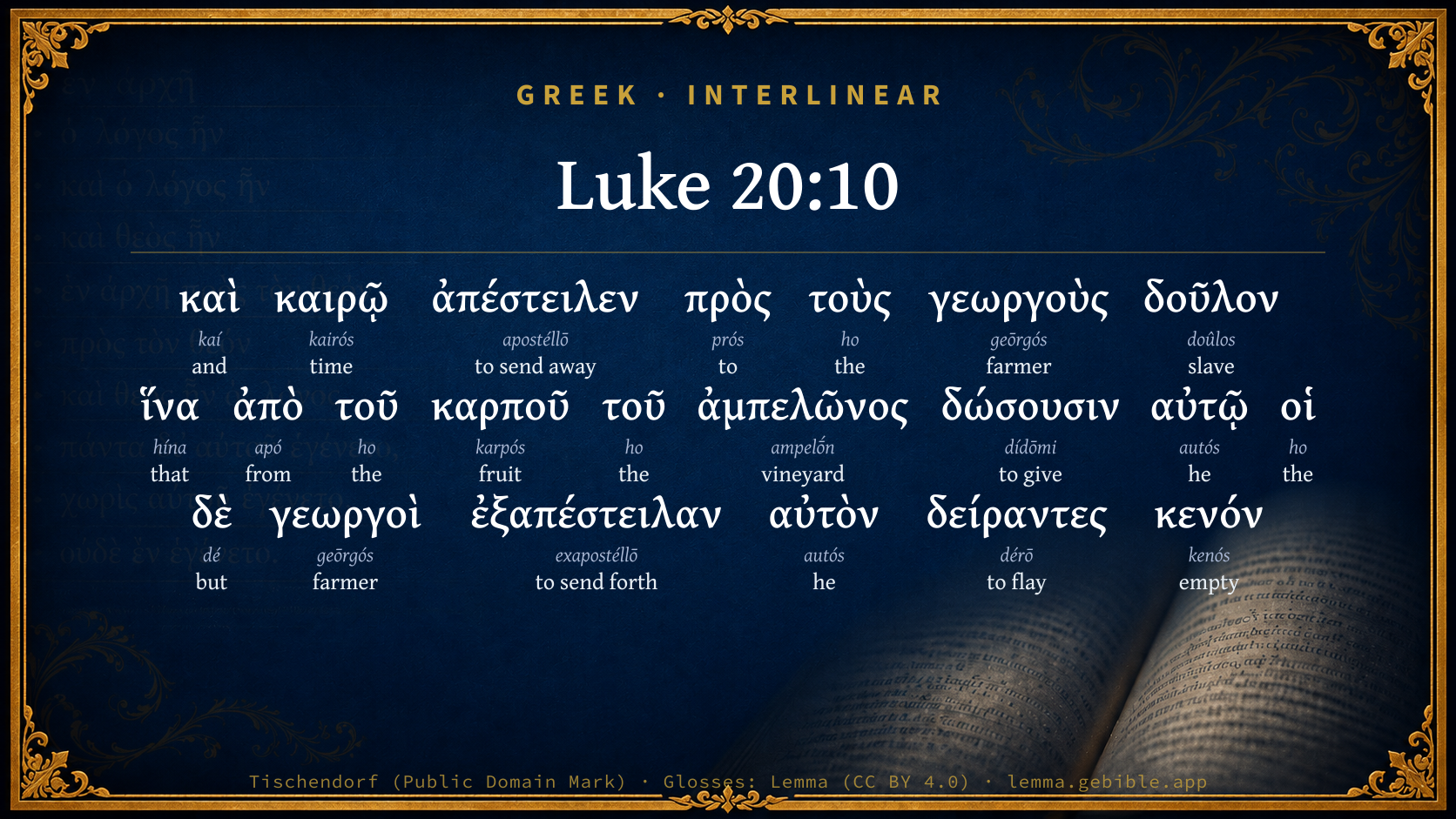
At the proper season, he sent a servant to the farmers to collect his share of the fruit of the vineyard. But the farmers beat him, and sent him away empty.
Download a study sheet
One document with this verse’s original text, its word-by-word gloss line, the meaning frame, cross-references with their text, attributed commentary, and full source and license credits — printable, and it pastes into notes with its structure intact.
This verse Autodidact and up
A passage Seminary Student
Up to 50 verses in one chapter. A passage sheet keeps up to 6 commentary sources and 12 cross-references per verse, in the order this page ranks them, and says so on the sheet whenever that leaves anything out. Ask for a single verse and you get the Autodidact verse sheet above.
Everything on this page stays free to read, with no account — the sheet is a download of what is already on screen, not access to it.
Compare translations 3
The same verse in 3 English versions, stacked beneath the original-language interlinear above. Click any original word for its lexicon entry.
Each is an independent rendering of the whole verse — the interlinear is not word-aligned to these translations.
Highlighted words mark where these versions differ — a whole-verse word diff, not a word-by-word alignment.
-
World English Bible Public Domain
At the proper season, he sent a servant to the farmers to collect his share of the fruit of the vineyard. But the farmers beat him, and sent him away empty.
-
King James Version Public Domain
And at the season he sent a servant to the husbandmen, that they should give him of the fruit of the vineyard: but the husbandmen beat him, and sent him away empty.
-
unfoldingWord Literal Text CC BY-SA 4.0
And at the time he sent a servant to the farmers so that they would give him from the fruit of the vineyard. But the farmers sent him away, having beaten, empty.
unfoldingWord Literal Text — © unfoldingWord, licensed CC BY-SA 4.0. Word-aligned USFM3 via Door43 (git.door43.org/unfoldingWord/en_ult).
Show all 19 translations
Every available English version of this verse, each an independent rendering of the whole verse.
-
World English Bible Public Domain
At the proper season, he sent a servant to the farmers to collect his share of the fruit of the vineyard. But the farmers beat him, and sent him away empty.
-
Berean Standard Bible Public Domain
At harvest time, he sent a servant to the tenants to collect his share of the fruit of the vineyard. But the tenants beat the servant and sent him away empty-handed.
-
Majority Standard Bible Public Domain
At harvest time, he sent a servant to the tenants to collect his share of the fruit of the vineyard. But the tenants beat the servant and sent him away empty-handed.
-
King James Version Public Domain
And at the season he sent a servant to the husbandmen, that they should give him of the fruit of the vineyard: but the husbandmen beat him, and sent him away empty.
-
American Standard Version (1901) Public Domain
And at the season he sent unto the husbandmen a servant, that they should give him of the fruit of the vineyard: but the husbandmen beat him, and sent him away empty.
-
Revised Version (1885) Public Domain
And at the season he sent unto the husbandmen a servant, that they should give him of the fruit of the vineyard: but the husbandmen beat him, and sent him away empty.
-
Geneva Bible (1599) Public Domain
And at the time conuenient he sent a seruant to the husbandmen, that they should giue him of the fruite of the vineyard: but the husbandmen did beate him, and sent him away emptie.
-
Douay-Rheims (1899) Public Domain
And at the season he sent a servant to the husbandmen, that they should give him of the fruit of the vineyard. Who, beating him, sent him away empty.
-
Young's Literal Translation Public Domain
and at the season he sent unto the husbandmen a servant, that from the fruit of the vineyard they may give to him, but the husbandmen having beat him, did send `him' away empty.
-
Literal Standard Version CC BY-SA 4.0
and at the season he sent a servant to the farmers, that they may give to him from the fruit of the vineyard, but the farmers having beat him, sent [him] away empty.
-
Unlocked Literal Bible CC BY-SA 4.0
At the appointed time he sent a servant to the vine growers, that they should give him of the fruit of the vineyard. But the vine growers beat him, and sent him away empty-handed.
-
unfoldingWord Literal Text CC BY-SA 4.0
And at the time he sent a servant to the farmers so that they would give him from the fruit of the vineyard. But the farmers sent him away, having beaten, empty.
-
Darby Bible Public Domain
And in the season he sent to the husbandmen a bondman, that they might give to him of the fruit of the vineyard; but the husbandmen, having beaten him, sent [him] away empty.
-
World Messianic Bible Public Domain
At the proper season, he sent a servant to the farmers to collect his share of the fruit of the vineyard. But the farmers beat him and sent him away empty.
-
Webster's Bible Public Domain
And at the season he sent a servant to the husbandmen, that they should give him of the fruit of the vineyard: but the husbandmen beat him, and sent him away empty.
-
Free Bible Version CC BY-SA 4.0
At harvest-time he sent a servant to the tenant farmers to collect his share of the crop, but the farmers beat the servant and sent him away with nothing.
-
Bible in Basic English Public Domain
And at the right time he sent a servant to the workers to get part of the fruit from the vines; but the workmen gave him blows and sent him away with nothing.
-
Text-Critical English NT CC BY 4.0
At harvest time he sent a servant to the farmers so that they would give him some of the fruit of the vineyard. But the farmers beat that servant and sent him away empty-handed.
-
Tyndale New Testament (1534) Public Domain
And when the tyme was come he sent a servaut to his tennauntes that they shuld geve him of the frutes of the vyneyarde. And the tennauntes dyd bet him and sent him awaye empty.
Literal Standard Version (2020), Covenant Press — licensed CC BY-SA 4.0. Text via the HelloAO Bible API (eBible.org). Unlocked Literal Bible (unfoldingWord) — licensed CC BY-SA 4.0. Text via the HelloAO Bible API (eBible.org). unfoldingWord Literal Text — © unfoldingWord, licensed CC BY-SA 4.0. Word-aligned USFM3 via Door43 (git.door43.org/unfoldingWord/en_ult). Free Bible Version, Dr. Jonathan Gallagher — licensed CC BY-SA 4.0. Text via the HelloAO Bible API (eBible.org).
Word by word
More ways to search: Search by grammar → Find every occurrence → Compare this word →
Practice this passage: Drill this verse → Learn its vocabulary →
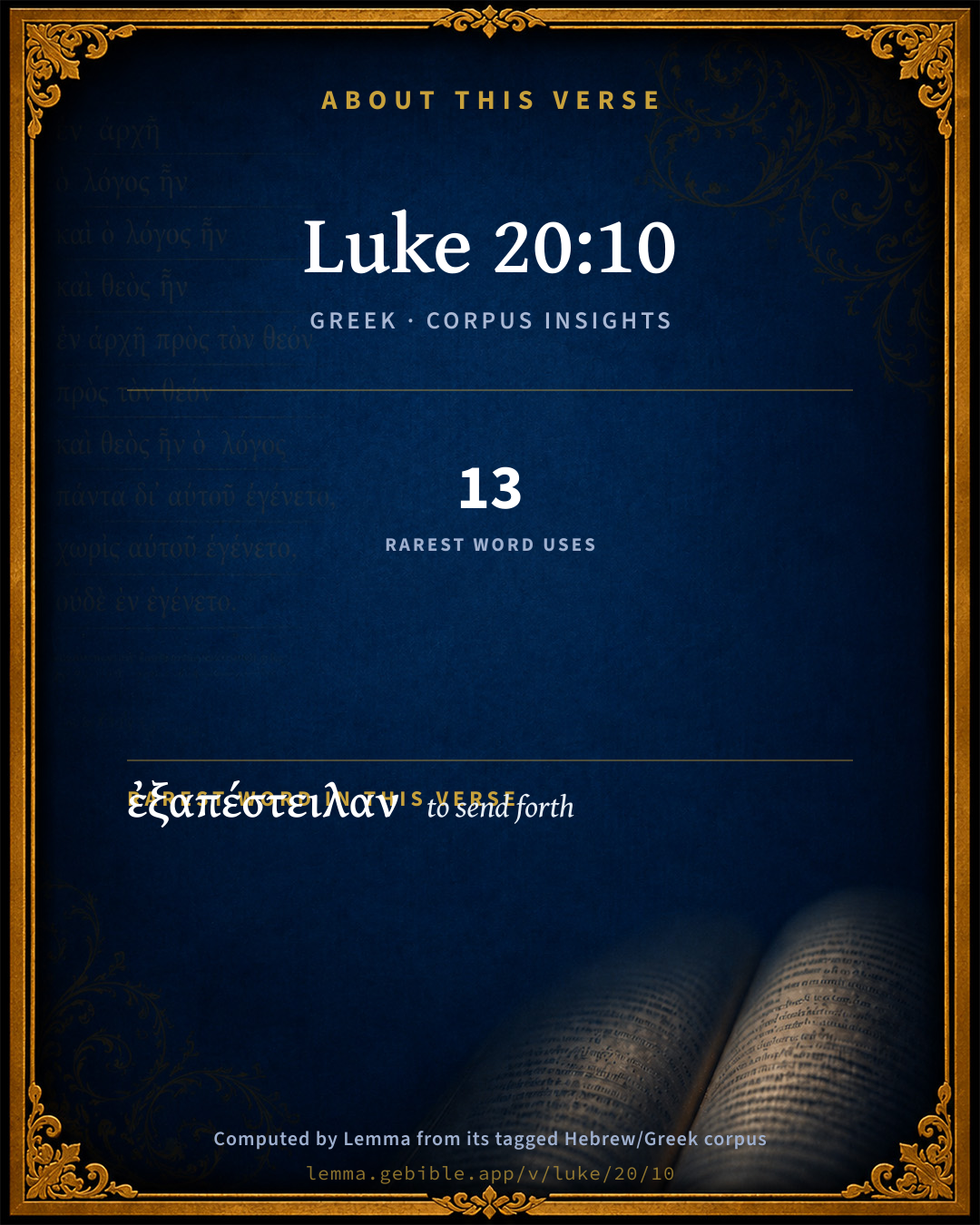
- Appears 13× in the Greek New Testament
- First appears at Luke 1:53
- Part of Speech
- Verb
- Tense
- Aorist
- Voice
- Active
- Mood
- Indicative
- Person
- 3rd person
- Number
- Plural
Full Thayer's Definition
- καὶ kaí G2532 “and” Conjunction
- καιρῷ kairós G2540 “time” Noun, Dative, Singular, Masculine
- ἀπέστειλεν apostéllō G649 “to send away” Verb, Aorist, Active, Indicative, 3rd person, Singular
- πρὸς prós G4314 “to” Preposition
- τοὺς ho G3588 “the” Article, Accusative, Plural, Masculine
- γεωργοὺς geōrgós G1092 “farmer” Noun, Accusative, Plural, Masculine
- δοῦλον doûlos G1401 “slave” Noun, Accusative, Singular, Masculine
- ἵνα hína G2443 “that” Conjunction
- ἀπὸ apó G575 “from” Preposition
- τοῦ ho G3588 “the” Article, Genitive, Singular, Masculine
- καρποῦ karpós G2590 “fruit” Noun, Genitive, Singular, Masculine
- τοῦ ho G3588 “the” Article, Genitive, Singular, Masculine
- ἀμπελῶνος ampelṓn G290 “vineyard” Noun, Genitive, Singular, Masculine
- δώσουσιν dídōmi G1325 “to give” Verb, Future, Active, Indicative, 3rd person, Plural
- αὐτῷ autós G846 “he” Personal pronoun, Dative, Singular, Masculine
- οἱ ho G3588 “the” Article, Nominative, Plural, Masculine
- δὲ dé G1161 “but” Conjunction
- γεωργοὶ geōrgós G1092 “farmer” Noun, Nominative, Plural, Masculine
- ἐξαπέστειλαν exapostéllō G1821 “to send forth” Verb, Aorist, Active, Indicative, 3rd person, Plural
- αὐτὸν autós G846 “he” Personal pronoun, Accusative, Singular, Masculine
- δείραντες dérō G1194 “to flay” Verb, Aorist, Active, Participle, Nominative, Plural, Masculine
- κενόν kenós G2756 “empty” Adjective, Accusative, Singular, Masculine
About this verse
These counts appear in no published source. They are computed here, from the morphology-tagged text and Lemma’s own curated glosses. What Lemma adds →
- 22
- words
- 17
- distinct lemmas
- Gospels
- section
Cross-references
29Topical passages linked to Luke 20:10 in the Treasury of Scripture Knowledge — connected by theme and wording, ordered by reader-vote popularity; previews shown in the World English Bible.
- 2 Chronicles 36:15–16 Yahweh, the God of their fathers, sent to them by his messengers, rising up early and sending, because he had compassion on his people, and on his dwelling-place:
- Nehemiah 9:26 Nevertheless they were disobedient, and rebelled against you, and cast your law behind their back, and killed your prophets that testified against them to turn them again to you, and they committed awful blasphemies.
- Matthew 21:34–36 When the season for the fruit drew near, he sent his servants to the farmers, to receive his fruit.
- Judges 6:8–10 that Yahweh sent a prophet to the children of Israel: and he said to them, Thus says Yahweh, the God of Israel, I brought you up from Egypt, and brought you forth out of the house of bondage;
- 1 Kings 22:24 Then Zedekiah the son of Chenaanah came near, and struck Micaiah on the cheek, and said, Which way went the Spirit of Yahweh from me to speak to you?
- 2 Kings 17:13 Yet Yahweh testified to Israel, and to Judah, by every prophet, and every seer, saying, Turn you from your evil ways, and keep my commandments and my statutes, according to all the law which I commanded your fathers, and which I sent to you by my servants the prophets.
- 2 Chronicles 16:10 Then Asa was angry with the seer, and put him in the prison-house; for he was in a rage with him because of this thing. Asa oppressed some of the people at the same time.
- 2 Chronicles 24:19–21 Yet he sent prophets to them, to bring them again to Yahweh; and they testified against them: but they would not give ear.
- Nehemiah 9:30 Yet many years did you bear with them, and testified against them by your Spirit through your prophets: yet would they not give ear: therefore gave you them into the hand of the peoples of the lands.
- Psalms 1:3 He will be like a tree planted by the streams of water, That brings forth its fruit in its season, Whose leaf also does not wither. Whatever he does shall prosper.
- Jeremiah 2:30 In vain have I struck your children; they received no correction: your own sword has devoured your prophets, like a destroying lion.
- Jeremiah 5:24 Neither say they in their heart, Let us now fear Yahweh our God, who gives rain, both the former and the latter, in its season; who preserves to us the appointed weeks of the harvest.
- Jeremiah 20:2 Then Pashhur struck Jeremiah the prophet, and put him in the stocks that were in the upper gate of Benjamin, which was in the house of Yahweh.
- Jeremiah 25:3–7 From the thirteenth year of Josiah the son of Amon, king of Judah, even to this day, these twenty-three years, the word of Yahweh has come to me, and I have spoken to you, rising up early and speaking; but you have not listened.
- Jeremiah 26:2–6 Thus says Yahweh: Stand in the court of Yahweh's house, and speak to all the cities of Judah, which come to worship in Yahweh's house, all the words that I command you to speak to them; don't diminish a word.
- Jeremiah 26:20–24 There was also a man who prophesied in the name of Yahweh, Uriah the son of Shemaiah of Kiriath Jearim; and he prophesied against this city and against this land according to all the words of Jeremiah:
- Jeremiah 29:26–27 Yahweh has made you priest in the place of Jehoiada the priest, that there may be officers in the house of Yahweh, for every man who is mad, and makes himself a prophet, that you should put him in the stocks and in shackles.
- Jeremiah 35:15 I have sent also to you all my servants the prophets, rising up early and sending them, saying, Return you now every man from his evil way, and amend your doings, and don't go after other gods to serve them, and you shall dwell in the land which I have given to you and to your fathers: but you have not inclined your ear, nor listened to me.
- Jeremiah 37:15–16 The princes were angry with Jeremiah, and struck him, and put him in prison in the house of Jonathan the scribe; for they had made that the prison.
- Jeremiah 38:4–6 Then the princes said to the king, Let this man, we pray you, be put to death; because he weakens the hands of the men of war who remain in this city, and the hands of all the people, in speaking such words to them: for this man doesn't seek the welfare of this people, but the hurt.
- Jeremiah 44:4–5 However I sent to you all my servants the prophets, rising up early and sending them, saying, Oh, don't do this abominable thing that I hate.
- Zechariah 1:3–6 Therefore tell them: Thus says Yahweh of Hosts: 'Return to me,' says Yahweh of Hosts, 'and I will return to you,' says Yahweh of Hosts.
- Zechariah 7:9–13 "Thus has Yahweh of Hosts spoken, saying, 'Execute true judgment, and show kindness and compassion every man to his brother.
- Mark 12:2–5 When it was time, he sent a servant to the farmer to get from the farmer his share of the fruit of the vineyard.
- Luke 11:47–50 Woe to you! For you build the tombs of the prophets, and your fathers killed them.
- Luke 13:34 "Jerusalem, Jerusalem, that kills the prophets, and stones those who are sent to her! How often I wanted to gather your children together, like a hen gathers her own brood under her wings, and you refused!
- John 15:16 You didn't choose me, but I chose you, and appointed you, that you should go and bear fruit, and that your fruit should remain; that whatever you will ask of the Father in my name, he may give it to you.
- Romans 7:4 Therefore, my brothers, you also were made dead to the law through the body of Christ, that you would be joined to another, to him who was raised from the dead, that we might bring forth fruit to God.
- Hosea 6:4–6 "Ephraim, what shall I do to you? Judah, what shall I do to you? For your love is like a morning cloud, And like the dew that disappears early.
Cross-references courtesy of OpenBible.info (CC BY 4.0).
Lesson kit
Teaching starters — assembled from the data on this page, not authored interpretation. Every prompt links to the verse data it draws on. Edit before teaching.
Luke, in the Gospels, opens this verse with 22 words (17 distinct Greek lemmas). Its most distinctive word is exapostéllō (“to send forth”). A historical commentator’s framing appears above. Read the whole chapter for the surrounding context.
Discussion questions
- The word exapostéllō carries the sense “to send forth.” How does it shape the verse?
- Luke 1:53 shares the word «to send forth» with this verse. How do the two illuminate each other?
- “farmer” occurs 2× in this one verse. What is the effect of the repetition?
- The translations on this page render this verse differently — a whole-verse word diff, not a word-by-word alignment. What might account for the different wordings?
- Reading how Tyndale Open Study Notes and Bengel's Gnomon read this verse, where do the two commentators agree and where do they part?
Things to notice
- These translations choose different wording for 13 words in this verse.
- “farmer” occurs 2× in this single verse.
- 17 distinct Greek lemmas span 22 words in this verse.
Commentary
Notes on Luke 20:10 from classic Christian and Jewish commentators (each source and its license shown beneath its notes). The classic Christian expositions comment on the surrounding passage and are grouped to its opening verse, so a note may address several verses; the Jewish commentaries on the Tanakh (Rashi and others) are per-verse, so they appear only where the commentator wrote on this verse.
Lemma curates 59 commentaries, every one of them public domain or Creative Commons licensed, each selected and text-cleaned for this edition rather than reprinted as found. About our sources →
Tyndale Open Study Notes
Tyndale Open Resources
Tyndale Open Study Notes — © Tyndale Open Resources, licensed CC BY-SA 4.0. Text via the HelloAO Bible API.
Bengel's Gnomon
Johann Albrecht Bengel
Bengel's Gnomon of the New Testament — English translation (T&T Clark, Edinburgh, 1860) — public domain. Text from a community e-Sword module.
Expositor's Greek Testament
ed. W. Robertson Nicoll
The Expositor's Greek Testament, edited by W. Robertson Nicoll (1897–1910) — public domain. Text from a community e-Sword module.
Jamieson, Fausset & Brown
Robert Jamieson, A. R. Fausset & David Brown
Jamieson, Fausset & Brown — Commentary Critical and Explanatory on the Whole Bible (1871) — public domain (CC PDM 1.0). Text via the HelloAO Bible API.
Adam Clarke's Commentary
Adam Clarke's Commentary on the Bible (1810–1826) — public domain. Text from a community e-Sword/MySword module.
Ellicott's Commentary for English Readers
A Bible Commentary for English Readers, edited by Charles John Ellicott (1878–1897) — public domain. Text from a community e-Sword module.
The Cambridge Bible for Schools and Colleges
gen. ed. J. J. S. Perowne
The Cambridge Bible for Schools and Colleges (gen. ed. J. J. S. Perowne; Cambridge University Press, 1878–1918) — public domain. Text from a community e-Sword module.
John Gill's Exposition
John Gill's Exposition of the Whole Bible (1746–1763) — public domain (CC PDM 1.0). Text via the HelloAO Bible API.
The Pulpit Commentary
The Pulpit Commentary (1880–1919), ed. H.D.M. Spence-Jones & Joseph S. Exell — public domain. Text from a community e-Sword module.
Cambridge Greek Testament for Schools and Colleges
Cambridge Greek Testament for Schools and Colleges (Cambridge University Press, 1896; 21 vols, various authors incl. Carr, Maclear, Plummer, Farrar, Lumby, Moule, M. R. James, Simcox) — public domain. Text from a community e-Sword module.
International Critical Commentary
International Critical Commentary — older volumes (1896–1929), various authors — public domain. Text from a community e-Sword module.
Vincent's Word Studies in the New Testament
Marvin R. Vincent
Marvin R. Vincent, Word Studies in the New Testament (1887–1900) — public domain. Text from a community e-Sword/MySword module.