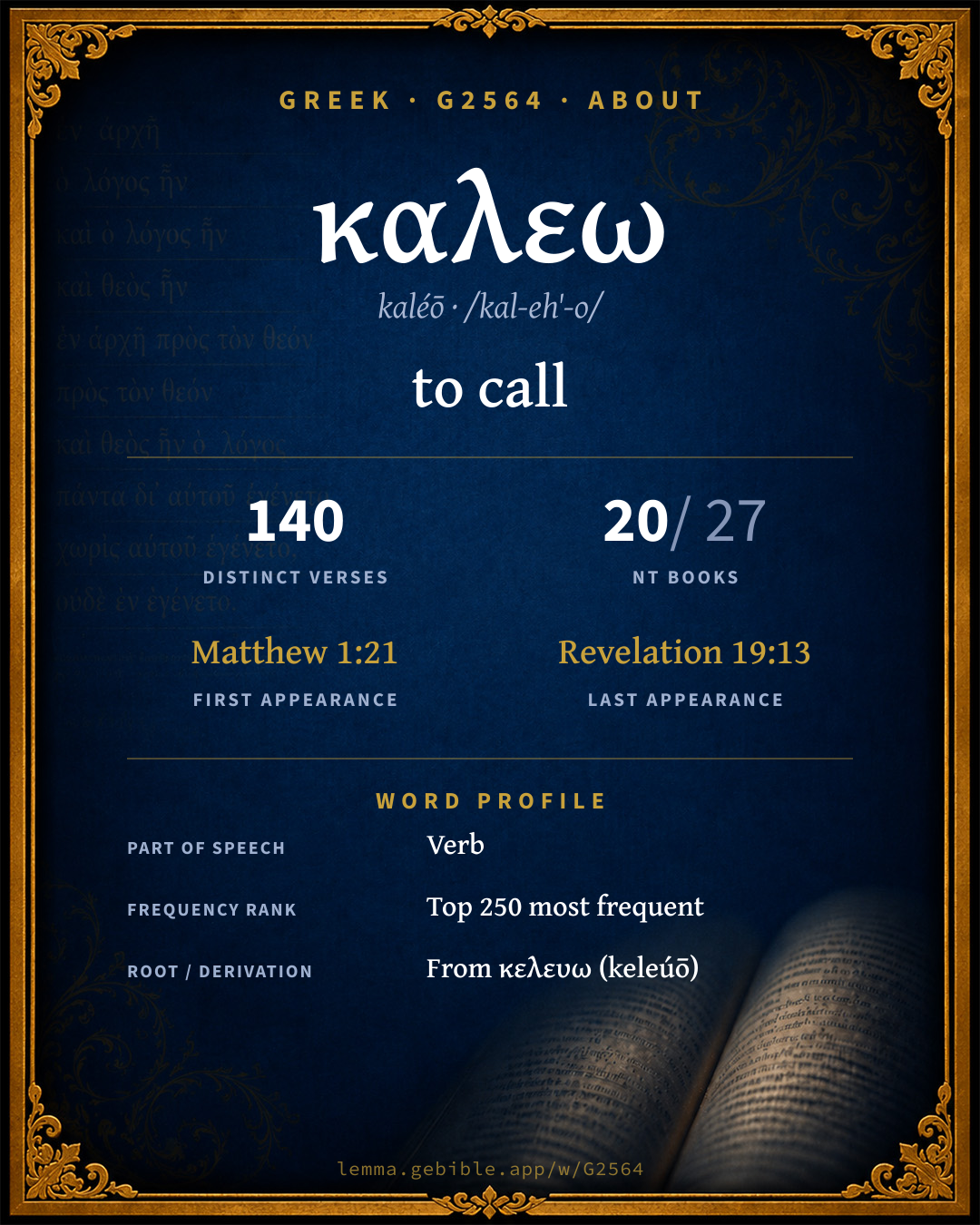
καλέω
to call
‘to call’ is one of 3 main senses fuller range ↓
Full lexicon entry — Thayer's Greek Lexicon
From Thayer's Greek Lexicon
Where this word appears
See every Aorist-tense verb in the Greek New Testament →
Grammar key — what these labels mean
Part of speech
- Verb
- An action or state-of-being word.
Tense
- Future
- Action expected in future time.
- Aorist
- Action viewed as a simple whole, without regard to duration — often past (perfective aspect).
- Present
- Ongoing or general action in present time (imperfective aspect).
- Perfect
- A completed past action with continuing present results.
- Imperfect
- Continuous or repeated action in past time (“was writing”).
Voice
- Passive
- The subject receives the action.
- Active
- The subject performs the action.
Mood
- Indicative
- States a fact or asks a factual question (the mood of reality).
- Participle
- A verbal adjective (“writing,” “having written”).
- Infinitive
- A verbal noun (“to write”), unmarked for person or number.
- Subjunctive
- Expresses probability, purpose, or possibility (the mood of contingency).
- Imperative
- Expresses a command or request.
Case
- Accusative
- The case of the direct object and of extent.
- Nominative
- The case of the subject (and the predicate nominative).
- Genitive
- The case of source, possession, or “of” — answers “whose / from what.”
- Dative
- The case of the indirect object, means, or location — “to / for / with / in.”
Person
- 3rd person
- The one spoken about (“he / she / it / they”).
- 2nd person
- The one addressed (“you”).
- 1st person
- The speaker (“I / we”).
Gender
- Masculine
- Grammatically masculine.
- Feminine
- Grammatically feminine.
- Neuter
- Grammatically neuter.
Number
- Singular
- One.
- Plural
- More than one.
Grammatical forms 56 distinct
- Verb, Future, Passive, Indicative, 3rd person, Singular 11 times (7%)
- Verb, Aorist, Active, Indicative, 3rd person, Singular 10 times (7%)
- Verb, Present, Passive, Participle, Accusative, Singular, Masculine 8 times (5%)
- Verb, Aorist, Passive, Indicative, 2nd person, Plural 7 times (5%)
- Verb, Aorist, Passive, Indicative, 3rd person, Singular 7 times (5%)
- Verb, Present, Passive, Participle, Nominative, Singular, Masculine 7 times (5%)
- Verb, Aorist, Active, Participle, Nominative, Singular, Masculine 6 times (4%)
- Verb, Present, Passive, Indicative, 3rd person, Singular 5 times (3%)
+48 more forms (87 occurrences)
Parsed forms decoded from the imported morphology (Robinson–Tischendorf, public domain), counted across 148 parsed occurrences — not distinct verses.
Every verse where G2564 appears — 140 distinct verses across 20 books. Click any verse to open its interlinear word-by-word view. Verse text shown in the World English Bible for context — . Each verse’s Greek form is shown with its reference; the English is not keyword-highlighted, since the data carries no word-level English alignment. Use “Compare translations” on any verse to read it across multiple English versions. This concordance covers the Greek New Testament; Septuagint (Greek Old Testament) occurrences of this word are not indexed here.
Matthew 24 verses
- Matthew 1:21 καλέσεις fut act ind 2sg She shall bring forth a son. You shall call his name Jesus, for it is he who shall save his people from their sins."
- Matthew 1:23 καλέσουσιν fut act ind 3pl "Behold, the virgin shall be with child, And shall bring forth a son. They shall call his name Immanuel;" Which is, being interpreted, "God with us."
- Matthew 1:25 ἐκάλεσεν aor act ind 3sg and didn't know her sexually until she had brought forth her firstborn son. He named him Jesus.
- Matthew 2:7 καλέσας aor act ptcp nom sg masc Then Herod secretly called the wise men, and learned from them exactly what time the star appeared.
- Matthew 2:15 ἐκάλεσα aor act ind 1sg and was there until the death of Herod; that it might be fulfilled which was spoken by the Lord through the prophet, saying, "Out of Egypt I called my son."
- Matthew 2:23 κληθήσεται fut pass ind 3sg and came and lived in a city called Nazareth; that it might be fulfilled which was spoken through the prophets: "He will be called a Nazarene."
- Matthew 4:21 ἐκάλεσεν aor act ind 3sg Going on from there, he saw two other brothers, James the son of Zebedee, and John his brother, in the boat with Zebedee their father, mending their nets. He called them.
- Matthew 5:9 κληθήσονται fut pass ind 3pl Blessed are the peacemakers, For they shall be called children of God.
- Matthew 5:19 κληθήσεται κληθήσεται fut pass ind 3sg fut pass ind 3sg Whoever, therefore, shall break one of these least commandments, and teach others to do so, shall be called least in the Kingdom of Heaven; but whoever shall do and teach them shall be called great in the Kingdom of Heaven.
- Matthew 9:13 καλέσαι aor act inf But you go and learn what this means: 'I desire mercy, and not sacrifice,' for I came not to call the righteous, but sinners to repentance."
- Matthew 20:8 κάλεσον aor act impv 2sg When evening had come, the lord of the vineyard said to his steward, 'Call the laborers and pay them their wages, beginning from the last to the first.'
- Matthew 21:13 κληθήσεται fut pass ind 3sg He said to them, "It is written, 'My house shall be called a house of prayer,' but you have made it a den of robbers!"
- Matthew 22:3 καλέσαι κεκλημένους aor act inf perf pass ptcp acc pl masc and sent out his servants to call those who were invited to the marriage feast, but they would not come.
- Matthew 22:4 κεκλημένοις perf pass ptcp dat pl masc Again he sent out other servants, saying, 'Tell those who are invited, "Behold, I have made ready my dinner. My oxen and my fatlings are killed, and all things are ready. Come to the marriage feast!"'
- Matthew 22:8 κεκλημένοι perf pass ptcp nom pl masc "Then he said to his servants, 'The wedding is ready, but those who were invited weren't worthy.
- Matthew 22:9 καλέσατε aor act impv 2pl Go therefore to the intersections of the highways, and as many as you may find, invite to the marriage feast.'
- Matthew 22:43 καλεῖ pres act ind 3sg He said to them, "How then does David in the Spirit call him Lord, saying,
- Matthew 22:45 καλεῖ pres act ind 3sg "If then David calls him Lord, how is he his son?"
- Matthew 23:7 καλεῖσθαι pres pass inf the salutations in the marketplaces, and to be called 'Rabbi, Rabbi' by men.
- Matthew 23:8 κληθῆτε aor pass subj 2pl But don't you be called 'Rabbi,' for one is your teacher, the Christ, and all of you are brothers.
- Matthew 23:9 καλέσητε aor act subj 2pl Call no man on the earth your father, for one is your Father, he who is in heaven.
- Matthew 23:10 κληθῆτε aor pass subj 2pl Neither be called masters, for one is your master, the Christ.
- Matthew 25:14 ἐκάλεσεν aor act ind 3sg "For it is like a man, going into another country, who called his own servants, and entrusted his goods to them.
- Matthew 27:8 ἐκλήθη aor pass ind 3sg Therefore that field was called "The Field of Blood" to this day.
Mark 4 verses
- Mark 1:20 ἐκάλεσεν aor act ind 3sg Immediately he called them, and they left their father, Zebedee, in the boat with the hired servants, and went after him.
- Mark 2:17 καλέσαι aor act inf When Jesus heard it, he said to them, "Those who are healthy have no need for a physician, but those who are sick. I came not to call the righteous, but sinners to repentance."
- Mark 3:31 καλοῦντες pres act ptcp nom pl masc His mother and his brothers came, and standing outside, they sent to him, calling him.
- Mark 11:17 κληθήσεται fut pass ind 3sg He taught, saying to them, "Isn't it written, 'My house will be called a house of prayer for all the nations?' But you have made it a den of robbers!"
Luke 40 verses
- Luke 1:13 καλέσεις fut act ind 2sg But the angel said to him, "Don't be afraid, Zacharias, because your request has been heard, and your wife, Elizabeth, will bear you a son, and you shall call his name John.
- Luke 1:31 καλέσεις fut act ind 2sg Behold, you will conceive in your womb, and bring forth a son, and will call his name 'Jesus.'
- Luke 1:32 κληθήσεται fut pass ind 3sg He will be great, and will be called the Son of the Most High. The Lord God will give him the throne of his father, David,
- Luke 1:35 κληθήσεται fut pass ind 3sg The angel answered her, "The Holy Spirit will come on you, and the power of the Most High will overshadow you. Therefore also the holy one who is born from you will be called the Son of God.
- Luke 1:36 καλουμένῃ pres pass ptcp dat sg fem Behold, Elizabeth, your relative, also has conceived a son in her old age; and this is the sixth month with her who was called barren.
- Luke 1:59 ἐκάλουν impf act ind 3pl It happened on the eighth day, that they came to circumcise the child; and they would have called him Zacharias, after the name of the father.
- Luke 1:60 κληθήσεται fut pass ind 3sg His mother answered, "Not so; but he will be called John."
- Luke 1:61 καλεῖται pres pass ind 3sg They said to her, "There is no one among your relatives who is called by this name."
- Luke 1:62 καλεῖσθαι pres pass inf They made signs to his father, what he would have him called.
- Luke 1:76 κληθήσῃ fut pass ind 2sg And you, child, will be called a prophet of the Most High, For you will go before the face of the Lord to make ready his ways,
- Luke 2:4 καλεῖται pres pass ind 3sg Joseph also went up from Galilee, out of the city of Nazareth, into Judea, to the city of David, which is called Bethlehem, because he was of the house and family of David;
- Luke 2:21 ἐκλήθη κληθὲν aor pass ind 3sg aor pass ptcp nom sg neut When eight days were fulfilled for the circumcision of the child, his name was called Jesus, which was given by the angel before he was conceived in the womb.
- Luke 2:23 κληθήσεται fut pass ind 3sg (as it is written in the law of the Lord, "Every male who opens the womb shall be called holy to the Lord"),
- Luke 5:32 καλέσαι aor act inf I have not come to call the righteous, but sinners to repentance."
- Luke 6:15 καλούμενον pres pass ptcp acc sg masc Matthew; Thomas; James, the son of Alphaeus; Simon, who was called the Zealot;
- Luke 6:46 καλεῖτε pres act ind 2pl "Why do you call me, 'Lord, Lord,' and don't do the things which I say?
- Luke 7:11 καλουμένην pres pass ptcp acc sg fem It happened soon afterwards, that he went to a city called Nain. Many of his disciples, along with a great multitude, went with him.
- Luke 7:39 καλέσας aor act ptcp nom sg masc Now when the Pharisee who had invited him saw it, he said to himself, "This man, if he were a prophet, would have perceived who and what kind of woman this is who touches him, that she is a sinner."
- Luke 8:2 καλουμένη pres pass ptcp nom sg fem and certain women who had been healed of evil spirits and infirmities: Mary who was called Magdalene, from whom seven demons had gone out;
- Luke 9:10 καλουμένην pres pass ptcp acc sg fem The apostles, when they had returned, told him what things they had done. He took them, and withdrew apart to a deserted place of a city called Bethsaida.
- Luke 10:39 καλουμένη pres pass ptcp nom sg fem She had a sister called Mary, who also sat at Jesus' feet, and heard his word.
- Luke 14:7 κεκλημένους perf pass ptcp acc pl masc He spoke a parable to those who were invited, when he noticed how they chose the best seats, and said to them,
- Luke 14:8 κληθῇς κεκλημένος aor pass subj 2sg perf pass ptcp nom sg masc "When you are invited by anyone to a marriage feast, don't sit in the best seat, since perhaps someone more honorable than you might be invited by him,
- Luke 14:9 καλέσας aor act ptcp nom sg masc and he who invited both of you would come and tell you, 'Make room for this person.' Then you would begin, with shame, to take the lowest place.
- Luke 14:10 κληθῇς κεκληκώς aor pass subj 2sg perf act ptcp nom sg masc But when you are invited, go and sit in the lowest place, so that when he who invited you comes, he may tell you, 'Friend, move up higher.' Then you will be honored in the presence of all who sit at the table with you.
- Luke 14:12 κεκληκότι perf act ptcp dat sg masc He also said to the one who had invited him, "When you make a dinner or a supper, don't call your friends, nor your brothers, nor your kinsmen, nor rich neighbors, or perhaps they might also return the favor, and pay you back.
- Luke 14:13 κάλει pres act impv 2sg But when you make a feast, ask the poor, the maimed, the lame, or the blind;
- Luke 14:16 ἐκάλεσεν aor act ind 3sg But he said to him, "A certain man made a great supper, and he invited many people.
- Luke 14:17 κεκλημένοις perf pass ptcp dat pl masc He sent out his servant at supper time to tell those who were invited, 'Come, for everything is ready now.'
- Luke 14:24 κεκλημένων perf pass ptcp gen pl masc For I tell you that none of those men who were invited will taste of my supper.'"
- Luke 15:19 κληθῆναι aor pass inf I am no more worthy to be called your son. Make me as one of your hired servants."'
- Luke 15:21 κληθῆναι aor pass inf The son said to him, 'Father, I have sinned against heaven, and in your sight. I am no longer worthy to be called your son.'
- Luke 19:2 καλούμενος pres pass ptcp nom sg masc There was a man named Zacchaeus. He was a chief tax collector, and he was rich.
- Luke 19:13 καλέσας aor act ptcp nom sg masc He called ten servants of his, and gave them ten mina coins, and told them, 'Conduct business until I come.'
- Luke 19:29 καλούμενον pres pass ptcp acc sg neut It happened, when he drew near to Bethsphage and Bethany, at the mountain that is called Olivet, he sent two of his disciples,
- Luke 20:44 καλεῖ pres act ind 3sg "David therefore calls him Lord, so how is he his son?"
- Luke 21:37 καλούμενον pres pass ptcp acc sg neut Every day Jesus was teaching in the temple, and every night he would go out and spend the night on the mountain that is called Olivet.
- Luke 22:3 καλούμενον pres pass ptcp acc sg masc Satan entered into Judas, who was surnamed Iscariot, who was numbered with the twelve.
- Luke 22:25 καλοῦνται pres pass ind 3pl He said to them, "The kings of the Gentiles lord it over them, and those who have authority over them are called 'benefactors.'
- Luke 23:33 καλούμενον pres pass ptcp acc sg masc When they came to the place that is called The Skull, they crucified him there with the criminals, one on the right and the other on the left.
John 2 verses
Acts 18 verses
- Acts 1:12 καλουμένου pres pass ptcp gen sg neut Then they returned to Jerusalem from the mountain called Olivet, which is near Jerusalem, a Sabbath day's journey away.
- Acts 1:19 κληθῆναι aor pass inf It became known to everyone who lived in Jerusalem that in their language that field was called 'Akeldama,' that is, 'The field of blood.'
- Acts 1:23 καλούμενον pres pass ptcp acc sg masc They put forward two, Joseph called Barsabbas, who was surnamed Justus, and Matthias.
- Acts 3:11 καλουμένῃ pres pass ptcp dat sg fem As the lame man who was healed held on to Peter and John, all the people ran together to them in the porch that is called Solomon's, greatly wondering.
- Acts 4:18 καλέσαντες aor act ptcp nom pl masc They called them, and charged them not to speak at all nor teach in the name of Jesus.
- Acts 7:58 καλουμένου pres pass ptcp gen sg masc They threw him out of the city, and stoned him. The witnesses placed their garments at the feet of a young man named Saul.
- Acts 8:10 καλουμένη pres pass ptcp nom sg fem to whom they all listened, from the least to the greatest, saying, "This man is that great power of God."
- Acts 9:11 καλουμένην pres pass ptcp acc sg fem The Lord said to him, "Arise, and go to the street which is called Straight, and inquire in the house of Judas for one named Saul, a man of Tarsus. For behold, he is praying,
- Acts 10:1 καλουμένης pres pass ptcp gen sg fem Now there was a certain man in Caesarea, Cornelius by name, a centurion of what was called the Italian Regiment,
- Acts 13:1 καλούμενος pres pass ptcp nom sg masc Now in the assembly that was at Antioch there were some prophets and teachers: Barnabas, Simeon who was called Niger, Lucius of Cyrene, Manaen the foster-brother of Herod the tetrarch, and Saul.
- Acts 14:12 ἐκάλουν impf act ind 3pl They called Barnabas "Jupiter," and Paul "Mercury," because he was the chief speaker.
- Acts 15:22 καλούμενον pres pass ptcp acc sg masc Then it seemed good to the apostles and the elders, with the whole assembly, to choose men out of their company, and send them to Antioch with Paul and Barnabas: Judas called Barsabbas, and Silas, chief men among the brothers.
- Acts 15:37 καλούμενον pres pass ptcp acc sg masc Barnabas planned to take John, who was called Mark, with them also.
- Acts 24:2 κληθέντος aor pass ptcp gen sg masc When he was called, Tertullus began to accuse him, saying, "Seeing that by you we enjoy much peace, and that excellent measures are coming to this nation,
- Acts 27:8 καλούμενον pres pass ptcp acc sg masc With difficulty sailing along it we came to a certain place called Fair Havens, near the city of Lasea.
- Acts 27:14 καλούμενος pres pass ptcp nom sg masc But before long, a tempestuous wind beat down from shore, which is called Euroclydon.
- Acts 27:16 καλούμενον pres pass ptcp acc sg neut Running under the lee of a small island called Clauda, we were able, with difficulty, to secure the boat.
- Acts 28:1 καλεῖται pres pass ind 3sg When we had escaped, then they learned that the island was called Malta.
Romans 7 verses
- Romans 4:17 καλοῦντος pres act ptcp gen sg masc As it is written, "I have made you a father of many nations." This is in the presence of him whom he believed: God, who gives life to the dead, and calls the things that are not, as though they were.
- Romans 8:30 ἐκάλεσεν ἐκάλεσεν aor act ind 3sg aor act ind 3sg Whom he predestined, those he also called. Whom he called, those he also justified. Whom he justified, those he also glorified.
- Romans 9:7 κληθήσεταί fut pass ind 3sg Neither, because they are Abraham's seed, are they all children. But, "In Isaac will your seed be called."
- Romans 9:11 καλοῦντος pres act ptcp gen sg masc For being not yet born, neither having done anything good or bad, that the purpose of God according to election might stand, not of works, but of him who calls,
- Romans 9:24 ἐκάλεσεν aor act ind 3sg us, whom he also called, not from the Jews only, but also from the Gentiles?
- Romans 9:25 καλέσω fut act ind 1sg As he says also in Hosea, "I will call them 'my people,' which were not my people; And her 'beloved,' who was not beloved."
- Romans 9:26 κληθήσονται fut pass ind 3pl "It will be that in the place where it was said to them, 'You are not my people,' There they will be called 'children of the living God.'"
1 Corinthians 10 verses
- 1 Corinthians 1:9 ἐκλήθητε aor pass ind 2pl God is faithful, through whom you were called into the fellowship of his Son, Jesus Christ, our Lord.
- 1 Corinthians 7:15 κέκληκεν perf act ind 3sg Yet if the unbeliever departs, let there be separation. The brother or the sister is not under bondage in such cases, but God has called us in peace.
- 1 Corinthians 7:17 κέκληκεν perf act ind 3sg Only, as the Lord has distributed to each man, as God has called each, so let him walk. So I command in all the assemblies.
- 1 Corinthians 7:18 ἐκλήθη κέκληταί aor pass ind 3sg perf pass ind 3sg Was anyone called having been circumcised? Let him not become uncircumcised. Has anyone been called in uncircumcision? Let him not be circumcised.
- 1 Corinthians 7:20 ἐκλήθη aor pass ind 3sg Let each man stay in that calling in which he was called.
- 1 Corinthians 7:21 ἐκλήθης aor pass ind 2sg Were you called being a bondservant? Don't let that bother you, but if you get an opportunity to become free, use it.
- 1 Corinthians 7:22 κληθεὶς κληθεὶς aor pass ptcp nom sg masc aor pass ptcp nom sg masc For he who was called in the Lord being a bondservant is the Lord's free man. Likewise he who was called being free is Christ's bondservant.
- 1 Corinthians 7:24 ἐκλήθη aor pass ind 3sg Brothers, let each man, in whatever condition he was called, stay in that condition with God.
- 1 Corinthians 10:27 καλεῖ pres act ind 3sg But if one of those who don't believe invites you to a meal, and you are inclined to go, eat whatever is set before you, asking no questions for the sake of conscience.
- 1 Corinthians 15:9 καλεῖσθαι pres pass inf For I am the least of the apostles, who is not worthy to be called an apostle, because I persecuted the assembly of God.
Galatians 4 verses
- Galatians 1:6 καλέσαντος aor act ptcp gen sg masc I marvel that you are so quickly deserting him who called you in the grace of Christ to a different gospel;
- Galatians 1:15 καλέσας aor act ptcp nom sg masc But when it was the good pleasure of God, who separated me from my mother's womb, and called me through his grace,
- Galatians 5:8 καλοῦντος pres act ptcp gen sg masc This persuasion is not from him who calls you.
- Galatians 5:13 ἐκλήθητε aor pass ind 2pl For you, brothers, were called for freedom. Only don't use your freedom for gain to the flesh, but through love be servants to one another.
Ephesians 2 verses
Colossians 1 verse
1 Thessalonians 3 verses
- 1 Thessalonians 2:12 καλοῦντος pres act ptcp gen sg masc to the end that you should walk worthily of God, who calls you into his own Kingdom and glory.
- 1 Thessalonians 4:7 ἐκάλεσεν aor act ind 3sg For God called us not for uncleanness, but in sanctification.
- 1 Thessalonians 5:24 καλῶν pres act ptcp nom sg masc Faithful is he who calls you, who will also do it.
2 Thessalonians 1 verse
1 Timothy 1 verse
2 Timothy 1 verse
Hebrews 6 verses
- Hebrews 2:11 καλεῖν pres act inf For both he who sanctifies and those who are sanctified are all from one, for which cause he is not ashamed to call them brothers,
- Hebrews 3:13 καλεῖται pres pass ind 3sg but exhort one another day by day, so long as it is called "today;" lest any one of you be hardened by the deceitfulness of sin.
- Hebrews 5:4 καλούμενος pres pass ptcp nom sg masc Nobody takes this honor on himself, but he is called by God, just like Aaron was.
- Hebrews 9:15 κεκλημένοι perf pass ptcp nom pl masc For this reason he is the mediator of a new covenant, since a death has occurred for the redemption of the transgressions that were under the first covenant, that those who have been called may receive the promise of the eternal inheritance.
- Hebrews 11:8 καλούμενος pres pass ptcp nom sg masc By faith, Abraham, when he was called, obeyed to go out to the place which he was to receive for an inheritance. He went out, not knowing where he went.
- Hebrews 11:18 κληθήσεταί fut pass ind 3sg even he to whom it was said, "In Isaac will your seed be called;"
James 1 verse
1 Peter 6 verses
- 1 Peter 1:15 καλέσαντα aor act ptcp acc sg masc but just as he who called you is holy, you yourselves also be holy in all of your behavior;
- 1 Peter 2:9 καλέσαντος aor act ptcp gen sg masc But you are a chosen race, a royal priesthood, a holy nation, a people for God's own possession, that you may show forth the excellencies of him who called you out of darkness into his marvelous light:
- 1 Peter 2:21 ἐκλήθητε aor pass ind 2pl For to this you were called, because Christ also suffered for us, leaving you an example, that you should follow his steps,
- 1 Peter 3:6 καλοῦσα pres act ptcp nom sg fem as Sarah obeyed Abraham, calling him lord, whose children you now are, if you do well, and are not put in fear by any terror.
- 1 Peter 3:9 ἐκλήθητε aor pass ind 2pl not rendering evil for evil, or reviling for reviling; but instead blessing; knowing that to this were you called, that you may inherit a blessing.
- 1 Peter 5:10 καλέσας aor act ptcp nom sg masc But may the God of all grace, who called you to his eternal glory by Christ Jesus, after you have suffered a little while, perfect, establish, strengthen, and settle you.
2 Peter 1 verse
1 John 1 verse
Revelation 7 verses
- Revelation 1:9 καλουμένῃ pres pass ptcp dat sg fem I John, your brother and partner with you in oppression, Kingdom, and perseverance in Christ Jesus, was on the isle that is called Patmos because of God's Word and the testimony of Jesus Christ.
- Revelation 11:8 καλεῖται pres pass ind 3sg Their dead bodies will be in the street of the great city, which spiritually is called Sodom and Egypt, where also their Lord was crucified.
- Revelation 12:9 καλούμενος pres pass ptcp nom sg masc The great dragon was thrown down, the old serpent, he who is called the devil and Satan, the deceiver of the whole world. He was thrown down to the earth, and his angels were thrown down with him.
- Revelation 16:16 καλούμενον pres pass ptcp acc sg masc He gathered them together into the place which is called in Hebrew, Megiddo.
- Revelation 19:9 κεκλημένοι perf pass ptcp nom pl masc He said to me, "Write, 'Blessed are those who are invited to the marriage supper of the Lamb.'" He said to me, "These are true words of God."
- Revelation 19:11 καλούμενος pres pass ptcp nom sg masc I saw the heaven opened, and behold, a white horse, and he who sat on it is called Faithful and True. In righteousness he judges and makes war.
- Revelation 19:13 κέκληται perf pass ind 3sg He is clothed in a garment sprinkled with blood. His name is called "The Word of God."
About this entry
At a glance — auto-summarized from this page’s data, not written by a person. Every figure links to its source below. This summary describes the numbers; it doesn’t interpret them.
At its core, καλεω (kaléō) means “to call.” Scripture first uses it in Matthew 1:21. Spanning 140 verses in 20 books, it ranks among the common words of the Greek New Testament. Its uses concentrate in Luke (29% of all occurrences). Catalogued under 3 senses, its meaning is not single-sense. Each statement above links to its evidence; the full detail follows below.
Gloss history
Strong's 1890 vs modern scholarship

About this word
Strong's G2564 catalogs a Greek word from the Greek New Testament.
These counts are not copied from any lexicon or concordance. They are computed here, from the morphology-tagged Greek New Testament. What Lemma adds →
- 140
- distinct verses
- The word appears in 140 distinct verses.
- 20 / 27
- NT books
- The word appears in 20 of 27 New Testament books.
- #108
- by frequency
- Top 250 most frequent Greek words (rank 108 of 5,347 Greek words by occurrence).
View all 140 occurrences in the concordance →
By section of the New Testament
By traditional corpus
Conventional, traditional groupings — biblical authorship is debated, so this is a traditional corpus grouping, not an authorship claim. Some books belong to more than one corpus (Luke is in both the Gospels and the Lukan corpus, and so on), so these shares overlap and need not total 100%. Each figure is a share of the word’s 140 distinct verses.
- Gospels 70 verses · 50%
- Lukan (Luke–Acts) 58 verses · 41%
- Pauline corpus 30 verses · 21%
- Johannine 10 verses · 7%
- General (Catholic) Epistles 9 verses · 6%
- Revelation 7 verses · 5%
- Hebrews 6 verses · 4%
How translations render this word
Counts come from each version’s own published word-to-Strong’s tagging or interlinear alignment — an approximate guide to how each version renders this word, not a word-level alignment the data otherwise carries. Because each total is that version’s own tagged count, the per-version totals vary from one another and need not match the appearance or distinct-verse counts above. These counts may also differ from a printed concordance because Lemma counts each distinctly tagged rendering and does not collapse phrase taggings into a single head-word total. This is a fixed set of word-tagged versions (KJV, ASV, BSB, ULT) and does not change with the reading translation you choose elsewhere. Each version’s license is shown beside its name below (and on Sources).
- King James Version: Called 25×, Is called 13×, Call 10×
- American Standard Version: Called 20×, Is called 13×, Was called 11×
- Berean Standard Bible: Called 33×, Will be called 9×, Call 7×
- unfoldingWord Literal Text: Called 28×, Will be called 11×, Call 10×
King James Version Public Domain
Renders G2564 across 154 tagged occurrences — most commonly:
Plus other, less common renderings. Plus 35 renderings that appear only once — usually multi-word phrases or single function words the recovered tagging swept in, not distinct renderings. Not rendered by a distinct English word in 1 further occurrence.
American Standard Version Public Domain
Renders G2564 across 153 tagged occurrences — most commonly:
Plus other, less common renderings. Plus 46 renderings that appear only once — usually multi-word phrases or single function words the recovered tagging swept in, not distinct renderings.
Berean Standard Bible Public Domain
Renders G2564 across 144 tagged occurrences — most commonly:
Plus other, less common renderings. Plus 42 renderings that appear only once — usually multi-word phrases or single function words the recovered tagging swept in, not distinct renderings. Not rendered by a distinct English word in 4 further occurrences.
unfoldingWord Literal Text CC BY-SA 4.0
Renders G2564 across 163 tagged occurrences — most commonly:
Plus other, less common renderings. Plus 35 renderings that appear only once — usually multi-word phrases or single function words the recovered tagging swept in, not distinct renderings.
Senses in Thayer's
The 3 senses Thayer's distinguishes for this word, in lexicon order (not ranked by frequency or importance). The full entry — with sub-senses — is in the Lexicon Entry tab.
- to call aloud, utter in a loud voice
- to invite
- to call i.e. to name, by name
Word origin
Derived from κελευω (keleúō) (G2753) — to command.
Akin to the base of G2753 ; to call (properly aloud but used in a variety of applications directly or otherwise): - bid call (forth) (whose whose sur-) name (was [called]).
— Strong’s Exhaustive Concordance (1890), public domain.
Forms in the corpus
The 56 distinct written forms G2564 takes in the Greek New Testament, most frequent first — each parse links to that tense’s occurrences in the concordance.
Same root — word family
Other Thayer's entries built from the same root as G2564, grouped by Strong’s listed origin. These share a root / origin per the lexicon — not necessarily a shared meaning. Each links to that word’s own entry.
Derives from
Shares the same root
Derived from this word
Compare all same-root words → Showing 4 of 5 — not the complete family. They share a root, not necessarily a meaning.
Septuagint usage
The same Greek word καλεω appears 398 times in the Greek Old Testament (Septuagint), across 374 verses in 29 books.
- 398
- LXX occurrences
- Tagged occurrences of this Greek word in the Septuagint.
- 374
- verses
- Distinct Septuagint verses containing this word.
- 29 / 39
- OT books
- The word appears in 29 of the 39 Old Testament books.
Sample Septuagint occurrences
- Genesis 1:5 καλέω
- Exodus 1:18 καλέω
- Leviticus 9:1 καλέω
- Numbers 11:3 καλέω
- Deuteronomy 5:1 καλέω
- Joshua 5:3 καλέω
- Judges 1:17 καλέω
- Ruth 1:20 καλέω
- 1 Samuel 1:20 καλέω
- 2 Samuel 1:7 καλέω
- 1 Kings 1:9 καλέω
- 2 Kings 1:9 καλέω
Septuagint occurrences (same lexeme)
Every verse where the same Strong’s number (G2564) appears in the Greek Septuagint — showing the first 50 of 374. Verse text shown in the World English Bible for context; the Greek form is the matched word — the English is not keyword-highlighted.
- Genesis 1:5 καλέω God called the light Day, and the darkness he called Night. There was evening and there was morning, one day.
- Genesis 1:8 καλέω God called the expanse sky. There was evening and there was morning, a second day.
- Genesis 1:10 καλέω God called the dry land Earth, and the gathering together of the waters he called Seas. God saw that it was good.
- Genesis 2:19 καλέω Out of the ground Yahweh God formed every animal of the field, and every bird of the sky, and brought them to the man to see what he would call them. Whatever the man called every living creature, that was its name.
- Genesis 2:20 καλέω The man gave names to all cattle, and to the birds of the sky, and to every animal of the field; but for man there was not found a helper suitable for him.
- Genesis 2:23 καλέω The man said, "This is now bone of my bones, and flesh of my flesh. She will be called Woman, because she was taken out of Man."
- Genesis 3:9 καλέω Yahweh God called to the man, and said to him, "Where are you?"
- Genesis 3:20 καλέω The man called his wife Eve, because she was the mother of all living.
- Genesis 11:9 καλέω Therefore the name of it was called Babel, because Yahweh confused the language of all the earth, there. From there, Yahweh scattered them abroad on the surface of all the earth.
- Genesis 12:18 καλέω Pharaoh called Abram, and said, "What is this that you have done to me? Why didn't you tell me that she was your wife?
- Genesis 16:11 καλέω The angel of Yahweh said to her, "Behold, you are with child, and will bear a son. You shall call his name Ishmael, because Yahweh has heard your affliction.
- Genesis 16:13 καλέω She called the name of Yahweh who spoke to her, "You are a God who sees," for she said, "Have I even stayed alive after seeing him?"
- Genesis 16:14 καλέω Therefore the well was called Beer Lahai Roi. Behold, it is between Kadesh and Bered.
- Genesis 16:15 καλέω Hagar bore a son for Abram. Abram called the name of his son, whom Hagar bore, Ishmael.
- Genesis 17:5 καλέω Neither will your name any more be called Abram, but your name will be Abraham; for the father of a multitude of nations have I made you.
- Genesis 17:15 καλέω God said to Abraham, "As for Sarai your wife, you shall not call her name Sarai, but her name will be Sarah.
- Genesis 17:19 καλέω God said, "No, but Sarah, your wife, will bear you a son. You shall call his name Isaac. I will establish my covenant with him for an everlasting covenant for his seed after him.
- Genesis 19:22 καλέω Hurry, escape there, for I can't do anything until you get there." Therefore the name of the city was called Zoar.
- Genesis 19:37 καλέω The firstborn bore a son, and named him Moab. The same is the father of the Moabites to this day.
- Genesis 19:38 καλέω The younger also bore a son, and called his name Ben Ammi. The same is the father of the children of Ammon to this day.
- Genesis 20:8 καλέω Abimelech rose early in the morning, and called all his servants, and told all these things in their ear. The men were very scared.
- Genesis 20:9 καλέω Then Abimelech called Abraham, and said to him, "What have you done to us? How have I sinned against you, that you have brought on me and on my kingdom a great sin? You have done deeds to me that ought not to be done!"
- Genesis 21:3 καλέω Abraham called his son who was born to him, whom Sarah bare to him, Isaac.
- Genesis 21:12 καλέω God said to Abraham, "Don't let it be grievous in your sight because of the boy, and because of your handmaid. In all that Sarah says to you, listen to her voice. For from Isaac will your seed be called.
- Genesis 21:17 καλέω God heard the voice of the boy. The angel of God called to Hagar out of the sky, and said to her, "What ails you, Hagar? Don't be afraid. For God has heard the voice of the boy where he is.
- Genesis 22:11 καλέω The angel of Yahweh called to him out of the sky, and said, "Abraham, Abraham!" He said, "Here I am."
- Genesis 22:14 καλέω Abraham called the name of that place Yahweh-Jireh. As it is said to this day, "In Yahweh's mountain it will be provided.
- Genesis 22:15 καλέω The angel of Yahweh called to Abraham a second time out of the sky,
- Genesis 24:57 καλέω They said, "We will call the young lady, and ask her."
- Genesis 24:58 καλέω They called Rebekah, and said to her, "Will you go with this man?" She said, "I will go."
- Genesis 25:26 καλέω After that, his brother came out, and his hand had hold on Esau's heel. He was named Jacob. Isaac was sixty years old when she bore them.
- Genesis 25:30 καλέω Esau said to Jacob, "Please feed me with that same red stew, for I am famished." Therefore his name was called Edom.
- Genesis 26:9 καλέω Abimelech called Isaac, and said, "Behold, surely she is your wife. Why did you say, 'She is my sister?'" Isaac said to him, "Because I said, 'Lest I die because of her.'"
- Genesis 26:20 καλέω The herdsmen of Gerar argued with Isaac's herdsmen, saying, "The water is ours." He called the name of the well Esek, because they contended with him.
- Genesis 26:33 καλέω He called it Shibah. Therefore the name of the city is Beersheba to this day.
- Genesis 27:1 καλέω It happened, that when Isaac was old, and his eyes were dim, so that he could not see, he called Esau his elder son, and said to him, "My son?" He said to him, "Here I am."
- Genesis 27:36 καλέω He said, "Isn't he rightly named Jacob? For he has supplanted me these two times. He took away my birthright. See, now he has taken away my blessing." He said, "Haven't you reserved a blessing for me?"
- Genesis 27:42 καλέω The words of Esau, her elder son, were told to Rebekah. She sent and called Jacob her younger son, and said to him, "Behold, your brother Esau comforts himself about you by planning to kill you.
- Genesis 28:19 καλέω He called the name of that place Bethel, but the name of the city was Luz at the first.
- Genesis 29:32 καλέω Leah conceived, and bore a son, and she named him Reuben. For she said, "Because Yahweh has looked at my affliction. For now my husband will love me."
- Genesis 29:33 καλέω She conceived again, and bare a son, and said, "Because Yahweh has heard that I am hated, he has therefore given me this son also." She named him Simeon.
- Genesis 29:34 καλέω She conceived again, and bare a son. Said, "Now this time will my husband be joined to me, because I have borne him three sons." Therefore was his name called Levi.
- Genesis 29:35 καλέω She conceived again, and bare a son. She said, "This time will I praise Yahweh." Therefore she named him Judah. Then she stopped bearing.
- Genesis 30:6 καλέω Rachel said, "God has judged me, and has also heard my voice, and has given me a son." Therefore called she his name Dan.
- Genesis 30:8 καλέω Rachel said, "With mighty wrestlings have I wrestled with my sister, and have prevailed." She named him Naphtali.
- Genesis 30:13 καλέω Leah said, "Happy am I, for the daughters will call me happy." She named him Asher.
- Genesis 30:18 καλέω Leah said, "God has given me my hire, because I gave my handmaid to my husband." She named him Issachar.
- Genesis 30:20 καλέω Leah said, "God has endowed me with a good dowry. Now my husband will live with me, because I have borne him six sons." She named him Zebulun.
- Genesis 30:21 καλέω Afterwards, she bore a daughter, and named her Dinah.
- Genesis 30:24 καλέω She named him Joseph, saying, "May Yahweh add another son to me."
These are occurrences of the same Greek lexeme (G2564) in the Septuagint — not a translation of any one Hebrew word. The store carries no word-level Hebrew↔Greek alignment, so no Hebrew original is asserted here. Counts come from the recovered LXX Strong's tagging — high-frequency vocabulary is well covered, while rare or late forms may be untagged — so they reflect tagged occurrences and may slightly undercount.