Acts 14:12

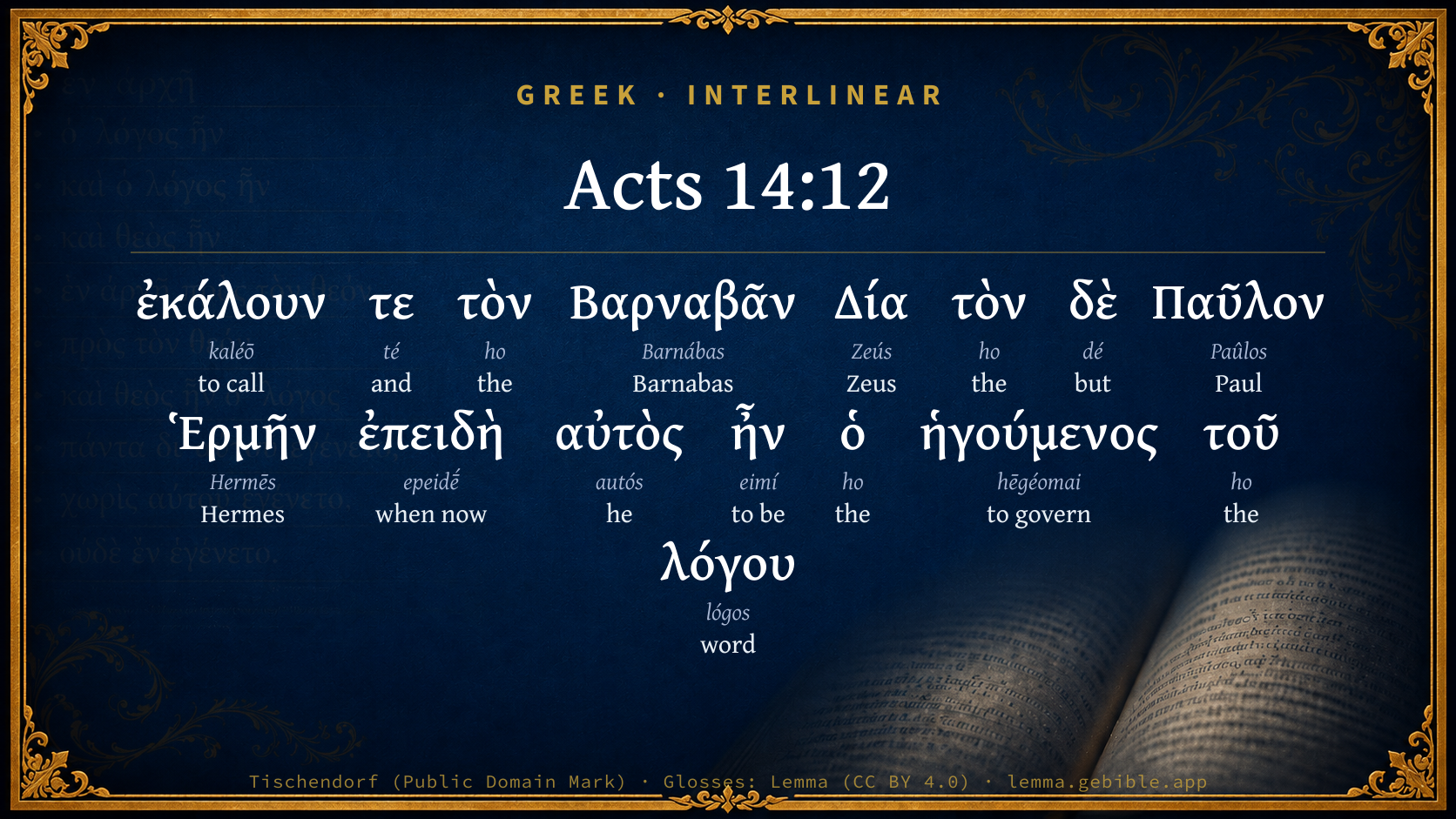
Greek (Tischendorf 8th ed.) Acts 14:12 appears in the Greek New Testament. The text above is from the Tischendorf 8th edition. Each word links to its Strong’s number and a concise gloss. Click any word for its full Thayer’s Greek Lexicon entry.
Download image
Cite this verse

Acts 14:12 (World English Bible). Public Domain. Lemma interlinear Bible study tool, https://lemma.gebible.app/v/acts/14/12.

Show BibTeX & RIS
BibTeX
RIS
English Translation
They called Barnabas "Jupiter," and Paul "Mercury," because he was the chief speaker.
World English Bible · Public Domain
Highlights
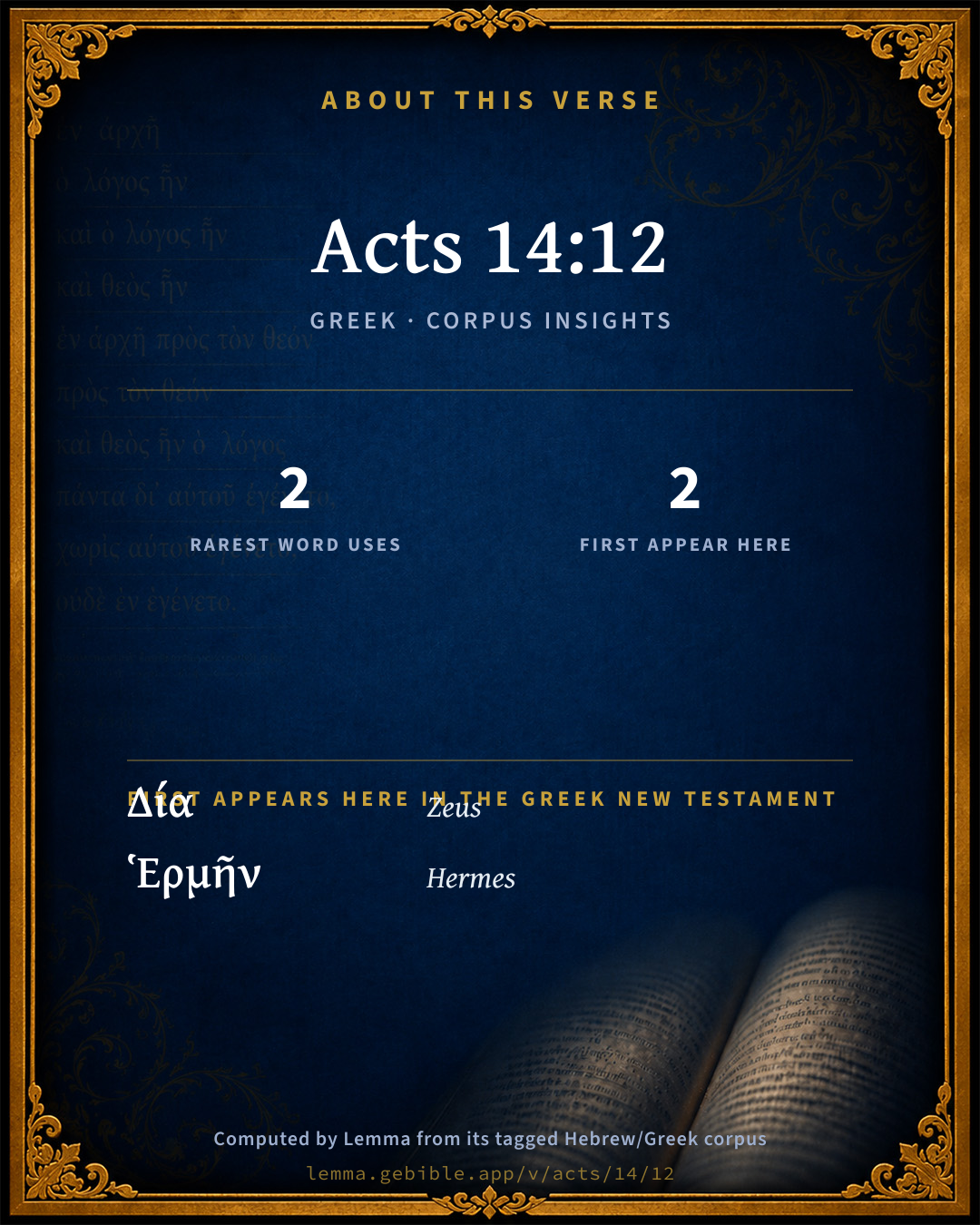
  • 2 first appearances in the Greek New Testament
Full analysis ↓
Download a study sheet

One document with this verse’s original text, its word-by-word gloss line, the meaning frame, cross-references with their text, attributed commentary, and full source and license credits — printable, and it pastes into notes with its structure intact.

This verse Autodidact and up

Study sheet (.html) Plain text (.txt)

A passage Seminary Student

Up to 50 verses in one chapter. A passage sheet keeps up to 6 commentary sources and 12 cross-references per verse, in the order this page ranks them, and says so on the sheet whenever that leaves anything out. Ask for a single verse and you get the Autodidact verse sheet above.

Everything on this page stays free to read, with no account — the sheet is a download of what is already on screen, not access to it.

Want to remove ads? Support Godless Engineer
Compare translations 3

The same verse in 3 English versions, stacked beneath the original-language interlinear above. Click any original word for its lexicon entry.

Each is an independent rendering of the whole verse — the interlinear is not word-aligned to these translations.

Highlighted words mark where these versions differ — a whole-verse word diff, not a word-by-word alignment.

  • World English Bible Public Domain
    They called Barnabas "Jupiter," and Paul "Mercury," because he was the chief speaker.
  • King James Version Public Domain
    And they called Barnabas, Jupiter; and Paul, Mercurius, because he was the chief speaker.
  • unfoldingWord Literal Text CC BY-SA 4.0
    And they were calling Barnabas “Zeus,” and Paul “Hermes,” because he was the leader of the word.

unfoldingWord Literal Text — © unfoldingWord, licensed CC BY-SA 4.0. Word-aligned USFM3 via Door43 (git.door43.org/unfoldingWord/en_ult).

Versions to compare (up to 4)

3 of 4 selected

Show all 19 translations

Every available English version of this verse, each an independent rendering of the whole verse.

  • World English Bible Public Domain
    They called Barnabas "Jupiter," and Paul "Mercury," because he was the chief speaker.
  • Berean Standard Bible Public Domain
    Barnabas they called Zeus, and Paul they called Hermes, because he was the chief speaker.
  • Majority Standard Bible Public Domain
    Barnabas they called Zeus, and Paul they called Hermes, because he was the chief speaker.
  • King James Version Public Domain
    And they called Barnabas, Jupiter; and Paul, Mercurius, because he was the chief speaker.
  • American Standard Version (1901) Public Domain
    And they called Barnabas, Jupiter; and Paul, Mercury, because he was the chief speaker.
  • Revised Version (1885) Public Domain
    And they called Barnabas, Jupiter; and Paul, Mercury, because he was the chief speaker.
  • Geneva Bible (1599) Public Domain
    And they called Barnabas, Iupiter: and Paul, Mercurius, because hee was the chiefe speaker.
  • Douay-Rheims (1899) Public Domain
    The priest also of Jupiter that was before the city, bringing oxen and garlands before the gate, would have offered sacrifice with the people.
  • Young's Literal Translation Public Domain
    they were calling also Barnabas Zeus, and Paul Hermes, since he was the leader in speaking.
  • Literal Standard Version CC BY-SA 4.0
    they were also calling Barnabas Zeus, and Paul Hermes, since he was the leader in speaking.
  • Unlocked Literal Bible CC BY-SA 4.0
    They called Barnabas “Zeus,” and Paul, “Hermes,” because he was the main speaker.
  • unfoldingWord Literal Text CC BY-SA 4.0
    And they were calling Barnabas “Zeus,” and Paul “Hermes,” because he was the leader of the word.
  • Darby Bible Public Domain
    And they called Barnabas Jupiter, and Paul Mercury, because he took the lead in speaking.
  • World Messianic Bible Public Domain
    They called Barnabas “Jupiter”, and Paul “Mercury”, because he was the chief speaker.
  • Webster's Bible Public Domain
    And they called Barnabas, Jupiter, and Paul, Mercurius, because he was the chief speaker.
  • Free Bible Version CC BY-SA 4.0
    They identified Barnabas as the Greek god Zeus, and Paul as the god Hermes because he was one who did most of the talking.
  • Bible in Basic English Public Domain
    And they gave the name of Jupiter to Barnabas, and to Paul that of Mercury, because he was the chief talker.
  • Text-Critical English NT CC BY 4.0
    Barnabas they called Zeus, and Paul they called Hermes, since he was the one who took the lead in speaking.
  • Tyndale New Testament (1534) Public Domain
    And they called Barnabas Iupiter and Paul Mercurius because he was the preacher.

Literal Standard Version (2020), Covenant Press — licensed CC BY-SA 4.0. Text via the HelloAO Bible API (eBible.org). Unlocked Literal Bible (unfoldingWord) — licensed CC BY-SA 4.0. Text via the HelloAO Bible API (eBible.org). unfoldingWord Literal Text — © unfoldingWord, licensed CC BY-SA 4.0. Word-aligned USFM3 via Door43 (git.door43.org/unfoldingWord/en_ult). Free Bible Version, Dr. Jonathan Gallagher — licensed CC BY-SA 4.0. Text via the HelloAO Bible API (eBible.org).

Word by word

More ways to search: Search by grammar → Find every occurrence → Compare this word →

Practice this passage: Drill this verse → Learn its vocabulary →

Δία
Zeús
G2203
“Zeus”
Noun, Accusative, Singular, Masculine
Part of Speech
Noun
Case
Accusative
Number
Singular
Gender
Masculine
Full Thayer's Definition

Origin: of uncertain affinity

TDNT: None

Jupiter or Zeus = "a father of helps" 1. the national god of the Greeks and corresponds to the Roman Jupiter
  1. ἐκάλουν kaléō G2564 “to call” Verb, Imperfect, Active, Indicative, 3rd person, Plural
  2. τε té G5037 “and” Particle
  3. τὸν ho G3588 “the” Article, Accusative, Singular, Masculine
  4. Βαρναβᾶν Barnábas G921 “Barnabas” Noun, Accusative, Singular, Masculine
  5. τὸν ho G3588 “the” Article, Accusative, Singular, Masculine
  6. δὲ dé G1161 “but” Conjunction
  7. Παῦλον Paûlos G3972 “Paul” Noun, Accusative, Singular, Masculine
  8. Ἑρμῆν Hermēs G2060 “Hermes” Noun, Accusative, Singular, Masculine
  9. ἐπειδὴ epeidḗ G1894 “when now” Conjunction
  10. αὐτὸς autós G846 “he” Personal pronoun, Nominative, Singular, Masculine
  11. ἦν eimí G1510 “to be” Verb, Imperfect, Active, Indicative, 3rd person, Singular
  12. ὁ ho G3588 “the” Article, Nominative, Singular, Masculine
  13. ἡγούμενος hēgéomai G2233 “to govern” Verb, Present, Middle or Passive deponent, Participle, Nominative, Singular, Masculine
  14. τοῦ ho G3588 “the” Article, Genitive, Singular, Masculine
  15. λόγου lógos G3056 “word” Noun, Genitive, Singular, Masculine

About this verse

These counts appear in no published source. They are computed here, from the morphology-tagged text and Lemma’s own curated glosses. What Lemma adds →

16
words
13
distinct lemmas
Acts
section

Notable vocabulary

The rarest word here is Δία Zeus G2203 — appearing just 2 times in the whole Greek New Testament.

First appearance in Scripture

These words make their first canonical appearance in the Greek New Testament here:

Shared distinctive vocabulary

Δία Zeus G2203 occurs in 2 verses of the Greek New Testament. Also found in:

Repetition

A word recurs within this verse:

Cross-references

1

Topical passages linked to Acts 14:12 in the Treasury of Scripture Knowledge — connected by theme and wording, ordered by reader-vote popularity; previews shown in the World English Bible.

  • Acts 19:35 When the town clerk had quieted the multitude, he said, "You men of Ephesus, what man is there who doesn't know that the city of the Ephesians is temple-keeper of the great goddess Artemis, and of the image which fell down from Zeus?

Cross-references courtesy of OpenBible.info (CC BY 4.0).

Commentary

Notes on Acts 14:12 from classic Christian and Jewish commentators (each source and its license shown beneath its notes). The classic Christian expositions comment on the surrounding passage and are grouped to its opening verse, so a note may address several verses; the Jewish commentaries on the Tanakh (Rashi and others) are per-verse, so they appear only where the commentator wrote on this verse.

Lemma curates 59 commentaries, every one of them public domain or Creative Commons licensed, each selected and text-cleaned for this edition rather than reprinted as found. About our sources →

Bengel's Gnomon

Johann Albrecht Bengel

Act 14:12. Δία, Jupiter) The people of Lystra used to worship Jupiter. The ancients called Jupiter Σωτήρ, the Saviour: therefore they accounted Barnabas as Jupiter in particular.

Bengel's Gnomon of the New Testament — English translation (T&T Clark, Edinburgh, 1860) — public domain. Text from a community e-Sword module.

Meyer's Critical & Exegetical Commentary

Heinrich August Wilhelm Meyer

Act_14:12. The fact that Barnabas and Paul were declared to be Zeus and Hermes, is explained partly and primarily from the well-known provincial myth, according to which these gods were once hospitably entertained in the same regions by Philemon and Baucis (Ovid. Met. viii. 611 ff.); but partly also from Zeus having a temple in front of the city (Act_14:13), and from its being the office of Hermes, as the eloquent (vocis et sermonis potens, Macrob. Sat. I. 8) interpreter (λόγου προφήτης, Orph. H. 27. 4) and messenger of the gods (Apollod. iii. 10. 2), to accompany his father when he came down to the earth (Hygin. Poet. Astron. 34; Ovid. Fast. v. 495). Comp. Walch, Diss. in Act. III. p. 173 ff Paul was called Hermes, because, in contrast to his companion, it was he who was leader of the word (αὐτὸς ἦν ὁ ἡγ. τ. λ.), as Hermes was considered Θεὸς ὁ τῶν λόγων ἡγεμών, Jamblich. de myster. Aeg. 1. Probably also his more juvenile appearance and greater activity, compared with the calmer and older Barnabas, contributed to this; but certainly not, as Neander conjectures, his insignificant bodily appearance; for apart from the fact that this rests only on very uncertain tradition (in the Acta Pauli et Theclae in Tischendorf, Act. apocr. p. 41, he is described as μικρὸς τῷ μεγέθει, ψιλὸς τὴν κεφαλήν, ἀγκύλος ταῖς κνήμαις; comp. Malalas, Chronogr. x. p. 247; Nicephor. H. E. iii. 37), Hermes is always represented as a handsome, graceful, very well-formed young man. Comp. Müller, Archäol. § 379, 380. But certainly Barnabas must have had a more imposing appearance, καὶ ἀπὸ τῆς ὄψεως ἀξιοπρεπής Chrysostom.

Meyer — Critical and Exegetical Commentary on the New Testament — English translation by Peter Christie, edited by Frederick Crombie (T&T Clark, 1880) — public domain. Text from a community e-Sword module.

Expositor's Greek Testament

ed. W. Robertson Nicoll

Act 14:12 . ἐκὰλουν , see above on Act 14:11 . τὸν μὲν Β . Δία . τὸν δὲ Π . Ἑρμῆν . The relative estimate of the Lycaonians was strikingly in accordance with Oriental notions Barnabas, the more silent and passive, is identified with Jupiter; and Paul, the more active, with Mercury. Ramsay, Church in the Roman Empire , p. 57; St. Paul , pp. 84, 85; McGiffert, Apostolic Age , p. 189. With the reason given for the identification of Paul with Mercury, cf. Iamblichus, De Myst. Ægypt. , i., where Mercury is designated as Θεὸς ὁ τῶν λόγων ἡγεμών (see also Wetstein). The comparison could not have been because of the Apostle’s insignificant appearance (although the fact that he was the younger of the two men may be taken into account), since Hermes is always represented as of a graceful well-formed figure. On the traditional accounts of Paul’s personal appearances see Wendt (1888), in loco , Blass, Renan, and Plumptre, Acts (Excursus, pp. 191, 192). It is of interest to note that in Gal 4:14 Paul writes to the Galatians: “Ye received me as a messenger of God,” Ramsay, St. Paul , p. 117.

The Expositor's Greek Testament, edited by W. Robertson Nicoll (1897–1910) — public domain. Text from a community e-Sword module.

Jamieson, Fausset & Brown

Robert Jamieson, A. R. Fausset & David Brown

they called Barnabas, Jupiter--the father of the gods, from his commanding mien (CHRYSOSTOM thinks).

and Paul, Mercurius--the god of eloquence and the messenger and attendant of Jupiter, in the heathen mythology.

Jamieson, Fausset & Brown — Commentary Critical and Explanatory on the Whole Bible (1871) — public domain (CC PDM 1.0). Text via the HelloAO Bible API.

Adam Clarke's Commentary

Verse 12. They called Barnabas, Jupiter; and Paul, Mercurius] The heathens supposed that Jupiter and Mercury were the gods who most frequently assumed the human form; and Jupiter was accustomed to take Mercury with him on such expeditions. Jupiter was the supreme god of the heathens; and Mercury was by them considered the god of eloquence. And the ancient fable, from which I have quoted so largely above, represents Jupiter and Mercury coming to this very region, where they were entertained by Lycaon, from whom the Lycaonians derived their name. See the whole fable in the first book of Ovid's Metamorphoses.

As the ancients usually represented Jupiter as rather an aged man, large, noble, and majestic; and Mercury young, light, and active, the conjecture of Chrysostom is very probable, that Barnabas was a large, noble, well-made man, and probably in years; and St. Paul, young, active, and eloquent; on which account, they termed the former Jupiter, and the latter Mercury. That Mercury was eloquent and powerful in his words is allowed by the heathens; and the very epithet that is applied here to Paul, ην ὁ ἡγουμενος του λογου, he was the chief or leader of the discourse, was applied to Mercury. So Jamblichus de Myster. Init. Θεος ὁ των λογων ἡγεμων ὁ Ἑρμης. And Macrobius, Sat. i. 8: Scimus Mercurium vocis et sermonis potentem. We know that Mercury is powerful both in his voice and eloquence. With the Lycaonians, the actions of these apostles proved them to be gods; and the different parts they took appeared to them to fix their character, so that one was judged to be Jupiter, and the other Mercury.

Adam Clarke's Commentary on the Bible (1810–1826) — public domain. Text from a community e-Sword/MySword module.

Ellicott's Commentary for English Readers

(12) They called Barnabas, Jupiter; and Paul, Mercurius.—St. Luke gives, as was natural, the Greek forms—Zeus and Hermes. The main reason for the assignment of the two names was that the listeners recognised in St. Paul the gift of eloquence, which was the special attribute of Hermes. Possibly, also, unlike as were the weak bodily presence and the many infirmities of the Apostle to the sculptured grace with which we are familiar as belonging to the sandalled messenger of the gods—young, and beautiful, and agile—there may have been something in the taller stature and more stately presence of Barnabas which impressed them with the sense of a dignity like that of Jupiter. In any case, we must remember that the master-pieces of Greek art were not likely to have found their way to a Lycaonian village, and that the Hermes of Lystra may have borne the same relation to that of Athens and Corinth as the grotesque Madonna of some Italian wayside shrine does to the masterpieces of Raphael. Real idolatry cares little about the æsthetic beauty of the objects of its worship; and the Lycaonians were genuine idolaters.

The chief speaker.—Literally, the ruler of speech—taking the chief part in it.

A Bible Commentary for English Readers, edited by Charles John Ellicott (1878–1897) — public domain. Text from a community e-Sword module.

The Cambridge Bible for Schools and Colleges

gen. ed. J. J. S. Perowne

12. And they called Barnabas, Jupiter; and Paul, Mercurius] Of course this was not known until afterwards, and St Luke in his narrative, as a Greek, gives the Greek names of the gods, Zeus and Hermes. We can understand how the heathen people concluded that if any deity came to visit them with a beneficent purpose it would be that god Jupiter whose temple was before their city and to whom therefore their chief worship was paid; and Mercury was counted as the principal attendant on Jupiter, and moreover as the god of eloquence. It was obvious, therefore, to assign that name to the chief speaker, and the name of Jupiter to that one of the two Apostles who had the more commanding presence. That St Paul was not such a figure we know from his own words, and tradition describes him as “little in height, with a bald head and crooked legs” (Acta Apocryph. p. 41, Tischendorf).

because he was the chief speaker] Literally, “the leader of the speech.” This character is always assigned to Mercury by the heathen writers, and almost the very words of the text are used of him by Iamblichus, de Myst. ad init.

The Cambridge Bible for Schools and Colleges (gen. ed. J. J. S. Perowne; Cambridge University Press, 1878–1918) — public domain. Text from a community e-Sword module.

John Gill's Exposition

And they called Barnabas Jupiter,.... The supreme God; it may be because that Barnabas was the oldest man, of the tallest stature, and largest bulk, and made the best figure; whereas Paul was younger, of a low stature, and mean appearance:

and Paul Mercurius, because he was the chief speaker; Mercury was the god of eloquence, and the messenger of the gods, and the interpreter of their will (r); Paul being chiefly concerned in preaching and speaking to the people, they called him by the name of this God: the Jews had a doctor in their schools, whom they called , "the chief of the speakers" (s).

(r) Vid Macrob. Saturnal. l. 1. c. 17, 19. (s) Juchasin, fol. 45. 2. & 46. 1.

John Gill's Exposition of the Whole Bible (1746–1763) — public domain (CC PDM 1.0). Text via the HelloAO Bible API.

Trapp's Complete Commentary

John Trapp

12 And they called Barnabas, Jupiter; and Paul, Mercurius, because he was the chief speaker.

Ver. 12. He was the chief speaker] Gr. ηγουμενος του λογου, a master of speech. Paul was another Pericles, who thundered and lightened in his orations; {a} another Phocion, who was ειπειν δεινοτατος, saith Plutarch, a most powerful speaker; another Cyneas, who conquered more cities by his eloquence than his master Pyrrhus did by his puissance. In Rogers and Bradford, martyrs, it was hard to say whether there were more force of eloquence and utterance in preaching (saith Mr Fox) or more holiness of life and conversation. Paul was eminent in both.

{a} Intonabat, fulgurabat, totam Graeciam permiscebat. Cic.

John Trapp, A Commentary or Exposition upon All the Books of the Old and New Testament (1647–1656) — public domain. Text from a community e-Sword module.

Albert Barnes' Notes on the Bible

And they called Barnabas, Jupiter - Jupiter was the most powerful of all the gods of the ancients. He was represented as the son of Saturn and Ops, and was educated in a cave on Mount Ida, in the island of Crete. The worship of Jupiter was almost universal. He was the Aremon of Africa, the Belus of Babylon, the Osiris of Egypt. His common appellation was, The Father of gods and men. He was usually represented as sitting upon a golden or an ivory throne, holding in one hand a thunderbolt, and in the other a scepter of cypress. His power was supposed to extend over other gods; and everything was subservient to his will except the Fates. There is the most abundant proof that he was worshipped in the region of Lycaonia and throughout Asia Minor. There was, besides, a fable among the inhabitants of Lycaonia that Jupiter and Mercury had once visited that place, and had been received by Philemon. The whole fable is related by Ovid, “Metam.,” 8, 611, etc.

And Paul, Mercurius - Mercury, called by the Greeks Hermes, was a celebrated god of antiquity. No less than five of this name are mentioned by Cicero. The most celebrated was the son of Jupiter and Maia. He was the messenger of the gods, and of Jupiter in particular; he was the patron of travelers and shepherds; he conducted the souls of the dead into the infernal regions; he presided over orators, and declaimers, and merchants; and he was also the god of thieves, pickpockets, and all dishonest persons. He was regarded as the god of eloquence; and as light, rapid, and quick in his movements. The conjecture of Chrysostom is, that Barnabas was a large, athletic man, and was hence taken for Jupiter; and that Paul was small in his person, and was hence supposed to be Mercury.

Because he was the chief speaker - The office of Mercury was to deliver the messages of the gods; and as Paul only had been discoursing, he was supposed to be Mercury.

Albert Barnes' Notes on the Bible (1834–1885) — public domain. Text from a community e-Sword/MySword module.

Haydock's Catholic Bible Commentary

Garlands. These might be for the victims, as they generally were crowned, or had gilded horns. Victima labe carens, præstantissima forma,

Sistitur ante aras, vittis præsignis et auro.---Ovid.

--- Or they might be for the two pretended gods, as it was usual to crown their statues. (Pliny, lib. xvi. chap. 4.) --- The priests likewise themselves, who sacrificed, wore crowns. (Virgil, Æneid ii.)

George Leo Haydock (1774–1849), Haydock's Catholic Family Bible and Commentary, 1859 edition — public domain. Excludes Psalms (Douay-Rheims chapter numbering differs from Protestant) and Deuterocanonical books (Catholic canon only).

Matthew Poole's English Annotations

Jupiter; whom the heathens took for their chief God.

Mercury was feigned to be the messenger of their gods, and therefore represented with wings; as also the interpreter of the gods, which caused their applying of his name to Paul.

Matthew Poole's English Annotations on the Holy Bible (1683–1685) — public domain. Text from a community e-Sword/MySword module.

Whedon's Commentary on the Bible

Daniel D. Whedon

12. Barnabas, Jupiter… Paul, Mercurius—Chrysostom was probably right in supposing that Barnabas was a man of venerable age, majestic presence, and dignified reserve, and so fitted to make a very suitable Jupiter. And as Jupiter was usually, in his visitations among men, accompanied by an attendant, so it was very supposable that Paul was Mercurius. Mercurius, too, was the god of eloquence, and was the nimble-tongued, wing-footed messenger of the gods, well represented by the younger, agile, eloquent chief speaker, Paul.

Daniel D. Whedon (gen. ed.), Commentary on the Old and New Testaments (1874–1909) — public domain. Text from a community e-Sword module.

The Pulpit Commentary

Mercury for Mercurius, A.V. For the Latin Jupiter and Mercury the Greek original has Zeus and Hermes. Jupiter is Jovis Pater, where Jovis or Diovis or Dies (in Diespiter) is the Latin form of Zeus, gen. Diov. Mercury is Hermes in his special character as the god of markets and trade. But the Lycaonians here thought of him in his principal character of herald and messenger of the gods, and hence the god of eloquence and speech.

The Pulpit Commentary (1880–1919), ed. H.D.M. Spence-Jones & Joseph S. Exell — public domain. Text from a community e-Sword module.

MacLaren's Expositions of Holy Scripture

Alexander MacLaren

Acts

DEIFIED AND STONED

Act 14:11 - Act 14:22.

The scene at Lystra offers a striking instance of the impossibility of eliminating the miraculous element from this book. The cure of a lame man is the starting-point of the whole story. Without it the rest is motiveless and inexplicable. There can be no explosion without a train and a fuse. The miracle, and the miracle only, supplies these. We may choose between believing and disbelieving it, but the rejection of the supernatural does not make this book easier to accept, but utterly chaotic.

I. We have, first, the burst of excited wonder which floods the crowd with the conviction that the two Apostles are incarnations of deities.

It is difficult to grasp the indications of locality in the story, but probably the miracle was wrought in some crowded place, perhaps the forum. At all events, it was in full view of ‘the multitudes,’ and they were mostly of the lower orders, as their speaking in ‘the speech of Lycaonia’ suggests.

This half-barbarous crowd had the ancient faith in the gods unweakened, and the legends, which had become dim to pure Greek and Roman, some of which had originated in their immediate neighbourhood, still found full credence among them. A Jew’s first thought on seeing a miracle was, ‘by the prince of the devils’; an average Greek’s or Roman’s was ‘sorcery’; these simple people’s, like many barbarous tribes to which white men have gone with the marvels of modern science, was ‘the gods have come down’; our modern superior person’s, on reading of one, is ‘hallucination,’ or ‘a mistake of an excited imagination.’ Perhaps the cry of the multitudes at Lystra gets nearer the heart of the thing than those others. For the miracle is a witness of present divine power, and though the worker of it is not an incarnation of divinity, ‘God is with him.’

But that joyful conviction, which shot through the crowd, reveals how deep lies the longing for the manifestation of divinity in the form of humanity, and how natural it is to believe that, if there is a divine being, he is sure to draw near to us poor men, and that in our own likeness. Then is the Christian doctrine of the Incarnation but one more of the many reachings out of the heart to paint a fair picture of the fulfilment of its longings? Well, since it is the only such that is alleged to have taken place in historic times, and the only one that comes with any body of historic evidence, and the only one that brings with it transforming power, and since to believe in a God, and also to believe that He has never broken the awful silence, nor done anything to fulfil a craving which He has set in men’s hearts, is absurd, it is reasonable to answer, No. ‘The gods are come down in the likeness of men’ is a wistful confession of need, and a dim hope of its supply. ‘The Word became flesh, and dwelt among us’ is the supply.

Barnabas was the older man, and his very silence suggested his superior dignity. So he was taken for Jupiter {Zeus in the Greek}, and the younger man for his inferior, Mercury {Hermes in the Greek}, ‘the messenger of the gods.’ Clearly the two missionaries did not understand what the multitudes were shouting in their ‘barbarous’ language, or they would have intervened. Perhaps they had left the spot before the excitement rose to its height, for they knew nothing of the preparations for the sacrifice till they ‘heard of it, and then they ‘sprang forth,’ which implies that they were within some place, possibly their lodging.

If we could be sure what ‘gates’ are meant in Act 14:13, the course of events would be plainer. Were they those of the city, in which case the priest and procession would be coming from the temple outside the walls? or those of the temple itself? or those of the Apostles’ lodging? Opinions differ, and the material for deciding is lacking. At all events, whether from sharing in the crowd’s enthusiasm, or with an eye to the reputation of his shrine, the priest hurriedly procured oxen for a sacrifice, which one reading of the text specifies as an ‘additional’ offering-that is, over and above the statutory sacrifices. Is it a sign of haste that the ‘garlands,’ which should have been twined round the oxen’s horns, are mentioned separately? If so, we get a lively picture of the exultant hurry of the crowd.

II. The Apostles are as deeply moved as the multitude is, but by what different emotions!

The horror of idolatry, which was their inheritance from a hundred generations, flamed up at the thought of themselves being made objects of worship. They had met many different sorts of receptions on this journey, but never before anything like this. Opposition and threats left them calm, but this stirred them to the depths. ‘Scoff at us, fight with us, maltreat us, and we will endure; but do not make gods of us.’ I do not know that their ‘successors’ have always felt exactly so.

In Act 14:14 Barnabas is named first, contrary to the order prevailing since Paphos, the reason being that the crowd thought him the superior. The remonstrance ascribed to both, but no doubt spoken by Paul, contains nothing that any earnest monotheist, Jew or Gentile philosopher, might not have said. The purpose of it was not to preach Christ, but to stop the sacrifice. It is simply a vehemently earnest protest against idolatry, and a proclamation of one living God. The comparison with the speech in Athens is interesting, as showing Paul’s exquisite felicity in adapting his style to his audience. There is nothing to the peasants of Lycaonia about poets, no argumentation about the degradation of the idea of divinity by taking images as its likeness, no wide view of the course of history, no glimpse of the mystic thought that all creatures live and move in Him. All that might suit the delicate ears of Athenians, but would have been wasted in Lystra amidst the tumultuous crowd. But we have instead of these the fearless assertion, flung in the face of the priest of Jupiter, that idols are ‘vanities,’ as Paul had learned from Isaiah and Jeremiah; the plain declaration of the one God, ‘living,’ and not like these inanimate images; of His universal creative power; and the earnest exhortation to turn to Him.

In Act 14:16 Paul meets an objection which rises in his mind as likely to be springing in his hearers: ‘If there is such a God, why have we never heard of Him till now?’ That is quite in Paul’s manner. The answer is undeveloped, as compared with the Athenian address or with Rom 1:1 - Rom 1:32 But there is couched in Act 14:16 a tacit contrast between ‘the generations gone by’ and the present, which is drawn out in the speech on Mars Hill: ‘but now commandeth all men everywhere to repent,’ and also a contrast between the ‘nations’ left to walk in their own ways, and Israel to whom revelation had been made. The place and the temper of the listeners did not admit of enlarging on such matters.

But there was a plain fact, which was level to every peasant’s apprehension, and might strike home to the rustic crowd. God had left ‘the nations to walk in their own ways,’ and yet not altogether. That thought is wrought out in Rom 1:1 - Rom 1:32, and the difference between its development there and here is instructive. Beneficence is the sign-manual of heaven. The orderly sequence of the seasons, the rain from heaven, the seat of the gods from which the two Apostles were thought to have come down, the yearly miracle of harvest, and the gladness that it brings-all these are witnesses to a living Person moving the processes of the universe towards a beneficent end for man.

In spite of all modern impugners, it still remains true that the phenomena of ‘nature,’ their continuity, their co-operation, and their beneficent issues, demand the recognition of a Person with a loving purpose moving them all. ‘Thou crownest the year with Thy goodness; and Thy paths drop fatness.’

III. The malice of the Jews of Antioch is remarkable.

Not content with hounding the Apostles from that city, they came raging after them to Lystra, where there does not appear to have been a synagogue, since we hear only of their stirring up the ‘multitudes.’ The mantle of Saul had fallen on them, and they were now ‘persecuting’ him ‘even unto strange cities.’

No note is given of the time between the attempted sacrifice and the accomplished stoning, but probably some space intervened. Persuading the multitudes, however fickle they were, would take some time; and indeed one ancient text of Acts has an expansion of the verse: ‘They persuaded the multitudes to depart from them [the Apostles], saying that they spake nothing true, but lied in everything.’

No doubt some time elapsed, but few emotions are more transient than such impure religious excitement as the crowd had felt, and the ebb is as great as the flood, and the oozy bottom laid bare is foul. Popular favourites in other departments have to experience the same fate-one day, ‘roses, roses, all the way’; the next, rotten eggs and curses. Other folks than the ignorant peasants at Lystra have had devout emotion surging over them and leaving them dry.

Who are ‘they’ who stoned Paul? Grammatically, the Jews, and probably it was so. They hated him so much that they themselves began the stoning; but no doubt the mob, which is always cruel, because it needs strong excitement, lent willing hands. Did Paul remember Stephen, as the stones came whizzing on him? It is an added touch of brutality that they dragged the supposed corpse out of the city, with no gentle hands, we may be sure. Perhaps it was flung down near the very temple ‘before the city,’ where the priest that wanted to sacrifice was on duty.

The crowd, having wreaked their vengeance, melted away, but a handful of brave disciples remained, standing round the bruised, unconscious form, ready to lay it tenderly in some hastily dug grave. No previous mention of disciples has been made. The narrative of Acts does not profess to be complete, and the argument from its silence is precarious.

Luke shows no disposition to easy belief in miracles. He does not know that Paul was dead; his medical skill familiarised him with protracted states of unconsciousness; so all he vouches for is that Paul lay as if dead on some rubbish heap ‘without the camp,’ and that, with courage and persistence which were supernatural, whether his reviving was so or not, the man thus sorely battered went back to the city, and next day went on with his work, as if stoning was a trifle not to be taken account of.

The Apostles turned at Derbe, and coming back on their outward route, reached Antioch, encouraging the new disciples, who had now to be left truly like shepherdless sheep among wolves. They did not encourage them by making light of the dangers waiting them, but they plainly set before them the law of the Kingdom, which they had seen exemplified in Paul, that we must suffer if we would reign with the King. That ‘we’ in Act 14:22 is evidently quoted from Paul, and touchingly shows how he pointed to his own stoning as what they too must be prepared to suffer. It is a thought frequently recurring in his letters. It remains true in all ages, though the manner of suffering varies.

Alexander MacLaren, Expositions of Holy Scripture (1904–1910) — public domain. Text from a community e-Sword module.

Scofield Reference Notes

C. I. Scofield

Jupiter Latin for Gr. Zeus, the national god of the Greeks.

Mercurius Gr. Hermes.

The Scofield Reference Bible (1917 edition), notes by C. I. Scofield — public domain. Text from a community e-Sword module.

McGarvey & Pendleton's Commentaries

J. W. McGarvey

See notes one verse 8

J. W. McGarvey (with Philip Y. Pendleton), Commentaries on the New Testament (The Fourfold Gospel, 1914; Acts; and the epistles) — public domain. Text from a community e-Sword/MySword module.

Cambridge Greek Testament for Schools and Colleges

12. ἐκάλουν τε τὸν Βαρνάβαν Δία, τὸν δὲ Παῦλον Ἑρμῆν, and they called Barnabas, Jupiter [Zeus]; and Paul, Mercurius [Hermes]. Of course this was not known until afterwards. We can understand how the heathen people concluded that if any deity came to visit them with a beneficent purpose it would be that god Jupiter whose temple was before their city, and to whom therefore their chief worship was paid; and Mercury was counted as the principal attendant on Jupiter, and moreover as the god of eloquence. It was obvious, therefore, to assign that name to the chief speaker, and the name of Jupiter to that one of the two Apostles who had the more commanding presence. That St Paul was not such a figure we know from his own words, and tradition describes him as ἀνὴρ μικρὸς τῷ μεγέθει, ψιλὸς τῇ κεφαλῇ, ἀγκύλος ταῖς κνήμαις, Acta Pauli et Theclæ, 2. Of the aspect of Barnabas, Chrysostom writes, ἐμοὶ δοκεῖ καὶ ἀπὸ τῆς ὄψεως ἀξιοπρεπὴς εἶναι ὁ Βαρνάβας.

ἐπειδὴ αὐτὸς ἦν ὁ ἡγούμενος τοῦ λόγου, because he was the chief speaker. This character is always assigned to Hermes by the heathen writers. Cf. Macrobius, Sat. I. 8, ‘Scimus Mercurium vocis et sermonis potentem,’ and Iamblichus, de Mysteriis ad init., says of him θεὸς ὁ τῶν λόγων ἡγεμών.

Cambridge Greek Testament for Schools and Colleges (Cambridge University Press, 1896; 21 vols, various authors incl. Carr, Maclear, Plummer, Farrar, Lumby, Moule, M. R. James, Simcox) — public domain. Text from a community e-Sword module.

Alford’s Greek Testament

Henry Alford

12.] This distinction is (besides the reason given) in accordance with what Paul himself cites (as the saying of his adversaries, it is true, but not therefore without some physical foundation), ἡ παρουσία τοῦ σώματος ἀσθενής. So Chrysostom, ἐμοὶ δοκεῖ καὶ ἀπὸ τῆς ὄψεως ἀξιοπρεπὴς εἶναι ὁ Βαρνάβας, Hom. xxx., p. 237.

ἡγούμενος τοῦ λόγου] So Iamblichus, of Hermes, in reff.: ‘vocis et sermonis potens,’ Macrob. Saturn, i. 8: λόγου προφήτης, Orph. H. xxvii. 4: λαλίστατος κ. λογιώτατος θεῶν ἁπάντων, Lucian, Gallus, 2.

Henry Alford, The Greek Testament (1849–1861) — public domain. Text from a community e-Sword module.

Vincent's Word Studies in the New Testament

Marvin R. Vincent

Barnabas Jupiter, and Paul Mercury. The Greek names of these deities were Zeus and Hermes. As the herald of the gods, Mercury is the God of skill in the use of speech and of eloquence in general, for the heralds are the public speakers in the assemblies and on other occasions. Hence he is sent on messages where persuasion or argument are required, as to Calypso to secure the release of Ulysses from Ogygia (" Odyssey, "1, 84); and to Priam to warn him of danger and to escort him to the Grecian fleet (" Iliad," 24, 390). Horace addresses him as the "eloquent" grandson of Atlas, who artfully formed by oratory the savage manners of a primitive race (" Odes, "1, 10). Hence the tongues of sacrificial animals were offered to him. As the God of ready and artful speech, his office naturally extended to business negotiations. He was the God of prudence and skill in all the relations of social intercourse, and the patron of business and gain. A merchant - guild at Rome was established under his protection. And as, from its nature, commerce is prone to degenerate into fraud, so he appears as the God of thievery, exhibiting cunning, fraud, and perjury. 20" He represents, so to speak, the utilitarian side of the human mind.... In the limitation of his faculties and powers, in the low standard of his moral habits, in the abundant activity of his appetites, in his indifference, his ease, his good nature, in the full - blown exhibition of what Christian theology would call conformity to the world, he is, as strictly as the nature of the case admits, a product of the invention of man. He is the God of intercourse on earth "(Gladstone," Homer and the Homeric Age "). The chief speaker [ο ηγουμενος του λογου] . Lit., the leader in discourse. Barnabas was called Jupiter, possibly because his personal appearance was more imposing than Paul 's (see 2Co 10:1, 10), and also because Jupiter and Mercury were commonly represented as companions in their visits to earth. 21

Marvin R. Vincent, Word Studies in the New Testament (1887–1900) — public domain. Text from a community e-Sword/MySword module.

Lesson kit

Teaching starters — assembled from the data on this page, not authored interpretation. Every prompt links to the verse data it draws on. Edit before teaching.

Acts, in the Acts, opens this verse with 16 words (13 distinct Greek lemmas). Its most distinctive word is Zeús (“Zeus”). A historical commentator’s framing appears above. Read the whole chapter for the surrounding context.

Discussion questions

  1. What does “Zeus” (Zeús) contribute to the verse as a whole?
  2. 2 words make their first appearance in Scripture here. What does this debut establish?
  3. How does Acts 14:13, which shares the word «Zeus», read alongside this verse?
  4. What does the repetition of “the” (4× in this one verse) do in this verse?
  5. These translations render this verse differently; the difference is in the English rendering, not the original. What questions does that raise?
  6. Compare how Bengel's Gnomon and Meyer's Critical & Exegetical Commentary read this verse. Where do they agree or differ?

Things to notice

  • 2 words make their first canonical appearance in Scripture here.
  • These translations choose different wording for 11 words in this verse.
  • “the” occurs 4× in this single verse.
  • 13 distinct Greek lemmas span 16 words in this verse.

Reading settings

Reading text

Shown beneath each verse's original-language words.

Old Testament
Old Testament edition

Read the OT as the Masoretic Hebrew (MT) or the Greek Septuagint (LXX).

English shown for the Greek Septuagint (in the Hebrew ↔ Greek comparison).

Comparing translations? Open the Compare panel on any verse page to stack up to four side by side.