
1 Peter 3:6

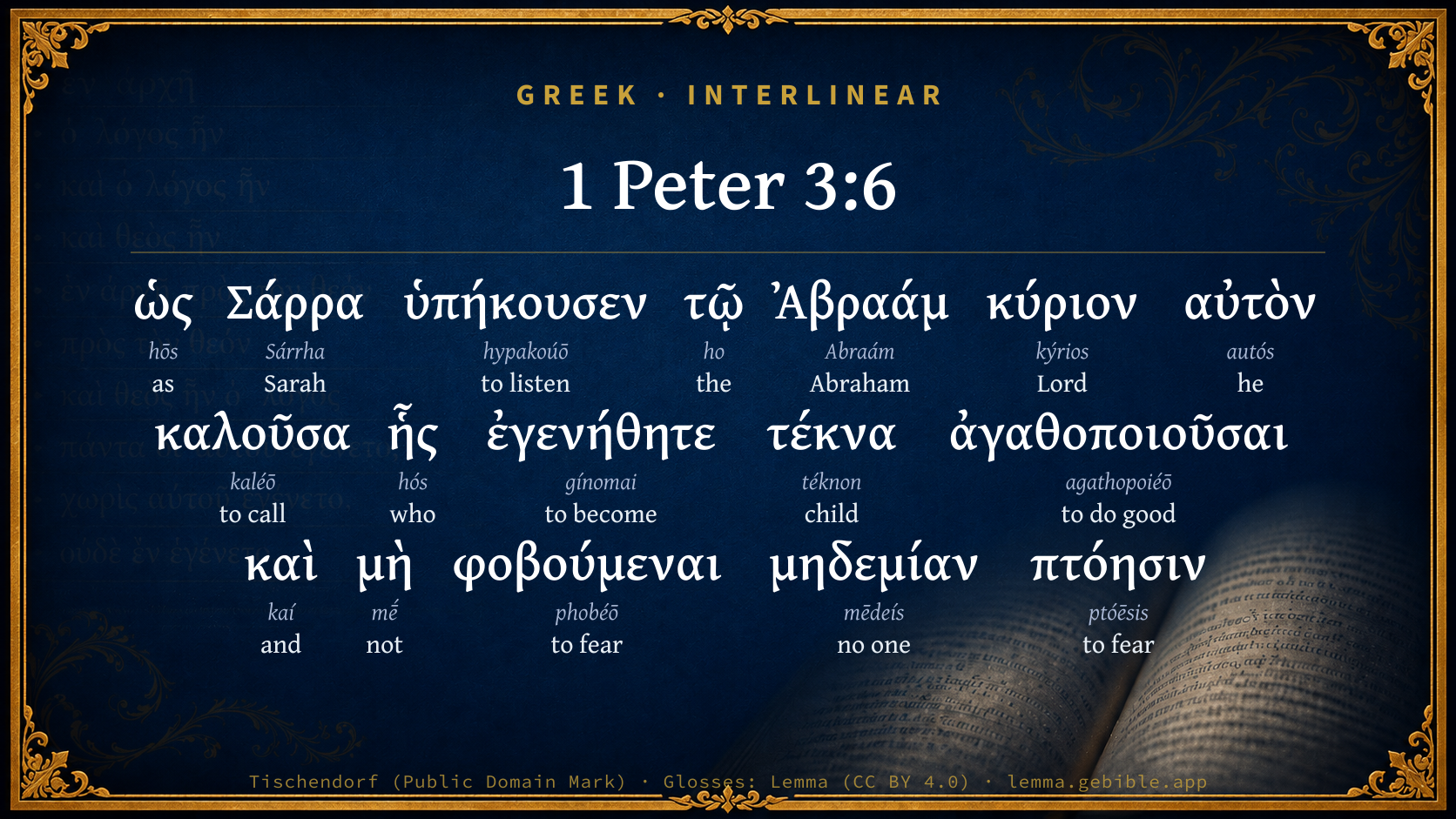
Greek (Tischendorf 8th ed.) 1 Peter 3:6 appears in the Greek New Testament. The text above is from the Tischendorf 8th edition. Each word links to its Strong’s number and a concise gloss. Click any word for its full Thayer’s Greek Lexicon entry.
Download image
Cite this verse

1 Peter 3:6 (World English Bible). Public Domain. Lemma interlinear Bible study tool, https://lemma.gebible.app/v/1-peter/3/6.

Show BibTeX & RIS
BibTeX
RIS
English Translation
as Sarah obeyed Abraham, calling him lord, whose children you now are, if you do well, and are not put in fear by any terror.
World English Bible · Public Domain
Highlights
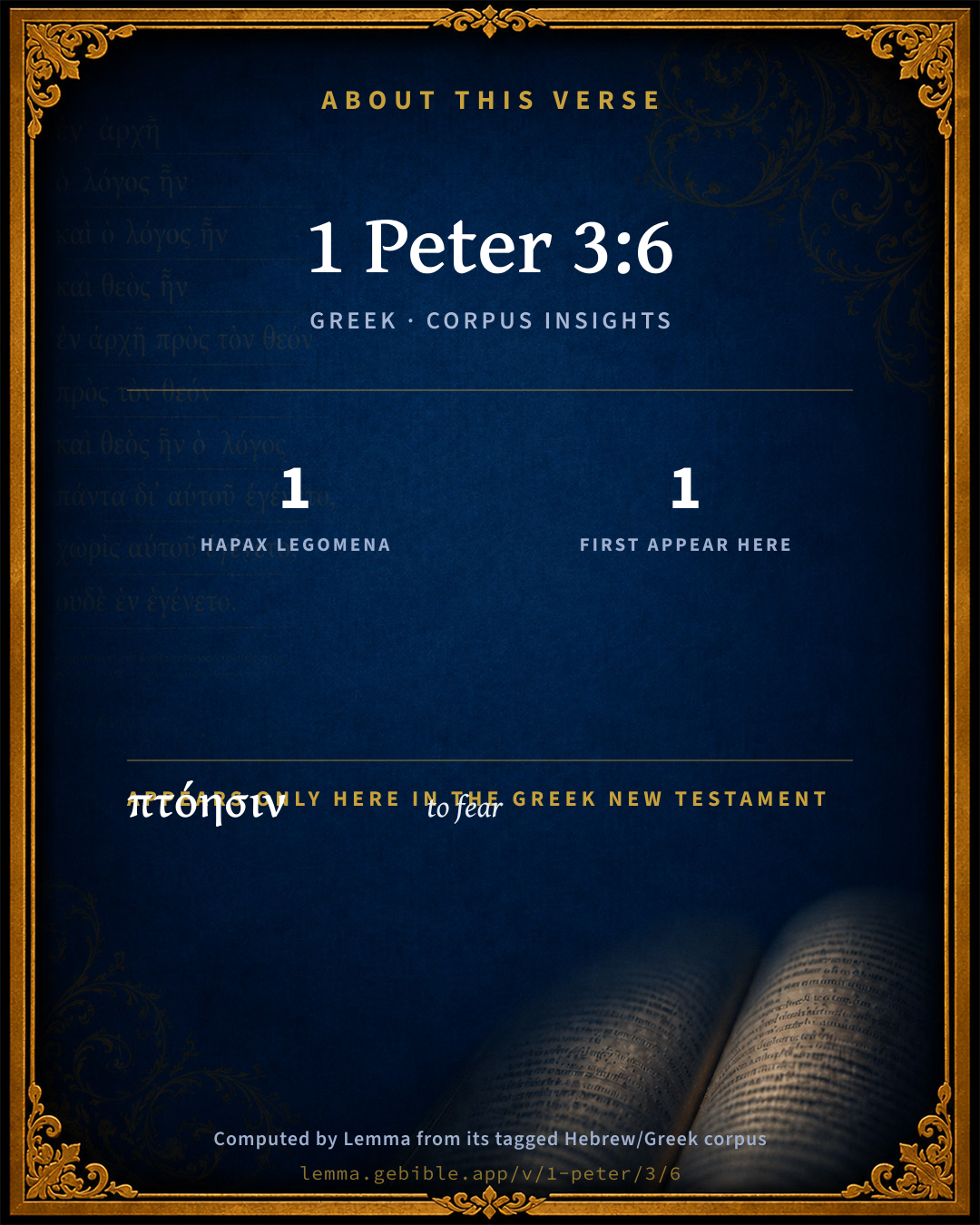
  • 1 hapax legomenon — only here in the Greek New Testament
  • 1 first appearance in the Greek New Testament
Full analysis ↓
Download a study sheet

One document with this verse’s original text, its word-by-word gloss line, the meaning frame, cross-references with their text, attributed commentary, and full source and license credits — printable, and it pastes into notes with its structure intact.

This verse Autodidact and up

Study sheet (.html) Plain text (.txt)

A passage Seminary Student

Up to 50 verses in one chapter. A passage sheet keeps up to 6 commentary sources and 12 cross-references per verse, in the order this page ranks them, and says so on the sheet whenever that leaves anything out. Ask for a single verse and you get the Autodidact verse sheet above.

Everything on this page stays free to read, with no account — the sheet is a download of what is already on screen, not access to it.

Want to remove ads? Support Godless Engineer
Compare translations 3

The same verse in 3 English versions, stacked beneath the original-language interlinear above. Click any original word for its lexicon entry.

Each is an independent rendering of the whole verse — the interlinear is not word-aligned to these translations.

Highlighted words mark where these versions differ — a whole-verse word diff, not a word-by-word alignment.

  • World English Bible Public Domain
    as Sarah obeyed Abraham, calling him lord, whose children you now are, if you do well, and are not put in fear by any terror.
  • King James Version Public Domain
    Even as Sara obeyed Abraham, calling him lord: whose daughters ye are, as long as ye do well, and are not afraid with any amazement.
  • unfoldingWord Literal Text CC BY-SA 4.0
    like Sarah obeyed Abraham, calling him “lord,” whose children you have become, doing what is good and not being afraid of any terror.

unfoldingWord Literal Text — © unfoldingWord, licensed CC BY-SA 4.0. Word-aligned USFM3 via Door43 (git.door43.org/unfoldingWord/en_ult).

Versions to compare (up to 4)

3 of 4 selected

Show all 19 translations

Every available English version of this verse, each an independent rendering of the whole verse.

  • World English Bible Public Domain
    as Sarah obeyed Abraham, calling him lord, whose children you now are, if you do well, and are not put in fear by any terror.
  • Berean Standard Bible Public Domain
    just as Sarah obeyed Abraham and called him lord. And you are her children if you do what is right and refuse to give way to fear.
  • Majority Standard Bible Public Domain
    just as Sarah obeyed Abraham and called him lord. And you are her children if you do what is right and refuse to give way to fear.
  • King James Version Public Domain
    Even as Sara obeyed Abraham, calling him lord: whose daughters ye are, as long as ye do well, and are not afraid with any amazement.
  • American Standard Version (1901) Public Domain
    as Sarah obeyed Abraham, calling him lord: whose children ye now are, if ye do well, and are not put in fear by any terror.
  • Revised Version (1885) Public Domain
    as Sarah obeyed Abraham, calling him lord: whose children ye now are, if ye do well, and are not put in fear by any terror.
  • Geneva Bible (1599) Public Domain
    As Sara obeyed Abraham, and called him Sir: whose daughters ye are, whiles yee doe well, not being afraide of any terrour.
  • Douay-Rheims (1899) Public Domain
    As Sara obeyed Abraham, calling him lord: whose daughters you are, doing well, and not fearing any disturbance.
  • Young's Literal Translation Public Domain
    as Sarah was obedient to Abraham, calling him `sir,' of whom ye did become daughters, doing good, and not fearing any terror.
  • Literal Standard Version CC BY-SA 4.0
    as Sarah was obedient to Abraham, calling him “lord,” of whom you became daughters, doing good, and not fearing any terror.
  • Unlocked Literal Bible CC BY-SA 4.0
    In this way Sarah obeyed Abraham and called him her lord. You are now her children if you do what is good and if you are not afraid of trouble.
  • unfoldingWord Literal Text CC BY-SA 4.0
    like Sarah obeyed Abraham, calling him “lord,” whose children you have become, doing what is good and not being afraid of any terror.
  • Darby Bible Public Domain
    as Sarah obeyed Abraham, calling him lord; whose children ye have become, doing good, and not fearing with any kind of consternation.
  • World Messianic Bible Public Domain
    So Sarah obeyed Abraham, calling him lord, whose children you now are if you do well and are not put in fear by any terror.
  • Webster's Bible Public Domain
    Even as Sarah obeyed Abraham, calling him lord: whose daughters ye are, as long as ye do well, and are not afraid with any amazement.
  • Free Bible Version CC BY-SA 4.0
    like Sarah who obeyed Abraham, and called him “lord.” You are her daughters if you do what's good and right and are not intimidated.
  • Bible in Basic English Public Domain
    As Sarah was ruled by Abraham, naming him lord; whose children you are if you do well, and are not put in fear by any danger.
  • Text-Critical English NT CC BY 4.0
    just as Sarah obeyed Abraham and called him her lord. You have become her children if you do good and do not give way to fear.
  • Tyndale New Testament (1534) Public Domain
    even as Sara obeyed Abraham and called him Lorde: whose doughters ye are as longe as ye do well and be not afrayde of every shadowe.

Literal Standard Version (2020), Covenant Press — licensed CC BY-SA 4.0. Text via the HelloAO Bible API (eBible.org). Unlocked Literal Bible (unfoldingWord) — licensed CC BY-SA 4.0. Text via the HelloAO Bible API (eBible.org). unfoldingWord Literal Text — © unfoldingWord, licensed CC BY-SA 4.0. Word-aligned USFM3 via Door43 (git.door43.org/unfoldingWord/en_ult). Free Bible Version, Dr. Jonathan Gallagher — licensed CC BY-SA 4.0. Text via the HelloAO Bible API (eBible.org).

Word by word

More ways to search: Search by grammar → Find every occurrence → Compare this word →

Practice this passage: Drill this verse → Learn its vocabulary →

πτόησιν
ptóēsis
G4423
“to fear”
Noun, Accusative, Singular, Feminine
Part of Speech
Noun
Case
Accusative
Number
Singular
Gender
Feminine
Full Thayer's Definition

Origin: from G4422

TDNT: None

1. to be afraid of with terror
  1. ὡς hōs G5613 “as” Adverb
  2. Σάρρα Sárrha G4564 “Sarah” Noun, Nominative, Singular, Feminine
  3. ὑπήκουσεν hypakoúō G5219 “to listen” Verb, Aorist, Active, Indicative, 3rd person, Singular
  4. τῷ ho G3588 “the” Article, Dative, Singular, Masculine
  5. Ἀβραάμ Abraám G11 “Abraham” Noun, Proper, indeclinable
  6. κύριον kýrios G2962 “Lord” Noun, Accusative, Singular, Masculine
  7. αὐτὸν autós G846 “he” Personal pronoun, Accusative, Singular, Masculine
  8. καλοῦσα kaléō G2564 “to call” Verb, Present, Active, Participle, Nominative, Singular, Feminine
  9. ἧς hós G3739 “who” Relative pronoun, Genitive, Singular, Feminine
  10. ἐγενήθητε gínomai G1096 “to become” Verb, Aorist, Passive deponent, Indicative, 2nd person, Plural
  11. τέκνα téknon G5043 “child” Noun, Accusative, Plural, Neuter
  12. ἀγαθοποιοῦσαι agathopoiéō G15 “to do good” Verb, Present, Active, Participle, Nominative, Plural, Feminine
  13. καὶ kaí G2532 “and” Conjunction
  14. μὴ mḗ G3361 “not” Particle, Negative
  15. φοβούμεναι phobéō G5399 “to fear” Verb, Present, Middle or Passive deponent, Participle, Nominative, Plural, Feminine
  16. μηδεμίαν mēdeís G3367 “no one” Adjective, Accusative, Singular, Feminine, Negative

About this verse

These counts appear in no published source. They are computed here, from the morphology-tagged text and Lemma’s own curated glosses. What Lemma adds →

17
words
17
distinct lemmas
General Epistles
section

Notable vocabulary

1 hapax legomenon — a word that appears only here in the entire Greek New Testament:

  • πτόησιν to fear G4423

First appearance in Scripture

This word makes its first canonical appearance in the Greek New Testament here:

  • πτόησιν to fear G4423

Shared distinctive vocabulary

Σάρρα Sarah G4564 occurs in 4 verses of the Greek New Testament. Also found in:
Cross-references

10

Topical passages linked to 1 Peter 3:6 in the Treasury of Scripture Knowledge — connected by theme and wording, ordered by reader-vote popularity; previews shown in the World English Bible.

  • Genesis 18:12 Sarah laughed within herself, saying, "After I have grown old will I have pleasure, my lord being old also?"
  • Romans 9:7–9 Neither, because they are Abraham's seed, are they all children. But, "In Isaac will your seed be called."
  • Isaiah 57:11 Of whom have you been afraid and in fear, that you lie, and have not remembered me, nor laid it to your heart? Haven't I held my peace even of long time, and you don't fear me?
  • Daniel 3:16–18 Shadrach, Meshach, and Abednego answered the king, Nebuchadnezzar, we have no need to answer you in this matter.
  • Acts 4:19 But Peter and John answered them, "Whether it is right in the sight of God to listen to you rather than to God, judge for yourselves,
  • Matthew 26:69–75 Now Peter was sitting outside in the court, and a maid came to him, saying, "You were also with Jesus, the Galilean!"
  • Genesis 18:15 Then Sarah denied, saying, "I didn't laugh," for she was afraid." He said, "No, but you did laugh."
  • Acts 4:8–13 Then Peter, filled with the Holy Spirit, said to them, "You rulers of the people, and elders of Israel,
  • 1 Peter 3:14–15 But even if you should suffer for righteousness' sake, you are blessed. "Don't fear what they fear, neither be troubled."
  • Galatians 4:22–26 For it is written that Abraham had two sons, one by the handmaid, and one by the free woman.

Cross-references courtesy of OpenBible.info (CC BY 4.0).

Commentary

Notes on 1 Peter 3:6 from classic Christian and Jewish commentators (each source and its license shown beneath its notes). The classic Christian expositions comment on the surrounding passage and are grouped to its opening verse, so a note may address several verses; the Jewish commentaries on the Tanakh (Rashi and others) are per-verse, so they appear only where the commentator wrote on this verse.

Lemma curates 59 commentaries, every one of them public domain or Creative Commons licensed, each selected and text-cleaned for this edition rather than reprinted as found. About our sources →

Ellicott's Commentary for English Readers

(6) Even as Sara.—A definite example of the general fact just alleged. St. Peter seems rather to have argued from what every one would feel must have been the case than from explicit records. Sara’s usual subjection is clearly seen in the one instance to which St. Peter refers (Gen_18:12), where Sara, though not addressing Abraham, but speaking to herself, calls him “my lord.” People show their usual habits of mind more freely in speaking to themselves.

Whose daughters ye are.—A very misleading version, following the Vulgate. What St. Peter says is, whose children ye became, or were made. There was a definite period in their past lives at which they came to be—what they were not before—children of Sara. Have we not here, therefore, a distinct proof that these readers of the Epistle were Gentiles and not Jewesses? Not so. The phrase, “which hoped in God,” pointing as it does to the coming of the Messiah, prepares us to understand how these Hebrew women became Sara’s children. It was only by entering into her hope and attaching themselves to Jesus Christ, for whose coming she had looked. St. Peter has already been insisting on the nothingness of the fleshly descent, the “corruptible seed.” As has been pointed out on 1Pe_1:24, this doctrine was not first taught by St. Paul, for St. Peter had heard it from the Baptist (Mat_3:9) and from our Lord Himself (Joh_8:39). Whether persons were naturally Jews or Gentiles, they could not be children of Abraham without voluntarily becoming so by embracing his principles—i.e., by becoming Christians. The participial clauses which follow will need no change of translation, for they express not the act or process by which these ladies became children of Sara, but the condition on which they would remain her children. A very similar passage occurs in Heb_3:14 : “We have become partakers of the Christ, if (for the future) we hold,” &c. (Comp. also 1Th_3:8; Heb_3:6.)

Do well.—See 1Pe_2:12; 1Pe_2:15; 1Pe_2:20. The word means, of course, general good behaviour, especially in all wifely duties. As this is a condition of remaining Sara’s children, it is implied that it was a characteristic of Sara. Some critics would even put in a parenthesis all the words from “even as” to “ye are,” and attach these participles (as they are in the Greek) to the last clause in 1Pe_3:5, thus: “adorned themselves, being in subjection to their own husbands (as Sara, for instance . . . whose daughters ye were made), doing well, and not being afraid,” &c. This is, however, somewhat cumbrous, and leaves the clause “whose daughters ye became” a little too bald.

Are not afraid with any amazement.—Though this translation is grammatically possible, it does not make such good sense as to translate, are not afraid of any alarm. It is, in fact, a quotation from or allusion to Pro_3:25, as Bengel points out, where “Be not afraid of sudden fear” is rendered in the LXX. by these same peculiar words. The “Wisdom” in that passage, which brings the calmness with it, is Christ, and it is Christ who must be understood in Pro_3:26 : “the Lord shall be thy confidence.” To be afraid of sudden alarms and panics argues a lack of trust in God’s providence and power, and would, therefore, be unbecoming the daughters of Sara, who “hoped in God.” The “alarms” which they naturally might fear are, of course, quite general, but especially here, we may suppose, dread of what their unbelieving husbands might do to them. (Comp. 1Pe_3:13 et seq.)

A Bible Commentary for English Readers, edited by Charles John Ellicott (1878–1897) — public domain. Text from a community e-Sword module.

Tyndale Open Study Notes

Tyndale Open Resources

3:6 and called him her master: See Gen 18:12. Peter views this address as indicative of Sarah’s overall attitude toward Abraham. • without fear of what your husbands might do: Christian wives married to unbelievers frequently found themselves pressured, both subtly and overtly, to abandon Christian principles and values. Peter urges them to continue to do what is right.

Tyndale Open Study Notes — © Tyndale Open Resources, licensed CC BY-SA 4.0. Text via the HelloAO Bible API.

Bengel's Gnomon

Johann Albrecht Bengel

1Pe 3:6. Ὡς, even as) The particle used in bringing forward an example.—ὑλήκουσε, obeyed) Gen 18:6.—κύριον, lord) Gen 18:12, Septuagint, ὁ δὲ κύριός μου. Also 1Sa 1:8: καὶ εἴπεν αὐτῇ, Ἐλκανᾶ ὁ ἀνὴρ αὐτῆς, Ἄννα· καὶ εἶπεν, ἰδοὺ ἐγώ κύριε·τί ἐστί σοι ὅτι κλαίεις; And Elkanah her husband said to her, Hannah! and she said, Here am I, my lord: and he said, why weepest thou?—αὐτὸν, him) although he was born of the same father: Gen 20:12.—ἐγενήθητε, ye have become) he says; not ye are [as Engl. Vers.] He addresses those that believe even of the Gentiles.—τέκνα, daughters) Daughters ought to imitate their mother, as the sons Abraham.—ἀγαθοποιῦσαι, doing well) This also depends upon adorned [1Pe 3:5; Engl. Vers, differently].—καὶ μὴ, and not) Comp. 1Pe 3:13; 1Pe 3:16; 1Pe 3:15. You need fear no man in doing what is right.—φοβούμεναι, fearing) Anger assails men, fear women.—πτόησιν, [fluttering] terror) coming upon them from without; 1Pe 3:14, note. Pro 3:25, Septuagint: Καὶ οὐ φοβηθήσῃ πτόησιν ἐπελθοῦσαν· And thou shalt not be afraid of sudden terror.

Bengel's Gnomon of the New Testament — English translation (T&T Clark, Edinburgh, 1860) — public domain. Text from a community e-Sword module.

Expositor's Greek Testament

ed. W. Robertson Nicoll

1Pe 3:6 . ὡς … καλοῦσα . The only evidence that can be adduced from the O.T. narrative is Sarah laughed within herself and said … “but my lord is old ” (Gen 18:12 ). The phrase, if pressed, implies a nominal subjection as of a slave to her lord, but the context at any rate excludes any hope in God . Philo, who starts with the assumption that Sarah is Virtue, evades the difficulty; her laughter was the expression of her joy, she denied it for fear of usurping God’s prerogative of laughter ( de Abr. , ii. p. 30 M). The Rabbinic commentaries dwell upon the title accorded to Abraham and draw the same inference as Peter; but there are also traces of a tendency to exalt Sarah “the princess” as superior to her husband in the gift of prophecy, which St. Peter may wish to correct (as St. James corrects the exaggerated respect paid to Elijah, Jas 5:17 ). ἧς … τέκνα . Christian women became children of Sarah who is Virtue or Wisdom: (Philo) just as men became children of Abraham. But the fact that they were Christians is still in the background; the essential point is that they must do the works traditionally ascribed to Sarah ( cf. Rom 4 .; Joh 8 .) and so justify their technical parentage, whether natural or acquired. Oec. compares Isa 41:2 , Sarah your mother . ἀγαθοποιοῦσαι the present participle emphasises the need for continuance of the behaviour appropriate to children of Sarah. μὴ … πτόησιν , from Pro 3:25 , LXX. Peter regards Sarah’s falsehood (Gen. l.c. ) as the yielding to a sudden terror for which she was rebuked by God. Fearlessness then is part of the character which is set before them for imitation and it is the result of obedience to the voice of Wisdom. Rabbinic exegesis as sociates the ideas of ornament with the promised child and that of peace between husband and wife with the whole incident.

The Expositor's Greek Testament, edited by W. Robertson Nicoll (1897–1910) — public domain. Text from a community e-Sword module.

Geneva Bible (1599)

Geneva Bible translators

Because women are of nature fearful, he giveth them to understand, that he requireth of them that subjection, which is not wrung out of them either by force or fear.

Geneva Bible (1599) marginal notes — public domain. Text via Bolls.life.

Jamieson, Fausset & Brown

Robert Jamieson, A. R. Fausset & David Brown

Sara--an example of faith.

calling him lord-- (Gen 18:12).

ye are--Greek, "ye have become": "children" of Abraham and Sara by faith, whereas ye were Gentile aliens from the covenant.

afraid with any amazement--Greek, "fluttering alarm," "consternation." Act well, and be not thrown into sudden panic, as weak females are apt to be, by any opposition from without. BENGEL translates, "Not afraid OF any fluttering terror coming from without" (Pe1 3:13-16). So the Septuagint, Pro 3:25 uses the same Greek word, which Peter probably refers to. Anger assails men; fear, women. You need fear no man in doing what is right: not thrown into fluttering agitation by any sudden outbreak of temper on the part of your unbelieving husbands, while you do well.

Jamieson, Fausset & Brown — Commentary Critical and Explanatory on the Whole Bible (1871) — public domain (CC PDM 1.0). Text via the HelloAO Bible API.

Adam Clarke's Commentary

Verse 6. Even as Sara obeyed] Almost the same words are in Rab. Tanchum, fol. 9, 3: "The wife of Abraham reverenced him, and called him lord, as it is written, Ge 18:12: And my lord is old." The words of the apostle imply that she acknowledged his superiority, and her own subjection to him, in the order of God.

Whose daughters ye are] As Abraham is represented the father of all his male believing descendants, so Sara is represented as the mother of all her believing female posterity. A son of Abraham is a true believer; a daughter of Sarah is the same.

As long as ye do well] For you cannot maintain your relationship to her longer than ye believe; and ye cannot believe longer than ye continue to obey.

And are not afraid with any amazement.] It is difficult to extract any sense out of this clause. The original is not very easy; μηφοβουμεναιμηδεμιανπτοησις may be rendered, And not fearing with any terror. If ye do well, and act conscientiously your part as faithful wives, ye will at no time live under the distressing apprehension of being found out, or terrified at every appearance of the discovery of infidelities, or improper conduct. Being not guilty of these, you will not have occasion to fear detection. On this subject a learned man has quoted these words, which I have produced elsewhere, Eph 6:14: -

--------------- hic murus aheneus esto,

Nil conscire sibi, nulla pallescere culpa.

"Let this be my brazen wall, to be self-convicted of no

private delinquency, nor to change colour at being

charged with a fault."

Happy is the wife, and happy is the husband, who can conscientiously adopt the saying.

Adam Clarke's Commentary on the Bible (1810–1826) — public domain. Text from a community e-Sword/MySword module.

John Calvin's Commentaries

6 And are not afraid The weakness of the sex causes women to be suspicious and timid, and therefore morose; for they fear lest by their subjection, they should be more reproachfully treated. It was this that Peter seems to have had in view in forbidding them to be disturbed by any fear, as though he had said, “Willingly submit to the authority of your husbands, nor let fear prevent your obedience, as though your condition would be worse, were you to obey.” The words may be more general, “Let them not raise up commotions at home.” For as they are liable to be frightened, they often make much of a little thing, and thus disturb themselves and the family. Others think that the timidity of women, which is contrary to faith, is generally reproved, as though Peter exhorted them to perform the duties of their calling with a courageous and intrepid spirit. However, the first explanation is what I prefer, though the last does not differ much from it.

John Calvin's Commentaries (1540-1563) — public domain. Text from the Calvin Translation Society English edition (1840s-50s) via the Christian Classics Ethereal Library (ccel.org). Calvin's coverage is partial (roughly two-thirds of the Bible); uncommented books and verses are honest gaps, never fabricated. The 19th-century editor's footnotes and remarks are omitted so the notes are faithfully Calvin's own voice.

The Cambridge Bible for Schools and Colleges

gen. ed. J. J. S. Perowne

6. even as Sara obeyed Abraham] The tense which St Peter uses would seem to imply a reference to some special instance of obedience, but, as the history of Genesis supplies no such instance in act, we are left to infer that he saw in her use of “my lord,” in speaking of her husband (Gen_18:12), a representative utterance that implied a sense of habitual subordination. It seems strange to refer to literature like that of the sixth satire of Juvenal in illustration of an Epistle of St Peter, but there can be no clearer evidence that the general corruption of the Empire had extended itself to the life of home, and that over and above the prevalence of adultery and divorce, the wives of Rome, and we may believe also, of the cities that followed in the wake of Rome, had well-nigh thrown aside all sense of the reverence which the Apostle looked on as essential to the holiness, and therefore the happiness, of married life.

whose daughters ye are] whose daughters ye became. If the words were addressed to women who were converts from heathenism, we might see in the words a suggestive parallel to those of St Paul, that Abraham was the father of “all them that believe though they be not circumcised” (Rom_4:11), that “they which are of faith, the same are the children of Abraham” (Gal_3:7). Taking this view there would be a special interest in the fact that St Peter, the married Apostle, told the female converts from among the Gentiles that they were as truly daughters of Sarah as their husbands, if believing, were sons of Abraham. On the assumption which has been adopted throughout these notes, as on the whole the most probable, that the Epistle was really addressed, as it purports to be, to the Jews of the dispersion, the words have another significance. The daughters of Sarah according to the flesh are told that they only became truly her children when they reproduced her character. The words, on this view, present a striking parallelism to those in which St Paul speaks of Abraham as being “the father not of the circumcision only, as such, but of those who walk in the steps of Abraham’s faith” (Rom_4:12).

as long as ye do well, and are not afraid with any amazement] The construction of the Greek sentence is not quite clear, and admits of being taken either (1) as in the English version, or (2) treating the words “as Sara obeyed.… whose daughters ye became” as a parenthesis, we may refer the words “doing well” to the “holy women” of 1Pe_3:5. On the whole (1) seems preferable. It may be questioned whether the words “so long as” rightly represent the force of the participle. If we adopt the rendering given above (“ye became”) that meaning is clearly inadmissible, and we have to see in the two participles the process by which Christian women became daughters by doing good and not being afraid. The word for “amazement” does not occur elsewhere in the New Testament, but the cognate verb is found in Luk_21:9; Luk_24:37. The noun itself meets us in the LXX. of Pro_3:25. It implies the crouching, shuddering fear of one who is overwhelmed with terror. In warning the women to whom he writes against such a fear, St Peter seems to be guarding them against the unwisdom of rushing from one extreme to the other. The Christian wives of unbelieving husbands, whether Jews or heathens, might often have much to bear from them, but if they were always shewing their terror, cowering as if they expected the curse or the blow, that very demeanour was certain to make matters worse. It was a tacit reproach, and therefore would but irritate and annoy. Wisely therefore does the Apostle urge on them a different line of action. “Be certain,” he seems to say, “that you are doing what is right and good, and then go about the daily tasks of your household life with a cheerful intrepidity.” Two interpretations may be noticed only to be rejected, (1) that which takes the second clause as meaning “be not afraid of anything that causes terror,” and (2) that which renders it “doing good, even though you are not afraid,” as though stress were laid on their good conduct being spontaneous and not originating in fear.

The Cambridge Bible for Schools and Colleges (gen. ed. J. J. S. Perowne; Cambridge University Press, 1878–1918) — public domain. Text from a community e-Sword module.

John Gill's Exposition

Even as Sarah obeyed Abraham,.... Going along with him wherever he went, as from Chaldea to Canaan, and into Egypt, and the land of the Philistines, saying the words he put into her mouth, Gen 12:5 and doing the things he bid her do, Gen 18:6 "calling him lord"; or "my lord", as the Syriac and Ethiopic versions render it, and as it appears she did from Gen 18:12. The Jews use this instance to the same purpose the apostle does, saying (p),

"the wife ought to take care of the family, to educate her children, to serve and minister to her husband in all things, "calling him her own lord"; which is what we learn from the example of Sarah, who called Abraham her lord, saying, "my lord is old".

Whose daughters ye are; meaning not by natural descent, though they were, these being Jews the apostle writes to, but by grace, and in a spiritual sense; just as those are the children of Abraham, who walk in the steps of his faith, whether they be Jews or Gentiles; so such are the daughters of Sarah, the children of the free woman, who imitate her in faith and obedience; that is, they appear, and are declared to be so:

as long as ye do well: do acts of beneficence and hospitality to strangers, and proper objects, as Sarah did, and all and every good work, according to the will of God, from love, and in faith, and with a view to his glory; and particularly obey and live in subjection to their husbands, as she did: and are not afraid with any amazement; are not deterred from doing well, nor scared by the terrors and menaces of wicked men, either their own husbands, or others; or who with fortitude and intrepidity of mind continue in the discharge of their duty to God and men, and particularly to their husbands, following them, and obeying their lawful commands, as Sarah did in Egypt, and in Gerar, though she exposed herself to great danger: this is said, because women are timorous, and apt to be frightened at everything, from the performance of their duty,

(p) Sepher Musar apud Drus. de Quaesitis, Ep. 54. & in loc.

John Gill's Exposition of the Whole Bible (1746–1763) — public domain (CC PDM 1.0). Text via the HelloAO Bible API.

Trapp's Complete Commentary

John Trapp

6 Even as Sara obeyed Abraham, calling him lord: whose daughters ye are, as long as ye do well, and are not afraid with any amazement.

Ver. 6. Calling him lord] See here, how in a great heap of sin, God can find out his own, and accept of it. There was no good word in all the whole sentence, but this, that she called her husband lord. God is pleased to single out this, and set it as a precious diamond in a gold ring to Sarah’s eternal commendation. So, Heb 11:31, mention is made of Rahab’s entertaining the spies, and not of the lie she told: God lays the finger of mercy on the scars of our sins, as that limner {a} in the story.

And are not afraid, &c.] Fear they must, 1Pe 3:2, and yet they must not. Fear God, but not their husband’s undeserved checks or threats for obeying God. One fear must expel another, as one fire drives out another.

{a} A painter, esp. a portrait painter. ŒD

John Trapp, A Commentary or Exposition upon All the Books of the Old and New Testament (1647–1656) — public domain. Text from a community e-Sword module.

Albert Barnes' Notes on the Bible

Even as Sara obeyed Abraham - Sarah was one of the most distinguished of the wives of the patriarchs, and her case is referred to as furnishing one of the best illustrations of the duty to which the apostle refers. Nothing is said, in the brief records of her life, of any passion for outward adorning; much is said of her kindness to her husband, and her respect for him. Compare Gen 12:5; Gen 18:6.

Calling him Lord - See Gen 18:12. It was probably inferred from this instance, by the apostle, and not without reason, that Sarah habitually used this respectful appellation, acknowledging by it that he was her superior, and that he had a right to rule in his own house. The word lord has the elementary idea of ruling, and this is the sense here - that she acknowledged that he had a right to direct the affairs of his household, and that it was her duty to be in subjection to him as the head of the family. In what respects this is a duty, may be seen by consulting the notes at Eph 5:22. Among the Romans, it was quite common for wives to use the appellation lord, (dominus), when speaking of their husbands. The same custom also prevailed among the Greeks. See Grotius, in loc. This passage does not prove that the term lord should be the particular appellation by which Christian wives should address their husbands now, but it proves that there should be the same respect and deference which was implied by its use in patriarchal times. The welfare of society, and the happiness of individuals, are not diminished by showing proper respect for all classes of persons in the various relations of life.

Whose daughters ye are - That is, you will be worthy to be regarded as her daughters, if you manifest the same spirit that she did. The margin here, as the Greek, is children. The sense is that if they demeaned themselves correctly in the relation of wives, it would be proper to look upon her as their mother, and to feel that they were not unworthy to be regarded as her daughters.

As long as ye do well - In respect to the particular matter under consideration.

And are not afraid with any amazement - This passage has been variously understood, Some have supposed that this is suggested as an argument to persuade them to do well, from the consideration that by so doing they would be preserved from those alarms and terrors which a contest with superior power might bring with it, and which would prove as injurious to their peace as to their character. Rosenmuller explains it, “If ye do well, terrified by no threats of unbelieving husbands, if they should undertake to compel you to deny the Christian faith.” Doddridge supposes that it means that they were to preserve their peace and fortitude in any time of danger, so as not to act out of character, through amazement or danger. Calvin, Benson, and Bloomfield understand it of that firmness and intrepidity of character which would be necessary to support their religious independence, when united with pagan husbands; meaning that they were not to be deterred from doing their duty by any threats or terrors, either of their unbelieving husbands, or of their enemies and persecutors. Dr. Clarke supposes that it means that if they did well, they would live under no dread of being detected in improprieties of life, or being found out in their infidelities to their husbands, as those must always be who are unfaithful to their marriage vows. The word rendered “amazement” ptonsis - does not elsewhere occur in the New Testament. It means terror, trepidation, fear; and the literal translation of the Greek is, “not fearing any fear.” It seems to me that the following may express the sense of the passage:

(1) There is undoubtedly an allusion to the character of Sarah, and the object of the apostle is to induce them to follow her example.

(2) The thing in Sarah which he would exhort them to imitate, was her pure and upright life, her faithful discharge of her duties as a woman fearing God. This she did constantly wherever she was, regardless of consequences. Among friends and strangers, at home and abroad, she was distinguished for doing well. Such was her character, such her fidelity to her husband and her God, such her firm integrity and benevolence, that she at all times lived to do good, and would have done it, unawed by terror, undeterred by threats, To whatever trial her piety was exposed, it bore the trial; and such was her strength of virtue, that it was certain her integrity would be firm by whatever consequences she might have been threatened for her adherence to her principles.

(3) They were to imitate her in this, and were thus to show that they were worthy to be regarded as her daughters. They were to do well; to be faithful to their husbands; to be firm in their principles; to adhere steadfastly to what was true and good, whatever trials they might pass through, however much they might be threatened with persecution, or however any might attempt to deter them from the performance of their duty. Thus, by a life of Christian fidelity, unawed by fear from any quarter, they would show that they were imbued with the same principles of unbending virtue which characterised the wife of the father of the faithful, and that they were not unworthy to be regarded as her daughters.

Albert Barnes' Notes on the Bible (1834–1885) — public domain. Text from a community e-Sword/MySword module.

Matthew Poole's English Annotations

Even as Sara; after ger name was changed from Sarai, my lady, to Sarah, simply a lady or princess, because kings were to come of her, Gen 17:15,16; yet even then she obeyed Abraham; and this is spoken in commendation of her obedience.

Calling him lord; not merely in compliment, but in reality, hereby acknowledging his authority and her own subjection.

Whose daughters ye are; not only according to the flesh, but spiritually, according to the promise.

Ye are; either ye are made or become, viz. by imitation of her faith and holiness, as well as ye are by kindred and succession; or, ye are declared and known to be, as the phrase is elsewhere used, Joh 15:8.

As long as ye do well; follow her in good works, 1Ti 2:10.

And are not afraid with any amazement; or, afraid of any amazement, any thing frightful, or which might terrify you, taking amazement for the object or cause or fear, as 1Pe 3:14; Psa 53:5; Pro 3:25; and the sense may be, either, so long as ye perform your duty with a resolute mind, and keep from that which is contrary to your faith; or, as long as you subject yourselves to your husbands willingly, cheerfuly, and without slavish fear of being losers by your obedience, and faring the worse for your patience and submission.

Matthew Poole's English Annotations on the Holy Bible (1683–1685) — public domain. Text from a community e-Sword/MySword module.

The Pulpit Commentary

Even as Sara obeyed Abraham, calling him lord. St. Peter singles out Sarah, as the mother of the chosen people. She obeyed her husband habitually (the imperfect uJphkouen is the reading of some of the oldest manuscripts; the aorist, also well supported, would represent her obedience as a whole, the character of her life now past); she called him lord (comp. terov.) Gen_18:12, oJ deriov mou presbu. Whose daughters ye are; literally, whose children ye became. This is another indication that the Epistle is addressed, not only to Jewish Christians, but also, and that in large measure, to Gentile converts. Gentile women became by faith the daughters of Sarah; just as we read in St. Paul"s Epistles that "they which are of faith, the same are the children of Abraham"; (Gal_3:7) anti that Abraham is "the father of all them that believe, though they be not circumcised"; (Rom_4:11) comp. Gal_4:22-31, where St. Paul tells us that we, like Isaac, are the children of promise; children, "not of the bondwoman, but of the free." As long as ye do well. This clause represents one Greek word ajgaqopiousai ("doing good Some commentators regard the words from "even as Sara" to "whose daughters ye are" as a parenthesis, and refer the participle to "the holy women" mentioned in ver. 5. This does not seem natural. It is better to regard the second half of this verse as a continuous sentence, and to understand the participle as meaning "if ye do well." The doing well, etc., is a mark that Christian women have become children of Sarah by faith. And are not afraid with any amazement. The Greek word for "amazement" (ptohsiv) does not occur in any other place of the New Testament, though we meet with the corresponding verb in Luk_21:9 Luk_24:7. There seems to be a reference tohsin Pro_3:25, "Be not afraid of sudden fear" (kaish pto ejpelqousan), Ptshsiv is "dismay, scared terrified excitement," very different from the calm thoughtful fobov, the fear lest they should fail in proper respect for their husbands, and that out of the holy fear of God, which St. Peter inculcates upon wives (ver. 2). The Christian wife might often experience cruel treatment from an unbelieving husband, but she was not to live in a flutter of excited terror; she was to be calm and quiet, trusting in God. As to the construction, the accusative may be cognate, as the Authorized Version takes it; or the accusative of the object, as in Pro_3:25. The last view is, perhaps, the most suitable: "And are not afraid of any sudden terror."

The Pulpit Commentary (1880–1919), ed. H.D.M. Spence-Jones & Joseph S. Exell — public domain. Text from a community e-Sword module.

John Wesley's Explanatory Notes

Whose children ye are - In a spiritual as well as natural sense, and entitled to the same inheritance, while ye discharge your conjugal duties, not out of fear, but for conscience' sake. Gen. xviii, 12.

John Wesley, Explanatory Notes Upon the Whole Bible (1754–1765) — public domain. Text via the GEBible commentary corpus.

The People's New Testament

B. W. Johnson

6. As Sarah obeyed Abraham, calling him lord. See Gen. 18:12; also 1 Sam. 1:15. This designation showed respect and submission. Women should follow the example of Sarah, who might be designated as “the mother of those who are Abraham's children by faith.” Are not put in fear. The fear might result from not doing well. They were to be quiet, submissive, loving wives, but were not to be kept from Christian duty by “any fear” which might threaten because of their heathen surroundings.

B. W. Johnson's The People's New Testament with Notes (1889–1891) — public domain. Electronic text from the Christian Classics Ethereal Library (CCEL) ThML edition.

Cambridge Greek Testament for Schools and Colleges

6. κύριον καλοῦσα. The only passage where Sarah is actually described as calling Abraham her “lord” is in Gen 18:12, but St Peter is referring to her habitual attitude towards Abraham.

ἧς ἐγενήθητε τέκνα. Those who regard the epistle as addressed to Jewish readers explain ἐγενήθητε to mean whose true daughters you proved yourselves; but the words are much more forcible if addressed to Gentiles. Just as St Paul describes the Gentiles as becoming true sons of Abraham by sharing his faith, so St Peter describes Gentile women as having become true daughters of Sarah by their admission into the new covenant people of God, cf. Gal 3:29; Rom 4:11.

ἀγαθοποιοῦσαι κ.τ.λ. These words are generally connected with ἐγενήθητε if (or so long as) ye do well. But if Gentile women are addressed they did not become daughters of Sarah by doing well.

The R.V. margin refers them to αἱ ἅγιαι γυναῖκες and treats the passage about “Sarah—whose daughters ye became” as a parenthesis. Holy women of old adorned themselves by submitting to their husbands, by well-doing and by tranquillity.

πτόησιν. R.V. text “put in fear by any terror” (objective acc.) but R.V. margin “afraid with” (cognate acc.). The substantive occurs only in Pro 3:25 “be not afraid of sudden fear,” but the verb is frequently used in the LXX. of alarm or panic. So it is used in Luk 21:9; Luk 24:37. Here it means not interrupting the quiet discharge of home duties by any excitement or panic.

Cambridge Greek Testament for Schools and Colleges (Cambridge University Press, 1896; 21 vols, various authors incl. Carr, Maclear, Plummer, Farrar, Lumby, Moule, M. R. James, Simcox) — public domain. Text from a community e-Sword module.

Alford’s Greek Testament

Henry Alford

6.] As (e. g.) Sarah obeyed (aor. It refers to her whole course of obedience considered as a completed whole: cf. reff., and Joh 17:4) Abraham calling him lord (ref.: ὁ δὲ κύριός μου πρεσβύτερος): of whom ye have become (i. e. by your implanting through faith into the family of faithful Abraham. The aor. properly refers back to the precise time when they were so made; but cannot be so expressed in English) children, if (the connexion of the following participles is variously taken. The worst way is with Bengel, Ernesti, al. to suppose them in apposition with ὑποτασσόμεναι above, ὡς … τέκνα being in a parenthesis: for there is nothing in either of the participles which finds any historical justification in the history of the holy women. Didymus, al., understand them of the manner in which ye are to become Sarah’s children: Harless, Wies., al., of the sign by which your having so become is to be known: but it is perhaps better to take them as the condition on which: and so most Commentators and virtually the E. V. “as long as,” rendering literally the dum of Beza) ye do good, and are not afraid of any sudden fear (to what do these words allude? As in reff., they appear to be a citation from Prov.: where it is said to him that obeys the counsels of wisdom, οὐ φοβηθήσῃ πτόησιν ἐπελθοῦσαν, οὐδὲ ὁρμὰς ἀσεβῶν ἐπερχομένας. This passage, the coincidence with which can hardly be fortuitous, seems to point to the objective rather than the subjective sense of πτόησις, so that φοβεῖσθαι πτόησιν is not = φοβεῖσθαι φόβον, but πτόησις is some external cause of terror. And such a meaning would suit very well with the context, in which as in ver. 14, the Apostle is often encouraging his readers to bear affliction and persecution cheerfully. So that we may interpret πτόησιν with Est., “quod dum facitis, non est quod metuatis quidquam mali: velut, ne maritis vestris displiceatis, si minus corruptæ inceditis: aut ne serviliter vos tractent, si faciles ad obsequium vos præbeatis; ut solet sexus muliebris vanis pavoribus esse obnoxius. Sed et si forte nacti estis maritos iniquiores, silentio potius ac patientia, quam multis verbis studete eorum animos lenire.” Cf. Luk 21:9; Luk 24:37. Huther quotes from Stephanus an extraordinary explanation, “jubentur mulieres officium facere etiam cum nullus eas metus constringit, i. e. sponte et ultro.” And Œc., interpreting ἀγαθοποιοῦσαι of doing good deeds of benevolence, understands this of the wives not being afraid of the account which their (unbelieving) husbands would require of them: ἐλεήμονας αὐτὰς εἶναι παραινεῖ, μηδὲν ὑποβλεπομένας τὸν ἀπὸ τῶν ἀνδρῶν αὐτῶν διὰ τοῦτο ἐκλογισμόν. See Winer, § 32. 2. b, who however interprets πτόησιν subjectively).

With regard to the much-disputed question whether by the preceding injunction all ornament of dress is forbidden, or only the making such ornament the adorning, it may safely be left to the Christian wisdom of believing women, to be not unwise, but understanding what the will of the Lord is, in this as in other similar matters. Within the limits of propriety and decorum, the common usage is the rule. There is sin in singularity, both as ministering to pride in ourselves, and as giving offence to others and discommending our holy religion. As Leighton well says, “There may be in some an affected pride in the meanness of apparel; and in others, under either neat or rich attire, a very humble unaffected mind.… ‘Magnus qui fictilibus utitur tanquam argento; nec ille minor qui argento tanquam fictilibus,’ says Seneca: Great is he who enjoys his earthenware as if it were plate, and not less great is the man to whom all his plate is no more than earthenware.”

Henry Alford, The Greek Testament (1849–1861) — public domain. Text from a community e-Sword module.

Vincent's Word Studies in the New Testament

Marvin R. Vincent

Amazement [πτοησιν] . Rev., terror. Compare the kindred verb ptohqhte, be terrified, Luk 21:9; Luk 24:37; on which, see note. The word means a scare, or nervous excitement.

Marvin R. Vincent, Word Studies in the New Testament (1887–1900) — public domain. Text from a community e-Sword/MySword module.

Lesson kit

Teaching starters — assembled from the data on this page, not authored interpretation. Every prompt links to the verse data it draws on. Edit before teaching.

1 Peter, in the General Epistles, opens this verse with 17 words (17 distinct Greek lemmas). Its most distinctive word is ptóēsis (“to fear”). A historical commentator’s framing appears above. Read the whole chapter for the surrounding context.

Discussion questions

  1. How does “to fear” (ptóēsis) shape what this verse is saying?
  2. This verse holds 1 word here found nowhere else in the Greek New Testament. What might the rare word draw attention to?
  3. The word “to fear” first appears here in Scripture. What is being introduced at this debut?
  4. Romans 4:19 shares the word «Sarah» with this verse. How do the two illuminate each other?
  5. These translations render this verse differently. What is at stake in choosing one wording over another?
  6. Reading how Ellicott's Commentary for English Readers and Tyndale Open Study Notes read this verse, where do the two commentators agree and where do they part?

Things to notice

  • 1 word in this verse appears nowhere else in the Greek New Testament.
  • 1 word makes its first canonical appearance in Scripture here.
  • These translations choose different wording for 22 words in this verse.
  • 17 distinct Greek lemmas span 17 words in this verse.

Reading settings

Reading text

Shown beneath each verse's original-language words.

Old Testament
Old Testament edition

Read the OT as the Masoretic Hebrew (MT) or the Greek Septuagint (LXX).

English shown for the Greek Septuagint (in the Hebrew ↔ Greek comparison).

Comparing translations? Open the Compare panel on any verse page to stack up to four side by side.