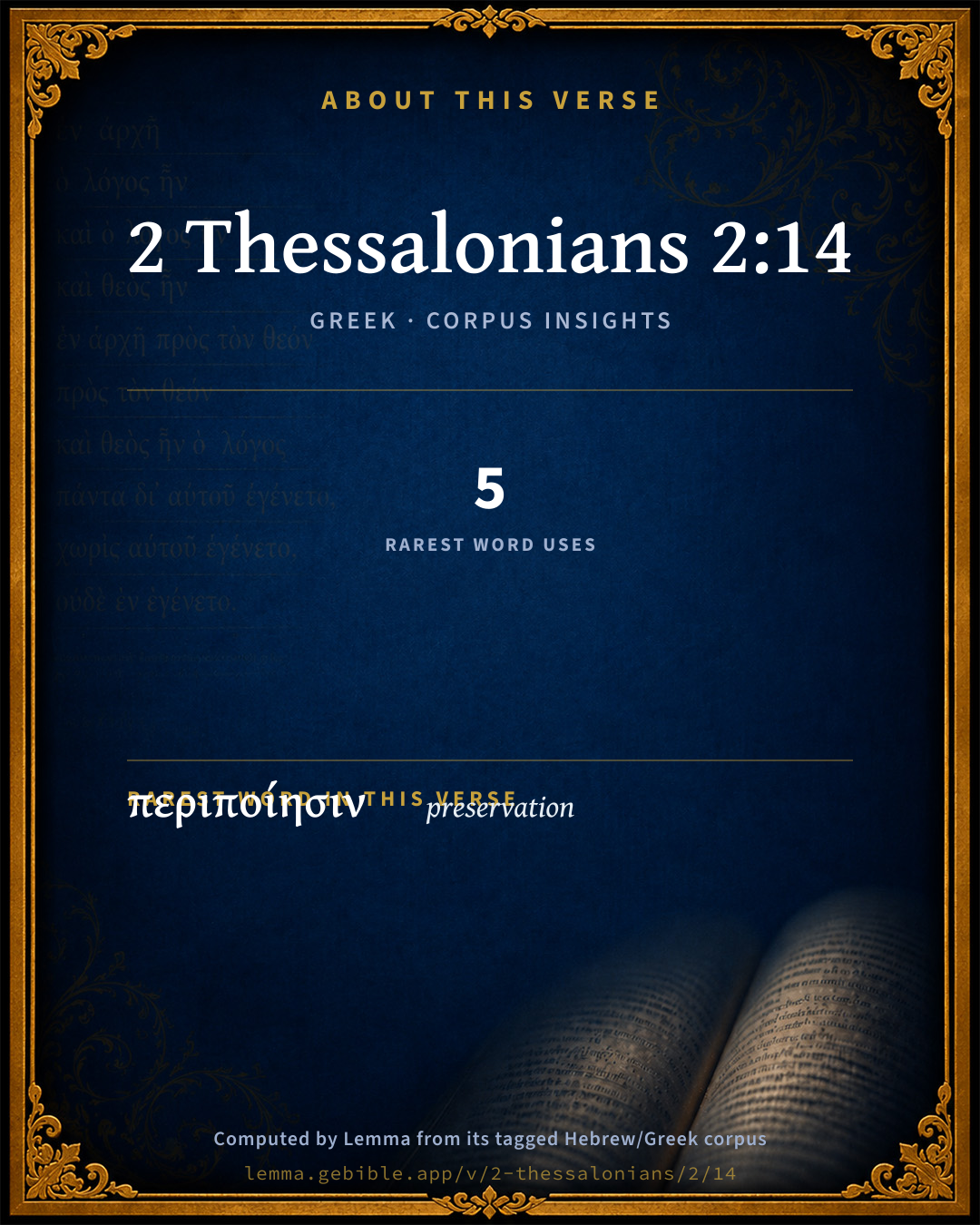
2 Thessalonians 2:14

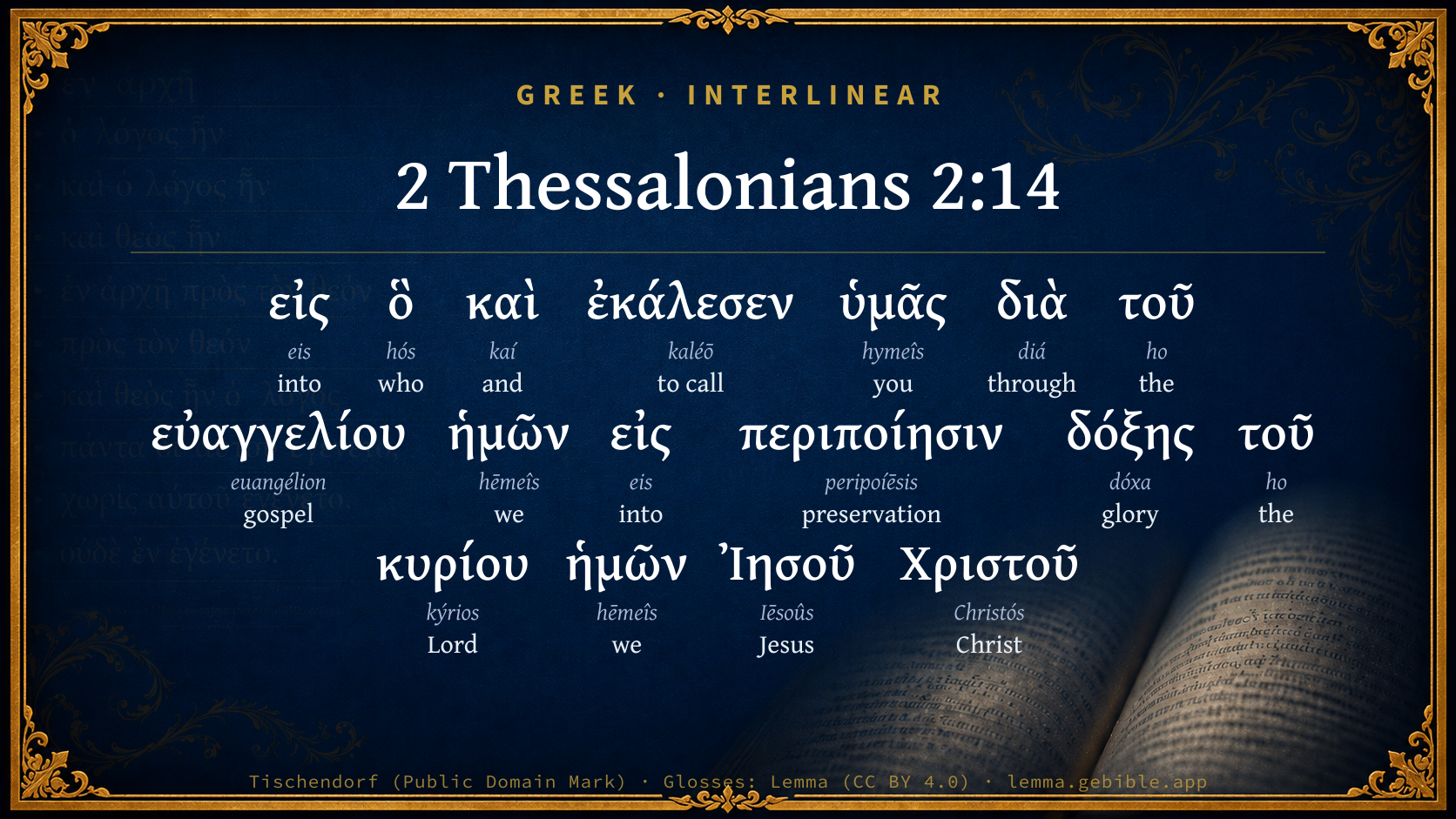
Greek (Tischendorf 8th ed.) 2 Thessalonians 2:14 appears in the Greek New Testament. The text above is from the Tischendorf 8th edition. Each word links to its Strong’s number and a concise gloss. Click any word for its full Thayer’s Greek Lexicon entry.
Download image
Cite this verse

2 Thessalonians 2:14 (World English Bible). Public Domain. Lemma interlinear Bible study tool, https://lemma.gebible.app/v/2-thessalonians/2/14.

Show BibTeX & RIS
BibTeX
RIS
English Translation
to which he called you through our Gospel, for the obtaining of the glory of our Lord Jesus Christ.
World English Bible · Public Domain
Download a study sheet

One document with this verse’s original text, its word-by-word gloss line, the meaning frame, cross-references with their text, attributed commentary, and full source and license credits — printable, and it pastes into notes with its structure intact.

This verse Autodidact and up

Study sheet (.html) Plain text (.txt)

A passage Seminary Student

Up to 50 verses in one chapter. A passage sheet keeps up to 6 commentary sources and 12 cross-references per verse, in the order this page ranks them, and says so on the sheet whenever that leaves anything out. Ask for a single verse and you get the Autodidact verse sheet above.

Everything on this page stays free to read, with no account — the sheet is a download of what is already on screen, not access to it.

Want to remove ads? Support Godless Engineer
Compare translations 3

The same verse in 3 English versions, stacked beneath the original-language interlinear above. Click any original word for its lexicon entry.

Each is an independent rendering of the whole verse — the interlinear is not word-aligned to these translations.

Highlighted words mark where these versions differ — a whole-verse word diff, not a word-by-word alignment.

  • World English Bible Public Domain
    to which he called you through our Gospel, for the obtaining of the glory of our Lord Jesus Christ.
  • King James Version Public Domain
    Whereunto he called you by our gospel, to the obtaining of the glory of our Lord Jesus Christ.
  • unfoldingWord Literal Text CC BY-SA 4.0
    He called you to this through our gospel, to the acquiring of the glory of our Lord Jesus Christ.

unfoldingWord Literal Text — © unfoldingWord, licensed CC BY-SA 4.0. Word-aligned USFM3 via Door43 (git.door43.org/unfoldingWord/en_ult).

Versions to compare (up to 4)

3 of 4 selected

Show all 19 translations

Every available English version of this verse, each an independent rendering of the whole verse.

  • World English Bible Public Domain
    to which he called you through our Gospel, for the obtaining of the glory of our Lord Jesus Christ.
  • Berean Standard Bible Public Domain
    To this He called you through our gospel, so that you may share in the glory of our Lord Jesus Christ.
  • Majority Standard Bible Public Domain
    To this He called you through our gospel, so that you may share in the glory of our Lord Jesus Christ.
  • King James Version Public Domain
    Whereunto he called you by our gospel, to the obtaining of the glory of our Lord Jesus Christ.
  • American Standard Version (1901) Public Domain
    whereunto he called you through our gospel, to the obtaining of the glory of our Lord Jesus Christ.
  • Revised Version (1885) Public Domain
    whereunto he called you through our gospel, to the obtaining of the glory of our Lord Jesus Christ.
  • Geneva Bible (1599) Public Domain
    Whereunto he called you by our Gospel, to obtaine the glory of our Lord Iesus Christ.
  • Douay-Rheims (1899) Public Domain
    Therefore, brethren, stand fast; and hold the traditions which you have learned, whether by word, or by our epistle.
  • Young's Literal Translation Public Domain
    to which He did call you through our good news, to the acquiring of the glory of our Lord Jesus Christ;
  • Literal Standard Version CC BY-SA 4.0
    to which He called you through our good news, to the acquiring of the glory of our Lord Jesus Christ;
  • Unlocked Literal Bible CC BY-SA 4.0
    He called you to this through our gospel, that you might obtain the glory of our Lord Jesus Christ.
  • unfoldingWord Literal Text CC BY-SA 4.0
    He called you to this through our gospel, to the acquiring of the glory of our Lord Jesus Christ.
  • Darby Bible Public Domain
    whereto he has called you by our glad tidings, to [the] obtaining of [the] glory of our Lord Jesus Christ.
  • World Messianic Bible Public Domain
    to which he called you through our Good News, for the obtaining of the glory of our Lord Yeshua the Messiah.
  • Webster's Bible Public Domain
    To which he called you by our gospel, to the obtaining of the glory of our Lord Jesus Christ.
  • Free Bible Version CC BY-SA 4.0
    This is what he called you to through the good news we shared with you, so that you could participate in the glory of our Lord Jesus Christ.
  • Bible in Basic English Public Domain
    And in this purpose he gave you a part through the good news of which we were the preachers, even that you might have part in the glory of our Lord Jesus Christ.
  • Text-Critical English NT CC BY 4.0
    He called you to this through our gospel, so that you might obtain the glory of our Lord Jesus Christ.
  • Tyndale New Testament (1534) Public Domain
    whervnto he called you byoure gospell to obtayne the glorye that cometh of oure lord Iesu Christ.

Literal Standard Version (2020), Covenant Press — licensed CC BY-SA 4.0. Text via the HelloAO Bible API (eBible.org). Unlocked Literal Bible (unfoldingWord) — licensed CC BY-SA 4.0. Text via the HelloAO Bible API (eBible.org). unfoldingWord Literal Text — © unfoldingWord, licensed CC BY-SA 4.0. Word-aligned USFM3 via Door43 (git.door43.org/unfoldingWord/en_ult). Free Bible Version, Dr. Jonathan Gallagher — licensed CC BY-SA 4.0. Text via the HelloAO Bible API (eBible.org).

Word by word

More ways to search: Search by grammar → Find every occurrence → Compare this word →

Practice this passage: Drill this verse → Learn its vocabulary →

περιποίησιν
peripoíēsis
G4047
“preservation”
Noun, Accusative, Singular, Feminine
Part of Speech
Noun
Case
Accusative
Number
Singular
Gender
Feminine
Full Thayer's Definition

Origin: from G4046

TDNT: None

1. a preserving, a preservation 2. possession, one's own property 3. an obtaining
  1. εἰς eis G1519 “into” Preposition
  2. ὃ hós G3739 “who” Relative pronoun, Accusative, Singular, Neuter
  3. καὶ kaí G2532 “and” Conjunction
  4. ἐκάλεσεν kaléō G2564 “to call” Verb, Aorist, Active, Indicative, 3rd person, Singular
  5. ὑμᾶς hymeîs G5210 “you” Personal pronoun, 2nd person, Accusative, Plural
  6. διὰ diá G1223 “through” Preposition
  7. τοῦ ho G3588 “the” Article, Genitive, Singular, Neuter
  8. εὐαγγελίου euangélion G2098 “gospel” Noun, Genitive, Singular, Neuter
  9. ἡμῶν hēmeîs G2249 “we” Personal pronoun, 1st person, Genitive, Plural
  10. εἰς eis G1519 “into” Preposition
  11. δόξης dóxa G1391 “glory” Noun, Genitive, Singular, Feminine
  12. τοῦ ho G3588 “the” Article, Genitive, Singular, Masculine
  13. κυρίου kýrios G2962 “Lord” Noun, Genitive, Singular, Masculine
  14. ἡμῶν hēmeîs G2249 “we” Personal pronoun, 1st person, Genitive, Plural
  15. Ἰησοῦ Iēsoûs G2424 “Jesus” Noun, Genitive, Singular, Masculine
  16. Χριστοῦ Christós G5547 “Christ” Noun, Genitive, Singular, Masculine

About this verse

These counts appear in no published source. They are computed here, from the morphology-tagged text and Lemma’s own curated glosses. What Lemma adds →

17
words
14
distinct lemmas
Pauline Epistles
section

Notable vocabulary

The rarest word here is περιποίησιν preservation G4047 — appearing just 5 times in the whole Greek New Testament.

Shared distinctive vocabulary

περιποίησιν preservation G4047 occurs in 5 verses of the Greek New Testament. Also found in:

Repetition

Words recur within this verse:

Cross-references

18

Topical passages linked to 2 Thessalonians 2:14 in the Treasury of Scripture Knowledge — connected by theme and wording, ordered by reader-vote popularity; previews shown in the World English Bible.

  • 1 Thessalonians 2:12 to the end that you should walk worthily of God, who calls you into his own Kingdom and glory.
  • 1 Peter 5:10 But may the God of all grace, who called you to his eternal glory by Christ Jesus, after you have suffered a little while, perfect, establish, strengthen, and settle you.
  • Romans 8:17 and if children, then heirs; heirs of God, and joint-heirs with Christ; if indeed we suffer with him, that we may also be glorified with him.
  • 1 Thessalonians 1:5 and that our Gospel came to you not in word only, but also in power, and in the Holy Spirit, and with much assurance. You know what kind of men we showed ourselves to be among you for your sake.
  • Romans 2:16 in the day when God will judge the secrets of men, according to my Gospel, by Jesus Christ.
  • Romans 8:28–30 We know that all things work together for good for those who love God, to those who are called according to his purpose.
  • 1 Peter 1:4–5 to an incorruptible and undefiled inheritance that doesn't fade away, reserved in heaven for you,
  • Psalms 16:11 You will show me the path of life. In your presence is fullness of joy. In your right hand there are pleasures forevermore.
  • Matthew 25:21 "His lord said to him, 'Well done, good and faithful servant. You have been faithful over a few things, I will set you over many things. Enter into the joy of your lord.'
  • John 14:2–3 In my Father's house are many mansions. If it weren't so, I would have told you. I am going to prepare a place for you.
  • John 17:22 The glory which you have given me, I have given to them; that they may be one, even as we are one;
  • John 17:24 Father, I desire that they also whom you have given me be with me where I am, that they may see my glory, which you have given me, for you loved me before the foundation of the world.
  • Romans 16:25
  • Ephesians 1:18 having the eyes of your hearts enlightened, that you may know what is the hope of his calling, and what are the riches of the glory of his inheritance in the saints,
  • 2 Timothy 2:12 If we endure, We will also reign with him. If we deny him, He also will deny us.
  • Revelation 3:21 He who overcomes, I will give to him to sit down with me on my throne, as I also overcame, and sat down with my Father on his throne.
  • Revelation 22:3–5 There will be no curse any more. The throne of God and of the Lamb will be in it, and his servants serve him.
  • Revelation 21:23 The city has no need for the sun, neither of the moon, to shine, for the very glory of God illuminated it, and its lamp is the Lamb.

Cross-references courtesy of OpenBible.info (CC BY 4.0).

Commentary

Notes on 2 Thessalonians 2:14 from classic Christian and Jewish commentators (each source and its license shown beneath its notes). The classic Christian expositions comment on the surrounding passage and are grouped to its opening verse, so a note may address several verses; the Jewish commentaries on the Tanakh (Rashi and others) are per-verse, so they appear only where the commentator wrote on this verse.

Lemma curates 59 commentaries, every one of them public domain or Creative Commons licensed, each selected and text-cleaned for this edition rather than reprinted as found. About our sources →

The Biblical Illustrator

Joseph S. Exell

2Th_2:14

Whereunto He called you by our gospel

Effectual calling

I.

Its author. He, viz., God.

1. None else has authority to call--

(1) To duties. Being our Creator, He is our owner; and being our owner, He is our sovereign and lawgiver, and may enact what laws He pleases (Jam_4:12).

(2) To privileges. His blessings are so great that none else can give us a right to them; and the soul can have no security that it does not intrude upon the possession of things till we have His warrant. None came to the wedding feast till bidden (Mat_22:1-46), or went into the vineyard till hired (Mat_20:1-34).

2. None else can have the power; for to calling there is not only the invitations of the word, but the effectual operations of the Spirit. None else can change the heart (2Pe_1:8; Rom_4:17; 2Co_4:6; Eph_2:10).

II. The outward means.

1. The means itself: the Gospel. This God uses--

(1) Because, if God will invite the creature by his duty to His happiness, it is necessary that the call should be evident by some visible sign. The natural duty of man is much seen by the Creation (Rom_1:19; Psa_19:1-2). But this call made to fallen man as a remedy for his lapsed estate can only be known by revelation.

(2) To convince and stop their mouths who refuse this calling, for the gospel brings grace home to us and leaves it to our choice (Act_13:26; Act_3:26). Great is the misery of those who refuse (Luk_14:24; Pro_1:24-26).

(3) Because He will preserve the liberty of His own workmanship, and therefore will not compel us, but will, at the same time teach and draw us (Joh_6:44-45; Act_11:21; Act_16:14; Rom_1:16).

2. The interest the apostle challenges in it--our gospel. Elsewhere it is called Gods gospel (1Ti_1:11). He is the Author. It is also called Christs gospel (2 Thessalonians1:8), as the principal sub-revealer. And then the apostles gospel, because they were the instruments chosen by Christ to declare it (1Ti_1:11). This expression is--

(1) A word of fidelity (1Co_9:17).

(2) A word of esteem and love; what we love we call ours (Rom_16:25; Eph_1:13).

(3) A word importing diligence (Act_20:24). Paul was willing to suffer or do anything for the sake of it.

(4) A word of mutual consent (2Co_4:8).

III. The ends.

1. Subordinate. Whereunto--

(1) God calls us to the faith of the gospel (Rom_10:14).

(a) There must be a belief in it in general.

(b) A particular affiance in Christ according to the terms of the New Covenant, i.e., the assent must be fiducial or accompanied with a trust in Christ (Eph_1:15; 2Ti_1:12), and obediential, not a devout sloth or carelessness (Psa_119:10; Jud_1:20-21; Psa_32:2; Rom_8:1.).

(2) God calls us to holiness (1Th_4:7) on several grounds.

(a) That there may be a likeness between the Person calling and the persons called (1Pe_1:15).

(b) Because the nature of the calling enforces sanctification (Heb_3:1; 2Ti_1:9; Rom_1:7).

(c) Because the grace shown in our calling obliges us to be holy in point of gratitude (1Th_2:12).

(d) Because the calling enables us to be holy, giving us all things necessary to holiness of heart and life (2Pe_1:3).

2. The ultimate end. To obtain the glory, etc. (1Pe_5:10).

(1) It is glory for body and soul (1Pe_1:9; 1Co_15:42-43).

(2) It is the glory of our Lord Jesus Christ.

(a) It is purchased by Him (Eph_1:7).

(b) Promised by Him (Joh_10:28; 1Jn_2:25).

(c) Prayed for by Him (Joh_17:14).

(d) Bestowed by Him; at death (Act_7:59; Php_1:23; 2Co_5:8); at judgment (Joh_14:3).

(e) With Him (Rom_8:17; Rev_3:21). (T. Manton, D. D.)

Effectual calling and Divine glory

I. The gospel call. What is that? It is the invitation of Divine mercy to accept the blessings of salvation.

1. The call is one of sovereign mercy. Mercy for mercys sake. God was under no obligation to show mercy. The act is of His rich grace, and of that only.

2. It is most free and open. Not clogged by difficulties. Ho everyone, etc. Come unto Me, etc. If any man thirst, let him come, etc. The message is to the world--to every creature.

3. It is most earnest and pressing. The ministers who bring it are to invite, persuade, beseech, compel men to be reconciled to God. There is not the shadow of a doubt respecting Gods sincerity.

II. The way in which the call is to be made sure.

1. It must be heard. How can they believe in Him of whom they have not heard? O earth! earth I hear the Word of the Lord. If any man hath ears, let him hear. Hear, and your soul shall live.

2. It must be understood. The truth as it is in Jesus must be comprehended.

3. It must be believed. Truth only realizes the call. Matthew believed; Saul believed; the Samaritans believed. Thus the pardon of sin, the acceptance of the person, and every blessing for time is obtained.

4. It must be retained. The profession of faith must be held fast. Abide in Me, says Christ. So we must continue Christs disciples to the end.

III. The provision made to render the call sure.

1. The Holy Spirit attends Divine truth. My speech and my preaching, said St. Paul to the Corinthians, was not with enticing words of mans wisdom, but in demonstration of the Spirit and of power; that your faith should not stand in the wisdom of men, but in the power of God.

2. The Holy Spirit is specially given when the call is accepted. So it came to pass on the Day of Pentecost. When the three thousand, pricked in their heart by the simple truth declared unto them by the burning earnestness of Peter, cried to him and the rest of the apostles, What shall we do? he said unto them, Repent, and be baptized every one of you in the name of the Lord Jesus for the remission of sins, and ye shall receive the gift of the Holy Ghost. They did as they were told, and received the Divine gift of the Divine Spirit. And so it comes to pass now in the experience of all penitent believers.

3. All the blessings and privileges of the gospel follow its acceptance. Such, for example, as justification (Rom_5:1); sonship (Joh_1:12); sanctification (1Th_5:23); everlasting life (Joh_3:16); heaven, or the obtaining of the glory, of our Lord Jesus Christ. (Joh_17:22; Joh_17:24). Application:

(1) To us the gracious call has come;

(2) it may be accepted now;

(3) All who receive it will be made happy and safe forever;

(4) and all who reject it by their unbelief and disobedience will be condemned by it forever. (J. Burns, D. D.)

The Biblical Illustrator, edited by Joseph S. Exell (c. 1880s–1900s) — public domain. Text from a community e-Sword module.

Tyndale Open Study Notes

Tyndale Open Resources

2:14 He called you to salvation: God calls his chosen ones to himself (1:11; 1 Thes 2:12; 4:7; 5:24) through the preaching of the Good News. • Those who suffer because of their faith will ultimately share in the glory of our Lord Jesus Christ (Rom 5:2; 8:17-18; Col 1:27; 1 Thes 2:12).

Tyndale Open Study Notes — © Tyndale Open Resources, licensed CC BY-SA 4.0. Text via the HelloAO Bible API.

Bengel's Gnomon

Johann Albrecht Bengel

2Th 2:14. Εἰς ὅ, Whereunto) The phrase, to salvation, is hereby explained.—εἰς περιποίησιν, [to the obtaining, Engl. V.] to the deliverance) εἰς is resumed the second time: supply, namely. There is no περιποίησις, or mere deliverance (preservation[22]), from the shipwreck of the world, but as it is conjoined with glorification, 2Ti 2:10. περιούσιον, in Deut., cited above, is in consonance with this.—ΤΟῦ) [ΚΥΡΊΟΥ] construed with ΠΕΡΙΠΟΊΗΣΙΝ [not with ΔΌΞΗς, as Engl. Vers.]

[22] Beng. understands περιποίησιν of “that which remains when all else perishes.” He translates it conservationis in Eph 1:14, and distinguishes it from redemption by the blood of Christ. Here liberatio, viz. final deliverance, which is connected with glory, and which is to be the gift of our Lord Jesus.—ED.

Bengel's Gnomon of the New Testament — English translation (T&T Clark, Edinburgh, 1860) — public domain. Text from a community e-Sword module.

Meyer's Critical & Exegetical Commentary

Heinrich August Wilhelm Meyer

2Th_2:14. Εἰς ὅ] to which. Incorrectly, Olshausen: therefore. Εἰς ὅ does not refer to πίστει (Aretius), also not to ἐν ἁγιασμῷ καὶ πίστει (Estius, Cornelius a Lapide, Fromond., Nat. Alexander, Moldenhauer, Koppe, Flatt, Schott, Schrader, de Wette, Hofmann), still less to the electio and the animus, quo eadem digni evadimus (Pelt), but to εἰς σωτηρίαν ἐν ἁγιασμῷ κ.τ.λ.; whilst to the aim of the election, and to the means by which it was to be realized according to Gods eternal counsel, is added the actual call of the readers occurring in time. Accordingly, εἰς ὅ is to be completed by εἰς τὸ σωθῆναι ὑμᾶς διʼ ἁγιασμοῦ πνεύματος καὶ πίστεως ἀληθείας.

διὰ τοῦ εὐαγγελίου ἡμῶν] through our publication of the gospel. Comp. 1Th_1:5. The historical condition of πίστις.

εἰς περιποίησιν δόξης τοῦ κυρίου] an appositional resumption of εἰς σωτηρίαν, in order further to characterize the salvation, whose reception God had predetermined to the readers, as an acquisition (see on 1Th_5:9) of the glory which Christ possesses. So in essentials, Pelagius, Musculus, Hunnius, Piscator, Vorstius, Grotius, Wolf, Schott, Olshausen, de Wette, Alford, Ewald, Bisping, Riggenbach, and others. Less suitably, because weakening the force and the important contents of the expression, Luc. Osiander, Benson, Moldenhauer, and Pelt explain δόξα τοῦ κυρίου of the glory, of which Christ is the source or bestower. Against the reference to God as the subject in περιποίησιν, and to Christ as the receiver of the δόξα (Oecumenius: ἵνα δόξαν περιποιήσῃ τῷ υἱῷ αὐτοῦ; Theophylact, Vatablus, Cornelius a Lapide), is the circumstance, that although εἰς περιποίησιν might stand instead of εἰς τό with the infinitive, yet the dative τῷ κυρίῳ ἡμῶν would require to be placed instead of the genitive τοῦ κυρίου ἡμῶν. Lastly, the passive signification of περιποίησις: ut essetis gloriosa possessio domini nostri Jesu Christi (Menochius, Harduin; also Luther: to the glorious inheritance, and Calvin), has against it the weakening of the substantive δόξης into an adjective, and the parallel passage in 1Th_5:9. Besides, the context decides against the two last-mentioned views. For the object of 2Th_2:13-14 is to bring forward the glory of the lot which is assigned to the Thessalonians, in order thereby to lead to the exhortation in 2Th_2:15.

Meyer — Critical and Exegetical Commentary on the New Testament — English translation by Peter Christie, edited by Frederick Crombie (T&T Clark, 1880) — public domain. Text from a community e-Sword module.

Expositor's Greek Testament

ed. W. Robertson Nicoll

2Th 2:14 . To be saved ultimately (12) is to possess or rather to share the glory of Christ ( cf. I., 1Th 2:12 ).

The Expositor's Greek Testament, edited by W. Robertson Nicoll (1897–1910) — public domain. Text from a community e-Sword module.

Geneva Bible (1599)

Geneva Bible translators

By our preaching.

Geneva Bible (1599) marginal notes — public domain. Text via Bolls.life.

Jamieson, Fausset & Brown

Robert Jamieson, A. R. Fausset & David Brown

you--The oldest manuscripts read, "us."

by our gospel--"through" the Gospel which we preach.

to . . . glory--In Th2 2:13 it was "salvation," that is, deliverance from all evil, of body and soul (Th1 5:9); here it is positive good, even "glory," and that "the glory of our Lord Jesus" Himself, which believers are privileged to share with Him (Joh 17:22, Joh 17:24; Rom 8:17, Rom 8:29; Ti2 2:10).

Jamieson, Fausset & Brown — Commentary Critical and Explanatory on the Whole Bible (1871) — public domain (CC PDM 1.0). Text via the HelloAO Bible API.

Adam Clarke's Commentary

Verse 14. 2Th 2:13.

Adam Clarke's Commentary on the Bible (1810–1826) — public domain. Text from a community e-Sword/MySword module.

John Calvin's Commentaries

14 To which he called us. He repeats the same thing, though in somewhat different terms. For the sons of God are not called otherwise than to the belief of the truth. Paul, however, meant to shew here how competent a witness he is for confirming that thing of which he was a minister. He accordingly puts himself forward as a surety, that the Thessalonians may not doubt that the gospel, in which they had been instructed by him, is the safety-bringing voice of God, by which they are aroused from death, and are delivered from the tyranny of Satan. He calls it his gospel, not as though it had originated with him, but inasmuch as the preaching of it had been committed to him.

What he adds, to the acquisition or possession of the glory of Christ, may be taken either in an active or in a passive signification — either as meaning, that they are called in order that they may one day possess a glory in common with Christ, or that Christ acquired them with a view to his glory. And thus it will be a second means of confirmation that he will defend them, as being nothing less than his own inheritance, and, in maintaining their salvation, will stand forward in defense of his own glory; which latter meaning, in my opinion, suits better.

John Calvin's Commentaries (1540-1563) — public domain. Text from the Calvin Translation Society English edition (1840s-50s) via the Christian Classics Ethereal Library (ccel.org). Calvin's coverage is partial (roughly two-thirds of the Bible); uncommented books and verses are honest gaps, never fabricated. The 19th-century editor's footnotes and remarks are omitted so the notes are faithfully Calvin's own voice.

Ellicott's Commentary for English Readers

(14) Whereunto.—From the neuter gender of the relative in the Greek we see that the antecedent in St. Paul’s mind is not exactly “belief of truth,” nor exactly “sanctification of spirit,” nor yet exactly “salvation,” but the general state of life which is compounded of these three notions—“to which thing He called you.” The election or choice takes place in eternity (2Th_2:13); the call at that point of time when the men first hear the gospel. (See Rom_8:30.)

By our gospel—i.e., of course, “by our bringing you the happy message”—the historical delivery of the message is dwelt on rather than its contents.

To the obtaining of the glory of our Lord.—Almost all the ancient commentators render it, “for obtaining of glory to our Lord;” and St. Chrysostom says, beautifully:” No small thing this either, if Christ esteems our salvation His glory. It is, indeed, a glory to the lover of men that the number of those who are being saved should be large.” But this version is not so easy grammatically as our own, nor does it suit so well with the context. St. Paul is encouraging his readers with the same thought of their destiny which he has put forward in 2Th_1:11-12—the identity of the joy of the Redeemer and the redeemed (Mat_25:23). It is well to be observed that God did not call them straight “to the glory of our Lord,” but “to the obtaining” of the same. This “obtaining” does not mean an otiose receiving of glory in the last day, but a laborious course of “earning” or “purchasing” it during this life. The word is the same as that used in 1Th_5:9, where see Note.

A Bible Commentary for English Readers, edited by Charles John Ellicott (1878–1897) — public domain. Text from a community e-Sword module.

The Cambridge Bible for Schools and Colleges

gen. ed. J. J. S. Perowne

14. whereunto (to which end, including the whole salvation described in 2Th_2:13) he called you by our gospel] i.e., “through the good news we brought.” On our gospel see note to 1Th_1:5; and on the call of God, 1Th_2:12-13 (where mark its connection with the Divine glory), 1Th_4:7, 1Th_5:24. The connection of 2Th_2:13-14 resembles that of 1Th_1:3-4 in 1 Thessalonians 1, and of Rom_8:29-30 : “whom He foreordained, He also called.” God’s election is the moving spring of human salvation; but His call came to the Thessalonians, when the good tidings first sounded in their ears. That summons declared God’s good will toward them, and His loving choice of each believing heart.

to the obtaining of the glory of our Lord Jesus Christ] More freely rendered, that you might win the glory of our Lord Jesus Christ. This defines more closely the “whereunto” just above, and brings to a climax the “salvation” contemplated in 2Th_2:13 : “To which end God sent yon through us the gospel message, that so you might have Christ’s glory at last for your own.”

In ch. 2Th_1:12 (see note) the glory of Christ and that of His saints were declared to be mutual. Here they are identified. In the glory which the exalted and perfect “Lord Jesus Christ” receives, the Thessalonians were called each of them finally to share. This is the goal of their salvation, “the prize of their high calling” (Php_3:14).

“Obtaining of glory” is therefore synonymous with the “obtaining of salvation” of 1Th_5:9, where the same rare verbal noun is used (see note). Christ’s glory is already won in principle, in its ground and beginning, both for Himself and His people. So He said, leaving the world, “Now was the Son of Man glorified” (Joh_13:31); yet He prays further, “Now, O Father, glorify Thou Me;” while He says of His disciples, “The glory which Thou hast given Me, I have given them” (Joh_17:5; Joh_17:22). His glory is ever advancing and, as it unfolds itself, ever anew imparting itself to men, till it is consummated in “the revelation of the Lord Jesus from heaven” (ch. 2Th_1:7-12, 2Th_2:8; comp. Tit_2:13; Mat_24:30, &c.). Then the glory of His saints will be complete and secure, in the completeness of His: “with Him in glory” (Col_3:4; comp. Php_3:20-21; and His own words in Joh_17:24). “We shall be like Him, for we shall see Him as He is” (1Jn_2:2).

The Cambridge Bible for Schools and Colleges (gen. ed. J. J. S. Perowne; Cambridge University Press, 1878–1918) — public domain. Text from a community e-Sword module.

John Gill's Exposition

Whereunto he called you by our Gospel,.... Salvation being appointed as the end in the decree of election, and sanctification of the Spirit, and belief of the truth, as means; the elect in the effectual calling are called to the participation of each of these; first to the one, and then to the other; to grace here, and glory hereafter: and the means by which they are called is the Gospel, which the apostle calls "our Gospel", not because they were the authors, or the subject of it; for with regard to these it is styled the Gospel of God, and the Gospel of Christ; but because they were intrusted with it, and faithfully preached it, and in opposition to another Gospel published by false teachers. And by this they were called

to the obtaining of the glory of our Lord Jesus Christ; not his essential glory, though he will be seen and known in the glory of his person as he is, so far as creatures in a state of perfection will be capable of; nor his mediatorial glory, though it will be one part of the saints' happiness in heaven to behold this glory of Christ; but rather the glory which shall be personally put upon the saints, both in soul and body, in the resurrection morn, is here intended: and which is called the glory of Christ, because it is in his hands for them; and is what he is preparing for them, and for which he gives them both a right and a meetness; and which he at last will introduce them into; and it will lie greatly in conformity to him, and in the everlasting vision and enjoyment of him: and now God's elect are called by the ministry of the word to "the obtaining" of this, not by any merit of theirs, or by any works of righteousness done by them, but to the "possession" of it, as the word used properly signifies. The Syriac version renders it, "that ye may be a glory to our Lord Jesus Christ": as the saints will be at the last day, and to all eternity, when they shall be raised again, and have the glory of God upon them, and be forever with the Lord.

John Gill's Exposition of the Whole Bible (1746–1763) — public domain (CC PDM 1.0). Text via the HelloAO Bible API.

Trapp's Complete Commentary

John Trapp

14 Whereunto he called you by our gospel, to the obtaining of the glory of our Lord Jesus Christ.

Ver. 14. To the obtaining of the glory] This is the end of faith, as faith is of effectual calling.

John Trapp, A Commentary or Exposition upon All the Books of the Old and New Testament (1647–1656) — public domain. Text from a community e-Sword module.

Albert Barnes' Notes on the Bible

Whereunto he called you by our gospel - He made the gospel as preached by us the means of calling you to salvation. That is, God has chosen you to salvation from eternity, and has made the gospel as preached by us the means of carrying that eternal purpose into effect.

To the obtaining of the glory of our Lord Jesus Christ - That you may partake of the same glory as the Saviour in heaven; see the notes on Joh 17:22, Joh 17:24.

Albert Barnes' Notes on the Bible (1834–1885) — public domain. Text from a community e-Sword/MySword module.

Haydock's Catholic Bible Commentary

Traditions,...whether by word,[10] or by our epistle. Therefore, says St. John Chrysostom, the apostle did not deliver all things that were to be believed, by writing; (Witham) but many things by word of mouth only, which have been perpetuated by tradition, and these traditions, no less than the writings of the apostles, are deserving of faith. Greek: Omoios de kakeina, kai tauta estin axiopista. (St. John Chrysostom, on this place)

===============================

[BIBLIOGRAPHY]

St. John Chrysostom, 237. Greek: enteuthen deilon, &c.

====================

George Leo Haydock (1774–1849), Haydock's Catholic Family Bible and Commentary, 1859 edition — public domain. Excludes Psalms (Douay-Rheims chapter numbering differs from Protestant) and Deuterocanonical books (Catholic canon only).

Matthew Poole's English Annotations

Whereunto he called you by our gospel: before, the apostle mentioned their election, now their calling; which are often in Scripture put together, Rom 8:30; 2Pe 1:10; and are both applied to Christ himself, Isa 42:1,6. They are those two sovereign acts of God, prerequisite to a state of salvation; the one eternal, the other in time; the one immanent in God, the other transient upon the creature; and it is the first transient act that flows from election. And because there is an outward and inward civil mentioned in Scripture, we must here understand the apostle of both: for Eις ο: Whereunto, or to which thing, mentioned in the beginning of this verse, refers to all that he said in the former verse, which is, salvation, sanctification, belief of the truth, which they could not attain with a mere outward call, though they had that also; for the apostle mentions here the gospel, which he calls

our gospel, because preached by them, and intrusted to them, though the original of it is from God, and the matter of it from Jesus Christ. And he puts them in mind of the great mercy they had received in their preaching the gospel to them, for thereby they were called into a state of salvation; as also of the way wherein they are to obtain this salvation, which is through sanctification of the Spirit, and the belief of the truth, that they might be careful to persevere both in faith and holiness; and not to expect it from the law, or the speculations of philosophy, which some false teachers might suggest, for as faith cometh by hearing the gospel, Rom 10:17, so it is that only which is the power of God unto salvation, Rom 1:16. And by this he confirms to them also their election, because they had been thus effectually called by the gospel: for no man can conclude his salvation from election, if he hath not been also thus called, which is by feeling the power of the gospel in the heart, and yielding obedience to it in his life. What the apostle before called salvation, he here styles

the obtaining of the glory of our Lord Jesus Christ. Though in 1Th 5:9, he had there also called it obtaining salvation, and by the same word here used in the text: yea, the word περιποιησις, here rendered obtaining, sometimes signifies salvation itself, Heb 10:39, and, which is equivalent, the purchased possession, Eph 1:14; and it may signify in the text, the obtaining the glory of Christ in a way of purchase, as also by diligent endeavours after it, by way of acquisition, as the word seems to signify. And by the glory of Christ is not meant the glory we give to him, as some would strain the words to that sense; but rather, the glory we shall receive from him, which is the same which the Father hath given to him, and which he hath given to his people. Joh 17:22, whereby they are co-heirs with him, Rom 8:17. And so the apostle sets forth the greatness of this salvation, to which these believers were called, it is to the obtaining the same glory with Christ, in kind at least; and shows their different state from those that perish, and will be damned, mentioned in the former verses. Or if we read the words, ye are called to be a peculiar people, as the Greek word is so rendered, 1Pe 2:9, λαος εις πιριποιησιν, a peculiar people, and understand by the glory of Christ, that glory of his grace he hath manifested herein, it shows also how God hath distinguished them from those before mentioned.

Matthew Poole's English Annotations on the Holy Bible (1683–1685) — public domain. Text from a community e-Sword/MySword module.

Whedon's Commentary on the Bible

Daniel D. Whedon

14. Whereunto—Refers to the entire clause salvation… truth.

By our gospel—Where the word our clearly limits it to Paul’s first preaching at Thessalonica, and fixes the meaning of from the beginning, in 2Th_2:13.

Obtaining—Attaining.

Glory—At and beyond the advent.

Daniel D. Whedon (gen. ed.), Commentary on the Old and New Testaments (1874–1909) — public domain. Text from a community e-Sword module.

The Pulpit Commentary

Whereunto; to which. The reference being to the whole clause, being "chosen to salvation in sanctification of the Spirit and belief of the truth." He called you. Whom God elects from eternity, he calls in time. By our gospel; the gospel preached by us. To the obtaining (or, acquisition) of the glory of our Lord Jesus Christ. Different meaning"s have been attached to these words; some render them "for the purpose of an acquisition of glory to Jesus Christ;" others, "for a glorious possession of Jesus Christ;" and others, "to be possessors or sharers in the glory of Jesus Christ." The last meaning is the correct one. Believers are constituted "heirs of God and joint heirs with Jesus Christ."

The Pulpit Commentary (1880–1919), ed. H.D.M. Spence-Jones & Joseph S. Exell — public domain. Text from a community e-Sword module.

John Wesley's Explanatory Notes

To which - Faith and holiness. He hath called you by our gospel - That which we preached, accompanied with the power of his Spirit.

John Wesley, Explanatory Notes Upon the Whole Bible (1754–1765) — public domain. Text via the GEBible commentary corpus.

Burkitt's Expository Notes on the New Testament

William Burkitt

The apostle comforted the Thessalonians in the former verse from their election, in this from their vocation; whereunto, that is, to which salvation, sanctification, and belief of the gospel, God hath called you, by our preaching of the word, to the obtaining of the glory purchased, and conferred by our Lord Jesus Christ.

Note here, 1. The author of the Thessalonians’ vocation, God the Father; he calleth you, that is, God, who from the beginning chose you to salvation.

None but God, (1.) Hath authority to call; He only is our proper Lord, and rightful Sovereign, our Creator, and our owner; therefore he has a right to call us to duty, and to require duty from us, Jas 4:12 There is one lawgiver, who is able to save and to destroy.

None but God, 1. Hath power to call; for to effectual calling there is required, not only the invitation of the word, but also the effectual operation of the Spirit; it is a work of divine power to give grace to graceless souls.

Note, 2. The means, that is, the external and outward means, by which they were called; By our gospel, that is, by our preaching of the gospel to you. The ministry of the word is the great instrument in the hand of the Spirit for a sinner’s effectual vocation, and bringing home to God.

But why doth our apostle call it our gospel? Doth not that derogate from the authority of it, to appropriate it to any man?

No; he calls it not his gospel by way of revelation, but in regard of dispensation only; and his gospel, imported the great pains which he took in preaching of the gospel, and the hazard he ran in dispensing of the gospel to them. It is also a word of esteem, love, and affection; what we love, we call ours.

Note, 3. The end of this calling, which is twofold,

1. Ultimate, to obtain the glory of our Lord Jesus Christ; that is, the glory of heaven, and of the whole man, whole soul and body in heaven, called the glory of Christ, because purchased by him, promised by him, prayed for by him, conferred by him, and enjoyed eternally with.

2. Subordinate, they are called to faith and holiness, in order to salvation: for there must be a likeness between the person calling, and the persons called; without likeness to him we can never love him, and without loving of him must never expect to live with him.

From the whole, learn, That such as are elected and chosen of God, are in time effectually called by faith and holiness to obtain eternal glory and happiness.

William Burkitt's Expository Notes on the New Testament (1700–1703) — public domain. Text from a community e-Sword module.

McGarvey & Pendleton's Commentaries

J. W. McGarvey

whereunto he called you through our gospel, to the obtaining of the glory of our Lord Jesus Christ . [To this working of salvation God had called the Thessalonians, not by an arbitrary election, but by the gospel which Paul had preached to them, and he had called them that they might be possessors, or sharers, in the glory of Christ--"joint heirs" with him-- Rom_8:17 ]

J. W. McGarvey (with Philip Y. Pendleton), Commentaries on the New Testament (The Fourfold Gospel, 1914; Acts; and the epistles) — public domain. Text from a community e-Sword/MySword module.

The People's New Testament

B. W. Johnson

14. Whereunto he called you. See how God calls! It is by the gospel.

B. W. Johnson's The People's New Testament with Notes (1889–1891) — public domain. Electronic text from the Christian Classics Ethereal Library (CCEL) ThML edition.

Cambridge Greek Testament for Schools and Colleges

14. και is inserted between εις ο and εκαλεσεν in אGP 37 and several minn., latt syr—a group resembling that which reads απαρχην in 2Th 2:13; against ABDKL &c., for omission. On the other hand, as Weiss points out, the conjunction in its contracted form might easily slip out in writing εισοκ, εκαλεσεν, as it did between καθως and εκληθητε in Eph 4:4 (B). Cf. Textual Note on 1Th 4:8 above.

ABD* and several minuscc. mechanically conform υμας to ευαγγ. ημων, writing ημας.

14. εἰς ὃ ἐκάλεσεν ὑμᾶς διὰ τοῦ εὐαγγελίου ἡμῶν, to which end He called you through our good tidings, i.e. “through the good news we brought”: cf., for this genitive, 1Th 1:5; 1Th 1:10 above; also 1Th 2:13, λόγον ἀκοῆς παρʼ ἡμῶν τοῦ θεοῦ. Since “through our gospel” the Thessalonians were called to salvation, “we are bound to give thanks” on this behalf (2Th 2:13: see note). For the thought of God as “caller” of men in the Gospel, see 1Th 2:12; 1Th 5:24, and notes. God’s summons gives expression and effect to His choice (εἵλατο, 2Th 2:13); see note on ἐκλογή, 1Th 1:4; also Rom 8:30, 1Co 1:26 f., for the connexion of election and call. Εἰς ὅ resumes εἰς σωτηρίαν ἐν ἁγιασμῷ κ.τ.λ., having the whole of this for its antecedent; the Divine call that brings men into the fellowship of Christ (1Co 1:9) includes “sanctification” among its primary objects (see 1Th 4:7; 1Th 5:23 f.).

εἰς περιποίησιν δόξης τοῦ κυρίου ἡμῶν Ἰησοῦ Χριστοῦ, unto the securing of the glory of our Lord Jesus Christ: cf. 1Pe 5:10, ὁ καλέσας … εἰς … δόξαν ἐν Χριστῷ; and 2Ti 2:10, σωτηρίας τῆς ἐν X. Ἰ. μετὰ δόξης αἰωνίου. This is an end not lying beyond or arising out of σωτηρία (2Th 2:13), but virtually identical with it, so that the second εἰς clause is explicative of the first (2Th 2:13) and represents objectively what εἰς σωτηρίαν (εἰς ὅ) states subjectively; the Christian’s ultimate salvation lies in the “glory” won by his Redeemer, wherein he shares: see Rom 8:17, ἴνα συνδοξασθῶμεν; 2Ti 2:11 f.; Rev 3:21. Εἰς περιποίησιν δόξης τοῦ κυρίου κ.τ.λ. is therefore identical in substance with εἰς περιπ. σωτηρίας, 1Th 5:9: see note there on περιποίησις. The “δόξα of our Lord Jesus Christ” is the “glory” proper and due to Him as our Lord, to be received on “the day of the Lord,” when the winning of His kingdom is complete (see Mat 19:28; Mat 25:31; Luk 24:26, &c.; Php 2:9-11; Tit 2:13); its chief matter will be found “in His saints” (2Th 1:10). God intends the glory of Christ in all that He does for men through Him; and Christ’s glory is in turn the heritage of those who are Christ’s (οἱ τοῦ χριστοῦ ἐν τῇ παρουσίᾳ, 1Co 15:23: cf. συγκληρονόμοι, Rom 8:17; also Joh 12:26; Joh 14:3; Rev 22:3 ff.). To this end “God called” them in calling them to their own salvation; cf. notes on ἐνδοξασθῆναι κ.τ.λ., ἐνδοξασθῇ, 2Th 1:10; 2Th 1:12 above; also on 1Th 2:12 b. The δόξα is already won in principle, and its περιποίησις is guaranteed: see 2Th 1:7-12, 2Th 2:8 above; Mat 24:30; Php 3:20 f.; Eph 5:26 f.; Col 1:22; Col 3:4; Rom 8:18 f.; 1Co 15:24-28; Joh 17:24; Rev 1:5-7, &c.

Cambridge Greek Testament for Schools and Colleges (Cambridge University Press, 1896; 21 vols, various authors incl. Carr, Maclear, Plummer, Farrar, Lumby, Moule, M. R. James, Simcox) — public domain. Text from a community e-Sword module.

Alford’s Greek Testament

Henry Alford

14. εἰς ὅ] to which (i.e. the being saved in sanctification of the Spirit and belief of the truth) He (God) called you through our Gospel (our preaching of the Gospel to you), in order to (your) acquisition (see on 1Th 5:9) of the glory of our Lord Jesus Christ (i.e. your sharing in the glory which He has; see ref. John: Rom 8:17, Rom 8:29: not the glory of which He is the bestower or source, as Pelt, al. Equally wrong is the interpretation of Œc., Thl., Corn.-a-lap., al.—ἵνα δόξαν περιποιήσῃ τῷ υἱῷ αὐτοῦ: of Luther, al., “zum herrlichen Eigenthum,”—‘ut essetis gloriosa possessio domini nostri J. C.:’ for, not to mention other objections, the whole context has for its purpose the lot of the Thessalonians as contrasted with that of those spoken of, vv. 10-12;—and the sense of περιποίησις is indicated by the parallel 1Th 5:9).

Henry Alford, The Greek Testament (1849–1861) — public domain. Text from a community e-Sword module.

International Critical Commentary

14. εἰς ὃ ἐκάλεσεν κτλ. “To which end,” “whereunto” (1:11), that is, “to be saved in consecration by the Spirit and faith in the truth.” The eternal purpose is historically manifested in God’s call (καλεῖ I 2:12, 4:7, 5:24; κλῆσι II 1:11), an invitation extended through the gospel which Paul (cf. Rom 10:14 ff.) and his associates preach (ἡμῶ; cf. I 1:5). That is, οὓς δὲ προώρισεν τούτους καὶ ἐκάλεσε (Rom 8:30).

εἰς περιποίησιν δίξης κτλ. With this clause, standing in apposition to εἰς ο, Paul proceeds to the final consummation of the purpose of God in election and calling, explaining εἰς σωτηρία as the acquisition of divine glory, “to the obtaining of the glory of our Lord Jesus Christ.” The “glory of Christ” (1:9), like the glory of God (to which he calls in I 2:12), is the glory which Christ possesses, and which he shares (cf. Rom 8:17) with “the beloved of the Lord.” In other words, οὕς ἐκάλεσε … τούτους καὶ ἐδόξασε (Rom 8:30). The repetition, in this appositional explanation, of a part of the language of I 5:9 (εἰς περιποίησιν σωτηρίας διὰ τοῦ κυρίου ἡμῶν Ἰησοῦ Χριστου) where the faint-hearted are likewise encouraged is undoubtedly purposed.

Lillie properly remarks: “There is no reason for restricting εἰς ο to any one (σωτηρία, as Piscator, Bengel, et al.; or πίστε, as Aretius, Cocceius, et al.), or any two (ἁγιασμῷ … καὶ πίστε, as Grotius, Flatt, Schott, de Wette, Hofmann, et al.), of the three; though, inasmuch as salvation is the leading idea and ultimate end, this is repeated and defined in the latter clause of the verse, εἰς περιποίησιν κτλ” Most commentators agree with the above in referring εἰς ο to σωτηρίαν ἐν ἁγιασμῷ … πίστε (Theophylact, Lün., Ell., Lft., Find., et al.); but B. Weiss refers it to εἵλατ “with reference to which election” (cf. εἰς ο in 1:11 which resumes εἰς τὸ καταξιωθῆνα 1:5).—A few codices read εἰς ὃ και (אPGF, Vulg), the και coming probably from 1:11 (but see Weiss, 112); cf. I 4:8 τὸν καὶ διδόντ (אDGF, Vulg et al.), and contrast the simple εἰς ο in Php 3:16.—On διὰ τοῦ εὐαγγελίο, cf. Eph 3:6, 1Co 4:15.—In vv. 13-14 (on which see especially Denney in Expositor’s Bible, 1892), which are “a system of theology in miniature” (Denney), nothing is expressly said of the death and resurrection of Christ, or of the specific hope of believers for a redeemed and spiritual body conformed τῷ σώματι τῆς δόξης αὐτου (Php 3:21; 1Co 15:42 ff.; Rom 8:23 f.). But these essential convictions of Paul, who is already a Christian of over seventeen years’ standing, are given in the very words “our gospel.”

International Critical Commentary — older volumes (1896–1929), various authors — public domain. Text from a community e-Sword module.

Vincent's Word Studies in the New Testament

Marvin R. Vincent

Our gospel. See on 1Th 1:5.

Marvin R. Vincent, Word Studies in the New Testament (1887–1900) — public domain. Text from a community e-Sword/MySword module.

Lesson kit

Teaching starters — assembled from the data on this page, not authored interpretation. Every prompt links to the verse data it draws on. Edit before teaching.

2 Thessalonians, in the Pauline Epistles, opens this verse with 17 words (14 distinct Greek lemmas). Its most distinctive word is peripoíēsis (“preservation”). A historical commentator’s framing appears above. Read the whole chapter for the surrounding context.

Discussion questions

  1. How does “preservation” (peripoíēsis) shape what this verse is saying?
  2. How does Ephesians 1:14, which shares the word «preservation», read alongside this verse?
  3. What does the repetition of “into” (2× in this one verse) do in this verse?
  4. The translations on this page render this verse differently — a whole-verse word diff, not a word-by-word alignment. What might account for the different wordings?
  5. Compare how The Biblical Illustrator and Tyndale Open Study Notes read this verse. Where do they agree or differ?

Things to notice

  • These translations choose different wording for 5 words in this verse.
  • “into” occurs 2× in this single verse.
  • 14 distinct Greek lemmas span 17 words in this verse.

Reading settings

Reading text

Shown beneath each verse's original-language words.

Old Testament
Old Testament edition

Read the OT as the Masoretic Hebrew (MT) or the Greek Septuagint (LXX).

English shown for the Greek Septuagint (in the Hebrew ↔ Greek comparison).

Comparing translations? Open the Compare panel on any verse page to stack up to four side by side.