
Acts 27:8

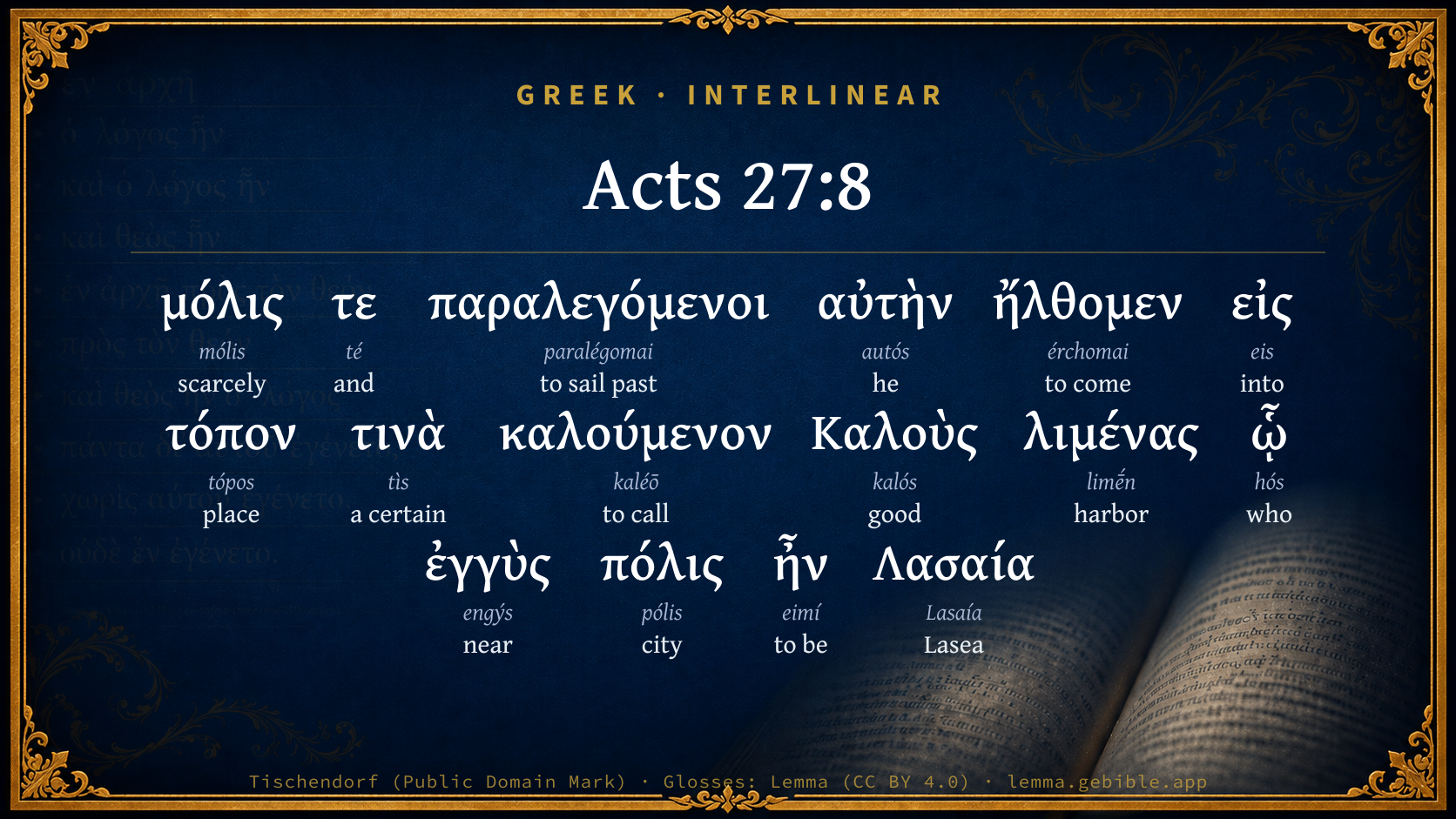
Greek (Tischendorf 8th ed.) Acts 27:8 appears in the Greek New Testament. The text above is from the Tischendorf 8th edition. Each word links to its Strong’s number and a concise gloss. Click any word for its full Thayer’s Greek Lexicon entry.
Download image
Cite this verse

Acts 27:8 (World English Bible). Public Domain. Lemma interlinear Bible study tool, https://lemma.gebible.app/v/acts/27/8.

Show BibTeX & RIS
BibTeX
RIS
English Translation
With difficulty sailing along it we came to a certain place called Fair Havens, near the city of Lasea.
World English Bible · Public Domain
Highlights
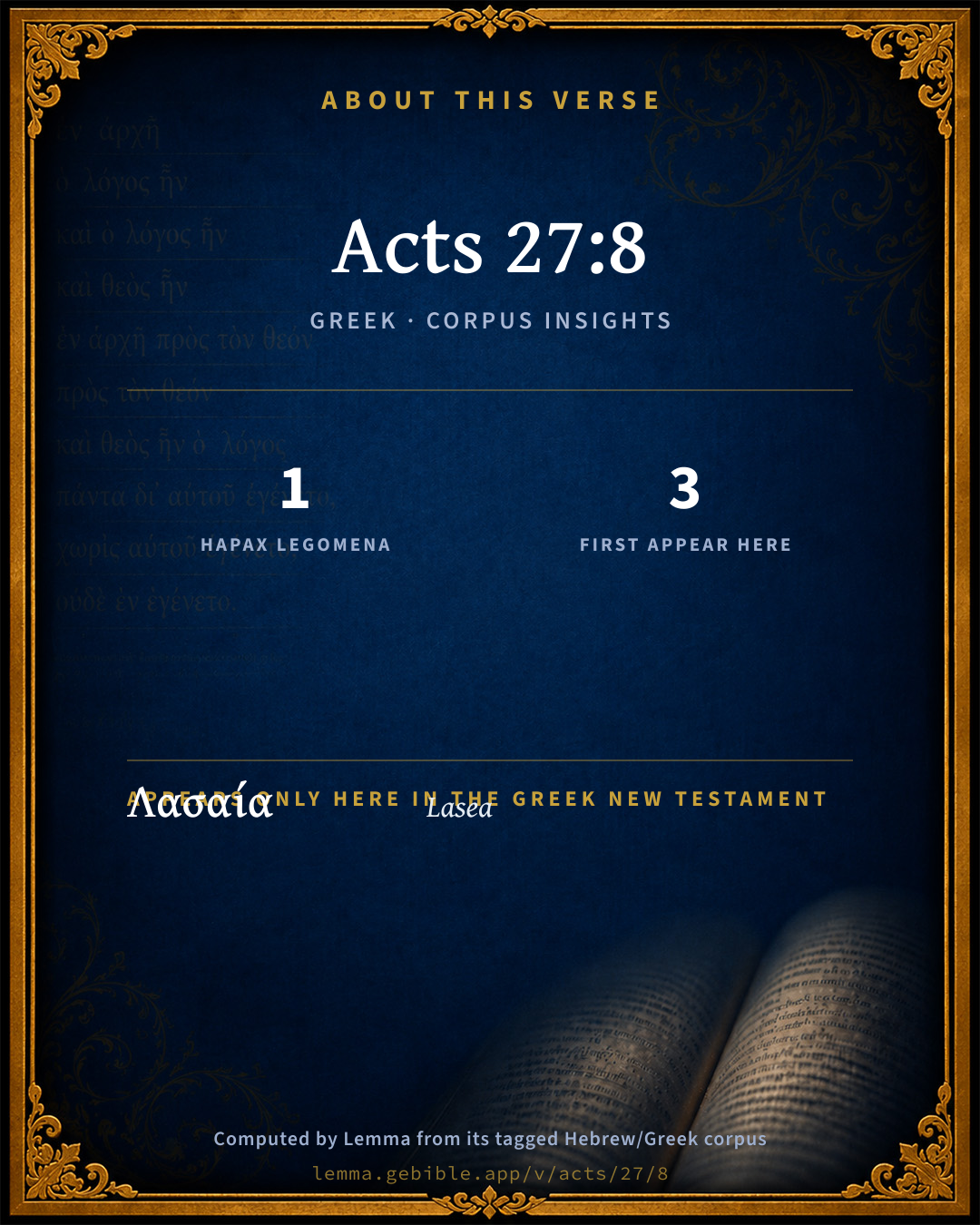
  • 1 hapax legomenon — only here in the Greek New Testament
  • 3 first appearances in the Greek New Testament
Full analysis ↓
Download a study sheet

One document with this verse’s original text, its word-by-word gloss line, the meaning frame, cross-references with their text, attributed commentary, and full source and license credits — printable, and it pastes into notes with its structure intact.

This verse Autodidact and up

Study sheet (.html) Plain text (.txt)

A passage Seminary Student

Up to 50 verses in one chapter. A passage sheet keeps up to 6 commentary sources and 12 cross-references per verse, in the order this page ranks them, and says so on the sheet whenever that leaves anything out. Ask for a single verse and you get the Autodidact verse sheet above.

Everything on this page stays free to read, with no account — the sheet is a download of what is already on screen, not access to it.

Want to remove ads? Support Godless Engineer
Compare translations 3

The same verse in 3 English versions, stacked beneath the original-language interlinear above. Click any original word for its lexicon entry.

Each is an independent rendering of the whole verse — the interlinear is not word-aligned to these translations.

Highlighted words mark where these versions differ — a whole-verse word diff, not a word-by-word alignment.

  • World English Bible Public Domain
    With difficulty sailing along it we came to a certain place called Fair Havens, near the city of Lasea.
  • King James Version Public Domain
    And, hardly passing it, came unto a place which is called The fair havens; nigh whereunto was the city of Lasea.
  • unfoldingWord Literal Text CC BY-SA 4.0
    And sailing along it with difficulty, we came to a certain place called Fair Havens, which was near the city of Lasea.

unfoldingWord Literal Text — © unfoldingWord, licensed CC BY-SA 4.0. Word-aligned USFM3 via Door43 (git.door43.org/unfoldingWord/en_ult).

Versions to compare (up to 4)

3 of 4 selected

Show all 19 translations

Every available English version of this verse, each an independent rendering of the whole verse.

  • World English Bible Public Domain
    With difficulty sailing along it we came to a certain place called Fair Havens, near the city of Lasea.
  • Berean Standard Bible Public Domain
    After we had moved along the coast with difficulty, we came to a place called Fair Havens, near the town of Lasea.
  • Majority Standard Bible Public Domain
    After we had moved along the coast with difficulty, we came to a place called Fair Havens, near the town of Lasea.
  • King James Version Public Domain
    And, hardly passing it, came unto a place which is called The fair havens; nigh whereunto was the city of Lasea.
  • American Standard Version (1901) Public Domain
    and with difficulty coasting along it we came unto a certain place called Fair Havens; nigh whereunto was the city of Lasea.
  • Revised Version (1885) Public Domain
    and with difficulty coasting along it we came unto a certain place called Fair Havens; nigh whereunto was the city of Lasea.
  • Geneva Bible (1599) Public Domain
    And with much adoe sayled beyond it, and came vnto a certaine place called the Faire hauens, neere vnto the which was the citie Lasea.
  • Douay-Rheims (1899) Public Domain
    And with much ado sailing by it, we came into a certain place, which is called Good-havens, nigh to which was the city of Thalassa.
  • Young's Literal Translation Public Domain
    and hardly passing it, we came to a certain place called `Fair Havens,' nigh to which was the city `of' Lasaea.
  • Literal Standard Version CC BY-SA 4.0
    and hardly passing it, we came to a certain place called Fair Havens, near to which was the city of Lasaea.
  • Unlocked Literal Bible CC BY-SA 4.0
    We sailed along the coast with difficulty, until we came to a certain place called Fair Havens, which is near the city of Lasea.
  • unfoldingWord Literal Text CC BY-SA 4.0
    And sailing along it with difficulty, we came to a certain place called Fair Havens, which was near the city of Lasea.
  • Darby Bible Public Domain
    and coasting it with difficulty we came to a certain place called Fair Havens, near to which was [the] city of Lasaea.
  • World Messianic Bible Public Domain
    With difficulty sailing along it we came to a certain place called Fair Havens, near the city of Lasea.
  • Webster's Bible Public Domain
    And hardly passing it, came to a place which is called, The fair havens; nigh to which was the city of Lasea.
  • Free Bible Version CC BY-SA 4.0
    With some difficulty we made our way along the coast until we arrived at a place called Fair Havens, near to the town of Lasea.
  • Bible in Basic English Public Domain
    And sailing down the side of it, as well as we were able, we came to a certain place named Fair Havens, near which was the town of Lasea.
  • Text-Critical English NT CC BY 4.0
    Sailing along the coast with difficulty, we came to a place called Fair Havens, which was near the city of Lasea.
  • Tyndale New Testament (1534) Public Domain
    and with moche worke sayled beyonde that and came vnto a place called good porte. Nye whervnto was a citie called Lasea.

Literal Standard Version (2020), Covenant Press — licensed CC BY-SA 4.0. Text via the HelloAO Bible API (eBible.org). Unlocked Literal Bible (unfoldingWord) — licensed CC BY-SA 4.0. Text via the HelloAO Bible API (eBible.org). unfoldingWord Literal Text — © unfoldingWord, licensed CC BY-SA 4.0. Word-aligned USFM3 via Door43 (git.door43.org/unfoldingWord/en_ult). Free Bible Version, Dr. Jonathan Gallagher — licensed CC BY-SA 4.0. Text via the HelloAO Bible API (eBible.org).

Word by word

More ways to search: Search by grammar → Find every occurrence → Compare this word →

Practice this passage: Drill this verse → Learn its vocabulary →

Λασαία
Lasaía
G2996
“Lasea”
Noun, Nominative, Singular, Feminine
Part of Speech
Noun
Case
Nominative
Number
Singular
Gender
Feminine
Full Thayer's Definition

Origin: of uncertain origin

TDNT: None

Lasea = "shaggy" 1. a city in Crete on the coast near Fair Havens
  1. μόλις mólis G3433 “scarcely” Adverb
  2. τε té G5037 “and” Particle
  3. παραλεγόμενοι paralégomai G3881 “to sail past” Verb, Present, Middle or Passive deponent, Participle, Nominative, Plural, Masculine
  4. αὐτὴν autós G846 “he” Personal pronoun, Accusative, Singular, Feminine
  5. ἤλθομεν érchomai G2064 “to come” Verb, Aorist, Active, Indicative, 1st person, Plural
  6. εἰς eis G1519 “into” Preposition
  7. τόπον tópos G5117 “place” Noun, Accusative, Singular, Masculine
  8. τινὰ tìs G5100 “a certain” Indefinite pronoun, Accusative, Singular, Masculine
  9. καλούμενον kaléō G2564 “to call” Verb, Present, Passive, Participle, Accusative, Singular, Masculine
  10. Καλοὺς kalós G2570 “good” Adjective, Accusative, Plural, Masculine
  11. λιμένας limḗn G3040 “harbor” Noun, Accusative, Plural, Masculine
  12. ᾧ hós G3739 “who” Relative pronoun, Dative, Singular, Masculine
  13. ἐγγὺς engýs G1451 “near” Adverb
  14. πόλις pólis G4172 “city” Noun, Nominative, Singular, Feminine
  15. ἦν eimí G1510 “to be” Verb, Imperfect, Active, Indicative, 3rd person, Singular

About this verse

These counts appear in no published source. They are computed here, from the morphology-tagged text and Lemma’s own curated glosses. What Lemma adds →

16
words
16
distinct lemmas
Acts
section

Notable vocabulary

1 hapax legomenon — a word that appears only here in the entire Greek New Testament:

  • Λασαία Lasea G2996

First appearance in Scripture

These words make their first canonical appearance in the Greek New Testament here:

  • παραλεγόμενοι to sail past G3881
  • λιμένας harbor G3040
  • Λασαία Lasea G2996

Shared distinctive vocabulary

παραλεγόμενοι to sail past G3881 occurs in 2 verses of the Greek New Testament. Also found in:
Commentary

Notes on Acts 27:8 from classic Christian and Jewish commentators (each source and its license shown beneath its notes). The classic Christian expositions comment on the surrounding passage and are grouped to its opening verse, so a note may address several verses; the Jewish commentaries on the Tanakh (Rashi and others) are per-verse, so they appear only where the commentator wrote on this verse.

Lemma curates 59 commentaries, every one of them public domain or Creative Commons licensed, each selected and text-cleaned for this edition rather than reprinted as found. About our sources →

Tyndale Open Study Notes

Tyndale Open Resources

27:8 Fair Havens was a small bay on the southern side of the island of Crete.

Tyndale Open Study Notes — © Tyndale Open Resources, licensed CC BY-SA 4.0. Text via the HelloAO Bible API.

Bengel's Gnomon

Johann Albrecht Bengel

Act 27:8. Μόλις, hardly) Construed with ἤλθομεν, we came.—καλοὺς) Perhaps this epithet was given by antiphrasis; comp. Act 27:12, “the haven was not commodious:” as the name, Pontus Euxinus.[148]—Λασαία) So the best MSS.: two have Ἄλασσα: whence the Latin Vulg. has Thalassa.[149] The word civitas, immediately preceding (in the Vulg.), may have caused the prefixing of the letter t from its third syllable.[150] We assign more weight to the Asiatic MSS. than to the African, when the question is concerning the names of places. Crete is said to be ἑκατόμπολις, as is remarked in the Periplus of Scylax. Among the hundred towns, how many are unknown in our days?

[148] Which means hospitable to strangers, whereas it was a sea notoriously inhospitable, ἄξεινος, and inclement: but was called the former from a superstitious feeling to avoid a bad omen.—E. and T.

[149] Rec. Text and Tisch. read Λασαία, with the sanction of the two Syr. Versions alone of the oldest authorities. B and Memph. read Λασέα. A has Ἄλασσα; and so Lachm. Vulg. has Thalassa, and in other MSS. Thassala.—E. and T.

[150] Before Ἄλασσα, which would favour the reading of A: Alassa, Talassa, Thalassa.—E. and T.

Bengel's Gnomon of the New Testament — English translation (T&T Clark, Edinburgh, 1860) — public domain. Text from a community e-Sword module.

Meyer's Critical & Exegetical Commentary

Heinrich August Wilhelm Meyer

Act_27:8. Παραλέγεσθαι] corresponds entirely to the Latin legere (oram), to sail along the coast, Diod. Sic xiii. 3, xiv. 55. This keeping to the coast was only with difficulty (μόλις) successful.

αὐτήν refers to τ. Κρήτην.

Nothing is known from antiquity of the anchorage Καλοὶ λιμένες (Fair Havens[168]). The name is perhaps, on account of Act_27:12 (ἀνευθέτου κ.τ.λ.), to be considered as euphemistic. The view that the place is identical with the town called by Stephanus Byzantinus Καλὴ ἀκτή, is improbable, because the Fair Havens here was not a town, as may be inferred from the appended remark: ᾯ ἘΓΓῪς ἮΝ ΠΌΛΙς ΛΑΣ.

ἮΝ] not ἘΣΤΊ. The preterite belongs to the graphic description. They saw the neighbouring city. Comp. Krüger, and Kühner, ad Xen. Anab. i. 4. 9; Breitenb. ad Xen. Hier. xi. 4. The town Λασαία also is entirely unknown;[169] hence the many variations, ΛΑΣΈΑ (B. min.; so Tischendorf), ἌΛΑΣΣΑ (A, 40, 96, Syr. p. on the margin; so Grotius, Lachmann, Ewald), Thalassa (Vulgate, Aethiopic), Thessala (codd. Lat.), et al. The evidence in support of these other forms is not strong enough to displace the Recepta (G H), seeing that it is also supported by B א* (which has ΛΑΣΣΑΊΑ). Beza conjectured ἘΛΑΊΑ (Plin. N. H. iv. 12); but such a conjecture, especially in the case of Crete with its hundred cities, was uncalled for.

[168] It is certainly the bay still called Limenes kali, Pococke, Morg. II. p. 361. Comp. Smith, p. 88, ed. 2. See, moreover, on the above localities generally, Hoeck, Kreta, I. p. 439 ff.

[169] Yet see on ruins with this name, Smith, p. 262.

Meyer — Critical and Exegetical Commentary on the New Testament — English translation by Peter Christie, edited by Frederick Crombie (T&T Clark, 1880) — public domain. Text from a community e-Sword module.

Expositor's Greek Testament

ed. W. Robertson Nicoll

Act 27:8 . μόλις τε παραλεγ . αὐτὴν : “and with difficulty coasting along it,” i.e. , Crete on the southern side with difficulty because under the same conditions as in their journey along the coast of Asia Minor (Breusing) (this is better than to refer αὐτήν to Σαλμώνην , and render to work past, to weather, cf. Grimm-Thayer); παραλέγομαι , oram legere , Diodorus Siculus, Strabo. Καλοὺς Λιμένας : a small bay two miles east of Cape Matala, in modern Greek, Λιμεῶνας Καλούς , J. Smith, p. 82, and Appendix, p. 251 ff., 4th edition; not mentioned, however, elsewhere. This harbour would afford them shelter for a time, for west of Cape Matala the land trends suddenly to the north, and they would have been again exposed to the north-westerly winds; see further for a description of the place Findlay’s Mediterranean Directory , p. 66, quoted by Breusing and Goerne, who also have no doubt that the place is identical with that mentioned by St. Luke (see also Wendt, 1898 and 1899). Λασαία , see critical note; like the Fair Havens not mentioned by name in any ancient writer. but since 1856 it may be fairly said that its identification has been established with a place some four miles to the east of Fair Havens, or rather the ruins of a place to which the name Lasea was still given, see J. Smith, 4th edition, p. 82, and p. 268 (Appendix); Alford, Proleg. to Acts, p. 27. If Lasea was one of “the (ninety or) hundred towns of Crete,” and one of the smaller amongst them, it ceases to be strange that no precise mention of it should occur in ancient writers (Grimm).

The Expositor's Greek Testament, edited by W. Robertson Nicoll (1897–1910) — public domain. Text from a community e-Sword module.

Jamieson, Fausset & Brown

Robert Jamieson, A. R. Fausset & David Brown

And hardly passing it--"with difficulty coasting along it," from the same cause as before, the westerly current and head winds.

came to . . . the Fair Havens--an anchorage near the center of the south coast, and a little east of Cape Matala, the southern most point of the island.

nigh whereunto was the city Lasea--identified by the REVEREND GEORGE BROWN [SMITH, Voyages and Shipwreck of St. Paul, Appendix 3, Second Edition, 1856]. (To this invaluable book commentators on this chapter, and these notes, are much indebted).

Jamieson, Fausset & Brown — Commentary Critical and Explanatory on the Whole Bible (1871) — public domain (CC PDM 1.0). Text via the HelloAO Bible API.

Adam Clarke's Commentary

Verse 8. The Fair Havens] This port still remains, and is known by the same name; it was situated towards the northern extremity of the island.

Was the city of Lasea.] There is no city of this name now remaining: the Codex Alexandrinus reads αλασσα, Alassa; probably Lysia, near the port of Gortyna, to the eastward.

Adam Clarke's Commentary on the Bible (1810–1826) — public domain. Text from a community e-Sword/MySword module.

Ellicott's Commentary for English Readers

(8) And, hardly passing it.—The Greek adverb is the same as the “scarce” of Act_27:7, and should be translated as before, with difficulty.

A place which is called The fair havens.—It was obvious that the ship would have been again exposed, after passing Crete, or even its central promontory, Cape Matala, to the full force of the northwest gales. About two miles to the east of the promontory, however, and therefore sheltered by it, there was tolerably good anchorage, in a harbour known then and now as the Fair Havens (Limeônes kaloi).

Nigh whereunto was the city of Lasea.—The comparative obscurity of the place has led to a large variety of readings of the name—Lassœa, Alassa, Thalassa, and other forms. Pliny mentions a city in Crete named Lasos, but does not describe its position. The remains of buildings, columns, the walls and foundations of temples have been found about two hours’ walk from the Fair Havens, under Cape Leonda, and are locally known as Lasea (Rev. G. Brown, in Smith’s Voyage and Shipwreck of St. Paul, Appendix 3).

A Bible Commentary for English Readers, edited by Charles John Ellicott (1878–1897) — public domain. Text from a community e-Sword module.

The Cambridge Bible for Schools and Colleges

gen. ed. J. J. S. Perowne

8. and hardly passing it] “Hardly” is in the original the same word which was rendered “scarce” in the previous verse. Read (with R. V.) “with difficulty coasting along it.” The verb represents the voyage as made by keeping close in to the southern shores of the island.

came unto a place] i.e. on the coast of Crete. The Gk. gives (as R. V.) “a certain place.”

which is called The fair havens] R. V. “called Fair Havens.” This place, though mentioned nowhere else in literature, yet is known by the same name still. It is on the south of Crete, four or five miles east of Cape Matala, which is the largest headland on that side of the island.

Lasea] This city has also been identified very recently. Its ruins were discovered in 1856, a few miles east of Fair Havens. See Smith’s Voyage and Shipwreck of St Paul, App. iii. pp. 262, 263.

The Cambridge Bible for Schools and Colleges (gen. ed. J. J. S. Perowne; Cambridge University Press, 1878–1918) — public domain. Text from a community e-Sword module.

John Gill's Exposition

And hardly passing it,.... That is, Salmone, with great difficulty, because of the winds:

came unto a place which is called the Fair Havens; called by other writers Cale Acte, or the fair shore, and is placed by Ptolomy (c) in Eubaea, and by Herodotus (d) in Sicily; but by Stephanus (e) is said to be a city of the Cretians, and which agrees with this account;

nigh whereunto was the city of Lasae; there was a city in Crete called by Solinus (f) Lisson, and by Ptolomy (g) Lyssus, which he places on the south side of the island; and by Pliny (h) Lasos, which comes pretty near to this name, but then he places it in the midland part of Crete; who also makes mention of an island called Lasia over against Troezenium, and another that was one of the Cyclades; the Syriac version here read, "Lasia": Jerom (i) says, Lasea is a city on the shore of the island of Crete, near the place which is called the Fair Havens, as Luke himself explains it; for which some corruptly read "Thalassa"; as do the Vulgate Latin and Ethiopic versions; and the Alexandrian copy "Alassa": Beza conjectures that it is the same with Eloea, which Pliny makes mention of in the above cited place, as a city in Crete.

(c) De ordis Situ. l. 3. c. 15. (d) L. 6. c. 22. (e) De urbibus. (f) Polyhist. c. 16. (g) Ib. l. 3. c. 17. (h) L. 4. c. 12. (i) De locis Hebraicis, fol. 96. D.

John Gill's Exposition of the Whole Bible (1746–1763) — public domain (CC PDM 1.0). Text via the HelloAO Bible API.

Trapp's Complete Commentary

John Trapp

8 And, hardly passing it, came unto a place which is called The fair havens; nigh whereunto was the city of Lasea.

Ver. 8. Called The fair havens] Which name it retains also at this day, Calos Limenas: for better cause, I believe, than the sea called Pacific, or calm, which Sir Francis Drake ever found rough and troublous above measure.

John Trapp, A Commentary or Exposition upon All the Books of the Old and New Testament (1647–1656) — public domain. Text from a community e-Sword module.

Albert Barnes' Notes on the Bible

And, hardly passing it - Scarcely being able to pass by it without being wrecked. Being almost driven on it. They passed round the east end of the island because they had been unable to sail directly forward between the island and the mainland,

The fair havens - This was on the southeastern part of the island of Crete. It was probably not so much a harbor as an open roadstead, which afforded good anchorage for a time. It is called by Stephen, the geographer, “the fair shore.” It still retains the name which it formerly had. It is called in ancient Dutch and French Sailing Directions “the beautiful bay.”

Nigh whereunto was the city of Lasea - There was no town or city at the “Fair Havens,” but the city of Lasea seems to have been well known, and it is mentioned here to identify the place.

Albert Barnes' Notes on the Bible (1834–1885) — public domain. Text from a community e-Sword/MySword module.

Haydock's Catholic Bible Commentary

Called Good-havens, a port on the east part of Crete, near the city of Thalassa, in the Greek text Lasea. (Witham)

George Leo Haydock (1774–1849), Haydock's Catholic Family Bible and Commentary, 1859 edition — public domain. Excludes Psalms (Douay-Rheims chapter numbering differs from Protestant) and Deuterocanonical books (Catholic canon only).

Matthew Poole's English Annotations

The fair havens; or, the fair or good shore, that being accounted the best which is safest for ships to ride in or enter into. A place of this name remains to this day (as some tell us) in the island of Candia.

Lasea; called Lasos, and more inland; yet some think that this town is not certainly known, not having been mentioned by any ancient geographer.

Matthew Poole's English Annotations on the Holy Bible (1683–1685) — public domain. Text from a community e-Sword/MySword module.

Whedon's Commentary on the Bible

Daniel D. Whedon

8. The Fair Havens—After arriving at the southern shore of Crete, the first port, and that an indifferent one. From it, further west about five miles, was the Cape of Matala, projecting far into the sea, which would have to be passed with much danger in any farther progress. Lasea has lately been identified as the proper town of which Fair Havens is the port. (See chart.)

Daniel D. Whedon (gen. ed.), Commentary on the Old and New Testaments (1874–1909) — public domain. Text from a community e-Sword module.

The Pulpit Commentary

With difficulty coasting along it for hardly passing it, A.V.; we came for came, A.V.; a certain place called for a place which is called, A.V.; Fair for the Fair, A.V.. With difficulty coasting along it; paralegomenoi, only here and ver. 13. It is a nautical phrase, meaning to sail alongside of the coast. In Latin legere has the same meaning. The difficulty arose from their being under the lee of the island, which sheltered them from the north-west wind, but left them without any motive power. However, they managed to get as far as Fair Havens, where they anchored in the roadstead so called, near to an obscure and otherwise unknown town called Lasea, possibly the same as Lasos, mentioned by Pliny as one of the inland cities of Crete ("Nat. Hist.," 4. 12:20), or as Elaea (ibid.).

The Pulpit Commentary (1880–1919), ed. H.D.M. Spence-Jones & Joseph S. Exell — public domain. Text from a community e-Sword module.

John Wesley's Explanatory Notes

The Fair Havens still retain the name. But the city of Lasea is now utterly lost, together with many more of the hundred cities for which Crete was once so renowned.

John Wesley, Explanatory Notes Upon the Whole Bible (1754–1765) — public domain. Text via the GEBible commentary corpus.

Godbey's Commentary on the New Testament

William B. Godbey

8-10. They seemed to have embarked from Caesarea in August, A. D. 58. Without steam-engines and mariner’s compass, subject to all the caprices and mutations of winds and tides, navigation was regarded as very unsafe after the autumnal equinox, celebrated by the Jews in a fast. Now, having been so detained by contrary winds, they have been caught out in the winter, the equinox having already passed, and Paul avails himself of God’s gift of prophecy to warn them against departing from the harbor called Fair Havens, in the island of Crete, assuring them of great perils and loss awaiting them.

William B. Godbey, Commentary on the New Testament (1896–1900) — public domain. Text from a community e-Sword module.

McGarvey & Pendleton's Commentaries

J. W. McGarvey

See notes on verse 7

J. W. McGarvey (with Philip Y. Pendleton), Commentaries on the New Testament (The Fourfold Gospel, 1914; Acts; and the epistles) — public domain. Text from a community e-Sword/MySword module.

Cambridge Greek Testament for Schools and Colleges

8. μόλις τε παραλεγόμενοι αὐτήν, and with difficulty coasting along it. παραλέγεσθαι describes a voyage made by keeping close to the shore of the island. Against a wind N.W., or nearly so, the island of Crete would afford them some protection.

ἤλθομεν εἰς τόπον τινά, we came to a place, i.e. on the coast of Crete.

καλούμενον Καλοὺς λιμένας, called Fair Havens. This place, though mentioned nowhere else in literature, is known by the same name still. It is on the south of Crete, four or five miles east of Cape Matala, which is the largest headland on that side of the island.

Λασαία, Lasæa. This city has also been identified very recently. Its ruins were discovered in 1856, a few miles east of Fair Havens. See Smith’s Voyage and Shipwreck of St Paul, App. III. pp. 262, 263.

Cambridge Greek Testament for Schools and Colleges (Cambridge University Press, 1896; 21 vols, various authors incl. Carr, Maclear, Plummer, Farrar, Lumby, Moule, M. R. James, Simcox) — public domain. Text from a community e-Sword module.

Alford’s Greek Testament

Henry Alford

8. μόλις παρ.] “After passing this point (Salmone), the difficulty they experienced in navigating to the westward along the coasts of Asia, would recur; but as the south side of Crete is also a weather shore with N.W. winds, they would be able to work up as far as Cape Matala. Here the land trends suddenly to the N., and the advantages of a weather shore cease, and their only resource was to make for a harbour. Now Fair Havens is the harbour nearest to Cape Matala, the farthest point to which an ancient ship could have attained with N.W.-ly winds”. Smith, ib.

παραλεγ. does not, as Servius on Æn. iii. 127 supposes, imply that the ship was towed (“funem legendo, i.e. colligendo, aspera loca prætereunt”), but, as Meyer explains it, that, the places on the coast being touched (or perhaps, rather, appearing) one after another, are, as it were, gathered up by the navigators.

Mr. Smith (p. 42) exposes the mistake of Eustathius (adopted by Valpy, from Dr. Falconer), by which the ship taking the S. coast of Crete is attempted to be explained: viz. δυσλίμενος ἡ Κρήτη πρὸς τὴν βόῤῥαν: whereas there are, in fact, excellent harbours on the N. side of Crete,—Souda and Spina Longa.

Καλοὺς Λιμένας] The situation of this anchorage was ascertained by Pococke, from the fact of the name still remaining. “In searching after Lebena farther to the west, I found out a place which I thought to be of greater consequence, because mentioned in Holy Scripture, and also honoured by the presence of St. Paul, that is, ‘the Fair Havens, near unto the city of Lasea;’ for there is another small bay about two leagues to the E. of Matala, which is now called by the Greeks good or fair havens (λιμέονες καλούς):” (Calolimounias of Mr. Brown’s letter: see excursus as above.) Travels in the East, ii. p. 250: cited by Mr. Smith, who adds: “The most conclusive evidence that this is the Fair Havens of Scripture, is, that its position is precisely that where a ship circumstanced as St. Paul’s was, must have put in. I have already shewn that the wind must have been about N.W.;—but with such a wind she could not pass Cape Matala: we must therefore look near, but to the E. of this promontory, for an anchorage well calculated to shelter a vessel in N.W. winds, but not from all winds, otherwise it would not have been, in the opinion of seamen (ver. 12), an unsafe winter harbour. Now here we have a harbour which not only fulfils every one of the conditions, but still retains the name given to it by St. Luke.” Smith, p. 45. He also gives an engraving of the place from a sketch by Signr. Schranz, the artist who accompanied Mr. Pashley in his travels.

There is no ground for identifying this anchorage with καλὴ ἀκτή mentioned as a city in Crete by Steph. Byzant. For this is clearly not the name of a city, by the subjoined notice, ᾧ ἐγγὺς ἦν πόλις Λασέα.

Nor is there any reason to suppose, with Meyer, that the name καλοὶ λιμ. was euphemistically given,—because the harbour was not one to winter in: this (see above) it may not have been, and yet may have been an excellent refuge at particular times, as now, from prevailing westerly winds.

Λασέα] This place was, until recently, altogether unknown; and from the variety of readings, the very name was uncertain. Pliny (iv. 12) mentions Lasos among the cities of Crete, but does not indicate its situation. It is singular, and tends to support the identity of Lasos with our Lasea, that as here Alassa, so there Alos, is a various reading. The reading Thalassa appears to have been an error of a transcriber from -αλασσα forming so considerable a part of a word of such common occurrence.

There is a Lisia named in Crete in the Peutinger Table, which may be the same. On the very interesting discovery of Lasea by the Rev. G. Brown in the beginning of the year 1856, see the excursus at the end of Prolegg. to Acts. The ruins are on the beach, about two hours eastward of Fair Havens.

Henry Alford, The Greek Testament (1849–1861) — public domain. Text from a community e-Sword module.

Lesson kit

Teaching starters — assembled from the data on this page, not authored interpretation. Every prompt links to the verse data it draws on. Edit before teaching.

Acts, in the Acts, opens this verse with 16 words (16 distinct Greek lemmas). Its most distinctive word is Lasaía (“Lasea”). A historical commentator’s framing appears above. Read the whole chapter for the surrounding context.

Discussion questions

  1. What does “Lasea” (Lasaía) contribute to the verse as a whole?
  2. This verse holds 1 word here found nowhere else in the Greek New Testament. What might the rare word draw attention to?
  3. 3 words here appear for the first time in Scripture. What is being introduced at this debut?
  4. Acts 27:13 shares the word «to sail past» with this verse. How do the two illuminate each other?
  5. These translations render this verse differently. What is at stake in choosing one wording over another?
  6. Reading how Tyndale Open Study Notes and Bengel's Gnomon read this verse, where do the two commentators agree and where do they part?

Things to notice

  • 1 word in this verse appears nowhere else in the Greek New Testament.
  • 3 words make their first canonical appearance in Scripture here.
  • These translations choose different wording for 11 words in this verse.
  • 16 distinct Greek lemmas span 16 words in this verse.

Reading settings

Reading text

Shown beneath each verse's original-language words.

Old Testament
Old Testament edition

Read the OT as the Masoretic Hebrew (MT) or the Greek Septuagint (LXX).

English shown for the Greek Septuagint (in the Hebrew ↔ Greek comparison).

Comparing translations? Open the Compare panel on any verse page to stack up to four side by side.