Luke 5:32

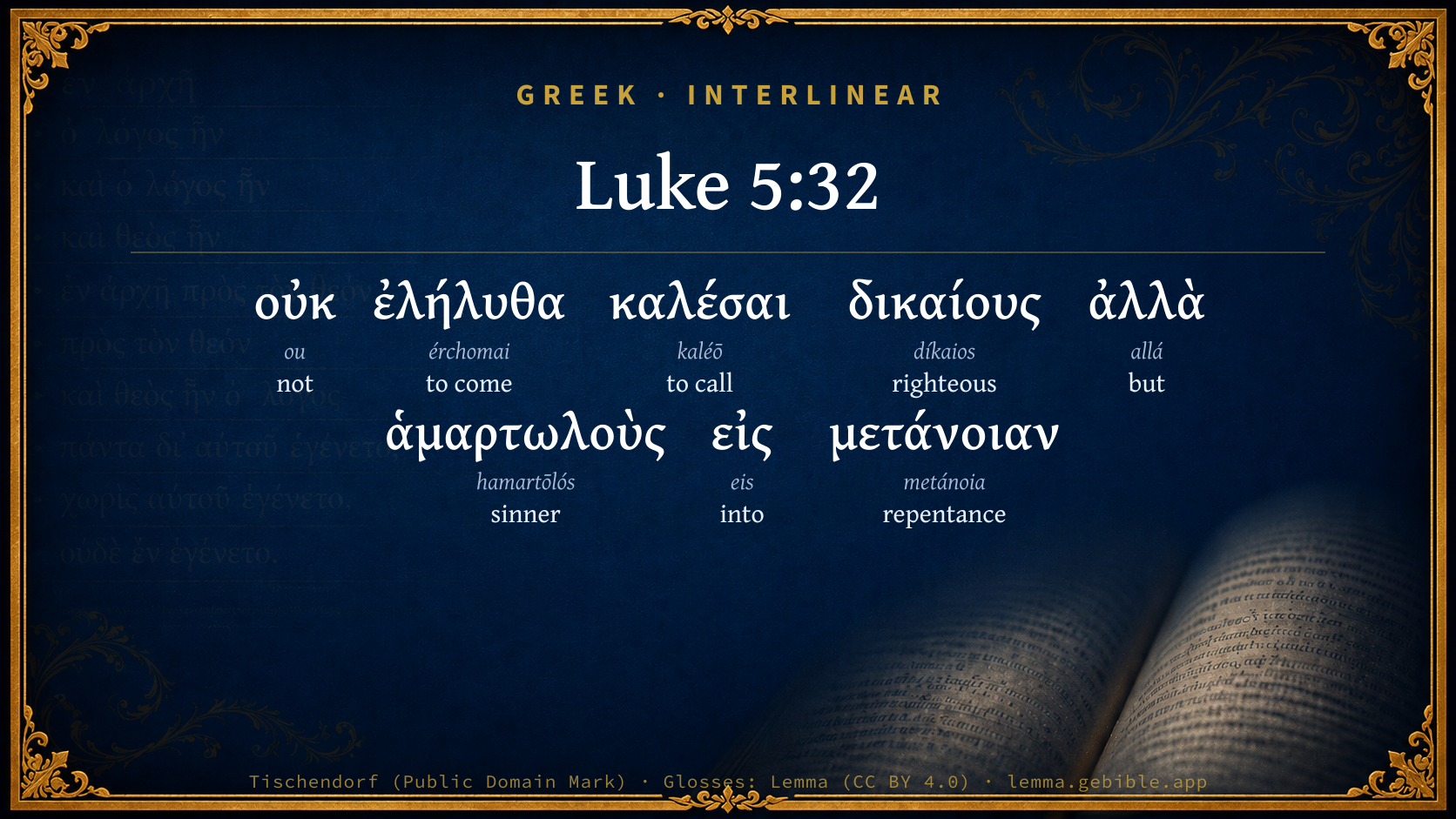
Greek (Tischendorf 8th ed.) Luke 5:32 appears in the Greek New Testament. The text above is from the Tischendorf 8th edition. Each word links to its Strong’s number and a concise gloss. Click any word for its full Thayer’s Greek Lexicon entry.
Download image
Cite this verse

Luke 5:32 (World English Bible). Public Domain. Lemma interlinear Bible study tool, https://lemma.gebible.app/v/luke/5/32.

Show BibTeX & RIS
BibTeX
RIS
English Translation
I have not come to call the righteous, but sinners to repentance."
World English Bible · Public Domain
Download a study sheet

One document with this verse’s original text, its word-by-word gloss line, the meaning frame, cross-references with their text, attributed commentary, and full source and license credits — printable, and it pastes into notes with its structure intact.

This verse Autodidact and up

Study sheet (.html) Plain text (.txt)

A passage Seminary Student

Up to 50 verses in one chapter. A passage sheet keeps up to 6 commentary sources and 12 cross-references per verse, in the order this page ranks them, and says so on the sheet whenever that leaves anything out. Ask for a single verse and you get the Autodidact verse sheet above.

Everything on this page stays free to read, with no account — the sheet is a download of what is already on screen, not access to it.

Want to remove ads? Support Godless Engineer
Compare translations 3

The same verse in 3 English versions, stacked beneath the original-language interlinear above. Click any original word for its lexicon entry.

Each is an independent rendering of the whole verse — the interlinear is not word-aligned to these translations.

Highlighted words mark where these versions differ — a whole-verse word diff, not a word-by-word alignment.

  • World English Bible Public Domain
    I have not come to call the righteous, but sinners to repentance."
  • King James Version Public Domain
    I came not to call the righteous, but sinners to repentance.
  • unfoldingWord Literal Text CC BY-SA 4.0
    I did not come to call the righteous, but sinners to repentance.”

unfoldingWord Literal Text — © unfoldingWord, licensed CC BY-SA 4.0. Word-aligned USFM3 via Door43 (git.door43.org/unfoldingWord/en_ult).

Versions to compare (up to 4)

3 of 4 selected

Show all 19 translations

Every available English version of this verse, each an independent rendering of the whole verse.

  • World English Bible Public Domain
    I have not come to call the righteous, but sinners to repentance."
  • Berean Standard Bible Public Domain
    I have not come to call the righteous, but sinners, to repentance.”
  • Majority Standard Bible Public Domain
    I have not come to call the righteous, but sinners, to repentance.”
  • King James Version Public Domain
    I came not to call the righteous, but sinners to repentance.
  • American Standard Version (1901) Public Domain
    I am not come to call the righteous but sinners to repentance.
  • Revised Version (1885) Public Domain
    I am not come to call the righteous but sinners to repentance.
  • Geneva Bible (1599) Public Domain
    I came not to call the righteous, but sinners to repentance.
  • Douay-Rheims (1899) Public Domain
    I came not to call the just, but sinners to penance.
  • Young's Literal Translation Public Domain
    I came not to call righteous men, but sinners, to reformation.'
  • Literal Standard Version CC BY-SA 4.0
    I did not come to call righteous men, but sinners, to conversion.”
  • Unlocked Literal Bible CC BY-SA 4.0
    I did not come to call righteous people to repentance, but to call sinners to repentance.”
  • unfoldingWord Literal Text CC BY-SA 4.0
    I did not come to call the righteous, but sinners to repentance.”
  • Darby Bible Public Domain
    I am not come to call righteous [persons], but sinful [ones] to repentance.
  • World Messianic Bible Public Domain
    I have not come to call the righteous, but sinners, to repentance.”
  • Webster's Bible Public Domain
    I came not to call the righteous, but sinners to repentance.
  • Free Bible Version CC BY-SA 4.0
    “I didn't come to call those who are living right to repentance—I came to call sinners.”
  • Bible in Basic English Public Domain
    I have come, not to get the upright, but sinners, so that they may be turned from their sins.
  • Text-Critical English NT CC BY 4.0
    I did not come to call the righteous, but sinners to repentance.”
  • Tyndale New Testament (1534) Public Domain
    I came not to call the rightewes but synners to repentaunce.

Literal Standard Version (2020), Covenant Press — licensed CC BY-SA 4.0. Text via the HelloAO Bible API (eBible.org). Unlocked Literal Bible (unfoldingWord) — licensed CC BY-SA 4.0. Text via the HelloAO Bible API (eBible.org). unfoldingWord Literal Text — © unfoldingWord, licensed CC BY-SA 4.0. Word-aligned USFM3 via Door43 (git.door43.org/unfoldingWord/en_ult). Free Bible Version, Dr. Jonathan Gallagher — licensed CC BY-SA 4.0. Text via the HelloAO Bible API (eBible.org).

Word by word

More ways to search: Search by grammar → Find every occurrence → Compare this word →

Practice this passage: Drill this verse → Learn its vocabulary →

About this verse

These counts appear in no published source. They are computed here, from the morphology-tagged text and Lemma’s own curated glosses. What Lemma adds →

8
words
8
distinct lemmas
Gospels
section

Notable vocabulary

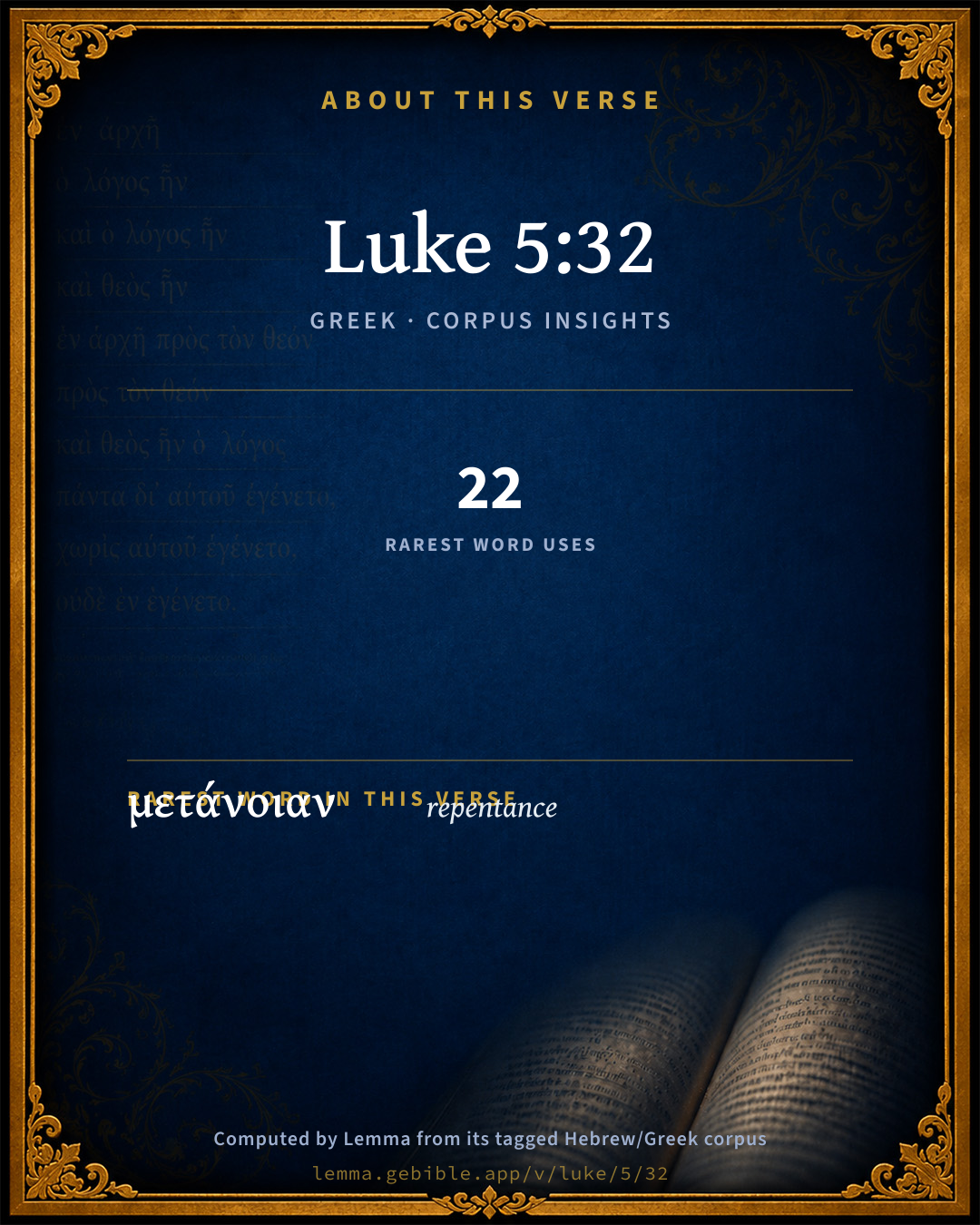
The rarest word here is μετάνοιαν repentance G3341 — appearing just 22 times in the whole Greek New Testament.

Shared distinctive vocabulary

μετάνοιαν repentance G3341 occurs in 22 verses of the Greek New Testament. Also found in:

Cross-references

21

Topical passages linked to Luke 5:32 in the Treasury of Scripture Knowledge — connected by theme and wording, ordered by reader-vote popularity; previews shown in the World English Bible.

  • Luke 19:10 For the Son of Man came to seek and to save that which was lost."
  • Luke 15:10 Even so, I tell you, there is joy in the presence of the angels of God over one sinner repenting."
  • 1 Timothy 1:15–16 The saying is faithful and worthy of all acceptance, that Christ Jesus came into the world to save sinners; of whom I am chief.
  • Luke 15:7 I tell you that even so there will be more joy in heaven over one sinner who repents, than over ninety-nine righteous people who need no repentance.
  • Acts 3:19 "Repent therefore, and turn again, that your sins may be blotted out, so that there may come times of refreshing from the presence of the Lord,
  • Luke 24:47 and that repentance and remission of sins should be preached in his name to all the nations, beginning at Jerusalem.
  • Acts 17:30 The times of ignorance therefore God overlooked. But now he commands that all people everywhere should repent,
  • Isaiah 55:6–7 Seek you Yahweh while he may be found; call you on him while he is near:
  • Luke 4:18–19 "The Spirit of the Lord is on me, Because he has anointed me to preach good news to the poor. He has sent me to heal the brokenhearted, To proclaim release to the captives, Recovering of sight to the blind, To deliver those who are crushed,
  • 2 Peter 3:9 The Lord is not slow concerning his promise, as some count slowness; but is patient with us, not wishing that any should perish, but that all should come to repentance.
  • Luke 18:10–14 "Two men went up into the temple to pray; one was a Pharisee, and the other was a tax collector.
  • Acts 2:38 Peter said to them, "Repent, and be baptized, everyone of you, in the name of Jesus Christ for the forgiveness of sins, and you will receive the gift of the Holy Spirit.
  • Acts 3:26 God, having raised up his servant, Jesus, sent him to you first, to bless you, in turning away everyone of you from your wickedness."
  • Acts 20:21 testifying both to Jews and to Greeks repentance toward God, and faith toward our Lord Jesus.
  • Acts 26:18–20 to open their eyes, that they may turn from darkness to light and from the power of Satan to God, that they may receive remission of sins and an inheritance among those who are sanctified by faith in me.'
  • 2 Timothy 2:25–26 in gentleness correcting those who oppose him: perhaps God may give them repentance leading to a full knowledge of the truth,
  • Acts 5:31 God exalted him with his right hand to be a Prince and a Savior, to give repentance to Israel, and remission of sins.
  • Isaiah 57:15 For thus says the high and lofty One who inhabits eternity, whose name is Holy: I dwell in the high and holy place, with him also who is of a contrite and humble spirit, to revive the spirit of the humble, and to revive the heart of the contrite.
  • Matthew 18:10 See that you don't despise one of these little ones, for I tell you that in heaven their angels always see the face of my Father who is in heaven.
  • 1 Corinthians 6:9–11 Or don't you know that the unrighteous will not inherit the Kingdom of God? Don't be deceived. Neither the sexually immoral, nor idolaters, nor adulterers, nor male prostitutes, nor homosexuals,
  • Mark 15:10 For he perceived that for envy the chief priests had delivered him up.

Cross-references courtesy of OpenBible.info (CC BY 4.0).

Commentary

Notes on Luke 5:32 from classic Christian and Jewish commentators (each source and its license shown beneath its notes). The classic Christian expositions comment on the surrounding passage and are grouped to its opening verse, so a note may address several verses; the Jewish commentaries on the Tanakh (Rashi and others) are per-verse, so they appear only where the commentator wrote on this verse.

Lemma curates 59 commentaries, every one of them public domain or Creative Commons licensed, each selected and text-cleaned for this edition rather than reprinted as found. About our sources →

The Biblical Illustrator

Joseph S. Exell

Luk_5:32

I came not to call the righteous, but sinners to repentance

The Sin healer

This conduct of Christ was not official or symbolic.

It was His feeling as very God that led Him to this course. It opened to the world the very Divine nature. A disposition to heal men of sin is a greater manifestation of Divine rectitude than to exterminate sin by punishment. It is this thought that I shall attempt to draw out briefly, and apply to our own case and experience.

I. To HEAR SIN EVINCES HATRED OF EVIL EVEN MORE THAN A SUMMARY PUNISHMENT OF IT. Consider the patience, the self-sacrifice, which is required to win men from evil habits, and from wicked dispositions. Now we measure our moral likes or dislikes by what they lead us to undergo. How much we love we can tell by how much we will bear for our affections; how much we dislike, by what effort we are willing to put forth to resist or avoid what is offensive to us. Consider a teacher who shall avenge himself of a pupils disobedience by punishing, or by summarily excluding that pupil. How cheap is such riddance of mischief from his school! How is all summed up in one outburst of feeling! It is very painful and disagreeable, but it is short. But suppose that, instead of resorting to expulsion, with its disgrace, the teacher shall enter into the sympathy of the pupil by gentleness, by winning kindness, by forbearance, by devoting his very life to him, and shall set him upon reformation, and wait for him to reform, and endure while he is reforming. How much more does he, by such a course of conduct as this, evince his dislike of evil, than by merely excluding the pupil! What we will bear for the sake of getting rid of evil, measures how much we dislike it.

II. A DISPOSITION TO HEAL SIN IS THE CLEAREST POSSIBLE EXPOSITOR OF MORAL RECTITUDE. Men do not always see it to be so. It is a part of our lower thinking to believe that a thunderous exhibition, with a display of wrath and punitive judgment, is a more solemn and conclusive manifestation of the Divine abhorrence of sin. But an abhorrence of sin is more illustriously marked by gentleness and patience in healing it, than by any display of justice in punishing it. He that once conceives of the God that presides over the universe, and keeps all its elements intact and unharmed, as a God that makes Himself the medicine for those that are led away from purity, and becomes Himself the Saviour of sinners--he that once does this has a conception of rectitude in God, and of the Divine hatred of evil, such as he can get in no other way.

III. A DISPOSITION TO HEAL SIN DOES NOT TAKE AWAY FROM SIN ANY OF ITS DANGERS. It removes no barriers, and yields no encouragements. There are ways of dealing with evil that lead to the presumption that it is safe to sin because there is a chance for recovery, if harm begins to come upon the sinner; but the way in which Christ dealt with evil led to no such presumption. Where men fall into sickness by their excesses, is the tenderness on the part of the nurse an argument for the repetition of those excesses. The care and the kindness of a parent in restoring a son from downfall are never a reason with a grateful son for falling again. And the grace of God in Christ Jesus, that bears With sin, not because it is to be allowed, but because, being hateful. God addresses the whole energy of His Being and administration to the rescue of men from it-this does not take away anything from the fear of sin, nor furnish motives to transgression.

IV. On the part of those who Ere healed, A DISPOSITION TO HEAL SIN PRODUCES A GENEROUS REPENTANCE, WHICH GROWS OUT OF THE NOBLER SENTIMENTS OF THE MIND, and which is therefore a true repentance--one that does not need to be repented of. It is no longer fear of consequences, nor even self-condemnation or conscience, that inspires reformation; it is an action of gratitude; a work of love.

V. SUCH A DISPOSITION PRESENTS THE DIVINE CHARACTER IN A LIGHT WHICH TENDS TO UNIVERSAL ADMIRATION AND UNIVERSAL CONFIDENCE. It takes nothing away from the essential authority and monarchy of God; but it brings God into vital sympathetic relations to His creatures--especially where the remedy has been wrought out at the expense of His own life. The spectacle of a God that is clothed with a spirit of justice made firm in the administration of a righteous government, and of one that, loving justice, still finds rescue and release for the transgressor through the interposition of His own self--that spectacle is one that cannot but fill the heart of every pure and noble creature with admiration and confidence and love. God, by the very pains with which He sought to cleanse the heart and the conscience, testified to how dangerous was that sin that had disfigured the conscience and soiled the heart. With this brief statement, I remark--

1. There is great encouragement for men that have given way to temptation and transgression, to turn back from evil, to repent, and to enter upon a course of right-living. One of the most wonderful of doctrines was the declaration of Christ that a man might be born again; not merely that he must be--which it true, if he would see the kingdom of heaven--but that he might be; that a man who had for years and years gone wrong, might, as it were, go back and call all the past nothing, and start over again. What would men give if they could do this in their secular affairs t Only God is on the side of the man that wants to return to the path of holiness. There is no parallel to the Divine helpfulness towards the erring anywhere out of the family. When men in secular relations and social connections have done wrong, nothing is on their side--everything is against them. The influences of this world tend to hold a man up in the beginning.

2. This exhibition of God in healing sin instead of punishing it, is the model for Christian dispositions. We must have the Spirit of Christ, or we are none of His. The mother that watches over her child, and that, seeing its faults, not so much punishes it as trains it out of those faults, devoting her life, day and night, to its welfare; the mother that wins her child out of evil into good--that mother stands as the childs saviour, reproducing the example and conduct of Christ towards her little one. Arc there those round about you that need succour and help: Have you done some things for them?

3. What will be the glorious disclosure of this Divine nature in heaven--the lovableness of God, the attractive beauty that there is in Him, so disclosed by the Saviour! (H. W. Beecher.)

Self-righteousness giving way to penitence

The man who thinks he is not so very bad, is no true penitent. I am the chief of sinners, said holy Paul, and that is sure to be the feeling of the man who is truly penitent. A good Quaker told me once how he visited a sick neighbour, and began to talk to the man about soul-matters. Religion was all very good, the poor sick man acknowledged, but he could not see what need he had to concern himself abort it, for he had never done anybody any harm in his life. The good Quaker tried to convince him that he had lived without hope and without God in the world, and that he was not fit to die; that he had neither prayed nor worshipped, nor read his Bible, nor trained up his children in the fear of God, and he ought to feel himself a sinner in the sight of his Maker. The good Quaker knelt and prayed with him, and visited him again and again, and began to observe that the man gradually forgot to boast of his innocence; and, at last, seemed to be growing very tender, for he observed him in tears. At last he could conceal his state no longer, but burst out into weeping--I am too great a sinner, said he; there is no mercy for me! Thank God! said the good Quaker, I have hope of thee now. Let us pray once more, and see if there be no mercy for thee. The Quaker prayed, and the poor sinner prayed; and before they gave over, the sinners soul was set free, and he rejoiced in the pardoning love of God. (Thomas Cooper.)

Christs errand

I. WHAT IS THE PURPORT OF CHRISTS COMING INTO AND WORK IN TEE WORLD AS ANNOUNCED IN THE SCRIPTURES GENERALLY? Universal and all-inclusive. The world. Whosoever.

II. HERE, HOWEVER, AN APPARENT LIMITATION. Some whom He did not come to call: the righteous. Who were these righteous? Wee e they really righteous? No, but only self-righteous.

III. ARE THERE, THEN, ANY WHOM CHRIST DID NOT COME TO SAVE? NO. But so long as a man is self-righteous he is not saveable, he cannot hear and obey the call of Christ. Christs errand is to the needy and the sinful. Let the self-righteous become conscious of his unrighteousness and sinfulness, and he becomes at once one of those whom Christ came to call. For--

IV. IN COMING TO CALL SINNERS HE TRULY CAME TO CALL ALL, for all are sinners. And thus is the apparent limitation, so far as His desire and purpose are concerned, shown not really to exist. He will have all men to be saved and to tome to a knowledge of the truth. (J. B. Bailey.)

Criminality certainly appeared to Christ more odious and detestable than it did to His contemporaries. How strange, then, to find Him treating it more leniently I perfect justice here appears to take the very course which would be taken by injustice. It is true that the extremes do in a manner meet. Christ, representing the highest humanity, treats crime in a manner which superficially resembles the treatment of it by those in whom humanity is at the lowest stage. But the other toleration was barbarous. Christs toleration is the newly-revealed virtue of mercy. (Ecce Homo.)

There are two classes of men--the righteous who believe themselves sinners; and sinners who believe themselves righteous. (Pascal.)

The Biblical Illustrator, edited by Joseph S. Exell (c. 1880s–1900s) — public domain. Text from a community e-Sword module.

Bengel's Gnomon

Johann Albrecht Bengel

Luk 5:32. Μετανοίαν) Μετανοία is the transition of the mind from sin to righteousness, from sickness to health. This change is something of a delightful, not of a formidable nature: comp. the instance of Levi in proof of this, Luk 5:27-29.

Bengel's Gnomon of the New Testament — English translation (T&T Clark, Edinburgh, 1860) — public domain. Text from a community e-Sword module.

Expositor's Greek Testament

ed. W. Robertson Nicoll

Luk 5:32 . εἰς μετάνοιαν : doubtless a gloss of Lk.’s or of a tradition he used, defining and guarding the saying, but also limiting its scope. καλέσαι is to be understood in a festive sense = I came to call sinners to the feast of the Kingdom , as I have called to this feast the “sinners” of Capernaum.

The Expositor's Greek Testament, edited by W. Robertson Nicoll (1897–1910) — public domain. Text from a community e-Sword module.

Ellicott's Commentary for English Readers

(32) I came not.—Strictly, I have not come.

But sinners to repentance.—In the best MSS. the last word is added by St. Luke only. One MS. (the Sinaitic) has the remarkable various-reading “the ungodly” for “sinners,” as if from a recollection of Rom_5:6-7.

A Bible Commentary for English Readers, edited by Charles John Ellicott (1878–1897) — public domain. Text from a community e-Sword module.

The Cambridge Bible for Schools and Colleges

gen. ed. J. J. S. Perowne

32. I came not to call] Rather, I have not come.

the righteous] This also was true in two senses. Our Lord came to seek and save the lost. He came not to the elder son but to the prodigal; not to the folded flock but to the straying sheep. In a lower and external sense these Pharisees were really, as they called themselves, ‘the righteous’ (chasidim). In another sense they were only self-righteous and self-deceived (Luk_18:9). St Matthew tells us that He further rebuked their haughty and pitiless exclusiveness by borrowing one of their own formulae, and bidding them “go and learn” the meaning of Hos_6:6, “I will have mercy and not sacrifice,” i. e. love is better than legal scrupulosity; Mat_9:13; Mat_12:7. The invariable tendency of an easy and pride-stimulating externalism when it is made a substitute for heart-religion is the most callous hypocrisy. The Pharisees were condemned not by Christ only but by their own Pharisaic Talmud, and after b. c. 70 the very name fell into such discredit among the Jews themselves as a synonym for greed and hypocrisy that it became a reproach and was dropped as a title (Jost, Gesch. d. Juden. iv. 76; Gfrörer, Jahrh. d. Heils, i. 140; Lightfoot, Hor. Hebr. on Mat_3:7).

The Cambridge Bible for Schools and Colleges (gen. ed. J. J. S. Perowne; Cambridge University Press, 1878–1918) — public domain. Text from a community e-Sword module.

John Gill's Exposition

I came not to call the righteous,.... Such as the Scribes and Pharisees were in their own apprehension, and in the esteem of others, who trusted in themselves, that they were righteous, and submitted not to the righteousness of Christ: these Christ came not to call by his grace, and therefore did not associate himself with them: but sinners to repentance; such as the publicans, and others, with them, were; and therefore he was chiefly with such, and chose to be among them: these he not only called to repentance by the outward ministry of the word, but brought them to it; he having power to bestow the grace of repentance, as well as to call to the duty of it; See Gill on Mat 9:13. See Gill on Mar 2:17.

.

Luke 5:33

luk 5:33

luk 5:33

luk 5:33And they say unto him,.... The Scribes and Pharisees, or the disciples of John; see Mat 9:14

why do the disciples of John fast often, and make prayers? set times apart frequently for fasting and prayer. The Ethiopic version reads, "why do the disciples of John baptize frequently, fast, and make prayers?" in which the former clause is added; and as without any authority, so without judgment, since it must suppose that the Pharisees did so likewise, whereas they rejected the baptism of John; for it follows, and "likewise" the disciples of "the Pharisees"; who fasted often, at least twice in the week, and made frequent prayers in the synagogues, and corners of the streets, and in widows' houses.

But thine eat and drink? instead of fasting and praying; See Gill on Mat 9:14.

John Gill's Exposition of the Whole Bible (1746–1763) — public domain (CC PDM 1.0). Text via the HelloAO Bible API.

Scofield Reference Notes

C. I. Scofield

sinners

See, Rom 5:6; Rom 5:8; 1Ti 1:15.

The Scofield Reference Bible (1917 edition), notes by C. I. Scofield — public domain. Text from a community e-Sword module.

Cambridge Greek Testament for Schools and Colleges

32. οὐκ ἐλήλυθα. ‘I am not come.’

δικαίους. ‘Righteous persons.’ This also was true in two senses. Our Lord came to seek and save the lost. He came not to the elder son but to the prodigal; not to the folded flock but to the straying sheep. In a lower and external sense these Pharisees were really, as they called themselves, ‘the righteous’ (chasidim). In another sense they were only self-righteous and self-deceived (Luk 18:9). St Matthew tells us that He further rebuked their haughty and pitiless exclusiveness by borrowing one of their own formulæ, and bidding them “go and learn” the meaning of Hos 6:6, “I will have mercy and not sacrifice,” i.e. love is better than legal scrupulosity; Mat 9:13; Mat 12:7. The invariable tendency of an easy and pride-stimulating externalism when it is made a substitute for heart-religion is the most callous hypocrisy. The Pharisees were condemned not by Christ only but by their own Pharisaic Talmud, and after A.D. 70 the very name fell into such discredit among the Jews themselves as a synonym for greed and hypocrisy that it became a reproach and was dropped as a title (Jost, Gesch. d. Juden. IV. 76; Gfrörer, Jahrh. d. Heils, I. 140; Lightfoot, Hor. Hebr. on Mat 3:7).

Cambridge Greek Testament for Schools and Colleges (Cambridge University Press, 1896; 21 vols, various authors incl. Carr, Maclear, Plummer, Farrar, Lumby, Moule, M. R. James, Simcox) — public domain. Text from a community e-Sword module.

International Critical Commentary

32. εἰς μετάνοιαν. These words are peculiar to Lk., but in some texts have been transferred to Mk. and Mt. Both μετάνοια and μετανοεῖν are freq. in Lk. See on 15:7. Obviously those who are really δίκαιοι do not need to be called to repentance; but who are δίκαιοι? That is the question which Christ’s reply suggests. If we had only Mk.’s account, we might suppose that what follows took place on some other occasion; but both Lk. and Mt. (τότε) connect it with the banquet in Matthew’s house.

International Critical Commentary — older volumes (1896–1929), various authors — public domain. Text from a community e-Sword module.

Lesson kit

Teaching starters — assembled from the data on this page, not authored interpretation. Every prompt links to the verse data it draws on. Edit before teaching.

Luke, in the Gospels, opens this verse with 8 words (8 distinct Greek lemmas). Its most distinctive word is metánoia (“repentance”). A historical commentator’s framing appears above. Read the whole chapter for the surrounding context.

Discussion questions

  1. How does “repentance” (metánoia) shape what this verse is saying?
  2. How does Matthew 3:8, which shares the word «repentance», read alongside this verse?
  3. These translations render this verse differently; the difference is in the English rendering, not the original. What questions does that raise?
  4. Compare how The Biblical Illustrator and Bengel's Gnomon read this verse. Where do they agree or differ?

Things to notice

Reading settings

Reading text

Shown beneath each verse's original-language words.

Old Testament
Old Testament edition

Read the OT as the Masoretic Hebrew (MT) or the Greek Septuagint (LXX).

English shown for the Greek Septuagint (in the Hebrew ↔ Greek comparison).

Comparing translations? Open the Compare panel on any verse page to stack up to four side by side.