
1 Corinthians 7:18

Greek (Tischendorf 8th ed.) 1 Corinthians 7:18 appears in the Greek New Testament. The text above is from the Tischendorf 8th edition. Each word links to its Strong’s number and a concise gloss. Click any word for its full Thayer’s Greek Lexicon entry.
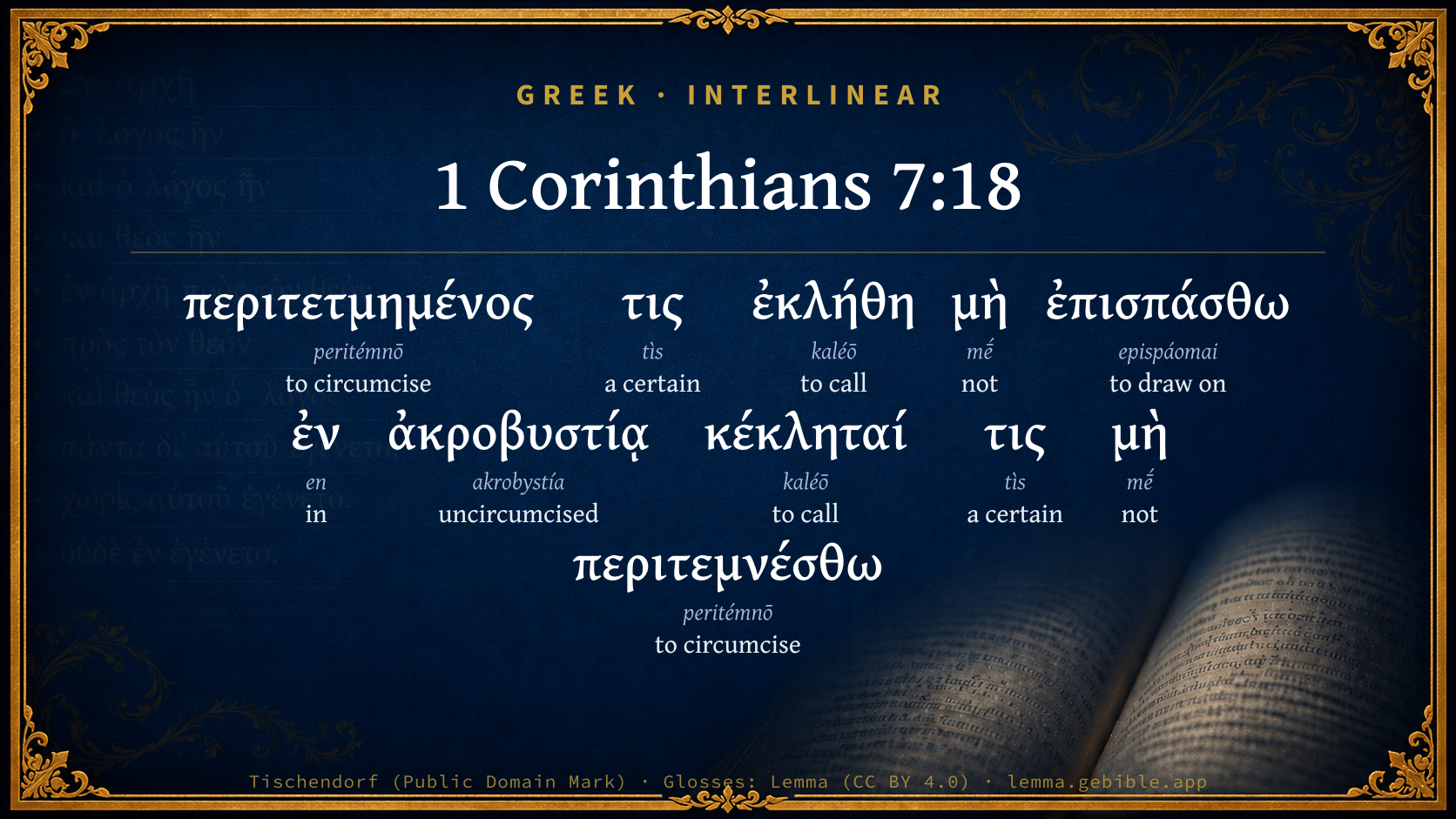
Download image
Cite this verse

1 Corinthians 7:18 (World English Bible). Public Domain. Lemma interlinear Bible study tool, https://lemma.gebible.app/v/1-corinthians/7/18.

Show BibTeX & RIS
BibTeX
RIS
English Translation
Was anyone called having been circumcised? Let him not become uncircumcised. Has anyone been called in uncircumcision? Let him not be circumcised.
World English Bible · Public Domain
Highlights
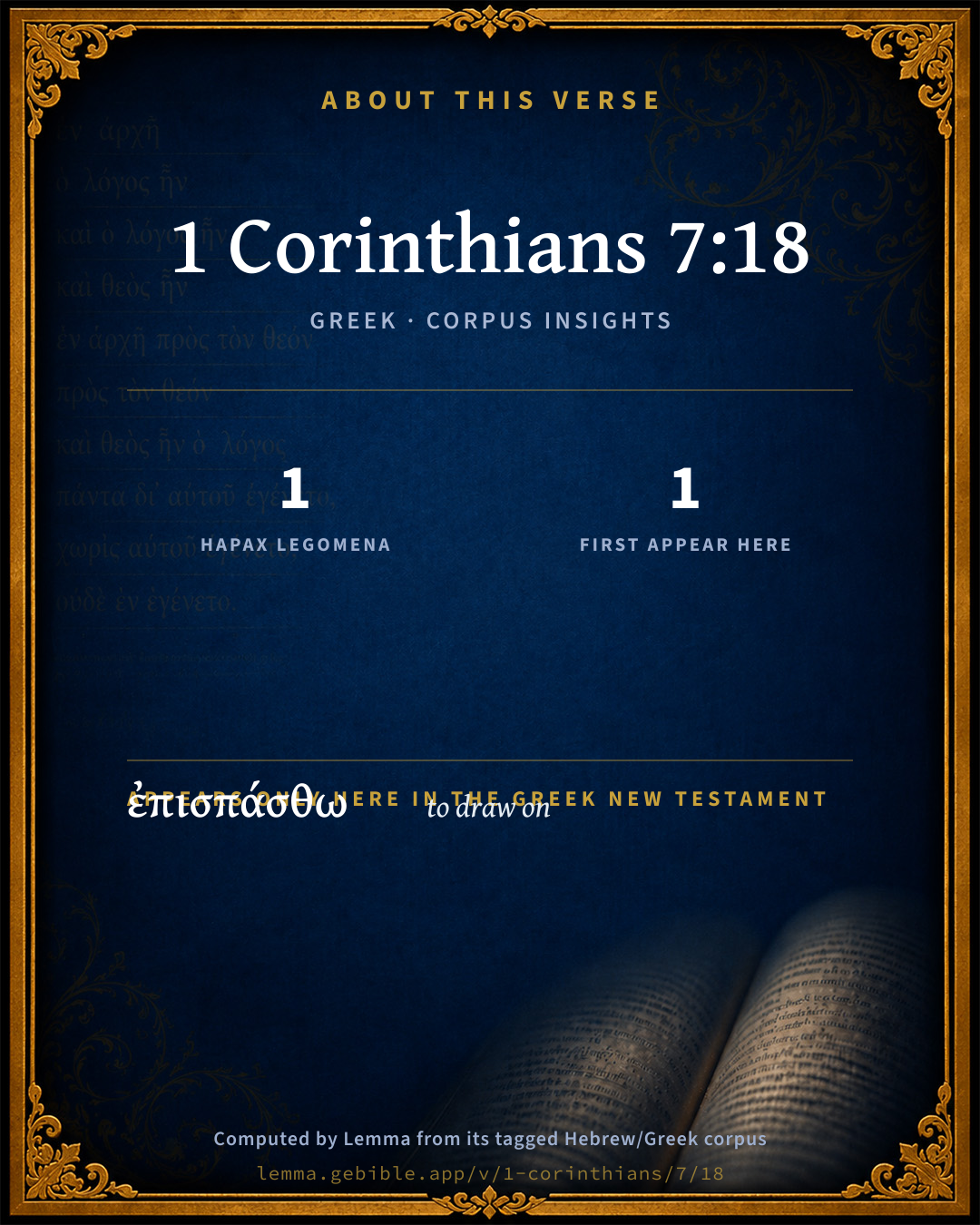
  • 1 hapax legomenon — only here in the Greek New Testament
  • 1 first appearance in the Greek New Testament
Full analysis ↓
Download a study sheet

One document with this verse’s original text, its word-by-word gloss line, the meaning frame, cross-references with their text, attributed commentary, and full source and license credits — printable, and it pastes into notes with its structure intact.

This verse Autodidact and up

Study sheet (.html) Plain text (.txt)

A passage Seminary Student

Up to 50 verses in one chapter. A passage sheet keeps up to 6 commentary sources and 12 cross-references per verse, in the order this page ranks them, and says so on the sheet whenever that leaves anything out. Ask for a single verse and you get the Autodidact verse sheet above.

Everything on this page stays free to read, with no account — the sheet is a download of what is already on screen, not access to it.

Want to remove ads? Support Godless Engineer
Compare translations 3

The same verse in 3 English versions, stacked beneath the original-language interlinear above. Click any original word for its lexicon entry.

Each is an independent rendering of the whole verse — the interlinear is not word-aligned to these translations.

Highlighted words mark where these versions differ — a whole-verse word diff, not a word-by-word alignment.

  • World English Bible Public Domain
    Was anyone called having been circumcised? Let him not become uncircumcised. Has anyone been called in uncircumcision? Let him not be circumcised.
  • King James Version Public Domain
    Is any man called being circumcised? let him not become uncircumcised. Is any called in uncircumcision? let him not be circumcised.
  • unfoldingWord Literal Text CC BY-SA 4.0
    Was anyone called, having been circumcised? Let him not be uncircumcised. Was anyone called in uncircumcision? Let him not be circumcised.

unfoldingWord Literal Text — © unfoldingWord, licensed CC BY-SA 4.0. Word-aligned USFM3 via Door43 (git.door43.org/unfoldingWord/en_ult).

Versions to compare (up to 4)

3 of 4 selected

Show all 19 translations

Every available English version of this verse, each an independent rendering of the whole verse.

  • World English Bible Public Domain
    Was anyone called having been circumcised? Let him not become uncircumcised. Has anyone been called in uncircumcision? Let him not be circumcised.
  • Berean Standard Bible Public Domain
    Was a man already circumcised when he was called? He should not become uncircumcised. Was a man still uncircumcised when called? He should not be circumcised.
  • Majority Standard Bible Public Domain
    Was a man already circumcised when he was called? He should not become uncircumcised. Was a man still uncircumcised when called? He should not be circumcised.
  • King James Version Public Domain
    Is any man called being circumcised? let him not become uncircumcised. Is any called in uncircumcision? let him not be circumcised.
  • American Standard Version (1901) Public Domain
    Was any man called being circumcised? Let him not become uncircumcised. Hath any been called in uncircumcision? Let him not be circumcised.
  • Revised Version (1885) Public Domain
    Was any man called being circumcised? let him not become uncircumcised. Hath any been called in uncircumcision? let him not be circumcised.
  • Geneva Bible (1599) Public Domain
    Is any man called being circumcised? let him not gather his vncircumcision: is any called vncircumcised? let him not be circumcised.
  • Douay-Rheims (1899) Public Domain
    Is any man called, being circumcised? let him not procure uncircumcision. Is any man called in uncircumcision? let him not be circumcised.
  • Young's Literal Translation Public Domain
    being circumcised -- was any one called? let him not become uncircumcised; in uncircumcision was any one called? let him not be circumcised;
  • Literal Standard Version CC BY-SA 4.0
    being circumcised—was anyone called? Do not let him become uncircumcised; in uncircumcision was anyone called? Do not let him be circumcised;
  • Unlocked Literal Bible CC BY-SA 4.0
    Was anyone circumcised when he was called to believe? He should not try to appear uncircumcised. Was anyone uncircumcised when he was called to faith? He should not be circumcised.
  • unfoldingWord Literal Text CC BY-SA 4.0
    Was anyone called, having been circumcised? Let him not be uncircumcised. Was anyone called in uncircumcision? Let him not be circumcised.
  • Darby Bible Public Domain
    Has any one been called circumcised? let him not become uncircumcised: has any one been called in uncircumcision? let him not be circumcised.
  • World Messianic Bible Public Domain
    Was anyone called having been circumcised? Let him not become uncircumcised. Has anyone been called in uncircumcision? Let him not be circumcised.
  • Webster's Bible Public Domain
    Is any man called being circumcised? let him not become uncircumcised. Is any called in uncircumcision? let him not become circumcised.
  • Free Bible Version CC BY-SA 4.0
    Were you circumcised when you were converted? Don't become uncircumcised. Were you uncircumcised when you were converted? Don't become circumcised.
  • Bible in Basic English Public Domain
    If any man who is a Christian has had circumcision, let him keep so; and if any man who is a Christian has not had circumcision, let him make no change.
  • Text-Critical English NT CC BY 4.0
    Was any man already circumcised when he was called? He should not remove the marks of circumcision. Was any man uncircumcised when he was called? He should not become circumcised.
  • Tyndale New Testament (1534) Public Domain
    Yf eny man be called beynge circumcised let him adde nothinge therto. Yf eny be called vncircumcised: let him not be circumcised.

Literal Standard Version (2020), Covenant Press — licensed CC BY-SA 4.0. Text via the HelloAO Bible API (eBible.org). Unlocked Literal Bible (unfoldingWord) — licensed CC BY-SA 4.0. Text via the HelloAO Bible API (eBible.org). unfoldingWord Literal Text — © unfoldingWord, licensed CC BY-SA 4.0. Word-aligned USFM3 via Door43 (git.door43.org/unfoldingWord/en_ult). Free Bible Version, Dr. Jonathan Gallagher — licensed CC BY-SA 4.0. Text via the HelloAO Bible API (eBible.org).

Word by word

More ways to search: Search by grammar → Find every occurrence → Compare this word →

Practice this passage: Drill this verse → Learn its vocabulary →

ἐπισπάσθω
epispáomai
G1986
“to draw on”
Verb, Present, Middle or Passive deponent, Imperative, 3rd person, Singular
Part of Speech
Verb
Tense
Present
Voice
Middle or Passive deponent
Mood
Imperative
Person
3rd person
Number
Singular
Full Thayer's Definition

Origin: from G1909 and G4685

TDNT: None

1. to draw on (let him not draw on his foreskin)
  1. περιτετμημένος peritémnō G4059 “to circumcise” Verb, Perfect, Passive, Participle, Nominative, Singular, Masculine
  2. τις tìs G5100 “a certain” Indefinite pronoun, Nominative, Singular, Masculine
  3. ἐκλήθη kaléō G2564 “to call” Verb, Aorist, Passive, Indicative, 3rd person, Singular
  4. μὴ mḗ G3361 “not” Particle, Negative
  5. ἐν en G1722 “in” Preposition
  6. ἀκροβυστίᾳ akrobystía G203 “uncircumcised” Noun, Dative, Singular, Feminine
  7. κέκληταί kaléō G2564 “to call” Verb, Perfect, Passive, Indicative, 3rd person, Singular
  8. τις tìs G5100 “a certain” Indefinite pronoun, Nominative, Singular, Masculine
  9. μὴ mḗ G3361 “not” Particle, Negative
  10. περιτεμνέσθω peritémnō G4059 “to circumcise” Verb, Present, Passive, Imperative, 3rd person, Singular

About this verse

These counts appear in no published source. They are computed here, from the morphology-tagged text and Lemma’s own curated glosses. What Lemma adds →

11
words
7
distinct lemmas
Pauline Epistles
section

Notable vocabulary

1 hapax legomenon — a word that appears only here in the entire Greek New Testament:

  • ἐπισπάσθω to draw on G1986

First appearance in Scripture

This word makes its first canonical appearance in the Greek New Testament here:

  • ἐπισπάσθω to draw on G1986

Shared distinctive vocabulary

περιτετμημένος to circumcise G4059 occurs in 15 verses of the Greek New Testament. Also found in:
Repetition

Words recur within this verse:

  • περιτετμημένος to circumcise G4059 ×2
  • τις a certain G5100 ×2
  • ἐκλήθη to call G2564 ×2
  • μὴ not G3361 ×2

Cross-references

7

Topical passages linked to 1 Corinthians 7:18 in the Treasury of Scripture Knowledge — connected by theme and wording, ordered by reader-vote popularity; previews shown in the World English Bible.

  • Acts 15:5 But some of the sect of the Pharisees who believed rose up, saying, "It is necessary to circumcise them, and to charge them to keep the law of Moses."
  • Acts 15:19 "Therefore my judgment is that we don't trouble those from among the Gentiles who turn to God,
  • Acts 15:24 Because we have heard that some who went out from us have troubled you with words, unsettling your souls, saying, 'You must be circumcised and keep the law,' to whom we gave no commandment;
  • Acts 15:28 For it seemed good to the Holy Spirit, and to us, to lay no greater burden on you than these necessary things:
  • Galatians 5:1–3 Stand firm therefore in the liberty by which Christ has made us free, and don't be entangled again with a yoke of bondage.
  • Colossians 3:11 where there can't be Greek and Jew, circumcision and uncircumcision, barbarian, Scythian, bondservant, freeman; but Christ is all, and in all.
  • Acts 15:1–2 Some men came down from Judea and taught the brothers, "Unless you are circumcised after the custom of Moses, you can't be saved."

Cross-references courtesy of OpenBible.info (CC BY 4.0).

Commentary

Notes on 1 Corinthians 7:18 from classic Christian and Jewish commentators (each source and its license shown beneath its notes). The classic Christian expositions comment on the surrounding passage and are grouped to its opening verse, so a note may address several verses; the Jewish commentaries on the Tanakh (Rashi and others) are per-verse, so they appear only where the commentator wrote on this verse.

Lemma curates 59 commentaries, every one of them public domain or Creative Commons licensed, each selected and text-cleaned for this edition rather than reprinted as found. About our sources →

Ellicott's Commentary for English Readers

(18) Is any man called being circumcised?—Better, Was any one called having been circumcised? The previous general rule is now illustrated by, and applied to, two conditions of life—CIRCUMCISION (1Co_7:18-20) and SLAVERY (1Co_7:20-24). If any man was converted after having been circumcised, he was not, as some over-zealous Christians might have been anxious to do, to remove every trace of his external connection with Judaism (Gal_5:2).

A Bible Commentary for English Readers, edited by Charles John Ellicott (1878–1897) — public domain. Text from a community e-Sword module.

Joseph Benson's Commentary

1Co 7:18-19. Is any man called — Brought to the saving knowledge of Christ, and to a participation of his grace; being circumcised — Having been born of Jewish parents, and therefore circumcised in his childhood, or being a proselyte of righteousness, and therefore circumcised; let him not become uncircumcised — Not act as if he were desirous, as far as possible, to undo what was done for him by his Jewish parents, or others. Is any called in uncircumcision — Having been a Gentile by birth; let him not be circumcised — The Judaizing teachers urged the Gentile converts to receive circumcision as necessary to salvation. This the apostle declared to be a renouncing of the gospel, Gal 5:2-3. Circumcision is nothing, and uncircumcision is nothing — Will neither promote nor obstruct our salvation. The one point is, keeping the commandments of God — Namely, from a principle of faith and love, and with a single eye to the glory of God: for this, according to the same apostle, implies faith working by love, and a new creature, or a new creation, the necessity of which the apostle declares, in similar terms, Gal 5:6; Gal 6:15.

Joseph Benson's Commentary on the Old and New Testaments (1811–1818) — public domain. Text from a community e-Sword module.

Tyndale Open Study Notes

Tyndale Open Resources

7:18-19 Circumcision illustrates the general principle just stated (7:17). All Jewish males were circumcised. Some, seeking acceptance in Gentile society, attempted to reverse the procedure surgically (see 1 Maccabees 1:14-15; Josephus, Antiquities 12.5.1), a practice Paul discourages. Circumcision has little importance (see also Rom 2:28-29; 4:9-12; Gal 5:2-6; 6:12-15; Phil 3:2-3) compared with keeping God’s commandments, such as the commands to love God and others.

Tyndale Open Study Notes — © Tyndale Open Resources, licensed CC BY-SA 4.0. Text via the HelloAO Bible API.

Bengel's Gnomon

Johann Albrecht Bengel

1Co 7:18. Μὴ ἐπισπάσθω, let him not draw) [become uncircumcised]. Many, who had apostatized from the Jews to the Gentiles, recovered their uncircumcision to some extent by surgical skill, 1Ma 1:15. See Reineccius on this passage. It may be gathered from the admonition of Paul, that they were imitated by some, who from Jews had become Christians.

Bengel's Gnomon of the New Testament — English translation (T&T Clark, Edinburgh, 1860) — public domain. Text from a community e-Sword module.

Meyer's Critical & Exegetical Commentary

Heinrich August Wilhelm Meyer

1Co_7:18 ff. Further explanation of this injunction by way of example, and not bearing simply on the case of Christians living in mixed marriage.[1160]

The protases do not convey a question either here or in 1Co_7:27, being in the rhetorically emphatic form of the hypothetic indicative. See Bernhardy, p. 385. Comp Kühner, II. p. 561.

ΜῊ ἘΠΙΣΠΆΣΘΩ] ne sibi attrahat, sc[1162] praeputium. A surgical operation frequent among the later Jews (1Ma_1:15, and Grimm in lo[1163]; Josephus, Antt. xii. 5. 1), described in detail by Celsus, vii. 25. 5, or otherwise performed, by which a sort of foreskin was again drawn over the glansresorted to not only in cases of perversion to heathenism, but also from shame or fear of heathen eyes, before which men sought to avoid appearing (in baths, for example, or otherwise) as circumcised. With Christians this might especially be occasioned by a shrinking from the eyes of Gentile converts. See, besides Wetstein, Groddeck in schoettgens Horae, p. 1159 f.; Lightfoot, p. 194; Lübkert in the Stud. u. Krit. 1835, p. 657. Such persons were styled מַשׁוּכִים. See Buxtorf, Lex. Talm. p. 1274.

ἐν ἀκροβ.] Comp Rom_4:10.

[1160] Theodoret says well: εἶτα συνήθως ἀπὸ τοῦ προκειμένου εἰς ἕτερα μεταβαίνει, πᾶσε νομοθετῶν τὰ κατάλληλα.

[1161] omp. compare. comp. on Matt. iii. 5 refers to Dr. Meyers own commentary on the passage. So also See on Matth. iii. 5.

[1162] c. scilicet.

[1163] n loc refers to the note of the commentator or editor named on the particular passage.

Meyer — Critical and Exegetical Commentary on the New Testament — English translation by Peter Christie, edited by Frederick Crombie (T&T Clark, 1880) — public domain. Text from a community e-Sword module.

Expositor's Greek Testament

ed. W. Robertson Nicoll

1Co 7:18-19 . The rule of 1Co 7:17 applied to the most prominent and critical distinction in the Church, that between Jew and Gentile : περιτετμημένος τις ἐκλήθη κ . τ . λ .; “Was any one called (as) a circumcised man? let him not have the mark effaced”. ἐπισπάσθω alludes to a surgical operation ( ἐπισπάω , to draw ever ) by which renegade Jews effaced the Covenant sign: see Mal 1:11Mal 1:11 ff., Joseph., Ant. , xii., 5, 1; Celsus, vii., 25. 5; also Schürer, Hist. of Jewish People , I., i., p. 203, and Wetstein ad loc [1078] Such apostates were called m’shûkím, recutiti (Buxtorf’s Lexic. , p. 1274). On the opp [1079] direction to the Gentile, μὴ περιτεμνέσθω , the Ep. to the Gal. is a powerful commentary; here the negative reasons against the change suffice (1Co 7:17 ; 1Co 7:19 ). The variation in tense and order of words in the two questions is noticeable: “Was any one a circumcised man at the time of his call ( ἐκλήθη )?… Has any one been called ( κέκληται ) though in uncircumcision?” To clinch the matter ( cf. 1Co 1:31 , 1Co 3:7 ) P. applies one of his great axioms: “Circumcision is nothing, and uncircumcision is nothing; but keeping of God’s commands” that is everything.

[1078] ad locum , on this passage.

[1079] opposite, opposition.

In Gal 5:6 ; Gal 6:15 this maxim reappears, with πίστις διʼ ἀγάπης ἐνεργουμένη and καινὴ κτίσις respectively in the antithesis: this text puts the condition of acceptance objectively , as it lies in a right attitude toward God ( cf. Rom 2:25 ff.); those other texts supply the subjective criterion, lying in a right disposition of the man. In Gal 5 , οὐκ ἰσχύει opposed to ἐνεργουμένη signalises the impotence of external states, the other two passages their nothingness as religious qualifications. “Those who would contrast the teaching of St. Paul with that of St. James, or exaggerate his doctrine of justification by faith, should reflect on this τήρησις ἐντολῶν Θεοῦ ” (Lt [1080] ).

[1080] J. B. Lightfoot’s (posthumous) Notes on Epp. of St. Paul (1895).

The Expositor's Greek Testament, edited by W. Robertson Nicoll (1897–1910) — public domain. Text from a community e-Sword module.

Hodge's Commentary on Romans, Ephesians & First Corinthians

Charles Hodge

1Co_7:18

Is any man called being circumcised? let him not become uncircumcised. Is any called in uncircumcision? let him not be circumcised.

This is the first application of the principle just laid down. Let every man remain as he is, circumcised or uncircumcised. The Jews were wont, when they abandoned their religion, to endeavor to obliterate the mark of circumcision. The Judaizas were disposed to insist on the circumcision of the Gentile converts. Both were wrong. Pauls command is that they should remain as they were. Instead of the interrogative form adopted in our version, the preferable translation is, One was called (ἐκλήθη) being circumcised; let him not become uncircumcised. Another was called in uncircumcision; let him not be circumcised. To call, throughout the doctrinal portions of the New Testament, is to convert, to call effectually.

Charles Hodge — Commentary on Romans (1835), First Corinthians (1857), and Ephesians (1856) — public domain. Text from a community e-Sword module.

Geneva Bible (1599)

Geneva Bible translators

He is said to gather his uncircumcision, who by the help of a Chirurgeon recovereth an upper skin: which is done by the drawing the skin with an instrument, to make it to cover the nut. Celsus in book 7, chapter 25.

Notwithstanding he giveth us to understand, that in these examples all are not like sort: because that circumcision is not simply of itself to be desired, but such as are bound may desire to be free. Therefore herein only they are equal, that the kingdom of God consisteth not in them, and therefore these are no hindrance to obey God.

Geneva Bible (1599) marginal notes — public domain. Text via Bolls.life.

Jamieson, Fausset & Brown

Robert Jamieson, A. R. Fausset & David Brown

not become uncircumcised--by surgical operation (1 Maccabees 1:15; JOSEPHUS [Antiquities, 12.5.1]). Some Christians in excess of anti-Jewish feeling might be tempted to this.

let him not be circumcised--as the Judaizing Christians would have him (Act 15:1, Act 15:5, Act 15:24; Gal 5:2).

Jamieson, Fausset & Brown — Commentary Critical and Explanatory on the Whole Bible (1871) — public domain (CC PDM 1.0). Text via the HelloAO Bible API.

Adam Clarke's Commentary

Verse 18. Is any man called being circumcised?] Is any man who was formerly a Jew converted to Christianity?

Let him not become circumcised.] Let him not endeavour to abolish the sign of the old covenant, which he bears in his flesh. The Greek words μη επισπασθω, let him not draw over, are evidently an elliptical expression: the word την ακροβυστιαν, the fore-skin, being understood; which, indeed, is added by the Armenian and the Itala, and several of the Latin fathers. It is a fact that it was possible by the assistance of art to do this; and Celsus himself prescribes the mode, De Medic. vii. 25. By frequent stretching, the circumcised skin could be again so drawn over, as to prevent the ancient sign of circumcision from appearing. Some in their zeal against Judaism endeavoured to abolish this sign of it in their flesh: it is most evidently against this that the apostle speaks. Many false Jews made use of this practice, that they might pass through heathen countries unobserved; otherwise, in frequenting the baths they would have been detected.

Let him not be circumcised.] Let no man who, being a Gentile, has been converted to the Christian faith, submit to circumcision as something necessary to his salvation.

Adam Clarke's Commentary on the Bible (1810–1826) — public domain. Text from a community e-Sword/MySword module.

John Calvin's Commentaries

18. Circumcised, etc. As he had made mention of the calling, he takes occasion, from a particular instance, to make a digression for a little into a general exhortation, as he is wont to do in many instances; and, at the same time, he confirms, by different examples, what he had said respecting marriage. The sum is this, that in external things you must not rashly abandon the calling on which you have once entered by the will of God. And he begins with circumcisions, respecting which many at that time disputed. Now, he says that with God it makes no difference whether you are a Gentile or a Jew. Hence he exhorts every one to be contented with his condition. It must always be kept in view, that he treats only of lawful modes of life, which have God as their approver and author.

John Calvin's Commentaries (1540-1563) — public domain. Text from the Calvin Translation Society English edition (1840s-50s) via the Christian Classics Ethereal Library (ccel.org). Calvin's coverage is partial (roughly two-thirds of the Bible); uncommented books and verses are honest gaps, never fabricated. The 19th-century editor's footnotes and remarks are omitted so the notes are faithfully Calvin's own voice.

The Cambridge Bible for Schools and Colleges

gen. ed. J. J. S. Perowne

18. Is any man called being circumcised? let him not become uncircumcised] Many Jews, we are assured, were ashamed of their Judaism, and were desirous to obliterate all the outward signs of it. (1Ma_1:15.) This feeling would receive an additional impulse from conversion to Christianity. But St Paul believed that, once a Jew, a man was ‘a debtor to do the whole law’ (Gal_5:3). He acted upon this view of the case himself (Act_18:21; Act_21:26) in marked contrast to the Judaizing teachers (Gal_6:13), but with one exception under special circumstances (Act_16:3). Therefore he urged those who were called in Judaism not to abandon the customs of their nation.

Is any called in uncircumcision?] That the Gentiles were free from the obligation of the Jewish law was decided in the conference held at Jerusalem (Acts 15) and after some wavering (Gal_2:11-21) it was set at rest, principally by the courage and clear-sightedness of the great Apostle of the Gentiles.

The Cambridge Bible for Schools and Colleges (gen. ed. J. J. S. Perowne; Cambridge University Press, 1878–1918) — public domain. Text from a community e-Sword module.

John Gill's Exposition

Is any man called being circumcised?.... That is, if any man that is a Jew, who has been circumcised in his infancy, is called by the grace of God, as there were many in those days, and many of them in the church at Corinth:

let him not become uncircumcised; or "draw on" the foreskin; as some did in the times of Antiochus, for fear of him, and to curry favour with him, who, it is said, 1 Maccab. 1:15, "made themselves uncircumcised", and forsook the holy covenant; and so did Menelaus, and the sons of Tobias, as Josephus reports (b); and there were many, in the days of Ben Cozba, who became uncircumcised by force, they had their foreskins drawn on by the Gentiles against their wills, and when he came to reign were circumcised again (c); for, according to the Jews, circumcision must be repeated, and not only four or five times (d), but a hundred times, if a man becomes so often uncircumcised (e) They make mention of several particular persons who voluntarily became uncircumcised, or, to use their phrase, and which exactly answers to the word used by the apostle, "that drew over his foreskin"; as Jehoiachin (f), Achan (g), yea even the first Adam (h); one guilty of this, they say, makes void the covenant (i); it was accounted a very great sin, so great that he that committed it was reckoned (k) among them that shall have no part in the world to come, but shall be cut off and perish; physicians say, this may be done by the use of an instrument they call spaster, which has its name from the word used in the text. The apostle's sense is, that such as had been circumcised, and had now embraced the faith of Christ, had no reason to be uneasy, or take any methods to remove this mark from their flesh, because it was abolished by Christ, and now of no significance; since as it did them no good, it did them no hurt:

is any called in uncircumcision? let him not become circumcised?; that is, if a Gentile who was never circumcised is called by grace, let him not submit to circumcision, which is now abrogated, and is altogether unnecessary and unprofitable in the business of salvation; yea, hurtful and pernicious if done on that account, since it makes men debtors to do the whole law, and Christ of none effect unto them.

(b) Antiqu. l. 12. c. 5. sect. 1. (c) Hieros. Yebamot, fol. 9. 1. & Sabbat, fol. 17. 1. T. Bab. Yebamot, fol. 72. 1. & Gloss. in ib. (d) Bereshit Rabba, sect. 46. fol. 41. 4. (e) T. Bab. Yebamot, fol. 72. 1. (f) Vajikra Rabba, sect. 19. fol. 161. 1. (g) T. Bab. Sanhedrin, fol. 44. 1. (h) Ib. fol. 38. 2. Zohar in Gen. fol. 27. 1. & 40. 4. (i) Hieros, Peah, fol. 16. 2. & Sanhedrin, fol. 27. 3. Bereshit Rabba, fol. 41. 4. (k) Maimon. Hilch. Teshuba, c. 3. sect. 6. & Milah, c. 3. sect. 8.

John Gill's Exposition of the Whole Bible (1746–1763) — public domain (CC PDM 1.0). Text via the HelloAO Bible API.

Trapp's Complete Commentary

John Trapp

18 Is any man called being circumcised? let him not become uncircumcised. Is any called in uncircumcision? let him not be circumcised.

Ver. 18. Let him not become uncircumcised] Some Jews, for fear of Antiochus, made themselves uncircumcised, RAPC 1Ma 1:15. Others for shame after they were gained to the knowledge of Christ, as here. This was done by drawing up the foreskin with a sergeon’s instrument. And of this wicked invention Esau is said to be the first author and practiser. (Godw. Antiq. Hebr.)

John Trapp, A Commentary or Exposition upon All the Books of the Old and New Testament (1647–1656) — public domain. Text from a community e-Sword module.

Albert Barnes' Notes on the Bible

Is any man called? - Does anyone become a Christian? See the note at 1Co 1:26.

Being circumcised - Being a native-born Jew, or having become a Jewish proselyte, and having submitted to the initiatory rite of the Jewish religion.

Let him not become uncircumcised - This could not be literally done. But the apostle refers here to certain efforts which were made to remove the marks of circumcision which were often attempted by those who were ashamed of having been circumcised. The practice is often alluded to by Jewish writers, and is described by them; compare 1 Mac. 1Co 1:15. It is not decorous or proper here to show how this was done. The process is described in Cels. de Med. 7:25; see Grotuns and Bloomfield.

Is any called in uncircumcision? - A Gentile, or one who had not been circumcised.

Let him not be circumcised - The Jewish rites are not binding, and are not to be enjoined on those who have been converted from the Gentiles; see the notes at Rom 2:27-30.

Albert Barnes' Notes on the Bible (1834–1885) — public domain. Text from a community e-Sword/MySword module.

Matthew Poole's English Annotations

Is any one who was a native Jew, and so circumcised according to the Jewish law, converted (while he is in that state) to the faith of Christ? Let him not affect the state of him that, having been formerly a Gentile, was never circumcised. On the other side, is any, being a native Gentile, and so not circumcised, converted to Christianity? Let not him affect the state of one converted from Judaism, who was circumcised. This is, doubtless, the sense of the verse, not, (as some would have it), let him not endeavour by art to make himself uncircumcised, which was the wicked practice of some, (for a better compliance with the Gentiles), of whom we read, 1Ma 1:15.

Matthew Poole's English Annotations on the Holy Bible (1683–1685) — public domain. Text from a community e-Sword/MySword module.

Whedon's Commentary on the Bible

Daniel D. Whedon

3. Counsel, generally, as to abiding in present calling, 18-24.

18. Circumcised—The first illustration.

Uncircumcised—Put off his Jewish relationships. The physical circumcision could be undone, or at least modified, by a surgical operation. See 1Ma_1:13-15.

Daniel D. Whedon (gen. ed.), Commentary on the Old and New Testaments (1874–1909) — public domain. Text from a community e-Sword module.

The Pulpit Commentary

Being circumcised. The first instance he gives is that of Judaism and paganism. The circumcised Jew is to remain circumcised; the uncircumcised Gentile is not to undergo circumcision. Become uncircumcised. The Hellenising Jews in the days of the priest Menelaus (l Macc. 1:15; Josephus, "Ant.," 12:5, 1) had discovered a process for obliterating the appearance of circumcision; such persons were known as masochim. St. Paul does not permit the adoption of this course. In the rebellion of Barcocheba many obliterated the sign of circumcision, and were afterwards, at great danger to themselves, recircumcised.

("Yevamoth," tel. 72, 1). Let him not be circumcised. This rule was of much more practical significance than the other. The early fortunes of Christianity had been almost shipwrecked by the attempt of Jewish rigorists to enforce this odious bondage on the Gentiles, and their deliverance flora it had been due almost solely to St. Paul. It was his inspired insight which had swayed the decision of the synod at Jerusalem; (Ac 15) and at a later period his Epistle to the Galatians was the manifesto of Gentile emancipation. He proved that after Christ"s death "circumcision" (peritome) became to Gentiles a mere physical mutilation (katatome). (Php_3:2)

The Pulpit Commentary (1880–1919), ed. H.D.M. Spence-Jones & Joseph S. Exell — public domain. Text from a community e-Sword module.

Kretzmann's Popular Commentary

Paul E. Kretzmann

A general application of these truths:

v. 18. Is any man called being circumcised? Let him not become uncircumcised. Is any called in uncircumcision? Let him not be circumcised.

v. 10. Circumcision is nothing, and uncircumcision is nothing, but the keeping of the commandments of God.

v. 20. Let every man abide in the same calling wherein he was called.

v. 21. Art thou called being a servant? Care not for it; but If thou mayest be made free, use it rather.

v. 22. For he that is called in the Lord, being a servant, is the Lord’s freeman; likewise also he that is called, being free, is Christ’s servant.

v. 23. Ye are bought with a price; be not ye the servants of men.

v. 24. Brethren, let every man, wherein he is called, therein abide with God.

Just as the matter of marriage was regulated by Paul in such a way that no one was to deal presumptuously, but was always to have the proper regard for God’s gift and call, so he wanted the same principles applied in other matters of daily life: As a circumcised person was any one called? Do not try to remove its sign. Paul is here referring to such renegade Jews, some of whom may have been found in the Corinthian church, as resorted to an operation to efface the sign of their nationality, probably to signify their entire repudiation of the Law. His ruling is strictly against this practice. And, on the other hand: In uncircumcision, as a Gentile, is any one called? Let him not be circumcised. It was just as little to be commended that the Gentile Christians attempted to reach the highest state of perfection by submitting to the Jewish sacrament. And the reason for this uncompromising attitude of Paul was: Circumcision is nothing, and uncircumcision is nothing; upon neither of these does the worth of a Christian in the eyes of God depend, in no way do they represent religious qualifications. The observing of the commandments of God, faith working by love, a new creature, is everything. Circumcision is no longer a sacrament, but a mere custom without the slightest religious or moral value; God looks upon the heart, upon the activity which faith develops in observing the demands of His holy will. See Gal 6:15. Where true, living faith is found, there the members of one nation are like those of another, there is neither Jew nor Greek, neither German nor American, they are all one in Christ Jesus. See Gal 3:28. And therefore let everyone remain in that same state in which he was called. It is not necessary to change either nationality or station in life in order to be acceptable to the Lord: He understands every language equally well, and the callous spots on a man’s hands do not debar him from any of the privileges of God’s kingdom.

Paul illustrates this by a second example, bringing out especially the social distinction of the times: As a slave were you called? Do not let it worry you; but if you can become free, rather make use of that. The members of the Corinthian congregation that were slaves were naturally anxious to have their liberty, and the teaching of the Gospel was understood by them to favor this longing. But a Christian slave was not to fear that he could not serve the Lord and be just as dear to Him in this state. The Lord having called him through the Gospel while he was in that social position would continue to show him His mercy even if he continued to be a slave for the rest of his life. At the same time, however, the apostle conceded that a slave may well make use of the opportunity to become free, to accept such a gift of grace from the hands of God. In either event the social state makes no difference, as far as the Lord is concerned: For the man called in the Lord as a slave, while he holds the position, the station of a slave, is nevertheless the Lord’s freeman; likewise the man that is called while he is free is Christ’s servant. This is a paradox, but a very beautiful way of describing the relation of both the bond and the free to the Lord. "Christ buys us from our old master, sin, and then sets us free; but a service is still due from the freedman to the patron. " The freedom spoken of here is, of course, spiritual freedom, according to which our liberation from the power of sin, by that token, gives us the strength to serve the Lord with all our heart, with all our soul, and with all our mind. And here the apostle calls out an emphatic warning: With a price you were bought, 1Pe 1:18-19. The price of redemption which had to be laid down to deliver us from the slavery of sin and Satan was so immeasurably great that it must serve for all times to deter us from a very -foolish step, that of becoming servants of men, of selling ourselves into the vilest of slavery by abandoning the truth of Scriptures and permitting ourselves to be swayed and governed by the imagination and wisdom of men. And the Corinthians could readily make the application of the word in their own case, namely, not to make themselves so dependent upon any man as to imagine that they were not really free, even though they had a master over them. And so Paul once more sums up the thought of the entire section: Every one wherein he was called, brethren, in this let him remain before God. That relation, that station in life which a person occupied when he came to faith he may retain without one qualm for the rest of his days. Let it but be before God, in the sight of God, that the entire life be one of faith and of holy works, well-pleasing to the Lord.

Paul E. Kretzmann, Popular Commentary of the Bible (1921–1924) — public domain. Text from a community e-Sword module.

Burkitt's Expository Notes on the New Testament

William Burkitt

Here the apostle proceeds to exhort the Corinthians to be content with the lot and condition which God had distributed unto them, and to frame themselves to walk Christianly in it.

Particularly he shows, That if any person amongst them were a native Jew, and so circumcised, and afterwards converted to Christianity, he should neither trouble himself to get off that mark from his flesh, nor affect the state of him who, being a Gentile, had never been circumcised.

On the other side, if any of them were native Gentiles, and never circumcised, but now converted to Christianity, let him not affect the state of one who was a native Jew, and circumcised: For circumcision is nothing and uncircumcision is nothing; that is, nothing now available to salvation, nothing that renders persons more or less acceptable in the sight of God; but the keeping of the commandments of God, this is all in all. For God regards not men’s outward conditions, but obedience to his commands.

Christianity consists not in a warm zeal, either for or against outward ceremonies, but in positive holiness, and a strict conformity to divine precepts.

William Burkitt's Expository Notes on the New Testament (1700–1703) — public domain. Text from a community e-Sword module.

McGarvey & Pendleton's Commentaries

J. W. McGarvey

Was any man called [converted] being circumcised? let him not become uncircumcised . [1 Macc. 1:15.] Hath any been called in uncircumcision? let him not be circumcised .

J. W. McGarvey (with Philip Y. Pendleton), Commentaries on the New Testament (The Fourfold Gospel, 1914; Acts; and the epistles) — public domain. Text from a community e-Sword/MySword module.

The People's New Testament

B. W. Johnson

18–24. Was any one called being circumcised? He now applies the principle just stated, of walking “as God called every one.” The circumcised Jews were to be content that they were circumcised; the uncircumcised Gentiles were to remain so when they became Christians.

B. W. Johnson's The People's New Testament with Notes (1889–1891) — public domain. Electronic text from the Christian Classics Ethereal Library (CCEL) ThML edition.

Cambridge Greek Testament for Schools and Colleges

18. κέκληται אABDFG. Rec. ἐκλήθη.

18. περιτετμημένος τις. Many Jews, we are assured, were ashamed of their Judaism, and were desirous to obliterate all the outward signs of it. (1Ma 1:15.) This feeling would receive an additional impulse from conversion to Christianity. But though St Paul evidently considered that Jews, when converted, were at liberty to dispense with the observance of the Jewish law (ch. 1Co 9:21), he here intimates equally clearly his conviction that they had a perfect right to continue in its observance if they thought fit to do so. τις, according to many editors, does not involve a question: ‘(Suppose) a man is called who has been circumcised.’

ἐν ἀκροβυστίᾳ. That the Gentiles were free from the obligation of the Jewish law was decided in the conference held at Jerusalem (Acts 15) and after some wavering (Gal 2:11-21) it was set at rest, principally by the courage and clear-sightedness of the great Apostle of the Gentiles.

κέκληται. It is easy to see how the rec. ἐκλήθη was substituted here. It was not observed that in the former place it was connected with a perf. participle, and so the change of tense seemed a solecism. But it is strictly accurate. ‘A man was called who has been circumcised. Let him not become uncircumcised. Or he has been called when in a state of uncircumcision. Let him not be circumcised.’

Cambridge Greek Testament for Schools and Colleges (Cambridge University Press, 1896; 21 vols, various authors incl. Carr, Maclear, Plummer, Farrar, Lumby, Moule, M. R. James, Simcox) — public domain. Text from a community e-Sword module.

Alford’s Greek Testament

Henry Alford

18-24.] Examples of the precept just given. εἶτα συνήθως ἀπὸ τοῦ προκειμένου εἰς ἕτερα μεταβαίνει, πᾶσι νομοθετῶν τὰ κατάλληλα. Theodoret.

18-20.] First example: Circumcision.

18. ἐκλήθη] Was any one called in circumcision,—i.e. circumcised at the time of his conversion.

ἐπισπάσθω] By a surgical operation; see Theophyl., Wetst.,—Winer, Realwörterbuch, art. Beschneidung,—Jos. Antt. xii. 5. 1; 1 Macc. 1:15; Celsus de Re Medica, vii. 25 (in Wetst.). The practice usually was adopted by those who wished to appear like the Gentiles, and to cast off their ancient faith and habits. Among the Christians a strong anti-Judaistic feeling might lead to it.

περιτεμνέσθω] See Gal 5:2, al.

Henry Alford, The Greek Testament (1849–1861) — public domain. Text from a community e-Sword module.

International Critical Commentary

18. Περιτετμημένος τις ἐκλήθη. The sentence is probably interrogative (AV., RV.), not hypothetical (Tyndale). The sense is much the same. A man who was circumcised before conversion is not to efface the signs of his Judaism. Jews did this sometimes to avoid being known as Jews in gymnastic exercises in the palaestra (1 Macc. 1:15; Joseph. Ant. XII. V. I).* And an uncircumcised Gentile is not to seek circumcision; Gal 5:2, Gal 5:3; Act 15:1, Act 15:5, Act 15:19, Act 15:24, Act 15:28. St Paul, while proclaiming Gentile liberty, acts as a Jew to Jews (9:20). See Dobschütz, Probleme, p. 84.

κέκληταί τις (א A B P), τις κέκληται (D F G), τις ἐκλήθη (E K L). κέκληται τις is doubtless right; the perf, may indicate that these cases were generally earlier, Jews converted before Gentiles.

International Critical Commentary — older volumes (1896–1929), various authors — public domain. Text from a community e-Sword module.

Vincent's Word Studies in the New Testament

Marvin R. Vincent

Become uncircumcised [επισπασθω] . The reference is to the process of restoring a circumcised person to his natural condition by a surgical operation. See Josephus, "Antiquities," 12, 5, 1; 1 Macc. 1 15; Smith's "Dictionary of the Bible," Article Circumcision; Celsus, "De Re Medica," cited in Wetstein with other passages. See, also, Edwards' note on this passage.

Marvin R. Vincent, Word Studies in the New Testament (1887–1900) — public domain. Text from a community e-Sword/MySword module.

Godet's Commentaries

Frédéric Louis Godet

Vv. 18, 19. “Is any man called being circumcised, let him not become uncircumcised; is any called in uncircumcision, let him not be circumcised. 19. Circumcision is nothing, and uncircumcision is nothing, but the keeping of the commandments of God is everything.”

Whether we give to the two verbs in the indicative the interrogative or affirmative sense matters little; it is here the hypothetical indicative.

The apostle is alluding to a custom which was introduced among the Hellenistic Jews, of practising a surgical operation intended to disguise their state of circumcision. They wished thereby to escape either persecution, or ridicule, in the public baths or games. These renegades were called meschoukim, recutiti. Epiphanius ascribes the invention of the process to Isaiah. Mention is made of it in the Book of Maccabees (1Co 1:11; 1Co 1:15) and in Josephus (Antiq. 12.5. 1). This difference, circumcision or uncircumcision, which had played so decisive a part from the religious standpoint of the Jews, was reduced to nothing by the gospel, which absolutely subordinates the ritual to the moral side of things. The coming of Christ inaugurated a new era, in which holiness alone remains; comp. Rom 2:29. In the expression commandments of God there are embraced the moral contents of the Jewish law and of the example and teachings of Jesus, as well as the directions of His Spirit. Paul in like manner elsewhere contrasts with circumcision and uncircumcision the new creature (Gal 6:15), or faith acting by love (Gal 5:6); comp. Rom 13:9, where the whole law is summed up in love. It is evident that Paul is here speaking of the end to be realized, not of the means indispensable to its attainment.

Frédéric Louis Godet — Commentaries on Luke, John, Romans, and 1 Corinthians — English translation (T&T Clark, Edinburgh, 1870s–1890s) — public domain. Text from a community e-Sword module.

Lesson kit

Teaching starters — assembled from the data on this page, not authored interpretation. Every prompt links to the verse data it draws on. Edit before teaching.

1 Corinthians, in the Pauline Epistles, opens this verse with 11 words (7 distinct Greek lemmas). Its most distinctive word is epispáomai (“to draw on”). A historical commentator’s framing appears above. Read the whole chapter for the surrounding context.

Discussion questions

  1. What does “to draw on” (epispáomai) contribute to the verse as a whole?
  2. 1 word here appears nowhere else in the Greek New Testament. Why might the author reach for such rare wording?
  3. This is the first place “to draw on” appears in Scripture (first appears here). What does its debut here establish?
  4. How does Luke 1:59, which shares the word «to circumcise», read alongside this verse?
  5. What does the repetition of “to circumcise” (2× in this one verse) do in this verse?
  6. The translations on this page render this verse differently — a whole-verse word diff, not a word-by-word alignment. What might account for the different wordings?
  7. Compare how Ellicott's Commentary for English Readers and Joseph Benson's Commentary read this verse. Where do they agree or differ?

Things to notice

  • 1 word in this verse appears nowhere else in the Greek New Testament.
  • 1 word makes its first canonical appearance in Scripture here.
  • These translations choose different wording for 8 words in this verse.
  • “to circumcise” occurs 2× in this single verse.
  • 7 distinct Greek lemmas span 11 words in this verse.

Reading settings

Reading text

Shown beneath each verse's original-language words.

Old Testament
Old Testament edition

Read the OT as the Masoretic Hebrew (MT) or the Greek Septuagint (LXX).

English shown for the Greek Septuagint (in the Hebrew ↔ Greek comparison).

Comparing translations? Open the Compare panel on any verse page to stack up to four side by side.