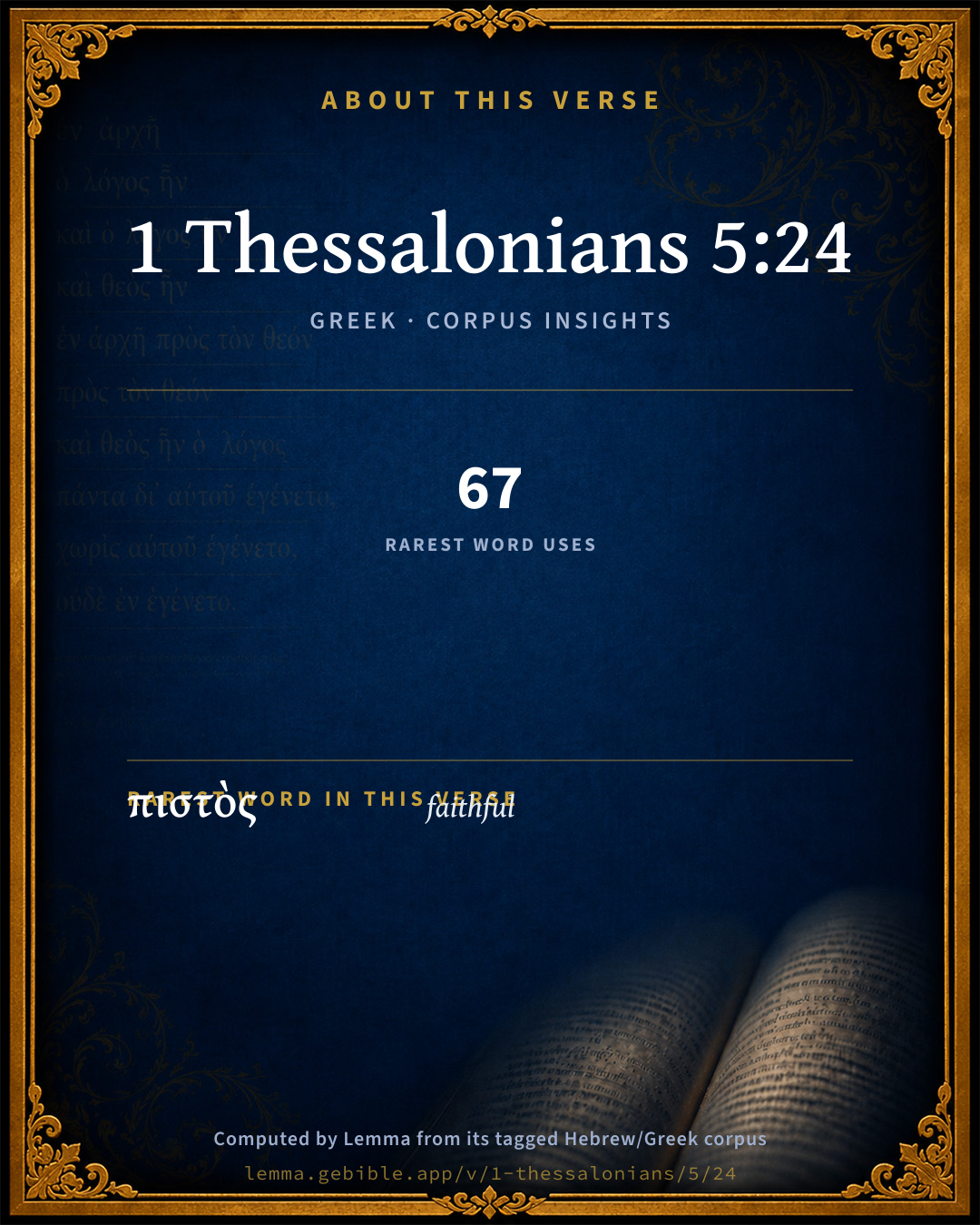
1 Thessalonians 5:24

Greek (Tischendorf 8th ed.) 1 Thessalonians 5:24 appears in the Greek New Testament. The text above is from the Tischendorf 8th edition. Each word links to its Strong’s number and a concise gloss. Click any word for its full Thayer’s Greek Lexicon entry.

Download image
Cite this verse

1 Thessalonians 5:24 (World English Bible). Public Domain. Lemma interlinear Bible study tool, https://lemma.gebible.app/v/1-thessalonians/5/24.

Show BibTeX & RIS
BibTeX
RIS
English Translation
Faithful is he who calls you, who will also do it.
World English Bible · Public Domain
Download a study sheet

One document with this verse’s original text, its word-by-word gloss line, the meaning frame, cross-references with their text, attributed commentary, and full source and license credits — printable, and it pastes into notes with its structure intact.

This verse Autodidact and up

Study sheet (.html) Plain text (.txt)

A passage Seminary Student

Up to 50 verses in one chapter. A passage sheet keeps up to 6 commentary sources and 12 cross-references per verse, in the order this page ranks them, and says so on the sheet whenever that leaves anything out. Ask for a single verse and you get the Autodidact verse sheet above.

Everything on this page stays free to read, with no account — the sheet is a download of what is already on screen, not access to it.

Want to remove ads? Support Godless Engineer
Compare translations 3

The same verse in 3 English versions, stacked beneath the original-language interlinear above. Click any original word for its lexicon entry.

Each is an independent rendering of the whole verse — the interlinear is not word-aligned to these translations.

Highlighted words mark where these versions differ — a whole-verse word diff, not a word-by-word alignment.

  • World English Bible Public Domain
    Faithful is he who calls you, who will also do it.
  • King James Version Public Domain
    Faithful is he that calleth you, who also will do it.
  • unfoldingWord Literal Text CC BY-SA 4.0
    Faithful the one calling you, who also will do.

unfoldingWord Literal Text — © unfoldingWord, licensed CC BY-SA 4.0. Word-aligned USFM3 via Door43 (git.door43.org/unfoldingWord/en_ult).

Versions to compare (up to 4)

3 of 4 selected

Show all 19 translations

Every available English version of this verse, each an independent rendering of the whole verse.

  • World English Bible Public Domain
    Faithful is he who calls you, who will also do it.
  • Berean Standard Bible Public Domain
    The One who calls you is faithful, and He will do it.
  • Majority Standard Bible Public Domain
    The One who calls you is faithful, and He will do it.
  • King James Version Public Domain
    Faithful is he that calleth you, who also will do it.
  • American Standard Version (1901) Public Domain
    Faithful is he that calleth you, who will also do it.
  • Revised Version (1885) Public Domain
    Faithful is he that calleth you, who will also do it.
  • Geneva Bible (1599) Public Domain
    Faithfull is hee which calleth you, which will also doe it.
  • Douay-Rheims (1899) Public Domain
    He is faithful who hath called you, who also will do it.
  • Young's Literal Translation Public Domain
    stedfast is He who is calling you, who also will do `it'.
  • Literal Standard Version CC BY-SA 4.0
    He who is calling you is steadfast, who also will do [it].
  • Unlocked Literal Bible CC BY-SA 4.0
    Faithful is he who calls you, the one who will also do it.
  • unfoldingWord Literal Text CC BY-SA 4.0
    Faithful the one calling you, who also will do.
  • Darby Bible Public Domain
    He [is] faithful who calls you, who will also perform [it].
  • World Messianic Bible Public Domain
    He who calls you is faithful, who will also do it.
  • Webster's Bible Public Domain
    Faithful is he that calleth you, who also will do it.
  • Free Bible Version CC BY-SA 4.0
    The one who calls you is trustworthy, and he will do this.
  • Bible in Basic English Public Domain
    God, by whom you have been marked out in his purpose, is unchanging and will make it complete.
  • Text-Critical English NT CC BY 4.0
    He who calls you is faithful; he will surely do it.
  • Tyndale New Testament (1534) Public Domain
    Faythfull is he which called you: which will also do it.

Literal Standard Version (2020), Covenant Press — licensed CC BY-SA 4.0. Text via the HelloAO Bible API (eBible.org). Unlocked Literal Bible (unfoldingWord) — licensed CC BY-SA 4.0. Text via the HelloAO Bible API (eBible.org). unfoldingWord Literal Text — © unfoldingWord, licensed CC BY-SA 4.0. Word-aligned USFM3 via Door43 (git.door43.org/unfoldingWord/en_ult). Free Bible Version, Dr. Jonathan Gallagher — licensed CC BY-SA 4.0. Text via the HelloAO Bible API (eBible.org).

Word by word

More ways to search: Search by grammar → Find every occurrence → Compare this word →

Practice this passage: Drill this verse → Learn its vocabulary →

πιστὸς
pistós
G4103
“faithful”
Adjective, Nominative, Singular, Masculine
Part of Speech
Adjective
Case
Nominative
Number
Singular
Gender
Masculine
Full Thayer's Definition

Origin: from G3982

TDNT: 08:54,8

1. trusty, faithful a. of persons who show themselves faithful in the transaction of business, the execution of commands, or the discharge of official duties b. one who kept his plighted faith, worthy of trust c. that can be relied on 2. easily persuaded a. believing, confiding, trusting b. in the NT one who trusts in God's promises 1. one who is convinced that Jesus has been raised from the dead 2. one who has become convinced that Jesus is the Messiah and author of salvation
  1. ὁ ho G3588 “the” Article, Nominative, Singular, Masculine
  2. καλῶν kaléō G2564 “to call” Verb, Present, Active, Participle, Nominative, Singular, Masculine
  3. ὑμᾶς hymeîs G5210 “you” Personal pronoun, 2nd person, Accusative, Plural
  4. ὃς hós G3739 “who” Relative pronoun, Nominative, Singular, Masculine
  5. καὶ kaí G2532 “and” Conjunction
  6. ποιήσει poiéō G4160 “to make” Verb, Future, Active, Indicative, 3rd person, Singular

About this verse

These counts appear in no published source. They are computed here, from the morphology-tagged text and Lemma’s own curated glosses. What Lemma adds →

7
words
7
distinct lemmas
Pauline Epistles
section

Cross-references

35

Topical passages linked to 1 Thessalonians 5:24 in the Treasury of Scripture Knowledge — connected by theme and wording, ordered by reader-vote popularity; previews shown in the World English Bible.

  • 2 Thessalonians 3:3 But the Lord is faithful, who will establish you, and guard you from the evil one.
  • Numbers 23:19 God is not a man, that he should lie, Neither the son of man, that he should repent: Has he said, and will he not do it? Or has he spoken, and will he not make it good?
  • Deuteronomy 7:9 Know therefore that Yahweh your God, he is God, the faithful God, who keeps covenant and loving kindness with them who love him and keep his commandments to a thousand generations,
  • 1 Corinthians 1:9 God is faithful, through whom you were called into the fellowship of his Son, Jesus Christ, our Lord.
  • 2 Timothy 2:13 If we are faithless, He remains faithful. He can't deny himself.
  • 1 Peter 5:10 But may the God of all grace, who called you to his eternal glory by Christ Jesus, after you have suffered a little while, perfect, establish, strengthen, and settle you.
  • Isaiah 25:1 Yahweh, you are my God; I will exalt you, I will praise your name; for you have done wonderful things, [even] counsels of old, in faithfulness [and] truth.
  • Lamentations 3:23 They are new every morning; great is your faithfulness.
  • John 3:33 He who has received his witness has set his seal to this, that God is true.
  • Psalms 138:2 I will bow down toward your holy temple, And give thanks to your Name for your loving kindness and for your truth; For you have exalted your Name and your Word above all.
  • Revelation 17:14 These will war against the Lamb, and the Lamb will overcome them, for he is Lord of lords, and King of kings. They also will overcome who are with him, called and chosen and faithful."
  • 2 Peter 1:3 seeing that his divine power has granted to us all things that pertain to life and godliness, through the knowledge of him who called us by his own glory and virtue;
  • Psalms 86:15 But you, Lord, are a merciful and gracious God, Slow to anger, and abundant in loving kindness and truth.
  • 1 Corinthians 10:13 No temptation has taken you except what is common to man. God is faithful, who will not allow you to be tempted above what you are able, but will with the temptation also make the way of escape, that you may be able to endure it.
  • 1 Thessalonians 2:12 to the end that you should walk worthily of God, who calls you into his own Kingdom and glory.
  • 2 Timothy 1:9 who saved us and called us with a holy calling, not according to our works, but according to his own purpose and grace, which was given to us in Christ Jesus before times eternal,
  • Titus 1:2 in hope of eternal life, which God, who can't lie, promised before eternal times;
  • Psalms 36:5 Your loving kindness, Yahweh, is in the heavens. Your faithfulness reaches to the skies.
  • Romans 8:30 Whom he predestined, those he also called. Whom he called, those he also justified. Whom he justified, those he also glorified.
  • Matthew 24:35 Heaven and earth will pass away, but my words will not pass away.
  • Galatians 1:15 But when it was the good pleasure of God, who separated me from my mother's womb, and called me through his grace,
  • Isaiah 14:24–26 Yahweh of Hosts has sworn, saying, Surely, as I have thought, so shall it happen; and as I have purposed, so shall it stand:
  • Psalms 89:2 I indeed declare, "Love stands firm forever. You established the heavens. Your faithfulness is in them."
  • Psalms 92:2 To proclaim your loving kindness in the morning, And your faithfulness every night,
  • Micah 7:20 You will give truth to Jacob, and mercy to Abraham, As you have sworn to our fathers from the days of old.
  • John 1:17 For the law was given through Moses. Grace and truth came through Jesus Christ.
  • Psalms 40:10 I have not hidden your righteousness within my heart. I have declared your faithfulness and your salvation. I have not concealed your loving kindness and your truth from the great assembly.
  • Isaiah 37:32 For out of Jerusalem shall go forth a remnant, and out of Mount Zion those who shall escape. The zeal of Yahweh of Hosts will perform this.
  • Romans 9:24 us, whom he also called, not from the Jews only, but also from the Gentiles?
  • 2 Thessalonians 2:14 to which he called you through our Gospel, for the obtaining of the glory of our Lord Jesus Christ.
  • Hebrews 6:17–18 In this way God, being determined to show more abundantly to the heirs of the promise the immutability of his counsel, interposed with an oath;
  • 2 Kings 19:31 For out of Jerusalem shall go forth a remnant, and out of Mount Zion those who shall escape: the zeal of Yahweh shall perform this.
  • Psalms 100:5 For Yahweh is good. His loving kindness endures forever, His faithfulness to all generations.
  • Psalms 146:6 Who made heaven and earth, The sea, and all that is in them; Who keeps truth forever;
  • Isaiah 9:7 Of the increase of his government and of peace there shall be no end, on the throne of David, and on his kingdom, to establish it, and to uphold it with justice and with righteousness from henceforth even forever. The zeal of Yahweh of Hosts will perform this.

Cross-references courtesy of OpenBible.info (CC BY 4.0).

Commentary

Notes on 1 Thessalonians 5:24 from classic Christian and Jewish commentators (each source and its license shown beneath its notes). The classic Christian expositions comment on the surrounding passage and are grouped to its opening verse, so a note may address several verses; the Jewish commentaries on the Tanakh (Rashi and others) are per-verse, so they appear only where the commentator wrote on this verse.

Lemma curates 59 commentaries, every one of them public domain or Creative Commons licensed, each selected and text-cleaned for this edition rather than reprinted as found. About our sources →

The Biblical Illustrator

Joseph S. Exell

1Th_5:24

Faithful is He that calleth you

The faith of man and the faithfulness of God

1.

The highest object of mans existence is to hold communion with God. For this his nature was framed, and in this alone will it find repose.

2. But the vital tie that connected us with heaven is broken. We are as a limb of the body separated by paralysis, or any other internal cause, from the benefits of the general circulation. God is the heart: we have insulated ourselves from God, and deadened the nerve that conducted his influences. We have a name to live but are dead.

3. This is a state of things deeply to be lamented; but no one ever lamented that the brute creation was shut out from the converse of angels--because there are no faculties in brutes that point to a higher destiny; no traces of a fall, nothing about them which makes it a practical contradiction that they should be as they are and yet what they are. But even in the natural man there are faint gleams of a something over and beyond his present state, a perpetual unhappiness, proving his designation for a different state of things originally.

4. Now without some notion of the extent of the loss, you can never estimate the value or nature of the restoration. It is by the length of the dark shadow that you compute the height of the elevation beyond it. It is by summing up the long catalogue of woe that you will be able to conceive the importance of that manifestation of mercy, whose object is, by the descent of God, to bind once more the broken links of communion.

5. The nature of this restoration. Man is separated from God as a criminal, and as unholy; the communion is restored by free pardon on Gods part for Christs sake, and the acceptance of that pardon upon mans, and by the process of sanctification which makes a lost and ruined soul at length meet for the inheritance of the saints.

6. Of this union with God the first great characteristic must be one which concerns both intellect and heart. It must behold Gods holiness, justice, and mercy, and must love the holiness, dread the justice, desire the mercy. This complex act of knowledge and affection is faith.

7. But in every perfect union there must be mutual confidence, and a strict fulfilment of enjoyments on both sides. If man be trustful, God must be faithful. This is the affirmation of the apostle. Thus faith in man and faithfulness in God are the two members of our spiritual harmony.

I. The Divine faithfulness is gloriously characteristic of the spiritual system to which we belong. No words can go beyond the confidence of David in the faithfulness of God, and no doubt high and spiritual meanings belong to his expressions of such confidence. Holiness was to be the foundation of all, but yet a holiness triumphant in visible majesty and regal pomp. But the faithfulness of our text has exclusive reference to sanctification. It was no relief from temporal evils that Paul promised; the mercy of God might send them to the lions; it was still His mercy, if it but kept them unspotted from the world. How many are content with such faithfulness as this? Is this the tenor of your prayers? Is your heart busy in pleading with God His own eternal faithfulness in behalf of your sanctification and spiritual safety?

II. The Divine faithfulness extends to the whole man. The entire, if feeble humanity, is sheltered under this canopy of Divine protection. The body is subdued into its place as minister to the soul; the soul is guarded from its own special corruptions; and the spirit is preserved undecayed amid an hostile world. Of a surety the sacred Trinity that occupies the throne of heaven will not forget this humble image of Their ineffable mystery. Surely the soul will be pre served by that creative Deity who first infused it into the frame; the body by that Eternal Son who was pleased to assume it; and the spirit, by that ever blessed Spirit who bestows it and may well guard His own inestimable gift.

III. This faithfulness is of Him that calleth you. It is a fidelity to His own gracious engagement. He without destroying human freedom or responsibility, of His free grace commences, continues and ends the whole Christian work. Yet so faithful is His compassion that He represents Himself as bound and tied to the impulses of His own unconstrained mercy. There is no bond but His own love, yet that bond is stronger than iron; and He, whom the universe cannot compel, commands Him self.

IV. With such a God, such promises and faithfulness, why is there a delay in appropriating so great salvation? If we believe that these things are true where is the earnest active faith, and where the life that answers to it? (W. Archer Butler, M. A.)

Gods faithfulness--Grandly did the old Scottish believer, of whom Dr. Brown tells us in his Horae Subsecivae, respond to the challenge of her pastor regarding the ground of her confidence. Janet, said the minister, what would you say, if after all He has done for you, God should let you drop into hell? Eens (even as) He likes, answered Janet. If He does, Hell lose mair than Ill do. At first sight Janets reply looks irreverent, if not something worse. As we contemplate it, however, its sublimity grows upon us. Like the Psalmist she could say, I on Thy Word rely (Psa_119:114, metrical version). If His Word were broken, if His faithfulness should fail, if that foundation could be destroyed, truly He would lose more than His trusting child. But that could never be. Forever, O Lord, Thy word is settled in heaven. Thy faithfulness is unto all generations. Well then might Janet encourage herself in the Lord her God, and say, God hath spoken in His holiness; I will rejoice. Assurance of victory--I can never conceive that it dispirits the soldier, when he is fighting, to tell him that he must win the victory. This is what Cromwells ironsides said when they saw the great general riding along the ranks, Tis he! they said, tis he! they felt the victory was sure where Cromwell was, and like thunderbolts they dashed upon their enemies, until as thin clouds before the tempest the foemen flew apace. The certainty of victory gives strength to the arm that wields the sword. To say to the Christian you shall persevere till you get to the journeys end--will that make him sit down on the next milestone? No; he will climb the mountain, wiping the sweat from his brow; and as he looks upon the plain, he will descend with surer and more cautious footsteps, because he knows he shall reach the journeys end. God Will speed the ship over the waves into the desired haven; will the conviction of that on the part of the captain make him neglect the vessel? Yes, if he be a fool; but if he be a man in his wits, the very certainty that he shall cross the deep will only strengthen him in time of storm to do what he would not have dreamt of doing if he had been afraid the vessel would be cast away. Brethren, let this doctrine impel us to a holy ardency of watchfulness, and may the Lord bless us and enable us to persevere to the end. (C. H. Spurgeon.)

The Biblical Illustrator, edited by Joseph S. Exell (c. 1880s–1900s) — public domain. Text from a community e-Sword module.

Tyndale Open Study Notes

Tyndale Open Resources

5:24 God will make this happen: Paul bases his confidence on the faithful character of God (1 Cor 1:9; 2 Thes 3:3; 2 Tim 2:13; 1 Jn 1:9).

Tyndale Open Study Notes — © Tyndale Open Resources, licensed CC BY-SA 4.0. Text via the HelloAO Bible API.

Bengel's Gnomon

Johann Albrecht Bengel

1Th 5:24. [34] Ὁ καλῶν ὑμᾶς) He, who has called you, so that He will not even now change His [purpose of grace in] calling you. This verse exhibits much of a triumphant spirit.—ποιήσει, will do it) will preserve you, 1Th 5:23. So that His calling of you may attain its designed end, Php 1:6; 1Pe 5:10; Rom 8:30.

[34] πιστὸς, faithful) In this short clause the whole summary of consolation is included. If you will enjoy your calling, rejoice in the faithfulness of Him who will do it.—V. g.

Bengel's Gnomon of the New Testament — English translation (T&T Clark, Edinburgh, 1860) — public domain. Text from a community e-Sword module.

Meyer's Critical & Exegetical Commentary

Heinrich August Wilhelm Meyer

1Th_5:24. Paul knows that he does not implore God in vain. For God is faithful; He keeps what He promises; if He has called the Thessalonians to a participation in His kingdom, He will preserve them pure and faultless even to its commencement.

πιστός] comp. 2Th_3:3; 1Co_1:9; 1Co_10:13. Τὸ πιστὸς ἀντὶ τοῦ ἀληθής, Theodoret.

ὁ καλῶν ὑμᾶς] not equivalent to ὁ καλέσας ὑμᾶς (Koppe and others), but the present participle used as a substantive, and therefore without regard to time: your Caller. See Winer, p. 316 [E. T. 444].

ὃς καὶ ποιήσει] who also will perform it, sc. τὸ ἀμέμπτως ὑμᾶς τηρηθῆναι.

Meyer — Critical and Exegetical Commentary on the New Testament — English translation by Peter Christie, edited by Frederick Crombie (T&T Clark, 1880) — public domain. Text from a community e-Sword module.

Expositor's Greek Testament

ed. W. Robertson Nicoll

1Th 5:24 . The call implies that God will faithfully carry out the process of ἁγιάζεσθαι and τηρεῖσθαι ( cf. Phi 1:6 ), which is the divine side of the human endeavour outlined in the preceding verse.

The Expositor's Greek Testament, edited by W. Robertson Nicoll (1897–1910) — public domain. Text from a community e-Sword module.

Geneva Bible (1599)

Geneva Bible translators

Who will also make you perfect.

The good will and power of God is a sure confirmation against all difficulties, whereof we have a sure witness in our vocation.

Always one and ever like himself, who performeth in deed whatsoever he promiseth: and an effectual calling is nothing else but a right declaring and true setting forth of God’s will: and therefore the salvation of the elect is safe and sure.

Geneva Bible (1599) marginal notes — public domain. Text via Bolls.life.

Jamieson, Fausset & Brown

Robert Jamieson, A. R. Fausset & David Brown

Faithful--to His covenant promises (Joh 10:27-29; Co1 1:9; Co1 10:23; Phi 1:6).

he that calleth you--God, the caller of His people, will cause His calling not to fall short of its designed end.

do it--preserve and present you blameless at the coming of Christ (Th1 5:23; Rom 8:30; Pe1 5:10). You must not look at the foes before and behind, on the right hand and on the left, but to God's faithfulness to His promises, God's zeal for His honor, and God's love for those whom He calls.

Jamieson, Fausset & Brown — Commentary Critical and Explanatory on the Whole Bible (1871) — public domain (CC PDM 1.0). Text via the HelloAO Bible API.

Adam Clarke's Commentary

Verse 24. Faithful is he that calleth you] In a great variety of places in his word God has promised to sanctify his followers, and his faithfulness binds him to fulfil his promises; therefore he will do it. He who can believe will find this thing also possible to him.

Adam Clarke's Commentary on the Bible (1810–1826) — public domain. Text from a community e-Sword/MySword module.

John Calvin's Commentaries

24 Faithful is he that hath called you. As he has shewn by his prayer what care he exercised as to the welfare of the Thessalonians, so he now confirms them in an assurance of Divine grace. Observe, however, by what argument he promises them the never-failing aid of God — because he has called them; by which words he means, that when the Lord has once adopted us as his sons, we may expect that his grace will continue to be exercised towards us. For he does not promise to be a Father to us merely for one day, but adopts us with this understanding, that he is to cherish us ever afterwards. Hence our calling ought to be held by us as an evidence of everlasting grace, for he will not leave the work of his hands incomplete. (Psalm 138:8) Paul, however, addresses believers, who had not been merely called by outward preaching, but had been effectually brought by Christ to the Father, that they might be of the number of his sons.

John Calvin's Commentaries (1540-1563) — public domain. Text from the Calvin Translation Society English edition (1840s-50s) via the Christian Classics Ethereal Library (ccel.org). Calvin's coverage is partial (roughly two-thirds of the Bible); uncommented books and verses are honest gaps, never fabricated. The 19th-century editor's footnotes and remarks are omitted so the notes are faithfully Calvin's own voice.

Ellicott's Commentary for English Readers

(24) Faithful is he.—A reason for hoping confidently that they will be blamelessly preserved. God would forfeit His character for keeping His promise, if He “called,” and did not enable men to obey the call. Of course He can only “do it” in case they continue willing to have it done. On the present tense, see Note on 1Th_2:12.

A Bible Commentary for English Readers, edited by Charles John Ellicott (1878–1897) — public domain. Text from a community e-Sword module.

The Cambridge Bible for Schools and Colleges

gen. ed. J. J. S. Perowne

24. Faithful is he that calleth you, who also will do it] who will also to it (R. V.). The Apostle often appeals to the faithfulness of God, as of One pledged to carry out what He promises in the Gospel; see 1Co_1:9; 2Ti_2:13, &c. The Thessalonians were conscious that God was calling them (ch. 1Th_2:12, see note) to a life of consecration to Himself, a consecration that claimed every power of their nature. This call was itself a proof of the possibility of their entire sanctification, which probably appeared to some of them a thing out of the question.

will do (the object is unexpressed),—as well as call. God will carry out His own purpose. His “calling” declared His intention toward the Thessalonians, which the Apostle declares He “will execute.” In the like emphatic sense “do” is frequently used of God in the O.T.: “Hath He said, and shall He not do?” (Num_23:19; comp. Psa_22:31, Isa_44:23; &c.). God is the great Doer in the work of man’s salvation, in deed true to His word; “no word from God shall be powerless” (Luk_1:37; comp. Php_2:13).

The Cambridge Bible for Schools and Colleges (gen. ed. J. J. S. Perowne; Cambridge University Press, 1878–1918) — public domain. Text from a community e-Sword module.

John Gill's Exposition

I charge you by the Lord,.... Or "I adjure by the Lord"; by the Lord Jesus: it is in the form of an oath, and a very solemn one; and shows that oaths may be used on certain and solemn occasions:

that this epistle be read unto all the holy brethren; to all the members of the church, who are called "holy", because they were sanctified or set apart by God the Father in election; and were sanctified by the blood of Christ, or their sins were expiated, or atoned for by the sacrifice of Christ in redemption; and were sanctified or made holy by the Spirit of God in regeneration; and were enabled by the grace of God to live holy lives and conversations. Now this epistle being directed only to some of the principal members of the church, it may be to one or more of their elders; lest he or they should be tempted on any account to conceal it, the apostle in a very solemn manner adjures, that it be read publicly to the whole church whom it concerned, that all might hear, and learn, and receive some advantage from it; from whence we may learn, as is observed by many interpreters, that the sacred Scriptures, neither one part nor another, nor the whole of them, are to be kept from private Christians, but may be read, and heard, and used by all.

John Gill's Exposition of the Whole Bible (1746–1763) — public domain (CC PDM 1.0). Text via the HelloAO Bible API.

Trapp's Complete Commentary

John Trapp

24 Faithful is he that calleth you, who also will do it.

Ver. 24. Faithfid is he, &c.] Prayer must be founded upon the faithfulness of God in fulfilling his promises. Hereby faith will be strengthened, and affection excited. Prayer is a putting the promises in suit.

John Trapp, A Commentary or Exposition upon All the Books of the Old and New Testament (1647–1656) — public domain. Text from a community e-Sword module.

Albert Barnes' Notes on the Bible

Faithful is he that calleth you - That is, your sanctification after all depends on him, and as he has begun a work of grace in your hearts, you may depend on his faithfulness to complete it; see the 1Th 4:3 note; Phi 1:6 note; 1Co 1:9 note.

Albert Barnes' Notes on the Bible (1834–1885) — public domain. Text from a community e-Sword/MySword module.

Matthew Poole's English Annotations

We had in the former verse the apostle’s prayer, here his faith; and he speaks it by way of consolation to them, that what he had prayed for God would effect. What need he then have prayed? Because God’s decrees and promises, though immutable and infallible, yet are to be accomplished in a way of prayer. Prayer is our duty, and God’s decrees and promises are no dispensation from our duty: besides, duties are more known to us than God’s decrees; and God decree the means as well as the end. But what is it he saith God will do? It is not here expressed, and the word it is not in the original, but only God will do, God will effect. He had prayed God would sanctify them wholly, and preserve them blameless, &c.; and this he would do or effect. And he grounds his confidence partly upon God’s calling them. For the apostle knew that God’s gifts and calling are without repentance; and whom he called, them he justified, and glorified, Rom 8:30; 11:29. And this the apostle saw in these Thessalonians, by that efficacy of the gospel upon their hearts, that they were effectually called and chosen, as 1Th 1:4; whence he concluded they should be at last wholly sanctified and finally preserved, which is a strong argument against final apostacy from a state of grace; though many that are outwardly called are never sanctified, much less wholly. But of this call the apostle speaks not here, at least not only. And partly also upon God’s faithfulness, who had called them. He doth not say, God is able to do it, though that is true, but he is

faithful, and will do it. Those that are effectually called are brought into God’s covenant, where perfection and perseverance are promised, and God’s faithfulness obligeth him to make good his covenant. It is an act of grace and mercy to call men; but when called, God’s faithfulness is engaged to preserve them, and perfect the work begun: as, 1Co 1:8, the apostle tells the Corinthians, God will confirm them, to the end they might be blameless in the day of Christ; and his argument is, for God is faithful, by whom ye were called, & c., 1Th 5:9.

Matthew Poole's English Annotations on the Holy Bible (1683–1685) — public domain. Text from a community e-Sword/MySword module.

Whedon's Commentary on the Bible

Daniel D. Whedon

24. Will do it—Not that the prayer would be surely accomplished in every individual; but that its non-fulfilment will be no fault of our faithful God. God will do it, if we will allow it to be done.

Daniel D. Whedon (gen. ed.), Commentary on the Old and New Testaments (1874–1909) — public domain. Text from a community e-Sword module.

The Pulpit Commentary

Faithful is he that calleth you. Paul knows that he does not beseech God in vain. He who calls you to the Christian faith is faithful to fulfill his promises. God"s calling is the commencement of a series which terminates in glorification. (Rom_8:30) A similar appeal to the faithfulness of God is elsewhere made by the apostle (1 Corinthians. (2Th_3:3) Who also will do it; namely, will preserve you blameless unto the coming of the Lord Jesus Christ.

God"s faithfulness.

Between the Divine call to salvation and the full accomplishment of salvation, the Christian needs faith to watch and wait, to work and walk through the darkness. The rock on which he must build this faith is God"s faithfulness.

I CHARACTERISTICS OF GOD"S FAITHFULNESS.

1. God performs what he promises. God promises in his Word. He promises most solemnly, and as it were by oath, in his covenants, e.g. with Noah, with Abraham, with Moses and Israel, and the new covenant sealed by the blood of Christ. God also promises by his actions. Natural instincts, such as the innate thirst for light, the yearning for immortality, etc., are the

2. Creator"s promises written on the very being of his creatures. God"s faithfulness means that he will not belie these promises.

3. God is true to himself. His consistency and immutability are the grounds of his faithfulness. Because he is true to himself he will be true to us: "The mercy of the Lord endureth for ever." If we are left to "the uncovenanted mercies" of God, these are large and sure enough to dispel all fear.

1. God justifies the confidence of his children. Faithfulness implies trustworthiness. If we commit our souls to God as to a faithful Creator, he accepts our trust, and thereby pledges his honor not to desert us.

II GROUNDS FOR BELIEVING IN GOD"S FAITHFULNESS.

1. Our knowledge of the nature of God. If we believe in God at all, we must believe in him as moral, good, nay, perfect. A weak and limited being may change and fail. God is too great to be faith less.

2. The testimony of those who can best speak for God. We judge of a person"s character largely on the evidence of those who have the most intimate acquaintance. Now we find prophets and saints who are nearest to God in thought and life most positive in asserting his faithfulness. Only they who dwell in the outer courts of his temple, or altogether away from his presence, venture to deny it.

3. The evidence afforded by the life of Christ. Christ was the great Revealer of the character of God; and Christ was faithful even to death.

4. The witness of history to the past faithfulness of God; e.g. the deliverance from Egypt, the return from the captivity, the advent of Christ, the presence of Christ in his Church to guide and strengthen and bless.

5. The confirmation of personal experience. Many have proved God"s faithfulness in their own lives. They can say, "This poor man cried, and the Lord heard him, and saved him out of all his" troubles.

III TEMPTATIONS TO DOUBT GOD"S FAITHFULNESS.

1. The weary time of waiting. God does not fulfill his promises as soon as he makes them. Long intervals try our faith. So was it with the Jewish expectation of the Messiah; so is it with the Christian expectation of the second advent. The heart is sickened with hope deferred. But this doubt is as foolish as that of one who, seeing the morning to be long in coming, begins to distrust the promise of sunrise.

2. Appearances of unfaithfulness. Nothing tries love so painfully as the necessity of so acting as to provoke doubts of its own constancy. Yet the truest love will not shrink from this necessity when it arises. God seems to desert us, or he visits us in chastisement. It is his greater faithfulness that leads him so to act as to cloud our vision of his love.

3. The unexpected fulfillment of Divine promises. God does not always fulfill his promises in the way expected by us. Then we are disappointed. But the error was in our previous delusion, not in any change on God"s part. Moreover, the true Divine fulfillment, though at first less pleasing to us than our expectation of it, always proves in the long run to be far better.

IV THE RESPONSE WHICH GOD"S FAITHFULNESS SHOULD CALL FORTH FROM US.

1. Adoration. The faithfulness of God is one of the most worthy themes of worship.

2. Trust Faithfulness merits confidence, and it encourages it.

3. Fidelity. If God is faithful to us, he has a right to bid us be faithful. W.F.A.

The Pulpit Commentary (1880–1919), ed. H.D.M. Spence-Jones & Joseph S. Exell — public domain. Text from a community e-Sword module.

John Wesley's Explanatory Notes

Who also will do it - Unless you quench the Spirit.

John Wesley, Explanatory Notes Upon the Whole Bible (1754–1765) — public domain. Text via the GEBible commentary corpus.

Burkitt's Expository Notes on the New Testament

William Burkitt

Here our apostle comforts the Thessalonians with the assurance that God, who had called them to the knowledge of Christianity, would do what he had prayed for, namely, sanctify them wholly, and preserve them blameless, and this because God is faithful, that is, always the same, true to his word. God will certainly do his part in and towards the work of sanctification and preservation; but in a way of concurrence with our care and industry; he will do nothing without us, as we can do nothing without him; God’s faithfulness is a pledge to us of the performance of all his promises, and will most certainly put him upon the performance of them; but his promise to us always supposes, yea, exacts from us, the use of all means, and particularly the exerting of our own endeavours, in order to our preservation in grace, and perseverance in holiness; Faithful is he that called you, who also will do it.

William Burkitt's Expository Notes on the New Testament (1700–1703) — public domain. Text from a community e-Sword module.

McGarvey & Pendleton's Commentaries

J. W. McGarvey

Faithful is he that calleth you, who will also do it . [If God were not thus faithful to sanctify and preserve blameless, it would be useless for him to call us; for it is certain that left to ourselves we can not keep ourselves from sin and evil-doing. This faithfulness is elsewhere noted ( 1Co_1:8-9 ; 1Co_10:13 ; 2Th_3:3 ; 1Jo_1:9 ); and is the basis of the glorious and sublime confidence expressed at Rom_8:31-39 ]

J. W. McGarvey (with Philip Y. Pendleton), Commentaries on the New Testament (The Fourfold Gospel, 1914; Acts; and the epistles) — public domain. Text from a community e-Sword/MySword module.

The People's New Testament

B. W. Johnson

24. Faithful is he. He who has called you is faithful, and if you trust him he will preserve you.

B. W. Johnson's The People's New Testament with Notes (1889–1891) — public domain. Electronic text from the Christian Classics Ethereal Library (CCEL) ThML edition.

Cambridge Greek Testament for Schools and Colleges

24. πιστὸς ὁ καλῶν ὑμᾶς, δς καὶ ποιήσει. Faithful is He that calls you, who also will do (it). The Thessalonians are conscious that God is calling them to a life of consecration to Himself, to be crowned by heavenly glory (see 1Th 2:12, 1Th 4:3, 1Th 5:18, and notes); He speaks in the Gospel as ὁ καλῶν: the “call” proves the possibility of the complete sanctification prayed for, since it pledges God’s all-sufficing aid to this effect. See 1Co 1:9; Php 1:6; Rom 11:29; 2Ti 2:13; Psa 57:2; Psa 138:8, for similar assumptions and tacit arguments. Elsewhere the Apostle points to the σφραγίς, or the ἀῤῥαβών, or the ἀπαρχή, “of the Spirit” as warranting the same certainty: see 2Co 1:22; Eph 1:13 f., Eph 4:30; Rom 8:14-17; Rom 8:23. Under the formula πιστὸς ὁ θεός (or κύριος) St Paul appeals to God’s fidelity, in various ways: see 2Th 3:3; 1Co 1:9; 1Co 10:13; 2Co 1:18; 2Ti 2:13; cf. Deu 7:9, Isa 49:7, &c. For the timeless present, ὁ καλῶν, see note on 1Th 2:12: it implies God’s abiding character.

Ποιήσει is elliptical and without expressed object: the verbs are apposed in their bare idea—“Your Caller will do”; God will put His summons into execution, He will not let it remain futile nor leave its fulfilment to man’s weakness. “Hath He said, and shall He not do?” Num 23:19; cf. Psa 22:31; Isa 44:23; Isa 55:11; Luk 1:37, &c.

Cambridge Greek Testament for Schools and Colleges (Cambridge University Press, 1896; 21 vols, various authors incl. Carr, Maclear, Plummer, Farrar, Lumby, Moule, M. R. James, Simcox) — public domain. Text from a community e-Sword module.

Alford’s Greek Testament

Henry Alford

24.] αὐτὸς δέ—contrast to all these feeble endeavours on your own part.

εἰρήνη here most probably in its wider sense, as the accomplishment of all these Christian graces, and result of the avoidance of all evil. It seems rather far-fetched to refer it back to ver. 13.

ὁλοτελεῖς seems to refer to the entireness of sanctification, which is presently expressed in detail. Jerome, who treats at length of this passage, ad Hedibiam (ep. cxx.) quæst. xii., vol. i. p. 1004, explains it, ‘per omnia vel in omnibus, sive plenos et perfectos:’ and so Pelt, ‘ut fiatis integri:’ and the reviewer of Mr. Jowett in the Journal of S. Lit., April, 1856: ‘sanctify you (to be) entire.’ But I prefer the other interpretation: in which case it = ὅλους.

καί introduces the detailed expression of the same wish from the lower side—in its effects.

ὁλόκληρον] emphatic predicate, as its position before the article shews: entire—refers to all three following substantives, though agreeing in gender with πνεῦμα, the nearest. Cf. besides reff., Lev 23:15, ἑπτὰ ἑβδομάδας ὁλοκλήρους.

τὸ πν. κ. ἡ ψυχ. κ. τὸ σῶμα] τὸ πνεῦμα is the spirit, the highest and distinctive part of man, the immortal and responsible soul, in our common parlance: ἡ ψυχή is the lower or animal soul, containing the passions and desires (αιτία κινήσεως ζωικῆς ζώων, Plato, Deff. p. 411), which we have in common with the brutes, but which in us is ennobled and drawn up by the πνεῦμα. That St. Paul had these distinctions in mind, is plain (against Jowett) from such places as 1Co 2:14. The spirit, that part whereby we are receptive of the Holy Spirit of God, is, in the unspiritual man, crushed down and subordinated to the animal soul (ψυχή): he therefore is called ψυχικὸς πνεῦμα μὴ ἔχων, Jud 1:19: see also note on 1 Cor. as above.

ἀμέμπτως defines and fixes ὁλόκληρον τηρηθ.: that, as Ellic., regarding quantity, this defining quality.

ἐν, for it will be in that day that the result will be seen,—that the ὁλοκληρον τηρηθῆναι will be accomplished.

24.] Assurance from God’s faithfulness, that it will be so.

πιστός (reff.)—true to His word and calling: ἀντὶ τοῦ ἀληθής, Thdrt.

ὁ καλῶν] not = ὁ καλέσας, but bringing out God’s office, as the Caller of his people: cf. Gal 5:8.

ποιήσει, viz. that which was specified in the last verse.

Henry Alford, The Greek Testament (1849–1861) — public domain. Text from a community e-Sword module.

International Critical Commentary

24. πιστὸς ὁ καλῶν κτλ The prayer of v. 23 will certainly be answered, for God is faithful. “This happens not from my prayers, he says, but from the purpose with which he called you” (Chrys.). This faithfulness of God has already been manifested when in keeping with his eternal choice (1:4) he called them (2:12) through the preaching of the gospel (II 2:14). But if the caller is faithful, he may also (και) be relied upon to perform the very thing involved in the call, namely, that for which Paul prayed, τὸ ἁγιάσαι καὶ τὸ τηρηθῆνα

In stating this assurance of faith (cf. 4:9-10) in the fewest words, Paul succeeds in putting in the forefront the main point, the faithfulness of God as caller and doer. It is to be observed that he does not even say that ὁ καλῶν ὐμᾶ (the participle is timeless as in 2:12) is God, though that is self-evident without recourse to v. 23, or to the Pauline turn πιστὸς ὁ θεό (1Co 1:9, 1Co 1:10:13, 2Co 1:18; cf. κύριο 2Th 3:3); nor does he say for what (2:12, 4:7) or through what (II 2:14) they are called; nor does he state the precise object of ποιήσε (cf. 2Co 8:10 f. Psa 36:5, Psa 51:11, etc.). It is better, however, to supply the object from v. 23 (Ell., Lft. and most) than to interpret generally: “will perform as surely as he calls, and everything promised or implied in the call” (Lillie, who notes Pelagius quod promisit and Œumenius ἐφʼ ᾦ ἐκάλεσε). Indeed some minuscules actually add from 2Co 1:7 τὴν ἐλπίδα (ὑμῶν) βεβαία (see Poole ad loc.). On the faithfulness of God, Grot. notes Isa 49:17 πιστός ἐστιν ο ἅγιος (τοῦ) Ἰσραήλ, καὶ ἐλεξάμην ς (cf. Deu 7:9, Deu 32:4, etc.).

VI. FINAL REQUESTS (5:25-27)

With an affectionate address (ἀδελφοι), Paul makes three more requests (note the triple exhortations in vv. 12-22 except vv 19-20) before closing the letter with the customary invocation of the grace of Christ. First, he bids the brethren in their prayers (v. 17) for themselves and others to remember also himself and his associates (v. 25). Next he bids them to greet for him all the brethren, with a tactful inclusion of the idlers (v. 26). Finally, with an abrupt change to the first person, he adjures them to see to it that the letter be read to all the brethren, presumably a covert admonition of the idlers who had apparently threatened to pay no heed to the epistolary injunctions of Paul.

25Brothers, pray for us as well (as for yourselves and others). 26Greet for us the brothers, all of them, with a holy kiss. 27I adjure you by the Lord that the present letter be read to the brothers, all of them.

International Critical Commentary — older volumes (1896–1929), various authors — public domain. Text from a community e-Sword module.

Vincent's Word Studies in the New Testament

Marvin R. Vincent

Faithful [πιστος] . Comp. 2Ti 2:13, and see on 1Jo 1:9; Rev 1:5; Rev 3:14.

That calleth [ο καλων] . = the caller. The emphasis is on the person rather than on the act. Comp. Rom 9:11; Gal 1:6, 15; Gal 5:8; 1Th 2:12; 1Pe 5:10; Jas 1:5.

Marvin R. Vincent, Word Studies in the New Testament (1887–1900) — public domain. Text from a community e-Sword/MySword module.

Lesson kit

Teaching starters — assembled from the data on this page, not authored interpretation. Every prompt links to the verse data it draws on. Edit before teaching.

1 Thessalonians, in the Pauline Epistles, opens this verse with 7 words (7 distinct Greek lemmas). Its most distinctive word is pistós (“faithful”). A historical commentator’s framing appears above. Read the whole chapter for the surrounding context.

Discussion questions

  1. How does “faithful” (pistós) shape what this verse is saying?
  2. 2 Thessalonians 3:3 shares this passage’s theme. How do the two illuminate each other?
  3. The translations on this page render this verse differently — a whole-verse word diff, not a word-by-word alignment. What might account for the different wordings?
  4. Reading how The Biblical Illustrator and Tyndale Open Study Notes read this verse, where do the two commentators agree and where do they part?

Things to notice

Reading settings

Reading text

Shown beneath each verse's original-language words.

Old Testament
Old Testament edition

Read the OT as the Masoretic Hebrew (MT) or the Greek Septuagint (LXX).

English shown for the Greek Septuagint (in the Hebrew ↔ Greek comparison).

Comparing translations? Open the Compare panel on any verse page to stack up to four side by side.