Romans 9:7

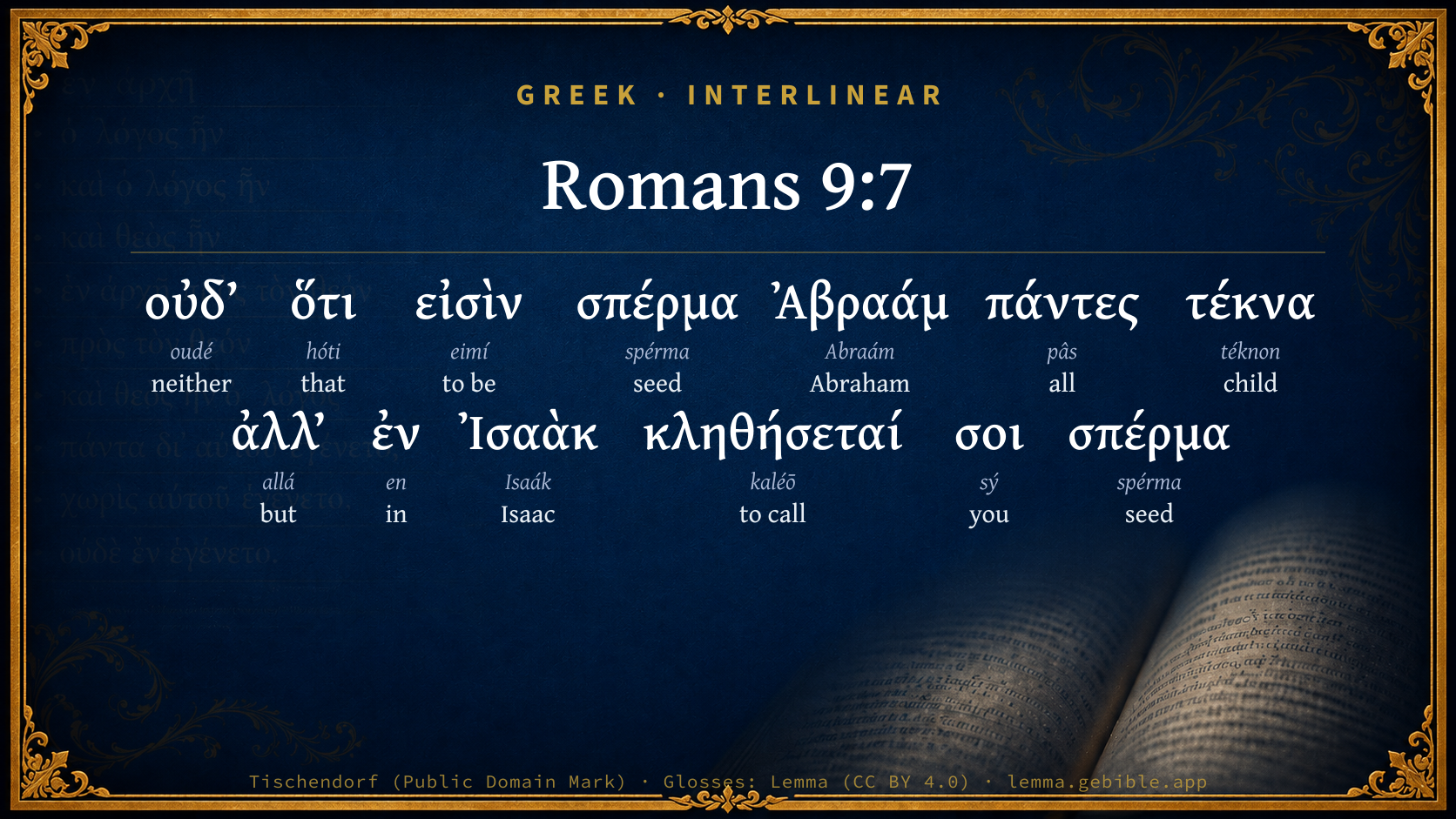
Greek (Tischendorf 8th ed.) Romans 9:7 appears in the Greek New Testament. The text above is from the Tischendorf 8th edition. Each word links to its Strong’s number and a concise gloss. Click any word for its full Thayer’s Greek Lexicon entry.
Download image
Cite this verse

Romans 9:7 (World English Bible). Public Domain. Lemma interlinear Bible study tool, https://lemma.gebible.app/v/romans/9/7.

Show BibTeX & RIS
BibTeX
RIS
English Translation
Neither, because they are Abraham's seed, are they all children. But, "In Isaac will your seed be called."
World English Bible · Public Domain
Download a study sheet

One document with this verse’s original text, its word-by-word gloss line, the meaning frame, cross-references with their text, attributed commentary, and full source and license credits — printable, and it pastes into notes with its structure intact.

This verse Autodidact and up

Study sheet (.html) Plain text (.txt)

A passage Seminary Student

Up to 50 verses in one chapter. A passage sheet keeps up to 6 commentary sources and 12 cross-references per verse, in the order this page ranks them, and says so on the sheet whenever that leaves anything out. Ask for a single verse and you get the Autodidact verse sheet above.

Everything on this page stays free to read, with no account — the sheet is a download of what is already on screen, not access to it.

Want to remove ads? Support Godless Engineer
Compare translations 3

The same verse in 3 English versions, stacked beneath the original-language interlinear above. Click any original word for its lexicon entry.

Each is an independent rendering of the whole verse — the interlinear is not word-aligned to these translations.

Highlighted words mark where these versions differ — a whole-verse word diff, not a word-by-word alignment.

  • World English Bible Public Domain
    Neither, because they are Abraham's seed, are they all children. But, "In Isaac will your seed be called."
  • King James Version Public Domain
    Neither, because they are the seed of Abraham, are they all children: but, In Isaac shall thy seed be called.
  • unfoldingWord Literal Text CC BY-SA 4.0
    Neither that all the children are seed of Abraham. But, “In Isaac your seed will be called.”

unfoldingWord Literal Text — © unfoldingWord, licensed CC BY-SA 4.0. Word-aligned USFM3 via Door43 (git.door43.org/unfoldingWord/en_ult).

Versions to compare (up to 4)

3 of 4 selected

Show all 18 translations

Every available English version of this verse, each an independent rendering of the whole verse.

  • World English Bible Public Domain
    Neither, because they are Abraham's seed, are they all children. But, "In Isaac will your seed be called."
  • Berean Standard Bible Public Domain
    Nor because they are Abraham’s descendants are they all his children. On the contrary, “Through Isaac your offspring will be reckoned.”
  • Majority Standard Bible Public Domain
    Nor because they are Abraham’s descendants are they all his children. On the contrary, “Through Isaac your offspring will be reckoned.”
  • King James Version Public Domain
    Neither, because they are the seed of Abraham, are they all children: but, In Isaac shall thy seed be called.
  • American Standard Version (1901) Public Domain
    neither, because they are Abraham's seed, are they all children: but, In Isaac shall thy seed be called.
  • Revised Version (1885) Public Domain
    neither, because they are Abraham’s seed, are they all children: but, In Isaac shall thy seed be called.
  • Geneva Bible (1599) Public Domain
    Neither are they all children, because they are the seede of Abraham: but, In Isaac shall thy seede be called:
  • Young's Literal Translation Public Domain
    nor because they are seed of Abraham `are' all children, but -- `in Isaac shall a seed be called to thee;'
  • Literal Standard Version CC BY-SA 4.0
    nor because they are seed of Abraham [are] all children, but, “in Isaac will a seed be called to you”;
  • Unlocked Literal Bible CC BY-SA 4.0
    Neither are all Abraham's descendants truly his children. But, “It is through Isaac that your descendants will be called.”
  • unfoldingWord Literal Text CC BY-SA 4.0
    Neither that all the children are seed of Abraham. But, “In Isaac your seed will be called.”
  • Darby Bible Public Domain
    nor because they are seed of Abraham [are] all children: but, In Isaac shall a seed be called to thee.
  • World Messianic Bible Public Domain
    Neither, because they are Abraham’s offspring, are they all children. But, “your offspring will be accounted as from Isaac.”
  • Webster's Bible Public Domain
    Neither because they are the seed of Abraham, are they all children: but, In Isaac shall thy seed be called.
  • Free Bible Version CC BY-SA 4.0
    and not all those who are descended from Abraham are his true children. For Scripture says, “Your descendants will be counted through Isaac,”
  • Bible in Basic English Public Domain
    And they are not all children because they are the seed of Abraham; but, In Isaac will your seed be named.
  • Text-Critical English NT CC BY 4.0
    and not all of Abraham's children are his true descendants, but, “Through Isaac yoʋr descendants will be counted.”
  • Tyndale New Testament (1534) Public Domain
    nether are they all chyldren strayght waye because they are the seed of Abraham. But in Isaac shall thy seede be called:

Literal Standard Version (2020), Covenant Press — licensed CC BY-SA 4.0. Text via the HelloAO Bible API (eBible.org). Unlocked Literal Bible (unfoldingWord) — licensed CC BY-SA 4.0. Text via the HelloAO Bible API (eBible.org). unfoldingWord Literal Text — © unfoldingWord, licensed CC BY-SA 4.0. Word-aligned USFM3 via Door43 (git.door43.org/unfoldingWord/en_ult). Free Bible Version, Dr. Jonathan Gallagher — licensed CC BY-SA 4.0. Text via the HelloAO Bible API (eBible.org).

Word by word

More ways to search: Search by grammar → Find every occurrence → Compare this word →

Practice this passage: Drill this verse → Learn its vocabulary →

About this verse

These counts appear in no published source. They are computed here, from the morphology-tagged text and Lemma’s own curated glosses. What Lemma adds →

13
words
12
distinct lemmas
Pauline Epistles
section

Notable vocabulary

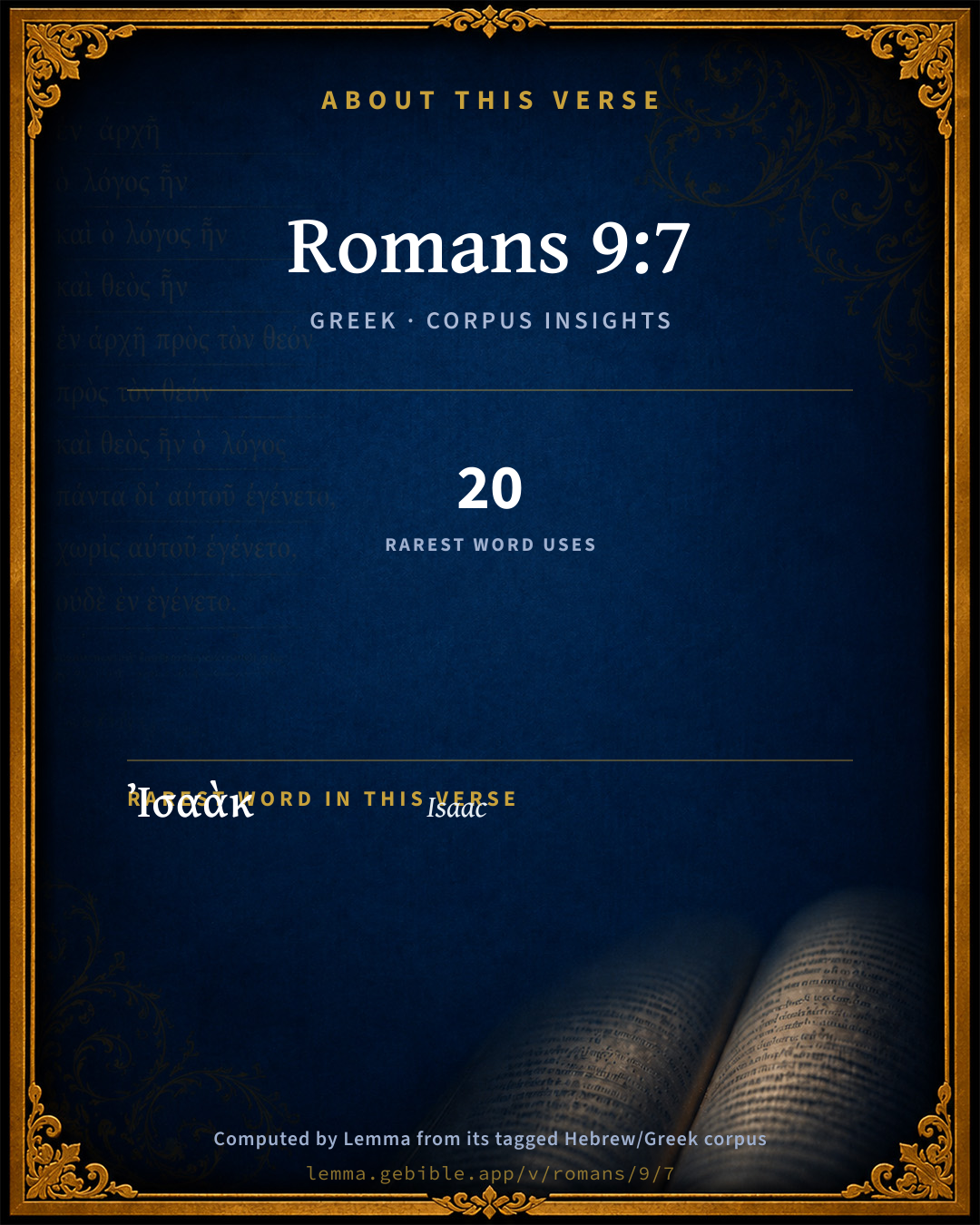
The rarest word here is Ἰσαὰκ Isaac G2464 — appearing just 20 times in the whole Greek New Testament.

Shared distinctive vocabulary

Ἰσαὰκ Isaac G2464 occurs in 18 verses of the Greek New Testament. Also found in:

Repetition

A word recurs within this verse:

  • σπέρμα seed G4690 ×2

Cross-references

9

Topical passages linked to Romans 9:7 in the Treasury of Scripture Knowledge — connected by theme and wording, ordered by reader-vote popularity; previews shown in the World English Bible.

  • Genesis 21:12 God said to Abraham, "Don't let it be grievous in your sight because of the boy, and because of your handmaid. In all that Sarah says to you, listen to her voice. For from Isaac will your seed be called.
  • Hebrews 11:18 even he to whom it was said, "In Isaac will your seed be called;"
  • John 8:37–39 I know that you are Abraham's seed, yet you seek to kill me, because my word finds no place in you.
  • Galatians 4:23 However, the son by the handmaid was born according to the flesh, but the son by the free woman was born through promise.
  • Luke 3:8 Bring forth therefore fruits worthy of repentance, and don't begin to say among yourselves, 'We have Abraham for our father;' for I tell you that God is able to raise up children to Abraham from these stones!
  • Philippians 3:3 For we are the circumcision, who worship God in the Spirit, and rejoice in Christ Jesus, and have no confidence in the flesh;
  • Luke 16:24–25 He cried and said, 'Father Abraham, have mercy on me, and send Lazarus, that he may dip the tip of his finger in water, and cool my tongue! For I am in anguish in this flame.'
  • Luke 16:30 "He said, 'No, father Abraham, but if one goes to them from the dead, they will repent.'
  • John 8:33 They answered him, "We are Abraham's seed, and have never been in bondage to anyone. How do you say, 'You will be made free?'"

Cross-references courtesy of OpenBible.info (CC BY 4.0).

Commentary

Notes on Romans 9:7 from classic Christian and Jewish commentators (each source and its license shown beneath its notes). The classic Christian expositions comment on the surrounding passage and are grouped to its opening verse, so a note may address several verses; the Jewish commentaries on the Tanakh (Rashi and others) are per-verse, so they appear only where the commentator wrote on this verse.

Lemma curates 59 commentaries, every one of them public domain or Creative Commons licensed, each selected and text-cleaned for this edition rather than reprinted as found. About our sources →

Tyndale Open Study Notes

Tyndale Open Resources

9:7 This quotation is from Gen 21:12, which God spoke to Abraham when he was reluctant to follow Sarah’s advice to banish his son Ishmael, who was born to the slave woman Hagar. God assured Abraham that Sarah’s child, Isaac, was the son through whom God’s promises would be fulfilled.

Tyndale Open Study Notes — © Tyndale Open Resources, licensed CC BY-SA 4.0. Text via the HelloAO Bible API.

Bengel's Gnomon

Johann Albrecht Bengel

Rom 9:7. Ὅτι) because; this particle makes an epitasis[112] in respect of the preceding sentence.—Αβραὰμ, of Abraham) That, which happened to the children of the Fathers in the most ancient times, may much more happen to their later descendants.—ἀλλʼ ἐν Ἰσαὰκ, κ.τ.λ., but in Isaac, etc.) This clause is put as a “Suppositio Materialis” [end.]; for we supply, it was written, and it is being fulfilled, LXX., Gen 21:12: ὅτι ἐν σπέρμα. Here we even find a suitableness in the origin of the name Isaac; for they are the seed, who embrace the covenant of grace with a pure and noble-minded joy, Gen 17:19 [Isaac Heb. = laughter, joy].

[112] Appendix. An addition made to a previous enunciation, to explain, or give emphasis.

Bengel's Gnomon of the New Testament — English translation (T&T Clark, Edinburgh, 1860) — public domain. Text from a community e-Sword module.

Meyer's Critical & Exegetical Commentary

Heinrich August Wilhelm Meyer

Rom_9:7. Nor yet, because they are descendants of Abraham, are they all (his) children.

Before οὐδʼ a colon only is correct, because the discourse proceeds continuously, annexing denial to denial.

εἰσί] The subject is that of the previous clause, οἱ ἐξ Ἰσραήλ. The τέκνα of Abraham, as significantly contrasted with the mere bodily descendants (σπέρμα), are those destined by God to receive the promised salvation. Comp. Mat_3:9; Joh_8:33; Joh_8:39; Justin, c. Tryph. 44. That it is not Gods children that are to be understood (although they are such), as, after Theodoret and several others, Glöcker afresh takes it, is manifest from the foregoing parallel οὗτοι Ἰσραήλ, and from the fact that it is not till afterwards that τέκνα τ. Θεοῦ are spoken of.

Wrongly, but in consequence of his erroneous understanding of the ὅτι, Rom_9:6, Hofmann regards οὐδʼ ὅτι εἰσὶ σπ. Ἀβρ. as the negation of a second ground of the ηὐχόμην, so that then a new sentence begins with πάντες τέκνα. This view the obvious correlation of οὐδʼ … τέκνα with the preceding οὐ γὰρ πάντες κ.τ.λ. should have precluded.

After ἀλλʼ we are not to supply γέγραπται or οὕτως ἐῤῥέθη, which would be quite arbitrary; but the saying in Gen_21:12, which is well known to the reader as a saying of God, is subjoined unaltered and immediately (comp. Gal_3:11-12; 1Co_15:27) without a καθὼς γέγραπται (Rom_15:3; 1Co_1:31) or the like being introduced, or the second person being altered into the third; simply because it is taken for granted that the saying is one well known.

ἐν Ἰς. κληθ. σοι σπέρμα] closely after the LXX., which renders the original literally. In the original text we read בְּיִצְחָק יִקָּרֵא לְךָ זָרַע: through Isaac posterity shall be named to thee, i.e. through Isaac it will come to pass to thee, that posterity of thine shall have the status and the name of the σπέρμα Ἀβρ. (comp. Heb_11:18); the descendants of Isaac (consequently not the Ishmaelites) shall be recognised as thy posterity (and therewith as the heirs of the divine promise). But the apostle has otherwise apprehended the sense of the passage according to its typical reference; for it is evident from the relation of Rom_9:9 to Rom_9:8, that he limited that saying to the person of Isaac himself, who (not Ishmael) was the promised child of Abraham, and thus represented in himself the character of the true posterity of Abraham accounted as such by God. Hence, in the sense of the apostle: In the person of Isaac will a descendant be named to thee; i.e. Isaac will be he, in whose person the notion descendant of Abraham shall be represented and recognised. Paul finds in this divine declaration the idea enunciated (Rom_9:8), that not on bodily descent (which was also the case with Ishmael), but on divine promise (which was the case with Isaac, Rom_9:9), the true sonship of Abraham is founded. Usually (not by Philippi and Ewald, who concur with our view) the passage is understood, conformably to the historical sense of the original, not of the person of Isaac, but of his posterity; which, because Isaac himself was the son of promise, represents the true descendants of Abraham according to the promise. But to this posterity all Israelites certainly belonged, and it would therefore be inappropriate to set them down, by virtue of their extraction from Isaac, as the type of the true sonship of Abraham, when the very claim to that sonship, resting upon bodily descent, is to be withdrawn from them. The person of Isaac himself, as contrasted with Ishmael, was this type, which was thereupon repeated in Jacob, as contrasted with Esau (in their persons), Rom_9:10-13. Chrysostom aptly indicates the reference to Isaac himself: διὰ γὰρ τοῦτο εἶπεν· ἐν Ἰς. κλ. ς. σπ., ἵνα μάθῃς, ὅτι οἱ τῷ τρόπῳ τούτῳ γεννώμενοι τῷ κατὰ τὸν Ἰσαὰκ, οὗτοι μάλιστά εἰσι τὸ σπέρμα τοῦ Ἀβραάμ· πῶς οὖν ὁ Ἰσαὰκ ἐγεννήθη; οὐ κατὰ νὸμον φύσεως, οὐδὲ κατὰ δύναμιν σαρκὸς, ἀλλὰ κατὰ δύναμιν ἐπαγγελίας.

κληθήσεται] nominabitur. See Winer, p. 571 f. [E. T. 769]; Eur. Hec. 625, and Pflugk, in loc. The opinion of Reiche, that ΚΑΛ. denotes to call out of nothing (see on Rom_4:7), which it signifies also in Gen_21:12, so that the sense would be: In the person of Isaac a descendant will be imparted to thee, is erroneous, because that saying of God was uttered after the birth of Isaac.

ΣΟΙ] Dative of ethical reference.

ΤΟῦΤʼ ἜΣΤΙΝ] This purports, thereby the idea is expressed. Rightly Grotius: Haec vox est explicantis ὑπόνοιαν latentem, quod דרש dicitur Hebraeis.

τέκνα τ. Θεοῦ] Paul characterizes the true descendants of Abraham, who are not so from bodily generation, as Gods children, that is, as such descendants of the ancestor, whose Abrahamic sonship is not different in the idea of God from that of sonship to Him, so that they are regarded and treated by God as His children.

ΤᾺ ΤΈΚΝΑ Τῆς ἘΠΑΓΓ.] might mean: the promised children (so van Hengel); for the promised child of Abraham was Isaac (Rom_9:9), whose birth was the realization of a promise (and so Hofmann takes it). But that Paul had the conception that Isaac was begotten by, virtue of the divine promise, is evident from Gal_4:23 (see in loc.), and therefore the genitive (as also previously τῆς σαρκός) is to be taken causatively: the children of Abraham who originate from the divine promise, who are placed in this their relation of sonship to Abraham through the creative power of the divine promise, analogously to the begetting of Isaac; ἡ τῆς ἐπαγγελίας ἰσχὺς ἔτεκε τὸ παιδίον, Chrysostom.

λογίζεται] by God. Comp. Rom_4:3; Rom_4:5.

εἰς σπέρμα] that is, as an Abrahamic posterity. See Rom_9:7. To understand Gentiles also, is here foreign to the context (in opposition to Beyschlag); see. Rom_9:9-13. Abrahams race is treated of, to which not all who descend from him are without distinction reckoned by God as belonging.

Meyer — Critical and Exegetical Commentary on the New Testament — English translation by Peter Christie, edited by Frederick Crombie (T&T Clark, 1880) — public domain. Text from a community e-Sword module.

Expositor's Greek Testament

ed. W. Robertson Nicoll

Rom 9:7 . Nor because they are Abraham’s seed, are they all τέκνα , i.e. , children in the sense which entitles them to the inheritance, Rom 4:11 , Rom 8:17 . God from the very first made a distinction here, and definitely announced that the seed of Abraham to which the promise belonged should come in the line of Isaac not of Ishmael, though he also could call Abraham father. Ἐν Ἰσαὰκ κληθήσεταί σοι σπέρμα = Gen 21:12 , LXX. The words literally mean that in the line of Isaac Abraham should have the posterity which would properly bear his name, and inherit the promises made to him by God. Isaac’s descendants are the true Abrahamidae.

The Expositor's Greek Testament, edited by W. Robertson Nicoll (1897–1910) — public domain. Text from a community e-Sword module.

International Critical Commentary

7. οὐδʼ ὅτι. The grammatical connexion of this passage with the preceding is that of an additional argument; the logical connexion is that of a proof of the statement just made. St. Paul could give scriptural proof, in the case of descent from Abraham, of what he had asserted in the case of descent from Jacob, and thus establish his fundamental principle—that inheritance of the promises is not the necessary result of Israelitish descent.

σπέρμα Ἁβραάμ. The word σπέρμα is used in this verse, first of natural seed or descent, then of seed according to the promise. Both senses occur together in Gen 21:12, Gen 21:13; and both are found elsewhere in the N. T., Gal 3:29 εἰ δὲ ὑμεῖς Χριστοῦ, ἄρα τοῦ Ἁβραὰμ σπέρμα ἐστέ: Rom 11:1 ἐγὼ … ἐκ σπέρματος Ἁβραάμ. The nominative to the whole sentence is πάντες οἱ ἐξ Ἰσραήλ. ‘The descendants of Israel have not all of them the legal rights of inheritance from Abraham because they are his offspring by natural descent.’

ἀλλʼ. Instead of the sentence being continued in the same form as it began in the first clause, a quotation is introduced which completes it in sense but not in grammar: cf. Gal 3:11, Gal 3:12; 1Co 15:27.

ἐν Ἰσαὰκ κληθήσεταί σοι σπέρμα: ‘in (i.e. through) Isaac will those who are to be your true descendants and representatives be reckoned.’ ἐν (as in Col 1:16 ἐν αὐτῷ ἐκτίσθη τὰ πάντα) implies that Isaac is the starting-point, place of origin of the descendants, and therefore the agent through whom the descent takes place; so Mat 9:34 ἐν τῷ ἄρχοντι τῶν δαιμονίων: 1Co 6:2. σπέρμα (cf. Gen 12:7 τῷ σπέρματί σου δώσω τὴν γῆν: Gen 15:5 οὕτως ἔσται τὸ σπέρμα σου) is used collectively to express the whole number of descendants, not merely the single son Isaac. The passage means that the sons of Israel did not inherit the promise made to Abraham because they were his offspring—there were some who were his offspring who had not inherited them; but they did so because they were descendants of that one among his sons through whom it had been specially said that his true descendants should be counted.

The quotation is taken from the LXX of Gen 21:12, which it reproduces exactly. It also correctly reproduces both the language and meaning of the original Hebrew. The same passage is quoted in Heb 11:18.

The opinion expressed in this verse is of course exactly opposite to the current opinion—that their descent bound Israel to God by an indissoluble bond. See the discussion at the end of this section.

κληθήσεται: ‘reckoned,’ ‘considered,’ ‘counted as the true σπέρμα’; not as in ver. 11, and as it is sometimes taken here, called,’ ‘summoned’ (see below).

The uses of the word καλέω are derived from two main significations, (1) to ‘call,’ ‘summon,’ (2) to ‘summon by name,’ hence ‘to name.’ It may mean (1) to ‘call aloud’ Heb 3:13, to ‘summon,’ to ‘summon to a banquet’ (in these senses also in the LXX), so 1Co 10:27; Mat 22:3; from these is derived the technical sense of ‘calling to the kingdom.’ This exact usage is hardly found in the LXX, but Isa 42:6 (ἐγὼ Κύριος ὁ Θεὸς ἐκάλεσά σε ἐν δικαιοσύνῃ), Isa 51:2 (ὅτι εἷς ἦν καὶ ἐκάλεσα αὐτόν, καὶ εὐλόγησα αὐτὸν καὶ ἠγάπησα αὐτὸν καὶ ἐπλήθυνα αὐτόν) approach it. In this sense it is confined to the epistles of St. Paul with Hebrews and St. Peter, the word hardly occurring at all in St. John and not in this sense elsewhere (although κλητός is so used Mat 22:14). The full construction is καλεῖν τινα εἴς τι, 1Th 2:12 τοῦ καλοῦντος ὑμᾶς εἰς τὴν ἑαυτοῦ βασιλείαν καὶ δόξαν: but the word was early used absolutely, and so ὁ καλῶν of God (so Rom 4:17; Rom 8:30; Rom 9:11, Rom 9:24). The technical use of the term comes out most strongly in 1Co_7 and in the derived words (see on κλητός Rom 1:1, Rom 1:7). (2) In the second group of meanings the ordinary construction is with a double accusative, Act 14:12 ἐκάλουν τε τὸν Βαρνάβαν Δία (so Rom 9:25, and constantly in LXX), or with ὀνόματι, ἐπὶ τῷ ὀνόματι as Luk 1:59, Luk 1:61, although the Hebraism καλέσουσι τὸ ὄνομα αὐτοῦ Ἐμμανουήλ (Mat 1:23) occurs. But to ‘call by name’ has associations derived on the one side from the idea of calling over, reckoning, accounting; hence such phrases as Rom 9:7 (from Gen 21:12 LXX), and on the other from the idea of affection suggested by the idea of calling by name, so Rom 9:26 (from LXX Hos 2:1 [1:10]). These derivative uses of the word occur independently both in Greek, where κέκλημαι may be used to mean little more than ‘to be,’ and in Hebrew. The two main meanings can always be distinguished, but probably in the use of the word each has influenced the other; when God is said to be ‘He that calls us’ the primary idea is clearly that of invitation, but the secondary idea of ‘calling by name,’ i.e. of expressing affection, gives a warmer colouring to the idea suggested.

International Critical Commentary — older volumes (1896–1929), various authors — public domain. Text from a community e-Sword module.

Hodge's Commentary on Romans, Ephesians & First Corinthians

Charles Hodge

Rom_9:7

Neither because they are the seed of Abraham are they all children. In this and the following verses the sentiment is confirmed, that natural descent from Abraham does not secure a portion in the promised inheritance. The language of this verse is, from the context, perfectly intelligible. The seed, or natural descendants of Abraham, are not all his children in the true sense of the term; i.e., like him in faith, and heirs of his promise. So in Gal_3:7, Paul says, They which are of faith, the same are the children of Abraham. This verse is part of the sentence begun in the preceding verse. It presents the same idea in a different form. All the descendants of Israel are not the true Israel, neither are all the seed of Abraham his (true, or spiritual) children. Children, viz., of Abraham. Others supply τοῦ Θεοῦ, the seed of Abraham are not all children of God. This is true, but it is not what the apostle here says. His object is to show that the promises made to the children of Abraham were not made to his natural descendants as such.

But in Isaac shall thy seed be called.

1. As the word rendered called sometimes means to choose, Isa_48:12, Isa_49:1, the meaning of the phrase may be In Isaac shall thy seed be chosen. I will select him as the recipient of the blessings promised to you.

2. To be called is often equivalent to be, to be regarded, as Isa_62:4, Thou shalt not be called desolate, i.e., thou shalt not be desolate. Hence, in this case, the text may mean, In Isaac shall thy seed be, i.e., he shall be thy seed. Or,

3. After Isaac shall thy seed be called, they shall derive their name from him. Shall be named, i.e. shall be so regarded and recognized. Not all the children of Abraham were made the heirs of his blessings, but Isaac was selected by the sovereign will of God to be the recipient of the promise. This is the general meaning of the passage; but here, as before, it may be understood either of the individual Isaac, or of his descendants. Isaac shall be to thee for a seed; or, Through Isaac shall a seed be to thee. The former is the more consistent with the context, because Pauls immediate object is to show that natural descent from Abraham did not make a man one of his true seed. Ishmael was a son of Abraham as well as Isaac, but the latter only was, in the spiritual sense of the term, his seed. The Greek here answers exactly to the original Hebrew, In Isaac a seed shall be called to thee, or for thee. That is, Isaac (not Ishmael) shall be to thee a son and heir. God therefore is sovereign in the distribution of his favors. As he rejected Ishmael notwithstanding his natural descent from Abraham, so he may reject the Jews, although they also had Abraham as a father.

Charles Hodge — Commentary on Romans (1835), First Corinthians (1857), and Ephesians (1856) — public domain. Text from a community e-Sword module.

Geneva Bible (1599)

Geneva Bible translators

The first proof is taken from the example of Abraham’s own house, wherein Isaac only was counted the son, and that by God’s ordinance: although that Ishmael also was born of Abraham, and circumcised before Isaac.

Isaac shall be thy true and natural son, and therefore heir of thy blessing.

Geneva Bible (1599) marginal notes — public domain. Text via Bolls.life.

Jamieson, Fausset & Brown

Robert Jamieson, A. R. Fausset & David Brown

Neither, because they are the seed of Abraham, are they all children--"Not in the line of mere fleshly descent from Abraham does the election run; else Ishmael, Hagar's child, and even Keturah's children, would be included, which they were not."

but--the true election are such of Abraham's seed as God unconditionally chooses, as exemplified in that promise.

in Isaac shall thy seed be called-- (Gen 21:12).

Jamieson, Fausset & Brown — Commentary Critical and Explanatory on the Whole Bible (1871) — public domain (CC PDM 1.0). Text via the HelloAO Bible API.

Adam Clarke's Commentary

Verse 7. Neither because they are the seed of Abraham, c.] Nor can they conclude, because they are the natural descendants of Abraham, that therefore they are all of them, without exception, the children in whom the promise is to be fulfilled.

But, in Isaac shall thy seed be called.] The promise is not confined to immediate natural descent, but may be accomplished in any part of Abraham's posterity. For Abraham had several sons besides Isaac, Ge 25:1, Ge 25:2, particularly Ishmael, who was circumcised before Isaac was born, and in whom Abraham was desirous that the promise should be fulfilled, Ge 17:18, and in him God might have fulfilled the promise, had he so pleased and yet he said to Abraham, Ge 21:12: Not in Ishmael, but in Isaac, shall thy seed be called.

Adam Clarke's Commentary on the Bible (1810–1826) — public domain. Text from a community e-Sword/MySword module.

John Calvin's Commentaries

7. But, “In Isaac shall thy seed be called.” Paul mentions this, to show that the hidden election of God overrules the outward calling, and that it is yet by no means inconsistent with it, but, on the contrary, that it tends to its confirmation and completion. That he might then in due order prove both, he in the first place assumes, that the election of God is not tied to the natural descendants of Abraham, and that it is not a thing that is included in the conditions of the covenant: and this is what he now confirms by a most suitable example. For if there ought to have been any natural progeny, which fell not away from the covenant; this ought to have been especially the case with those who obtained the privilege at first: but when we find, that of the first sons of Abraham, while he was yet alive, and the promise new, one of them was separated as the seed, how much more might the same thing have taken place in his distant posterity? Now this testimony is taken from Genesis 17:20, where the Lord gives an answer to Abraham, that he had heard his prayer for Ishmael, but that there would be another on whom the promised blessing would rest. It hence follows, that some men are by special privilege elected out of the chosen people, in whom the common adoption becomes efficacious and valid.

John Calvin's Commentaries (1540-1563) — public domain. Text from the Calvin Translation Society English edition (1840s-50s) via the Christian Classics Ethereal Library (ccel.org). Calvin's coverage is partial (roughly two-thirds of the Bible); uncommented books and verses are honest gaps, never fabricated. The 19th-century editor's footnotes and remarks are omitted so the notes are faithfully Calvin's own voice.

Ellicott's Commentary for English Readers

(7) Neither are all the bodily descendants of Abraham also his spiritual descendants. It was expressly stated from the first that the promise was confined to a particular branch of his posterity. The posterity of Abraham, strictly so called, was to be that derived through Isaac. This is very nearly the sense of the original, “In Isaac shall thy seed be called,” i.e., in “Isaac shalt thou have posterity, which shall be called thy posterity”—“true and legitimate descendants,” thus excluding the seed of Hagar.

A Bible Commentary for English Readers, edited by Charles John Ellicott (1878–1897) — public domain. Text from a community e-Sword module.

The Cambridge Bible for Schools and Colleges

gen. ed. J. J. S. Perowne

7. neither because, &c.] An illustration from manifest fact, to shew that an apparently inclusive promise may be limited. We may paraphrase: “Abraham’s descendants, again, are not all his ‘children’ in the sense contemplated, just because they are his descendants; on the contrary, there is a distinct limitation: ‘in Isaac and his line are they who shall bear the title of thy seed.’ ”—The cases of Israel’s and Abraham’s “children” are not here precisely parallel; because all Israel’s bodily descendants inherited a Promise, in some sense. But the second case illustrates the possibility of a limitation in the first.

In Isaac, &c.] The quotation is verbatim from LXX., Gen_21:12, and literally according to the Hebrew. It is introduced without “It is written,” as being perfectly well known with its context. See on Rom_4:18.

The Cambridge Bible for Schools and Colleges (gen. ed. J. J. S. Perowne; Cambridge University Press, 1878–1918) — public domain. Text from a community e-Sword module.

John Gill's Exposition

That is, they which are the children of the flesh,.... This is an explanation of the foregoing verse, and shows, that by "the seed of" Abraham are meant, the natural seed of Abraham, who are born after the flesh, or descend from him by carnal generation:

these are not the children of God; that is, not all of them, nor any of them, on account of their being children of the flesh, or Abraham's natural seed; for adoption does not come this way; men do not commence children of God by their fleshly descent; they are not "born of blood", but of God, who are the sons of God:

but the children of the promise are counted for the seed; "children of the covenant", is a common phrase with the Jews; who reckoned themselves as such, because they were the seed of Abraham: thus in their prayers they say (e) to God,

"we are thy people, , "the children of thy covenant", the children of Abraham thy friend.''

And so they were the children of the covenant, or promise, which God made with Abraham and his natural seed, respecting the land of Canaan, and their enjoyment of temporal good things in it; but they were not all of them the children of the promise, which God made to Abraham and his spiritual seed, whether Jews or Gentiles, respecting spiritual and eternal things; to whom alone the promises of God, being their God in a spiritual sense, of spiritual and eternal salvation by Christ, and of the grace of the Spirit of God, and of eternal life belong; and who are the seed which were promised to Abraham by God, saying, "thou shalt be a father of many nations", Gen 17:4, for which reasons, because these spiritual promises belong to them, and because they themselves were promised to Abraham, as his children, therefore they are called "children of the promise": or rather, because as Isaac was a child of promise, being born after the Spirit, by virtue of the promise of God, through his divine power and goodness, when there were no ground or foundation in nature, for Abraham and Sarah to hope for a son; so these are called "children of promise", Gal 4:28, because they are born again, not through the power of nature, and strength of their own free will; they are not born of the will of the flesh, nor of the will of man, but of God, according to the will of God and his abundant mercy, by the word of truth, through his power, Spirit, and grace; and by faith receive the promises made unto them; and are counted and reckoned as "Abraham's seed, and heirs according to the promise", Gal 3:29, whether they be Jews, or whether they be Gentiles: and since now the promises of God are all made good to these persons, the word of God is not without effect, or is not made void, by the casting off the children of the flesh, or the carnal seed of Abraham, who were not children of the promise in the sense now given.

(e) Seder Tephillot, fol. 3. 2. Ed. Basil. fol. 6. 1. Ed. Amstelod.

John Gill's Exposition of the Whole Bible (1746–1763) — public domain (CC PDM 1.0). Text via the HelloAO Bible API.

Trapp's Complete Commentary

John Trapp

7 Neither, because they are the seed of Abraham, are they all children: but, In Isaac shall thy seed be called.

Ver. 7. Neither because they are] This profiteth them no more than it did Dives that Abraham called him son.

John Trapp, A Commentary or Exposition upon All the Books of the Old and New Testament (1647–1656) — public domain. Text from a community e-Sword module.

Albert Barnes' Notes on the Bible

Are they all children - Adopted into the true family of God. Many of the descendants of Abraham were rejected.

But in Isaac - This was the promise; Gen 21:12.

Shall thy seed ... - Thy true people. This implied a selection, or choice; and therefore the doctrine of election was illustrated in the very commencement of the history of the nation; and as God had then made such a distinction, he might still do it. As he had then rejected a part of the natural descendants of Abraham, so he might still do it. This is the argument which the apostle is pursuing.

Albert Barnes' Notes on the Bible (1834–1885) — public domain. Text from a community e-Sword/MySword module.

Matthew Poole's English Annotations

He had before made a difference of Israelites, and now he makes a difference of the seed of Abraham. This was ever and anon in the mouths of the Jews: We are Abraham’s seed, Joh 8:33. But here he tells them, that all Abraham’s seed were not the children of the promise; for it was said to Sarah, Gen 21:12, that the promised seed should be confined to Isaac’s line, of his issue should the Messiah come, and all the true seed of Abraham, who are born after the manner of Isaac, by the word and promise of God. And as Ishmael, though Abraham’s natural seed, was cast out, and therein was a type of those who are born only according to the flesh; so Isaac is a type of Abraham’s spiritual seed, who are born not of the power of nature, but by virtue of the promise of God.

Matthew Poole's English Annotations on the Holy Bible (1683–1685) — public domain. Text from a community e-Sword/MySword module.

Whedon's Commentary on the Bible

Daniel D. Whedon

7. Children—That is, children and heirs of the Abrahamic promise; for that promise includes the natural seed only as they are the faith-seed, and comprehends all the faith-seed of the earth, even though not natural seed.

In Isaac—As the representative lineal personage in whose name all the faithful are called to be seed.

Daniel D. Whedon (gen. ed.), Commentary on the Old and New Testaments (1874–1909) — public domain. Text from a community e-Sword module.

John Wesley's Explanatory Notes

Neither because they are lineally the seed of Abraham, will it follow that they are all children of God - This did not hold even in Abraham's own family; and much less in his remote descendants. But God then said, In Isaac shall thy seed be called - That is, Isaac, not Ishmael, shall be called thy seed; that seed to which the promise is made.

John Wesley, Explanatory Notes Upon the Whole Bible (1754–1765) — public domain. Text via the GEBible commentary corpus.

Scofield Reference Notes

C. I. Scofield

children

Also Rom 9:8. (Greek - τέκνον, child).

(See Scofield "Rom 8:16")

The Scofield Reference Bible (1917 edition), notes by C. I. Scofield — public domain. Text from a community e-Sword module.

McGarvey & Pendleton's Commentaries

J. W. McGarvey

neither, because they are Abraham's seed, are they all children: but [as God said to Abraham-- Gen_21:12 ], In Isaac shall thy seed be called . [I. e., the children of Isaac alone shall be known distinctively as thy children, the heirs of thy covenant. Here, again, Paul attacks a second false construction which the Jews placed upon the promises. They said: "We must all be saved because we have Abraham for our father ( Mat_3:9 ). If God does not save us, he breaks his word with Abraham." "Here again ye err," says Paul, "for at the very start when Abraham had but two sons, God rejected one of them, casting Ishmael off, and choosing Isaac; and later when Abraham had many sons God still refused all but Isaac, saying, The sons of yours which I shall call mine shall descend from Isaac alone."]

J. W. McGarvey (with Philip Y. Pendleton), Commentaries on the New Testament (The Fourfold Gospel, 1914; Acts; and the epistles) — public domain. Text from a community e-Sword/MySword module.

The People's New Testament

B. W. Johnson

7. Neither because they are Abraham's seed are they all children. Abraham had other children besides Isaac, notably Ishmael, but none of these belonged to the chosen people, for it was said (Gen. 21:12), In Isaac shall thy seed be called.

B. W. Johnson's The People's New Testament with Notes (1889–1891) — public domain. Electronic text from the Christian Classics Ethereal Library (CCEL) ThML edition.

Cambridge Greek Testament for Schools and Colleges

7. οὐδ’ ὅτι κ.τ.λ., nor does descent of flesh make children, in the sense of the promise, as witness Ishmael’s case; cf. Joh 8:33 f.

σπέρμα, sc. κατὰ σάρκα.; cf. 11 τέκνα, sc. ἐπαγγελίας or τοῦ θεοῦ. ἀλλ’ Ἐν Ἰς. Gen 21:12.

Cambridge Greek Testament for Schools and Colleges (Cambridge University Press, 1896; 21 vols, various authors incl. Carr, Maclear, Plummer, Farrar, Lumby, Moule, M. R. James, Simcox) — public domain. Text from a community e-Sword module.

Alford’s Greek Testament

Henry Alford

7.] Nor, because they are (physically) the seed of Abraham, are all children (so as to inherit the promise), but (we read), “In Isaac shall thy seed he called” (i.e. those only shall be called truly and properly, for the purposes of the covenant, thy seed, who are descended from Isaac, not those from Ishmael or any other son. Thol. renders καλεῖν here by erwecken, ‘to raise up’):

Henry Alford, The Greek Testament (1849–1861) — public domain. Text from a community e-Sword module.

Vincent's Word Studies in the New Testament

Marvin R. Vincent

In Isaac. Not in Ishmael, though Ishmael also was the seed of Abraham. The saying of Gen 21:12 is directly added without it is written or it was said, because it is assumed to be well known to the readers as a saying of God. The Hebrew is : "in Isaac shall posterity be named to thee." In the person of Isaac the descendant of Abraham will be represented and recognized. The general principle asserted is that the true sonship of Abraham does not rest on bodily descent.

Shall be called [κληθησεται] . Named. See on ch. Rom 4:17. Others, called from nothing. But the promise was made after Isaac was born.

Marvin R. Vincent, Word Studies in the New Testament (1887–1900) — public domain. Text from a community e-Sword/MySword module.

Godet's Commentaries

Frédéric Louis Godet

Vv. 7. The first proposition of this verse has almost the same meaning as the second of Rom 9:6, but with a different shade intimated by the particle οὐδέ, neither further. The apostle, by way of transition to the following discussion, Rom 9:8-9, for the expression: which are of Israel, substitutes seed of Abraham. For he is going to speak of the lot of Abraham’s two sons, Ishmael and Isaac. Both were seed of Abraham; but they did not both for that reason deserve the title of child. This term, taken absolutely, combines the characteristic of a child of Abraham with that of a child of God; for the subject in question is evidently that of the true members of God’s family.

The simple fact of descending from Abraham is so far from making a man his child, in this exalted sense, that God, on the contrary, excludes from the divine family every other descendant of Abraham than Isaac and his seed, when He says to Abraham, Gen 21:12 (literally): “In Isaac shall thy seed be called.” This last word evidently denotes the seed of Abraham properly so called, that which was to remain the depositary of the promise of salvation for the world. We might identify the person of Isaac with his seed, and understand the ἐν, in, in this sense: in the very person of Isaac (as containing in him all his descendants). The verb καλεῖν, to call, would be taken here, as in Rom 4:17, in the sense of: to call into existence. But as Isaac was already born, and as the verb kara refers rather to the name to be given, it is more natural to distinguish Isaac from the seed, to understand καλεῖσθαι in the sense of: to bear the name of, and to explain the ἐν in the sense of through: “By Isaac it is that the race shall be born who shall truly bear the name of seed.”

Frédéric Louis Godet — Commentaries on Luke, John, Romans, and 1 Corinthians — English translation (T&T Clark, Edinburgh, 1870s–1890s) — public domain. Text from a community e-Sword module.

Lesson kit

Teaching starters — assembled from the data on this page, not authored interpretation. Every prompt links to the verse data it draws on. Edit before teaching.

Romans, in the Pauline Epistles, opens this verse with 13 words (12 distinct Greek lemmas). Its most distinctive word is Isaák (“Isaac”). A historical commentator’s framing appears above. Read the whole chapter for the surrounding context.

Discussion questions

  1. What does “Isaac” (Isaák) contribute to the verse as a whole?
  2. Matthew 1:2 shares the word «Isaac» with this verse. How do the two illuminate each other?
  3. “seed” occurs 2× in this one verse. What is the effect of the repetition?
  4. These translations render this verse differently; the difference is in the English rendering, not the original. What questions does that raise?
  5. Reading how Tyndale Open Study Notes and Bengel's Gnomon read this verse, where do the two commentators agree and where do they part?

Things to notice

  • These translations choose different wording for 5 words in this verse.
  • “seed” occurs 2× in this single verse.
  • 12 distinct Greek lemmas span 13 words in this verse.

Reading settings

Reading text

Shown beneath each verse's original-language words.

Old Testament
Old Testament edition

Read the OT as the Masoretic Hebrew (MT) or the Greek Septuagint (LXX).

English shown for the Greek Septuagint (in the Hebrew ↔ Greek comparison).

Comparing translations? Open the Compare panel on any verse page to stack up to four side by side.