1 Thessalonians 2:12

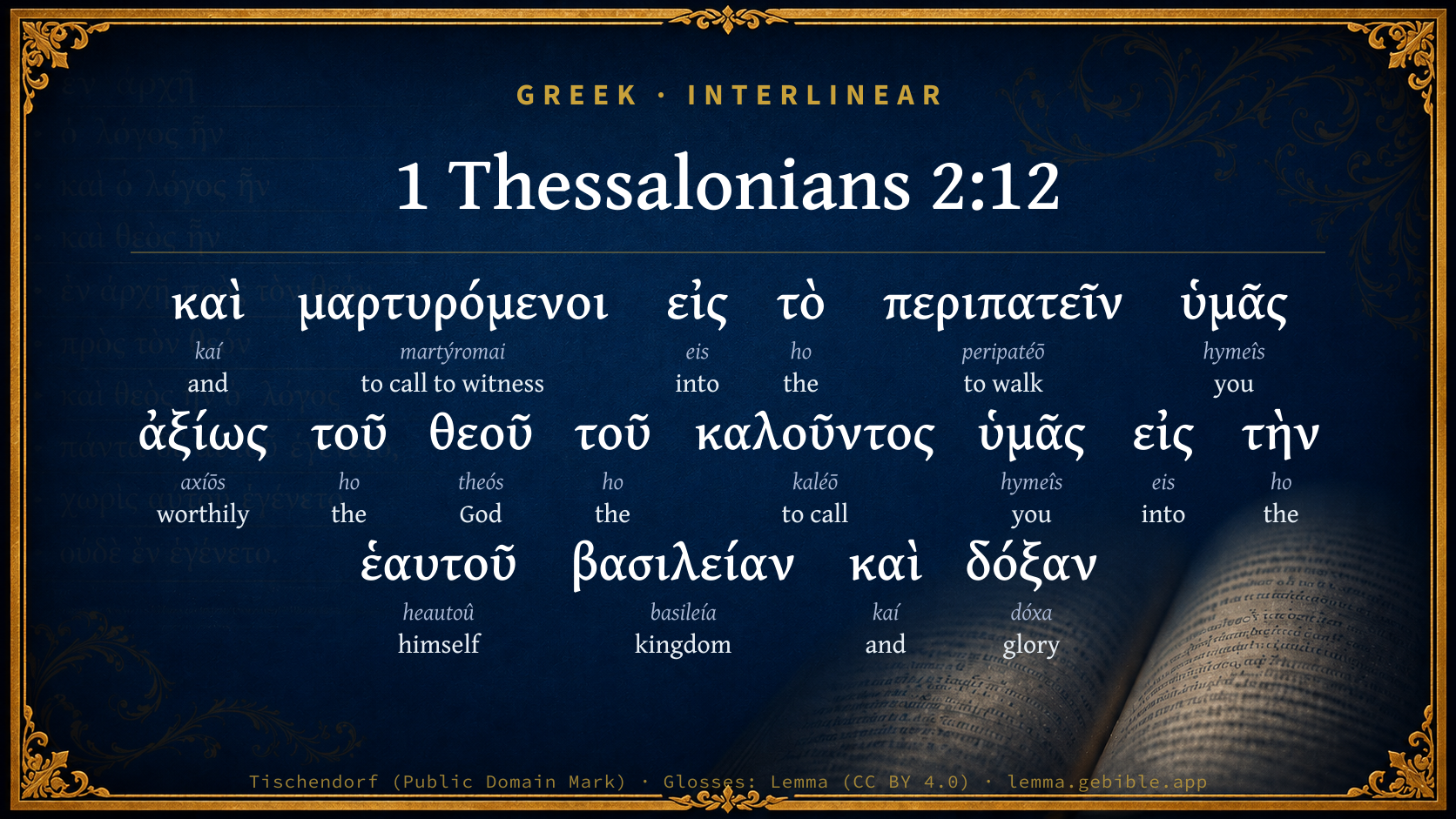
Greek (Tischendorf 8th ed.) 1 Thessalonians 2:12 appears in the Greek New Testament. The text above is from the Tischendorf 8th edition. Each word links to its Strong’s number and a concise gloss. Click any word for its full Thayer’s Greek Lexicon entry.
Download image
Cite this verse

1 Thessalonians 2:12 (World English Bible). Public Domain. Lemma interlinear Bible study tool, https://lemma.gebible.app/v/1-thessalonians/2/12.

Show BibTeX & RIS
BibTeX
RIS
English Translation
to the end that you should walk worthily of God, who calls you into his own Kingdom and glory.
World English Bible · Public Domain
Download a study sheet

One document with this verse’s original text, its word-by-word gloss line, the meaning frame, cross-references with their text, attributed commentary, and full source and license credits — printable, and it pastes into notes with its structure intact.

This verse Autodidact and up

Study sheet (.html) Plain text (.txt)

A passage Seminary Student

Up to 50 verses in one chapter. A passage sheet keeps up to 6 commentary sources and 12 cross-references per verse, in the order this page ranks them, and says so on the sheet whenever that leaves anything out. Ask for a single verse and you get the Autodidact verse sheet above.

Everything on this page stays free to read, with no account — the sheet is a download of what is already on screen, not access to it.

Want to remove ads? Support Godless Engineer
Compare translations 3

The same verse in 3 English versions, stacked beneath the original-language interlinear above. Click any original word for its lexicon entry.

Each is an independent rendering of the whole verse — the interlinear is not word-aligned to these translations.

Highlighted words mark where these versions differ — a whole-verse word diff, not a word-by-word alignment.

  • World English Bible Public Domain
    to the end that you should walk worthily of God, who calls you into his own Kingdom and glory.
  • King James Version Public Domain
    That ye would walk worthy of God, who hath called you unto his kingdom and glory.
  • unfoldingWord Literal Text CC BY-SA 4.0
    exhorting you and encouraging and testifying in order that you might walk worthily of God, the one calling you into his own kingdom and glory.

unfoldingWord Literal Text — © unfoldingWord, licensed CC BY-SA 4.0. Word-aligned USFM3 via Door43 (git.door43.org/unfoldingWord/en_ult).

Versions to compare (up to 4)

3 of 4 selected

Show all 19 translations

Every available English version of this verse, each an independent rendering of the whole verse.

  • World English Bible Public Domain
    to the end that you should walk worthily of God, who calls you into his own Kingdom and glory.
  • Berean Standard Bible Public Domain
    encouraging you, comforting you, and urging you to walk in a manner worthy of God, who calls you into His own kingdom and glory.
  • Majority Standard Bible Public Domain
    encouraging you, comforting you, and urging you to walk in a manner worthy of God, who calls you into His own kingdom and glory.
  • King James Version Public Domain
    That ye would walk worthy of God, who hath called you unto his kingdom and glory.
  • American Standard Version (1901) Public Domain
    to the end that ye should walk worthily of God, who calleth you into his own kingdom and glory.
  • Revised Version (1885) Public Domain
    to the end that ye should walk worthily of God, who calleth you into his own kingdom and glory.
  • Geneva Bible (1599) Public Domain
    That ye would walke worthy of God, who hath called you vnto his kingdome and glorie.
  • Douay-Rheims (1899) Public Domain
    We testified to every one of you, that you would walk worthy of God, who hath called you unto his kingdom and glory.
  • Young's Literal Translation Public Domain
    for your walking worthily of God, who is calling you to His own reign and glory.
  • Literal Standard Version CC BY-SA 4.0
    for your walking worthily of God, who is calling you to His own kingdom and glory.
  • Unlocked Literal Bible CC BY-SA 4.0
    We were begging you and encouraging and urging you to walk in a manner that is worthy of God, who calls you into his own kingdom and glory.
  • unfoldingWord Literal Text CC BY-SA 4.0
    exhorting you and encouraging and testifying in order that you might walk worthily of God, the one calling you into his own kingdom and glory.
  • Darby Bible Public Domain
    that ye should walk worthy of God, who calls you to his own kingdom and glory.
  • World Messianic Bible Public Domain
    to the end that you should walk worthily of God, who calls you into his own Kingdom and glory.
  • Webster's Bible Public Domain
    That ye would walk worthy of God, who hath called you into his kingdom and glory.
  • Free Bible Version CC BY-SA 4.0
    so that you could live as God would want you to live—the God who calls you to his own kingdom and glory.
  • Bible in Basic English Public Domain
    So that your lives might be pleasing to God, who has given you a part in his kingdom and his glory.
  • Text-Critical English NT CC BY 4.0
    and testifying that you should walk in a manner worthy of God, who calls you into his own kingdom and glory.
  • Tyndale New Testament (1534) Public Domain
    that ye wolde walke worthy of God which hath called you vnto his kyngdome and glory.

Literal Standard Version (2020), Covenant Press — licensed CC BY-SA 4.0. Text via the HelloAO Bible API (eBible.org). Unlocked Literal Bible (unfoldingWord) — licensed CC BY-SA 4.0. Text via the HelloAO Bible API (eBible.org). unfoldingWord Literal Text — © unfoldingWord, licensed CC BY-SA 4.0. Word-aligned USFM3 via Door43 (git.door43.org/unfoldingWord/en_ult). Free Bible Version, Dr. Jonathan Gallagher — licensed CC BY-SA 4.0. Text via the HelloAO Bible API (eBible.org).

Word by word

More ways to search: Search by grammar → Find every occurrence → Compare this word →

Practice this passage: Drill this verse → Learn its vocabulary →

μαρτυρόμενοι
martýromai
G3143
“to call to witness”
Verb, Present, Middle or Passive deponent, Participle, Nominative, Plural, Masculine
Part of Speech
Verb
Tense
Present
Voice
Middle or Passive deponent
Mood
Participle
Case
Nominative
Number
Plural
Gender
Masculine
Full Thayer's Definition

Origin: middle voice from G3144

TDNT: 12:30,6

1. to cite a witness, bring forward a witness, call to witness a. to affirm be appeal to God, to declare solemnly, protest 2. to conjure, beseech as in God's name, exhort solemnly
  1. καὶ kaí G2532 “and” Conjunction
  2. εἰς eis G1519 “into” Preposition
  3. τὸ ho G3588 “the” Article, Accusative, Singular, Neuter
  4. περιπατεῖν peripatéō G4043 “to walk” Verb, Present, Active, Infinitive
  5. ὑμᾶς hymeîs G5210 “you” Personal pronoun, 2nd person, Accusative, Plural
  6. ἀξίως axíōs G516 “worthily” Adverb
  7. τοῦ ho G3588 “the” Article, Genitive, Singular, Masculine
  8. θεοῦ theós G2316 “God” Noun, Genitive, Singular, Masculine
  9. τοῦ ho G3588 “the” Article, Genitive, Singular, Masculine
  10. καλοῦντος kaléō G2564 “to call” Verb, Present, Active, Participle, Genitive, Singular, Masculine
  11. ὑμᾶς hymeîs G5210 “you” Personal pronoun, 2nd person, Accusative, Plural
  12. εἰς eis G1519 “into” Preposition
  13. τὴν ho G3588 “the” Article, Accusative, Singular, Feminine
  14. ἑαυτοῦ heautoû G1438 “himself” Reflexive pronoun, 3rd person, Genitive, Singular, Masculine
  15. βασιλείαν basileía G932 “kingdom” Noun, Accusative, Singular, Feminine
  16. καὶ kaí G2532 “and” Conjunction
  17. δόξαν dóxa G1391 “glory” Noun, Accusative, Singular, Feminine

About this verse

These counts appear in no published source. They are computed here, from the morphology-tagged text and Lemma’s own curated glosses. What Lemma adds →

18
words
12
distinct lemmas
Pauline Epistles
section

Notable vocabulary

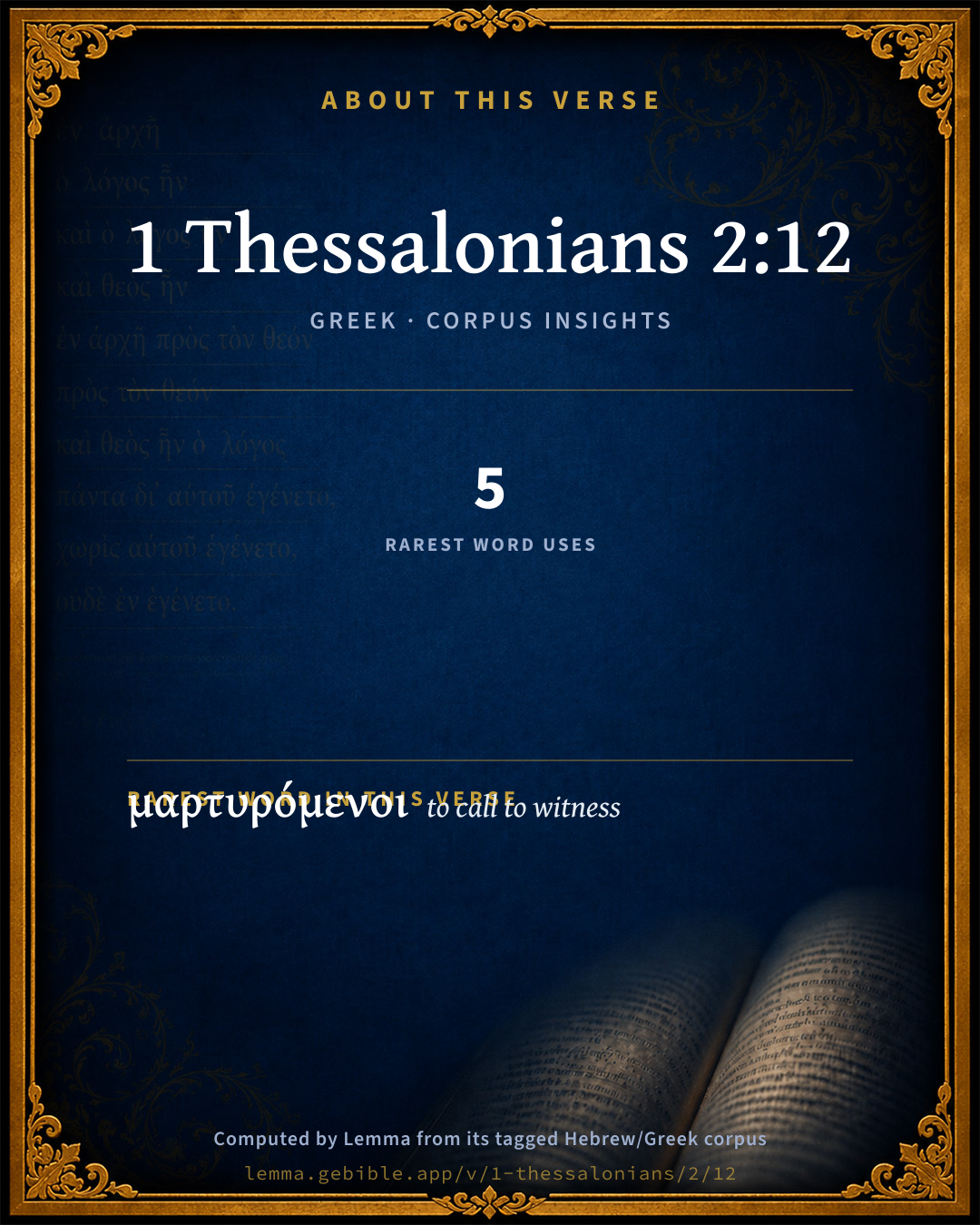
The rarest word here is μαρτυρόμενοι to call to witness G3143 — appearing just 5 times in the whole Greek New Testament.

Shared distinctive vocabulary

μαρτυρόμενοι to call to witness G3143 occurs in 5 verses of the Greek New Testament. Also found in:

Repetition

Words recur within this verse:

Cross-references

23

Topical passages linked to 1 Thessalonians 2:12 in the Treasury of Scripture Knowledge — connected by theme and wording, ordered by reader-vote popularity; previews shown in the World English Bible.

  • Ephesians 4:1 I therefore, the prisoner in the Lord, beg you to walk worthily of the calling with which you were called,
  • 1 John 2:6 he who says he remains in him ought himself also to walk just like he walked.
  • 1 John 1:6–7 If we say that we have fellowship with him and walk in the darkness, we lie, and don't tell the truth.
  • 2 Thessalonians 2:13–14 But we are bound to always give thanks to God for you, brothers loved by the Lord, because God chose you from the beginning for salvation through sanctification of the Spirit and belief in the truth;
  • 1 Thessalonians 4:12 that you may walk properly toward those who are outside, and may have need of nothing.
  • 1 Peter 5:10 But may the God of all grace, who called you to his eternal glory by Christ Jesus, after you have suffered a little while, perfect, establish, strengthen, and settle you.
  • Ephesians 5:2 Walk in love, even as Christ also loved you, and gave himself up for us, an offering and a sacrifice to God for a sweet-smelling fragrance.
  • Ephesians 5:8 For you were once darkness, but are now light in the Lord. Walk as children of light,
  • Colossians 1:10 that you may walk worthily of the Lord, to please him in all respects, bearing fruit in every good work, and increasing in the knowledge of God;
  • 1 Thessalonians 5:24 Faithful is he who calls you, who will also do it.
  • 2 Thessalonians 1:11–12 To this end we also pray always for you, that our God may count you worthy of your calling, and fulfill every desire of goodness and work of faith, with power;
  • Romans 9:23–24 and that he might make known the riches of his glory on vessels of mercy, which he prepared beforehand for glory,
  • 1 Corinthians 1:9 God is faithful, through whom you were called into the fellowship of his Son, Jesus Christ, our Lord.
  • Galatians 5:16 But I say, walk by the Spirit, and you won't fulfill the lust of the flesh.
  • Colossians 2:6 As therefore you received Christ Jesus, the Lord, walk in him,
  • 1 Thessalonians 4:1 Finally then, brothers, we beg and exhort you in the Lord Jesus, that as you received from us how you ought to walk and to please God, that you abound more and more.
  • 1 Peter 1:15–16 but just as he who called you is holy, you yourselves also be holy in all of your behavior;
  • Philippians 1:27 Only let your manner of life be worthy of the Gospel of Christ, that, whether I come and see you or am absent, I may hear of your state, that you stand firm in one spirit, with one soul striving for the faith of the Gospel;
  • 1 Peter 2:9 But you are a chosen race, a royal priesthood, a holy nation, a people for God's own possession, that you may show forth the excellencies of him who called you out of darkness into his marvelous light:
  • Romans 8:28 We know that all things work together for good for those who love God, to those who are called according to his purpose.
  • 2 Timothy 1:9 who saved us and called us with a holy calling, not according to our works, but according to his own purpose and grace, which was given to us in Christ Jesus before times eternal,
  • 1 Peter 3:9 not rendering evil for evil, or reviling for reviling; but instead blessing; knowing that to this were you called, that you may inherit a blessing.
  • Romans 8:30 Whom he predestined, those he also called. Whom he called, those he also justified. Whom he justified, those he also glorified.

Cross-references courtesy of OpenBible.info (CC BY 4.0).

Commentary

Notes on 1 Thessalonians 2:12 from classic Christian and Jewish commentators (each source and its license shown beneath its notes). The classic Christian expositions comment on the surrounding passage and are grouped to its opening verse, so a note may address several verses; the Jewish commentaries on the Tanakh (Rashi and others) are per-verse, so they appear only where the commentator wrote on this verse.

Lemma curates 59 commentaries, every one of them public domain or Creative Commons licensed, each selected and text-cleaned for this edition rather than reprinted as found. About our sources →

MacLaren's Expositions of Holy Scripture

Alexander MacLaren

1 Thessalonians

WALKING WORTHILY

1Th 2:12.

Here we have the whole law of Christian conduct in a nutshell. There may be many detailed commandments, but they can all be deduced from this one. We are lifted up above the region of petty prescriptions, and breathe a bracing mountain air. Instead of regulations, very many and very dry, we have a principle which needs thought and sympathy in order to apply it, and is to be carried out by the free action of our own judgments.

Now it is to be noticed that there are a good many other passages in the New Testament in which, in similar fashion, the whole sum of Christian conduct is reduced to a ‘walking worthy’ of some certain thing or other, and I have thought that it might aid in appreciating the many-sidedness and all-sufficiency of the great principles into which Christianity crystallises the law of our life, if we just gather these together and set them before you consecutively.

They are these: we are told in our text to ‘walk worthy of God.’ Then again, we are enjoined, in other places, to ‘walk worthy of the Lord,’ who is Christ. Or again, ‘of the Gospel of Christ.’ Or again, ‘of the calling wherewith we were called.’ Or again, of the name of ‘saints.’ And if you put all these together, you will get many sides of one thought, the rule of Christian life as gathered into a single expression--correspondence with, and conformity to, a certain standard.

I. And first of all, we have this passage of my text, and the other one to which I have referred, ‘Walking worthy of the Lord,’ by whom we are to understand Christ. We may put these together and say that the whole sum of Christian duty lies in conformity to the character of a Divine Person with whom we have loving relations.

The Old Testament says: ‘Be ye holy, for I the Lord your God am holy.’ The New Testament says: ‘Be ye imitators of God, and walk in love.’ So then, whatever of flashing brightness and infinite profundity in that divine nature is far beyond our apprehension and grasp, there are in that divine nature elements--and those the best and divinest in it--which it is perfectly within the power of every man to copy.

Is there anything in God that is more Godlike than righteousness and love? And is there any difference in essence between a man’s righteousness and God’s;--between a man’s love and God’s? The same gases make combustion in the sun and on the earth, and the spectroscope tells you that it is so. The same radiant brightness that flames burning in the love, and flashes white in the purity of God, even that may be reproduced in man.

Love is one thing, all the universe over. Other elements of the bond that unites us to God are rather correspondent in us to what we find in Him. Our concavity, so to speak, answers to His convexity; our hollowness to His fulness; our emptiness to His all-sufficiency. So our faith, for instance, lays hold upon His faithfulness, and our obedience grasps, and bows before, His commanding will. But the love with which I lay hold of Him is like the love with which He lays hold on me; and righteousness and purity, howsoever different may be their accompaniments in an Infinite and uncreated Nature from what they have in our limited and bounded and progressive being, in essence are one. So, ‘Be ye holy, for I am holy’; ‘Walk in the light as He is in the light,’ is the law available for all conduct; and the highest divine perfections, if I may speak of pre-eminence among them, are the imitable ones, whereby He becomes our Example and our Pattern.

Let no man say that such an injunction is vague or hopeless. You must have a perfect ideal if you are to live at all by an ideal. There cannot be any flaws in your pattern if the pattern is to be of any use. You aim at the stars, and if you do not hit them you may progressively approach them. We need absolute perfection to strain after, and one day--blessed be His name--we shall attain it. Try to walk worthy of God and you will find out how tight that precept grips, and how close it fits.

The love and the righteousness which are to become the law of our lives, are revealed to us in Jesus Christ. Whatever may sound impracticable in the injunction to imitate God assumes a more homely and possible shape when it becomes an injunction to follow Jesus. And just as that form of the precept tends to make the law of conformity to the divine nature more blessed and less hopelessly above us, so it makes the law of conformity to the ideal of goodness less cold and unsympathetic. It makes all the difference to our joyfulness and freedom whether we are trying to obey a law of duty, seen only too clearly to be binding, but also above our reach, or whether we have the law in a living Person whom we have learned to love. In the one case there stands upon a pedestal above us a cold perfection, white, complete, marble; in the other case there stands beside us a living law in pattern, a Brother, bone of our bone and flesh of our flesh; whose hand we can grasp; whose heart we can trust, and of whose help we can be sure. To say to me: ‘Follow the ideal of perfect righteousness,’ is to relegate me to a dreary, endless struggling; to say to me, ‘Follow your Brother, and be like your Father,’ is to bring warmth and hope and liberty into all my effort. The word that says, ‘Walk worthy of God,’ is a royal law, the perfect law of perfect freedom.

Again, when we say, ‘Walk worthy of God,’ we mean two things--one, ‘Do after His example,’ and the other, ‘Render back to Him what He deserves for what He has done to you.’ And so this law bids us measure, by the side of that great love that died on the Cross for us all, our poor imperfect returns of gratitude and of service. He has lavished all His treasure on you; what have you brought him back? He has given you the whole wealth of His tender pity, of His forgiving mercy, of His infinite goodness. Do you adequately repay such lavish love? Has He not ‘sown much and reaped little’ in all our hearts? Has He not poured out the fulness of His affection, and have we not answered Him with a few grudging drops squeezed from our hearts? Oh! brethren! ‘Walk worthy of the Lord,’ and neither dishonour Him by your conduct as professing children of His, nor affront Him by the wretched refuse and remnants of your devotion and service that you bring back to Him in response to His love to you.

II. Now a word about the next form of this all-embracing precept. The whole law of our Christian life may be gathered up in another correspondence, ‘Walk worthy of the Gospel’ {Php 1:27}, in a manner conformed to that great message of God’s love to us.

That covers substantially the same ground as we have already been going over, but it presents the same ideas in a different light. It presents the Gospel as a rule of conduct. Now people have always been apt to think of it more as a message of deliverance than as a practical guide, as we all need to make an effort to prevent our natural indolence and selfishness from making us forget that the Gospel is quite as much a rule of conduct as a message of pardon.

It is both by the same act. In the very facts on which our redemption depends lies the law of our lives.

What was Paul’s Gospel? According to Paul’s own definition of it, it was this: ‘How that Jesus Christ died for our sins, according to the Scriptures.’ And the message that I desire now to bring to all you professing Christians is this: Do not always be looking at Christ’s Cross only as your means of acceptance. Do not only be thinking of Christ’s Passion as that which has barred for you the gates of punishment, and has opened for you the gates of the Kingdom of Heaven. It has done all that; but if you are going to stop there you have only got hold of a very maimed and imperfect edition of the Gospel. The Cross is your pattern , as well as the anchor of your hope and the ground of your salvation, if it is anything at all to you. And it is not the ground of your salvation and the anchor of your hope unless it is your pattern. It is the one in exactly the same degree in which it is the other.

So all self-pleasing, all harsh insistence on your own claims, all neglect of suffering and sorrow and sin around you, comes under the lash of this condemnation: ‘They are not worthy of the Gospel.’ And all unforgivingness of spirit and of temper in individuals and in nations, in public and in private matters, that, too, is in flagrant contradiction to the principles that are taught on the Cross to which you say you look for your salvation. Have you got forgiveness, and are you going out from the presence-chamber of the King to take your brother by the throat for the beggarly coppers that he owes you, and say: ‘Pay me what thou owest!’ when the Master has forgiven you all that great mountain of indebtedness which you owe Him? Oh, my brother! if Christian men and women would only learn to take away the scales from their eyes and souls; not looking at Christ’s Cross with less absolute trustfulness, as that by which all their salvation comes, but also learning to look at it as closely and habitually as yielding the pattern to which their lives should be conformed, and would let the heart-melting thankfulness which it evokes when gazed at as the ground of our hope prove itself true by its leading them to an effort at imitating that great love, and so walking worthy of the Gospel, how their lives would be transformed! It is far easier to fetter your life with yards of red-tape prescriptions--do this, do not do that--far easier to out-pharisee the Pharisees in punctilious scrupulosities, than it is honestly, and for one hour, to take the Cross of Christ as the pattern of your lives, and to shape yourselves by that.

One looks round upon a lethargic, a luxurious, a self-indulgent, a self-seeking, a world-besotted professing Church, and asks: ‘Are these the people on whose hearts a cross is stamped?’ Do these men--or rather let us say, do we live as becometh the Gospel which proclaims the divinity of self-sacrifice, and that the law of a perfect human life is perfect self-forgetfulness, even as the secret of the divine nature is perfect love? ‘Walk worthy of the Gospel of Jesus Christ.’

III. Then again, there is another form of this same general prescription which suggests to us a kindred and yet somewhat different standard. We are also bidden to bring our lives into conformity to, and correspondence with, or, as the Bible has it, ‘to walk worthy of the calling wherewith we are called’ {Eph 4:1}.

God summons or invites us, and summons us to what? The words which follow our text answer, ‘Who calleth you into His own kingdom and glory.’ All you Christian people have been invited, and if you are Christians you have accepted the invitation; and all you men and women, whether you are Christians or not, have been and are being invited and summoned into a state and a world {for the reference is to the future life}, in which God’s will is supreme, and all wills are moulded into conformity with that, and into a state and a world in which all shall--because they submit to His will--partake of His glory, the fulness of His uncreated light.

That being the aim of the summons, that being the destiny that is held out before us all, ought not that destiny and the prospect of what we may be in the future, to fling some beams of guiding brightness on to the present?

Men that are called to high functions prepare themselves therefor. If you knew that you were going away to Australia in six months, would you not be beginning to get your outfit ready? You Christian men profess to believe that you have been called to a condition in which you will absolutely obey God’s will, and be the loyal subjects of His kingdom, and in which you will partake of God’s glory. Well then, obey His will here, and let some scattered sparklets of that uncreated light that is one day going to flood your soul lie upon your face to-day. Do not go and cut your lives into two halves, one of them all contradictory to that which you expect in the other, but bring a harmony between the present, in all its weakness and sinfulness, and that great hope and certain destiny that blazes on the horizon of your hope, as the joyful state to which you have been invited. ‘Walk worthy of the calling to which you are called.’

And again, that same thought of the destiny should feed our hope, and make us live under its continual inspiration. A walk worthy of such a calling and such a caller should know no despondency, nor any weary, heartless lingering, as with tired feet on a hard road. Brave good cheer, undimmed energy, a noble contempt of obstacles, a confidence in our final attainment of that purity and glory which is not depressed by consciousness of present failure--these are plainly the characteristics which ought to mark the advance of the men in whose ears such a summons from such lips rings as their marching orders.

And a walk worthy of our calling will turn away from earthly things. If you believe that God has summoned you to His kingdom and glory, surely, surely, that should deaden in your heart the love and the care for the trifles that lie by the wayside. Surely, surely, if that great voice is inviting, and that merciful hand is beckoning you into the light, and showing you what you may possess there, it is not walking according to that summons if you go with your eyes fixed upon the trifles at your feet, and your whole heart absorbed in this present fleeting world. Unworldliness, in its best and purest fashion--by which I mean not only a contempt for material wealth and all that it brings, but the sitting loose by everything that is beneath the stars--unworldliness is the only walk that is ‘worthy of the calling wherewith ye are called.’

And if you hear that voice ringing like a trumpet call, or a commander’s shout on the battlefield, into your ears, ever to stimulate you, to rebuke your lagging indifference; if you are ever conscious in your inmost hearts of the summons to His kingdom and glory, then, no doubt, by a walk worthy of it, you will make your calling sure; and there shall ‘an entrance be ministered unto you abundantly into the everlasting kingdom.’

IV. And the last of the phases of this prescription which I have to deal with is this. The whole Christian duty is further crystallised into the one command, to walk in a manner conformed to, and corresponding with, the character which is impressed upon us.

In the last chapter of the Epistle to the Romans {verse 2}, we read about a very small matter, that it is to be done ‘worthily of the saints.’ It is only about the receiving of a good woman who was travelling from Corinth to Rome, and extending hospitality to her in such a manner as became professing Christians; but the very minuteness of the details to which the great principle is applied points a lesson. The biggest principle is not too big to be brought down to the narrowest details, and that is the beauty of principles as distinguished from regulations. Regulations try to be minute, and, however minute you make them, some case always starts up that is not exactly provided for in them, and so the regulations come to nothing. A principle does not try to be minute, but it casts its net wide and it gathers various cases into its meshes. Like the fabled tent in the old legend that could contract so as to have room for but one man, or expand wide enough to hold an army, so this great principle of Christian conduct can be brought down to giving ‘Phoebe our sister, who is a servant of the church at Cenchrea,’ good food and a comfortable lodging, and any other little kindnesses, when she comes to Rome. And the same principle may be widened out to embrace and direct us in the largest tasks and most difficult circumstances.

‘Worthily of saints’--the name is an omen, and carries in it rules of conduct. The root idea of ‘saint’ is ‘one separated to God,’ and the secondary idea which flows from that is ‘one who is pure.’

All Christians are ‘saints.’ They are consecrated and set apart for God’s service, and in the degree in which they are conscious of and live out that consecration, they are pure.

So their name, or rather the great fact which their name implies, should be ever before them, a stimulus and a law. We are bound to remember that we are consecrated, separated as God’s possession, and that therefore purity is indispensable. The continual consciousness of this relation and its resulting obligations would make us recoil from impurity as instinctively as the sensitive plant shuts up its little green fingers when anything touches it; or as the wearer of a white robe will draw it up high above the mud on a filthy pavement. Walk ‘worthily of saints’ is another way of saying, Be true to your own best selves. Work up to the highest ideal of your character. That is far more wholesome than to be always looking at our faults and failures, which depress and tempt us to think that the actual is the measure of the possible, and the past or present of the future. There is no fear of self-conceit or of a mistaken estimate of ourselves. The more clearly we keep our best and deepest self before our consciousness, the more shall we learn a rigid judgment of the miserable contradictions to it in our daily outward life, and even in our thoughts and desires. It is a wholesome exhortation, when it follows these others of which we have been speaking {and not else}, which bids Christians remember that they are saints and live up to their name.

A Christian’s inward and deepest self is better than his outward life. We have all convictions in our inmost hearts which we do not work out, and beliefs that do not influence us as we know they ought to do, and sometimes wish that they did. By our own fault our lives but imperfectly show their real inmost principle. Friction always wastes power before motion is produced.

So then, we may well gather together all our duties in this final form of the all-comprehensive law, and say to ourselves, ‘Walk worthily of saints.’ Be true to your name, to your best selves, to your deepest selves. Be true to your separation for God’s service, and to the purity which comes from it. Be true to the life which God has implanted in you. That life may be very feeble and covered by a great deal of rubbish, but it is divine. Let it work, let it out. Do not disgrace your name.

These are the phases of the law of Christian conduct. They reach far, they fit close, they penetrate deeper than the needle points of minute regulations. If you will live in a manner corresponding to the character, and worthy of the love of God, as revealed in Christ, and in conformity with the principles that are enthroned upon His Cross, and in obedience to the destiny held forth in your high calling, and in faithfulness to the name that He Himself has impressed upon you, then your righteousness shall exceed the righteousness of the painful and punctilious pharisaical obedience to outward commands, and all things lovely and of good report will spring to life in your hearts and bear fruit in your lives.

One last word--all these exhortations go on the understanding that you are a Christian, that you have taken Christ for your Saviour, and are resting upon Him, and recognising in Him the revelation of God, and in His Cross the foundation of your hope; that you have listened to, and yielded to, the divine summons, and that you have a right to be called a saint. Is that presumption true about you, my friend? If it is not, Christianity thinks that it is of no use wasting time talking to you about conduct.

It has another word to speak to you first, and after you have heard and accepted it, there will be time enough to talk to you about rules for living. The first message which Christ sends to you by my lips is, Trust your sinful selves to Him as your only all-sufficient Saviour. When you have accepted Him, and are leaning on Him with all your weight of sin and suffering, and loving Him with your ransomed heart, then, and not till then, will you be in a position to hear His law for your life, and to obey it. Then, and not till then, will you appreciate the divine simplicity and breadth of the great command to walk worthy of God, and the divine tenderness and power of the motive which enforces it, and prints it on yielding and obedient hearts, even the dying love and Cross of His Son. Then, and not till then, will you know how the voice from heaven that calls you to His kingdom stirs the heart like the sound of a trumpet, and how the name which you bear is a perpetual spur to heroic service and priestly purity. Till then, the word which we would plead with you to listen to and accept is that great answer of our Lord’s to those who came to Him for a rule of conduct, instead of for the gift of life: ‘This is the work of God, that ye should believe on Him whom He hath sent.’

Alexander MacLaren, Expositions of Holy Scripture (1904–1910) — public domain. Text from a community e-Sword module.

Tyndale Open Study Notes

Tyndale Open Resources

2:12 What God would consider worthy is a life lived in harmony with the high standards he expects of those called (4:7) to share his Kingdom and glory (Rom 8:17-18; Col 1:27; 2 Thes 2:14).

Tyndale Open Study Notes — © Tyndale Open Resources, licensed CC BY-SA 4.0. Text via the HelloAO Bible API.

Bengel's Gnomon

Johann Albrecht Bengel

1Th 2:12. Βασιλείαν καὶ δόξαν, His kingdom and glory) A magnificent combination.

Bengel's Gnomon of the New Testament — English translation (T&T Clark, Edinburgh, 1860) — public domain. Text from a community e-Sword module.

Meyer's Critical & Exegetical Commentary

Heinrich August Wilhelm Meyer

1Th_2:12. Μαρτύρεσθαι] (comp. Eph_4:17) in the sense of διαμαρτύρεσθαι (1Ti_5:21; 2Ti_2:14; 2Ti_4:1), earnestly conjuring; comp. also Thucyd. vi. 80: δεόμεθα δὲ καὶ μαρτυρόμεθα ἅμα, and viii. 53: μαρτυρομένων καὶ ἐπιθειαζόντων μὴ κατάγειν, which later passage is peculiarly interesting on this account, because there (as in our verse, see critical notes) most MSS. read the meaningless μαρτυρουμένων. μαρτυρόμενοι strengthens the two former participles.

εἰς τὸ περιπατεῖν ὑμᾶς κ.τ.λ.] contains not the design (de Wette, Koch), also not the design and effect of the exhortation (Schott), but is the object to all three preceding participles. The meaning is: Calling on you, and exhorting, and adjuring you to a walk worthy of God, i.e. to make such a walk yours. But Christians walk ἀξίως τοῦ Θεοῦ (comp. Col_1:10; Eph_4:1; Rom_16:2; Php_1:27; 3Jn_1:6), when they actually prove by their conduct and behaviour that they are mindful of those blessings, which the grace of God has vouchsafed to them, and of the undisturbed blessedness which He promises them in the future.

τοῦ καλοῦντος] The present occurs, because the call already indeed made to the Thessalonians is uninterruptedly continued, until the completion succeeds to the call and invitation, namely, at Christs return. The meaning of Hofmann is wide of the mark: that by the present, the call is indicated as such that would become wholly in vain for those who walk unworthily.

βασιλείαν καὶ δόξαν] not an ἓν διὰ δυοῖν; to the kingdom of His glory, or to the glory of His kingdom (Turretin, Benson, Bolten, Koppe, Olshausen). Both substantives have the same rank and the same emphasis. Baumgarten-Crusius erroneously distinguishes βασιλεία and δόξα as the earthly and heavenly kingdom of God. Further, δόξα is not the glory of the Messianic kingdom, which is specially brought forward after the general βασιλείαν (de Wette); but God calls the readers to participate in His kingdom (i.e. the Messianic) and in His (Gods) glory, for Christians are destined to enter upon the joint possession of the δόξα which God Himself has; comp. Rom_5:2; Eph_3:19.

Meyer — Critical and Exegetical Commentary on the New Testament — English translation by Peter Christie, edited by Frederick Crombie (T&T Clark, 1880) — public domain. Text from a community e-Sword module.

Expositor's Greek Testament

ed. W. Robertson Nicoll

1Th 2:12 . ἀξίως in this connection (see references) was a familiar ethnic phrase. C. Michel (in his Recueil d’inscriptions grecques , 1900, 266, 413) quotes two pre-Christian instances with τῶν θεῶν . εἰς τὸ , κ . τ . λ ., grammatically meaning either the object or the content of the solemn charge ( cf. Moulton, 218 f.). The ethic is dominated by the eschatology, as in 1Th 3:13 , 1Th 5:23 .

The Expositor's Greek Testament, edited by W. Robertson Nicoll (1897–1910) — public domain. Text from a community e-Sword module.

Geneva Bible (1599)

Geneva Bible translators

To exhort all men diligently and earnestly to lead a godly life.

Geneva Bible (1599) marginal notes — public domain. Text via Bolls.life.

Jamieson, Fausset & Brown

Robert Jamieson, A. R. Fausset & David Brown

worthy of God--"worthy of the Lord" (Col 1:10); "worthily of the saints" (Rom 16:2, Greek): ". . . of the Gospel" (Phi 1:27) ". . . of the vocation wherewith ye are called" (Eph 4:1). Inconsistency would cause God's name to be "blasphemed among the Gentiles" (Rom 2:24). The Greek article is emphatical, "Worthy of THE God who is calling you."

hath called--So one of the oldest manuscripts and Vulgate. Other oldest manuscripts, "Who calleth us."

his kingdom--to be set up at the Lord's coming.

glory--that ye may share His glory (Joh 17:22; Col 3:4).

Jamieson, Fausset & Brown — Commentary Critical and Explanatory on the Whole Bible (1871) — public domain (CC PDM 1.0). Text via the HelloAO Bible API.

Adam Clarke's Commentary

Verse 12. That ye would walk worthy of God] That they should, in every respect, act up to their high calling, that it would not be a reproach to the God of holiness to acknowledge them as his sons and daughters. See Clarke on Eph 4:1; "Php 1:27"; and "Col 1:10".

His Kingdom and glory.] His Church here, for that is the kingdom of God among men; and his glory hereafter, for that is the state to which the dispensations of grace in his Church lead. The words, how ever, may be a hendiadys, and signify his glorious kingdom.

Adam Clarke's Commentary on the Bible (1810–1826) — public domain. Text from a community e-Sword/MySword module.

John Calvin's Commentaries

12 Exhorted. He shews with what earnestness he devoted himself to their welfare, for he relates that in preaching to them respecting piety towards God and the duties of the Christian life, it had not been merely in a perfunctory way, but he says that he had made use of exhortations and adjurations. It is a lively preaching of the gospel, when persons are not merely told what is right, but are pricked (Acts 2:37) by exhortations, and are called to the judgment-seat of God, that they may not fall asleep in their vices, for this is what is properly meant by adjuring. But if pious men, whose promptitude Paul so highly commends, stood in absolute need of being stimulated by stirring exhortations, nay, adjurations, what must be done with us, in whom sluggishness of the flesh does more reign? In the mean time, as to the wicked, whose obstinacy is incurable, it is necessary to denounce upon them the horrible vengeance of God, not so much from hope of success, as in order that they may be rendered inexcusable.

Some render the participle παραμυθουμένοι, comforted. If we adopt this rendering, he means that he made use of consolations in dealing with the afflicted, who need to be sustained by the grace of God, and refreshed by tasting of heavenly blessings, that they may not lose heart or become impatient. The other meaning, however, is more suitable to the context, that he admonished; for the three verbs, it is manifest, refer to the same thing.

That ye might walk. He presents in a few words the sum and substance of his exhortations, that, in magnifying the mercy of God, he admonished them not to fail as to their calling. His commendation of the grace of God is contained in the expression, who hath called us into his kingdom. For as our salvation is founded upon God’s gracious adoption, every blessing that Christ has brought us is comprehended in this one term. It now remains that we answer God’s call, that is, that we shew ourselves to be such children to him as he is a Father to us. For he who lives otherwise than as becomes a child of God, deserves to be cut off from God’s household.

John Calvin's Commentaries (1540-1563) — public domain. Text from the Calvin Translation Society English edition (1840s-50s) via the Christian Classics Ethereal Library (ccel.org). Calvin's coverage is partial (roughly two-thirds of the Bible); uncommented books and verses are honest gaps, never fabricated. The 19th-century editor's footnotes and remarks are omitted so the notes are faithfully Calvin's own voice.

Ellicott's Commentary for English Readers

(12) Hath called.—The right reading is, was calling, which has been altered because of the slight theological difficulty, on the analogy of Gal_1:6, etc. The call is not simply a momentary act, but a continual beckoning upwards, until the privileges offered are actually attained. The Thessalonians at that time, though already by baptism members of the kingdom (Col_1:13), were not yet so assured in their new allegiance as to be certain of reaching the full-developed glory of that kingdom. Note again the thought of the Advent.

A Bible Commentary for English Readers, edited by Charles John Ellicott (1878–1897) — public domain. Text from a community e-Sword module.

The Cambridge Bible for Schools and Colleges

gen. ed. J. J. S. Perowne

12. that ye would walk worthy of God] Better, in order that ye should, and worthily (R. V.) “Walk” is the common Hebrew and O.T. figure for the conduct of life.

It was God’s message the apostles of Christ had brought to the Thessalonians (1Th_2:2; 1Th_2:9); “unto God, the living and true,” they had “turned from their idols to serve” Him (ch. 1Th_1:9). They must, therefore, now live a life “worthy of God”—worthy of those who have such a God and are His servants and sons. Nowhere, perhaps, does St Pail lay such continued emphasis on the relation of the Christian believer to God as in these Epistles; see Introd. pp. 17, 18.

To “walk worthily of God” is the noblest possible ideal of life; so high that it would appear visionary and impracticable, if it were not for what follows:—

(worthy of God) who hath called you unto his kingdom and glory] According to the truer reading, who calleth—for it is a call that continues till its purpose is accomplished (comp. ch. 1Th_4:8, “God who giveth His Holy Spirit,” R. V.); and into His own kingdom, &c.

Such is the confidence of “you that believe” (1Th_2:10); and this conviction gives the believer will and courage to aspire to the loftiest moral attainments: comp. ch. 1Th_5:24 (note). God’s summons the Thessalonians had heard; His call could not be purposeless or powerless.

The announcement of the Kingdom of God was a leading feature of St Paul’s preaching at Thessalonica; comp. 2Th_1:5, and see Introd. pp. 18–21. It is also designated “the kingdom of the Son,” Col_1:13; “of Christ and God,” Eph_5:5; Rev_11:15; “of heaven,” in St Matthew. This kingdom is sometimes spoken of as present, sometimes as future—a variation which marks the language of Christ equally with His Apostle. The expression comes in the first place from the Jewish Rabbis, being derived from the predictions of Dan_2:44-45; Dan_7:13-14; Mic_4:7; and these predictions again had their foundation in the great prophetic declarations respecting the throne and house of David (2 Samuel 7; Psalms 2, 110). It was the popular designation for that perfect Divine rule which the Jews expected to see established on earth by the Messiah at His coming. It was called “the kingdom of heaven” (or “the heavens”), as having its seat and origin in heaven, and in contrast with the existing “kingdoms of this world and their glory,” of which the Tempter said to Jesus, in harmony with Jewish ideas, “All this hath been delivered unto me” (Luk_4:6). But God calls men “from the dominion of Satan” (Act_26:18) into “His own kingdom and glory.” The difference is, fundamentally, not one of place or time; it is a moral opposition. John the Baptist, and then Christ, in similar terms announced the new kingdom to be “at hand;” in leaving the world Jesus declared that His “Father’s kingdom” would be revealed on His return (Mat_13:43; Mat_26:29; Mat_26:64; Luk_19:12, &c.). At the same time, He taught that the kingdom already existed in His Person and was constituted by His presence; that in its essence it was set up within His disciples, and therefore its future coming would be the manifestation and unfolding of what they already possessed in the spiritual life received from Him: see Luk_17:21; Joh_18:36-37; Mat_5:3; Mat_5:10; Mat_13:31-33; Mat_13:38, &c. Christ’s doctrine of the kingdom is virtually contained in the two petitions of the Lord’s Prayer: “Thy kingdom come, Thy will be done, as in heaven so also upon earth.” This implies that so far as God’s will is done on earth, His kingdom is here already; earth being ruled from heaven and by heaven’s law. But the more it makes its power felt on earth, the more necessary does its heavenly glory become. St Paul sees the kingdom present and ruling where there is “righteousness and peace and joy in the Holy Spirit” (Rom_14:17): but what is now possessed of it he regards as only the “earnest of our inheritance” (Rom_8:23; Eph_1:14); God “is” ever “calling” His servants onward “to His own kingdom and glory.”

The glory is God’s glory—the splendour of His future revelation as He will at last, on the return of Christ, be manifested to His saints. In this glory they will share. “The kingdom and glory of God” are one, the latter being the full display and consummation of the former. And in the Apostle’s view, “the hope of the glory of God” (Rom_5:2) is bound up with the “hope in our Lord Jesus Christ,” which the Thessalonians so earnestly cherished.

Obeying the voice of God that calls them to a place in His glorious kingdom, St Paul’s readers will know how to “walk worthily.” This summons is the ever-renewed incitement of a holy life, and inspires us with the most exalted of those “mighty hopes which make us men.” So “we were saved by hope” (Rom_8:24).

This view of the religion of the Thessalonians agrees with what was said of them in ch. 1Th_1:9-10. “Walking worthily of God” corresponds to “serving a living and true God;” and the “call to His kingdom and glory” invites them to “wait for His Son from the heavens.”

The Cambridge Bible for Schools and Colleges (gen. ed. J. J. S. Perowne; Cambridge University Press, 1878–1918) — public domain. Text from a community e-Sword module.

John Gill's Exposition

That ye would walk worthy of God,.... In imitation of him; not of his perfections, which are inimitable, but of his works; and these not of his power and wisdom, but those of kindness and beneficence, and of righteousness and holiness; and in conformity to his revealed will, which is good, perfect, and acceptable; and agreeably to his Gospel, that that may be adorned, and not blasphemed; and particularly, in a manner worthy of the calling wherewith saints are called by him: since it follows,

who hath called you unto his kingdom and glory; which instance of the grace of God carries in it many arguments, and lays many obligations on the persons interested in it, to walk in their lives and conversations worthy of God; which may be taken from the nature of this call, which is not a mere external one by the outward ministry of the word, but an internal and effectual one, by the powerful and efficacious grace of God; it is a call of persons out of darkness into light, and therefore it becomes them to walk as children of the light, and honestly, as in the daytime; and from a state of bondage to sin and Satan, unto liberty, and therefore ought not to walk after the dictates of corrupt nature, nor the suggestions of Satan, but after the Spirit of God, who is a spirit of liberty; and from fellowship with the world, and the men of it, to communion with Christ, and therefore should not walk as other Gentiles do, nor run with them in the same excess of riot; in short, such are called with an holy calling, and to holiness, and have in their effectual calling principles of holiness implanted in them, and therefore should be holy in all manner of conversation: moreover, arguments may be taken from the consideration of him that calls, God, who is a holy Being, and therefore as he that hath called them is holy, so should they be likewise; he is the God of all grace that has called them, and he has called them by his grace, and to special blessings of grace, and that according to his sovereign will and pleasure; and has called them the most unworthy, base, mean, and despicable, and not others, which greatly enhances the obligation to walk worthy of him: to which add, that he that calls is God that dwells on high in heaven, and changes not, and such is his call; hence it is styled the high calling of God, and the heavenly calling, and said to be without repentance; and therefore the saints should live and walk as pilgrims and strangers here, and be steadfast and immovable, always abounding in the work of the Lord: likewise the consideration of what they are called to should engage them to a becoming walk, being called "to his kingdom"; to the kingdom of grace, which lies in righteousness and peace, and joy in the Holy Ghost, and which cannot be moved, and where they are kings and priests unto God; and unto a Gospel church state, and to all the privileges and immunities of it; and unto the kingdom of heaven, prepared by God for them from the foundation of the world, their Father's free gift to them, of which they are born heirs apparent in regeneration, and have both a meetness for it, and a right unto it; and therefore ought to behave suitable to this high honour and dignity which belong unto them: and this latter sense is the rather to be chose, since it follows, "and glory": or "to his glory", as the Syriac, Arabic, and Ethiopic versions read; to the glory of God, to the beholding of the glory of God through Christ, and the glory of Christ himself; and to a participation of that glory which God has provided, and is in the hands of Christ for them, where it is hid, who when he shall appear, they will appear with him in glory; which will be both upon their souls and bodies; and this will be an eternal glory, a glory that fades not away, and not like the glory of this world, which is transient, and soon passes away, but this will abide for ever; and therefore since the saints are called to the obtaining of this, it is a reason why their conversation should be in heaven now, and as becomes God and his Gospel.

John Gill's Exposition of the Whole Bible (1746–1763) — public domain (CC PDM 1.0). Text via the HelloAO Bible API.

Trapp's Complete Commentary

John Trapp

12 That ye would walk worthy of God, who hath called you unto his kingdom and glory.

Ver. 12. Walk worthy of God] Whose livery we wear, whose image we bear, whose kingdom we are called unto, &c. Those that stood with the Lamb, Rev 14:1, had his Father’s name on their foreheads. Our wanderings reflect upon God, who will require and requite.

John Trapp, A Commentary or Exposition upon All the Books of the Old and New Testament (1647–1656) — public domain. Text from a community e-Sword module.

Albert Barnes' Notes on the Bible

That ye would walk worthy of God ... - That you would live in such a manner as would honor God, who has chosen you to be his friends; notes, Eph 4:1. A child “walks worthy of a parent” when he lives in such way as to reflect honor on that parent for the method in which he has trained him; when he so lives as to bring no disgrace on him, so as not to pain his heart by misconduct, or so as to give no occasion to any to speak reproachfully of him. This he does, when:

(1)He keeps all his commands;

(2)When he leads a life of purity and virtue;

(3)When he carries out the principles of the family into his own life;

(4)When he honors a father by evincing a profound respect for his opinions; and,

(5)When he endeavors to provide for his comfort and to promote his welfare.

In a manner similar to this, a true Christian honors God. He lives so as not to bring a reproach upon him or his cause, and so as to teach the world to honor him who has bestowed such grace upon him.

Who hath called you - See the notes at 1Co 1:9.

Albert Barnes' Notes on the Bible (1834–1885) — public domain. Text from a community e-Sword/MySword module.

Matthew Poole's English Annotations

In the Greek text the word charged, mentioned in the former verse, begins this verse; μαρτυρομενοι, it signifies testifying: some read it, we obtested, which is as much as beseeching; others, contested, which is a severe charge, containing a threatening, as Exo 19:21; Charge the people, saith God to Moses; in the margin: Contest the people, or wish the people. It is a charge here which the apostle gives solemnly in the name of God to them, calling in the witness of God to it.

That ye would walk worthy of God; that is, suitably to the nature of that God who is the true and living God. That you may walk like a people who belong to such a God, and express the virtues of this God in your conversation, 1Pe 2:9; or, suitably to the great mercy and glorious privileges you have received from him, which he mentions in the following words.

Who hath called you unto his kingdom and glory; or, who is calling you; then by God’s kingdom and glory we must understand the future state of heaven: though they were not yet possessed of it, yet by the gospel God had called them to it, as Phi 3:14; 1Pe 5:10. Or, who hath called you, as we read it; then he means their present state since they believed and obeyed the call of the gospel, they were brought thereby into God’s kingdom and glory; or, his glorious kingdom, wherein the glory of God, especially the glory of his grace, mercy, love, and wisdom, eminently shine forth. Hereupon a Christian’s calling is termed a high calling, Phi 3:14; a heavenly calling, Heb 3:1. And they being called by God out of Satan’s kingdom into this glorious kingdom, the apostle chargeth them to walk worthy of God and this calling, by having a conversation suitable thereunto, Eph 4:1; Col 1:10; to walk according to the laws of this glorious kingdom they were already brought into, and suitably to the glory of heaven that they were called to the hope of.

Matthew Poole's English Annotations on the Holy Bible (1683–1685) — public domain. Text from a community e-Sword/MySword module.

Whedon's Commentary on the Bible

Daniel D. Whedon

12. Called you—In consequence of your faith in Christ.

Kingdom—After the judgment-day.

And glory—The resplendence that eternally fills that kingdom.

So closes St. Paul’s description of his entrance, labouring, and gospel in Thessalonica, for which Thessalonica is his witness. How they received he will now be their witness.

Daniel D. Whedon (gen. ed.), Commentary on the Old and New Testaments (1874–1909) — public domain. Text from a community e-Sword module.

The Pulpit Commentary

That (or, to the end that) ye would walk worthy of God; so as to adorn the gospel of God. So in the Epistle to the Colossians: "That ye would walk worthy of the Lord unto all pleasing". (Col_1:10) Who hath called you; or, as the best attested manuscripts read, who calleth you. To his kingdom and glory. Not to be weakened as if it were a Hebraism for "his glorious kingdom," or "the kingdom of his glory;" but the kingdom and glory are to be viewed as two different objects. "God called you to Ms kingdom," namely, the Messianic kingdom which he has established on earth; and which will be completely realized at the advent. And "God called you to his glory," namely, the glory which is in reserve for all the members of his kingdom. Our high and holy calling.

We ought to walk worthy of God, so as:

1. To obey God"s laws.

2. To imitate God"s moral perfections.

3. To enjoy God"s fellowship.

4. To adorn God"s gospel.

5. To promote God"s cause.

6. To live to God"s glory.

Worthy of God.

I TO BE WORTHY OF GOD IS THE HIGHEST AIM OF SPIRITUAL ASPIRATION. It is so high an aim that it seems to be hopelessly out of our reach. Are we not in everything unworthy of God? Our sinfulness is direct ill-desert, our unbelief, weakness, and imperfection dishonoring to Divine grace, our very virtues and good deeds of no absolute worth, because at best we are unprofitable servants, who have but done that which it was our duty to do. Nevertheless:

1. We should aim at the highest attainment, though as yet we may be far from reaching it.

2. We may become increasingly less unworthy of God.

3. We may truly honor God by our character and deeds.

4. We may hope at last to be worthy of God in the sense that we shall be fit to dwell with him; no disgrace to his Name when we bear it, and able to take our position as members of his family.

II TO BE WORTHY OF GOD IS TO BE LIVING IN A RIGHT COURSE OF DAILY LIFE. This is expressed by the word "walk.

1. It must be a continuous course. To have passing phases of very pure spiritual thought is not to be so worthy of God as to walk continuously in obedience to his will though on a much lower plain.

2. It is to be striven after in daily life. We do not want angels" wings wherewith to soar into unearthly altitudes. We can walk on the lowly earth and yet be worthy of God. The worthiness depends on the spirit of our conduct, not on the sphere in which we live. With coarse surroundings, in toilsome drudgery, by humble tasks, the soul can so live as to be worthy of God.

III IT IS THE DUTY OF ALL CHRISTIANS TO BE WORTHY OF GOD. The requirement does not belong to a counsel of perfection which a few rare souls may adopt at their will. It is laid upon all Christians as a duty. The special ground of the obligation is in what God has done for his people. He has called them "into his own kingdom and glory.

1. Gratitude requires us to walk worthy of God. His gifts and his promises reveal love and sacrifice on his part which naturally call for love and devotion on ours.

2. The future destiny of Christians also demands this conduct. The heir should behave as befits his future position. "Prince Hal" was an unworthy prince in his youth, especially because he disgraced himself in view of an exalted future. Christians are heirs of God"s kingdom. Therefore they should walk worthily of him who has called them into it.

IV IT IS THE OBJECT OF CHRISTIAN PREACHING TO LEAD MEN TO BE THUS WORTHY OF GOD. If the aim of the spiritual life must be high, so also must be that of its guide and teacher. The preacher"s work is not done when a soul is first turned from the slavery of sin to the service of Christ. Then follows all the education and training of the new life up to the perfect worthiness. Hence the need of affectionate influence and all graces of persuasion. W.F.A.

The Pulpit Commentary (1880–1919), ed. H.D.M. Spence-Jones & Joseph S. Exell — public domain. Text from a community e-Sword module.

John Wesley's Explanatory Notes

To his kingdom here, and glory hereafter.

John Wesley, Explanatory Notes Upon the Whole Bible (1754–1765) — public domain. Text via the GEBible commentary corpus.

McGarvey & Pendleton's Commentaries

J. W. McGarvey

to the end that ye should walk worthily of God, who calleth you into his own kingdom and glory . [As those who are called to an honor owe it to the one calling them to walk worthy of the honor, so the Thessalonians, being called to have part in the present kingdom and future glory of God, needed to walk circumspectly. Having thus rehearsed the ministry at Thessalonica, step by step, from the day he entered the city until he departed from it, Paul now turns to tell the effects of that ministry upon the Thessalonians.]

J. W. McGarvey (with Philip Y. Pendleton), Commentaries on the New Testament (The Fourfold Gospel, 1914; Acts; and the epistles) — public domain. Text from a community e-Sword/MySword module.

The People's New Testament

B. W. Johnson

12. Hath called you unto his kingdom. The kingdom of Christ, visible as the church on earth.

B. W. Johnson's The People's New Testament with Notes (1889–1891) — public domain. Electronic text from the Christian Classics Ethereal Library (CCEL) ThML edition.

Cambridge Greek Testament for Schools and Colleges

12. περιπατειν, in all pre-Syrian witnesses. The περιπατησαι of Eph 4:1, Col 1:10, may have determined the Syrian reading here.

καλεσαντος: אA, six minuscc., f vg (qui vocavit) syrr cop sah go, Ambrst. καλουντος: BDGHKLP, &c., latt (generally) syr hcl mg. Both have good parallels in Paul. It is a question whether the aorist partic. should be explained as an Alexandrian corruption of the present, or the present as a Western corruption of the aorist.

12. εἰς τὸ περιπατεῖν ὑμᾶς ἀξίως τοῦ θεοῦ. The sublime turn now taken by the participial clause carries the Apostle away from the scheme of sentence beginning at ὡς ἕνα ἕκαστον; he forgets what he and his comrades did, as he thinks of what God is doing for the readers: cf. 1Co 3:7. Εἰς τό with infin. is synonymous with πρὸς τό, 1Th 2:9; the former carries one on to the purpose (or sometimes result) aimed at (“in order to”), while πρός contemplates and points to it (“with a view to,” “with reference to”): cf. 1Th 4:9, 2Th 1:5. Περιπατεῖν, a familiar Hebraism (הִתְהַלֵּךְ) = ἀναστρέφεσθαι, 2Co 1:12, &c.

That they should “behave worthily of God” is the proper aim of those who “have turned to God from idols” (1Th 1:9), and the aim on their behalf of those who “were entrusted by God” with “the gospel of God” to convey to them (1Th 2:2; 1Th 2:4; 1Th 2:8 f.): ἀξίως has τοῦ θεοῦ for its fitting complement here (only in 3Jn 1:6 besides in N.T.),—τοῦ κυρίου in Col 1:10, τοῦ εὐαγγελίου τοῦ χριστοῦ in Php 1:27, τῆς κλήσεως in Eph 4:1 (cf. 2Th 1:11 below). For other references to God as the standard of the religious life, see Eph 5:1; 1Pe 1:15; Mat 5:48; Lev 19:2; Gen 17:1. For parallels to ἀξίως τοῦ θεοῦ, see Deissmann, Bible Studies, p. 248.

ἀξίως τοῦ θεοῦ τοῦ καλοῦντος ὑμᾶς κ.τ.λ., worthily of the God who calls you: for it is “the God (living and real,” 1Th 1:9), whom the Thessalonians have come to know through His gracious “call” and “choice” (1Th 1:4) of them for salvation, of whom they are urged to “walk worthily,”—i.e. in a manner befitting the relationship in which God places them to Himself and the glorious destiny to which He summons them. The present participle may intimate the continuousness of the call (cf. note on τὸν διδόντα, 1Th 4:8); or rather—since God’s call is commonly conceived as the single, initial manifestation of His grace to Christians (see 1Th 4:7; 1Co 1:9, &c.)—τοῦ καλοῦντος is substantival, like τὸν ῥυόμενον in 1Th 1:10 (see note): “God your caller” (similarly in 1Th 5:24); St Paul and the rest are only κήρυκες, bearers of the summons from Him.

εἰς τὴν ἑαυτοῦ βασιλείαν καὶ δόξαν, (who calleth you) into (i.e. to enter) His own kingdom and glory,—the kingdom of which God is the immediate Ruler, entering which men become His acknowledged and privileged servants. “Kingdom and glory” form one idea (observe the single article and preposition): “God’s own kingdom” culminates in “His own glory,”—viz. the splendour of the revelation attending the return of Christ, which will exhibit God in the full glory of His accomplished purposes of salvation and of judgement (Joh 17:1; 1Co 15:21-28; Php 2:11); hence kingdom and glory match the serving and waiting of 1Th 1:9 f. The Christian’s “hope of the glory of God” (Rom 5:2) is one with his “hope in our Lord Jesus Christ” (1Th 1:3), and is the crown of his service in God’s kingdom.

The idea of the kingdom of God was developed in the teaching of Jesus, and lies at the basis of St Paul’s doctrine. The announcement of it had been a leading feature of his preaching at Thessalonica (cf. 2Th 1:5; see Introd. pp. xviii. ff.); in his missionary work, like John the Baptist and Jesus Himself, the Apostle Paul “went about heralding the kingdom” (Act 20:25; Act 28:31). He designates it sometimes “the kingdom of the Son” (Col 1:13), “the kingdom of Christ and God” (Eph 5:5; cf. Rev 11:15), since God rules in it through Christ; and, in 2Ti 4:18, as “His (the Lord’s) heavenly kingdom” (cf. Mat 4:17; Mat 6:10; Mat 13:24, &c.). The Kingdom is represented as future and yet present, existing hidden as “the leaven in the meal,” “the corn in the blade,” ever struggling and growing towards its ripeness: see especially Luk 17:21; Mat 5:3; Mat 5:10; Mat 13:31 ff., Mat 13:38, &c., for our Lord’s view of the Kingdom, which is indeed virtually comprised in the petitions of the Lord’s Prayer, “Thy kingdom come, Thy will be done, as in heaven so on earth.” The kingdom is realized in its essence and potency wherever there is “righteousness and peace and joy in the Holy Spirit” (Rom 14:17); but whatever of it men now possess the Apostle regards as only the “earnest of our inheritance” (Eph 1:13 f.; Rom 8:17; Tit 3:7). His appeals, consolations, and protestations to his Thessalonian converts point to the sublime issue of their admission into the perfected kingdom of God; he adjures them to be worthy both of the God who had set His love upon them and of the wondrous future assured to them as His sons in Christ.

Cambridge Greek Testament for Schools and Colleges (Cambridge University Press, 1896; 21 vols, various authors incl. Carr, Maclear, Plummer, Farrar, Lumby, Moule, M. R. James, Simcox) — public domain. Text from a community e-Sword module.

Alford’s Greek Testament

Henry Alford

12.] Appeal to the detailed judgment of each one, that this was so. This ὁσίως κ. δικαίως κ. ἀμέμπτως in their judgment is substantiated by the fact, that οἱ περὶ τὸν Παῦλον busied themselves in establishing every one of them in the faith.

12. μαρτυρόμ.] see reff.: it strengthens the two former participles; conjuring. This is the sense of the verb not only in later but in earlier writers also: see reff.

εἰς τὸ … belongs to all three participles preceding: the εἰς implying the direction, and, of course, in a subjective sentence, consequently the purpose of their action.

καλοῦντος, pres. because the action is extended on to the future by the following words.

βασιλείαν and δόξαν must not be incorporated by the silly ἓν διὰ δυοῖν: God calls us to His kingdom, the kingdom of our Lord Jesus, which He shall establish at His coming: and He calls us to His glory,—to partake of that glory in His presence, which our Lord Jesus had with Him before the world began; Joh 17:5, Joh 17:24. See Rom 5:2.

Henry Alford, The Greek Testament (1849–1861) — public domain. Text from a community e-Sword module.

Vincent's Word Studies in the New Testament

Marvin R. Vincent

Walk [περιπατειν] . By Paul exclusively in the metaphorical sense of behaving or conducting one's self. Similarly in Hebrews. In the Synoptic Gospels, with one exception (Mr 7:5), of the physical act. Both senses in the Fourth Gospel, but only the metaphorical sense in John's Epistles. Once in the metaphorical sense in Act 21:21. In LXX almost exclusively literal; but see 2Ki 20:23; Pro 8:20; Ecc 11:9. The phrase ajxiwv peripatein to walk worthily, in Eph 4:1; Col 1:10. Worthy of God [αξιως θεου] . Better worthily. For ajxiwv comp. LXX, Wisd. 7 15; 16 1; Sir. 14 11. The formula ajxiwv qeou is found among the Pergamum papyri. A priest of Dionysus is described as having performed his sacred duties ajxiwv qeou. A priestess of Athene as having served ajxiwv thv qeou kai thv patridov worthily of the goddess and of her fatherland. A chief herdsman as having conducted the divine mysteries. ajxiwv tou kaqhgemonov Dionusou worthily of his chief, Dionysus. The dates of these papyri are from 141 B. C. to the beginning of the first century A. D. 19 Kingdom and glory. The only instance of this collocation. God 's kingdom is here conceived as present - the economy of divine grace to which the readers are called as Christians. Glory is the future consummation of that kingdom. For basileia kingdom, see on Luk 6:20. Doxa glory is not used in N. T. in its primary, classical sense of opinion or notion. It signifies reputation, Joh 12:43; Rom 2:7, 10 brightness or splendor, Act 22:11; Rom 9:4; 1Co 14:40. Glory of God expresses the sum total of the divine perfections. The idea is prominent in redemptive revelation : see Isa 60:1; Rom 5:2; Rom 6:4. It expresses the form in which God reveals himself in the economy of salvation : see Rom 9:23; Eph 1:12; 1Ti 1:11. It is the means by which the redemptive work is carried on : see 2Pe 1:3; Rom 6:4; Eph 3:16; Col 1:11. It is the goal of Christian hope : see Rom 5:2; Rom 8:18, 21; Tit 2:13.

Marvin R. Vincent, Word Studies in the New Testament (1887–1900) — public domain. Text from a community e-Sword/MySword module.

Lesson kit

Teaching starters — assembled from the data on this page, not authored interpretation. Every prompt links to the verse data it draws on. Edit before teaching.

1 Thessalonians, in the Pauline Epistles, opens this verse with 18 words (12 distinct Greek lemmas). Its most distinctive word is martýromai (“to call to witness”). A historical commentator’s framing appears above. Read the whole chapter for the surrounding context.

Discussion questions

  1. How does “to call to witness” (martýromai) shape what this verse is saying?
  2. Acts 20:26 shares the word «to call to witness» with this verse. How do the two illuminate each other?
  3. “into” occurs 2× in this one verse. What is the effect of the repetition?
  4. These translations render this verse differently; the difference is in the English rendering, not the original. What questions does that raise?
  5. Reading how MacLaren's Expositions of Holy Scripture and Tyndale Open Study Notes read this verse, where do the two commentators agree and where do they part?

Things to notice

Reading settings

Reading text

Shown beneath each verse's original-language words.

Old Testament
Old Testament edition

Read the OT as the Masoretic Hebrew (MT) or the Greek Septuagint (LXX).

English shown for the Greek Septuagint (in the Hebrew ↔ Greek comparison).

Comparing translations? Open the Compare panel on any verse page to stack up to four side by side.