Matthew 2:7

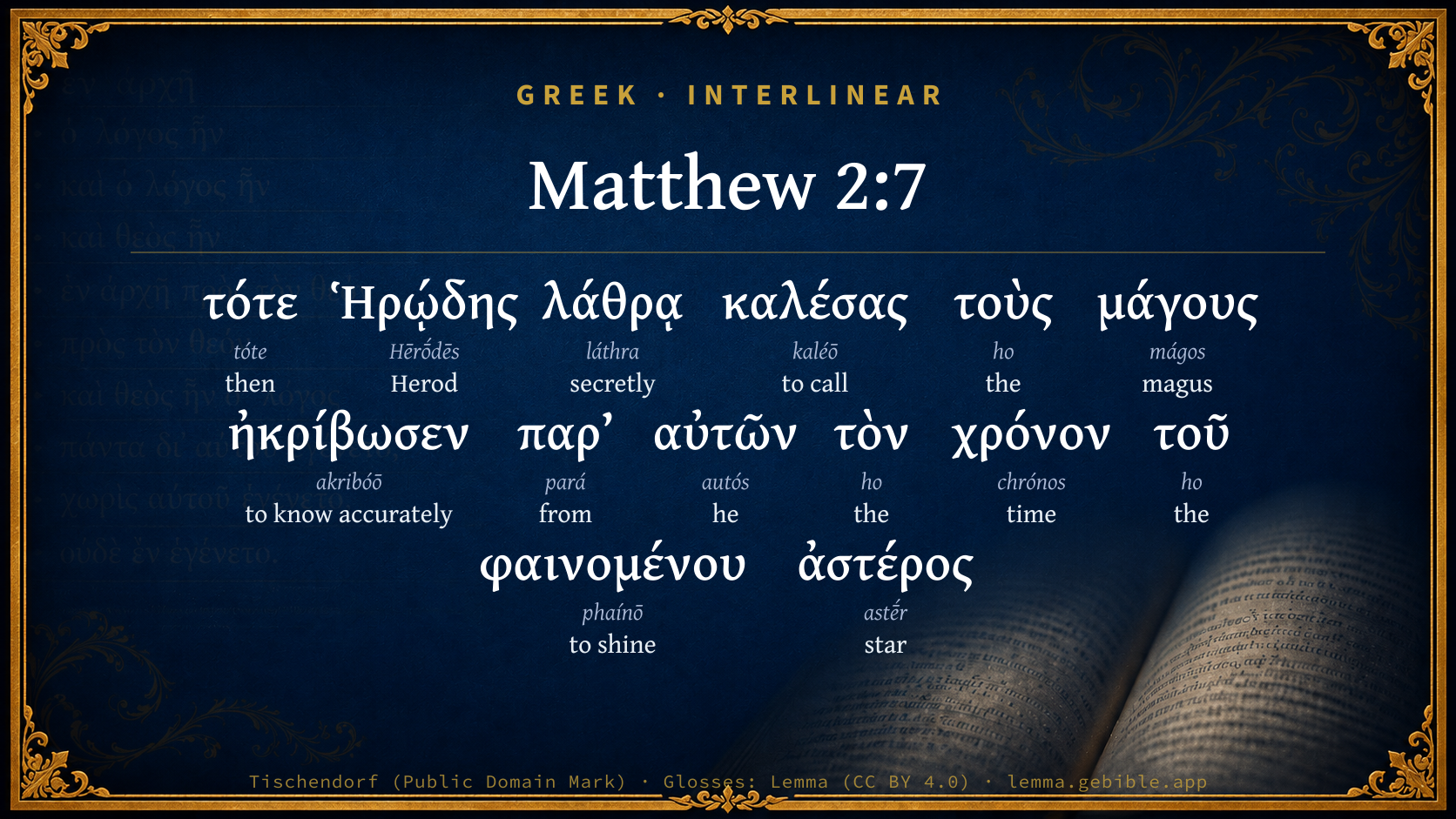
Greek (Tischendorf 8th ed.) Matthew 2:7 appears in the Greek New Testament. The text above is from the Tischendorf 8th edition. Each word links to its Strong’s number and a concise gloss. Click any word for its full Thayer’s Greek Lexicon entry.
Download image
Cite this verse

Matthew 2:7 (World English Bible). Public Domain. Lemma interlinear Bible study tool, https://lemma.gebible.app/v/matthew/2/7.

Show BibTeX & RIS
BibTeX
RIS
English Translation
Then Herod secretly called the wise men, and learned from them exactly what time the star appeared.
World English Bible · Public Domain
Highlights
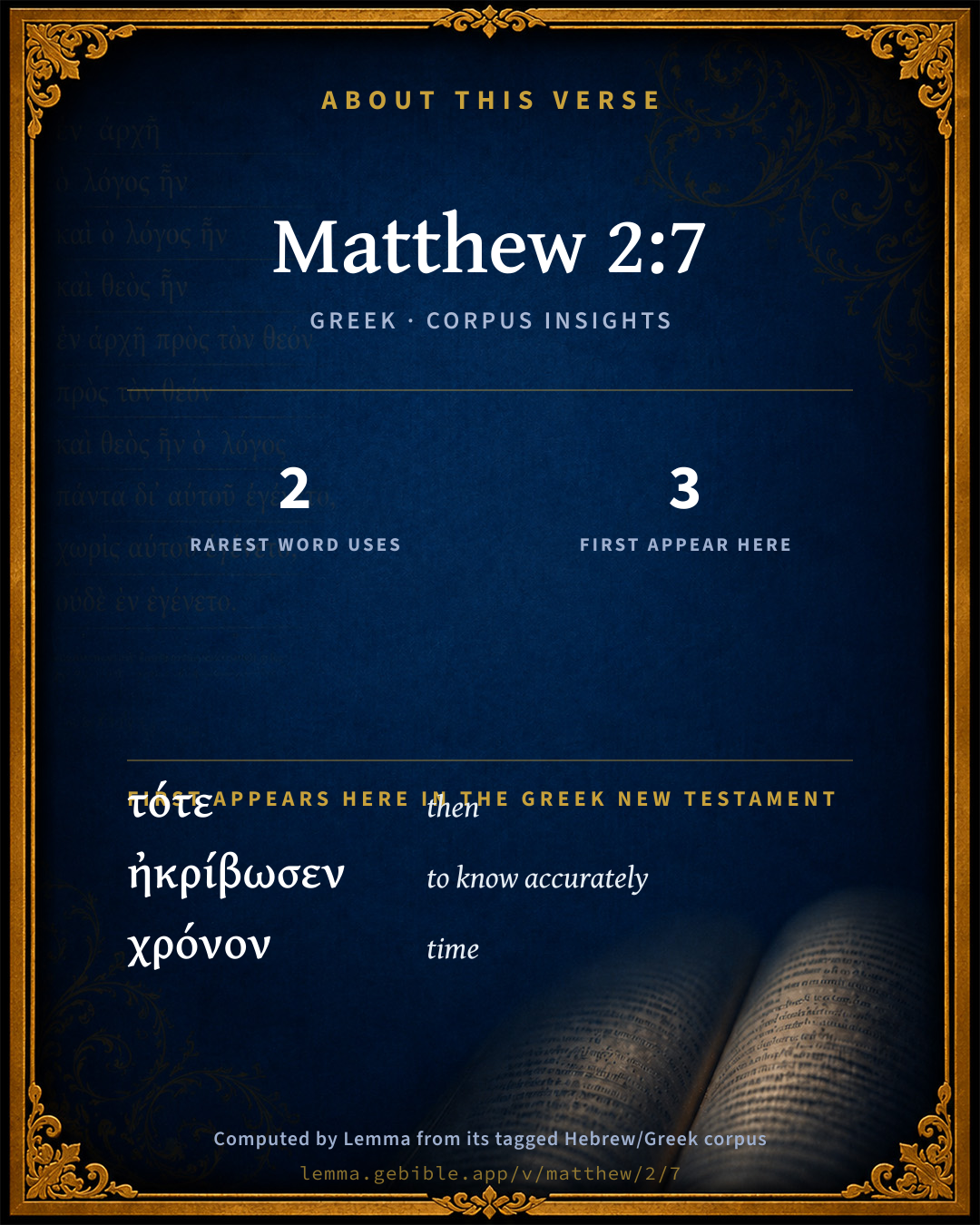
  • 3 first appearances in the Greek New Testament
Full analysis ↓
Download a study sheet

One document with this verse’s original text, its word-by-word gloss line, the meaning frame, cross-references with their text, attributed commentary, and full source and license credits — printable, and it pastes into notes with its structure intact.

This verse Autodidact and up

Study sheet (.html) Plain text (.txt)

A passage Seminary Student

Up to 50 verses in one chapter. A passage sheet keeps up to 6 commentary sources and 12 cross-references per verse, in the order this page ranks them, and says so on the sheet whenever that leaves anything out. Ask for a single verse and you get the Autodidact verse sheet above.

Everything on this page stays free to read, with no account — the sheet is a download of what is already on screen, not access to it.

Want to remove ads? Support Godless Engineer
Compare translations 3

The same verse in 3 English versions, stacked beneath the original-language interlinear above. Click any original word for its lexicon entry.

Each is an independent rendering of the whole verse — the interlinear is not word-aligned to these translations.

Highlighted words mark where these versions differ — a whole-verse word diff, not a word-by-word alignment.

  • World English Bible Public Domain
    Then Herod secretly called the wise men, and learned from them exactly what time the star appeared.
  • King James Version Public Domain
    Then Herod, when he had privily called the wise men, enquired of them diligently what time the star appeared.
  • unfoldingWord Literal Text CC BY-SA 4.0
    Then Herod, having secretly called the learned men, inquired from them the time of the appearing of the star.

unfoldingWord Literal Text — © unfoldingWord, licensed CC BY-SA 4.0. Word-aligned USFM3 via Door43 (git.door43.org/unfoldingWord/en_ult).

Versions to compare (up to 4)

3 of 4 selected

Show all 19 translations

Every available English version of this verse, each an independent rendering of the whole verse.

  • World English Bible Public Domain
    Then Herod secretly called the wise men, and learned from them exactly what time the star appeared.
  • Berean Standard Bible Public Domain
    Then Herod called the Magi secretly and learned from them the exact time the star had appeared.
  • Majority Standard Bible Public Domain
    Then Herod called the Magi secretly and learned from them the exact time the star had appeared.
  • King James Version Public Domain
    Then Herod, when he had privily called the wise men, enquired of them diligently what time the star appeared.
  • American Standard Version (1901) Public Domain
    Then Herod privily called the Wise-men, and learned of them exactly what time the star appeared.
  • Revised Version (1885) Public Domain
    Then Herod privily called the wise men, and learned of them carefully what time the star appeared.
  • Geneva Bible (1599) Public Domain
    Then Herod priuily called the Wisemen, and diligently inquired of them the time of the starre that appeared,
  • Douay-Rheims (1899) Public Domain
    Then Herod, privately calling the wise men, learned diligently of them the time of the star which appeared to them;
  • Young's Literal Translation Public Domain
    Then Herod, privately having called the mages, did inquire exactly from them the time of the appearing star,
  • Literal Standard Version CC BY-SA 4.0
    Then Herod, having called the magi privately, inquired exactly from them the time of the appearing star,
  • Unlocked Literal Bible CC BY-SA 4.0
    Then Herod secretly called the learned men to ask them exactly what time the star had appeared.
  • unfoldingWord Literal Text CC BY-SA 4.0
    Then Herod, having secretly called the learned men, inquired from them the time of the appearing of the star.
  • Darby Bible Public Domain
    Then Herod, having secretly called the magi, inquired of them accurately the time of the star that was appearing;
  • World Messianic Bible Public Domain
    Then Herod secretly called the wise men, and learned from them exactly what time the star appeared.
  • Webster's Bible Public Domain
    Then Herod, when he had privately called the wise men, inquired of them diligently what time the star appeared.
  • Free Bible Version CC BY-SA 4.0
    Then Herod called the wise men and met with them in private and found out from them exactly when the star appeared.
  • Bible in Basic English Public Domain
    Then Herod sent for the wise men privately, and put questions to them about what time the star had been seen.
  • Text-Critical English NT CC BY 4.0
    Then Herod secretly called the wise men and ascertained from them what time the star had appeared.
  • Tyndale New Testament (1534) Public Domain
    Then Herod prevely called the wyse men and dyligetly enquyred of them the tyme of the starre that appered

Literal Standard Version (2020), Covenant Press — licensed CC BY-SA 4.0. Text via the HelloAO Bible API (eBible.org). Unlocked Literal Bible (unfoldingWord) — licensed CC BY-SA 4.0. Text via the HelloAO Bible API (eBible.org). unfoldingWord Literal Text — © unfoldingWord, licensed CC BY-SA 4.0. Word-aligned USFM3 via Door43 (git.door43.org/unfoldingWord/en_ult). Free Bible Version, Dr. Jonathan Gallagher — licensed CC BY-SA 4.0. Text via the HelloAO Bible API (eBible.org).

Word by word

More ways to search: Search by grammar → Find every occurrence → Compare this word →

Practice this passage: Drill this verse → Learn its vocabulary →

ἠκρίβωσεν
akribóō
G198
“to know accurately”
Verb, Aorist, Active, Indicative, 3rd person, Singular
Part of Speech
Verb
Tense
Aorist
Voice
Active
Mood
Indicative
Person
3rd person
Number
Singular
Full Thayer's Definition

Origin: from the same as G196

TDNT: None

1. to know accurately, to do exactly 2. to investigate diligently
  1. τότε tóte G5119 “then” Adverb
  2. Ἡρῴδης Hērṓdēs G2264 “Herod” Noun, Nominative, Singular, Masculine
  3. λάθρᾳ láthra G2977 “secretly” Adverb
  4. καλέσας kaléō G2564 “to call” Verb, Aorist, Active, Participle, Nominative, Singular, Masculine
  5. τοὺς ho G3588 “the” Article, Accusative, Plural, Masculine
  6. μάγους mágos G3097 “magus” Noun, Accusative, Plural, Masculine
  7. παρ’ pará G3844 “from” Preposition
  8. αὐτῶν autós G846 “he” Personal pronoun, Genitive, Plural, Masculine
  9. τὸν ho G3588 “the” Article, Accusative, Singular, Masculine
  10. χρόνον chrónos G5550 “time” Noun, Accusative, Singular, Masculine
  11. τοῦ ho G3588 “the” Article, Genitive, Singular, Masculine
  12. φαινομένου phaínō G5316 “to shine” Verb, Present, Middle or Passive, Participle, Genitive, Singular, Masculine
  13. ἀστέρος astḗr G792 “star” Noun, Genitive, Singular, Masculine

About this verse

These counts appear in no published source. They are computed here, from the morphology-tagged text and Lemma’s own curated glosses. What Lemma adds →

14
words
12
distinct lemmas
Gospels
section

Notable vocabulary

The rarest word here is ἠκρίβωσεν to know accurately G198 — appearing just 2 times in the whole Greek New Testament.

First appearance in Scripture

These words make their first canonical appearance in the Greek New Testament here:

  • τότε then G5119
  • ἠκρίβωσεν to know accurately G198
  • χρόνον time G5550

Shared distinctive vocabulary

ἠκρίβωσεν to know accurately G198 occurs in 2 verses of the Greek New Testament. Also found in:

Repetition

A word recurs within this verse:

  • τοὺς the G3588 ×3

Cross-references

11

Topical passages linked to Matthew 2:7 in the Treasury of Scripture Knowledge — connected by theme and wording, ordered by reader-vote popularity; previews shown in the World English Bible.

  • Exodus 1:10 Come, let us deal wisely with them, lest they multiply, and it happen that when any war breaks out, they also join themselves to our enemies, and fight against us, and escape out of the land."
  • 1 Samuel 18:21 Saul said, I will give her to him, that she may be a snare to him, and that the hand of the Philistines may be against him. Therefore Saul said to David, You shall this day be my son-in-law a second time.
  • Psalms 55:21 His mouth was smooth as butter, But his heart was war. His words were softer than oil, Yet they were drawn swords.
  • Psalms 64:4–6 To shoot innocent men from ambushes. They shoot at him suddenly and fearlessly.
  • Isaiah 7:5–7 Because Syria, Ephraim, and the son of Remaliah, have plotted evil against you, saying,
  • Psalms 10:9–10 He lurks in secret as a lion in his ambush. He lies in wait to catch the helpless. He catches the helpless, when he draws him in his net.
  • Psalms 83:3–4 They conspire with cunning against your people. They plot against your cherished ones.
  • Ezekiel 38:10–11 Thus says the Lord Yahweh: It shall happen in that day, that things shall come into your mind, and you shall devise an evil device:
  • Revelation 12:1–5 A great sign was seen in heaven: a woman clothed with the sun, and the moon under her feet, and on her head a crown of twelve stars.
  • Matthew 26:3–5 Then the chief priests, the scribes, and the elders of the people were gathered together in the court of the high priest, who was called Caiaphas.
  • Revelation 12:15 The serpent spewed water out of his mouth after the woman like a river, that he might cause her to be carried away by the stream.

Cross-references courtesy of OpenBible.info (CC BY 4.0).

Commentary

Notes on Matthew 2:7 from classic Christian and Jewish commentators (each source and its license shown beneath its notes). The classic Christian expositions comment on the surrounding passage and are grouped to its opening verse, so a note may address several verses; the Jewish commentaries on the Tanakh (Rashi and others) are per-verse, so they appear only where the commentator wrote on this verse.

Lemma curates 59 commentaries, every one of them public domain or Creative Commons licensed, each selected and text-cleaned for this edition rather than reprinted as found. About our sources →

The Biblical Illustrator

Joseph S. Exell

Mat_2:7

Search diligently.

I. Wicked men often cloak their evil designs under the appearance of religion. They attempt to deceive those who are really good, and to make them suppose that they have the same design. But God cannot be deceived, and He will bring them to punishment.

II. Wicked men often make use of the PIOUS to advance their evil purposes. Men like Herod will stop at nothing if they can carry their ends. They endeavour to deceive the simple, allure the unsuspecting, and to beguile the weak, to answer their purposes of wickedness.

III. The plans of wicked men are often well laid. They occupy a long time; they make diligent inquiry; and all of it has the appearance of religion. But God sees the design; and though men are deceived, He cannot be (Pro_15:3). (Dr. A. Barnes.)

A king frightened by an infant

I. That men may be interested in Christ, and inquire about Him from different motives- some to worship, some to murder.

1. The motive of the wise men.

2. Herods motive.

II. That inquiry about Christ does not produce the same results in all.

1. The wise men rejoiced.

2. Herod was troubled.

III. That all opposition to Christ and His cause must end in failure and overthrow. (T. Kelly.)

The Biblical Illustrator, edited by Joseph S. Exell (c. 1880s–1900s) — public domain. Text from a community e-Sword module.

Joseph Benson's Commentary

Mat 2:7. Then Herod, when he had privily called the wise men, &c. — He thought it prudent to keep the matter as close as possible, lest the Jews, understanding the time of the birth of the Messiah, should, from thence, take occasion to rebel: for not having an hereditary right to the kingdom, and having been guilty of many acts of cruelty among them, he had no reason to presume upon their good-will toward him. He feared, likewise, lest, if it should be noised abroad that the Messiah was born, his purpose of destroying him should be prevented. But there is no wisdom or counsel against the Most High! He inquired of them diligently — Or, as the words ηκριβωσε παρ’ αυτων, more properly signify, inquired of them the exact time, or, got exact information from them, what time the star appeared — That is, at what time it began to appear, judging, as probably the fact was, that the star first appeared at the time the child was born. His view in this was, that he might thereby form some conjecture concerning the age of the child to whose birth it referred. For on the one hand, it seems, he did not wish to destroy more children than the accomplishment of his design appeared to require; and on the other, not to leave this child alive.

Joseph Benson's Commentary on the Old and New Testaments (1811–1818) — public domain. Text from a community e-Sword module.

Bengel's Gnomon

Johann Albrecht Bengel

Mat 2:7. Αάθρα, privily) lest anything should transpire. This argues insidious designs on the part of Herod.—ἠκρίβωσε, enquired diligently) even to the smallest particle of time. Hence we perceive the craft of Herod,[88] and the simplicity of the Magi.—φαινομένου, appearing) The Present Tense. Herod enquired the time at which the star which was now visible, had first become so.[89]

[88] So great enmities did that monarch indulge in and foster, although he did not esteem as a fable the doctrine concerning Christ, but was by this time aware of the time and place of His nativity.—Vers. Germ.

[89] In the original the passage stands thus—“Præsens tempus, quo conspici cœpta esset stella, quœ appareret, quaesivit Herodes.” This is evidently a misprint for—“Præsens. Tempus quo conspici cœpta esset stella, quœ appareret, quaesivit Herodes.”

In his German Version Bengel renders the passage “und vernahm von ihnen die Zeit, da der Stern erschienen,” i.e. “and ascertained accurately from them the Time when the Star appeared.” In his Harmony he renders it—“und erlernte mit fleis von ihnen wann der Stern erschienen wäre,” i.e. “and learnt with diligence from them, when the star made its appearance.”—(I. B.)

Bengel's Gnomon of the New Testament — English translation (T&T Clark, Edinburgh, 1860) — public domain. Text from a community e-Sword module.

Meyer's Critical & Exegetical Commentary

Heinrich August Wilhelm Meyer

Mat_2:7 f. Λάθρα] Inconsistently enough, as that could only arouse suspicion; but to adopt secret measures is natural to wickedness!

The question after the time of the appearance [of the star] has its reason in this, that the mistrustful Herod already thinks of the possibility of his not seeing the Magi again, and that he will then still have a hold for taking further proceedings against the mysterious child (Mat_2:16).

ἠκρίβωσε] with the accusative does not mean: he investigated minutely (ἀκριβόω περί τινος may mean this), but: after he had made them come to him secretly, he obtained from them a minute knowledge, and so on. Vulgate appropriately says: Diligenter didicit. Comp. Plat. Charm. p. 156 A; Xen. Mem. iv. 2. 10; Eur. Hec. 1192; Lucian, Jov. trag. 27, Piscat. xx.; Herodian, i. 11. 14. But the passages where it means to make exact (Aquila, Isa_49:16; Simonides, lxxxiv.; Xen. Cyr. ii. 1. 26) do not apply here. Euth. Zigabenus rightly says: προσεδόκησε γὰρ, ὅτι ὅτε οὗτος (the star) ἐφάνη, τότε πάντως ἐγεννήθη καὶ ὁ Χριστός.

τοῦ φαινομένου ἀστέρος] Grotius: Non initium, sed continuitas. Herod asked: How long does the star appear? how long does it make itself visible? namely, since its rising in the east, where ye saw it arise (Mat_2:9). Thus the present is not to be taken either in the sense of the aorist or of the imperfect (de Wette, Bleek).

πέμψας] not contemporaneous with the εἶπε (de Wette), but prior to it; comp. Mat_11:2. After he had directed them to Bethlehem (in consequence of Mat_2:5 f.), he added the commission, etc. Otherwise it would have been ἔπεμψεν … εἰπών.

Meyer — Critical and Exegetical Commentary on the New Testament — English translation by Peter Christie, edited by Frederick Crombie (T&T Clark, 1880) — public domain. Text from a community e-Sword module.

Expositor's Greek Testament

ed. W. Robertson Nicoll

Mat 2:7-8 . Herod’s next step . τότε Ἡρώδης … ἀστέρος : τότε , frequent formula of transition with our evangelist, cf. Mat 2:16-17 ; Mat 4:1 ; Mat 4:5 ; Mat 4:11 , etc. Herod wished to ascertain precisely when the child the Magi had come to worship was born. He assumed that the event would synchronise with the ascent of the star which the Magi had seen in its rising, and which still continued to be seen ( φαινομένου ). Therefore he made particular inquiries ( ἠκρίβωσε ) as to the time of the star, i.e. , the time of its first appearing. This was a blind, an affectation of great interest in all that related to the child, in whose destinies even the stars were involved.

The Expositor's Greek Testament, edited by W. Robertson Nicoll (1897–1910) — public domain. Text from a community e-Sword module.

Jamieson, Fausset & Brown

Robert Jamieson, A. R. Fausset & David Brown

Then Herod, when he had privily called the wise men--Herod has so far succeeded in his murderous design: he has tracked the spot where lies his victim, an unconscious babe. But he has another point to fix--the date of His birth--without which he might still miss his mark. The one he had got from the Sanhedrim; the other he will have from the sages; but secretly, lest his object should be suspected and defeated. So he

inquired of them diligently--rather, "precisely."

what time the star appeared--presuming that this would be the best clue to the age of the child. The unsuspecting strangers tell him all. And now he thinks he is succeeding to a wish, and shall speedily clutch his victim; for at so early an age as they indicate, He would not likely have been removed from the place of His birth. Yet he is wary. He sends them as messengers from himself, and bids them come to him, that he may follow their pious example.

Jamieson, Fausset & Brown — Commentary Critical and Explanatory on the Whole Bible (1871) — public domain (CC PDM 1.0). Text via the HelloAO Bible API.

Ellicott's Commentary for English Readers

(7) When he had privily called.—True to his nature to the last—himself probably a believer in astrology, and haunted by fears of what the star portended—the king’s next measure is to ascertain the limits of his danger. The English “what time the star appeared” is not quite accurate. Literally, the time of the star that was appearing—i.e., at what time the star, which was still visible (Mat_2:9), had first appeared.

Enquired of them diligently.—Better, ascertained exactly.

A Bible Commentary for English Readers, edited by Charles John Ellicott (1878–1897) — public domain. Text from a community e-Sword module.

The Cambridge Bible for Schools and Colleges

gen. ed. J. J. S. Perowne

7. inquired of them diligently] Rather, having accurately ascertained; the word is used of scientific exactness. The reason of this inquiry appears in Mat_2:16.

what time the star appeared] Literally, the time of the star which was appearing, i. e. when it first appeared and how long it would continue.

The Cambridge Bible for Schools and Colleges (gen. ed. J. J. S. Perowne; Cambridge University Press, 1878–1918) — public domain. Text from a community e-Sword module.

John Gill's Exposition

Then Herod, when he had privately called the wise men,.... As soon as he had got the intelligence of the place of the Messiah's birth, he called, or ordered the wise men to be brought into his presence, and that in a very private manner; lest the Jews, who knew his hypocrisy and deceit, should perceive his views, and enter into his designs, and so give the wise men some instructions, which would be prejudicial to the scheme he was forming in his own mind to destroy the young king; and having called them to him, he

inquired of them diligently what time the star appeared. He took a good deal of pains in examining them, he sifted them, and inquired of them with much accuracy, and exactness, the precise time of the star's appearing to them, how long ago it was when it was first observed by them; that hereby he might exactly know the age of Christ, and the better execute the bloody design he had formed, should the wise men disappoint him; and the better detect an impostor, should another afterwards arise, and set up himself for the king of the Jews.

John Gill's Exposition of the Whole Bible (1746–1763) — public domain (CC PDM 1.0). Text via the HelloAO Bible API.

Trapp's Complete Commentary

John Trapp

7 Then Herod, when he had privily called the wise men, enquired of them diligently what time the star appeared.

Ver. 7. Then Herod, when he had privily called the wise men, inquired of them diligently] {a} The children of this world are wise in their generation, but so are serpents, foxes, &c., to the which the Church’s enemies are often compared, He thought by this means to have made all sure, but in the thing wherein he dealt proudly and politically, God was above them, as old Jethro hath it, Exo 18:11. There is neither power nor policy against the Lord; "who ever waxed fierce against him, and prospered?" Job 9:4.

{a} ηκριβωσε. Accuravit, et omnibus nervis incubuit.

John Trapp, A Commentary or Exposition upon All the Books of the Old and New Testament (1647–1656) — public domain. Text from a community e-Sword module.

Albert Barnes' Notes on the Bible

Privily - Secretly, privately. He did this to ascertain the time when Jesus was born.

Diligently - Accurately, exactly. He took pains to learn the precise time when the star appeared. He did this because he naturally concluded that the star appeared just at the time of his birth, and he wished to know precisely how old the child was.

Albert Barnes' Notes on the Bible (1834–1885) — public domain. Text from a community e-Sword/MySword module.

Matthew Poole's English Annotations

Herod having heard the answer of the priests and scribes, did not think fit to make any noise of it amongst the people; he knew the Jews were apt enough to rebel, and being so little a conqueror had no reason to presume much of their goodwill towards him; he therefore calls the wise men privily, and takes no notice of any King they talked of, but only inquires the time when this new star first appeared. To what end he made this inquiry may be learned from Mat 2:16; only that he might be able to govern himself in his bloody decree, that he might neither destroy more children than would serve his present design, nor yet leave this Child behind.

Matthew Poole's English Annotations on the Holy Bible (1683–1685) — public domain. Text from a community e-Sword/MySword module.

Whedon's Commentary on the Bible

Daniel D. Whedon

7. Privily — Privately, because he wished the excitement to die, and to keep the matter under his own control. Called the wise men — Who plainly were waiting to learn the locality of the Messiah, being not now directed by the visible star. What time the star appeared — In order to know the precise time of the birth.

Daniel D. Whedon (gen. ed.), Commentary on the Old and New Testaments (1874–1909) — public domain. Text from a community e-Sword module.

The Pulpit Commentary

Then Herod, when he had privily called the Wise Men. Secrecy was doubly necessary. He would not publicly commit himself to acknowledging the rights of the new King, and he would give no opportunity for others to warn the Child"s parents of the dangerous interest that Herod was taking in him. Duplicity was very characteristic of Herod; cf. his assassination of Aristobulus the high priest (Josephus, "Ant.," 15:3. 3), and his alluring his son Antipater home to death (ibid., 17:5. 1). Inquired of them diligently; learned of them carefully (Revised Version); "lerned of hem bisili" (Wickliffe); hkribwsen par autwn . The stress is not upon Herod"s careful questioning, but on the exact information that he obtained. What time the star appeared. Although this is not the literal translation, it may, perhaps, represent the sense of the original (tonon tou fainomenou asterov), the participle characterizing the star in its most important relation its appearance, and the words being treated as a compound expression. (cf. Joh_12:9, Joh_12:12) Herod supposed that the birth of the Babe was synchronous with the first appearance of the star. The translation, however, of the Revised Version margin, "the time of the star that appeared," better suits the exact wording (cronon , not kairon ; fainomenou , not fanentov), the phrase thus including both the first appearance and also the period of continuance (cf. Grotius, "non initium, sed continuitas"). But it is difficult to see What Herod would have learned from this latter particular. Some even think that the star was still visible (Plumptre; Weiss, "Matthew"), but in this case the joy of the Magi in ver. 10 is not satisfactorily explained.

The Pulpit Commentary (1880–1919), ed. H.D.M. Spence-Jones & Joseph S. Exell — public domain. Text from a community e-Sword module.

Burkitt's Expository Notes on the New Testament

William Burkitt

Observe here, 1. How Herod clokes his intended cruelty with disguised hypocrisy: he had a murder in his heart, when he pretended to worship Christ with his mouth. There is no villainy so great, but will mask itself under a pretence ond shew of piety. Herod veils his intent to kill Christ, with a pretence to worship him.

Observe, 2. Herod calls him the young child, not the young king: that word was too big to come out of Herod’s proud mouth; he could neither bear the thing, nor brook the title. A king it is true he is, but one that will never be thy rival: he has a kingdom, but it is not of this world.

Observe, 3. How craftily Herod lays his plot; he desires the wise men to enquire thoroughly, and to inform him privately. To be wise in doing mischief, is the worst wisdom in the world: it is not the wisdom from above, but from hell beneath.

William Burkitt's Expository Notes on the New Testament (1700–1703) — public domain. Text from a community e-Sword module.

The People's New Testament

B. W. Johnson

7. Then Herod privily called the wise men. The crafty and cruel king had gained one point: he now knew where the Christ was to be born. He therefore asks another question of the wise men, by which he hopes to ascertain the age of the royal child. What time the star appeared. The fact that, as stated below, he slew the children of two years and under, denotes that the star had been seen first about two years before.

B. W. Johnson's The People's New Testament with Notes (1889–1891) — public domain. Electronic text from the Christian Classics Ethereal Library (CCEL) ThML edition.

unfoldingWord translationNotes

Door43 World Missions Community

Herod secretly called the learned men

This means that Herod talked to the learned men without other people knowing.

men to ask them exactly what time the star had appeared. He

This can be translated as a direct quotation. AT: "men, and he asked them, 'When exactly did this star appear?' He" (See: Direct and Indirect Quotations)

what time the star had appeared

It is implied that the learned men told him when the star appeared. AT: "what time the star had appeared. The learned men told Herod when the star first appeared" (See: Assumed Knowledge and Implicit Information)

young child

This refers to Jesus.

bring me word

"let me know" or "tell me" or "report back to me"

worship him

See how you translated this in Matthew 2:2.

translationWords

Herod the Great

learned men

Bethlehem

word

worship

unfoldingWord translationNotes — © Distant Shores Media and the Door43 World Missions Community, licensed CC BY-SA 4.0. Source: git.door43.org/Door43/en_tn.

Cambridge Greek Testament for Schools and Colleges

7. τότε, a favourite word of transition with St Matthew. It occurs more frequently in this gospel alone than in all the rest of the N.T. The modes of transition in the several Evangelists are interesting as notes of style. Thus τότε is characteristic of St Matthew, εὐθὺς (εὐθέως) of St Mark, καὶ ἐγένετο of St Luke, καὶ ἰδοὺ is about equally common in Luke and Matthew.

ἠκρίβωσεν, ‘accurately ascertained,’ used of scientific exactness, σοφοὶ μὲν οὖν εἰσʼ οἱ τάδʼ ἠκριβωκότες, Eur. Hec. 1192. The reason of Herod’s enquiry appears in Mat 2:16.

τὸν χρόνον τοῦ φαιν. ἀστ. Literally, ‘the time of the star which was appearing,’ i.e. when it first appeared and how long it would continue. The χρόνος was astrologically important.

Cambridge Greek Testament for Schools and Colleges (Cambridge University Press, 1896; 21 vols, various authors incl. Carr, Maclear, Plummer, Farrar, Lumby, Moule, M. R. James, Simcox) — public domain. Text from a community e-Sword module.

Alford’s Greek Testament

Henry Alford

7. ἠκρίβωσεν] ascertained accurately.

φαινομένου] lit. the time (or, duration: perhaps as an element in his calculation of age) of the star which appeared: φ. being the part. pres., referred back to the time when they saw the star. The position of φ. between the art. and its subst. forbids such renderings as ‘the time when the star appeared.’

Henry Alford, The Greek Testament (1849–1861) — public domain. Text from a community e-Sword module.

International Critical Commentary

7. Then Herod having secretly called the Magi, made accurate inquiry of them as to the time of the appearing star.] τότε is a favourite word in this Gospel. Mt. 90 times, Mar_6, Luk_15. τὸν χρόνον τοῦ φαινομένου ἀστέρος, i.e. the period since the star first appeared to them at (its) rising.

(P)

7. The silence of S. Paul seems adverse to an early date.1 Whether this Apostle was or was not acquainted with the tradition, it is clear that he did not make any extended use of it as a basis of Christological doctrine in his extant letters.

But, on the other hand, it is in every way probable that even if the Apostle had received this tradition, he would not have employed it as an argument for Christianity in his preaching to the Gentiles. To him the resurrection of Christ was the conclusive proof of His divinity (cf. Rom 1:2). The supernatural birth neither enhanced nor diminished that proof. And, on the other hand, there was every reason for keeping in the background a tradition which in the early stages of Church development would probably have proved a great stumbling-block to the progress of Christianity, and a continual source of wounded feeling for the reverence of Christians for the Person of their Master. On the one hand, the proclamation of the supernatural birth amongst the pagan peoples of Asia Minor and Greece and Italy would no doubt have seemed to lower Christianity in this respect to the level of the heathen mythologies. Nothing could be more disastrous, and S. Paul was no doubt far-sighted enough to see it, than quite unnecessarily to give pagan hearers facts which would encourage many of them to think of Christ as they thought of the deities and heroes of their mythologies. When the risen Christ had been revealed in them as in S. Paul, the tradition of His supernatural birth would come to them safeguarded by their belief in Him as the only-begotten Son of God. The silence of S. Paul is analogous to the silence of the author of the Fourth Gospel. This writer almost undeniably wrote at a period when the tradition of the supernatural birth was current. Yet he does not put it forward as a main argument for Christianity. On the other hand, he certainly does not wish to deny its historical character nor to depreciate its value. But he seems to assume it as a part of the Christian faith just as he does the tradition of the Ascension, and to use it as an analogy of the spiritual birth of the Christian believer, 1:14. See Interpreter, Oct. 1905, pp. 51 ff.

And again, if the proclamation of the supernatural birth would have lowered Christian doctrine in the eyes of the pagan world, so it would have led to debate which would have been distasteful and painful to Christian reverence. At a very early period Jewish caricatures of the story of the supernatural birth were current. They may already underlie Mar 6:3, and more probably are reflected in Mat 1:18-25. And wherever Christianity spread, Jewish misrepresentation followed it. If the proclamation of the supernatural birth would have encouraged on the one hand semi-pagan conception of the Messiah, so on the other it would have provoked Jewish slander of a most offensive kind. The silence of S. Paul may well be due partly to his common sense, which enabled him to see that there are wise ways and unwise ways of presenting the facts of Christianity to the world (pearls were not to be cast before swine), and partly to that highly developed Christian reverence and modesty which also marks the narratives of the Gospels.

The alleged silence of S. Paul seems, therefore, to be no sufficient argument against the existence of the tradition of the supernatural birth in Palestine during his lifetime.

International Critical Commentary — older volumes (1896–1929), various authors — public domain. Text from a community e-Sword module.

Lesson kit

Teaching starters — assembled from the data on this page, not authored interpretation. Every prompt links to the verse data it draws on. Edit before teaching.

Matthew, in the Gospels, opens this verse with 14 words (12 distinct Greek lemmas). Its most distinctive word is akribóō (“to know accurately”). A historical commentator’s framing appears above. Read the whole chapter for the surrounding context.

Discussion questions

  1. How does “to know accurately” (akribóō) shape what this verse is saying?
  2. 3 words make their first appearance in Scripture here. What does this debut establish?
  3. How does Matthew 2:16, which shares the word «to know accurately», read alongside this verse?
  4. What does the repetition of “the” (3× in this one verse) do in this verse?
  5. These translations render this verse differently; the difference is in the English rendering, not the original. What questions does that raise?
  6. Compare how The Biblical Illustrator and Joseph Benson's Commentary read this verse. Where do they agree or differ?

Things to notice

  • 3 words make their first canonical appearance in Scripture here.
  • These translations choose different wording for 14 words in this verse.
  • “the” occurs 3× in this single verse.
  • 12 distinct Greek lemmas span 14 words in this verse.

Reading settings

Reading text

Shown beneath each verse's original-language words.

Old Testament
Old Testament edition

Read the OT as the Masoretic Hebrew (MT) or the Greek Septuagint (LXX).

English shown for the Greek Septuagint (in the Hebrew ↔ Greek comparison).

Comparing translations? Open the Compare panel on any verse page to stack up to four side by side.