Galatians 5:8

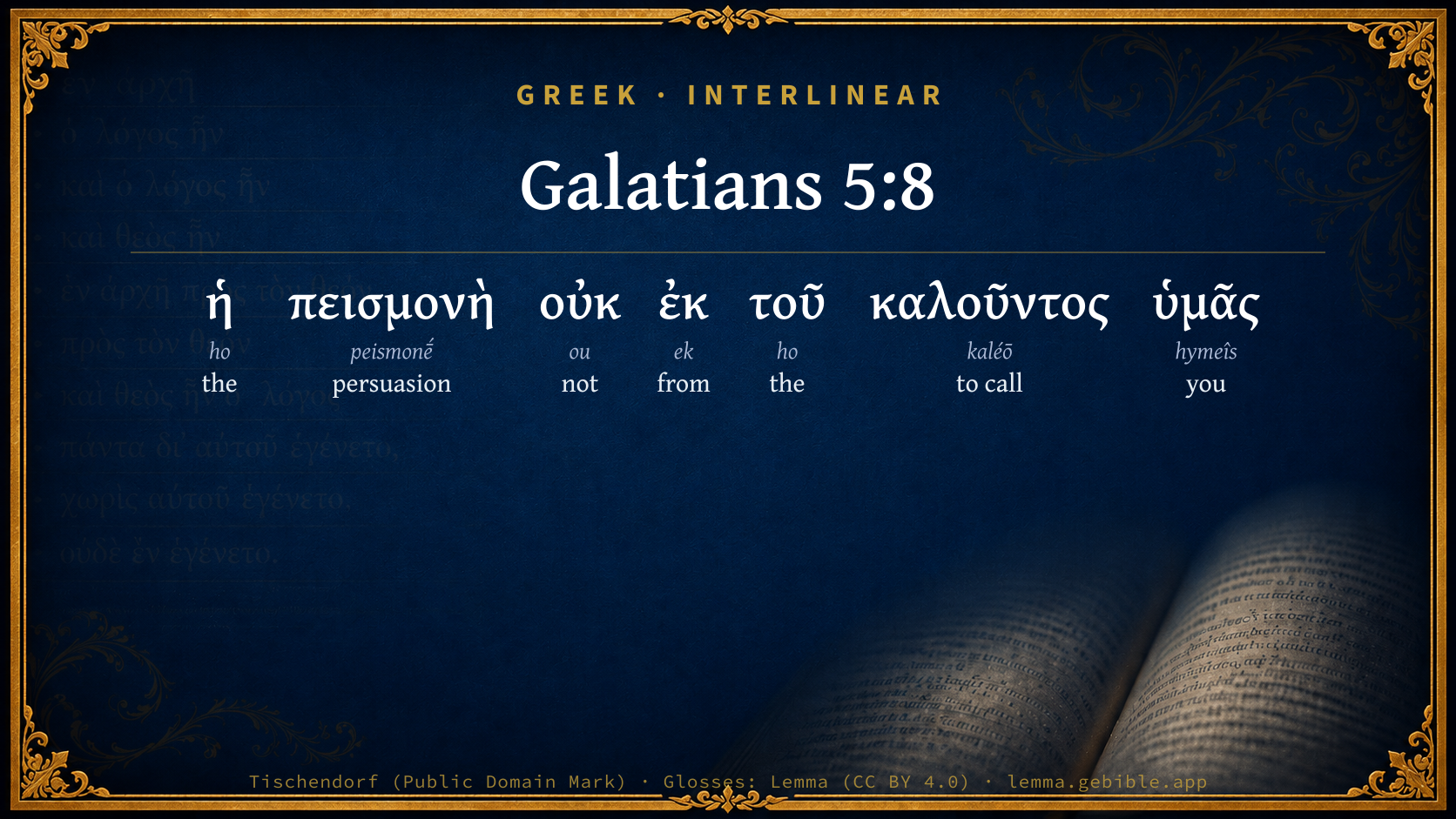
Greek (Tischendorf 8th ed.) Galatians 5:8 appears in the Greek New Testament. The text above is from the Tischendorf 8th edition. Each word links to its Strong’s number and a concise gloss. Click any word for its full Thayer’s Greek Lexicon entry.
Download image
Cite this verse

Galatians 5:8 (World English Bible). Public Domain. Lemma interlinear Bible study tool, https://lemma.gebible.app/v/galatians/5/8.

Show BibTeX & RIS
BibTeX
RIS
English Translation
This persuasion is not from him who calls you.
World English Bible · Public Domain
Highlights
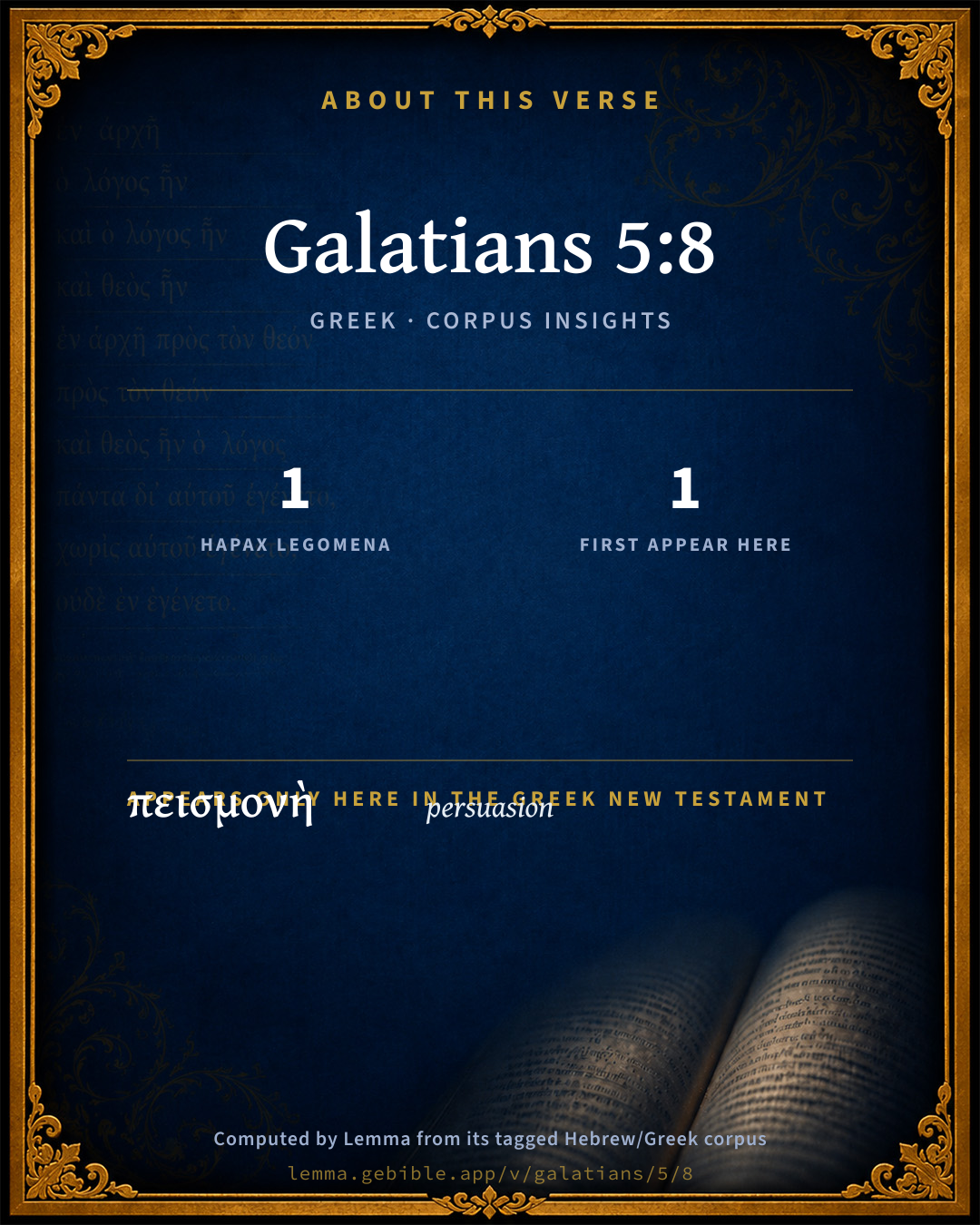
  • 1 hapax legomenon — only here in the Greek New Testament
  • 1 first appearance in the Greek New Testament
Full analysis ↓
Download a study sheet

One document with this verse’s original text, its word-by-word gloss line, the meaning frame, cross-references with their text, attributed commentary, and full source and license credits — printable, and it pastes into notes with its structure intact.

This verse Autodidact and up

Study sheet (.html) Plain text (.txt)

A passage Seminary Student

Up to 50 verses in one chapter. A passage sheet keeps up to 6 commentary sources and 12 cross-references per verse, in the order this page ranks them, and says so on the sheet whenever that leaves anything out. Ask for a single verse and you get the Autodidact verse sheet above.

Everything on this page stays free to read, with no account — the sheet is a download of what is already on screen, not access to it.

Want to remove ads? Support Godless Engineer
Compare translations 3

The same verse in 3 English versions, stacked beneath the original-language interlinear above. Click any original word for its lexicon entry.

Each is an independent rendering of the whole verse — the interlinear is not word-aligned to these translations.

Highlighted words mark where these versions differ — a whole-verse word diff, not a word-by-word alignment.

  • World English Bible Public Domain
    This persuasion is not from him who calls you.
  • King James Version Public Domain
    This persuasion cometh not of him that calleth you.
  • unfoldingWord Literal Text CC BY-SA 4.0
    This persuasion not from the one calling you!

unfoldingWord Literal Text — © unfoldingWord, licensed CC BY-SA 4.0. Word-aligned USFM3 via Door43 (git.door43.org/unfoldingWord/en_ult).

Versions to compare (up to 4)

3 of 4 selected

Show all 19 translations

Every available English version of this verse, each an independent rendering of the whole verse.

  • World English Bible Public Domain
    This persuasion is not from him who calls you.
  • Berean Standard Bible Public Domain
    Such persuasion does not come from the One who calls you.
  • Majority Standard Bible Public Domain
    Such persuasion does not come from the One who calls you.
  • King James Version Public Domain
    This persuasion cometh not of him that calleth you.
  • American Standard Version (1901) Public Domain
    This persuasion `came' not of him that calleth you.
  • Revised Version (1885) Public Domain
    This persuasion came not of him that calleth you.
  • Geneva Bible (1599) Public Domain
    It is not the perswasion of him that calleth you.
  • Douay-Rheims (1899) Public Domain
    This persuasion is not from him that calleth you.
  • Young's Literal Translation Public Domain
    the obedience `is' not of him who is calling you!
  • Literal Standard Version CC BY-SA 4.0
    The persuasion [is] not of Him who is calling you!
  • Unlocked Literal Bible CC BY-SA 4.0
    This persuasion does not come from him who calls you!
  • unfoldingWord Literal Text CC BY-SA 4.0
    This persuasion not from the one calling you!
  • Darby Bible Public Domain
    The persuasibleness [is] not of him that calls you.
  • World Messianic Bible Public Domain
    This persuasion is not from him who calls you.
  • Webster's Bible Public Domain
    This persuasion cometh not from him that calleth you.
  • Free Bible Version CC BY-SA 4.0
    This “persuasion” certainly isn't from the one who calls you.
  • Bible in Basic English Public Domain
    This ready belief did not come from him who had made you his.
  • Text-Critical English NT CC BY 4.0
    This persuasion does not come from him who calls you.
  • Tyndale New Testament (1534) Public Domain
    Even that counsell that is not of him that called you.

Literal Standard Version (2020), Covenant Press — licensed CC BY-SA 4.0. Text via the HelloAO Bible API (eBible.org). Unlocked Literal Bible (unfoldingWord) — licensed CC BY-SA 4.0. Text via the HelloAO Bible API (eBible.org). unfoldingWord Literal Text — © unfoldingWord, licensed CC BY-SA 4.0. Word-aligned USFM3 via Door43 (git.door43.org/unfoldingWord/en_ult). Free Bible Version, Dr. Jonathan Gallagher — licensed CC BY-SA 4.0. Text via the HelloAO Bible API (eBible.org).

Word by word

More ways to search: Search by grammar → Find every occurrence → Compare this word →

Practice this passage: Drill this verse → Learn its vocabulary →

About this verse

These counts appear in no published source. They are computed here, from the morphology-tagged text and Lemma’s own curated glosses. What Lemma adds →

7
words
6
distinct lemmas
Pauline Epistles
section

Notable vocabulary

1 hapax legomenon — a word that appears only here in the entire Greek New Testament:

  • πεισμονὴ persuasion G3988

First appearance in Scripture

This word makes its first canonical appearance in the Greek New Testament here:

  • πεισμονὴ persuasion G3988

Repetition

A word recurs within this verse:

Cross-references

2

Topical passages linked to Galatians 5:8 in the Treasury of Scripture Knowledge — connected by theme and wording, ordered by reader-vote popularity; previews shown in the World English Bible.

  • Galatians 1:6 I marvel that you are so quickly deserting him who called you in the grace of Christ to a different gospel;
  • Romans 8:28 We know that all things work together for good for those who love God, to those who are called according to his purpose.

Cross-references courtesy of OpenBible.info (CC BY 4.0).

Commentary

Notes on Galatians 5:8 from classic Christian and Jewish commentators (each source and its license shown beneath its notes). The classic Christian expositions comment on the surrounding passage and are grouped to its opening verse, so a note may address several verses; the Jewish commentaries on the Tanakh (Rashi and others) are per-verse, so they appear only where the commentator wrote on this verse.

Lemma curates 59 commentaries, every one of them public domain or Creative Commons licensed, each selected and text-cleaned for this edition rather than reprinted as found. About our sources →

The Biblical Illustrator

Joseph S. Exell

Gal_5:8

This persuasion cometh not of Him that calleth you.

This persuasion

We learn--

I. That the cause of religious declension is unbelief in Gods Word, and surrender to plausible persuasions. Thus--

1. Eve, by the persuasion of the devil.

2. Papists, by persuasion that the Church cannot err.

3. Common people, by persuasion that God is all mercy.

4. Tradesmen, that they have a family to keep.

5. Moralists, that honesty and temperance are sufficient for salvation.

II. That our duty and safety lie in following absolutely the calling of God.

1. Thus Abraham.

2. Thus Paul.

III. That doctrines are to be tested by their conformity or nonconformity to the calling of God.

1. God calls us to liberty; hence the yoke of ordinances is wrong.

2. God calls us to justification by the merits of Christ; hence justification by works is wrong.

3. God calls us to self-denial and service; hence self-indulgence even in religious privileges is wrong.

4. God calls us absolutely to and for Himself; hence the sin of conformity to the world.

IV. That God calls even backsliders; which shows--

1. Gods patience.

2. The possibility of restoration.

V. That our life and conversation must be suitable to the high calling of God. (W. Perkins.)

The Biblical Illustrator, edited by Joseph S. Exell (c. 1880s–1900s) — public domain. Text from a community e-Sword module.

Tyndale Open Study Notes

Tyndale Open Resources

5:8 The Galatians thought that their commitment to the law would please God, but God wasn’t calling them to this slavery. God called them to freedom.

Tyndale Open Study Notes — © Tyndale Open Resources, licensed CC BY-SA 4.0. Text via the HelloAO Bible API.

Bengel's Gnomon

Johann Albrecht Bengel

Gal 5:8. Ἡ πεισμονὴ) Most commentators interpret it persuasion, also with the addition of this, that, or your [hæc, ista, vestra], according to the testimony of Lubinus on this passage. Comp. Chrysost. This word very rarely occurs, and Eustathius alone, as I can find, has it at Odyss. χ., where he shows that “πεῖσμα and πεισμονὴ are said respecting those that start difficulties and set themselves in the way [ἐπὶ τῶν ἐνστατικῶν—stubborn, obstinate persons], and are figuratively taken from the cables [πεισμάτων], that is, the hawsers used in ships.” But a pertinacious and obstinate man is given to starting difficulties [is ἐνστατικὸς]; and therefore that man has πεισμονὴν, self-confidence, who, having left off running, ἐνέχεται, holds fast to [the law] obstinately, and who persuades and trusts to himself alone, and does not obey [πείθεται] another, Gal 5:1; Gal 5:7; and in this way μὴ πείθεσθαι, and ἡ πεισμονὴ, and πέποιθα, form an Antanaclasis,[46] a figure, which is frequently used both by Paul, as many constantly observe, and by the other sacred writers, as Glassius well demonstrates. Whether it be a metaphor or not, at least this verbal noun, like other nouns in-ονὴ, is intransitive[47] [not a persuading of others, but a persuasion in one’s self].—οὐκ, not) supply is; is not of (God), who called you, but from a power truly hostile; and there is subjoined a metonymy of the abstract for the concrete, as appears from the previous word, who, not what.—καλοῦντος) who called you; comp. Gal 5:13, you have been called. So 1Th 5:24; comp. Php 3:14. The calling is the rule of the whole race.

[46] See App. When a word is put twice in the same passage in a double sense.

[47] Wahl notices the paronomasia in the words πείθεσθαι and πεισμονή. He gives the latter word a transitive meaning, Studium persuadendi aliis ea quæ nobis placent et probantur—The desire to persuade others of what pleases ourselves and meets our approval. ‘Ueberredungskunst.’—ED.

Bengel's Gnomon of the New Testament — English translation (T&T Clark, Edinburgh, 1860) — public domain. Text from a community e-Sword module.

Expositor's Greek Testament

ed. W. Robertson Nicoll

Gal 5:8 . It was God who called Abraham, Moses, Samuel and the prophets of old and was now calling the Galatians through the Gospel of which Paul was minister, but this new persuasion was no true gospel, and did not come forth from Him.

The Expositor's Greek Testament, edited by W. Robertson Nicoll (1897–1910) — public domain. Text from a community e-Sword module.

Geneva Bible (1599)

Geneva Bible translators

He playeth the part of an Apostle with them, and useth his authority, denying that that doctrine can come from God which is contrary to his.

Of God.

Geneva Bible (1599) marginal notes — public domain. Text via Bolls.life.

Jamieson, Fausset & Brown

Robert Jamieson, A. R. Fausset & David Brown

This persuasion--Greek, "The persuasion," namely, to which you are yielding. There is a play on words in the original, the Greek for persuasion being akin to "obey" (Gal 5:7). This persuasion which ye have obeyed.

cometh not of--that is "from." Does not emanate from Him, but from an enemy.

that calleth you-- (Gal 5:13; Gal 1:6; Phi 3:14; Th1 5:24). The calling is the rule of the whole race [BENGEL].

Jamieson, Fausset & Brown — Commentary Critical and Explanatory on the Whole Bible (1871) — public domain (CC PDM 1.0). Text via the HelloAO Bible API.

Adam Clarke's Commentary

Verse 8. This persuasion] Of the necessity of your being circumcised and obeying the law of Moses, is not of him that calleth you. I never preached such a doctrine to you; I called you out of bondage to liberty, from a galling yoke to a cheerful service. Some translate πεισμονη, obedience or subjection. This subjection of yours to the Mosaic law is opposed to the will of God, and never was preached by me.

Adam Clarke's Commentary on the Bible (1810–1826) — public domain. Text from a community e-Sword/MySword module.

John Calvin's Commentaries

8. This persuasion cometh not. Having formerly combated them by arguments, he at length pronounces, with a voice of authority, that their persuasion came not from God. Such an admonition would not be entitled to much regard, were it not supported by the authority of the speaker. But Paul, to whom the Galatians had been indebted for the announcement of their Divine calling, was well entitled to address them in this confident language. This is the reason why he does not directly say, from God, but expresses it by a circumlocution, him that hath called you As if he had said, “God is never inconsistent with himself, and he it is who by my preaching called you to salvation. This new persuasion then has come from some other quarter; and if you wish to have it thought that your calling is from God, beware of lending an ear to those who thrust upon you their new inventions.” Though the Greek participle καλοῦντος, I acknowledge, is in the present tense, I have preferred translating, who hath called you, in order to remove the ambiguity.

John Calvin's Commentaries (1540-1563) — public domain. Text from the Calvin Translation Society English edition (1840s-50s) via the Christian Classics Ethereal Library (ccel.org). Calvin's coverage is partial (roughly two-thirds of the Bible); uncommented books and verses are honest gaps, never fabricated. The 19th-century editor's footnotes and remarks are omitted so the notes are faithfully Calvin's own voice.

Ellicott's Commentary for English Readers

(8) This persuasion . . .—He who calls the Galatians is here, as elsewhere, God; and certainly, the Apostle says, it can have been by no intimation or guidance from Him that they were led to accept such perverted teaching.

A Bible Commentary for English Readers, edited by Charles John Ellicott (1878–1897) — public domain. Text from a community e-Sword module.

The Cambridge Bible for Schools and Colleges

gen. ed. J. J. S. Perowne

8. This persuasion] nearly equivalent to ‘submission, obedience’. Others take it in an active sense ‘this suasion on the part of the false teachers, to which you are yielding’. The objection to this view is that ‘persuasion’ is a weak term to apply to those who had hindered them by throwing obstacles in their way. The word translated hindered is a military term, and denotes the obstructions thrown in the way of an advancing army, by opening trenches, erecting barricades, &c.—a very cogent kind of persuasion.

him that calleth you] i.e. God the Father. The present participle is used here, instead of the past (c. Gal_1:6), because the reference is not to the particular case of those addressed, but to that never-failing grace of God to which all ‘effectual calling’ is owing, Rom_9:11.

The Cambridge Bible for Schools and Colleges (gen. ed. J. J. S. Perowne; Cambridge University Press, 1878–1918) — public domain. Text from a community e-Sword module.

John Gill's Exposition

This persuasion cometh not of him that calleth you. That is, the opinion they were persuaded to believe; and which the Syriac version renders, "your persuasion"; this is not of God, who had called them into the grace of Christ; nor of Christ, who had called them to the knowledge of himself, and communion with him; nor of the Spirit of Christ, who had called them with an holy calling, and who still continued to call them to repentance; nor of any faithful minister of the Gospel, who had been concerned as an instrument in their effectual calling; meaning the notion they were persuaded to give into, that circumcision and the works of the law were necessary to salvation, and that these were to be joined with the righteousness of Christ for justification; such a conceit as this could never be of God, nor any evangelical minister, but must be of Satan or his emissaries, the false apostles.

This persuasion cometh not of him that calleth you. That is, the opinion they were persuaded to believe; and which the Syriac version renders, "your persuasion"; this is not of God, who had called them into the grace of Christ; nor of Christ, who had called them to the knowledge of himself, and communion with him; nor of the Spirit of Christ, who had called them with an holy calling, and who still continued to call them to repentance; nor of any faithful minister of the Gospel, who had been concerned as an instrument in their effectual calling; meaning the notion they were persuaded to give into, that circumcision and the works of the law were necessary to salvation, and that these were to be joined with the righteousness of Christ for justification; such a conceit as this could never be of God, nor any evangelical minister, but must be of Satan or his emissaries, the false apostles.

Galatians 5:9

gal 5:9

gal 5:9

gal 5:9A little leaven leaveneth the whole lump. A proverbial expression pretty much in use with the Jews; see Co1 5:6, respecting either persons or things; and is in answer to, or prevents an objection that might be made, or something that might be said, in favour of these churches; that their case was not so bad, or the danger they were in so great, as was represented by the apostle; since they were only a few persons that propagated this notion, and but few that received it, at least thoroughly gave into it; and that, if it was an error, it was but a small one, and only regarded a single ritual, or a few rituals of the law; to which the apostle replies, by supposing, but not granting this to be the case, since they were pretty generally declined, and the error was not a slight one, that as a little sour leaven influences and ferments a large mass, or lump of dough, and makes it of the same nature with it, so a small error in doctrine, as it may be thought to be, increases to more ungodliness, and eats as doth a canker; and though a few hands may be first concerned in propagating it, and but few be infected with it, yet these may soon spread the contagion through the whole society: wherefore errors and false teachers should be nipped in the bud, and stopped in their beginnings, how inconsiderable soever they and their tenets may be judged to be.

John Gill's Exposition of the Whole Bible (1746–1763) — public domain (CC PDM 1.0). Text via the HelloAO Bible API.

Trapp's Complete Commentary

John Trapp

8 This persuasion cometh not of him that calleth you.

Ver. 8. This persuasion] Sectarians and seducers have a strange art in persuading, πιθανολογια, Col 2:4. And although we think ourselves able enough to answer and withstand their arguments, yet it is dangerous dealing with them. The Valentinian heretics had a trick to persuade before they taught. (Tertullian.) Arius could cog {a} a dice, and deceive the simple and heedless hearer.

{a} (Dicing.) To practise certain tricks in throwing dice. From contextual evidence it would seem that ‘cogging’ generally designated some sleight of hand, made use of to control the falling of a die; occasionally it may mean the substitution of a false die for the true one. ŒD

John Trapp, A Commentary or Exposition upon All the Books of the Old and New Testament (1647–1656) — public domain. Text from a community e-Sword module.

Albert Barnes' Notes on the Bible

This persuasion - This belief that it is necessary to obey the laws of Moses, and to intermingle the observance of Jewish rites with the belief of the Christian doctrines in order to be saved.

Not of him that calleth you - That is, of God, who had called them into his kingdom. That it refers to God and not to Paul is plain. They knew well enough that Paul had not persuaded them to it, and it was important now to show them that it could not be traced to God, though they who taught it pretended to be commissioned by him.

Albert Barnes' Notes on the Bible (1834–1885) — public domain. Text from a community e-Sword/MySword module.

Haydock's Catholic Bible Commentary

This persuasion of yours is not from him who calleth you; is not from God: and I hope you will be shortly again of no other mind than what I taught you. (Witham) --- This was a Jewish proverb, and alluded to the time of the Pasch, when it was not permitted to eat of any but unleavened bread; during which time the least leaven made the whole mass unclean to a Jew....Some Greek copies read, Greek: mikra zume olon to phurama zumoi, when the sense will be, "a little leaven causes the whole mass to rise." (Calmet) --- Hence the introduction of any, however small, share of the ceremonial and Jewish rites, will greatly disfigure the purity and simplicity of the Christian institute. --- As for me, my adversaries misrepresent me, when they say I preach circumcision; which if I did, I should not be persecuted as I am by the Jews. I never preach it necessary for Gentile converts, though I have not condemned the use of it for the Jewish converts, provided they do not oblige other converts to it. --- The scandal of the cross is therefore made void. The sense is, according to St. Jerome, that the Jews’ greatest objection against St. Paul used to be, because he preached that circumcision and the law of Moses need not be observed: another objection against him was, that he preached Jesus, who was crucified on an infamous cross, to be their great Messias. He reasons then in this manner, that if the Jews think he again preacheth the necessity of circumcision and the precepts of the old law, they will no longer be offended that he preacheth Christ crucified, because they were not so much offended with the latter as with the first. Thus also St. John Chrysostom on this verse. Others expound it thus: If I preach circumcision and the ceremonies of the law, therefore according to my doctrine, the cross of Christ, and justification by the merits of Christ crucified, is abolished, because justification is still to be sought for by the works of the law. --- I would they were even cut off: separated from your communion by excommunication. This seems the true sense; so that I need not mention any other exposition. See Corn. a Lapide. (Witham)

George Leo Haydock (1774–1849), Haydock's Catholic Family Bible and Commentary, 1859 edition — public domain. Excludes Psalms (Douay-Rheims chapter numbering differs from Protestant) and Deuterocanonical books (Catholic canon only).

Matthew Poole's English Annotations

This persuasion; this new opinion into which seducers have misled you, which, by embracing it, you have made yours.

Cometh not of him that calleth you; is not from God, who hath called you out of darkness into marvellous light, unto fellowship with himself, into a state of grace and favour with him, and to the hopes of eternal life; and who yet calleth you by his gospel: it must therefore be from the devil and his instruments, who go about to seduce and pervert you.

Matthew Poole's English Annotations on the Holy Bible (1683–1685) — public domain. Text from a community e-Sword/MySword module.

Whedon's Commentary on the Bible

Daniel D. Whedon

8. This persuasion—The Greek for persuasion is another form of the word faith, and is here used as an antithesis to the true faith named above. It may, like the English persuasion, be taken in an active or passive meaning; that is, it may mean this proselyting you by Judaists, or this credulity in believing Judaism. Very clearly it here means the former of the two, as referring to the who, and the did hinder of the last verse. The who is the same as the he that troubleth in Gal_5:10. The did hinder is the present persuasion to become circumcised, coming from the who. And this who is the little leaven of the next verse.

Him… calleth you—God, or Christ. Note, Gal_1:6. The present term implies that God is in permanent act of calling the Christian. The whole passage implies, that such calling neither secures the necessary first obedience of the called nor his perseverance. In that sense, no calling of God is an “effectual calling.”

Daniel D. Whedon (gen. ed.), Commentary on the Old and New Testaments (1874–1909) — public domain. Text from a community e-Sword module.

The Pulpit Commentary

This persuasion cometh not of him that calleth you (hJ peismonh oujk ejk tou kalountov uJmav); this persuasion, or the mind to hearken to this doctrine, is not from him that calleth you. The exact force of the word peismonh, which so far as has been noted does not occur in any earlier writer, is disputed. We may group it with ejpilhsmonh, forgetfulness; feismonh (sparinguess), clemency; plhsmonh, fulness, satiety; which are likewise verbal nouns formed from the perfect passive (ejpilelhsmai, etc.). And the comparison favours the conclusion that peismonh denotes the disposition, state, or habit of mind evinced in being persuaded in the way now thought of. So the Greek commentators (Ecumenius and Theophylact understand it of their having been persuaded to Judaize. The explanation of the noun as an active verbal, as if it were the persuasion which was soliciting them from without, does not seem to be so well berne out by its etymological formation, but appears nevertheless to be that accepted by Chrysostom. This noun, seemingly not often used, appears to have been selected by the apostle to brand the belief in the truth of Judaizing views which the Galatians were imbibing as being in nature diverse from the positive faith, which realizes the truth of the gospel; it is the product of over-persuasion, of cozenage even, rather than an acceptance of the plain setting forth of the simple truth, while "faith" is "the gift of God". (Eph_1:19, 20 2:5, 8) As Chrysostom observes,." It was not men"s persuasion (peismonhnh), but the power of God, which persuaded the souls of these who believe." By "him that calleth you" is plainly meant God (comp. 1Th_2:12 1Th_5:24) "The present participle is preferred here to the aorist, because the stress is laid on the person rather than the act" (Bishop Lightfoot). That persuasibleness of the Galatians was not from God; at the best it was from the world; (comp. Col_2:20) but was it not, rather, from Satan, whose emissaries those false teachers were? (comp. 2Co_11:15) The apostle makes this assertion categorically, knowing it to be true. The gospel which he had brought to them had been sealed by the gifts of the Spirit accompanying its reception; while the doctrine they were now in danger of listening to was another thing altogether (Gal_1:6) a thing with an anathema upon it.

The Pulpit Commentary (1880–1919), ed. H.D.M. Spence-Jones & Joseph S. Exell — public domain. Text from a community e-Sword module.

John Wesley's Explanatory Notes

This your present persuasion cometh not from God, who called you - to his kingdom and glory.

John Wesley, Explanatory Notes Upon the Whole Bible (1754–1765) — public domain. Text via the GEBible commentary corpus.

Luther on Galatians

Martin Luther

VERSE 8. This persuasion cometh not of him that calleth you.

Paul explains how those who had been deceived by false teachers may be restored to spiritual health. The false apostles were amiable fellows. Apparently they surpassed Paul in learning and godliness. The Galatians were easily deceived by outward appearances. They supposed they were being taught by Christ Himself. Paul proved to them that their new doctrine was not of Christ, but of the devil. In this way he succeeded in regaining many. We also are able to win back many from the errors into which they were seduced by showing that their beliefs are imaginary, wicked, and contrary to the Word of God.

The devil is a cunning persuader. He knows how to enlarge the smallest sin into a mountain until we think we have committed the worst crime ever committed on earth. Such stricken consciences must be comforted and set straight as Paul corrected the Galatians by showing them that their opinion is not of Christ because it runs counter to the Gospel, which describes Christ as a meek and merciful Savior.

Satan will circumvent the Gospel and explain Christ in this his own diabolical way: "Indeed Christ is meek, gentle, and merciful, but only to those who are holy and righteous. If you are a sinner you stand no chance. Did not Christ say that unbelievers are already damned? And did not Christ perform many good deeds, and suffer many evils patiently, bidding us to follow His example? You do not mean to say that your life is in accord with Christ’s precepts or example? You are a sinner. You are no good at all."

Satan is to be answered in this way: The Scriptures present Christ in a twofold aspect. First, as a gift. "He of God is made unto us wisdom, and righteousness, and sanctification and redemption." (1Co 1:30.) Hence my many and grievous sins are nullified if I believe in Him. Secondly, the Scriptures present Christ for our example. As an exemplar He is to be placed before me only at certain times. In times of joy and gladness that l may have Him as a mirror to reflect upon my shortcomings. But in the day of trouble I will have Christ only as a gift. I will not listen to anything else, except that Christ died for my sins.

To those that are cast down on account of their sins Christ must be introduced as a Savior and Gift, and not as an example. But to sinners who live in a false assurance, Christ must be introduced as an example. The hard sayings of Scripture and the awful judgments of God upon sin must be impressed upon them. Defy Satan in times of despair. Say: "O cursed Satan, you choose a nice time to talk to me about doing and working when you know very well that I am in trouble over my sins. I will not listen to you. I will listen to Christ, who says that He came into the world to save sinners. This is the true Christ and there is none other. I can find plenty of examples for a holy life in Abraham, Isaiah, John the Baptist, Paul, and other saints. But they cannot forgive my sins. They cannot save me. They cannot procure for me everlasting life. Therefore I will not have you for my teacher, O Satan."

Martin Luther — Commentary on the Epistle to the Galatians (1535), English translation by Theodore Graebner (Zondervan, 1939) — public domain (U.S. copyright not renewed). Text from a community e-Sword module.

Burkitt's Expository Notes on the New Testament

William Burkitt

As if the apostle had said, "this judaizing opinion and practice of yours, this persuasion of the necessity of your being circumcised, and obeying the law of Moses; this new doctrine, so contrary to the spirit of the gospel, and the design of Christianity; was never taught you either by God or myself, or any other faithful minister of Jesus Christ, who first converted you to the faith; but it is a mere delusion of Satan, and his emissaries the false apostles: and do not think this a small matter: let not circumcision seem a little thing to you; and let not these judaizing teachers be disregarded by you as inconsiderable, because they are few in number, for they are like to leaven; and ye know very well that a little leaven leaveneth the whole lump; intimating, that a few false teachers, and a little of error and false doctrine, crept into the congregation and church of Christ, may do unspeakable mischief by speedily infecting the whole church, as a little leaven (to error is compared) leaveneth the whole lump.

William Burkitt's Expository Notes on the New Testament (1700–1703) — public domain. Text from a community e-Sword module.

McGarvey & Pendleton's Commentaries

J. W. McGarvey

This persuasion came not of him that calleth you. [The apostle again borrows a metaphor from the foot-race of the Grecian game. In their faith and love and works the Christians were running in a course obedient to the truth, but some one had broken up the race-course, and had persuaded them to desist from running. Who had done this? Paul does not answer, but states the important fact in the matter that whoever these persuaders were they were not the agents of the God who had called them to enter the race. The term "hindered" is military and indicates the embarrassment of an army's progress by tearing down bridges, etc.]

J. W. McGarvey (with Philip Y. Pendleton), Commentaries on the New Testament (The Fourfold Gospel, 1914; Acts; and the epistles) — public domain. Text from a community e-Sword/MySword module.

The People's New Testament

B. W. Johnson

8. This persuasion. To obey not the truth. It was not of him that called them, God, that they should turn from it.

B. W. Johnson's The People's New Testament with Notes (1889–1891) — public domain. Electronic text from the Christian Classics Ethereal Library (CCEL) ThML edition.

Cambridge Greek Testament for Schools and Colleges

8. ἡ πεισμονὴ οὐκ ἐκ τοῦ καλοῦντος ὑμᾶς. οὐκ is omitted by D* and some other “western” authorities, e.g. Orig. De Princ. III. i. 7 ἡ πεισμονὴ ἐκ τοῦ καλοῦντος καὶ οὐκ ἐξ ἡμῶν, but evidently read by him in c. Cels. VI. 57.

8. ἡ πεισμονὴ[136], “This persuasion.” The word is rare, and in Ignat. Rom. iii., Justin Apol. I. 53.1 its meaning ambiguous. But in Iren. IV. 33. 7 (πίστις ὁλόκληρος καὶ … πεισμονὴ βεβαία) it is plainly passive. So the forms πλησμονή “satiety,” Col 2:23; ἐπιλησμονή, Jas 1:25; φλεγμονή “inflammation,” “passion,” 4Ma 3:17. So probably here “This persuasion that you have.” The article is demonstrative.

[136] Is affixed it means that all the passages are mentioned where the word occurs in the Greek Bible.

οὐκ ἐκ τοῦ καλοῦντος ὑμᾶς, see notes on Textual Criticism. You have been over-persuaded, but this has been due to merely human art (cf. 1Co 2:4-5); it has not come from Him whose voice you heard at first, Gal 1:6. Yet καλ. is not quite timeless; it rather suggests the continuous call of the living God. Yet see Milligan on 1Th 2:12.

Cambridge Greek Testament for Schools and Colleges (Cambridge University Press, 1896; 21 vols, various authors incl. Carr, Maclear, Plummer, Farrar, Lumby, Moule, M. R. James, Simcox) — public domain. Text from a community e-Sword module.

Alford’s Greek Testament

Henry Alford

8.] The persuasion (to which you are yielding—active; not your persuasion, passive. πεισμονή may mean either. Ellic. says: “As the similar form πλησμονή means both satietas (the state) and also expletio (the act), Col 2:23; Plato, Sympos. 186 c. πλ. καὶ κένωσις,—so πεισμονή may mean the state of being persuaded, i.e. conviction, or the act of persuading, ‘persuadendi sollertia’ (Schött.): cf. Chrys. on 1Th 1:3, οὐ πεισμονὴ ἀνθρωπίνη … ἦν ἡ πείθουσα.” But here, ἡ πεισμ. being connected with ὁ καλῶν ὑμᾶς, and answering to the act of ἐγκόπτειν in the last verse, is better taken actively) is not from (does not come from, is not originated by) Him who calleth you (i.e. God: see ch. 1:6 and note).

9] ζύμη may allude either to men (Jer., Aug., Grot., Est., Beng., De W., al.), or to doctrine. In the parallel place in 1Co 5:6, it is moral influence; so also where our Lord uses the same figure, Mat 16:12, where ζύμη = διδαχή. Nor can there be any objection to taking it as abstract, and φύραμα concrete:—a little false doctrine corrupts the whole mass (of Christians). So Chrys. (οὕτω καὶ ὑμᾶς ἰσχύει τὸ μικρὸν τοῦτο κακόν, μὴ διορθωθέν, καὶ εἰς τέλειον ἰουδαϊσμὸν ἀγαγεῖν), Thl., Luth., Calv., all.

Henry Alford, The Greek Testament (1849–1861) — public domain. Text from a community e-Sword module.

International Critical Commentary

8. ἡ πεισμονὴ οὐκ ἐκ τοῦ καλοῦντος ὑμᾶς. “This persuasion is not from him that calleth you.” The restrictive article with πεις μονή makes it refer definitely to that persuasion just spoken of, viz., the persuasion no longer to hold (his message which is) truth. By τοῦ καλοῦντος Paul means God. On the meaning of the term and its reference to God, see on 1:6; and on the omission of θεοῦ, see on 2:8, 3:5. The negative statement carries with it the positive intimation that the influence which is affecting them is one that is hostile to God, an intimation which is definitely expressed in v. 9.

Πεισμονή may be either active (Chrys. on 1Th 1:3; Just. Mart. Apol. 53:1) or passive (Ign. Rom 3:3 Iren. Haer. 4, 33:7), and it is impossible to tell in which sense Paul thought of it here. The passive sense involves the thought of a persuasion actually accomplished, the active an effort. It was, of course, the latter, but ἐνέκοψεν shows that in Paul’s thought it was in a sense the former, also. On the tense and modal force of καλοῦντος (general present; adjective participle used substantively), see BMT 123, 124, 423, and cf. 1Th 2:12, 1Th 5:24.

International Critical Commentary — older volumes (1896–1929), various authors — public domain. Text from a community e-Sword module.

Vincent's Word Studies in the New Testament

Marvin R. Vincent

This persuasion [η πεισμονη] . Or, the persuasion. N. T. o. o LXX, o Class. It occurs in Ignatius, Rom. iii. and Just. Mart. Ap. 1 53. The sense is not passive, your being persuaded, but active, the persuasion which the Judaising teacher s exert over you. Comp. 1Co 1:4, piqoiv logoiv persuasive words. There may be a slight word play on peiqesqai and peismonh. Obedience to the truth is the result of the persuasive power of the truth.

Him that calleth [του καλουντος] . Very often applied to God by Paul. See Rom 8:30; Rom 9:11; 1Co 1:9; 1Co 7:15; Gal 1:15; 1Th 2:12 1Th 4:7; 1Th 5:24; 2Th 2:14. The persuasion to subject yourselves to the Jewish law does not proceed from him who called you to freedom in Christ.

Marvin R. Vincent, Word Studies in the New Testament (1887–1900) — public domain. Text from a community e-Sword/MySword module.

Lesson kit

Teaching starters — assembled from the data on this page, not authored interpretation. Every prompt links to the verse data it draws on. Edit before teaching.

Galatians, in the Pauline Epistles, opens this verse with 7 words (6 distinct Greek lemmas). Its most distinctive word is peismonḗ (“persuasion”). A historical commentator’s framing appears above. Read the whole chapter for the surrounding context.

Discussion questions

  1. The word peismonḗ carries the sense “persuasion.” How does it shape the verse?
  2. 1 word here appears nowhere else in the Greek New Testament. Why might the author reach for such rare wording?
  3. This is the first place “persuasion” appears in Scripture (first appears here). What does its debut here establish?
  4. How does Galatians 1:6, which shares this passage’s theme, read alongside this verse?
  5. What does the repetition of “the” (2× in this one verse) do in this verse?
  6. The translations on this page render this verse differently — a whole-verse word diff, not a word-by-word alignment. What might account for the different wordings?
  7. Compare how The Biblical Illustrator and Tyndale Open Study Notes read this verse. Where do they agree or differ?

Things to notice

  • 1 word in this verse appears nowhere else in the Greek New Testament.
  • 1 word makes its first canonical appearance in Scripture here.
  • These translations choose different wording for 7 words in this verse.
  • “the” occurs 2× in this single verse.
  • 6 distinct Greek lemmas span 7 words in this verse.

Reading settings

Reading text

Shown beneath each verse's original-language words.

Old Testament
Old Testament edition

Read the OT as the Masoretic Hebrew (MT) or the Greek Septuagint (LXX).

English shown for the Greek Septuagint (in the Hebrew ↔ Greek comparison).

Comparing translations? Open the Compare panel on any verse page to stack up to four side by side.