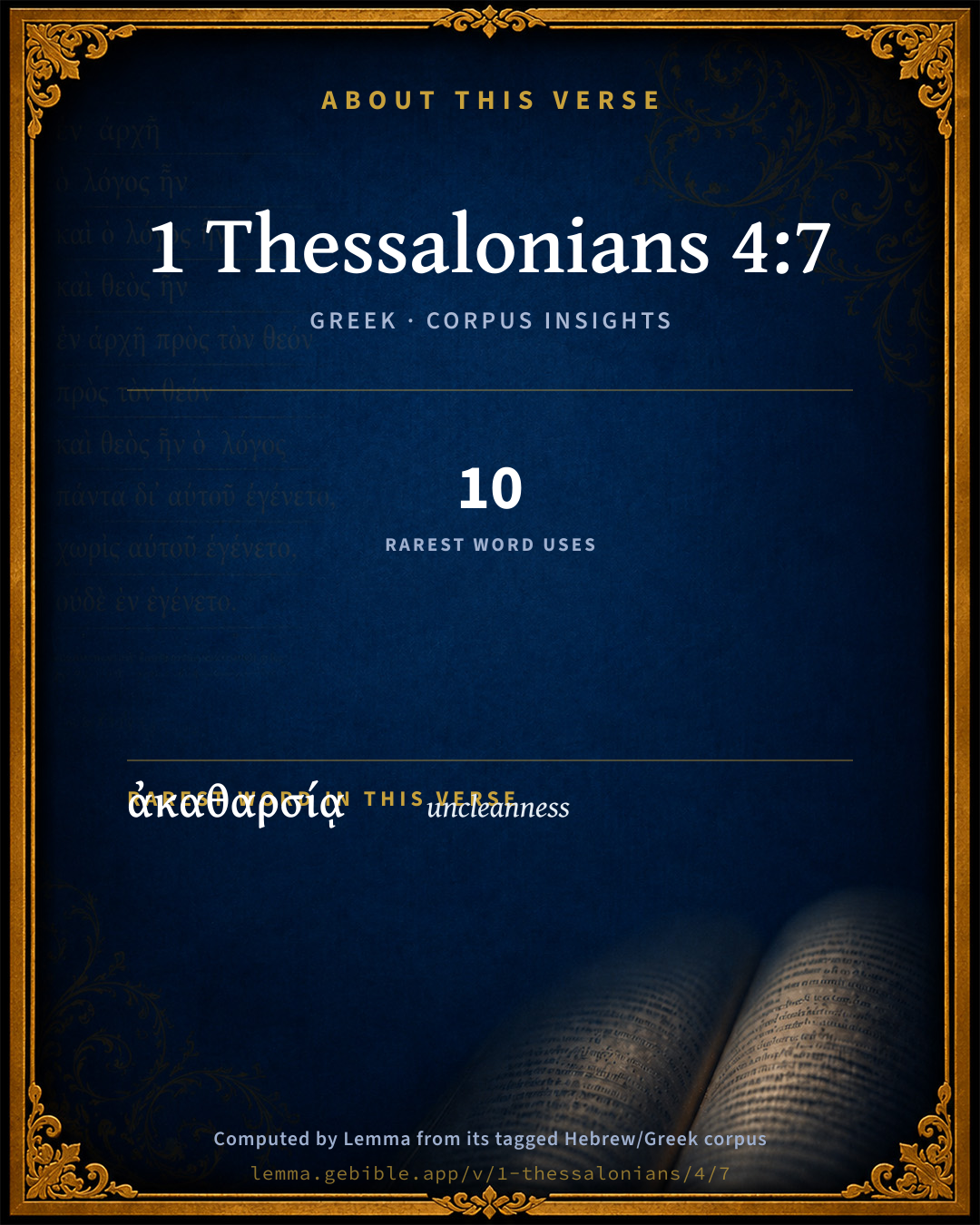
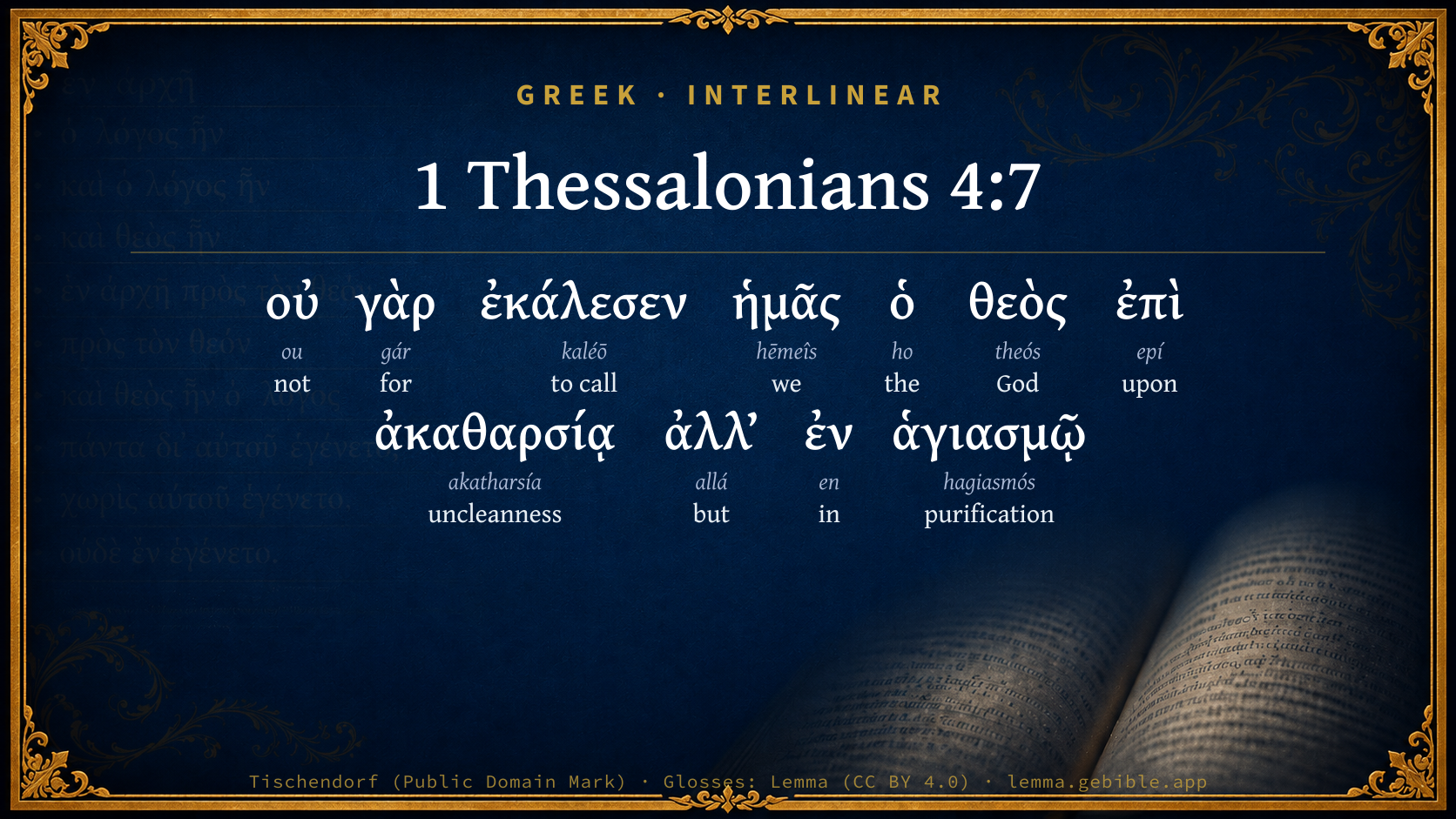
1 Thessalonians 4:7

Greek (Tischendorf 8th ed.) 1 Thessalonians 4:7 appears in the Greek New Testament. The text above is from the Tischendorf 8th edition. Each word links to its Strong’s number and a concise gloss. Click any word for its full Thayer’s Greek Lexicon entry.
Download image
Cite this verse

1 Thessalonians 4:7 (World English Bible). Public Domain. Lemma interlinear Bible study tool, https://lemma.gebible.app/v/1-thessalonians/4/7.

Show BibTeX & RIS
BibTeX
RIS
English Translation
For God called us not for uncleanness, but in sanctification.
World English Bible · Public Domain
Download a study sheet

One document with this verse’s original text, its word-by-word gloss line, the meaning frame, cross-references with their text, attributed commentary, and full source and license credits — printable, and it pastes into notes with its structure intact.

This verse Autodidact and up

Study sheet (.html) Plain text (.txt)

A passage Seminary Student

Up to 50 verses in one chapter. A passage sheet keeps up to 6 commentary sources and 12 cross-references per verse, in the order this page ranks them, and says so on the sheet whenever that leaves anything out. Ask for a single verse and you get the Autodidact verse sheet above.

Everything on this page stays free to read, with no account — the sheet is a download of what is already on screen, not access to it.

Want to remove ads? Support Godless Engineer
Compare translations 3

The same verse in 3 English versions, stacked beneath the original-language interlinear above. Click any original word for its lexicon entry.

Each is an independent rendering of the whole verse — the interlinear is not word-aligned to these translations.

Highlighted words mark where these versions differ — a whole-verse word diff, not a word-by-word alignment.

  • World English Bible Public Domain
    For God called us not for uncleanness, but in sanctification.
  • King James Version Public Domain
    For God hath not called us unto uncleanness, but unto holiness.
  • unfoldingWord Literal Text CC BY-SA 4.0
    For God did not call us for uncleanness, but in sanctification.

unfoldingWord Literal Text — © unfoldingWord, licensed CC BY-SA 4.0. Word-aligned USFM3 via Door43 (git.door43.org/unfoldingWord/en_ult).

Versions to compare (up to 4)

3 of 4 selected

Show all 19 translations

Every available English version of this verse, each an independent rendering of the whole verse.

  • World English Bible Public Domain
    For God called us not for uncleanness, but in sanctification.
  • Berean Standard Bible Public Domain
    For God has not called us to impurity, but to holiness.
  • Majority Standard Bible Public Domain
    For God has not called us to impurity, but to holiness.
  • King James Version Public Domain
    For God hath not called us unto uncleanness, but unto holiness.
  • American Standard Version (1901) Public Domain
    For God called us not for uncleanness, but in sanctification.
  • Revised Version (1885) Public Domain
    For God called us not for uncleanness, but in sanctification.
  • Geneva Bible (1599) Public Domain
    For God hath not called vs vnto vncleannesse, but vnto holinesse.
  • Douay-Rheims (1899) Public Domain
    For God hath not called us unto uncleanness, but unto sanctification.
  • Young's Literal Translation Public Domain
    for God did not call us on uncleanness, but in sanctification;
  • Literal Standard Version CC BY-SA 4.0
    for God did not call us to uncleanness, but in sanctification.
  • Unlocked Literal Bible CC BY-SA 4.0
    For God did not call us to uncleanness, but to holiness.
  • unfoldingWord Literal Text CC BY-SA 4.0
    For God did not call us for uncleanness, but in sanctification.
  • Darby Bible Public Domain
    For God has not called us to uncleanness, but in sanctification.
  • World Messianic Bible Public Domain
    For God called us not for uncleanness, but in sanctification.
  • Webster's Bible Public Domain
    For God hath not called us to uncleanness, but to holiness.
  • Free Bible Version CC BY-SA 4.0
    For God did not call us to live impure lives, but holy lives.
  • Bible in Basic English Public Domain
    Because it is God's purpose that our way of life may be not unclean but holy.
  • Text-Critical English NT CC BY 4.0
    For God did not call us to be impure, but to live in holiness.
  • Tyndale New Testament (1534) Public Domain
    For god hath not called vs vnto vnclennes: but vnto holynes.

Literal Standard Version (2020), Covenant Press — licensed CC BY-SA 4.0. Text via the HelloAO Bible API (eBible.org). Unlocked Literal Bible (unfoldingWord) — licensed CC BY-SA 4.0. Text via the HelloAO Bible API (eBible.org). unfoldingWord Literal Text — © unfoldingWord, licensed CC BY-SA 4.0. Word-aligned USFM3 via Door43 (git.door43.org/unfoldingWord/en_ult). Free Bible Version, Dr. Jonathan Gallagher — licensed CC BY-SA 4.0. Text via the HelloAO Bible API (eBible.org).

Word by word

More ways to search: Search by grammar → Find every occurrence → Compare this word →

Practice this passage: Drill this verse → Learn its vocabulary →

About this verse

These counts appear in no published source. They are computed here, from the morphology-tagged text and Lemma’s own curated glosses. What Lemma adds →

11
words
11
distinct lemmas
Pauline Epistles
section

Notable vocabulary

The rarest word here is ἀκαθαρσίᾳ uncleanness G167 — appearing just 10 times in the whole Greek New Testament.

Shared distinctive vocabulary

ἀκαθαρσίᾳ uncleanness G167 occurs in 10 verses of the Greek New Testament. Also found in:

Cross-references

18

Topical passages linked to 1 Thessalonians 4:7 in the Treasury of Scripture Knowledge — connected by theme and wording, ordered by reader-vote popularity; previews shown in the World English Bible.

  • Leviticus 11:44 For I am Yahweh your God. Sanctify yourselves therefore, and be holy; for I am holy: neither shall you defile yourselves with any kind of creeping thing that moves on the earth.
  • 1 Peter 2:9–12 But you are a chosen race, a royal priesthood, a holy nation, a people for God's own possession, that you may show forth the excellencies of him who called you out of darkness into his marvelous light:
  • Ephesians 1:4 even as he chose us in him before the foundation of the world, that we would be holy and without blemish before him in love;
  • 1 Peter 1:14–16 as children of obedience, not conforming yourselves according to your former lusts as in your ignorance,
  • Leviticus 19:2 "Speak to all the congregation of the children of Israel, and tell them, 'You shall be holy; for I Yahweh your God am holy.
  • Romans 8:29–30 For whom he foreknew, he also predestined to be conformed to the image of his Son, that he might be the firstborn among many brothers.
  • 1 Peter 2:21–22 For to this you were called, because Christ also suffered for us, leaving you an example, that you should follow his steps,
  • 2 Timothy 1:9 who saved us and called us with a holy calling, not according to our works, but according to his own purpose and grace, which was given to us in Christ Jesus before times eternal,
  • 2 Peter 2:10 but chiefly those who walk after the flesh in the lust of defilement, and despise authority. Daring, self-willed, they are not afraid to speak evil of dignitaries;
  • Galatians 5:19 Now the works of the flesh are obvious, which are: adultery, sexual immorality, uncleanness, lustfulness,
  • 1 Thessalonians 2:3 For our exhortation is not of error, nor of uncleanness, nor in deception.
  • 2 Thessalonians 2:13–14 But we are bound to always give thanks to God for you, brothers loved by the Lord, because God chose you from the beginning for salvation through sanctification of the Spirit and belief in the truth;
  • Hebrews 12:14 Follow after peace with all men, and the sanctification without which no man will see the Lord,
  • Ephesians 2:10 For we are his workmanship, created in Christ Jesus for good works, which God prepared before that we would walk in them.
  • Ephesians 4:1 I therefore, the prisoner in the Lord, beg you to walk worthily of the calling with which you were called,
  • Ephesians 4:19 who having become callous gave themselves up to lust, to work all uncleanness with greediness.
  • Romans 1:7 to all who are in Rome, beloved of God, called to be saints: Grace to you and peace from God our Father and the Lord Jesus Christ.
  • 1 Corinthians 1:2 to the assembly of God which is at Corinth; those who are sanctified in Christ Jesus, called to be saints, with all who call on the name of our Lord Jesus Christ in every place, both theirs and ours:

Cross-references courtesy of OpenBible.info (CC BY 4.0).

Commentary

Notes on 1 Thessalonians 4:7 from classic Christian and Jewish commentators (each source and its license shown beneath its notes). The classic Christian expositions comment on the surrounding passage and are grouped to its opening verse, so a note may address several verses; the Jewish commentaries on the Tanakh (Rashi and others) are per-verse, so they appear only where the commentator wrote on this verse.

Lemma curates 59 commentaries, every one of them public domain or Creative Commons licensed, each selected and text-cleaned for this edition rather than reprinted as found. About our sources →

Ellicott's Commentary for English Readers

(7) For God.—This gives the reason for stating that the Lord will take vengeance on such sins; because they are not part of the terms on which His Father called us. It should be “did not call.” These 1Th_4:7-8, sum up the little disquisition, returning to the principle announced in 1Th_4:3.

Unto uncleanness, but unto holiness.—The preposition translated “unto” has the same force in Gal_5:13, “Called unto liberty,” and Eph_2:10, “Created unto good works.” It implies not so much the definite end to which we are invited, as the terms on which the invitation will still stand; for the call is not yet accomplished. (See Note on 1Th_2:12.) The second “unto” in the Greek is simply “in,” used in the same sense as in 1Th_4:4. Paraphrase, “For God did not call us on the understanding that we might be unclean, but by the way of sanctification.”

Holiness is a mistranslation for sanctification. The process, not the quality, is meant.

A Bible Commentary for English Readers, edited by Charles John Ellicott (1878–1897) — public domain. Text from a community e-Sword module.

Tyndale Open Study Notes

Tyndale Open Resources

4:7 holy . . . not impure: Cp. 1:4; 2:12; 5:23-24; 2 Thes 2:13-14; 1 Pet 1:15-16.

Tyndale Open Study Notes — © Tyndale Open Resources, licensed CC BY-SA 4.0. Text via the HelloAO Bible API.

Bengel's Gnomon

Johann Albrecht Bengel

1Th 4:7. Ἐν ἁγιασμῷ, in sanctification) ἐπὶ, for, on account of, rather expresses the end; ἐν, in, the nature or character of the thing [viz. of our calling].

Bengel's Gnomon of the New Testament — English translation (T&T Clark, Edinburgh, 1860) — public domain. Text from a community e-Sword module.

Meyer's Critical & Exegetical Commentary

Heinrich August Wilhelm Meyer

1Th_4:7. Reason of ἔκδικος ὁ κύριος περὶ πάντων τούτων.

ἐκάλεσεν] the fuller form in 1Th_2:12.

ἐπὶ ἀκαθαρσίᾳ] on condition of, or for the purpose of uncleanness; comp. Gal_5:13; Eph_2:10; Winer, p. 351 [E. T. 492]; Erasmus: Non vocavit nos hac lege, ut essemus immundi, siquidem causa et conditio vocationis erat, ut desineremus esse, quod eramus.

ἀκαθαρσίᾳ] is uncleanness, moral impurity generally (comp. 1Th_2:3), and thus includes covetousness as well as lust.

ἀλλʼ ἐν ἁγιασμῷ] gives, by means of an abbreviation (comp. Kühner, II. p. 316), instead of the purpose, the result of the calling: but in holiness, i.e. so that complete holiness of life has become a characteristic property of us Christians. Comp. 1Co_7:15; Gal_1:6; Eph_4:4. But ἁγιασμός, as it forms the counterpart to ἀκαθαρσίᾳ, must denote moral holiness in its entire compass, and is accordingly here taken in a wider sense than in 1Th_4:3.

Meyer — Critical and Exegetical Commentary on the New Testament — English translation by Peter Christie, edited by Frederick Crombie (T&T Clark, 1880) — public domain. Text from a community e-Sword module.

Cambridge Greek Testament for Schools and Colleges

7. ημας is υμας in several minn., as in cop syrpesh; but in no uncial.

7. οὐ γὰρ ἐκάλεσεν ἡμᾶς ὁ θεὸς ἐπὶ ἀκαθαρσίᾳ ἀλλʼ ἐν ἁγιασμῷ. For God did not call us for (with a view to) uncleanness, but in sanctification. A further reason (γάρ), put by way of explanation at the close, for chastity amongst Christians. That purity of life was God’s purpose for us in sending the Gospel-message, explains in part the peculiar anger with which a departure from it will be visited.

The A.V. misrenders both ἐπί and ἐν here. Ἐπί with dative may signify either on terms of or with a view to, according as the reference is subjective or objective—i.e. as the intention implied was in the mind of the called themselves, or of God who called them; the latter rendering is preferable in this connexion (cf. Gal 5:13; Eph 2:10). Ἐν ἁγιασμῷ, as in 1Th 4:4 and 2Th 2:13, marks out “sanctification” not as the ultimate aim, nor as a gradual attainment, of the Christian life, but as its basis and ruling condition, the assumption on which God’s dealings with Christian men rest,—viz. that they are ἅγιοι, consecrated persons; cf. note on ὁ ἁγιασμὸς ὑμῶν, 1Th 4:3. Accordingly ἐκάλεσεν bears the emphasis of the sentence (cf. 1Th 2:12, and note; also 1Th 1:4 and 2Th 2:13). God’s call in the Gospel, from which the Christian status of the readers took its rise, would be frustrated by any relapse into the filthiness of heathen life.

1Th 4:8 concludes the rehearsal of the apostolic παραγγελία on this subject by an appeal to God, such as διεμαρτυράμεθα in 1Th 4:6 already implied (see note above):—

τοιγαροῦν ὁ ἀθετῶν οὐκ ἄνθρωπον ἀθετεῖ ἀλλὰ τὸν θεόν. Wherefore then the rejector is not rejecting a man, but God. The compound particle τοι-γαρ-οῦν, “collective and retrospective” (Ellicott), “introduces its conclusion with some specific emphasis or formality” (Grimm, in Lexicon), in a style suitable to the solemn language of 1Th 4:6 b, 7: Heb 12:1 supplies the only other example of this conjunction in the N.T.; it is common in Epictetus. Ἀθετέω (α- privative, and √ θη- of τίθημι, through ἄθετος) means to set out of position, to make void (a promise, law, or the like; see Gal 3:15; Heb 10:28), to set aside, deny, in his authority or rights, a person (Mar 6:26; Luk 10:16; Jud 1:8). For the antithesis of man and God, cf. 1Th 2:13 b; Gal 1:10; Act 5:4. While ἄνθρωπος is anarthrous (indefinite) in the negative clause, the articular ὁ θεός signifies the (one, actual) God; cf. Gal 4:31, for the article.

Romanist divines (e.g. Estius), following the received Latin reading of the two last words of the verse (in nobis), quote this text in proof of the Divine sanction of ecclesiastical authority. The Apostles, however, are insisting not on their own commandment as Divine, but on God’s commandment as distinct from and immeasurably above theirs. That the “charge” of 1Th 4:3-6 comes from God is evidenced (1) by the nature of the injunction itself, (2) by the moral purpose of the Gospel (1Th 4:7), and (3) by the witness of the Holy Spirit given to the readers (1Th 4:8 b):—

τὸν διδόντα τὸ πνεῦμα αὐτοῦ τὸ ἅγιον εἰς ὑμᾶς, (God) who gives His Spirit, the Holy (Spirit), to be within you. Even if εἰς ἡμᾶς were the true reading (see Textual Note, and last paragraph), this would refer not to the writers specifically or officially, but to writers and readers communicatively; cf. the 1st plural in the same connexion in Rom 8:15 f., Gal 4:6. Lightfoot sees in the participle διδόντα an indication of “ever fresh accessions of the Holy Spirit” (cf. Gal 3:5; 1Co 12:11); it is, perhaps, better conceived as a substantival present, like τὸν ῥυόμενον in 1Th 1:10 or τῷ δοκιμάζοντι in 1Th 2:4—“the giver of His Holy Spirit”; for this bestowment is God’s prerogative, and sets Him in an abiding relation of inward guidance and command toward believers: cf. Luk 11:13; Joh 3:34; Joh 7:38 f.; 2Co 1:22; 2Co 5:5; Rom 8:9; Rom 8:14 f.; Gal 3:2; Gal 4:6; Gal 5:25; 2Ti 1:7; 1Jn 3:24; 1Jn 4:13. The epithet ἅγιον is emphasized by its position, in accordance with the stress thrown on holiness throughout (1Th 4:3-4; 1Th 4:7). (Τὸν διδόντα) εἰς ὑμᾶς means not “to you” (ὑμῖν) but “into you,” so as to enter your hearts and dwell within you: Eze 37:6 (δώσω πνεῦμά μου εἰς ὑμᾶς, נָתַתִּי בָכֶם רוּחַ) probably suggested the phrase; cf. δίδωμι εἰς in Act 19:31; Heb 8:10; also εἰς in Eph 3:16; Mar 2:1, &c. That God who called us to a pure life, puts His Spirit in us, is a consideration heightening the fear of Divine vengeance upon sins of inchastity; for they affront God’s indwelling Presence and defile “God’s temple”: cf. 1Co 3:16 f., 1Co 6:19; Eph 4:30. Seen in this light, uncleanness is profanity.

Cambridge Greek Testament for Schools and Colleges (Cambridge University Press, 1896; 21 vols, various authors incl. Carr, Maclear, Plummer, Farrar, Lumby, Moule, M. R. James, Simcox) — public domain. Text from a community e-Sword module.

Jamieson, Fausset & Brown

Robert Jamieson, A. R. Fausset & David Brown

unto uncleanness--Greek, "for the purpose of."

unto--rather as Greek, "in"; marking that "holiness" is the element in which our calling has place; in a sphere of holiness. Saint is another name for Christian.

Jamieson, Fausset & Brown — Commentary Critical and Explanatory on the Whole Bible (1871) — public domain (CC PDM 1.0). Text via the HelloAO Bible API.

Adam Clarke's Commentary

Verse 7. God hath not called us unto uncleanness] He is the creator of male and female, and the institutor of marriage, and he has called men and women to this state; but the end of this and all the other callings of God to man is holiness, not uncleanness. And they who use the marriage state as he directs, will find it conducive to their holiness and perfection.

Adam Clarke's Commentary on the Bible (1810–1826) — public domain. Text from a community e-Sword/MySword module.

John Calvin's Commentaries

7 For God hath not called us. This appears to be the same sentiment with the preceding one — that the will of God is our sanctification. There is, however, a little difference between them. For after having discoursed as to the correcting of the vices of the flesh, he proves, from the end of our calling, that God desires this. For he sets us apart to himself as his peculiar possession. Again, that God calls us to holiness, he proves by contraries, because he rescues us, and calls us back, from unchastity. From this he concludes, that all that reject this doctrine reject not men, but God, the Author of this calling, which altogether falls to the ground so soon as this principle as to newness of life is overthrown. Now, the reason why he rouses himself so vehemently is, because there are always wanton persons who, while they fearlessly despise God, treat with ridicule all threatenings of his judgment, and at the same time hold in derision all injunctions as to a holy and pious life. Such persons must not be taught, but must be beaten with severe reproofs as with the stroke of a hammer.

John Calvin's Commentaries (1540-1563) — public domain. Text from the Calvin Translation Society English edition (1840s-50s) via the Christian Classics Ethereal Library (ccel.org). Calvin's coverage is partial (roughly two-thirds of the Bible); uncommented books and verses are honest gaps, never fabricated. The 19th-century editor's footnotes and remarks are omitted so the notes are faithfully Calvin's own voice.

The Cambridge Bible for Schools and Colleges

gen. ed. J. J. S. Perowne

7. For God hath not called us unto uncleanness, but unto holiness] The two prepositions alike rendered “unto” in the A.V., are quite distinct in the Greek. St Paul writes, God called us not for (with a view to) uncleanness, but in sanctification; similarly in 2Th_2:13, “God chose you from the beginning unto salvation in sanctification of spirit.” The call of God was from the first a sanctifying call for the Thessalonians, and was attended with holy influences that forbade all uncleanness. Certainly He never intended them to live impure lives, when He “called them to His own kingdom and glory” (ch. 1Th_2:12); the understanding on which that call was received was the opposite of this. The entire purpose and tendency of God’s message to them was “in sanctification.” For this last word, see notes to 1Th_4:3-4. True believers in Christ are necessarily “saints;” so the Apostle commonly addresses all Christians to whom he writes (see Rom_1:7, &c.—“called saints,” i.e. “saints in virtue of your calling”); and their sainthood excludes impurity and wrong-doing.

Observe that God’s call is the starting-point of a Christian’s life. All the motives and aims by which that life is governed are virtually contained in this. “Walk worthily of the calling wherewith you were called” is with St Paul an exhortation that includes all others (Eph_4:1). So he comes to his last word on this matter:—

The Cambridge Bible for Schools and Colleges (gen. ed. J. J. S. Perowne; Cambridge University Press, 1878–1918) — public domain. Text from a community e-Sword module.

John Gill's Exposition

For God hath not called us,.... The Syriac version reads "you". This is another reason to enforce the above exhortations, and to caution them against the above unclean practices, taken from the end of the effectual calling by the efficacious grace of God, which is not

unto uncleanness of any sort, as before specified. This they had lived in before their calling, and were now called from it into communion with Christ, who loves righteousness, and hates iniquity; and by the Gospel, which teaches to deny ungodliness, and worldly lusts, and to forsake all impurity, both of flesh and spirit:

but this call is

unto holiness of life and conversation in general, and to chastity in thought, look, word, and actions in particular; for God that calls is holy, and therefore those who are called ought to be so; the calling with which they are called is an holy calling, principles of grace and holiness are wrought in their souls, when they are called; and the end of their calling is to live soberly, righteously, and godly; and then, and then only, do they walk worthy of that calling wherewith they are called, and of God who has, by his grace, called them to his kingdom and glory.

John Gill's Exposition of the Whole Bible (1746–1763) — public domain (CC PDM 1.0). Text via the HelloAO Bible API.

Trapp's Complete Commentary

John Trapp

7 For God hath not called us unto uncleanness, but unto holiness.

Ver. 7. For God hath not called us] {See Trapp on "Eph 4:1"} It is a sure rule given by the ancients, Confusiones libidinum sunt signa cuius libet sectae. Simon Magus had his Helena, Carpocrates his Marcellina, Apelles his Philumena, Montanus his Priscilla and Maximilla, &c.

John Trapp, A Commentary or Exposition upon All the Books of the Old and New Testament (1647–1656) — public domain. Text from a community e-Sword module.

Albert Barnes' Notes on the Bible

For God hath not called us unto uncleanness - When he called us to be his followers, it was not that we should lead lives of impurity, but of holiness. We should, therefore, fulfil the purposes for which we were called into his kingdom. The word “uncleanness” (ἀκαθαρσία akatharsia), means, properly, “impurity, filth;” and then, in a moral sense, “pollution, lewdness,” as opposed to chastity; Rom 1:24; Rom 6:19; 2Co 12:21; Gal 5:19; Eph 4:19; Eph 5:3; Col 3:5.

Albert Barnes' Notes on the Bible (1834–1885) — public domain. Text from a community e-Sword/MySword module.

Matthew Poole's English Annotations

These two verses are added, as further arguments to persuade to that chastity he had spoken of, called sanctification, 1Th 4:3,4. The first is taken from their Christian calling, which is not to uncleanness, but to chastity, called holiness. When they were Gentiles in state, they lived in the lust of uncleanness, but they were now called by the power of the gospel, and brought to such a profession that did forbid and condemn it. And the author of their call is God himself, though the apostles and other ministers were the instruments. Whence he fetcheth this second argument, 1Th 4:8, that if this chastity he despised, or rejected, as we may read the text, it is not man, but God, that is despised. To despise a minister in a commandment he delivers from God is to despise God himself, Luk 10:16, &c.; and the apostle doth here intimate, not to obey the commandment of God is a despising God. Or, that the apostle was despised by some because of the outward meanness of his person, or questioning his authority.

Who hath also given unto us his holy Spirit: this he adds as a third argument; so that what he had preached to them, was not from himself, but from the Holy Spirit. Or if by us he means these Thessalonians also, as some copies read it, he hath given you, &c., then he argues from the gift of the Holy Spirit they had received against living in the sin of uncleanness. This would be very disagreeable, not only to their holy calling, but the Holy Spirit God had given them. Or else these arguments of the apostle are to persuade to universal holiness, taking sanctification and holiness in a larger sense; and uncleanness, for all sin in general standing opposite thereunto. Sin is often spoken of in Scripture under the notion of filth, defilement, pollution, &c., and so was typed forth under the law; and to be cleansed from sin is a cleansing man from filthiness, 2Co 7:1; so that to live in sin, as the apostle argues, is to live in uncleanness, to contradict our holy calling, to despise God, and to walk contrary to the nature and dictates of his Holy Spirit.

Matthew Poole's English Annotations on the Holy Bible (1683–1685) — public domain. Text from a community e-Sword/MySword module.

Whedon's Commentary on the Bible

Daniel D. Whedon

7. For—Ground of these warnings.

Not called us—Says Erasmus, (quoted by Lunemann,) “God has not called us under the law that we should be impure, since, indeed, the very cause and condition of our calling is, that we should cease to be what we once were.”

Uncleanness—Impurity; primarily applicable to sexual impurity, but capable of including any moral contamination, as here of both adultery and fraud. These were closely allied vices, and, to the chaste and unselfish mind of the apostle, both were a foul stain upon the body and soul.

Daniel D. Whedon (gen. ed.), Commentary on the Old and New Testaments (1874–1909) — public domain. Text from a community e-Sword module.

The Pulpit Commentary

For God hath not called us unto; or, for the purpose of. Uncleanness; moral uncleanness in general. (comp. 1Co_6:15) But unto; or, in; in a state of Holiness ; or sanctification; the same word as in the third verse; so that holiness is the whole sphere of cur Christian life.

The Pulpit Commentary (1880–1919), ed. H.D.M. Spence-Jones & Joseph S. Exell — public domain. Text from a community e-Sword module.

McGarvey & Pendleton's Commentaries

J. W. McGarvey

For God called us not for uncleanness, but in sanctification . ["God has not called us under the law that we should be impure, since, indeed, the very cause and condition of our calling is that we should cease to be what we once were."--Erasmus.]

J. W. McGarvey (with Philip Y. Pendleton), Commentaries on the New Testament (The Fourfold Gospel, 1914; Acts; and the epistles) — public domain. Text from a community e-Sword/MySword module.

The People's New Testament

B. W. Johnson

7. Unto holiness. The Christian calling demands purity of life.

B. W. Johnson's The People's New Testament with Notes (1889–1891) — public domain. Electronic text from the Christian Classics Ethereal Library (CCEL) ThML edition.

unfoldingWord translationNotes

Door43 World Missions Community

God did not call us to uncleanness, but to holiness

This can be stated in positive form. AT: "God called us to cleanness and holiness" (See: Double Negatives)

God did not call us

The word "us" refers to all believers. (See: Inclusive "We")

he who rejects this

"whoever disregards this teaching" or "whoever ignores this teaching"

rejects not people, but God

Paul stresses that this teaching is not from man, but from God.

translationWords

God

call

clean

holy

reject

Holy Spirit

unfoldingWord translationNotes — © Distant Shores Media and the Door43 World Missions Community, licensed CC BY-SA 4.0. Source: git.door43.org/Door43/en_tn.

Alford’s Greek Testament

Henry Alford

7.] This verse (see above) is in my view decisive for the above rendering of ver. 6. There is no mention here of avarice: nor is it possible to understand ἀκαθαρσία, when ver. 3 has gone before, of any thing but carnal impurity. Chap. 2:3, which is adduced to shew that it may here represent covetousness, is a very doubtful example: see there.

ἐπί, for the purpose of,—on condition of: ἐν, in, ‘in the element of,’ not = εἰς, the aim: but ἁγιασμός is the whole sphere of our Christian life.

Henry Alford, The Greek Testament (1849–1861) — public domain. Text from a community e-Sword module.

International Critical Commentary

7. οὐ γὰρ ἐκάλεσεν κτλ. The γά, parallel to διότ (v. 6), introduces a second motive for obedience, the moral goal of God’s call. “For God called us Christians not that we should be impure (ἐπί denoting the purpose or object) but that we should be holy” (ἐ indicating the state of holiness resulting from the calling). Such being the moral purpose of the call, it would be sin to disregard these commands which express God’s will.

On καλεῖ, which is mediated by the preaching of the gospel (II 2:14), see 2:12; on ἀκαθαρσί, which sums up περὶ πάντων τούτων see 2:3. ἁγιασμό is here, as in v. 4, holiness, the state of those whom God consecrates to himself through the Spirit. ἐπι indicates either the condition or basis on which, or the “object or purpose for which, they were (not) called” (Ell.); cf. Gal 5:13, Eph 2:10 and Bl 43:3; also Sap. 2:23 ὁ θεὸς ἔκτισεν τὸν ἄνθρωπον ἐπʼ ἀφθαρσίᾳ (Mill.). ἐ is not for εἰ (Piscator) but is a “natural abbreviation for ὥστε εἶναι ἐν ἁγιασμῷ as the sense requires” (Lft. who notes Eph 4:4). For ἐ introducing the result of καλεῖ, Col 3:15 is pertinent. Other expositors (e. g. Bengel, Hofmann, Riggenbach, Wohl. Dob.) understand ἁγιασμό as an act of God and ἐ as indicating the essential character of the call.

International Critical Commentary — older volumes (1896–1929), various authors — public domain. Text from a community e-Sword module.

Vincent's Word Studies in the New Testament

Marvin R. Vincent

Unto uncleanness [επι ακαθαρσια] . Better, for uncleanness; ejpi denoting aim or intention. The intention is viewed as the basis of the act [επι υπον] . Comp. Gal 5:13; Eph 2:10.

In sanctification [εν] . Note the change of preposition. Sanctification is the characteristic life - element of the Christian, in which he is to live. Comp. in peace, 1Co 7:15; in hope, Eph 4:4.

Marvin R. Vincent, Word Studies in the New Testament (1887–1900) — public domain. Text from a community e-Sword/MySword module.

Lesson kit

Teaching starters — assembled from the data on this page, not authored interpretation. Every prompt links to the verse data it draws on. Edit before teaching.

1 Thessalonians, in the Pauline Epistles, opens this verse with 11 words (11 distinct Greek lemmas). Its most distinctive word is akatharsía (“uncleanness”). A historical commentator’s framing appears above. Read the whole chapter for the surrounding context.

Discussion questions

  1. The word akatharsía carries the sense “uncleanness.” How does it shape the verse?
  2. Matthew 23:27 shares the word «uncleanness» with this verse. How do the two illuminate each other?
  3. These translations render this verse differently. What is at stake in choosing one wording over another?
  4. Reading how Ellicott's Commentary for English Readers and Tyndale Open Study Notes read this verse, where do the two commentators agree and where do they part?

Things to notice

Reading settings

Reading text

Shown beneath each verse's original-language words.

Old Testament
Old Testament edition

Read the OT as the Masoretic Hebrew (MT) or the Greek Septuagint (LXX).

English shown for the Greek Septuagint (in the Hebrew ↔ Greek comparison).

Comparing translations? Open the Compare panel on any verse page to stack up to four side by side.