
Colossians 3:15

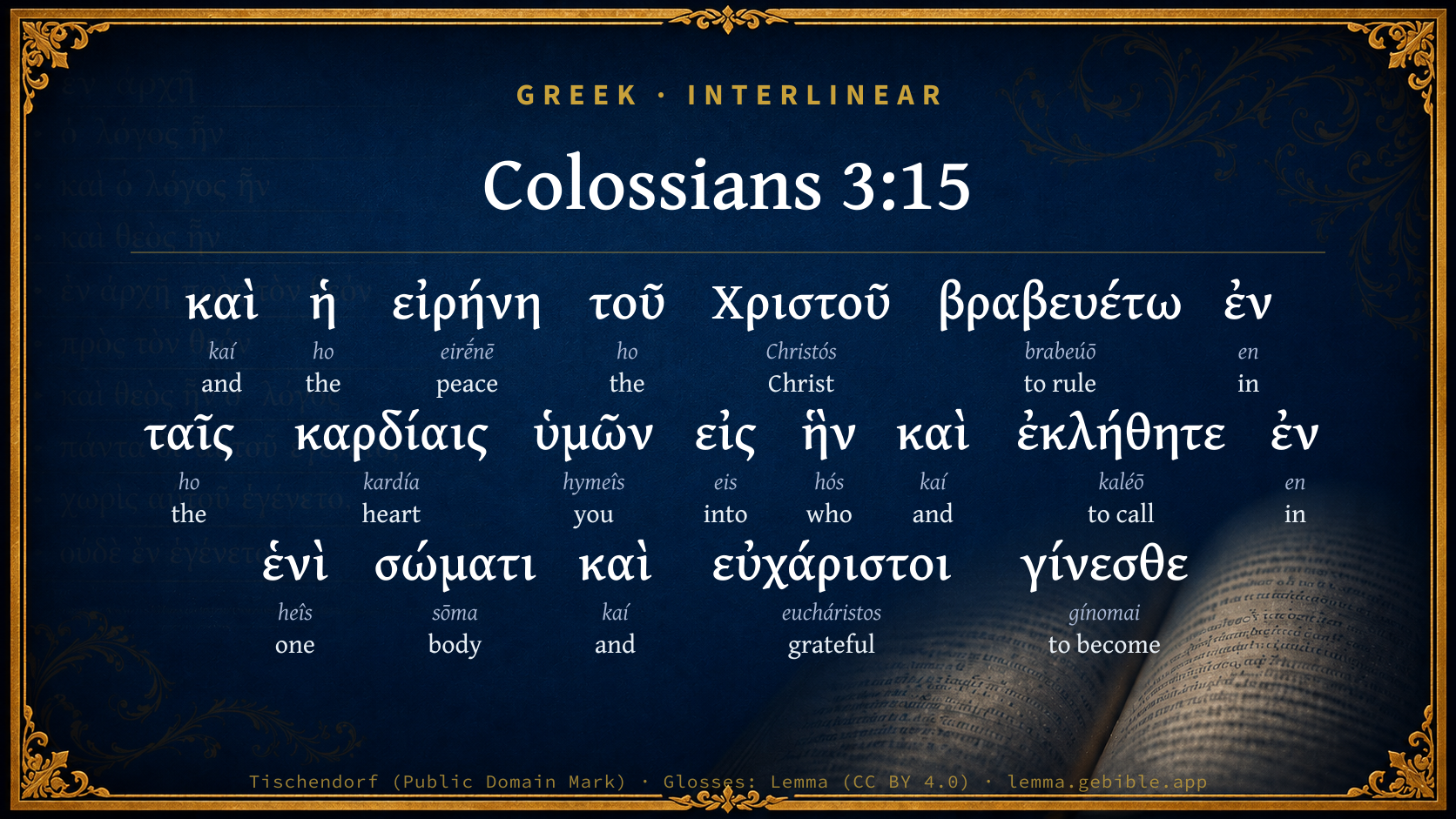
Greek (Tischendorf 8th ed.) Colossians 3:15 appears in the Greek New Testament. The text above is from the Tischendorf 8th edition. Each word links to its Strong’s number and a concise gloss. Click any word for its full Thayer’s Greek Lexicon entry.
Download image
Cite this verse

Colossians 3:15 (World English Bible). Public Domain. Lemma interlinear Bible study tool, https://lemma.gebible.app/v/colossians/3/15.

Show BibTeX & RIS
BibTeX
RIS
English Translation
And let the peace of God rule in your hearts, to which also you were called in one body; and be thankful.
World English Bible · Public Domain
Highlights
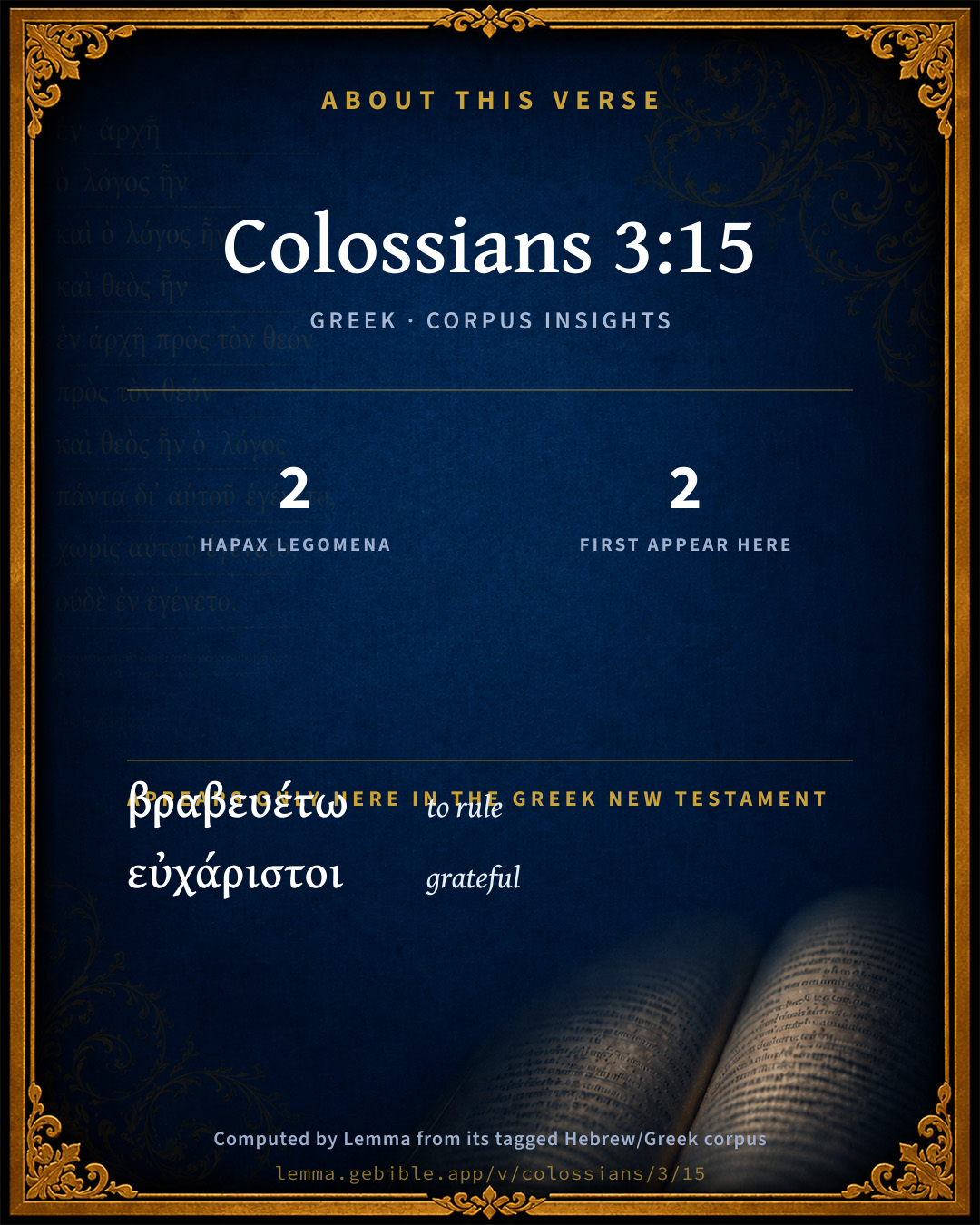
  • 2 hapax legomena — only here in the Greek New Testament
  • 2 first appearances in the Greek New Testament
Full analysis ↓
Download a study sheet

One document with this verse’s original text, its word-by-word gloss line, the meaning frame, cross-references with their text, attributed commentary, and full source and license credits — printable, and it pastes into notes with its structure intact.

This verse Autodidact and up

Study sheet (.html) Plain text (.txt)

A passage Seminary Student

Up to 50 verses in one chapter. A passage sheet keeps up to 6 commentary sources and 12 cross-references per verse, in the order this page ranks them, and says so on the sheet whenever that leaves anything out. Ask for a single verse and you get the Autodidact verse sheet above.

Everything on this page stays free to read, with no account — the sheet is a download of what is already on screen, not access to it.

Want to remove ads? Support Godless Engineer
Compare translations 3

The same verse in 3 English versions, stacked beneath the original-language interlinear above. Click any original word for its lexicon entry.

Each is an independent rendering of the whole verse — the interlinear is not word-aligned to these translations.

Highlighted words mark where these versions differ — a whole-verse word diff, not a word-by-word alignment.

  • World English Bible Public Domain
    And let the peace of God rule in your hearts, to which also you were called in one body; and be thankful.
  • King James Version Public Domain
    And let the peace of God rule in your hearts, to the which also ye are called in one body; and be ye thankful.
  • unfoldingWord Literal Text CC BY-SA 4.0
    And let the peace of Christ rule in your hearts, to which also you were called in one body, and become thankful.

unfoldingWord Literal Text — © unfoldingWord, licensed CC BY-SA 4.0. Word-aligned USFM3 via Door43 (git.door43.org/unfoldingWord/en_ult).

Versions to compare (up to 4)

3 of 4 selected

Show all 19 translations

Every available English version of this verse, each an independent rendering of the whole verse.

  • World English Bible Public Domain
    And let the peace of God rule in your hearts, to which also you were called in one body; and be thankful.
  • Berean Standard Bible Public Domain
    Let the peace of Christ rule in your hearts, for to this you were called as members of one body. And be thankful.
  • Majority Standard Bible Public Domain
    Let the peace of God rule in your hearts, for to this you were called as members of one body. And be thankful.
  • King James Version Public Domain
    And let the peace of God rule in your hearts, to the which also ye are called in one body; and be ye thankful.
  • American Standard Version (1901) Public Domain
    And let the peace of Christ rule in your hearts, to the which also ye were called in one body; and be ye thankful.
  • Revised Version (1885) Public Domain
    And let the peace of Christ rule in your hearts, to the which also ye were called in one body; and be ye thankful.
  • Geneva Bible (1599) Public Domain
    And let the peace of God rule in your hearts, to the which ye are called in one body, and be ye thankfull.
  • Douay-Rheims (1899) Public Domain
    And let the peace of Christ rejoice in your hearts, wherein also you are called in one body: and be ye thankful.
  • Young's Literal Translation Public Domain
    and let the peace of God rule in your hearts, to which also ye were called in one body, and become thankful.
  • Literal Standard Version CC BY-SA 4.0
    and let the peace of God rule in your hearts, to which you were also called in one body, and become thankful.
  • Unlocked Literal Bible CC BY-SA 4.0
    Let the peace of Christ rule in your hearts. It was for this peace that you were called in one body. And be thankful.
  • unfoldingWord Literal Text CC BY-SA 4.0
    And let the peace of Christ rule in your hearts, to which also you were called in one body, and become thankful.
  • Darby Bible Public Domain
    And let the peace of Christ preside in your hearts, to which also ye have been called in one body, and be thankful.
  • World Messianic Bible Public Domain
    And let the peace of God rule in your hearts, to which also you were called in one body, and be thankful.
  • Webster's Bible Public Domain
    And let the peace of God rule in your hearts, to which also ye are called in one body; and be ye thankful.
  • Free Bible Version CC BY-SA 4.0
    May the peace of Christ direct your thinking, because you were called to this by God who makes you one, and thank God for it!
  • Bible in Basic English Public Domain
    And let the peace of Christ be ruling in your hearts, as it was the purpose of God for you to be one body; and give praise to God at all times.
  • Text-Critical English NT CC BY 4.0
    Let the peace of God rule in your hearts, since as members of one body you were called to peace. And be thankful.
  • Tyndale New Testament (1534) Public Domain
    And the peace of god rule in youre hertes to the which peace ye are called in one body. And se that ye be thankfull.

Literal Standard Version (2020), Covenant Press — licensed CC BY-SA 4.0. Text via the HelloAO Bible API (eBible.org). Unlocked Literal Bible (unfoldingWord) — licensed CC BY-SA 4.0. Text via the HelloAO Bible API (eBible.org). unfoldingWord Literal Text — © unfoldingWord, licensed CC BY-SA 4.0. Word-aligned USFM3 via Door43 (git.door43.org/unfoldingWord/en_ult). Free Bible Version, Dr. Jonathan Gallagher — licensed CC BY-SA 4.0. Text via the HelloAO Bible API (eBible.org).

Word by word

More ways to search: Search by grammar → Find every occurrence → Compare this word →

Practice this passage: Drill this verse → Learn its vocabulary →

βραβευέτω
brabeúō
G1018
“to rule”
Verb, Present, Active, Imperative, 3rd person, Singular
Part of Speech
Verb
Tense
Present
Voice
Active
Mood
Imperative
Person
3rd person
Number
Singular
Full Thayer's Definition

Origin: from the same as G1017

TDNT: 11:37,1

1. to be an umpire 2. to decide, determine 3. to direct, control, rule
  1. καὶ kaí G2532 “and” Conjunction
  2. ἡ ho G3588 “the” Article, Nominative, Singular, Feminine
  3. εἰρήνη eirḗnē G1515 “peace” Noun, Nominative, Singular, Feminine
  4. τοῦ ho G3588 “the” Article, Genitive, Singular, Masculine
  5. Χριστοῦ Christós G5547 “Christ” Noun, Genitive, Singular, Masculine
  6. ἐν en G1722 “in” Preposition
  7. ταῖς ho G3588 “the” Article, Dative, Plural, Feminine
  8. καρδίαις kardía G2588 “heart” Noun, Dative, Plural, Feminine
  9. ὑμῶν hymeîs G5210 “you” Personal pronoun, 2nd person, Genitive, Plural
  10. εἰς eis G1519 “into” Preposition
  11. ἣν hós G3739 “who” Relative pronoun, Accusative, Singular, Feminine
  12. καὶ kaí G2532 “and” Conjunction
  13. ἐκλήθητε kaléō G2564 “to call” Verb, Aorist, Passive, Indicative, 2nd person, Plural
  14. ἐν en G1722 “in” Preposition
  15. ἑνὶ heîs G1520 “one” Adjective, Dative, Singular, Neuter
  16. σώματι sōma G4983 “body” Noun, Dative, Singular, Neuter
  17. καὶ kaí G2532 “and” Conjunction
  18. εὐχάριστοι eucháristos G2170 “grateful” Adjective, Nominative, Plural, Masculine
  19. γίνεσθε gínomai G1096 “to become” Verb, Present, Middle or Passive deponent, Imperative, 2nd person, Plural

About this verse

These counts appear in no published source. They are computed here, from the morphology-tagged text and Lemma’s own curated glosses. What Lemma adds →

20
words
15
distinct lemmas
Pauline Epistles
section

Notable vocabulary

2 hapax legomena — words that appear only here in the entire Greek New Testament:

  • βραβευέτω to rule G1018
  • εὐχάριστοι grateful G2170

First appearance in Scripture

These words make their first canonical appearance in the Greek New Testament here:
  • βραβευέτω to rule G1018
  • εὐχάριστοι grateful G2170

Repetition

Words recur within this verse:

Cross-references

33

Topical passages linked to Colossians 3:15 in the Treasury of Scripture Knowledge — connected by theme and wording, ordered by reader-vote popularity; previews shown in the World English Bible.

  • Philippians 4:6–7 In nothing be anxious, but in everything, by prayer and petition with thanksgiving, let your requests be made known to God.
  • John 14:27 Peace I leave with you. My peace I give to you; not as the world gives, give I to you. Don't let your heart be troubled, neither let it be fearful.
  • Isaiah 26:3 You will keep [him] in perfect peace, [whose] mind [is] stayed [on you]; because he trusts in you.
  • Romans 15:13 Now may the God of hope fill you with all joy and peace in believing, that you may abound in hope, in the power of the Holy Spirit.
  • Psalms 29:11 Yahweh will give strength to his people. Yahweh will bless his people with peace.
  • 1 Thessalonians 5:18 In everything give thanks, for this is the will of God in Christ Jesus toward you.
  • Colossians 3:17 Whatever you do, in word or in deed, do all in the name of the Lord Jesus, giving thanks to God the Father, through him.
  • Romans 5:1 Being therefore justified by faith, we have peace with God through our Lord Jesus Christ;
  • John 16:33 I have told you these things, that in me you may have peace. In the world you have oppression; but cheer up! I have overcome the world."
  • Ephesians 5:20 giving thanks always concerning all things in the name of our Lord Jesus Christ, to God, even the Father;
  • Psalms 116:17 I will offer to you the sacrifice of thanksgiving, And will call on the name of Yahweh.
  • Romans 14:17 for the Kingdom of God is not eating and drinking, but righteousness, peace, and joy in the Holy Spirit.
  • 2 Corinthians 9:11 you being enriched in everything to all liberality, which works through us thanksgiving to God.
  • Colossians 2:7 rooted and built up in him, and established in the faith, even as you were taught, abounding in it in thanksgiving.
  • 1 Timothy 2:1 I exhort therefore, first of all, that petitions, prayers, intercessions, and givings of thanks, be made for all men:
  • Isaiah 57:15 For thus says the high and lofty One who inhabits eternity, whose name is Holy: I dwell in the high and holy place, with him also who is of a contrite and humble spirit, to revive the spirit of the humble, and to revive the heart of the contrite.
  • Ephesians 2:12–18 that you were at that time separate from Christ, alienated from the commonwealth of Israel, and strangers from the covenants of the promise, having no hope and without God in the world.
  • Ephesians 4:4 There is one body, and one Spirit, even as you also were called in one hope of your calling;
  • Psalms 107:22 Let them offer the sacrifices of thanksgiving, And declare his works with singing.
  • Ephesians 5:1 Be therefore imitators of God, as beloved children.
  • Psalms 100:4 Enter into his gates with thanksgiving, Into his courts with praise. Give thanks to him, and bless his name.
  • Jonah 2:9 But I will sacrifice to you with the voice of thanksgiving. I will pay that which I have vowed. Salvation belongs to Yahweh."
  • Luke 17:16–18 He fell on his face at Jesus' feet, giving him thanks; and he was a Samaritan.
  • 1 Corinthians 7:15 Yet if the unbeliever departs, let there be separation. The brother or the sister is not under bondage in such cases, but God has called us in peace.
  • 2 Corinthians 4:15 For all things are for your sakes, that the grace, being multiplied through the many, may cause the thanksgiving to abound to the glory of God.
  • Ephesians 4:16 from whom all the body, being fitted and knit together through that which every joint supplies, according to the working in measure of each individual part, makes the body increase to the building up of itself in love.
  • Colossians 1:12 giving thanks to the Father, who made us fit to be partakers of the inheritance of the saints in light;
  • Hebrews 13:15 Through him, then, let us offer up a sacrifice of praise to God continually, that is, the fruit of lips which make confession to his name.
  • Revelation 7:12 saying, "Amen! Blessing, glory, wisdom, thanksgiving, honor, power, and might, be to our God forever and ever! Amen."
  • Romans 1:21 Because, knowing God, they didn't glorify him as God, neither gave thanks, but became vain in their reasoning, and their senseless heart was darkened.
  • 2 Corinthians 5:19–21 namely, that God was in Christ reconciling the world to himself, not reckoning to them their trespasses, and having committed to us the word of reconciliation.
  • Isaiah 27:5 Or else let him take hold of my strength, that he may make peace with me; [yes], let him make peace with me.
  • Isaiah 57:19 I create the fruit of the lips: Peace, peace, to him who is far off and to him who is near, says Yahweh; and I will heal him.

Cross-references courtesy of OpenBible.info (CC BY 4.0).

Where the printed editions differ

1 variant

Places in this verse where the major printed Greek editions disagree on the wording in a way that affects the translation — a comparison of editions, not a manuscript-by-manuscript collation. The editions are the modern critical texts (Nestlé-Aland 28/27, SBL, Westcott-Hort, Tregelles, Tyndale House) and the traditional texts behind the KJV (the Textus Receptus and the Byzantine/Majority text). It is not a claim about which reading is original.

  1. Different wording
    Χριστοῦ

    “from Christ”

    In NA28NA27TynSBLWHTreg Not in TRByz

    θεοῦ (theou) 'of God' occurs in traditional manuscripts (TR+Byz) instead of Χριστοῦ (Christou) 'from Christ' in older manuscripts (NA28+NA27+Tyn+SBL+WH+Treg)

Textual data: Translators Amalgamated Greek New Testament (STEPBible TAGNT) · CC BY 4.0.

Commentary

Notes on Colossians 3:15 from classic Christian and Jewish commentators (each source and its license shown beneath its notes). The classic Christian expositions comment on the surrounding passage and are grouped to its opening verse, so a note may address several verses; the Jewish commentaries on the Tanakh (Rashi and others) are per-verse, so they appear only where the commentator wrote on this verse.

Lemma curates 59 commentaries, every one of them public domain or Creative Commons licensed, each selected and text-cleaned for this edition rather than reprinted as found. About our sources →

The Biblical Illustrator

Joseph S. Exell

Col_3:15

And let the peace of God rule in your hearts.

The peace of Christ

The various reading peace of Christ is not only recommended by MS. authority, but has the advantage of bringing the expression into connection with the great words of our Lord, Peace I leave you, etc. A strange legacy left at a strange moment. It was but an hour or so since He had been troubled in spirit as He thought of the betrayer--and in an hour more He would be beneath the olives of Gethsemane; and yet even at such a time He bestows on His friends some share in His deep repose of spirit. Surely the peace of Christ must mean what My peace meant: not only the peace which He gives, but the peace which lay like a great calm on the sea on His own deep heart, and we must not restrict it to mutual concord. When He gave us His peace He gave us some share in that meek submission of will to His Fathers will, and in that stainless purity, which were its chief elements. The hearts and lives of men are made troubled not by circumstances, but by themselves. Whoever can keep his own will in harmony with Gods enters into rest. Even if within and without are fightings, there may be a central peace. Christs peace was the result of the perfect harmony of His nature. All was co-operant to one great purpose; desires and passions did not war with conscience and reason, nor did the flesh lust against the spirit. Though that complete uniting of all our inner selves is not attained on earth, yet its beginnings are given us by Christ, and in Him we may be at peace with ourselves, and have one great ruling power binding all our conflicting desires in one, as the moon draws after her the heaped waters of the sea. (A. Maclaren, D. D.)

The power of Divine peace

The connection between this verse and the foregoing is obvious. The man who has this peace is most likely to cultivate love. Christian calmness is the concomitant and stimulus of Christian affection which is hindered by doubt, anxiety, or fear.

I. The nature and value of this blessing.

1. It is the highest blessing. It is peace with God and the rest of the soul in Him--the peace which comes from Christ and through Him. In its character it is that which Christ Himself enjoys, and when we have it, with no gloom from the past, no forebodings for the future, no pursuing vengeance and no depressing fear, we stand strong and calm amid the troubles of this world, like the rock unmoved amid the ocean surges. It is a Divine tranquillity which the world cannot take away and no earthly sorrow diminish.

2. It is a present blessing--not one hoped for to be realized by and by. Yet there are many who are in uncertainty about it, and they go about doubting and unhappy. It ought not to be so when Christ gives it freely. Come forth and dwell in the glory of the Divine love and it will flow into the soul.

3. It is a powerful blessing.

(1) A power of stimulus. It is the mightiest help on the side of piety, it leads and lifts the soul to Him from whom it comes.

(2) A power of defence (Php_4:7).

(a) It fortifies against temptation and sin;

(b) against infidelity.

A Christian may be a poor logician and unacquainted with historical evidences, but if Divine peace rules his heart, he has a stronger defence than reason or learning can supply.

(3) A power of control. It is a wise and safe monitor. We are often perplexed as to what is right or wrong in pursuits, amusements, alliances, etc. But if the peace of God is supreme it will settle these moral difficulties at once.

(4) A power of concentration. It gathers together all the powers of manhood that they may go forth in obedience to Christ. It enabled Paul, freed as he was by it from all doubts and fears, to say, This one thing I do.

II. Inducements and encouragements to its realization.

1. The Divine call to it--To which we also are called. They surely forget this who go in doubt or uncertainty. It is Gods gracious design that we should have it. The gospel summons us to happiness. Peace on earth was the proclamation of the angels. To give it was the mission of Christ, and His promise to the disciples, In the world ye shall have tribulation, but in Me peace.

2. Our condition in this world of turmoil and sin. By it we may be raised above the sorrows and anxieties of time. We can and ought to be calm when other men are agitated--when panic is abroad, credit shaken, commerce paralyzed, the bonds of society loosened, human hopes stricken.

3. The unity of the Church--in one body. The more we are conscious of it, and let it rule, the more shall we contribute to the manifest oneness of the body of Christ. No strifes and divisions can exist where it reigns.

III. The spirit in which it is to be cherished. Thankfulness is an habitual exercise of the Christian soul; here it is for peace. And when we think that God has called us to it, and contemplate the way in which it has come to us through the Cross, and estimate its value in this world of sorrow, how profound should be our gratitude. (J. Spence, D. D.)

The ruling peace of Christ

The figure is that of the umpire or abitrator at the games who, looking down on the arena, watches that the combatants strive lawfully, and adjudges the prize. The peace of Christ, then, is to sit enthroned as umpire in the heart; or if we might give a mediaeval instead of a classical shape to the figure, that fair sovereign, Peace, is to be Queen of the Tournament, and her eyes rain influence and adjudge the prize. When contending impulses and reasons distract and seem to pull us in opposite directions, let her settle which is to prevail. We may make a rude test of good and evil by their effects on our inward repose. Whatever mars our tranquillity, ruffling the surface so that Christs image is no longer visible, is to be avoided. That stillness of spirit is very sensitive, and shrinks away at the presence of an evil thing. Let it be for us what the barometer is to the sailor, and if it sinks let us be sure that a storm is at hand. There is nothing so precious that it is worthwhile to lose the peace of Christ for the sake of it. (A. Maclaren, D. D.)

The peace of God ruling the heart

There are here four pieces of advice.

I. Possess the peace of God. Many persons have peace but it is a false peace, the peace of ignorance, stupidity, indifference--the followers of the false prophet who cried peace, peace, when there was no peace. Woe to the man whose peace of mind is like the deadly smoothness of the current just as it nears the cataract! The text refers to--

1. Peace with God. If you are reconciled through Jesus Christ, dont act as though it were doubtful (Rom_5:1). Growing out of this there is peace with God in all His providences which can only come through an entire submission to the Divine will. If thou canst not change thy place change thy mind till thy mind shall love thy place. If forgiven why raise minor points. It is like quarreling on small points of law when the great case has been decided.

2. Peace such as God commends. Perfect peace with Himself and then with all men. What are mens offences against us compared with those which God has forgiven? And what can men do to us at the worst that we should fear or revenge their injuries? Peace on earth: good-will toward men.

3. Peace which God works in the soul. We cannot create this. To take the wild-beast heart out of us and to put a new heart in us is a Divine work.

4. The peace of God--a Hebraism for excellence, as great mountains and trees are called hills and trees of God. It is greater than any other peace. It is the holiest, deepest, one which passeth all understanding, and eternal.

II. Let this peace rule in your hearts.

1. In order to peace there must be a ruler. Those people who are for putting down all governors may bid farewell to peace. The worst king is better than the despotism of the mob, the carnival of misrule wherein every man doth what is right in his own eyes, and all eyes love darkness rather than light. See how it is in a house! Where the head is not the head, the hand is not the hand, and nothing is itself. You must have a governing faculty somewhere; and if nothing governs within your heart the devil governs.

2. It is a blessed gift of grace when the peace of God rules in the heart. If it is in your heart at all, it must rule, for it has power to put down all rebellion. When a riot arises we appeal to the lawful power to come and put down the uproar. So in our hearts we can say to the master principle, the peace of God, Come, put down my murmuring, arrest this bad temper, help me that I may not break out into anger.

3. Yield yourself to the blessed umpireship of the peace of God. Resolve to judge all things by it, and do nothing that would upset its government. If you do--say by getting angry--you harm yourself physically, but much more spiritually. In such a case you cannot pray as you did, nor read some scriptures as you did, nor look the Well-beloved in the face and say I am acting in a way that pleases Him. It is therefore a serious thing for a believer to break this peace.

4. If a man has this peace he may go down to any meeting, however turbulent--and yet he will be wise to answer and be silent, to do or not to do, for it will keep him quiet. But if his mind be unhinged before the Lord he will be weak as another man, and say and do what he will wish to wipe out with tears.

III. Strengthen yourself by Gods spirit with arguments. Remember--

1. Only can you be happy in heart and healthy in spirit as long as you keep the peace of God.

2. Only then can the Church prosper. A Church disputing is a Church committing suicide, and most disputes are about little points?

3. Only thus can God be glorified. If you are always fretting and anxious how can you promote that; or if you are finding fault with everybody.

4. God calls you to this. If you are not a peaceful man you have not inherited your true calling. He called you to be a peacemaker.

5. He calls you in one body. What would you think of the hand if it should say, I will have no peace with the eye, or the foot if it should say, I will not carry the heavy body about? What is to become of the glory of Christ if the members live in contention?

IV. Occupy tour minds healthily--Be ye thankful.

1. That is the way to keep our peace with God. Bless Him for all your miseries as well as for all your mercies.

2. That is the way to keep our peace with men. Be thankful in the home society, etc., for benefits received. (C. H. Spurgeon.)

Unity and Peace

1. It may surprise us to find peace urged as a duty, whereas it seems a matter over which we have no control. But the text proceeds upon the supposition and urges thankfulness for it also.

2. Moreover, remember that these words were written when the apostle lay in prison, expecting a violent death; when false doctrines were rife and religious animosities fierce; and they are part of an eager controversial Epistle. Therefore it is possible to be in the midst of danger, to breathe the atmosphere of religious controversy, and even to be a controversialist, and yet the soul not lose its deep peace. Joined with this is the doctrine of Church unity as its basis.

I. The unity of the Church of Christ.

1. Distinguish between the unity of comprehensiveness and that of singularity. The army is one, that is the oneness of unity; the soldier is one, that is the oneness of the unit. The body is a unity of manifold comprehensiveness, a member of a body exhibits a unity of singularity. Without unity peace is impossible. There is no peace in a soldier, but there is in an army; none in a limb, only in a body. In order to have peace you must have a higher unity, and herein consists the unity of Gods own being. When the Unitarian speaks of God as one, he means simply singularity of number. We mean that He is of manifold comprehensiveness. I and My Father are one.

2. Unity subsists between things dissimilar.

(1) There is no unity in the separate atoms of a sand-pit; they are things similar. Even if they be hardened into a mass they are only a mass. There is no unity in a flock of sheep; it is simply a repetition of things similar.

(2) But a body is made up of dissimilar members and is thus a unity; so that if you strike off from this any one member the unity is destroyed and only a part is left..

(3) So with the Church.

(a) The unity of its ages is not that every age is the repetition of every other, but that each has put forth its own fragment of truth. In early ages martyrdom proclaimed the eternal sanctity of truth rather than give up which a man must lose his life. This age by its revolutions and socialisms proclaims the brotherhood of man. So that just as every separate ray--violet, blue, and orange--make up the white ray, so these manifold fragments blended make up the perfect white ray of truth.

(b) With regard to individuals. At the reformation, e.g., it was given to one to proclaim that salvation is not local; to another, justification by faith; to another, the sovereignty of God; to others, the supremacy of the Scriptures, the right of private judgment, the duty of the individual conscience.

(c) So again with regard to Churches. Would we force upon others our Anglicanism? Then in consistency you are bound to demand that in Gods world there shall be but one colour, and one note. But the various Churches advance different truths, varieties to be blended in unity.

3. Unity consists in submission to one single influence or spirit. Take away the unifying life of the body, and decomposition begins, the principle of cohesion being gone. We know the power of a single living influence. Take, e.g., the power wherewith the orator holds together a thousand men as if they were one; or that which concentrates the conflicting feelings of a people when the threat of foreign invasion has fused down the edges of variance and makes the classes of this manifold and mighty England one; or the mighty winds which hold together the various atoms of the desert, so that they rush like a living thing across the wilderness. And this is the unity of the Church, the subjection to the one uniting spirit of its God. You cannot produce unity by ecclesiastical discipline, by consenting to some form of expression, such as Let us agree to differ, by parliamentary enactments. Give us the living Spirit of God and we shall be one. This was exhibited at Pentecost, and may be so again.

II. The inward peace of the members of the Church.

1. This peace is when a man is contented with his lot, when the flesh is subdued to the spirit, and when he feels in his heart that all is right. To this we are called, Come unto Me all ye that labour, etc.

2. This was the dying bequest of Christ; and herein lies the power of Christianity to satisfy the deepest want of man--the repose of acquiescence in the will of God.

3. It is Gods peace. God is rest. The I am of God is contrasted with the I am becoming of all other things. And this peace arises out of His unity. There is no discord between the powers and attributes of God.

4. It is a living peace, and must be distinguished from the peace of the man who lives for and enjoys self: the peace on the surface of the caverned lake that no wind can stir; that is the peace of stagnation: the peace of the stones which have fallen down the mountains side; that is the peace of inanity: the peace in the hearts of enemies who lie together on the battle field; their animosity is silenced in death. If ours is the peace of the sensualist, or of inaction, apathy or sin, we may whisper to ourselves Peace, peace, but there will be no peace.

5. It is the peace which comes from an inward power--rule. There is no peace except where there is the possibility of the opposite of peace, although now restrained and controlled. You do not speak of the peace of a grain of sand, or of a mere pond, but of the sea, because its opposite is there implied. And we make a great mistake when we say there is strength in passion. If the passions of a man are strong, the man is weak if he cannot control them. The real strength of a man is calmness, the word of Christ saying, Peace! and there is a great calm.

6. It is the peace of reception, but not of inaction.

(1) The peace of obedience. Very great is this when a man has his lot fixed, and his mind made up, and sees his destiny before him and acquiesces in it. Deep is the peace of a soldier to whom has been assigned an untenable position, with the command, Keep that, even if you die, and he obediently remains to die. Great was the peace of Elisha. Knowest thou, said the excited men around him, that the Lord will take, etc. Yea, I know it; hold ye your peace.

(2) The peace of gratefulness; that peace which Israel had when these words were spoken. Stand still and see the salvation of God. (F. W. Robertson, M. A.)

The heart controls the life

An engine, dragging its train on the rail, is sweeping along the landscape. As it comes near it strikes awe into the spectator. Its furious fire and smoke, its rapid whirling wheels, its mighty mass shaking the ground beneath it, and the stealthy quickness of its approach,--its whole appearance and adjuncts make the observer bate his breath till it is past. What power would suffice to arrest that giant strength. Although a hundred men should stand up before it, or seize its whirling wheels, it would cast them down, and over their mangled bodies hold on its unimpeded course, with nothing to mark the occurrence but a quiver as it cleared the heap. But there is a certain spot in the machinery where the touch of a little child will make the monster slacken his pace, creep gently forward, stand still, slide back, like a spaniel fawning under an angry wold at the feet of his master. I find a law in my members that when I would do good evil is present with me. No power in heaven or earth will arrest that downward fall, unless it be laid upon the heart. (W. Arnot, D. D.)

Be ye thankful.

Thankfulness

I. Things to be thankful for.

1. Providential mercies.

(1) Your food.

(2) Your clothing.

(3) Your health.

(4) Your learning.

(5) Your reason.

(6) Your parents, friends, and homes.

(7) Deliverance from danger.

2. The means of grace.

(1) Your Bible.

(2) Your sabbaths.

(3) Prayer.

(4) Christian companion ships.

(5) Christian books.

3. Christ and salvation.

II. The ways of showing thankfulness.

1. In word. Thank God--

(1) at your meals.

(2) In your prayers.

(3) In your praises.

2. In deed.

(1) By giving of our money.

(2) Your time.

(3) Yourselves.

III. The sin of unthankfulness. It is ranked with the vilest sins. (J. H. Wilson, M. A.)

Thankfulness; natural

If you consider the universe as one body, you shall find society and conversation to supply the office of the blood and spirits: and it is gratitude that makes them circulate. Look over the whole creation, and you shall see that the band or cement which holds together all the parts of this glorious fabric is gratitude or something like it. You may observe it in all the elements; for does not the air feed the flame, and does not the flame at the same time warm and enlighten the air? Is not the sea always sending forth as well as taking in? And does not the earth quit scores with all the elements, in the noble fruits and productions that issue from it? And in all the light and influence that the heavens bestow on this lower world, though the lower world cannot equal their benefaction, yet, with a kind of grateful return, it reflects those rays that it cannot recompense; so that there is some return, however, although there can be no requital. (R. South, D. D.)

Thankfulness should be practical

As physicians judge of the condition of mens hearts by the pulse that beats in their arms and not by the words that proceed from their mouths; so we may judge of the thankfulness of men by their lives rather than by their professions. (E. Foster.)

Gratitude the one thing needed

A gentleman in Bombay seeing an anchorite sitting under a cocoa nut tree, asked for an interest in his prayers. The anchorite replied he would with pleasure grant the request, but he scarce knew what best to ask for him. I have seen you often, he said, and you appear to have everything you want that can conduce to human happiness; perhaps the best thing I can ask for you will be a grateful heart. (W. Baxendale.)

Rest and be thankful

There is a picturesque tract of the Western Highlands of Scotland, in passing through which the traveller has to ascend a long winding path, very steep, rough, and lonely, leading up a wild and desolate glen. The savage and awful grandeur of the scenery, with its bare hills and rocks, is hardly equalled in this country. But if the traveller goes up that glen on foot (and it is hardly possible to go up it otherwise), his appreciation of the scene around him is gradually overborne by the sense of pure physical fatigue. Not without a great strain upon limbs and heart, can that rugged way be traversed. At last you reach a ridge, whence the road descends steeply on the other side of the hill. You have ended your climbing, and you may now begin to go down again, from whichever side you come. And there, at this summit, you will find a rude seat of stone, which bears the inscription in deeply-cut letters, Rest and be thankful. Many weary travellers have rested there: let us trust that a good many have been thankful. We all know that the like name has been given to more than one or two like restingplaces, that it is borne by various seats, at the top of various steep ascents in this country. There is something pleasing, and something touching, in the simple natural piety which has dictated the homely name. He was a heathen who said it, but he spoke well who said, Wheresoever man feels himself in peace and rest, let him think of God, and give thanks to Him. Rest and be thankful, says the stone in the Highland glen: Be ye thankful, says St. Paul to the Christians of Colossae. It is not said to whom we are to be thankful. There is a touch of natural piety in the fact, that that does not need to be said. That is taken for granted. We all know who it is that is the Giver of all good: and when we are told, generally, to be thankful, of course we know to whom! Resting at the summit of the mountain path, it is not to the man who erected that seat for the weary traveller: though it is fit and right that he should be kindly thought of while we are enjoying the effect of his work, yet we are to look beyond him to a cause above him. He erected that seat, acting (as it were) for God: every mortal who does a kind and good deed, in a right spirit, is acting for God, and in Gods name: and he went away when his work was done, asking of the wayfarer, putting his request on record with a pen of iron upon the stone,--that for whatever comfort and rest might be experienced there, the wayfarer might bestow his thanks in the right quarter. And St. Paul does just the same! (A. K. H. Boyd, D. D.)

The Biblical Illustrator, edited by Joseph S. Exell (c. 1880s–1900s) — public domain. Text from a community e-Sword module.

Whedon's Commentary on the Bible

Daniel D. Whedon

c. Unity and mutual helpfulness, Col_3:15-17.

15. The peace of God—Rather, of Christ. The peace which he breathes into the soul, reigning in and governing their affections toward one another, becomes the blessed bond of their Church unity.

Be ye thankful—Grateful to God for the calling into his Church.

Daniel D. Whedon (gen. ed.), Commentary on the Old and New Testaments (1874–1909) — public domain. Text from a community e-Sword module.

The Preacher's Complete Homiletical Commentary

Joseph S. Exell (gen. ed.)

CRITICAL AND EXPLANATORY NOTES

Col_3:15. And let the peace of God rule in your hearts.—R.V. margin, “arbitrate.” We met the verb for “rule” in Col_2:18, but with a prefix “against.” “Let the peace of God be umpire,” says the apostle, in every case of uncertainty and hesitation. He who slept on Galilee’s stormy waters had but to say, “Peace! Be still!” and there was a great calm. He said, “My peace I leave with you”; and reckless of consequences the men who received it amazed the authorities by the boldness of their question, “Whether it be right in the sight of God to hearken unto you more than unto God, judge ye” (Act_4:19).

MAIN HOMILETICS OF Col_3:15

The Rule of Divine Peace.

War in any form is unfriendly to the growth of piety. The soul is tossed on the waves of disquietude, and courage—the principal virtue called into exercise—is apt to acquire an unnatural and unhealthy development at the expense of all other graces. The whole structure of the Christian character is dislocated and thrown off its balance. Peace restores the soul to its true equipoise, fixes every power in its just relation to each other and to the whole, and encourages the harmonious cultivation of that love which is the bond of perfectness. Lord Bacon has said: “It is heaven upon earth to have a man’s mind move in charity, rest in Providence, and turn upon the poles of truth.” In this verse we are taught that the one supreme umpire in the heart, by which all differences are to be settled, is the peace of God—the destined end of the Christian calling, in which is realised the unity belonging to members of one body; and that this blessing is to be sought in a spirit of thankfulness. Observe:—

I. That peace is a divine blessing.—“The peace of God.” Some of the oldest manuscripts here read, “The peace of Christ”—a reading adopted by the ablest biblical critics. The verbal difference, however, is of no moment. The truth is the same: it is equally the peace of God and the peace of Christ—a divine tranquillity filling the soul with a calm that no mere worldly power can give or take away, and that the ocean-surges of trouble can never diminish or disturb. Christ hath made peace through the blood of His cross, and left it as a sacred legacy to all His disciples through all time. In its essence it is the peace that Christ Himself enjoys—a sublime calmness similar to that which pervades the divine bosom. It is not like the long, painful, oppressive stillness that is the precursor of a storm, but a profound, pervasive, heavenly quiet that soothes while it invigorates the soul. It proceeds from God through Christ, and is maintained and nourished in the heart as a positive, gracious reality and priceless blessing.

II. That peace is a ruling power.—“Let the peace of God rule.” The word “rule” is borrowed from the practice of the Greeks at their great national games, and described the duty of the arbiter or umpire presiding, who held the prize in his hand while the contest proceeded in the stadium, and conferred it on the victor at the close. Thereby he exercised over the athletes a peculiar kind of rule. Impelled by a sight of the prize, they gave their whole being to the contest. So, in contending in the race of life, the peace of God, as containing all desirable blessings, is to exercise supreme authority and regulate all the concerns of the soul.

1. As a ruling power peace pervades and stimulates every other grace.—It lifts the soul to God, and enables it to take hold of His strength. It prepares for every holy duty, and stimulates to every spiritual enterprise. The more the soul is permeated with divine peace, the more desire and aptitude will there be for higher attainments in piety.

2. As a ruling power peace is a powerful defence.—It resists successfully the attacks of evil from whatever source they come. The shafts of infidelity cannot pierce the invulnerable defence of a conscious peace with God: right feeling is superior to the subtlest logic. Peace erects a formidable bulwark against temptation, and is the surest safeguard against every form of sin.

3. As a ruling power it concentrates and controls all the energies of the soul.—It calms the intellect, soothes the heart, tranquillises the conscience, and centralises all the powers of manhood, that they may go forth and do valiant battle for the truth. As by an unerring instinct it decides upon what is right, and shuns the wrong. The questions as to whether it is right to engage in certain amusements, to visit certain places, or to join this or that company, will soon be settled when the peace of God rules in the heart. It is a regulating power in moral difficulties, and a potent help in all moral enterprises. The peace of God keeps the heart and mind through Jesus Christ (Php_4:7).

III. That peace is a ruling power in man.—“In your hearts.” The heart is the region where the ruling power is exercised and takes effect. It embraces the will and affections as distinguished from the intellect. It is the choosing faculty as distinguished from the knowing faculty. When the heart is drawn in one direction the whole man follows. There the moral disease begins, and there the remedy must be applied. By sin the heart has become deceitful above all things; in the regeneration the heart is made new. The rush of an evil heart’s affections will not always yield to reason. When God, by His word and Spirit, comes to save, He saves by arresting and renewing the heart. The psalmist recognised this when he cried, “Create in me a clean heart, O God, and renew a right spirit within me.” No man is conquered until his heart is conquered. It is in this region the peace of God has powerful sway, and where it aids in achieving the most brilliant moral conquests.

IV. That peace is essential to the unity of the Church.—

1. The Church is called to the enjoyment of peace. “To the which also ye are called.” The burden of the gospel message is peace. Its mission is to extinguish wars and enmities, and to pacify heaven and earth. The Church is called to peace by the commands of Christ, by the teachings of His example when on earth, by the reiterated precepts of God’s word, and by the necessities of the grand enterprise in which she is engaged.

2. The enjoyment of peace is essential in preserving and promoting the unity of the Church.—“In one body.” As ye were called as members of one body, so let there be one spirit animating that body. Among the stellar systems, in social communities and states, as well as in the Christian Church, a common agreement is essential to unity. Divine peace preserves harmony, nourishes spiritual strength, and promotes union by drawing the souls, in which it is the ruling power, more closely to God and to each other. There is to be the constant endeavour “to keep the unity of the Spirit in the bond of peace” (Eph_4:3).

V. That peace is to be cultivated in the spirit of thankfulness.—“And be ye thankful.” These words are not to be restricted in their application. Not only do they imply that the Colossians were to act towards each other in a thankful and amiable temper, but they teach in what spirit the peace of God should be universally sought and exercised. The duty of thankfulness was the constant theme of the apostle: there are upwards of thirty references to it in his epistles. Here we are exhorted to consider it in special connection with the enjoyment of peace. Only he who has been swung in the dark whirl of unrest and doubt, who has witnessed the horrible riot of disunion and discord, can appreciate the blessing of peace and the gratitude it inspires. Cicero declared that gratitude was the mother of all other virtues. Certain it is that no man sins without ingratitude. Thanksgiving has always been the principal element in all religion, whether instituted by divine command, prompted by natural reason, or propagated by general tradition. The pagan religion consists in the praise of their gods and acknowledgments of their benefits; the Jewish, to a great extent, in eucharistic oblations and solemn commemorations of providential favours; and the ancient Christians were distinguished by singing hymns to Christ, and by mutual sacraments obliging themselves to abstain from all villainy. Thanksgiving is a joyous exercise—the pleasantest of duties. Prayer reminds us of our wants and imperfections; confession enforces a painful remembrance of our sins; but gratitude includes nothing but the memory of exceeding goodness. It is a duty most acceptable to God and most profitable to man.

Lessons.—

1. True peace is found only in Christ.

2. Peace is a mighty engine of spiritual power.

3. Gratitude should combine with every blessing.

GERM NOTES ON THE VERSE

Unity and Peace.

I. The unity of the Church of Christ.—

1. Distinguish the unity of comprehensiveness from the unity of mere singularity.

2. It subsists between things not similar or alike, but dissimilar or unlike.

3. It is made up of dissimilar members, without which dissimilarity there could be no unity.

4. It consists in submission to one single influence or spirit. The Spirit of its God.

II. The individual peace resulting from this unity.—

1. It is God’s peace.

2. A living peace.

3. The peace which comes from an inward power.

4. The peace of reception.—Robertson.

The Peace of God ruling in the Heart.

I. The region.—“In your hearts.” When the heart is drawn in one direction, the whole man follows. When God by His word and Spirit comes to save, He saves by arresting the heart and making it new.

II. The reign.—“Rule.” Freedom from rule is not competent to man; the only choice he has is a choice of masters.

III. The Ruler.—“The peace of God.”

1. It is God and no idol that should rule in a human heart.

2. It is not the wrath but the peace of God that rules in a human heart. It is the act of letting me go free that binds my whole soul for ever.—W. Arnot.

The Preacher's Complete Homiletical Commentary (gen. ed. Joseph S. Exell; Funk & Wagnalls, c. 1892) — public domain (pre-1929). A full-Bible homiletical/sermon-outline anthology covering 65 of 66 books (2 John is absent from the source module). Text from a community e-Sword module.

The Expositor's Bible

Chapter 3 Part 5

THE PRACTICAL EFFECTS OF THE PEACE OF CHRIST, THE WORD OF CHRIST, AND THE NAME OF CHRIST

Col_3:15-17 (R.V)

There are here three precepts somewhat loosely connected, of which the first belongs properly to the series considered in our last chapter, from which it is only separated as not sharing in the metaphor under which the virtues contained in the former verses were set forth. In substance it is closely connected with them, though in form it is different, and in sweep is more comprehensive. The second refers mainly to Christian intercourse, especially to social worship; and the third covers the whole field of conduct, and fitly closes the series, which in it reaches the utmost possible generality, and from it drops to the inculcation of very special domestic duties. The three verses have each a dominant phrase round which we may group their teaching. These three are, the peace of Christ, the word of Christ, the name of the Lord Jesus.

I. The Ruling Peace of Christ.

The various reading "peace of Christ," for "peace of God," is not only recommended by manuscript authority, but has the advantage of bringing the expression into connection with the great words of the Lord, "Peace I leave with you, My peace I give unto you." A strange legacy to leave, and a strange moment at which to speak of His peace! It was but an hour or so since He had been "troubled in spirit," as He thought of the betrayer-and in an hour more He would be beneath the olives of Gethsemane; and yet, even at such a time, He bestows on His friends some share in His own deep repose of spirit. Surely "the peace of Christ" must mean what "My peace" meant; not only the peace which He gives, but the peace which lay, like a great calm on the sea, on His own deep heart; and surely we cannot restrict so solemn an expression to the meaning of mutual concord among brethren. That, no doubt, is included in it, but there is much more than that. Whatever made the strange calm. which leaves such unmistakable traces in the picture of Christ drawn in the Gospels, may be ours. When He gave us His peace, He gave us some share in that meek submission of will to His Fathers will, and in that stainless purity, which were its chief elements. The hearts and lives of men are made troubled, not by circumstances, but by themselves. Whoever can keep his own will in harmony with Gods enters into rest, though many trials and sorrows may be his. Even if within and without are fightings, there may be a central "peace subsisting at the heart of endless agitation." We are our own disturbers. The eager swift motions of our own wills keep us restless. Forsake these, and quiet comes. Christs peace was the result of the perfect harmony of all His nature. All was cooperant to one great purpose; desires and passions did not war with conscience and reason, nor did the flesh lust against the Spirit. Though that complete uniting of all our inner selves in the sweet concord of perfect obedience is not attained on earth, yet its beginnings are given to us by Christ, and in Him we may be at peace with ourselves, and have one great ruling power binding all our conflicting desires in one, as the moon draws after her the heaped waters of the sea.

We are summoned to improve that gift-to "let the peace of Christ" have its way in our hearts. The surest way to increase our possession of it is to decrease our separation from Him. The fulness of our possession of His gift of peace depends altogether on our proximity to the Giver. It evaporates in carrying. It "diminishes as the square of the distance" from the source. So the exhortation to let it rule in us will be best fulfilled by keeping thought and affection in close union with our Lord.

This peace is to "rule" in our hearts. The figure Contained in the word here translated "rule" is that of the umpire or arbitrator at the games, who, looking down on the arena, watches that the combatants strive lawfully, and adjudges the prize. Possibly the force of the figure may have been washed out of the word by use, and "rule" of our rendering may be all that it means. But there seems no reason against keeping the full force of the expression, which adds picturesqueness and point to the precept. The peace of Christ, then, is to sit enthroned as umpire in the heart; or, if we might give a medieval instead of a classical shape to the figure, that fair sovereign, Peace, is to be Queen of the Tournament, and her "eyes rain influence and adjudge the prize." When contending impulses and reasons distract and seem. to pull us in opposite directions, let her settle which is to prevail. How can the peace of Christ do that for us? We may make a rude test of good and evil by their effects on our inward repose. Whatever mars our tranquillity, ruffling the surface so that Christs image is no longer visible, is to be avoided. That stillness of spirit is very sensitive and shrinks away at the presence of an evil thing. Let it be for us what the barometer is to a sailor, and if it sinks, let us be sure a storm is at hand. If we find that a given course of action tends to break our peace, we may be certain that there is poison in the draught which as in the old stories, has been detected by the shivered cup, and we should not drink any more. There is nothing so precious that it is worth while to lose the peace of Christ for the sake of it. Whenever we find it in peril, we must retrace our steps.

Then follows appended a reason for cultivating the peace of Christ "to which also ye were called in one body." The very purpose of Gods merciful summons and invitation to them. in the gospel was that they might share in this peace. There are many ways of putting Gods design in His call by the gospel-it may be represented under many angles and from many points of view, and is glorious from all and each. No one word can state all the fulness to which we are called by His wonderful love, but none can be tenderer and more blessed than this thought, that Gods great voice has summoned us to a share in Christs peace. Being so called, all who share in it of course find themselves knit to each other by possession of a common gift. What a contradiction, then, to be summoned in order to so blessed a possession, and not to allow it sovereign sway in moulding heart and life! What a contradiction, further, to have been gathered into one body by the common possession of the peace of Christ, and yet not to allow it to bind all the members in its sweet fetters with cords of love! The sway of the "peace of Christ" in our hearts will ensure the perfect exercise of all the other graces of which we have been hearing, and therefore this precept fitly closes the series of exhortations to brotherly affections, and seals all with the thought of the "one body" of which all these "new men" are members.

The very abruptness of the introduction of the next precept gives it force, "and be ye thankful," or, as we might translate with an accuracy which perhaps is not too minute, "become thankful," striving towards deeper gratitude than you have yet attained. Paul is ever apt to catch fire as often as his thought brings him in sight of Gods great love in drawing men to Himself, and in giving them such rich gifts.

It is quite a feature of his style to break into sudden bursts of praise as often as his path leads him to a summit from which he catches a glimpse of that great miracle of love. This interjected precept is precisely like these sudden jets of praise. It is as if he had broken off for a moment from. the line of his thought, and had said to his hearers-Think of that wonderful love of your Father God. He has called you from the midst of your heathenism, He has called you from a world of tumult and a life of troubled unrest to possess the peace which brooded ever, like the mystic dove, over Christs head; He has called you in one body, having knit in a grand unity us, Jews and Gentiles, so widely parted before. Let us pause and lift up our voices in praise to Him. True thankfulness will well up at all moments, and will underlie and blend with all duties. There are frequent injunctions to thankfulness in this letter, and we have it again enjoined in the closing words of the verses which we are now considering, so that we may defer any further remarks till we come to deal with these.

II. The Indwelling Word of Christ.

The main reference of this verse seems to be to the worship of the Church-the highest expression of its oneness. There are three points enforced in its three clauses, of which the first is the dwelling in the hearts of the Colossian Christians of the "word of Christ," by which is meant, as I conceive, not simply "the presence of Christ in the heart, as an inward monitor," but the indwelling of the definite body of truths contained in the gospel which had been preached to them. That gospel is the word of Christ, inasmuch as He is its subject. These early Christians received that body of truth by oral teaching. To us it comes in the history of Christs life and death, and in the exposition of the significance and far-reaching depth and power of these, which are contained in the rest of the New Testament-a very definite body of teaching. How can it abide in the heart? Or what is the dwelling of that word within us but the occupation of mind and heart and will with the truth concerning Jesus revealed to us in Scripture? This indwelling is in our own power, for it is matter of precept and not of promise-and if we want to have it we must do with religious truth just what we do with other truths that we want to keep in our minds- ponder them, use our faculties on them, be perpetually recurring to them, fix them in our memories, like nails fastened in a sure place, and, that, we may remember them, get them by heart, as the children say. Few things are more wanting today than this. The popular Christianity of the day is strong in philanthropic service, and some phases of it are full of "evangelistic" activity, but it is woefully lacking in intelligent grasp of the great principles involved and revealed in the gospel. Some Christians have yielded to the popular prejudice against "dogma," and have come to dislike and neglect the doctrinal side of religion, and others are so busy in good works of various kinds that they have no time nor inclination to reflect nor to learn, and for others "the cares of this world and the lusts of other things, entering in, choke the word." A merely intellectual Christianity is a very poor thing, no doubt; but that has been dinned into our ears so long and loudly for a generation now, that there is much need for a clear preaching of the other side-namely, that a merely emotional Christianity is a still poorer, and that if feeling on the one hand and conduct on the other are to be worthy of men with heads on their shoulders and brains in their heads, both feeling and conduct must be built on a foundation of truth believed and pondered. In the ordered monarchy of human nature, reason is meant to govern, but she is also meant to submit, and for her the law holds good, she must learn to obey that she may be able to rule. She must bow to the word of Christ, and then she will sway aright the kingdom of the soul. It becomes us to make conscience of seeking to get a firm and intelligent grasp of Christian truth as a whole, and not to be always living on milk meant for babes, nor to expect that teachers and preachers should only repeat forever the things which we know already.

That word is to dwell in Christian men richly. It is their own fault if they possess it, as so many do, in scant measure. It might be a full tide. Why in so many is it a mere trickle, like an Australian river in the heat, a line of shallow ponds with no life or motion, scarcely connected by a thread of moisture, and surrounded by great stretches of blinding shingle, when it might be a broad water-"waters to swim in?" Why, but because they do not do with this word, what all students do with the studies which they love?

The word should manifest the rich abundance of its dwelling in men by opening out in their minds into "every kind of wisdom." Where the gospel in its power dwells in a mans spirit, and is intelligently meditated on and studied, it will effloresce into principles of thought and action applicable to all subjects, and touching the whole round horizon of human life. All, and more than all, the wisdom which these false teachers promised in their mysteries, is given to the babes and the simple ones who treasure the word of Christ in their hearts, and the least among them may say, "I have more understanding than all my teachers, for Thy testimonies are my meditation." That gospel which the child may receive has "infinite riches in a narrow room," and, like some tiny black seed, for all its humble form, has hidden in it the promise and potency of wondrous beauty of flower, and nourishment of fruit. Cultured and cared for in the heart where it is sown, it will unfold into all truth which a man can receive or God can give, concerning God and man, our nature, duties, hopes, and destinies, the tasks of the moment, and the glories of eternity. He who has it and lets it dwell richly in his heart is wise; he who has it not, "at his latter end shall be a fool."

The second clause of this verse deals with the manifestations of the indwelling word in the worship of the Church. The individual possession of the word in ones own heart does not make us independent of brotherly help. Rather, it is the very foundation of the duty of sharing our riches with our fellows, and of increasing ours by contributions from their stores. And so -"teaching and admonishing one another" is the outcome of it. The universal possession of Christs word involves the equally universal right and duty of mutual instruction.

We have already heard the Apostle declaring it to be his work to "admonish every man and to teach every man," and found that the former office pointed to practical ethical instruction, not without rebuke and warning, while the latter referred rather to doctrinal teaching. What he there claimed for himself, he here enjoins on the whole Christian community. We have here a glimpse of the perfectly simple, informal public services of the early Church, which seem to have partaken much more of the nature of a free conference than of any of the forms of worship at present in use in any Church. The evidence both of this passage and of the other Pauline Epistles, especially of the First Epistle to the Corinthians (chapter 14) unmistakably shows this. The forms of worship in the apostolic Church are not meant for models, and we do not prove a usage as intended to be permanent because we prove it to be primitive; but the principles which underlie the usages are valid always and everywhere, and one of these principles is the universal though not equal inspiration of Christian men, which results in their universal calling to teach and admonish. In what forms that principle shall be expressed, how safeguarded and controlled, is of secondary importance. Different stages of culture and a hundred other circumstances will modify these, and nobody but a pedant or religious martinet will care about uniformity. But I cannot but believe that the present practice of confining the public teaching of the Church to an official class has done harm. Why should one man be forever speaking, and hundreds of people who are able to teach sitting dumb to listen or pretend to listen to him? Surely there is a wasteful expenditure there. I hate forcible revolution, and do not believe that any institutions, either political or ecclesiastical, which need violence to sweep them away, are ready to be removed; but I believe that if the level of spiritual life were raised among us, new forms would naturally be evolved, in which there should be a more adequate recognition of the great principle on which the democracy of Christianity is founded, namely, "I will pour out My Spirit on all flesh-and on My servants and on My handmaidens I will pour out in these days of My Spirit, and they shall prophesy." There are not wanting signs that many different classes of Christian worshippers have ceased to find edification in the present manner of teaching. The more cultured write books on "the decay of preaching"; the more earnest take to mission halls and a "freer service," and "lay preaching"; the more indifferent stay at home. When the tide rises, all the idle craft stranded on the mud are set in motion; such a time is surely coming for the Church, when the aspiration that has waited millenniums for its fulfilment, and received but a partial accomplishment at Pentecost, shall at last be a fact: "would God that all the Lords people were prophets, and that the Lord would put His Spirit upon them!"

The teaching and admonishing are here regarded as being effected by means of song. That strikes one as singular, and tempts to another punctuation of the verse, by which "In all wisdom teaching and admonishing one another" should make a separate clause, and "in psalms and hymns and spiritual songs" should be attached to the following words. But probably the ordinary arrangement of clauses is best on the whole. The distinction between "psalms" and "hymns" appears to be that the former is a song with a musical accompaniment, and that the latter is vocal praise to God. No doubt the "psalms" meant were chiefly those of the Psalter, the Old Testament element in the early Christian worship, while the "hymns" were the new product of the spirit of devotion which had naturally broken into song, the first beginnings of the great treasure of Christian hymnody. "Spiritual songs" is a more general expression, including all varieties of Christian poesy: provided that they come from the Spirit moving in the heart. We know from many sources that song had a large part in the worship of the early Church. Indeed, whenever a great quickening of religious life comes, a great burst of Christian song comes with it. The onward march of the Church has ever been attended by music of praise; "as well the singers as the players on instruments" have been there. The medieval Latin hymns cluster round the early pure days of the monastic orders; Luthers rough stormy hymns were as powerful as his treatises; the mystic tenderness and rapture of Charles Wesleys have become the possession of the whole Church. We hear from outside observers that one of the practices of the early Christians which most attracted heathen notice was, that they assembled daily before it was light and "sang hymns of praise to one Christus as to a god."

These early hymns were of a dogmatic character. No doubt, just as in many a missionary Church a hymn is found to be the best vehicle for conveying the truth, so it was in these early Churches, which were made up largely of slaves and women-both uneducated. "Singing the gospel" is a very old invention, though the name be new. The picture which we get here of the meetings of the early Christians is very remarkable. Evidently their gatherings were free and social, with the minimum of form, and that most elastic. If a man had any word of exhortation for the people, he might say on. "Every one of you hath a psalm, a doctrine." If a man had some fragment of an old psalm, or some strain that had come fresh from the Christian heart, he might sing it, and his brethren would listen. We do not have that sort of psalmody now. But what a long way we have travelled from it to a modern congregation, standing with books that they scarcely look at, and "worshipping" in a hymn which half of them do not open their mouths to sing at all, and the other half do in a voice inaudible three pews off.

The best praise, however, is a heart song. So the Apostle adds "singing in your hearts unto God." And it is to be in "grace," that is to say, in it as the atmosphere and element in which the song moves, which is nearly equivalent to "by means of the Divine grace" which works in the heart, and impels to that perpetual music of silent praise. If we have the peace of Christ in our hearts, and the word of Christ dwelling in us richly in all wisdom, then an unspoken and perpetual music will dwell there too, "a noise like of a hidden brook" singing forever its "quiet tune."

III. The all-hallowing Name of Jesus.

From worship the Apostle passes to life, and crowns the entire series of injunctions with an allcomprehensive precept, covering the whole ground of action. "Whatsoever ye do, in word or deed"-then, not merely worship, specially so called, but everything is to come under the influence of the same motive. That expresses emphatically the sanctity of common life, and extends the idea of worship to all deeds. "Whatsoever ye do in word"-then words are doings, and in many respects the most important of our doings. Some words, though they fade off the ear so quickly, outlast all contemporary deeds, and are more lasting than brass. Not only "the word of the Lord," but, in a very solemn sense, the word of man "endureth forever." Do all "in the name of the Lord Jesus." That means at least two things-in obedience to His authority, and in dependence on His help. These two are the twin talismans which change the whole character of our actions, and preserve us, in doing them, from every harm. That name hallows and ennobles all work. Nothing can be so small but this will make it great, nor so monotonous and tame but this will make it beautiful and fresh. The name now, as of old, casts out devils and stills storms. "For the name of the Lord Jesus" is the silken padding which makes our yokes easy. It brings the sudden strength which makes our burdens light. We may write it over all our actions. If there be any on which we dare not inscribe it, they are not for us.

Thus done in the name of Christ, all deeds will become thanksgiving, and so reach their highest consecration and their truest blessedness. "Giving thanks to God the Father through Him" is ever to accompany the work in the name of Jesus. The exhortation to thanksgiving, which is in a sense the Alpha and the Omega of the Christian life, is perpetually on the Apostles lips, because thankfulness should be in perpetual operation in our hearts. It is so important because it presupposes all-important things, and because it certainly leads to every Christian grace. For continual thankfulness there must be a continual direction of mind towards God and towards the great gifts of our salvation in Jesus Christ. There must be a continual going forth of our love and our desire to these, that is to say-thankfulness rests on the reception and the joyful appropriation of the mercies of God, brought to us by our Lord. And it underlies all acceptable service and all happy obedience. The servant who thinks of God as a harsh exactor is slothful; the servant who thinks of Him as the "giving God" rejoices in toil. He who brings his work in order to be paid for it will get no wages, and turn out no work worth any. He who brings it because he feels that he has been paid plentiful wages beforehand, of which he will never earn the least mite, will present service well pleasing to the Master.

So we should keep thoughts of Jesus Christ, and of all we owe to Him, ever before us in our common work, in shop and mill and counting house, in study and street and home. We should try to bring all our actions more under their influence, and, moved by the mercies of God, should yield ourselves living thank offerings to Him, who is the sin offering for us. If, as every fresh duty arises, we hear Christ saying, "This do in remembrance of Me," all life will become a true communion with Him, and every common vessel will be as a sacramental chalice, and the bells of the horses will bear the same inscription as the high priests mitre "Holiness to the Lord." To lay work on that altar sanctifies both the giver and the gift. Presented through Him, by whom all blessings come to man and all thanks go to God, and kindled by the flame of gratitude, our poor deeds, for all their grossness and earthliness, shall go up in curling wreaths of incense, an odour of a sweet smell acceptable to God by Jesus Christ.

William Robertson Nicoll, ed., The Expositor's Bible (London: Hodder & Stoughton, 1887–1910) — public domain. 65 of 66 books (1 Corinthians is not separately keyed, as that volume carries no machine-parseable verse references); section-level commentary keyed to the opening verse. Introductory and overview sections not keyed to a specific passage are excluded.

Tyndale Open Study Notes

Tyndale Open Resources

3:15 Just as Christ is one, so there can be only one body of Christ (see 1:18; Eph 4:4-6). Allegiance to Jesus as Lord must transcend differences and will result in peace (harmonious relationships).

Tyndale Open Study Notes — © Tyndale Open Resources, licensed CC BY-SA 4.0. Text via the HelloAO Bible API.

Bengel's Gnomon

Johann Albrecht Bengel

Col 3:15. Καὶ) and, so. The connection may be inferred from Eph 4:3.[23]—ἡ εἰρήνη τοῦ Θεοῦ, the peace of God) Php 4:7.—βραβευέτω) a remarkable word. Hesychius has, βραβευέτω, μεσιτευέτω, μηνυσάτω, ἰθυνέσθω, Wis 10:12: Wisdom [gave Jacob the victory, Eng Vers.] was the guide and director of Jacob in a sore conflict: therefore βραβεὐειν, is to regulate or direct a person running, until he reaches the goal. Keep in safety (φρουρήσει), Php 4:7, is nearly akin to it. Give yourselves up to the peace of God, that directs and regulates all things. An imperative after an imperative involves the signification of a future indicative.[24] Antithetical to βραβεύειν here, is καταβραβεύειν, ch. Col 2:18 (where see the note), having in it the notion of excess.—ἐκλήθητε, you have been called) Eph 4:4.—εὐχάριστοι, thankful) for that calling. This stands as a statement of subject (Propositio) in relation to what follows. The same duty is commanded, Eph 5:4.

[23] Where “forbearing one another in love” is followed by “endeavouring to keep the unity of the Spirit in the bond of peace,” as the consequence.—ED.

[24] “Put on charity, and let the peace of God regulate:” equivalent to, “put on charity, and then the peace of God shall regulate” or, be the regulator.—ED.

Bengel's Gnomon of the New Testament — English translation (T&T Clark, Edinburgh, 1860) — public domain. Text from a community e-Sword module.

Meyer's Critical & Exegetical Commentary

Heinrich August Wilhelm Meyer

Col_3:15. All these virtues, however, along with the love which binds them together, must have their deep living foundation in the peace of Christ, which reigns in the heart, and their abiding incitement in gratitude towards God for the salvation received in Christ. Hence now the further summonsappended by the simple καίto the readers, to let that peace reign in their hearts and to be thankful. The εἰρήνη τοῦ Χριστοῦ is the holy satisfaction of mind wrought by Christ through the Spirit, the blessed inner rest, of which the atonement and justification appropriated in faith (Rom_5:1) are the presupposition and condition. See on Php_4:7. Comp. Luther, Bengel, and others, including Flatt, Bähr, Olshausen, Huther, de Wette, Baumgarten-Crusius, Ewald, Bleek, Hofmann. To understand the peace of mutual concord (the Greek Fathers, Erasmus, Calvin, Grotius, Calovius, and many others, also Reiche, Comm. Crit. p. 297), is less in accordance with the universality of the connection, which here descends to the deepest ground of the Christian life in the heart; and besides, the concord in question already follows of itself on the virtues recommended. Moreover, there is implied in βραβ. the determining and regulating power, the supreme authority, which the peace of Christ is to have in the Christian heart, which suits most fully the above interpretation alone.

βραβευέτω] βραβεύειν only found here in the N. T., but as little un-Pauline as καταβραβ. in Col_2:18 (in opposition to Holtzmann); it means primarily: to arrange and conduct the contest (Wis_10:12, and Grimm in loc.); then: to confer the prize of victory, to be βραβεύς, i.e. umpire (Plut. Mor. p. 960 A; Diod. Sic. xiii. 53); finally: to govern[156] generally. See for the last signification especially Dem. 36. 7, 1231. 19; Eur. Hel. 1079; Isocr. Areop. p. 144 B; Polyb. vi. 4. 3, xiii. 1. 5, xxvii. 14. 4, et al.; passages from Josephus in Krebs, and from Philo in Loesner. Considering its very frequent occurrence in the latter sense, and its appropriateness in that sense to ἐν τ. καρδ. ὑμ., and seeing that any reference to the Messianic βραβεῖον (comp. Col_2:18) is foreign to the context, the majority of modern expositors have rightly interpreted it: the peace of Christ must rule, govern in your hearts. So Luther (let it be master and keep you in all tribulation), Castalio, Beza, Bengel, and many others, including Flatt, Bähr, Olshausen, Steiger, Huther, de Wette, Baumgarten-Crusius, Dalmer, and Bleek. The conception involves the superintending, arranging, and administering activity, and that in supreme deciding competence (comp. Ewald and Hofmann), as it ought to be exercised by the εἰρήνη τ. Χ. in the heart, quite like the German verfügen [to dispose of]. Bremi says aptly, ad Dem. Ol. p. 179, Goth.: it is not simply equivalent to διοικεῖν, sed pleno jure et ex arbitrio διοικεῖν. Chrysostom and his followers have retained the meaning: to confer the prize of victory, but with ideas introduced to which nothing in the text points. Theophylact: ὑβρίσθημεν πολλάκις ὑπό τινος· ἀγωνίζονται παρʼ ἡμῖν λογισμοὶ δύο, ὁ μὲν εἰς ἄμυναν κινῶν, ὁ δὲ εἰς μακροθυμίαν. Ἐὰν ἡ εἰρήνη τ. Θεοῦ στῇ ἐν ἡμῖν, ὥσπερ τις βραβευτὴς δίκαιος, τουτέστι κριτὴς καὶ ἀγωνοθέτης, καὶ δῷ τὸ βραβεῖον τῆς νίκης τῷ κελεύοντι μακροθυμεῖν, παύσεται ὁ ἀνταγωνιστής. Comp. also Erasmus, Vatablus, and Calvin, who, however, explain it erroneously: palmam ferat. Grotius: dijudicet, nempe si quid est inter vos controversum. So also, substantially, Hammond, Kypke, and others; similarly, Melanchthon: gubernet omnia certamina. Comp. βραβεύειν ἔριν (Plut. Romans 9) and the like. See Dorville, ad Charit. p. 445. But the context points to deeper matters than disputes, upon which the peace of Christ in the heart is to decide.

εἰς ἣν κ. ἐκλ. κ.τ.λ.] argumentative, supporting the exhortation just uttered; for which ye also (καί expressing the corresponding relation) were called, etc.; εἰς ἥν, in behalf of which, i.e. to possess which peace, is not the final aim of the calling, which is rather participation in the Messianic kingdom, but a mediate aim. Comp. 1Pe_2:21.

ἐν ἑνὶ σώματι] not instead of εἰς ἓν σῶμα (Grotius, Flatt, and many others); nor yet: as growing to be members of a single body (Hofmann, gratuitously importing), but (comp. Ellicott and Bleek) as the result of ἐκλήθητε, announcing the relation of fellowship, into which the individuals are translated through their calling, and in which they now find themselves continuously. This abiding condition was the predominant conception; hence the pregnancy of the expression (Kühner, II. 1, p. 469); so that ye are in one body, namely, as its members. The element of unity, added with emphasis, and that quite in Pauline form (Rom_12:5; 1Co_10:17; in opposition to Holtzmann), stands in appropriate reference to the entire requirement. To have become by the calling one body with those who share in that calling, and yet not to let the holy moral disposition, for the sake of which we are called, be the common ruling power of lifewhat a contradiction! In that case there would be wanting to the ἓν σῶμα the ἓν πνεῦμα accordant with the calling (Eph_4:4; 1Co_12:13).

The mention of this callingthe great blessing which makes everything, that is at variance with what has hitherto been demanded (Col_3:12 ff.), appear as ingratitude towards Godinduces the apostle to add still further the highest motive of all for every Christian virtue (comp. Col_2:7, Col_1:12): κ. εὐχάριστοι γίνεσθε: and become ye thankful (comp. on Eph_4:32); in which the γίνεσθε (not equivalent to ἐστέ) requires the constant striving after this exalted aim as something not yet attained; comp. e.g. Joh_15:8. It was nothing but a misconception of that inner connection and of this significance of γίνεσθε, which led to the taking εὐχάρ. as amabiles, friendly, and the like (comp. Eph_4:32; Pro_11:15). So Jerome, Erasmus (not in the Paraphr.), Calvin, Vatablus, Beza, (benefici), Cornelius a Lapide, Wolf, Krebs, and many others, including Bähr, Steiger, Olshausen, and Reiche. The linguistic use of εὐχάριστος in this sense in the classical writers is well known (Xen. Cyr. ii. 2. 1, Oec. v. 10), but equally so is also its use in the sense of thankful (Xen. Cyr. viii. 3. 49; Herodian, ii. 3. 14; Diod. Sic. xviii. 28); and the N. T., in which, moreover, the adjective is nowhere else found, has, like the Apocrypha, εὐχαριστεῖν and εὐχαριστία only in the latter signification (comp. Col_3:17), the reference of which in our passage to God after εἰς ἣν κ. ἐκλήθ. (it is God who calls) is self-evident, but not (in opposition to Grotius and Calovius) the mutua gratitudo. The ascription of the words κ. εὐχάρ. γίν. to the interpolator, who is also supposed to have inserted ἐν εὐχαριστίᾳ in Col_4:2 (Holtzmann), is destitute of ground either in the language or in the matter of the passage. It is not at all easy to see why εὐχάριστος should be as un-Pauline as εὔσπλαγχνος in Eph_4:32.

[156] The Vulgate incorrectly renders: exultet. So also the Gothic.

Meyer — Critical and Exegetical Commentary on the New Testament — English translation by Peter Christie, edited by Frederick Crombie (T&T Clark, 1880) — public domain. Text from a community e-Sword module.

Expositor's Greek Testament

ed. W. Robertson Nicoll

Col 3:15 . ἡ εἰρήνη τοῦ Χριστοῦ : “the peace which Christ gives”. It might be the peace between the members of the Church bestowed by Christ (Calv., Ol., Sod.). This suits the preceding, but not the following words so well, especially, perhaps, εὐχ . γίν . βραβευέτω : “rule” ( cf. Col 2:18 ). The word has lost its old sense “to act as umpire,” and there is no reference to a contest or a prize. The meaning is: in deciding on any course of action, let that be chosen which does not ruffle the peace within you. εἰς ἣν καὶ ἐκλήθητε : i.e. , to the enjoyment of which ye were called. ἐν ἑνὶ σώματι : “so that ye are in one body,” result rather than aim being expressed. Disunion in the body is incompatible with the peace of individual members. καὶ εὐχάριστοι γίνεσθε : “and become thankful,” i.e. , to God for calling you, or more probably for the peace in your hearts, which is the main thought. εὐχ . might mean “gracious” (a rare sense), but this would not be weighty enough to end these exhortations.

The Expositor's Greek Testament, edited by W. Robertson Nicoll (1897–1910) — public domain. Text from a community e-Sword module.

Geneva Bible (1599)

Geneva Bible translators

Rule and govern all things.

You are joined together into one body through God’s goodness, that you might help one another as fellow members.

Geneva Bible (1599) marginal notes — public domain. Text via Bolls.life.

Jamieson, Fausset & Brown

Robert Jamieson, A. R. Fausset & David Brown

peace of God--The oldest manuscripts and versions read, "The peace of CHRIST" (compare Phi 4:7). "The peace of GOD." Therefore Christ is God. Peace was His legacy to His disciples before He left them (Joh 14:27), "MY peace I give unto you." Peace is peculiarly His to give. Peace follows love (Col 3:14; Eph 4:2-3).

rule--literally, "sit as umpire"; the same Greek verb simple, as appears compounded (Col 2:18). The false teacher, as a self-constituted umpire, defrauds you of your prize; but if the peace of Christ be your umpire ruling in your hearts, your reward is sure. "Let the peace of Christ act as umpire when anger, envy, and such passions arise; and restrain them." Let not those passions give the award, so that you should be swayed by them, but let Christ's peace be the decider of everything.

in your hearts--Many wear a peaceful countenance and speak peace with the mouth, while war is in their hearts (Psa 28:3; Psa 55:21).

to the which--that is, with a view to which state of Christian peace (Isa 26:3); Co1 7:15, "God hath called us to peace."

ye are called--Greek, "ye were also called." The "also" implies that besides Paul's exhortation, they have also as a motive to "peace," their having been once for all called.

in one body-- (Eph 4:4). The unity of the body is a strong argument for "peace" among the members.

be ye thankful--for your "calling." Not to have "peace ruling in your hearts" would be inconsistent with the "calling in one body," and would be practical unthankfulness to God who called us (Eph 5:4, Eph 5:19-20).

Jamieson, Fausset & Brown — Commentary Critical and Explanatory on the Whole Bible (1871) — public domain (CC PDM 1.0). Text via the HelloAO Bible API.

Adam Clarke's Commentary

Verse 15. And let the peace of God] Instead of θεου, God, ξριστου, Christ, is the reading of ABC*D*FG, several others, both the Syriac, the Arabic of Erpen, Coptic, AEthopic, Armenian, Vulgate, and Itala, with several of the fathers; on this evidence Griesbach has inserted it in the text.

Rule in your hearts] βραβευετω. Let the peace of Christ judge, decide, and govern in your hearts, as the brabeus, or judge, does in the Olympic contests. No heart is right with God where the peace of Christ does not rule; and the continual prevalence of the peace of Christ is the decisive proof that the heart is right with God. When a man loses his peace, it is an awful proof that he has lost something else; that he has given way to evil, and grieved the Spirit of God. While peace rules, all is safe.

In one body] Ye cannot have peace with God, in yourselves, nor among each other, unless ye continue in unity; and, as one body, continue in connection and dependence on him who is your only head: to this ye are called; it is a glorious state of salvation, and ye should be for ever thankful that ye are thus privileged.

Adam Clarke's Commentary on the Bible (1810–1826) — public domain. Text from a community e-Sword/MySword module.

John Calvin's Commentaries

15. And the peace of God. He gives the name of the peace of God to that which God has established among us, as will appear from what follows. He would have it reign in our hearts. He employs, however, a very appropriate metaphor; for as among wrestlers, he who has vanquished all the others carries off the palm, so he would have the peace of God be superior to all carnal affections, which often hurry us on to contentions, disagreements, quarrels, secret grudges. He accordingly prohibits us from giving loose reins to corrupt affections of this kind. As, however it is difficult to restrain them, he points out also the remedy, that the peace of God may carry the victory, because it must be a bridle, by which carnal affections may be restrained. Hence he says, in our hearts; because we constantly feel there great conflicts, while the flesh lusteth against the Spirit. (Galatians 5:17.)

The clause, to which ye are called, intimates what manner of peace this is — that unity which Christ has consecrated among us under his own direction. For God has reconciled us to himself in Christ, (2 Corinthians 5:18,) with this view, that we may live in entire harmony among ourselves. He adds, in one body, meaning by this, that we cannot be in a state of agreement with God otherwise than by being united among ourselves as members of one body. When he bids us be thankful, I do not take this as referring so much to the remembrance of favors, as to sweetness of manners. Hence, with the view of removing ambiguity, I prefer to render it, “Be amiable.” At the same time I acknowledge that, if gratitude takes possession of our minds, we shall without fail be inclined to cherish mutual affection among ourselves.

John Calvin's Commentaries (1540-1563) — public domain. Text from the Calvin Translation Society English edition (1840s-50s) via the Christian Classics Ethereal Library (ccel.org). Calvin's coverage is partial (roughly two-thirds of the Bible); uncommented books and verses are honest gaps, never fabricated. The 19th-century editor's footnotes and remarks are omitted so the notes are faithfully Calvin's own voice.

Ellicott's Commentary for English Readers

(15) The peace of God.—The true reading is the peace of Christ—that which He gives (Joh_14:27), that which He is (see Eph_2:14). The ordinary reading is, no doubt, borrowed from Php_4:7. This verse forms a link between the preceding exhortation to love of man, and the following exhortation to a loving and thankful service of God. The “peace of Christ” is the sense of unity in Him, with our fellow-men and with God. We are “called to it in one Body,” of which He is the Head. (Comp. the fuller treatment of this subject in Eph_2:14-22; where, in accordance with the whole character of that Epistle, the unity “in one Body,” here only alluded to, is worked out in vividness and detail.)

A Bible Commentary for English Readers, edited by Charles John Ellicott (1878–1897) — public domain. Text from a community e-Sword module.

The Cambridge Bible for Schools and Colleges

gen. ed. J. J. S. Perowne

15. the peace of God] Read, with decisive documentary evidence, the peace of Christ. Cp. Joh_14:27; Joh_16:33. It is the chastened but glad tranquillity caused by knowledge of Christ, and communion with Him, as our all-sufficient Atonement, Life, Friend, and King.

rule] Lit., arbitrate (so R.V. margin). The Lord’s peace, received and enjoyed, is to decide every internal debate between self and God, self and others; to give its casting-vote always on the side of holy love. “I have peace with God, and in God, through Christ; how can I use such a gift but for the Giver?”—The Greek verb, brabeuein, means first to act as an athletic umpire, then generally to arbitrate, then to rule. The two latter meanings blend here.

Wyclif has “enioie,” and the Rhemish (Romanist) Version “exult.” Both are from the Vulgate Latin, exsultet; this probably is a free interpretation of the Greek, which was taken to mean “to have its way,” and so, “to break forth into joy.”

in your hearts] Such settlement of debates there would quite preclude all harsh conflicts in the community.

to the which] Into which (peace).

ye are called] Cp. Eph_4:4, where the “call” of grace appears in a similar connexion.—On the meaning of “call,” “calling,” in the Epistles (a meaning nearly represented by the popular use of the word “conversion” in religion now) see note in this Series on Eph_1:18.

in one body] I.e., so as to form one body, in which now you are. Cp. again Eph_4:4. Each true convert was, as such, brought into Divine peace, so as to be a living unit in a divinely peaceful society.

Here for the last time in the Epistle is named the mystical Body, vivified and ruled by its glorious Head. See Col_1:18; Col_1:24, Col_2:19.

thankful] See below, Col_3:17.

The Cambridge Bible for Schools and Colleges (gen. ed. J. J. S. Perowne; Cambridge University Press, 1878–1918) — public domain. Text from a community e-Sword module.

John Gill's Exposition

And let the peace of God rule in your hearts,.... By "the peace of God" is meant, either the peace believers have with God, which is his gift, and passes all understanding, and flows from a comfortable apprehension of interest in the blood, righteousness, and atonement of Christ; or rather that peace which does, or should subsist among the saints themselves, which God is the author of, calls for, and requires, and encourages in them. The Vulgate Latin, Syriac, and, Ethiopic versions, read, "the peace of Christ"; and so the Alexandrian copy, and some others. This may be said to "reign" in their hearts, when it is the governing principle there; when it restrains the turbulent passions of anger, wrath, and revenge, allays undue heats, moderates the spirits, and composes differences. The metaphor is taken from the judge in the Olympic games, who was the umpire, the moderator, and who determined whose the victory was, and to whom the crown belonged; the apostle would have no other umpire among the saints than the peace of God: and the arguments he uses follow,

to the which also you are called in one body; the saints in their effectual calling are called to peace by God, who is the God of peace; by Christ, who is the Prince of peace; and by the Spirit, whose fruit is peace; and through the Gospel, which is the Gospel of peace, and into a Gospel state, which lies in peace, righteousness, and joy in the Holy Ghost: and they are not only called to this, but they are called "in one body"; though they are many members, yet they are but one body; and therefore ought to be in peace, and that should bear the sway in them, seeing it is unnatural for members of the same body to quarrel with each other.

And be ye thankful; which intends either gratitude to men, to fellow creatures, for any service or kindness done by them, especially to the saints, the members of the same body, who are placed in a subservience, and in order to be useful to each other; or else to God, for all spiritual blessings in Christ, and particularly the peace he gives, for the effectual calling, and a place in the body, the church; and "to Christ", as the Syriac version reads, for all those graces which come from him, and strength to exercise them, and for himself, and an interest in him, who is all in all; and a grateful spirit, both for spiritual and temporal mercies, is a very becoming and beautiful one, and is another part of the ornament of a Christian: this last is added to make way for what follows.

John Gill's Exposition of the Whole Bible (1746–1763) — public domain (CC PDM 1.0). Text via the HelloAO Bible API.

Trapp's Complete Commentary

John Trapp

15 And let the peace of God rule in your hearts, to the which also ye are called in one body; and be ye thankful.

Ver. 15. And let the peace of God rule] βραβευετω, it certaminis moderator: let it rule after the manner of a moderator or an umpire. Let it oversee and overrule in all your personal discords. Or (as others sense it) let it carry away the prize, or distribute the garlands.

And be ye thankful] sc. To those that are courteous and beneficial to you. 2 Ingratum dixeris, omnia dixeris. Lycurgus would make no law against unthankfulness, because he could not think there could be any such evil committed. If there be any sin in the world against the Holy Ghost, said Queen Elizabeth in a letter to Henry IV of France, it is ingratitude. This saith one, is a monster in nature, a solecism in good manners, a paradox in divinity, a parching wind to dam up the fountain of divine and human favours. (Camden.) Ventus urens et exsiccans.

{a} Arbor honoretur cuius nos umbra tuetur.

John Trapp, A Commentary or Exposition upon All the Books of the Old and New Testament (1647–1656) — public domain. Text from a community e-Sword module.

Albert Barnes' Notes on the Bible

And let the peace of God - The peace which God gives; Notes, Phi 4:7.

Rule in your hearts - Preside in your hearts; sit as umpire there (Doddridge); govern and control you. The word rendered here “rule” - βραβεύετω brabeuetō - is commonly used in reference to the Olympic and other games. It means, to be a director, or arbiter of the public games; to preside over them and preserve order, and to distribute the prizes to the victors. The meaning here is, that the peace which God gives to the soul is to be to us what the brabeutes, or governor at the games was to those who contended there. It is to preside over and govern the mind; to preserve every thing in its place; and to save it from tumult, disorder, and irregularity. The thought is a very beautiful one. The soul is liable to the agitations of passion and excitement - like an assembled multitude of men. It needs something to preside over it, and keep its various faculties in place and order; and nothing is so well fitted to do this as the calm peace which religion gives, a deep sense of the presence of God, the desire and the evidence of his friendship, the hope of his favor, and the belief that he has forgiven all our sins. The “peace of God” will thus calm down every agitated element of the soul; subdue the tumult of passion, and preserve the mind in healthful action and order - as a ruler sways and controls the passions of assembled multitudes of people.

To the which ye are also called - To which peace.

In one body - To be one body; or to be united as one; notes, Eph 4:4-6.

And be ye thankful - For all mercies, and especially for your privileges and hopes as Christians. A spirit of thankfulness, also, would tend much to promote harmony and peace. An ungrateful people is commonly a tumultuous, agitated, restless, and dissatisfied people. Nothing better tends to promote peace and order than gratitude to God for his mercies.

Albert Barnes' Notes on the Bible (1834–1885) — public domain. Text from a community e-Sword/MySword module.

Haydock's Catholic Bible Commentary

The peace of Christ rejoice:[2] reign, conquer, bear away the prize. (Witham)

===============================

[BIBLIOGRAPHY]

Exultet, Greek: brabeueto, palmam referat.

====================

George Leo Haydock (1774–1849), Haydock's Catholic Family Bible and Commentary, 1859 edition — public domain. Excludes Psalms (Douay-Rheims chapter numbering differs from Protestant) and Deuterocanonical books (Catholic canon only).

Matthew Poole's English Annotations

And let the peace of God; he doth not say the peace of the world, but the peace of God, or, as some copies, the peace of Christ; be sure, without the mediation of Christ we can have no peace with God; he alone hath made peace, Col 1:20, with Col 2:14; he is our peace, making it with God and amongst ourselves, to whom he hath preached it, Act 10:36; Eph 2:14-17, and whom he hath brought into the bond of it, Eph 4:3; the Lord of peace himself, who always gives it where it is enjoyed, Joh 14:27; 2Th 3:16. It is then the peace of God through Christ; see Phi 4:7,9; by faith in whom we have peace in our own hearts with God, Isa 32:17; Rom 5:1, and Rom 14:17, and with one another, Joh 17:21; Rom 15:6,7,13. That the members of Christ may live in this peace, 2Co 13:11, the apostle here enjoins, as we render the word, let it rule in your hearts: the Greek word (both simple here, and compound, Col 2:18) is no where else to be found in the New Testament but in this Epistle, and it may signify either to arbitrate, or to mediate: our translation and the generality of interpreters take it in the former notion, for to arbitrate, or to rule, govern, sway, or moderate by way of arbitration, as he who sat judge, or umpire, to adjudge the reward in the agonistics. So the import of the apostle’s injunction is, let it regulate, govern, superintend, or give law to the rest of the affections of the new man; let it be mistress and governess of all your motions, to keep them in due respect, and withhold them from attempting any thing disorderly, and to oversway disinclinations to the Divine pleasure or the good order of Christian community. The Arabic version is, let it be as the centre. Yet one learned man, conceiving the apostle doth here, as before, Col 2:18, glance upon the false apostles, (who would insinuate the mediation or intercession of angels), thinks because the word signifies also to mediate, intercede, or interpose, the apostle’s meaning may be, let the peace of God be to you instead of all conceited angelical mediators or intercessors, which would derogate from him that made peace, Col 1:20, nailing what hindered to his cross, Col 2:14; let that preponderate with you in your hearts to overbalance any thing that can be suggested to the contrary.

To the which also ye are called in one body; considering the Divine vocation, or the call of God, Rom 12:18; 1Co 7:15, and the condition or unity of the body into which ye are called under Christ your Head, 1Co 10:16; 12:12,13,25,26; Eph 4:4. He adds,

and be ye thankful; be ye gracious, or amiable, of an obliging temper (as some render the word, passively); or rather, as we take it, actively, be ye thankful, i.e. to God and Christ, and Christians; be mindful of the benefits ye have received, giving thanks to God always for all things, Eph 5:20, and behaving yourselves as becomes the gospel.

Matthew Poole's English Annotations on the Holy Bible (1683–1685) — public domain. Text from a community e-Sword/MySword module.

The Pulpit Commentary

And let the peace of Christ be umpire in your hearts (Col_1:14, 20-22 2:18; Eph_2:13-18; Rom_5:1, Rom_5:10; 2Co_5:18-21; Act_10:36; Heb_13:20; Php_3:14) "Of God," the reading of the Received Text, is borrowed from Php_4:7, where, however, "in Christ Jesus" follows. (comp. ver. 13 b, and Eph_4:32) "The peace of Christ" is that which he effects in reconciling men to God, and to himself as their Lord. (ver. 13 b; Col_1:20, see note; Rom_5:1) Here is the source of inner tranquillity and health of soul (see note on "peace," Col_1:2; Rom_8:6-9; Joh_16:33) and of the outward union and harmony of the Church, the body of Christ. (Eph_2:16 Eph_4:2, Eph_4:3; Rom_14:15-19 Rom_15:7) In Joh_14:27, on the other hand, Christ"s peace, his "legacy," is that which he possessed and exemplified an idea foreign to this context. This "peace" is to "act as umpire" in the Christian"s heart. The compound kata bra-beu) ("act as umpire against you") has already been used in Col_2:18 (see note; also Php_3:14, cognate brabeion) of the false teacher who, in condemning the faith of the Colossian Christians as insufficient for the attaining of "perfectness" (ver. 14) without angel worship, etc., virtually took away their prize and judged them "unworthy of eternal life." The Greek commentators seem, therefore, to be right, as against most moderns (but see Klopper on the other side), in retaining the primary sense of the verb instead of generalizing it into "rule" or the like. It stands in precise antithesis, both of sense and sound, to Col_2:18: "Let not the deceivers decide against you, but let the peace of Christ decide in your hearts" (Cramer"s "Catena") "The peace of Christ" dwelling within the heart is to be the security of the Colossian believer against the threats of false teachers: "They sock to rob you of your prize; let this assure you of it." Present, conscious peace with God is a warrant of the Christian"s hope of everlasting life (Rom_5:1-11 Rom_8:31-39 Rom_15:13; Eph_1:13, Eph_1:14; 1Th_5:23; Tit_3:7) This assurance is identical with "the witness of the Spirit" (Rom_8:15, Rom_8:16; Gal_4:6, Gal_4:7; Eph_1:13, Eph_1:14) The apostle argued in Col_1:4, 5 from the present faith and love of his readers to "the hope laid up for them in heaven;" here he bids them find in the peace which Christ has brought to their souls the earnest of their future bliss. It is but a generalizing of the same idea when he speaks in Php_4:7 of "the peace of God" as "garrisoning the heart and thoughts" against fear and doubt. Unto which also ye were called, in one (Col_1:12, 18 2:2; Eph_4:14-18, Eph_4:1-6; Php_1:27, 28; 1Co_10:17 1Co_12:12, 1Co_12:13; Rom_12:5) So this "peace" is to be at once their inward safeguard, and the ground of their outward union. They are to stand together in its defence. (Php_1:27, 28) Error, which blights the Church"s hope, destroys her unity. So the maintenance of that "one hope of our calling," assured by a Divine peace within the soul, unites all Christian hearts in a common cause (compare the connection of vers. 18 and 19 in Col 2). With St. Paul, the peace of God"s children with him and with each other is so essentially one that he speaks almost indistinguishably of both (Eph_2:15, Eph_2:16; 2Co_13:11; 2Th_3:16) He adds, and be ye thankful (Col_1:3-5, 12 2:7 3:17; Eph_5:20) viz. "for this assurance of your future blessedness afforded by the peace of Christ within your hearts, with its outward evidence in your Christian unity." The apostle gave thanks for them on like grounds. (Col_1:3-5: comp. 1:12-14) The command to give thanks prevails in this Epistle, as that to rejoice in Philippians. "Be" is the Greek ginomai ("become"); so in Eph_4:32 Eph_5:1, Eph_5:17. It implies "striving after an aim as not yet realized" (Meyer: Joh_15:8) rather, therefore, "to be in act," "to prove" or "show one"s self thankful" (see Grimm"s "Lexicon;" and comp. (Rom_3:4; Luk_10:36)

Peace and thanksgiving.

let the peace of Christ rule in your hearts, to the which also ye were called in one body; and be ye thankful.

I CHRISTIAN PEACE.

1. Its Author.

(1) Christ is our Peace, (Eph_2:14) and "the Lord of peace", (2Th_3:16) and "the Prince of peace". (Isa_9:6)

(2) It is his legacy to the Church. (Joh_14:27) It is one of the fruits of the Spirit. (Gal_5:22)

(3) He proclaims it publisheth peace". (Isa_52:7)

1. The sphere or element of its exercise. "To the which also ye were called in one body." As "God hath called us in peace", (1Co_7:15) we are to realize our unity by it as members of the body. Unity is out of the question without peace. Let us show the fruit of our calling by being lovers of peace. The kingdom of God is "righteousness and peace.

2. Its enthronement as umpire in the heart. "Let it be umpire in your hearts.

(1) It is to act with decisive force in the conflict of impulses or feelings that may arise in a Christian life.

(2) Yet we must retain truth along with peace (Heb_12:14; Mar_9:50) The true wisdom is to be "first pure, then peaceable". (Jam_3:17)

II THANKSGIVING. "And be ye thankful." It is our duty to be always thankful to God. It held a constant place in the apostle"s thoughts. The word, in its substantive and verbal forms, occurs thirty-seven times in his Epistles. We must be in a constant mood of thanksgiving for his mercies, for his grace, for his comforts, and for his ordinances. T. C.

Peace the umpire.

St. Paul is not exactly desiring that the peace of Christ may have a large place in the hearts of his readers, that it may be unfettered and dominant, that it may govern all the affections and passions of the soul, as the translation in our Authorized Version would lead us to read his words, and as they are commonly quoted. Instead of the word "rule" we should read "arbitrate." The apostle would have this peace arbitrating among the conflicting claims of various interests and the mutually opposing forces of various thoughts and feelings. In fact, it is to be an umpire.

I WE NEED AN UMPIRE IN OUR HEARTS. The conditions of our troublesome inner life prove this necessity.

1. The war of passions. Earthly desire fights against heavenly aspiration, bodily appetite against spiritual hunger, selfish greed against generous love, wild passion against pure emotion.

2. The conflict of claims. Public claims conflict with private claims. Future interests do not agree with temporary advantages. We are drawn hither and thither by cross attractions, confused by a babel of contradictory voices, urged by the force of a tempest of impulses.

3. The distraction of doubts. Our thoughts will not harmonize. One idea clashes with another. We hear no music of the spheres in the circling doubts of our troubled minds. We need an umpire to help us to discover what are true among so many prophet voices.

II PEACE IS THE UMPIRE SEEDED BY OUR HEARTS. When we possess our souls in quietness we are able to see the right and the truly desirable as we never can while we are distracted by exciting influences.

1. Peace arbitrates between the passions. Like a runaway horse who has taken the bit in his teeth and rushes on blindly to destruction, passion sees nothing, and the soul possessed by passion wrecks its highest interests. We must be calm to know what feelings may be indulged and what must be curbed.

2. Peace arbitrates between conflicting claims. When all claimants shout together it is impossible to discover the rights of any. There must be quiet in the court of justice. There must be quiet in the soul, that a calm consideration of apparently opposed duties and interests may be made.

3. Peace arbitrates between distracting thoughts. While the storm rages the sea is turbid. The waters must be calm if we are to look down to the pearls that may lie in their depths. We must think quietly if we would think truly.

III IS CHRIST WE FIND THE PEACE WHICH WILL BE THE UMPIRE NEEDED BY OUR SOULS. It is vain simply to exhort the heart to beat more calmly. The very effort to do so only increases the perturbation. It would be cruel mockery for a man to say to one in distress and tumult, "Let peace arbitrate in your heart." You may as well command the wild waves of the sea to hush themselves to rest.

1. Christ gives peace. He who said, "Peace, be still!" to the waters and there was a great calm, speaks peace to the troubled soul: "Come unto me, and I will give you rest.

2. Christ gives his own peace. The peace of Christ is that which dwells in him. As he desired that his joy might be in his disciples, so he also blessed them by leaving his own peace as a legacy when he departed. "My peace I give unto you". (Joh_14:27) Nothing is more wonderful, nothing is more beautiful, than the calmness of Jesus among the storms of human foes and diabolical temptations that beat upon him. Like the steady beams of the lighthouse shining calmly over a wild waste of howling waters, Christ, the Light of the world, shone in quietness of soul over all storms and tumults. Now he gives this his peace to his people. W.F.A.

The Pulpit Commentary (1880–1919), ed. H.D.M. Spence-Jones & Joseph S. Exell — public domain. Text from a community e-Sword module.

John Wesley's Explanatory Notes

And then the peace of God shall rule in your hearts - Shall sway every temper, affection, thought, as the reward (so the Greek word implies) of your preceding love and obedience.

John Wesley, Explanatory Notes Upon the Whole Bible (1754–1765) — public domain. Text via the GEBible commentary corpus.

Scofield Reference Notes

C. I. Scofield

God

God Christ.

rule See Joh 14:27; Rom 14:17; Php 4:7.

The Scofield Reference Bible (1917 edition), notes by C. I. Scofield — public domain. Text from a community e-Sword module.

Burkitt's Expository Notes on the New Testament

William Burkitt

As if the apostle had said, "Let that peace which God has given you within, and calleth you to exercise without, govern your lives, and direct you in all your actions towards men, and live in continual thankfulness to God!"

Here note, That the original word to rule in the heart, signifies to umpire, or to act the part of an umpire, in appeasing strife.

Now, this peace, 1. Inwardly hushes and stills all in the soul, the tumultuous affections are up, and in an hurry; when anger, hatred, and revenge begin to rise in the soul, this calms and composes all.

2. Outwardly, peace of conscience produces peaceableness of conversation; where the peace of God rules in the heart, it disposes it to peaceableness in the life.

Now, this consists in these things, namely, in an unwillingnesss to provoke others, in an unaptness to be provoked by others, in a readiness to be to be reconciled when provoked, and in a forwardness to reconcile others that are at variance.

William Burkitt's Expository Notes on the New Testament (1700–1703) — public domain. Text from a community e-Sword module.

The People's New Testament

B. W. Johnson

15. Let the peace of Christ rule. The peace of those who are made brethren in Christ and filled with his love. It must reign in the heart, then it will rule in the acts. This is the peace to which Jew, Gentile, and every race is called in one body. There must be no discord, schism, or factious spirit in the fold.

B. W. Johnson's The People's New Testament with Notes (1889–1891) — public domain. Electronic text from the Christian Classics Ethereal Library (CCEL) ThML edition.

unfoldingWord translationNotes

Door43 World Missions Community

Let the peace of Christ rule in your hearts

Paul speaks of the peace that Christ gives as if it were a ruler. Possible meanings are 1) "Do everything so that you can have peaceful relationships with each other" or 2) "Allow God to give you peace in your heart" (See: Metonymy)

in your hearts

Here "hearts" is a metonym for a people's minds or inner being. AT: "in your minds" or "inside of you" (See: Metonymy)

Let the word of Christ live in you

Paul speaks of Christ's word as if it were a person capable of living inside other people. "Word of Christ" here is a metonym for the teachings of Christ. AT: "Be obedient to the instructions of Christ" or "Always trust Christ's promises" (See: Metaphor and Metonymy)

admonish one another

"caution and encourage one another"

with psalms and hymns and spiritual songs

"with all sorts of songs to praise God"

Sing with thankfulness in your hearts

Here "hearts" is a metonym for people's minds or inner being. AT: "Sing with thankfulness in your minds" or "Sing and be thankful" (See: Metonymy)

in word or in deed

"in speaking or in acting"

in the name of the Lord Jesus

Acting in the name of a person here is a metonym for acting to help other people think well of that person. AT: "to honor the Lord Jesus" or "so that others will know you belong to the Lord Jesus and think well of him" or "as if the Lord Jesus himself were doing it" (See: Metonymy)

through him

Possible meanings are 1) because he has done great deeds or 2) because he has made it possible for people to speak to God and so give him thanks. (See: Metaphor)

translationWords

peace

Christ

heart

wise

psalm

God the Father

unfoldingWord translationNotes — © Distant Shores Media and the Door43 World Missions Community, licensed CC BY-SA 4.0. Source: git.door43.org/Door43/en_tn.

Cambridge Greek Testament for Schools and Colleges

15. ἡ εἰρήνη τοῦ χριστοῦ. Text. Rec. reads θεοῦ with אcCbDcKL, etc. Chr. Thdrt. Ambrst. Cf. Php 4:7.

ἐν [ἑνὶ] σώματι. The numeral is omitted by B 67** sahid.

15. καὶ merely copulative, not “atque ita” (Beng.).

ἡ εἰρήνη τοῦ χριστοῦ. See notes on Textual Criticism.

The peace possessed by Christ (εἰρήνην τὴν ἐμὴν) and given by Him to His followers (δίδωμι ὑμῖν), Joh 14:27. Not primarily peace towards others but the rest of the soul that has accepted Christ’s salvation. Hence St Paul at the end of the verse can join to it thanksgiving. The exact phrase occurs here only, but Php 4:7 approaches it in meaning and effect.

βραβευέτω, “act as umpire.” Here only in N.T. For meaning see note on καταβραβευέτω, Col 2:18. “Wherever there is a conflict of motives or impulses or reasons, the peace of Christ must step in and decide which is to prevail” (Lightfoot).

ἐν ταῖς καρδίαις ὑμῶν. The addition is necessary to show that St Paul does not mean that the community is to appeal to the peace of Christ, but each in his own heart. This reaches further, for “such settlement of debates there would quite preclude all harsh conflicts in the community” (Moule).

εἰς ἥν καὶ ἐκλήθητε. The relative is half causal (cf. Col 1:18, note), and the καὶ “marks the introduction of an additional motive” (Alf.).

The emphasis is obtained in a different way in 1Co 7:15.

ἐν [ἑνί] σώματι. See notes on Textual Criticism.

ἐν states the result of the call, “into” and now “in” one body. Compare, besides 1Co 7:15, Gal 1:6. Eph 4:3-4 illustrates both this and the connexion of thought in our passage.

If ἐν σώματι be read St Paul means “in a community,” as contrasted with the merely individual call. If ἑνί be genuine he emphasizes the essential oneness of this community; cf. Rom 12:5. You were called to inner unity and also are in fact in external unity.

καὶ εὐχάριστοι γίνεσθε. The connexion is probably as follows: Your want of love is due in measure to lack of rest in soul, and this to not realising what has been done for you (cf. Col 1:12). Thankfulness has a reflex action on peace in the heart, and on love to others.

εὐχάριστος here only in N.T. In the LXX. it is found once, Pro 11:16, in the sense of “winning,” “agreeable” (cf. the twofold meaning of “grateful”). But such a sense here, besides being very weak, is excluded by the universal use of εὐχαριστεῖν and εὐχαριστία in the N.T.

Cambridge Greek Testament for Schools and Colleges (Cambridge University Press, 1896; 21 vols, various authors incl. Carr, Maclear, Plummer, Farrar, Lumby, Moule, M. R. James, Simcox) — public domain. Text from a community e-Sword module.

International Critical Commentary

15. καὶ ἡ εἰρήνη τοῦ Χριστοῦ. The peace of Christ is the peace which He gives and has left to His Church, εἰρήνην τὴν ἐμὴν δίδωμι ὑμῖν, Joh 14:27. But it is Christ’s peace in another sense, as the peace which belongs to His kingdom by virtue of His sovereignty; compare the expression, “the King’s peace.” The immediate reference here is not to the inward peace of the soul, but to peace one with another, as the context shows. But it cannot be limited to this, the moment the words are uttered or heard they suggest the other reference.

βραβεύτω, only here in N.T.; see on καταβραβευέτω, 2:18. As there observed, βραβεύω had dropped, for the most part, the reference to a contest, and was used of deciding or governing in general. Josephus, Ant. iv. 3. 2, uses it as synonymous with διοικεῖν; Moses, in his prayer, says: πάντα σῇ προνοίᾳ διοικεῖται, καὶ μηδὲν αὐτομάτως, ἀλλὰ κατὰ βούλησιν βραβευόμενον τὴν σὴν εἰς τέλος ἔρχεται. Again, ib. βραβεύων ὁμονοίαν καὶ εἰρήνην. Philo, Quis Rer. Div. 1. p. 494 A, οὐ θαυμαστὸν δὲ παρʼ ἀληθείᾳ βραβευούσῃ.

The transition of meaning is exactly parallel to that of the Latin “arbitrium,” which from meaning the sentence of an arbitrator comes to signify “will and pleasure.” “Jovis nutu et arbitrio caelum terra mariaque reguntur,” Cic. pro Rosc. Amer. c. 45. Obtinere arbitrium rei Romanae,” Tac. Ann. vi. c. ult.

Hence there is no necessity to insist on the idea of a contest of opposing parties, and the attempt to introduce it by reference to a conflict of motives, etc., really forces on the text more than is suggested by it. Chrysostom carries this to an extreme, στάδιον ἔνδον ἐποίησεν ἐν τοῖς λογισμοῖς, καὶ ἀγῶνα καὶ ἄθλησιν καὶ βραβεντήν.

The sense then appears to be, “let the peace of Christ be the ruling principle in your hearts.”

ἐν ταῖς καρδίαις ὑμῶν. In order that this principle may govern your actions and your words, it must first govern in your hearts.

Χριστοῦ is the reading of א*A B C* D* G P 37 47, Vulg., Syr. (both), Boh., Sah, Arm., Eth.

Θεοῦ is in אc C2 Dc K L 17, Goth. As ἡ εἰρηνη τοῦ Θεοῦ occurs in Php 4:7, the substitution of Θεοῦ for Χριστοῦ is readily accounted for. The latter is clearly more suitable to the present context, since εἰρήνη τοῦ Θεοῦ could not well be understood of anything but our peace with God. In Php 4:7, A has Χριστοῦ. Bengel and others who defend the reading Θεοῦ here, suppose Χριστοῦ to have come in from 13 or 16.

εἰς ἡ καὶ ἐκλήθητε. This is nearly equivalent to “for to that we were also called.” Comp. 1Co 7:15, ἐν εἰρήνῃ κέκληκεν ἡμᾶς ὁ Θεός.

ἐν ἑνὶ σώματι. Not = εἰς ἓν σῶμα, but expressing the result of their calling; they are so called that they are in one body. It is on the fact that this is their present condition that the stress is placed. As there is one body, there should be one spirit; cf. Eph 4:3, Eph 4:4, τηρεῖν τὴν ἑνότητα τοῦ πνεύματος ἐν τῷ συνδέσμῳ τῆς εἰρηνης, Ἕν σῶμα καὶ ἓν πνεῦμα, κ.τ.λ.

καὶ εὐΧάριστοι γίνεσθε. “And become thankful.” Thankfulness for this calling is the strongest motive for the preservation of the peace to which they were called. The mention of this leads on to what follows. γίεσθε is used because the ideal is not yet reached. εὐχάριστος does not occur elsewhere in N.T. It is not uncommon in classical writers, both in the sense “thankful” and “pleasant” (so usually of things). It occurs once in Sept., and then in the latter sense, Pro 11:16, γυνὴ εὐχάριστος. Some commentators take it here in the latter sense (cf. Eph 4:32, χρηστοί). So Jerome, Beza, a Lapide, Olshausen, Reiche; “in mutuo vestro commercio estote gratiosi, amabiles, comes … qua virtute pax et concordia saepe servantur,” Reiche. This sense is certainly not inappropriate; and in favour of it it may be observed that the duty of thankfulness is brought in as the final exhortation in ver. 17.

International Critical Commentary — older volumes (1896–1929), various authors — public domain. Text from a community e-Sword module.

Vincent's Word Studies in the New Testament

Marvin R. Vincent

Peace of Christ. Which comes from Christ. See Joh 14:27; Eph 2:14.

Rule [βραβευετω] . Lit., be umpire. Only here in the New Testament. See on ch. Col 2:18. The previous references to occasions for meekness, long - suffering, forbearance, forgiveness, etc., indicate a conflict of passions and motives in the heart. Christ is the one who adjusts all these, so that the metaphorical sense is appropriate, as in ch. 2 18.

Called in one body. See Eph 4:4. So that ye are in one body according to your call.

Marvin R. Vincent, Word Studies in the New Testament (1887–1900) — public domain. Text from a community e-Sword/MySword module.

Lightfoot's Colossians and Philemon

J. B. Lightfoot

τὴν ἀγάπην] sc. ἐνδύσασθε, from ver. 12.

ὅ] ‘which thing’, i.e. ‘love’; comp. Ephes. v. 5 πλεονέκτης, ὅ ἐστιν εἰδωλολάτρης, Ign. Rom. 7 ἅρτον Θεοῦ θέλω, ὅ ἐστιν σὰρξ Χριστοῦ, Magn. 10 μετάβάλεσθε εἰς νέαν ζύμην ὅ ἐστιν Ἰησοῦς Χριστός, Trall. 7 ἀνακτήσασθε ἑαυτοὺς ἐν πίστει ὅ ἐστιν σὰρξ τοῦ Κυρίου. Though there are various readings in the passages of the Ignatian Epistles, the ὅ seems to be right in every case. These instances will show that ὅ may be referred to τὴν ἀγάπην alone. Otherwise we might suppose the antecedent to be τὸ ἐνδυσασθαι τὴν ἀγάπην, but this hardly suits the sense. The common reading ἥτις is obviously a scribe’s correction.

σύνδεσμος κ.τ.λ.] ‘the bond of perfection’, i.e. the power, which unites and holds together all those graces and virtues, which together make up perfection. Πάντα ἐκεῖνα, says Chrysostom, hάυτη συσφίγγει· ὅπερ ἂν εἴπῃς ἀγαθόν, τάυτης ἀπούσης οὐδέν ἐστιν ἀλλὰ διαρρεῖ: comp. Clem. Rom. 49 τὸν δεσμὸν τῆς ἀγαπῆς τοῦ Θεοῦ τίς δύναται ἐξηγήσασθαι; Thus the Pythagoreans (Simplic. in Epictet. p. 208 A) περισσῶς τῶν ἄλλων ἀρετῶν τὴν φιλίαν ἐτίμων καὶ σύνδεσμον αὐτὴν πασῶν τῶν ἀρετῶν ἔλεγον. So too Themist. Orat. i. (p. 5 C) βασιλικὴ (ἀρετὴ) παρὰ τὰς ἄλλας εἰς ἣν ξυνδοῦνται καὶ αἱ λοιπαί, ὥσπερ εἰς μίαν κορυφὴν ἀνημμέναι. The word will take a genitive either of the object bound or of the binding force: e.g. Plato Polit. 310 A τοῦτον θειότερον εἶναι τὸν ξύνδεσμον ἀρετῆς μερῶν φύσεως ἀνόμοιων καὶ ἐπὶ τἀναντία φερομένων, where the ἀρετὴ ξυνδεῖ and the μέρη φύσεως ξυνδεῖται. We have an instance of the one genitive (the objective) here, of the other (the subjective) in Ephes. iv. 3 ἐν τῷ συνδέσμῳ τῆς εἰρήνης (see the note there).

Another explanation makes σύνδεσμος = σύνθεσις here, ‘the bundle, the totality’, as e.g. Herodian. iv. 12 πάντα τὸν σύνδεσμον τῶν ἐπιστολῶν (comp. Ign. Trall. 3 σύνδεσμον ἀποστόλων); but this unusual metaphor is highly improbable and inappropriate here, not to mention that we should expect the definite article ὁ σύνδεσμος in this case. With either interpretation, the function assigned to ἀγάπη here is the same as when it is declared to be πλήρωμα νόμου, Rom. xiii. 10 (comp. Gal. v. 14). See also the all-embracing office which is assigned to it in 1 Cor. xiii.

15. ἡ εἰρήνη τοῦ Χριστοῦ] ‘Christ’s peace’, which He left as a legacy to His disciples: Joh. xiv. 27 εἰρήνην ἀφίημι ὑμῖν, εἰρήνην τὴν ἐμὴν δίδωμι ὑμῖν; comp. Ephes. ii. 14 αὐτὸς γάρ ἐστιν ἡ εἰρήνη ἡμῶν with the context. The common reading ἡ εἰρήνη τοῦ Θεοῦ has a parallel in Phil. iv. 7.

βραβεύετω] ‘be umpire’, for the idea of a contest is only less prominent here, than in βραβεῖον 1 Cor. ix. 24, Phil. iii. 14 (see the note there). Στάδιον ἕνδον ἐποίησεν ἐν τοῖς λογισμοῖς, writes Chrysostom, καὶ ἀγῶνα καὶ ἄθλησιν καὶ βραβευτήν. Wherever there is a conflict of motives or impulses or reasons, the peace of Christ must step in and decide which is to prevail; Μὴ θυμὸς βραβεύετω, says Chrysostom again, μὴ φιλονεικία, μὴ ἀνθρωπίνη εἰρήνη· ἡ γὰρ ἀνθρωπίνη εἰρήνη ἐκ τοῦ ἀμύνεσθαι γίνεται, ἐκ τοῦ μηδὲν πάσχειν δεινόν.

For this metaphor of some one paramount consideration acting as umpire, where there is a conflict of internal motives, see Polyb. ii. 35. 3 ἅπαν τὸ γιγνόμενον ὑπὸ τῶν Γαλάτων θυμῷ μᾶλλον ἢ λογισμῷ βραβεύεσθαι, Philo de Migr. Abr. 12 (I[. p. 446) πορεύεται ὁ ἄφρων δι’ ἀμφοτέρων θυμοῦ τε καὶ ἐπιθυμίας )αὲι ... τὸν ἡνίοχον καὶ βραβευτὴν λόγον ἀποβαλών (comp. de Ebriet. 19, I. p. 368), Jos. B. J. vi. 2. 6 ἐβράβευε τὰς τόλμας ὁ ... φόβος. Somewhat similarly τύχη (Polyb. xxvii. 14. 4) or φύσις (Athen. xv. p. 670 A) are made βραβεύειν. In other passages, where ὁ Θεὸς or τὸ θεῖον is said βραβεύειν, this implies that, while man proposes, God disposes. In Philo ἀλήθεια βραβεύουσα (Qui rer. div. her. 19, I. p. 486) is a rough synonyme for ἀλήθεια δικάζουσα (de Abrah. 14, II. p. 10, etc.): and in Josephus (Ant. vi. 3. 1) δικάζειν and βραβεύειν are used together of the same action. In all such cases it appears that the idea of a decision and an award is prominent in the word, and that it must not be taken to denote simply rule or power.

εἰς ἣν κ.τ.λ.] Comp. 1 Cor. vii. 15 ἐν δὲ εἰρήνῃ κέκληκεν ἡμᾶς ὁ Θεός.

ἐν ἑνὶ σώματι] ‘As ye were called as members of one body, so let there be one spirit animating that body’: Ephes. iv. 4 hὲν σῶμα καὶ hὲν πνεῦμα. This passage strikes the keynote of the companion Epistle to the Ephesians (see esp. ii. 16 sq., iv. 3 sq.).

εὐχάριστοι] ‘And to crown all forget yourselves in thanksgiving towards God’: see the notes on i. 12, ii. 7. The adjective εὐχάριστος, though not occurring elsewhere in the Greek Bible, is not uncommon in classical writers, and like the English ‘grateful’, has two meanings; either (1) ‘pleasurable’ (e.g. Xen. Cyr. ii. 2. 1); or (2) ‘thankful’ (e.g. Boeckh C. I. no. 1625), as here.

J. B. Lightfoot, St Paul's Epistles to the Colossians and Philemon: a revised text with introductions, notes and dissertations (London: Macmillan, 1875) — public domain. Electronic text from Project Gutenberg (ebook #50857). Covers Colossians and Philemon only (the verse-by-verse notes; introductions and dissertations are omitted); Lightfoot's companion Galatians and Philippians volumes are not included, as the available public-domain scans carry garbled Greek that cannot be faithfully reproduced.

Lesson kit

Teaching starters — assembled from the data on this page, not authored interpretation. Every prompt links to the verse data it draws on. Edit before teaching.

Colossians, in the Pauline Epistles, opens this verse with 20 words (15 distinct Greek lemmas). Its most distinctive word is brabeúō (“to rule”). A historical commentator’s framing appears above. Read the whole chapter for the surrounding context.

Discussion questions

  1. How does “to rule” (brabeúō) shape what this verse is saying?
  2. 2 words here appear nowhere else in the Greek New Testament. Why might the author reach for such rare wording?
  3. 2 words make their first appearance in Scripture here. What does this debut establish?
  4. How does Philippians 4:6–7, which shares this passage’s theme, read alongside this verse?
  5. What does the repetition of “and” (3× in this one verse) do in this verse?
  6. These translations render this verse differently. What is at stake in choosing one wording over another?
  7. Compare how The Biblical Illustrator and Whedon's Commentary on the Bible read this verse. Where do they agree or differ?

Things to notice

  • 2 words in this verse appear nowhere else in the Greek New Testament.
  • 2 words make their first canonical appearance in Scripture here.
  • These translations choose different wording for 4 words in this verse.
  • “and” occurs 3× in this single verse.
  • 15 distinct Greek lemmas span 20 words in this verse.

Reading settings

Reading text

Shown beneath each verse's original-language words.

Old Testament
Old Testament edition

Read the OT as the Masoretic Hebrew (MT) or the Greek Septuagint (LXX).

English shown for the Greek Septuagint (in the Hebrew ↔ Greek comparison).

Comparing translations? Open the Compare panel on any verse page to stack up to four side by side.