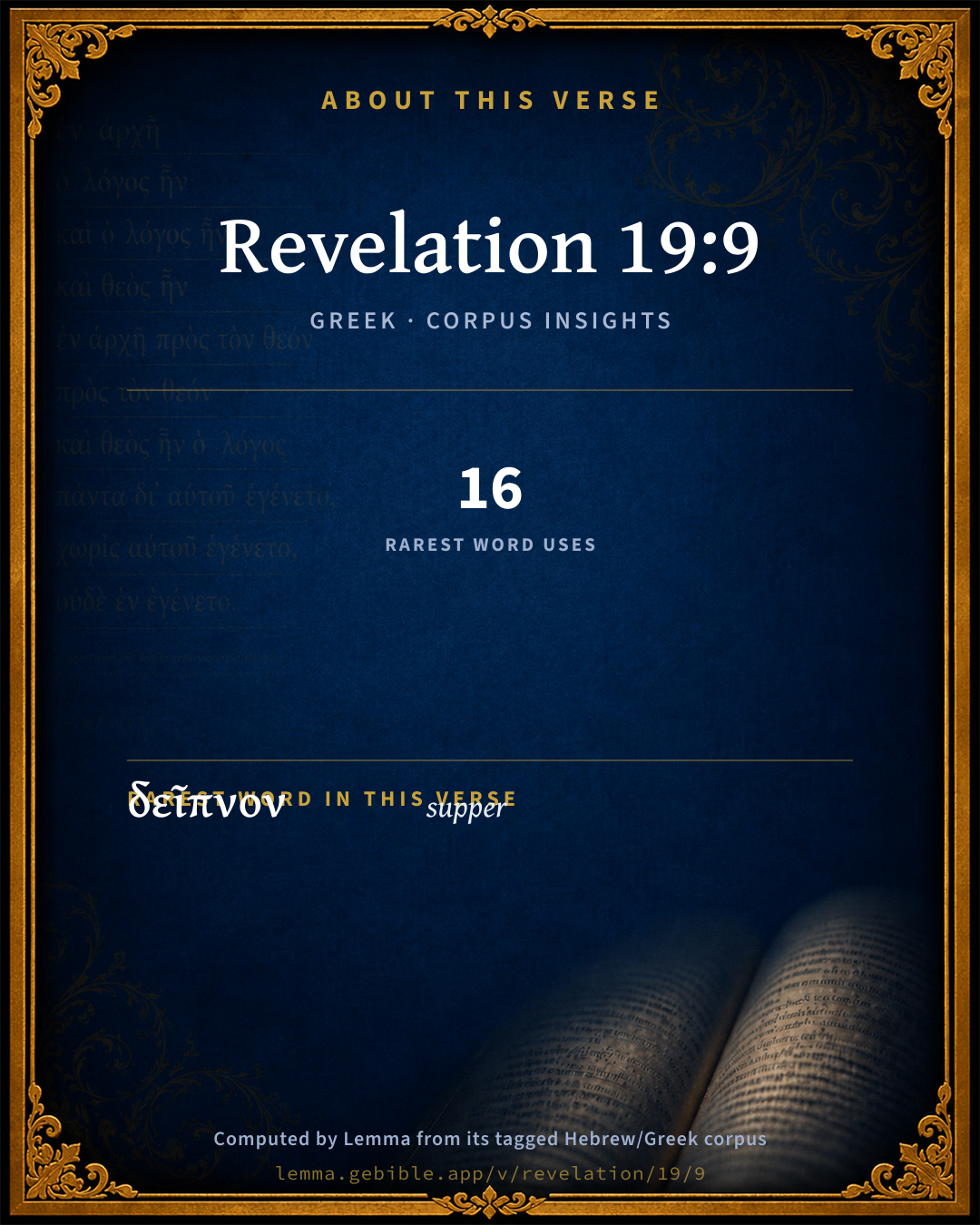
Revelation 19:9

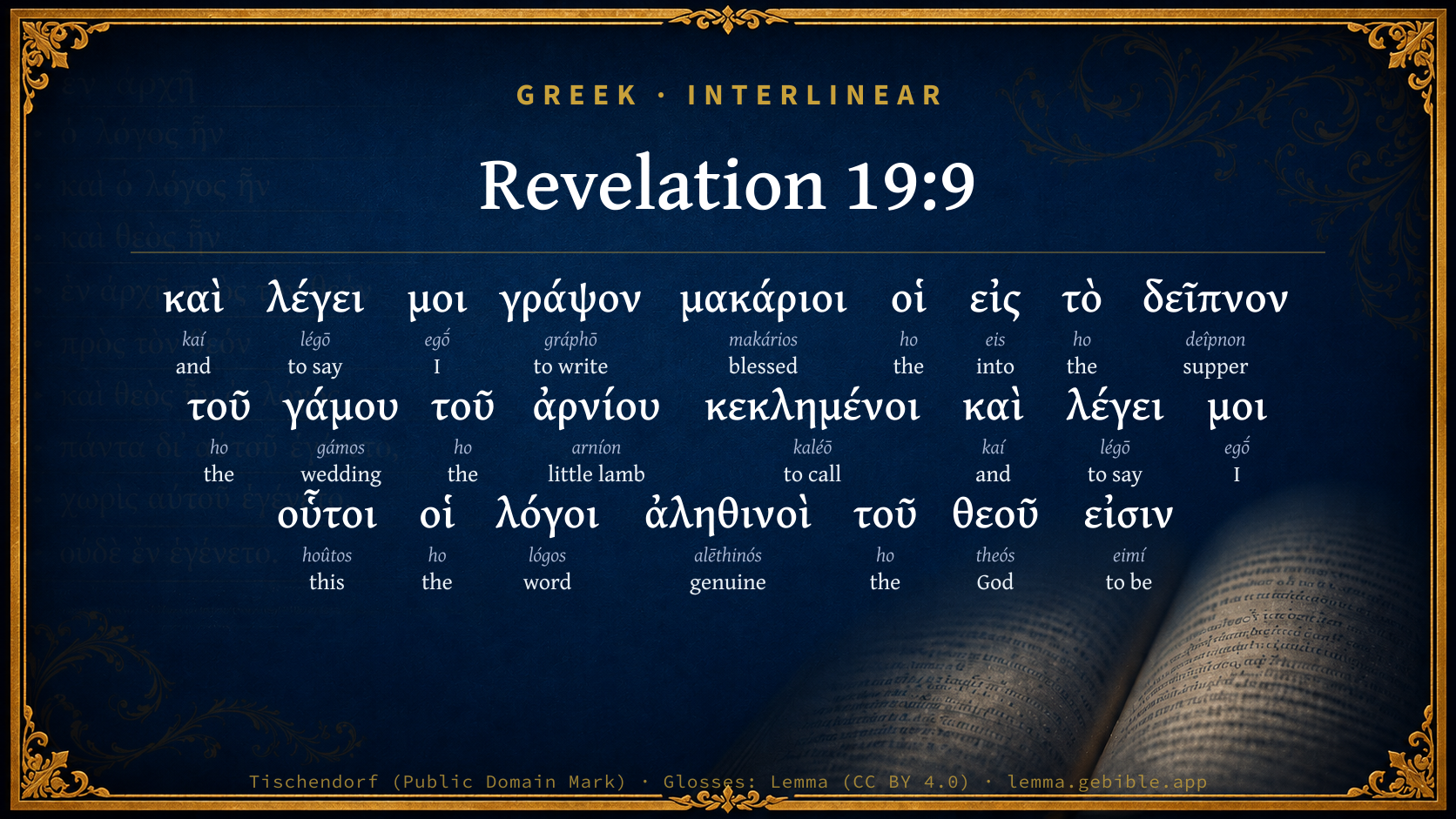
Greek (Tischendorf 8th ed.) Revelation 19:9 appears in the Greek New Testament. The text above is from the Tischendorf 8th edition. Each word links to its Strong’s number and a concise gloss. Click any word for its full Thayer’s Greek Lexicon entry.
Download image
Cite this verse

Revelation 19:9 (World English Bible). Public Domain. Lemma interlinear Bible study tool, https://lemma.gebible.app/v/revelation/19/9.

Show BibTeX & RIS
BibTeX
RIS
English Translation
He said to me, "Write, 'Blessed are those who are invited to the marriage supper of the Lamb.'" He said to me, "These are true words of God."
World English Bible · Public Domain
Download a study sheet

One document with this verse’s original text, its word-by-word gloss line, the meaning frame, cross-references with their text, attributed commentary, and full source and license credits — printable, and it pastes into notes with its structure intact.

This verse Autodidact and up

Study sheet (.html) Plain text (.txt)

A passage Seminary Student

Up to 50 verses in one chapter. A passage sheet keeps up to 6 commentary sources and 12 cross-references per verse, in the order this page ranks them, and says so on the sheet whenever that leaves anything out. Ask for a single verse and you get the Autodidact verse sheet above.

Everything on this page stays free to read, with no account — the sheet is a download of what is already on screen, not access to it.

Want to remove ads? Support Godless Engineer
Compare translations 3

The same verse in 3 English versions, stacked beneath the original-language interlinear above. Click any original word for its lexicon entry.

Each is an independent rendering of the whole verse — the interlinear is not word-aligned to these translations.

Highlighted words mark where these versions differ — a whole-verse word diff, not a word-by-word alignment.

  • World English Bible Public Domain
    He said to me, "Write, 'Blessed are those who are invited to the marriage supper of the Lamb.'" He said to me, "These are true words of God."
  • King James Version Public Domain
    And he saith unto me, Write, Blessed are they which are called unto the marriage supper of the Lamb. And he saith unto me, These are the true sayings of God.
  • unfoldingWord Literal Text CC BY-SA 4.0
    And he says to me, “Write, ‘Blessed the ones having been called to the supper of the wedding of the Lamb.’” And he says to me, “These are true words of God.”

unfoldingWord Literal Text — © unfoldingWord, licensed CC BY-SA 4.0. Word-aligned USFM3 via Door43 (git.door43.org/unfoldingWord/en_ult).

Versions to compare (up to 4)

3 of 4 selected

Show all 19 translations

Every available English version of this verse, each an independent rendering of the whole verse.

  • World English Bible Public Domain
    He said to me, "Write, 'Blessed are those who are invited to the marriage supper of the Lamb.'" He said to me, "These are true words of God."
  • Berean Standard Bible Public Domain
    Then the angel told me to write, “Blessed are those who are invited to the marriage supper of the Lamb.” And he said to me, “These are the true words of God.”
  • Majority Standard Bible Public Domain
    Then the angel told me to write, “Blessed are those who are invited to the marriage supper of the Lamb.” And he said to me, “These are the true words of God.”
  • King James Version Public Domain
    And he saith unto me, Write, Blessed are they which are called unto the marriage supper of the Lamb. And he saith unto me, These are the true sayings of God.
  • American Standard Version (1901) Public Domain
    And he saith unto me, Write, Blessed are they that are bidden to the marriage supper of the Lamb. And he saith unto me, These are true words of God.
  • Revised Version (1885) Public Domain
    And he saith unto me, Write, Blessed are they which are bidden to the marriage supper of the Lamb. And he saith unto me, These are true words of God.
  • Geneva Bible (1599) Public Domain
    Then he said vnto me, Write, Blessed are they which are called vnto the Lambes supper. And he said vnto me, These wordes of God are true.
  • Douay-Rheims (1899) Public Domain
    And he said to me: Write: Blessed are they that are called to the marriage supper of the Lamb. And he saith to me: These words of God are true.
  • Young's Literal Translation Public Domain
    And he saith to me, `Write: Happy `are' they who to the supper of the marriage of the Lamb have been called;' and he saith to me, `These `are' the true words of God;'
  • Literal Standard Version CC BY-SA 4.0
    And he says to me, “Write: Blessed [are] they who have been called to the banquet of the marriage of the Lamb”; and he says to me, “These [are] the true words of God”;
  • Unlocked Literal Bible CC BY-SA 4.0
    The angel said to me, “Write this: Blessed are those who are invited to the wedding feast of the Lamb.” He also said to me, “These are true words of God.”
  • unfoldingWord Literal Text CC BY-SA 4.0
    And he says to me, “Write, ‘Blessed the ones having been called to the supper of the wedding of the Lamb.’” And he says to me, “These are true words of God.”
  • Darby Bible Public Domain
    And he says to me, Write, Blessed [are] they who are called to the supper of the marriage of the Lamb. And he says to me, These are the true words of God.
  • World Messianic Bible Public Domain
    He said to me, “Write, ‘Blessed are those who are invited to the wedding supper of the Lamb.’” He said to me, “These are true words of God.”
  • Webster's Bible Public Domain
    And he saith to me, Write, Blessed are they who are called to the marriage supper of the Lamb. And he saith to me, These are the true sayings of God.
  • Free Bible Version CC BY-SA 4.0
    The angel told me, “Write this down: How happy are those who are invited to the Lamb's wedding feast.” Then he said to me, “These are God's true words.”
  • Bible in Basic English Public Domain
    And he said to me, Put in the book, Happy are the guests at the bride-feast of the Lamb. And he said to me, These are the true words of God.
  • Text-Critical English NT CC BY 4.0
    Then the angel said to me, “Write: ‘Blessed are those who are invited to the marriage supper of the Lamb.’ ” He also said to me, “These are the true words of God.”
  • Tyndale New Testament (1534) Public Domain
    And he sayde vnto me: happy are they which are called vnto the Lambes supper. And he sayde vnto me: these are the true sayinges of God.

Literal Standard Version (2020), Covenant Press — licensed CC BY-SA 4.0. Text via the HelloAO Bible API (eBible.org). Unlocked Literal Bible (unfoldingWord) — licensed CC BY-SA 4.0. Text via the HelloAO Bible API (eBible.org). unfoldingWord Literal Text — © unfoldingWord, licensed CC BY-SA 4.0. Word-aligned USFM3 via Door43 (git.door43.org/unfoldingWord/en_ult). Free Bible Version, Dr. Jonathan Gallagher — licensed CC BY-SA 4.0. Text via the HelloAO Bible API (eBible.org).

Word by word

More ways to search: Search by grammar → Find every occurrence → Compare this word →

Practice this passage: Drill this verse → Learn its vocabulary →

δεῖπνον
deîpnon
G1173
“supper”
Noun, Accusative, Singular, Neuter
Part of Speech
Noun
Case
Accusative
Number
Singular
Gender
Neuter
Full Thayer's Definition

Origin: from the same as G1160

TDNT: 02:34,1

1. supper, especially a formal meal usually held at the evening, a. used of the Messiah's feast, symbolising salvation in the kingdom 2. food taken at evening
  1. καὶ kaí G2532 “and” Conjunction
  2. λέγει légō G3004 “to say” Verb, Present, Active, Indicative, 3rd person, Singular
  3. μοι egṓ G1473 “I” Personal pronoun, 1st person, Dative, Singular
  4. γράψον gráphō G1125 “to write” Verb, Aorist, Active, Imperative, 2nd person, Singular
  5. μακάριοι makários G3107 “blessed” Adjective, Nominative, Plural, Masculine
  6. οἱ ho G3588 “the” Article, Nominative, Plural, Masculine
  7. εἰς eis G1519 “into” Preposition
  8. τὸ ho G3588 “the” Article, Accusative, Singular, Neuter
  9. τοῦ ho G3588 “the” Article, Genitive, Singular, Masculine
  10. γάμου gámos G1062 “wedding” Noun, Genitive, Singular, Masculine
  11. τοῦ ho G3588 “the” Article, Genitive, Singular, Neuter
  12. ἀρνίου arníon G721 “little lamb” Noun, Genitive, Singular, Neuter
  13. κεκλημένοι kaléō G2564 “to call” Verb, Perfect, Passive, Participle, Nominative, Plural, Masculine
  14. καὶ kaí G2532 “and” Conjunction
  15. λέγει légō G3004 “to say” Verb, Present, Active, Indicative, 3rd person, Singular
  16. μοι egṓ G1473 “I” Personal pronoun, 1st person, Dative, Singular
  17. οὗτοι hoûtos G3778 “this” Demonstrative pronoun, Nominative, Plural, Masculine
  18. οἱ ho G3588 “the” Article, Nominative, Plural, Masculine
  19. λόγοι lógos G3056 “word” Noun, Nominative, Plural, Masculine
  20. ἀληθινοὶ alēthinós G228 “genuine” Adjective, Nominative, Plural, Masculine
  21. τοῦ ho G3588 “the” Article, Genitive, Singular, Masculine
  22. θεοῦ theós G2316 “God” Noun, Genitive, Singular, Masculine
  23. εἰσιν eimí G1510 “to be” Verb, Present, Active, Indicative, 3rd person, Plural

About this verse

These counts appear in no published source. They are computed here, from the morphology-tagged text and Lemma’s own curated glosses. What Lemma adds →

24
words
16
distinct lemmas
Revelation
section

Notable vocabulary

The rarest word here is δεῖπνον supper G1173 — appearing just 16 times in the whole Greek New Testament.

Shared distinctive vocabulary

δεῖπνον supper G1173 occurs in 16 verses of the Greek New Testament. Also found in:

Repetition

Words recur within this verse:

Cross-references

23

Topical passages linked to Revelation 19:9 in the Treasury of Scripture Knowledge — connected by theme and wording, ordered by reader-vote popularity; previews shown in the World English Bible.

  • Luke 14:15–16 When one of those who sat at the table with him heard these things, he said to him, "Blessed is he who will feast in the Kingdom of God!"
  • Revelation 22:6 He said to me, "These words are faithful and true. The Lord God of the spirits of the prophets sent his angel to show to his bondservants the things which must happen soon."
  • Matthew 22:2–4 "The Kingdom of Heaven is like a certain king, who made a marriage feast for his son,
  • Revelation 1:19 Write therefore the things which you have seen, and the things which are, and the things which will happen hereafter;
  • Revelation 19:7–8 Let us rejoice and be exceedingly glad, and let us give the glory to him. For the marriage of the Lamb has come, and his wife has made herself ready."
  • Revelation 21:5 He who sits on the throne said, "Behold, I am making all things new." He said, "Write, for these words of God are faithful and true."
  • Isaiah 8:1 Yahweh said to me, "Take a large tablet, and write on it with a man's pen, 'For Maher Shalal Hash Baz;'
  • Habakkuk 2:2 Yahweh answered me, "Write the vision, and make it plain on tablets, that he may run who reads it.
  • Revelation 3:20 Behold, I stand at the door and knock. If anyone hears my voice and opens the door, then I will come in to him, and will dine with him, and he with me.
  • Revelation 19:10–11 I fell down before his feet to worship him. He said to me, "Look! Don't do it! I am a fellow bondservant with you and with your brothers who hold the testimony of Jesus. Worship God, for the testimony of Jesus is the Spirit of Prophecy."
  • Revelation 2:1 To the angel of the assembly in Ephesus write: "He who holds the seven stars in his right hand, he who walks among the seven golden lampstands says these things:
  • Revelation 2:8 "To the angel of the assembly in Smyrna write: "The first and the last, who was dead, and has come to life says these things:
  • Revelation 2:12 "To the angel of the assembly in Pergamum write: "He who has the sharp two-edged sword says these things:
  • Revelation 2:18 "To the angel of the assembly in Thyatira write: "The Son of God, who has his eyes like a flame of fire, and his feet are like burnished brass, says these things:
  • Revelation 3:1 "And to the angel of the assembly in Sardis write: He who has the seven Spirits of God, and the seven stars says these things: "I know your works, that you have a reputation of being alive, but you are dead.
  • Revelation 3:7 "To the angel of the assembly in Philadelphia write: "He who is holy, he who is true, he who has the key of David, he who opens and no one can shut, and who shuts and no one opens, says these things:
  • Revelation 3:14 "To the angel of the assembly in Laodicea write: "The Amen, the Faithful and True Witness, the Head of God's creation, says these things:
  • Revelation 10:4 When the seven thunders sounded, I was about to write; but I heard a voice from the sky saying, "Seal up the things which the seven thunders said, and don't write them."
  • Revelation 14:13 I heard the voice from heaven saying, "Write, 'Blessed are the dead who die in the Lord from now on.'" "Yes," says the Spirit, "that they may rest from their labors; for their works follow with them."
  • 1 Timothy 1:15 The saying is faithful and worthy of all acceptance, that Christ Jesus came into the world to save sinners; of whom I am chief.
  • 1 Timothy 4:9 This saying is faithful and worthy of all acceptance.
  • 2 Timothy 2:11 This saying is faithful: For if we died with him, We will also live with him.
  • Titus 3:8 This saying is faithful, and concerning these things I desire that you affirm confidently, so that those who have believed God may be careful to maintain good works. These things are good and profitable to men;

Cross-references courtesy of OpenBible.info (CC BY 4.0).

Commentary

Notes on Revelation 19:9 from classic Christian and Jewish commentators (each source and its license shown beneath its notes). The classic Christian expositions comment on the surrounding passage and are grouped to its opening verse, so a note may address several verses; the Jewish commentaries on the Tanakh (Rashi and others) are per-verse, so they appear only where the commentator wrote on this verse.

Lemma curates 59 commentaries, every one of them public domain or Creative Commons licensed, each selected and text-cleaned for this edition rather than reprinted as found. About our sources →

The Biblical Illustrator

Joseph S. Exell

Rev_19:9

Blessed are they which are called unto the marriage supper of the Lamb.

The marriage supper of the Lamb

I. The lamb. We know at once who this is; but it is remarkable that, with one exception and that occurring in this evangelists own Gospel, this is the only part of the inspired writings in which our Lord is ever called by this name. Now this could not have happened by accident. There is a meaning in it, and it is not difficult perhaps to see what it is--the Lord Jesus would have us look up to Him in heaven as the same Jesus who died for us on the Cross.

II. The marriage supper of the Lamb. Here, you observe, is a complete change of metaphor. Our Lord puts off the character of a Lamb, and takes on Him that of a Bridegroom; or rather He takes this character on Him without putting off the other.

1. A long looked for and much desired hour. The Saviour Himself desires it. It is the hour that will bring Him the consummation of all His wishes, the full reward of all His labour and sufferings. And His Church desires it. Scarcely had He disappeared, when its language was, Come, Lord Jesus, come quickly.

2. An hour of great love and affection. No earthly affection is equal to that of a redeemed sinner for his Saviour. There may not at times seem much warmth in it, but when it is real there is as much strength and depth in it perhaps as mans nature, in its present state and circumstances, is capable of. But still it is an imperfect love, very much broken in upon by the love of other things, and damped by the cares of life, its business and troubles. It is an unseen object too that we love, and we find it difficult to realise anything we have never seen. And even in our best moments, we often feel as though we only half loved our Lord. We long for a better and higher nature, that we may love Him more. At this marriage supper we shall have what we long for. We shall see our Lord, and see Him in a form in which we shall know Him; and shall have souls within us, that will for the first time feel large enough to love Him, and these souls shall be filled to overflowing with admiration of and delight in Him. The love of this hour will be the perfection of love. This marriage feast will be the feast, the triumph of love--the exalted Saviour showing to the whole universe that He loves us to the utmost bound love can go, and we loving Him with a fervour, a gratitude, an adoration a delight, that are new even in heaven.

3. A scene of abounding joy. The affection that reigns in it would of itself make it so. Let me only be with my Lord, the Christian says, and I ask no more. That, without anything else, will make me happy, and happy to the full. The heavenly Bridegroom provides for His guests all that can gratify and delight them, and all too that can show His love for them and His munificence. The provisions made by Him for our enjoyment, will astonish us. So will it be with us in heaven. We shall find it a feast and a monarchs feast.

III. Those invited or called to it.

1. They are those who have been invited before to this supper. And here we are all included.

2. They are those only who have before accepted the invitation to it.

3. These guests are yet further distinguished--they are ready and prepared for this supper. A worldly-minded, ungodly man in heaven, would be a miserable man in heaven. A prepared place for a prepared people, a holy place for a holy people--this is the heaven of the Bible.

IV. The happiness of these men. Blessed are they which are called to the marriage supper of the Lamb. It is not an invitation to every feast that will make a man happy. Not a snare or a danger can await them there. Not a single being will they see there who can do them harm or whom they would wish away. (C. Bradley, M. A.)

The marriage supper of the Lamb

I. The description of the bridegroom.

1. As the Lamb He is the one everlasting sacrifice for sin: He will not be other than this in His glory.

2. As the Lamb, suffering for sin, He is specially glorious in the eyes of the angels and all other holy intelligences; and so in His joyous day He wears that character.

3. As the Lamb He most fully displayed His love to His Church; and so He appears in this form on the day of His loves triumph.

4. As the Lamb He is best loved of our souls. Behold, how He loved us even to the death!

II. The meaning of the marriage supper.

1. The completion and perfection of the Church. His bride hath made herself ready.

2. The rising of the Church into the nearest and happiest communion with Christ in His glory. The marriage of the Lamb is come. The espousals lead up to this.

3. The fulfilment of the long expectations of both.

4. The open publication of the great fact of mutual love and union.

5. The overflowing of mutual delight and joy. Be glad and rejoice.

6. The grandest display of magnificent munificence in a banquet.

7. The commencement of an eternally unbroken rest. He shall rest in His love. The Church, like Ruth, shall find rest in the house of her Husband.

III. The persons who are called to it.

1. Those who are so called as to accept the invitation.

2. Those who now possess the faith which is the token of admission.

3. Those who love Bridegroom and bride.

4. Those who have on the wedding garment of sanctification.

5. Those who watch with lamps burning.

IV. The blessedness which is ascribed to them.

1. They have a prospect which blesses them even now.

2. They have great honour in being called to such a future.

3. They will be blessed indeed when at that feast, for--Those who are called will be admitted. Those who are admitted will be married. Those who are married to Jesus will be endlessly happy. How many a marriage leads to misery! but it is not so in this case. (C. H. Spurgeon.)

The marriage supper of the Lamb

A distinction seems to be drawn between the marriage, and the marriage supper of the Lamb. The marriage, takes place now,--The marriage supper is to follow by and by. The marriage is that act of union between each soul and Christ, when that soul, drawn by Gods love and made willing by His grace, is linked to, and made one with, the mystical body of Christ. The marriage supper will be the public celebration, and the glorious consummation, of that union. Therefore there are differences. The marriage here, blessed and beautiful as it is, has its trouble and its separation. The soul has to leave, not without pain, what once was very dear to it. And some fear cannot help to mingle, even where love prevails. But at the marriage supper it will be all union, and no parting; and there will be no room for the shadow of a fear there. The marriage here is an individual act. One by one, each as God chooses, one here, and another there, a soul gives itself to Christ. The marriage supper will be the solemnity of the whole Churchs collective partnership, one and another, with Jesus. The marriage here, at least so it seems, sometimes, to the poor Christians heart, was capable of being dissolved again. But when the marriage supper comes, who will ever think of breaking the tie? In the marriage here, real and perfect though it be, there are intervals of distance; seasons, when there is no union between the soul and Him it loves. But in the marriage supper, the felt and visible presence of Christ will be for ever and for ever. In the marriage here there were many who, though truly and indissolubly joined to Christ, yet often seemed to others, and seemed to themselves, not to be His. But at the marriage supper there will be no misunderstandings. Christ will have proclaimed His own; and the whole universe will confess Him, and His saints. (James Vaughan, M. A.)

And he saith unto me, These are the true sayings of God.--

The Scriptures divinely true

I. A right estimate of holy scripture.

1. These words which we find in the Old and New Testaments are true. Free from error, certain, enduring, infallible.

2. These are Divine words. Infallibly inspired, so as to be in very truth the sayings of God.

3. These words are thus true and Divine in opposition to words of man. These may or may not be true. Pretended words of God. False prophets and men with addled intellects profess to speak in the name of God; but they lie.

4. These words are all of them truly Divine. Neither too severe to be true, nor too terrible to be uttered by a God of love, as some dare to say. Nor too good to be true, as tremblers fear. Nor too old to be true, as novelty-hunters affirm. Nor too simple to be truly Divine, as the worldly-wise insinuate.

5. These words are a blessing to us for that reason. What else can guide us if we have no sure revelation from God? How can we understand the revelation if it is not all true?

II. The result of forming such an estimate. If you believe that these are the true sayings of God--

1. You will listen to them with attention, and judge what you hear from preachers by this infallible standard.

2. You will receive these words with assurance. This will produce confidence of understanding. This will produce rest of heart.

3. You will submit with reverence to these words, obey their precepts, believe their teachings, and value their prophecies.

4. You will expect fulfilment of Divine promises under difficulties.

5. You will cling to revealed truth with pertinacity.

6. You will proclaim it with boldness.

III. Our justification for forming such an estimate.

1. The Scriptures are what they profess to be--the word of God.

2. There is a singular majesty and power in them; and we see this when the truth of God is preached.

3. There is a marvellous omniscience in Scripture, which is perceived by us when it unveils our inmost souls.

4. They have proven themselves true to us. They warned us of the bitter fruit of sin, and we have tasted it. They told us of the evil of the heart, and we have seen it. They told us of the peace-giving power of the blood, and we have proved it by faith in Jesus. They told us of the purifying energy of Divine grace: we are already instances of it, and desire to be more so. They assured us of the efficacy of prayer, and it is true. They assured us of the upholding power of faith in God, and by faith we have been upheld in trial. They assured us of the faithfulness of God to His people as shown in providence, and we have experienced it. All things have worked together for our good hitherto.

5. The witness of the Holy Spirit in our hearts confirms our faith in Holy Scripture. We believe, and are saved from sin by believing. Those words must be truly Divine which have wrought in us such gracious results. (C. H. Spurgeon.)

Worship God.--

The Supreme Being the only proper object of religious worship

I. The scripture represents God as the only proper object of religious worship.

II. The absolute supremacy of God in all His great and essential attributes.

1. God is supreme in respect to His existence.

2. God infinitely surpasses all other beings in the immensity of His presence.

3. God far transcends all other beings in His knowledge.

4. God is absolutely supreme in wisdom.

5. God is supreme in power.

6. God is supremely excellent in His holiness, goodness, or benevolence.

III. It is absurd to pay religious worship to any being who is not possessed of the essential attributes of divinity. (N. Emmons, D. D.)

The testimony of Jesus is the spirit of prophecy.

The great prophetic burden

I. The theme or burden of the bible is Jesus. Not philosophy, nor science, nor theology, nor metaphysics, nor morality, but Jesus.

II. The theme of bible-annals is Jesus. Not mere history, but history as containing Jesus. Not the mere rise and fall of nations and kingdoms, but these as connected with the promised seed of the woman.

III. The theme of the Psalms is Jesus. It is not mere poetry, Hebrew poetry, that we find in them, but Jesus. It is poetry embodying Jesus; it is praise, of which every note is Immanuel.

IV. The theme of prophecy is Jesus. It is not certain future events, dark or bright, presented to the view of the curious and speculative; it is Jesus; earthly events and hopes and fears only as linked with Him. (H. Bonar, D. D.)

The one witness and the one testimony

(with Rev_22:20):--

I. The oneness of the testifier. He is the one God. The sender of the testimony is the one Jehovah; the subject of the testimony is the one Jesus; the inspirer is the one Spirit. Through many lips He has spoken, by many pens He has written; but it is the mind, the will, the purpose, the revelation of the one God that is here.

II. The oneness of the messenger. It is intimated here that it was one angel alone that was employed to communicate the testimony. He was sent to patriarchs and prophets of old, to apostles and brethren in later times. The instrument or medium of communication was a created being, an angel; but it was the same throughout.

III. The oneness of the testimony. It is not many testimonies, but one; it is the word (not words) of God. It was given at sundry times and divers manners; in fragments and portions, great and small; yet there is unity throughout, not discord or contradiction--marvellous unity, which can only be accounted for on the fact that there was in reality but one writer, He to whom one day is as a thousand years, and that therefore the truths enunciated are the offspring of one mind, the thoughts of one heart. This testimony bore all upon one point, one person, one work, one kingdom. It was the testimony of Jesus, that is, it testified of Him from first to last; for Christ is the all and in all of prophecy, the all and in all of the Bible. (H. Bonar, D. D.)

The Biblical Illustrator, edited by Joseph S. Exell (c. 1880s–1900s) — public domain. Text from a community e-Sword module.

Joseph Benson's Commentary

Rev 19:9-10. And he (the angel) saith unto me, Write — Record this as an important truth, in which all that read this book in future ages will be greatly concerned; Blessed — Μακαριοι, happy; are they which are called unto the marriage-supper of the Lamb — Who shall be living at this time, and shall obey the invitation to this marriage-feast, and partake of all the privileges and blessings belonging to it. And he saith unto me, after a little pause, These are the true sayings of God — They are to be regarded by thee, and all that read them, as declarations infallibly true, and infinitely momentous. And — While he was speaking to me in this kind and condescending manner, being overawed by his majestic appearance, and in such a rapture and ecstasy at these discoveries that I knew not, or did not consider, what I did; I fell at his feet — Prostrated myself before him; to worship him — Or to do him homage, as though I had owed all these discoveries to him. And he said, See thou do it not — Greek, ωρα μη, See not, with a beautiful abruptness. It does not appear that St. John intended to pay religious worship to this angel; for he could not but know that he was only a creature, and that religiously to worship any creature, however exalted, would be flat idolatry. He seems only to have intended such civil respect and reverence as the Asiatics were wont to pay to superiors, and especially to persons in high rank; which indeed is frequently all that is meant by the word προσκυνεω, here rendered to worship. Thus Ruth complimented Boaz with this kind of honour, when she fell on her face, and bowed herself to the ground, Rth 2:10. Thus Abigail also showed her respect for David: she fell before him on her face, and bowed herself to the ground, 1Sa 25:23. Indeed, the reason for which the angel forbids this high act of respect, seems to intimate that he did not understand it as an act of religious honour, for he mentions nothing concerning the sin or danger of idolatry, as implied in it: he only shows that it was improper the apostle should pay such respect to him, which he does, not by showing that it was unlawful to give such respect to any created being whatsoever, but because he was only a fellow-servant with the apostle, and a servant of his brethren, that had the testimony of Jesus. As if he had said, I am now employed as your fellow-servant, to testify of the Lord Jesus by the same Spirit which inspired the prophets of old. Worship God — Pay thine homage, in such expressions of it, to God alone, to whom alone thou owest these revelations. The testimony of Jesus is the spirit of prophecy — That is, the spirit of prophecy serves, in a glorious manner, to confirm Jesus’s divine mission, to all that know and duly observe the circumstances of it; and that which I now reveal to thee makes a considerable article of the proof: or, this ability of foretelling things to come is an argument or evidence of Christ’s speaking in and by me, as he does by thee.

Joseph Benson's Commentary on the Old and New Testaments (1811–1818) — public domain. Text from a community e-Sword module.

Tyndale Open Study Notes

Tyndale Open Resources

19:9 Blessed are those: This fourth blessing in Revelation (see 1:3; 14:13; 16:15) affirms the hope of the faithful. • who are invited: God is in control and determines who will participate. • wedding feast (cp. 19:17): Jesus often used meals to explain the Kingdom (Matt 22:1-13; Luke 14:7-24), and he ordained a meal for the church (Mark 14:22-25; 1 Cor 11:23-26). • These are true words: This oath asserts the reliability of the message.

Tyndale Open Study Notes — © Tyndale Open Resources, licensed CC BY-SA 4.0. Text via the HelloAO Bible API.

Bengel's Gnomon

Johann Albrecht Bengel

Rev 19:9. Γράψον) The Apparatus makes mention of the MSS. which omit this word. Among them are the first editions of Erasmus, which Luther followed: whence the suspicion of a typographical error in the German Bibles is removed. The more recent editors of the German Bibles have inserted that word.—ἀληθινοὶ, true) A remarkable epithet. It is used by itself in this one passage only of the Apocalypse, as πιστὸς, faithful, of the Witness, ch. Rev 1:5. In other places both are joined. The faithful and true witness, ch. Rev 3:14 Faithful and true, put absolutely, ch. Rev 19:11. Then, Faithful and true words, ch. Rev 21:5, Rev 22:6. In other places another epithet is added. Jesus, Holy and true, ch. Rev 3:7. God, the Lord Holy and true, ch. Rev 6:10. Just and true are the ways of God: true and just are His judgments, ch. Rev 15:3, Rev 16:7, Rev 19:2. Where these epithets are used conjointly, God is called Holy, with reference to Himself: faithful and just, with reference to His people, and in the word given to His people: He is called true, in His work, the issue of which, especially in this place, answers to the word which has preceded. Where one epithet only is used, as Faithful, at the beginning of the book, and True, here, about the end, the force of the other is to be understood. And as He Himself is, so are His words, and ways, and judgments.

Bengel's Gnomon of the New Testament — English translation (T&T Clark, Edinburgh, 1860) — public domain. Text from a community e-Sword module.

Meyer's Critical & Exegetical Commentary

Heinrich August Wilhelm Meyer

Rev_19:9-10. The significance of the short interlude lies in what the angel says to John (Rev_19:9), by applying in express exhortation,[4057] the reference contained already in the ascription of praise of the heavenly beings, to the goal of all the hopes of believers, and emphatically confirming the consolatory certainty of the hope thus set before believers, by the assurance that this word of God is true. Also to the prophetical declaration of this glorious hope by John, an attestation is given in Rev_19:10, which must confirm believers[4058] receiving the testimony of the prophet in the hope and patience upon which their victory depends.

λέγει-g0- μοι-g0-. The one speaking is, at all events, according to Rev_19:10, an angel; but not an interpreting angel, such as Ewald and Ebrard think was the constant attendant of John,[4059] but the angel who from Rev_17:1 on serves John as the communicator of the revelation.[4060] To this points also the immediately succeeding declaration of the same angel (οὖτοι οἱ λόγοι, κ.τ.λ.).

Γράψον μακάριοι, κ.τ.λ.). Cf. Rev_14:3.

τὸ δεῖπνον τοῦ γάμ. τ. ἀρν. In a still more concrete way than Rev_19:7 (ὁ γάμος τ. ἀρν.) is the final blessed communion with the Lord illustrated. Moreover the paracletic pertinence of the discourse brings with it also the fact that it is not the idea of the Church as the bride of the Lamb, but that of individual believers as wedding guests, which enters here.[4061] By the repetition of the formula καὶ λέγει μοι, the succeeding speech of the angel is especially separated from his preceding words, and thus receives a peculiar importance. If we suppose that the art. is to be read before ἀληθινοὶ,[4062]which certainly does not serve to facilitate the construction,[4063]we must translate with Beng., Ebrard, Bleek, and Ew. ii.: These are the true words of God. The ingenious explanation of Hengstenb. (These words are true, they are words of God), even apart from the art. before ἀληθ., is refuted by the fact that the εἰσίν, in any case, belongs not before, but after, the τοῦ θεοῦ. De Wette, who translates: These words are the true (words) of God,[4064] appeals, in opposition to Beng., to the parallel, Rev_21:5. But there the construction of the sentence is extremely simple, since to the subj. οὗτοι οἱ λόγοι the definition of the predicate is added, πιστοὶ καὶ ἀληθινοί εἰσιν; but here not only the τοῦ θεοῦ, but especially the art. before ἀληθ., effects another relation in the entire statement. By means of this art., it becomes far simpler to bring together οἱ λόγοι οἱ ἀληθινοὶ, and to understand these words combined with τοῦ θεοῦ as a predicate to the subject οὖτοι.[4065] But the sense is by no means that which Bengels explanation suggests to De Wette,[4066] but after the angel has afforded John the revelation of the judgment upon the harlot, and, from this beginning of the final judgment, has given an intimation concerning the blessed mystery of God, which lies back of the entire judgment, he reviews all the words of revelation, of which he had served as the interpreter to the prophet from Rev_17:1 on. These, he says, are the true, i.e., the genuine and right, words of God. The ἀληθινοί here mentions not the truth or the correctness of the contents, but the reality of the correlated statement: τοῦ θεοῦ. This explanation is afforded, on the one hand, by the plural οἱ λόγοι alone,which Hengstenb., as well as Klief., refers to 58, Ebrard to 68 and 9, but the most do not take into further consideration,and, on the other hand, also by what is reported in Rev_19:10. Ebrard was on the right track when he alluded to the expression οἱ λόγοι τοῦ θεοῦ, Rev_17:17; but he wanders from it again, when, just as he understands those λόγοι τοῦ θεοῦ as promises concerning the final redemption of the Church, so, in this passage, he limits the λόγοι οἱ ἀληθ. τ. θ. to Rev_19:6-9. The latter is not entirely correct; for there is no reason for excluding the songs of Rev_19:1-5, which also refer to the goal presented in Rev_19:9, in a manner precisely identical with Rev_19:6-8. But what is said from Rev_19:1 on, concerning the now-impending glorification of the Church, has to do with but one side of the subject, with only one part of the λόγοι τοῦ θεοῦ (Rev_17:17), or of the mystery of God, announced by the ancient prophets.[4067] This one point is made prominent also in the songs from Rev_19:1 on, only upon the ground of the judgment lying before the same, which is now already fulfilled in an act. As now (Rev_17:17) the λόγοι τ. θεοῦ contain both, viz., the proclamation of the Divine judgment against every thing antichristian,the kings of the world, with the beast of the world, are to rule only until the words of God, which proclaim the destruction of these same powers, shall find their fulfilment, i.e., until the dominion of those antichristian powers shall be annihilated according to Gods declaration,and the promise; the λόγοι οἱ ἀληθ. τ. θ., in this passage, refer to all the revelations which the prophet has received, as the fulfilment of the promise (Rev_17:1) of the angel even now also speaking with him (δεἰξω σοι τὸ κρίμα τῆς πόρνης τ. μεγ.), i.e., they refer to Rev_18:1 to Rev_19:9. By the expression οὐτοι οἱ λόγοι οἱ ἀληθ., a review is made of that entire sectionin which the expressions referring to the glorification of believers, Rev_19:1-9, are represented in most immediate combination with judgment upon the antichristian powers already fulfilled in one actin a way precisely analogous to that of Rev_22:6, where, at the conclusion of the entire revelation, a confirmatory reference is made to all that was disclosed to the gazing prophet, from Rev_4:1 on, as about to happen. But in this passage, also, such a conclusion is entirely justified, because here an important part of what was to happen had already happened, viz., the judgment upon the great harlot; and therewith the fulfilment of the words,[4068] or of the mystery,[4069] of God, had already begun. Now also there is given to the prophet the direct pledge of the certainty of what he has beheld; that these words which he has received are the actual and true words of God himself. From this the explanation follows as to why it is that John (Rev_19:10)[4070] falls down before the angel in order to worship him. Ebrard is wrong in his attempt to attach a prophetic significance to this occurrence; viz., that the children of God are to be warned against the temptation of worshipping angels, who have brought about the victory over antichrist. The last is here entirely foreign. Grot., Vitr., Beng., etc., recognize in the adoring prostration an excessive token of gratitude, and therefore forbidden also by the angel.[4071] De Wette, in accordance with his exposition of 9b, finds here an expression of joyful astonishment at prophecies so confirmed (?). But partly from what precedes (λόγ. οἱ ἀληθ. τοῦ θεοῦ), and partly from the manner in which the angel rejects the adoration as not due him, as a fellow-servant of John, it may be first of all inferred that John regarded the angel thus addressing him, not as a fellow-servant, but as the Lord himself.[4072] At first,[4073] John had a proper estimate of the angel; but just by what was said (Rev_19:9 b), John could attain the supposition that the Lord himself spoke to him.

ὅρα μη. The aposiopesis[4074] is self-evident from what precedes: See that thou dost it not! Ay, do it not!

σύνδουλος. Because the angel serves the same Lord[4075] as John and all his brethren, who have the testimony of Jesus, i.e., all believers.[4076] The Lord is God;[4077] to him, therefore, belongs the adoration which John intended to offer to the angel (τῷ θεῷ προσκύνησον). The entire repulse by the angel does not therefore sound as tender as possible, almost having the tone of intercession,[4078] but is throughout decided.

The closing words of Rev_19:10 belong not to the address of the angel, but are a remark of John, whereby he establishes and explains (γάρ) what has just been said by the angel. It is incorrect to explain the gen. τοῦ Ἰησοῦ as subjective, the testimony proceeding from Jesus;[4079] for if, on the one hand, reference to the expression ἐχόντων τὴν μαρτ. τοῦ Ἰησοῦ require this explanation,[4080] on the other hand the declaration is intelligible only by defining the μαρτυρία τοῦ Ἰησ. as τὸ πνευμα τῆς προφητείας. This cannot mean: He who confesses Christ as thou dost has also the spirit of prophecy,[4081] but designates, in the sense of 1Pe_1:11, and in thorough agreement with what is indicated in Rev_1:1 and Rev_22:6; Rev_22:16, concerning the nature and the origin of prophecy, that Christ, by himself imparting his testimony of revelation to a man, fills him[4082] with the spirit of prophecy,who now speaks from and through the prophets.[4083] As Christ, the coming One, is the goal of all Christian prophecy,[4084] so is He also its author. From the closing words of the verse, it might be inferred,[4085] that they who have the testimony of Jesus are not believers in general, but only the prophets, so that the angel would call himself a fellow-servant only of the prophets; as Hengstenb. also (Rev_22:6) understands by the ΔΟΎΛΟΙς ΑὐΤΟῦ only prophets. But as (Rev_22:6), on the contrary, the servants of God[4086] are distinguished from the prophets, and considered as the believers for whose instruction the prophets receive their revelations,[4087] so also in this passage.[4088] Believers do not have the testimony proceeding from Jesus without the service of the prophets, as John himself is one; but they are prophets because of the testimony communicated to them by the Lord, which testimony in them is the spirit of prophecy. Thus there is in Rev_19:10 b an attestation to the prophetical book of John, similar to that which was emphatically maintained in the beginning[4089] and at the close.[4090] [Note LXXXV., p. 461.]

[4057] Cf. Rev_14:13.

[4058] Cf. Rev_1:3, Rev_22:18 sqq.

[4059] Cf. Rev_1:1.

[4060] Beng., Züll., De Wette, Hengstenb.

[4061] Cf. Rev_3:20; Mat_22:1 sqq., Mat_25:1 sqq. Beng., Hengstenb.

[4062] See Critical Notes.

[4063] Against Hengstenb.

[4064] Cf. Züll.: These true words are Gods words.

[4065] Cf. Rev_20:5; Luk_24:44.

[4066] Now the truth of Gods word manifests itself, viz., in its immediate results.

[4067] Rev_10:7.

[4068] Rev_17:17.

[4069] Rev_10:7.

[4070] As also Rev_22:8.

[4071] Cf. also Hengstenb., who, however, praises the humility of John as well as of the angel.

[4072] Cf. Laun.

[4073] Rev_17:1, Rev_15:6, Rev_16:1 sqq.

[4074] Cf. Winer, p. 558.

[4075] Cf. Rev_6:11.

[4076] Cf. Rev_6:9.

[4077] Rev_22:6.

[4078] Züll.

[4079] Against Ewald: If any one with constancy maintain faith in Christ; De Wette; Hengstenb., Ebrard, not clear.

[4080] Cf. Rev_6:9, Rev_12:17.

[4081] De Wette, Ewald.

[4082] Vitr. paraphrases: The same Spirit who speaks and acts through those who proclaim the testimony of Christ (which the apostles did), is the very one who speaks through me, who am sent by the Lord to declare to thee the things of the time to come. Thy affairs, therefore, are as important as my dignity, and we are accordingly called, as fellow-servants, to offices of not unequal honor. But it would be impossible for the concluding words of Rev_19:10 to belong to the angel (cf. Rev_19:8; Rev_5:8); and the explanation of τ. ἐχόντων τὴν μαρτυρίαν τ. Ἰησ., which forms its basis, is false.

[4083] Cf. Rev_2:7; Rev_2:11; Rev_2:17, Rev_3:22, with Rev_2:1; Rev_2:8; Rev_2:12, Rev_3:14.

[4084] Also of that of O. T., Rev_10:7.

[4085] Hengstenb.; cf. Vitr.

[4086] Cf. Rev_1:1.

[4087] Cf. Rev_22:16.

[4088] Cf., besides, Rev_22:9.

[4089] Rev_1:1 sqq.

[4090] Rev_22:6 sqq.

NOTES BY THE AMERICAN EDITOR

LXXXV. Rev_19:10. ἡ γὰρ μαρτυρία Ἰησοῦ

Luthardt paraphrases this clause: He who has this testimony of Jesus participates also in the Spirit who works prophecy, and teaches how it is to be understood, because all prophecy has Jesus Christ as its contents; and, therefore, the knowledge and confession of Jesus Christ is the key of the future. Cremer accordingly infers that ἔχειν τὴν μαρτ. Ἰησοῦ (Rev_12:17, Rev_19:10, Rev_6:9) is synonymous with ἔχειν τὸ πν. τῆς προφ. Gebhard also insists on the subjective meaning of Ἰησοῦ here, and says that wherever the testimony of Jesus occurs, it is synonymous with the word of God. Alford, dissenting from Düsterdiecks construction of Ἰησοῦ as subjective, says: What the angel says is this: Thou, and I, and our brethren are all ἔχοντες τὴν μαρτυρίαν Ἰησοῦ; and the way in which we bear this witness, the substance and essence of this testimony, is the spirit of prophecy; ἓν πνεῦμα ἐποτίσθημεν. This spirit, given to me in that I show thee these things, given to thee in that thou seest and art to write them, is the token that we are fellow-servants and brethren.

Meyer — Critical and Exegetical Commentary on the New Testament — English translation by Peter Christie, edited by Frederick Crombie (T&T Clark, 1880) — public domain. Text from a community e-Sword module.

Expositor's Greek Testament

ed. W. Robertson Nicoll

Rev 19:9 . The saints are the Bride, but by a confusion inevitable when the the two cognate figures, apocalyptic and synoptic (Mat 22:2 f.), are combined they are also the guests at the wedding. (The bliss of the next world is termed “the Banquet” in rabbinic writings, which interpret Exo 24:11 as though the sight of God were meat and drink to the beholders). Like the Greek πόλις , the church is composed of members who are ideally distinguishable from her, just as in En. xxxviii. 1 the congregation of the righteous is equivalent to the new Jerusalem. With the idea of 7 9, cf. Pirke Aboth, iv. 23: This world is like a vestibule before the world to come; prepare thyself at the vestibule that thou mayest be admitted into the τρικλίνιον . ἀληθ . either “real” as opposed to fanciful and delusive revelations, or (if ἀληθ . = ἀληθής ) “trustworthy words of God” (Dan 2:9 ) emphasising the previous beatitude (like ναί , λέγει τὸ πνεῦμα Rev 14:13 ). Originally the words (see above) gravely corroborated all the preceding threats and promises ( cf. Rev 17:17 ), despite their occasionally strange and doubtful look. It is a common reiteration in apocc. ( cf. reff.), underlining as it were the solemn statements of a given passage. See, e.g. , Herm. Vis. iii. 4, “that God’s name may be glorified, hath this been revealed to thee, for the sake of those who are of doubtful mind, questioning in their hearts whether this is so or not. Tell them it is all true, that there is nothing but truth in it, that all is sure and valid and founded”. In Sanhed. Jerus. Rabbi Jochanan declares, with reference to Dan 10:1 , that a true word is one which has been already revealed by God to the council of the heavenly host.

The Expositor's Greek Testament, edited by W. Robertson Nicoll (1897–1910) — public domain. Text from a community e-Sword module.

Geneva Bible (1599)

Geneva Bible translators

Namely the Angel, as appeareth by the next verse.

Geneva Bible (1599) marginal notes — public domain. Text via Bolls.life.

Jamieson, Fausset & Brown

Robert Jamieson, A. R. Fausset & David Brown

He--God by His angel saith unto me.

called--effectually, not merely externally. The "unto," or into," seems to express this: not merely invited to (Greek, "epi"), but called INTO, so as to be partakers of (Greek, "eis"); compare Co1 1:9.

marriage supper--Greek, "the supper of the marriage." Typified by the Lord's Supper.

true--Greek, "genuine"; veritable sayings which shall surely be fulfilled, namely, all the previous revelations.

Jamieson, Fausset & Brown — Commentary Critical and Explanatory on the Whole Bible (1871) — public domain (CC PDM 1.0). Text via the HelloAO Bible API.

Adam Clarke's Commentary

Verse 9. Blessed are they which are called unto the marriage supper] This is an evident allusion to the marriage of the king's son, Mt 22:2, &c., where the incarnation of our Lord, and the calling of Jews and Gentiles, are particularly pointed out. See the notes there. Blessed are all they who hear the Gospel, and are thus invited to lay hold on everlasting life.

Adam Clarke's Commentary on the Bible (1810–1826) — public domain. Text from a community e-Sword/MySword module.

Ellicott's Commentary for English Readers

(9) And he saith unto me . . .—Who is the speaker? The general and simplest opinion is that it is the angel mentioned in Rev_17:1 who speaks. The speaker bids the seer write: “Blessed are they who are bidden to the supper of the marriage of the Lamb.” This is one of the six benedictions of the Apocalypse (Rev. Rev_1:3; Rev_14:13; Rev_20:6; Rev_22:7; Rev_22:14): it is founded on our Lord’s parables (Mat_22:1; Mat_25:1; comp. also Rev_3:20): the blessing of the call to the marriage supper is more clearly realised now that the day of joy is at hand. We must not draw too sharp distinctions, as some have done, between the bride and the guests: the imagery is varied to give fulness and force to the truths which no emblems can adequately express. The Church of Christ will rest, and feast, and reign with her Lord; and in all the peace, gladness, and triumph of that joy-time God’s servants will share. A solemn confirmation of this follows, as in Rev_21:5; Rev_22:6 : “these words are true (sayings) of God.”

A Bible Commentary for English Readers, edited by Charles John Ellicott (1878–1897) — public domain. Text from a community e-Sword module.

The Cambridge Bible for Schools and Colleges

gen. ed. J. J. S. Perowne

9. And he saith] Who speaks? Plainly an angel (see Rev_19:10), presumably the angel of Rev_17:1.

Blessed are they, &c.] St John, and “they that hear the words of this prophecy, and keep those things which are written therein” (Rev_1:3) are made to realise heartily what our Lord’s fellow-guest (St Luk_14:15) said without seeing the full force of his own words. Of course, when we reduce the image to plain prose, “they that are called” are the same as the Bride: while St Paul again speaks of them as her children.

These are the true sayings of God] More literally, These words are [some add “the”] true (words) of God.

The Cambridge Bible for Schools and Colleges (gen. ed. J. J. S. Perowne; Cambridge University Press, 1878–1918) — public domain. Text from a community e-Sword module.

John Gill's Exposition

And he saith unto me, write,.... What follows, because of the importance of it, and to show the certainty of it, and that it may be regarded and remembered: the person speaking is either the voice from the throne, Rev 19:5 or the angel that attended John all along, and showed him this revelation, Rev 1:1 or the angel that proposed to show him the judgment of the great whore, Rev 17:1.

Blessed are they which are called to the marriage supper of the Lamb; by which is meant the Gospel ministry and ordinances, and communion in them, to which the Jews will be called to partake of in the latter day; these at the first of the Gospel dispensation are called a "dinner", to which, the Jews were invited, but refused to come, and now a "supper", because made in the evening of that dispensation; to which being called with an effectual calling, they will come and partake of it; on which account they are pronounced blessed, being the bride, the Lamb's wife, having on his righteousness, partaking of his benefits, and being called unto, and made meet for eternal glory and happiness; or else these may design converted Gentiles, who will be invited to join with them, and will.

And he saith unto me, these are the true sayings of God; the Syriac version reads, "these my true words are of God"; being true, it is plain they are of God, and being of God, it is certain they are true; for he is the God of truth, and cannot lie, and therefore may be depended upon.

John Gill's Exposition of the Whole Bible (1746–1763) — public domain (CC PDM 1.0). Text via the HelloAO Bible API.

Trapp's Complete Commentary

John Trapp

9 And he saith unto me, Write, Blessed are they which are called unto the marriage supper of the Lamb. And he saith unto me, These are the true sayings of God.

Ver. 9. Write] To wit, this ensuing sentence, for the use of posterity, worthy to be written in letters of gold.

Blessed are they that are called] So they have hearts to come at Christ’s call, and not show themselves unworthy to taste of his supper by framing excuses, as those recusant guests did, Luk 14:15-24.

These are the true sayings of God] q.d. This foregoing sentence is "a faithful saying, and worthy of all acceptation," 1Ti 1:15.

John Trapp, A Commentary or Exposition upon All the Books of the Old and New Testament (1647–1656) — public domain. Text from a community e-Sword module.

Albert Barnes' Notes on the Bible

And he saith unto me - The angel who made these representations to him. See Rev 19:10.

Write, Blessed are they - See the notes on Rev 14:13.

Which are called unto the marriage-supper of the Lamb - The idea of a festival, or a marriage-supper, was a familiar one to the Jews to represent the happiness of heaven, and is frequently found in the New Testament. Compare the Luk 14:15-16; Luk 16:22; Luk 22:16 notes; Mat 22:2 note. The image in the passage before us is that of many guests invited to a great festival.

And he saith unto me, These are the true sayings of God - Confirming all by a solemn declaration. The importance of what is here said; the desirableness of having it fixed in the mind, amidst the trials of life and the scenes of persecution through which the church was to pass, makes this solemn declaration proper. The idea is, that in all times of persecution - in every dark hour of despondency - the church, as such, and every individual member of the church, should receive it as a solemn truth never to be doubted, that the religion of Christ would finally prevail, and that all persecution and sorrow here would be followed by joy and triumph in heaven.

Albert Barnes' Notes on the Bible (1834–1885) — public domain. Text from a community e-Sword/MySword module.

Matthew Poole's English Annotations

And he saith unto me, Write; write it, as a business of moment, of which a record is fit to be kept.

Blessed are they which are called to the marriage supper of the Lamb; that is, (say those who understand by the marriage of the Lamb the Jews’ conversion), who live in this happy period of time when the Jews shall be converted, and with the Gentiles make one gospel church. But this seems to me not sufficient. The marriage is one thing, the supper another, and (ordinarily) consequential to the marriage itself. The kingdom of glory seems to me rather intended, and those are called to it, who are made meet for the inheritance of the saints in light.

These are the true sayings of God; that is, these are the undoubted truths of God, and therefore to be called into question by none.

Matthew Poole's English Annotations on the Holy Bible (1683–1685) — public domain. Text from a community e-Sword/MySword module.

Whedon's Commentary on the Bible

Daniel D. Whedon

9. He—Who? The last-mentioned antecedent is, Rev_17:1, “one of the seven angels that had the seven vials.” And in Rev_17:7, the same “angel said” all the rest of that chapter. And the same angel reappears after the millennium and after the final judgment, (Rev_21:9,) and shows the bride the Lamb’s wife, namely, the New Jerusalem, the description extends to the end of that chapter. And the next and final Rev_22:1, commences with, “And he showed me,” etc., referring to the same angel. Then, in Rev_19:6 of that chapter, he evidently refers to the same angel-guide. Two remarkable points here present themselves. First, this same angel-guide crosses, officially, over the thousand years of chapter 20. Of course, in the panorama visible to the seer, the thousand years could not be optically presented, and could only be narrated. The continuity of the angel is, therefore, only the convenient continuity of the panorama. And as the seven-vial angels were contents of the seventh trumpet, so the proper inference is, that the peal of the seventh trumpet continues from the beginning of the twelfth chapter to the end of the Apocalypse; that is, from the first advent to the end of the millennium, and the opening of eternity. Second, the parallelism shown in our note on Rev_17:3, between Rev_17:1; Rev_17:3, and Rev_21:9-10, shows not only that there is an intended contrast between the harlot, or old Babylon, and the wife, or New Jerusalem, but indicates that the immediacy of the marriage of the Lamb, indicated in Rev_19:7 of this nineteenth chapter, is also very much a panoramic immediacy, and that it crosses over the millennium and reaches to the descending of the celestial city, which is the true wife. Hence it clearly follows, that the said immediacy does not prove a real nearness of the second advent and judgment. That is, the scene of Rev_19:11-21 of this chapter is not Christ’s personal, literal, judgment-advent.

Write, Blessed—Here is a blessedness, as in Rev_14:13, worthy of record while the world stands.

Called—A call resulting from the justifying faith of the invited guest. The same hand that seals the pardon of the sinner writes his name in the book of life, and calls him to share at the marriage supper. Stuart supposes it to be a great difficulty that the saints of last verse, who really constitute the bride, are here only invited guests. But while collectively the body of saints is the bride, yet individually each saint may be viewed as guest.

True—Both genuine, as being truly God’s sayings, and true as uttering what is truth.

Daniel D. Whedon (gen. ed.), Commentary on the Old and New Testaments (1874–1909) — public domain. Text from a community e-Sword module.

The Pulpit Commentary

And he saith unto me, Write, Blessed are they which are called unto the marriage supper of the Lamb; which are bidden (Revised Version). Cf. the command in Rev_1:11 and Rev_21:5, and the prohibition in Rev_10:4; cf. also the expression in Rev_14:13, "Blessed are the dead," etc. It almost seems as if the writer has in his mind the connection of ideas indicated by the words quoted above on ver. 8, "Their works do follow them." The figure of the "marriage supper" is rather a new symbol than the continuation of the symbol of the bride; though very probably suggested by it. For those who partake of the "marriage supper" are those who constitute the bride, viz. the faithful Church of God. Cf. Rev_3:20, the words which are spoken by the "Amen, the faithful and true Witness": (Rev_3:14) "If any man hear my voice, and open the door, I will come in to him, and will sup with him, and he with me." It is impossible to say who the speaker is that thus addresses St. John, except in so far as may be gathered from ver. 10. And he saith unto me, These are the true sayings of God. Cf. the words Rev_3:14, quoted above, and Rev_21:5; also the "Yea, saith the Spirit" of Rev_14:13. (On the word "true," see Rev_3:7) These words have been restricted to different portions of the Apocalypse by different commentators; but it seems best, on the whole, to understand them as referring to the whole series of visions connected with the harlot and Babylon and the faithful bride of Christ.

The Pulpit Commentary (1880–1919), ed. H.D.M. Spence-Jones & Joseph S. Exell — public domain. Text from a community e-Sword module.

John Wesley's Explanatory Notes

And he - The angel, saith to me, Write - St. John seems to have been so amazed at these glorious sights, that he needeth to be reminded of this. Happy are they who are invited to the marriage supper of the Lamb - Called to glory. And he saith - After a little pause.

John Wesley, Explanatory Notes Upon the Whole Bible (1754–1765) — public domain. Text via the GEBible commentary corpus.

Burkitt's Expository Notes on the New Testament

William Burkitt

Blessed are they which are called to the marriage-supper of the Lamb; that is, (say they, who understand, by the marriage of the Lamb, the conversion of the Jews,) who shall live in the happy time, when the Jews being converted shall with the Gentiles make up one glorious gospel church. But the marriage is one thing, and the marriage-supper another; the marriage-supper follows the marriage; so that the kingdom of glory rather seems here intended: blessed are they which are called to it, being made meet and prepared for it, by grace here, and glory hereafter: we must be made meet for heaven before we can be admitted into heaven. Blessed are they which are called to the marriage-supper of the Lamb.

Observe next, That St. John being overjoyed at the good news of his countrymen’s (the Jews’) conversion, fell down at the angel’s feet to worship him, as Cornelius did at St. Peter’s, when he heard of the conversion of the Gentiles, And I fell at his feet to worship him. Act 10:25. The holiest and best of saints are not wholly free from passionate infirmities: he would now have worshipped this angel, yet we read not of any attempt made to worship any of the former angels which conversed with him. This makes it probable that he apprehended it to be an uncreated angel, even the Son of God, which now talked with him.

Observe next, With what indignation this holy angel rejected the offer of religious adoration, and how peremptorily he forbids it: Ora mey By no means, upon no terms do it, See thou do it not.

The church of Rome asks us, Why we reprove them for worshipping the angels, when St. John himself did it? Our answer is ready, That St. John himself was reproved for it: the angel rejected it as none of his due.

O the presumption of those men, who dare do that which the angel expressly forbids to be done! Yet, after all, Bellarmine says, That St. John did well to worship the angel; then, say we, the angel did ill to reprove St. John; but whether we shall believe a cardinal at Rome, or an angel of God, judge ye.

Observe lastly, The reasons assigned by the angel who forbade it.

1. Because God, and God alone, is the sole and proper object of religious worship: Worship thou God.

2. Because the angel was St. John’s equal in office, though not in nature: I am thy fellow-servant.

As if he had said, "Those who serve and worship God together with you, must not be worshipped by you: those who are fellow-servants to one master, should not give to one another that worship which is only due to their Lord and Master. But we are fellow-servants; how doth that appear? Thus: you have the testimony of Jesus, and I have the spirit of prophecy.

Now the spirit of prophecy, and the work of the ministry in testifying of Jesus, being of the same nature and kind of service, therefore from those that are employed in one of them, religious worship is not due to the other. It is Christ that employs us both, and therefore he alone is to be worshipped, and neither I nor thou: Worship God, to whom religious worship is justly and peculiarly due."

William Burkitt's Expository Notes on the New Testament (1700–1703) — public domain. Text from a community e-Sword module.

The People's New Testament

B. W. Johnson

9. And he saith unto me, Write. This always implies a very important message. Blessed are they which are called unto the marriage supper of the Lamb. The blessing is upon those who have a part in the blessedness of this holy union. Those will be called who have wedding garments pure and white of fine linen. See verse 8.

B. W. Johnson's The People's New Testament with Notes (1889–1891) — public domain. Electronic text from the Christian Classics Ethereal Library (CCEL) ThML edition.

unfoldingWord translationNotes

Door43 World Missions Community

General Information:

An angel begins to speak to John. This is likely the same angel who began to speak to John in Revelation 17:1.

those who are invited

You can state this in active form. AT: "the people whom God invites" (See: Active or Passive)

the wedding feast of the Lamb

Here the angel speaks of the joining of Jesus and his people forever as if it were a wedding feast. (See: Metaphor)

I fell down at his feet

This means that John purposely lay on the ground and stretched himself out in reverence or submission. This action was an important part of worship, to show respect and willingness to serve. See note in Revelation 19:3.

your brothers

The word "brothers" here refers to all believers, male and female.

who hold the testimony about Jesus

Here holding stands for believing in or announcing. AT: "who speak the truth about Jesus" (See: Metaphor)

for the testimony about Jesus is the spirit of prophecy

Here "spirit of prophecy" refers to God's Holy Spirit. AT: "for it is the Spirit of God who gives people the power to speak the truth about Jesus" (See: Assumed Knowledge and Implicit Information)

translationWords

angel

bless

lamb

true

word of God

worship

servant

brother

testimony

Jesus

God

Holy Spirit

prophet

unfoldingWord translationNotes — © Distant Shores Media and the Door43 World Missions Community, licensed CC BY-SA 4.0. Source: git.door43.org/Door43/en_tn.

Cambridge Greek Testament for Schools and Colleges

9. καὶ … Γράψον. Arm[709] has unus e presbyteris after καί. γράψον is omitted by 1 An[710][711], ba[712].

[709] Armenian.

[710] Andreas’ Augsburg MS. 12th century.

[711] Andreas’ Augsburg MS. 12th century.

[712] Andreas’ Munich MS.

τοῦ γάμου. א* P 1 And[713] omit.

[713] Andreas Archbishop of Caesarea.

οὗτοι οἱ λόγοι. א* adds μου.

9. καὶ λέγει. Who speaks? Plainly an angel (see Rev 19:10), presumably the angel of Rev 17:1. Possibly the same as the angel of Rev 1:1.

μακάριοι. St John and “they that hear the words of this prophecy, and keep those things which are written therein” (Rev 1:3) are made to realise heartily what our Lord’s fellow-guest (St Luk 14:15) said without seeing the full force of his own words. Of course, when we reduce the image to plain prose, “they that are called” are the same as the Bride: while St Paul again speaks of them as her children. All will rejoice together, and each will rejoice apart; each will have a joy of his own, and each will have his own sight of the joy of all.

Cambridge Greek Testament for Schools and Colleges (Cambridge University Press, 1896; 21 vols, various authors incl. Carr, Maclear, Plummer, Farrar, Lumby, Moule, M. R. James, Simcox) — public domain. Text from a community e-Sword module.

Lesson kit

Teaching starters — assembled from the data on this page, not authored interpretation. Every prompt links to the verse data it draws on. Edit before teaching.

Revelation, in the Revelation, opens this verse with 24 words (16 distinct Greek lemmas). Its most distinctive word is deîpnon (“supper”). A historical commentator’s framing appears above. Read the whole chapter for the surrounding context.

Discussion questions

  1. The word deîpnon carries the sense “supper.” How does it shape the verse?
  2. Matthew 23:6 shares the word «supper» with this verse. How do the two illuminate each other?
  3. “to say” occurs 2× in this one verse. What is the effect of the repetition?
  4. The translations on this page render this verse differently — a whole-verse word diff, not a word-by-word alignment. What might account for the different wordings?
  5. Reading how The Biblical Illustrator and Joseph Benson's Commentary read this verse, where do the two commentators agree and where do they part?

Things to notice

Reading settings

Reading text

Shown beneath each verse's original-language words.

Old Testament
Old Testament edition

Read the OT as the Masoretic Hebrew (MT) or the Greek Septuagint (LXX).

English shown for the Greek Septuagint (in the Hebrew ↔ Greek comparison).

Comparing translations? Open the Compare panel on any verse page to stack up to four side by side.