
Acts 27:16

Greek (Tischendorf 8th ed.) Acts 27:16 appears in the Greek New Testament. The text above is from the Tischendorf 8th edition. Each word links to its Strong’s number and a concise gloss. Click any word for its full Thayer’s Greek Lexicon entry.
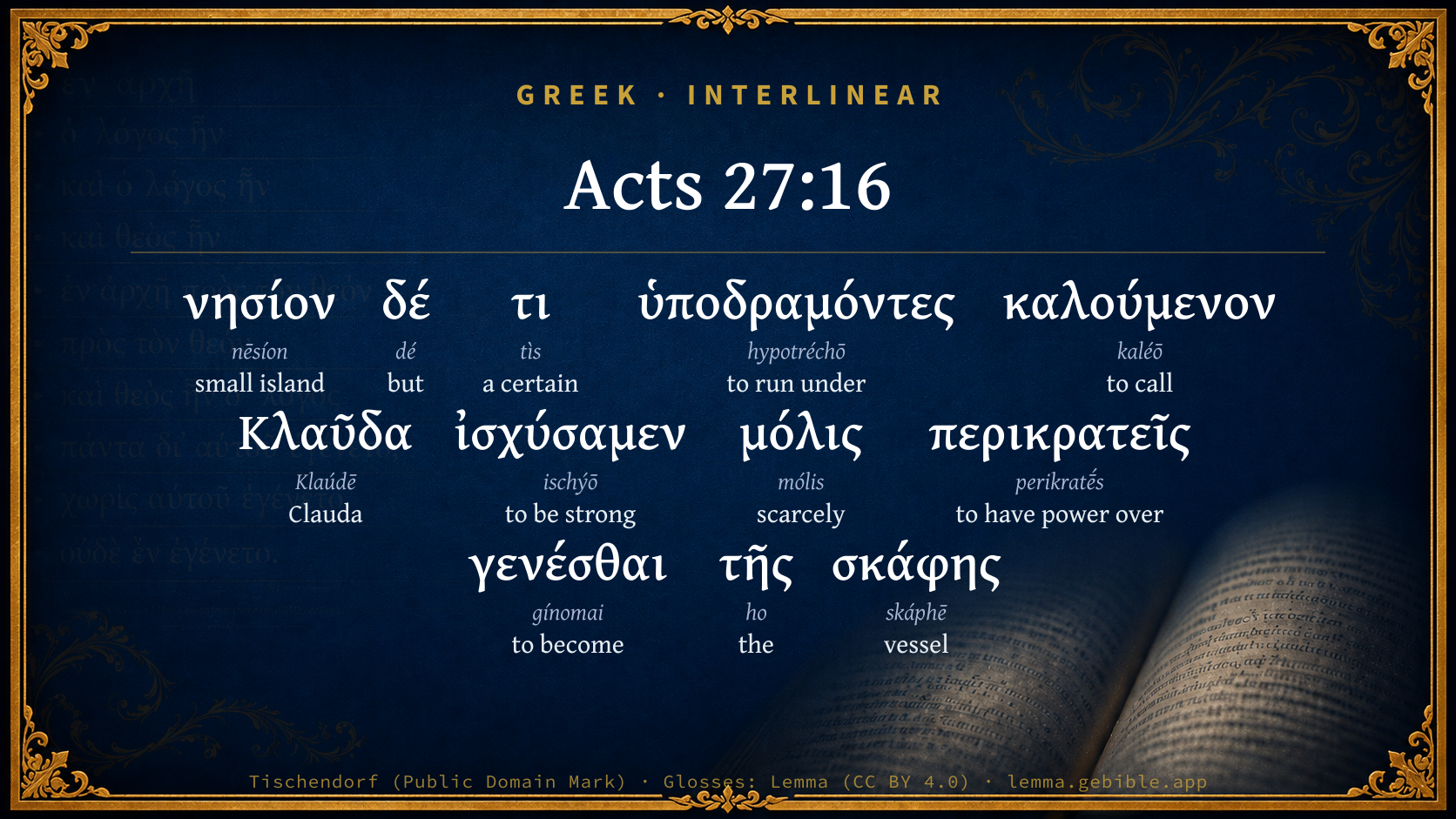
Download image
Cite this verse

Acts 27:16 (World English Bible). Public Domain. Lemma interlinear Bible study tool, https://lemma.gebible.app/v/acts/27/16.

Show BibTeX & RIS
BibTeX
RIS
English Translation
Running under the lee of a small island called Clauda, we were able, with difficulty, to secure the boat.
World English Bible · Public Domain
Highlights
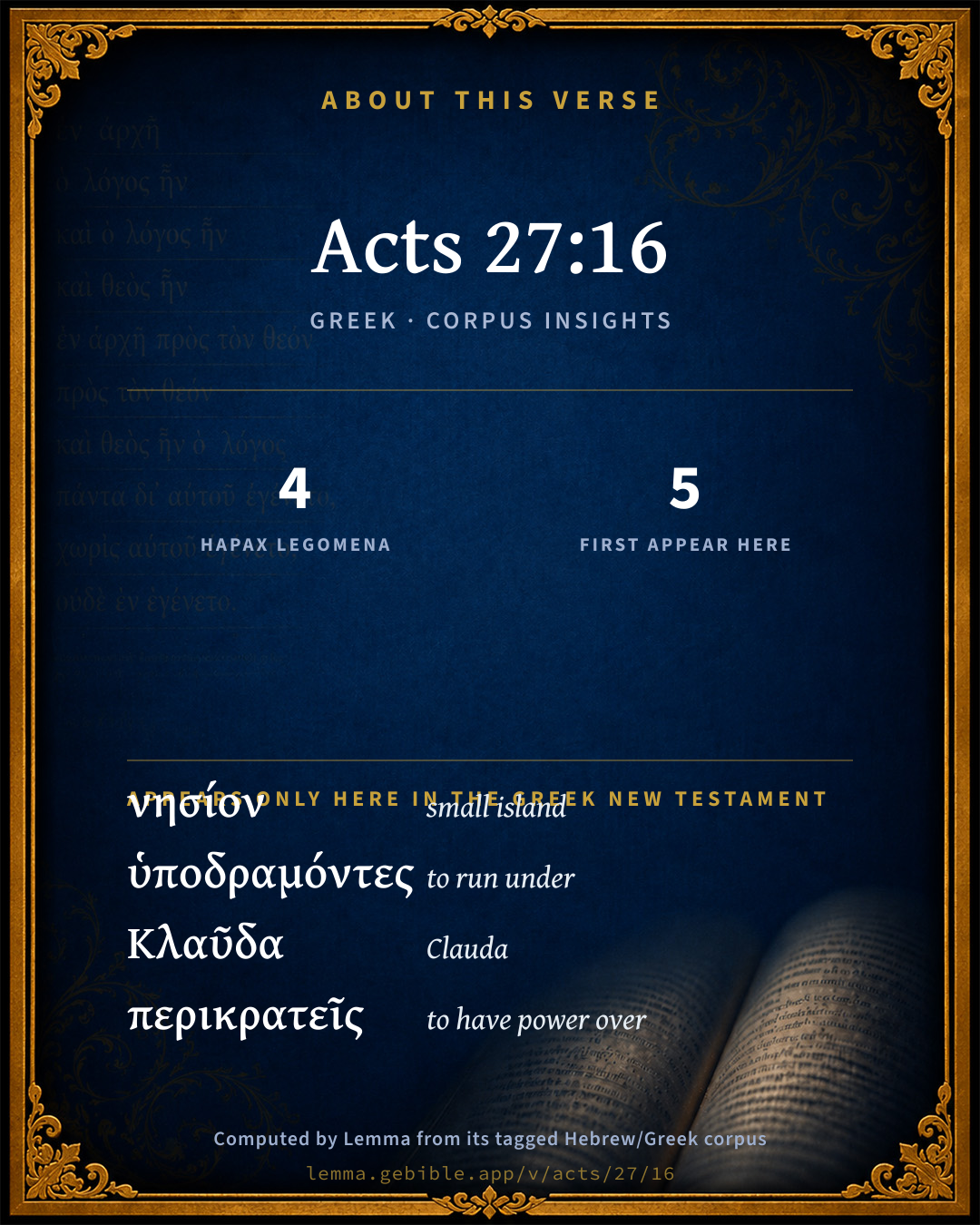
  • 4 hapax legomena — only here in the Greek New Testament
  • 5 first appearances in the Greek New Testament
Full analysis ↓
Download a study sheet

One document with this verse’s original text, its word-by-word gloss line, the meaning frame, cross-references with their text, attributed commentary, and full source and license credits — printable, and it pastes into notes with its structure intact.

This verse Autodidact and up

Study sheet (.html) Plain text (.txt)

A passage Seminary Student

Up to 50 verses in one chapter. A passage sheet keeps up to 6 commentary sources and 12 cross-references per verse, in the order this page ranks them, and says so on the sheet whenever that leaves anything out. Ask for a single verse and you get the Autodidact verse sheet above.

Everything on this page stays free to read, with no account — the sheet is a download of what is already on screen, not access to it.

Want to remove ads? Support Godless Engineer
Compare translations 3

The same verse in 3 English versions, stacked beneath the original-language interlinear above. Click any original word for its lexicon entry.

Each is an independent rendering of the whole verse — the interlinear is not word-aligned to these translations.

Highlighted words mark where these versions differ — a whole-verse word diff, not a word-by-word alignment.

  • World English Bible Public Domain
    Running under the lee of a small island called Clauda, we were able, with difficulty, to secure the boat.
  • King James Version Public Domain
    And running under a certain island which is called Clauda, we had much work to come by the boat:
  • unfoldingWord Literal Text CC BY-SA 4.0
    But running under a certain island called Cauda, we were able with difficulty to become controllers of the lifeboat,

unfoldingWord Literal Text — © unfoldingWord, licensed CC BY-SA 4.0. Word-aligned USFM3 via Door43 (git.door43.org/unfoldingWord/en_ult).

Versions to compare (up to 4)

3 of 4 selected

Show all 19 translations

Every available English version of this verse, each an independent rendering of the whole verse.

  • World English Bible Public Domain
    Running under the lee of a small island called Clauda, we were able, with difficulty, to secure the boat.
  • Berean Standard Bible Public Domain
    Passing to the lee of a small island called Cauda, we barely managed to secure the lifeboat.
  • Majority Standard Bible Public Domain
    Passing to the lee of a small island called Clauda, we barely managed to secure the lifeboat.
  • King James Version Public Domain
    And running under a certain island which is called Clauda, we had much work to come by the boat:
  • American Standard Version (1901) Public Domain
    And running under the lee of a small island called Cauda, we were able, with difficulty, to secure the boat:
  • Revised Version (1885) Public Domain
    And running under the lee of a small island called Cauda, we were able, with difficulty, to secure the boat:
  • Geneva Bible (1599) Public Domain
    And we ran vnder a litle Yle named Clauda, and had much a doe to get the boat.
  • Douay-Rheims (1899) Public Domain
    And running under a certain island, that is called Cauda, we had much work to come by the boat.
  • Young's Literal Translation Public Domain
    and having run under a certain little isle, called Clauda, we were hardly able to become masters of the boat,
  • Literal Standard Version CC BY-SA 4.0
    and having run under a certain little island called Clauda, we were hardly able to become masters of the boat,
  • Unlocked Literal Bible CC BY-SA 4.0
    We sailed along the lee of a small island called Cauda, and with difficulty we were able to secure the lifeboat.
  • unfoldingWord Literal Text CC BY-SA 4.0
    But running under a certain island called Cauda, we were able with difficulty to become controllers of the lifeboat,
  • Darby Bible Public Domain
    But running under the lee of a certain island called Clauda, we were with difficulty able to make ourselves masters of the boat;
  • World Messianic Bible Public Domain
    Running under the lee of a small island called Clauda, we were able, with difficulty, to secure the boat.
  • Webster's Bible Public Domain
    And running under a certain isle which is called Clauda, we had much work to come by the boat:
  • Free Bible Version CC BY-SA 4.0
    We were eventually able to run into the lee of a small island called Cauda, and managed with some difficulty to secure the ship's boat on board.
  • Bible in Basic English Public Domain
    And, sailing near the side of a small island named Cauda, we were able, though it was hard work, to make the ship's boat safe:
  • Text-Critical English NT CC BY 4.0
    Running under the lee of a small island called Clauda, we were able with difficulty to secure the skiff.
  • Tyndale New Testament (1534) Public Domain
    And we came vnto an yle named Clauda and had moche worke to come by abote

Literal Standard Version (2020), Covenant Press — licensed CC BY-SA 4.0. Text via the HelloAO Bible API (eBible.org). Unlocked Literal Bible (unfoldingWord) — licensed CC BY-SA 4.0. Text via the HelloAO Bible API (eBible.org). unfoldingWord Literal Text — © unfoldingWord, licensed CC BY-SA 4.0. Word-aligned USFM3 via Door43 (git.door43.org/unfoldingWord/en_ult). Free Bible Version, Dr. Jonathan Gallagher — licensed CC BY-SA 4.0. Text via the HelloAO Bible API (eBible.org).

Word by word

More ways to search: Search by grammar → Find every occurrence → Compare this word →

Practice this passage: Drill this verse → Learn its vocabulary →

About this verse

These counts appear in no published source. They are computed here, from the morphology-tagged text and Lemma’s own curated glosses. What Lemma adds →

12
words
12
distinct lemmas
Acts
section

Notable vocabulary

4 hapax legomena — words that appear only here in the entire Greek New Testament:

  • νησίον small island G3519
  • ὑποδραμόντες to run under G5295
  • Κλαῦδα Clauda G2802
  • περικρατεῖς to have power over G4031

First appearance in Scripture

These words make their first canonical appearance in the Greek New Testament here:

  • νησίον small island G3519
  • ὑποδραμόντες to run under G5295
  • Κλαῦδα Clauda G2802
  • περικρατεῖς to have power over G4031
  • σκάφης vessel G4627

Shared distinctive vocabulary

σκάφης vessel G4627 occurs in 3 verses of the Greek New Testament. Also found in:
Where the printed editions differ

1 variant

Places in this verse where the major printed Greek editions disagree on the wording in a way that affects the translation — a comparison of editions, not a manuscript-by-manuscript collation. The editions are the modern critical texts (Nestlé-Aland 28/27, SBL, Westcott-Hort, Tregelles, Tyndale House) and the traditional texts behind the KJV (the Textus Receptus and the Byzantine/Majority text). It is not a claim about which reading is original.

  1. Different wording
    Καῦδα

    “Cauda”

    In NA28NA27SBLWHTreg Not in TynTRByz

    Κλαύδην (Klaudēn) 'Clauda' occurs in traditional manuscripts (Tyn+TR+Byz) instead of Καῦδα (Kauda) 'Cauda' in older manuscripts (NA28+NA27+SBL+WH+Treg)

Textual data: Translators Amalgamated Greek New Testament (STEPBible TAGNT) · CC BY 4.0.

Commentary

Notes on Acts 27:16 from classic Christian and Jewish commentators (each source and its license shown beneath its notes). The classic Christian expositions comment on the surrounding passage and are grouped to its opening verse, so a note may address several verses; the Jewish commentaries on the Tanakh (Rashi and others) are per-verse, so they appear only where the commentator wrote on this verse.

Lemma curates 59 commentaries, every one of them public domain or Creative Commons licensed, each selected and text-cleaned for this edition rather than reprinted as found. About our sources →

Joseph Benson's Commentary

Act 27:16-19. Running under a certain island called Clauda — A little to the south of the western coast of Crete. Such was the violence of the storm, that we had much work — Great difficulty to become masters of the boat, so as to secure it from being staved; which when they had taken up, they used helps — Not only all such instruments as were fit for their purpose, but all hands too; undergirding the ship — With cables, to keep it from bulging, and enable it to ride out the storm; and fearing — As the wind had varied more to the north, and blew them toward Africa; lest they should fall into the quick-sands — The greater or the lesser Syrtis, those quick-sands on the African shore, so famous for the destruction of mariners and vessels; they strake sail — That so their progress might be slower, and some more favourable weather, in the mean time, might come to their relief; and so were driven — Before the wind, as before. And the next day they lightened the ship — Casting the heavy goods with which she was laden into the sea. And the third day we cast out the tackling of the ship — Cutting away even those masts that were not absolutely necessary, and throwing them overboard with their furniture.

Joseph Benson's Commentary on the Old and New Testaments (1811–1818) — public domain. Text from a community e-Sword module.

Bengel's Gnomon

Johann Albrecht Bengel

Act 27:16. Περικρατεῖς γένεσθαι τῆς σκαφῆς) to retain, and haul out of the sea, the boat, which heretofore had accompanied the ship: Act 27:30; Act 27:32.

Bengel's Gnomon of the New Testament — English translation (T&T Clark, Edinburgh, 1860) — public domain. Text from a community e-Sword module.

Meyer's Critical & Exegetical Commentary

Heinrich August Wilhelm Meyer

Act_27:16. Κλαύδη, or according to Ptol. iii. 7 Κλαῦδος, or according to Mela ii. 7 and Plin. iv. 20 Gaudos, according to Suidas Καυδώ, was the name of the modern Gozzo to the south of Crete. From the different forms of the name given by the ancients must be explained the variations in the codd. and vss., among which Καῦδα is attested by B א** Syr. Aeth. Vulg., adopted by Lachmann, and approved by Ewald. We cannot determine how Luke originally wrote the name; still, as most among the ancients have transmitted it without λ, the λ, which has in its favour A G H א* vss. and the Greek Fathers, has probably been deleted by subsequent, though in itself correct, emendation.

τῆς σκάφης] they could scarcely become masters (περικρατεῖς, Simmias in the Anthol. I. p. 137, Jacobs) of the boat (belonging to the ship) which swam attached to it, when they wished to hoist it up (Act_27:17; Act_27:30), that it might not be torn away by the storm.

Meyer — Critical and Exegetical Commentary on the New Testament — English translation by Peter Christie, edited by Frederick Crombie (T&T Clark, 1880) — public domain. Text from a community e-Sword module.

Expositor's Greek Testament

ed. W. Robertson Nicoll

Act 27:16 . ὑποδραμόντες : “and running under the lee of a small island,” R.V.J. Smith calls attention to the nautical accuracy of St. Luke’s terms; they ran before the wind to leeward of Cauda; ὑποδραμ ., they sailed with a side wind to leeward of Cyprus and Crete, ὑπεπλεύσαμεν , Act 27:4 , see also Ramsay, Saint Paul , p. 328, to the same effect; here was calmer water, and the island (see below) would afford them a refuge for a time from the gale. Breusing, pp. 167, 168, 181, thinks that the great sail had been struck at once, and that the artemon or small foresail was kept up as a storm sail; otherwise the ship would have been simply the plaything of the waves. But Ramsay and others (see Farrar) think, on the contrary, that the one huge sail, in comparison with which all others were of little importance, was kept up, but that the strain of this great sail on the single mast was more than the hull could sustain; the timbers would have started, and the ship foundered, had she not gained the smooth water to the lee of Cauda. μόλις ἰσχύσ .: “we were able with difficulty to secure the boat,” R.V., the boat had not been hauled in, as the storm was so sudden; and now as it was nearly filled with water, and battered by the waves and storm, it was hard work to haul it in at all (J. Smith), as Luke himself experienced (pressed into this service of hauling in the boat; note first person, Hackett, Ramsay, p. 327); clearly they could not afford to lose such a means of safety; even as it was, the boat was dragging along as a heavy weight retarding the ship (Breusing, p. 169). περικ ., cf. Susannah, v er. 39, A, for ἐγκρατεῖς in . σκάφης : a small boat towed behind, only in this passage in N.T., cf. Act 27:30 ; Act 27:32 , Latin, scapha; Cic., De Invent. , ii., 51 (Humphry). Κλαύδην , see critical note, an island twenty-three miles from Crete, nearly due south of Phœnice. Ramsay (but see on the other hand Wendt, p. 408, 1899) maintains that preference be given to the forms of the name in which the letter [416] is omitted, cf. the modern Gavdho in Greek, and Gozzo in Italian; not to be confounded with Gozzo near Malta (Renan, Saint Paul , p. 551), and see further on its present name, J. Smith, pp. 95, 259, 4th edition.

[416] Codex Angelicus (sæc. ix.), at Rome, collated by Tischendorf and others.

The Expositor's Greek Testament, edited by W. Robertson Nicoll (1897–1910) — public domain. Text from a community e-Sword module.

Jamieson, Fausset & Brown

Robert Jamieson, A. R. Fausset & David Brown

under--the lee of.

a certain--"small"

island . . . Clauda--southwest of Crete, now called Gonzo; about twenty-three miles to leeward.

we had much work to come by--that is, to hoist up and secure.

the boat--now become necessary. But why was this difficult? Independently of the gale, raging at the time, the boat had been towed between twenty and thirty miles after the gale sprang up, and could scarcely fail to be filled with water [SMITH].

Jamieson, Fausset & Brown — Commentary Critical and Explanatory on the Whole Bible (1871) — public domain (CC PDM 1.0). Text via the HelloAO Bible API.

Adam Clarke's Commentary

Verse 16. A certain island - called Clauda] Called also Gaudos; situated at the south-western extremity of the island of Crete, and now called Gozo, according to Dr. Shaw.

Much work to come by the boat] It was likely to have been washed overboard; or, if the boat was in tow, at the stern of the vessel, which is probable, they found it very difficult to save it from being staved, or broken to pieces.

Adam Clarke's Commentary on the Bible (1810–1826) — public domain. Text from a community e-Sword/MySword module.

Ellicott's Commentary for English Readers

(16) And running under a certain island which is called Clauda.—Some MSS. give the various-reading Cauda, which agrees more closely with the form Gaudos found in Pliny and Suidas. This, in its turn, has passed into the modern Gozzo. The island lay about twenty-three miles to the south-west of Crete. Here they got under the lee of the shore, and availed themselves of the temporary shelter to prepare the ship more thoroughly than had been possible before to encounter the fury of the storm. The first step was to get the boat, which hitherto apparently had been towed through the waves, on board the ship. This, as St. Luke says, was a matter of much work (literally, we were with difficulty able to get hold of the boat), partly, we may believe, because it was not easy to keep the vessel with her head to the wind, and so avoid the motion which would have impeded the operation, partly, because the boat was probably full of water.

A Bible Commentary for English Readers, edited by Charles John Ellicott (1878–1897) — public domain. Text from a community e-Sword module.

The Cambridge Bible for Schools and Colleges

gen. ed. J. J. S. Perowne

16. And running under a certain island which is called Clauda] (R. V. And running under the lee of a small island, called Cauda”) For the verb cp. above on Act_27:4; Act_27:7. The word for “island” is here in the original a diminutive form, hence “small island.” The name “Cauda” which has the best MS. support agrees well with the form which the name has assumed in modern times, “Gozzo” and “Gaudo.” But the form in A.V. is warranted by the orthography of Ptolemy (Claudos) and Pliny (Glaudos).

we had much work to come by the boat] This is most idiomatic old English, but is changed in R. V. into “we were able, with difficulty, to secure the boat.” The boats in old times were not as in modern ships made fast round about the vessel, but were carried on in tow. In stormy weather, there was of course much danger that the boat would be washed away. This was the case here, and as soon as ever they had gained the shelter of the island, they set about making sure of its safety by hauling it on board, but this they were not able to do without much difficulty, probably because it had been already filled with water.

The Cambridge Bible for Schools and Colleges (gen. ed. J. J. S. Perowne; Cambridge University Press, 1878–1918) — public domain. Text from a community e-Sword module.

John Gill's Exposition

And running under a certain island,.... Or below a certain island and hard by, it or under the sea shore of it, where the sea might be smoother, the wind not being there so strong:

which is called Clauda: by Ptolomy (x) it is called Claudus, and was near the island of Crete, and now called Gozo. The Vulgate Latin and Ethiopic versions, and some copies, read "Cauda"; and there was an island near to Crete, which was called Gaudos (y), and is thought to be the place here meant:

we had much work to come by the boat; which they had with them to go ashore in, or to betake themselves to in case of shipwreck; and which in this storm was in danger of being dashed to pieces against the ship, or lost; and it was with some difficulty that they came at it, and took it up into the ship.

(x) Geograph. l. 3. c. 17. (y) Mela, l. 2. c. 7. Plin. l. 4. c. 12.

John Gill's Exposition of the Whole Bible (1746–1763) — public domain (CC PDM 1.0). Text via the HelloAO Bible API.

Trapp's Complete Commentary

John Trapp

16 And running under a certain island which is called Clauda, we had much work to come by the boat:

Ver. 16. To come by the boat] i.e. To recover, take up, and save the boat, that the waves should not break it.

John Trapp, A Commentary or Exposition upon All the Books of the Old and New Testament (1647–1656) — public domain. Text from a community e-Sword module.

Albert Barnes' Notes on the Bible

And running under - Running near to an island. They ran near to it, where the violence of the wind was probably broken by the island,

Which is called Clauda - This is a small island about 20 miles southwest of Crete.

We had much work - Much difficulty; we were scarcely able to do it.

To come by the boat - This does not mean that they attempted here to land in the boat, but they had much difficulty in saving the small boat attached to the ship by lifting it into the ship. The importance of securing the small boat is known by all seamen.

Albert Barnes' Notes on the Bible (1834–1885) — public domain. Text from a community e-Sword/MySword module.

Haydock's Catholic Bible Commentary

An island that is called Cauda. In some Greek copies Clauda, which the Protestants have followed; in others Caudos. --- We had much work to come by the boat, or to hoist up the skiff belonging to the ship; which we did, lest it should be broken to pieces by the wind against the ship, or separated from it. (Witham)

George Leo Haydock (1774–1849), Haydock's Catholic Family Bible and Commentary, 1859 edition — public domain. Excludes Psalms (Douay-Rheims chapter numbering differs from Protestant) and Deuterocanonical books (Catholic canon only).

Matthew Poole's English Annotations

Clauda; called also Claudos, and by some Gaudos, and now Gozo, an island near unto Crete.

We had much work to come by the boat; in this stress of weather they would take up the boat, lest it should have been staved or beat in pieces against the ship.

Matthew Poole's English Annotations on the Holy Bible (1683–1685) — public domain. Text from a community e-Sword/MySword module.

Whedon's Commentary on the Bible

Daniel D. Whedon

16. Running under—Under the shelter of Clauda. (See chart.)

The boat—The small boat, which had hitherto been towed at the stern. It was an important means of escape in shipwreck, and the sailors availed themselves of the smooth waters in the lee of Clauda to haul it in. This was difficult, as the boat had probably swamped, and was full of water.

Daniel D. Whedon (gen. ed.), Commentary on the Old and New Testaments (1874–1909) — public domain. Text from a community e-Sword module.

The Pulpit Commentary

Under the lee of for under, A.V.; small for certain, A.V. (nhsion); called Cauda for which is called Clauda, A.V. and T.R.; were able, with difficulty, to secure for had much work to come by, A.V. Running under the lee of; uJpodramontev, only here in the New Testament, but common in classical Greek for "running under" or "between." (For the use of uJpo in compound in the sense of "under the lee of," see ver. 7.) Cauda, or Caudos, as it is called by Pomp. Mela (2. 7)and Pliny ("Nat. Hist.," 4. 12. 20), the modern Gozzo. Ptolemy (3:7) calls it Claudus. The manuscripts greatly vary. Clauda, or Cauda, was about twenty-three miles south-west of Crete. With difficulty (moliv, as in vers. 7, 8). To secure the boat. The boat was doubtless being towed astern. But in the violence of the storm, there was a danger every moment of her being parted from the ship by the snapping of the hawser, or by being broken by the waves, and it was impossible to take her up. Under the lee of the little island, however, the sea was somewhat quieter; and so after greater efforts they secured the boat, and, as it is said in the next verse, "hoisted it up" on to the deck.

The Pulpit Commentary (1880–1919), ed. H.D.M. Spence-Jones & Joseph S. Exell — public domain. Text from a community e-Sword module.

John Wesley's Explanatory Notes

We were hardly able to get masters of the boat - To prevent its being staved.

John Wesley, Explanatory Notes Upon the Whole Bible (1754–1765) — public domain. Text via the GEBible commentary corpus.

Godbey's Commentary on the New Testament

William B. Godbey

16. “And running under a certain island called Clauda,” i. e., on the windward side of the island, in order to protect them from the awful violence of the storm, “we were scarcely able to get possession of the boat,” i. e., to get the boat up into the ship, as they had but one, and that their only hope in case of a wreck.

William B. Godbey, Commentary on the New Testament (1896–1900) — public domain. Text from a community e-Sword module.

McGarvey & Pendleton's Commentaries

J. W. McGarvey

See notes on verse 14

J. W. McGarvey (with Philip Y. Pendleton), Commentaries on the New Testament (The Fourfold Gospel, 1914; Acts; and the epistles) — public domain. Text from a community e-Sword/MySword module.

Cambridge Greek Testament for Schools and Colleges

16. Καῦδα with אB. Vulg. ‘Cauda.’

16. νησίον δέ τι ὑποδραμόντες καλούμενον Καῦδα, and running under the lee of a small island named Cauda. For the verb cf. above on Act 27:4; Act 27:7. νησίον is a rare word, found only here and in Strabo. The name ‘Cauda’ which has the best MS. support agrees well with the form which the name has assumed in modern times, ‘Gozzo’ and ‘Gaudo.’ But the form in A.V. is warranted by the orthography of Ptolemy (Claudos) and Pliny (Glaudos).

ἰσχύσαμεν μόλις περικρατεῖς γενέσθαι τῆς σκάφης, we were able with difficulty to secure the boat. The boats in old times were not as in modern ships made fast round about the vessel, but were carried on in tow. In stormy weather, there was of course much danger that the boat would be washed away. This was the case here, and as soon as ever they had gained the shelter of the island, they set about making sure of its safety by hauling it on board, but this they were not able to do without much difficulty, probably because it had been already filled with water.

For περικρατεῖς γενέσθαι, cf. Susanna 39 (Codex Alex.).

Cambridge Greek Testament for Schools and Colleges (Cambridge University Press, 1896; 21 vols, various authors incl. Carr, Maclear, Plummer, Farrar, Lumby, Moule, M. R. James, Simcox) — public domain. Text from a community e-Sword module.

Alford’s Greek Testament

Henry Alford

16. ὑποδραμόντες] running under the lee of.

“St. Luke exhibits here as on every other occasion, the most perfect command of nautical terms, and gives the utmost precision to his language by selecting the most appropriate: they ran before the wind to leeward of Clauda, hence it is ὑποδραμόντες: they sailed with a side wind to leeward of Cyprus and Crete: hence it is ὑπεπλεύσαμεν” (Smith, p. 61, note).

Κλαῦδα] Here again, there can be little doubt that the name of the island was Καῦδα, or Γαῦδα, as we have in some mss., or, as in Pliny and Mela, Gaudos: but Ptol. (iii. 7) has Κλαῦδος, and the corruption was very obvious. The island is the modern Gozzo.

ἰσχύσαμ. μόλ. κ.τ.λ.] “Upon reaching Clauda, they availed themselves of the smooth water under its lee, to prepare the ship to resist the fury of the storm. Their first care was to secure the boat by hoisting it on board. This had not been done at first, because the weather was moderate, and the distance they had to go, short. Under such circumstances, it is not usual to hoist boats on board, but it had now become necessary. In running down upon Clauda, it could not be done, on account of the ship’s way through the water. To enable them to do it, the ship must have been rounded to, with her head to the wind, and her sails, if she had any set at the time, trimmed, so that she had no head-way, or progressive movement. In this position she would drift, broadside to leeward. I conclude they passed round the east end of the island: not only because it was nearest, but because ‘an extensive reef with numerous rocks extends from Gozzo to the N. W., which renders the passage between the two isles very dangerous’ (Sailing Directions, p. 207). In this case the ship would be brought to on the starboard tack, i.e. with the right side to windward.” … “St. Luke tells us they had much difficulty in securing the boat. He does not say why: but independently of the gale which was raging at the time, the boat had been towed between twenty and thirty miles after the gale had sprung up, and could scarcely fail to be filled with water.” Smith, pp. 64, 65.

Henry Alford, The Greek Testament (1849–1861) — public domain. Text from a community e-Sword module.

Vincent's Word Studies in the New Testament

Marvin R. Vincent

We had much work to come by the boat [μολις ισχυσαμεν περικρατεις γενεσθαι της σκαφης] . Lit., we were with difficulty able to become masters of the boat : i e., to secure on deck the small boat which, in calm weather, was attached by a rope to the vessel 's stern. Rev., we were able with difficulty to secure the boat. On with difficulty, see note on scarce, ver. 7.

Marvin R. Vincent, Word Studies in the New Testament (1887–1900) — public domain. Text from a community e-Sword/MySword module.

Lesson kit

Teaching starters — assembled from the data on this page, not authored interpretation. Every prompt links to the verse data it draws on. Edit before teaching.

Acts, in the Acts, opens this verse with 12 words (12 distinct Greek lemmas). Its most distinctive word is nēsíon (“small island”). A historical commentator’s framing appears above. Read the whole chapter for the surrounding context.

Discussion questions

  1. How does “small island” (nēsíon) shape what this verse is saying?
  2. 4 words here appear nowhere else in the Greek New Testament. Why might the author reach for such rare wording?
  3. 5 words make their first appearance in Scripture here. What does this debut establish?
  4. How does Acts 27:30, which shares the word «vessel», read alongside this verse?
  5. These translations render this verse differently; the difference is in the English rendering, not the original. What questions does that raise?
  6. Compare how Joseph Benson's Commentary and Bengel's Gnomon read this verse. Where do they agree or differ?

Things to notice

  • 4 words in this verse appear nowhere else in the Greek New Testament.
  • 5 words make their first canonical appearance in Scripture here.
  • These translations choose different wording for 17 words in this verse.
  • 12 distinct Greek lemmas span 12 words in this verse.

Reading settings

Reading text

Shown beneath each verse's original-language words.

Old Testament
Old Testament edition

Read the OT as the Masoretic Hebrew (MT) or the Greek Septuagint (LXX).

English shown for the Greek Septuagint (in the Hebrew ↔ Greek comparison).

Comparing translations? Open the Compare panel on any verse page to stack up to four side by side.