Hebrews 11:18

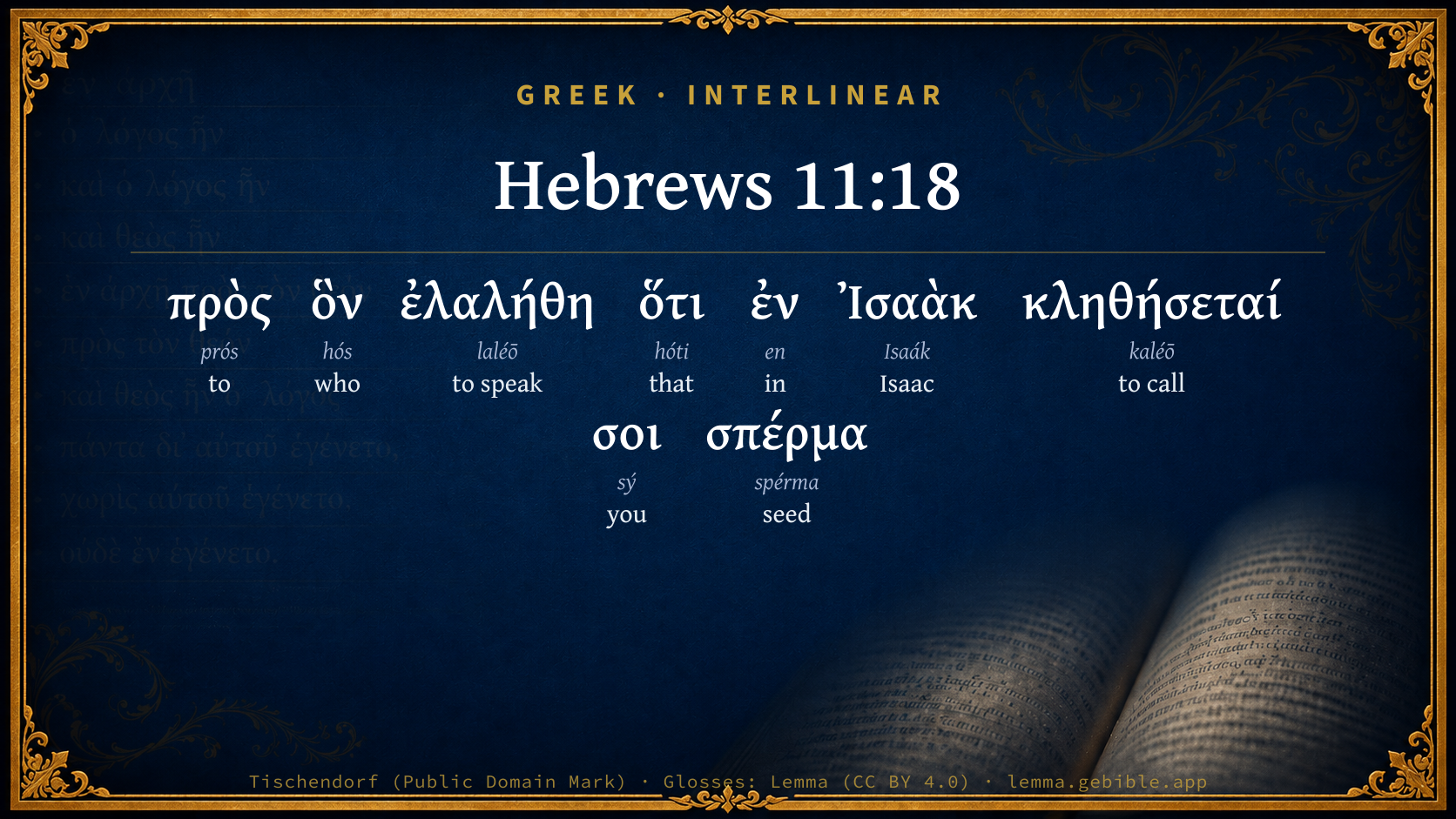
Greek (Tischendorf 8th ed.) Hebrews 11:18 appears in the Greek New Testament. The text above is from the Tischendorf 8th edition. Each word links to its Strong’s number and a concise gloss. Click any word for its full Thayer’s Greek Lexicon entry.
Download image
Cite this verse

Hebrews 11:18 (World English Bible). Public Domain. Lemma interlinear Bible study tool, https://lemma.gebible.app/v/hebrews/11/18.

Show BibTeX & RIS
BibTeX
RIS
English Translation
even he to whom it was said, "In Isaac will your seed be called;"
World English Bible · Public Domain
Download a study sheet

One document with this verse’s original text, its word-by-word gloss line, the meaning frame, cross-references with their text, attributed commentary, and full source and license credits — printable, and it pastes into notes with its structure intact.

This verse Autodidact and up

Study sheet (.html) Plain text (.txt)

A passage Seminary Student

Up to 50 verses in one chapter. A passage sheet keeps up to 6 commentary sources and 12 cross-references per verse, in the order this page ranks them, and says so on the sheet whenever that leaves anything out. Ask for a single verse and you get the Autodidact verse sheet above.

Everything on this page stays free to read, with no account — the sheet is a download of what is already on screen, not access to it.

Want to remove ads? Support Godless Engineer
Compare translations 3

The same verse in 3 English versions, stacked beneath the original-language interlinear above. Click any original word for its lexicon entry.

Each is an independent rendering of the whole verse — the interlinear is not word-aligned to these translations.

Highlighted words mark where these versions differ — a whole-verse word diff, not a word-by-word alignment.

  • World English Bible Public Domain
    even he to whom it was said, "In Isaac will your seed be called;"
  • King James Version Public Domain
    Of whom it was said, That in Isaac shall thy seed be called:
  • unfoldingWord Literal Text CC BY-SA 4.0
    to whom it was said, “Through Isaac your offspring will be named,”

unfoldingWord Literal Text — © unfoldingWord, licensed CC BY-SA 4.0. Word-aligned USFM3 via Door43 (git.door43.org/unfoldingWord/en_ult).

Versions to compare (up to 4)

3 of 4 selected

Show all 19 translations

Every available English version of this verse, each an independent rendering of the whole verse.

  • World English Bible Public Domain
    even he to whom it was said, "In Isaac will your seed be called;"
  • Berean Standard Bible Public Domain
    even though God had said to him, “Through Isaac your offspring will be reckoned.”
  • Majority Standard Bible Public Domain
    even though God had said to him, “Through Isaac your offspring will be reckoned.”
  • King James Version Public Domain
    Of whom it was said, That in Isaac shall thy seed be called:
  • American Standard Version (1901) Public Domain
    even he to whom it was said, In Isaac shall thy seed be called:
  • Revised Version (1885) Public Domain
    even he to whom it was said, In Isaac shall thy seed be called:
  • Geneva Bible (1599) Public Domain
    (To whom it was said, In Isaac shall thy seede be called.)
  • Douay-Rheims (1899) Public Domain
    (To whom it was said: In Isaac shall thy seed be called.)
  • Young's Literal Translation Public Domain
    of whom it was said -- `In Isaac shall a seed be called to thee;'
  • Literal Standard Version CC BY-SA 4.0
    of whom it was said, “In Isaac will your Seed be called,”
  • Unlocked Literal Bible CC BY-SA 4.0
    It was Abraham to whom it had been said, “It is through Isaac that your descendants will be named.”
  • unfoldingWord Literal Text CC BY-SA 4.0
    to whom it was said, “Through Isaac your offspring will be named,”
  • Darby Bible Public Domain
    as to whom it had been said, In Isaac shall thy seed be called:
  • World Messianic Bible Public Domain
    to whom it was said, “Your offspring will be accounted as from Isaac,”
  • Webster's Bible Public Domain
    Of whom it was said, That in Isaac shall thy seed be called:
  • Free Bible Version CC BY-SA 4.0
    even though he'd been told, “It's through Isaac that your descendants will be counted.”
  • Bible in Basic English Public Domain
    Of whom it had been said, From Isaac will your seed take their name:
  • Text-Critical English NT CC BY 4.0
    even though God had said to him, “Through Isaac yoʋr descendants will be counted.”
  • Tyndale New Testament (1534) Public Domain
    of whom it was sayde in Isaac shall thy seed be called:

Literal Standard Version (2020), Covenant Press — licensed CC BY-SA 4.0. Text via the HelloAO Bible API (eBible.org). Unlocked Literal Bible (unfoldingWord) — licensed CC BY-SA 4.0. Text via the HelloAO Bible API (eBible.org). unfoldingWord Literal Text — © unfoldingWord, licensed CC BY-SA 4.0. Word-aligned USFM3 via Door43 (git.door43.org/unfoldingWord/en_ult). Free Bible Version, Dr. Jonathan Gallagher — licensed CC BY-SA 4.0. Text via the HelloAO Bible API (eBible.org).

Word by word

More ways to search: Search by grammar → Find every occurrence → Compare this word →

Practice this passage: Drill this verse → Learn its vocabulary →

About this verse

These counts appear in no published source. They are computed here, from the morphology-tagged text and Lemma’s own curated glosses. What Lemma adds →

9
words
9
distinct lemmas
General Epistles
section

Notable vocabulary

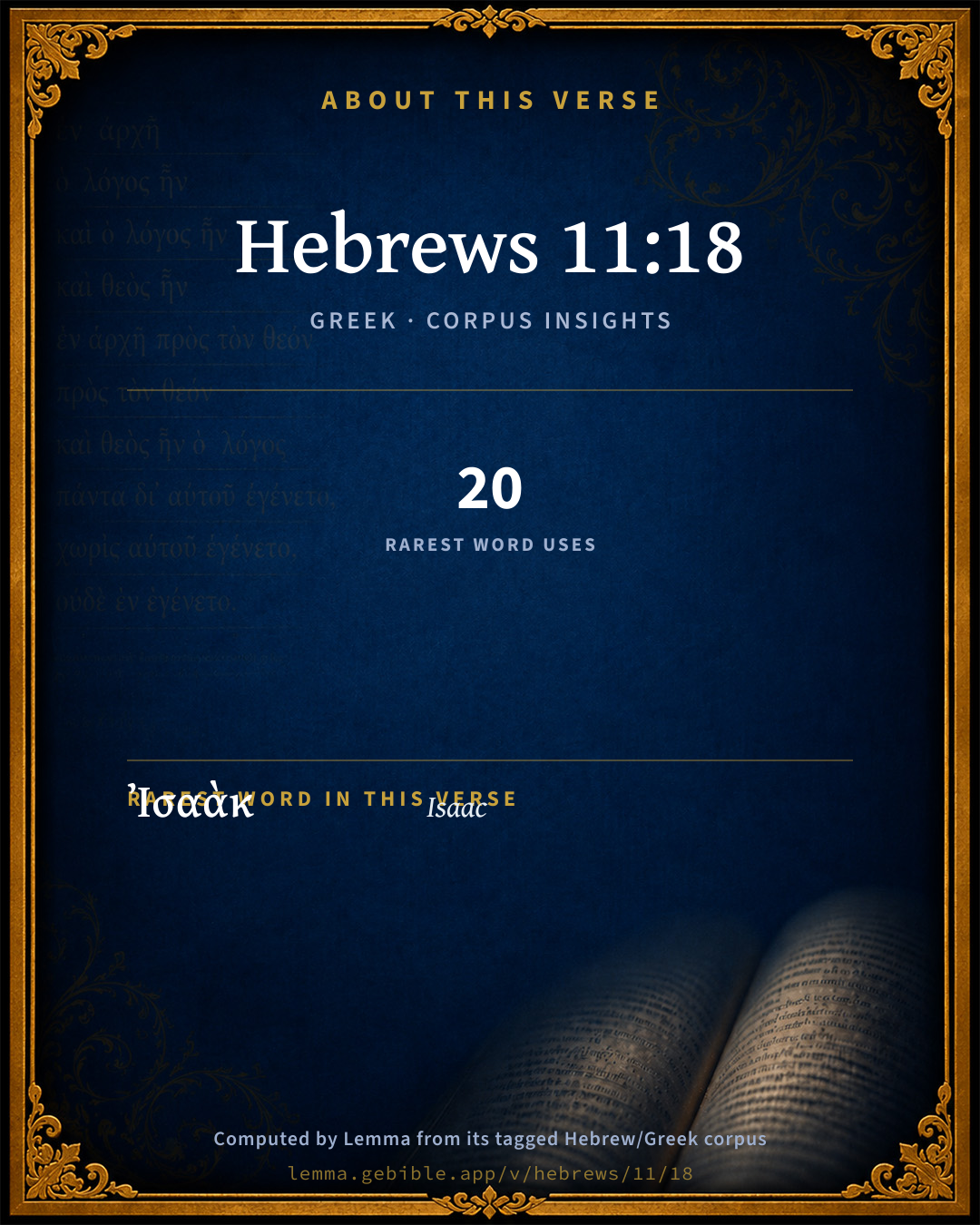
The rarest word here is Ἰσαὰκ Isaac G2464 — appearing just 20 times in the whole Greek New Testament.

Shared distinctive vocabulary

Ἰσαὰκ Isaac G2464 occurs in 18 verses of the Greek New Testament. Also found in:

Cross-references

3

Topical passages linked to Hebrews 11:18 in the Treasury of Scripture Knowledge — connected by theme and wording, ordered by reader-vote popularity; previews shown in the World English Bible.

  • Genesis 21:12 God said to Abraham, "Don't let it be grievous in your sight because of the boy, and because of your handmaid. In all that Sarah says to you, listen to her voice. For from Isaac will your seed be called.
  • Romans 9:7 Neither, because they are Abraham's seed, are they all children. But, "In Isaac will your seed be called."
  • Genesis 17:19 God said, "No, but Sarah, your wife, will bear you a son. You shall call his name Isaac. I will establish my covenant with him for an everlasting covenant for his seed after him.

Cross-references courtesy of OpenBible.info (CC BY 4.0).

Commentary

Notes on Hebrews 11:18 from classic Christian and Jewish commentators (each source and its license shown beneath its notes). The classic Christian expositions comment on the surrounding passage and are grouped to its opening verse, so a note may address several verses; the Jewish commentaries on the Tanakh (Rashi and others) are per-verse, so they appear only where the commentator wrote on this verse.

Lemma curates 59 commentaries, every one of them public domain or Creative Commons licensed, each selected and text-cleaned for this edition rather than reprinted as found. About our sources →

Bengel's Gnomon

Johann Albrecht Bengel

Heb 11:18. Πρὸς ὃν, as to whom) The pronoun is to be referred to the only-begotten; nay, this verse gives a definition of the only-begotten. Πρὸς, so far as concerns, has the force of limitation (determining the sense). The word had been spoken to Abraham, but referred to Isaac; comp. πρὸς, unto, in reference to, Luk 19:9.

Bengel's Gnomon of the New Testament — English translation (T&T Clark, Edinburgh, 1860) — public domain. Text from a community e-Sword module.

Meyer's Critical & Exegetical Commentary

Heinrich August Wilhelm Meyer

Heb_11:18. Πρὸς ὅν] not: of whom (more accurately: in relation to whom, comp. Heb_1:7), in such wise that it should be referred to Isaac (Faber Stapulensis, Luther, Jac. Cappellus, Limborch, Wolf, Bengel, Carpzov, Michaelis, Chr. Fr. Schmid, and others), but: to whom, sc. Abraham.

ὅτι ἐν Ἰσαὰκ κληθήσεταί σοι σπέρμα] In Isaac shall a seed be named (called) to thee, i.e. through Isaac shall the posterity, whose forefather thou shalt be called, be founded. The emphasis falls upon ἐν Ἰσαάκ, and the citation is from Gen_21:12. ὅτι, however, which has there causal significance, the author takes as a recitative.

Meyer — Critical and Exegetical Commentary on the New Testament — English translation by Peter Christie, edited by Frederick Crombie (T&T Clark, 1880) — public domain. Text from a community e-Sword module.

Jamieson, Fausset & Brown

Robert Jamieson, A. R. Fausset & David Brown

Of whom--rather as Greek "He (Abraham, not Isaac) TO whom it was said" [ALFORD]. BENGEL supports English Version. So Heb 1:7 uses the same Greek preposition, "unto," for "in respect to," or "of." This verse gives a definition of the "only-begotten Son" (Heb 11:17).

in Isaac shall thy seed be called-- (Gen 21:12). The posterity of Isaac alone shall be accounted as the seed of Abraham, which is the heir of the promises (Rom 9:7).

Jamieson, Fausset & Brown — Commentary Critical and Explanatory on the Whole Bible (1871) — public domain (CC PDM 1.0). Text via the HelloAO Bible API.

Ellicott's Commentary for English Readers

(18) Of whom.—That is, Isaac. But the Greek words should perhaps be rendered to whom (Abraham): “Even he to whom it was said.” On this quotation from Gen_21:12 see the Note on Rom_9:7.

A Bible Commentary for English Readers, edited by Charles John Ellicott (1878–1897) — public domain. Text from a community e-Sword module.

The Cambridge Bible for Schools and Colleges

gen. ed. J. J. S. Perowne

18. of whom] Lit. “with reference to whom” (Isaac); or perhaps “to whom,” i.e. to Abraham.

in Isaac shall thy seed be called] Gen_17:8; Gen_17:19; Gen_21:12, &c.

The Cambridge Bible for Schools and Colleges (gen. ed. J. J. S. Perowne; Cambridge University Press, 1878–1918) — public domain. Text from a community e-Sword module.

John Gill's Exposition

Accounting that God was able to raise him up, even from the dead,.... Abraham did not go about this affair without thought; and yet he did not consult with flesh and blood; his reasoning was the reasoning of faith; and the conclusion of it was, not that he believed that God would raise his son from the dead, but that he was able to do it. He knew that he had received him at first, as it were, from the dead; he sprung from his own dead body, and out of Sarah's dead womb; and though his faith did not prescribe to God, yet as he believed the doctrine of the resurrection of the dead, he might believe that God would raise his son from the dead, rather than that his promise should fail; and this conclusion proceeded upon the power and faithfulness of God:

from whence also he received him in a figure; or for an "example" of faith and obedience; or for a "parable or proverb", that such a proverbial expression might be made use of, for the comfort and encouragement of saints in distressed and difficult circumstances, as is in Gen 22:14 or as a type of the death and resurrection of Christ, whose type he was in other things, as well as in this; as in his birth, and the circumstances of it; he was long promised and expected, as Christ, was; his birth was beyond the ordinary course of nature, and attended with great joy; he was circumcised the eighth day; at his weaning a great feast was made, typical of the Gospel feast; and as he was persecuted by Ishmael, so was Christ by Herod, in his infancy: and he was a figure of him in his oblation; they were both sons of Abraham; both only begotten and beloved sons; both heirs; both carried the wood on which they were offered; both were offered on a Mount, and by their father, by whom neither of them were spared; and both by the command of God, and alone, none were with them: and Isaac prefigured him in his deliverance; Abraham stretched out his hand, but was restrained, and not a bone of Christ must be broken; not Isaac, but the ram was slain, not the divine, but the human nature suffered; both were delivered on the third day, the one as from death, the other really from death; and both returned to their father's house. Moreover, Abraham received his son in the similitude of a resurrection; it was as life from the dead; it was like the return of the prodigal, Luk 15:32. Abraham, looked upon him as dead to him, and Isaac thought himself a dead man; so that he that was accounted as one dead, was received alive. The Jews speak of this matter agreeably to the apostle; they say, a man has two breaths or souls, one in this world, and another in the world to come; and of Isaac they say (d), that

"in the time that he was offered upon the altar, his soul (or "breath"), which he had in this world, "went out"; and when it was said to Abraham (or by him) blessed be he that quickeneth the dead, his soul (or breath), which he had in the world to come, returned to him--for , "he was accounted as dead".''

They speak of him as if he was just dead; they say (e),

"when he saw the sword over his neck, his breath fled from him, and came to the place of the soul, , "as if he was at the point of giving up the ghost".''

So that a Jew cannot find fault with the apostle for expressing himself in this manner.

(d) Tosaphta in Zohar in Gen. fol. 46. 21. (e) Tzeror Hammor, fol. 58. 2. Pirke Eliezer, c. 31.

John Gill's Exposition of the Whole Bible (1746–1763) — public domain (CC PDM 1.0). Text via the HelloAO Bible API.

Trapp's Complete Commentary

John Trapp

18 Of whom it was said, That in Isaac shall thy seed be called:

Ver. 18. Of whom it was said] This was one of those many promises that Abraham might think were all lost in the loss of his Isaac. Never was gold tried in so hot a fire.

John Trapp, A Commentary or Exposition upon All the Books of the Old and New Testament (1647–1656) — public domain. Text from a community e-Sword module.

Albert Barnes' Notes on the Bible

Of whom it was said, That in Isaac shall thy seed be called; - Gen 21:12. A numerous posterity had been promised to him. It was there said expressly that this promise was not to be fulfilled through the son of Abraham, by the bondwoman Hagar, but through Isaac. Of course, it was implied that Isaac was to reach manhood, and yet notwithstanding this, and notwithstanding Abraham fully believed it, be prepared deliberately, in obedience to the divine command, to put him to death. The phrase “thy seed be called” means, that his posterity was to be named after Isaac, or was to descend only from him. The word “called” in the Scriptures is often equivalent to the verb “to be;” see Isa 56:7. To “name” or “call” a thing was the same as to say that it was, or that it existed. It does not mean here that his “spiritual” children were to be called or selected from among the posterity of Isaac, but that the posterity promised to Abraham would descend neither from Ishmael nor the sons of Keturah, but in the line of Isaac. This is a strong circumstance insisted on by the apostle to show the strength of Abraham’s faith. It was shown not only by his willing hess to offer up the child of his old age - his only son by his beloved wife, but by his readiness, at the command of God, to sacrifice even him on whom the fulfillment of the promises depended.

Albert Barnes' Notes on the Bible (1834–1885) — public domain. Text from a community e-Sword/MySword module.

Matthew Poole's English Annotations

This did greaten Abraham’s trial, that unto him it was promised by God himself: That in this only begotten son Isaac, the eminently blessed and blessing Seed, with all his mystical body, should be called; that is, put in being, propagated and made known as by name in Isaac, Gal 4:28. This God revealed to Abraham, Gen 17:19,21, and hereby was his faith put to it to reconcile contradictions, as to believe this special promise, and yet execute this special command to sacrifice Isaac, yet to believe in him his seed should be called.

Matthew Poole's English Annotations on the Holy Bible (1683–1685) — public domain. Text from a community e-Sword/MySword module.

Whedon's Commentary on the Bible

Daniel D. Whedon

18. In Isaac—On this phrase Alford notes: “‘Three ways,’ says Delitzsch, ‘of interpreting this are possible—1. After Isaac shall thy seed be named; 2. In, through, of, Isaac shall seed be called into being to thee; 3. In Isaac shall seed be named to thee; that is, in or through him shall it come that a seed of Abraham shall be possible.’ Then he puts aside the first, seeing that only once is the seed of Abraham called Isaac, [Amo_7:9;] and the second, seeing that the Hebrew word for call [though sometimes bearing the meaning, see Isa_41:4] never so absolutely signifies ‘to call into existence,’ as it must on that interpretation; and he prefers the third: in Isaac, through and in descent from him, shall thy seed be called thy seed: that is, only Isaac’s descendants shall be known as Abraham’s seed.”

Daniel D. Whedon (gen. ed.), Commentary on the Old and New Testaments (1874–1909) — public domain. Text from a community e-Sword module.

John Wesley's Explanatory Notes

In Isaac shall thy seed be called - From him shall the blessed seed spring. Gen. xxi, 12.

John Wesley, Explanatory Notes Upon the Whole Bible (1754–1765) — public domain. Text via the GEBible commentary corpus.

Cambridge Greek Testament for Schools and Colleges

18. πρὸς ὅν. Lit., “with reference to whom” (Isaac); or perhaps “to whom,” i.e. to Abraham.

κληθήσεται. Gen 17:8; Gen 17:19; Gen 21:12, &c.

Cambridge Greek Testament for Schools and Colleges (Cambridge University Press, 1896; 21 vols, various authors incl. Carr, Maclear, Plummer, Farrar, Lumby, Moule, M. R. James, Simcox) — public domain. Text from a community e-Sword module.

Alford’s Greek Testament

Henry Alford

18.] he to whom (πρὸς ὅν refers, not to Isaac, as many Commentators and our E. V., “of whom it was said,” but to Abraham, the immediate antecedent in the text, and the immediately resumed subject, after the relative clause, λογισάμενος κ.τ.λ.) it was spoken (by God: but the aor. need not be made into a pluperfect), In Isaac (the ὅτι is found in ref. Gen., and in a causal meaning. The most probable account of its appearing here is, that the Writer takes it from the O. T. text, but uses it as the recitative particle) shall thy seed be called (“Three ways,” says Delitzsch, “of interpreting this are possible, 1. after Isaac shall thy seed be named (Hofm.): 2. in, through, of, Isaac shall seed be called into being to thee (Drechsler): 3. in Isaac shall seed be named to thee, i. e. in or through him shall it come that a seed of Abraham shall be possible (Bleek).” Then he puts aside the first, seeing that only once is the seed of Abraham called Isaac (Amo 7:9), and the second, seeing that קָרָא (though sometimes bearing the meaning, see Isa 41:4) never so absolutely signifies “to call into existence” as it must on that interpretation: and prefers the third. In Isaac, through and in descent from him, shall thy seed be called thy seed: only Isaac’s descendants shall be known as Abraham’s seed):

Henry Alford, The Greek Testament (1849–1861) — public domain. Text from a community e-Sword module.

Westcott on Hebrews & the Epistles of John

Brooke Foss Westcott

18. πρὸς ὃν ἔλαλ.] he to whom it eas said (i.e. Abraham). Vulg. ad quem dictum est,...not ‘him in reJSerence to whom’ (Isaac)...; Luke ii. 18, 20. The latter rendering is against the structure of the sentence; though it is in iteelf possible: comp. i, 7, 8.

dy ᾿Ισαάκ...) Gen. xxi 12, The words ἐν Ἰσαάκ stand emphatically first: In Jeaac, and in no other, a

seed shall bear thy name, shall be called thine. Comp. Rom. ix. 7.

Sedulius sums up weil the elements in Abraham’s act of faith: Triplex bonum focit, quod filium, et quod unigenitum, et repromissionem in quo accepit, offerebat.

19. The obedience of Abraham rested on his faith in the creative power of God. His conclusion was made at once and finally (λογισάμενος not λογιζόμενος) that God could raiso from the dead. That this was his judgment follows of nocessity from the fact that he was ready to surrender Isaac without giving up his faith in the fulfilment of the divine promise.

καὶ ἐκ νεκρῶν éy....] Tho bolief is expressed quite generally that God ‘is able even from the dead to raise’ (Vulg. guia δὲ a mortuis suscitare potens est Deus). The order of the sentence is telling in every word, as also is ite absolute form (not ἐγ. placo of δύναται extends the idca of the power of God beyond this particular act which would roveal it. Comp. 2 Tim. i. 12. Δυνατός is practically equivalent to Seward (Rom. xiv. 4; 2 Oor. ix. 8: opposod to ἀσθενεῦ as contrasted with δύναται.

ὅθεν.. ἐκομίσατο] whence (i. o. from the dead) he also in a figure received him. Elsewhoro in the Epistle (ace ii, 17 n.) the word has the sense of ‘wherefore’; but such a connexion of the clauses here (pro hoc etiam Aug.),

whether the words which follow are supposed to express the reward or the circumstances of his Faith, is altogether unnatural, and the local sense is common (Luke xi. 24, &c.).

But it is doubted whether the reference is to the birth of Isaac or to his dolivorance from the altar. The latter explanation, which is adopted by tho great majority of commentators from oarly timoa, and is porfectly justified by the original words, adds nothing to the thought of the passngo. It seoms to bo pointless to complote the description of Abraham’s faith by saying that something really came to pass far less than he was ablo to look forward to. On the other hand there is great meaning in the clause if it reveals the grounds of the patriarch’s expectation. The circumstances of Isaac’s birth (Ὁ. 12 vevexpepéevov) were such as to lead him to look beyond the mere fact. It evidently contained a divine lesson and had a spiritual meaning. That giving of a son beyond nature included a larger hope. Comp. Aug. Serm. ii. § 1 Cogitavit Abraham Deum qui dedit ut fille de senibus nasceretur qui non erat posse etiam de morte reparare.

If this sonso bo adopted thon the intorprotation of ἐν παραβολῇ follows from it. Abraham roceived tho gift of his son not literally from tho dead but figuratively, in such a way that the gift suggested a further lesson. This appears to be the force of the order of the phrase (καὶ ἐν wap. ἐκομίcaro) in which the καὶ goes with the compound verb “ἐν wap. ἐκομίσατο." Thus the oxact sense is not ‘ whence in figure he also received him’ (ἐν wap. καὶ dxop.), but ‘whence he also received him in figure. The manner in which the birth took place was, so to speak, part of the divine gift. It constrained the father to see in it a type of other quickening.

If, however, ἐκομίσατο be referred to the deliverance of Isaac, then ἐν παραβολῇ will mark the significance

Oompare Mal. i. 2, 3 (Rom. ix. 13); 6. xti. 16.

Isaac acknowledged the overruling of his-own purpose (Gen. xxvii. 33).

καὶ περὶ μελλ. evAdy.] Teaac blessed Jacob and Esau and that concerning things to come (Gen. xxvii), concerning things to come as well as (xai) in regard to their immediate position. (Syr. vg. by fatth in that which was to come.)

The blessing of Isaac reached beyond the immediate future which could be realised by his sons in their own life-time. His words pointed onward to a distant order (μελλόντων

not τῶν pedr.). The faith of Isaac was shewn by his acceptance of the destination of his highest blessing, ‘the blessing,’ to the youngor son which was against his own will; and by his later blessing of Eeau. In itself tho supreme value attached to ‘the blessing’ (xii. 17) with its unseen consequences was a sign of faith.

Throughout the later history of the O. T. the fortunes of the children of Israel and of the children of Esau are in constant connexion and conflict.

With tho indefinite μέλλοντα contrast τὰ ἐρχόμενα John xvi. 13.

21. The blessing of Jacob, like that of Isaac, marked a fresh stage in the fulfilment of the promise. The providential office was then entrusted not to one but to a whole family the mombers of which had separate parts to perform. But the writer of the Epistle does not refer to the general foreshadowing of the future of the several patriarchs. He confines himself to the peculiar blessing given to Joseph through his sons, in whom the service of Egypt was, so to speak, received for divine use. Here again one point seems to be the freodom of God’s choice. In this caso also, as in the caso of Jacob, the younger is preferred to the elder. But at the samo time the practical exaltation of Joseph to the privilege of the firstborn in place of Reuben indicates the fulfilmont of a righteous judgment in the providence of God.

The blessing itself is remarkable: Gen. xilviii. 16 The angel which redeemed me from ali evil bless the lade... Compare the prophetic words to Joseph: Gen. xlix. 25.

w. Ἶ. ἀποθν. ἕ. τ. vl. "L εὐλ.) By fatth Jacob when he was dying blessed each of the sons of Joseph, Gen. xlviii. At the close of life (Gen. xlviii. 21 ἰδοὺ ἐγὼ ἀποθνήσκω) Jacob’s faith was

τὴν ἐσομένην αὐτῷ (50 also Theodoret, (cumenius, Theophylact), Primasius follows out the thought more in detail, giving at the same time an alternative intorpretation: Spiritu siquidem prophetico afflatus Jacob cognovit designari per illam virgam Joseph regnum Christi, per fastigium vero, id est, summitatem virges, potentiam et honorem Christi regni, de qua Pealmista dicit: Virga recta est virga regni tui... Quantum vero ad litteram pertinet, fortassis...adoravit virgam

37; ix. 15; x. 36; 2 Oor. iii. 7, 13; Apo, fi. 14; vii 4; xxi. 12.

(4) 23—31. Tho Faith of Conflict and Ounquest.

The Faith which has beon hitherto regarded undor the disciplino of patience and sacrifice is now considered in action, Under this aspect it is traced both (a) in the great leader, Moses (23—28), and (ὃ) in the people whom he led (29—31).

(a) The Faith of Moses the leader of Israel (23—28).

Moses ‘the firat Redeemer,’ like Abraham ‘the father of tho faithful,’ is treated at some length. His Faith is shown (a) in ita personal (23—26) and (8) in its public working (27, 28).

°° Dy fuith Moses, when he was born, was hidden for three munths by his parents, because they saw the child was gvodly to look on; and they feared not the king's order.

“By faith Moscs, when he was grown up, refused to be called aun Of Pharaoh's daughter, "5 choosing rather to be evil entreated with the people of God than to have enjoyment of sin for a season, “since he counted

the reproach of the Christ greater riches than the treasures of Egypt ; Sor he looked unto the recompense of reward,

: By faith he laft Egypt, not fearing the wrath of the king ; for he endured as seeing Him who is invisible.

* By fatth he kept (he hath kept) the Passover and the sprinkling of the blood, that he who destroyed the Arstborn should not touch them.

(a) 23—26. The Faith of Moses was prepared, as it were, by the Faith which he called out in his parents (23). When the time came his choice showed his own Faith (24 —26).

Brooke Foss Westcott (1825–1901), The Epistle to the Hebrews (1889) and The Epistles of St John (1883) — public domain (pre-1929). Text recovered from Internet Archive / Google Books OCR scans. Westcott’s Gospel of John commentary is not included (its OCR lost the chapter running-heads required for reliable verse-keying). Some Greek quoted in the Hebrews volume is imperfectly rendered by the OCR.

Lesson kit

Teaching starters — assembled from the data on this page, not authored interpretation. Every prompt links to the verse data it draws on. Edit before teaching.

Hebrews, in the General Epistles, opens this verse with 9 words (9 distinct Greek lemmas). Its most distinctive word is Isaák (“Isaac”). A historical commentator’s framing appears above. Read the whole chapter for the surrounding context.

Discussion questions

  1. How does “Isaac” (Isaák) shape what this verse is saying?
  2. How does Matthew 1:2, which shares the word «Isaac», read alongside this verse?
  3. These translations render this verse differently; the difference is in the English rendering, not the original. What questions does that raise?
  4. Compare how Bengel's Gnomon and Meyer's Critical & Exegetical Commentary read this verse. Where do they agree or differ?

Things to notice

Reading settings

Reading text

Shown beneath each verse's original-language words.

Old Testament
Old Testament edition

Read the OT as the Masoretic Hebrew (MT) or the Greek Septuagint (LXX).

English shown for the Greek Septuagint (in the Hebrew ↔ Greek comparison).

Comparing translations? Open the Compare panel on any verse page to stack up to four side by side.