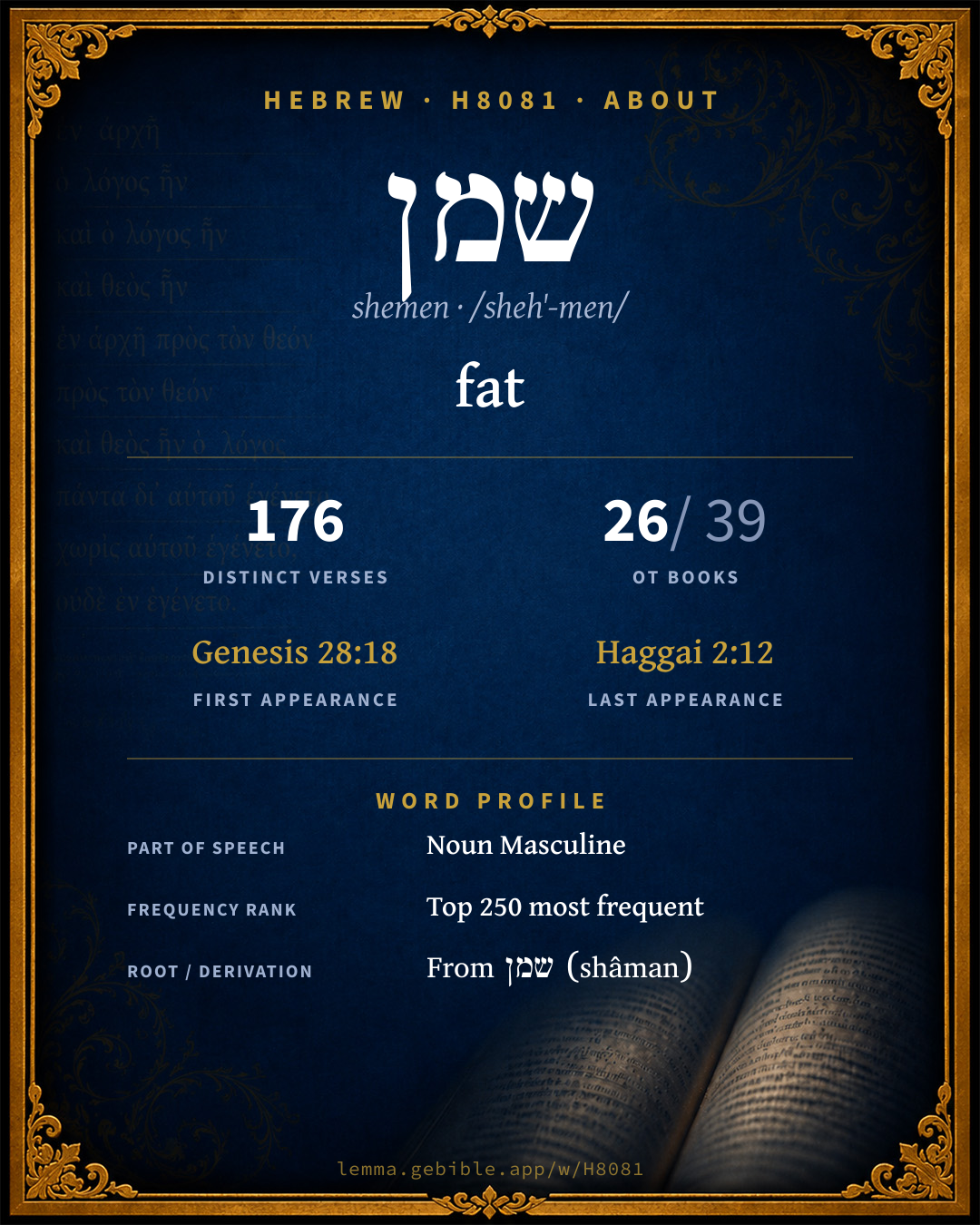
שֶׁ֫מֶן
fat
‘fat’ is one of 4 main senses fuller range ↓
Full lexicon entry — Brown-Driver-Briggs (BDB)
From Brown-Driver-Briggs (BDB)
Where this word appears
See every Absolute-state word in the Hebrew Bible →
Grammar key — what these labels mean
Part of speech
- Noun
- A naming word — a person, place, thing, or idea.
Noun type
- Common
- A common noun — a general class of person, place, or thing (“king,” “city,” “water”), not a specific name.
State
- Absolute
- The independent form of a noun, not bound to a following word.
- Construct
- A noun bound to a following noun in a possessive / “of” relationship (the construct chain).
Gender
- Masculine
- Grammatically masculine.
Number
- Singular
- One.
- Plural
- More than one (in Hebrew, generally three or more).
Grammatical forms
- Noun, Common, Masculine, Singular, Absolute 141 times (73%)
- Noun, Common, Masculine, Singular, Construct 45 times (23%)
- Noun, Common, Masculine, Plural, Absolute 5 times (3%)
- Noun, Common, Masculine, Plural, Construct 2 times (1%)
Parsed forms decoded from the imported morphology (morphhb / Westminster Leningrad Codex — WLC text public domain, morphhb tagging CC BY 4.0), counted across 193 parsed occurrences — not distinct verses.
Every verse where H8081 appears — 176 distinct verses across 26 books. Click any verse to open its interlinear word-by-word view. Verse text shown in the World English Bible for context — . Each verse’s Hebrew form is shown with its reference; the English is not keyword-highlighted, since the data carries no word-level English alignment. Use “Compare translations” on any verse to read it across multiple English versions. This concordance covers the Hebrew Bible; Septuagint (Greek Old Testament) occurrences are not indexed here.
Genesis 2 verses
- Genesis 28:18 שֶׁ֖מֶן n c ms Jacob rose up early in the morning, and took the stone that he had put under his head, and set it up for a pillar, and poured oil on the top of it.
- Genesis 35:14 שָֽׁמֶן n c ms Jacob set up a pillar in the place where he spoke with him, a pillar of stone. He poured out a drink-offering on it, and poured oil on it.
Exodus 19 verses
- Exodus 25:6 שֶׁ֖מֶן לְ/שֶׁ֣מֶן n c ms prep + n c ms cs oil for the light, spices for the anointing oil and for the sweet incense,
- Exodus 27:20 שֶׁ֣מֶן n c ms cs "You shall command the children of Israel, that they bring to you pure olive oil beaten for the light, to cause a lamp to burn continually.
- Exodus 29:2 בַּ/שֶּׁ֔מֶן בַּ/שָּׁ֑מֶן prep det + n c ms prep det + n c ms unleavened bread, unleavened cakes mixed with oil, and unleavened wafers anointed with oil: you shall make them of fine wheat flour.
- Exodus 29:7 שֶׁ֣מֶן n c ms cs Then you shall take the anointing oil, and pour it on his head, and anoint him.
- Exodus 29:21 וּ/מִ/שֶּׁ֣מֶן conj + prep + n c ms cs You shall take of the blood that is on the altar, and of the anointing oil, and sprinkle it on Aaron, and on his garments, and on his sons, and on the garments of his sons with him: and he shall be made holy, and his garments, and his sons, and his sons' garments with him.
- Exodus 29:23 שֶׁ֛מֶן n c ms and one loaf of bread, one cake of oiled bread, and one wafer out of the basket of unleavened bread that is before Yahweh.
- Exodus 29:40 בְּ/שֶׁ֤מֶן prep + n c ms and with the one lamb a tenth part of an ephah of fine flour mixed with the fourth part of a hin of beaten oil, and the fourth part of a hin of wine for a drink-offering.
- Exodus 30:24 וְ/שֶׁ֥מֶן conj + n c ms cs and of cassia five hundred, after the shekel of the sanctuary; and a hin of olive oil.
- Exodus 30:25 שֶׁ֚מֶן שֶׁ֥מֶן n c ms cs n c ms cs You shall make it a holy anointing oil, a perfume compounded after the art of the perfumer: it shall be a holy anointing oil.
- Exodus 30:31 שֶׁ֠מֶן n c ms cs You shall speak to the children of Israel, saying, 'This shall be a holy anointing oil to me throughout your generations.
- Exodus 31:11 שֶׁ֧מֶן n c ms cs the anointing oil, and the incense of sweet spices for the holy place: according to all that I have commanded you they shall do."
- Exodus 35:8 וְ/שֶׁ֖מֶן לְ/שֶׁ֣מֶן conj + n c ms prep + n c ms cs oil for the light, spices for the anointing oil and for the sweet incense,
- Exodus 35:14 שֶׁ֥מֶן n c ms cs the lampstand also for the light, with its vessels, its lamps, and the oil for the light;
- Exodus 35:15 שֶׁ֣מֶן n c ms cs and the altar of incense with its poles, the anointing oil, the sweet incense, the screen for the door, at the door of the tent;
- Exodus 35:28 הַ/שָּׁ֑מֶן וּ/לְ/שֶׁ֨מֶן֙ ptcl def.art + n c ms conj + prep + n c ms cs and the spice, and the oil for the light, for the anointing oil, and for the sweet incense.
- Exodus 37:29 שֶׁ֤מֶן n c ms cs He made the holy anointing oil and the pure incense of sweet spices, after the art of the perfumer.
- Exodus 39:37 שֶׁ֥מֶן n c ms cs the pure lampstand, its lamps, even the lamps to be set in order, all its vessels, the oil for the light,
- Exodus 39:38 שֶׁ֣מֶן n c ms cs the golden altar, the anointing oil, the sweet incense, the screen for the door of the Tent,
- Exodus 40:9 שֶׁ֣מֶן n c ms cs You shall take the anointing oil, and anoint the tent, and all that is in it, and shall make it holy, and all its furniture: and it will be holy.
Leviticus 36 verses
- Leviticus 2:1 שֶׁ֔מֶן n c ms "'When anyone offers an offering of a meal offering to Yahweh, his offering shall be of fine flour; and he shall pour oil on it, and put frankincense on it.
- Leviticus 2:2 וּ/מִ/שַּׁמְנָ֔/הּ conj + prep + n c ms cs + sfx pers 3fs He shall bring it to Aaron's sons the priests; and he shall take his handful of its fine flour, and of its oil, with all its frankincense; and the priest shall burn the memorial of it on the altar, an offering made by fire, of a sweet savor to Yahweh.
- Leviticus 2:4 בַּ/שֶּׁ֔מֶן בַּ/שָּֽׁמֶן prep det + n c ms prep det + n c ms "'When you offer an offering of a meal offering baked in the oven, it shall be unleavened cakes of fine flour mixed with oil, or unleavened wafers anointed with oil.
- Leviticus 2:5 בַ/שֶּׁ֖מֶן prep det + n c ms If your offering is a meal offering of the baking pan, it shall be of unleavened fine flour, mixed with oil.
- Leviticus 2:6 שָׁ֑מֶן n c ms You shall cut it in pieces, and pour oil on it. It is a meal offering.
- Leviticus 2:7 בַּ/שֶּׁ֖מֶן prep det + n c ms If your offering is a meal offering of the frying pan, it shall be made of fine flour with oil.
- Leviticus 2:15 שֶׁ֔מֶן n c ms You shall put oil on it, and lay frankincense on it: it is a meal offering.
- Leviticus 2:16 וּ/מִ/שַּׁמְנָ֔/הּ conj + prep + n c ms cs + sfx pers 3fs The priest shall burn as its memorial, part of its bruised grain, and part of its oil, along with all its frankincense: it is an offering made by fire to Yahweh.
- Leviticus 5:11 שֶׁ֗מֶן n c ms "'But if he can't afford two turtledoves, or two young pigeons, then he shall bring his offering for that in which he has sinned, the tenth part of an ephah of fine flour for a sin offering. He shall put no oil on it, neither shall he put any frankincense on it, for it is a sin offering.
- Leviticus 6:15 וּ/מִ/שַּׁמְנָ֔/הּ conj + prep + n c ms cs + sfx pers 3fs He shall take from there his handful of the fine flour of the meal offering, and of its oil, and all the frankincense which is on the meal offering, and shall burn it on the altar for a sweet savor, as its memorial, to Yahweh.
- Leviticus 6:21 בַּ/שֶּׁ֛מֶן prep det + n c ms It shall be made with oil in a baking pan. When it is soaked, you shall bring it in. You shall offer the meal offering in baked pieces for a sweet savor to Yahweh.
- Leviticus 7:10 בַ/שֶּׁ֖מֶן prep det + n c ms Every meal offering, mixed with oil or dry, belongs to all the sons of Aaron, one as well as another.
- Leviticus 7:12 בַּ/שֶּׁ֔מֶן בַּ/שָּׁ֑מֶן בַּ/שָּֽׁמֶן prep det + n c ms prep det + n c ms prep det + n c ms If he offers it for a thanksgiving, then he shall offer with the sacrifice of thanksgiving unleavened cakes mixed with oil, and unleavened wafers anointed with oil, and cakes mixed with oil.
- Leviticus 8:2 שֶׁ֣מֶן n c ms cs "Take Aaron and his sons with him, and the garments, and the anointing oil, and the bull of the sin offering, and the two rams, and the basket of unleavened bread;
- Leviticus 8:10 שֶׁ֣מֶן n c ms cs Moses took the anointing oil, and anointed the tabernacle and all that was in it, and sanctified them.
- Leviticus 8:12 מִ/שֶּׁ֣מֶן prep + n c ms cs He poured some of the anointing oil on Aaron's head, and anointed him, to sanctify him.
- Leviticus 8:26 שֶׁ֛מֶן n c ms and out of the basket of unleavened bread, that was before Yahweh, he took one unleavened cake, and one cake of oiled bread, and one wafer, and placed them on the fat, and on the right thigh.
- Leviticus 8:30 מִ/שֶּׁ֣מֶן prep + n c ms cs Moses took some of the anointing oil, and some of the blood which was on the altar, and sprinkled it on Aaron, on his garments, and on his sons, and on his sons' garments with him, and sanctified Aaron, his garments, and his sons, and his sons' garments with him.
- Leviticus 9:4 בַ/שָּׁ֑מֶן prep det + n c ms and an ox and a ram for peace offerings, to sacrifice before Yahweh; and a meal offering mixed with oil: for today Yahweh appears to you.'"
- Leviticus 10:7 שֶׁ֛מֶן n c ms cs You shall not go out from the door of the Tent of Meeting, lest you die; for the anointing oil of Yahweh is on you." They did according to the word of Moses.
- Leviticus 14:10 בַ/שֶּׁ֔מֶן שָֽׁמֶן prep det + n c ms n c ms "On the eighth day he shall take two male lambs without blemish, and one ewe lamb a year old without blemish, and three tenths of an ephah of fine flour for a meal offering, mingled with oil, and one log of oil.
- Leviticus 14:12 הַ/שָּׁ֑מֶן ptcl def.art + n c ms "The priest shall take one of the male lambs, and offer him for a trespass offering, with the log of oil, and wave them for a wave offering before Yahweh.
- Leviticus 14:15 הַ/שָּׁ֑מֶן ptcl def.art + n c ms The priest shall take some of the log of oil, and pour it into the palm of his own left hand.
- Leviticus 14:16 הַ/שֶּׁ֕מֶן הַ/שֶּׁ֧מֶן ptcl def.art + n c ms ptcl def.art + n c ms The priest shall dip his right finger in the oil that is in his left hand, and shall sprinkle some of the oil with his finger seven times before Yahweh.
- Leviticus 14:17 הַ/שֶּׁ֜מֶן ptcl def.art + n c ms The priest shall put some of the rest of the oil that is in his hand on the tip of the right ear of him who is to be cleansed, and on the thumb of his right hand, and on the big toe of his right foot, upon the blood of the trespass offering.
- Leviticus 14:18 בַּ/שֶּׁ֨מֶן֙ prep det + n c ms The rest of the oil that is in the priest's hand he shall put on the head of him who is to be cleansed, and the priest shall make atonement for him before Yahweh.
- Leviticus 14:21 בַּ/שֶּׁ֛מֶן שָֽׁמֶן prep det + n c ms n c ms "If he is poor, and can't afford so much, then he shall take one male lamb for a trespass offering to be waved, to make atonement for him, and one tenth of an ephah of fine flour mingled with oil for a meal offering, and a log of oil;
- Leviticus 14:24 הַ/שָּׁ֑מֶן ptcl def.art + n c ms The priest shall take the lamb of the trespass offering, and the log of oil, and the priest shall wave them for a wave offering before Yahweh.
- Leviticus 14:26 הַ/שֶּׁ֖מֶן ptcl def.art + n c ms The priest shall pour some of the oil into the palm of his own left hand;
- Leviticus 14:27 הַ/שֶּׁ֕מֶן ptcl def.art + n c ms and the priest shall sprinkle with his right finger some of the oil that is in his left hand seven times before Yahweh.
- Leviticus 14:28 הַ/שֶּׁ֣מֶן ptcl def.art + n c ms Then the priest shall put some of the oil that is in his hand on the tip of the right ear of him who is to be cleansed, and on the thumb of his right hand, and on the big toe of his right foot, on the place of the blood of the trespass offering.
- Leviticus 14:29 הַ/שֶּׁ֨מֶן֙ ptcl def.art + n c ms The rest of the oil that is in the priest's hand he shall put on the head of him who is to be cleansed, to make atonement for him before Yahweh.
- Leviticus 21:10 שֶׁ֤מֶן n c ms cs "'He who is the high priest among his brothers, upon whose head the anointing oil is poured, and that is consecrated to put on the garments, shall not let the hair of his head hang loose, nor tear his clothes;
- Leviticus 21:12 שֶׁ֣מֶן n c ms cs neither shall he go out of the sanctuary, nor profane the sanctuary of his God; for the crown of the anointing oil of his God is upon him. I am Yahweh.
- Leviticus 23:13 בַ/שֶּׁ֛מֶן prep det + n c ms The meal offering with it shall be two tenth parts of an ephah of fine flour mingled with oil, an offering made by fire to Yahweh for a sweet savor; and the drink offering with it shall be of wine, the fourth part of a hin.
- Leviticus 24:2 שֶׁ֣מֶן n c ms cs "Command the children of Israel, that they bring to you pure olive oil beaten for the light, to cause a lamp to burn continually.
Numbers 31 verses
- Numbers 4:9 שַׁמְנָ֔/הּ n c ms cs + sfx pers 3fs They shall take a blue cloth, and cover the lampstand of the light, and its lamps, and its snuffers, and its snuff dishes, and all its oil vessels, with which they minister to it.
- Numbers 4:16 שֶׁ֤מֶן וְ/שֶׁ֣מֶן n c ms cs conj + n c ms cs "The charge of Eleazar the son of Aaron the priest shall be the oil for the light, the sweet incense, the continual meal offering, and the anointing oil, the charge of all the tabernacle, and of all that is in it, the sanctuary, and its furnishings."
- Numbers 5:15 שֶׁ֗מֶן n c ms then the man shall bring his wife to the priest, and shall bring her offering for her: the tenth part of an ephah of barley meal. He shall pour no oil on it, nor put frankincense on it, for it is a meal offering of jealousy, a meal offering of memorial, bringing iniquity to memory.
- Numbers 6:15 בַּ/שֶּׁ֔מֶן בַּ/שָּׁ֑מֶן prep det + n c ms prep det + n c ms and a basket of unleavened bread, cakes of fine flour mixed with oil, and unleavened wafers anointed with oil, and their meal offering, and their drink offerings.
- Numbers 7:13 בַ/שֶּׁ֖מֶן prep det + n c ms and his offering was: one silver platter, the weight of which was one hundred thirty shekels, one silver bowl of seventy shekels, after the shekel of the sanctuary; both of them full of fine flour mixed with oil for a meal offering;
- Numbers 7:19 בַ/שֶּׁ֖מֶן prep det + n c ms He offered for his offering: one silver platter, the weight of which was one hundred thirty shekels, one silver bowl of seventy shekels, after the shekel of the sanctuary; both of them full of fine flour mixed with oil for a meal offering;
- Numbers 7:25 בַ/שֶּׁ֖מֶן prep det + n c ms gave his offering: one silver platter, the weight of which was a hundred and thirty shekels, one silver bowl of seventy shekels, after the shekel of the sanctuary; both of them full of fine flour mixed with oil for a meal offering;
- Numbers 7:31 בַ/שֶּׁ֖מֶן prep det + n c ms gave his offering: one silver platter, the weight of which was one hundred thirty shekels, one silver bowl of seventy shekels, after the shekel of the sanctuary; both of them full of fine flour mixed with oil for a meal offering;
- Numbers 7:37 בַ/שֶּׁ֖מֶן prep det + n c ms gave his offering: one silver platter, the weight of which was one hundred thirty shekels, one silver bowl of seventy shekels, after the shekel of the sanctuary; both of them full of fine flour mixed with oil for a meal offering;
- Numbers 7:43 בַ/שֶּׁ֖מֶן prep det + n c ms gave his offering: one silver platter, the weight of which was one hundred thirty shekels, one silver bowl of seventy shekels, after the shekel of the sanctuary; both of them full of fine flour mixed with oil for a meal offering;
- Numbers 7:49 בַ/שֶּׁ֖מֶן prep det + n c ms gave his offering: one silver platter, the weight of which was one hundred thirty shekels, one silver bowl of seventy shekels, after the shekel of the sanctuary; both of them full of fine flour mixed with oil for a meal offering;
- Numbers 7:55 בַ/שֶּׁ֖מֶן prep det + n c ms gave his offering: one silver platter, the weight of which was one hundred thirty shekels, one silver bowl of seventy shekels, after the shekel of the sanctuary; both of them full of fine flour mixed with oil for a meal offering;
- Numbers 7:61 בַ/שֶּׁ֖מֶן prep det + n c ms gave his offering: one silver platter, the weight of which was one hundred thirty shekels, one silver bowl of seventy shekels, after the shekel of the sanctuary; both of them full of fine flour mixed with oil for a meal offering;
- Numbers 7:67 בַ/שֶּׁ֖מֶן prep det + n c ms gave his offering: one silver platter, the weight of which was one hundred thirty shekels, one silver bowl of seventy shekels, after the shekel of the sanctuary; both of them full of fine flour mixed with oil for a meal offering;
- Numbers 7:73 בַ/שֶּׁ֖מֶן prep det + n c ms gave his offering: one silver platter, the weight of which was one hundred thirty shekels, one silver bowl of seventy shekels, after the shekel of the sanctuary; both of them full of fine flour mixed with oil for a meal offering;
- Numbers 7:79 בַ/שֶּׁ֖מֶן prep det + n c ms gave his offering: one silver platter, the weight of which was one hundred thirty shekels, one silver bowl of seventy shekels, after the shekel of the sanctuary; both of them full of fine flour mixed with oil for a meal offering;
- Numbers 8:8 בַ/שָּׁ֑מֶן prep det + n c ms Then let them take a young bull, and its meal offering, fine flour mixed with oil; and another young bull you shall take for a sin offering.
- Numbers 11:8 הַ/שָּֽׁמֶן ptcl def.art + n c ms The people went about, and gathered it, and ground it in mills, or beat it in mortars, and boiled it in pots, and made cakes of it: and the taste of it was as the taste of fresh oil.
- Numbers 15:4 שָֽׁמֶן n c ms then shall he who offers his offering offer to Yahweh a meal-offering of a tenth part [of an ephah] of fine flour mixed with the fourth part of a hin of oil:
- Numbers 15:6 בַ/שֶּׁ֖מֶן prep det + n c ms Or for a ram, you shall prepare for a meal-offering two tenth parts [of an ephah] of fine flour mixed with the third part of a hin of oil:
- Numbers 15:9 בַּ/שֶּׁ֖מֶן prep det + n c ms then shall he offer with the bull a meal-offering of three tenth parts [of an ephah] of fine flour mixed with half a hin of oil:
- Numbers 28:5 בְּ/שֶׁ֥מֶן prep + n c ms cs and the tenth part of an ephah of fine flour for a meal-offering, mixed with the fourth part of a hin of beaten oil.
- Numbers 28:9 בַ/שֶּׁ֖מֶן prep det + n c ms On the Sabbath day two he-lambs a year old without blemish, and two tenth parts [of an ephah] of fine flour for a meal-offering, mixed with oil, and the drink-offering of it:
- Numbers 28:12 בַ/שֶּׁ֔מֶן בַ/שֶּׁ֔מֶן prep det + n c ms prep det + n c ms and three tenth parts [of an ephah] of fine flour for a meal-offering, mixed with oil, for each bull; and two tenth parts of fine flour for a meal-offering, mixed with oil, for the one ram;
- Numbers 28:13 בַ/שֶּׁ֔מֶן prep det + n c ms and a tenth part of fine flour mixed with oil for a meal-offering to every lamb; for a burnt offering of a sweet savor, an offering made by fire to Yahweh.
- Numbers 28:20 בַ/שָּׁ֑מֶן prep det + n c ms and their meal-offering, fine flour mixed with oil: three tenth parts shall you offer for a bull, and two tenth parts for the ram;
- Numbers 28:28 בַ/שָּׁ֑מֶן prep det + n c ms and their meal-offering, fine flour mixed with oil, three tenth parts for each bull, two tenth parts for the one ram,
- Numbers 29:3 בַ/שָּׁ֑מֶן prep det + n c ms and their meal-offering, fine flour mixed with oil, three tenth parts for the bull, two tenth parts for the ram,
- Numbers 29:9 בַ/שָּׁ֑מֶן prep det + n c ms and their meal-offering, fine flour mixed with oil, three tenth parts for the bull, two tenth parts for the one ram,
- Numbers 29:14 בַ/שָּׁ֑מֶן prep det + n c ms and their meal-offering, fine flour mixed with oil, three tenth parts for every bull of the thirteen bulls, two tenth parts for each ram of the two rams,
- Numbers 35:25 בְּ/שֶׁ֥מֶן prep + n c ms cs and the congregation shall deliver the manslayer out of the hand of the avenger of blood, and the congregation shall restore him to his city of refuge, where he was fled: and he shall dwell therein until the death of the high priest, who was anointed with the holy oil.
Deuteronomy 4 verses
- Deuteronomy 8:8 שֶׁ֖מֶן n c ms a land of wheat and barley, and vines and fig trees and pomegranates; a land of olive trees and honey;
- Deuteronomy 28:40 וְ/שֶׁ֨מֶן֙ conj + n c ms You shall have olive trees throughout all your borders, but you shall not anoint yourself with the oil; for your olive shall cast [its fruit].
- Deuteronomy 32:13 וְ/שֶׁ֖מֶן conj + n c ms He made him ride on the high places of the earth, He ate the increase of the field; He made him to suck honey out of the rock, Oil out of the flinty rock;
- Deuteronomy 33:24 בַּ/שֶּׁ֖מֶן prep det + n c ms Of Asher he said, Blessed be Asher with children; Let him be acceptable to his brothers, Let him dip his foot in oil.
1 Samuel 3 verses
- 1 Samuel 10:1 הַ/שֶּׁ֛מֶן ptcl def.art + n c ms Then Samuel took the vial of oil, and poured it on his head, and kissed him, and said, Isn't it that Yahweh has anointed you to be prince over his inheritance?
- 1 Samuel 16:1 שֶׁ֗מֶן n c ms Yahweh said to Samuel, How long will you mourn for Saul, seeing I have rejected him from being king over Israel? fill your horn with oil, and go: I will send you to Jesse the Bethlehemite; for I have provided me a king among his sons.
- 1 Samuel 16:13 הַ/שֶּׁ֗מֶן ptcl def.art + n c ms Then Samuel took the horn of oil, and anointed him in the midst of his brothers: and the Spirit of Yahweh came mightily on David from that day forward. So Samuel rose up, and went to Ramah.
2 Samuel 2 verses
- 2 Samuel 1:21 בַּ/שָּֽׁמֶן prep det + n c ms You mountains of Gilboa, Let there be no dew nor rain on you, neither fields of offerings: For there the shield of the mighty was vilely cast away, The shield of Saul, not anointed with oil.
- 2 Samuel 14:2 שֶׁ֔מֶן n c ms Joab sent to Tekoa, and fetched there a wise woman, and said to her, please act like a mourner, and put on mourning clothing, Please, and don't anoint yourself with oil, but be as a woman who has a long time mourned for the dead:
1 Kings 9 verses
- 1 Kings 1:39 הַ/שֶּׁ֨מֶן֙ ptcl def.art + n c ms Zadok the priest took the horn of oil out of the Tent, and anointed Solomon. They blew the trumpet; and all the people said, [Long] live king Solomon.
- 1 Kings 5:11 שֶׁ֣מֶן n c ms Solomon gave Hiram twenty thousand measures of wheat for food to his household, and twenty measures of pure oil: thus gave Solomon to Hiram year by year.
- 1 Kings 6:23 שָׁ֑מֶן n c ms In the oracle he made two cherubim of olive-wood, each ten cubits high.
- 1 Kings 6:31 שָׁ֑מֶן n c ms For the entrance of the oracle he made doors of olive-wood: the lintel [and] door-posts were a fifth part [of the wall].
- 1 Kings 6:32 שֶׁמֶן֒ n c ms So [he made] two doors of olive-wood; and he carved on them carvings of cherubim and palm trees and open flowers, and overlaid them with gold; and he spread the gold on the cherubim, and on the palm trees.
- 1 Kings 6:33 שָׁ֑מֶן n c ms So also made he for the entrance of the temple door-posts of olive-wood, out of a fourth part [of the wall];
- 1 Kings 17:12 שֶׁ֖מֶן n c ms She said, As Yahweh your God lives, I don't have a cake, but a handful of meal in the jar, and a little oil in the jar: and, behold, I am gathering two sticks, that I may go in and bake it for me and my son, that we may eat it, and die.
- 1 Kings 17:14 הַ/שֶּׁ֖מֶן ptcl def.art + n c ms For thus says Yahweh, the God of Israel, The jar of meal shall not empty, neither shall the jar of oil fail, until the day that Yahweh sends rain on the earth.
- 1 Kings 17:16 הַ/שֶּׁ֖מֶן ptcl def.art + n c ms The jar of meal didn't empty, neither did the jar of oil fail, according to the word of Yahweh, which he spoke by Elijah.
2 Kings 7 verses
- 2 Kings 4:2 שָֽׁמֶן n c ms Elisha said to her, What shall I do for you? tell me; what have you in the house? She said, Your handmaid has nothing in the house, except a pot of oil.
- 2 Kings 4:6 הַ/שָּֽׁמֶן ptcl def.art + n c ms It happened, when the vessels were full, that she said to her son, Bring me yet a vessel. He said to her, There isn't another vessel. The oil stayed.
- 2 Kings 4:7 הַ/שֶּׁ֔מֶן ptcl def.art + n c ms Then she came and told the man of God. He said, Go, sell the oil, and pay your debt, and live you and your sons of the rest.
- 2 Kings 9:1 הַ/שֶּׁ֤מֶן ptcl def.art + n c ms Elisha the prophet called one of the sons of the prophets, and said to him, Gird up your loins, and take this vial of oil in your hand, and go to Ramoth-gilead.
- 2 Kings 9:3 הַ/שֶּׁ֨מֶן֙ ptcl def.art + n c ms Then take the vial of oil, and pour it on his head, and say, Thus says Yahweh, I have anointed you king over Israel. Then open the door, and flee, and don't wait.
- 2 Kings 9:6 הַ/שֶּׁ֖מֶן ptcl def.art + n c ms He arose, and went into the house; and he poured the oil on his head, and said to him, Thus says Yahweh, the God of Israel, I have anointed you king over the people of Yahweh, even over Israel.
- 2 Kings 20:13 שֶׁ֣מֶן n c ms cs Hezekiah listened to them, and shown them all the house of his precious things, the silver, and the gold, and the spices, and the precious oil, and the house of his armor, and all that was found in his treasures: there was nothing in his house, nor in all his dominion, that Hezekiah didn't show them.
1 Chronicles 3 verses
- 1 Chronicles 9:29 וְ/הַ/שֶּׁ֔מֶן conj + ptcl def.art + n c ms Some of them also were appointed over the furniture, and over all the vessels of the sanctuary, and over the fine flour, and the wine, and the oil, and the frankincense, and the spices.
- 1 Chronicles 12:40 וְ/שֶׁ֛מֶן conj + n c ms Moreover those who were near to them, [even] as far as Issachar and Zebulun and Naphtali, brought bread on donkeys, and on camels, and on mules, and on oxen, food of meal, cakes of figs, and clusters of raisins, and wine, and oil, and oxen, and sheep in abundance: for there was joy in Israel.
- 1 Chronicles 27:28 הַ/שֶּׁ֖מֶן ptcl def.art + n c ms and over the olive trees and the sycamore trees that were in the lowland was Baal Hanan the Gederite: and over the cellars of oil was Joash:
2 Chronicles 3 verses
- 2 Chronicles 2:10 וְ/שֶׁ֕מֶן conj + n c ms Behold, I will give to your servants, the cutters who cut timber, twenty thousand measures of beaten wheat, and twenty thousand measures of barley, and twenty thousand baths of wine, and twenty thousand baths of oil.
- 2 Chronicles 2:15 הַ/שֶּׁ֤מֶן ptcl def.art + n c ms Now therefore the wheat and the barley, the oil and the wine, which my lord has spoken of, let him send to his servants:
- 2 Chronicles 11:11 וְ/שֶׁ֥מֶן conj + n c ms He fortified the strongholds, and put captains in them, and stores of food, and oil and wine.
Ezra 1 verse
Nehemiah 1 verse
Esther 1 verse
Job 1 verse
Psalms 10 verses
- Psalms 23:5 בַ/שֶּׁ֥מֶן prep + n c ms You prepare a table before me in the presence of my enemies. You anoint my head with oil. My cup runs over.
- Psalms 45:7 שֶׁ֥מֶן n c ms cs You have loved righteousness, and hated wickedness. Therefore God, your God, has anointed you with the oil of gladness above your fellows.
- Psalms 55:21 מִ/שֶּׁ֗מֶן prep + n c ms His mouth was smooth as butter, But his heart was war. His words were softer than oil, Yet they were drawn swords.
- Psalms 89:20 בְּ/שֶׁ֖מֶן prep + n c ms cs I have found David, my servant. I have anointed him with my holy oil,
- Psalms 92:10 בְּ/שֶׁ֣מֶן prep + n c ms But you have exalted my horn like that of the wild ox. I am anointed with fresh oil.
- Psalms 104:15 מִ/שָּׁ֑מֶן prep + n c ms Wine that makes glad the heart of man, Oil to make his face to shine, And bread that strengthens man's heart.
- Psalms 109:18 וְ֝/כַ/שֶּׁ֗מֶן conj + prep det + n c ms He clothed himself also with cursing as with his garment. It came into his inward parts like water, Like oil into his bones.
- Psalms 109:24 מִ/שָּֽׁמֶן prep + n c ms My knees are weak through fasting. My body is thin and lacks fat.
- Psalms 133:2 כַּ/שֶּׁ֤מֶן prep det + n c ms It is like the precious oil on the head, That ran down on the beard, Even Aaron's beard; That came down on the edge of his robes;
- Psalms 141:5 שֶׁ֣מֶן n c ms cs Let the righteous strike me, it is kindness; Let him reprove me, it is like oil on the head; Don't let my head refuse it; Yet my prayer is always against evil deeds.
Proverbs 5 verses
- Proverbs 5:3 מִ/שֶּׁ֣מֶן prep + n c ms For the lips of an adulteress drip honey. Her mouth is smoother than oil,
- Proverbs 21:17 וָ֝/שֶׁ֗מֶן conj + n c ms He who loves pleasure shall be a poor man: He who loves wine and oil shall not be rich.
- Proverbs 21:20 וָ֭/שֶׁמֶן conj + n c ms There is precious treasure and oil in the dwelling of the wise; But a foolish man swallows it up.
- Proverbs 27:9 שֶׁ֣מֶן n c ms Perfume and incense bring joy to the heart; So does earnest counsel from a man's friend.
- Proverbs 27:16 וְ/שֶׁ֖מֶן conj + n c ms cs Restraining her is like restraining the wind, Or like grasping oil in his right hand.
Ecclesiastes 3 verses
- Ecclesiastes 7:1 מִ/שֶּׁ֣מֶן prep + n c ms A good name is better than fine perfume; and the day of death better than the day of one's birth.
- Ecclesiastes 9:8 וְ/שֶׁ֖מֶן conj + n c ms Let your garments be always white, and don't let your head lack oil.
- Ecclesiastes 10:1 שֶׁ֣מֶן n c ms cs Dead flies cause the oil of the perfumer to send forth an evil odor; so does a little folly outweigh wisdom and honor.
Song of Solomon 2 verses
- Song of Solomon 1:3 שְׁמָנֶ֣י/ךָ שֶׁ֖מֶן n c mp cs + sfx pers 2ms n c ms Your oils have a pleasing fragrance. Your name is oil poured forth, Therefore the virgins love you.
- Song of Solomon 4:10 שְׁמָנַ֖יִ/ךְ n c mp cs + sfx pers 2fs How beautiful is your love, my sister, my bride! How much better is your love than wine! The fragrance of your perfumes than all manner of spices!
Isaiah 10 verses
- Isaiah 1:6 בַּ/שָּֽׁמֶן prep det + n c ms From the sole of the foot even to the head there is no soundness in it: Wounds, welts, and open sores. They haven't been closed, neither bandaged, neither soothed with oil.
- Isaiah 5:1 שָֽׁמֶן n c ms Let me sing for my well beloved a song of my beloved about his vineyard. My beloved had a vineyard on a very fruitful hill.
- Isaiah 10:27 שָֽׁמֶן n c ms It shall happen in that day, that his burden shall depart from off your shoulder, and his yoke from off your neck, and the yoke shall be destroyed by reason of fatness.
- Isaiah 25:6 שְׁמָנִ֖ים שְׁמָנִים֙ n c mp n c mp In this mountain will Yahweh of Hosts make to all peoples a feast of fat things, a feast of wines on the lees, of fat things full of marrow, of wines on the lees well refined.
- Isaiah 28:1 שְׁמָנִ֖ים n c mp Woe to the crown of pride of the drunkards of Ephraim, and to the fading flower of his glorious beauty, which is on the head of the fat valley of those who are overcome with wine!
- Isaiah 28:4 שְׁמָנִ֑ים n c mp and the fading flower of his glorious beauty, which is on the head of the fat valley, shall be as the first-ripe fig before the summer; which when he who looks on it sees, while it is yet in his hand he eats it up.
- Isaiah 39:2 הַ/שֶּׁ֣מֶן ptcl def.art + n c ms Hezekiah was glad of them, and shown them the house of his precious things, the silver, and the gold, and the spices, and the precious oil, and all the house of his armor, and all that was found in his treasures: there was nothing in his house, nor in all his dominion, that Hezekiah didn't show them.
- Isaiah 41:19 שָׁ֑מֶן n c ms I will put in the wilderness the cedar, the acacia, and the myrtle, and the oil tree; I will set in the desert the fir tree, the pine, and the box tree together:
- Isaiah 57:9 בַּ/שֶּׁ֔מֶן prep det + n c ms You went to the king with oil, and did increase your perfumes, and did send your ambassadors far off, and did debase yourself even to Sheol.
- Isaiah 61:3 שֶׁ֤מֶן n c ms cs to appoint to those who mourn in Zion, to give to them a garland for ashes, the oil of joy for mourning, the garment of praise for the spirit of heaviness; that they may be called trees of righteousness, the planting of Yahweh, that he may be glorified.
Jeremiah 2 verses
- Jeremiah 40:10 וְ/שֶׁ֗מֶן conj + n c ms As for me, behold, I will dwell at Mizpah, to stand before the Chaldeans who shall come to us: but you, gather you wine and summer fruits and oil, and put them in your vessels, and dwell in your cities that you have taken.
- Jeremiah 41:8 וְ/שֶׁ֣מֶן conj + n c ms But ten men were found among those who said to Ishmael, Don't kill us; for we have stores hidden in the field, of wheat, and of barley, and of oil, and of honey. So he stopped, and didn't kill them among their brothers.
Ezekiel 15 verses
- Ezekiel 16:9 בַּ/שָּֽׁמֶן prep det + n c ms Then washed I you with water; yes, I thoroughly washed away your blood from you, and I anointed you with oil.
- Ezekiel 16:13 וָ/שֶׁ֖מֶן conj + n c ms Thus was you decked with gold and silver; and your clothing was of fine linen, and silk, and embroidered work; you ate fine flour, and honey, and oil; and you were exceeding beautiful, and you did prosper to royal estate.
- Ezekiel 16:18 וְ/שַׁמְנִ/י֙ conj + n c ms cs + sfx pers 1cs and you took your embroidered garments, and covered them, and did set my oil and my incense before them.
- Ezekiel 16:19 וָ/שֶׁ֤מֶן conj + n c ms My bread also which I gave you, fine flour, and oil, and honey, with which I fed you, you did even set it before them for a sweet savor; and [thus] it was, says the Lord Yahweh.
- Ezekiel 23:41 וְ/שַׁמְנִ֖/י conj + n c ms cs + sfx pers 1cs and sit on a stately bed, with a table prepared before it, whereupon you did set my incense and my oil.
- Ezekiel 27:17 וָ/שֶׁ֨מֶן֙ conj + n c ms Judah, and the land of Israel, they were your traffickers: they traded for your merchandise wheat of Minnith, and confections, and honey, and oil, and balm.
- Ezekiel 32:14 כַּ/שֶּׁ֣מֶן prep det + n c ms Then will I make their waters clear, and cause their rivers to run like oil, says the Lord Yahweh.
- Ezekiel 45:14 הַ/שֶּׁ֜מֶן הַ/שֶּׁ֗מֶן ptcl def.art + n c ms ptcl def.art + n c ms and the set portion of oil, of the bath of oil, the tenth part of a bath out of the cor, [which is] ten baths, even a homer; (for ten baths are a homer;)
- Ezekiel 45:24 וְ/שֶׁ֖מֶן conj + n c ms cs He shall prepare a meal-offering, an ephah for a bull, and an ephah for a ram, and a hin of oil to an ephah.
- Ezekiel 45:25 וְ/כַ/שָּֽׁמֶן conj + prep det + n c ms In the seventh [month], in the fifteenth day of the month, in the feast, shall he do the like the seven days; according to the sin-offering, according to the burnt offering, and according to the meal-offering, and according to the oil.
- Ezekiel 46:5 וְ/שֶׁ֖מֶן conj + n c ms and the meal-offering shall be an ephah for the ram, and the meal-offering for the lambs as he is able to give, and a hin of oil to an ephah.
- Ezekiel 46:7 וְ/שֶׁ֖מֶן conj + n c ms and he shall prepare a meal-offering, an ephah for the bull, and an ephah for the ram, and for the lambs according as he is able, and a hin of oil to an ephah.
- Ezekiel 46:11 וְ/שֶׁ֖מֶן conj + n c ms In the feasts and in the solemnities the meal-offering shall be an ephah for a bull, and an ephah for a ram, and for the lambs as he is able to give, and a hin of oil to an ephah.
- Ezekiel 46:14 וְ/שֶׁ֛מֶן conj + n c ms You shall prepare a meal-offering with it morning by morning, the sixth part of an ephah, and the third part of a hin of oil, to moisten the fine flour; a meal-offering to Yahweh continually by a perpetual ordinance.
- Ezekiel 46:15 הַ/שֶּׁ֖מֶן ptcl def.art + n c ms Thus shall they prepare the lamb, and the meal-offering, and the oil, morning by morning, for a continual burnt offering.
Hosea 2 verses
- Hosea 2:5 שַׁמְנִ֖/י n c ms cs + sfx pers 1cs For their mother has played the prostitute. She who conceived them has done shamefully; For she said, 'I will go after my lovers, Who give me my bread and my water, My wool and my flax, My oil and my drink.'
- Hosea 12:1 וְ/שֶׁ֖מֶן conj + n c ms Ephraim feeds on wind, And chases the east wind. He continually multiplies lies and desolation. They make a covenant with Assyria, And oil is carried into Egypt.
Amos 1 verse
Micah 2 verses
- Micah 6:7 שָׁ֑מֶן n c ms Will Yahweh be pleased with thousands of rams? With tens of thousands of rivers of oil? Shall I give my firstborn for my disobedience? The fruit of my body for the sin of my soul?
- Micah 6:15 שֶׁ֔מֶן n c ms You will sow, but won't reap. You will tread the olives, but won't anoint yourself with oil; And crush grapes, but won't drink the wine.
Haggai 1 verse
About this entry
At a glance — auto-summarized from this page’s data, not written by a person. Every figure links to its source below. This summary describes the numbers; it doesn’t interpret them.
שמן (shemen) is a Hebrew noun most often rendered “fat.” Not a single-sense word: explore its full sense range. It turns up in 176 verses across 26 books, a common footprint. Scripture first uses it in Genesis 28:18. It clusters with שמן, משמן and שמן under a shared root. For the data behind this summary, explore the sense tree and the renderings breakdown below.
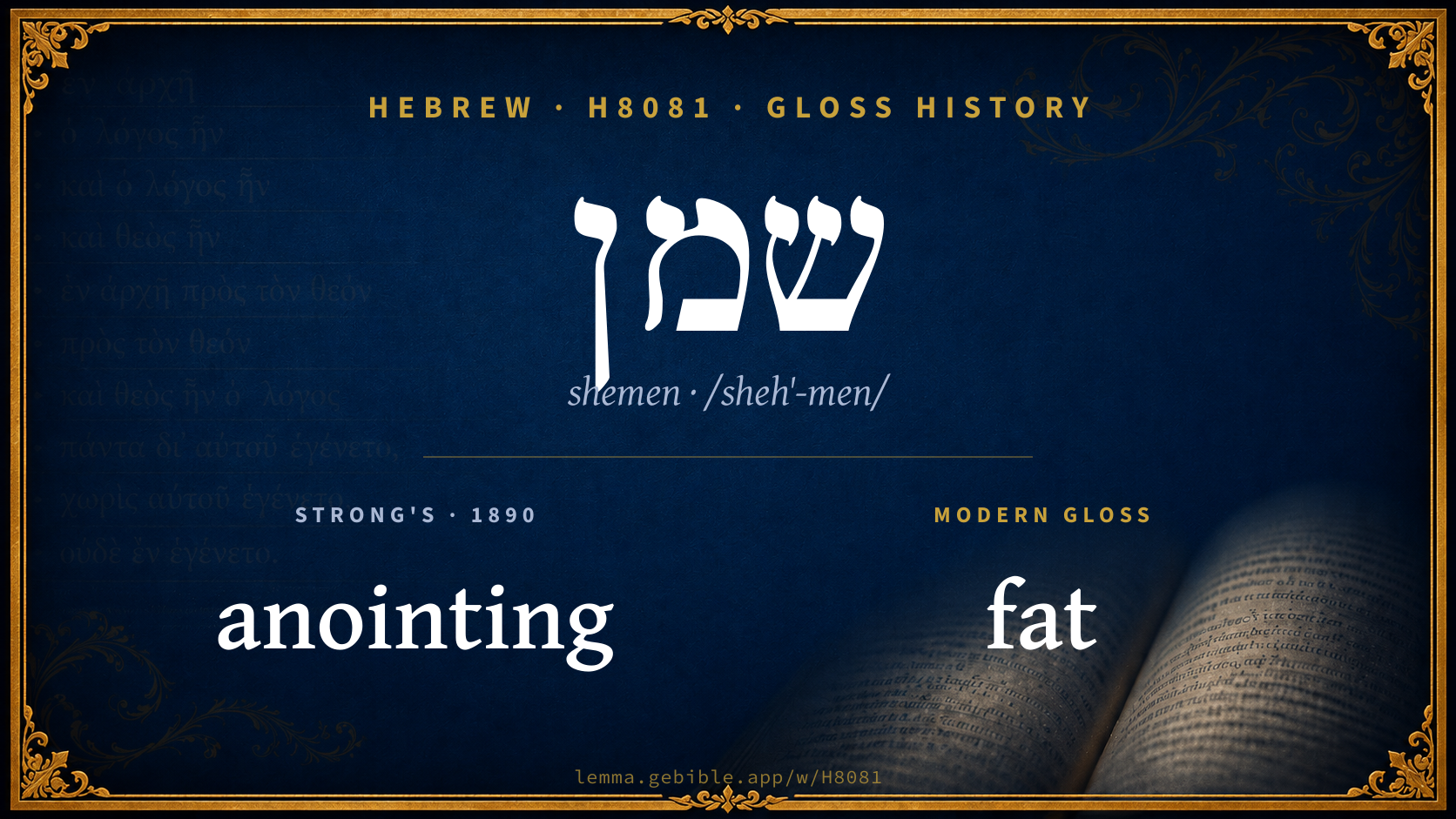
Gloss history
Strong's 1890 vs modern scholarship
About this word
Strong's H8081 catalogs a Hebrew word from the Hebrew Old Testament.
These counts are not copied from any lexicon or concordance. They are computed here, from the morphology-tagged Hebrew Old Testament. What Lemma adds →
- 176
- distinct verses
- The word appears in 176 distinct verses.
- 26 / 39
- OT books
- The word appears in 26 of 39 Old Testament books.
- #243
- by frequency
- Top 250 most frequent Hebrew words (rank 243 of 8,640 Hebrew words by occurrence).
View all 176 occurrences in the concordance →
By section of the Old Testament
By traditional corpus
Conventional, traditional groupings — biblical authorship is debated, so this is a traditional corpus grouping, not an authorship claim. Each share is this word’s portion of its verses in that division of the Hebrew canon. Each figure is a share of the word’s 176 distinct verses.
- Torah (Pentateuch) 92 verses · 52%
- Prophets (Nevi'im) 54 verses · 31%
- Writings (Ketuvim) 30 verses · 17%
How translations render this word
Counts come from each version’s own published word-to-Strong’s tagging or interlinear alignment — an approximate guide to how each version renders this word, not a word-level alignment the data otherwise carries. Because each total is that version’s own tagged count, the per-version totals vary from one another and need not match the appearance or distinct-verse counts above. These counts may also differ from a printed concordance because Lemma counts each distinctly tagged rendering and does not collapse phrase taggings into a single head-word total. This is a fixed set of word-tagged versions (KJV, ASV, BSB, ULT) and does not change with the reading translation you choose elsewhere. Each version’s license is shown beside its name below (and on Sources).
- King James Version: Oil 147×, Ointment 9×, Ointments 3×
- American Standard Version: Oil 150×, Olive-wood 4×, Oils 3×
- Berean Standard Bible: Oil 139×, Olive oil 22×, Olive 4×
- unfoldingWord Literal Text: Oil 142×, Oil of 27×, With 5×
King James Version Public Domain
Renders H8081 across 192 tagged occurrences — most commonly:
Plus 18 renderings that appear only once — usually multi-word phrases or single function words the recovered tagging swept in, not distinct renderings. Not rendered by a distinct English word in 1 further occurrence.
American Standard Version Public Domain
Renders H8081 across 192 tagged occurrences — most commonly:
Plus 21 renderings that appear only once — usually multi-word phrases or single function words the recovered tagging swept in, not distinct renderings.
Berean Standard Bible Public Domain
Renders H8081 across 191 tagged occurrences — most commonly:
Plus 15 renderings that appear only once — usually multi-word phrases or single function words the recovered tagging swept in, not distinct renderings. Not rendered by a distinct English word in 2 further occurrences.
unfoldingWord Literal Text CC BY-SA 4.0
Renders H8081 across 210 tagged occurrences — most commonly:
Plus 15 renderings that appear only once — usually multi-word phrases or single function words the recovered tagging swept in, not distinct renderings.
11 senses and sub-senses in the full BDB
What do BDB’s symbols mean?
BDB uses these scholarly abbreviations:
| Symbol | Meaning |
|---|---|
| 𝔊 | the Septuagint (the ancient Greek translation, LXX) |
| 𝔙 | the Vulgate (the Latin translation) |
| 𝔖 | the Syriac version (the Peshitta) |
| 𝔗 | the Targum (the Aramaic translation) |
| ψ | the Psalms |
| √ | root (the underlying root or stem) |
| ‖ | parallel passage (a synonymous or contrasted parallel) |
| † | the dagger: every passage where the word occurs is cited |
The 11 senses and sub-senses the full Brown-Driver-Briggs lexicon distinguishes for this word, in lexicon order (not ranked by frequency), with BDB’s own verbatim wording and sub-sense lettering. Shown in Hebrew script with BDB’s own scholarly abbreviations. The condensed entry is in the Lexicon Entry tab. See also the Forms in the corpus table below.
- 1. fat, fatness: קֶרֶן בֶּן־שׁ׳ Is 5:1 (of fertile slope); pl. גֵּיא־שְׁמָנִים 28:1, 4; of food (in fig.) 25:6(×2); lit. בְּשָׂרִי כַּחַשׁ מִשָּׁ֑מֶן ψ 109:24 (cf. צוֹם v a), cf. מִפְּנֵי שׁ׳ Is 10:27 (in fig., si vera l., meaning obscure; most now emend by conjecture; RSJPh xiii (1885), 62 עָלָה מִצָּפוֹן שֹׁדֵד [v. also II. חבל], joining to v 28; Du Marti has gone up from Pene-Rimmon [??], cf. Di-Kit). e.g. Isaiah 5:1
- 2.
- a. oil, specif. olive-oil, as rich product Dt 8:8 + (v. זַיִת); hence עֵץ שׁ׳ Is 41:19 oil-tree, usually explained as wild olive, oleaster, so Ne 8:15 (‖ זַיִת), עֲצֵי שׁ׳ oleaster-wood 1 K 6:23, 31, 32, 33; once שׁ׳ הַמֹּר Est 2:2 (v. מֹר p. 600b; מ׳ also in holy anointing oil Ex 30:23). e.g. Deuteronomy 8:8
- b. שׁ׳ as staple (condiment) Nu 11:8 (J; v. לשׁד), of value 1 K 17:12, 14, 16; 2 K 2:4, 6, 7 + 4 times; symb. of plenty Dt 32:13; 33:24; Jb 29:6; ascribed (falsely) to gift of Baals Ho 2:7; as royal treasure 2 K 20:13 = Is 39:2, cf. 1 K 5:25 (שׁ׳ כָּתִית, v. כ׳) = 2 Ch 2:9, 14 + 3 times; tribute Ho 12:2, art. of trade Ez 27:17; odoriferous Pr 27:9; Ct 1:3; 4:10, שׁ׳ רוֹקֵחַ Ec 10:1, so (fig.) Ct 1:3; Ec 7:1; Pr. 27:16 is corrupt, v. Toy; sign of luxury Ez 16:13; Pr 21:17, of prosperity Ez 16:20. e.g. Numbers 11:8
- c. שׁ׳ as medicament Is 1:6; as unguent, for shield 2 S 1:21, person Am 6:6; Mi 6:15; Dt 28:40; Ez 16:9; Est 2:12 ψ 92:11; 104:15, not for mourner 2 S 14:2; on head, token of happiness Ec 9:8, of hospitality, דִּשַּׁנְתָּ בַּשּׁ׳ רֹאשִׁי ψ 23:5 (fig.), in sim. 133:2; 141:5. e.g. Isaiah 1:6
- d. for anointing king, פַּךְ הַשּׁ׳ 1 S 10:1; 2 K 9:1, 3, cf. v 6, c. קֶרֶן 1 S 16:1, 13; 1 K 1:39; cf. בְּשׁ׳ קָדְשִׁי מְשַׁחְתִּיו ψ 89:21. e.g. 1 Samuel 10:1
- e. in various figs., of joy שׁ׳ שָׂשׂוֹן Is 61:3 ψ 45:8; soft words 55:22 Pr 5:3; as penetrating 109:18; as clear, transparent Ez 32:14. e.g. Isaiah 61:3
- f. used in primitive worship, poured on stone Gn 28:18 (E), 35:14 (J). e.g. Genesis 28:18
- g. in later ritual: for anointing priests, tabern., altar utensils, etc. (P), made of various ingred., שׁ׳ זַיִת among them, Ex 30:24, שׁ׳ הָמִּשְׁחָה 25:6 Lv 8:2, 10, 12 + 11 times; שׁ׳ מִשְׁחַת־קֹדֶשׁ Ex 30:25(×2) + 2 times; שׁ׳ מ׳ י׳ Lv 10:7, שׁ׳ מ׳ אֱלֹהָיו 21:12; שׁ׳ הַקּ׳ Nu 35:25; שׁ׳ alone Lv 14:10 + 12 times Lv 14; for lighting Ex 25:6 + 6 times + שׁ׳ זַיִת זָךְ כָּתִית Ex 27:20; Lv 24:2 (v. כָּתִית); poured upon מִנְחָה Lv 2:1 + 5 times, cf. 5:11 Nu 5:15; smeared (v. מָשַׁח) upon wafers Ex 29:2; Lv 2:4 +, and cakes (or mixed in the making? cf. בָּלַל) Ex 29:2; Lv 2:4, 5 +, so סֹלֶת בַּשׁ׳ Lv 2:7, etc. (c. 45 times in all), חַלַּת לֶחֶם שׁ׳ Ex 29:23; Lv 8:26. e.g. Exodus 30:24
- h. for use in temple 1 Ch 9:29. e.g. 1 Chronicles 9:29
- i. for תְּרוּמָה in Ezekiel’s temple Ez 45:14(×2) + 7 times 45, 46. e.g. Ezekiel 45:14
- j. efficacy denied Mi 6:7. †k. offered to idols Is 57:9; Ez 16:18, 19; 23:41.—Vid. MacalisterHastDB Oil ARS KennedyEncy. Bib. Oil. e.g. Micah 6:7
Senses from the full Brown-Driver-Briggs lexicon (Brown, Driver, Briggs; Oxford 1906 — public domain), digitized via Sefaria, supplemented by the OpenScriptures HebrewLexicon (CC BY 4.0). Full attribution on Sources.
Word origin
n.m. 2 K 20:13 (on appar. f. Ct 1:3 cf. AlbrZAW xvi (1896), 99, 106) fat, oil;—שׁ׳ abs. Gn 28:18 +, cstr. Lv 8:2 +; שָׁ֑׳ 2 K 4:6 +; sf. שַׁמְנִי Ho 2:7 +, etc.; pl. שְׁמָנִים Am 6:6 +; sf. שְׁמָנֶיךָ Ct 1:3, -נַיִךְ 4:10;—
— Brown-Driver-Briggs (Oxford 1906, public domain), digitized via Sefaria, supplemented by the OpenScriptures HebrewLexicon (CC BY 4.0). See Sources.
Derived from שמן (shâman) (H8080) — to be fat.
Jastrow Dictionary
A second Hebrew/Aramaic lexicon for comparison, covering Aramaic and post-biblical (Talmudic, Targumic, Midrashic) usage that the biblical-Hebrew BDB does not. Matched by lemma rather than by Strong’s number, so a lemma may carry more than one Jastrow headword (shown separately below), and the entries cover usage well beyond the Bible.
שֶׁמֶן
- preced. wds.) oil, fat. Sabb. II, 1 ש׳ שרפה oil of T’rumah which is condemned to be burnt on account of contamination; ש׳ קיק, v. קִיק. Ib. 2 ש׳ דגים fish-oil; ש׳ אגוזים nut-oil &c. Ib. 17ᵇ שׁמְנָן their oil, manufactured by gentiles; Ab. Zar. 36ᵃ. Ib. ש׳ רב יהודה וכ׳ as to gentiles’ oil, R. Judah and his court voted on it and permitted it. Pes. 83ᵇ; Ḥull. 91ᵃ; 92ᵇ שַׁמְנוֹ the fat surrounding the nervus ischiadicus, v. שׁוּמָן; a. fr.—עֵץ ש׳ pine-wood, v. עֵץ.—Pl. שְׁמָנִים, שְׁמָנִין. Sabb. II, 2 מתירין בכל הש׳ allow all kinds of oil to be used for Sabbath lights. Ib. 26ᵃ כל הש׳ יפין וכ׳ all oils are good for ink, but olive oil is the best. Y. Bicc. I, 64ᵇ top; a. fr.
מִן
- (b. h.) from, of; more (or less) than. Ab. Zar. 18ᵃ מן השמים ירחמו from heaven they will have mercy (on me), i.e. I trust in God. Sabb. 21ᵇ המהדרין מן המהדרין v. הָדַר.—מן המובחר, v. בָּחַר; מן המומחה, v. מוּמְחֶה.—Tem. 28ᵃ מן הבהמה להוציא וכ׳ ‘of the cattle’ (Lev. I, 2) intimates the exclusion of &c.; a. v. fr.—Prefix מִ־, מָי־, מֵ־, מֵי־ q. v.—מִנַּיִן, מִנַּיִין, מִינַּיִין (= b. h. מֵאַיִן, v. אַיִן) whence?, whence is it proven?—Yoma 32ᵃ מ׳ לחמש וכ׳ whence is derived the regulation about five immersions &c.? Ib. ומ׳ שכל טבילה וכ׳ and whence is the rule derived that each immersion requires &c.? Ib. 44ᵃ אין לי אלא … מ׳ this would prove to me only in favor of …, whence do you derive that the same applies to …?; a. v. fr. e.g. Leviticus 1:2
מִן ²
- Targ. Gen. I, 2; a. v. fr.—With suffixes of pers. pron. מִנִּי, מִי׳ from me; מִנָּךְ, מִי׳ from thee; מִנֵּיה, מִי׳ from him, it &c. Ib. XXII, 12. Ib. III, 3; a. fr.—Y. Ber. II, 5ᵃ bot. מן הן דסלק to where he had come from. Sabb. 80ᵇ מן דיליה דא ליה this came to him from his own doing. Sot. 40ᵃ ומאי נפקא ליך מִינָּהּ and what difference does it make? מִנִּי ומִנֵּיה יתקלס וכ׳ through myself and him the Most High is exalted. B. Kam. 18ᵃ קאזיל מיניה מיניה it was lost through its (the chicken’s) action alone. Y. Peah VII, 20ᵇ מיניה וביה הוא (the sweetness) is entirely its own (no honey has been added). Snh. 39ᵇ, v. אִבָּא; a. fr.—לא כולא מיניה, לא כל כמיניה it is not at all in his power; v. כּוֹלָא.—מן ד־ from the time that, after; from the fact that; when; because. Lam. R. to II, 2 מן דאכלון after they had eaten; a. v. fr.; v. מִדְּ־.
מָן I
- portion, food. Num. R. s. 12 (play on א̇ר̇ג̇מ̇ן̇) the sun שיצרו הקב"ה לארוג מן וכ׳ whom the Lord has created to weave (ripen) food for creatures; ואין מן אלא פירות וכ׳ man means fruits and food (with ref. to וימן, Dan. I, 5).—Esp. מָּן(הַ) the manna of the desert. Ex. R. s. 25. Tanḥ. B’shall. 20; Mekh. ib., Vayassa, s. 2 אוכלי המן those eating manna (not troubling themselves about to-morrow). Yoma 75ᵃ; a. fr. e.g. Daniel 1:5
מַן I
- (a day’s) support. Succ. 39ᵇ בכדי מן for as much only as is needed for the day. Ib. דהאי מ׳ וכ׳ that man means support, v. preced.—Esp. מַנָּא the manna. Targ. Ex. XVI, 31. Targ. Y. ib. 27; a. e. (some ed. מָנָא).
מַן
- who?, what?, v. מַאן. Targ. Gen. XXIV, 23. Ib. XXXIII, 8 (ed. Berl. מָא; oth. ed. מאן); a. fr.—Emphatic. (מָנָא) מְנָא. Targ. Ps. XXXIX, 5. Targ. Prov. IV, 19; a. fr.
מָן III
- thing, vessel, garment; coulter, v. מָאן.
שָׁמֵן I
- (b. h.) [to be smooth,] to be fat.
- to grow fat, improve. Y. B. Kam. IX, beg. 6ᵈ גזל כחושה והִשְׁמִינָה if he took forcibly a lean animal, and it grew fat (in his possession); Tosef. B. Kam. VII, 17; Bab. B. Kam. 65ᵃ; a. e.
- to become smooth, bright; to glisten. Gen. R. s. 34 כל שהוא … היא מִשְׁתַּמֶּנֶת the more he beats it (the flax), the more it will glisten; Yalk. ib. 95; Yalk. Ps. 654.
- 1. (denom. of (denom. of שֶׁמֶן) to oil. Men. 23ᵃ קומץ … שׁשִׁמְּנוֹ וכ׳ the handful of the sinner’s meal-offering on which he (the priest) put oil, … has become unfit for the altar; Yalk. Lev. 474.
- 2. to smooth, level; ש׳ בין to compromise to average. B. Mets. 87ᵃ השוכר … מְשַׁמְּנִין ביניהם if one hires a laborer, saying, I will pay you as much as one or two of the inhabitants of the place get: he may pay him the lowest wages …; the scholars say, you compromise between them, i.e. you make him pay the average wages. B. Bath. VII, 4 האומר … משמנין ביניהם וכ׳ if one says to his neighbor, I sell thee one-half of my field (and one part is better than the other), we compromise between them, i.e. the field is divided into two portions of equal value, but the purchaser must take whichever portion the seller may assign to him; חציה בדרום … משמנין וכ׳ if he says, I sell thee half of the field on the south side, we compromise between them, and he gets his portion on the south side; expl. ib. 107ᵇ משמנין … לדמי ‘we compromise’ means according to value. Bekh. II, 6, sq. משמנין ביניהם we compromise between them, i.e. the priest takes the inferior of the twin animals, and the difference in value remains under litigation; expl. ib. 18ᵃ מהו משמנין שומן יהא ביניהן m’shamm’nin means, the fat one (the difference of value) remains to be decided &c., v. שׁוּמָן.
שָׁמֵן
- preced.) fat, rich. Keth. 61ᵃ בשר ש׳ fat meat. Pes. 42ᵃ. Ḥull. 45ᵇ גדי שמן Rashi (ed. גדי שמינה, v. Rabb. D. S. a. l. note 8) a fat kid. Y. B. Kam. IX, beg. 6ᵈ גזל ש׳ והכחישה וכ׳ if he took by force a fat animal, and it became lean &c., v. שׁוּמָן; a. fr.—Pl. שְׁמֵנִים, שְׁמֵי׳; שְׁמֵנוֹת, שְׁמֵי׳. Gen. R. s. 66 דגים ש׳ יתיר מדאי exceedingly fat fish. Num. R. s. 1612 אם … אם ש׳ whether its fruits are light or rich; ib. אם של צונמא … ש׳, v. צוֹנָם; Tanḥ. Sh’laḥ 6; a. fr.
שְׁמַן
- (preced. wds.)
- 1. cream. Targ. O. Gen. XVIII, 8 (Y. לוואי שָׁמִין; h. text חמאה). Targ. Ps. LV, 22 ש׳ דגובנין (h. text מחמאות).
- 2. fat. Targ. Is. XXX, 23. Targ. Y. Gen. XVIII, 7 שְׁמֵין.—V. שׁוּמְנָא.
שִׁמָּן
- Shimmon, v. שִׁמְעוֹן.
A Dictionary of the Targumim, the Talmud Babli and Yerushalmi, and the Midrashic Literature (Marcus Jastrow; London, Luzac, 1903) — Public Domain. Digitized via Sefaria. Digitized via Sefaria. Full attribution on Sources.
Forms in the corpus
The 75 distinct written forms H8081 takes in the Hebrew Bible, most frequent first — each parse links to that state’s occurrences in the concordance. Hebrew forms include their vowel points and cantillation, so a single lemma takes many written forms.
The 60 most common forms are shown; 15 rarer forms follow in the full concordance.
Same root — word family
Other BDB entries built from the same root as H8081, grouped by Strong’s listed origin. These share a root / origin per the lexicon — not necessarily a shared meaning. Each links to that word’s own entry.
Derives from
Shares the same root
Derived from this word
Proper names from this root
People and places named from this root — a name, not an additional meaning of the word.
Compare all same-root words → Showing 4 of 6 — not the complete family. 1 of the same-root words is a proper name (a person or place). They share a root, not necessarily a meaning.
Septuagint verse parallels
This word appears in 164 verses that also exist in the Greek Old Testament (Septuagint), out of the 176 Hebrew verses it occurs in. You can read those verses in Greek by switching the Old Testament edition to the Septuagint.
Read these verses in the Septuagint
- Genesis 28:18
- Exodus 27:20
- Leviticus 2:1
- Numbers 4:9
- Deuteronomy 8:8
- 1 Samuel 10:1
- 2 Samuel 1:21
- 1 Kings 1:39
- 2 Kings 4:2
- 1 Chronicles 9:29
- 2 Chronicles 2:10
- Ezra 3:7
This is a verse-level parallel only — the same verses exist in both the Hebrew and Greek Old Testaments. No word-level Hebrew↔Greek correspondence is claimed: the data carries no such alignment, so no Greek word is shown as this Hebrew word’s translation. Coverage is not total — the Septuagint omits the deuterocanon and renumbers the Psalms, so some Hebrew verses have no direct Greek parallel.