Exodus 29:40

Hebrew (Westminster Leningrad Codex) Exodus 29:40 appears in the Hebrew Old Testament. The text above is from the Westminster Leningrad Codex. Each word links to its Strong’s number, a concise gloss, and parsing drawn from the Open Scriptures Hebrew Bible morphology. Click any word for its full Brown-Driver-Briggs (BDB) entry.
Download image
Cite this verse

Exodus 29:40 (World English Bible). Public Domain. Lemma interlinear Bible study tool, https://lemma.gebible.app/v/exodus/29/40.

Show BibTeX & RIS
BibTeX
RIS
English Translation
and with the one lamb a tenth part of an ephah of fine flour mixed with the fourth part of a hin of beaten oil, and the fourth part of a hin of wine for a drink-offering.
World English Bible · Public Domain
Highlights
  • 3 first appearances in the Hebrew Bible
Full analysis ↓
Download a study sheet

One document with this verse’s original text, its word-by-word gloss line, the meaning frame, cross-references with their text, attributed commentary, and full source and license credits — printable, and it pastes into notes with its structure intact.

This verse Autodidact and up

Study sheet (.html) Plain text (.txt)

A passage Seminary Student

Up to 50 verses in one chapter. A passage sheet keeps up to 6 commentary sources and 12 cross-references per verse, in the order this page ranks them, and says so on the sheet whenever that leaves anything out. Ask for a single verse and you get the Autodidact verse sheet above.

Everything on this page stays free to read, with no account — the sheet is a download of what is already on screen, not access to it.

Want to remove ads? Support Godless Engineer
Compare translations 3

The same verse in 3 English versions, stacked beneath the original-language interlinear above. Click any original word for its lexicon entry.

Each is an independent rendering of the whole verse — the interlinear is not word-aligned to these translations.

Highlighted words mark where these versions differ — a whole-verse word diff, not a word-by-word alignment.

  • World English Bible Public Domain
    and with the one lamb a tenth part of an ephah of fine flour mixed with the fourth part of a hin of beaten oil, and the fourth part of a hin of wine for a drink-offering.
  • King James Version Public Domain
    And with the one lamb a tenth deal of flour mingled with the fourth part of an hin of beaten oil; and the fourth part of an hin of wine for a drink offering.
  • unfoldingWord Literal Text CC BY-SA 4.0
    For the first lamb: a tenth of fine flour mixed with pressed oil (the fourth part of a hin) and a drink offering: the fourth part of a hin of wine.

unfoldingWord Literal Text — © unfoldingWord, licensed CC BY-SA 4.0. Word-aligned USFM3 via Door43 (git.door43.org/unfoldingWord/en_ult).

Versions to compare (up to 4)

3 of 4 selected

Show all 18 translations

Every available English version of this verse, each an independent rendering of the whole verse.

  • World English Bible Public Domain
    and with the one lamb a tenth part of an ephah of fine flour mixed with the fourth part of a hin of beaten oil, and the fourth part of a hin of wine for a drink-offering.
  • Berean Standard Bible Public Domain
    With the first lamb offer a tenth of an ephah of fine flour, mixed with a quarter hin of oil from pressed olives, and a drink offering of a quarter hin of wine.
  • Majority Standard Bible Public Domain
    With the first lamb offer a tenth of an ephah of fine flour, mixed with a quarter hin of oil from pressed olives, and a drink offering of a quarter hin of wine.
  • King James Version Public Domain
    And with the one lamb a tenth deal of flour mingled with the fourth part of an hin of beaten oil; and the fourth part of an hin of wine for a drink offering.
  • American Standard Version (1901) Public Domain
    and with the one lamb a tenth part `of an ephah' of fine flour mingled with the fourth part of a hin of beaten oil, and the fourth part of a hin of wine for a drink-offering.
  • Revised Version (1885) Public Domain
    and with the one lamb a tenth part of an ephah of fine flour mingled with the fourth part of an hin of beaten oil; and the fourth part of an hin of wine for a drink offering.
  • Geneva Bible (1599) Public Domain
    And with the one lambe, a tenth part of fine floure mingled with the fourth part of an Hin of beaten oyle, and the fourth part of an Hin of wine, for a drinke offring.
  • Douay-Rheims (1899) Public Domain
    With one lamb a tenth part of flour tempered with beaten oil, of the fourth part of a hin, and wine for libation of the same measure.
  • Young's Literal Translation Public Domain
    and a tenth `deal' of fine flour, mixed with beaten oil, a fourth part of a hin, and a libation, a fourth part of a hin, of wine, `is' for the one lamb.
  • Literal Standard Version CC BY-SA 4.0
    and a tenth part of fine flour mixed with a fourth part of a hin of beaten oil, and a fourth part of a hin of wine [for] a drink-offering, [is] for the first lamb.
  • Unlocked Literal Bible CC BY-SA 4.0
    With the first lamb, offer a tenth of an ephah of fine flour mixed with the fourth part of a hin of oil from pressed olives, and the fourth part of a hin of wine as a drink offering.
  • unfoldingWord Literal Text CC BY-SA 4.0
    For the first lamb: a tenth of fine flour mixed with pressed oil (the fourth part of a hin) and a drink offering: the fourth part of a hin of wine.
  • Darby Bible Public Domain
    And with the one lamb a tenth part of wheaten flour mingled with beaten oil, a fourth part of a hin; and a drink-offering, a fourth part of a hin of wine.
  • World Messianic Bible Public Domain
    and with the one lamb a tenth part of an efah of fine flour mixed with the fourth part of a hin of beaten oil, and the fourth part of a hin of wine for a drink offering.
  • Webster's Bible Public Domain
    And with the one lamb a tenth-portion of flour mingled with the fourth part of a hin of beaten oil; and the fourth part of a hin of wine for a drink-offering.
  • Free Bible Version CC BY-SA 4.0
    With the first lamb also offer a tenth of an ephah of best quality flour, mixed with a quarter of a hin of olive oil, and a drink offering of a quarter of a hin of wine.
  • Bible in Basic English Public Domain
    And with the one lamb, a tenth part of an ephah of the best meal, mixed with a fourth part of a hin of clear oil; and the fourth part of a hin of wine for a drink offering.
  • JPS Tanakh (1917) Public Domain
    And with the one lamb a tenth part of an ephah of fine flour mingled with the fourth part of a hin of beaten oil; and the fourth part of a hin of wine for a drink-offering.

Literal Standard Version (2020), Covenant Press — licensed CC BY-SA 4.0. Text via the HelloAO Bible API (eBible.org). Unlocked Literal Bible (unfoldingWord) — licensed CC BY-SA 4.0. Text via the HelloAO Bible API (eBible.org). unfoldingWord Literal Text — © unfoldingWord, licensed CC BY-SA 4.0. Word-aligned USFM3 via Door43 (git.door43.org/unfoldingWord/en_ult). Free Bible Version, Dr. Jonathan Gallagher — licensed CC BY-SA 4.0. Text via the HelloAO Bible API (eBible.org).

Word by word

More ways to search: Search by grammar → Find every occurrence → Compare this word →

Practice this passage: Drill this verse → Learn its vocabulary →

כָּתִית֙
kâthîyth
H3795
“pure”
Adjective, Adjective, Masculine, Singular, Absolute
Part of Speech
Adjective
Type
Adjective
Gender
Masculine
Number
Singular
State
Absolute
Full BDB Definition

Origin: from H3807

TWOT: 1062a

beaten out, pure, pounded fine (in a mortar), costly - of olive oil
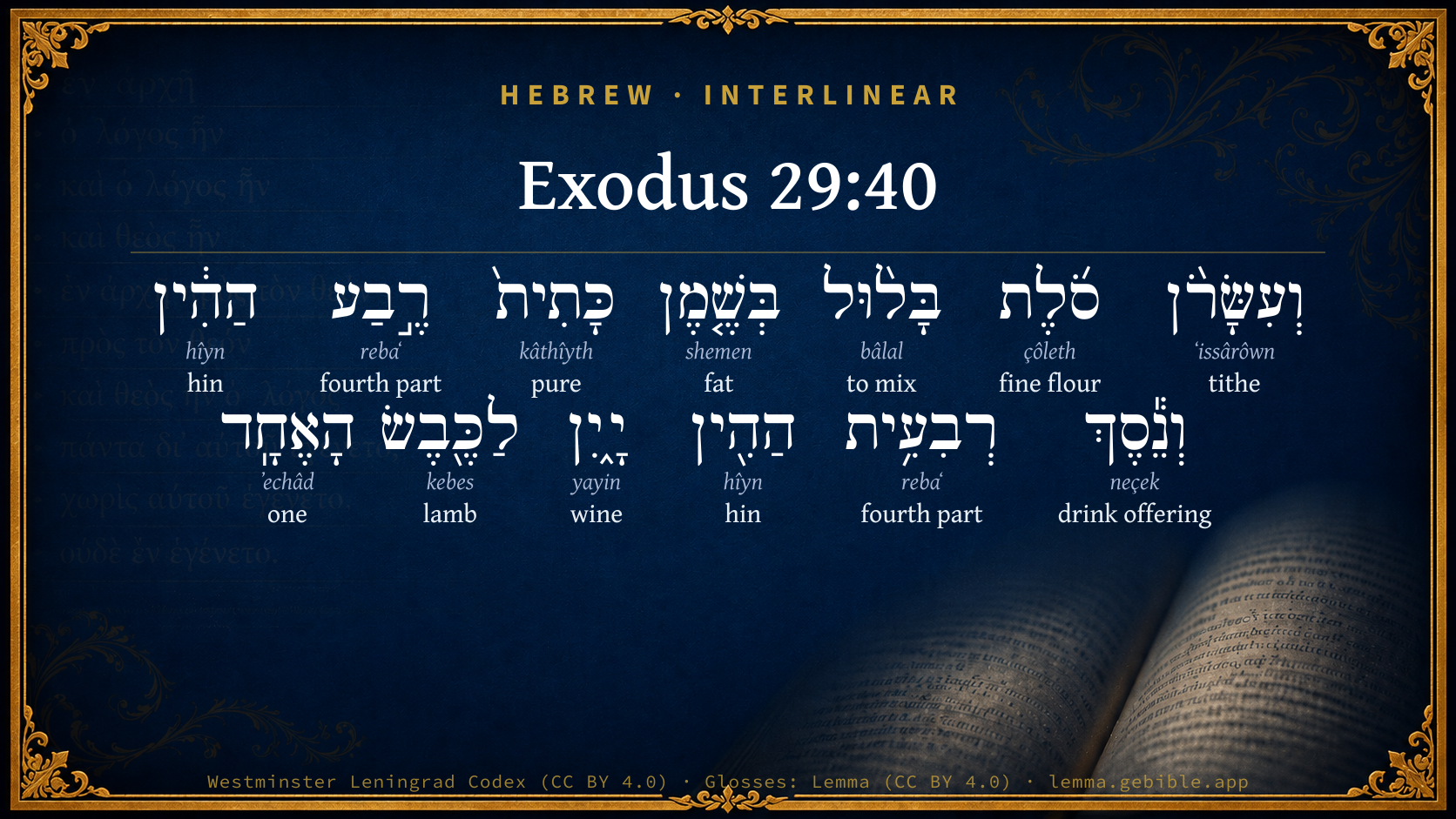
  1. וְעִשָּׂרֹ֨ן ʻissârôwn H6241 “and · tithe” Conjunction + Noun, Common, Masculine, Singular, Absolute
  2. סֹ֜לֶת çôleth H5560 “fine flour” Noun, Common, Feminine, Singular, Absolute
  3. בָּל֨וּל bâlal H1101 “mixed” Verb, Qal, Participle Passive, Masculine, Singular, Absolute
  4. בְּשֶׁ֤מֶן shemen H8081 “in/at · fat” Preposition + Noun, Common, Masculine, Singular, Absolute
  5. רֶ֣בַע rebaʻ H7253 “fourth part of” Noun, Common, Masculine, Singular, Construct
  6. הַהִ֔ין hîyn H1969 “the · hin” Particle, Definite Article + Noun, Common, Masculine, Singular, Absolute
  7. וְנֵ֕סֶךְ neçek H5262 “and · drink offering” Conjunction + Noun, Common, Masculine, Singular, Absolute
  8. רְבִעִ֥ית rebaʻ H7253 “fourth part” Adjective, Ordinal number, Feminine, Singular, Construct
  9. הַהִ֖ין hîyn H1969 “the · hin” Particle, Definite Article + Noun, Common, Masculine, Singular, Absolute
  10. יָ֑יִן yayin H3196 “wine” Noun, Common, Masculine, Singular, Absolute
  11. לַכֶּ֖בֶשׂ kebes H3532 “to/for the · lamb” Preposition, Determined + Noun, Common, Masculine, Singular, Absolute
  12. הָאֶחָֽד ʼechâd H259 “the · one” Particle, Definite Article + Adjective, Cardinal number, Masculine, Singular, Absolute

About this verse

These counts appear in no published source. They are computed here, from the morphology-tagged text and Lemma’s own curated glosses. What Lemma adds →

13
words
11
distinct lemmas
Pentateuch
section

Notable vocabulary

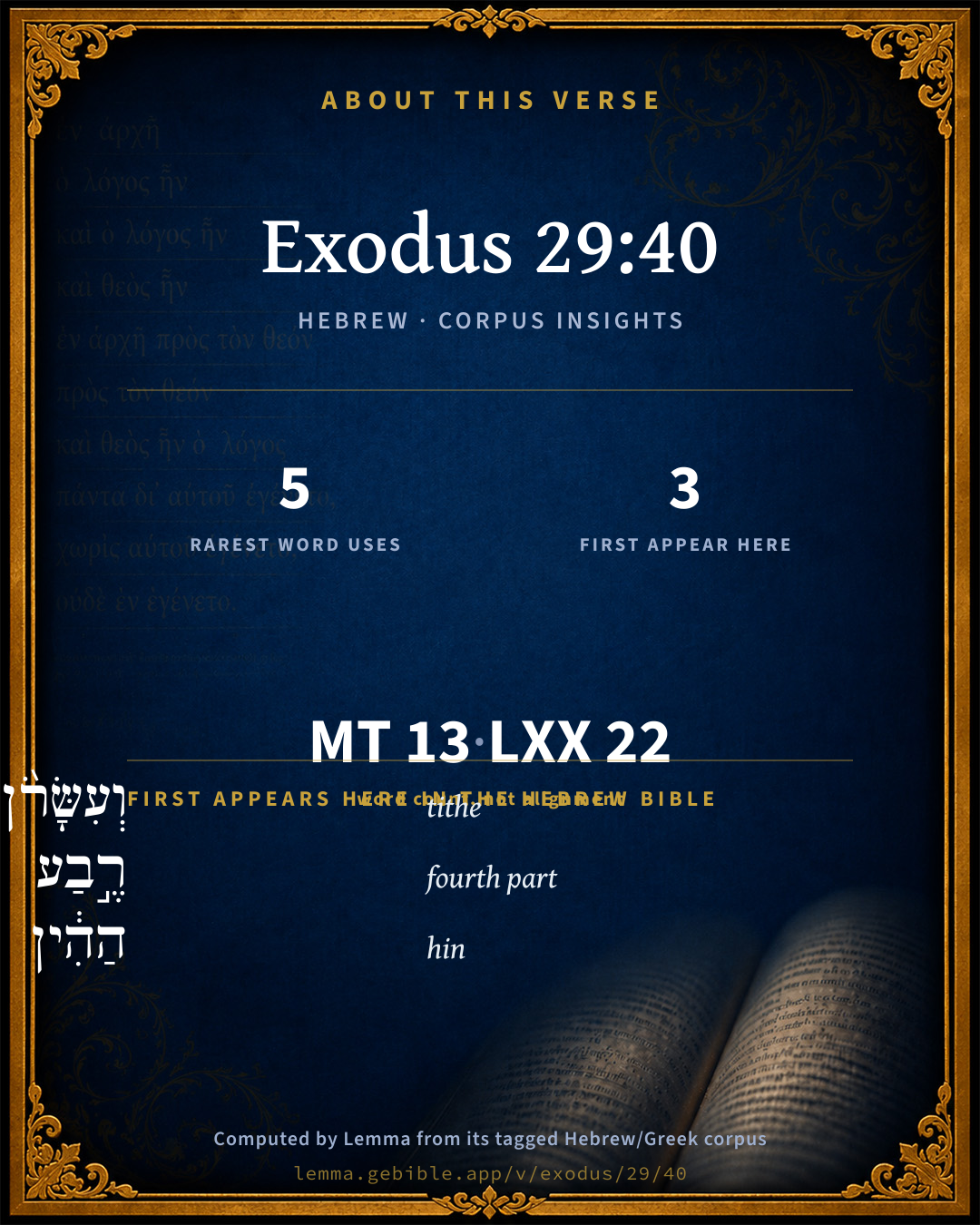
The rarest word here is כָּתִית֙ pure H3795 — appearing just 5 times in the whole Hebrew Bible.

First appearance in Scripture

These words make their first canonical appearance in the Hebrew Bible here:

  • וְעִשָּׂרֹ֨ן tithe H6241
  • רֶ֣בַע fourth part H7253
  • הַהִ֔ין hin H1969

Shared distinctive vocabulary

כָּתִית֙ pure H3795 occurs in 5 verses of the Hebrew Bible. Also found in:

Grammatical profile

  • 1 verb
  • 9 nouns
  • 3 adjectives

Verb forms

  • בָּל֨וּל Qal · Participle Passive

Repetition

Words recur within this verse — often emphatic in Hebrew:

  • רֶ֣בַע fourth part H7253 ×2
  • הַהִ֔ין hin H1969 ×2

Hebrew & Septuagint length

In English translation the verse runs 37 words from the Hebrew and 32 from the Septuagint (LXX English) — closely comparable.

A rough comparison of the two English renderings, which tokenize alike — not a word-level alignment.

Word counts can differ between the Hebrew and the Greek without any difference in meaning — e.g. the Hebrew direct-object marker אֵת has no separate Greek word, and Greek often adds the article ὁ.

In the original languages it is 13 Hebrew tokens and 22 Greek tokens — but the two are counted differently (Hebrew bundles its prefixes and suffixes into one token; the Greek is in lemma form), so that isn’t a like-for-like length.

Cross-references

28

Topical passages linked to Exodus 29:40 in the Treasury of Scripture Knowledge — connected by theme and wording, ordered by reader-vote popularity; previews shown in the World English Bible.

  • Philippians 2:17 Yes, and if I am poured out on the sacrifice and service of your faith, I rejoice, and rejoice with you all.
  • Leviticus 23:13 The meal offering with it shall be two tenth parts of an ephah of fine flour mingled with oil, an offering made by fire to Yahweh for a sweet savor; and the drink offering with it shall be of wine, the fourth part of a hin.
  • Isaiah 57:6 Among the smooth [stones] of the valley is your portion; they, they are your lot; even to them have you poured a drink-offering, you have offered an offering. Shall I be appeased for these things?
  • Ezekiel 45:17 It shall be the prince's part to give the burnt offerings, and the meal-offerings, and the drink-offerings, in the feasts, and on the new moons, and on the Sabbaths, in all the appointed feasts of the house of Israel: he shall prepare the sin-offering, and the meal-offering, and the burnt offering, and the peace-offerings, to make atonement for the house of Israel.
  • Ezekiel 46:14 You shall prepare a meal-offering with it morning by morning, the sixth part of an ephah, and the third part of a hin of oil, to moisten the fine flour; a meal-offering to Yahweh continually by a perpetual ordinance.
  • Joel 2:14 Who knows? He may turn and relent, And leave a blessing behind him, Even a meal offering and a drink offering to Yahweh, your God.
  • Genesis 35:14 Jacob set up a pillar in the place where he spoke with him, a pillar of stone. He poured out a drink-offering on it, and poured oil on it.
  • Exodus 16:36 Now an omer is the tenth part of an ephah.
  • Exodus 30:24 and of cassia five hundred, after the shekel of the sanctuary; and a hin of olive oil.
  • Numbers 6:15–17 and a basket of unleavened bread, cakes of fine flour mixed with oil, and unleavened wafers anointed with oil, and their meal offering, and their drink offerings.
  • Numbers 15:4–5 then shall he who offers his offering offer to Yahweh a meal-offering of a tenth part [of an ephah] of fine flour mixed with the fourth part of a hin of oil:
  • Numbers 15:7 and for the drink-offering you shall offer the third part of a hin of wine, of a sweet savor to Yahweh.
  • Numbers 15:9–10 then shall he offer with the bull a meal-offering of three tenth parts [of an ephah] of fine flour mixed with half a hin of oil:
  • Numbers 15:24 then it shall be, if it be done unwittingly, without the knowledge of the congregation, that all the congregation shall offer one young bull for a burnt offering, for a sweet savor to Yahweh, with the meal-offering of it, and the drink-offering of it, according to the ordinance, and one male goat for a sin-offering.
  • Numbers 28:5 and the tenth part of an ephah of fine flour for a meal-offering, mixed with the fourth part of a hin of beaten oil.
  • Numbers 28:10 this is the burnt offering of every Sabbath, besides the continual burnt-offering, and the drink-offering of it.
  • Numbers 28:13–15 and a tenth part of fine flour mixed with oil for a meal-offering to every lamb; for a burnt offering of a sweet savor, an offering made by fire to Yahweh.
  • Numbers 28:24 After this manner you shall offer daily, for seven days, the food of the offering made by fire, of a sweet savor to Yahweh: it shall be offered besides the continual burnt offering, and the drink-offering of it.
  • Numbers 29:16 and one male goat for a sin-offering, besides the continual burnt offering, the meal-offering of it, and the drink-offering of it.
  • Deuteronomy 32:38 Which ate the fat of their sacrifices, And drank the wine of their drink-offering? Let them rise up and help you, Let them be your protection.
  • Ezekiel 4:11 You shall drink water by measure, the sixth part of a hin: from time to time shall you drink.
  • Ezekiel 20:28 For when I had brought them into the land, which I swore to give to them, then they saw every high hill, and every thick tree, and they offered there their sacrifices, and there they presented the provocation of their offering; there also they made their sweet savor, and they poured out there their drink-offerings.
  • Ezekiel 45:24 He shall prepare a meal-offering, an ephah for a bull, and an ephah for a ram, and a hin of oil to an ephah.
  • Ezekiel 46:5 and the meal-offering shall be an ephah for the ram, and the meal-offering for the lambs as he is able to give, and a hin of oil to an ephah.
  • Ezekiel 46:7 and he shall prepare a meal-offering, an ephah for the bull, and an ephah for the ram, and for the lambs according as he is able, and a hin of oil to an ephah.
  • Ezekiel 46:11 In the feasts and in the solemnities the meal-offering shall be an ephah for a bull, and an ephah for a ram, and for the lambs as he is able to give, and a hin of oil to an ephah.
  • Joel 1:9 The meal offering and the drink offering are cut off from Yahweh's house. The priests, Yahweh's ministers, mourn.
  • Joel 1:13 Put on sackcloth and mourn, you priests! Wail, you ministers of the altar. Come, lie all night in sackcloth, you ministers of my God, For the meal offering and the drink offering are withheld from your God's house.

Cross-references courtesy of OpenBible.info (CC BY 4.0).

Hebrew and Greek witnesses Masoretic Hebrew ↔ Greek Septuagint

The same verse in the two great witnesses to the Old Testament, shown verse-for-verse.

These are two independent witnesses, not word-aligned to each other, and the Septuagint is shown in lemma (dictionary) form.

Hebrew Exodus 29:40 Masoretic · Westminster Leningrad Codex

וְעִשָּׂרֹ֨ן סֹ֜לֶת בָּל֨וּל בְּשֶׁ֤מֶן כָּתִית֙ רֶ֣בַע הַהִ֔ין וְנֵ֕סֶךְ רְבִעִ֥ית הַהִ֖ין יָ֑יִן לַכֶּ֖בֶשׂ הָאֶחָֽד

and with the one lamb a tenth part of an ephah of fine flour mixed with the fourth part of a hin of beaten oil, and the fourth part of a hin of wine for a drink-offering.

World English Bible · Public Domain

Greek LXX Exodus 29:40 Septuagint · lemma form

καί δέκατος σεμίδαλις φυράω ἐν ἔλαιον κόπτω ὁ τέταρτος ὁ ιν καί σπονδή ὁ τέταρτος ὁ ιν οἶνος ὁ ἀμνός ὁ εἷς

And a tenth measure of fine flour mingled with the fourth part of an hin of beaten oil, and a drink-offering the fourth part of a hin of wine for one lamb.

LXX2012 (modern English Septuagint) · Public Domain

Hebrew: Westminster Leningrad Codex (CC BY 4.0). Greek: Septuagint (public domain); English from LXX2012 (modern English Septuagint) (Public Domain). How the Septuagint differs from the Hebrew →

Targum (Aramaic paraphrase)

2

The Targum is the ancient Jewish Aramaic paraphrase of the Hebrew Scriptures — an interpretive translation, not the Hebrew text itself. Onkelos (literal) and Pseudo-Jonathan (expansive) render the Torah, and Jonathan the Prophets. Coverage is partial: where no permissively-licensed English translation exists for a verse, only the Aramaic is shown. This is verse-level text, not a word-by-word alignment to the Hebrew.

  1. Targum Onkelos Torah (Genesis–Deuteronomy)
    וְעִסְרוֹנָא סֻלְתָּא דְפִילָא בִמְשַׁח כָּתִישָׁא רַבְעוּת הִינָא וְנִסְכָּא רַבְעוּת הִינָא חַמְרָא לְאִמְרָא חָד:

    (no public-domain English translation for this verse)

    Targum Onkelos — Aramaic: “Onkelos Genesis” (public domain); “Onkelos Exodus” (public domain); “Onkelos Leviticus” (public domain); “Onkelos Numbers” (public domain); “Onkelos Deuteronomy” (public domain). English: “Sefaria Community Translation” (CC0 1.0 (public-domain dedication)); “J.W. Etheridge. The Targums of Onkelos and Jonathan Ben Uzziel on the Pentateuch. London: Longmans, Green, 1862” (public domain). Text via Sefaria.

  2. Targum Pseudo-Jonathan Torah (Genesis–Deuteronomy)
    וְעִשְרוֹנָא סְמִידָא פָּתִיךְ בִּמְשַׁח זֵיתָא כְּתִישָׁא רַבְעוּת הִינָא וְנִיסוּכָא רַבְעוּת הִינָא חַמְרָא לְאִימְרָא חָד

    And the tenth of flour mingled with oil of olives beaten; (with) the fourth of a hina, and the libation of a fourth of a hina for the one lamb.

    Targum Pseudo-Jonathan — Aramaic: “Targum Jonathan on Genesis” (public domain); “Targum Jonathan on Exodus” (public domain); “Targum Jonathan on Leviticus” (public domain); “Targum Jonathan on Numbers” (public domain); “Targum Jonathan on Deuteronomy” (public domain). English: “The Targum of Jonathan ben Uzziel, trans. J. W. Etheridge, London, 1862” (public domain). Text via Sefaria.

Commentary

Notes on Exodus 29:40 from classic Christian and Jewish commentators (each source and its license shown beneath its notes). The classic Christian expositions comment on the surrounding passage and are grouped to its opening verse, so a note may address several verses; the Jewish commentaries on the Tanakh (Rashi and others) are per-verse, so they appear only where the commentator wrote on this verse.

Lemma curates 59 commentaries, every one of them public domain or Creative Commons licensed, each selected and text-cleaned for this edition rather than reprinted as found. About our sources →

Joseph Benson's Commentary

Exo 29:40. A tenth-deal, or tenth part of an ephah, is about three quarts. A hin is five quarts.

Joseph Benson's Commentary on the Old and New Testaments (1811–1818) — public domain. Text from a community e-Sword module.

Geneva Bible (1599)

Geneva Bible translators

Which is about a pint.

That is, an Omer, read Exod. 16:16.

Geneva Bible (1599) marginal notes — public domain. Text via Bolls.life.

Adam Clarke's Commentary

Verse 40. A tenth deal of flour] Deal signifies a part, from the Anglo-Saxon [Anglo-Saxon], to divide; hence [Anglo-Saxon], a part, a portion taken from the whole. From Nu 28:5 we learn that this tenth deal was the tenth part of an ephah, which constituted what is called an omer. See Ex 16:36; and See Clarke on Ex 16:16 of the same chapter, where an account is given of different measures of capacity among the Hebrews. The omer contained about three quarts English.

The fourth part of a hin] The hin contained one gallon and two pints. The fourth part of this was about one quart and a half of a pint.

Drink-offering.] A libation poured out before the Lord. See its meaning, Le 7:1, &c.

Adam Clarke's Commentary on the Bible (1810–1826) — public domain. Text from a community e-Sword/MySword module.

The Cambridge Bible for Schools and Colleges

gen. ed. J. J. S. Perowne

40. The minḥâh, or ‘meal-offering’ (see Leviticus 2), as it is expressly termed in the || Num_28:5, which in P is the regular concomitant of a burnt-offering (see Num_15:1-12; and cf. Num_28:9; Num_28:12-13, &c.).

a tenth part (of an ephah)] Heb. ‘issârôn, only in P (28 times). The ephah was probably about 8 gallons, so the ‘issârôn would be about 6½ pints (see further Kennedy, in DB. iv. 912b, near the bottom).

fine flour] Gen_18:6 and often: as the material of a meal-offering Lev_2:1; Lev_2:4-5; Lev_2:7, and elsewhere.

mingled with … oil] as v. 2, Lev_2:4-5 al. A ‘hin’ (Jos. Ant. iii. 8. 3) was 1/6 of the ‘bath’ (the equivalent for liquid measure of the ephah for dry measure, Eze_45:11) = about 1⅓ gallon; ¼ of a hin would thus be about 2⅔ pints. For the oil of superior quality called beaten oil, see on Exo_27:20 : this is the only minḥâh for which it is prescribed.

a drink offering] or libation; also a frequent concomitant of the burnt-offering (Num_15:5; Num_15:7; Num_15:10; cf. Num_28:9; Num_28:14; Num_29:18; Num_29:21, &c.). According to Sir_50:15 it was poured out at the base of the altar. The amount, ¼ hin for a lamb, is the same as in Num_15:5; Num_28:14; for larger animals the amount was greater.

The Cambridge Bible for Schools and Colleges (gen. ed. J. J. S. Perowne; Cambridge University Press, 1878–1918) — public domain. Text from a community e-Sword module.

John Gill's Exposition

And with the one lamb a tenth deal,.... That is, the tenth part of an "ephah", as Jarchi and Aben Ezra, which is an "omer", and held as much as a man could eat in one day, or more, see Exo 16:18,

of flour mingled with the fourth part of an hin of beaten oil; this was a meat, or, rather bread offering, which went along with the daily sacrifice, and typified Christ the food of his people, who is compared to a corn of wheat; is the finest of the wheat, and the bread of God, which came down from heaven, and gives life, food; and nourishment to men; and the "beaten oil" may signify the graces of the Spirit in him, and the exercise of them through the many trials and sufferings he endured, and which make him savoury food to his people, as a crucified Christ is:

and the fourth part of a hin of wine for a drink offering; a "hin", Aben Ezra says, was an Egyptian measure, but what reason he had for it does not appear; according to Ainsworth, the fourth part of it was a pint and a half; but according to Bishop Cumberland (n), who has with great exactness calculated the Jewish measures, it was a quart and above half a pint; this was poured out upon the altar. Jarchi says there were two silver basins on the top of the altar, and there were bored in them like two small nostrils, and wine was put in the middle of them; and it flowed and went out by the way of the nostrils, and fell upon the top of the altar, and from thence descended to the bottom: this wine poured may either signify the blood of Christ shed, or poured out for the remission of sin; or the love of Christ very plentifully manifested in the offering up of himself for men, and the acceptableness of to God: and, moreover, as sacrifices are called the bread of God, and he makes as it were a feast of them, feeding on them with delight and pleasure, it was necessary there should be wine to complete the banquet; wherefore wine is said to cheer both God and man, Jdg 9:13, alluding to the libations of wine in sacrifices.

(n) Of Scripture Weights and Measures, c. 3. p. 86.

John Gill's Exposition of the Whole Bible (1746–1763) — public domain (CC PDM 1.0). Text via the HelloAO Bible API.

Haydock's Catholic Bible Commentary

Part of an epha, half of which was used in each sacrifice.

George Leo Haydock (1774–1849), Haydock's Catholic Family Bible and Commentary, 1859 edition — public domain. Excludes Psalms (Douay-Rheims chapter numbering differs from Protestant) and Deuterocanonical books (Catholic canon only).

Matthew Poole's English Annotations

A tenth deal; the tenth part of an ephah, as is evident from Num 28:5, which is an omer, Exo 16:36.

An hin was a measure for liquid things, as the ephah was for dry things, containing six pints of our measure.

Matthew Poole's English Annotations on the Holy Bible (1683–1685) — public domain. Text from a community e-Sword/MySword module.

Whedon's Commentary on the Bible

Daniel D. Whedon

40. A tenth deal of flour — The tenth part of an ephah is probably meant, which was an omer. See Exo_16:36, note. Compare Num_5:15. Supposed to have been about three pounds in weight and not far from three quarts in measure. The hin was a liquid measure containing a little more than a gallon. The flour mingled with the beaten oil (Exo_27:20) constituted the meat offering, on which see notes at Leviticus 2, and the wine is here expressly called a drink offering. This was a form of worship old as the days of the patriarchs, (see on Gen_35:14,) and consisted in a devotional pouring out the wine as an oblation before or upon the altar of burnt offerings. It was not to be poured out on the altar of incense, (Exo_30:9.)

Daniel D. Whedon (gen. ed.), Commentary on the Old and New Testaments (1874–1909) — public domain. Text from a community e-Sword module.

The Pulpit Commentary

A tenth deali.e. , a "tenth part." The tenth part of an ephah is no doubt meant. This was sometimes called "an omen", (Exo_16:36) and would be about three pounds weight of flour, or a little more. One fourth part of a hin of beaten oil. The word hin is said to be Egyptian. It occurs here for the first time. The bin was the sixth part of a bath, and probably contained about one pint and a half English. The fourth part of a hin of wine for a drink-offering. The application of the "drink-offerings" is uncertain. Josephus says (Ant. Jud: 3:9, that they were poured out round the brazen altar. But the analogy of the "meat offering" makes it probable that a portion only was thus treated, while the greater part belonged to the priests. In the entire provision by which burnt and peace-offering were to be necessarily accompanied with meat-offerings and drink-offerings, we can scarcely be wrong in seeing an arrangement made especially for the convenience of the priests.

The Pulpit Commentary (1880–1919), ed. H.D.M. Spence-Jones & Joseph S. Exell — public domain. Text from a community e-Sword module.

John Wesley's Explanatory Notes

A tenth deal, or tenth part of an ephah, is about three quarts. A hin is five quarts.

John Wesley, Explanatory Notes Upon the Whole Bible (1754–1765) — public domain. Text via the GEBible commentary corpus.

unfoldingWord translationNotes

Door43 World Missions Community

General Information:

Yahweh continues speaking to Moses.

a tenth ... the fourth part

"1/10 ... 1/4" (See: Fractions)

ephah

An ephah is 22 liters. (See: Biblical Volume)

hin

A hin is 3.7 liters. (See: Biblical Volume)

translationWords

lamb

tenth

oil

olive

wine

drink offering

unfoldingWord translationNotes — © Distant Shores Media and the Door43 World Missions Community, licensed CC BY-SA 4.0. Source: git.door43.org/Door43/en_tn.

Rashi

Rabbi Shlomo Yitzchaki (Rashi)

ועשרן סלת A TENTH DEAL OF FLOUR — i. e. a tenth part of an ephah: a capacity of forty three and a fifth eggs (cf. Rashi on Exodus 16:36).

בשמן כתית [MINGLED] WITH OIL, BEATEN — Not to make this obligatory is it stated “beaten” but to make it lawful if such oil be at all used. Since it is stated, (Exodus 27:20) “beaten for the light” and the implication is that for the light it must be beaten and not for the meal-offerings, one might think that this is expressly stated in order to declare it unfitting for the meal-offerings; therefore it states here “beaten”, meaning that for the meal-offerings beaten oil may be used if one so wishes. And it is stated “beaten for the light”, only to exclude the meal-offerings from the command: that beaten oil is not obligatory for them — that oil obtained from olives ground in a mill is also permissible for them (Menachot 86b).

רבע ההין THE FOURTH PART OF A HIN — three logs.

ונסך AND A LIBATION — for the bowls, as we learn in Treatise Sukkah 48a: there were two silver bowls above the altar pierced with holes, as it were like two slender nostrils. He poured the wine into these and it ran through and gushed forth by way of this “nostril”, falling upon the top of the altar. Thence it ran down into the subterranean channels in the case of the altar in the Temple, but in the case of the copper altar in the Tabernacle it ran down from the altar to the ground.

Rashi on the Tanakh — English translations: “The Judaica Press complete Tanach with Rashi, translated by A. J. Rosenberg” (CC BY 4.0); “Pentateuch with Rashi's commentary by M. Rosenbaum and A.M. Silbermann, 1929-1934” (public domain); “The Metsudah Tanach series, Lakewood, N.J” (CC BY 4.0); and “The Book of Joshua, Metsudah Publications, 1997” (CC BY 4.0). Text via Sefaria.

Lesson kit

Teaching starters — assembled from the data on this page, not authored interpretation. Every prompt links to the verse data it draws on. Edit before teaching.

Exodus, in the Pentateuch, opens this verse with 13 words (11 distinct Hebrew lemmas). Its most distinctive word is kâthîyth (“pure”). A historical commentator’s framing appears above. Read the whole chapter for the surrounding context.

Discussion questions

  1. The word kâthîyth carries the sense “pure.” How does it shape the verse?
  2. 3 words make their first appearance in Scripture here. What does this debut establish?
  3. How does Exodus 27:20, which shares the word «pure», read alongside this verse?
  4. What does the repetition of “fourth part” (2× in this one verse) do in this verse?
  5. These translations render this verse differently. What is at stake in choosing one wording over another?
  6. «בָּל֨וּל» is a Qal Participle Passive verb. How does that grammatical form shape the action described?
  7. Compare how Joseph Benson's Commentary and Geneva Bible (1599) read this verse. Where do they agree or differ?

Things to notice

Reading settings

Reading text

Shown beneath each verse's original-language words.

Old Testament
Old Testament edition

Read the OT as the Masoretic Hebrew (MT) or the Greek Septuagint (LXX).

English shown for the Greek Septuagint (in the Hebrew ↔ Greek comparison).

Comparing translations? Open the Compare panel on any verse page to stack up to four side by side.