Leviticus 8:10

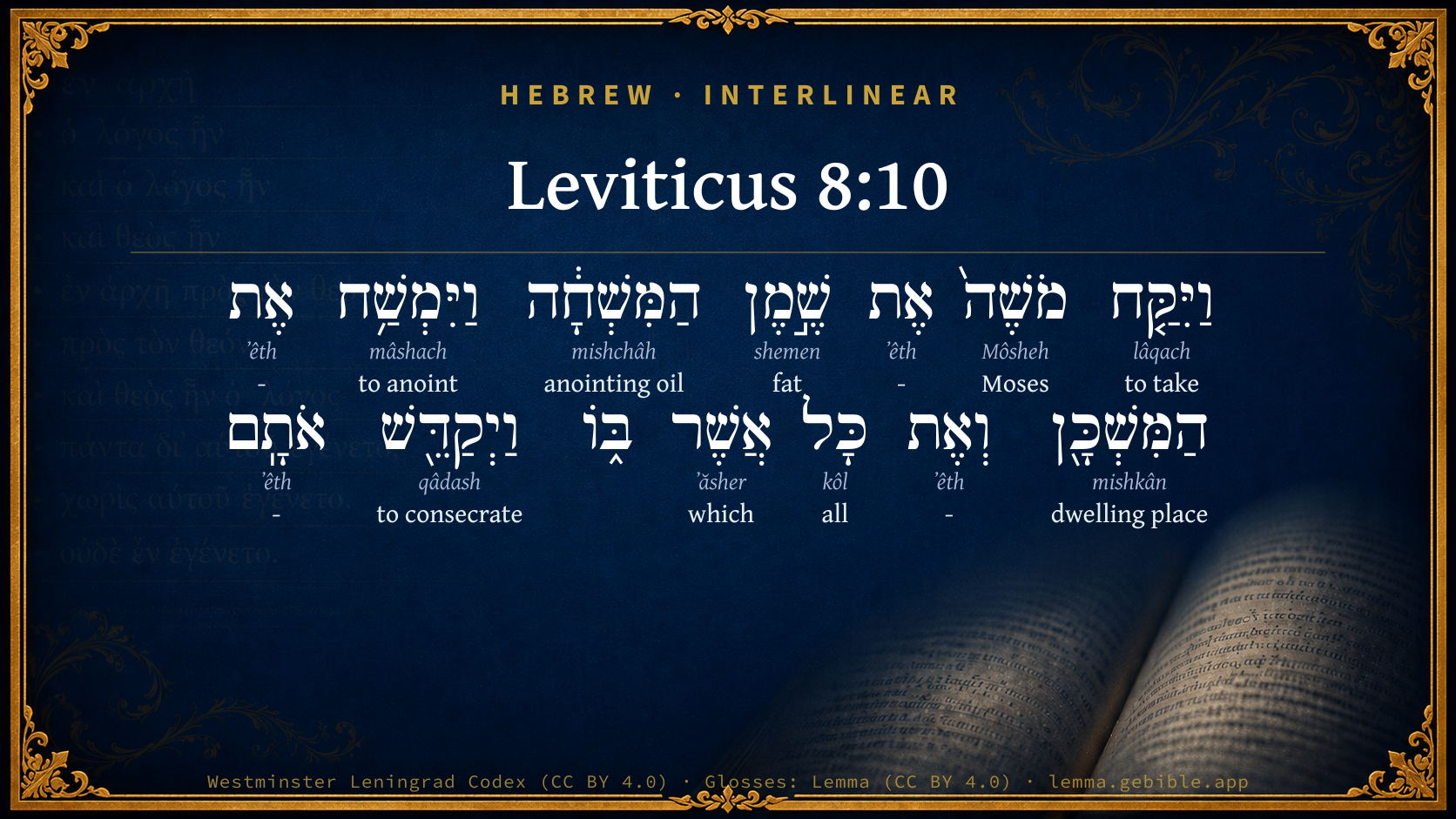
Hebrew (Westminster Leningrad Codex) Leviticus 8:10 appears in the Hebrew Old Testament. The text above is from the Westminster Leningrad Codex. Each word links to its Strong’s number, a concise gloss, and parsing drawn from the Open Scriptures Hebrew Bible morphology. Click any word for its full Brown-Driver-Briggs (BDB) entry.
Download image
Cite this verse

Leviticus 8:10 (World English Bible). Public Domain. Lemma interlinear Bible study tool, https://lemma.gebible.app/v/leviticus/8/10.

Show BibTeX & RIS
BibTeX
RIS
English Translation
Moses took the anointing oil, and anointed the tabernacle and all that was in it, and sanctified them.
World English Bible · Public Domain
Download a study sheet

One document with this verse’s original text, its word-by-word gloss line, the meaning frame, cross-references with their text, attributed commentary, and full source and license credits — printable, and it pastes into notes with its structure intact.

This verse Autodidact and up

Study sheet (.html) Plain text (.txt)

A passage Seminary Student

Up to 50 verses in one chapter. A passage sheet keeps up to 6 commentary sources and 12 cross-references per verse, in the order this page ranks them, and says so on the sheet whenever that leaves anything out. Ask for a single verse and you get the Autodidact verse sheet above.

Everything on this page stays free to read, with no account — the sheet is a download of what is already on screen, not access to it.

Want to remove ads? Support Godless Engineer
Compare translations 3

The same verse in 3 English versions, stacked beneath the original-language interlinear above. Click any original word for its lexicon entry.

Each is an independent rendering of the whole verse — the interlinear is not word-aligned to these translations.

Highlighted words mark where these versions differ — a whole-verse word diff, not a word-by-word alignment.

  • World English Bible Public Domain
    Moses took the anointing oil, and anointed the tabernacle and all that was in it, and sanctified them.
  • King James Version Public Domain
    And Moses took the anointing oil, and anointed the tabernacle and all that was therein, and sanctified them.
  • unfoldingWord Literal Text CC BY-SA 4.0
    And Moses took the oil of anointing, and he anointed the Dwelling and all that in it. And he consecrated them.

unfoldingWord Literal Text — © unfoldingWord, licensed CC BY-SA 4.0. Word-aligned USFM3 via Door43 (git.door43.org/unfoldingWord/en_ult).

Versions to compare (up to 4)

3 of 4 selected

Show all 18 translations

Every available English version of this verse, each an independent rendering of the whole verse.

  • World English Bible Public Domain
    Moses took the anointing oil, and anointed the tabernacle and all that was in it, and sanctified them.
  • Berean Standard Bible Public Domain
    Next, Moses took the anointing oil and anointed the tabernacle and everything in it; and so he consecrated them.
  • Majority Standard Bible Public Domain
    Next, Moses took the anointing oil and anointed the tabernacle and everything in it; and so he consecrated them.
  • King James Version Public Domain
    And Moses took the anointing oil, and anointed the tabernacle and all that was therein, and sanctified them.
  • American Standard Version (1901) Public Domain
    And Moses took the anointing oil, and anointed the tabernacle and all that was therein, and sanctified them.
  • Revised Version (1885) Public Domain
    And Moses took the anointing oil, and anointed the tabernacle and all that was therein, and sanctified them.
  • Geneva Bible (1599) Public Domain
    (Nowe Moses had taken the anointing oyle, and anoynted the Tabernacle, and al that was therein, and sanctified them,
  • Douay-Rheims (1899) Public Domain
    He took also the oil of unction, with which he anointed the tabernacle, with all the furniture thereof.
  • Young's Literal Translation Public Domain
    And Moses taketh the anointing oil, and anointeth the tabernacle, and all that `is' in it, and sanctifieth them;
  • Literal Standard Version CC BY-SA 4.0
    And Moses takes the anointing oil, and anoints the Dwelling Place, and all that [is] in it, and sanctifies them;
  • Unlocked Literal Bible CC BY-SA 4.0
    Moses took the anointing oil, anointed the tabernacle and everything in it and set them apart to Yahweh.
  • unfoldingWord Literal Text CC BY-SA 4.0
    And Moses took the oil of anointing, and he anointed the Dwelling and all that in it. And he consecrated them.
  • Darby Bible Public Domain
    And Moses took the anointing oil, and anointed the tabernacle and all that was in it, and hallowed them.
  • World Messianic Bible Public Domain
    Moses took the anointing oil, and anointed the tabernacle and all that was in it, and sanctified them.
  • Webster's Bible Public Domain
    And Moses took the anointing oil, and anointed the tabernacle and all that was in it, and sanctified them.
  • Free Bible Version CC BY-SA 4.0
    Then Moses took the anointing oil and anointed the Tabernacle and everything in it to dedicate it all.
  • Bible in Basic English Public Domain
    And Moses took the holy oil and put it on the House and on all the things in it, to make them holy.
  • JPS Tanakh (1917) Public Domain
    And Moses took the anointing oil, and anointed the tabernacle and all that was therein, and sanctified them.

Literal Standard Version (2020), Covenant Press — licensed CC BY-SA 4.0. Text via the HelloAO Bible API (eBible.org). Unlocked Literal Bible (unfoldingWord) — licensed CC BY-SA 4.0. Text via the HelloAO Bible API (eBible.org). unfoldingWord Literal Text — © unfoldingWord, licensed CC BY-SA 4.0. Word-aligned USFM3 via Door43 (git.door43.org/unfoldingWord/en_ult). Free Bible Version, Dr. Jonathan Gallagher — licensed CC BY-SA 4.0. Text via the HelloAO Bible API (eBible.org).

Word by word

More ways to search: Search by grammar → Find every occurrence → Compare this word →

Practice this passage: Drill this verse → Learn its vocabulary →

הַמִּשְׁחָ֔ה
mishchâh
H4888
“the · anointing oil”
Particle, Definite Article + Noun, Common, Feminine, Singular, Absolute
Part of Speech
Particle + Noun
Type
Common
Gender
Feminine
Number
Singular
State
Absolute
Full BDB Definition

Origin: from H4886

TWOT: 1255a , 1255b

consecrated portion, anointing oil, portion, ointment, anointing portion - ointment (used to consecrate by anointing) - anointing portion
  1. וַיִּקַּ֤ח lâqach H3947 “and · to take” Conjunction + Verb, Qal, Sequential Imperfect, 3rd Person, Masculine, Singular
  2. מֹשֶׁה֙ Môsheh H4872 “Moses” Noun, Proper
  3. אֶת ʼêth H853 “-” Particle, Direct Object
  4. שֶׁ֣מֶן shemen H8081 “fat of” Noun, Common, Masculine, Singular, Construct
  5. וַיִּמְשַׁ֥ח mâshach H4886 “and · to anoint” Conjunction + Verb, Qal, Sequential Imperfect, 3rd Person, Masculine, Singular
  6. אֶת ʼêth H853 “-” Particle, Direct Object
  7. הַמִּשְׁכָּ֖ן mishkân H4908 “the · dwelling place” Particle, Definite Article + Noun, Common, Masculine, Singular, Absolute
  8. וְאֶת ʼêth H853 “and · -” Conjunction + Particle, Direct Object
  9. כָּל kôl H3605 “all of” Noun, Common, Masculine, Singular, Construct
  10. אֲשֶׁר ʼăsher H834 “which” Particle, Relative
  11. וַיְקַדֵּ֖שׁ qâdash H6942 “and · to consecrate” Conjunction + Verb, Piel, Sequential Imperfect, 3rd Person, Masculine, Singular
  12. אֹתָֽם ʼêth H853 “- · them” Particle, Direct Object + Suffix, Personal, 3rd Person, Masculine, Plural

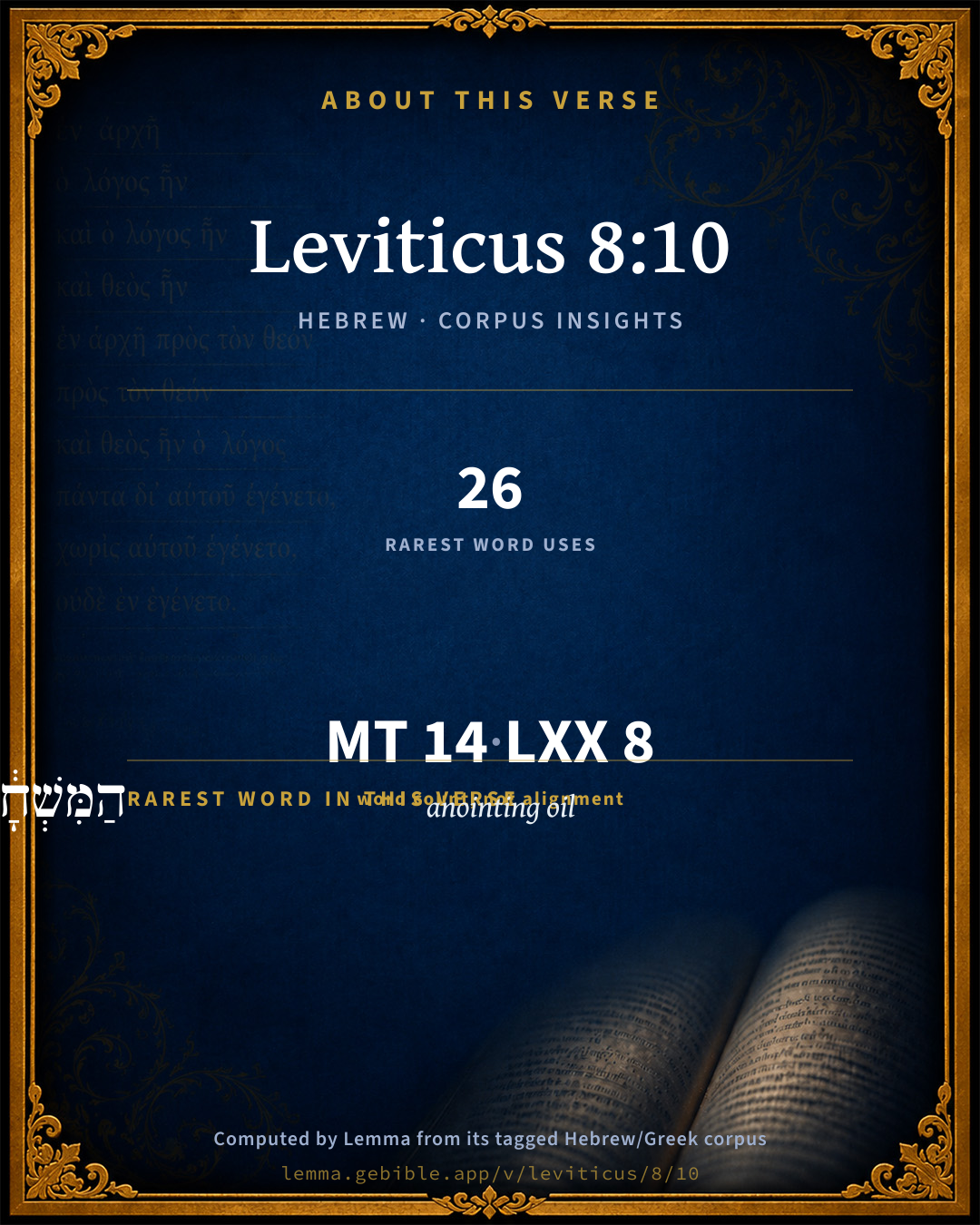
About this verse

These counts appear in no published source. They are computed here, from the morphology-tagged text and Lemma’s own curated glosses. What Lemma adds →

14
words
10
distinct lemmas
Pentateuch
section

Shared distinctive vocabulary

הַמִּשְׁחָ֔ה anointing oil H4888 occurs in 24 verses of the Hebrew Bible. Also found in:

Grammatical profile

  • 3 verbs
  • 5 nouns
  • 1 preposition
  • 5 particles

Verb forms

  • וַיִּקַּ֤ח Qal · Sequential Imperfect
  • וַיִּמְשַׁ֥ח Qal · Sequential Imperfect
  • וַיְקַדֵּ֖שׁ Piel · Sequential Imperfect

Hebrew & Septuagint length

In English translation the verse runs 18 words from the Hebrew and 7 from the Septuagint (LXX English) — the Septuagint runs noticeably shorter here. See the side-by-side →

A rough comparison of the two English renderings, which tokenize alike — not a word-level alignment.

Word counts can differ between the Hebrew and the Greek without any difference in meaning — e.g. the Hebrew direct-object marker אֵת has no separate Greek word, and Greek often adds the article ὁ.

In the original languages it is 14 Hebrew tokens and 8 Greek tokens — but the two are counted differently (Hebrew bundles its prefixes and suffixes into one token; the Greek is in lemma form), so that isn’t a like-for-like length.

Cross-references

3

Topical passages linked to Leviticus 8:10 in the Treasury of Scripture Knowledge — connected by theme and wording, ordered by reader-vote popularity; previews shown in the World English Bible.

  • Exodus 40:9–11 You shall take the anointing oil, and anoint the tent, and all that is in it, and shall make it holy, and all its furniture: and it will be holy.
  • Exodus 30:23–29 "Also take fine spices: of liquid myrrh, five hundred shekels; and of fragrant cinnamon half as much, even two hundred and fifty; and of fragrant cane, two hundred and fifty;
  • Leviticus 8:2 "Take Aaron and his sons with him, and the garments, and the anointing oil, and the bull of the sin offering, and the two rams, and the basket of unleavened bread;

Cross-references courtesy of OpenBible.info (CC BY 4.0).

Hebrew and Greek witnesses Masoretic Hebrew ↔ Greek Septuagint

The same verse in the two great witnesses to the Old Testament, shown verse-for-verse.

Here the Septuagint runs noticeably shorter than the Hebrew — LXX2012 (modern English Septuagint) 7 words vs World English Bible 18. A rough length comparison of the two English translations, not a word-level alignment — read both below.

These are two independent witnesses, not word-aligned to each other, and the Septuagint is shown in lemma (dictionary) form.

Hebrew Leviticus 8:10 Masoretic · Westminster Leningrad Codex

וַיִּקַּ֤ח מֹשֶׁה֙ אֶת שֶׁ֣מֶן הַמִּשְׁחָ֔ה וַיִּמְשַׁ֥ח אֶת הַמִּשְׁכָּ֖ן וְאֶת כָּל אֲשֶׁר בּ֑וֹ וַיְקַדֵּ֖שׁ אֹתָֽם

Moses took the anointing oil, and anointed the tabernacle and all that was in it, and sanctified them.

World English Bible · Public Domain

Greek LXX Leviticus 8:10 Septuagint · lemma form

καί λαμβάνω μωυσῆς ἀπό ὁ ἔλαιον ὁ χρῖσις

And Moses took of the anointing oil,

LXX2012 (modern English Septuagint) · Public Domain

On this verse, The Cambridge Bible for Schools and Colleges discusses the Septuagint’s reading. Read the note in Commentary ↓

Hebrew: Westminster Leningrad Codex (CC BY 4.0). Greek: Septuagint (public domain); English from LXX2012 (modern English Septuagint) (Public Domain). How the Septuagint differs from the Hebrew →

Targum (Aramaic paraphrase)

2

The Targum is the ancient Jewish Aramaic paraphrase of the Hebrew Scriptures — an interpretive translation, not the Hebrew text itself. Onkelos (literal) and Pseudo-Jonathan (expansive) render the Torah, and Jonathan the Prophets. Coverage is partial: where no permissively-licensed English translation exists for a verse, only the Aramaic is shown. This is verse-level text, not a word-by-word alignment to the Hebrew.

  1. Targum Onkelos Torah (Genesis–Deuteronomy)
    וּנְסִיב מֹשֶׁה יָתּ מִשְׁחָא דִרְבוּתָא וְרַבִּי יָת מַשְׁכְּנָא וְיָת כָּל דִי בֵהּ וְקַדִישׁ יָתְהוֹן

    (no public-domain English translation for this verse)

    Targum Onkelos — Aramaic: “Onkelos Genesis” (public domain); “Onkelos Exodus” (public domain); “Onkelos Leviticus” (public domain); “Onkelos Numbers” (public domain); “Onkelos Deuteronomy” (public domain). English: “Sefaria Community Translation” (CC0 1.0 (public-domain dedication)); “J.W. Etheridge. The Targums of Onkelos and Jonathan Ben Uzziel on the Pentateuch. London: Longmans, Green, 1862” (public domain). Text via Sefaria.

  2. Targum Pseudo-Jonathan Torah (Genesis–Deuteronomy)
    וּנְסֵיב משֶׁה יַת מִשְׁחָא דִרְבוּתָא וְרַבֵּי יַת מַשְׁכְּנָא וְיַת כָּל דְבֵיהּ וְקַדִישׁ יָתֵיהּ

    And Mosheh took the oil of consecration, and anointed the tabernacle, and sanctified it.

    Targum Pseudo-Jonathan — Aramaic: “Targum Jonathan on Genesis” (public domain); “Targum Jonathan on Exodus” (public domain); “Targum Jonathan on Leviticus” (public domain); “Targum Jonathan on Numbers” (public domain); “Targum Jonathan on Deuteronomy” (public domain). English: “The Targum of Jonathan ben Uzziel, trans. J. W. Etheridge, London, 1862” (public domain). Text via Sefaria.

Commentary

Notes on Leviticus 8:10 from classic Christian and Jewish commentators (each source and its license shown beneath its notes). The classic Christian expositions comment on the surrounding passage and are grouped to its opening verse, so a note may address several verses; the Jewish commentaries on the Tanakh (Rashi and others) are per-verse, so they appear only where the commentator wrote on this verse.

Lemma curates 59 commentaries, every one of them public domain or Creative Commons licensed, each selected and text-cleaned for this edition rather than reprinted as found. About our sources →

The Cambridge Bible for Schools and Colleges

gen. ed. J. J. S. Perowne

10. Probably an interpolation, as (1) there is no parallel for it in Exodus 29, and (2) the LXX. places Lev_8:10 b after Lev_8:11.

10–12. (c) anointing. The first definite variation from Exodus 29 is found in these verses. Exo_29:7 contains the command: ‘Then shall thou take the anointing oil, and pour it upon his head, and anoint him.’ To this correspond the opening words of Lev_8:10, ‘And Moses took the anointing oil …’ and Lev_8:12, ‘And he poured of the anointing oil upon Aaron’s head, and anointed him.’ The clauses of Lev_8:10-11 which intervene, record the anointing of the tabernacle, the altar, and the laver, in words closely parallel to those of Exo_40:9-11. Other passages which refer to the ceremony of anointing are: Exo_29:7 (referring to Aaron only), Exo_29:36 (to the altar), Exo_30:26-29 (a full list of things to be anointed) and Exo_40:9-11 (a shorter list). It will be seen that the verbal coincidences in Lev_8:10-12 are with Exo_29:7; Exo_40:9-11. But it should be noticed that whereas in Exo_40:12-15 mention is made of anointing Aaron’s sons as well as Aaron himself, there is no account of such a ceremony in Leviticus 8.

The Cambridge Bible for Schools and Colleges (gen. ed. J. J. S. Perowne; Cambridge University Press, 1878–1918) — public domain. Text from a community e-Sword module.

The Expositor's Bible

THE ANOINTING

Lev_8:10-12

"And Moses took the anointing oil, and anointed the tabernacle and all that was therein, and sanctified them. And he sprinkled thereof upon the altar seven times, and anointed the altar and aft its vessels, and the laver and its base, to sanctify them. And he poured of the anointed oil upon Aarons head, and anointed him, to sanctify him."

Next in order came the anointing, first of the tabernacle and all that pertained to its service, and then the anointing of Aaron.

The anointing oil was made {Exo_30:22-23} with a perfume of choice spices, their number, four, the sacred number so constantly recurring in the tabernacle. To make or use this oil, except for the sacred purposes of the sanctuary, was forbidden under penalty of being cut off from the holy people. The purpose of the anointing of the tabernacle and all within it, is declared to be its consecration thereby to the service of Jehovah. The altar, as a place of special sanctity, the place where God had covenanted to meet with Israel, was anointed seven times. For the number seven, compounded of three, the signet number of the Godhead, and four, the constant symbol of the creaturely, is thus by eminence the sacred number, the number, in particular, which is the sign and reminder of the covenant of redemption; and so here it is with special meaning that the altar, as being the place where God had specially covenanted to meet with Israel as reconciled through the blood of atonement, should receive a sevenfold anointing.

After this, the anointing oil was poured on the head of Aaron, to sanctify him.

As to the meaning of this part of the symbolic service, there is little room for doubt. The "anointing" is said to have been "to sanctify" or set apart to the service of Jehovah him that was anointed. And, inasmuch as oil, in the Holy Scriptures, is the constant symbol of the Holy Spirit, it is taught hereby that consecration is secured only through the anointing with the Holy Ghost.

The direct typical reference of this part of the ceremonial to Christ, will not be denied by anyone for whom the Scripture any longer has authority. For Christ Himself quoted the words we find in Isa_61:1, as fulfilled inHimself: "The Spirit of the Lord God is upon Me, because the Lord God hath anointed Me." And the Apostle Peter afterward taught {Act_10:38} that God had "anointed Jesus with the Holy Ghost and with power"; while the most common title of our Lord, as "the Messiah" or "Christ," as we all know, though often forgetful of its meaning, simply means "the Anointed One." So every time we use the word, we unconsciously testify to the fulfilment of this type of the anointing of Aaron as priest, as, afterward, of the anointing of David as king, in Him. And as the anointing of Aaron took place in the sight of all Israel, assembled at the door of the tent of meeting, so in the fulness of time was Jesus, in the sight of all the multitude that waited on the baptism of John, after having been washed with water, "to fulfil all righteousness," anointed from heaven, as "the Holy Ghost descended in bodily form, as a dove," and abode upon him. {Luk_3:22} And while, according to Jewish tradition, the anointing oil was applied to the ordinary priests only in small quantity and by the finger, on the head of Aaron it was "poured"; in which word, as suggested in Psa_133:2, we are to understand a reference to the great copiousness with which it was used. In which, again, the type exactly corresponds to the Antitype. For while it is true of all believers that they "have an anointing from the Holy One," {1Jn_2:20} even as their Lord, yet of Him alone is it true that unto Him the Spirit "was not given by measure." {Joh_3:34} And by this Divine anointing with the Holy Spirit without limit, was Jesus sanctified and qualified for the office of High Priest for all His people.

The anointing of the tabernacle with the same holy oil was according to a custom long before prevalent, and however it may seem strange to any of us now, will not have seemed strange to Israel. We read, for instance, {Gen_28:18} of the anointing of the stone at Bethel by Jacob, by which he thus consecrated it to be a stone of remembrance of the revelation of God to him in that place. So, by this anointing, the tabernacle, with all that it contained, was "sanctified"; that is, consecrated that so the use of these might be made, through the power of the Holy Ghost, a means of grace and blessing to Israel. And it was thus anointed, and for this purpose, as being a "copy and pattern of the heavenly things." By the ceremony is signified to us, that by the power of the Holy Ghost, through the high priesthood of our Lord, the whole universe and all that is in it has been consecrated and endowed by God with virtue, to become a means of grace and blessing to all believers, by His grace and might who works "in all things and through all things" to this end.

William Robertson Nicoll, ed., The Expositor's Bible (London: Hodder & Stoughton, 1887–1910) — public domain. 65 of 66 books (1 Corinthians is not separately keyed, as that volume carries no machine-parseable verse references); section-level commentary keyed to the opening verse. Introductory and overview sections not keyed to a specific passage are excluded.

Tyndale Open Study Notes

Tyndale Open Resources

8:10 making them holy: God is the Holy One (Pss 22:3; 78:41). In the strictest sense, only God can make a person or thing holy (Lev 20:8; 21:15, 23; 22:9, 16, 32; Exod 31:13; see Heb 2:11); the actions of Moses simply recognized and declared what God had done (also in Lev 8:11, 12, 15).

Tyndale Open Study Notes — © Tyndale Open Resources, licensed CC BY-SA 4.0. Text via the HelloAO Bible API.

Geneva Bible (1599)

Geneva Bible translators

That is, the Holiest of all, the Sanctuary and the court.

Geneva Bible (1599) marginal notes — public domain. Text via Bolls.life.

Jamieson, Fausset & Brown

Robert Jamieson, A. R. Fausset & David Brown

took the anointing oil, &c.--which was designed to intimate that persons who acted as leaders in the solemn services of worship should have the unction of the Holy One both in His gifts and graces.

Jamieson, Fausset & Brown — Commentary Critical and Explanatory on the Whole Bible (1871) — public domain (CC PDM 1.0). Text via the HelloAO Bible API.

Ellicott's Commentary for English Readers

(10) As the Lord commanded Moses.—That is, the making of these pontifical garments here enumerated, and the investiture of the high priest by Moses, were according to the Divine command given in Exo_28:1-43.

(10) And Moses took the anointing oil.—Having invested the high priest with the visible emblems of his office and holiness, Moses now, in accordance with the directions given in Exo_30:26-30; Exo_40:9-11, first anointed the tabernacle and all that was therein—that is, the ark of the covenant, the altar of incense, the candlestick, the table of shewbread, with all the utensils belonging unto them. For the ingredients of this oil, which is also called “oil of holy ointment” (Exo_30:25), see Exo_30:23-25.

And sanctified them.—That is, by this unction Moses separated them from the laity, and dedicated them to the service of God, so that they were not to come in contact with any defilement. (See Exo_29:37; Exo_30:29-30.)

A Bible Commentary for English Readers, edited by Charles John Ellicott (1878–1897) — public domain. Text from a community e-Sword module.

John Gill's Exposition

And Moses took the anointing oil,.... Which Bezaleel had made, according to the directions which Moses had given him, and he had received from the Lord: this Moses brought with him to the door of the tabernacle, as he was ordered, Lev 8:2 and now he took it and made use of it as follows:

and anointed the tabernacle and all that was therein; the altar of incense, the candlestick, and table of shewbread:

and sanctified them; separated and devoted them to sacred use and service.

John Gill's Exposition of the Whole Bible (1746–1763) — public domain (CC PDM 1.0). Text via the HelloAO Bible API.

Albert Barnes' Notes on the Bible

Moses first anointed with the holy oil Exo 30:25 the tabernacle and all therein, that is, the ark of the covenant, the table of showbread, the candlestick and the golden altar, with all the articles that belonged to them.

Albert Barnes' Notes on the Bible (1834–1885) — public domain. Text from a community e-Sword/MySword module.

Whedon's Commentary on the Bible

Daniel D. Whedon

10. Anointed… sanctified — The first verb is the act of setting apart, the second expresses the state of objects thus set apart or consecrated to a religious use. The anointing of the Holy Ghost introduces the soul into that marvellous light, full assurance, and perfect love, which constitute evangelical perfection. 1Jn_2:27; 2Co_3:8-18.

Daniel D. Whedon (gen. ed.), Commentary on the Old and New Testaments (1874–1909) — public domain. Text from a community e-Sword module.

The Pulpit Commentary

Vers. 10, 11. The anointing is still more specifically the means of consecration than the investing or the washing. (For the anointing oil, which is here referred to as a thing well known, see Exo_30:22-25, where its component parts are designated.) The consecration of things as well as of persons is sanctioned by the action of Moses, who anointed the tabernacle and all that was therein, and sanctified them. They were thus set apart for holy purposes. By all that was therein would be meant the ark, the vail, the altar of incense, the candlesticks, the table of showbread. After the tabernacle and its furniture had been anointed, the altar that is, the brazen altarand all his vessels, both the laver and his foot, were sprinkled; not once only, as the things within the tabernacle, but seven times, to show that it was specially holy, although situated only in the court. The laver, for the priests" use, was between the door of the tabernacle and the brazen altar of burnt offering. Its foot, or base, is described in Exo_38:8, as made, according to the translation of the Authorized Version, "of brass, of the looking-glasses of the women assembling, which assembled at the door of the tabernacle.

Vers. 10-12. Levitical anointings.

The subjects of these anointings, as brought under our notice in the text, are, generally, "the tabernacle and all that was therein." From amongst these included things we have afterwards particularly specified, "the altar and all his vessels," and "the laver and his foot." The anointing of Aaron also is distinctly mentioned. We shall review these in order.

I THE TABERNACLE.

1. This was an emblem of the moral universe. The holy places represented the heavens. (Heb_8:1, Heb_8:2) Thus

(1) the most holy place, where the shechinah was, represented the "heaven of heavens," the "third heaven," or that which, by way of distinction and excellence, is called "heaven itself". (Heb_9:24)

(2) The holy place, which must be passed through in order to reach the most holy, represented those regions of the moral universe through which Jesus passed on his way from his cross to the throne of his majesty. (Heb_4:14 Heb_7:26) In that passage he was "in paradise," and sometimes manifesting himself to his disciples. (see Psa_16:10 Act_2:23-32 Luk_23:43 Luk_24:15, Luk_24:16, Luk_24:31, Luk_24:36, Luk_24:51) The spiritual world is not far from us.

(3) If the most holy place represented the "third heaven," and the holy place leading to it the second, then the court of the priests will stand for the first. It describes the "kingdom of heaven" on earth, in other words, the spiritual Church of God. In this we are already "come," in faith and hope and joy, "unto Mount Sion, and unto the city of the living God, the heavenly Jerusalem," etc., and hear the very voice of Jesus from the heavens above us. (see Heb_12:22-25)

(4) The courts outside represented the Church in its visible part, viz. the court of Israel, the court of the women, and the court of the Gentiles. The distinctions which formerly existed here are now done away, so that instead of three, the courts are one. (see Gal_3:25-28 Eph_2:11-19) It is well to be found in these courts, for all outside are in alienation. But we should not rest satisfied with the profession of the outer court. Without the spiritual experience of the court of the priests we can never pass into the heavens "whither the Forerunner is for us entered". (Heb_6:19, Heb_6:20)

2. It was sanctified with the holy anointing oil (verse 10).

(1) This oil represented the Holy Spirit in his gifts and graces. (comp. Act_1:5 with Act_10:38; see also 2Co_1:21 1Jn_2:20, 1Jn_2:27) It was of peculiar composition. The formula is given in Exo_30:23-25; but on pain of excommunication it must not be put to common use. (Exo_30:31-33) The person and offices of the Holy Ghost must be held in the greatest reverence; to profane these is fatal wickedness. (Mat_12:31, Mat_12:32)

(2) With this oil the tabernacle was "sanctified," that is, separated to God. It was so separated to him for services of worship. Also to be a shadow of heavenly things. So the moral universe is claimed by God. The gifts and graces of the Holy Spirit arc the principles of universal sanctification.

II THE ALTAR AND THE LAVER.

1. The altar and all his vessels.

(1) This is obviously the altar of burnt offerings which stood in the court of the priests. The "vessels" were those for receiving the blood of the sacrifices, and all the implements used in connection with the service of the altar.

(2) It typified Calvary, the altar upon which the Great Sacrifice of the gospel was offered. And taken in a grander sense, in consistency with the magnificence of the figure in which the tabernacle represents the great universe of God, this earth was the altar upon which our Lord was offered.

(3) The altar was sprinkled with the oil "to sanctify it." The earth is thereby marked out as destined to be sanctified to God, and sanctified too by the gifts and graces of the Holy Spirit. It was sprinkled "seven times," to show the perfectness of that sanctification. And is not this the burden of prophetic hope? (Psa_37:10, Psa_37:11, 34 Isa_11:6-9)

2. The laver and his foot.

(1) This also was located in the court of the priests. In it they washed their hands and feet, and also the parts of the sacrifices requiring washing according to the Law.

(2) The anointing of this was "to sanctity it," or separate it to God. It was separated to him for the purposes of the ceremonial service. It was also separated, to represent the "laver of regeneration" under the gospel, or the "renewing of the Holy Ghost". (Tit_3:5) Those who are spiritually baptized into Christ are anointed with the gifts and graces of his Holy Spirit.

III AARON.

1. The oil was poured upon Aaron"s head.

(1) This anointing was profuse. "Poured". (see Psa_133:2)

(2) It was "to sanctify him." He was thus separated to accomplish the service of God in the tabernacle. He was also separated to typify the Great High Priest of the gospel.

2. But when was the true oil poured upon Jesus?

(1) We have seen that, as Aaron was washed with water, so was Jesus, viz. at the Jordan (notes on verses 1-6). But the baptism of Jesus there was not so truly that conferred by John as that which came upon him from heaven. (Mat_3:16)

(2) The second act in the consecration of Christ appears to have been in the mount of transfiguration. There he had the "oil that maketh the face to shine," and was "anointed with the oil of gladness above his fellows". (Psa_45:7) This dazzling luster of the Holy Spirit was so profuse as to stream not only out of the pores of his skin, but to brighten all his raiment. (comp. Psa_133:2 Mat_17:2)

(3).As at the Jordan the voice of the Father was heard from the excellent glory approving, so on Tabor the same voice is heard again. (comp. Mat_3:17 Mat_17:5) He that received the Spirit "not by measure" is emphatically THE Messiah, THE Anointed One. J.A.M.

Vers. 10-12. Anointing.

The tabernacle, the altar, the vessels, the laver and its foot, Aaron the high priest. The main intention to lift up the thoughts of all, both priests and people, to Jehovah as the Source of all good gifts. The sprinkling was seven times, to denote the covenant relation between God and Israel.

I The service of God requires SPECIAL CONSECRATION both of persons and places and instrumentalities.

1. To keep the world"s corruption away.

2. To exalt the faculties and feelings.

3. To help us to maintain the remembrance of the Divine covenant, and therefore to lay hold by special intercourse with God of his gifts.

4. To enable us, by concentration of efforts, to make the influence of religion more powerful in the world. Great mistake to suppose that, by breaking down distinctions between the believing and the unbelieving, the multitudes are brought nearer to God; on the contrary, the effect is to lessen the spiritual efficacy of religious ordinances, and to postpone the triumph of God"s people.

II The TRUE ANOINTING OF THE SPIRIT, THE TRUE DISTINCTION OF THE MINISTRY AND OF THE MEANS EMPLOYED.

1. Distinguish between the rite itself and its fulfillment. Man anoints with oil, God with the Spirit. The two baptisms with water and with the Holy Ghost.

2. Special responsibility of those in office for the possession of spiritual power. We must not worship our own nets. They are nothing if not successful. By their fruits the living trees will be known.

3. God will be inquired of to bestow his grace; the anointing by his commandment was a renewal of his promise to bestow his gifts when they are asked. It was a covenant ceremony, and represented a covenant life.

4. Spiritual men engaged in the fulfillment of spiritual duties will, as much as possible, separate themselves from all earthly entanglements and in cumbrances. The oil was poured on the head of the priest, and flowed downwards to the skirts of his garments, to signify that he must be totally possessed by the claims of his office, and endowed in every energy and act by the bestowment of the Spirit. What an encouragement to holiness, and at the same time what an incentive to prayer! We are kings and priests. If we forget our anointing, we not only lose our priestly purity, but our princely power over the world. A degraded priesthood the curse of the Church and the plague of mankind. A revived ministry the hope of the future. "Brethren, pray for us." "Ye have an unction from the Holy One. R.

The Pulpit Commentary (1880–1919), ed. H.D.M. Spence-Jones & Joseph S. Exell — public domain. Text from a community e-Sword module.

unfoldingWord translationNotes

Door43 World Missions Community

all its utensils

These are all the pots, pans, shovels, and forks used at the altar.

the washbasin

This is a bronze basin that was located between the altar and the tabernacle.

its base

This is a bronze stand on which the washbasin was placed.

translationWords

Moses

anoint

oil

tabernacle

altar

set apart

unfoldingWord translationNotes — © Distant Shores Media and the Door43 World Missions Community, licensed CC BY-SA 4.0. Source: git.door43.org/Door43/en_tn.

Ramban (Nachmanides)

Rabbi Moshe ben Nachman (Ramban / Nachmanides)

AND MOSES TOOK THE ANOINTING OIL, AND ANOINTED THE TABERNACLE … 12. AND HE POURED OF THE ANOINTING OIL UPON AARON’S HEAD. This too Moses did in the proper order, for so he was commanded [in the section on the making] of the oil of anointment: And thou shalt anoint therewith the Tent of Meeting etc., and thou shalt anoint Aaron and his sons. Therefore Moses did not want to anoint the Tabernacle until he had clothed Aaron, and then he anointed them together, so that the one who is to perform the Divine Service should be ready, as it were, to come at once into the Sanctuary to minister. It sufficed to do so in the case of Aaron, for he was the holy one of the Eternal, although in the command regarding the erecting of the Tabernacle it is written, and thou shalt anoint the Tabernacle, and all that is therein, and afterwards, and thou shalt bring Aaron and his sons unto the door of the Tent of Meeting, and shalt wash them with water. And thou shalt put upon Aaron the holy garments, Verse 12-13. for there He arranged all that was done to Aaron and his sons in one verse.

Ramban (Nachmanides) on the Tanakh — English translation: “Commentary on the Torah by Ramban (Nachmanides). Translated and annotated by Charles B. Chavel. New York, Shilo Pub. House, 1971-1976” (CC BY 4.0). Text via Sefaria.

Lesson kit

Teaching starters — assembled from the data on this page, not authored interpretation. Every prompt links to the verse data it draws on. Edit before teaching.

Leviticus, in the Pentateuch, opens this verse with 14 words (10 distinct Hebrew lemmas). Its most distinctive word is mishchâh (“anointing oil”). The Greek Septuagint runs shorter here. A historical commentator’s framing appears above. Read the whole chapter for the surrounding context.

Discussion questions

  1. What does “anointing oil” (mishchâh) contribute to the verse as a whole?
  2. How does Exodus 25:6, which shares the word «anointing oil», read alongside this verse?
  3. The Septuagint runs shorter here than the Hebrew. What might account for the difference?
  4. These translations render this verse differently. What is at stake in choosing one wording over another?
  5. «וַיִּקַּ֤ח» is a Qal Sequential Imperfect verb. How does that grammatical form shape the action described?
  6. Compare how The Cambridge Bible for Schools and Colleges and The Expositor's Bible read this verse. Where do they agree or differ?

Things to notice

Reading settings

Reading text

Shown beneath each verse's original-language words.

Old Testament
Old Testament edition

Read the OT as the Masoretic Hebrew (MT) or the Greek Septuagint (LXX).

English shown for the Greek Septuagint (in the Hebrew ↔ Greek comparison).

Comparing translations? Open the Compare panel on any verse page to stack up to four side by side.