Ezekiel 23:41

Hebrew (Westminster Leningrad Codex) Ezekiel 23:41 appears in the Hebrew Old Testament. The text above is from the Westminster Leningrad Codex. Each word links to its Strong’s number, a concise gloss, and parsing drawn from the Open Scriptures Hebrew Bible morphology. Click any word for its full Brown-Driver-Briggs (BDB) entry.
Download image
Cite this verse

Ezekiel 23:41 (World English Bible). Public Domain. Lemma interlinear Bible study tool, https://lemma.gebible.app/v/ezekiel/23/41.

Show BibTeX & RIS
BibTeX
RIS
English Translation
and sit on a stately bed, with a table prepared before it, whereupon you did set my incense and my oil.
World English Bible · Public Domain
Download a study sheet

One document with this verse’s original text, its word-by-word gloss line, the meaning frame, cross-references with their text, attributed commentary, and full source and license credits — printable, and it pastes into notes with its structure intact.

This verse Autodidact and up

Study sheet (.html) Plain text (.txt)

A passage Seminary Student

Up to 50 verses in one chapter. A passage sheet keeps up to 6 commentary sources and 12 cross-references per verse, in the order this page ranks them, and says so on the sheet whenever that leaves anything out. Ask for a single verse and you get the Autodidact verse sheet above.

Everything on this page stays free to read, with no account — the sheet is a download of what is already on screen, not access to it.

Want to remove ads? Support Godless Engineer
Compare translations 3

The same verse in 3 English versions, stacked beneath the original-language interlinear above. Click any original word for its lexicon entry.

Each is an independent rendering of the whole verse — the interlinear is not word-aligned to these translations.

Highlighted words mark where these versions differ — a whole-verse word diff, not a word-by-word alignment.

  • World English Bible Public Domain
    and sit on a stately bed, with a table prepared before it, whereupon you did set my incense and my oil.
  • King James Version Public Domain
    And satest upon a stately bed, and a table prepared before it, whereupon thou hast set mine incense and mine oil.
  • unfoldingWord Literal Text CC BY-SA 4.0
    There you sat on a beautiful bed and at a table arranged before it where you placed my incense and my oil.

unfoldingWord Literal Text — © unfoldingWord, licensed CC BY-SA 4.0. Word-aligned USFM3 via Door43 (git.door43.org/unfoldingWord/en_ult).

Versions to compare (up to 4)

3 of 4 selected

Show all 18 translations

Every available English version of this verse, each an independent rendering of the whole verse.

  • World English Bible Public Domain
    and sit on a stately bed, with a table prepared before it, whereupon you did set my incense and my oil.
  • Berean Standard Bible Public Domain
    You sat on a couch of luxury with a table spread before it, on which you had set My incense and My oil,
  • Majority Standard Bible Public Domain
    You sat on a couch of luxury with a table spread before it, on which you had set My incense and My oil,
  • King James Version Public Domain
    And satest upon a stately bed, and a table prepared before it, whereupon thou hast set mine incense and mine oil.
  • American Standard Version (1901) Public Domain
    and sit upon a stately bed, with a table prepared before it, whereupon thou didst set mine incense and mine oil.
  • Revised Version (1885) Public Domain
    and satest upon a stately bed. with a table prepared before it, whereupon thou didst set mine incense and mine oil.
  • Geneva Bible (1599) Public Domain
    And satest vpon a costly bed, and a table prepared before it, whereupon thou hast set mine incense and mine oyle.
  • Douay-Rheims (1899) Public Domain
    Thou sattest on a very fine bed, and a table was decked before thee: whereupon thou didst set my incense, and my ointment.
  • Young's Literal Translation Public Domain
    And thou hast sat on a couch of honour, And a table arrayed before it, And My perfume and My oil placed on it.
  • Literal Standard Version CC BY-SA 4.0
    And you have sat on a couch of honor, || And a table arrayed before it, || And placed My incense and My oil on it.
  • Unlocked Literal Bible CC BY-SA 4.0
    There you sat on a beautiful bed and at a table arranged before it where you placed my incense and my oil.
  • unfoldingWord Literal Text CC BY-SA 4.0
    There you sat on a beautiful bed and at a table arranged before it where you placed my incense and my oil.
  • Darby Bible Public Domain
    and satest upon a stately bed, with a table prepared before it, whereupon thou hadst set mine incense and mine oil.
  • World Messianic Bible Public Domain
    and sat on a stately bed, with a table prepared before it, whereupon you set my incense and my oil.
  • Webster's Bible Public Domain
    And sattest upon a stately bed and a table prepared before it, upon which thou hast set my incense and my oil.
  • Free Bible Version CC BY-SA 4.0
    You sat on an expensive couch, with my incense and my oil on a table placed in front of it.
  • Bible in Basic English Public Domain
    And she took her seat on a great bed, with a table put ready before it on which she put my perfume and my oil.
  • JPS Tanakh (1917) Public Domain
    and sattest upon a stately bed, with a table prepared before it, whereupon thou didst set Mine incense and Mine oil.

Literal Standard Version (2020), Covenant Press — licensed CC BY-SA 4.0. Text via the HelloAO Bible API (eBible.org). Unlocked Literal Bible (unfoldingWord) — licensed CC BY-SA 4.0. Text via the HelloAO Bible API (eBible.org). unfoldingWord Literal Text — © unfoldingWord, licensed CC BY-SA 4.0. Word-aligned USFM3 via Door43 (git.door43.org/unfoldingWord/en_ult). Free Bible Version, Dr. Jonathan Gallagher — licensed CC BY-SA 4.0. Text via the HelloAO Bible API (eBible.org).

Word by word

More ways to search: Search by grammar → Find every occurrence → Compare this word →

Practice this passage: Drill this verse → Learn its vocabulary →

כְבוּדָּ֔ה
kᵉbûwddâh
H3520
“wealth”
Noun, Common, Feminine, Singular, Absolute
Part of Speech
Noun
Type
Common
Gender
Feminine
Number
Singular
State
Absolute
Full BDB Definition

Origin: irreg. pass. participle of H3513

TWOT: 943f

abundance, riches, wealth - gloriousness, glorious
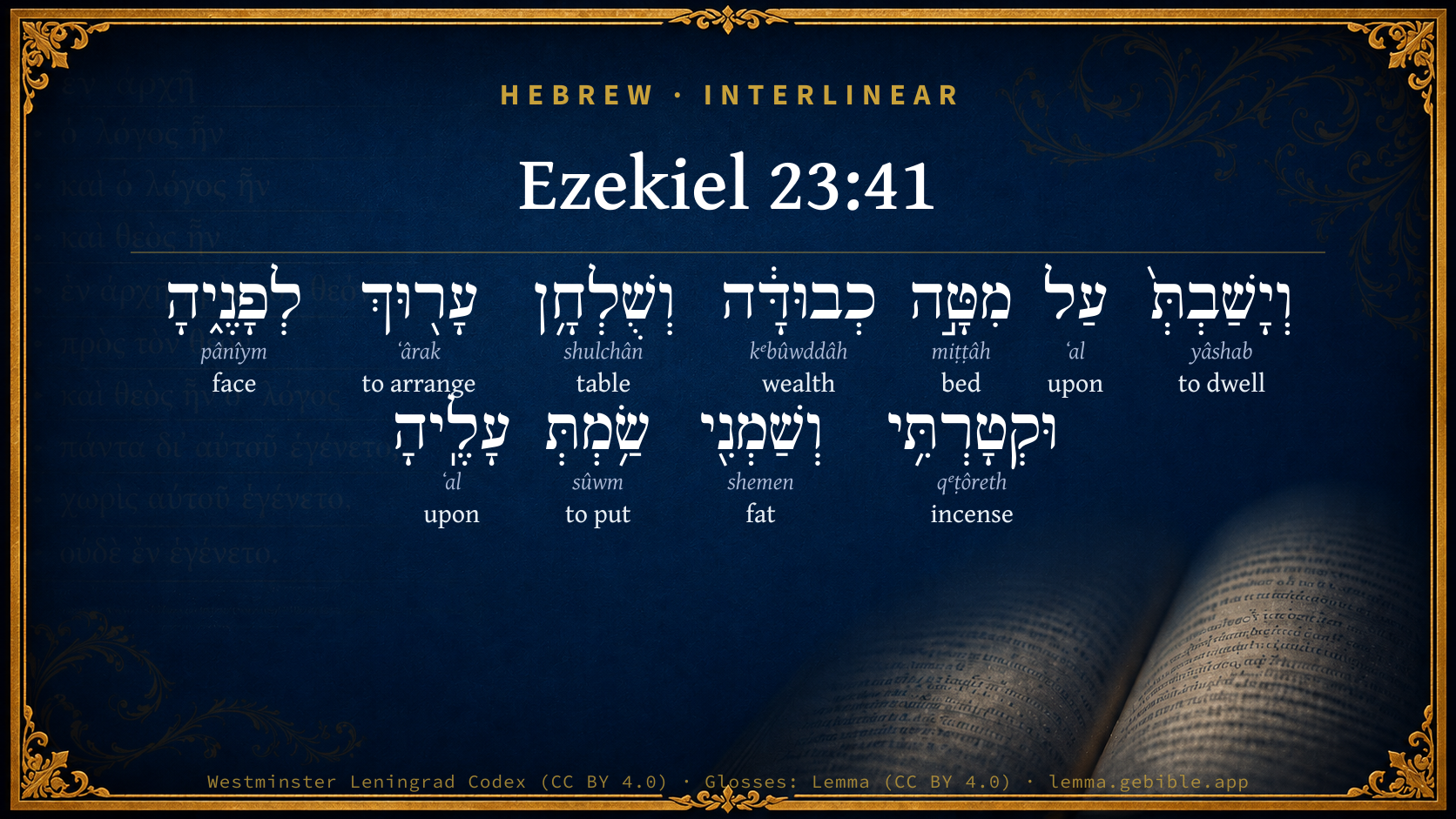
  1. וְיָשַׁבְתְּ֙ yâshab H3427 “and · to dwell” Conjunction + Verb, Qal, Perfect, 2nd Person, Feminine, Singular
  2. עַל ʻal H5921 “upon” Preposition
  3. מִטָּ֣ה miṭṭâh H4296 “bed” Noun, Common, Feminine, Singular, Absolute
  4. וְשֻׁלְחָ֥ן shulchân H7979 “and · table” Conjunction + Noun, Common, Masculine, Singular, Absolute
  5. עָר֖וּךְ ʻârak H6186 “arranged” Verb, Qal, Participle Passive, Masculine, Singular, Absolute
  6. לְפָנֶ֑יהָ pânîym H6440 “to/for · face(s) · her” Preposition + Noun, Common, Both, Plural, Construct + Suffix, Personal, 3rd Person, Feminine, Singular
  7. וּקְטָרְתִּ֥י qᵉṭôreth H7004 “and · incense · my” Conjunction + Noun, Common, Feminine, Singular, Construct + Suffix, Personal, 1st Person, Common, Singular
  8. וְשַׁמְנִ֖י shemen H8081 “and · fat · my” Conjunction + Noun, Common, Masculine, Singular, Construct + Suffix, Personal, 1st Person, Common, Singular
  9. שַׂ֥מְתְּ sûwm H7760 “to put” Verb, Qal, Perfect, 2nd Person, Feminine, Singular
  10. עָלֶֽיהָ ʻal H5921 “upon · her” Preposition + Suffix, Personal, 3rd Person, Feminine, Singular

About this verse

These counts appear in no published source. They are computed here, from the morphology-tagged text and Lemma’s own curated glosses. What Lemma adds →

11
words
10
distinct lemmas
Prophets
section

Notable vocabulary

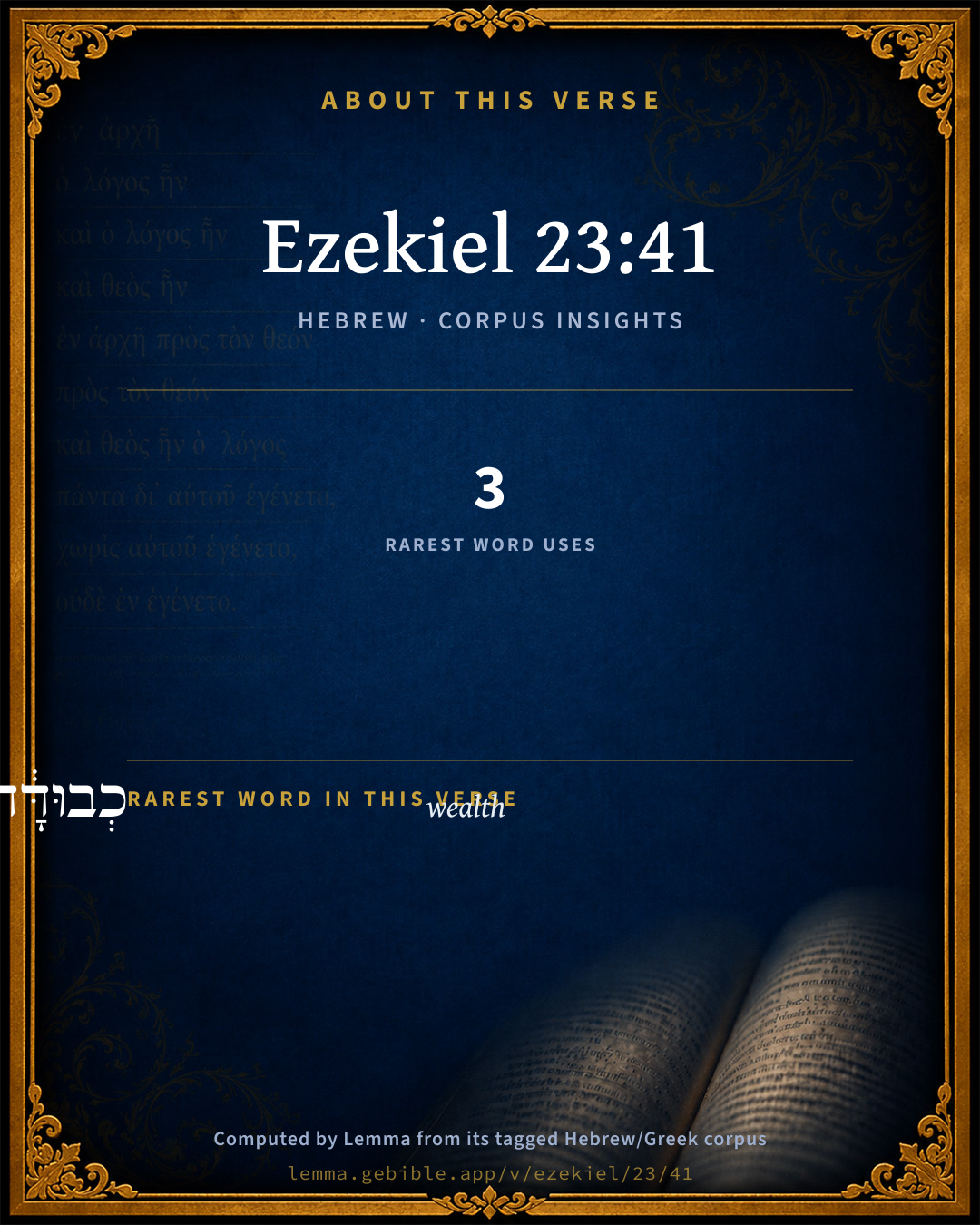
The rarest word here is כְבוּדָּ֔ה wealth H3520 — appearing just 3 times in the whole Hebrew Bible.

Shared distinctive vocabulary

כְבוּדָּ֔ה wealth H3520 occurs in 3 verses of the Hebrew Bible. Also found in:

Grammatical profile

  • 3 verbs
  • 6 nouns
  • 2 prepositions

Verb forms

  • וְיָשַׁבְתְּ֙ Qal · Perfect
  • עָר֖וּךְ Qal · Participle Passive
  • שַׂ֥מְתְּ Qal · Perfect

Repetition

A word recurs within this verse — often emphatic in Hebrew:

Hebrew & Septuagint length

In English translation the verse runs 21 words from the Hebrew and 27 from the Septuagint (LXX English) — closely comparable.

A rough comparison of the two English renderings, which tokenize alike — not a word-level alignment.

Word counts can differ between the Hebrew and the Greek without any difference in meaning — e.g. the Hebrew direct-object marker אֵת has no separate Greek word, and Greek often adds the article ὁ.

Cross-references

11

Topical passages linked to Ezekiel 23:41 in the Treasury of Scripture Knowledge — connected by theme and wording, ordered by reader-vote popularity; previews shown in the World English Bible.

  • Esther 1:6 [There were hangings of] white [cloth], [of] green, and [of] blue, fastened with cords of fine linen and purple to silver rings and pillars of marble: the couches were of gold and silver, on a pavement of red, and white, and yellow, and black marble.
  • Isaiah 65:11 But you who forsake Yahweh, who forget my holy mountain, who prepare a table for Fortune, and who fill up mixed wine to Destiny;
  • Jeremiah 44:17 But we will certainly perform every word that is gone forth out of our mouth, to burn incense to the queen of the sky, and to pour out drink-offerings to her, as we have done, we and our fathers, our kings and our princes, in the cities of Judah, and in the streets of Jerusalem; for then had we plenty of food, and were well, and saw no evil.
  • Ezekiel 44:16 they shall enter into my sanctuary, and they shall come near to my table, to minister to me, and they shall keep my charge.
  • Amos 6:4 Who lie on beds of ivory, And stretch themselves on their couches, And eat the lambs out of the flock, And the calves out of the midst of the stall;
  • Isaiah 57:7 On a high and lofty mountain have you set your bed; there also you went up to offer sacrifice.
  • Proverbs 7:16–17 I have spread my couch with carpets of tapestry, With striped cloths of the yarn of Egypt.
  • Ezekiel 16:18–19 and you took your embroidered garments, and covered them, and did set my oil and my incense before them.
  • Hosea 2:8–9 For she did not know that I gave her the grain, the new wine, and the oil, And multiplied to her silver and gold, which they used for Baal.
  • Amos 2:8 And they lay themselves down beside every altar on clothes taken in pledge; And in the house of their God they drink the wine of those who have been fined.
  • Malachi 1:7 You offer polluted bread on my altar. You say, 'How have we polluted you?' In that you say, 'Yahweh's table contemptible.'

Cross-references courtesy of OpenBible.info (CC BY 4.0).

Hebrew and Greek witnesses Masoretic Hebrew ↔ Greek Septuagint

The same verse in the two great witnesses to the Old Testament, shown verse-for-verse.

These are two independent witnesses, not word-aligned to each other, and the Septuagint is shown in lemma (dictionary) form.

Hebrew Ezekiel 23:41 Masoretic · Westminster Leningrad Codex

וְיָשַׁבְתְּ֙ עַל מִטָּ֣ה כְבוּדָּ֔ה וְשֻׁלְחָ֥ן עָר֖וּךְ לְפָנֶ֑יהָ וּקְטָרְתִּ֥י וְשַׁמְנִ֖י שַׂ֥מְתְּ עָלֶֽיהָ

and sit on a stately bed, with a table prepared before it, whereupon you did set my incense and my oil.

World English Bible · Public Domain

Greek LXX Ezekiel 23:41 Septuagint · lemma form

καί καταἧμαι ἐπί κλίνη στρωννύω καί τράπεζα κοσμέω πρό πρόσωπον αὐτός καί ὁ θυμίαμα ἐγώ καί ὁ ἔλαιον ἐγώ εὐφραίνω ἐν αὐτός

and sat on a prepared bed, and before it there was a table set out, and as for my incense and my oil, they rejoiced in them,

LXX2012 (modern English Septuagint) · Public Domain

Hebrew: Westminster Leningrad Codex (CC BY 4.0). Greek: Septuagint (public domain); English from LXX2012 (modern English Septuagint) (Public Domain). How the Septuagint differs from the Hebrew →

Targum (Aramaic paraphrase)

1

The Targum is the ancient Jewish Aramaic paraphrase of the Hebrew Scriptures — an interpretive translation, not the Hebrew text itself. Onkelos (literal) and Pseudo-Jonathan (expansive) render the Torah, and Jonathan the Prophets. Coverage is partial: where no permissively-licensed English translation exists for a verse, only the Aramaic is shown. This is verse-level text, not a word-by-word alignment to the Hebrew.

  1. Targum Jonathan Prophets (Joshua–Malachi)
    וּרְמֵית דַרְגְשִׁין מַכִּיכִין דִיקַר וּפְתוֹרִין מְלַן כָּל טוּב סִדַרְתְּ קֳדָמֵיהוֹן וּקְטוֹרֶת בּוּסְמִי וּמִשְׁחִי שַׁוֵית עֲלֵיהוֹן:

    (no public-domain English translation for this verse)

    Targum Jonathan — Aramaic: “Mikraot Gedolot” (public domain). English: “Sefaria Community Translation” (CC0 1.0 (public-domain dedication)); “London "Chaldee Paraphrase," 1871” (public domain). Text via Sefaria.

Commentary

Notes on Ezekiel 23:41 from classic Christian and Jewish commentators (each source and its license shown beneath its notes). The classic Christian expositions comment on the surrounding passage and are grouped to its opening verse, so a note may address several verses; the Jewish commentaries on the Tanakh (Rashi and others) are per-verse, so they appear only where the commentator wrote on this verse.

Lemma curates 59 commentaries, every one of them public domain or Creative Commons licensed, each selected and text-cleaned for this edition rather than reprinted as found. About our sources →

Trapp's Complete Commentary

John Trapp

Eze 23:41 And satest upon a stately bed, and a table prepared before it, whereupon thou hast set mine incense and mine oil.

Ver. 41. And satest.] For entertainment sake.

Whereupon thou hast set mine incense] So fighting against me, as it were, with mine own weapons, and abusing my best gifts to my greatest dishonour, contrary to Pro 3:9.

John Trapp, A Commentary or Exposition upon All the Books of the Old and New Testament (1647–1656) — public domain. Text from a community e-Sword module.

Geneva Bible (1599)

Geneva Bible translators

He meaneth the altar that was prepared for the idols.

Geneva Bible (1599) marginal notes — public domain. Text via Bolls.life.

Jamieson, Fausset & Brown

Robert Jamieson, A. R. Fausset & David Brown

bed--divan. While men reclined at table, women sat, as it seemed indelicate for them to lie down (Amo 6:4) [GROTIUS].

table--that is, the idolatrous altar.

mine incense--which I had given thee, and which thou oughtest to have offered to Me (Eze 16:18-19; Hos 2:8; compare Pro 7:17).

Jamieson, Fausset & Brown — Commentary Critical and Explanatory on the Whole Bible (1871) — public domain (CC PDM 1.0). Text via the HelloAO Bible API.

Adam Clarke's Commentary

Verse 41. And satest upon a stately bed] Hast raised a stately altar to thy idols; probably alluding to that which Ahaz ordered to be made, after the similitude of that which he saw at Damascus. The bed here is in allusion to the sofas on which the ancients were accustomed to recline at their meals; or to the couches on which they place Asiatic brides, with incense pots and sweetmeats on a table before them.

Adam Clarke's Commentary on the Bible (1810–1826) — public domain. Text from a community e-Sword/MySword module.

Ellicott's Commentary for English Readers

(41) A stately bed is rather the couch or divan used for reclining at a feast. “Mine incense and mine oil” (comp. Eze_16:18) may be taken simply as the products of the land, the good gifts of God which Israel bestowed upon the heathen; but as both of these were especially used in sacrifices, it is better to connect with this the perversion to the worship of the idols of the heathen of what should have been Jehovah’s only.

A Bible Commentary for English Readers, edited by Charles John Ellicott (1878–1897) — public domain. Text from a community e-Sword module.

The Cambridge Bible for Schools and Colleges

gen. ed. J. J. S. Perowne

41. a table prepared] i.e. spread.

hast set mine incense] didst set. The words indicate that service of other gods is referred to under the figure of the harlot’s entertainment.

The Cambridge Bible for Schools and Colleges (gen. ed. J. J. S. Perowne; Cambridge University Press, 1878–1918) — public domain. Text from a community e-Sword module.

John Gill's Exposition

And satest upon a stately bed,.... Or honourable (g), a bed of state: either a throne, a royal seat under a canopy, on which the king of Judah sat to receive foreign ambassadors; or a stately bed at a feast, made for the entertainment of them; it being usual in the eastern nations to sit on beds at eating, to which the next clause agrees. The allusion is to a harlot sitting on a bed decked out by her to allure men to lie with her; see Pro 7:16,

and a table prepared before it; before the bed, furnished with the richest provisions to treat the ambassadors with; or this may design an altar built for them to offer on it sacrifices to their idols, according to the customs of their countries:

whereupon thou hast set mine incense and mine oil; which were the gifts of God to this people, and which they should have used in his service; but with these they treated the ministers of Heathen princes; scenting the room where they were entertained with incense, and anointing their heads and feet with oil, for their pleasure and refreshment; or they offered these on the altars of the idols to them.

(g) "honorato", Junius and Tremellius, Polanus, Coeccius, Starckius.

John Gill's Exposition of the Whole Bible (1746–1763) — public domain (CC PDM 1.0). Text via the HelloAO Bible API.

Haydock's Catholic Bible Commentary

Bed: it seems at table, Amos ii. 8., and Tobias ii. 3. --- Ointment; using them for thyself, or presenting them to idols, Exodus xxx. 23, 33. (Calmet)

George Leo Haydock (1774–1849), Haydock's Catholic Family Bible and Commentary, 1859 edition — public domain. Excludes Psalms (Douay-Rheims chapter numbering differs from Protestant) and Deuterocanonical books (Catholic canon only).

Matthew Poole's English Annotations

Safest; it is a table gesture, as appears, she was prepared to feast them.

Upon a stately bed; a magnificent, rich bed, on which women sat to feast, when men leant on their sides, which would not have been a comely posture to a woman.

Table prepared; table furnished with choicest provision, such as made for feasts, when solemn sacrifices were offered, or when vows were paid, as the harlot, Pro 7:14,15.

Set mine incense: this assures us that idolatrous worship was acted by her in compliance with the Chaldeans, offered to their idols, and then feasted the idolaters, with what God had given her, when they confirmed their leagues, and swore by false gods.

Matthew Poole's English Annotations on the Holy Bible (1683–1685) — public domain. Text from a community e-Sword/MySword module.

John Wesley's Explanatory Notes

Sattest - Prepared to feast them. A stately bed - A magnificent bed, on which women sat to feast, when men leaned on their sides. Incense - Offered to their idols.

John Wesley, Explanatory Notes Upon the Whole Bible (1754–1765) — public domain. Text via the GEBible commentary corpus.

Rashi

Rabbi Shlomo Yitzchaki (Rashi)

a stately bed Adorned with all kinds of beautiful bedclothes, parede in Old French, adorned lavishly.

Rashi on the Tanakh — English translations: “The Judaica Press complete Tanach with Rashi, translated by A. J. Rosenberg” (CC BY 4.0); “Pentateuch with Rashi's commentary by M. Rosenbaum and A.M. Silbermann, 1929-1934” (public domain); “The Metsudah Tanach series, Lakewood, N.J” (CC BY 4.0); and “The Book of Joshua, Metsudah Publications, 1997” (CC BY 4.0). Text via Sefaria.

Lesson kit

Teaching starters — assembled from the data on this page, not authored interpretation. Every prompt links to the verse data it draws on. Edit before teaching.

Ezekiel, in the Prophets, opens this verse with 11 words (10 distinct Hebrew lemmas). Its most distinctive word is kᵉbûwddâh (“wealth”). A historical commentator’s framing appears above. Read the whole chapter for the surrounding context.

Discussion questions

  1. The word kᵉbûwddâh carries the sense “wealth.” How does it shape the verse?
  2. How does Judges 18:21, which shares the word «wealth», read alongside this verse?
  3. What does the repetition of “upon” (2× in this one verse) do in this verse?
  4. These translations render this verse differently. What is at stake in choosing one wording over another?
  5. «וְיָשַׁבְתְּ֙» is a Qal Perfect verb. How does that grammatical form shape the action described?
  6. Compare how Trapp's Complete Commentary and Geneva Bible (1599) read this verse. Where do they agree or differ?

Things to notice

Reading settings

Reading text

Shown beneath each verse's original-language words.

Old Testament
Old Testament edition

Read the OT as the Masoretic Hebrew (MT) or the Greek Septuagint (LXX).

English shown for the Greek Septuagint (in the Hebrew ↔ Greek comparison).

Comparing translations? Open the Compare panel on any verse page to stack up to four side by side.