
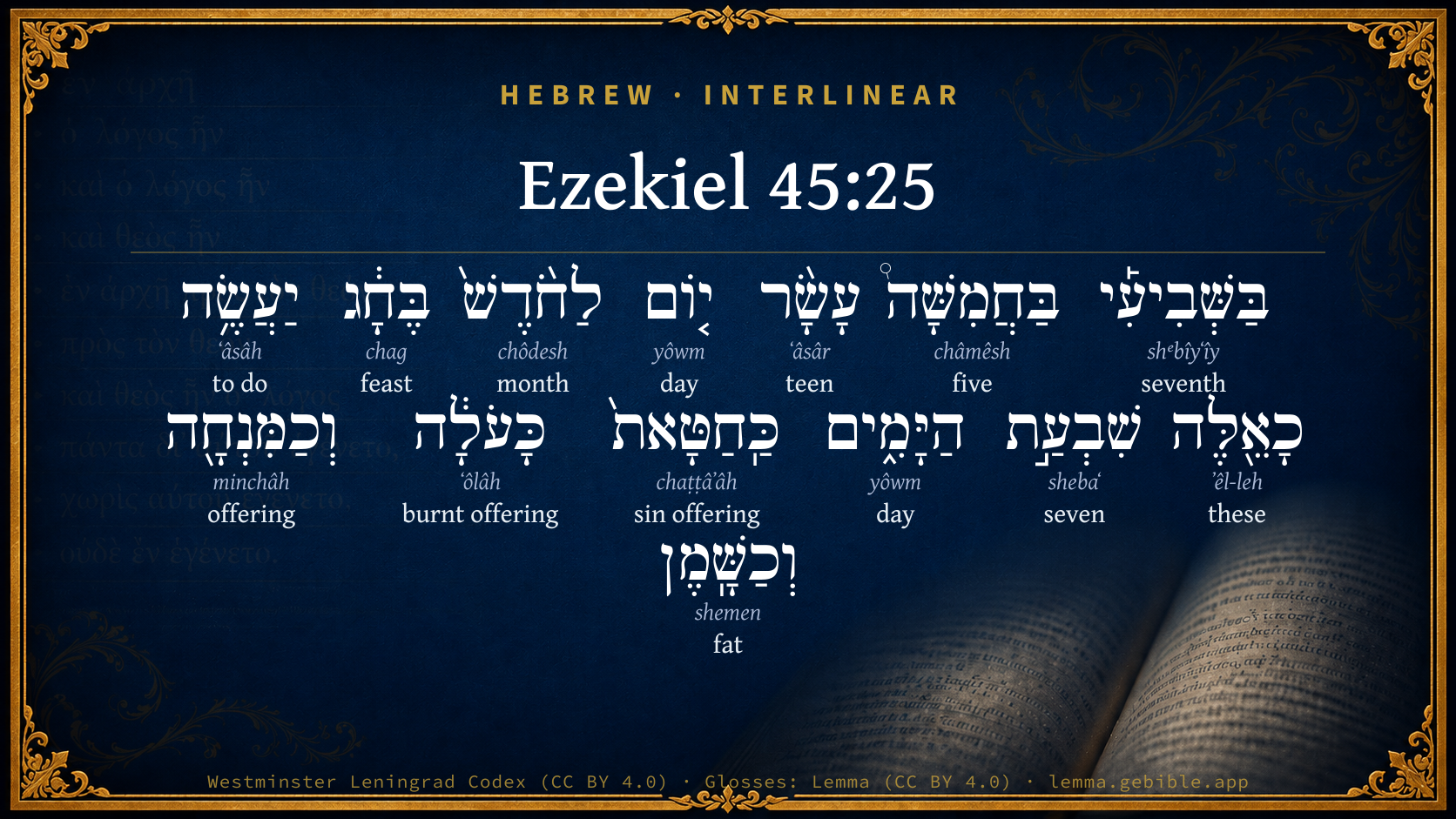
Ezekiel 45:25

Hebrew (Westminster Leningrad Codex) Ezekiel 45:25 appears in the Hebrew Old Testament. The text above is from the Westminster Leningrad Codex. Each word links to its Strong’s number, a concise gloss, and parsing drawn from the Open Scriptures Hebrew Bible morphology. Click any word for its full Brown-Driver-Briggs (BDB) entry.
Download image
Cite this verse

Ezekiel 45:25 (World English Bible). Public Domain. Lemma interlinear Bible study tool, https://lemma.gebible.app/v/ezekiel/45/25.

Show BibTeX & RIS
BibTeX
RIS
English Translation
In the seventh [month], in the fifteenth day of the month, in the feast, shall he do the like the seven days; according to the sin-offering, according to the burnt offering, and according to the meal-offering, and according to the oil.
World English Bible · Public Domain
Download a study sheet

One document with this verse’s original text, its word-by-word gloss line, the meaning frame, cross-references with their text, attributed commentary, and full source and license credits — printable, and it pastes into notes with its structure intact.

This verse Autodidact and up

Study sheet (.html) Plain text (.txt)

A passage Seminary Student

Up to 50 verses in one chapter. A passage sheet keeps up to 6 commentary sources and 12 cross-references per verse, in the order this page ranks them, and says so on the sheet whenever that leaves anything out. Ask for a single verse and you get the Autodidact verse sheet above.

Everything on this page stays free to read, with no account — the sheet is a download of what is already on screen, not access to it.

Want to remove ads? Support Godless Engineer
Compare translations 3

The same verse in 3 English versions, stacked beneath the original-language interlinear above. Click any original word for its lexicon entry.

Each is an independent rendering of the whole verse — the interlinear is not word-aligned to these translations.

Highlighted words mark where these versions differ — a whole-verse word diff, not a word-by-word alignment.

  • World English Bible Public Domain
    In the seventh [month], in the fifteenth day of the month, in the feast, shall he do the like the seven days; according to the sin-offering, according to the burnt offering, and according to the meal-offering, and according to the oil.
  • King James Version Public Domain
    In the seventh month, in the fifteenth day of the month, shall he do the like in the feast of the seven days, according to the sin offering, according to the burnt offering, and according to the meat offering, and according to the oil.
  • unfoldingWord Literal Text CC BY-SA 4.0
    In the seventh month on the fifteenth day of the month, at the festival, the prince will perform offerings on these seven days: Sin offerings, burnt offerings, food offerings, and offerings of oil.

unfoldingWord Literal Text — © unfoldingWord, licensed CC BY-SA 4.0. Word-aligned USFM3 via Door43 (git.door43.org/unfoldingWord/en_ult).

Versions to compare (up to 4)

3 of 4 selected

Show all 18 translations

Every available English version of this verse, each an independent rendering of the whole verse.

  • World English Bible Public Domain
    In the seventh [month], in the fifteenth day of the month, in the feast, shall he do the like the seven days; according to the sin-offering, according to the burnt offering, and according to the meal-offering, and according to the oil.
  • Berean Standard Bible Public Domain
    During the seven days of the feast that begins on the fifteenth day of the seventh month, he is to make the same provision for sin offerings, burnt offerings, grain offerings, and oil.’
  • Majority Standard Bible Public Domain
    During the seven days of the feast that begins on the fifteenth day of the seventh month, he is to make the same provision for sin offerings, burnt offerings, grain offerings, and oil.’
  • King James Version Public Domain
    In the seventh month, in the fifteenth day of the month, shall he do the like in the feast of the seven days, according to the sin offering, according to the burnt offering, and according to the meat offering, and according to the oil.
  • American Standard Version (1901) Public Domain
    In the seventh `month', in the fifteenth day of the month, in the feast, shall he do the like the seven days; according to the sin-offering, according to the burnt-offering, and according to the meal-offering, and according to the oil.
  • Revised Version (1885) Public Domain
    In the seventh month, in the fifteenth day of the month, in the feast, shall he do the like the seven days; according to the sin offering, according to the burnt offering, and according to the meal offering, and according to the oil.
  • Geneva Bible (1599) Public Domain
    In the seuenth moneth, in the fifteenth day of the moneth, shall he do the like in the feast for seuen dayes, according to the sinne offring, according to the burnt offring, and according to the meate offring, and according to the oyle.
  • Douay-Rheims (1899) Public Domain
    In the seventh month, in the fifteenth day of the month, in the solemn feast, he shall do the like for the seven days: as well in regard to the sin offering, as to the holocaust, and. the sacrifice, and the
  • Young's Literal Translation Public Domain
    In the seventh `month', in the fifteenth day of the month, in the feast, he doth according to these things seven days; as the sin-offering so the burnt-offering, and as the present so also the oil.
  • Literal Standard Version CC BY-SA 4.0
    In the seventh [month], on the fifteenth day of the month, in the celebration, he does according to these things [for] seven days; as the sin-offering so the burnt-offering, and as the present so also the oil.”
  • Unlocked Literal Bible CC BY-SA 4.0
    In the seventh month on the fifteenth day of the month, at the festival, the prince will perform offerings on these seven days: Sin offerings, burnt offerings, food offerings, and offerings of oil.
  • unfoldingWord Literal Text CC BY-SA 4.0
    In the seventh month on the fifteenth day of the month, at the festival, the prince will perform offerings on these seven days: Sin offerings, burnt offerings, food offerings, and offerings of oil.
  • Darby Bible Public Domain
    In the seventh [month], on the fifteenth day of the month, at the feast, shall he do the like seven days, according to the sin-offering, according to the burnt-offering, and according to the oblation, and according to the oil.
  • World Messianic Bible Public Domain
    “‘“In the seventh month, on the fifteenth day of the month, during the feast, he shall do like that for seven days. He shall make the same provision for sin offering, the burnt offering, the meal offering, and the oil.”
  • Webster's Bible Public Domain
    In the seventh month, in the fifteenth day of the month, shall he do the like in the feast of the seven days, according to the sin-offering, according to the burnt-offering, and according to the meat-offering, and according to the oil.
  • Free Bible Version CC BY-SA 4.0
    For the seven days of the festival that begins on the fifteenth day of the seventh month, he is to provide the same number of sin offerings, burnt offerings, grain offerings, and olive oil.
  • Bible in Basic English Public Domain
    In the seventh month, on the fifteenth day of the month, at the feast, he is to give the same for seven days; the sin-offering, the burned offering, the meal offering, and the oil as before.
  • JPS Tanakh (1917) Public Domain
    In the seventh month, in the fifteenth day of the month, in the feast, shall he do the like the seven days; to the sin-offering as well as the burnt-offering, and the meal-offering as well as the oil.

Literal Standard Version (2020), Covenant Press — licensed CC BY-SA 4.0. Text via the HelloAO Bible API (eBible.org). Unlocked Literal Bible (unfoldingWord) — licensed CC BY-SA 4.0. Text via the HelloAO Bible API (eBible.org). unfoldingWord Literal Text — © unfoldingWord, licensed CC BY-SA 4.0. Word-aligned USFM3 via Door43 (git.door43.org/unfoldingWord/en_ult). Free Bible Version, Dr. Jonathan Gallagher — licensed CC BY-SA 4.0. Text via the HelloAO Bible API (eBible.org).

Word by word

More ways to search: Search by grammar → Find every occurrence → Compare this word →

Practice this passage: Drill this verse → Learn its vocabulary →

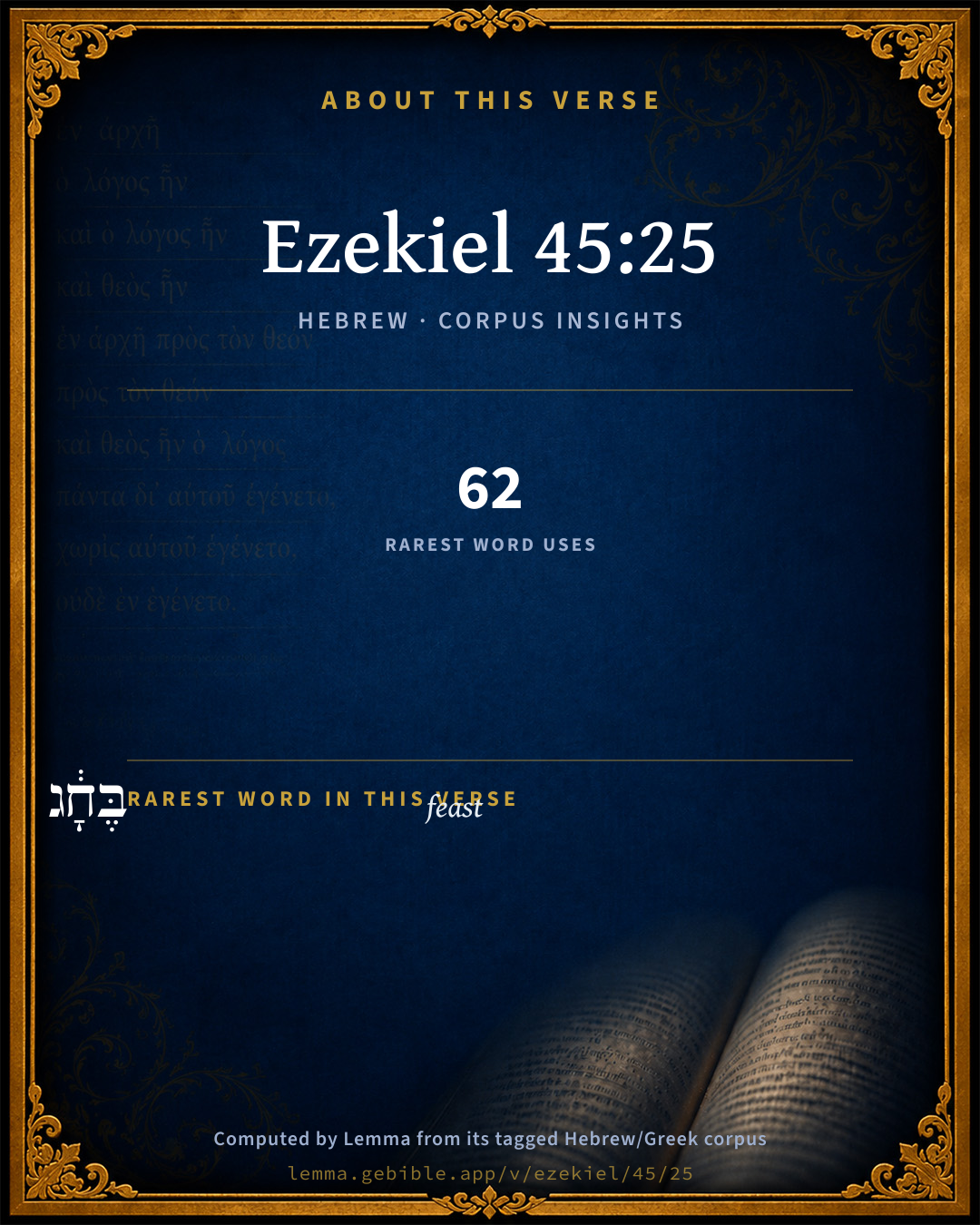
בֶּחָ֔ג
chag
H2282
“in/at the · feast”
Preposition, Determined + Noun, Common, Masculine, Singular, Absolute
Part of Speech
Preposition + Noun
Type
Common
Gender
Masculine
Number
Singular
State
Absolute
Full BDB Definition

Origin: from H2287

TWOT: 602a

festival, feast, festival-gathering, pilgrim-feast - feast - festival sacrifice
  1. בַּשְּׁבִיעִ֡י shᵉbîyʻîy H7637 “in/at the · seventh” Preposition, Determined + Adjective, Ordinal number, Masculine, Singular, Absolute
  2. בַּחֲמִשָּׁה֩ châmêsh H2568 “in/at the · five” Preposition, Determined + Adjective, Cardinal number, Masculine, Singular, Absolute
  3. עָשָׂ֨ר ʻâsâr H6240 “teen” Adjective, Cardinal number, Masculine, Singular, Absolute
  4. י֤וֹם yôwm H3117 “day” Noun, Common, Masculine, Singular, Absolute
  5. לַחֹ֨דֶשׁ֙ chôdesh H2320 “to/for the · month” Preposition, Determined + Noun, Common, Masculine, Singular, Absolute
  6. יַעֲשֶׂ֥ה ʻâsâh H6213 “to do” Verb, Qal, Imperfect, 3rd Person, Masculine, Singular
  7. כָאֵ֖לֶּה ʼêl-leh H428 “like/as · these” Preposition + Pronoun, Demonstrative, Common, Plural
  8. שִׁבְעַ֣ת shebaʻ H7651 “seven” Adjective, Cardinal number, Masculine, Singular, Construct
  9. הַיָּמִ֑ים yôwm H3117 “the · days” Particle, Definite Article + Noun, Common, Masculine, Plural, Absolute
  10. כַּֽחַטָּאת֙ chaṭṭâʼâh H2403 “like/as the · sin offering” Preposition, Determined + Noun, Common, Feminine, Singular, Absolute
  11. כָּעֹלָ֔ה ʻôlâh H5930 “like/as the · burnt offering” Preposition, Determined + Noun, Common, Feminine, Singular, Absolute
  12. וְכַמִּנְחָ֖ה minchâh H4503 “and · like/as the · offering” Conjunction + Preposition, Determined + Noun, Common, Feminine, Singular, Absolute
  13. וְכַשָּֽׁמֶן shemen H8081 “and · like/as the · fat” Conjunction + Preposition, Determined + Noun, Common, Masculine, Singular, Absolute

About this verse

These counts appear in no published source. They are computed here, from the morphology-tagged text and Lemma’s own curated glosses. What Lemma adds →

14
words
13
distinct lemmas
Prophets
section

Grammatical profile

  • 1 verb
  • 8 nouns
  • 4 adjectives
  • 1 pronoun

Verb forms

  • יַעֲשֶׂ֥ה Qal · Imperfect

Repetition

A word recurs within this verse — often emphatic in Hebrew:

  • י֤וֹם day H3117 ×2

Hebrew & Septuagint length

In English translation the verse runs 41 words from the Hebrew and 42 from the Septuagint (LXX English) — closely comparable.

A rough comparison of the two English renderings, which tokenize alike — not a word-level alignment.

Word counts can differ between the Hebrew and the Greek without any difference in meaning — e.g. the Hebrew direct-object marker אֵת has no separate Greek word, and Greek often adds the article ὁ.

Cross-references

9

Topical passages linked to Ezekiel 45:25 in the Treasury of Scripture Knowledge — connected by theme and wording, ordered by reader-vote popularity; previews shown in the World English Bible.

  • Leviticus 23:33–43 Yahweh spoke to Moses, saying,
  • Numbers 29:12–38 On the fifteenth day of the seventh month you shall have a holy convocation; you shall do no servile work, and you shall keep a feast to Yahweh seven days:
  • 2 Chronicles 5:3 And all the men of Israel assembled themselves to the king at the feast, which was [in] the seventh month.
  • Deuteronomy 16:13–15 You shall keep the feast of tents seven days, after that you have gathered in from your threshing floor and from your winepress:
  • 2 Chronicles 7:8–10 So Solomon held the feast at that time seven days, and all Israel with him, a very great assembly, from the entrance of Hamath to the brook of Egypt.
  • Nehemiah 8:14–18 They found written in the law, how that Yahweh had commanded by Moses, that the children of Israel should dwell in booths in the feast of the seventh month;
  • Zechariah 14:16–19 It will happen that everyone who is left of all the nations that came against Jerusalem will go up from year to year to worship the King, Yahweh of Hosts, and to keep the feast of tents.
  • John 7:2 Now the feast of the Jews, the Feast of Booths, was at hand.
  • John 7:37–39 Now on the last and greatest day of the feast, Jesus stood and cried out, "If anyone is thirsty, let him come to me and drink!

Cross-references courtesy of OpenBible.info (CC BY 4.0).

Hebrew and Greek witnesses Masoretic Hebrew ↔ Greek Septuagint

The same verse in the two great witnesses to the Old Testament, shown verse-for-verse.

These are two independent witnesses, not word-aligned to each other, and the Septuagint is shown in lemma (dictionary) form.

Hebrew Ezekiel 45:25 Masoretic · Westminster Leningrad Codex

בַּשְּׁבִיעִ֡י בַּחֲמִשָּׁה֩ עָשָׂ֨ר י֤וֹם לַחֹ֨דֶשׁ֙ בֶּחָ֔ג יַעֲשֶׂ֥ה כָאֵ֖לֶּה שִׁבְעַ֣ת הַיָּמִ֑ים כַּֽחַטָּאת֙ כָּעֹלָ֔ה וְכַמִּנְחָ֖ה וְכַשָּֽׁמֶן

In the seventh [month], in the fifteenth day of the month, in the feast, shall he do the like the seven days; according to the sin-offering, according to the burnt offering, and according to the meal-offering, and according to the oil.

World English Bible · Public Domain

Greek LXX Ezekiel 45:25 Septuagint · lemma form

καί ἐν ὁ ἕβδομος μήν πεντεκαιδέκατος ὁ μήν ἐν ὁ ἑορτή ποιέω κατά ὁ αὐτός ἑπτά ἡμέρα καθώς ὁ ὑπέρ ὁ ἁμαρτία καί καθώς ὁ ὁλοκαύτωμα καί καθώς ὁ μαναα καί καθώς ὁ ἔλαιον

And in the seventh month, on the fifteenth day of the month, you shall sacrifice in the feast in the same way seven days, as they sacrificed the sin-offerings, and the whole burnt offerings, and the free will offering, and the oil.

LXX2012 (modern English Septuagint) · Public Domain

Hebrew: Westminster Leningrad Codex (CC BY 4.0). Greek: Septuagint (public domain); English from LXX2012 (modern English Septuagint) (Public Domain). How the Septuagint differs from the Hebrew →

Targum (Aramaic paraphrase)

1

The Targum is the ancient Jewish Aramaic paraphrase of the Hebrew Scriptures — an interpretive translation, not the Hebrew text itself. Onkelos (literal) and Pseudo-Jonathan (expansive) render the Torah, and Jonathan the Prophets. Coverage is partial: where no permissively-licensed English translation exists for a verse, only the Aramaic is shown. This is verse-level text, not a word-by-word alignment to the Hebrew.

  1. Targum Jonathan Prophets (Joshua–Malachi)
    בִּשְׁבִיעָאָה בְּחַמְשַׁת עַסְרָא יוֹמָא לְיַרְחָא בְּחַגָא יַעְבֵּיד כְּאִלֵין שִׁבְעָא יוֹמִין כְּאִלֵין שִׁבְעָא יוֹמִין כְּחַטָאתָא וְכַעֲלָתָא וּכְמִנְחָתָא וּכְמִשְׁחָא:

    (no public-domain English translation for this verse)

    Targum Jonathan — Aramaic: “Mikraot Gedolot” (public domain). English: “Sefaria Community Translation” (CC0 1.0 (public-domain dedication)); “London "Chaldee Paraphrase," 1871” (public domain). Text via Sefaria.

Commentary

Notes on Ezekiel 45:25 from classic Christian and Jewish commentators (each source and its license shown beneath its notes). The classic Christian expositions comment on the surrounding passage and are grouped to its opening verse, so a note may address several verses; the Jewish commentaries on the Tanakh (Rashi and others) are per-verse, so they appear only where the commentator wrote on this verse.

Lemma curates 59 commentaries, every one of them public domain or Creative Commons licensed, each selected and text-cleaned for this edition rather than reprinted as found. About our sources →

Trapp's Complete Commentary

John Trapp

Eze 45:25 In the seventh [month], in the fifteenth day of the month, shall he do the like in the feast of the seven days, according to the sin offering, according to the burnt offering, and according to the meat offering, and according to the oil.

Ver. 25. In the feast of the seven days,] i.e., Of tabernacles, wont to be of eight days. {Lev 23:34-35} Quam sunt nova omnia There are all thing new. Of Pentecost here is no mention at all.

John Trapp, A Commentary or Exposition upon All the Books of the Old and New Testament (1647–1656) — public domain. Text from a community e-Sword module.

Joseph Benson's Commentary

Eze 45:25. In the seventh month — According to their ecclesiastical account, which is Tisri, and answers to part of our August and September. In the fifteenth day, &c., shall he do the like — Namely, the prince. On that day the feast of tabernacles began, and continued seven days. Here we see the deficiency of the legal sacrifices for sin; they were often repeated, not only every year, but every feast, and every day of the feast, because they could not make the comers thereunto perfect. Hence we may also learn the necessity of frequently repeating the same religious exercises. Indeed, the sacrifice of atonement was offered once for all; but the sacrifice of acknowledgment, that of a broken heart, that of a thankful heart, must be offered every day. And these spiritual sacrifices are always acceptable to God through Christ Jesus.

Joseph Benson's Commentary on the Old and New Testaments (1811–1818) — public domain. Text from a community e-Sword module.

Adam Clarke's Commentary

Verse 25. In the seventh month] He shall do at the feast of tabernacles the same things that he was desired to do on the passover. The prince should offer the same number of victims, of the same quality, and with the same ceremonies, as during the above seven days. The offerings were, sin-offerings, burnt-offerings, and peace-offerings.

Adam Clarke's Commentary on the Bible (1810–1826) — public domain. Text from a community e-Sword/MySword module.

Ellicott's Commentary for English Readers

(25) In the seventh month.—This corresponds to the Feast of Tabernacles, though the name is not mentioned, doubtless because the custom of living in booths is to be discontinued. The sacrifices at this feast are to be the same as at the Passover, and are to be repeated for each day of the feast. There is in this an entire change from the peculiar ordinances of the Mosaic law (Num_29:12-24), and on the whole a great diminution in the number of sacrifices, with a simplification of the ritual, and an omission of the eighth day, added to the feast by the Mosaic law.

Ezekiel here omits altogether the Feast of Pentecost, the Day of Atonement, and the Day of Trumpets (the first of the seventh month); for these he substitutes a special sin offering for the first and seventh days of the first month, and for the first day of the Paschal feast; he, moreover, largely modifies the ritual of the two feasts which he retains. All this essentially transforms the ideas which form the basis of the cycle of the Mosaic feasts. No attempt was ever made by the Jews of the restoration to carry out the scheme here set forth; and it appears to have been regarded by the prophet’s contemporaries and successors as purely ideal.

A Bible Commentary for English Readers, edited by Charles John Ellicott (1878–1897) — public domain. Text from a community e-Sword module.

The Cambridge Bible for Schools and Colleges

gen. ed. J. J. S. Perowne

25. Feast of tabernacles on the fifteenth day of the seventh month. Render: in the seventh month, on the fifteenth day of the month, in the feast, shall he do the like, the seven days. The “feast” is that of tabernacles, the feast par excellence of the year, concluding the yearly round of festivals (Isa_29:1). For this feast the prince makes the same provision as for the feast of unleavened bread (Eze_45:23).

The Cambridge Bible for Schools and Colleges (gen. ed. J. J. S. Perowne; Cambridge University Press, 1878–1918) — public domain. Text from a community e-Sword module.

John Gill's Exposition

In the seventh month, in the fifteenth day of the month,.... The month Tisri, which answers to part of our September and October:

shall he do the like in the feast of the seven days; the feast of tabernacles, which began the fifteenth of Tisri, and was kept seven days; and on the eighth day was a solemn assembly, which is not here taken notice of: this feast was in commemoration of the Jews dwelling in tabernacles in the wilderness; and was typical of Christ's tabernacling in our nature, or of his incarnation; and which feast is to be kept in Gospel times, and particularly in the latter day, by believing in the incarnate Saviour, and in all the blessings flowing from his incarnation; and by attending the Gospel feast, his word and ordinances, which hold him forth as the only Saviour; See Gill on Zac 14:16, now, the same things are to be done at this feast as at the feast of the passover:

according to the sin offering, according to the burnt offering, and according to the meat offering, and according to the oil: that is, so many bullocks and rams for the burnt offering, and a kid of the goats for the sin offering, as before; and the same quantity of fine flour and oil for the meat offering: this also is a new thing, as Kimchi observes; for, according to the law, the sacrifices at the feast of passover, and at the feast of tabernacles, were very different; and it might be further observed, that no notice is taken of the feast of pentecost, or first fruits; and the whole confirms what has been already observed, that this shows the abrogation of the Mosaic economy; and that these things are to be understood in a spiritual and evangelic sense.

Next: Ezekiel Chapter 46

John Gill's Exposition of the Whole Bible (1746–1763) — public domain (CC PDM 1.0). Text via the HelloAO Bible API.

Haydock's Catholic Bible Commentary

Day: the feast of tabernacles, to be observed like the Pasch, Numbers xxix. 12. (Calmet)

George Leo Haydock (1774–1849), Haydock's Catholic Family Bible and Commentary, 1859 edition — public domain. Excludes Psalms (Douay-Rheims chapter numbering differs from Protestant) and Deuterocanonical books (Catholic canon only).

Matthew Poole's English Annotations

The seventh month, according to their ecclesiastical account, Tisri, which answers to part of our August and September.

The fifteenth day; on that day the feast of tabernacles began, and it continued seven days.

Shall he, the prince, as before, Eze 45:24, do the like, in every respect, for sacrifices, and all that belonged to them.

According to the sin offering, & c.: as was required at the passover, so at this feast also, and therefore you are referred to the particulars of that feast.

Matthew Poole's English Annotations on the Holy Bible (1683–1685) — public domain. Text from a community e-Sword/MySword module.

The Pulpit Commentary

In the seventh month, i.e. in month of Tishri, (1Ki_8:2) in the fifteenth day of the month, shall he, i.e. the prince, as in ver. 22, do the like in the feast of the seven days; or, in the feast shall he do the like the seven days (Revised Version). That is, the same sacrifices should be offered daily throughout the seven days of this feast as had been offered during the seven days of the former feast. That this feast was designed to represent the ancient Feast of Tabernacles can scarcely be doubted, though the practice of living in booths (Lev_23:40-43) is not adverted to. Possibly this may have been omitted, as Keil remarks, "because the practice of living in booths would be dropped in the time to come", (see, however Neh_8:14-17) or, as Kliefoth observes, "because, when Ezekiel"s Torah should come into operation, the people of God would be dwelling in the eternal tabernacles of which the booths of the Mosaic Torah were but the types." Nor are the deviations of Ezekiel"s Torah from that of Moses, in respect of the daily offerings prescribed for this feast, fewer or of less importance than those which have been noted in connection with the Passover. Ezekiel"s Torah prescribes for a burnt offering seven bullocks and seven rams daily, for a sin offering a he-goat daily, for a meat offering an ephah of flour with a hin of oil for each bullock and each ram daily; the Mosaic Torah, while retaining the he goat for a sin offering, required for a burnt offering on the first day thirteen young bullocks, two rams, and fourteen lambs, and so on, diminishing by one bullock each day, till the seventh, when seven bullocks, two rams, and fourteen lambs should be sacrificed; and for a meal offering three-tenths of an ephah of flour for every bullock, and two-tenths of an ephah for every ram, and one-tenth of an ephah for each lamb, according to the number of bullocks, rams, and lambs for each day. In addition, the Mosaic celebration concluded with a solemn assembly with special sacrifices on the eighth day (Lev_23:34-36; Num_29:12-39) of which no mention is made in Ezekiel. Nor should it be overlooked that Ezekiel"s Torah omits all reference to the other great festival that figures in the Mosaic Torah, viz. that of Pentecost, or the Feast of Weeks, as well as to the Feast of Trumpets and the great Day of Atonement (see on ver. 21), although Hengstenberg is of opinion that Ezekiel, having instanced the Passover and Tabernacles, the beginning and end of the feast-cycle already known to the Jews, designed that all the feasts which lay between should be included. Be this, however, as it may, to infer from the deviations in Ezekiel"s Torah from that of Moses, as George, Vatke, Kuenen, Wellhausen, Smend, Robertson Smith, Cornill, and Driver have done, that the latter had no existence in the time of Ezekiel is, as Havernick observes, not only to render Ezekiel"s representations completely unintelligible, but to beg the entire question between the newer criticism and the old faith. "How will one generally explain," asks Cornill ("Einleitung in das Alte Testament," p. 64), "that a Jerusalem priest sets up a Torah for the future, which completely ignores the priest code(?), in all points remains far behind its requirements(?), and in a groping manner lays hold of the future, instead of appropriating to himself the finished system (i.e. of the, so-called priest code, supposing it to have then existed)? Why does Ezekiel require, in the cultus (which he sets up) so much less than Nu 28, and Nu 29\ Where, in Ezekiel is the high priest, who for the priest code is the center of the theocracy? Where is the great Day of Atonement of Le 16?" and so on. The answer to these interrogations is that Ezekiel did not intend to republish the Mosaic Torah, but to modify it so as to meet the requirements of the new era, or (perhaps better) to express more adequately the new conceptions of religion and worship he had been commissioned to set before his fellow-exiles; and that Ezekiel had a perfect right to deal in this way even with the Mosaic Torah, inasmuch as he distinctly claimed, in committing to writing the details of his temple vision, to be acting under special Divine guidance. (Eze_43:10, 11 44:5) Canon Driver ("An Introduction to the Literature of the Old Testament," p. 133) admits that the argument from Ezekiel"s deviations from the so-called priest-code in favor of the later origin of the latter, if "taken by itself, would not, perhaps, be a decisive one," and even adds that, "however doubtful it may be whether Ezekiel presupposes the completed priests" code, it is difficult not to conclude that he presupposes parts of it" ibid., p. 138). But if none of it existed before Ezekiel, then a counter-question to that of Cornill may be put, "How is it to be explained that the unknown author of the priests" code should have allowed himself to deviate so far from the arrangements which Ezekiel, a prophet acting under Jehovah"s guidance, had established?" The natural reply is that when the priests" code was composed, Ezekiel"s Torah did not exist. If the newer criticism believes that Ezekiel would not have deviated so largely as he has done from the rites prescribed in the priests" code had these been in operation and invested with authority (see "Drivel", "An Introduction," etc., p. 133), the newer criticism should explain how the priests" code came to deviate from the Torah of Ezekiel, which, if it was not then in actual operation, was at least invested with Divine authority. Is it not every way as logical to infer, from the deviations of the priests" code (supposing it to be post-exilic) from the Torah of Ezekiel, that the author of the priests" code could not have known of the existence of Ezekiel"s Torah, and therefore that it could not then have been in existence, as vice versa that Ezekiel had no acquaintance with the priests" code, and that therefore it had not in his day been composed? The impartial reasoner, with no theory to uphold, will recognize that the two arguments run exactly purpose.

The Pulpit Commentary (1880–1919), ed. H.D.M. Spence-Jones & Joseph S. Exell — public domain. Text from a community e-Sword module.

John Wesley's Explanatory Notes

In the seventh month - According to their ecclesiastical account, which is Tisri, and answers to part of our August and September. In the fifteenth day - On that day the feast of tabernacles began, and continued seven days. He - The prince. In the feast of the seven days - Hence we also may learn the necessity of frequently repeating the same religious exercises. Indeed the sacrifice of atonement was offered once for all. But the sacrifice of acknowledgement, that of a broken heart, that of a thankful heart, must be offered every day. And these spiritual sacrifices are always acceptable to God through Christ Jesus.

John Wesley, Explanatory Notes Upon the Whole Bible (1754–1765) — public domain. Text via the GEBible commentary corpus.

Scofield Reference Notes

C. I. Scofield

seventh month

i.e. October.

The Scofield Reference Bible (1917 edition), notes by C. I. Scofield — public domain. Text from a community e-Sword module.

unfoldingWord translationNotes

Door43 World Missions Community

General Information:

Yahweh continues giving Ezekiel his message to the princes of Israel.

In the seventh month on the fifteenth day of the month

This is the seventh month of the Hebrew calendar. The fifteenth day is near the beginning of October. (See: Hebrew Months and Ordinal Numbers)

at the festival

This is a different festival from the festival Ezekiel was describing before.

translationWords

day

sin offering

unfoldingWord translationNotes — © Distant Shores Media and the Door43 World Missions Community, licensed CC BY-SA 4.0. Source: git.door43.org/Door43/en_tn.

Lesson kit

Teaching starters — assembled from the data on this page, not authored interpretation. Every prompt links to the verse data it draws on. Edit before teaching.

Ezekiel, in the Prophets, opens this verse with 14 words (13 distinct Hebrew lemmas). Its most distinctive word is chag (“feast”). A historical commentator’s framing appears above. Read the whole chapter for the surrounding context.

Discussion questions

  1. The word chag carries the sense “feast.” How does it shape the verse?
  2. How does Leviticus 23:33–43, which shares this passage’s theme, read alongside this verse?
  3. What does the repetition of “day” (2× in this one verse) do in this verse?
  4. These translations render this verse differently; the difference is in the English rendering, not the original. What questions does that raise?
  5. «יַעֲשֶׂ֥ה» is a Qal Imperfect verb. How does that grammatical form shape the action described?
  6. Compare how Trapp's Complete Commentary and Joseph Benson's Commentary read this verse. Where do they agree or differ?

Things to notice

Reading settings

Reading text

Shown beneath each verse's original-language words.

Old Testament
Old Testament edition

Read the OT as the Masoretic Hebrew (MT) or the Greek Septuagint (LXX).

English shown for the Greek Septuagint (in the Hebrew ↔ Greek comparison).

Comparing translations? Open the Compare panel on any verse page to stack up to four side by side.