
1 Kings 6:23

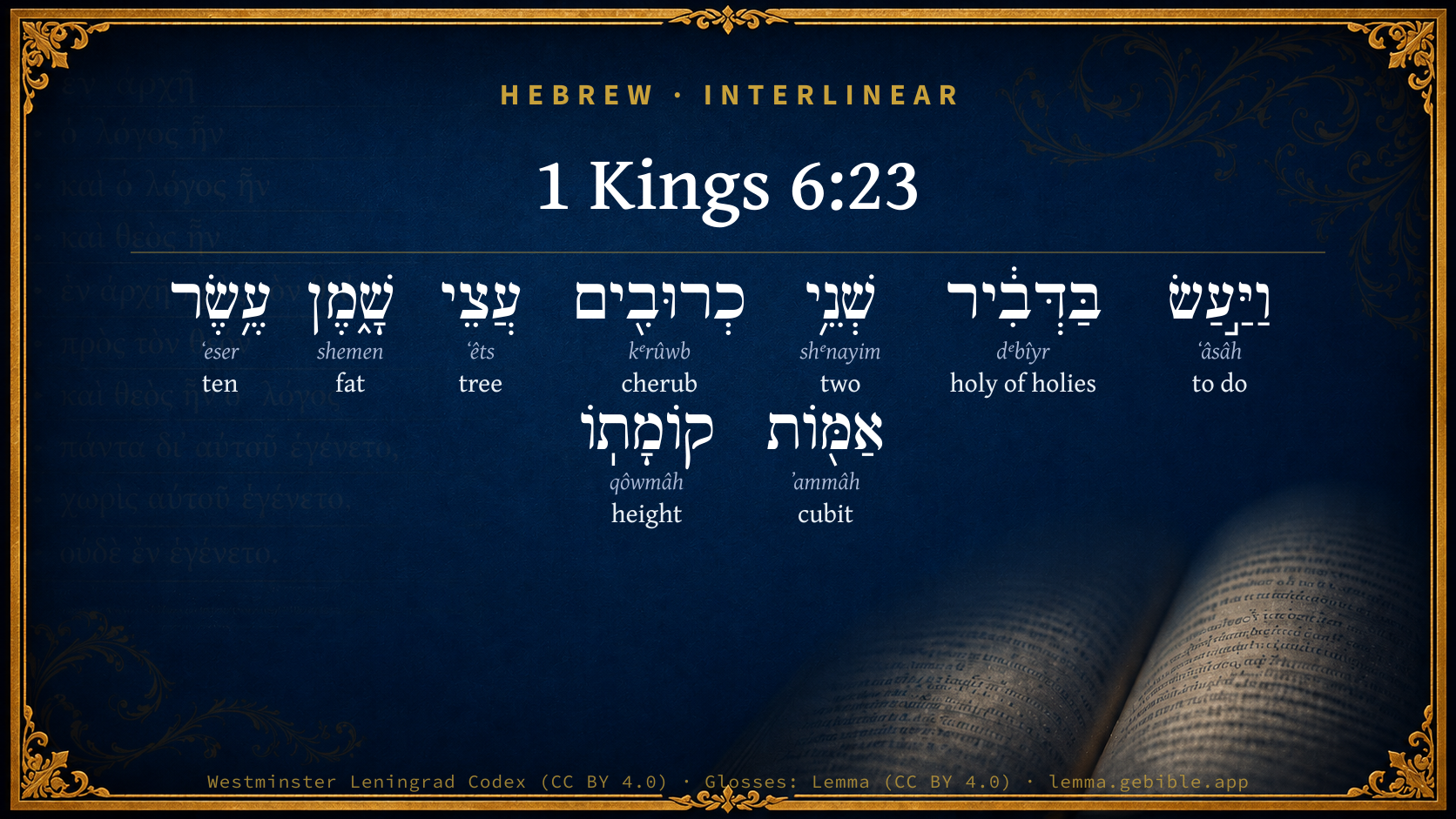
Hebrew (Westminster Leningrad Codex) 1 Kings 6:23 appears in the Hebrew Old Testament. The text above is from the Westminster Leningrad Codex. Each word links to its Strong’s number, a concise gloss, and parsing drawn from the Open Scriptures Hebrew Bible morphology. Click any word for its full Brown-Driver-Briggs (BDB) entry.
Download image
Cite this verse

1 Kings 6:23 (World English Bible). Public Domain. Lemma interlinear Bible study tool, https://lemma.gebible.app/v/1-kings/6/23.

Show BibTeX & RIS
BibTeX
RIS
English Translation
In the oracle he made two cherubim of olive-wood, each ten cubits high.
World English Bible · Public Domain
Download a study sheet

One document with this verse’s original text, its word-by-word gloss line, the meaning frame, cross-references with their text, attributed commentary, and full source and license credits — printable, and it pastes into notes with its structure intact.

This verse Autodidact and up

Study sheet (.html) Plain text (.txt)

A passage Seminary Student

Up to 50 verses in one chapter. A passage sheet keeps up to 6 commentary sources and 12 cross-references per verse, in the order this page ranks them, and says so on the sheet whenever that leaves anything out. Ask for a single verse and you get the Autodidact verse sheet above.

Everything on this page stays free to read, with no account — the sheet is a download of what is already on screen, not access to it.

Want to remove ads? Support Godless Engineer
Compare translations 3

The same verse in 3 English versions, stacked beneath the original-language interlinear above. Click any original word for its lexicon entry.

Each is an independent rendering of the whole verse — the interlinear is not word-aligned to these translations.

Highlighted words mark where these versions differ — a whole-verse word diff, not a word-by-word alignment.

  • World English Bible Public Domain
    In the oracle he made two cherubim of olive-wood, each ten cubits high.
  • King James Version Public Domain
    And within the oracle he made two cherubim of olive tree, each ten cubits high.
  • unfoldingWord Literal Text CC BY-SA 4.0
    And he made in the inner sanctuary two cherubs of wood of oil. Ten cubits its height.

unfoldingWord Literal Text — © unfoldingWord, licensed CC BY-SA 4.0. Word-aligned USFM3 via Door43 (git.door43.org/unfoldingWord/en_ult).

Versions to compare (up to 4)

3 of 4 selected

Show all 18 translations

Every available English version of this verse, each an independent rendering of the whole verse.

  • World English Bible Public Domain
    In the oracle he made two cherubim of olive-wood, each ten cubits high.
  • Berean Standard Bible Public Domain
    In the inner sanctuary he made two cherubim, each ten cubits high, out of olive wood.
  • Majority Standard Bible Public Domain
    In the inner sanctuary he made two cherubim, each ten cubits high, out of olive wood.
  • King James Version Public Domain
    And within the oracle he made two cherubim of olive tree, each ten cubits high.
  • American Standard Version (1901) Public Domain
    And in the oracle he made two cherubim of olive-wood, each ten cubits high.
  • Revised Version (1885) Public Domain
    And in the oracle he made two cherubim of olive wood, each ten cubits high.
  • Geneva Bible (1599) Public Domain
    And within the oracle he made two Cherubims of oliue tree, ten cubites hie.
  • Douay-Rheims (1899) Public Domain
    And he made in the oracle two cherubims of olive tree, of ten cubits in height.
  • Young's Literal Translation Public Domain
    And he maketh within the oracle two cherubs, of the oil-tree, ten cubits `is' their height;
  • Literal Standard Version CC BY-SA 4.0
    And he makes two cherubim of the oil-tree within the oracle; their height [is] ten cubits;
  • Unlocked Literal Bible CC BY-SA 4.0
    Solomon made two cherubim of olivewood, each ten cubits high, for the inner room.
  • unfoldingWord Literal Text CC BY-SA 4.0
    And he made in the inner sanctuary two cherubs of wood of oil. Ten cubits its height.
  • Darby Bible Public Domain
    And he made in the oracle two cherubim of olive-wood, ten cubits high;
  • World Messianic Bible Public Domain
    In the inner sanctuary he made two cherubim of olive wood, each ten cubits high.
  • Webster's Bible Public Domain
    And within the oracle he made two cherubim of olive tree, each ten cubits high.
  • Free Bible Version CC BY-SA 4.0
    He had two cherubim made out of olive wood for the inner sanctuary, each one ten cubits tall.
  • Bible in Basic English Public Domain
    In the inmost room he made two winged beings of olive-wood, ten cubits high;
  • JPS Tanakh (1917) Public Domain
    And in the Sanctuary he made two cherubim of olive-wood, each ten cubits high.

Literal Standard Version (2020), Covenant Press — licensed CC BY-SA 4.0. Text via the HelloAO Bible API (eBible.org). Unlocked Literal Bible (unfoldingWord) — licensed CC BY-SA 4.0. Text via the HelloAO Bible API (eBible.org). unfoldingWord Literal Text — © unfoldingWord, licensed CC BY-SA 4.0. Word-aligned USFM3 via Door43 (git.door43.org/unfoldingWord/en_ult). Free Bible Version, Dr. Jonathan Gallagher — licensed CC BY-SA 4.0. Text via the HelloAO Bible API (eBible.org).

Word by word

More ways to search: Search by grammar → Find every occurrence → Compare this word →

Practice this passage: Drill this verse → Learn its vocabulary →

בַּדְּבִ֔יר
dᵉbîyr
H1687
“in/at the · holy of holies”
Preposition, Determined + Noun, Common, Masculine, Singular, Absolute
Part of Speech
Preposition + Noun
Type
Common
Gender
Masculine
Number
Singular
State
Absolute
Full BDB Definition

Origin: from H1696 (apparently in the sense of oracle)

TWOT: 399g

the holy of holies, the innermost room of the temple or tabernacle - hindmost chamber, innermost room of the temple of Solomon, most holy place, holy of holies - (TWOT) oracle
  1. וַיַּ֣עַשׂ ʻâsâh H6213 “and · to do” Conjunction + Verb, Qal, Sequential Imperfect, 3rd Person, Masculine, Singular
  2. שְׁנֵ֥י shᵉnayim H8147 “two” Adjective, Cardinal number, Masculine, Dual, Construct
  3. כְרוּבִ֖ים kᵉrûwb H3742 “cherubim” Noun, Common, Masculine, Plural, Absolute
  4. עֲצֵי ʻêts H6086 “trees of” Noun, Common, Masculine, Plural, Construct
  5. שָׁ֑מֶן shemen H8081 “fat” Noun, Common, Masculine, Singular, Absolute
  6. עֶ֥שֶׂר ʻeser H6235 “ten” Adjective, Cardinal number, Feminine, Singular, Absolute
  7. אַמּ֖וֹת ʼammâh H520 “cubits” Noun, Common, Feminine, Plural, Absolute
  8. קוֹמָתֽוֹ qôwmâh H6967 “height · his” Noun, Common, Feminine, Singular, Construct + Suffix, Personal, 3rd Person, Masculine, Singular

About this verse

These counts appear in no published source. They are computed here, from the morphology-tagged text and Lemma’s own curated glosses. What Lemma adds →

9
words
9
distinct lemmas
Historical
section

Notable vocabulary

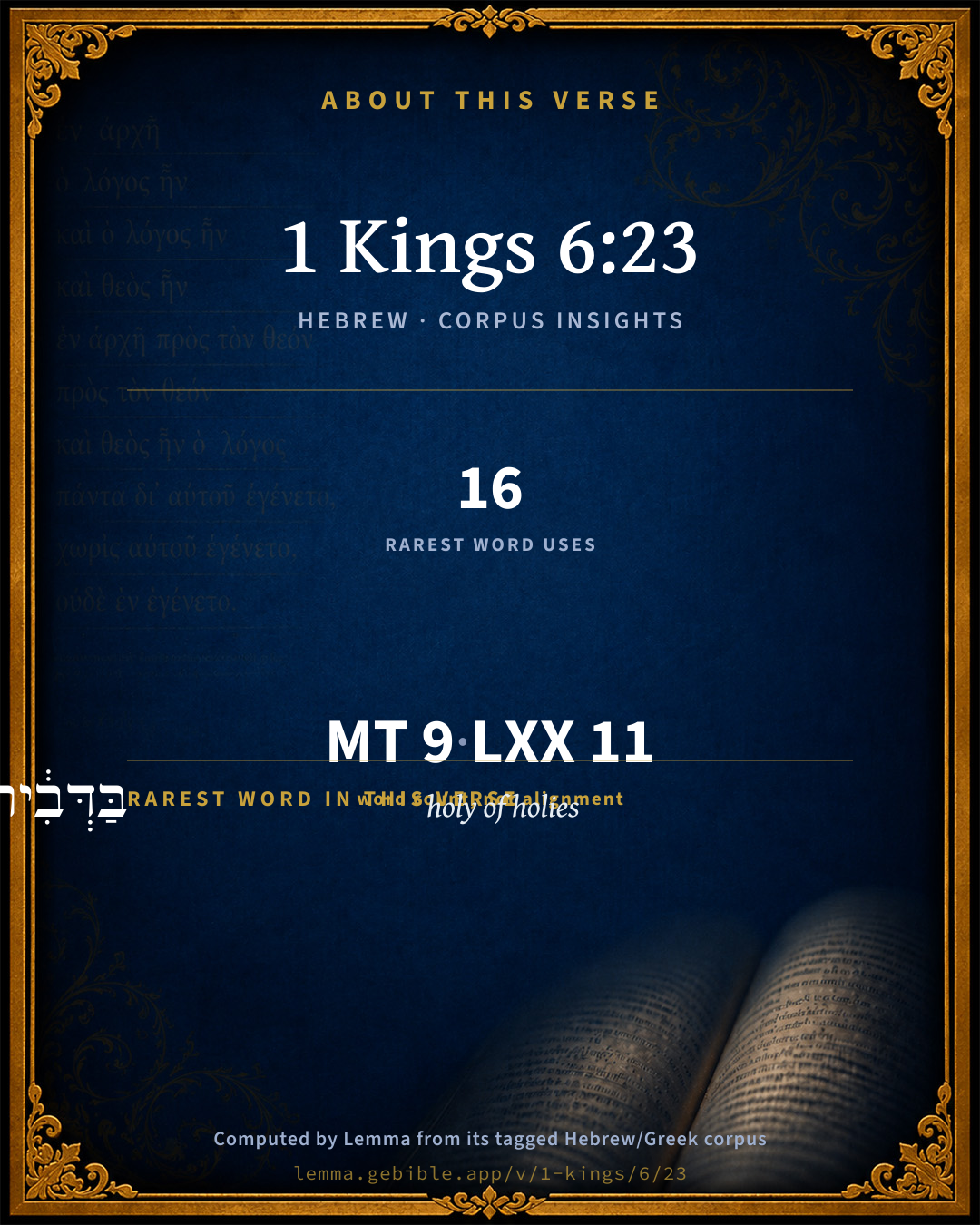
The rarest word here is בַּדְּבִ֔יר holy of holies H1687 — appearing just 16 times in the whole Hebrew Bible.

Shared distinctive vocabulary

בַּדְּבִ֔יר holy of holies H1687 occurs in 16 verses of the Hebrew Bible. Also found in:

Grammatical profile

  • 1 verb
  • 6 nouns
  • 2 adjectives

Verb forms

  • וַיַּ֣עַשׂ Qal · Sequential Imperfect

Hebrew & Septuagint length

In English translation the verse runs 13 words from the Hebrew and 13 from the Septuagint (LXX English) — the same length.

A rough comparison of the two English renderings, which tokenize alike — not a word-level alignment.

Word counts can differ between the Hebrew and the Greek without any difference in meaning — e.g. the Hebrew direct-object marker אֵת has no separate Greek word, and Greek often adds the article ὁ.

In the original languages it is 9 Hebrew tokens and 11 Greek tokens — but the two are counted differently (Hebrew bundles its prefixes and suffixes into one token; the Greek is in lemma form), so that isn’t a like-for-like length.

Cross-references

10

Topical passages linked to 1 Kings 6:23 in the Treasury of Scripture Knowledge — connected by theme and wording, ordered by reader-vote popularity; previews shown in the World English Bible.

  • Exodus 37:7–9 He made two cherubim of gold. He made them of beaten work them, at the two ends of the mercy seat;
  • Genesis 3:24 So he drove out the man; and he placed Cherubs at the east of the garden of Eden, and the flame of a sword which turned every way, to guard the way to the tree of life.
  • Exodus 25:18–22 You shall make two cherubim of hammered gold. You shall make them at the two ends of the mercy seat.
  • 2 Chronicles 3:10–13 In the most holy house he made two cherubim of image work; and they overlaid them with gold.
  • Psalms 18:10 He rode on a cherub, and flew. Yes, he soared on the wings of the wind.
  • Psalms 80:1 Hear us, Shepherd of Israel, You who lead Joseph like a flock, You who sit above the cherubim, shine forth.
  • Isaiah 37:16 Yahweh of hosts, the God of Israel, who sits [above] the cherubim, you are the God, even you alone, of all the kingdoms of the earth; you have made heaven and earth.
  • Ezekiel 10:2–22 He spoke to the man clothed in linen, and said, Go in between the whirling [wheels], even under the cherub, and fill both your hands with coals of fire from between the cherubim, and scatter them over the city. He went in as I watched.
  • Hebrews 1:14 Aren't they all ministering spirits, sent out to do service for the sake of those who will inherit salvation?
  • 1 Peter 1:12 To them it was revealed, that not to themselves, but to you, did they minister these things, which now have been announced to you through those who preached the Gospel to you by the Holy Spirit sent out from heaven; which things angels desire to look into.

Cross-references courtesy of OpenBible.info (CC BY 4.0).

Hebrew and Greek witnesses Masoretic Hebrew ↔ Greek Septuagint

The same verse in the two great witnesses to the Old Testament, shown verse-for-verse.

These are two independent witnesses, not word-aligned to each other, and the Septuagint is shown in lemma (dictionary) form.

Hebrew 1 Kings 6:23 Masoretic · Westminster Leningrad Codex

וַיַּ֣עַשׂ בַּדְּבִ֔יר שְׁנֵ֥י כְרוּבִ֖ים עֲצֵי שָׁ֑מֶן עֶ֥שֶׂר אַמּ֖וֹת קוֹמָתֽוֹ

In the oracle he made two cherubim of olive-wood, each ten cubits high.

World English Bible · Public Domain

Greek LXX 1 Kings 6:23 Septuagint · lemma form

καί ποιέω ἐν ὁ δαβιρ δύο χερουβιν δέκα πῆχυς μέγεθος σταθμπόω

And he made in the oracle two cherubs of ten cubits measured size.

LXX2012 (modern English Septuagint) · Public Domain

Hebrew: Westminster Leningrad Codex (CC BY 4.0). Greek: Septuagint (public domain); English from LXX2012 (modern English Septuagint) (Public Domain). How the Septuagint differs from the Hebrew →

Targum (Aramaic paraphrase)

1

The Targum is the ancient Jewish Aramaic paraphrase of the Hebrew Scriptures — an interpretive translation, not the Hebrew text itself. Onkelos (literal) and Pseudo-Jonathan (expansive) render the Torah, and Jonathan the Prophets. Coverage is partial: where no permissively-licensed English translation exists for a verse, only the Aramaic is shown. This is verse-level text, not a word-by-word alignment to the Hebrew.

  1. Targum Jonathan Prophets (Joshua–Malachi)
    וַעֲבַד בְּבֵית כַּפּוֹרֵי תְּרֵין כְּרוּבִין דַאֲעֵי זֵיתָא עֲסַר אַמִין רוּמֵיהּ:

    (no public-domain English translation for this verse)

    Targum Jonathan — Aramaic: “Mikraot Gedolot” (public domain). English: “Sefaria Community Translation” (CC0 1.0 (public-domain dedication)); “London "Chaldee Paraphrase," 1871” (public domain). Text via Sefaria.

Commentary

Notes on 1 Kings 6:23 from classic Christian and Jewish commentators (each source and its license shown beneath its notes). The classic Christian expositions comment on the surrounding passage and are grouped to its opening verse, so a note may address several verses; the Jewish commentaries on the Tanakh (Rashi and others) are per-verse, so they appear only where the commentator wrote on this verse.

Lemma curates 59 commentaries, every one of them public domain or Creative Commons licensed, each selected and text-cleaned for this edition rather than reprinted as found. About our sources →

Trapp's Complete Commentary

John Trapp

1Ki 6:23 And within the oracle he made two cherubims [of] olive tree, [each] ten cubits high.

Ver. 23. And within the oracle he made two cherubims.] These were two great human winged statues, five yards high, representing the strength and excellency of the blessed angels, ever attendant upon the Almighty God; as also the eminent parts, and praiseworthy practices of gospel ministers, who should be at peace among themselves, and promote peace all they can among others. These cherubims were two of them, - Christ sent out his apostles by two and two, - they were also made of olive, that emblem of peace, and their faces looked one toward another: they were also uniform.

John Trapp, A Commentary or Exposition upon All the Books of the Old and New Testament (1647–1656) — public domain. Text from a community e-Sword module.

Joseph Benson's Commentary

1Ki 6:23. Within the oracle he made two cherubims — These were different from, and much larger than those made by Moses, which were of solid gold, and arose out of each end of the mercy-seat, being of one piece with it, and looking one upon the other, Exo 25:18-19. But these made by Solomon were of olive-wood, or, as it is in the Hebrew, of tree of oil; many sorts of which wood there were besides olive; as pine, cedar, &c. The heathen set up images of their gods, and worshipped them. These cherubim were designed to represent the servants and attendants of the God of Israel, the holy angels; not to be worshipped themselves, but to show how great he is whom we worship.

Here it may be proper to note, that the word דביר, debir, (which our translation constantly renders oracle,) comes from דבר, dabar, which signifies to speak; because God, who dwelt between the cherubim of the ark in the Mosaic tabernacle, declared his mind from thence, when he was consulted by the high-priest with Urim and Thummim. And it still retained this name, though we never read of any answer by Urim and Thummim in this temple. It is highly probable that, upon their rejecting the government of God, and turning the theocracy into a human government by kings, God ceased to direct and govern them by that divine oracle. During the reign of David, indeed, there are some footsteps of it, their new government by kings being not well established. So that we may suppose there was a mixture of the theocracy still with it, as may be gathered from 2Sa 2:1; 2Sa 21:1. But after that there is not the least glimpse of it; but they inquired of God by the prophets, 1Ki 22:3; 2Ki 3:11; 2Ki 3:20. And, what is very remarkable, in the days of Josiah, when the high-priest was sent by that king to inquire of God, he applied to Huldah the prophetess for that purpose: which is a demonstration that the answer by Urim and Thummim ceased when God’s government was cast off by them; to which that oracle properly appertained. And therefore in all these places it would be more properly rendered, the most holy place. For though the ark was placed there, no oracles or words of the Lord were given from thence.

Joseph Benson's Commentary on the Old and New Testaments (1811–1818) — public domain. Text from a community e-Sword module.

The Expositor's Bible

THE ARK AND THE CHERUBIM

1Ki_6:23-30; 1Ki_8:6-11.

"Jehovah, thundering out of Zion, throned Between the cherubim."

- MILTON

THE inculcation of truths so deep as the unity, the presence, and the mercy of God would alone have sufficed to give preciousness to the national sanctuary, and to justify the lavish expenditure with which it was carried to completion. But as in the Tabernacle, so in the Temple, which was only a more rich and permanent structure, the numbers, the colors, and many details had a real significance. The unity of the Temple shadowed forth the unity of the Godhead; while the concrete and perfect unity, resulting from the reconciliation of unity with difference and opposition (1 + 2), is "the signature of the Deity." Hence, as in our English cathedrals, three was the predominant number. There were three divisions, Porch, Holy Place, Oracle. Each main division contained three expiatory objects. Three times its width (which was 3 x 10) was the measure of its length. The number ten is also prominent in the measurements. It includes all the cardinal numbers, and, as the completion of multiplicity, is used to indicate a perfect whole. The seven pillars which supported the house, and the seven branches of the candlestick, recalled the sacredness of the seventh day hallowed by the Sabbath, by circumcision, and by the Passover. The number of the cakes of shewbread was twelve, "the signature of the people of Israel, a whole in the midst of which God resides, a body which moves after Divine laws." Of the colors predominant in the Temple, blue, the color of heaven, symbolizes revelation; white is the color of light and innocence; purple, of majesty and royal power; crimson, of life, being the color of fire and blood. Every gem on the high priests pectoral had its mystic significance, and the bells and pomegranates which fringed the edge of his ephod were emblems of devotion and good works.

Two instances will suffice to indicate how deep and rich was the significance of the truths which Moses had endeavored to engraft in the minds of his people, and to which Solomon, whether with full consciousness or not, gave permanence in the Temple.

1. Consider, first, the Ark.

Every step towards the Holiest was a step of deepening reverence. The Holy Land was sacred, but Jerusalem was more sacred than all the rest. The Temple was the most sacred part of the city; the Oracle was the most sacred part of the Temple; the Ark was the most sacred thing in the Oracle; yet the Ark was only sacred because of that which it contained.

And what did it contain? What was it which enshrined in itself this quintessence of all sanctitude? When we pierce to the inmost recesses of a pyramid, we find there only the ashes of a dead man, or even of an animal. Within the adytum of an Egyptian temple we might have found "an ox wallowing on purple tapestry." The Egyptians, too, had their arks, as the Greeks had the cyst of Cybele, and the vannus of Iacchus. What did they contain? At the best phallic emblems, the emblems of prolific nature. But the Ark of Jehovah contained nothing but the stone tablets on which were carved the Ten Words of the Covenant, the briefest possible form of the moral law of God. In the inmost heart of the Temple was its most inestimable treasure, -a protest against all idolatry; a protest against all polytheism, or ditheism, or atheism; a protest, too against the formalism which the Temple itself and its services might tend to produce in its least spiritually minded worshippers. Thus the entire Temple was a glorification of the truth that "the fear of the Lord is the beginning of wisdom," and that the one end to be produced by the fear of the Lord is obedience to His commandments. The Ark and its unseen treasure taught that no religion can be of the least value which does not result in conformity with the plain moral laws:-be obedient; be kind; be pure; be honest; be truthful; be contented; and that this obedience can only spring from faith in the one God whom all real worshippers must worship in spirit and truth.

Obvious as this lesson might seem to be, it was entirely missed by the Jews in general. The Ark, too, was degraded into a fetish, and Jeremiah says {Jer_3:16} of the exiles, "They shall say no more, The ark of the covenant of the Lord: neither shall it come to mind: neither shall they miss it: neither shall it be made any more" (Hebrews). When a symbol has been perverted into a source of materialism and superstition, it becomes not only useless but positively dangerous. No religions have fallen so absolutely dead as those which have sunk into petty formalism. The Ark, for all its quintessential sacredness, had been suffered to fall into the hands of uncircumcised Philistines, and to be placed in their Dagon temple, to show that it was no mere idolatrous amulet. Ultimately it was carried away to Babylon, to adorn the palace of a heathen tyrant, and probably to perish by fire in his captured city. In the second Temple there was no ark. Nothing remained but the rock of Araunahs threshing-floor, on which it once had stood.

2. Consider, next, the meaning of the Cherubim.

(1) The infinite sanctity given to the conception of the moral law was enhanced by the introduction of these overshadowing figures. We are never told in the entire books of Scripture what was the form of these cherubim; nor is their function anywhere specially defined; nor, again, can we be at all certain of the derivation of the name. That the cherubim over the Ark were not identical with the fourfold-visage-four of Ezekiels cherub-chariot we know, because they certainly had but one face. But we now know that among the Assyrians, Persians, Egyptians, and other nations nothing was more common than these cherubic emblems, which were introduced into their palaces and temples under the forms of winged lions, oxen, men, and eagle-headed human figures. We see also that in the Tabernacle, and to a still greater extent in the Temple, a tacit exception to the stringency of the Second Commandment seems to have been made in favor of the component parts of these cherubic figures. If Solomon was aware (as he surely must have been) of the existence of the law, "Thou shalt not make to thyself any graven image," he must either have laid stress on the words "to thyself," and have excused the brazen oxen which supported his great laver on the ground that they could not be turned into objects of worship, or he must have held, as Ezekiel apparently did, that the ox was the predominant form in the cherubic emblem. From the Vision of Ezekiel we see that the cherubim-like the "Immortalities" (zw~a) of the Apocalypse, which had faces of the ox, the eagle, the lion, and the man-were conceived of as "living creatures" upholding the sapphire Throne of God. They had wings, and the similitude of hands under their wings. They flashed to and fro like lightning in the midst of a great cloud, and an enfolding fire, and a rolling mass of amber-colored flame. Of the form of this "changeable hieroglyphic" we need say no more. Perhaps originally suggested by the wreathing fires and rolling storm clouds, which were regarded as immediate signs of the Divine proximity, the cherubim came to be regarded as the genius of the created universe in its richest perfection and energy, at once revealing and shrouding the Presence of God. Their eyes represent His omniscience, for "the eyes of the Lord are in every place"; their wings and straight feet represent the speed and fiery gliding of His omnipresence; each element of their fourfold shape indicates His love, His patience, His power, His sublimity. Their wheels imply that "the dread magnificence of the unintelligent creation" is under His entire control; and, as a whole, they symbolize the dazzling beauty of the universe, alike conscious and material. They were the ideal anima animantium-the perfection of existence emanating from and subject to the Divine Creator whose tender mercy is over all His works. Their function, when they are first introduced in the Book of Genesis, is at once vengeful and protective; vengeful of the violated law, protective of the treasure of life. They are here the Erinnyes of the Dawn, revealing and avenging the works of darkness. Their "dreadful faces and fiery arms" at the gate of Eden typify guilty awakenment, realized retribution, conscious alienation from God, the universe siding with His awakened anger.

(2) But when next they are mentioned, God says to Moses, "Thou shalt make a mercy-seat of pure gold, and thou shalt make two cherubim of gold at the two ends of the mercy-seat." But for their presence on the mercy-seat how terrible would have been the symbolism of the Holy of Holies-Gods darkness, mans crime, a broken law! It would have represented Him who hath clouds and darkness round about Him, and dwelleth in darkness which no man can approach unto; and the Ark would only have treasured up, as a witness against mans apostasy, the shattered slabs of the words of Sinai. But over that Ark, and its saddening because dishallowed treasure, bent once more these mystic figures, these "cherubim of glory." They bent down as though at once to protect with outspread wings, and to regard with awful contemplation, that mystic gift of a law promulgated to all nations as their moral heritage and as the revealed will of God. These are no longer cherubim of vengeance or awakened wrath, for they stand on the Capporeth, the "covering," or "propitiatory" of the Ark. They gleamed out in the red light of the high priests golden brazier on the one day when human foot entered the darkness m which they were shrouded; and even by him they were but dimly discerned through the ascending wreaths of fragrant incense. But he stood before them, where, on their spreading wings, the light of the Divine presence was deemed to dwell; and with the blood of expiation he sprinkled seven times the mercy-seat over which these adoring figures leaned. The wrathful cherubim of the lost Eden had driven man from a treasure which he had forfeited; but these, though they guard the ten words of a law which man had broken, were cherubim of mercy and reconciliation. Those of Eden were armed with swords of flame; those of the Temple were reddened with the blood of forgiveness. Those typified a covenant destroyed and ended; these a covenant broken yet renewed. Those spoke of awakened wrath; these of covenanted mercy. Those kept men back from the Tree of Life; these guarded that which is a Tree of Life to them that love it.

Could the whole covenant of the law and the gospel have been symbolized more simply, yet with Diviner force? The Temple itself, with all its sacrifices, with all its service and ceremonial and all the gorgeous vestments of Aarons vestry, served but to teach the infinite worth of simple righteousness. The heart of the Mosaic legislation was nothing so poor, so paltry, so material as the promotion of liturgical Levitism, and the pomp of ritual, and the organization of priestly functions-as though these in themselves had any value in the sight of God. It lay in the lesson that "Obedience is better than sacrifice, and to hearken than the fat of rams." The law of Moses-the ten words which constituted the inmost preciousness of his legislation-was, alas! a violated law. For the disobedient it had no message but the wrathful menace of death. But to show that God has not abandoned His disobedient children, but would still enable them to keep that law, and to repent for its transgression, the cherubim are there. Their presence on the propitiatory was meant to reveal the glory of the gospel. The high priest, who alone saw them on the Great Day of Israel, was a type of Him who, not with the blood of bulls and goats, but in His own blood (i.e., in the glory of the life outpoured for man), entered into Gods presence within the veil.

(3) In the dazzling living creatures before the throne in the Revelation of St. John, we see once more these cherubim of Eden, who, having indicated at the Fall an awful warning, and represented in the Tabernacle a blessed hope, symbolize, in the last book of the Bible, a Divine fulfillment. They are there no longer with fiery swords, in wrathful aspect, in repellent silence; but, gracious and beautiful, they join in the new song of the redeemed multitude under the shadow of the Tree of Life, to which all have free access in that recovered Eden. In the Temple-glimmering through the rising fumes of incense, which were the type of accepted prayer, their golden plumage sprinkled with the blood of the atoning sacrifice-they became a type both of all creation up to its most celestial beings, gazing in adoration on the will of God, and of all creation, in its groaning and travailing, restored through the precious blood that speaketh better things than the blood of Abel. Not all, of course, of these deep meanings were present to the souls of Israels worshippers; but the best of them might with joy see something of the things which we see when we say that in these glorious figures are summed up the three chief images of all Scripture: first, the Primaeval Dispensation, "In the day that thou eatest thereof, thou shalt surely die"; next, in the wilderness, "This do, and thou shalt live"; last of all, in the Gospel Dispensation, "Thou wast slain, and hast redeemed us to God by Thy blood out of every kindred and tongue and people and nation, and hast made us unto our God kings and priests."

William Robertson Nicoll, ed., The Expositor's Bible (London: Hodder & Stoughton, 1887–1910) — public domain. 65 of 66 books (1 Corinthians is not separately keyed, as that volume carries no machine-parseable verse references); section-level commentary keyed to the opening verse. Introductory and overview sections not keyed to a specific passage are excluded.

Tyndale Open Study Notes

Tyndale Open Resources

6:23-28 In the inner sanctuary were two cherubim (see study note on 1 Chr 28:18) made of olive wood and overlaid . . . with gold. Standing like sentries facing the door (2 Chr 3:13), their combined wingspan reached from wall to wall. Along with the two smaller cherubim facing each other atop the Ark (Exod 25:17-21), they symbolized the awesome presence of the Most Holy God.

Tyndale Open Study Notes — © Tyndale Open Resources, licensed CC BY-SA 4.0. Text via the HelloAO Bible API.

Geneva Bible (1599)

Geneva Bible translators

Or, Pine tree

Geneva Bible (1599) marginal notes — public domain. Text via Bolls.life.

Ellicott's Commentary for English Readers

(23) Cherubim.—These were copied from the Tabernacle, but apparently with some differences, over and above the necessary increase of size, and the change of material from solid gold to olive-wood overlaid with gold. In Exo_25:18-20; Exo_37:7-9, they are described as having their faces towards the mercy-seat, and covering the mercy-seat with their wings. Here, from the careful description of the outstretched wings, of ten cubits in width for each cherub, meeting in the midst of the house and touching the walls, it would seem that they must have been turned so as to face the entrance. The cherubim over the ark are described only in three places in the Old Testament—in the passages in Exodus, here, and in the parallel 2Ch_3:10-13, and in those great visions of the priestly prophet Ezekiel (Eze_1:4-25; Eze_10:1-22) which have determined the imagery of the Apocalypse. In no case is their form distinctly mentioned, unless, by comparison of Eze_10:14-15 with Eze_1:10, it may be inferred to have been the form of a winged bull; whence would be naturally derived the golden calves of the idolatry introduced into Israel in the time of Jeroboam. Josephus, indeed, in his description of the Temple (Antt. viii. c. 3, § 3), expressly says that “no one can tell, or even conjecture, of what shape the cherubim were.” The tradition, therefore, must have been lost in the Second Temple, where there was no ark; and this is the more strange, because in Exo_26:1 the cherubim are said to have been represented in the embroidery of the curtains, and here (in 1Ki_6:32; 1Ki_6:35) to have been similarly carved on the walls.

But, whatever the cherubim were, it is certain that they were in no sense representations or emblems of Deity, like the winged figures of Assyria or Egypt, with which they have been often compared. They appear to symbolise the great physical forces of the universe, as guided by superhuman angelic intelligence to serve the supreme will of God. Thus, when first mentioned in Scripture (Gen_4:24), the cherubim are associated with “the flaming sword, turning every way, to guard the tree of life”; in Psa_18:10, the Lord is said “to ride upon the cherubim,” and “come flying upon the wings of the wind”; in Eze_1:10, the four living creatures, or cherubim, sustain the throne of God, and bear it away upon their wings; in Rev_4:6-8; Rev_5:8-9, the same living creatures unite with the elders representing the Church of redeemed humanity, in worship of the Lord upon His throne. The representation, therefore, of the cherubim in the Temple simply expresses the claim for Jehovah, the God of Israel, of such lordship over all creation as is hymned in the seraphic song of Isa_6:3. Possibly the change of attitude of the cherubim in the Temple denoted a change of idea, characteristic of Solomon and his age. The old attitude is clearly that of worship of God: the new rather of manifestation of His glory to man.

A Bible Commentary for English Readers, edited by Charles John Ellicott (1878–1897) — public domain. Text from a community e-Sword module.

The Cambridge Bible for Schools and Colleges

gen. ed. J. J. S. Perowne

23–30. Of the Cherubim within the oracle (2Ch_3:10-12)

23. And within the oracle he made two cherubims] As the Hebrew word is already in the plural form, write cherubim. These cherubim were winged figures intended to represent some holy and heavenly form. They are first mentioned in Gen_3:24, where some have thought that ‘the flame of a sword’ spoken of in connexion with them implies that the cherubim were aimed with this weapon. But this is not certainly to be deduced from the words. In 2Ch_3:13 they are said to stand upon their feet, while the descriptions in Ezekiel (chapp. 1 and 10) make them to have four faces. (Cf. also Exo_25:18-22). Their chief office in Scripture is to be a chariot for Jehovah (Psa_18:11), and for this reason they were set up in the most holy place, where the divine presence was to manifest itself. Hence of God it is frequently said ‘who dwelleth’ or ‘sitteth upon the cherubim.’

The Cambridge Bible for Schools and Colleges (gen. ed. J. J. S. Perowne; Cambridge University Press, 1878–1918) — public domain. Text from a community e-Sword module.

John Gill's Exposition

And five cubits was the one wing of the cherub,.... When stretched out on one side:

and five cubits the other wing of the cherub; on the other side him:

from the uttermost part of the one wing, to the uttermost part of the other wing, were ten cubits; half the breadth of the house.

John Gill's Exposition of the Whole Bible (1746–1763) — public domain (CC PDM 1.0). Text via the HelloAO Bible API.

Albert Barnes' Notes on the Bible

Two cherubims - The pattern of the tabernacle was followed (marginal reference), but without servile imitation. The original cherubs were entirely of gold. These, being so much larger, were of wood, merely overlaid with a golden plating. The arrangement of the wings, and the direction of the faces, seem also to have been different. Moses’ cherubim “covered with their wings over the mercy seat;” Solomon’s stretched out theirs to the full 1Ki 6:27, so that the four wings, each five cubits long 1Ki 6:24, extended across the whole sanctuary, the width of which was twenty cubits 1Ki 6:20. The former looked toward one another, and were bent downward toward the mercy-seat; the latter looked outward, toward the great chamber. (See 2Ch 3:13, and note.)

Of olive-tree - The oleaster or wild olive, not the cultivated species.

Albert Barnes' Notes on the Bible (1834–1885) — public domain. Text from a community e-Sword/MySword module.

Haydock's Catholic Bible Commentary

Olive. Hebrew, "trees full of oil or resin," distinguished from olive trees, 2 Esdras viii. 15. Vatable translates, "pine;" others, "cypress-wood." (Calmet) --- Height. Their gigantic stature served to denote the magnificence and greatness of God. They looked towards the east. (Menochius) --- Their wings extended equalled their height; so that the two cherubims occupied the whole space from north to south, (Haydock) covering the smaller cherubim of Moses. They only reached half the height of the sanctuary. Their form is not clearly ascertained. See Exodus xxv. 18. (Calmet) --- What will the Iconoclasts say to these images, which adorned not only the temple, which the people might behold, but also the most sacred place? (Haydock) --- Villalpand and Salien suppose, that a cherub resembled a young man in the higher parts, adorned with four wings of an eagle and a lion’s skin, round his breast and shoulders, while his feet were like those of a calf. (Menochius) --- Ezechiel seems to insinuate that, in the temple, the cherubim had two faces, one of a man and another of a lion, each looking at palm-trees; as these were placed alternately with cherubim, round the walls, Ezechiel xli. 18, 19.

George Leo Haydock (1774–1849), Haydock's Catholic Family Bible and Commentary, 1859 edition — public domain. Excludes Psalms (Douay-Rheims chapter numbering differs from Protestant) and Deuterocanonical books (Catholic canon only).

Matthew Poole's English Annotations

Besides those two made by Moses, Exo 25:18, which were of gold, and far less than these, and fixed in another place and posture.

Of olive tree, or, of oily trees, which sometimes are distinguished from the olive trees, as Isa 41:19.

Matthew Poole's English Annotations on the Holy Bible (1683–1685) — public domain. Text from a community e-Sword/MySword module.

Whedon's Commentary on the Bible

Daniel D. Whedon

23. Made two cherubim — The cherubim were composite images significant of all forms of creature life, and symbols of the living presence of Jehovah in all departments of the animal world. Their form is described in the opening vision of Ezekiel. Eze_1:5-11. Each cherub had four faces and four wings, and every part of their appearance seems to have been symbolical of some aspect or manifestation of Divine energy and power in creature life. Ezekiel’s magnificent picture may have added somewhat to the form of the cherubim in the temple, but in all essential particulars they were doubtless substantially the same. The probable form of one of these cherubim is presented in the annexed cut, the eagle face being out of sight. It is evident from their great size that these cherubim were not substituted, as some have thought, for the old cherubim that stood upon the ends of the mercyseat, (Exo_25:18,) for these stood ten cubits apart, while the mercyseat was only two and a half cubits long. These cherubim were therefore additional to the smaller and older ones on the ark, and overshadowed them by their vast wings, which reached across the entire oracle. The smaller cherubs looked towards each other over the mercyseat. (Exo_25:20;) these greater ones stood with their faces towards the house, (2Ch_3:13, margin;) that is, the human face, as chief and representative of all, looked towards the greater house, the holy place before the vail.

Olive tree — Or, tree of oil, meaning, perhaps, the wild olive, whose wood is hard and solid, with a fine grain and a pleasing yellowish tint.

Daniel D. Whedon (gen. ed.), Commentary on the Old and New Testaments (1874–1909) — public domain. Text from a community e-Sword module.

The Pulpit Commentary

And within the oracle The description now passes on to the mysterious symbolic figures which were placed in the holy of holies) he made two cherubims As to the nature, composition, and significance of the cherubim, see notes on Exo_25:19 Exo_37:7. The only particulars which will require notice here are those in which the cherub of the temple differed from that of the tabernacle of olive tree Heb. trees or wood of oil. The oleaster (wild olive) is supposed to be intended, the proper name for the olive tree being tyiz. (Neh_8:15) The wood of the oleaster, which is firm, fine grained, and durable, was used by the Greeks for the images of their gods (Winer). The cherubim of the tabernacle were of solid gold; those of the temple, on account of their great size (fifteen feet high) were necessarily of less costly material. But though of wood, yet the most durable and beautiful of wood, the olive, was employed in their construction. It is noticeable how olive wood is employed for the cherubim and doors of oracle, and for the posts of the temple doorway; the less precious cedar was used for lining the walls and for Beams, etc., while for the floor and doors of house, the commoner cypress sufficed, each ten cubits high. Half the height of the oracle. They occupied its entire width (ver. 24).

The Mystery of the Cherubim.

That the cherubim were symbolic no one denies. They are so often mentioned in Scripture that their meaning has been frequently discussed. Enumerate some of the opinions held. The view we accept is that they were symbolic representations of redeemed humanity. They were intended to inspire men with hope of redemption, from the day when the Lord placed them at the east of the garden of Eden, till the vision of John (Re 21) is fulfilled in the "new heavens and new earth," wherein the cherubim are no longer seen, having vanished before the reality they symbolically represented. In the cherubim we are reminded of the following

I THE PERFECTING OF HUMANITY. Some obscurity lingers about the forms of these beings. They are introduced in Genesis without a word of description; and in Exodus (25 and 37.) little is said beyond this, that they had "wings and faces." Turning to their visionary appearances to Ezekiel and to John there is variety in form. But whatever latitude there may be in detail, the leading form was always that of a man e.g. , Ezekiel, (Eze_1:5) "they had the likeness of a man." With this, other creature forms were combined, viz., the lion, the ox, and eagle. These were selected for special reasons. They belonged to the noblest kingdom, that of animal life, as distinguished from that which was vegetable or mineral.They were amongst the highest after man in the nature of their life; very different, for example, from sea anemones, etc. They had loftier attributes than those of other creatures; greater powers or wider usefulness. Hence, combined with the image of man to form the cherubim, they suggested the addition to him of the powers they specially represented. The lion, especially to the Hebrews, was a type of kingly majesty and glorious strength. Give quotations from Scripture. The eagle, with its keen vision and swift flight, was a type of rapidity of thought and movement (Deu_28:49; Job_9:26; Pro_23:5) The ox, used in ploughing, harrowing, carrying home the sheaves, and treading out the corn, represented patient and productive activity. In the cherubim all these were grafted on man an ideal combination, to show that, though man was the highest creature of God (he alone having a moral and a rational nature), he could be, and would be, ennobled by having hereafter the powers bestowed, of which in creature life these animals were representatives. Show the Scripture evidence for expecting in heaven the faculties for knowing, for serving, for enjoying, which we have not here.

II THE FULNESS OF LIFE. In Ezekiel and Revelation the cherubim are frequently spoken of as "the living ones" (animantia, zwa). This expression is obscured in our translation by the unhappy rendering "beasts", (Rev_4:6) etc. The expression denotes life in its highest and most active form. In harmony with this, Ezekiel speaks of their "running and returning." John says, "they rest not day nor night." Though the cherubim in the temple and tabernacle were of necessity stationary, the same idea was there expressed by the outspread wings. The cherubim pointed on to the plenitude of life, Divine and spiritual, over which weald. ness should have no power, and towards which death would never approach. "I give unto them eternal life, etc. "I am come that they might have life, and that they might have it more abundantly," etc.

III THE DWELLING WITH GOD. The cherubim were always associated with the Divine Presence. After man was driven from Eden, the cherubim was placed there to occupy the place he had forfeited; where life was full, and where holiness was a necessity. When the tabernacle was constructed, all the inner curtains were inwoven with cherubic figures, and images of cherubim appeared on the sacred ark, which was the throne of Jehovah. This was repeated in the temple, as the passage before us shows; for the magnificent cherubim, each ten cubits high, were stationed in the "oracle," the place where the Shechinah proclaimed God"s presence. We must add, therefore, to the ideas we have dwelt on this thought, that the life represented was life essentially connected with God Himself. Not only will the life of the future be full, but it will be holy. Holiness will be its essence. "The pure in heart shall see God." "Without holiness no man shall see the Lord." "Neither shall there enter into it anything that defileth," etc.

IV THE BLISS OF THE FUTURE. A careful reading of Gen_3:24 shows that the "sword" and the "cherubim" were not only distinct,but had different functions. The sword "kept" the way to the tree of life, so that it was more accessible to fallen man. It was a symbol of repulsion and alarm. The cherubim "kept" the garden in a different sense. They did not defend it against man, but occupied it for man, and therefore gave to those who were shut out the hope of that which the promise of Jehovah had already announced. The presence of the cherubim said to fallen man: "This region of life is not destroyed, it is not given over to other creatures, but it is occupied and kept provisionally for you by a being in whom your nature predominates; and hereafter, you yourself changed, enriched with new powers, restored by redemptive love to holiness, shall share Paradise regained." The means of realizing this became more clear as the ages rolled by. The hope that ideal humanity would inherit bliss did not die out, but the method of its fulfilment was unfolded in the Mosaic institutions. Not only did the cherubim in the oracle witness, as the cherubim in Eden had done, but once a year the high priest, as the representative of the people, went in, and stood with the cherubim in the presence of Jehovah. He entered not "without blood," but after atonement had been made for the sins of the people. Apply this to the truth revealed in the Epistle to the Hebrews. Show how Christ, who has atoned for the world"s sin, has entered as our High Priest into the holiest of all, and how He has opened the kingdom of heaven to all believers. No wonder that in the Revelation "the Lamb that was slain" is depicted as being the object of heaven"s praise; the link between man"s guilt and God"s mercy.

(For justification of this use of the cherubim, see Fairbairn"s "Typology of Scripture. A.R.

The Pulpit Commentary (1880–1919), ed. H.D.M. Spence-Jones & Joseph S. Exell — public domain. Text from a community e-Sword module.

John Wesley's Explanatory Notes

Cherubim - Besides those two made by Moses, Exod. xxv, 18, which were of gold, and far less than these. The Heathens set up images of their gods, and worshipped them. These were designed to represent the servants and attendants of the God of Israel, the holy angels, not to be worshipped themselves, but to shew how great he is whom we worship.

John Wesley, Explanatory Notes Upon the Whole Bible (1754–1765) — public domain. Text via the GEBible commentary corpus.

unfoldingWord translationNotes

Door43 World Missions Community

Solomon made

Solomon would have commanded his workers to do this work. AT: "Solomon commanded them to make" (See: Metonymy)

olivewood

wood from an olive tree

ten cubits ... five cubits

A cubit is 46 centimeters. AT: "4.6 meters ... 2.3 meters" (See: Biblical Distance)

wingspan

the distance from the tip of one wing to the tip of the other wing

same dimensions

"same size"

translationWords

cherub

unfoldingWord translationNotes — © Distant Shores Media and the Door43 World Missions Community, licensed CC BY-SA 4.0. Source: git.door43.org/Door43/en_tn.

Rashi

Rabbi Shlomo Yitzchaki (Rashi)

Olive wood. [Targum Yonoson rendered,] “olive wood.”

Ten amohs high. And their legs were standing on the ground, one was on the north of the Ark and one on the south, covering the Ark and its poles. The length of the wings covered part (of the poles’ width) since the Ark’s length was set to the width of the Temple, and its poles were protruding at the entrance of the Holy of Holies into the curtain which was at the entrance. Its poles were set at the ends of the Ark’s length, in order that two Leviyim should be able to enter between them, when they were carrying it in the wilderness.

Rashi on the Tanakh — English translations: “The Judaica Press complete Tanach with Rashi, translated by A. J. Rosenberg” (CC BY 4.0); “Pentateuch with Rashi's commentary by M. Rosenbaum and A.M. Silbermann, 1929-1934” (public domain); “The Metsudah Tanach series, Lakewood, N.J” (CC BY 4.0); and “The Book of Joshua, Metsudah Publications, 1997” (CC BY 4.0). Text via Sefaria.

Lesson kit

Teaching starters — assembled from the data on this page, not authored interpretation. Every prompt links to the verse data it draws on. Edit before teaching.

1 Kings, in the Historical, opens this verse with 9 words (9 distinct Hebrew lemmas). Its most distinctive word is dᵉbîyr (“holy of holies”). A historical commentator’s framing appears above. Read the whole chapter for the surrounding context.

Discussion questions

  1. The word dᵉbîyr carries the sense “holy of holies.” How does it shape the verse?
  2. 1 Kings 6:5 shares the word «holy of holies» with this verse. How do the two illuminate each other?
  3. These translations render this verse differently; the difference is in the English rendering, not the original. What questions does that raise?
  4. The verb «וַיַּ֣עַשׂ» is Qal Sequential Imperfect. How does its form color the action?
  5. Reading how Trapp's Complete Commentary and Joseph Benson's Commentary read this verse, where do the two commentators agree and where do they part?

Things to notice

Reading settings

Reading text

Shown beneath each verse's original-language words.

Old Testament
Old Testament edition

Read the OT as the Masoretic Hebrew (MT) or the Greek Septuagint (LXX).

English shown for the Greek Septuagint (in the Hebrew ↔ Greek comparison).

Comparing translations? Open the Compare panel on any verse page to stack up to four side by side.