Numbers 29:3

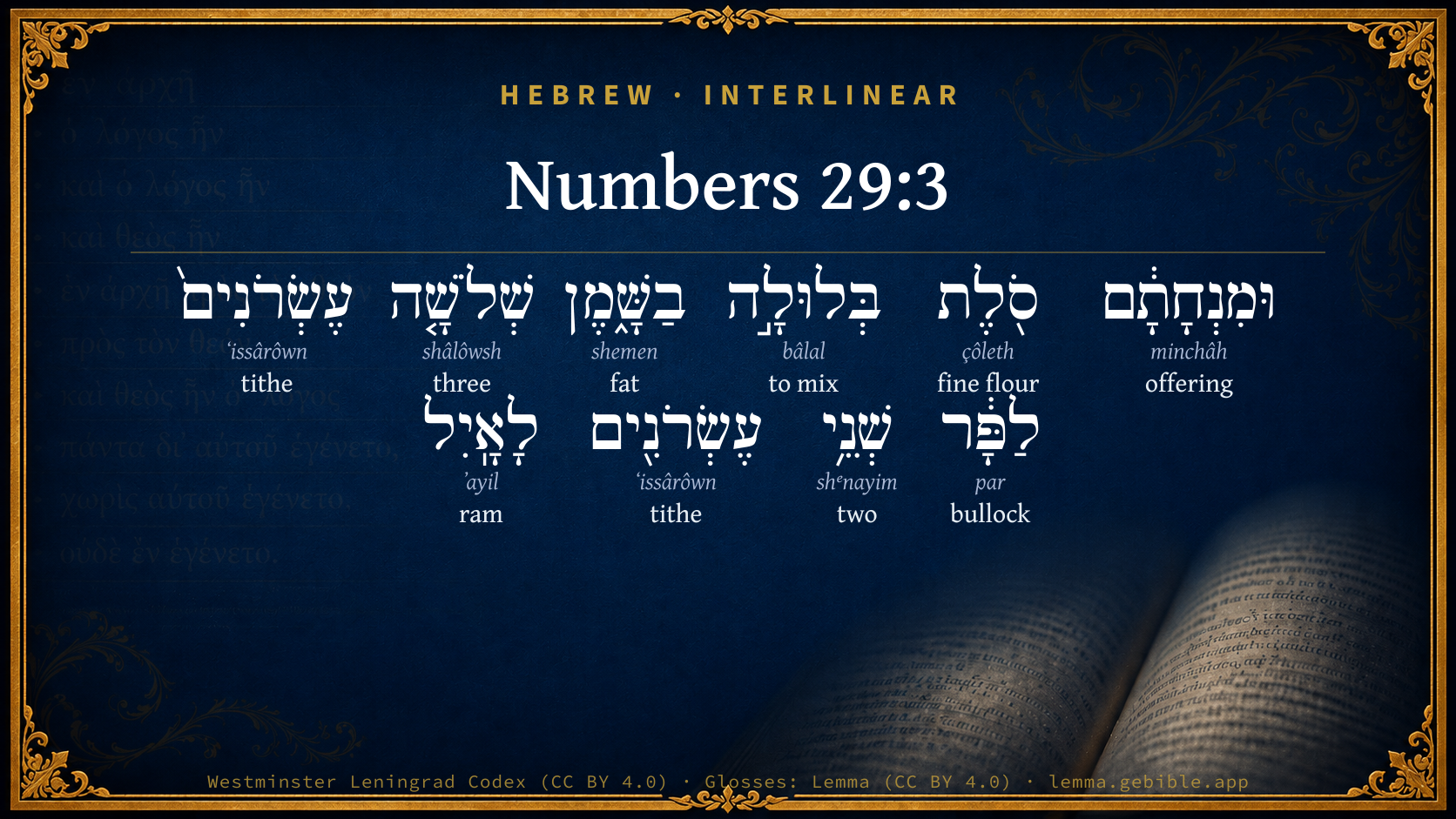
Hebrew (Westminster Leningrad Codex) Numbers 29:3 appears in the Hebrew Old Testament. The text above is from the Westminster Leningrad Codex. Each word links to its Strong’s number, a concise gloss, and parsing drawn from the Open Scriptures Hebrew Bible morphology. Click any word for its full Brown-Driver-Briggs (BDB) entry.
Download image
Cite this verse

Numbers 29:3 (World English Bible). Public Domain. Lemma interlinear Bible study tool, https://lemma.gebible.app/v/numbers/29/3.

Show BibTeX & RIS
BibTeX
RIS
English Translation
and their meal-offering, fine flour mixed with oil, three tenth parts for the bull, two tenth parts for the ram,
World English Bible · Public Domain
Download a study sheet

One document with this verse’s original text, its word-by-word gloss line, the meaning frame, cross-references with their text, attributed commentary, and full source and license credits — printable, and it pastes into notes with its structure intact.

This verse Autodidact and up

Study sheet (.html) Plain text (.txt)

A passage Seminary Student

Up to 50 verses in one chapter. A passage sheet keeps up to 6 commentary sources and 12 cross-references per verse, in the order this page ranks them, and says so on the sheet whenever that leaves anything out. Ask for a single verse and you get the Autodidact verse sheet above.

Everything on this page stays free to read, with no account — the sheet is a download of what is already on screen, not access to it.

Want to remove ads? Support Godless Engineer
Compare translations 3

The same verse in 3 English versions, stacked beneath the original-language interlinear above. Click any original word for its lexicon entry.

Each is an independent rendering of the whole verse — the interlinear is not word-aligned to these translations.

Highlighted words mark where these versions differ — a whole-verse word diff, not a word-by-word alignment.

  • World English Bible Public Domain
    and their meal-offering, fine flour mixed with oil, three tenth parts for the bull, two tenth parts for the ram,
  • King James Version Public Domain
    And their meat offering shall be of flour mingled with oil, three tenth deals for a bullock, and two tenth deals for a ram,
  • unfoldingWord Literal Text CC BY-SA 4.0
    And their grain offering shall be fine flour mixed with the oil, three-tenths for the bull, two-tenths for the ram,

unfoldingWord Literal Text — © unfoldingWord, licensed CC BY-SA 4.0. Word-aligned USFM3 via Door43 (git.door43.org/unfoldingWord/en_ult).

Versions to compare (up to 4)

3 of 4 selected

Show all 18 translations

Every available English version of this verse, each an independent rendering of the whole verse.

  • World English Bible Public Domain
    and their meal-offering, fine flour mixed with oil, three tenth parts for the bull, two tenth parts for the ram,
  • Berean Standard Bible Public Domain
    together with their grain offerings of fine flour mixed with oil—three-tenths of an ephah with the bull, two-tenths of an ephah with the ram,
  • Majority Standard Bible Public Domain
    together with their grain offerings of fine flour mixed with oil—three-tenths of an ephah with the bull, two-tenths of an ephah with the ram,
  • King James Version Public Domain
    And their meat offering shall be of flour mingled with oil, three tenth deals for a bullock, and two tenth deals for a ram,
  • American Standard Version (1901) Public Domain
    and their meal-offering, fine flour mingled with oil, three tenth parts for the bullock, two tenth parts for the ram,
  • Revised Version (1885) Public Domain
    and their meal offering, fine flour mingled with oil, three tenth parts for the bullock, two tenth parts for the ram,
  • Geneva Bible (1599) Public Domain
    And their meat offring shalbe of fine floure mingled with oyle, three tenth deales vnto the bullocke, and two tenth deales vnto the ramme,
  • Douay-Rheims (1899) Public Domain
    And for their sacrifices, three tenths of flour tempered with oil to every calf, two tenths to a ram,
  • Young's Literal Translation Public Domain
    and their present, flour mixed with oil, three-tenth deals for the bullock, two-tenth deals for the ram,
  • Literal Standard Version CC BY-SA 4.0
    and their present of flour mixed with oil: three-tenth parts for the bullock, two-tenth parts for the ram,
  • Unlocked Literal Bible CC BY-SA 4.0
    You must offer with them their grain offering, fine flour mixed with oil, three-tenths of an ephah for the bull, two-tenths for the ram,
  • unfoldingWord Literal Text CC BY-SA 4.0
    And their grain offering shall be fine flour mixed with the oil, three-tenths for the bull, two-tenths for the ram,
  • Darby Bible Public Domain
    and their oblation of fine flour mingled with oil, three tenth parts for the bullock, two tenth parts for the ram,
  • World Messianic Bible Public Domain
    and their meal offering, fine flour mixed with oil: three tenths for the bull, two tenths for the ram,
  • Webster's Bible Public Domain
    And their meat-offering shall be of flour mingled with oil, three tenth-parts for a bullock, and two tenth-parts for a ram,
  • Free Bible Version CC BY-SA 4.0
    along with their grain offerings of the best flour mixed with olive oil: three-tenths of an ephah for the bull, two-tenths of an ephah for the ram,
  • Bible in Basic English Public Domain
    And their meal offering, the best meal mixed with oil, three tenth parts for an ox, two tenth parts for a male sheep,
  • JPS Tanakh (1917) Public Domain
    and their meal-offering, fine flour mingled with oil, three tenth parts for the bullock, two tenth part for the ram,

Literal Standard Version (2020), Covenant Press — licensed CC BY-SA 4.0. Text via the HelloAO Bible API (eBible.org). Unlocked Literal Bible (unfoldingWord) — licensed CC BY-SA 4.0. Text via the HelloAO Bible API (eBible.org). unfoldingWord Literal Text — © unfoldingWord, licensed CC BY-SA 4.0. Word-aligned USFM3 via Door43 (git.door43.org/unfoldingWord/en_ult). Free Bible Version, Dr. Jonathan Gallagher — licensed CC BY-SA 4.0. Text via the HelloAO Bible API (eBible.org).

Word by word

More ways to search: Search by grammar → Find every occurrence → Compare this word →

Practice this passage: Drill this verse → Learn its vocabulary →

עֶשְׂרֹנִים֙
ʻissârôwn
H6241
“tithes”
Noun, Common, Masculine, Plural, Absolute
Part of Speech
Noun
Type
Common
Gender
Masculine
Number
Plural
State
Absolute
Full BDB Definition

Origin: from H6235

TWOT: 1711h

tenth part, tithe
  1. וּמִנְחָתָ֔ם minchâh H4503 “and · offering · their” Conjunction + Noun, Common, Feminine, Singular, Construct + Suffix, Personal, 3rd Person, Masculine, Plural
  2. סֹ֖לֶת çôleth H5560 “fine flour” Noun, Common, Feminine, Singular, Absolute
  3. בְּלוּלָ֣ה bâlal H1101 “mixed” Verb, Qal, Participle Passive, Feminine, Singular, Absolute
  4. בַשָּׁ֑מֶן shemen H8081 “in/at the · fat” Preposition, Determined + Noun, Common, Masculine, Singular, Absolute
  5. שְׁלֹשָׁ֤ה shâlôwsh H7969 “three” Adjective, Cardinal number, Masculine, Singular, Absolute
  6. לַפָּ֔ר par H6499 “to/for the · bullock” Preposition, Determined + Noun, Common, Masculine, Singular, Absolute
  7. שְׁנֵ֥י shᵉnayim H8147 “two” Adjective, Cardinal number, Masculine, Dual, Construct
  8. עֶשְׂרֹנִ֖ים ʻissârôwn H6241 “tithes” Noun, Common, Masculine, Plural, Absolute
  9. לָאָֽיִל ʼayil H352 “to/for the · ram” Preposition, Determined + Noun, Common, Masculine, Singular, Absolute

About this verse

These counts appear in no published source. They are computed here, from the morphology-tagged text and Lemma’s own curated glosses. What Lemma adds →

10
words
9
distinct lemmas
Pentateuch
section

Shared distinctive vocabulary

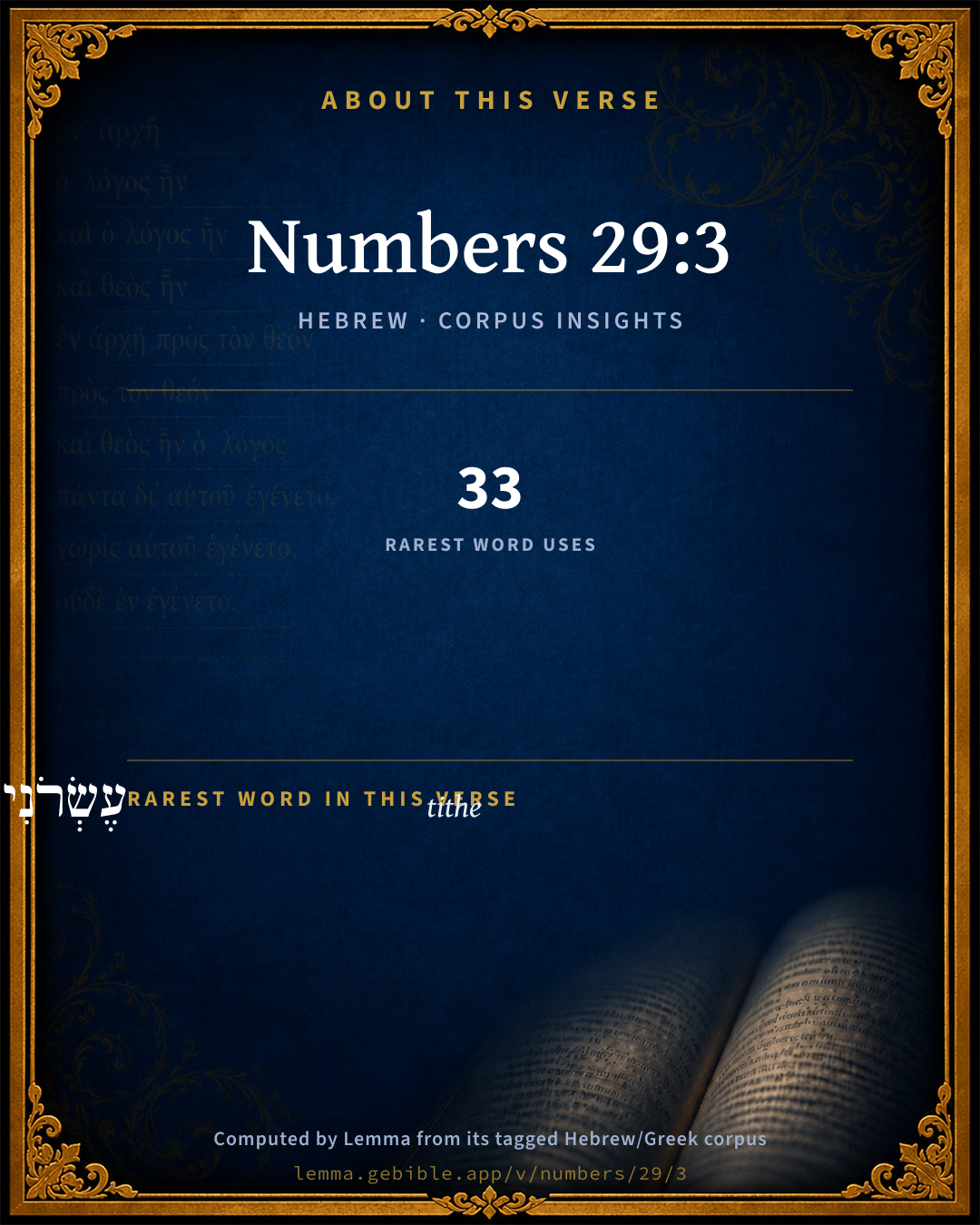
עֶשְׂרֹנִים֙ tithe H6241 occurs in 22 verses of the Hebrew Bible. Also found in:

Grammatical profile

  • 1 verb
  • 7 nouns
  • 2 adjectives

Verb forms

  • בְּלוּלָ֣ה Qal · Participle Passive

Repetition

A word recurs within this verse — often emphatic in Hebrew:

  • עֶשְׂרֹנִים֙ tithe H6241 ×2

Hebrew & Septuagint length

In English translation the verse runs 20 words from the Hebrew and 22 from the Septuagint (LXX English) — closely comparable.

A rough comparison of the two English renderings, which tokenize alike — not a word-level alignment.

Word counts can differ between the Hebrew and the Greek without any difference in meaning — e.g. the Hebrew direct-object marker אֵת has no separate Greek word, and Greek often adds the article ὁ.

Hebrew and Greek witnesses Masoretic Hebrew ↔ Greek Septuagint

The same verse in the two great witnesses to the Old Testament, shown verse-for-verse.

These are two independent witnesses, not word-aligned to each other, and the Septuagint is shown in lemma (dictionary) form.

Hebrew Numbers 29:3 Masoretic · Westminster Leningrad Codex

וּמִנְחָתָ֔ם סֹ֖לֶת בְּלוּלָ֣ה בַשָּׁ֑מֶן שְׁלֹשָׁ֤ה עֶשְׂרֹנִים֙ לַפָּ֔ר שְׁנֵ֥י עֶשְׂרֹנִ֖ים לָאָֽיִל

and their meal-offering, fine flour mixed with oil, three tenth parts for the bull, two tenth parts for the ram,

World English Bible · Public Domain

Greek LXX Numbers 29:3 Septuagint · lemma form

ὁ θυσία αὐτός σεμίδαλις ἀναποιέω ἐν ἔλαιον τρεῖς δέκατος ὁ μόσχος ὁ εἷς καί δύο δέκατος ὁ κριός ὁ εἷς

Their meat-offering shall be fine flour mingled with oil; three tenth deals for one calf, and two tenth deals for one ram:

LXX2012 (modern English Septuagint) · Public Domain

Hebrew: Westminster Leningrad Codex (CC BY 4.0). Greek: Septuagint (public domain); English from LXX2012 (modern English Septuagint) (Public Domain). How the Septuagint differs from the Hebrew →

Targum (Aramaic paraphrase)

2

The Targum is the ancient Jewish Aramaic paraphrase of the Hebrew Scriptures — an interpretive translation, not the Hebrew text itself. Onkelos (literal) and Pseudo-Jonathan (expansive) render the Torah, and Jonathan the Prophets. Coverage is partial: where no permissively-licensed English translation exists for a verse, only the Aramaic is shown. This is verse-level text, not a word-by-word alignment to the Hebrew.

  1. Targum Onkelos Torah (Genesis–Deuteronomy)
    וּמִנְחַתְהוֹן סוּלְתָּא דְפִילָא בִמְשַׁח תְּלָתָא עִשְׂרוֹנִין לְתוֹרָא תְּרֵין עִשְׂרוֹנִין לְדִכְרָא

    (no public-domain English translation for this verse)

    Targum Onkelos — Aramaic: “Onkelos Genesis” (public domain); “Onkelos Exodus” (public domain); “Onkelos Leviticus” (public domain); “Onkelos Numbers” (public domain); “Onkelos Deuteronomy” (public domain). English: “Sefaria Community Translation” (CC0 1.0 (public-domain dedication)); “J.W. Etheridge. The Targums of Onkelos and Jonathan Ben Uzziel on the Pentateuch. London: Longmans, Green, 1862” (public domain). Text via Sefaria.

  2. Targum Pseudo-Jonathan Torah (Genesis–Deuteronomy)
    וּמִנְחַתְהוֹן סְמִידָא דְחִינְטַיָא פְּתִיכָא בִּמְשַׁח זֵיתָא תְּלָתָא עֶשְרוֹנִין לְתוֹרָא וּתְרֵין עֶשְרוֹנִין לְדִיכְרָא

    and their mincha of wheaten flour mingled with olive oil, three tenths for the bullock, two tenths for the ram,

    Targum Pseudo-Jonathan — Aramaic: “Targum Jonathan on Genesis” (public domain); “Targum Jonathan on Exodus” (public domain); “Targum Jonathan on Leviticus” (public domain); “Targum Jonathan on Numbers” (public domain); “Targum Jonathan on Deuteronomy” (public domain). English: “The Targum of Jonathan ben Uzziel, trans. J. W. Etheridge, London, 1862” (public domain). Text via Sefaria.

Commentary

Notes on Numbers 29:3 from classic Christian and Jewish commentators (each source and its license shown beneath its notes). The classic Christian expositions comment on the surrounding passage and are grouped to its opening verse, so a note may address several verses; the Jewish commentaries on the Tanakh (Rashi and others) are per-verse, so they appear only where the commentator wrote on this verse.

Lemma curates 59 commentaries, every one of them public domain or Creative Commons licensed, each selected and text-cleaned for this edition rather than reprinted as found. About our sources →

John Gill's Exposition

And their meat offering,.... Which went along with the creatures offered for a burnt offering; the quantity of flour and oil used in it was the same, for a bullock, a ram, and each lamb, as in the offerings at the new moons, feast of unleavened bread and the day of firstfruits, Num 28:10 and a kid of the goats was also offered for a sin offering at this time, as in those seasons, and for the same purpose, to make atonement for the sins of their holy things.

and a kid of the goats was also offered for a sin offering at this time, as in those seasons, and for the same purpose, to make atonement for the sins of their holy things.

Numbers 29:6

num 29:6

num 29:6

num 29:6Beside the burnt offering of the month, and his meat offering,.... The bullock, ram, and seven lambs, were offered on this day, besides the two bullocks, one ram, and seven lambs, which were offered on it, on account of its being the first day of the month and besides the meat offering that went along with them; these were not omitted on account of those additional sacrifices:

and the daily burnt offering; the two lambs of the daily sacrifice; these also were offered as usual, so that there were offered on this day three bullocks, two rams, and sixteen lambs:

and his meat offering, and their drink offerings, according to their manner; these also were offered with the daily sacrifice, according to the law and rule prescribed for the making of them, and all were

for a sweet savour, a sacrifice made by fire unto the Lord; for they were burnt sacrifices, and very acceptable to the Lord, as they were types of the better sacrifice, with which he is infinitely well pleased; and it is with respect to that that such a number of sacrifices were appointed.

John Gill's Exposition of the Whole Bible (1746–1763) — public domain (CC PDM 1.0). Text via the HelloAO Bible API.

unfoldingWord translationNotes

Door43 World Missions Community

their grain offering

This refers to the grain offerings that are required to accompany each of the animals when they are sacrificed. AT: "the grain offerings that are offered with them" or "the grain offerings that accompany them" (See: Possession)

mixed with oil

This can be stated in active form. AT: "which you have mixed with oil" (See: Active or Passive)

three-tenths of an ephah

The phrase "of fine flour mixed with oil" is understood from the previous phrase and can be repeated. "Three-tenths" means three parts out of ten equal parts. This can be written in modern measurements. AT: "six liters of fine flour mixed with oil" or "three-tenths of an ephah (which is about six liters)" (See: Fractions and Biblical Volume)

two-tenths

The phrase "of an ephah of fine flour mixed with oil" is understood from earlier in the sentence. "Two tenths" means two parts out of ten equal parts. This can be written in modern measurements. AT: "four and a half liters of fine flour mixed with oil" or "two-tenths of an ephah (which is about 4.5 liters)" (See: Ellipsis and Fractions and Biblical Volume)

one-tenth

The phrase "of an ephah of fine flour mixed with oil" is understood from earlier in the sentence. "One-tenth" means one part out of ten equal parts. This can be written in modern measurements. AT: "2 liters of fine flour mixed with oil" or "a tenth of an ephah (which is about 2 liters)" (See: Fractions and Biblical Volume)

to make atonement

The word "atonement" can be expressed with the verb "atone." AT: "to atone" (See: Abstract Nouns)

translationWords

grain offering

oil

goat

sin offering

atonement

unfoldingWord translationNotes — © Distant Shores Media and the Door43 World Missions Community, licensed CC BY-SA 4.0. Source: git.door43.org/Door43/en_tn.

Lesson kit

Teaching starters — assembled from the data on this page, not authored interpretation. Every prompt links to the verse data it draws on. Edit before teaching.

Numbers, in the Pentateuch, opens this verse with 10 words (9 distinct Hebrew lemmas). Its most distinctive word is ʻissârôwn (“tithe”). A historical commentator’s framing appears above. Read the whole chapter for the surrounding context.

Discussion questions

  1. The word ʻissârôwn carries the sense “tithe.” How does it shape the verse?
  2. Exodus 29:40 shares the word «tithe» with this verse. How do the two illuminate each other?
  3. “tithe” occurs 2× in this one verse. What is the effect of the repetition?
  4. These translations render this verse differently; the difference is in the English rendering, not the original. What questions does that raise?
  5. The verb «בְּלוּלָ֣ה» is Qal Participle Passive. How does its form color the action?
  6. Reading how John Gill's Exposition and unfoldingWord translationNotes read this verse, where do the two commentators agree and where do they part?

Things to notice

Reading settings

Reading text

Shown beneath each verse's original-language words.

Old Testament
Old Testament edition

Read the OT as the Masoretic Hebrew (MT) or the Greek Septuagint (LXX).

English shown for the Greek Septuagint (in the Hebrew ↔ Greek comparison).

Comparing translations? Open the Compare panel on any verse page to stack up to four side by side.