Isaiah 41:19

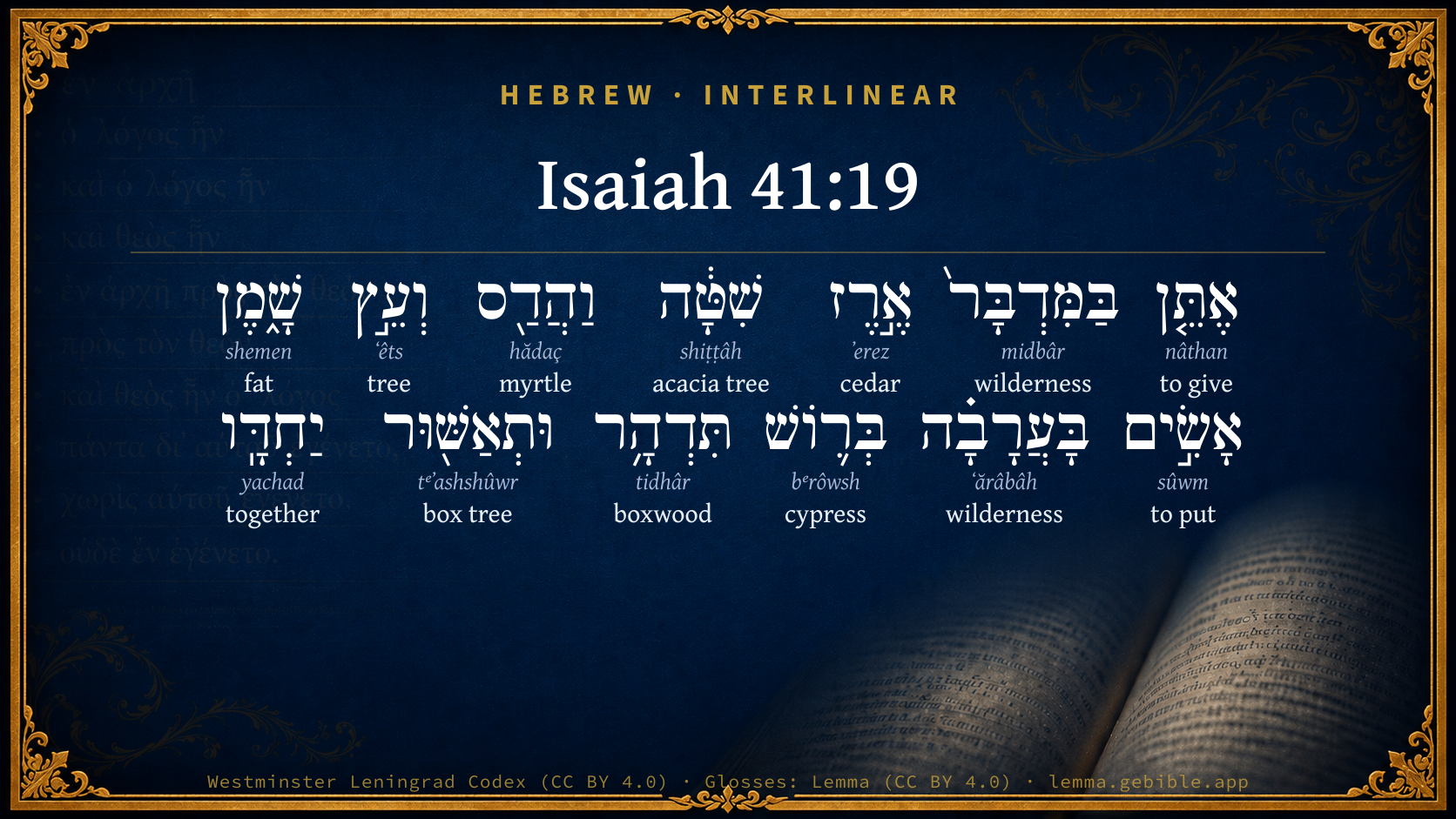
Hebrew (Westminster Leningrad Codex) Isaiah 41:19 appears in the Hebrew Old Testament. The text above is from the Westminster Leningrad Codex. Each word links to its Strong’s number, a concise gloss, and parsing drawn from the Open Scriptures Hebrew Bible morphology. Click any word for its full Brown-Driver-Briggs (BDB) entry.
Download image
Cite this verse

Isaiah 41:19 (World English Bible). Public Domain. Lemma interlinear Bible study tool, https://lemma.gebible.app/v/isaiah/41/19.

Show BibTeX & RIS
BibTeX
RIS
English Translation
I will put in the wilderness the cedar, the acacia, and the myrtle, and the oil tree; I will set in the desert the fir tree, the pine, and the box tree together:
World English Bible · Public Domain
Highlights Full analysis ↓
Download a study sheet

One document with this verse’s original text, its word-by-word gloss line, the meaning frame, cross-references with their text, attributed commentary, and full source and license credits — printable, and it pastes into notes with its structure intact.

This verse Autodidact and up

Study sheet (.html) Plain text (.txt)

A passage Seminary Student

Up to 50 verses in one chapter. A passage sheet keeps up to 6 commentary sources and 12 cross-references per verse, in the order this page ranks them, and says so on the sheet whenever that leaves anything out. Ask for a single verse and you get the Autodidact verse sheet above.

Everything on this page stays free to read, with no account — the sheet is a download of what is already on screen, not access to it.

Want to remove ads? Support Godless Engineer
Compare translations 3

The same verse in 3 English versions, stacked beneath the original-language interlinear above. Click any original word for its lexicon entry.

Each is an independent rendering of the whole verse — the interlinear is not word-aligned to these translations.

Highlighted words mark where these versions differ — a whole-verse word diff, not a word-by-word alignment.

  • World English Bible Public Domain
    I will put in the wilderness the cedar, the acacia, and the myrtle, and the oil tree; I will set in the desert the fir tree, the pine, and the box tree together:
  • King James Version Public Domain
    I will plant in the wilderness the cedar, the shittah tree, and the myrtle, and the oil tree; I will set in the desert the fir tree, and the pine, and the box tree together:
  • unfoldingWord Literal Text CC BY-SA 4.0
    I will set in the wilderness the cedar, the acacia, and the myrtle and the tree of oil. I will put in the Arabah the cypress, the plane, and the box tree together,

unfoldingWord Literal Text — © unfoldingWord, licensed CC BY-SA 4.0. Word-aligned USFM3 via Door43 (git.door43.org/unfoldingWord/en_ult).

Versions to compare (up to 4)

3 of 4 selected

Show all 18 translations

Every available English version of this verse, each an independent rendering of the whole verse.

  • World English Bible Public Domain
    I will put in the wilderness the cedar, the acacia, and the myrtle, and the oil tree; I will set in the desert the fir tree, the pine, and the box tree together:
  • Berean Standard Bible Public Domain
    I will plant cedars in the wilderness, acacias, myrtles, and olive trees. I will set cypresses in the desert, elms and boxwood together,
  • Majority Standard Bible Public Domain
    I will plant cedars in the wilderness, acacias, myrtles, and olive trees. I will set cypresses in the desert, elms and boxwood together,
  • King James Version Public Domain
    I will plant in the wilderness the cedar, the shittah tree, and the myrtle, and the oil tree; I will set in the desert the fir tree, and the pine, and the box tree together:
  • American Standard Version (1901) Public Domain
    I will put in the wilderness the cedar, the acacia, and the myrtle, and the oil-tree; I will set in the desert the fir-tree, the pine, and the box-tree together:
  • Revised Version (1885) Public Domain
    I will plant in the wilderness the cedar, the acacia tree, and the myrtle, and the oil tree; I will set in the desert the fir tree, the pine, and the box tree together:
  • Geneva Bible (1599) Public Domain
    I will set in the wildernesse the cedar, the shittah tree, and the mirre tree, and the pine tree, and I will set in the wildernesse the firre tree, the elme and the boxe tree together.
  • Douay-Rheims (1899) Public Domain
    I will plant in the wilderness the cedar, and the thorn, and the myrtle, and the olive tree: I will set in the desert the fir tree, the elm, and the box tree together:
  • Young's Literal Translation Public Domain
    I give in a wilderness the cedar, Shittah, and myrtle, and oil-tree, I set in a desert the fir-pine and box-wood together.
  • Literal Standard Version CC BY-SA 4.0
    I give in a wilderness the cedar, || Shittah, and myrtle, and oil-tree, || I set in a desert the fir-pine and box-wood together.
  • Unlocked Literal Bible CC BY-SA 4.0
    In the wilderness I will set the cedar, the acacia, and the myrtle, and the olive tree. I will set the cypress in the desert plain, with the pines and the cypress box trees.
  • unfoldingWord Literal Text CC BY-SA 4.0
    I will set in the wilderness the cedar, the acacia, and the myrtle and the tree of oil. I will put in the Arabah the cypress, the plane, and the box tree together,
  • Darby Bible Public Domain
    I will give in the wilderness the cedar, acacia, myrtle, and oleaster; I will set in the desert the cypress, pine, and box-tree together;
  • World Messianic Bible Public Domain
    I will put cedar, acacia, myrtle, and oil trees in the wilderness. I will set cypress trees, pine, and box trees together in the desert;
  • Webster's Bible Public Domain
    I will plant in the wilderness the cedar, the shittah-tree, and the myrtle, and the oil-tree; I will set in the desert the fir-tree, the pine, and the box-tree together:
  • Free Bible Version CC BY-SA 4.0
    I will plant cedars, acacias, myrtles, and olive trees in the desert. I will place evergreens in the desert, firs and box trees together.
  • Bible in Basic English Public Domain
    I will put in the waste land the cedar, the acacia, the myrtle, and the olive-tree; and in the lowland will be planted the fir-tree, the plane, and the cypress together:
  • JPS Tanakh (1917) Public Domain
    I will plant in the wilderness the cedar, the acacia-tree, and the myrtle, and the oil-tree; I will set in the desert the cypress, the plane-tree, and the larch together;

Literal Standard Version (2020), Covenant Press — licensed CC BY-SA 4.0. Text via the HelloAO Bible API (eBible.org). Unlocked Literal Bible (unfoldingWord) — licensed CC BY-SA 4.0. Text via the HelloAO Bible API (eBible.org). unfoldingWord Literal Text — © unfoldingWord, licensed CC BY-SA 4.0. Word-aligned USFM3 via Door43 (git.door43.org/unfoldingWord/en_ult). Free Bible Version, Dr. Jonathan Gallagher — licensed CC BY-SA 4.0. Text via the HelloAO Bible API (eBible.org).

Word by word

More ways to search: Search by grammar → Find every occurrence → Compare this word →

Practice this passage: Drill this verse → Learn its vocabulary →

תִּדְהָ֥ר
tidhâr
H8410
“boxwood”
Noun, Common, Masculine, Singular, Absolute
Part of Speech
Noun
Type
Common
Gender
Masculine
Number
Singular
State
Absolute
Full BDB Definition

Origin: apparently from H1725

TWOT: 408b

a species of hardwood tree - perhaps boxwood, elm
  1. אֶתֵּ֤ן nâthan H5414 “to give” Verb, Qal, Imperfect, 1st Person, Common, Singular
  2. בַּמִּדְבָּר֙ midbâr H4057 “in/at the · wilderness” Preposition, Determined + Noun, Common, Masculine, Singular, Absolute
  3. אֶ֣רֶז ʼerez H730 “cedar” Noun, Common, Masculine, Singular, Absolute
  4. שִׁטָּ֔ה shiṭṭâh H7848 “acacia tree” Noun, Common, Feminine, Singular, Absolute
  5. וַהֲדַ֖ס hădaç H1918 “and · myrtle” Conjunction + Noun, Common, Masculine, Singular, Absolute
  6. וְעֵ֣ץ ʻêts H6086 “and · tree of” Conjunction + Noun, Common, Masculine, Singular, Construct
  7. שָׁ֑מֶן shemen H8081 “fat” Noun, Common, Masculine, Singular, Absolute
  8. אָשִׂ֣ים sûwm H7760 “to put” Verb, Qal, Imperfect, 1st Person, Common, Singular
  9. בָּעֲרָבָ֗ה ʻărâbâh H6160 “in/at the · wilderness” Preposition, Determined + Noun, Common, Feminine, Singular, Absolute
  10. בְּר֛וֹשׁ bᵉrôwsh H1265 “cypress” Noun, Common, Masculine, Singular, Absolute
  11. וּתְאַשּׁ֖וּר tᵉʼashshûwr H8391 “and · box tree” Conjunction + Noun, Common, Feminine, Singular, Absolute
  12. יַחְדָּֽו yachad H3162 “together” Adverb

About this verse

These counts appear in no published source. They are computed here, from the morphology-tagged text and Lemma’s own curated glosses. What Lemma adds →

13
words
13
distinct lemmas
Prophets
section

Notable vocabulary

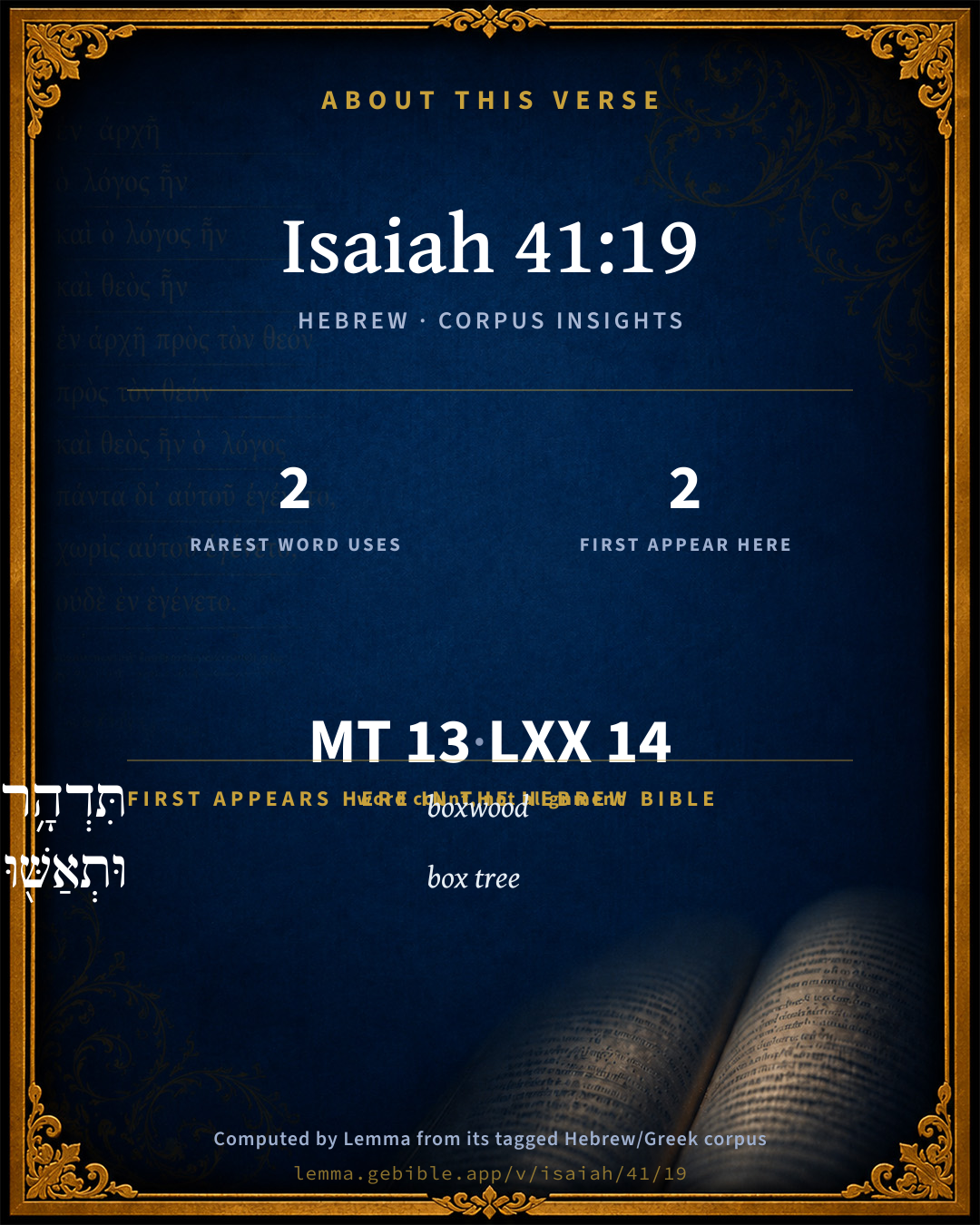
The rarest word here is תִּדְהָ֥ר boxwood H8410 — appearing just 2 times in the whole Hebrew Bible.

First appearance in Scripture

These words make their first canonical appearance in the Hebrew Bible here:

  • תִּדְהָ֥ר boxwood H8410
  • וּתְאַשּׁ֖וּר box tree H8391

Shared distinctive vocabulary

תִּדְהָ֥ר boxwood H8410 occurs in 2 verses of the Hebrew Bible. Also found in:

Grammatical profile

  • 2 verbs
  • 10 nouns
  • 1 adverb

Verb forms

  • אֶתֵּ֤ן Qal · Imperfect
  • אָשִׂ֣ים Qal · Imperfect

Hebrew & Septuagint length

In English translation the verse runs 33 words from the Hebrew and 18 from the Septuagint (LXX English) — the Septuagint runs noticeably shorter here. See the side-by-side →

A rough comparison of the two English renderings, which tokenize alike — not a word-level alignment.

Word counts can differ between the Hebrew and the Greek without any difference in meaning — e.g. the Hebrew direct-object marker אֵת has no separate Greek word, and Greek often adds the article ὁ.

In the original languages it is 13 Hebrew tokens and 14 Greek tokens — but the two are counted differently (Hebrew bundles its prefixes and suffixes into one token; the Greek is in lemma form), so that isn’t a like-for-like length.

Cross-references

13

Topical passages linked to Isaiah 41:19 in the Treasury of Scripture Knowledge — connected by theme and wording, ordered by reader-vote popularity; previews shown in the World English Bible.

  • Isaiah 55:13 Instead of the thorn shall come up the fir tree; and instead of the brier shall come up the myrtle tree: and it shall be to Yahweh for a name, for an everlasting sign that shall not be cut off.
  • Isaiah 37:31–32 The remnant that is escaped of the house of Judah shall again take root downward, and bear fruit upward.
  • Isaiah 35:1 The wilderness and the dry land shall be glad; and the desert shall rejoice, and blossom as the rose.
  • Isaiah 60:13 The glory of Lebanon shall come to you, the fir tree, the pine, and the box tree together, to beautify the place of my sanctuary; and I will make the place of my feet glorious.
  • Isaiah 60:21 Your people also shall be all righteous; they shall inherit the land forever, the branch of my planting, the work of my hands, that I may be glorified.
  • Isaiah 61:11 For as the earth brings forth its bud, and as the garden causes the things that are sown in it to spring forth; so the Lord Yahweh will cause righteousness and praise to spring forth before all the nations.
  • Isaiah 27:6 In days to come shall Jacob take root; Israel shall blossom and bud; and they shall fill the surface of the world with fruit.
  • Ezekiel 17:22–24 Thus says the Lord Yahweh: I will also take of the lofty top of the cedar, and will set it; I will crop off from the topmost of its young twigs a tender one, and I will plant it on a high and lofty mountain:
  • Psalms 92:13–14 They are planted in Yahweh's house. They will flourish in our God's courts.
  • Isaiah 32:15 until the Spirit be poured on us from on high, and the wilderness become a fruitful field, and the fruitful field be esteemed as a forest.
  • Isaiah 51:3 For Yahweh has comforted Zion; he has comforted all her waste places, and has made her wilderness like Eden, and her desert like the garden of Yahweh; joy and gladness shall be found therein, thanksgiving, and the voice of melody.
  • Isaiah 61:3 to appoint to those who mourn in Zion, to give to them a garland for ashes, the oil of joy for mourning, the garment of praise for the spirit of heaviness; that they may be called trees of righteousness, the planting of Yahweh, that he may be glorified.
  • Ezekiel 47:12 By the river on the bank of it, on this side and on that side, shall grow every tree for food, whose leaf shall not wither, neither shall the fruit of it fail: it shall bring forth new fruit every month, because the waters of it issue out of the sanctuary; and the fruit of it shall be for food, and the leaf of it for healing.

Cross-references courtesy of OpenBible.info (CC BY 4.0).

Hebrew and Greek witnesses Masoretic Hebrew ↔ Greek Septuagint

The same verse in the two great witnesses to the Old Testament, shown verse-for-verse.

Here the Septuagint runs noticeably shorter than the Hebrew — LXX2012 (modern English Septuagint) 18 words vs World English Bible 33. A rough length comparison of the two English translations, not a word-level alignment — read both below.

These are two independent witnesses, not word-aligned to each other, and the Septuagint is shown in lemma (dictionary) form.

Hebrew Isaiah 41:19 Masoretic · Westminster Leningrad Codex

אֶתֵּ֤ן בַּמִּדְבָּר֙ אֶ֣רֶז שִׁטָּ֔ה וַהֲדַ֖ס וְעֵ֣ץ שָׁ֑מֶן אָשִׂ֣ים בָּעֲרָבָ֗ה בְּר֛וֹשׁ תִּדְהָ֥ר וּתְאַשּׁ֖וּר יַחְדָּֽו

I will put in the wilderness the cedar, the acacia, and the myrtle, and the oil tree; I will set in the desert the fir tree, the pine, and the box tree together:

World English Bible · Public Domain

Greek LXX Isaiah 41:19 Septuagint · lemma form

τίθημι εἰς ὁ ἄνυδρος γῆ κέδρος καί πύξος καί μυρσίνη καί κυπάρισσος καί λευκός

I will plant in the dry land the cedar and box, the myrtle and cypress, and white poplar:

LXX2012 (modern English Septuagint) · Public Domain

On this verse, The Biblical Illustrator discusses the Septuagint’s reading. Read the note in Commentary ↓

Hebrew: Westminster Leningrad Codex (CC BY 4.0). Greek: Septuagint (public domain); English from LXX2012 (modern English Septuagint) (Public Domain). How the Septuagint differs from the Hebrew →

Targum (Aramaic paraphrase)

1

The Targum is the ancient Jewish Aramaic paraphrase of the Hebrew Scriptures — an interpretive translation, not the Hebrew text itself. Onkelos (literal) and Pseudo-Jonathan (expansive) render the Torah, and Jonathan the Prophets. Coverage is partial: where no permissively-licensed English translation exists for a verse, only the Aramaic is shown. This is verse-level text, not a word-by-word alignment to the Hebrew.

  1. Targum Jonathan Prophets (Joshua–Malachi)
    אֶתֵּן בְּמַדְבְּרָא אַרְזִין שִׁיטִין וַהֲדַסִין וְאָעִין דִמְשַׁח אֱרַבֵּי בְמֵישְׁרָא בּוּרְוָן מוּרְנְיָן וְאֶשְׁכְּרוֹעִין כַּחֲדָא:

    I will put cedars, acacias, and myrtles, and oil trees in the wilderness; I will make the fir tree, the elm, and the box tree to grow in the desert together:

    Targum Jonathan — Aramaic: “Mikraot Gedolot” (public domain). English: “Sefaria Community Translation” (CC0 1.0 (public-domain dedication)); “London "Chaldee Paraphrase," 1871” (public domain). Text via Sefaria.

Commentary

Notes on Isaiah 41:19 from classic Christian and Jewish commentators (each source and its license shown beneath its notes). The classic Christian expositions comment on the surrounding passage and are grouped to its opening verse, so a note may address several verses; the Jewish commentaries on the Tanakh (Rashi and others) are per-verse, so they appear only where the commentator wrote on this verse.

Lemma curates 59 commentaries, every one of them public domain or Creative Commons licensed, each selected and text-cleaned for this edition rather than reprinted as found. About our sources →

Trapp's Complete Commentary

John Trapp

Isa 41:19 I will plant in the wilderness the cedar, the shittah tree, and the myrtle, and the oil tree; I will set in the desert the fir tree, [and] the pine, and the box tree together:

Ver. 19. I will plant in the wilderness the cedar, &c.] That is, saith Lyra, I will give variety of graces to my people.

And the box tree.] {a} That groweth of itself in wild places, saith Diodate, to signify that the Church will always have worldly wild plants mixed and growing in it. Box is always green indeed, and full of leaves, but it is of an ill smell, et semen habet omnibus invisum animantibus, {b} and of a worse seed.

{a} Per varia ligna varietatem gratiarum insinuat. - Oecol.

{b} Sphinx, Philos.

John Trapp, A Commentary or Exposition upon All the Books of the Old and New Testament (1647–1656) — public domain. Text from a community e-Sword module.

The Biblical Illustrator

Joseph S. Exell

Isa_41:19

I will plant in the wilderness

Trees

The cedar grew on Mount Lebanon, and was of great height, and had extended branches, which afforded kindly shade.

The shittah tree is probably, as the R.V. renders it, the acacia. This was a large tree, growing abundantly in Egypt and Arabia, and is the tree from which gum-arabic is obtained. It is covered with black thorns, and the wood is hard, and when old resembles ebony. The myrtle rises eight or ten feet high, its characteristic being a dense, full head. It is thus convenient for shade.

The off tree is probably the olive tree. The fir tree usually denotes the cypress, an evergreen. This is also a tree whose wide-spread foliage would afford shade. The pine tree is perhaps the poplar (according to the Septuagint), or elm (according to the Vulgate), or a kind of hard oak (according to Gesenius). The box tree is probably some tall tree of the cedar kind, also affording shade. The chief common characteristic of these trees is that they afford welcome shade. In Western lands the intensity of the suns heat and rays is not felt; but in the East he is at his fiercest, and a shadow is a most grateful possession. A missionary from the South Seas said: Oh, the shining of the sun! The one thing we wanted to hide from was the sun. Its glare was intolerable! (J. A. Davies, B. D.)

The rejoicing wilderness

What meaneth this figurative picture of a vast oasis--a wen-watered grove of stately, fragrant shady trees? Observe, there are seven kinds of these mentioned; seven--the Hebrew symbol of abundance, diversity, perfection. The words may well be taken, therefore, to denote the plenitude of Divine grace vouchsafed in the hour of deepest perplexity and sorrow. (J. R. Macduff, D. D.)

Divine grace adapted to human need

The beautiful part of the picture is, that God bestows grace varied in its manifestations; adapted in its wondrous diversity to meet the wants and necessities and trials of all His suffering people. He has sustaining grace for one, restraining grace for another; strengthening grace for one, sanctifying grace for another; comforting grace for one, dying grace for another. But all these trees of God are full of sap, from the lowly: nabk or mountain-thorn, to the cedar of Lebanon which He hath planted. Each tree may be taken as the type or emblem of a cluster of Bible promises. To the weak, there is the cedar in its strength; to the bereaved, there is the olive, with its ashen leaves, and yet with its oil of joy for the mourner; to the fainting and downcast, there is the tall pine and tapering cypress pointing upwards; to the wounded spirit, there is the balsam tree of Gilead and the fragrant myrtle; to the dying, there is the palm tree with its graceful fronds, according to the Eastern tradition, whispering in the ear the name of Jesus! And the further peculiarity of this promise is, that it is in the hour of sorest want and trial and perplexity that that grace is most abundant. It is in the depths of the arid desert, with hillocks of sand on all sides bounding the horizon,--in seasons of loneliest bereavement and uttermost sorrow,--that these palm and acacia and olive and myrtle groves, as if by the hand of an enchanter, rise up to view. It was at the fourth watch of the night (when the darkness was deepest, and the hearts of the disciples were most despairing and desponding) that Jesus cometh unto them walking upon the sea. Mans extremity is often Gods opportunity. (C. H. Spurgeon.)

The symbolism of trees

In the more figurative sense it intimates that the Lord God would raise up, for the benefit of His Church, men of distinguished eminence and usefulness, such as judges and generals, to afford them protection; rulers and governors, who should prove both ornamental and useful to them; and choice ministers of the Word, from whose doctrine they were to derive defence from evil, spiritual nourishment, and consolation. (R. Macculloch.)

The Biblical Illustrator, edited by Joseph S. Exell (c. 1880s–1900s) — public domain. Text from a community e-Sword module.

Jamieson, Fausset & Brown

Robert Jamieson, A. R. Fausset & David Brown

(Isa 32:15; Isa 55:13).

shittah--rather, the "acacia," or Egyptian thorn, from which the gum Arabic is obtained [LOWTH].

oil tree--the olive.

fir tree--rather, the "cypress": grateful by its shade.

pine--GESENIUS translates, "the holm."

box tree--not the shrub used for bordering flower beds, but [GESENIUS] a kind of cedar, remarkable for the smallness of its cones, and the upward direction of its branches.

Jamieson, Fausset & Brown — Commentary Critical and Explanatory on the Whole Bible (1871) — public domain (CC PDM 1.0). Text via the HelloAO Bible API.

Adam Clarke's Commentary

Verse 19. I will plant in the wilderness the cedar] The two preceding verses express God's mercy to them in their passage through the dry deserts, in supplying them with abundant water, when distressed with thirst, in allusion to the exodus. This verse expresses the relief afforded to them, fainting with heat in their journey through that hot country, destitute of shelter, by causing shady trees, and those of the tallest and most beautiful kinds, to spring up for their defense. The apocryphal Baruch, speaking of the return from Babylon, expresses God's protection of his people by the same image: "Even the woods and every sweet-smelling tree shall overshadow Israel by the commandment of God." Isa 5:8.

The oil tree] This, Kimchi says, is not to be understood of the olive tree, for the olive is distinguished, Ne 8:15; but it means the pine or fir, from which pitch is extracted.

Adam Clarke's Commentary on the Bible (1810–1826) — public domain. Text from a community e-Sword/MySword module.

Ellicott's Commentary for English Readers

(19) I will plant in the wilderness.—A picture as of the Paradise of God (Isa_51:3), with its groves of stately trees, completes the vision of the future. The two groups of four and three, making up the symbolic seven, may probably have a mystic meaning. The “shittah” is the acacia, the “oil tree” the wild olive, as distinguished from the cultivated (Rom_11:17), the “fir tree” is probably the cypress, the “pine” stands for the plane, always—as in the opening of Plato’s Phœdrus, and the story of Xerxes in Herod. vii. 31,—the glory of Eastern scenery and the “box-tree” is perhaps the larch, or a variety of cedar. The “myrtle” does not appear elsewhere in the Old Testament till after the exile (Neh_8:15; Zec_1:8; Zec_1:10-11), but then it appears as if indigenous. It supplies the proper name Hadassah (Esther) in Est_2:7.

A Bible Commentary for English Readers, edited by Charles John Ellicott (1878–1897) — public domain. Text from a community e-Sword module.

The Cambridge Bible for Schools and Colleges

gen. ed. J. J. S. Perowne

19. The desert itself shall be transformed into a grove of stately and beautiful trees. I will plant] Better: I will place. The shittah tree is the acacia. The myrtle is only mentioned in exilic and post-exilic writings; ch. Isa_55:13; Zec_1:8; Zec_1:10 f.; Neh_8:15.

the oil tree] Not the olive, but the oleaster or wild olive.

the fir tree] Rather: the cypress (R.V. marg.). With regard to the two last of the seven trees there is no sure tradition. The first (tidhar) is identified by different authorities with the fir, the elm and the plane. The other (tì’asshûr) is according to some the box-tree, according to others a species of cedar, probably the sherbîn-tree of the Arabs (cypressus oxycedrus). The names occur again only in ch. Isa_60:13; the last, however, is also disguised in a corrupt reading in Eze_27:6.

The Cambridge Bible for Schools and Colleges (gen. ed. J. J. S. Perowne; Cambridge University Press, 1878–1918) — public domain. Text from a community e-Sword module.

John Gill's Exposition

I will plant in the wilderness the cedar, the shittah tree,.... Where such trees had not used to grow, but in Lebanon, and such like places. The "shittah tree" is thought to be a kind of cedar; it is the same of which is the "shittim wood" mentioned in Exo 25:5 and is so called by the Targum here:

and the myrtle, and the oil tree; about the former there is no difficulty, and one would think there should be none about the latter, and that the olive tree is meant; but Kimchi thinks that is not certain, and supposes the pine tree is meant; and observes that the olive tree is distinguished from this oil tree in Neh 8:15, as indeed it is; and is by our translators there rendered the pine tree, which they take to be meant by another word in the next clause:

I will set in the desert the fir tree, and the pine, and the box tree together; what we here render the "pine" the Targum interprets it of the "elm", and so the Vulgate Latin version: now by all these are figuratively meant converted persons in the Gentile world, in whom as great a change was wrought, as if, instead of briers and thorns, came up such trees as these; and who, by the grace of God, were made as goodly and beautiful as some of these trees were; as odorous and of as sweet a scent in their graces and duties as others; and as profitable and fruitful in grace and good works like others of them; and comparable to them, as being some of them evergreen, durable, and incorruptible; because of their perseverance in grace and holiness.

John Gill's Exposition of the Whole Bible (1746–1763) — public domain (CC PDM 1.0). Text via the HelloAO Bible API.

Albert Barnes' Notes on the Bible

I will plant in the wilderness - The image in this verse is one that is frequent in Isaiah. It is designed to show that God would furnish for his people abundant consolations, and that he would furnish unanticipated sources of comfort, and would remove from them their anticipated trials and calamities. The image refers to the return of the exiles to their own land. That journey lay through Arabia Deserta - a vast desert - where they would naturally expect to meet with nothing but barren hills, naked rocks, parched plains, and burning sands. God says that he would bless them in the same manner as if in that desolate wilderness he should plant the cedar, the acacia, the myrtle, and the fir-tree, and should make the whole distance a grove, where fountains would bubble along their way, and streams burst forth from the hills (compare the notes at Isa 32:15).

The cedar - The large and beautiful cedar, with lofty height, and extended branches such as grew on Lebanon (compare Isa 9:10, note; Isa 37:24, note).

The shittah-tree - This is the Hebrew name without change, שׁטה shı̂ṭṭâh. The Vulgate is spinam. The Septuagint renders it, Πύξον Puchon - ‘The box.’ Lowth renders it, ‘The acacia.’ Probably the acacia, or the spina AEgyptiaca - the Egyptian thorn of the ancients - is intended by it. It is a large tree, growing abundantly in Egypt and Arabia, and is the tree from which the gum-arabic is obtained. It is covered with large black thorns, and the wood is hard, and, when old, resembles ebony.

And the myrtle - The myrtle is a tree which rises with a shrubby upright stem, eight or ten feet high. Its branches form a dense, full head, closely garnished with oval lanceolate leaves. It has numerous small pale flowers from the axillas, singly on each footstalk (Encyc.) There are several species of the myrtle, and they are especially distinguished for their forming a dense and close top, and thus constituting a valuable tree for shade. It is a tree that grows with great rapidity.

And the oil-tree - Hebrew, ‘Tree of oil’ that is, producing oil. Doubtless the olive is intended here, from whose fruit oil was obtained in abundance. This was a common tree in Palestine, and was one of the most valued that grew.

The fir-tree - The word used here (ברושׁ berôsh) is commonly rendered, in our version, ‘fir-tree’ (Isa 60:13; Isa 55:13; Zec 11:2; Hos 14:8-9; 2Sa 6:5; 1Ki 5:8, 1Ki 5:10; 1Ki 6:15, 1Ki 6:34; Nah 2:3, and in other places). Our translators understood it evidently as referring to the cedar. It is often joined, however, with the cedar (see the note at Isa 14:8; compare Isa 37:24; Zec 11:1-2), and evidently denotes another tree, probably of the same class. It is probable that the word usually denotes the cypress. There are various kinds of cypress. Some are evergreen, and some are deciduous, as the American white cedar. The wood of these trees is remarkable for its durability. Among the ancients, coffins were made of it, and the tree itself was an emblem of mourning. It is mentioned here because its extended branches and dense foliage would produce a grateful shade.

And the pine - The Septuagint renders this Λεύκην Leukēn, And - ‘The white poplar.’ The Vulgate renders it, ‘The elm.’ Gesenius supposes that a species of hard oak, holm or ilex, is intended. It is not easy, however, to determine what species of tree is meant.

The box-tree - Gesenius supposes that by this word is denoted some tall tree - a species of cedar growing on mount Lebanon that was distinguished by the smallness of its cones, and the upward direction of its branches. With us the word box denotes a shrub used for bordering flower-beds. But the word here denotes a tree - such as was sufficient to constitute a shade.

Albert Barnes' Notes on the Bible (1834–1885) — public domain. Text from a community e-Sword/MySword module.

Haydock's Catholic Bible Commentary

The thorn. In Hebrew, the shitta or settim, a tree resembling the whitethorn. (Challoner) (St. Jerome) --- A fragrant shade shall speedily rise up, Baruch v. 6. (Calmet)

George Leo Haydock (1774–1849), Haydock's Catholic Family Bible and Commentary, 1859 edition — public domain. Excludes Psalms (Douay-Rheims chapter numbering differs from Protestant) and Deuterocanonical books (Catholic canon only).

Matthew Poole's English Annotations

Trees which are both useful and pleasant to the eye, and giving a good shadow to the traveller, which in those hot and parched countries was very comfortable. Thus much is evident and confessed. But what particular trees these Hebrew words signify seems to me improper to discourse here, because only the learned are capable of judging in this case, and they may consult my Latin Synopsis upon this and other places of Scripture where they are mentioned.

Matthew Poole's English Annotations on the Holy Bible (1683–1685) — public domain. Text from a community e-Sword/MySword module.

Whedon's Commentary on the Bible

Daniel D. Whedon

19, 20. I will plant in the wilderness — Quite as ample shall be the protection from heat and sunstroke by means of overspreading shade from the trees which God shall plant in the waterless desert: the cedar, such as Lebanon grows; the shittah tree, or, acacia, which abounds in Arabia’s favourite valleys; the oil tree, that is, the wild olive; fir tree, or the cypress; the pine, or, as Gesenius renders it, the durable holm oak; the box, a species of cedar, (Gesenius,) — these are to cover the wilderness for the safety and refreshment of God’s people. Here is employed Isaiah’s accustomed imagery. See chapter 35. Here, too, is incidental evidence — from the nature of the trees mentioned — of Isaiah’s authorship, though the chapters in the earlier prophecies having resemblance to those in these later prophecies, are, by the negative critics, all alike thrown out. The description, however, is of trees familiar to all in Palestine; scarcely so to any Babylonian resident claimed to be necessarily the author. All these rich provisions are to show the difference there is between trusting in the Holy One of Israel (the other keyword of these chapters) and trusting to lifeless idols.

Daniel D. Whedon (gen. ed.), Commentary on the Old and New Testaments (1874–1909) — public domain. Text from a community e-Sword module.

The Pulpit Commentary

I will plant in the wilderness the cedar, etc. The "glory of Lebanon," the "excellency of Carmel and Sharon", (Isa_35:2) shall be given to the "wilderness," wherein Israel dwells. The trees named are the choicest of Syria and Palestine, viz. the cedar (erez). the great glory of Libanus; the acacia (shittah), abundant in the Jordan valley; the myrtle (hadas), which grew on the hills about Jerusalem; (Neh_8:15) the olive, cultivated over the whole country; the fir (berosh), or juniper. a product of Lebanon; (2Ch_2:8) the plane (tidhar), a tree far from uncommon in Coele-syria, sometimes growing to a great size; and the sherbin (teasshur), a sort of cedar, remarkable for the upward tendency of its branches. The list of names shows a writer familiar with the Palestinian region, but not familiar with Babylonia.

The Pulpit Commentary (1880–1919), ed. H.D.M. Spence-Jones & Joseph S. Exell — public domain. Text from a community e-Sword module.

John Wesley's Explanatory Notes

The box tree - Trees which are both useful and pleasant to the eye, and giving a good shadow to the traveler. But what particular trees these Hebrew words signify, is not certainly known.

John Wesley, Explanatory Notes Upon the Whole Bible (1754–1765) — public domain. Text via the GEBible commentary corpus.

J. A. Alexander on Isaiah

Joseph Addison Alexander

“I will give in the wilderness cedar, acacia, and myrtle, and oil-tree; and I will place in the desert fir, pine, and box together.” The main idea, common to all explanations of this verse, is that of trees growing where they never grew before. It is comparatively unimportant therefore to identify the species. With respect to the cedar and the myrtle there is no doubt. The acacia here mentioned is a thorny tree growing in Arabia and Egypt. (See Robinson’s Palestine, vol. I p. 349.) By the oil-tree is meant the oleaster or wild olive, as distinguished from the cultivated tree of the same species.

Joseph Addison Alexander, The Prophecies of Isaiah (1846–1847; New York: Scribner, 1870–1878) — public domain. Text from a community e-Sword module.

unfoldingWord translationNotes

Door43 World Missions Community

General Information:

Yahweh continues speaking.

the myrtle ... the pines and the cypress box trees

These are types of trees. (See: Translate Unknowns)

the hand of Yahweh has done this

Here the word "hand" represents Yahweh himself. AT: "Yahweh has done this" (See: Synecdoche)

translationWords

desert

cedar

acacia

olive

fir

hand

Yahweh

Holy One

Israel

create

unfoldingWord translationNotes — © Distant Shores Media and the Door43 World Missions Community, licensed CC BY-SA 4.0. Source: git.door43.org/Door43/en_tn.

Rashi

Rabbi Shlomo Yitzchaki (Rashi)

I will give in the desert cedars, acacia trees all kinds of civilization. Even in them will I give all kinds of wisdom, goodness, and peace.

firs and cypresses Names of trees that do not produce fruit, used for building.

Rashi on the Tanakh — English translations: “The Judaica Press complete Tanach with Rashi, translated by A. J. Rosenberg” (CC BY 4.0); “Pentateuch with Rashi's commentary by M. Rosenbaum and A.M. Silbermann, 1929-1934” (public domain); “The Metsudah Tanach series, Lakewood, N.J” (CC BY 4.0); and “The Book of Joshua, Metsudah Publications, 1997” (CC BY 4.0). Text via Sefaria.

Ibn Ezra

Rabbi Abraham ibn Ezra

ארז שטה The cedar, the shittah tree. Asyndeton, like ירח שמש the sun, the moon (Hab. 3:10),

תדהר ותאשור. Names of trees. All these trees grow about rivers; they do not grow where there is a want of water.

Ibn Ezra on the Tanakh — English translations: “Sefaria Community Translation” (CC0 1.0 (public-domain dedication)); “Yalkut, Sifsei Chachomim Chumash, Metsudah Publications, 2009” (CC BY 4.0); and “Commentary of Ibn Ezra on Isaiah - trans. by M. Friedlander, 1873” (public domain). Text via Sefaria.

Lesson kit

Teaching starters — assembled from the data on this page, not authored interpretation. Every prompt links to the verse data it draws on. Edit before teaching.

Isaiah, in the Prophets, opens this verse with 13 words (13 distinct Hebrew lemmas). Its most distinctive word is tidhâr (“boxwood”). The Greek Septuagint runs shorter here. A historical commentator’s framing appears above. Read the whole chapter for the surrounding context.

Discussion questions

  1. How does “boxwood” (tidhâr) shape what this verse is saying?
  2. 2 words here appear for the first time in Scripture. What is being introduced at this debut?
  3. Isaiah 60:13 shares the word «boxwood» with this verse. How do the two illuminate each other?
  4. Compared with the Hebrew, the Septuagint runs shorter here. What questions does that raise?
  5. These translations render this verse differently; the difference is in the English rendering, not the original. What questions does that raise?
  6. The verb «אֶתֵּ֤ן» is Qal Imperfect. How does its form color the action?
  7. Reading how Trapp's Complete Commentary and The Biblical Illustrator read this verse, where do the two commentators agree and where do they part?

Things to notice

Reading settings

Reading text

Shown beneath each verse's original-language words.

Old Testament
Old Testament edition

Read the OT as the Masoretic Hebrew (MT) or the Greek Septuagint (LXX).

English shown for the Greek Septuagint (in the Hebrew ↔ Greek comparison).

Comparing translations? Open the Compare panel on any verse page to stack up to four side by side.