Psalms 133:2

Hebrew (Westminster Leningrad Codex) Psalms 133:2 appears in the Hebrew Old Testament. The text above is from the Westminster Leningrad Codex. Each word links to its Strong’s number, a concise gloss, and parsing drawn from the Open Scriptures Hebrew Bible morphology. Click any word for its full Brown-Driver-Briggs (BDB) entry.
Download image
Cite this verse

Psalms 133:2 (World English Bible). Public Domain. Lemma interlinear Bible study tool, https://lemma.gebible.app/v/psalms/133/2.

Show BibTeX & RIS
BibTeX
RIS
English Translation
It is like the precious oil on the head, That ran down on the beard, Even Aaron's beard; That came down on the edge of his robes;
World English Bible · Public Domain
Download a study sheet

One document with this verse’s original text, its word-by-word gloss line, the meaning frame, cross-references with their text, attributed commentary, and full source and license credits — printable, and it pastes into notes with its structure intact.

This verse Autodidact and up

Study sheet (.html) Plain text (.txt)

A passage Seminary Student

Up to 50 verses in one chapter. A passage sheet keeps up to 6 commentary sources and 12 cross-references per verse, in the order this page ranks them, and says so on the sheet whenever that leaves anything out. Ask for a single verse and you get the Autodidact verse sheet above.

Everything on this page stays free to read, with no account — the sheet is a download of what is already on screen, not access to it.

Want to remove ads? Support Godless Engineer
Compare translations 3

The same verse in 3 English versions, stacked beneath the original-language interlinear above. Click any original word for its lexicon entry.

Each is an independent rendering of the whole verse — the interlinear is not word-aligned to these translations.

Highlighted words mark where these versions differ — a whole-verse word diff, not a word-by-word alignment.

  • World English Bible Public Domain
    It is like the precious oil on the head, That ran down on the beard, Even Aaron's beard; That came down on the edge of his robes;
  • King James Version Public Domain
    It is like the precious ointment upon the head, that ran down upon the beard, even Aaron's beard: that went down to the skirts of his garments;
  • unfoldingWord Literal Text CC BY-SA 4.0
    Like the good oil on the head, coming down on the beard, the beard of Aaron, that is coming down on the mouth of his garments,

unfoldingWord Literal Text — © unfoldingWord, licensed CC BY-SA 4.0. Word-aligned USFM3 via Door43 (git.door43.org/unfoldingWord/en_ult).

Versions to compare (up to 4)

3 of 4 selected

Show all 18 translations

Every available English version of this verse, each an independent rendering of the whole verse.

  • World English Bible Public Domain
    It is like the precious oil on the head, That ran down on the beard, Even Aaron's beard; That came down on the edge of his robes;
  • Berean Standard Bible Public Domain
    It is like fine oil on the head, running down on the beard, running down Aaron’s beard over the collar of his robes.
  • Majority Standard Bible Public Domain
    It is like fine oil on the head, running down on the beard, running down Aaron’s beard over the collar of his robes.
  • King James Version Public Domain
    It is like the precious ointment upon the head, that ran down upon the beard, even Aaron's beard: that went down to the skirts of his garments;
  • American Standard Version (1901) Public Domain
    It is like the precious oil upon the head, That ran down upon the beard, Even Aaron's beard; That came down upon the skirt of his garments;
  • Revised Version (1885) Public Domain
    It is like the precious oil upon the head, that ran down upon the beard, even Aaron’s beard; that came down upon the skirt of his garments;
  • Geneva Bible (1599) Public Domain
    It is like to the precious oyntment vpon the head, that runneth downe vpon the beard, euen vnto Aarons beard, which went downe on the border of his garments:
  • Douay-Rheims (1899) Public Domain
    How he swore to the Lord, he vowed a vow to the God of Jacob:
  • Young's Literal Translation Public Domain
    As the good oil on the head, Coming down on the beard, the beard of Aaron, That cometh down on the skirt of his robes,
  • Literal Standard Version CC BY-SA 4.0
    As the good oil on the head, || Coming down on the beard, the beard of Aaron, || That comes down on the skirt of his robes,
  • Unlocked Literal Bible CC BY-SA 4.0
    It is like fine oil on the head pouring down on the beard— Aaron's beard, and then it pours down on the collar of his robes.
  • unfoldingWord Literal Text CC BY-SA 4.0
    Like the good oil on the head, coming down on the beard, the beard of Aaron, that is coming down on the mouth of his garments,
  • Darby Bible Public Domain
    Like the precious oil upon the head, that ran down upon the beard, upon Aaron's beard, that ran down to the hem of his garments;
  • World Messianic Bible Public Domain
    It is like the precious oil on the head, that ran down on the beard, even Aaron’s beard, that came down on the edge of his robes,
  • Webster's Bible Public Domain
    It is like the precious ointment upon the head, that ran down upon the beard, even Aaron's beard: that went down to the skirts of his garment;
  • Free Bible Version CC BY-SA 4.0
    This is as precious as the oil used to anoint Aaron, running down from his head onto his beard, onto the collar of his clothes.
  • Bible in Basic English Public Domain
    It is like oil of great price on the head, flowing down over the face, even Aaron's face: coming down to the edge of his robe;
  • JPS Tanakh (1917) Public Domain
    It is like the precious oil upon the head, coming down upon the beard; even Aaron's beard, that cometh down upon the collar of his garments;

Literal Standard Version (2020), Covenant Press — licensed CC BY-SA 4.0. Text via the HelloAO Bible API (eBible.org). Unlocked Literal Bible (unfoldingWord) — licensed CC BY-SA 4.0. Text via the HelloAO Bible API (eBible.org). unfoldingWord Literal Text — © unfoldingWord, licensed CC BY-SA 4.0. Word-aligned USFM3 via Door43 (git.door43.org/unfoldingWord/en_ult). Free Bible Version, Dr. Jonathan Gallagher — licensed CC BY-SA 4.0. Text via the HelloAO Bible API (eBible.org).

Word by word

More ways to search: Search by grammar → Find every occurrence → Compare this word →

Practice this passage: Drill this verse → Learn its vocabulary →

הַזָּקָ֥ן
zâqân
H2206
“the · beard”
Particle, Definite Article + Noun, Common, Both, Singular, Absolute
Part of Speech
Particle + Noun
Type
Common
Gender
Both
Number
Singular
State
Absolute
Full BDB Definition

Origin: from H2204

TWOT: 574a

beard, chin - beard - chin
  1. כַּשֶּׁ֤מֶן shemen H8081 “like/as the · fat” Preposition, Determined + Noun, Common, Masculine, Singular, Absolute
  2. הַטּ֨וֹב ṭôwb H2896 “the · good” Particle, Definite Article + Adjective, Adjective, Masculine, Singular, Absolute
  3. עַל ʻal H5921 “upon” Preposition
  4. הָרֹ֗אשׁ rôʼsh H7218 “the · head” Particle, Definite Article + Noun, Common, Masculine, Singular, Absolute
  5. יֹרֵ֗ד yârad H3381 “going down” Verb, Qal, Participle Active, Masculine, Singular, Absolute
  6. עַֽל ʻal H5921 “upon” Preposition
  7. זְקַֽן zâqân H2206 “beard of” Noun, Common, Both, Singular, Construct
  8. אַהֲרֹ֑ן ʼAhărôwn H175 “Aaron” Noun, Proper
  9. שֶׁ֝יֹּרֵ֗ד yârad H3381 “who/which · going down” Particle, Relative + Verb, Qal, Participle Active, Masculine, Singular, Absolute
  10. עַל ʻal H5921 “upon” Preposition
  11. פִּ֥י peh H6310 “mouth of” Noun, Common, Masculine, Singular, Construct
  12. מִדּוֹתָֽיו middâh H4060 “measures · his” Noun, Common, Feminine, Plural, Construct + Suffix, Personal, 3rd Person, Masculine, Singular

About this verse

These counts appear in no published source. They are computed here, from the morphology-tagged text and Lemma’s own curated glosses. What Lemma adds →

13
words
9
distinct lemmas
Wisdom
section

Notable vocabulary

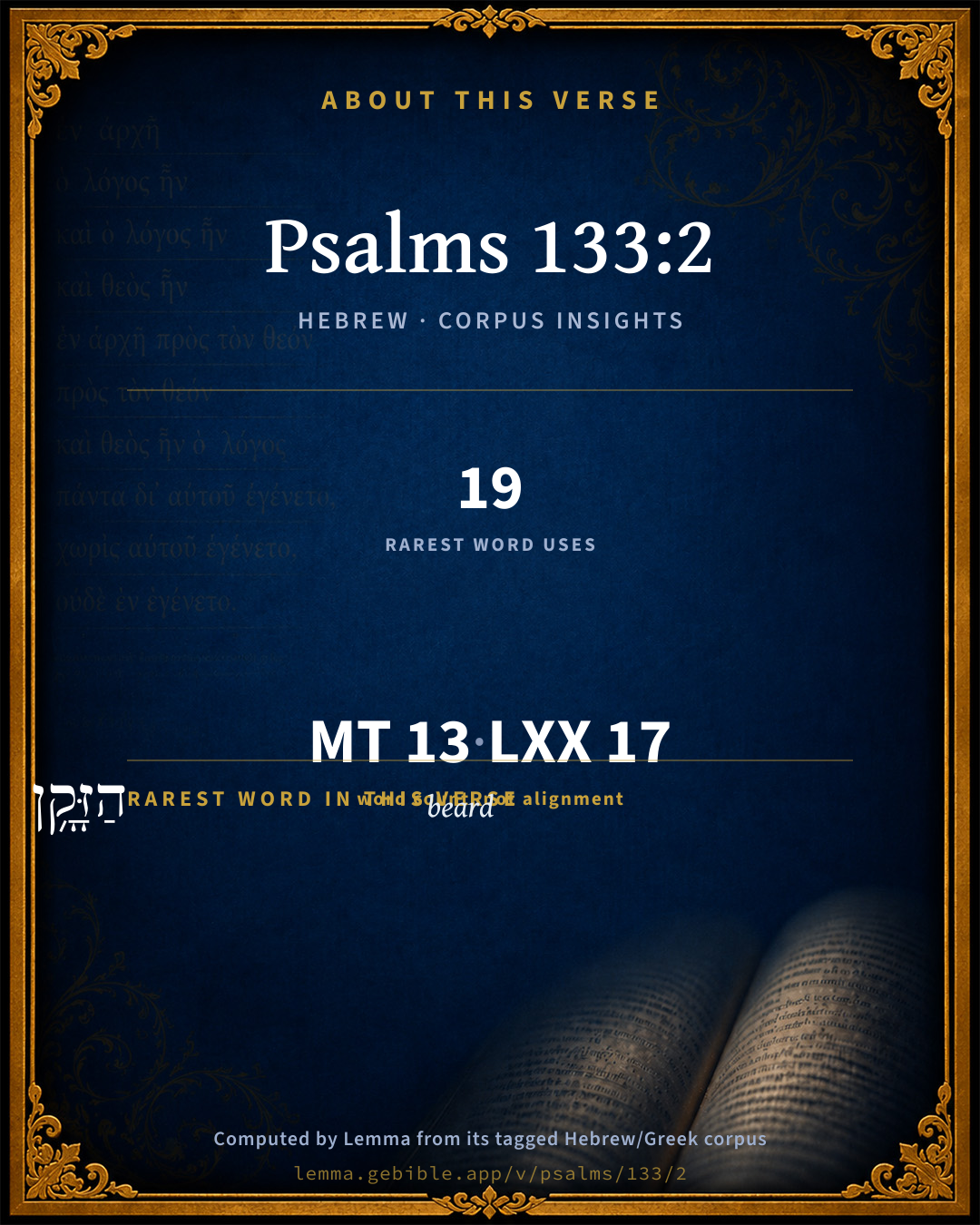
The rarest word here is הַזָּקָ֥ן beard H2206 — appearing just 19 times in the whole Hebrew Bible.

Shared distinctive vocabulary

הַזָּקָ֥ן beard H2206 occurs in 18 verses of the Hebrew Bible. Also found in:

Grammatical profile

  • 2 verbs
  • 7 nouns
  • 1 adjective
  • 3 prepositions

Verb forms

  • יֹרֵ֗ד Qal · Participle Active
  • שֶׁ֝יֹּרֵ֗ד Qal · Participle Active

Repetition

Words recur within this verse — often emphatic in Hebrew:

  • עַל upon H5921 ×3
  • יֹרֵ֗ד to go down H3381 ×2
  • הַזָּקָ֥ן beard H2206 ×2

Hebrew & Septuagint length

In English translation the verse runs 27 words from the Hebrew and 27 from the Septuagint (LXX English) — the same length.

A rough comparison of the two English renderings, which tokenize alike — not a word-level alignment.

Word counts can differ between the Hebrew and the Greek without any difference in meaning — e.g. the Hebrew direct-object marker אֵת has no separate Greek word, and Greek often adds the article ὁ.

In the original languages it is 13 Hebrew tokens and 17 Greek tokens — but the two are counted differently (Hebrew bundles its prefixes and suffixes into one token; the Greek is in lemma form), so that isn’t a like-for-like length.

Cross-references

9

Topical passages linked to Psalms 133:2 in the Treasury of Scripture Knowledge — connected by theme and wording, ordered by reader-vote popularity; previews shown in the World English Bible.

  • Leviticus 8:12 He poured some of the anointing oil on Aaron's head, and anointed him, to sanctify him.
  • Exodus 30:25–30 You shall make it a holy anointing oil, a perfume compounded after the art of the perfumer: it shall be a holy anointing oil.
  • Exodus 29:7 Then you shall take the anointing oil, and pour it on his head, and anoint him.
  • Proverbs 27:9 Perfume and incense bring joy to the heart; So does earnest counsel from a man's friend.
  • Exodus 39:24 They made on the skirts of the robe pomegranates of blue, purple, scarlet, and twined linen.
  • Song of Solomon 1:3 Your oils have a pleasing fragrance. Your name is oil poured forth, Therefore the virgins love you.
  • John 12:3 Mary, therefore, took a pound of ointment of pure nard, very precious, and anointed the feet of Jesus, and wiped his feet with her hair. The house was filled with the fragrance of the ointment.
  • Psalms 141:5 Let the righteous strike me, it is kindness; Let him reprove me, it is like oil on the head; Don't let my head refuse it; Yet my prayer is always against evil deeds.
  • Exodus 28:33 On its hem you shall make pomegranates of blue, and of purple, and of scarlet, around its hem; and bells of gold between them round about:

Cross-references courtesy of OpenBible.info (CC BY 4.0).

Hebrew and Greek witnesses Masoretic Hebrew ↔ Greek Septuagint

The same verse in the two great witnesses to the Old Testament, shown verse-for-verse.

You’re reading Greek Psalm 132 (Hebrew Psalm 133). The Septuagint counts the superscription, so verse numbers can differ from the Hebrew — chapter-level alignment, not verse-by-verse. Numbering follows Rahlfs.

These are two independent witnesses, not word-aligned to each other, and the Septuagint is shown in lemma (dictionary) form.

Hebrew Psalms 133:2 Masoretic · Westminster Leningrad Codex

כַּשֶּׁ֤מֶן הַטּ֨וֹב עַל הָרֹ֗אשׁ יֹרֵ֗ד עַֽל הַזָּקָ֥ן זְקַֽן אַהֲרֹ֑ן שֶׁ֝יֹּרֵ֗ד עַל פִּ֥י מִדּוֹתָֽיו

It is like the precious oil on the head, That ran down on the beard, Even Aaron's beard; That came down on the edge of his robes;

World English Bible · Public Domain

Greek LXX Greek Psalm 132:2 Septuagint · lemma form

ὡς μύρον ἐπί κεφαλή ὁ καταβαίνω ἐπί πώγων ὁ πώγων ὁ ἀαρών ὁ καταβαίνω ἐπί ὁ ὤ

It is as ointment on the head, that ran down to the beard, even the beard of Aaron; that ran down to the fringe of his clothing.

LXX2012 (modern English Septuagint) · Public Domain

On this verse, The Treasury of David discusses the Septuagint’s reading. Read the note in Commentary ↓

Hebrew: Westminster Leningrad Codex (CC BY 4.0). Greek: Septuagint (public domain); English from LXX2012 (modern English Septuagint) (Public Domain). How the Septuagint differs from the Hebrew →

Commentary

Notes on Psalms 133:2 from classic Christian and Jewish commentators (each source and its license shown beneath its notes). The classic Christian expositions comment on the surrounding passage and are grouped to its opening verse, so a note may address several verses; the Jewish commentaries on the Tanakh (Rashi and others) are per-verse, so they appear only where the commentator wrote on this verse.

Lemma curates 59 commentaries, every one of them public domain or Creative Commons licensed, each selected and text-cleaned for this edition rather than reprinted as found. About our sources →

Trapp's Complete Commentary

John Trapp

Psa 133:2 [It is] like the precious ointment upon the head, that ran down upon the beard, [even] Aaron’s beard: that went down to the skirts of his garments;

Ver. 2. It is like the precious ointment] This similitude setteth forth the pleasure and amenity of it; as the other (from the dew) the profit and commodity. Sic miscnit utile dulci. This ointment was most rich (as made up of the chiefest spices, Exo 30:1-38), and very fragrant, refreshing the senses, not of Aaron oaly, but of all about him; so doth Christian unity and amity (that "fruit of the Spirit," Gal 5:22) far beyond that common friendship so highly extolled by Cicero, and other heathens; and is therefore here fitly compared to that nonsuch odoriferous ointment.

Upon the head, that ran down upon the beard] So the Spirit of grace, that oil of gladness, Psa 45:7, poured out abundantly, even to a redundancy, upon Christ the Head, runneth down upon all the members of his body mystical, even to the meanest, so that they have grace for grace.

John Trapp, A Commentary or Exposition upon All the Books of the Old and New Testament (1647–1656) — public domain. Text from a community e-Sword module.

The Biblical Illustrator

Joseph S. Exell

Psa_133:2

It is like the precious ointment.

Unity compared to oil

1. It is precious ointment. It is not to common and ordinary use; oil of any consideration whatsoever, but the best and choicest that could be lighted on: like that wherewith Mary Magdalene anointed Christ before His passion (Mar_14:3). Such was this whereunto the concord of brethren is compared here in this Scripture. To set forth unto us the preciousness and excellency of it. It is a virtue of very rare account, and so to be esteemed of by us. It is such which carries a good name and report with it, and accordingly like that is also better than precious ointment.

2. It is compared not to oil enclosed and shut up in a vessel, but to oil effused and poured forth abroad, which is more significant, as that which does cast forth a special fragrancy and odoriferousness with it. Look how a box of precious ointment when it is broken casts forth such a smell as does refresh the nostrils and brains of all such persons as are made partakers of it. So in like manner the unity of brethren is very sweet to all that observe it.

3. It is not the anointing only of some Levite, or common priest, but the anointing of Aaron himself, who was the highest priest of all, and therein a special type of Christ, as prefigured, and shadowed out in him.

4. It was not oil which rested only upon Aarons head, but ran down upon his heard, and froth thence further to the skirts of his garments, which is a lively description to us of the property of this grace of love and brotherly agreement. It is such as does not rest itself only in those who are the next and immediate subjects of it, but it conveys itself to many others. Love it is of a very diffusive and communicative disposition. (T. Horton, D. D.)

The Biblical Illustrator, edited by Joseph S. Exell (c. 1880s–1900s) — public domain. Text from a community e-Sword module.

The Treasury of David

Charles H. Spurgeon

Ver. 2. It is like the precious ointment upon the head. In order that we may the better behold brotherly unity David gives us a resemblance, so that as in a glass we may perceive its blessedness. It has a sweet perfume about it, comparable to that precious ointment with which the first High Priest was anointed at his ordination. It is a holy thing, and so again is like the oil of consecration which was to be used only in the Lord's service. What a sacred thing must brotherly love be when it can be likened to an oil which must never be poured on any man but on the Lord's high priest alone! It is a diffusive thing: being poured on his bead the fragrant oil flowed down upon Aaron's head, and thence dropped upon his garments till the utmost hem was anointed therewith; and even so doth brotherly love extend its benign power and bless all who are beneath its influence. Hearty concord brings a benediction upon all concerned; its goodness and pleasure are shared in by the lowliest members of the household; even the servants are the better and the happier because of the lovely unity among the members of the family. It has a special use about it; for as by the anointing oil Aaron was set apart for the special service of Jehovah, even so those who dwell in love are the better fitted to glorify God in his church. The Lord is not likely to use for his glory those who are devoid of love; they lack the anointing needful to make them priests unto the Lord. That ran down upon the beard, even Aaron's beard. This is a chief point of comparison, that as the oil did not remain confined to the place where it first fell, but flowed down the High Priest's hair and bedewed his beard, even so brotherly love descending from the head distils and descends, anointing as it runs, and perfuming all it lights upon. That went down to the skirts of his garments. Once set in motion it would not cease from flowing. It might seem as if it were better not to smear his garments with oil, but the sacred unguent could not be restrained, it flowed over his holy robes; even thus does brotherly love not only flow over the hearts upon which it was first poured out, and descend to those who are an inferior part of the mystical body of Christ, but it runs where it is not sought for, asking neither leave nor license to make its way. Christian affection knows no limits of parish, nation, sect, or age. Is the man a believer in Christ? Then he is in the one body, and I must yield him an abiding love. Is he one of the poorest, one of the least spiritual, one of the least lovable? Then he is as the skirts of the garment, and my heart's love must fall even upon him. Brotherly love comes from the head, but falls to the feet. Its way is downward. It "ran down", and it" went down": love for the brethren condescends to men of low estate, it is not puffed up, but is lowly and meek. This is no small part of its excellence: oil would not anoint if it did not flow down, neither would brotherly love diffuse its blessing if it did not descend.

Ver. 2. Precious ointment upon the head. Though every priest was anointed, yet only the high priest was anointed on the head, and there is a tradition that this rite was omitted after the Captivity, so that there is a special stress on the name of Aaron. Neale and Littledale.

Ver. 2. The precious ointment... that ran down upon the beard... that went down to the skirts of his garments. Magnificence, misnamed by churls extravagance and waste, is the invariable attribute of all true love. David recognized this truth when he selected the profuse anointing of Aaron with the oil of consecration at his installation into the office of High Priest as a fit emblem of brotherly love. There was waste in that anointing, too, as well as in the one which took place at Bethany. For the oil was not sprinkled on the head of Aaron, though that might have been sufficient for the purpose of a mere ceremony. The vessel was emptied on the High Priest's person, so that its contents flowed clown from the head upon the beard, and even to the skirts of the sacerdotal robes. In that very waste lay the point of the resemblance for David. It was a feature that was very likely to strike his mind; for he, too, was a wasteful man in his way. He had loved God in a manner which exposed him to the charge of extravagance. He had danced before the Lord, for example, when the ark was brought up from the house of Obededom to Jerusalem, forgetful of his dignity, exceeding the bounds of decorum, and, as it might seem, without excuse, as a much less hearty demonstration would have served the purpose of a religious solemnity. Alexander Balmain Bruce, in "The Training of the Twelve", 1877.

Ver. 2. The precious ointment...that ran down. Of the Hebrew perfumes an immense quantity was annually manufactured and consumed, of which we have a very significant indication in the fact that the holy anointing oil of the tabernacle and temple was never made in smaller quantities than 750 ounces of solids compounded with five quarts of oil, and was so profusely employed that when applied to Aaron's head it flowed down over his beard and breast, to the very skirts of his garments. Hugh Macmillan, in "The Ministry of Nature", 1871.

Ver. 2. That ran down...that went down, etc. Christ's grace is so diffusive of itself, that it conveys holiness to us, "running down from the head to the skirts", to all his members. He was not only anointed himself, but he is our anointer. Therefore it is called "the oil of gladness", because it rejoiceth our hearts, by giving us spiritual gladness, and peace of conscience. Thomas Adams.

Ver. 2. Down upon the beard, even Aaron's beard: that went down to the skirts of his garments. Not the extremity of them, as our version inclines to; for not so great a quantity of oil was poured upon him; nor would it have been decent to have his clothes thus greased from top to bottom; but the upper part of his garment, the top of his coat, on which the beard lay, as Zarchi; the neck or collar of it, as Kimchi and Ben Melech; the hole in which the head went through when it was put on, about which there was a band, that it might not be rent: Ex 28:32 39:23; where the Septuagint use the same word as here. John Gill.

Ver. 2-3. In this prayer and song of the unity of the church, it is note worthy how, commencing with the fundamental idea of "brethren", we rise to the realization of the Elder Brother, who is our common anointed High Priest. It is the bond of his priesthood which joins us together as brethren. It is the common anointing which flows down even to the skirts of the garment of our High Priest which marks our being brethren. Whether we dwell north or south, meeting in Zion, and sharing in the blessings of that eternal Priesthood of Christ, we form in reality, and before our Father, but one family "the whole family in earth and heaven." Our real bond of union consists in the "flowing down", the "running down", or "descending" of the common blessing, which marks the steps in this Psalm of Degrees (Ps 133:2-3). And if "the dew of Hermon" has descended upon "the mountains of Zion", long after the sun has risen shall gladsome fruit appearin some twenty, in some thirty, and in some a hundred fold. Alfred Edersheim

Ver. 2. There must have been special reasons why a priestly anointing should be selected for the comparison, and why that of Aaron, rather than of any other of the high priests. They are these

1. The ointment was "holy", prepared in accordance with the Divine prescription: Ex 30:23-25. Church union is sacred. It must spring from the love commanded by God; be based on the principles laid down by God; and exist for the ends appointed of God.

2. The anointing was from God through Moses, who acted on behalf of God in the matter. Church unity is of the Holy Spirit (1Co 13:13), through Jesus as mediator. Therefore it should be prayed for, and thankfully acknowledged.

3. By the anointing, Aaron became consecrated, and officially qualified to act as priest. By unity the Church, as a whole, lives its life of consecration, and effectively ministers in the priesthood assigned it.

4. The oil was diffusive;it rested not on Aaron's head, but flowed down to the skirts of his garments. Unity will, in time, make its way from a few to the whole, especially from the leaders in a church to the rest of its members. Hence, it is a personal matter. Each should realize it, and by love and wise conduct diffuse it. J. F.

Ver. 2-3. Christian love scatters blessing by the way of coming down: "ran down", "went down", "descended."

1. God to his saints.

2. Saint to saint.

3. Saint to sinner.

Psalms 133:3*

Charles H. Spurgeon's The Treasury of David (1869–1885) — public domain. Psalms only. Text from a community e-Sword/MySword module.

Joseph Benson's Commentary

Psa 133:2. It is like the precious ointment, &c. — It is no less grateful and refreshing than that holy anointing oil, which was strongly perfumed, and diffused its fragrance all around, to the great delight of all present, when it was poured upon the head of Aaron, at the time of his consecration to the priestly office, so plentifully, that it ran down his face, even to the collar or binding of his garment. “This verse is explained by Exodus 13:23, &c., where God gave directions concerning the ointment which was to anoint Aaron and his sons. It was to be composed of several rich spices, which, by being rightly tempered and mixed together, yielded a most fragrant odour, and thus became a most expressive emblem of unanimity and concord, in a well-cemented society; all jointly conspiring and contributing, according to their various capacities, tempers, and conditions, to the good of the whole.” — Dodd. Dr. Hammond carries this comparison further, and supposes that this anointing oil, being said to go down to the skirts of Aaron’s garments, implies that unity is a blessing to the subject, as well as to the governor; to the meanest person in the society, as well as the greatest; which is an undoubted truth, though, perhaps, it might not be intended here by the psalmist.

Joseph Benson's Commentary on the Old and New Testaments (1811–1818) — public domain. Text from a community e-Sword module.

J. A. Alexander on Psalms

Joseph Addison Alexander

2. (Psa 133:2) Like the oil, the good (oil), on the head, running down upon the beard, the beard of Aaron, which runs down to the edge of his robes. The joyous character of this great family meeting suggests the "oil of joy" (Isa 61:3), the standing symbol of festivity, to which a more specific and religious character is then imparted by a beautiful transition to the good oil (i.e. sweet and costly), with which Aaron was anointed (Exo 29:7; Exo 30:22; Exo 40:13), as a sign of consecration and of spiritual influences. See above, on Psa 2:2. As we read of the anointing of no subsequent High Priest, except prospectively (Lev 21:10, Num 35:25), the reference here may be confined to Aaron himself. This is alleged to have differed from the unction of the other priests, by adding to the simple application of the oil to certain parts of the body, a copious affusion on the head, extending to the beard and even to the sacerdotal vestments. Some interpreters apply the last clause to the beard itself as reaching down to the mouth or opening at the neck of the official tunic. But the repetition of the verb, and the strong improbability that so much stress would have been laid upon the length of the beard, to which nothing is compared and which illustrates nothing, seem decisive in favour of the other explanation.

Joseph Addison Alexander, The Psalms Translated and Explained (1850) — public domain. Text from a community e-Sword module.

Tyndale Open Study Notes

Tyndale Open Resources

133:2 The anointing oil was the oil used to ordain and consecrate Aaron for service in his office (see Exod 29:7). • head . . . beard . . . border of his robe: The oil consecrated Aaron completely.

Tyndale Open Study Notes — © Tyndale Open Resources, licensed CC BY-SA 4.0. Text via the HelloAO Bible API.

Geneva Bible (1599)

Geneva Bible translators

The ointment was a figure of the graces which come from Christ the head upon his Church.

Geneva Bible (1599) marginal notes — public domain. Text via Bolls.life.

Adam Clarke's Commentary

Verse 2. Like the precious ointment] The composition of this holy anointing oil may be seen, Ex 30:23; sweet cinnamon, sweet calamus, cassia lignea, and olive oil. The odour of this must have been very agreeable, and serves here as a metaphor to point out the exquisite excellence of brotherly love.

Ran down upon the beard] The oil was poured upon the head of Aaron so profusely as to run down upon his garments. It is customary in the east to pour out the oil on the head so profusely as to reach every limb.

Adam Clarke's Commentary on the Bible (1810–1826) — public domain. Text from a community e-Sword/MySword module.

Ellicott's Commentary for English Readers

(2) It is like.—The italics of the Authorised Version are wrongly inserted. Unity could not be said to flow down. The other term of the simile is implied in Psa_133:3. (See Note.) Literally, Like the oil, the good oil, on the head descending upon the beard, Aaron’s beard, which (was) descending to the mouth of his robes. Oil meets us as the standing symbol of joy and festivity. (See Psa_45:7, Note; Isa_61:3.) It is also brought closely into connection with love (Son_1:3). But while this association, as also the pleasure derived from the fragrance of the oil, would be present here as always in the truly Oriental image, its elaboration in this passage points to a further purpose. It is the holy oil, that whose composition is described in Exo_30:22-23, that the poet alludes to. This, while the garments of all the priests were sprinkled with it (Exo_29:21; Lev_8:30), was poured on the head of Aaron (Exo_29:7; Lev_8:12; Lev_21:10), so that the description of the psalm, unpleasing as it is to Western ideas, of the saturation, not only of his head, but of face and beard, was actually true. It would run down his neck to the collar of the priestly robe. That this is the meaning of “mouth” here is plain from the actual description of the sacerdotal garments (Exo_28:31-32): “And thou shalt make the robe of the ephod all of blue. And there shall be a mouth in the top of it, in the midst thereof: and it shall have a binding of woven work round about the mouth of it, as it were the mouth of a habergeon, that it be not rent.” (Comp. Exo_39:23; and Job_30:18, where Authorised Version has “collar.”) To the ideas of “joy” and “fragrance,” therefore, must also be added that of “consecration.” But the point of the comparison does not lie even here; nor is it in the freshness of the dew, in the next verse, or its abundance, though dew suggests both of these (see Note, Psa_110:3), but in the word three times repeated—descending. Our version unfortunately obscures this point, by rendering this recurrent participle each time by a different word, missing, at the same time, the marked peculiarity of the rhythm of these psalms. The oil descends from Aaron’s head over his face and beard; the dew of Hermon descends on Zion—low in actual measurement, but exalted by the Divine favour above the loftiest hills. It is not unity, then, in itself which is the subject of the poem, but the unity of the covenant under which all blessings flowed down from above, rested on Mount Zion, and took outward shape and form there in the political and religious constitution.

A Bible Commentary for English Readers, edited by Charles John Ellicott (1878–1897) — public domain. Text from a community e-Sword module.

The Cambridge Bible for Schools and Colleges

gen. ed. J. J. S. Perowne

2. It is like the goodly oil upon the head descending upon the beard, even Aaron’s beard,

Which descendeth upon the collar of his garments.

Oil was a symbol of joy and festivity (Psa_45:7), but it is not common oil that is mentioned here. The brotherly concord of the dwellers in Jerusalem is compared to the sacred oil with which the High-priest was anointed (Exo_30:23 ff.). This sacred oil was poured upon Aaron’s head (Exo_29:7; Lev_8:12; Lev_21:10) when he was consecrated to the office of high-priest, whereas the ordinary priests were only sprinkled with it (Exo_29:21). It would flow down upon his beard and on to his shoulders and his breast, upon which he bore the names of the Twelve Tribes (Exo_28:9-12; Exo_28:17-21), symbolising thereby the consecration of the whole nation of which he was the representative. The stream of perfumed oil, carefully compounded with aromatic spices, would diffuse its fragrance all around, symbolising the holy influence which should emanate from the chief religious representative of Israel, and from the nation which he represented. The point of the simile then seems to be, that as the sacred oil flowed down over Aaron’s shoulders, so the harmonious unity of those who dwell in Jerusalem will influence the whole nation for good. The same spirit will be diffused throughout the whole community. Cp. Psalms 122.

Aaron might denote any high-priest; but the Psalmist by the use of the present participles seems rather to intend to recall the scene of the consecration of Aaron himself (Leviticus 8). It might have been thought that he was alluding to some recent ceremony; but according to Jewish tradition, the sacred oil was wanting in the time of the Second Temple, and the high-priest was consecrated by investiture with the pontifical robes only.

It is a question whether the clause which descendeth upon the collar of his garments refers to the oil or to Aaron’s beard. The Massoretic accentuation (unless it is to be regarded as rhythmical and not syntactical) makes it refer to Aaron’s beard: the Ancient Versions take it to refer to the oil. In the former case the beard is thought of as connecting the head and the garments; but the latter interpretation is the more natural, and is supported by the fondness of the Psalms of Ascent for the repetition of words.

The collar not the skirts of the high-priest’s garment is denoted by the Heb. word, which means literally ‘mouth’ or ‘opening,’ i.e. the hole through which the head passed, or its bordering. Cp. Exo_28:32; Exo_39:23; Job_30:18.

The Cambridge Bible for Schools and Colleges (gen. ed. J. J. S. Perowne; Cambridge University Press, 1878–1918) — public domain. Text from a community e-Sword module.

John Gill's Exposition

It is like the precious ointment upon the head,.... The composition which Moses was ordered to make of the principal spices, and therefore called precious; and which was poured on the heads of kings and priests, when they were anointed with it, Exo 30:23;

that ran down upon the beard, even Aaron's beard; this was put upon the head of Aaron when he was anointed, and so on any other high priest, and trickled down to his beard; see Exo 29:7. The reasons Kimchi and Ben Melech give, why the anointing of Aaron and other priests is mentioned, and not the anointing of a king, or of David himself, are, because the anointing of Aaron was first, and also more public and better known by the people;

that went down to the skirts of his garments; or, "the mouth" or "opening of his garments" (a); not the extremity of them, as our version inclines to; for not so great a quantity of oil was poured upon him; nor would it have been decent to have his clothes thus greased from top to bottom: but the upper part of his garment, the top of the coat, on which the beard lay, as Jarchi; the neck or collar of it, as Kimchi and Ben Melech; the hole in which the head went through when it was put on, about which there was a band, that it might not be rent, Exo 28:32; where the Septuagint use the same word as here. Suidas (b) says, David means the superior aperture of the garment, that which we call the neck or collar band; and so Theodoret: and the Arabic version renders it, the "aperture", or opening of it; and hitherto the ointment came. This was typical of the grace of the Spirit, the unction from the Holy One; which has been poured on Christ, the head of the church, without measure; and with which he has been anointed above his fellows; and from him it is communicated to all his members; to every one of which is given grace, according to the measure of the gift of Christ; and who from his fulness receive, and grace for grace: and particularly brotherly love is compared to this ointment; because of the preciousness of it, which is true of every grace; and because of the extensiveness of it, reaching to head and members, to Christ and all his saints, the meanest and lowest of them; and because of its fragrancy and sweet odour to all that are sensible of it; and because of its delightful, cheering, and refreshing nature; like ointment and perfume it rejoices the heart; yea, the worst things said, or reproofs given, in brotherly love, are like oil, pleasant and useful, Pro 27:9; and is as necessary for the saints, who are all priests unto God, to offer up their spiritual sacrifices; particularly that of prayer, which should be "without wrath", as well as without doubting; and to do all other duties of religion, which should spring from charity or love; as the anointing oil was to Aaron and his sons, in order to their officiating in the priest's office.

(a) , Sept. "super os", Montanus, Piscator; "super os, vel aperturam", Michaelis; "in capitium", Tigurine version; "upon the collar of his garments", Ainsworth. (b) In voce

John Gill's Exposition of the Whole Bible (1746–1763) — public domain (CC PDM 1.0). Text via the HelloAO Bible API.

Albert Barnes' Notes on the Bible

It is like the precious ointment upon the head - That is, which was poured upon the head of the high priest, when consecrated to the holy office. The Hebrew is, “the good ointment.” For a description of the ointment which was used in the consecration of the high priest, and the holy things of the sanctuary, see Exo 30:22-30. Compare the notes at Isa 61:3, on the phrase “oil of joy.” Anointing with oil was common on festivals and joyous occasions (see the notes at Psa 23:5), and hence, it became an emblem of anything joyous, happy, beautiful; and the idea seemed to be carried to the highest degree when it was connected with the anointing of a high priest to the sacred duties of his office. There is no other resemblance between the idea of anointing with oil and that of harmony among brethren than this which is derived from the gladness - the joyousness - connected with such an anointing. The psalmist wished to give the highest idea of the pleasantness of such harmony; and he, therefore, compared it with that which was most beautiful to a pious mind - the idea of a solemn consecration to the highest office of religion. The comparison is one which would not unnaturally occur to a Jew.

That ran down upon the beard - Descending from the head upon the long, flowing beard. The idea here is that of copiousness, or abundance - as if so much ointment was poured forth as to descend on the whole person, consecrating the entire man.

Even Aaron’s beard - The word “even” here, introduced by our translators, weakens the force and beauty of the comparison. The psalmist had the simple image of Aaron before his mind, without intending to compare him with any other.

That went down to the skirts of his garments - literally, “to the mouth of his garment.” The idea is that the anointing oil was abundant enough to flow down so as to fall on his entire robe, diffusing a sweet fragrance all around. It is possible, though it may seem like a conceit, that the psalmist may have had an idea of unity in this, as if in the anointing of the high priest the whole man was consecrated, or was “united” in the consecration. It was not merely the head, but the beard, the raiment, the entire person, that partook of the fragrance of the anointing oil. Thus love in a Christian community is so abundant - so overflowing - that it spreads over all the spiritual body, the church; the same sweet and holy influence, represented by the oil of anointing, pervades all, and combines all in one.

Albert Barnes' Notes on the Bible (1834–1885) — public domain. Text from a community e-Sword/MySword module.

Matthew Poole's English Annotations

It is no less grateful and refreshing than that oil which was plentifully poured forth upon Aaron’s head at the time of his consecration to the priestly office, which was exceeding pleasant, not only for the extraordinary fragrancy of it, but because by this, together with the other rites prescribed, he was initiated into that sacred office, which was so acceptable to God, and so comfortable and beneficial to the people, as being the happy instrument of making atonement to God for them, and of procuring and maintaining their peace with God, upon which all their happiness of this life and of the next depends.

Skirts; or, skirt; for the Hebrew word is of the singular number. Not to the lower skirt or bottom of his sacerdotal garment, for that the sacred oil was poured forth in so great plenty is not probable, nor was it necessary or convenient; but to the upper skirt of it, or the mouth of it, as this Hebrew word properly signifies; or to the collar of his upper priestly garment, which the ointment falling upon his beard might easily reach.

Matthew Poole's English Annotations on the Holy Bible (1683–1685) — public domain. Text from a community e-Sword/MySword module.

Whedon's Commentary on the Bible

Daniel D. Whedon

2. Precious ointment—Hebrew, Good oil. The allusion is to the consecration of Aaron, Leviticus 8. The purest olive oil was used, perfumed with costly spices, Exo_30:22-33. It was good or “precious” because it was pure, highly aromatic, and holy; it was unlawful to use it for any but holy or ritualistic purposes.

Upon the head—As the representative of the entire man. Thus was all consecrating oil used, whether on kings or priests. Thus, also, by the imposition of hands upon the head were priestly and other consecrations made, both in the Old and New Testaments. Thus the Spirit descended upon the head at Pentecost, and thus God applied his seal to the forehead of his own, Rev_7:3. The particle of comparison indicates a resemblance between brotherly love and unity and the holy anointing of Aaron. The point of the comparison is not in the purity, or fragrance, or copiousness, or holiness, of the oil, separately considered, but in these combined, uniting with them the significance of the holy act of consecration. Nothing was more sacred in the Jewish service than the holy oil. Itself an emblem of purity and fragrance, its consecrating use conferred the highest honour and sanctity.

Skirts of his garments—Hebrew, The mouth of his garments; that is, the aperture, or opening about the neck, translated “collar,” Job_30:18, and “hole,” or opening at the top, Exo_28:32. The oil dropped from Aaron’s head to his beard, and from his beard to the neck band of his garment. Thus the whole body was consecrated, and thus the oil of consecrating grace descends from Christ, the Head, to all the members of the Church, his mystical body.

Daniel D. Whedon (gen. ed.), Commentary on the Old and New Testaments (1874–1909) — public domain. Text from a community e-Sword module.

The Pulpit Commentary

It is like the precious ointment upon the head. The anointing oil of the sanctuary was an ointment composed of many "precious" ingredients, as myrrh, cinnamon, sweet calamus, and cassia, besides oil olive, which was its basis. (Exo_30:23, Exo_30:24) Not only Aaron, (Lev_8:12) but all later high priests, were anointed with it. (Exo_30:30) That ran down upon the beard, even Aaron"s beard. This would be the natural result of a copious "pouring" of the oil upon the top of the head. Though not mentioned historically in Leviticus, it presents itself to the eye of the poet, on whose mental vision the whole scene rises. That went down to the skirts of his garments. Streamed even to the lower fringe of his long vesture (Kay). The high priest at his consecration was a type and symbol of unity. He bore on his breastplate the names of the twelve tribes, so that the holy oil, typical of the grace of God, when it was poured upon him, flowed down on all the tribes, diffusing everywhere an odor of fragrance.

Fragrance of the brotherhood.

"True concord is a holy thing, a sacred oil, a rich perfume which, flowing down from the head to the beard, from the beard to the garment, sanctifies the whole body." We get a better idea of the figure if we think of scent, or perfume, rather than oil, which Western people dislike, save for special uses. There can be little room for doubting that the psalm is a rejoicing over the restored unity of the Jewish nation. "Ephraim no longer vexed Judah, or Judah Ephraim." The mutual jealousies of the tribes had ceased; and those who returned to Jerusalem belonged to all the tribes. "That at this time there was a real unity of heart and mind in the nation may be inferred from the narratives in Ezra and Nehemiah". (Ezr_3:1 Neh_8:1) The point of comparison does not lie in the preciousness of the oil, or in its all-pervading fragrance; but in this that, being poured on the head, it did not rest there, but flowed to the beard, and descended even to the garments, and thus, as it were, consecrated the whole body in all its parts. All the members participate in the same blessing. (for the composition of the anointing oil, see Exo_30:22-33) The point to unfold is that the consecration of God, which binds the Church in unity, secures the unity of a common fragrance.

I THE BROTHERHOOD IS NOT A UNITY OF SAMENESS, God never makes the brothers of a family alike; and when he remakes men, he does not shape them to a pattern, he gives them a new common life. The oil is represented as not stopping with intellectual people, who are as the head; it goes on to the strong people, who are as the beard; and to the useful people, who are as the limbs. All the members of the body retain their individualities.

II THE BROTHERHOOD IS A UNITY OF GRACE RECEIVED. The new bond uniting all the members of the body, and all the relations of the life (which are represented by the garments) is the oil of Divine grace which reaches to and sanctifies them all.

III THE BROTHERHOOD IS A UNITY OF COMMON RESPONSE. Every part gives forth fragrance, and it is everywhere the same fragrance the fragrance of that godly character and godly living which grace sanctifies. Scents are dependent on the substances on which they lie. Some absorb and destroy fragrance. Others freely give it forth. The unity of the Church is the fragrance of the holy living of each one of its members. R.T.

The Pulpit Commentary (1880–1919), ed. H.D.M. Spence-Jones & Joseph S. Exell — public domain. Text from a community e-Sword module.

John Wesley's Explanatory Notes

Ointment - It is no less grateful and refreshing than that oil which was poured forth upon Aaron's head at the time of his consecration to the priestly office. Skirts - Not to the lower skirt or bottom of his sacerdotal garment, but to the upper skirt of it, or the mouth of it, as the Hebrew word properly signifies.

John Wesley, Explanatory Notes Upon the Whole Bible (1754–1765) — public domain. Text via the GEBible commentary corpus.

unfoldingWord translationNotes

Door43 World Missions Community

It is like fine oil on the head

The goodness of unity among God's people is spoken of as if it were like the fine oil that was poured on Aaron's head. AT: "This unity is precious like the oil that was poured on Aaron's head" (See: Simile)

like the dew of Hermon

The goodness of unity among God's people is spoken of as it if it were refreshing like dew. AT: "refreshing like the dew of Hermon" (See: Simile)

Hermon

This is a mountain in Israel that has snow on its peak year-round.

translationWords

precious

oil

Aaron

Zion

Yahweh

decree

bless

life

eternity

unfoldingWord translationNotes — © Distant Shores Media and the Door43 World Missions Community, licensed CC BY-SA 4.0. Source: git.door43.org/Door43/en_tn.

Rashi

Rabbi Shlomo Yitzchaki (Rashi)

As the good oil with which Aaron the priest was anointed.

which runs down from his head to his beard, to the mouth of his tunic, for the beard rests on the mouth of the tunic. So is the dew of Hermon, which is high, pleasant on the mountains of Zion. Just as the anointing oil is for greatness, so is the dew of Zion for glory and distinction for Israel. Just as the good oil is so, so is the dew of Hermon. Like this, so is that, like (Isa. 24:2): “as with the people, so with the priest.” Our Rabbis explained “for brothers to dwell” as concerning Moses and Aaron, regarding unlawful use of the anointment oil, in tractate Horioth (12a) the entire psalm. But [there is], in words of Torah and post- Mosaic Scriptures, an allegory and a figure, and [in the] words of the wise and their riddles, but the primary meaning of the song of ascents is that it was said regarding the Temple.

Rashi on the Tanakh — English translations: “The Judaica Press complete Tanach with Rashi, translated by A. J. Rosenberg” (CC BY 4.0); “Pentateuch with Rashi's commentary by M. Rosenbaum and A.M. Silbermann, 1929-1934” (public domain); “The Metsudah Tanach series, Lakewood, N.J” (CC BY 4.0); and “The Book of Joshua, Metsudah Publications, 1997” (CC BY 4.0). Text via Sefaria.

Lesson kit

Teaching starters — assembled from the data on this page, not authored interpretation. Every prompt links to the verse data it draws on. Edit before teaching.

Psalms, in the Wisdom, opens this verse with 13 words (9 distinct Hebrew lemmas). Its most distinctive word is zâqân (“beard”). A historical commentator’s framing appears above. Read the whole chapter for the surrounding context.

Discussion questions

  1. How does “beard” (zâqân) shape what this verse is saying?
  2. How does Leviticus 13:29, which shares the word «beard», read alongside this verse?
  3. What does the repetition of “upon” (3× in this one verse) do in this verse?
  4. These translations render this verse differently; the difference is in the English rendering, not the original. What questions does that raise?
  5. «יֹרֵ֗ד» is a Qal Participle Active verb. How does that grammatical form shape the action described?
  6. Compare how Trapp's Complete Commentary and The Biblical Illustrator read this verse. Where do they agree or differ?

Things to notice

Reading settings

Reading text

Shown beneath each verse's original-language words.

Old Testament
Old Testament edition

Read the OT as the Masoretic Hebrew (MT) or the Greek Septuagint (LXX).

English shown for the Greek Septuagint (in the Hebrew ↔ Greek comparison).

Comparing translations? Open the Compare panel on any verse page to stack up to four side by side.