
Jeremiah 41:8

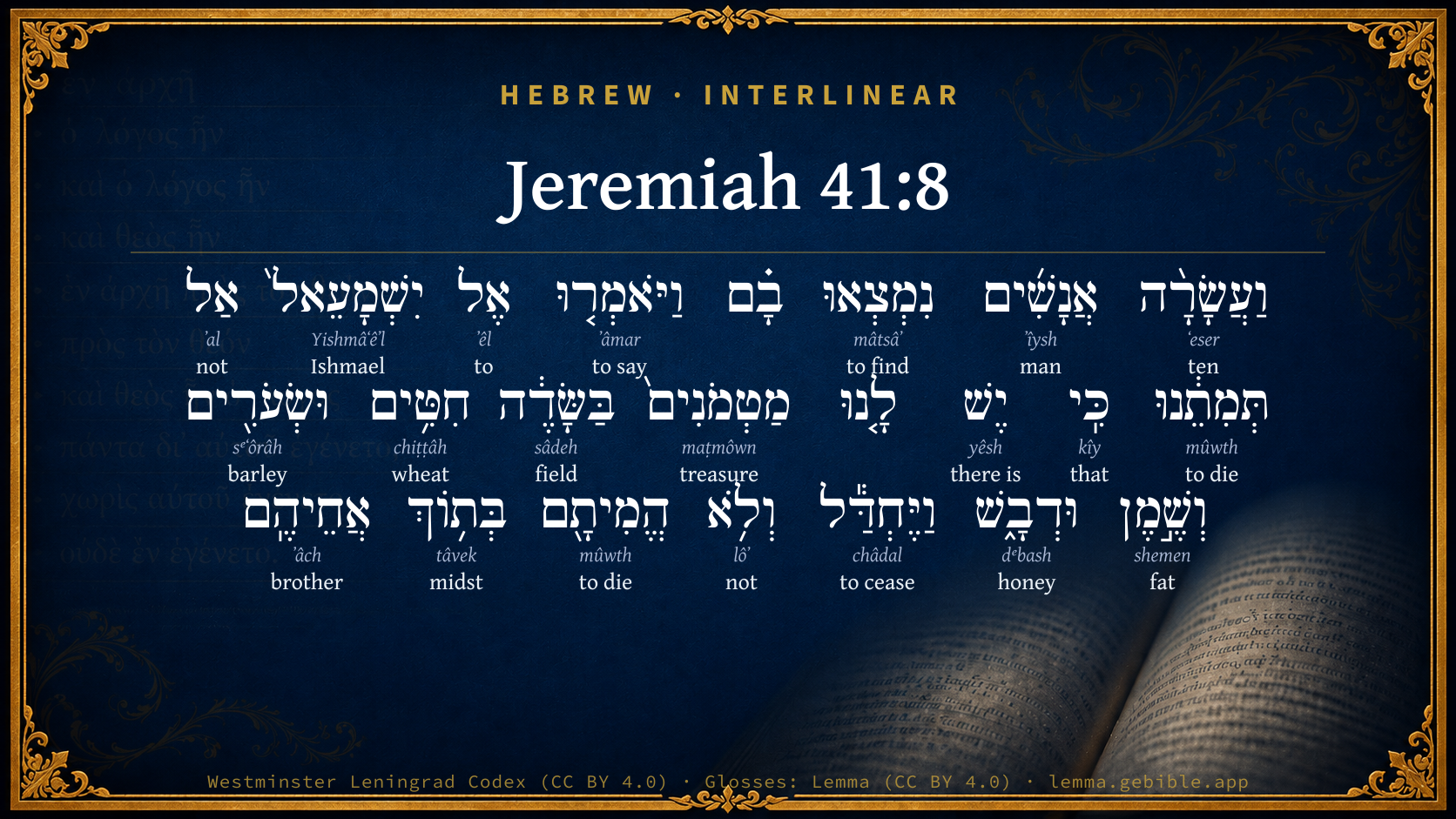
Hebrew (Westminster Leningrad Codex) Jeremiah 41:8 appears in the Hebrew Old Testament. The text above is from the Westminster Leningrad Codex. Each word links to its Strong’s number, a concise gloss, and parsing drawn from the Open Scriptures Hebrew Bible morphology. Click any word for its full Brown-Driver-Briggs (BDB) entry.
Download image
Cite this verse

Jeremiah 41:8 (World English Bible). Public Domain. Lemma interlinear Bible study tool, https://lemma.gebible.app/v/jeremiah/41/8.

Show BibTeX & RIS
BibTeX
RIS
English Translation
But ten men were found among those who said to Ishmael, Don't kill us; for we have stores hidden in the field, of wheat, and of barley, and of oil, and of honey. So he stopped, and didn't kill them among their brothers.
World English Bible · Public Domain
Download a study sheet

One document with this verse’s original text, its word-by-word gloss line, the meaning frame, cross-references with their text, attributed commentary, and full source and license credits — printable, and it pastes into notes with its structure intact.

This verse Autodidact and up

Study sheet (.html) Plain text (.txt)

A passage Seminary Student

Up to 50 verses in one chapter. A passage sheet keeps up to 6 commentary sources and 12 cross-references per verse, in the order this page ranks them, and says so on the sheet whenever that leaves anything out. Ask for a single verse and you get the Autodidact verse sheet above.

Everything on this page stays free to read, with no account — the sheet is a download of what is already on screen, not access to it.

Want to remove ads? Support Godless Engineer
Compare translations 3

The same verse in 3 English versions, stacked beneath the original-language interlinear above. Click any original word for its lexicon entry.

Each is an independent rendering of the whole verse — the interlinear is not word-aligned to these translations.

Highlighted words mark where these versions differ — a whole-verse word diff, not a word-by-word alignment.

  • World English Bible Public Domain
    But ten men were found among those who said to Ishmael, Don't kill us; for we have stores hidden in the field, of wheat, and of barley, and of oil, and of honey. So he stopped, and didn't kill them among their brothers.
  • King James Version Public Domain
    But ten men were found among them that said unto Ishmael, Slay us not: for we have treasures in the field, of wheat, and of barley, and of oil, and of honey. So he forbare, and slew them not among their brethren.
  • unfoldingWord Literal Text CC BY-SA 4.0
    But there were ten men among them who said to Ishmael, “Do not kill us, for there are provisions of ours in a field: Wheat and barley, oil and honey.” So he did not kill them with their other companions.

unfoldingWord Literal Text — © unfoldingWord, licensed CC BY-SA 4.0. Word-aligned USFM3 via Door43 (git.door43.org/unfoldingWord/en_ult).

Versions to compare (up to 4)

3 of 4 selected

Show all 18 translations

Every available English version of this verse, each an independent rendering of the whole verse.

  • World English Bible Public Domain
    But ten men were found among those who said to Ishmael, Don't kill us; for we have stores hidden in the field, of wheat, and of barley, and of oil, and of honey. So he stopped, and didn't kill them among their brothers.
  • Berean Standard Bible Public Domain
    But ten of the men among them said to Ishmael, “Do not kill us, for we have hidden treasure in the field—wheat, barley, oil, and honey!” So he refrained from killing them with the others.
  • Majority Standard Bible Public Domain
    But ten of the men among them said to Ishmael, “Do not kill us, for we have hidden treasure in the field—wheat, barley, oil, and honey!” So he refrained from killing them with the others.
  • King James Version Public Domain
    But ten men were found among them that said unto Ishmael, Slay us not: for we have treasures in the field, of wheat, and of barley, and of oil, and of honey. So he forbare, and slew them not among their brethren.
  • American Standard Version (1901) Public Domain
    But ten men were found among them that said unto Ishmael, Slay us not; for we have stores hidden in the field, of wheat, and of barley, and of oil, and of honey. So he forbare, and slew them not among their brethren.
  • Revised Version (1885) Public Domain
    But ten men were found among them that said unto Ishmael, Slay us not: for we have stores hidden in the field, of wheat, and of barley, and of oil, and of honey. So he forbare, and slew them not among their brethren.
  • Geneva Bible (1599) Public Domain
    But tenne men were founde among them, that saide vnto Ishmael, Slay vs not: for we haue treasures in the fielde, of wheate, and of barley, and of oyle, and of honie: so he stayed, and slew them not among their brethren.
  • Douay-Rheims (1899) Public Domain
    But ten men were found among them, that said to Ismahel: Kill us not: for we have stores in the field, of wheat, and barley, and oil, and honey. And he forbore, and slew them not with their brethren.
  • Young's Literal Translation Public Domain
    And ten men have been found among them, and they say unto Ishmael, `Do not put us to death, for we have things hidden in the field -- wheat, and barley, and oil, and honey.' And he forbeareth, and hath not put them to death in the midst of their brethren.
  • Literal Standard Version CC BY-SA 4.0
    And ten men have been found among them, and they say to Ishmael, “Do not put us to death, for we have things hidden in the field—wheat, and barley, and oil, and honey.” And he refrains, and has not put them to death in the midst of their brothers.
  • Unlocked Literal Bible CC BY-SA 4.0
    But there were ten men among them who said to Ishmael, “Do not kill us, for there are provisions of ours in a field: Wheat and barley, oil and honey.” So he did not kill them with their other companions.
  • unfoldingWord Literal Text CC BY-SA 4.0
    But there were ten men among them who said to Ishmael, “Do not kill us, for there are provisions of ours in a field: Wheat and barley, oil and honey.” So he did not kill them with their other companions.
  • Darby Bible Public Domain
    But ten men were found among them that said unto Ishmael, Do not kill us, for we have hidden stores in the field, of wheat, and of barley, and of oil, and of honey. So he forbore, and did not kill them among their brethren.
  • World Messianic Bible Public Domain
    But ten men were found among those who said to Ishmael, “Don’t kill us; for we have stores hidden in the field, of wheat, and of barley, and of oil, and of honey.” So he stopped, and didn’t kill them among their brothers.
  • Webster's Bible Public Domain
    But ten men were found among them that said to Ishmael, Slay us not: for we have treasures in the field, of wheat, and of barley, and of oil, and of honey. So he forbore, and slew them not among their brethren.
  • Free Bible Version CC BY-SA 4.0
    But ten of them pleaded with Ishmael, “Don't kill us! We've got some good things hidden in the fields—wheat, barley, olive oil, and honey.” So Ishmael didn't kill them along with the others.
  • Bible in Basic English Public Domain
    But there were ten men among them who said to Ishmael, Do not put us to death, for we have secret stores, in the country, of grain and oil and honey. So he did not put them to death with their countrymen.
  • JPS Tanakh (1917) Public Domain
    But ten men were found among them that said unto Ishmael: 'Slay us not; for we have stores hidden in the field, of wheat, and of barley, and of oil, and of honey.' So he forbore, and slew them not among their brethren.

Literal Standard Version (2020), Covenant Press — licensed CC BY-SA 4.0. Text via the HelloAO Bible API (eBible.org). Unlocked Literal Bible (unfoldingWord) — licensed CC BY-SA 4.0. Text via the HelloAO Bible API (eBible.org). unfoldingWord Literal Text — © unfoldingWord, licensed CC BY-SA 4.0. Word-aligned USFM3 via Door43 (git.door43.org/unfoldingWord/en_ult). Free Bible Version, Dr. Jonathan Gallagher — licensed CC BY-SA 4.0. Text via the HelloAO Bible API (eBible.org).

Word by word

More ways to search: Search by grammar → Find every occurrence → Compare this word →

Practice this passage: Drill this verse → Learn its vocabulary →

מַטְמֹנִים֙
maṭmôwn
H4301
“treasures”
Noun, Common, Masculine, Plural, Absolute
Part of Speech
Noun
Type
Common
Gender
Masculine
Number
Plural
State
Absolute
Full BDB Definition

Origin: from H2934

TWOT: 811a

hidden treasure, treasure
  1. וַעֲשָׂרָ֨ה ʻeser H6235 “and · ten” Conjunction + Adjective, Cardinal number, Masculine, Singular, Absolute
  2. אֲנָשִׁ֜ים ʼîysh H376 “men” Noun, Common, Masculine, Plural, Absolute
  3. נִמְצְאוּ mâtsâʼ H4672 “to find” Verb, Niphal, Perfect, 3rd Person, Common, Plural
  4. וַיֹּאמְר֤וּ ʼâmar H559 “and · to say” Conjunction + Verb, Qal, Sequential Imperfect, 3rd Person, Masculine, Plural
  5. אֶל ʼêl H413 “to” Preposition
  6. יִשְׁמָעֵאל֙ Yishmâʻêʼl H3458 “Ishmael” Noun, Proper
  7. אַל ʼal H408 “not” Particle, Negative
  8. תְּמִתֵ֔נוּ mûwth H4191 “to die · us” Verb, Hiphil, Jussive, 2nd Person, Masculine, Singular + Suffix, Personal, 1st Person, Common, Plural
  9. כִּֽי kîy H3588 “that” Conjunction
  10. יֶשׁ yêsh H3426 “there is” Particle, Demonstrative
  11. בַּשָּׂדֶ֔ה sâdeh H7704 “in/at the · field” Preposition, Determined + Noun, Common, Masculine, Singular, Absolute
  12. חִטִּ֥ים chiṭṭâh H2406 “wheat” Noun, Common, Feminine, Plural, Absolute
  13. וּשְׂעֹרִ֖ים sᵉʻôrâh H8184 “and · barley” Conjunction + Noun, Common, Feminine, Plural, Absolute
  14. וְשֶׁ֣מֶן shemen H8081 “and · fat” Conjunction + Noun, Common, Masculine, Singular, Absolute
  15. וּדְבָ֑שׁ dᵉbash H1706 “and · honey” Conjunction + Noun, Common, Masculine, Singular, Absolute
  16. וַיֶּחְדַּ֕ל châdal H2308 “and · to cease” Conjunction + Verb, Qal, Sequential Imperfect, 3rd Person, Masculine, Singular
  17. וְלֹ֥א lôʼ H3808 “and · not” Conjunction + Particle, Negative
  18. הֱמִיתָ֖ם mûwth H4191 “to die · them” Verb, Hiphil, Perfect, 3rd Person, Masculine, Singular + Suffix, Personal, 3rd Person, Masculine, Plural
  19. בְּת֥וֹךְ tâvek H8432 “in/at · midst of” Preposition + Noun, Common, Masculine, Singular, Construct
  20. אֲחֵיהֶֽם ʼâch H251 “brothers · their” Noun, Common, Masculine, Plural, Construct + Suffix, Personal, 3rd Person, Masculine, Plural

About this verse

These counts appear in no published source. They are computed here, from the morphology-tagged text and Lemma’s own curated glosses. What Lemma adds →

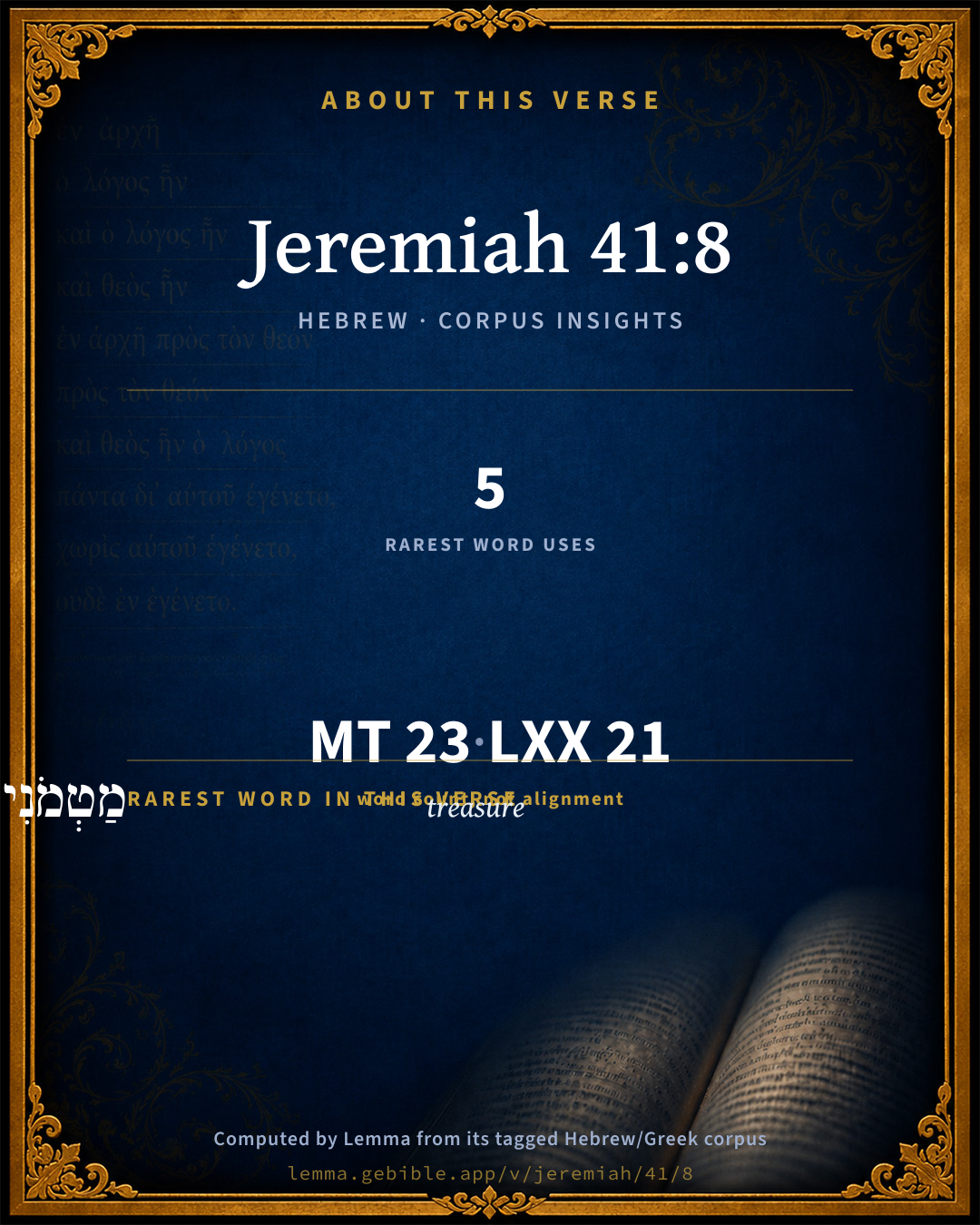
23
words
20
distinct lemmas
Prophets
section

Notable vocabulary

The rarest word here is מַטְמֹנִים֙ treasure H4301 — appearing just 5 times in the whole Hebrew Bible.

Shared distinctive vocabulary

מַטְמֹנִים֙ treasure H4301 occurs in 5 verses of the Hebrew Bible. Also found in:

Grammatical profile

  • 5 verbs
  • 10 nouns
  • 1 adjective
  • 3 prepositions
  • 1 conjunction
  • 3 particles

Verb forms

  • נִמְצְאוּ Niphal · Perfect
  • וַיֹּאמְר֤וּ Qal · Sequential Imperfect
  • תְּמִתֵ֔נוּ Hiphil · Jussive
  • וַיֶּחְדַּ֕ל Qal · Sequential Imperfect
  • הֱמִיתָ֖ם Hiphil · Perfect

Repetition

A word recurs within this verse — often emphatic in Hebrew:

  • תְּמִתֵ֔נוּ to die H4191 ×2

Hebrew & Septuagint length

In the original languages it is 23 Hebrew tokens and 21 Greek tokens — but the two are counted differently (Hebrew bundles its prefixes and suffixes into one token; the Greek is in lemma form), so that isn’t a like-for-like length.

Cross-references

8

Topical passages linked to Jeremiah 41:8 in the Treasury of Scripture Knowledge — connected by theme and wording, ordered by reader-vote popularity; previews shown in the World English Bible.

  • Job 2:4 Satan answered Yahweh, and said, "Skin for skin. Yes, all that a man has will he give for his life.
  • Proverbs 13:8 The ransom of a man's life is his riches, But the poor hear no threats.
  • Psalms 49:6–8 Those who trust in their wealth, And boast in the multitude of their riches--
  • Isaiah 45:3 and I will give you the treasures of darkness, and hidden riches of secret places, that you may know that it is I, Yahweh, who call you by your name, even the God of Israel.
  • Matthew 6:25 Therefore, I tell you, don't be anxious for your life: what you will eat, or what you will drink; nor yet for your body, what you will wear. Isn't life more than food, and the body more than clothing?
  • Matthew 16:26 For what will it profit a man, if he gains the whole world, and forfeits his life? Or what will a man give in exchange for his life?
  • Mark 8:36–37 For what does it profit a man, to gain the whole world, and forfeit his life?
  • Philippians 3:7–9 However, what things were gain to me, these have I counted loss for Christ.

Cross-references courtesy of OpenBible.info (CC BY 4.0).

Hebrew and Greek witnesses Masoretic Hebrew ↔ Greek Septuagint

The same verse in the two great witnesses to the Old Testament, shown verse-for-verse.

These are two independent witnesses, not word-aligned to each other, and the Septuagint is shown in lemma (dictionary) form.

Hebrew Jeremiah 41:8 Masoretic · Westminster Leningrad Codex

וַעֲשָׂרָ֨ה אֲנָשִׁ֜ים נִמְצְאוּ בָ֗ם וַיֹּאמְר֤וּ אֶל יִשְׁמָעֵאל֙ אַל תְּמִתֵ֔נוּ כִּֽי יֶשׁ לָ֤נוּ מַטְמֹנִים֙ בַּשָּׂדֶ֔ה חִטִּ֥ים וּשְׂעֹרִ֖ים וְשֶׁ֣מֶן וּדְבָ֑שׁ וַיֶּחְדַּ֕ל וְלֹ֥א הֱמִיתָ֖ם בְּת֥וֹךְ אֲחֵיהֶֽם

But ten men were found among those who said to Ishmael, Don't kill us; for we have stores hidden in the field, of wheat, and of barley, and of oil, and of honey. So he stopped, and didn't kill them among their brothers.

World English Bible · Public Domain

Greek LXX Structure differs

In the Septuagint, Jeremiah is about an eighth shorter than the Hebrew and arranges its material differently — the Oracles Against the Nations (Hebrew chapters 46–51) appear in the middle of the Greek book, after 25:13. Because the chapter and verse boundaries do not line up, a verse-for-verse comparison with the Hebrew is not shown.

A verse-for-verse comparison isn’t shown here because the chapters and verses don’t line up. Switch to the LXX edition with the MT / LXX toggle above to read the Greek directly.

On this verse, Keil & Delitzsch discusses the Septuagint’s reading. Read the note in Commentary ↓

Hebrew: Westminster Leningrad Codex (CC BY 4.0). Greek: Septuagint (public domain); English from a public-domain English Septuagint. How the Septuagint differs from the Hebrew →

Targum (Aramaic paraphrase)

1

The Targum is the ancient Jewish Aramaic paraphrase of the Hebrew Scriptures — an interpretive translation, not the Hebrew text itself. Onkelos (literal) and Pseudo-Jonathan (expansive) render the Torah, and Jonathan the Prophets. Coverage is partial: where no permissively-licensed English translation exists for a verse, only the Aramaic is shown. This is verse-level text, not a word-by-word alignment to the Hebrew.

  1. Targum Jonathan Prophets (Joshua–Malachi)
    וְעַסְרָא גַבְרִין אִשְׁתְּכָחוּ בְּהוֹן וַאֲמָרוּ לְיִשְׁמָעֵאל לָא תִקְטְלִינָנָא אֲרֵי אִית לָנָא מַטְמוֹרִין בְּחַקְלָא חִטִין וּסְעָרִין וּמְשַׁח וּדְבַשׁ וְאִתְמְנַע וְלָא קַטְלִינוּן בְּגוֹ אֲחוּהוֹן:

    (no public-domain English translation for this verse)

    Targum Jonathan — Aramaic: “Mikraot Gedolot” (public domain). English: “Sefaria Community Translation” (CC0 1.0 (public-domain dedication)); “London "Chaldee Paraphrase," 1871” (public domain). Text via Sefaria.

Commentary

Notes on Jeremiah 41:8 from classic Christian and Jewish commentators (each source and its license shown beneath its notes). The classic Christian expositions comment on the surrounding passage and are grouped to its opening verse, so a note may address several verses; the Jewish commentaries on the Tanakh (Rashi and others) are per-verse, so they appear only where the commentator wrote on this verse.

Lemma curates 59 commentaries, every one of them public domain or Creative Commons licensed, each selected and text-cleaned for this edition rather than reprinted as found. About our sources →

Trapp's Complete Commentary

John Trapp

Jer 41:8 But ten men were found among them that said unto Ishmael, Slay us not: for we have treasures in the field, of wheat, and of barley, and of oil, and of honey. So he forbare, and slew them not among their brethren.

Ver. 8. But there were ten men found among them.] Qui miro astu sibi ab indigna morte provident, who pleaded for their lives, were spared.

Slay us not, for we have treasures in the field.] And these we will willingly part with for the redemption of our lives. They knew that soldiers would do much for money, and what is wealth in comparison with life? Wicked worldlings would say the like to death, if their tale might be heard. Henry Beaufort, Cardinal, Bishop of Winchester, and Chancellor of England, in the reign of Henry VI, perceiving that he must die, murmured at death, that his riches could not reprieve him till a further time. {a}

So he forbare, and slew them not.] Ambition covetousness strove for mastery in this man, and here covetousness conquereth cruelty. This also was it that put him upon carrying his poor countrymen captive, as hoping to make prize of them.

{a} Foxe’s Mart., vol. i. p. 925

John Trapp, A Commentary or Exposition upon All the Books of the Old and New Testament (1647–1656) — public domain. Text from a community e-Sword module.

The Biblical Illustrator

Joseph S. Exell

Jer_41:8

So he forbare, and slew them not among their, brethren.

Sin hindered by sin

Ishmael would have killed these men but for his greed of the wealth they had. It is satisfactory to think he never gained possession of it. Nevertheless, his greed made him guilty of one sin less. This story suggests that--

I. God has many ways of hindering sin. There is--

1. The best way of all. By granting a true repentance and His Holy Spirit, creating the clean heart and renewing the right spirit.

2. But there are other ways. By keeping the opportunity and the will apart. How much of our freedom from sin do we owe to this blessed providential severance! By fear of present evil consequence of our sin.

3. And sometimes, as here, by one sin getting in the way of another. Thus pride holds back not a few; not love of God, gratitude to Christ, love of holiness, hut pride. And covetousness checks the sinner in many sins he would be guilty of but for this. Anger, breaking up the alliances of transgressors; as when, in the days of Jehoshaphat, the Ammonites who were coming against him fell out one with the other (2Ch_20:22). When thieves fall out, honest men come by their rights. (W. Clarkson, B. A.)

Sensual self-indulgence

The vilest Roman emperors were those who least persecuted the Church--Tiberius, Commodus, &c. They were too absorbed in their own indulgences to trouble about the Christians.

II. But these other ways leave men as great sinners as before. The question is not as to your freedom from transgression so much, but--what kept you free? Only the first and best way is accepted of God.

III. Nevertheless, let us be thankful that sin is self-destructive in its very nature. It is a blessed anarchy, for it protects many who would otherwise suffer.

IV. But for ourselves let us seek that sin may be destroyed by Christ. (W. Clarkson, B. A.)

The Biblical Illustrator, edited by Joseph S. Exell (c. 1880s–1900s) — public domain. Text from a community e-Sword module.

Tyndale Open Study Notes

Tyndale Open Resources

41:8 The surviving ten men had quick wits and saved their lives by promising to provide what Ishmael’s men needed most: wheat, barley, olive oil, and honey.

Tyndale Open Study Notes — © Tyndale Open Resources, licensed CC BY-SA 4.0. Text via the HelloAO Bible API.

Jamieson, Fausset & Brown

Robert Jamieson, A. R. Fausset & David Brown

treasures--It was customary to hide grain in cavities underground in troubled times. "We have treasures," which we will give, if our lives be spared.

slew . . . not-- (Pro 13:8). Ishmael's avarice and needs overcame his cruelty.

Jamieson, Fausset & Brown — Commentary Critical and Explanatory on the Whole Bible (1871) — public domain (CC PDM 1.0). Text via the HelloAO Bible API.

John Calvin's Commentaries

We here see that the barbarity of Ishmael was connected with avarice, he was indeed inflamed with ferocious madness when he slew simple and innocent men; but when the hope of gain was presented to him, he spared some of them. Thus then we see that he was a lion, a wolf, or a bear in savageness, but that he was also a hungry man, for as soon as he smelt the odor of prey, he spared ten out of the eighty, who, it is probable, thus redeemed their life and returned home. So in one man we see there were many monsters; for if he hated all those who favored Gedaliah, why did he suffer these to escape? even because avarice and rapacity prevailed in him.

It is then added, that he slew them not in the midst of their brethren, that is, when they were exposed to death and were mixed with the others, so that their condition seems to have been the same. The Prophet says, that they were spared, even because Ishmael sought nothing else but gain. And it is probable that in a state of things so disturbed he was not furnished with provisions and other things. As, then, want urged him, so he became moderate, lest his cruelty should cause a loss to him.

Here also is set before us the inscrutable purpose of God, that he suffered unhappy men to have been thus slain by robbers. They had left. their houses to lament the burning of the Temple. As then the ardor of their piety led them to Jerusalem, how unworthy it was that they should become a prey to the barbarity of Ishmael and his associates? But as we said yesterday, God has hidden ways by which he provides for the salvation of his people. He took away Gedaliah; his end indeed was sad, having been slain by Ishmael whom he had hospitably entertained. Thus God did not suffer him to be tossed about in the midst of great troubles. For John, the son of Kareah, who yet was a most faithful man, would have become soon troublesome to the holy man; for he became soon after the head and ringleader of an impious faction, and ferociously opposed Jeremiah. Had then Gedaliah lived, he would have been assailed on every side by his own people. It was then God’s purpose to free him at once from all these miserable troubles. The same thing also happened to the seventy who were slain; for the Lord removed them to their rest, that they might; not be exposed to the grievous evils and calamities which afterwards soon followed; for none could have been in a more miserable state than the remnant whom Nebuchadnezzar had spared. We have then reason in this instance to admire the secret purpose of God, when we see that these unhappy men were killed, who yet had gone to Jerusalem for the sake of testifying their piety. It was, in short, better for them to have been removed than to have been under the necessity of suffering again many miseries. It now follows, —

John Calvin's Commentaries (1540-1563) — public domain. Text from the Calvin Translation Society English edition (1840s-50s) via the Christian Classics Ethereal Library (ccel.org). Calvin's coverage is partial (roughly two-thirds of the Bible); uncommented books and verses are honest gaps, never fabricated. The 19th-century editor's footnotes and remarks are omitted so the notes are faithfully Calvin's own voice.

Ellicott's Commentary for English Readers

(8) But ten men were found among them.—The stores which formed the purchase-money by which the ten saved their lives represented probably the produce of the previous year, which, after the manner of the East, had been concealed in pits, far from the habitations of men, while the land was occupied by the Chaldæan armies.

A Bible Commentary for English Readers, edited by Charles John Ellicott (1878–1897) — public domain. Text from a community e-Sword module.

The Cambridge Bible for Schools and Colleges

gen. ed. J. J. S. Perowne

8. we have stores hidden] In the East it is to this day a common custom to use “wells or cisterns for grain. In them the farmers store their crops of all kinds after the grain is threshed and winnowed. These cisterns are cool, perfectly dry, and tight. The top is hermetically sealed with plaster, and covered with a deep bed of earth.” See Thomson, The Land and the Book, pp. 509 f.

The Cambridge Bible for Schools and Colleges (gen. ed. J. J. S. Perowne; Cambridge University Press, 1878–1918) — public domain. Text from a community e-Sword module.

John Gill's Exposition

But ten men were found among them, that said unto Ishmael, slay us not,.... They begged for their lives, using what follows as an argument to prevail upon him:

for we have treasures in the field, of wheat, and of barley, and of oil, and of honey; not that they had then a stock upon the ground at this time; for this being the seventh month, not only the barley and wheat harvests had been over long ago, but the rest of the fruits of the earth were gathered in: but this either means storehouses of such things in the field; or else that these things were hid in cells under ground, the land having been invaded, to secure them from the enemy, as is common to do in time of war; and so Josephus says (i), they promised to deliver to him things hid in the fields, household goods, clothes, and corn:

so he forbore, and slew them not among their brethren; but saved them, and kept and carried them with him, in order to take these hidden treasures, which lay in his way to Ammon; for between Gibeon, where he was found, Jer 41:12; and Ammon, lay Samaria, Sichem, and Shiloh; at least it was not far out of his way to take that course; and thus he appears to be a covetous man, as well as a cruel one.

(i) Ibid. (Antiqu. l. 10. c. 9. sect. 4.)

John Gill's Exposition of the Whole Bible (1746–1763) — public domain (CC PDM 1.0). Text via the HelloAO Bible API.

Albert Barnes' Notes on the Bible

Treasures - Hidden stores; which would be of great value to Ishmael in his retreat back to Baalis.

Albert Barnes' Notes on the Bible (1834–1885) — public domain. Text from a community e-Sword/MySword module.

Haydock's Catholic Bible Commentary

Field. It was usual to cover them up carefully. (Chardin.) --- Avarice sometimes will set bounds to cruelty, when nothing else will. (Worthington)

George Leo Haydock (1774–1849), Haydock's Catholic Family Bible and Commentary, 1859 edition — public domain. Excludes Psalms (Douay-Rheims chapter numbering differs from Protestant) and Deuterocanonical books (Catholic canon only).

Matthew Poole's English Annotations

He slew seventy of them, but ten of them pleading for their lives, urged that they had estates in the country, both of corn, oil, and honey. His covetousness prevailed over his cruelty, he spared their lives to become master of what they had.

Matthew Poole's English Annotations on the Holy Bible (1683–1685) — public domain. Text from a community e-Sword/MySword module.

Whedon's Commentary on the Bible

Daniel D. Whedon

8. Treasures — In Isa_45:3, the same original word is translated “hid den riches.” Doubtless at this troublous and dangerous time the practice of concealing the choicest products of the earth in caves or subterranean chambers must have been quite common.

Daniel D. Whedon (gen. ed.), Commentary on the Old and New Testaments (1874–1909) — public domain. Text from a community e-Sword module.

The Pulpit Commentary

Slay us not, etc. Bishop Callaway refers to this passage in his "Zulu Nursery Tales" (1:242), in illustration of a Zulu form of deprecating death on the ground of having some important work in hand which absolutely requires the life of the person in danger. But the "ten men" do not, as the bishop supposes, beg their lives on the ground that they had not yet harvested, but rather offer a bribe. We have treasures (literally, hidden things) in the field. The allusion is to the "wells or cisterns for grain," in which "the farmers store their crops of all kinds after the grain is threshed and winnowed. These cisterns are cool, perfectly dry, and tight. The top is hermetically sealed with plaster, and covered with a deep bed of earth; and thus they keep out rats, mice, and even ants, the latter by no means a contemptible enemy .... These ten men had doubtless thus hid their treasures to avoid being plundered in that time of utter lawlessness" (Thomson, "The Land and the Book," p. 509). Honey. Probably that obtained from wild bees.

Sin hindered by sin.

"So he forbare," etc. This was a case of bloodthirsty cruelty versus greed. Ishmael would have killed these men but for his greed of the wealth they had. It is satisfactory to think he never gained possession of it. Nevertheless, his greed made him guilty of one sin less. This story suggests that

I GOD HAS MANY WAYS OF HINDERING SIN. There is:

1. The best way of all. By granting a true repentance and his Holy Spirit, creating the clean heart and renewing the right spirit.

2. But there are other ways. By keeping the opportunity and the will apart. How much of our freedom from sin do we owe to this blessed providential severance! By fear of present evil consequences of our sin.

3. And sometimes, as here, by one sin getting in the way of another. Thus pride holds back not a few; not love of God, gratitude to Christ, love of holiness, but pride. And coveteousness checks the sinner in many sins he would be guilty of but for this. Anger, breaking up the alliances of transgressors; as when, in the days of Jehoshaphat, the Ammonites who were coming against him fell out one with the other. (2Ch_20:22) The old saying is, "When thieves fall Out, honest men come by their rights." Sensual self-indulgence. The vilest Romans emperors were those who least persecuted the Church Tiberius, Commodus, etc. They were too absorbed in their own indulgences to trouble about the Christians.

II BUT THESE OTHER WAYS LEAVE MEN AS GREAT SINNERS AS BEFORE. The question is not as to your freedom from transgression so much, but What kept you free? Only the first and best way is accepted of God.

III NEVERTHELESS, LET US BE THANKFUL THAT SIN IS SELFDESTRUCTIVE IN ITS VERY NATURE. It is a blessed anarchy, for it protects many who would otherwise suffer.

IV BUT FOR OURSELVES LET US SEEK THAT SIN MAY BE DESTROYED BY CHRIST. C.

The Pulpit Commentary (1880–1919), ed. H.D.M. Spence-Jones & Joseph S. Exell — public domain. Text from a community e-Sword module.

John Wesley's Explanatory Notes

He forebare - His covetousness prevailed over his cruelty.

John Wesley, Explanatory Notes Upon the Whole Bible (1754–1765) — public domain. Text via the GEBible commentary corpus.

Keil & Delitzsch

C. F. Keil & F. Delitzsch

Only ten men out of the eighty saved their lives, and this by saying to Ishmael, "Do not kill us, for we have hidden stores in the field - wheat, and barley, and oil, and honey." מטמנים are excavations in the form of cisterns, or subterranean storehouses in the open country, for keeping grain; the openings or entrances to these are so concealed that the eye of a stranger could not perceive them. Such places are still universally employed in Palestine at the present day (Robinson's Palestine, i. pp. 324-5), and are also to be found in other southern countries, both in ancient and modern times; see proofs of this in Rosenmller's Scholia ad hunc locum. It is remarked, in Jer 41:9, of the pit into which Ishmael threw the corpses, that it was the same that King Asa had made, i.e., had caused to be made, against, i.e., for protection against, Baasha the king of Israel. In the historical books there is no mention made of this pit in the account of the war between Asa and Baasha, Kg1 15:16-22 and Ch2 16:1-6; it is only stated in Kg1 15:22 and Ch2 16:6 that, after Baasha, who had fortified Ramah, had been compelled to return to his own land because of the invasion of Benhadad the Syrian king, whom Asa had called to his aid, the king of Judah ordered all his people to carry away from Ramah the stones and timber which Baasha had employed in building, and therewith fortify Geba and Mizpah. The expression מפּני בעשׁא certainly implies that the pit had been formed as a protection against Baasha, and belonged to the fortifications raised at that time. However, הבּור cannot mean the burial-place belonging to the city (Grotius), but only a cistern (cf. Kg2 10:14); and one such as could contain a considerable store of water was as necessary as a wall and a moat for the fortification of a city, so that it might be able to endure a long siege (Graf). Hitzig, on the other hand, takes בּור to mean a long and broad ditch which cut off the approach to the city from Ephraim, or which, forming a part of the fortifications, made a break in the road to Jerusalem, though it was bridged over in times of peace, thus forming a kind of tunnel. This idea is certainly incorrect; for, according to Jer 41:7, the "ditch" was inside the city (בּתוך). The expression בּיד גּדליהוּ is obscure, and cannot be explained with any of certainty. בּיד cannot mean "through the fault of" Gedaliah (Raschi), or "because of" Gedaliah - for his sake (Kimchi, Umbreit), or "coram" Gedaliah (Venema), but must rather be rendered "by means of, through the medium of," or "at the side of, together with." Ngelsbach has decided for the rendering "by means of," giving as his reason the fact that Ishmael had made use of the name of Gedaliah in order to decoy these men into destruction. He had called to them, "Come to Gedaliah" (Jer 41:6); and simply on the authority of this name, they had followed him. But the employment of the name as a means of decoy can hardly be expressed by בּיד. We therefore prefer the meaning "at the hand = at the side of" (following the Syriac, L. de Dieu, Rosenmller, Ewald), although this signification cannot be established from the passages cited by Rosenm. (Sa1 14:34; Sa1 16:2; Ezr 7:23), nor can the meaning "together with" (Ewald) be shown to belong to it. On the other hand, a passage which is quite decisive for the rendering "by the hand of, beside," is Job 15:23 : "there stands ready at his hand (בּידו, i.e., close to him) a day of darkness." If we take this meaning for the passage now before us, then בּיד גּדליהוּ cannot be connected with אשׁר , in accordance with the Masoretic accents, but with השׁליך שׁם, "where Ishmael cast the bodies of the men whom he had slain, by the side of Gedaliah;" so that it is not stated till here and now, and only in a casual manner, what had become of Gedaliah's corpse. Nothing that admits of being proved can be brought against this view.

(Note: Because the lxx have, for בּיד גּדליהוּ הוּא, φρέαρ μέγα τοῦτό ἐστιν, J. D. Michaelis, Dahler, Movers, Hitzig, and Graf would change the text, and either take ryb lwdg 'wh (Dahler, Movers) or בּיר הגּדול הוּא (= בּור) as the original reading, inasmuch as one codex of De Rossi's also has בור. But apart from the improbability of בּור גּדול or הגּדול being incorrectly changed into בּיד גּדליהוּ, we find that הוּא stands provokingly in the way; for it would be superfluous, or introduce an improper emphasis into the sentence. The lxx have but been attempting to guess at a translation of a text they did not understand. What Hitzig further supposes has no foundation, viz., that this "ditch" is identical with that mentioned Sa1 19:22, in שׂכוּ, and with τὸ φρέαρ τὸ μέγα of 1 Macc. 7:19; for the ditch at Sechu was near Ramah, which was about four miles from Mizpah, and the large fountain 1 Macc. 7:19 was ἐν Βηζέθ, an unknown place in the vicinity of Jerusalem.)

The הוּא which follows is a predicate: "the ditch wherein...was that which Asa the king had formed."

The motive for this second series of assassinations by Ishmael is difficult to discover. The supposition that he was afraid of being betrayed, and for this reason killed these strangers, not wishing to be troubled with them, is improbable, for the simple reason that these strangers did not want to go to Mizpah, but to Jerusalem. For the supposition of Thenius (on Kg2 25:23) and of Schmieder, that the people had intended going to Mizpah to a house of God that was there, is very properly rejected by Hitzig, because no mention is made in history of a place of worship at Mizpah; and, according to the express statement of Jer 41:6., Ishmael had enticed them into this city only by inviting them to come and see Gedaliah. Had Ishmael wished merely to conceal the murder of Gedaliah from these strangers, he ought to have done anything but let them into Mizpah. As little can we regard this deed (with Graf) as an act of revenge on these Israelites by Ishmael for the murder of his relations and equals in rank by Nebuchadnezzar (Jer 52:10), because these men, who had now for a long time been living together with heathens, were Assyrian and Chaldean subjects. For we cannot comprehend how he could look on these Israelites as friends of the Chaldeans, and vent his anger against the Chaldean rule by murdering them; the mournful procession which they formed, and the offerings they were carrying to present, proclaimed them faithful adherents of Judah. Ngelsbach, accordingly, is of opinion that Ishmael had simply intended robbery. As it is evident that he, a rough and wild man, had assassinated the noble Gedaliah from personal jealousy, and in order to further the political interest of his Ammonite patron, he must have been seeking to put himself in the position of his victim, or to flee. "When we find, moreover, that he soon murdered a peaceable caravan of pilgrims, and preserved the lives only of a few who offered to show him hidden treasures; when, finally, we perceive that the whole turba imbellis of Mizpah were seized and carried off into slavery, Ishmael proves himself a mere robber." But, though the fact that Ishmael spared the lives of the ten men who offered to show him hidden treasures seems to support this view, yet the supposition that nothing more than robbery was intended does not suffice to explain the double murder. The two series of assassinations plainly stand in the closest connection, and must have been executed from one and the same motive. It was at the instigation of the Ammonite king that Ishmael murdered Gedaliah; moreover, as we learn from the report brought to Gedaliah by Johanan (Jer 40:15), the crime was committed in the expectation that the whole of Judah would then be dispersed, and the remnant of them perish. This murder was thus the work of the Ammonite king, who selected the royally-descended Ishmael as his instrument simply because he could conveniently, for the execution of his plans, employ the personal envy of one man against another who had been preferred by the king of Babylon. There can be no doubt that the same motive which urged him to destroy the remnant of Judah, i.e., to frustrate the attempt to gather and restore Judah, was also at work in the massacre of the pilgrims who were coming to the temple. If Ishmael, the leader of a robber-gang, had entered into the design of the Ammonite king, then everything that might serve for the preservation and consolidation of Judah must have been a source of pain to him; and this hatred of his towards Judah, which derived its strength and support from his religious views, incited him to murder the Jewish pilgrims to the temple, although the prospect of obtaining treasures might well cooperate with this in such a way as to make him spare the ten men who pretended they had hidden stores. With this, too, we can easily connect the hypocritical dealing on the part of Ishmael, in going forth, with tears, to meet these pious pilgrims, so that he might deceive them by making such a show of grief over the calamity that had befallen Judah; fore the wicked often assume an appearance of sanctity for the more effectual accomplishment of their evil deeds. The lxx evidently did not know what to make of this passage as it stands; hence, in Jer 41:6, they have quite dropped the words "from Mizpah," and have rendered הלך הלך by αὐτοὶ ἐπορεύοντο καὶ ἔκλαιον. Hitzig and Graf accept this as indicating the original text, since Ishmael had no ostensible ground for weeping. But the reasons which are supposed to justify this conjecture are, as Ngelsbach well remarks, of such a nature that one can scarcely believe they are seriously held.

Keil & Delitzsch — Biblical Commentary on the Old Testament (1861–1891) — public domain (CC PDM 1.0). Text via the HelloAO Bible API. (Old Testament only.)

unfoldingWord translationNotes

Door43 World Missions Community

ten men among them

The word "them" refers to the 80 men.

for there are provisions of ours in a field

It is implied that they would give their provisions to Ishmael and his men. AT: "for we will give you our provisions that we have hidden in a field" (See: Assumed Knowledge and Implicit Information)

provisions

supplies to be used to provide for future needs

The cistern where Ishmael ... against King Baasha of Israel

This is background information about the cistern that Ishmael used. King Asa had his men dig the cistern so his people would have a water supply when King Baasha attacked them. (See: Background Information)

that King Asa dug

Here King Asa represents his men. AT: "that King Asa ordered his men to dig" (See: Metonymy)

against King Baasha of Israel

Here King Baasha represents himself and his army. AT: "against Baasha, king of Israel, and his army" (See: Synecdoche)

Ishmael son of Nethaniah filled it

Here Ishmael represents himself and all of his men. AT: "Ishmael and his men filled it" (See: Synecdoche)

with the dead

This nominal adjective can be stated as an adjective. AT: "with those who were dead" or "with those they had killed" (See: Nominal Adjectives)

translationWords

wheat

barley

oil

honey

companion

Asa

Baasha

kingdom of Israel

unfoldingWord translationNotes — © Distant Shores Media and the Door43 World Missions Community, licensed CC BY-SA 4.0. Source: git.door43.org/Door43/en_tn.

Lesson kit

Teaching starters — assembled from the data on this page, not authored interpretation. Every prompt links to the verse data it draws on. Edit before teaching.

Jeremiah, in the Prophets, opens this verse with 23 words (20 distinct Hebrew lemmas). Its most distinctive word is maṭmôwn (“treasure”). A historical commentator’s framing appears above. Read the whole chapter for the surrounding context.

Discussion questions

  1. How does “treasure” (maṭmôwn) shape what this verse is saying?
  2. Genesis 43:23 shares the word «treasure» with this verse. How do the two illuminate each other?
  3. “to die” occurs 2× in this one verse. What is the effect of the repetition?
  4. The translations on this page render this verse differently — a whole-verse word diff, not a word-by-word alignment. What might account for the different wordings?
  5. The verb «נִמְצְאוּ» is Niphal Perfect. How does its form color the action?
  6. Reading how Trapp's Complete Commentary and The Biblical Illustrator read this verse, where do the two commentators agree and where do they part?

Things to notice

Reading settings

Reading text

Shown beneath each verse's original-language words.

Old Testament
Old Testament edition

Read the OT as the Masoretic Hebrew (MT) or the Greek Septuagint (LXX).

English shown for the Greek Septuagint (in the Hebrew ↔ Greek comparison).

Comparing translations? Open the Compare panel on any verse page to stack up to four side by side.