
Proverbs 21:20

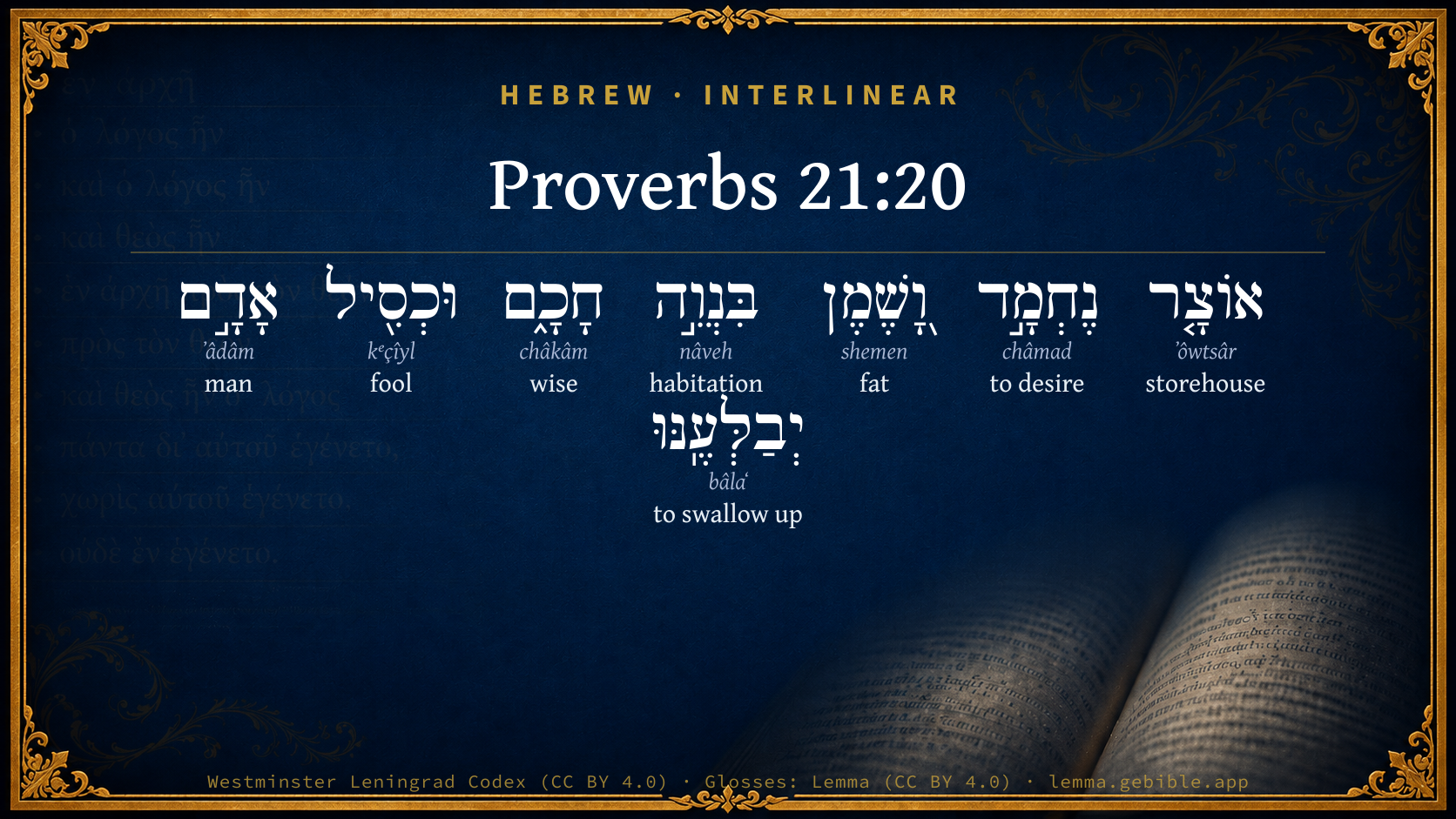
Hebrew (Westminster Leningrad Codex) Proverbs 21:20 appears in the Hebrew Old Testament. The text above is from the Westminster Leningrad Codex. Each word links to its Strong’s number, a concise gloss, and parsing drawn from the Open Scriptures Hebrew Bible morphology. Click any word for its full Brown-Driver-Briggs (BDB) entry.
Download image
Cite this verse

Proverbs 21:20 (World English Bible). Public Domain. Lemma interlinear Bible study tool, https://lemma.gebible.app/v/proverbs/21/20.

Show BibTeX & RIS
BibTeX
RIS
English Translation
There is precious treasure and oil in the dwelling of the wise; But a foolish man swallows it up.
World English Bible · Public Domain
Download a study sheet

One document with this verse’s original text, its word-by-word gloss line, the meaning frame, cross-references with their text, attributed commentary, and full source and license credits — printable, and it pastes into notes with its structure intact.

This verse Autodidact and up

Study sheet (.html) Plain text (.txt)

A passage Seminary Student

Up to 50 verses in one chapter. A passage sheet keeps up to 6 commentary sources and 12 cross-references per verse, in the order this page ranks them, and says so on the sheet whenever that leaves anything out. Ask for a single verse and you get the Autodidact verse sheet above.

Everything on this page stays free to read, with no account — the sheet is a download of what is already on screen, not access to it.

Want to remove ads? Support Godless Engineer
Compare translations 3

The same verse in 3 English versions, stacked beneath the original-language interlinear above. Click any original word for its lexicon entry.

Each is an independent rendering of the whole verse — the interlinear is not word-aligned to these translations.

Highlighted words mark where these versions differ — a whole-verse word diff, not a word-by-word alignment.

  • World English Bible Public Domain
    There is precious treasure and oil in the dwelling of the wise; But a foolish man swallows it up.
  • King James Version Public Domain
    There is treasure to be desired and oil in the dwelling of the wise; but a foolish man spendeth it up.
  • unfoldingWord Literal Text CC BY-SA 4.0
    Desirable treasure and oil in the home of a wise, but a stupid man swallows it up.

unfoldingWord Literal Text — © unfoldingWord, licensed CC BY-SA 4.0. Word-aligned USFM3 via Door43 (git.door43.org/unfoldingWord/en_ult).

Versions to compare (up to 4)

3 of 4 selected

Show all 18 translations

Every available English version of this verse, each an independent rendering of the whole verse.

  • World English Bible Public Domain
    There is precious treasure and oil in the dwelling of the wise; But a foolish man swallows it up.
  • Berean Standard Bible Public Domain
    Precious treasures and oil are in the dwelling of the wise, but a foolish man consumes them.
  • Majority Standard Bible Public Domain
    Precious treasures and oil are in the dwelling of the wise, but a foolish man consumes them.
  • King James Version Public Domain
    There is treasure to be desired and oil in the dwelling of the wise; but a foolish man spendeth it up.
  • American Standard Version (1901) Public Domain
    There is precious treasure and oil in the dwelling of the wise; But a foolish man swalloweth it up.
  • Revised Version (1885) Public Domain
    There is precious treasure and oil in the dwelling of the wise; but a foolish man swalloweth it up.
  • Geneva Bible (1599) Public Domain
    In the house of the wise is a pleasant treasure and oyle: but a foolish man deuoureth it.
  • Douay-Rheims (1899) Public Domain
    There is a treasure to be desired, and oil in the dwelling of the just: and the foolish man shall spend it.
  • Young's Literal Translation Public Domain
    A treasure to be desired, and oil, `Is' in the habitation of the wise, And a foolish man swalloweth it up.
  • Literal Standard Version CC BY-SA 4.0
    A treasure to be desired, and oil, || [Is] in the habitation of the wise, || And a foolish man swallows it up.
  • Unlocked Literal Bible CC BY-SA 4.0
    Desirable treasure and oil are kept in the dwelling of the wise, but a foolish person swallows it all up.
  • unfoldingWord Literal Text CC BY-SA 4.0
    Desirable treasure and oil in the home of a wise, but a stupid man swallows it up.
  • Darby Bible Public Domain
    There is costly store and oil in the dwelling of a wise [man]; but a foolish man swalloweth it up.
  • World Messianic Bible Public Domain
    There is precious treasure and oil in the dwelling of the wise, but a foolish man swallows it up.
  • Webster's Bible Public Domain
    There is a treasure to be desired, and oil in the dwelling of the wise; but a foolish man spendeth it up.
  • Free Bible Version CC BY-SA 4.0
    The wise hold on to their wealth and olive oil, but stupid people use up everything they have.
  • Bible in Basic English Public Domain
    There is a store of great value in the house of the wise, but it is wasted by the foolish man.
  • JPS Tanakh (1917) Public Domain
    There is desirable treasure and oil in the dwelling of the wise; but a foolish man swalloweth it up.

Literal Standard Version (2020), Covenant Press — licensed CC BY-SA 4.0. Text via the HelloAO Bible API (eBible.org). Unlocked Literal Bible (unfoldingWord) — licensed CC BY-SA 4.0. Text via the HelloAO Bible API (eBible.org). unfoldingWord Literal Text — © unfoldingWord, licensed CC BY-SA 4.0. Word-aligned USFM3 via Door43 (git.door43.org/unfoldingWord/en_ult). Free Bible Version, Dr. Jonathan Gallagher — licensed CC BY-SA 4.0. Text via the HelloAO Bible API (eBible.org).

Word by word

More ways to search: Search by grammar → Find every occurrence → Compare this word →

Practice this passage: Drill this verse → Learn its vocabulary →

נֶחְמָ֣ד
châmad
H2530
“desiring”
Verb, Niphal, Participle Active, Masculine, Singular, Absolute
Part of Speech
Verb
Stem
Niphal
Form
Participle Active
Gender
Masculine
Number
Singular
State
Absolute
Full BDB Definition

Origin: a primitive root

TWOT: 673

to desire, covet, take pleasure in, delight in (verb) - (Qal) to desire - (Niphal) to be desirable - (Piel) to delight greatly, desire greatly - desirableness, preciousness (noun feminine)
  1. אוֹצָ֤ר ʼôwtsâr H214 “storehouse” Noun, Common, Masculine, Singular, Absolute
  2. וָ֭שֶׁמֶן shemen H8081 “and · fat” Conjunction + Noun, Common, Masculine, Singular, Absolute
  3. בִּנְוֵ֣ה nâveh H5116 “in/at · habitation of” Preposition + Noun, Common, Both, Singular, Construct
  4. חָכָ֑ם châkâm H2450 “wise” Adjective, Adjective, Masculine, Singular, Absolute
  5. וּכְסִ֖יל kᵉçîyl H3684 “and · fool” Conjunction + Adjective, Adjective, Masculine, Singular, Absolute
  6. אָדָ֣ם ʼâdâm H120 “man” Noun, Common, Masculine, Singular, Absolute
  7. יְבַלְּעֶֽנּוּ bâlaʻ H1104 “to swallow up · him” Verb, Piel, Imperfect, 3rd Person, Masculine, Singular + Suffix, Personal, 3rd Person, Masculine, Singular

About this verse

These counts appear in no published source. They are computed here, from the morphology-tagged text and Lemma’s own curated glosses. What Lemma adds →

8
words
8
distinct lemmas
Wisdom
section

Shared distinctive vocabulary

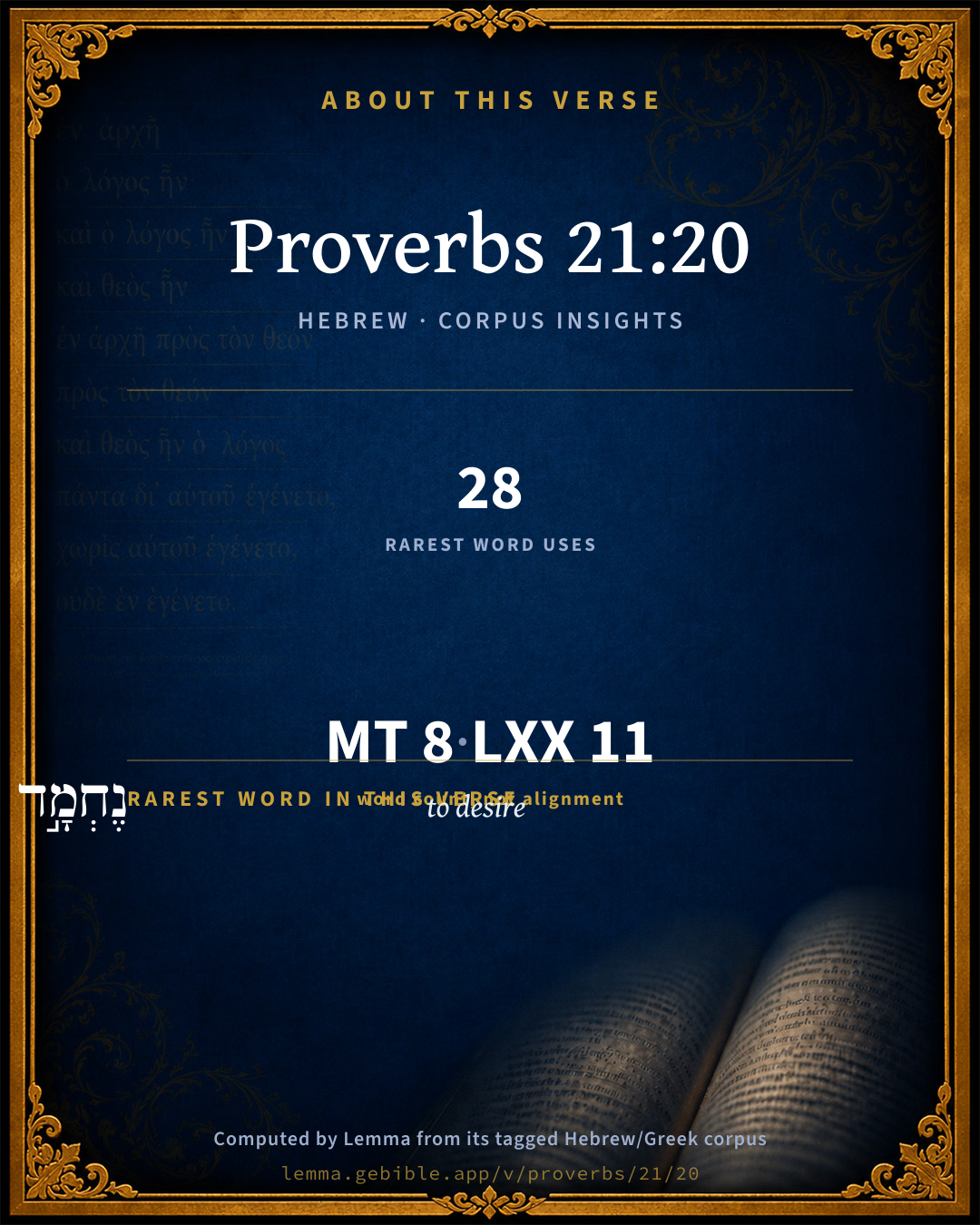
נֶחְמָ֣ד to desire H2530 occurs in 27 verses of the Hebrew Bible. Also found in:

Grammatical profile

  • 2 verbs
  • 4 nouns
  • 2 adjectives

Verb forms

  • נֶחְמָ֣ד Niphal · Participle Active
  • יְבַלְּעֶֽנּוּ Piel · Imperfect

Hebrew & Septuagint length

In English translation the verse runs 19 words from the Hebrew and 18 from the Septuagint (LXX English) — closely comparable.

A rough comparison of the two English renderings, which tokenize alike — not a word-level alignment.

Word counts can differ between the Hebrew and the Greek without any difference in meaning — e.g. the Hebrew direct-object marker אֵת has no separate Greek word, and Greek often adds the article ὁ.

In the original languages it is 8 Hebrew tokens and 11 Greek tokens — but the two are counted differently (Hebrew bundles its prefixes and suffixes into one token; the Greek is in lemma form), so that isn’t a like-for-like length.

Cross-references

17

Topical passages linked to Proverbs 21:20 in the Treasury of Scripture Knowledge — connected by theme and wording, ordered by reader-vote popularity; previews shown in the World English Bible.

  • Matthew 25:3–4 Those who were foolish, when they took their lamps, took no oil with them,
  • Psalms 112:3 Wealth and riches are in his house. His righteousness endures forever.
  • Ecclesiastes 5:19 Every man also to whom God has given riches and wealth, and has given him power to eat of it, and to take his portion, and to rejoice in his labor--this is the gift of God.
  • Proverbs 15:6 In the house of the righteous is much treasure, But the income of the wicked brings trouble.
  • Ecclesiastes 7:11 Wisdom is as good as an inheritance. Yes, it is more excellent for those who see the sun.
  • Psalms 23:5 You prepare a table before me in the presence of my enemies. You anoint my head with oil. My cup runs over.
  • Proverbs 10:22 Yahweh's blessing brings wealth, And he adds no trouble to it.
  • Luke 15:14 When he had spent all of it, there arose a severe famine in that country, and he began to be in need.
  • Ecclesiastes 10:19 A feast is made for laughter, And wine makes the life glad; And money is the answer for all things.
  • Jeremiah 41:8 But ten men were found among those who said to Ishmael, Don't kill us; for we have stores hidden in the field, of wheat, and of barley, and of oil, and of honey. So he stopped, and didn't kill them among their brothers.
  • Matthew 6:19–20 "Don't lay up treasures for yourselves on the earth, where moth and rust consume, and where thieves break through and steal;
  • Luke 6:45 The good man out of the good treasure of his heart brings out that which is good, and the evil man out of the evil treasure of his heart brings out that which is evil, for out of the abundance of the heart, his mouth speaks.
  • Luke 16:1 He also said to his disciples, "There was a certain rich man who had a manager. An accusation was made to him that this man was wasting his possessions.
  • Job 20:15 He has swallowed down riches, and he shall vomit them up again. God will cast them out of his belly.
  • Job 20:18 That for which he labored he shall restore, and shall not swallow it down; According to the substance that he has gotten, he shall not rejoice.
  • Matthew 25:8 The foolish said to the wise, 'Give us some of your oil, for our lamps are going out.'
  • Luke 16:19–25 "Now there was a certain rich man, and he was clothed in purple and fine linen, living in luxury every day.

Cross-references courtesy of OpenBible.info (CC BY 4.0).

Hebrew and Greek witnesses Masoretic Hebrew ↔ Greek Septuagint

The same verse in the two great witnesses to the Old Testament, shown verse-for-verse.

These are two independent witnesses, not word-aligned to each other, and the Septuagint is shown in lemma (dictionary) form.

Hebrew Proverbs 21:20 Masoretic · Westminster Leningrad Codex

אוֹצָ֤ר נֶחְמָ֣ד וָ֭שֶׁמֶן בִּנְוֵ֣ה חָכָ֑ם וּכְסִ֖יל אָדָ֣ם יְבַלְּעֶֽנּוּ

There is precious treasure and oil in the dwelling of the wise; But a foolish man swallows it up.

World English Bible · Public Domain

Greek LXX Proverbs 21:20 Septuagint · lemma form

θησαυρός ἐπιθυμητός ἀναπαύω ἐπί στόμα σοφός ἄφρων δέ ἀνήρ καταπίνω αὐτός

A desirable treasure will rest on the mouth of the wise; but foolish men will swallow it up.

LXX2012 (modern English Septuagint) · Public Domain

On this verse, The Cambridge Bible for Schools and Colleges discusses the Septuagint’s reading. Read the note in Commentary ↓

Hebrew: Westminster Leningrad Codex (CC BY 4.0). Greek: Septuagint (public domain); English from LXX2012 (modern English Septuagint) (Public Domain). How the Septuagint differs from the Hebrew →

Commentary

Notes on Proverbs 21:20 from classic Christian and Jewish commentators (each source and its license shown beneath its notes). The classic Christian expositions comment on the surrounding passage and are grouped to its opening verse, so a note may address several verses; the Jewish commentaries on the Tanakh (Rashi and others) are per-verse, so they appear only where the commentator wrote on this verse.

Lemma curates 59 commentaries, every one of them public domain or Creative Commons licensed, each selected and text-cleaned for this edition rather than reprinted as found. About our sources →

Trapp's Complete Commentary

John Trapp

Pro 21:20 [There is] treasure to be desired and oil in the dwelling of the wise; but a foolish man spendeth it up.

Ver. 20. There is a treasure to be desired.] He had said before, He that loveth wine and oil shall not be rich. Here he shows, that though these things may not be loved or lavished, yet they may and must be had and heaped up in a way of good husbandry for necessity, yea, for honest affluence; that we may not only live, but live comfortably; that we may not only have prisoner’s pittance, so much as will keep us alive, but that we may have plenty of things desirable, both for profit, as treasure, and for delight, as oil. And these things must not be foolishly wasted, as they are usually by unthrifts, lest that make the wife that wants angry and unquiet, as in the former verse.

John Trapp, A Commentary or Exposition upon All the Books of the Old and New Testament (1647–1656) — public domain. Text from a community e-Sword module.

The Biblical Illustrator

Joseph S. Exell

Pro_21:20

There is treasure to be desired . . . in the dwelling of the wise.

Treasure in the house; or proverbs of home-life

One simple Saxon word has talismanic power over every heart. That word is home. Who of us can forget our home and home-life in the past? We are now what our mothers made us in that far-off time of childhood. Great are the responsibilities of home-life, for it is the seedtime of the eternal harvest. God Himself instituted the family relationship as one of His antidotes for Satans various enticements. Terrible is the vengeance God exacts for the violation of His laws of love. Education cannot be confined to the school, academy, or college. The true educators are the street and the home. God has given to parents a mighty instrument for good in the family relationship. But home-life and home-lessons will avail little without home-love. And there should be real and attractive pleasures by the fireside and round the home-table. Obedience, truth, and love will give us treasure in the house, and will clothe us with the ornaments of grace in our earthly homes. The same qualities of mind and temper exercised towards the great All-Father in heaven will make us meet for the house above, and lay up for us there treasures that shall never fail. (Wm. Stevens Perry, D. D.)

The Biblical Illustrator, edited by Joseph S. Exell (c. 1880s–1900s) — public domain. Text from a community e-Sword module.

Joseph Benson's Commentary

Pro 21:20. There is a treasure, &c., in the dwelling of the wise — Wise men lay up all necessary and desirable treasures for their own use and for their families. Oil is particularly mentioned, because it was a considerable part of their wealth and treasures in those countries; but a foolish man spendeth it — Or, as Houbigant renders the clause, A foolish man will dissipate these; or, as Schultens reads it, A foolish man, a man given to luxury and extravagance, absorbs it; “that is, all that desirable treasure and opulence which his wise and careful father had abundantly laid up.”

Joseph Benson's Commentary on the Old and New Testaments (1811–1818) — public domain. Text from a community e-Sword module.

Tyndale Open Study Notes

Tyndale Open Resources

21:20 See also 3:9-10, 15-16; 10:15, 16, 22; 14:24.

Tyndale Open Study Notes — © Tyndale Open Resources, licensed CC BY-SA 4.0. Text via the HelloAO Bible API.

Geneva Bible (1599)

Geneva Bible translators

Meaning, abundance of all things.

Geneva Bible (1599) marginal notes — public domain. Text via Bolls.life.

Matthew Henry's Commentary

Note, 1. Those that are wise will increase what they have and live plentifully; their wisdom will teach them to proportion their expenses to their income and to lay up for hereafter; so that there is a treasure of things to be desired, and as much as needs be desired, a good stock of all things convenient, laid up in season, and particularly of oil, one of the staple commodities of Canaan, Deu 8:8. This is in the habitation, or cottage, of the wise; and it is better to have an old-fashioned house, and have it well furnished, than a fine modern one, with sorry housekeeping. God blesses the endeavors of the wise and then their houses are replenished. 2. Those that are foolish will misspend what they have upon their lusts, and so bring the stock they have to nothing. Those manage wretchedly that are in haste to spend what they had, but not in care which way to get more. Foolish children spend what their wise parents have laid up. One sinner destroys much good, as the prodigal son.

Matthew Henry's Commentary on the Whole Bible (1708–1710) — public domain (CC PDM 1.0). Text via the HelloAO Bible API.

Jamieson, Fausset & Brown

Robert Jamieson, A. R. Fausset & David Brown

The wise, by diligence and care, lay up and increase wealth, while fools

spend--literally, "swallow it up," greedily.

Jamieson, Fausset & Brown — Commentary Critical and Explanatory on the Whole Bible (1871) — public domain (CC PDM 1.0). Text via the HelloAO Bible API.

The Cambridge Bible for Schools and Colleges

gen. ed. J. J. S. Perowne

20. spendeth] Lit. swalloweth, R.V. So LXX. καταπίονται; but Vulg. dissipabit.

The Cambridge Bible for Schools and Colleges (gen. ed. J. J. S. Perowne; Cambridge University Press, 1878–1918) — public domain. Text from a community e-Sword module.

John Gill's Exposition

There is a treasure to be desired,.... Gold, silver, jewels, and precious stones; all sorts food, as Aben Ezra explains it, and rich and costly, raiment; all which may be lawfully desired and sought after, and, when obtained, laid up for future use; which may be spared for their own service and that of posterity: but there are riches of grace, a pearl of great price and treasure in heaven, more desirable than these, Mat 6:19;

and oil in the dwelling of the wise; which is particularly mentioned, because a principal blessing of the land of Canaan; much used for food, and was for delight and refreshment: and something of this was in the house of every wise, provident, and industrious man, for the use of him and his family; even though he lived but in a "cottage", as the word (f) signifies this is an emblem of the grace of God, which is sometimes compared to oil; which a wise man is chiefly concerned, that it may be in his heart, in his house, and in his family;

but a foolish man spendeth it up; the oil; he swallows it up at once, as soon as he has got it, and wastes and lavishes away what his wise father had provided for him. This may refer not to oil only, but to the desired treasure, wealth, riches, substance of every sort, he is heir to and becomes possessed of; and which, in a spiritual sense, may be applied to a foolish wicked man, who misspends his time, neglects the means of grace, and all opportunities by which men grow rich and wise in spiritual things; see Mat 25:1.

(f) "tuguirolum", Mercerus, Gejerus.

John Gill's Exposition of the Whole Bible (1746–1763) — public domain (CC PDM 1.0). Text via the HelloAO Bible API.

Albert Barnes' Notes on the Bible

Spendeth it up - literally, swalloweth it. The wise man keeps a store in reserve. He gains uprightly, spends moderately, never exhausts himself. But the proverb may have also a higher application. The wise man stores up all “treasure to be desired” of wisdom, all “oil” of divine influence, which strengthens and refreshes, and so is ready at all times for the work to which the Master calls him. Compare Mat 25:1-13.

Albert Barnes' Notes on the Bible (1834–1885) — public domain. Text from a community e-Sword/MySword module.

Haydock's Catholic Bible Commentary

Treasure of provisions. Temporal blessings were promised as a figure of more lasting ones, which are set before Christians.

George Leo Haydock (1774–1849), Haydock's Catholic Family Bible and Commentary, 1859 edition — public domain. Excludes Psalms (Douay-Rheims chapter numbering differs from Protestant) and Deuterocanonical books (Catholic canon only).

Matthew Poole's English Annotations

Wise men lay up all necessary and desirable treasures for their own use, and for their children and families.

Oil is particularly mentioned, partly because that was a considerable part of their wealth and treasures in those countries, of which see Deu 7:13; 28:40,51; Jdg 9:9; Mic 5:15, &c.; and partly to show that his providence reached not only to necessaries, but even to matters of just and lawful delight.

Matthew Poole's English Annotations on the Holy Bible (1683–1685) — public domain. Text from a community e-Sword/MySword module.

Whedon's Commentary on the Bible

Daniel D. Whedon

20. Treasure to be desired — All desirable stores, including oil, the emblem of abundance and comfort.

Dwelling — Abode or cottage. The word seems to imply comeliness, beauty.

Foolish man — Or, fool of a man, as in Pro_15:20.

Spendeth it up — Rather, swallows it down. The wise man uses prudently his stores, and has plenty; the fool lavishly devours them, and has nothing. In its spiritual application, compare the parable of the virgins, Mat_25:1-13.

Daniel D. Whedon (gen. ed.), Commentary on the Old and New Testaments (1874–1909) — public domain. Text from a community e-Sword module.

The Pulpit Commentary

There is treasure to be desired and oil in the dwelling of the wise. Precious treasure and store of provision and rich unguents (ver. 17) are collected in the house of the wise man, by which he may fare sumptuously, exercise hospitality, and lay up for the future. (comp. Pro_24:4) But a foolish man spendeth it up. "A fool of a man" (Pro_15:20) soon swallows, runs through and exhausts, all that has been accumulated (ver. 17). Septuagint, "A desirable epiyumhto treasure will rest on the mouth of the wise, but foolish men will swallow it up." It is obvious to apply the maxim to spiritual things, seeing in it the truth that the really wise man stores up treasures of Divine love and the oil of God"s grace, while the foolish man wastes his opportunities, squanders his powers, and drives the Holy Spirit from him.

The Pulpit Commentary (1880–1919), ed. H.D.M. Spence-Jones & Joseph S. Exell — public domain. Text from a community e-Sword module.

John Wesley's Explanatory Notes

The wise - Wise men lay up desirable treasures for their own use, and for their families. Oil is particularly mentioned, because that was a considerable part of their wealth and treasures in those countries.

John Wesley, Explanatory Notes Upon the Whole Bible (1754–1765) — public domain. Text via the GEBible commentary corpus.

Keil & Delitzsch

C. F. Keil & F. Delitzsch

20 Precious treasure and oil are in the dwelling of the wise;

And a fool of a man squanders it.

The wise spares, the fool squanders; and if the latter enters on the inheritance which the former with trouble and care collected, it is soon devoured. The combination אוצר נחמד ושׁמן [desirable treasure and oil] has something inconcinnate, wherefore the accentuation places אוצר by itself by Mehuppach Legarmeh; but it is not to be translated "a treasure of that which is precious, and oil," since it is punctuated אוצר, and not אוצר; and besides, in that case מחמדּים would have been used instead of נחמד. Thus by אוצר נחמד, a desirable and splendid capital in gold and things of value (Isa 23:18; Psa 19:11); and by שׁמן, mentioned by way of example, stores in kitchen and cellar are to be thought of, which serve him who lives luxuriously, and afford noble hospitality, - a fool of a man (כּסיל אדם, as at Pro 15:20), who finds this, devours it, i.e., quickly goes through it, makes, in short, a tabula rasa of it; cf. בּלע, Isa 28:4, with בּלּע, Sa2 20:26, and Pro 19:28. The suffix of יבלּענּוּ refers back to אוצר as the main idea, or distributively also both to the treasure and the oil. The lxx (θησαυρὸς ἐπιθυμητὸς) ἀναπαύσεται ἐπὶ στόματος σοφοῦ, i.e., ישׁכן בפה חכם, according to which Hitzig corrects; but the fool, he who swallows down "the precious treasure with a wise mouth," is a being we can scarcely conceive of. His taste is not at all bad; why then a fool? Is it perhaps because he takes more in than he can at one time digest? The reading of the lxx is corrected by 20b.

Keil & Delitzsch — Biblical Commentary on the Old Testament (1861–1891) — public domain (CC PDM 1.0). Text via the HelloAO Bible API. (Old Testament only.)

Bridges on Proverbs

Charles Bridges

To love an earthly treasure is the way to poverty. (Pro 21:17 .) Yet we may thankfully enjoy the prudent gathering, as the fruit of the LORD’s blessing (Pro 10:22 ), like the oil of Canaan,†1 for refreshment. This is not the forbidden "laying up for ourselves treasures upon earth" (Mat 6:19 ), a hoarding for selfishness and distrust of God. (Luk 12:16-22 .) This treasure is in the dwelling of the wise. For prudence is not worldliness (Pro 10:5 . Gen 41:48 ); an indifference to coming trial, is not faith, but foolish simplicity. (Pro 22:3 .)

Even the cottage of the godly poor often contains this desirable treasure, the reward of Christian diligence. Yet poor indeed is the palace, where the Bible with its stores of unsearchable riches is not the grand treasure, and where the oil of gladness, while it poureth out richly, is not his choicest comfort.†2 Wherever this treasure is pre-eminently prized, this is the dwelling of the wise, whether it be the prince or the pauper. And, as Cecil, Queen Elizabeth’s Secretary, said, on leaving Bernard Gilpin’s house — ’There dwells as much happiness as can be known on earth’ — how shall we joy to be found in the same world with such men!

But whatever be the treasure of the foolish man, or however obtained, his improvidence is a wide gulf to spend it up. All goes one way. Drunkenness, wasteful expenditure, idleness, gambling, devours it all. He serves a master, who will leave him nothing at the year’s end, and as the only reward of his drudgery, will bring him to utter destitution. Such was the prodigal’s course; yet in the gracious mercy of his Father the means of changing him from his folly into a better mind, and bringing him to the dwelling of the wise; a possessor of a treasure more desirable, than his earthly appetite had longed for. (Luk 15:13-24 .)

But there are other foolish men besides the drunkard and the spend-thrift; and other treasure infinitely more desirable, that is spent up. Admission to the dwelling of the wise — the opportunity of thus growing rich in knowledge and holiness (Pro 13:20 ) — what a "price would it be in the hands of a fool," had he but "an heart for it!" But the golden moment is lost; the treasure is spent up. Time is wasted in reckless frivolity of pursuit in innumerable ways. The entire absence of an holy aim in his daily employments deadens all sense of responsibility. He lives only as the creature of the present moment, with no object connected with eternity. Oh! my God! leave me not to my own folly, lest I spend up my treasure, instead of trading with it, and thus enlarging it for my best welfare.

Footnotes:

†1 See note on verse 17. (Note, This refers to a footnote on Pro 21:17, middle of the first paragraph at the end of this sentence: ",,, one of the most precious fruits of Canaan† ,,,". That footnote reads as follows: Deu 8:8 ; Deu 11:14 . Jdg 9:9 . Psa 23:5 . Mic 6:15 . Hab 3:17 .)

†2 Treasure and oil are mentioned; first the general term, then one of its valuable items. A similar idiom may be found, Mar 16:7 . (? Note to e-Sword users: This is an incorrect reference. Mar 16:17 reads: "But go, tell his disciples and Peter, He goeth before you into Galilee: there shall ye see him, as he said unto you. But go your way, tell his disciples and Peter that he goeth before you into Galilee: there shall ye see him, as he said unto you."

Charles Bridges, An Exposition of the Book of Proverbs (1846) — public domain. Text from a community e-Sword module.

Kretzmann's Popular Commentary

Paul E. Kretzmann

v. 20. There is treasure to be desired and oil in the dwelling of the wise, because he will carefully lay up and increase wealth; but a foolish man spendeth it up, he is a spendthrift and a waster.

Paul E. Kretzmann, Popular Commentary of the Bible (1921–1924) — public domain. Text from a community e-Sword module.

Rashi

Rabbi Shlomo Yitzchaki (Rashi)

but man’s foolishness Heb. וכסיל אדם foolishness of a man.

Rashi on the Tanakh — English translations: “The Judaica Press complete Tanach with Rashi, translated by A. J. Rosenberg” (CC BY 4.0); “Pentateuch with Rashi's commentary by M. Rosenbaum and A.M. Silbermann, 1929-1934” (public domain); “The Metsudah Tanach series, Lakewood, N.J” (CC BY 4.0); and “The Book of Joshua, Metsudah Publications, 1997” (CC BY 4.0). Text via Sefaria.

Lesson kit

Teaching starters — assembled from the data on this page, not authored interpretation. Every prompt links to the verse data it draws on. Edit before teaching.

Proverbs, in the Wisdom, opens this verse with 8 words (8 distinct Hebrew lemmas). Its most distinctive word is châmad (“to desire”). A historical commentator’s framing appears above. Read the whole chapter for the surrounding context.

Discussion questions

  1. The word châmad carries the sense “to desire.” How does it shape the verse?
  2. Genesis 2:9 shares the word «to desire» with this verse. How do the two illuminate each other?
  3. These translations render this verse differently; the difference is in the English rendering, not the original. What questions does that raise?
  4. The verb «נֶחְמָ֣ד» is Niphal Participle Active. How does its form color the action?
  5. Reading how Trapp's Complete Commentary and The Biblical Illustrator read this verse, where do the two commentators agree and where do they part?

Things to notice

Reading settings

Reading text

Shown beneath each verse's original-language words.

Old Testament
Old Testament edition

Read the OT as the Masoretic Hebrew (MT) or the Greek Septuagint (LXX).

English shown for the Greek Septuagint (in the Hebrew ↔ Greek comparison).

Comparing translations? Open the Compare panel on any verse page to stack up to four side by side.