
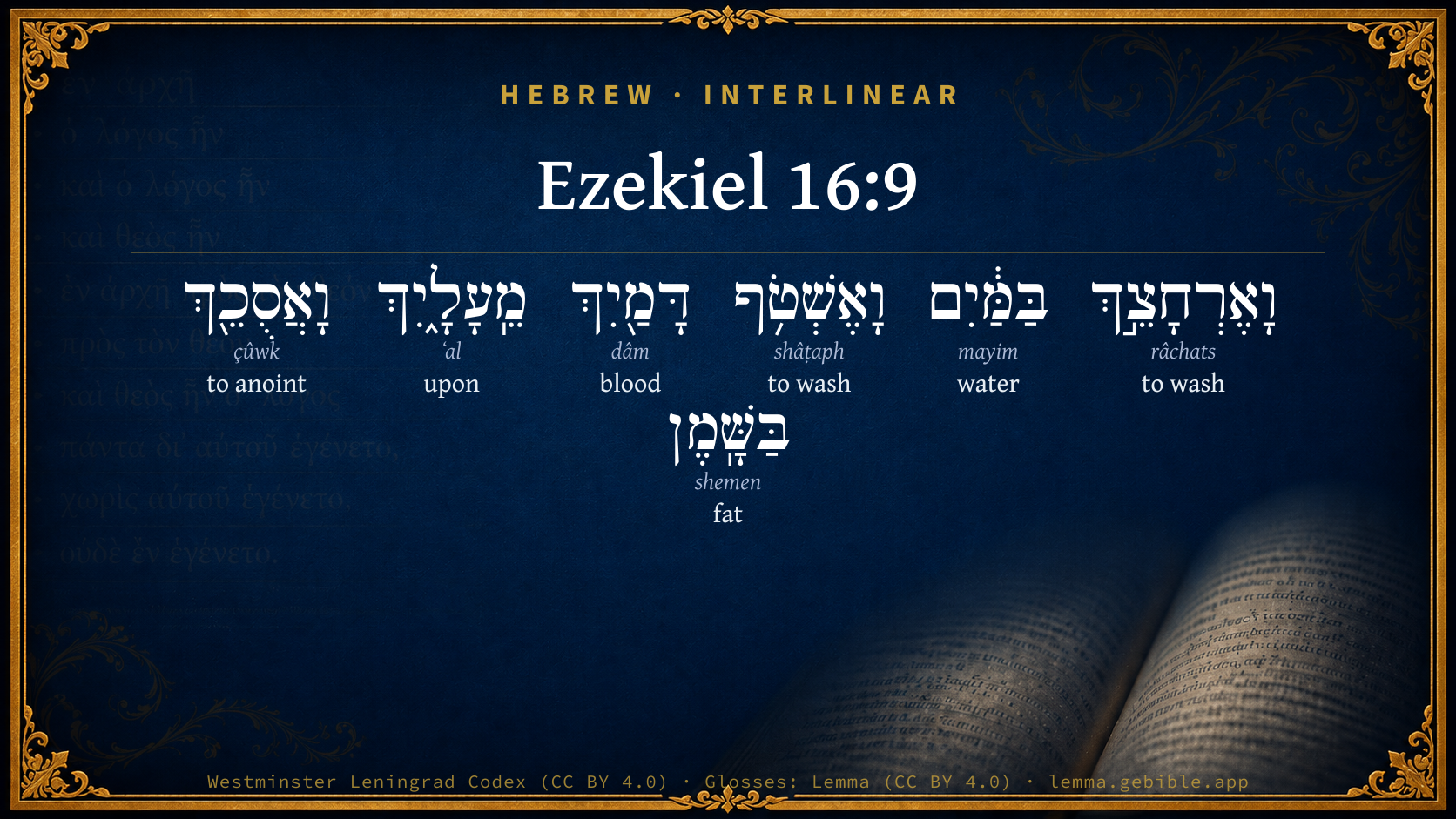
Ezekiel 16:9

Hebrew (Westminster Leningrad Codex) Ezekiel 16:9 appears in the Hebrew Old Testament. The text above is from the Westminster Leningrad Codex. Each word links to its Strong’s number, a concise gloss, and parsing drawn from the Open Scriptures Hebrew Bible morphology. Click any word for its full Brown-Driver-Briggs (BDB) entry.
Download image
Cite this verse

Ezekiel 16:9 (World English Bible). Public Domain. Lemma interlinear Bible study tool, https://lemma.gebible.app/v/ezekiel/16/9.

Show BibTeX & RIS
BibTeX
RIS
English Translation
Then washed I you with water; yes, I thoroughly washed away your blood from you, and I anointed you with oil.
World English Bible · Public Domain
Download a study sheet

One document with this verse’s original text, its word-by-word gloss line, the meaning frame, cross-references with their text, attributed commentary, and full source and license credits — printable, and it pastes into notes with its structure intact.

This verse Autodidact and up

Study sheet (.html) Plain text (.txt)

A passage Seminary Student

Up to 50 verses in one chapter. A passage sheet keeps up to 6 commentary sources and 12 cross-references per verse, in the order this page ranks them, and says so on the sheet whenever that leaves anything out. Ask for a single verse and you get the Autodidact verse sheet above.

Everything on this page stays free to read, with no account — the sheet is a download of what is already on screen, not access to it.

Want to remove ads? Support Godless Engineer
Compare translations 3

The same verse in 3 English versions, stacked beneath the original-language interlinear above. Click any original word for its lexicon entry.

Each is an independent rendering of the whole verse — the interlinear is not word-aligned to these translations.

Highlighted words mark where these versions differ — a whole-verse word diff, not a word-by-word alignment.

  • World English Bible Public Domain
    Then washed I you with water; yes, I thoroughly washed away your blood from you, and I anointed you with oil.
  • King James Version Public Domain
    Then washed I thee with water; yea, I throughly washed away thy blood from thee, and I anointed thee with oil.
  • unfoldingWord Literal Text CC BY-SA 4.0
    So I washed you with water and rinsed your blood off you, and I anointed you with oil.

unfoldingWord Literal Text — © unfoldingWord, licensed CC BY-SA 4.0. Word-aligned USFM3 via Door43 (git.door43.org/unfoldingWord/en_ult).

Versions to compare (up to 4)

3 of 4 selected

Show all 18 translations

Every available English version of this verse, each an independent rendering of the whole verse.

  • World English Bible Public Domain
    Then washed I you with water; yes, I thoroughly washed away your blood from you, and I anointed you with oil.
  • Berean Standard Bible Public Domain
    Then I bathed you with water, rinsed off your blood, and anointed you with oil.
  • Majority Standard Bible Public Domain
    Then I bathed you with water, rinsed off your blood, and anointed you with oil.
  • King James Version Public Domain
    Then washed I thee with water; yea, I throughly washed away thy blood from thee, and I anointed thee with oil.
  • American Standard Version (1901) Public Domain
    Then washed I thee with water; yea, I thoroughly washed away thy blood from thee, and I anointed thee with oil.
  • Revised Version (1885) Public Domain
    Then washed I thee with water; yea, I throughly washed away thy blood from thee, and I anointed thee with oil.
  • Geneva Bible (1599) Public Domain
    Then washed I thee with water: yea, I washed away thy blood from thee, and I anointed thee with oyle.
  • Douay-Rheims (1899) Public Domain
    And I washed thee with water, and cleansed away thy blood from thee: and I anointed thee with oil.
  • Young's Literal Translation Public Domain
    And I do wash thee with water, And I wash away thy blood from off thee, And I anoint thee with perfume.
  • Literal Standard Version CC BY-SA 4.0
    And I wash you with water, || And I wash away your blood from off you, || And I anoint you with oil.
  • Unlocked Literal Bible CC BY-SA 4.0
    So I washed you with water and rinsed your blood off you, and I anointed you with oil.
  • unfoldingWord Literal Text CC BY-SA 4.0
    So I washed you with water and rinsed your blood off you, and I anointed you with oil.
  • Darby Bible Public Domain
    And I washed thee with water, and thoroughly washed away thy blood from thee, and I anointed thee with oil;
  • World Messianic Bible Public Domain
    “‘“Then I washed you with water. Yes, I thoroughly washed away your blood from you, and I anointed you with oil.
  • Webster's Bible Public Domain
    Then I washed thee with water; yes, I thoroughly washed away thy blood from thee, and I anointed thee with oil.
  • Free Bible Version CC BY-SA 4.0
    Then I washed you with water, cleaned off your blood, and anointed you with oil.
  • Bible in Basic English Public Domain
    Then I had you washed with water, washing away all your blood and rubbing you with oil.
  • JPS Tanakh (1917) Public Domain
    Then washed I thee with water; yea, I cleansed away thy blood from thee, and I anointed thee with oil.

Literal Standard Version (2020), Covenant Press — licensed CC BY-SA 4.0. Text via the HelloAO Bible API (eBible.org). Unlocked Literal Bible (unfoldingWord) — licensed CC BY-SA 4.0. Text via the HelloAO Bible API (eBible.org). unfoldingWord Literal Text — © unfoldingWord, licensed CC BY-SA 4.0. Word-aligned USFM3 via Door43 (git.door43.org/unfoldingWord/en_ult). Free Bible Version, Dr. Jonathan Gallagher — licensed CC BY-SA 4.0. Text via the HelloAO Bible API (eBible.org).

Word by word

More ways to search: Search by grammar → Find every occurrence → Compare this word →

Practice this passage: Drill this verse → Learn its vocabulary →

וָאֲסֻכֵ֖ךְ
çûwk
H5480
“and · to anoint · you”
Conjunction + Verb, Qal, Sequential Imperfect, 1st Person, Common, Singular + Suffix, Personal, 2nd Person, Feminine, Singular
Part of Speech
Conjunction + Verb
Stem
Qal
Form
Sequential Imperfect
Person
1st Person
Gender
Common
Number
Singular
Full BDB Definition

Origin: a primitive root

TWOT: 1474

to anoint, pour in anointing - (Qal) to anoint - to anoint oneself - to anoint (another) - to be poured - (Hiphil) to anoint
  1. וָאֶרְחָצֵ֣ךְ râchats H7364 “and · to wash · you” Conjunction + Verb, Qal, Sequential Imperfect, 1st Person, Common, Singular + Suffix, Personal, 2nd Person, Feminine, Singular
  2. בַּמַּ֔יִם mayim H4325 “in/at the · water(s)” Preposition, Determined + Noun, Common, Masculine, Plural, Absolute
  3. וָאֶשְׁטֹ֥ף shâṭaph H7857 “and · to wash” Conjunction + Verb, Qal, Sequential Imperfect, 1st Person, Common, Singular
  4. דָּמַ֖יִךְ dâm H1818 “blood · your” Noun, Common, Masculine, Plural, Construct + Suffix, Personal, 2nd Person, Feminine, Singular
  5. מֵֽעָלָ֑יִךְ ʻal H5921 “from · upon · you” Preposition + Preposition + Suffix, Personal, 2nd Person, Feminine, Singular
  6. בַּשָּֽׁמֶן shemen H8081 “in/at the · fat” Preposition, Determined + Noun, Common, Masculine, Singular, Absolute

About this verse

These counts appear in no published source. They are computed here, from the morphology-tagged text and Lemma’s own curated glosses. What Lemma adds →

7
words
7
distinct lemmas
Prophets
section

Notable vocabulary

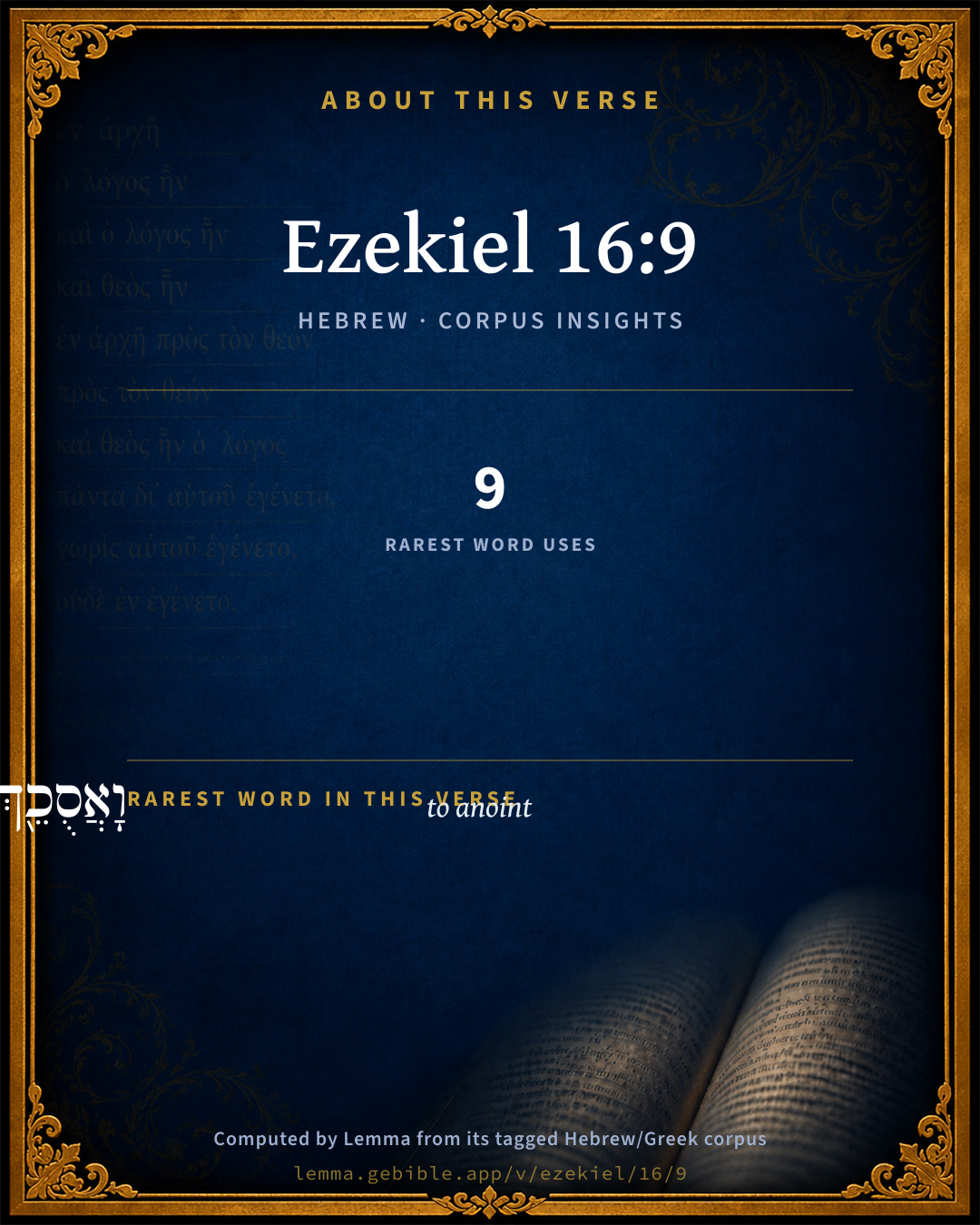
The rarest word here is וָאֲסֻכֵ֖ךְ to anoint H5480 — appearing just 9 times in the whole Hebrew Bible.

Shared distinctive vocabulary

וָאֲסֻכֵ֖ךְ to anoint H5480 occurs in 8 verses of the Hebrew Bible. Also found in:

Grammatical profile

  • 3 verbs
  • 3 nouns
  • 1 preposition

Verb forms

  • וָאֶרְחָצֵ֣ךְ Qal · Sequential Imperfect
  • וָאֶשְׁטֹ֥ף Qal · Sequential Imperfect
  • וָאֲסֻכֵ֖ךְ Qal · Sequential Imperfect

Hebrew & Septuagint length

In English translation the verse runs 21 words from the Hebrew and 17 from the Septuagint (LXX English) — closely comparable.

A rough comparison of the two English renderings, which tokenize alike — not a word-level alignment.

Word counts can differ between the Hebrew and the Greek without any difference in meaning — e.g. the Hebrew direct-object marker אֵת has no separate Greek word, and Greek often adds the article ὁ.

Cross-references

15

Topical passages linked to Ezekiel 16:9 in the Treasury of Scripture Knowledge — connected by theme and wording, ordered by reader-vote popularity; previews shown in the World English Bible.

  • Ruth 3:3 Wash yourself therefore, and anoint you, and put your clothing on you, and get you down to the threshing floor, but don't make yourself known to the man, until he shall have done eating and drinking.
  • Psalms 23:5 You prepare a table before me in the presence of my enemies. You anoint my head with oil. My cup runs over.
  • 1 John 2:27 As for you, the anointing which you received from him remains in you, and you don't need for anyone to teach you. But as his anointing teaches you concerning all things, and is true, and is no lie, and even as it taught you, you will remain in him.
  • 1 John 5:8 the Spirit, and the water, and the blood; and the three agree as one.
  • 1 Corinthians 6:11 Such were some of you, but you were washed. But you were sanctified. But you were justified in the name of the Lord Jesus, and in the Spirit of our God.
  • Psalms 51:7 Purify me with hyssop, and I will be clean. Wash me, and I will be whiter than snow.
  • Isaiah 4:4 when the Lord shall have washed away the filth of the daughters of Zion, and shall have purged the blood of Jerusalem from its midst, by the spirit of justice, and by the spirit of burning.
  • Ezekiel 16:4 As for your birth, in the day you were born your navel was not cut, neither were you washed in water to cleanse you; you weren't salted at all, nor swaddled at all.
  • Ezekiel 36:25 I will sprinkle clean water on you, and you shall be clean: from all your filthiness, and from all your idols, will I cleanse you.
  • John 13:8–10 Peter said to him, "You will never wash my feet!" Jesus answered him, "If I don't wash you, you have no part with me."
  • 1 Corinthians 10:2 and were all baptized into Moses in the cloud and in the sea;
  • 2 Corinthians 1:21 Now he who establishes us with you in Christ, and anointed us, is God;
  • Hebrews 9:10–14 being only (with meats and drinks and various washings) fleshly ordinances, imposed until a time of reformation.
  • 1 John 2:20 You have an anointing from the Holy One, and you know the truth.
  • Revelation 1:5–6 and from Jesus Christ, the faithful witness, the firstborn of the dead, and the ruler of the kings of the earth. To him who loves us, and washed us from our sins by his blood;

Cross-references courtesy of OpenBible.info (CC BY 4.0).

Hebrew and Greek witnesses Masoretic Hebrew ↔ Greek Septuagint

The same verse in the two great witnesses to the Old Testament, shown verse-for-verse.

These are two independent witnesses, not word-aligned to each other, and the Septuagint is shown in lemma (dictionary) form.

Hebrew Ezekiel 16:9 Masoretic · Westminster Leningrad Codex

וָאֶרְחָצֵ֣ךְ בַּמַּ֔יִם וָאֶשְׁטֹ֥ף דָּמַ֖יִךְ מֵֽעָלָ֑יִךְ וָאֲסֻכֵ֖ךְ בַּשָּֽׁמֶן

Then washed I you with water; yes, I thoroughly washed away your blood from you, and I anointed you with oil.

World English Bible · Public Domain

Greek LXX Ezekiel 16:9 Septuagint · lemma form

καί λούω σύ ἐν ὕδωρ καί ἀποπλύνω ὁ αἷμα σύ ἀπό σύ καί χρίω σύ ἐν ἔλαιον

And I washed you in water, and washed your blood from you, and anointed you with oil.

LXX2012 (modern English Septuagint) · Public Domain

On this verse, John Gill's Exposition discusses the Septuagint’s reading. Read the note in Commentary ↓

Hebrew: Westminster Leningrad Codex (CC BY 4.0). Greek: Septuagint (public domain); English from LXX2012 (modern English Septuagint) (Public Domain). How the Septuagint differs from the Hebrew →

Targum (Aramaic paraphrase)

1

The Targum is the ancient Jewish Aramaic paraphrase of the Hebrew Scriptures — an interpretive translation, not the Hebrew text itself. Onkelos (literal) and Pseudo-Jonathan (expansive) render the Torah, and Jonathan the Prophets. Coverage is partial: where no permissively-licensed English translation exists for a verse, only the Aramaic is shown. This is verse-level text, not a word-by-word alignment to the Hebrew.

  1. Targum Jonathan Prophets (Joshua–Malachi)
    וּפָרִיקִית יַתְכוֹן מִשִׁעְבּוּד מִצְרָאֵי וְאַעְדֵיתִי תְּקוֹף מַרְוָתָא מִנְכוֹן וְדַבְּרֵית יַתְכוֹן בְּחֵירוּתָא:

    And I liberated you from Egyptian slavery and removed their strong dominion from you and led you in freedom.

    Targum Jonathan — Aramaic: “Mikraot Gedolot” (public domain). English: “Sefaria Community Translation” (CC0 1.0 (public-domain dedication)); “London "Chaldee Paraphrase," 1871” (public domain). Text via Sefaria.

Commentary

Notes on Ezekiel 16:9 from classic Christian and Jewish commentators (each source and its license shown beneath its notes). The classic Christian expositions comment on the surrounding passage and are grouped to its opening verse, so a note may address several verses; the Jewish commentaries on the Tanakh (Rashi and others) are per-verse, so they appear only where the commentator wrote on this verse.

Lemma curates 59 commentaries, every one of them public domain or Creative Commons licensed, each selected and text-cleaned for this edition rather than reprinted as found. About our sources →

Trapp's Complete Commentary

John Trapp

Eze 16:9 Then washed I thee with water; yea, I throughly washed away thy blood from thee, and I anointed thee with oil.

Ver. 9. Then washed I thee with water.] I cleansed thee from all thy pollutions by the merit and Spirit of my dear Son. See 1Co 6:11.

And I anointed thee with oil.] Newly married wives were usually washed, anointed, and richly arrayed. The dead also were washed, as Dorcas; and embalmed, as Jacob; and Pro 31:8, they are called bene chaloph, which signifieth "change of raiment." Death strips us all, but happy are they whom Christ hath spread his skirt over. See 2Co 5:2-4.

John Trapp, A Commentary or Exposition upon All the Books of the Old and New Testament (1647–1656) — public domain. Text from a community e-Sword module.

Tyndale Open Study Notes

Tyndale Open Resources

16:9-10 The Lord did for Jerusalem what her parents had never done: he washed, anointed, and clothed her, thus reversing the circumstances of her birth. • The Lord provided Jerusalem with adornments fit for a queen, including materials elsewhere associated with the Tabernacle (see Exod 25:3-5; 26:1-14). This reminded the people of Jerusalem that she was chosen as the home of God’s sanctuary and the king’s palace.

Tyndale Open Study Notes — © Tyndale Open Resources, licensed CC BY-SA 4.0. Text via the HelloAO Bible API.

Geneva Bible (1599)

Geneva Bible translators

I washed away thy sins.

I sanctified thee with mine holy Spirit.

Geneva Bible (1599) marginal notes — public domain. Text via Bolls.life.

Jamieson, Fausset & Brown

Robert Jamieson, A. R. Fausset & David Brown

washed I thee--as brides used to pass through a preparatory purification (Est 2:12). So Israel, before the giving of the law at Sinai (Exo 19:14); "Moses sanctified the people, and they washed their clothes." So believers (Co1 6:11).

oil--emblem of the Levitical priesthood, the type of Messiah (Psa 45:7).

Jamieson, Fausset & Brown — Commentary Critical and Explanatory on the Whole Bible (1871) — public domain (CC PDM 1.0). Text via the HelloAO Bible API.

John Calvin's Commentaries

Here God more clearly explains what had been formerly touched upon, namely, that he then married the people, as a young man marries his bride. But he here states that he endowed her; for they would not have been sufficiently adopted by God unless they had been adorned with superior presents; since if they had been left in that miserable slavery by which they were oppressed, God’s favor would have been very obscure. Now, therefore, God means, that by his law he had entered into a new covenant with his people, so that he did not leave them naked and bare, but clothed with remarkable gifts. First of all, he says, I washed thee with water. Although he had just said that the people were like a beautiful damsel, and had praised their beauty, yet the filth of which the prophet had spoken yet remained: it ought, therefore, to be cleansed from those stains: I have cleansed thee with water, says he, and washed off thy bloods, namely, the corrupt blood which the damsel whom Ezekiel mentions had retained from her birth. Lastly, Ezekiel says that God performed those offices which the nurse discharges for the child. Afterwards he adds —

John Calvin's Commentaries (1540-1563) — public domain. Text from the Calvin Translation Society English edition (1840s-50s) via the Christian Classics Ethereal Library (ccel.org). Calvin's coverage is partial (roughly two-thirds of the Bible); uncommented books and verses are honest gaps, never fabricated. The 19th-century editor's footnotes and remarks are omitted so the notes are faithfully Calvin's own voice.

Ellicott's Commentary for English Readers

(9-14) These verses describe the purifications and preparations for marriage to one of high rank (comp. Est_2:9; Est_2:12). The reality corresponding to the figure is, of course, the Divine care over Israel at Sinai, in the wilderness, and in the conquest of Canaan.

A Bible Commentary for English Readers, edited by Charles John Ellicott (1878–1897) — public domain. Text from a community e-Sword module.

The Cambridge Bible for Schools and Colleges

gen. ed. J. J. S. Perowne

9. Purifications before marriage. Whether “blood” be used somewhat generally to indicate the uncleanness of her infancy still cleaving to her, or in a more specific sense, may be uncertain (Eze_16:7). Rth_3:3; Est_2:12.

The Cambridge Bible for Schools and Colleges (gen. ed. J. J. S. Perowne; Cambridge University Press, 1878–1918) — public domain. Text from a community e-Sword module.

John Gill's Exposition

I clothed thee also, with broidered work,.... Or, "with needle work" (q); with garments of divers colours, like Joseph's coat; perhaps it may refer to the rich raiment borrowed of the Egyptians, when they came out from thence. So the Targum,

"and I clothed you with various garments, the desirable things of your enemies;''

and which, with their other clothes, waxed not old all the while they were in the wilderness; see Exo 12:35; this may be expressive, either of the various graces of the Spirit of God, with which the saints are clothed and adorned; and, when exercised by them, are said to be put on as a garment, Col 3:12; or rather of the righteousness of Christ, called "raiment of needle work", Psa 45:14;

and shod thee with badgers' skin; the same the covering of the tabernacle was made of, Exo 26:14; and though the word here used may not design the creature we so call, yet may intend one whose skin was fit for shoe leather, and was very beautiful, and perhaps durable; reference may be had to the shoes of the Israelites in the wilderness, which waxed not old, Deu 29:5. Some think only the hyacinth or purple colour is here meant; and so the Septuagint version renders the word; agreeably to which Bochart (r) gives this version of the words, "I shod thee with the purple"; that is, with shoes of a purple colour; and it is very probable that of this colour were the shoes wore by the Jewish women of the first rank; since, as the same writer has not only shown from Procopius that great personages in other nations used to wear such, as the Persian and Roman emperors; who, in their own countries only, might wear them; but this was the custom of neighbouring provinces, particularly the Tyrian women, as Virgil (s) plainly suggests. Bynaeus (t) is of opinion that they were of a red or scarlet colour; and that the words should be rendered, "I shod thee with scarlet"; that is, with scarlet coloured shoes; which he observes have been in great esteem and use among persons of figure and quality; and, be they of what colour they will, they were, no doubt, made of skins of value, fine, soft, and pliable; as the Targum paraphrases it,

"I put precious shoes (or shoes of value) upon your feet:''

and therefore cannot be well thought to be made of badgers' skins, of which it was never known that shoes were made; with those indeed quivers and shields have been covered, and of those the harness of horses and collars of dogs have been made; but not men's shoes, and much less the shoes of delicate women. This may denote the agreeable walk of the saints, having their feet shod with the preparation of the Gospel of peace; or a conversation agreeable to the Gospel of Christ; which is very beautiful, and in which they are enabled to continue by the power and grace of God; see Luk 15:22;

and I girded thee about with fine linen; as the high priest was with the linen girdle of the ephod, Exo 28:8. So the Targum,

"and I separated from you the priests, that they might minister before me with linen mitres, and the high priest in garments of divers colours;''

all the saints are made priests to God, and art girt about with the girdle of love, which constrains them to fear and serve the Lord with all readiness and cheerfulness: and with the girdle of truth, which they cause to cleave and keep close unto them; see Eph 6:14;

and I covered thee with silk. The Targum interprets this of the clothing of the high priest; but, if respect is had to that, silk cannot be intended; for, as the Jews themselves say (u), the priests were not clothed for service, in the house of the sanctuary, but with wool and linen; and indeed, though the Jewish commentators in general, as Jarchi, Aben Ezra, and Kimchi, and others (w), as well as our version, take the word here used to signify silk; yet, as Braunius (x) observes, it does not appear that this was known among the Jews in the times of Ezekiel, nor even before the times of Christ; nor was it known among the Romans before the times of Augustus. The word seems to be derived from an Arabic word (y), which signifies to colour or paint clothes; and may be rendered painted or coloured cloth, or garments; and so the Targum renders it died or coloured garments; and so Aquila translates it by a "flowered garment", either painted or wrought with flowers; and so Jerom, and the Vulgate Latin, by "polymitium", a garment of divers colours; and may signify; as before, the rich apparel of the Jews, and the plenty of good things enjoyed by them; see Luk 16:19; and, in a mystical sense, the beautiful clothing of the church, with the robe of Christ's righteousness, and the graces of the Spirit.

(q) "veste acupicta", Vatablus, Grotius; "acupicto", Montanus, Cocceius, Starckius. (r) Hierozoicon, par. 2. l. 3. c. 31. col. 992. (s) "Virginibus Tyriis mos est gestare pharetram, Purpureoque alte suras vincire cothurno". Aeneid l. 1. (t) De Calceis Hebr. l. 1. c. 5. sect. 16. (u) Misn. Celaim, c. 9. sect. 1. (w) "serico", Pagninus, Montanus, Junius & Tremellius, Piscator, Cocceius, Starckius. So Buxtorf, Stockius, &c. (x) De Vestitu Sacerdot. Hebr. l. 1. c. 8. p. 168, 169. (y) "coloravit, pinxitque pannum. Hinc" "coloratus, pinctusque, pannus", Golius, col. 2678, 2679. Castel. col. 996.

John Gill's Exposition of the Whole Bible (1746–1763) — public domain (CC PDM 1.0). Text via the HelloAO Bible API.

Albert Barnes' Notes on the Bible

The usual purifications for marriage.

Albert Barnes' Notes on the Bible (1834–1885) — public domain. Text from a community e-Sword/MySword module.

Haydock's Catholic Bible Commentary

Oil, used after bathing, or with perfume. (Calmet)

George Leo Haydock (1774–1849), Haydock's Catholic Family Bible and Commentary, 1859 edition — public domain. Excludes Psalms (Douay-Rheims chapter numbering differs from Protestant) and Deuterocanonical books (Catholic canon only).

Matthew Poole's English Annotations

Then, Heb. And: this continueth the allegory, and declareth what more was done to prepare this virgin for advancement by this marriage covenant.

Washed I thee: it was a very ancient custom among those Eastern people, as appears Rth 3:3; Es 2 12, to purify virgins who were to be espoused ere long; and it is likely the prophet alludes to that, Exo 19:10.

I throughly washed away: the same thing, by a very usual figure, repeated to confirm and illustrate what is spoken; the word in Hebrew notes an abundant washing, a rinsing of what was washed to make it cleaner; it includes a bathing, as Lev 15:10.

Thy blood; thy original and birth pollution, which rendered thee displeasing to the eye, and unfit for the familiar and loving entertainment of a husband.

I anointed thee; not to royal sovereign dignity, this is expressed by another word in the Hebrew; but anointed as they that were to be married, as Rth 3:3; Est 2:12; or as those who were to come into the presence of great and noble personages, as Dan 10:3; or as such who would look with cheerfuller countenances, and change their sad and mournful deportment, as 2Sa 12:20; it is not improbable it may allude to the bounty of God toward the Jews in a land flowing with oil. Spiritually these refer to our cleansing by the blood of Christ, and by his sanctifying Spirit.

Matthew Poole's English Annotations on the Holy Bible (1683–1685) — public domain. Text from a community e-Sword/MySword module.

Whedon's Commentary on the Bible

Daniel D. Whedon

9, 10. Then washed I thee… I clothed thee also — This young maiden in her Egyptian bondage is “naked and bare,” groaning in her affliction, bruised, and beaten with many stripes, even unto blood (Exo_5:14; Exo_5:21) when Jehovah takes her to himself as bride. The expression used here may also be intended to carry the impression that the first time she had ever been washed was during the purifications preparatory to the wedding. (See Lev_15:19; Lev_15:24.)

Broidered work,… badgers’ skin — Rather, variegated work [so Eze_16:13; Eze_16:18; Exo_26:36]… seal skin [Exo_25:5]… byssus (Exo_28:39; Exo_39:27). It is not absolutely certain whether the byssus was of linen or cotton.

I covered thee with silk — Silk when first adopted in Europe was of such value that the Emperor Aurelian denied his wife a silk shawl because a pound of silk cost a pound weight of gold. The early fathers, such as Clement of Alexandria, Tertullian, Chrysostom, etc., have much to say against the extravagance of the women in their congregations who wore silk. Whether this word — which is only used again in Eze_16:13 — means silk in the modern sense or not, it evidently means the costliest dress possible at that time.

Daniel D. Whedon (gen. ed.), Commentary on the Old and New Testaments (1874–1909) — public domain. Text from a community e-Sword module.

The Pulpit Commentary

The "washing" and "anointing" were part of the customary preparations for the marriage union (Rth_3:3; Est_2:12 RAPC Jdt 10:3) The mention of blood receives its explanation, not in the facts of ver. 6, but in the ceremonial rules of Lev_15:19-24

Vers. 9-13. The glory of redemption.

Under the similitude of a wretched child cast off by its mother and picked up by a passer by, Israel is shown to have been found by God in a miserable condition and cared for and blessed by him. Tins idea may be carried further as a symbol of the redemption of the Church by Christ.

I THE FIRST CONDITION IS ONE OF POLLUTION AND NEGLECT. Israel was in a miserable condition in Egypt when God had pity on his people. But the spiritual state of souls in sin is more wretched and forlorn.

1. It is a condition of pollution. Sinners lie in the defilement of their own sinfulness, and their wretched plight is the direct consequence of their own moral corruption.

2. It is a condition of neglect. Until God interfered, Israel in Egypt was friendless. No kindred Semitic tribe cared or dared to rescue the nation of slaves. No being came to save the world before God made bare his arm.

II THE FIRST STEP TO RECOVERY SPRINGS FROM THE PITY OF GOD. The good Samaritan is a type of our great Father. There is no beauty in sinful man to attract the attention of God. It is not our claim, but his pity, that moves God to save the world. The love of Christ, not the worth of man, brought our redemption. Pity commiseration for the wretched lies at the root of the gospel. God is love, and therefore he comes to themiserable in supreme compassion.

III THE REDEMPTION BEGINS IN CLEANSING. Sin must be washed away before the soul can be received into the privileges of the family of God. Even this early process is preceded by God"s adoption of the wretched castaway, and the cleansing is done by God himself. It is as when a miserable child of the street has been taken by a charitable person into his own home. The child cannot make itself clean. But the first act of the kind rescuer is to wash it. Christ cleanses from sin with his own blood.

IV THE REDEMPTION IS CROWNED WITH SPLENDOUR. The poor wastling is not treated as a workhouse child or put to low drudgery. She is clothed in purest apparel and decked with rarest ornaments. So the prodigal is to wear the best robe and to have a ring on his hand. God does not save grudgingly or by halves. He does not content himself with plucking the brand from the burning. He gives royally of his best to the miserable sinners whom he has redeemed. The gospel promises glory as well as grace.

V THE RESCUE AND REDEMPTION ESTABLISH A NEW RELATION WITH GOD. According to the richly illustrative picture of Ezekiel, when the poor abandoned infant is grown up, her rescuer makes her his bride. God is often regarded as the Husband of his people. But here the picture is not of God marrying any human soul, but of his marrying the most abandoned. This illustrates his marvellous condescension. At the same time, it shows the supreme duty of fidelity to God on the part of the Church that has been rescued from so dire a fate and then raised to so great an honors.

The Pulpit Commentary (1880–1919), ed. H.D.M. Spence-Jones & Joseph S. Exell — public domain. Text from a community e-Sword module.

John Wesley's Explanatory Notes

Washed - It was a very ancient custom among the eastern people, to purify virgins who were to be espoused. And I anointed - They were anointed that were to be married, as Ruth iii, 3.

John Wesley, Explanatory Notes Upon the Whole Bible (1754–1765) — public domain. Text via the GEBible commentary corpus.

unfoldingWord translationNotes

Door43 World Missions Community

General Information:

Yahweh continues to speak about Jerusalem as if the city were a young woman. The city represents the people who live there. (See: Metaphor and Metonymy)

embroidered clothes

"beautiful clothes." To embroider is to sew a design into a piece of cloth.

I adorned you with jewelry

"I put jewelry on you"

translationWords

anoint

oil

sandal

crown

head

unfoldingWord translationNotes — © Distant Shores Media and the Door43 World Missions Community, licensed CC BY-SA 4.0. Source: git.door43.org/Door43/en_tn.

Rashi

Rabbi Shlomo Yitzchaki (Rashi)

and I anointed you Heb. וָאֲסֻכֵך, a word expressing anointing. Now the entire episode is only a parable, and Jonathan explained it all, leaving nothing to add to the Targum, and he explained it in this manner:

[3] Your dwelling place and your birthplace, etc. Your dwelling place and your birthplace are from the land of the Canaanites; there I revealed Myself to your father Abraham [in the covenant] between the parts, and I let him know that you are going down to Egypt. With an arm raised on high, I redeemed you, and through the merit of your fathers, I drove out the Amorites and destroyed the Hittites.

[4] And as for your birth, on the day you were born, etc. And also, when your forefathers went down to Egypt, sojourners in a land that was not theirs, they subjugated them and oppressed them. The assembly of Israel was like a newborn infant abandoned in the open field, whose navel was not cut, and who was not rinsed with water to be cleansed, and not salted with salt or swaddled with swaddling clothes.

[5] No eye pitied you, etc. The eye of the wicked Pharaoh did not pity you to do you any favor, to lighten your bondage, [or] to have pity on you, and he decreed upon you a decree of annihilation, to cast your males into the river to destroy you at the time you were in Egypt.

[6] And I passed by you, etc. And the remembrance of the covenant of your forefathers came before Me. I revealed Myself to redeem you because it was known to Me that you were being oppressed in your bondage, and I said to you, “With the blood of the circumcision I shall spare you,” and I said, “With the blood of the Passover, I shall redeem you.”

[7] Myriads, like the plants of the field I have made you Myriads, as the plants of the field, I have made you, and you have increased and become strong, and you have become families and tribes, and with the good deeds of your forefathers, the time of the redemption of your assembly arrived because you were subjugated and oppressed.

Myriads, like the plants of the field I made you as it is said (Exod. 1:7): “And the children of Israel were fruitful and increased.”

but you were naked and bare of the commandments.

[8] And I passed by you, etc And I revealed Myself to Moses in the thorn bush because it was revealed to Me that the time of your redemption had arrived. I shielded you with My word, and I removed your sins, and I swore by My word to redeem you as I swore to your forefathers, said the Lord God, that you should be a people serving before Me.

and I spread My skirt The skirt of My garment.

and I swore to you (Exod. 6: 6): “Therefore (לָכֵן), say to the children of Israel: I am the Lord! I shall take you out, etc.” “Therefore” means only an [introduction to an] oath, as it is said (I Sam. 3:14): “therefore, I have sworn to the house of Eli...”

and came into a covenant with you (Exod. 24:8): “Behold the blood of the covenant that the Lord has made with you.”

[9] and I washed you with water And I redeemed you from the bondage of the Egyptians, and I removed the strength of their lordship from you, and I led you to freedom.

Rashi on the Tanakh — English translations: “The Judaica Press complete Tanach with Rashi, translated by A. J. Rosenberg” (CC BY 4.0); “Pentateuch with Rashi's commentary by M. Rosenbaum and A.M. Silbermann, 1929-1934” (public domain); “The Metsudah Tanach series, Lakewood, N.J” (CC BY 4.0); and “The Book of Joshua, Metsudah Publications, 1997” (CC BY 4.0). Text via Sefaria.

Lesson kit

Teaching starters — assembled from the data on this page, not authored interpretation. Every prompt links to the verse data it draws on. Edit before teaching.

Ezekiel, in the Prophets, opens this verse with 7 words (7 distinct Hebrew lemmas). Its most distinctive word is çûwk (“to anoint”). A historical commentator’s framing appears above. Read the whole chapter for the surrounding context.

Discussion questions

  1. How does “to anoint” (çûwk) shape what this verse is saying?
  2. How does Deuteronomy 28:40, which shares the word «to anoint», read alongside this verse?
  3. The translations on this page render this verse differently — a whole-verse word diff, not a word-by-word alignment. What might account for the different wordings?
  4. «וָאֶרְחָצֵ֣ךְ» is a Qal Sequential Imperfect verb. How does that grammatical form shape the action described?
  5. Compare how Trapp's Complete Commentary and Tyndale Open Study Notes read this verse. Where do they agree or differ?

Things to notice

Reading settings

Reading text

Shown beneath each verse's original-language words.

Old Testament
Old Testament edition

Read the OT as the Masoretic Hebrew (MT) or the Greek Septuagint (LXX).

English shown for the Greek Septuagint (in the Hebrew ↔ Greek comparison).

Comparing translations? Open the Compare panel on any verse page to stack up to four side by side.