
Ezekiel 32:14

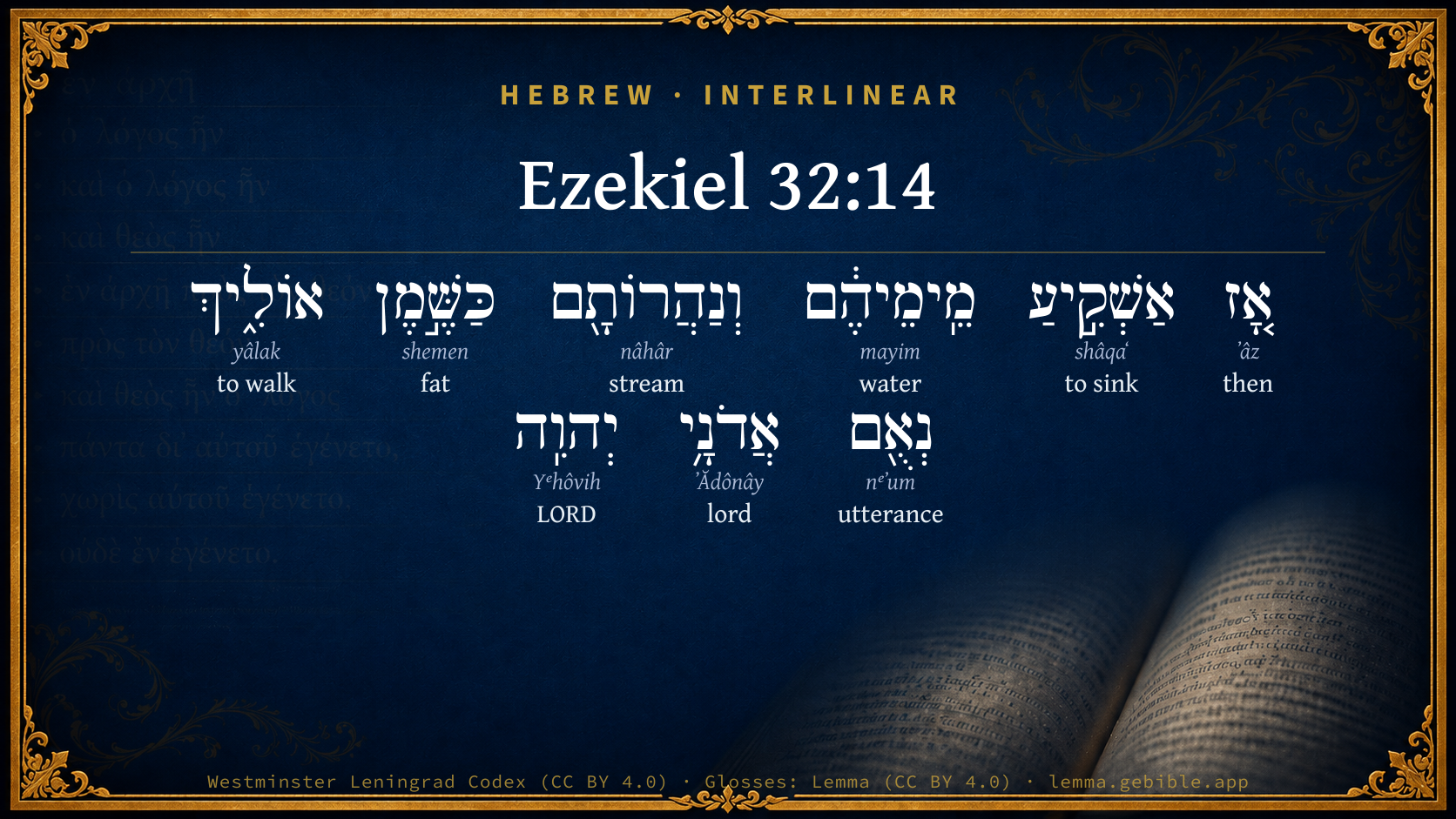
Hebrew (Westminster Leningrad Codex) Ezekiel 32:14 appears in the Hebrew Old Testament. The text above is from the Westminster Leningrad Codex. Each word links to its Strong’s number, a concise gloss, and parsing drawn from the Open Scriptures Hebrew Bible morphology. Click any word for its full Brown-Driver-Briggs (BDB) entry.
Download image
Cite this verse

Ezekiel 32:14 (World English Bible). Public Domain. Lemma interlinear Bible study tool, https://lemma.gebible.app/v/ezekiel/32/14.

Show BibTeX & RIS
BibTeX
RIS
English Translation
Then will I make their waters clear, and cause their rivers to run like oil, says the Lord Yahweh.
World English Bible · Public Domain
Download a study sheet

One document with this verse’s original text, its word-by-word gloss line, the meaning frame, cross-references with their text, attributed commentary, and full source and license credits — printable, and it pastes into notes with its structure intact.

This verse Autodidact and up

Study sheet (.html) Plain text (.txt)

A passage Seminary Student

Up to 50 verses in one chapter. A passage sheet keeps up to 6 commentary sources and 12 cross-references per verse, in the order this page ranks them, and says so on the sheet whenever that leaves anything out. Ask for a single verse and you get the Autodidact verse sheet above.

Everything on this page stays free to read, with no account — the sheet is a download of what is already on screen, not access to it.

Want to remove ads? Support Godless Engineer
Compare translations 3

The same verse in 3 English versions, stacked beneath the original-language interlinear above. Click any original word for its lexicon entry.

Each is an independent rendering of the whole verse — the interlinear is not word-aligned to these translations.

Highlighted words mark where these versions differ — a whole-verse word diff, not a word-by-word alignment.

  • World English Bible Public Domain
    Then will I make their waters clear, and cause their rivers to run like oil, says the Lord Yahweh.
  • King James Version Public Domain
    Then will I make their waters deep, and cause their rivers to run like oil, saith the Lord GOD.
  • unfoldingWord Literal Text CC BY-SA 4.0
    Then I will calm their waters and make their rivers run like oil— this is the Lord Yahweh’s declaration.

unfoldingWord Literal Text — © unfoldingWord, licensed CC BY-SA 4.0. Word-aligned USFM3 via Door43 (git.door43.org/unfoldingWord/en_ult).

Versions to compare (up to 4)

3 of 4 selected

Show all 18 translations

Every available English version of this verse, each an independent rendering of the whole verse.

  • World English Bible Public Domain
    Then will I make their waters clear, and cause their rivers to run like oil, says the Lord Yahweh.
  • Berean Standard Bible Public Domain
    Then I will let her waters settle and will make her rivers flow like oil,’ declares the Lord GOD.
  • Majority Standard Bible Public Domain
    Then I will let her waters settle and will make her rivers flow like oil,’ declares the Lord GOD.
  • King James Version Public Domain
    Then will I make their waters deep, and cause their rivers to run like oil, saith the Lord GOD.
  • American Standard Version (1901) Public Domain
    Then will I make their waters clear, and cause their rivers to run like oil, saith the Lord Jehovah.
  • Revised Version (1885) Public Domain
    Then will I make their waters clear, and cause their rivers to run like oil, saith the Lord GOD.
  • Geneva Bible (1599) Public Domain
    Then will I make their waters deepe, and cause their riuers to runne like oyle, sayeth the Lord God.
  • Douay-Rheims (1899) Public Domain
    Then will I make their waters clear, and cause their rivers to run like oil, saith the Lord God:
  • Young's Literal Translation Public Domain
    Then do I cause their waters to sink, And their rivers as oil I cause to go, An affirmation of the Lord Jehovah.
  • Literal Standard Version CC BY-SA 4.0
    Then I cause their waters to sink, || And I cause their rivers to go as oil, || A declaration of Lord YHWH.
  • Unlocked Literal Bible CC BY-SA 4.0
    Then I will calm their waters and make their rivers run like oil— this is the Lord Yahweh's declaration.
  • unfoldingWord Literal Text CC BY-SA 4.0
    Then I will calm their waters and make their rivers run like oil— this is the Lord Yahweh’s declaration.
  • Darby Bible Public Domain
    Then will I make their waters clear, and cause their rivers to run like oil, saith the Lord Jehovah.
  • World Messianic Bible Public Domain
    Then I will make their waters clear, and cause their rivers to run like oil,” says the Lord GOD.
  • Webster's Bible Public Domain
    Then will I make their waters deep, and cause their rivers to run like oil, saith the Lord GOD.
  • Free Bible Version CC BY-SA 4.0
    I will allow their waters to settle and I will make her rivers flow smoothly like oil, declares the Lord God.
  • Bible in Basic English Public Domain
    Then I will make their waters clear and their rivers will be flowing like oil, says the Lord.
  • JPS Tanakh (1917) Public Domain
    Then will I make their waters to settle, and cause their rivers to run like oil, saith the Lord GOD.

Literal Standard Version (2020), Covenant Press — licensed CC BY-SA 4.0. Text via the HelloAO Bible API (eBible.org). Unlocked Literal Bible (unfoldingWord) — licensed CC BY-SA 4.0. Text via the HelloAO Bible API (eBible.org). unfoldingWord Literal Text — © unfoldingWord, licensed CC BY-SA 4.0. Word-aligned USFM3 via Door43 (git.door43.org/unfoldingWord/en_ult). Free Bible Version, Dr. Jonathan Gallagher — licensed CC BY-SA 4.0. Text via the HelloAO Bible API (eBible.org).

Word by word

More ways to search: Search by grammar → Find every occurrence → Compare this word →

Practice this passage: Drill this verse → Learn its vocabulary →

אַשְׁקִ֣יעַ
shâqaʻ
H8257
“to sink”
Verb, Hiphil, Imperfect, 1st Person, Common, Singular
Part of Speech
Verb
Stem
Hiphil
Form
Imperfect
Person
1st Person
Gender
Common
Number
Singular
Full BDB Definition

Origin: a primitive root

TWOT: 2456

to sink, sink down, subside - (Qal) to sink - (Niphal) to sink, collapse - (Hiphil) to sink down, cause to settle
  1. אָ֚ז ʼâz H227 “then” Adverb
  2. מֵֽימֵיהֶ֔ם mayim H4325 “water(s) · their” Noun, Common, Masculine, Plural, Construct + Suffix, Personal, 3rd Person, Masculine, Plural
  3. וְנַהֲרוֹתָ֖ם nâhâr H5104 “and · streams · their” Conjunction + Noun, Common, Masculine, Plural, Construct + Suffix, Personal, 3rd Person, Masculine, Plural
  4. כַּשֶּׁ֣מֶן shemen H8081 “like/as the · fat” Preposition, Determined + Noun, Common, Masculine, Singular, Absolute
  5. אוֹלִ֑יךְ yâlak H3212 “to walk” Verb, Hiphil, Imperfect, 1st Person, Common, Singular
  6. נְאֻ֖ם nᵉʼum H5002 “utterance of” Noun, Common, Masculine, Singular, Construct
  7. אֲדֹנָ֥י ʼĂdônây H136 “Lord · my” Noun, Common, Masculine, Plural, Construct + Suffix, Personal, 1st Person, Common, Singular
  8. יְהוִֽה Yᵉhôvih H3069 “LORD” Noun, Proper

About this verse

These counts appear in no published source. They are computed here, from the morphology-tagged text and Lemma’s own curated glosses. What Lemma adds →

9
words
9
distinct lemmas
Prophets
section

Notable vocabulary

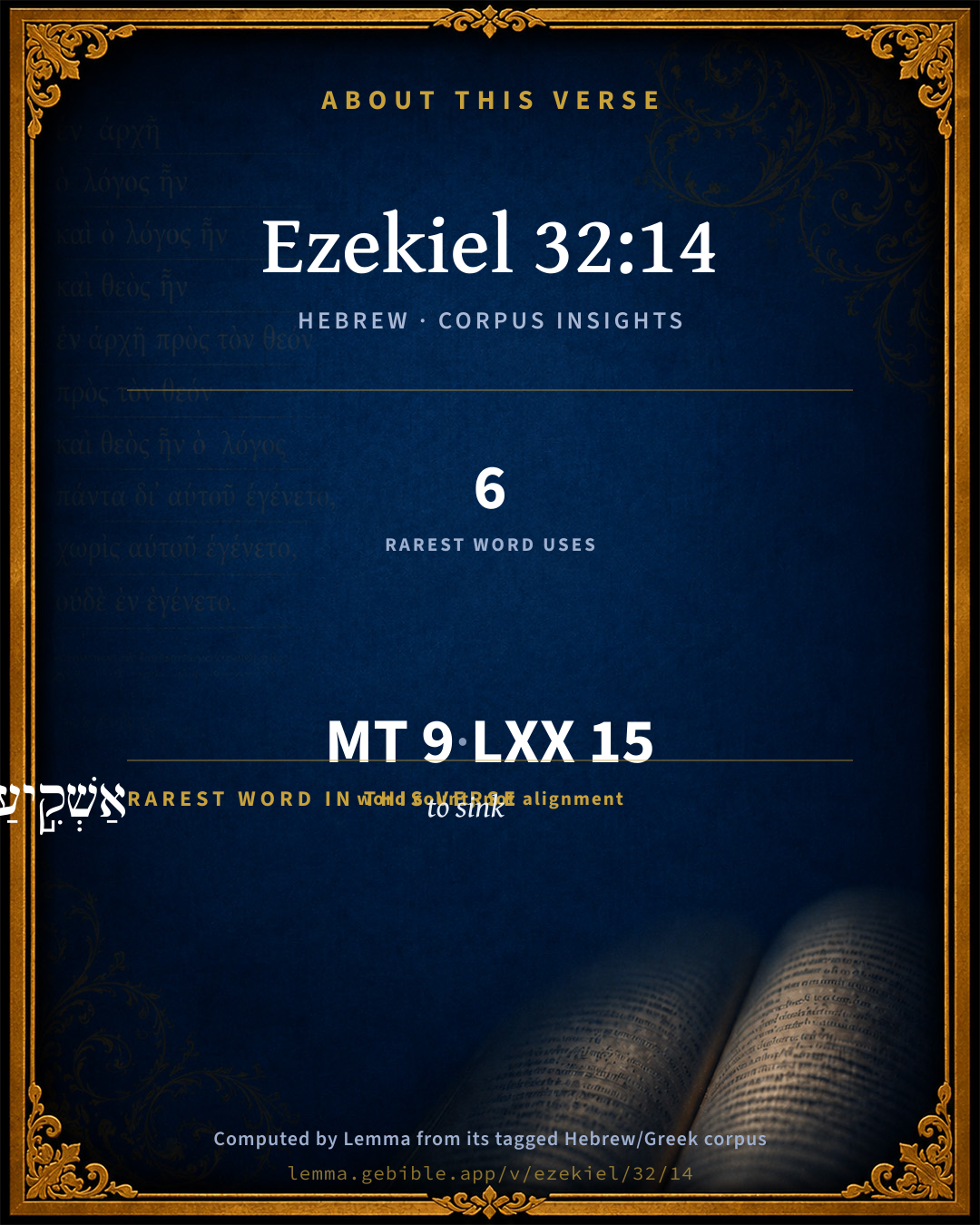
The rarest word here is אַשְׁקִ֣יעַ to sink H8257 — appearing just 6 times in the whole Hebrew Bible.

Shared distinctive vocabulary

אַשְׁקִ֣יעַ to sink H8257 occurs in 6 verses of the Hebrew Bible. Also found in:

Grammatical profile

  • 2 verbs
  • 6 nouns
  • 1 adverb

Verb forms

  • אַשְׁקִ֣יעַ Hiphil · Imperfect
  • אוֹלִ֑יךְ Hiphil · Imperfect

Hebrew & Septuagint length

In English translation the verse runs 19 words from the Hebrew and 18 from the Septuagint (LXX English) — closely comparable.

A rough comparison of the two English renderings, which tokenize alike — not a word-level alignment.

Word counts can differ between the Hebrew and the Greek without any difference in meaning — e.g. the Hebrew direct-object marker אֵת has no separate Greek word, and Greek often adds the article ὁ.

In the original languages it is 9 Hebrew tokens and 15 Greek tokens — but the two are counted differently (Hebrew bundles its prefixes and suffixes into one token; the Greek is in lemma form), so that isn’t a like-for-like length.

Hebrew and Greek witnesses Masoretic Hebrew ↔ Greek Septuagint

The same verse in the two great witnesses to the Old Testament, shown verse-for-verse.

These are two independent witnesses, not word-aligned to each other, and the Septuagint is shown in lemma (dictionary) form.

Hebrew Ezekiel 32:14 Masoretic · Westminster Leningrad Codex

אָ֚ז אַשְׁקִ֣יעַ מֵֽימֵיהֶ֔ם וְנַהֲרוֹתָ֖ם כַּשֶּׁ֣מֶן אוֹלִ֑יךְ נְאֻ֖ם אֲדֹנָ֥י יְהוִֽה

Then will I make their waters clear, and cause their rivers to run like oil, says the Lord Yahweh.

World English Bible · Public Domain

Greek LXX Ezekiel 32:14 Septuagint · lemma form

οὕτως τότε ἡσυχάζω ὁ ὕδωρ αὐτός καί ὁ ποταμός αὐτός ὡς ἔλαιον πορεύομαι λέγω κύριος

Thus shall their waters then be at rest, and their rivers shall flow like oil, says the Lord,

LXX2012 (modern English Septuagint) · Public Domain

Hebrew: Westminster Leningrad Codex (CC BY 4.0). Greek: Septuagint (public domain); English from LXX2012 (modern English Septuagint) (Public Domain). How the Septuagint differs from the Hebrew →

Targum (Aramaic paraphrase)

1

The Targum is the ancient Jewish Aramaic paraphrase of the Hebrew Scriptures — an interpretive translation, not the Hebrew text itself. Onkelos (literal) and Pseudo-Jonathan (expansive) render the Torah, and Jonathan the Prophets. Coverage is partial: where no permissively-licensed English translation exists for a verse, only the Aramaic is shown. This is verse-level text, not a word-by-word alignment to the Hebrew.

  1. Targum Jonathan Prophets (Joshua–Malachi)
    בְּכֵן אַשְׁקֵיט לְעַמְמַיָא וּמַלְכֵיהוֹן בְּנִיחַ אֲדַבֵּר אֲמַר יְיָ אֱלֹהִים:

    (no public-domain English translation for this verse)

    Targum Jonathan — Aramaic: “Mikraot Gedolot” (public domain). English: “Sefaria Community Translation” (CC0 1.0 (public-domain dedication)); “London "Chaldee Paraphrase," 1871” (public domain). Text via Sefaria.

Commentary

Notes on Ezekiel 32:14 from classic Christian and Jewish commentators (each source and its license shown beneath its notes). The classic Christian expositions comment on the surrounding passage and are grouped to its opening verse, so a note may address several verses; the Jewish commentaries on the Tanakh (Rashi and others) are per-verse, so they appear only where the commentator wrote on this verse.

Lemma curates 59 commentaries, every one of them public domain or Creative Commons licensed, each selected and text-cleaned for this edition rather than reprinted as found. About our sources →

Trapp's Complete Commentary

John Trapp

Eze 32:14 Then will I make their waters deep, and cause their rivers to run like oil, saith the Lord GOD.

Ver. 14. Then will I make their waters deep.] There shall not be men left to drive them by ditches and channels into their grounds and pastures, for the making of them fruitful.

And cause their rivers to run like oil,] i.e., Smoothly and silently.

“ Lene fluit Nilus, sed cunctis amnibus extat

Utilior, nullas confessus murmure vires. ”

- Claudian.

John Trapp, A Commentary or Exposition upon All the Books of the Old and New Testament (1647–1656) — public domain. Text from a community e-Sword module.

Tyndale Open Study Notes

Tyndale Open Resources

32:14 The great sea monster (32:2) would no longer thrash around in the stream, stirring up mud like an irate crocodile. After Pharaoh’s demise, the waters of Egypt would flow again as smoothly as olive oil, with the untroubled serenity of death.

Tyndale Open Study Notes — © Tyndale Open Resources, licensed CC BY-SA 4.0. Text via the HelloAO Bible API.

Geneva Bible (1599)

Geneva Bible translators

To wit, of the Chaldeans thine enemies, which shall quietly enjoy all thy commodities.

Geneva Bible (1599) marginal notes — public domain. Text via Bolls.life.

Jamieson, Fausset & Brown

Robert Jamieson, A. R. Fausset & David Brown

make their waters deep--rather, "make . . . to subside"; literally, "sink" [FAIRBAIRN].

like oil--emblem of quietness. No longer shall they descend violently on other countries as the overflowing Nile, but shall be still and sluggish in political action.

Jamieson, Fausset & Brown — Commentary Critical and Explanatory on the Whole Bible (1871) — public domain (CC PDM 1.0). Text via the HelloAO Bible API.

Adam Clarke's Commentary

Verse 14. Cause their rivers to run like oil] Bring the whole state into quietness, there being no longer a political hippopotamus to foul the waters-to disturb the peace of the country.

Adam Clarke's Commentary on the Bible (1810–1826) — public domain. Text from a community e-Sword/MySword module.

Ellicott's Commentary for English Readers

(14) Deep should rather be rendered quiet. When the restless ambition of Egypt should be curbed, there would come about peace and quiet prosperity. This is thought by many to be a glance forward at the Messianic blessing of the future; but it does not necessarily look so far.

A Bible Commentary for English Readers, edited by Charles John Ellicott (1878–1897) — public domain. Text from a community e-Sword module.

The Cambridge Bible for Schools and Colleges

gen. ed. J. J. S. Perowne

14. The waters of Egypt, no more troubled by the foot of man or beast, shall run smooth like oil.

make their waters deep] Rather: make to settle, become clear; cf. noun, Eze_34:18. No more trampled they shall settle and run smooth.

The Cambridge Bible for Schools and Colleges (gen. ed. J. J. S. Perowne; Cambridge University Press, 1878–1918) — public domain. Text from a community e-Sword module.

John Gill's Exposition

Then will l make their waters deep,.... Either the water, of Egypt literally, the waters of the Nile: no canals being cut from it, to carry the water to the several parts of the land, the land being depopulated, and no business done: or, figuratively, other nations, compared to waters for their numbers, who before had been disturbed by the Egyptians; but now they being destroyed, these would be at ease, like troubled waters, which subside, and: become deep and clear, when there is none to trouble them:

and cause their, rivers to run like oil, saith the Lord God; very slowly, as if, they were mourning the unhappy condition of the land; or smoothly, clearly, undisturbed, as before. The Targum is,

"there will I cause the people to rest, and I will lead their kings quietly, saith the Lord God.''

John Gill's Exposition of the Whole Bible (1746–1763) — public domain (CC PDM 1.0). Text via the HelloAO Bible API.

Albert Barnes' Notes on the Bible

A promise of a return of God’s favor. This concerns not the restoration of Egypt’s original power, but the establishment of the Divine Ruler in the place of a pagan God-opposing power.

Albert Barnes' Notes on the Bible (1834–1885) — public domain. Text from a community e-Sword/MySword module.

Haydock's Catholic Bible Commentary

Oil. It is very transparent. It seems the Nile was rendered muddy by cattle, &c.

George Leo Haydock (1774–1849), Haydock's Catholic Family Bible and Commentary, 1859 edition — public domain. Excludes Psalms (Douay-Rheims chapter numbering differs from Protestant) and Deuterocanonical books (Catholic canon only).

Matthew Poole's English Annotations

Make their waters deep: the sense literally this, the waters undisturbed shall be clear, the mud settled at the bottom, and the waters above it of good depth.

To run like oil; smooth and softly, as oil glides along, which will be when neither men nor cattle disturb the rivers: but figuratively, waters and rivers are people and nations, and those near to, and once disturbed, and put into confusion by Egypt, at whose fall all those troubles shall cease, the people shall settle in quiet state, and affairs shall, like a quieted river, run smoothly and in great peace.

Matthew Poole's English Annotations on the Holy Bible (1683–1685) — public domain. Text from a community e-Sword/MySword module.

The Pulpit Commentary

Still waters of death.

The waters of Egypt are to settle and so to be clean. From being a highway of commerce the Nile is to become an undisturbed inland river. The waterwheels shall be still, the splash of the oar shall be no more heard. The silent river shall be left to its own peace the peace of death.

I SIN DESTROYS CIVILIZATION. The river is the busy scene of Egyptian life and activity. Its waters will be quiet because Egypt will lose its energy. This is represented as the consequence of the nation"s wickedness. Consider how the process works.

1. Sin is anti-social. Civilization is the art of city-life. It is dependent on co-operation, division of labor, mutual ministries, and mutual confidence. All these things are shattered by the selfish and untrue conduct of sin.

2. Sin, is unaspiring. Civilization presses forward; essentially it seeks an advance. Sin may be greedy and grasping, and may incline men to seize much for themselves, but it does not inspire energy for general progress. It is depressing and discoursing.

3. Sin is essentially opposed to the laws of God. Now, no civilization can be secure and lasting that is not based on those laws. All corrupt civilization bears within it the seeds of its own destruction. The only "city which hath foundations" is the city of God, and this is "let down from heaven," i.e. it is a city of which the constitution is Divine, and which embodies the idea of "the kingdom of heaven.

II IT IS WELL THAT A SINFUL CIVILIZATION SHOULD BE SHATTERED. The East is scored with the ruins of ancient empires. Today the scene of decay is melancholy and oppressive. Yet the sight of those old, bad empires in their flourishing days was far more sad to behold. They were seats of cruelty and haunts of vice. It is well that they have ceased to be. The hyenas and jackals that now infest their neglected temples and palaces are clean and innocent inhabitants compared with the lustful and murderous men who formerly lived there. The running sore of modern Christendom is in the condition of its great cities. The broken-down wrecks of civilization are far more degraded than the simple savages of the forest. It was good for the world that Sodom and Gomorrah were destroyed, that great Nineveh became a lonely resort of lions of the desert, that the Egypt of the Pharaohs fell from her proud and wicked splendor. It wilt be well for modem civilization to be swept away if it becomes only secular, atheistic, and immoral.

III THE RESULTS OF A SHATTERED CIVILIZATION WILL BE A PREPARATION FOR A BETTER FUTURE. The old foul Nile is to settle quietly and so become clear. Its once disturbed waters are to run smoothly like oil. These facts which occur in the list of calamities for Egypt and rightly, because they indicate the departure of the old, busy, populous life from its banks and its surface are nevertheless in themselves good. It is well that the river should be clear and run smoothly. The destruction of empires brings deliverance to oppressed subject races. The loss of civilization may be the gain of naturalness. There may be less wealth, but more welfare; less pleasure, but more peace. In silence and sorrow of soul people learn to look beneath the surface of life, the Egyptians in their desolation could look deep down into the still, smooth waters of the Nile. This may be a preparation for a holier new life in the future.

The Pulpit Commentary (1880–1919), ed. H.D.M. Spence-Jones & Joseph S. Exell — public domain. Text from a community e-Sword module.

John Wesley's Explanatory Notes

Like oil - A figurative expression, signifying, there shall be such an universal sadness and heaviness upon the whole nation, that the very rivers which used to flow briskly, shall grow deep, and slow, and heavy.

John Wesley, Explanatory Notes Upon the Whole Bible (1754–1765) — public domain. Text via the GEBible commentary corpus.

Rashi

Rabbi Shlomo Yitzchaki (Rashi)

I shall sink their waters The foot of cattle will not make it murky, and the mud will sink, so that the water will be clear and clean like refined oil.

Rashi on the Tanakh — English translations: “The Judaica Press complete Tanach with Rashi, translated by A. J. Rosenberg” (CC BY 4.0); “Pentateuch with Rashi's commentary by M. Rosenbaum and A.M. Silbermann, 1929-1934” (public domain); “The Metsudah Tanach series, Lakewood, N.J” (CC BY 4.0); and “The Book of Joshua, Metsudah Publications, 1997” (CC BY 4.0). Text via Sefaria.

Lesson kit

Teaching starters — assembled from the data on this page, not authored interpretation. Every prompt links to the verse data it draws on. Edit before teaching.

Ezekiel, in the Prophets, opens this verse with 9 words (9 distinct Hebrew lemmas). Its most distinctive word is shâqaʻ (“to sink”). A historical commentator’s framing appears above. Read the whole chapter for the surrounding context.

Discussion questions

  1. How does “to sink” (shâqaʻ) shape what this verse is saying?
  2. How does Numbers 11:2, which shares the word «to sink», read alongside this verse?
  3. The translations on this page render this verse differently — a whole-verse word diff, not a word-by-word alignment. What might account for the different wordings?
  4. «אַשְׁקִ֣יעַ» is a Hiphil Imperfect verb. How does that grammatical form shape the action described?
  5. Compare how Trapp's Complete Commentary and Tyndale Open Study Notes read this verse. Where do they agree or differ?

Things to notice

Reading settings

Reading text

Shown beneath each verse's original-language words.

Old Testament
Old Testament edition

Read the OT as the Masoretic Hebrew (MT) or the Greek Septuagint (LXX).

English shown for the Greek Septuagint (in the Hebrew ↔ Greek comparison).

Comparing translations? Open the Compare panel on any verse page to stack up to four side by side.