
Proverbs 5:3

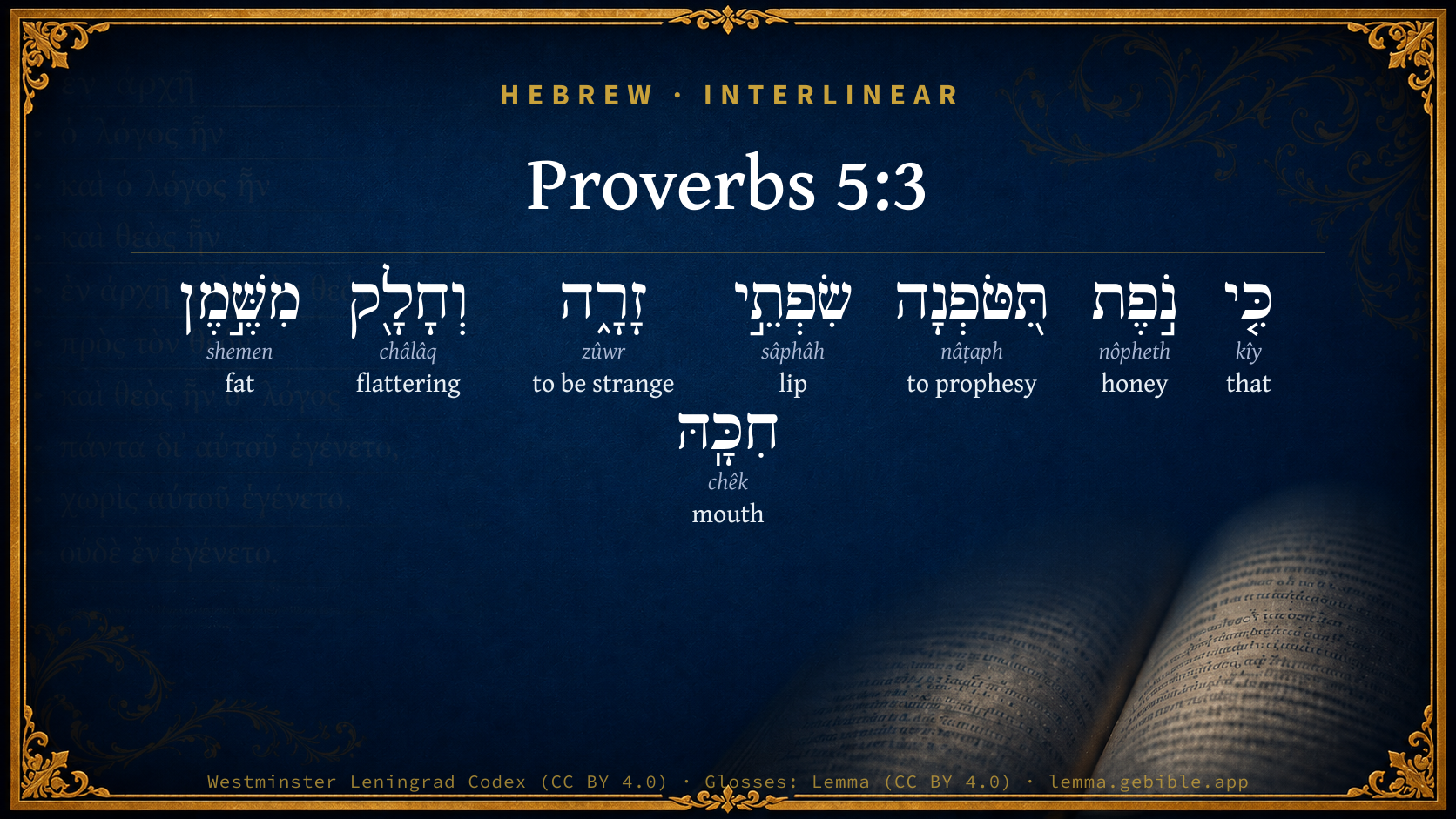
Hebrew (Westminster Leningrad Codex) Proverbs 5:3 appears in the Hebrew Old Testament. The text above is from the Westminster Leningrad Codex. Each word links to its Strong’s number, a concise gloss, and parsing drawn from the Open Scriptures Hebrew Bible morphology. Click any word for its full Brown-Driver-Briggs (BDB) entry.
Download image
Cite this verse

Proverbs 5:3 (World English Bible). Public Domain. Lemma interlinear Bible study tool, https://lemma.gebible.app/v/proverbs/5/3.

Show BibTeX & RIS
BibTeX
RIS
English Translation
For the lips of an adulteress drip honey. Her mouth is smoother than oil,
World English Bible · Public Domain
Download a study sheet

One document with this verse’s original text, its word-by-word gloss line, the meaning frame, cross-references with their text, attributed commentary, and full source and license credits — printable, and it pastes into notes with its structure intact.

This verse Autodidact and up

Study sheet (.html) Plain text (.txt)

A passage Seminary Student

Up to 50 verses in one chapter. A passage sheet keeps up to 6 commentary sources and 12 cross-references per verse, in the order this page ranks them, and says so on the sheet whenever that leaves anything out. Ask for a single verse and you get the Autodidact verse sheet above.

Everything on this page stays free to read, with no account — the sheet is a download of what is already on screen, not access to it.

Want to remove ads? Support Godless Engineer
Compare translations 3

The same verse in 3 English versions, stacked beneath the original-language interlinear above. Click any original word for its lexicon entry.

Each is an independent rendering of the whole verse — the interlinear is not word-aligned to these translations.

Highlighted words mark where these versions differ — a whole-verse word diff, not a word-by-word alignment.

  • World English Bible Public Domain
    For the lips of an adulteress drip honey. Her mouth is smoother than oil,
  • King James Version Public Domain
    For the lips of a strange woman drop as an honeycomb, and her mouth is smoother than oil:
  • unfoldingWord Literal Text CC BY-SA 4.0
    For the lips of a strange woman drip fresh honey and smoother than oil her palate,

unfoldingWord Literal Text — © unfoldingWord, licensed CC BY-SA 4.0. Word-aligned USFM3 via Door43 (git.door43.org/unfoldingWord/en_ult).

Versions to compare (up to 4)

3 of 4 selected

Show all 18 translations

Every available English version of this verse, each an independent rendering of the whole verse.

  • World English Bible Public Domain
    For the lips of an adulteress drip honey. Her mouth is smoother than oil,
  • Berean Standard Bible Public Domain
    Though the lips of the forbidden woman drip honey and her speech is smoother than oil,
  • Majority Standard Bible Public Domain
    Though the lips of the forbidden woman drip honey and her speech is smoother than oil,
  • King James Version Public Domain
    For the lips of a strange woman drop as an honeycomb, and her mouth is smoother than oil:
  • American Standard Version (1901) Public Domain
    For the lips of a strange woman drop honey, And her mouth is smoother than oil:
  • Revised Version (1885) Public Domain
    For the lips of a strange woman drop honey, and her mouth is smoother than oil:
  • Geneva Bible (1599) Public Domain
    For the lippes of a strange woman drop as an honie combe, and her mouth is more soft then oyle.
  • Douay-Rheims (1899) Public Domain
    For the lips of a harlot are like a honeycomb dropping, and her throat is smoother than oil.
  • Young's Literal Translation Public Domain
    For the lips of a strange woman drop honey, And smoother than oil `is' her mouth,
  • Literal Standard Version CC BY-SA 4.0
    For the lips of a strange woman drop honey, || And her mouth [is] smoother than oil,
  • Unlocked Literal Bible CC BY-SA 4.0
    For the lips of an adulteress drip with honey and her mouth is smoother than oil,
  • unfoldingWord Literal Text CC BY-SA 4.0
    For the lips of a strange woman drip fresh honey and smoother than oil her palate,
  • Darby Bible Public Domain
    For the lips of the strange woman drop honey, and her mouth is smoother than oil;
  • World Messianic Bible Public Domain
    For the lips of an adulteress drip honey. Her mouth is smoother than oil,
  • Webster's Bible Public Domain
    For the lips of a strange woman drop as a honey-comb, and her mouth is smoother than oil:
  • Free Bible Version CC BY-SA 4.0
    For the lips of an immoral woman may taste as sweet as honey, the kisses of her mouth may be as smooth as oil,
  • Bible in Basic English Public Domain
    For honey is dropping from the lips of the strange woman, and her mouth is smoother than oil;
  • JPS Tanakh (1917) Public Domain
    For the lips of a strange woman drop honey, and her mouth is smoother than oil;

Literal Standard Version (2020), Covenant Press — licensed CC BY-SA 4.0. Text via the HelloAO Bible API (eBible.org). Unlocked Literal Bible (unfoldingWord) — licensed CC BY-SA 4.0. Text via the HelloAO Bible API (eBible.org). unfoldingWord Literal Text — © unfoldingWord, licensed CC BY-SA 4.0. Word-aligned USFM3 via Door43 (git.door43.org/unfoldingWord/en_ult). Free Bible Version, Dr. Jonathan Gallagher — licensed CC BY-SA 4.0. Text via the HelloAO Bible API (eBible.org).

Word by word

More ways to search: Search by grammar → Find every occurrence → Compare this word →

Practice this passage: Drill this verse → Learn its vocabulary →

About this verse

These counts appear in no published source. They are computed here, from the morphology-tagged text and Lemma’s own curated glosses. What Lemma adds →

8
words
8
distinct lemmas
Wisdom
section

Notable vocabulary

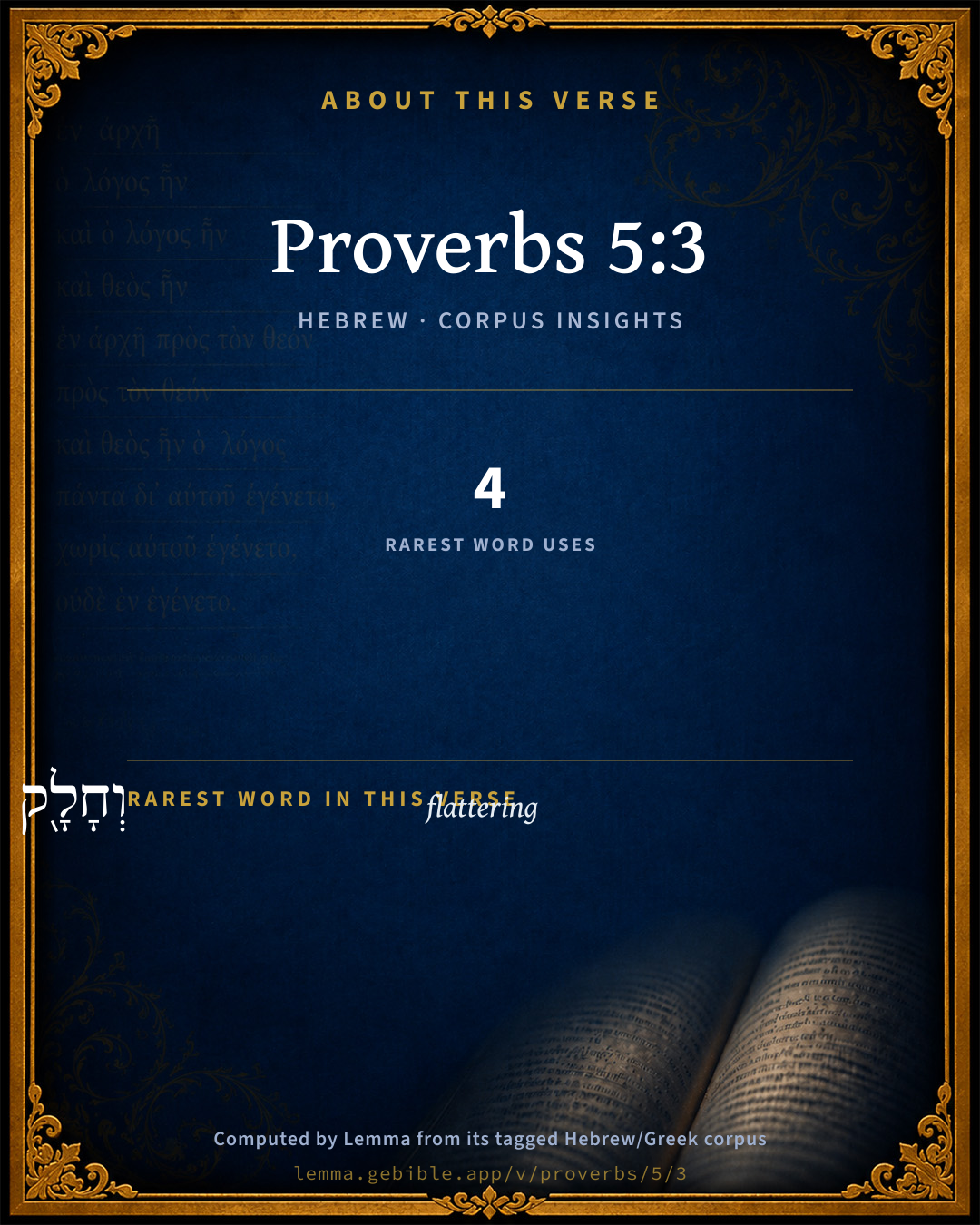
The rarest word here is וְחָלָ֖ק flattering H2509 — appearing just 4 times in the whole Hebrew Bible.

Shared distinctive vocabulary

וְחָלָ֖ק flattering H2509 occurs in 4 verses of the Hebrew Bible. Also found in:

Grammatical profile

  • 1 verb
  • 4 nouns
  • 2 adjectives
  • 1 conjunction

Verb forms

  • תִּ֭טֹּפְנָה Qal · Imperfect

Hebrew & Septuagint length

In English translation the verse runs 14 words from the Hebrew and 16 from the Septuagint (LXX English) — closely comparable.

A rough comparison of the two English renderings, which tokenize alike — not a word-level alignment.

Word counts can differ between the Hebrew and the Greek without any difference in meaning — e.g. the Hebrew direct-object marker אֵת has no separate Greek word, and Greek often adds the article ὁ.

Cross-references

6

Topical passages linked to Proverbs 5:3 in the Treasury of Scripture Knowledge — connected by theme and wording, ordered by reader-vote popularity; previews shown in the World English Bible.

  • Proverbs 2:16 To deliver you from the strange woman, Even from the foreigner who flatters with her words;
  • Proverbs 6:24 To keep you from the immoral woman, From the flattery of the wayward wife's tongue.
  • Psalms 55:21 His mouth was smooth as butter, But his heart was war. His words were softer than oil, Yet they were drawn swords.
  • Proverbs 7:5 That they may keep you from the strange woman, From the foreigner who flatters with her words.
  • Proverbs 7:21 With persuasive words, she led him astray. With the flattering of her lips, she seduced him.
  • Revelation 17:2–6 with whom the kings of the earth committed sexual immorality, and those who dwell in the earth were made drunken with the wine of her sexual immorality."

Cross-references courtesy of OpenBible.info (CC BY 4.0).

Hebrew and Greek witnesses Masoretic Hebrew ↔ Greek Septuagint

The same verse in the two great witnesses to the Old Testament, shown verse-for-verse.

These are two independent witnesses, not word-aligned to each other, and the Septuagint is shown in lemma (dictionary) form.

Hebrew Proverbs 5:3 Masoretic · Westminster Leningrad Codex

כִּ֤י נֹ֣פֶת תִּ֭טֹּפְנָה שִׂפְתֵ֣י זָרָ֑ה וְחָלָ֖ק מִשֶּׁ֣מֶן חִכָּֽהּ

For the lips of an adulteress drip honey. Her mouth is smoother than oil,

World English Bible · Public Domain

Greek LXX Proverbs 5:3 Septuagint · lemma form

μή προςἔχω φαῦλος γυνή μέλι γάρ ἀποστάζω ἀπό χεῖλος γυνή πόρνη ἥ πρός καιρός λιπαίνω σός φάρυγξ

for honey drops from the lips of a harlot, who for a season pleases your palate:

LXX2012 (modern English Septuagint) · Public Domain

On this verse, John Gill's Exposition discusses the Septuagint’s reading. Read the note in Commentary ↓

Hebrew: Westminster Leningrad Codex (CC BY 4.0). Greek: Septuagint (public domain); English from LXX2012 (modern English Septuagint) (Public Domain). How the Septuagint differs from the Hebrew →

Commentary

Notes on Proverbs 5:3 from classic Christian and Jewish commentators (each source and its license shown beneath its notes). The classic Christian expositions comment on the surrounding passage and are grouped to its opening verse, so a note may address several verses; the Jewish commentaries on the Tanakh (Rashi and others) are per-verse, so they appear only where the commentator wrote on this verse.

Lemma curates 59 commentaries, every one of them public domain or Creative Commons licensed, each selected and text-cleaned for this edition rather than reprinted as found. About our sources →

Trapp's Complete Commentary

John Trapp

Pro 5:3 For the lips of a strange woman drop [as] an honeycomb, and her mouth [is] smoother than oil:

Ver. 3. For the lips of a strange woman drop.] Take heed therefore how thou exchange any words at all with her. But if thou be first set upon, as Joseph was by his mistress, and as Franciscus Junius {a} was by those impudent queans (harlots) at Lyons, in France (whither he was sent by his father for learning’s sake), who night and day solicited him; then to keep thee from the bitter sweet lips of these enchantresses, "let thy lips keep knowledge"; answer them (as Joseph did) with "the words of truth and soberness"; {Act 26:25} with "gracious and wholesome words," {1Ti 6:3} such as have a cooling and healing property in them; with Scripture language, which the devil and his agents cannot answer or away with. When, therefore, thou art tempted to this or any like sin, say No - I may not, I dare not; for it is forbidden in such a place, and again in such a place, "How then can I do this great wickedness, and sin against God?" {Gen 39:9} "Lo this is the way, walk in it." Let thy lips keep knowledge, and it shall keep thee from the lips of a strange woman, though they drop as a honeycomb, and seem to have plenty of pleasure and sweetness in them.

Drop as a honeycomb.] But is like that honey spoken of by Pliny that had poison in it, as being sucked out of poisonous herbs and flowers. In the Cadiz voyage, at Alvelana, three miles from Lisbon, many of our English soldiers, under the Earl of Essex, perished by eating of honey, purposely left in the houses, and spiced with poison, as it was thought. {b} How much better is it to be preserved in brine than to rot in honey! to mortify lusts, than to enjoy them! {Rom 8:13} Voluptatem vicisse voluptas est maxima, saith Cyprian, {c} nec ulla maior est victoria, quam ea, quae cupiditatibus refertur. There is no such pleasure as to have overcome an offered pleasure; neither is there any greater conquest than that which is gotten over a man’s corruptions.

{a} Jun. in Vita sua.

{b} Speed. xii. 10.

{c} De bono pudicit.

John Trapp, A Commentary or Exposition upon All the Books of the Old and New Testament (1647–1656) — public domain. Text from a community e-Sword module.

The Biblical Illustrator

Joseph S. Exell

Pro_5:3-5

For the lips of a strange woman drop as an honeycomb.

A strange woman

One outside of the true family bonds and relationships. This description has been regarded by expositors as having a double sense.

1. It is a portrait of a harlot, especially one of foreign extraction.

2. It is a representation of the allurements of unsound doctrine and corrupt worship.

I. We have here a description of the strange woman.

1. Her vile, unclean, flattering, enticing speech.

2. Her fate: her end bitter, physical suffering, mental anguish, spiritual distress.

II. A word to her.

1. You are somebodys child; think of the old time, etc.

2. You are ruining soul and body.

3. Ruining others as well.

4. The woman that was a sinner found mercy, and there is mercy for you. (Anon.)

Evil companionship

It would not be complaisance, but cowardice--it would be a sinful softness, which allowed affinity in taste to imperil your faith or your virtue. It would be the same sort of courtesy which in the equatorial forest, for the sake of its beautiful leaf, lets the liana with its strangling arms run up the plantain or the orange, and pays the forfeit in blasted boughs and total ruin. It would be the same sort of courtesy which, for fear of appearing rude and inhospitable, took into dock an infested vessel, or welcomed, not as a patient, but a guest, the plague-stricken stranger. (J. Hamilton, D. D.)

The consequences of profligacy

This chapter consists of caution and warning against licentiousness--the lawless and irregular indulgence of the passions--Youthful lusts that war against the soul. Inhumanity is the union of two opposite natures--the animal with the impulses and appetites of the brute, the spiritual with Godlike aspirations and capacities of intelligence and religion. Whatever may be the aspirations of the soul, we find there is an animal nature as really and truly us as the spiritual itself. In man the conjugal relation is associated with all pure ideas, and is the source and fountain of the purest joy; the family circle is the nursing-mother of all virtue. Licentiousness would subvert all these connections. The Jewish law was so framed as not to suffer any of the daughters of Israel to sink into harlotry; the text speaks of a strange woman, because such were usually persons from the surrounding nations.

1. There is nothing so expensive as sin. How many constitutions, how many fortunes have been blasted and wasted through early subjugation to lust!

2. God urges obedience to His laws by the happiness, purity, and beauty of a well-ordered, wise, and prudent conjugal connection. The young man is surrounded by Gods omniscience. If he does not ponder his ways, God will. Iniquity, and especially sins of this sort, tend to gain a fixed habit. There is nothing so utterly repulsive as the picture of one who has grown old in habits of grossness. (T. Binney.)

Her steps take hold on hell.

A beautiful hell

One memorable night, a young lad and an old Scotchman being in Paris together, found themselves in front of one of the dens of infamy; the fragrance of the spices of Araby seemed to float in the air, and the sound of music and dancing broke upon the ear. The glitter and dazzle of fairyland was at the door; and the Scotch boy said, What is that? The body of the friend to whom he spoke now moulders in the dust; the voice that answered is now singing praises to God on high; but the hand of that Scotchman came like a vice to the wrist of the lad who was with him, and the voice hardened to a tone that he never forgot, as he said, Man, that is hell! What! It was a new idea to the country lad. Hell with an entrance like that!--with all the colours of the rainbow; with all the flowers and beauty, and the witching scenery and attractions! I thought hell was ugly; I thought I would get the belch of sulphur at the pits mouth; I thought harpies on infernal wing would be hovering above the pit: but here like this? Yes, I saw above the gate--and I knew French enough to know what it meant--Nothing to pay. That was on the gate; but, though there be nothing to pay to get in, what have you to pay to get out? That is the question. Character blasted! soul lost! Mind that. Just examine your ways. Do not be taken in by the flowers and music, and the beautiful path that is at your feet this afternoon. (John Robertson.)

The Biblical Illustrator, edited by Joseph S. Exell (c. 1880s–1900s) — public domain. Text from a community e-Sword module.

Joseph Benson's Commentary

Pro 5:3-6. For the lips of a strange woman, &c. — It concerns thee to get and to use discretion, that thou mayest be able to resist those manifold temptations to which thou art exposed; drop as a honeycomb — Her words and discourses are sweet, pleasing, and prevalent. But her end is bitter as wormwood — Her design, and the effect of that lewdness to which she entices men, are the sinner’s destruction. So that the beginning of this intercourse is not so sweet as the conclusion is bitter: after a short pleasure follows long pain, by the impairing men’s health, strength, estates, and credit, which they cannot reflect upon without trouble and vexation, remorse of conscience, and anguish of spirit, for, like a sword that cuts on both sides, she wounds both mind and body. Her feet — Her course, or manner of life, go down to death — Lead those that follow her to an untimely, shameful, and miserable end. Her steps take hold on hell — To have any, the least, converse with her, is to approach to certain, inevitable destruction. Lest thou shouldest ponder — Though thou mayest think to make a retreat in time: thou wilt be deceived, she having more arts than thou canst ever know, (winding and turning herself a thousand ways,) to keep thee from so much as deliberating about thy return to a virtuous course of life.

Joseph Benson's Commentary on the Old and New Testaments (1811–1818) — public domain. Text from a community e-Sword module.

Tyndale Open Study Notes

Tyndale Open Resources

5:3-4 The lips of the immoral woman seem sweet and enticing but are actually bitter and deadly. Sexual activity often begins with a kiss, and flattering words can entice.

Tyndale Open Study Notes — © Tyndale Open Resources, licensed CC BY-SA 4.0. Text via the HelloAO Bible API.

Geneva Bible (1599)

Geneva Bible translators

That is, an harlot which giveth herself to another than to her husband.

By oil and honey he meaneth flattering and crafty enticements.

Geneva Bible (1599) marginal notes — public domain. Text via Bolls.life.

Jamieson, Fausset & Brown

Robert Jamieson, A. R. Fausset & David Brown

(Compare Pro 2:16). Her enticing promises are deceitful.

Jamieson, Fausset & Brown — Commentary Critical and Explanatory on the Whole Bible (1871) — public domain (CC PDM 1.0). Text via the HelloAO Bible API.

Adam Clarke's Commentary

Verse 3. The lips of a strange woman] One that is not thy own, whether Jewess or heathen.

Drop as a honey-comb] She uses the most deceitful, flattering, and alluring speeches: as the droppings of the honey out of the comb are the sweetest of all.

Adam Clarke's Commentary on the Bible (1810–1826) — public domain. Text from a community e-Sword/MySword module.

Ellicott's Commentary for English Readers

V.

(3) Her mouth is smoother than oil.—The experience of David also with Ahitophel (Psa_55:21).

A Bible Commentary for English Readers, edited by Charles John Ellicott (1878–1897) — public domain. Text from a community e-Sword module.

The Cambridge Bible for Schools and Colleges

gen. ed. J. J. S. Perowne

3. strange woman] See Pro_2:16, note.

The Cambridge Bible for Schools and Colleges (gen. ed. J. J. S. Perowne; Cambridge University Press, 1878–1918) — public domain. Text from a community e-Sword module.

John Gill's Exposition

For the lips of a strange woman drop as an honeycomb,.... "Mulsa dicta", "honey words", as is Plautus's (e) expression. The Septuagint and Arabic versions premise something here which is not in the Hebrew text,

"do not give heed to a wicked woman;''

and the Vulgate Latin version,

"to the fallacy of a woman:''

but there is no need to connect the words by such a supplement; since, as they lie, they give a reason why it was necessary to attend to wisdom and understanding, in order to act discreetly and speak knowingly; since there is so much danger of being drawn aside by a wicked woman, a lewd and adulterous one; the kisses of whose lips, her confabulations and songs, are as pleasing to the carnal senses of men as honey is sweet to the taste; she promises them a great deal of pleasure in her embraces, and in the enjoyment of her: so the poet (f) describes an agreeable voice to be sweeter than the honeycomb;

and her mouth is smoother than oil; her fair speeches, enticing words, and flattering fawning language, and amorous expressions, easily find their way and slide into the hearts of men, to prevail upon them to listen to her, and yield to her temptations. Gersom interprets this strange woman of the imaginative faculty; and Jarchi of heresy: it is applicable enough to the whore of Rome; who, by the blandishments of pomp and grandeur, and the allurements of wealth and riches, draws many into her idolatrous practices; which are spiritual adultery, signified by her golden cup, Rev 17:4.

(e) Rudens, Act. 2. Sc. 3. v. 84. Poenulus, 1, 2. v. 112. (f) , Theocrit. Idyll. 21.

John Gill's Exposition of the Whole Bible (1746–1763) — public domain (CC PDM 1.0). Text via the HelloAO Bible API.

Albert Barnes' Notes on the Bible

Smoother than oil - The same comparison is used in marginal reference to describe the treachery of a false friend.

Albert Barnes' Notes on the Bible (1834–1885) — public domain. Text from a community e-Sword/MySword module.

Matthew Poole's English Annotations

It concerns thee to get and to use discretion, that thou mayst be able to resist and repel those manifold temptations to which thou art exposed.

Drop as an honeycomb; her words and discourses are sweet, and charming, and prevalent.

Matthew Poole's English Annotations on the Holy Bible (1683–1685) — public domain. Text from a community e-Sword/MySword module.

Whedon's Commentary on the Bible

Daniel D. Whedon

3. Strange woman — See note on Pro_2:16. The terms lips and mouth are, of course, used tropically — speech, words. She uses persuasive, delusive, and fascinating arts and modes of speech. Compare Pro_7:14, etc.

Daniel D. Whedon (gen. ed.), Commentary on the Old and New Testaments (1874–1909) — public domain. Text from a community e-Sword module.

The Pulpit Commentary

The teacher enters upon the subject of his warning, and under two familiar figures common alike to Oriental and Greek writers describes the nature of the "strange woman"s" allurements. For the lips of a strange woman drop as a honeycomb. The conjunction "for" (Hebrew ki) here, like the LXX gar , states the reason why the preceding exhortation is worthy of attention. Some commentators render "although," "albeit," as corresponding with the antithetical "but" in ver. 4. The lips; siphthey, the construct case of saphah in ver. 2. The organ of speech is here used for the speech itself, like the parallel "mouth." A strange woman (zarah); i.e. the harlot. The word occurs before in Pro_2:16, and again in Pro_5:20 Pro_7:5 Pro_22:14 Pro_23:33. She is extranea, a stranger with respect to the youth whom she would beguile, either as being of foreign extraction, or as being the wife of another man, in which capacity she is so represented in Pro_7:19. In this sense she would be an adulteress. St. Jerome, in Ezekiel 6., takes her as the representative of the allurements from sound doctrine, and of corrupt worship (Wordsworth). Drop as a honeycomb (nopheth tithoph" nah); rather, distil honey. The Hebrew nophteth is properly a "dropping," distillatio, and so the honey flowing from the honeycombs (tsuphim). Kimchi explains it as the honey flowing from the cells before they are broken, and hence it is the pure fine virgin honey. Exactly the same phrase occurs in Son_4:11, "Thy lips, O my spouse, drop as a honeycomb (nopheth tithoph"nah)." The only other places where we meet with the word nopheth are Psa_24:10 (there combined with tsuphim, which helps to determine its meaning) and Pro_24:13 Pro_27:7. The meaning is the same as she "flattereth with her words" of Pro_7:5, in which chapter the teacher gives an example of the alluring words which the strange woman uses. (Pro_7:14-20) As honey is sweet and attractive to the taste, so in a higher degree are her words pleasant to the senses. Her mouth is smoother than oil; i.e. her words are most plausible and persuasive. The Hebrew khik is properly "the palate," though it also included the corresponding lower part of the mouth (Gesenius). It is used as the instrument or organ of speech in Pro_8:7, "For my mouth (khik) shall speak truth;" and in Job_31:30, "I have not suffered my mouth (khik) to sin." Under the same figure David describes the treachery of his friend in Psa_55:22, "His words were softer than oil, yet they were drawn swords."

The Pulpit Commentary (1880–1919), ed. H.D.M. Spence-Jones & Joseph S. Exell — public domain. Text from a community e-Sword module.

John Wesley's Explanatory Notes

The lips - It concerns thee to get and to use discretion, that thou mayest be able to resist those temptations to which thou art exposed.

John Wesley, Explanatory Notes Upon the Whole Bible (1754–1765) — public domain. Text via the GEBible commentary corpus.

unfoldingWord translationNotes

Door43 World Missions Community

the lips of an adulteress drip with honey

Possible meanings are 1) the word "lips" represents the words of the adulteress and the writer speaks of the attractiveness of her words as if her lips dripped with honey. AT: "the words of an adulteress are sweet, as if dripping with honey" or 2) the writer speaks of the allure of kissing the adulteress as if her lips dripped with honey. AT: "the kisses of an adulteress are sweet, as if her lips dripped with honey" (See: Metonymy and Metaphor)

her mouth is smoother than oil

Possible meanings are 1) the word "mouth" represents the speech of the adulteress and the writer speaks of the persuasiveness of her speech as if her mouth were smoother than olive oil. AT: "her speech is persuasive and smoother than olive oil" or 2) the writer speaks of the pleasure of kissing the adulteress as if her mouth were smoother than oil. AT: "her kisses are smoother than olive oil" (See: Metonymy and Metaphor)

but in the end she is as bitter as wormwood

The writer speaks of the harm that comes from having a relationship with an adulteress as if she tasted as bitter as wormwood. AT: "but in the end, she is like bitter-tasting wormwood and will cause you harm" (See: Metaphor)

wormwood

a plant that tastes bitter

cutting like a sharp sword

The writer speaks of the pain that the adulteress will cause to the one who has a relationship with her as if she were a sharp weapon that cuts the person. AT: "she wounds a person, as if she were a sharp sword" (See: Metaphor)

translationWords

adultery

honey

oil

sword

unfoldingWord translationNotes — © Distant Shores Media and the Door43 World Missions Community, licensed CC BY-SA 4.0. Source: git.door43.org/Door43/en_tn.

Rashi

Rabbi Shlomo Yitzchaki (Rashi)

drip honey Heb. נפת, an expression of sweetness.

the lips of a strange woman Apostasy.

her palate Heb. חכה, an expression of חךּ, a palate.

Rashi on the Tanakh — English translations: “The Judaica Press complete Tanach with Rashi, translated by A. J. Rosenberg” (CC BY 4.0); “Pentateuch with Rashi's commentary by M. Rosenbaum and A.M. Silbermann, 1929-1934” (public domain); “The Metsudah Tanach series, Lakewood, N.J” (CC BY 4.0); and “The Book of Joshua, Metsudah Publications, 1997” (CC BY 4.0). Text via Sefaria.

Lesson kit

Teaching starters — assembled from the data on this page, not authored interpretation. Every prompt links to the verse data it draws on. Edit before teaching.

Proverbs, in the Wisdom, opens this verse with 8 words (8 distinct Hebrew lemmas). Its most distinctive word is châlâq (“flattering”). A historical commentator’s framing appears above. Read the whole chapter for the surrounding context.

Discussion questions

  1. The word châlâq carries the sense “flattering.” How does it shape the verse?
  2. How does Genesis 27:11, which shares the word «flattering», read alongside this verse?
  3. The translations on this page render this verse differently — a whole-verse word diff, not a word-by-word alignment. What might account for the different wordings?
  4. «תִּ֭טֹּפְנָה» is a Qal Imperfect verb. How does that grammatical form shape the action described?
  5. Compare how Trapp's Complete Commentary and The Biblical Illustrator read this verse. Where do they agree or differ?

Things to notice

Reading settings

Reading text

Shown beneath each verse's original-language words.

Old Testament
Old Testament edition

Read the OT as the Masoretic Hebrew (MT) or the Greek Septuagint (LXX).

English shown for the Greek Septuagint (in the Hebrew ↔ Greek comparison).

Comparing translations? Open the Compare panel on any verse page to stack up to four side by side.