Ezekiel 27:17

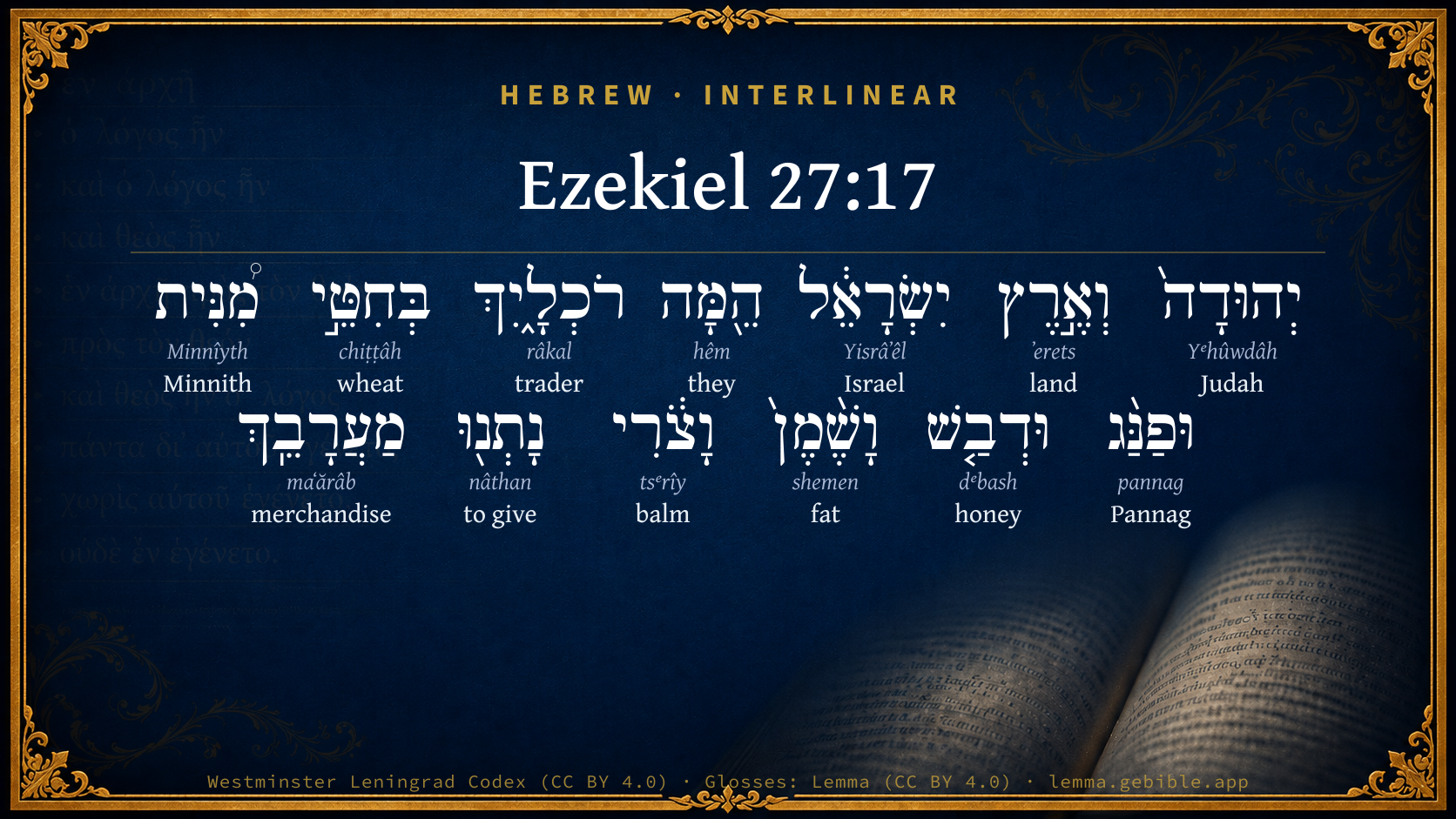
Hebrew (Westminster Leningrad Codex) Ezekiel 27:17 appears in the Hebrew Old Testament. The text above is from the Westminster Leningrad Codex. Each word links to its Strong’s number, a concise gloss, and parsing drawn from the Open Scriptures Hebrew Bible morphology. Click any word for its full Brown-Driver-Briggs (BDB) entry.
Download image
Cite this verse

Ezekiel 27:17 (World English Bible). Public Domain. Lemma interlinear Bible study tool, https://lemma.gebible.app/v/ezekiel/27/17.

Show BibTeX & RIS
BibTeX
RIS
English Translation
Judah, and the land of Israel, they were your traffickers: they traded for your merchandise wheat of Minnith, and confections, and honey, and oil, and balm.
World English Bible · Public Domain
Highlights
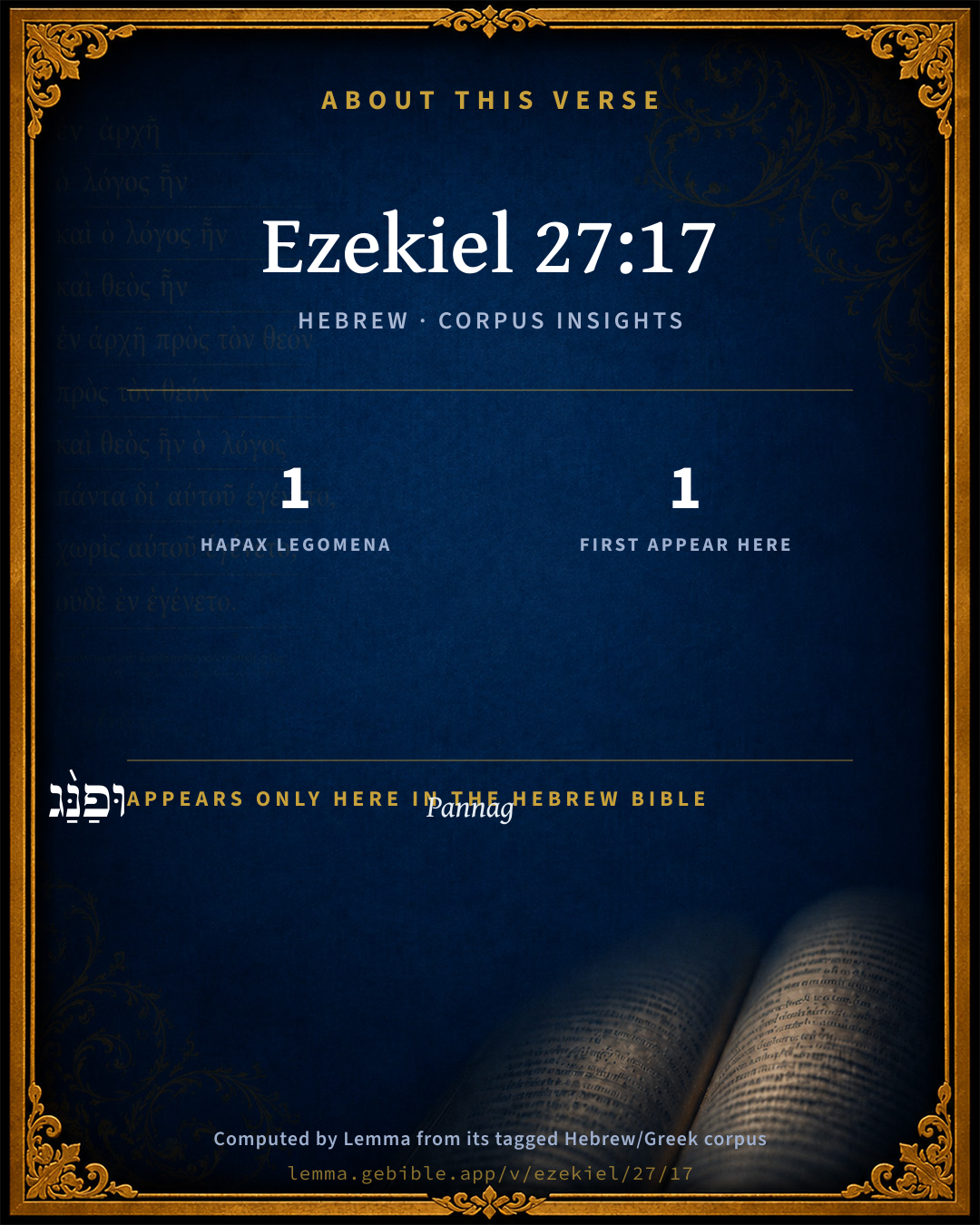
  • 1 hapax legomenon — only here in the Hebrew Bible
  • 1 first appearance in the Hebrew Bible
Full analysis ↓
Download a study sheet

One document with this verse’s original text, its word-by-word gloss line, the meaning frame, cross-references with their text, attributed commentary, and full source and license credits — printable, and it pastes into notes with its structure intact.

This verse Autodidact and up

Study sheet (.html) Plain text (.txt)

A passage Seminary Student

Up to 50 verses in one chapter. A passage sheet keeps up to 6 commentary sources and 12 cross-references per verse, in the order this page ranks them, and says so on the sheet whenever that leaves anything out. Ask for a single verse and you get the Autodidact verse sheet above.

Everything on this page stays free to read, with no account — the sheet is a download of what is already on screen, not access to it.

Want to remove ads? Support Godless Engineer
Compare translations 3

The same verse in 3 English versions, stacked beneath the original-language interlinear above. Click any original word for its lexicon entry.

Each is an independent rendering of the whole verse — the interlinear is not word-aligned to these translations.

Highlighted words mark where these versions differ — a whole-verse word diff, not a word-by-word alignment.

  • World English Bible Public Domain
    Judah, and the land of Israel, they were your traffickers: they traded for your merchandise wheat of Minnith, and confections, and honey, and oil, and balm.
  • King James Version Public Domain
    Judah, and the land of Israel, they were thy merchants: they traded in thy market wheat of Minnith, and Pannag, and honey, and oil, and balm.
  • unfoldingWord Literal Text CC BY-SA 4.0
    Judah and the land of Israel were trading with you. They provided wheat from Minnith, cakes, honey, oil, and balsam as your merchandise.

unfoldingWord Literal Text — © unfoldingWord, licensed CC BY-SA 4.0. Word-aligned USFM3 via Door43 (git.door43.org/unfoldingWord/en_ult).

Versions to compare (up to 4)

3 of 4 selected

Show all 18 translations

Every available English version of this verse, each an independent rendering of the whole verse.

  • World English Bible Public Domain
    Judah, and the land of Israel, they were your traffickers: they traded for your merchandise wheat of Minnith, and confections, and honey, and oil, and balm.
  • Berean Standard Bible Public Domain
    Judah and the land of Israel traded with you; they exchanged wheat from Minnith, cakes and honey, oil and balm for your merchandise.
  • Majority Standard Bible Public Domain
    Judah and the land of Israel traded with you; they exchanged wheat from Minnith, cakes and honey, oil and balm for your merchandise.
  • King James Version Public Domain
    Judah, and the land of Israel, they were thy merchants: they traded in thy market wheat of Minnith, and Pannag, and honey, and oil, and balm.
  • American Standard Version (1901) Public Domain
    Judah, and the land of Israel, they were thy traffickers: they traded for thy merchandise wheat of Minnith, and pannag, and honey, and oil, and balm.
  • Revised Version (1885) Public Domain
    Judah, and the land of Israel, they were thy traffickers: they traded for thy merchandise wheat of Minnith, and pannag, and honey, and oil, and balm:
  • Geneva Bible (1599) Public Domain
    They of Iudah and of the land of Israel were thy marchants: they brought for thy marchandise wheat of Minnith, and Pannag, and honie and oyle, and balme.
  • Douay-Rheims (1899) Public Domain
    Juda and the land of Israel, they were thy merchants with the best corn: they set forth balm, and honey, and oil, and rosin in thy fairs.
  • Young's Literal Translation Public Domain
    Judah and the land of Israel -- they `are' thy merchants, For wheat of Minnith, and Pannag, And honey, and oil, and balm, They have given out thy merchandise.
  • Literal Standard Version CC BY-SA 4.0
    Judah and the land of Israel—they [are] your merchants, || They have given wheat of Minnith, and Pannag, || And honey, and oil, and balm [for] your merchandise.
  • Unlocked Literal Bible CC BY-SA 4.0
    Judah and the land of Israel were trading with you. They provided wheat from Minnith, cakes, honey, oil, and balsam as your merchandise.
  • unfoldingWord Literal Text CC BY-SA 4.0
    Judah and the land of Israel were trading with you. They provided wheat from Minnith, cakes, honey, oil, and balsam as your merchandise.
  • Darby Bible Public Domain
    Judah and the land of Israel were thy traffickers: they bartered with thee wheat of Minnith, and sweet cakes, and honey, and oil, and balm.
  • World Messianic Bible Public Domain
    “‘“Judah and Eretz-Israel were your traders. They traded wheat of Minnith, confections, honey, oil, and balm for your merchandise.
  • Webster's Bible Public Domain
    Judah, and the land of Israel, they were thy merchants: they traded in thy market in wheat of Minnith, and Pannag, and honey, and oil, and balm.
  • Free Bible Version CC BY-SA 4.0
    Judah and the country of Israel traded with you, paying you with wheat from Minnith, pastries and honey, olive oil and balm in return for your goods.
  • Bible in Basic English Public Domain
    Judah and the land of Israel were your traders; they gave grain of Minnith and sweet cakes and honey and oil and perfume for your goods.
  • JPS Tanakh (1917) Public Domain
    Judah, and the land of Israel, they were thy traffickers; they traded for thy merchandise wheat of Minnith, and balsam, and honey, and oil, and balm.

Literal Standard Version (2020), Covenant Press — licensed CC BY-SA 4.0. Text via the HelloAO Bible API (eBible.org). Unlocked Literal Bible (unfoldingWord) — licensed CC BY-SA 4.0. Text via the HelloAO Bible API (eBible.org). unfoldingWord Literal Text — © unfoldingWord, licensed CC BY-SA 4.0. Word-aligned USFM3 via Door43 (git.door43.org/unfoldingWord/en_ult). Free Bible Version, Dr. Jonathan Gallagher — licensed CC BY-SA 4.0. Text via the HelloAO Bible API (eBible.org).

Word by word

More ways to search: Search by grammar → Find every occurrence → Compare this word →

Practice this passage: Drill this verse → Learn its vocabulary →

וּפַנַּ֨ג
pannag
H6436
“and · Pannag”
Conjunction + Noun, Common, Masculine, Singular, Absolute
Part of Speech
Conjunction + Noun
Type
Common
Gender
Masculine
Number
Singular
State
Absolute
Full BDB Definition

Origin: of uncertain derivation

TWOT: 1781

Pannag - an edible food, perhaps pastry - meaning dubious
  1. יְהוּדָה֙ Yᵉhûwdâh H3063 “Judah” Noun, Proper
  2. וְאֶ֣רֶץ ʼerets H776 “and · land of” Conjunction + Noun, Common, Both, Singular, Construct
  3. יִשְׂרָאֵ֔ל Yisrâʼêl H3478 “Israel” Noun, Proper
  4. הֵ֖מָּה hêm H1992 “they” Pronoun, Personal, 3rd Person, Masculine, Plural
  5. רֹכְלָ֑יִךְ râkal H7402 “trader · you” Verb, Qal, Participle Active, Masculine, Plural, Construct + Suffix, Personal, 2nd Person, Feminine, Singular
  6. בְּחִטֵּ֣י chiṭṭâh H2406 “in/at · wheat of” Preposition + Noun, Common, Feminine, Plural, Construct
  7. מִ֠נִּית Minnîyth H4511 “Minnith” Noun, Proper
  8. וּדְבַ֤שׁ dᵉbash H1706 “and · honey” Conjunction + Noun, Common, Masculine, Singular, Absolute
  9. וָשֶׁ֨מֶן֙ shemen H8081 “and · fat” Conjunction + Noun, Common, Masculine, Singular, Absolute
  10. וָצֹ֔רִי tsᵉrîy H6875 “and · balm” Conjunction + Noun, Common, Masculine, Singular, Absolute
  11. נָתְנ֖וּ nâthan H5414 “to give” Verb, Qal, Perfect, 3rd Person, Common, Plural
  12. מַעֲרָבֵֽךְ maʻărâb H4627 “merchandise · your” Noun, Common, Masculine, Singular, Construct + Suffix, Personal, 2nd Person, Feminine, Singular

About this verse

These counts appear in no published source. They are computed here, from the morphology-tagged text and Lemma’s own curated glosses. What Lemma adds →

13
words
13
distinct lemmas
Prophets
section

Notable vocabulary

1 hapax legomenon — a word that appears only here in the entire Hebrew Bible:

  • וּפַנַּ֨ג Pannag H6436

First appearance in Scripture

This word makes its first canonical appearance in the Hebrew Bible here:

  • וּפַנַּ֨ג Pannag H6436

Shared distinctive vocabulary

מִ֠נִּית Minnith H4511 occurs in 2 verses of the Hebrew Bible. Also found in:

Grammatical profile

  • 2 verbs
  • 10 nouns
  • 1 pronoun

Verb forms

  • רֹכְלָ֑יִךְ Qal · Participle Active
  • נָתְנ֖וּ Qal · Perfect

Hebrew & Septuagint length

In English translation the verse runs 26 words from the Hebrew and 33 from the Septuagint (LXX English) — closely comparable.

A rough comparison of the two English renderings, which tokenize alike — not a word-level alignment.

Word counts can differ between the Hebrew and the Greek without any difference in meaning — e.g. the Hebrew direct-object marker אֵת has no separate Greek word, and Greek often adds the article ὁ.

Cross-references

9

Topical passages linked to Ezekiel 27:17 in the Treasury of Scripture Knowledge — connected by theme and wording, ordered by reader-vote popularity; previews shown in the World English Bible.

  • Judges 11:33 He struck them from Aroer until you come to Minnith, even twenty cities, and to Abelcheramim, with a very great slaughter. So the children of Ammon were subdued before the children of Israel.
  • 1 Kings 5:9 My servants shall bring them down from Lebanon to the sea; and I will make them into rafts to go by sea to the place that you shall appoint me, and will cause them to be broken up there, and you shall receive them; and you shall accomplish my desire, in giving food for my household.
  • Genesis 43:11 Their father, Israel, said to them, "If it be so now, do this. Take from the choice fruits of the land in your bags, and carry down a present for the man, a little balm, a little honey, spices and myrrh, nuts, and almonds;
  • Deuteronomy 8:8 a land of wheat and barley, and vines and fig trees and pomegranates; a land of olive trees and honey;
  • Deuteronomy 32:14 Butter of the herd, and milk of the flock, With fat of lambs, Rams of the breed of Bashan, and goats, With the finest of the wheat; Of the blood of the grape you drank wine.
  • 2 Chronicles 2:10 Behold, I will give to your servants, the cutters who cut timber, twenty thousand measures of beaten wheat, and twenty thousand measures of barley, and twenty thousand baths of wine, and twenty thousand baths of oil.
  • Ezra 3:7 They gave money also to the masons, and to the carpenters; and food, and drink, and oil, to them of Sidon, and to them of Tyre, to bring cedar trees from Lebanon to the sea, to Joppa, according to the grant that they had of Cyrus king of Persia.
  • Jeremiah 8:22 Is there no balm in Gilead? is there no physician there? why then isn't the health of the daughter of my people recovered?
  • Acts 12:20 Now Herod was very angry with the people of Tyre and Sidon. They came with one accord to him, and, having made Blastus, the king's chamberlain, their friend, they asked for peace, because their country depended on the king's country for food.

Cross-references courtesy of OpenBible.info (CC BY 4.0).

Hebrew and Greek witnesses Masoretic Hebrew ↔ Greek Septuagint

The same verse in the two great witnesses to the Old Testament, shown verse-for-verse.

These are two independent witnesses, not word-aligned to each other, and the Septuagint is shown in lemma (dictionary) form.

Hebrew Ezekiel 27:17 Masoretic · Westminster Leningrad Codex

יְהוּדָה֙ וְאֶ֣רֶץ יִשְׂרָאֵ֔ל הֵ֖מָּה רֹכְלָ֑יִךְ בְּחִטֵּ֣י מִ֠נִּית וּפַנַּ֨ג וּדְבַ֤שׁ וָשֶׁ֨מֶן֙ וָצֹ֔רִי נָתְנ֖וּ מַעֲרָבֵֽךְ

Judah, and the land of Israel, they were your traffickers: they traded for your merchandise wheat of Minnith, and confections, and honey, and oil, and balm.

World English Bible · Public Domain

Greek LXX Ezekiel 27:17 Septuagint · lemma form

ἰούδας καί ὁ υἱός ὁ ἰσραήλ οὗτος ἔμπορος σύ ἐν σῖτος πρᾶσις καί μύρον καί κασία καί πρῶτος μέλι καί ἔλαιον καί ῥητίνη δίδωμι εἰς ὁ συμμικτός σύ

Juda and the children of Israel, these were your merchants; in the sale of corn and ointments and cassia: and they gave the best honey, and oil, and resin, to your trading population.

LXX2012 (modern English Septuagint) · Public Domain

On this verse, The Cambridge Bible for Schools and Colleges discusses the Septuagint’s reading. Read the note in Commentary ↓

Hebrew: Westminster Leningrad Codex (CC BY 4.0). Greek: Septuagint (public domain); English from LXX2012 (modern English Septuagint) (Public Domain). How the Septuagint differs from the Hebrew →

Targum (Aramaic paraphrase)

1

The Targum is the ancient Jewish Aramaic paraphrase of the Hebrew Scriptures — an interpretive translation, not the Hebrew text itself. Onkelos (literal) and Pseudo-Jonathan (expansive) render the Torah, and Jonathan the Prophets. Coverage is partial: where no permissively-licensed English translation exists for a verse, only the Aramaic is shown. This is verse-level text, not a word-by-word alignment to the Hebrew.

  1. Targum Jonathan Prophets (Joshua–Malachi)
    יְהוּדָה וְאַרְעָא דְיִשְׂרָאֵל אִינוּן תַּגָרֵיךְ בְּהִטֵי רִיחוּשׁ וְקוֹלְיָא וּדְבַשׁ וּמְשַׁח וּשְׁעֵיף יְהָבוּ בַּחֲנּוּתָיִךְ:

    (no public-domain English translation for this verse)

    Targum Jonathan — Aramaic: “Mikraot Gedolot” (public domain). English: “Sefaria Community Translation” (CC0 1.0 (public-domain dedication)); “London "Chaldee Paraphrase," 1871” (public domain). Text via Sefaria.

Commentary

Notes on Ezekiel 27:17 from classic Christian and Jewish commentators (each source and its license shown beneath its notes). The classic Christian expositions comment on the surrounding passage and are grouped to its opening verse, so a note may address several verses; the Jewish commentaries on the Tanakh (Rashi and others) are per-verse, so they appear only where the commentator wrote on this verse.

Lemma curates 59 commentaries, every one of them public domain or Creative Commons licensed, each selected and text-cleaned for this edition rather than reprinted as found. About our sources →

Trapp's Complete Commentary

John Trapp

Eze 27:17 Judah, and the land of Israel, they [were] thy merchants: they traded in thy market wheat of Minnith, and Pannag, and honey, and oil, and balm.

Ver. 17. Wheat of Minnith.] Where the best grew, even the kidneys of wheat, as Moses hath it. {Deu 32:14 cf. Jdg 11:33 Act 12:20}

Pannag.] Rosin or balsam, whereof Judea yielded the best in the whole world.

For the wine of Helbon,] i.e., Of Aleppo, say some, famous then for wine, now for milk, whence also it hath its name, for the Turks call milk alep; and if the Via lactea Milky Way were on earth, it would be found there, saith one.

John Trapp, A Commentary or Exposition upon All the Books of the Old and New Testament (1647–1656) — public domain. Text from a community e-Sword module.

Tyndale Open Study Notes

Tyndale Open Resources

27:17 Minnith, located in Transjordan (the area east of the Jordan River), was a well-known source of wheat.

Tyndale Open Study Notes — © Tyndale Open Resources, licensed CC BY-SA 4.0. Text via the HelloAO Bible API.

Geneva Bible (1599)

Geneva Bible translators

Where the best wheat grew.

Or, turpentine, or, treacle.

Geneva Bible (1599) marginal notes — public domain. Text via Bolls.life.

Jamieson, Fausset & Brown

Robert Jamieson, A. R. Fausset & David Brown

Minnith . . . Pannag--names of places in Israel famed for good wheat, wherewith Tyre was supplied (Kg1 5:9, Kg1 5:11; Ezr 3:7; Act 12:20); Minnith was formerly an Ammonite city (Jdg 11:33). "Pannag" is identified by GROTIUS with "Phenice," the Greek name for "Canaan." "They traded . . . wheat," that is, they supplied thy market with wheat.

balm--or, "balsam."

Jamieson, Fausset & Brown — Commentary Critical and Explanatory on the Whole Bible (1871) — public domain (CC PDM 1.0). Text via the HelloAO Bible API.

Adam Clarke's Commentary

Verse 17. Judah, and the land of Israel - traded in thy market wheat] The words have been understood as articles of merchandise, not names of places. So the Jews traded with the Tyrians in wheat, stacte, balsam, honey, oil, and resin.

Adam Clarke's Commentary on the Bible (1810–1826) — public domain. Text from a community e-Sword/MySword module.

Ellicott's Commentary for English Readers

(17) Minnith, and Pannag.—Minnith was in Ammon (Jdg_11:33), rich in wheat (2Ch_27:5), and the Tyrians obtained its products through the Israelites. Pannag is unknown; it is even uncertain whether it is a proper name at all, or some sweet confection, as grape syrup.

A Bible Commentary for English Readers, edited by Charles John Ellicott (1878–1897) — public domain. Text from a community e-Sword module.

The Cambridge Bible for Schools and Colleges

gen. ed. J. J. S. Perowne

17. Judah and the land of Israel furnished Tyre with wheat, honey, oil and balsam.

traded in thy market wheat] they brought as thy wares wheat. Minnith is supposed to be the Ammonitish place of that name (Jdg_11:33). There is something unnatural, however, in Judah and Israel bringing an Ammonitish product to Tyre. It is their own productions that the nations bring, or at least the articles are assumed to be their own. LXX. renders “ointments;” and Corn, conjectures “spices” (Gen_43:11; Isa_39:2; 2Ki_20:13). The term “pannag” is otherwise unknown; R.V. marg. suggests a kind of confection (Targ.), while Corn, conjectures “wax” (donag). The “honey” referred to is no doubt that of bees, not grape honey. The “balm” mentioned, a product of Gilead (Jer_8:22), and of Palestine (Gen_43:11), was not the genuine balm, which was peculiar to Arabia, but an odoriferous resin (LXX. Vulg.) exuding from the mastix tree (Pistaccia lentiscus).

The Cambridge Bible for Schools and Colleges (gen. ed. J. J. S. Perowne; Cambridge University Press, 1878–1918) — public domain. Text from a community e-Sword module.

John Gill's Exposition

Damascus was thy merchant in the multitude of the wares of thy making,.... Of the many things manufactured at Tyre, the inhabitants of Damascus, once the chief city of Syria, took some:

for the multitude of all riches: in lieu of the vast quantity of rich things there made, they traded with them for them:

in the wine of Helbon, and white wool; Helbon very probably is the same with the Chalybon of Ptolemy (p), which he places in Syria; a place famous for wine, as Strabo (q) reports; the kings of Persia, he says, through riches fell into luxury, so that they would have wheat brought from Assos in Aeolia, and Chalybonian wine out of Syria, and water from Eulaeus (the river Ulai in Dan 8:2), which was lightest of all; and so Athenaeus (r) says, the kings of the Persians drink only Chalybonian wine; which, says Posidonius, was made at Damascus in Syria, from whence the Persians transplant vines: Helbon is thought to be the same with Aleppo; the grapes there are all white, and make a strong wine, as Monsieur Thevenot (s) relates; and who also observes, that the wines of Damascus are treacherous and strong: and the wool they bought was such as it came off of the backs of the sheep, and the purer and whiter sort of it; which was brought to Tyre, and by them bought, and dyed purple, for which dye the Tyrians were famous.

(p) Geograph. l. 5. c. 15. (q) Ibid. l. 12. p. 505. (r) L. 1. c. 22. (s) Travels, part 2. B. 1. c. 5. p. 25. & c. 7. p. 33.

John Gill's Exposition of the Whole Bible (1746–1763) — public domain (CC PDM 1.0). Text via the HelloAO Bible API.

Haydock's Catholic Bible Commentary

Rosin. Our version generally renders this, balm. (Haydock) --- It was much used to heal, Jeremias viii. 22., and Genesis xxxvii. 25.

George Leo Haydock (1774–1849), Haydock's Catholic Family Bible and Commentary, 1859 edition — public domain. Excludes Psalms (Douay-Rheims chapter numbering differs from Protestant) and Deuterocanonical books (Catholic canon only).

Matthew Poole's English Annotations

Judah; the two tribes, or kingdom of Judah.

The land of Israel; the kingdom of Israel, or the ten tribes until their dispersion.

Minnith; the name of some rich and excellent wheat country; it is mentioned in Jdg 11:33, on occasion of Jephthah’s slaying the Ammonites, as lying on their borders, and it is said there is a town of that name still in being about four miles from Esbus, (or Sabasant as now called,) in the way toward Philadelphia, formerly Rubbath.

Pannag: some doubt whether this be a proper name of any country or region, but if it is, they conclude it must be Phenicia, but do not tell us how Judah and Israel should trade their wheat in Tyre market; it may be it was some more obscure place, which now is forgotten. Honey; with which Canaan flowed.

Oil; in making and selling whereof the labour, care, and profit of that country did lie.

Balm; the choicest balms were those of Gilead, whence it is probable it was carried to Tyre; or it may be it was rosin, of which they had great use. The Chaldee paraphrast interprets it by the word that denotes wax, and so it may possibly be; a good commodity in Tyre.

Matthew Poole's English Annotations on the Holy Bible (1683–1685) — public domain. Text from a community e-Sword/MySword module.

Whedon's Commentary on the Bible

Daniel D. Whedon

17. Minnith, and Pannag — The Minnith mentioned here is probably not the Amorite town mentioned in Jdg_11:33 (vs. Bertholet, etc.), but may be the thing after which the town was named. (Compare note Eze_27:16.) What it was no one knows. The Syrian translates “millet;” LXX., “ointment,” while many scholars would suggest “spices,” because these are prominent in other lists of the productions of the land of Canaan. (Compare Gen_43:11.) It is possible that it was the technical name for a species of wheat — which was the greatest necessity supplied by Judah to Tyre (1Ki_5:9-11; Act_12:20). As R.V. suggests (margin), following the Mishna, pannag may be a species of confection, or Cornill may be right in reading donag (wax), but nothing is certain. The prophets did not like their countrymen to imitate the habits of the Canaanites (Old Hebrews, “traders”) in leaving the quiet simple life of agriculture for the more speculative, luxurious, and often dissolute career of the “traveling men” who were engaged in trade.

Daniel D. Whedon (gen. ed.), Commentary on the Old and New Testaments (1874–1909) — public domain. Text from a community e-Sword module.

The Pulpit Commentary

Judah and the land of Israel. The narrow strip of land occupied by the Phoenicians was unable to supply its crowded population. It was dependent on Israel for its corn and oil and the like in the days of Solomon (1Ki_5:9-11) and continued to be so to those of Herod Agrippa. (Act_12:20) Minnith appears in Jud_1:11:33 as a city of the Ammonites near Heshbon, and the region of Ammon was famous for its wheat. (2Ch_27:5) Minnith wheat probably fetched the highest price in the Tyrian markets. Pannag is found here only. The versions, Targum, LXX, give "ointments" (muroi), Vulgate, balsam. Most modern commentators take it as meaning sweetmeats, the syrup of grape-juice, possibly something like the modern rahat-la-koum of Turkish commerce. Possibly, like Minnith, it may have been a proper name the significance of which is lost to us. Honey was at all times one of the famous products of Palestine (Jud_1:14:8; 1Sa_14:27; Psa_19:10; Exo_33:3)

The Pulpit Commentary (1880–1919), ed. H.D.M. Spence-Jones & Joseph S. Exell — public domain. Text from a community e-Sword module.

John Wesley's Explanatory Notes

Minnith - The name of an excellent wheat country. Pannag - Some obscure place, which now is forgotten.

John Wesley, Explanatory Notes Upon the Whole Bible (1754–1765) — public domain. Text via the GEBible commentary corpus.

Rashi

Rabbi Shlomo Yitzchaki (Rashi)

with wheat of Minnith the name of a place that produced wheat of high quality, like (Jud. 11: 33): “until you come to Minnith.” Midrash Aggadah (source unknown) [explains it as] good, thick wheat kernels, which are sold by number. Jonathan renders: בִּחִטֵי רִיחוּשּׁ expression for a gathering of many numbers, troche in Old French, bundle, bunch. A similar word appears in Pesikta [d’Rav Kahana, p. 184b]: “Just as the myrtle is crowded (רָחוּשּׁ) with leaves, so was Leah crowded with sons.” But I do not know what it [wheat of Minnith] is. In the name of Rabbi Simon, I heard that he found in a Bible with a Jerusalem Targum בְּחִטֵי מִנִיתוּפַנַג rendered: בְּחוּשְּׁלָא וְקֲלְמָא. Now, שַּׁעֲרֵי דְחוּשְּׁלָא, which is found in the Talmud (Yoma 79a), is explained as: peeled barley. I say, however, that “Minnith” is an expression of portions (מָנוֹת), prepared food. Even according to its vocalization with a “dagesh,” Jonathan is wont to translate a word sometimes according to its apparent meaning and sometimes according to its midrashic meaning. So did he render (below 39:16): “And also the name of the city shall be Hamonah (הֲמוֹנָה).” Although we punctuate the name הֲמוֹנָה without a “mappiq hey” (הֱמוֹנָה), [with a “mappiq hey” (pronounced) הֲמוֹנָה would mean “her multitude” with a silent “hey” it means simply “a multitude.”] Jonathan paraphrases: And also there, the slain of the city whose multitude is great will be cast.

balsam trees [Heb. פַנַג.] I saw in the book of Joseph the priest (Josiphon vol. 1 p.155 ch. 36 Flusser): The balsam tree is “pannag,” and they were found in Jericho, and because of the fragrant scent, it [the city] is called Jericho [יְרִיחוֹ from רֵיחַ, scent], balsme in Old French.

Rashi on the Tanakh — English translations: “The Judaica Press complete Tanach with Rashi, translated by A. J. Rosenberg” (CC BY 4.0); “Pentateuch with Rashi's commentary by M. Rosenbaum and A.M. Silbermann, 1929-1934” (public domain); “The Metsudah Tanach series, Lakewood, N.J” (CC BY 4.0); and “The Book of Joshua, Metsudah Publications, 1997” (CC BY 4.0). Text via Sefaria.

Lesson kit

Teaching starters — assembled from the data on this page, not authored interpretation. Every prompt links to the verse data it draws on. Edit before teaching.

Ezekiel, in the Prophets, opens this verse with 13 words (13 distinct Hebrew lemmas). Its most distinctive word is pannag (“Pannag”). A historical commentator’s framing appears above. Read the whole chapter for the surrounding context.

Discussion questions

  1. How does “Pannag” (pannag) shape what this verse is saying?
  2. This verse holds 1 word here found nowhere else in the Hebrew Bible. What might the rare word draw attention to?
  3. The word “Pannag” first appears here in Scripture. What is being introduced at this debut?
  4. Judges 11:33 shares the word «Minnith» with this verse. How do the two illuminate each other?
  5. The translations on this page render this verse differently — a whole-verse word diff, not a word-by-word alignment. What might account for the different wordings?
  6. The verb «רֹכְלָ֑יִךְ» is Qal Participle Active. How does its form color the action?
  7. Reading how Trapp's Complete Commentary and Tyndale Open Study Notes read this verse, where do the two commentators agree and where do they part?

Things to notice

  • 1 word in this verse appears nowhere else in the Hebrew Bible.
  • 1 word makes its first canonical appearance in Scripture here.
  • These translations choose different wording for 13 words in this verse.
  • 13 distinct Hebrew lemmas span 13 words in this verse.

Reading settings

Reading text

Shown beneath each verse's original-language words.

Old Testament
Old Testament edition

Read the OT as the Masoretic Hebrew (MT) or the Greek Septuagint (LXX).

English shown for the Greek Septuagint (in the Hebrew ↔ Greek comparison).

Comparing translations? Open the Compare panel on any verse page to stack up to four side by side.