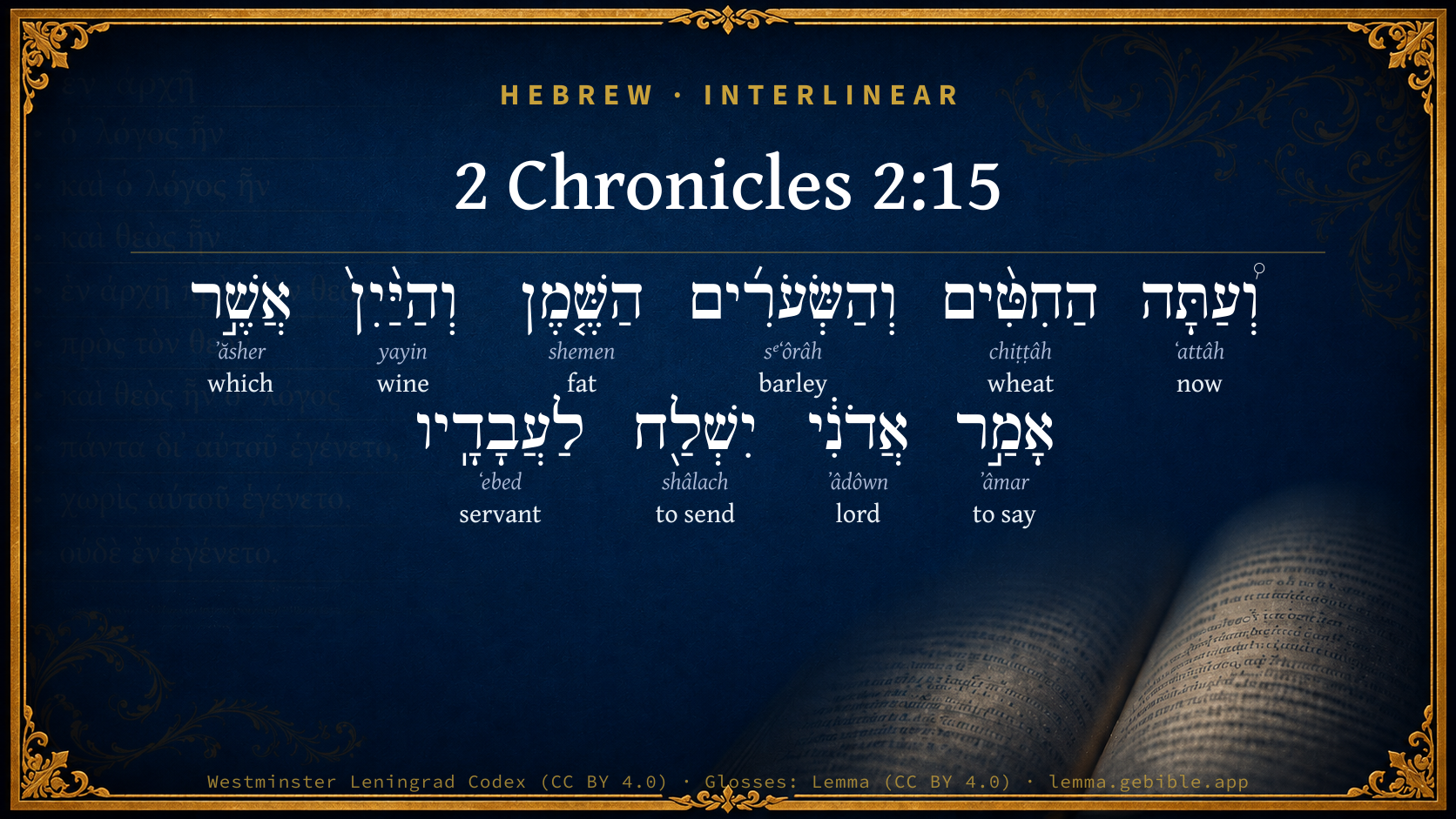
2 Chronicles 2:15

Hebrew (Westminster Leningrad Codex) 2 Chronicles 2:15 appears in the Hebrew Old Testament. The text above is from the Westminster Leningrad Codex. Each word links to its Strong’s number, a concise gloss, and parsing drawn from the Open Scriptures Hebrew Bible morphology. Click any word for its full Brown-Driver-Briggs (BDB) entry.
Download image
Cite this verse

2 Chronicles 2:15 (World English Bible). Public Domain. Lemma interlinear Bible study tool, https://lemma.gebible.app/v/2-chronicles/2/15.

Show BibTeX & RIS
BibTeX
RIS
English Translation
Now therefore the wheat and the barley, the oil and the wine, which my lord has spoken of, let him send to his servants:
World English Bible · Public Domain
Download a study sheet

One document with this verse’s original text, its word-by-word gloss line, the meaning frame, cross-references with their text, attributed commentary, and full source and license credits — printable, and it pastes into notes with its structure intact.

This verse Autodidact and up

Study sheet (.html) Plain text (.txt)

A passage Seminary Student

Up to 50 verses in one chapter. A passage sheet keeps up to 6 commentary sources and 12 cross-references per verse, in the order this page ranks them, and says so on the sheet whenever that leaves anything out. Ask for a single verse and you get the Autodidact verse sheet above.

Everything on this page stays free to read, with no account — the sheet is a download of what is already on screen, not access to it.

Want to remove ads? Support Godless Engineer
Compare translations 3

The same verse in 3 English versions, stacked beneath the original-language interlinear above. Click any original word for its lexicon entry.

Each is an independent rendering of the whole verse — the interlinear is not word-aligned to these translations.

Highlighted words mark where these versions differ — a whole-verse word diff, not a word-by-word alignment.

  • World English Bible Public Domain
    Now therefore the wheat and the barley, the oil and the wine, which my lord has spoken of, let him send to his servants:
  • King James Version Public Domain
    Now therefore the wheat, and the barley, the oil, and the wine, which my lord hath spoken of, let him send unto his servants:
  • unfoldingWord Literal Text CC BY-SA 4.0
    And now, the wheat and the barley, the oil and the wine, which my lord has said, let him send to his servants.

unfoldingWord Literal Text — © unfoldingWord, licensed CC BY-SA 4.0. Word-aligned USFM3 via Door43 (git.door43.org/unfoldingWord/en_ult).

Versions to compare (up to 4)

3 of 4 selected

Show all 18 translations

Every available English version of this verse, each an independent rendering of the whole verse.

  • World English Bible Public Domain
    Now therefore the wheat and the barley, the oil and the wine, which my lord has spoken of, let him send to his servants:
  • Berean Standard Bible Public Domain
    Now let my lord send to his servants the wheat, barley, olive oil, and wine he promised.
  • Majority Standard Bible Public Domain
    Now let my lord send to his servants the wheat, barley, olive oil, and wine he promised.
  • King James Version Public Domain
    Now therefore the wheat, and the barley, the oil, and the wine, which my lord hath spoken of, let him send unto his servants:
  • American Standard Version (1901) Public Domain
    Now therefore the wheat and the barley, the oil and the wine, which my lord hath spoken of, let him send unto his servants:
  • Revised Version (1885) Public Domain
    Now therefore the wheat and the barley, the oil and the wine, which my lord hath spoken of, let him send unto his servants:
  • Geneva Bible (1599) Public Domain
    Now therefore the wheate and the barley, the oyle and the wine, which my lorde hath spoken of, let him send vnto his seruants.
  • Douay-Rheims (1899) Public Domain
    The wheat therefore, and the barley and the oil, and the wine, which thou, my lord, hast promised, send to thy servants.
  • Young's Literal Translation Public Domain
    `And, now, the wheat, and the barley, the oil, and the wine, as my lord said, let him send to his servants,
  • Literal Standard Version CC BY-SA 4.0
    And now, the wheat, and the barley, the oil, and the wine, as my lord said, let him send to his servants,
  • Unlocked Literal Bible CC BY-SA 4.0
    Now then, the wheat and the barley, the oil and the wine, of which my master has spoken, let him send these things to his servants.
  • unfoldingWord Literal Text CC BY-SA 4.0
    And now, the wheat and the barley, the oil and the wine, which my lord has said, let him send to his servants.
  • Darby Bible Public Domain
    And now the wheat and the barley, the oil and the wine, which my lord hath spoken of, let him send unto his servants.
  • World Messianic Bible Public Domain
    “Now therefore, the wheat, the barley, the oil, and the wine which my lord has spoken of, let him send to his servants;
  • Webster's Bible Public Domain
    Now therefore the wheat, and the barley, the oil, and the wine which my lord hath spoken of, let him send to his servants;
  • Free Bible Version CC BY-SA 4.0
    Now my lord, please send to us his servants the wheat, barley, olive oil, and wine he spoke about.
  • Bible in Basic English Public Domain
    So now let my lord send to his servants the grain and the oil and the wine as my lord has said;
  • JPS Tanakh (1917) Public Domain
    (2-14) Now therefore the wheat and the barley, the oil and the wine, which my lord hath spoken of, let him send unto his servants;

Literal Standard Version (2020), Covenant Press — licensed CC BY-SA 4.0. Text via the HelloAO Bible API (eBible.org). Unlocked Literal Bible (unfoldingWord) — licensed CC BY-SA 4.0. Text via the HelloAO Bible API (eBible.org). unfoldingWord Literal Text — © unfoldingWord, licensed CC BY-SA 4.0. Word-aligned USFM3 via Door43 (git.door43.org/unfoldingWord/en_ult). Free Bible Version, Dr. Jonathan Gallagher — licensed CC BY-SA 4.0. Text via the HelloAO Bible API (eBible.org).

Word by word

More ways to search: Search by grammar → Find every occurrence → Compare this word →

Practice this passage: Drill this verse → Learn its vocabulary →

הַחִטִּ֨ים
chiṭṭâh
H2406
“the · wheat”
Particle, Definite Article + Noun, Common, Feminine, Plural, Absolute
Part of Speech
Particle + Noun
Type
Common
Gender
Feminine
Number
Plural
State
Absolute
Full BDB Definition

Origin: of uncertain derivation

TWOT: 691b

wheat - wheat (plant) - wheat flour
  1. וְ֠עַתָּה ʻattâh H6258 “and · now” Conjunction + Adverb
  2. וְהַשְּׂעֹרִ֜ים sᵉʻôrâh H8184 “and · the · barley” Conjunction + Particle, Definite Article + Noun, Common, Feminine, Plural, Absolute
  3. הַשֶּׁ֤מֶן shemen H8081 “the · fat” Particle, Definite Article + Noun, Common, Masculine, Singular, Absolute
  4. וְהַיַּ֨יִן֙ yayin H3196 “and · the · wine” Conjunction + Particle, Definite Article + Noun, Common, Masculine, Singular, Absolute
  5. אֲשֶׁ֣ר ʼăsher H834 “which” Particle, Relative
  6. אָמַ֣ר ʼâmar H559 “to say” Verb, Qal, Perfect, 3rd Person, Masculine, Singular
  7. אֲדֹנִ֔י ʼâdôwn H113 “lord · my” Noun, Common, Masculine, Singular, Construct + Suffix, Personal, 1st Person, Common, Singular
  8. יִשְׁלַ֖ח shâlach H7971 “to send” Verb, Qal, Jussive, 3rd Person, Masculine, Singular
  9. לַעֲבָדָֽיו ʻebed H5650 “to/for · servants · his” Preposition + Noun, Common, Masculine, Plural, Construct + Suffix, Personal, 3rd Person, Masculine, Singular

About this verse

These counts appear in no published source. They are computed here, from the morphology-tagged text and Lemma’s own curated glosses. What Lemma adds →

10
words
10
distinct lemmas
Historical
section

Shared distinctive vocabulary

הַחִטִּ֨ים wheat H2406 occurs in 30 verses of the Hebrew Bible. Also found in:

Grammatical profile

  • 2 verbs
  • 6 nouns
  • 1 adverb
  • 1 particle

Verb forms

  • אָמַ֣ר Qal · Perfect
  • יִשְׁלַ֖ח Qal · Jussive

Hebrew & Septuagint length

In English translation the verse runs 24 words from the Hebrew and 23 from the Septuagint (LXX English) — closely comparable.

A rough comparison of the two English renderings, which tokenize alike — not a word-level alignment.

Word counts can differ between the Hebrew and the Greek without any difference in meaning — e.g. the Hebrew direct-object marker אֵת has no separate Greek word, and Greek often adds the article ὁ.

Cross-references

2

Topical passages linked to 2 Chronicles 2:15 in the Treasury of Scripture Knowledge — connected by theme and wording, ordered by reader-vote popularity; previews shown in the World English Bible.

  • 2 Chronicles 2:10 Behold, I will give to your servants, the cutters who cut timber, twenty thousand measures of beaten wheat, and twenty thousand measures of barley, and twenty thousand baths of wine, and twenty thousand baths of oil.
  • 1 Kings 5:11 Solomon gave Hiram twenty thousand measures of wheat for food to his household, and twenty measures of pure oil: thus gave Solomon to Hiram year by year.

Cross-references courtesy of OpenBible.info (CC BY 4.0).

Hebrew and Greek witnesses Masoretic Hebrew ↔ Greek Septuagint

The same verse in the two great witnesses to the Old Testament, shown verse-for-verse.

These are two independent witnesses, not word-aligned to each other, and the Septuagint is shown in lemma (dictionary) form.

Hebrew 2 Chronicles 2:15 Masoretic · Westminster Leningrad Codex

וְ֠עַתָּה הַחִטִּ֨ים וְהַשְּׂעֹרִ֜ים הַשֶּׁ֤מֶן וְהַיַּ֨יִן֙ אֲשֶׁ֣ר אָמַ֣ר אֲדֹנִ֔י יִשְׁלַ֖ח לַעֲבָדָֽיו

Now therefore the wheat and the barley, the oil and the wine, which my lord has spoken of, let him send to his servants:

World English Bible · Public Domain

Greek LXX 2 Chronicles 2:15 Septuagint · lemma form

καί ἐγώ κόπτω ξύλον ἐκ ὁ λιβάνος κατά πᾶς ὁ χρεία σύ καί ἄγω αὐτός σχεδία ἐπί θάλασσα ιόππη καί σύ ἄγω αὐτός εἰς ἰερουσαλήμ

And now, the wheat, and the barley, and the oil, and the wine which my lord mentioned, let him send to his servants.

LXX2012 (modern English Septuagint) · Public Domain

Hebrew: Westminster Leningrad Codex (CC BY 4.0). Greek: Septuagint (public domain); English from LXX2012 (modern English Septuagint) (Public Domain). How the Septuagint differs from the Hebrew →

Commentary

Notes on 2 Chronicles 2:15 from classic Christian and Jewish commentators (each source and its license shown beneath its notes). The classic Christian expositions comment on the surrounding passage and are grouped to its opening verse, so a note may address several verses; the Jewish commentaries on the Tanakh (Rashi and others) are per-verse, so they appear only where the commentator wrote on this verse.

Lemma curates 59 commentaries, every one of them public domain or Creative Commons licensed, each selected and text-cleaned for this edition rather than reprinted as found. About our sources →

Trapp's Complete Commentary

John Trapp

2Ch 2:15 Now therefore the wheat, and the barley, the oil, and the wine, which my lord hath spoken of, let him send unto his servants:

Ver. 15. Now therefore the wheat.] See 2Ch 2:10.

John Trapp, A Commentary or Exposition upon All the Books of the Old and New Testament (1647–1656) — public domain. Text from a community e-Sword module.

Ellicott's Commentary for English Readers

(15) The wheat, and the barley.—See 2Ch_2:10. Huram accepts Solomon’s proposed exchange of benefits.

His servants.—Huram means himself and his court. The term is the correlative of “lord.”

A Bible Commentary for English Readers, edited by Charles John Ellicott (1878–1897) — public domain. Text from a community e-Sword module.

John Gill's Exposition

And Solomon numbered all the strangers that were in the land of Israel,.... Which, according to Kimchi, were the remains of the Amorites, Hittites, Perizzites, and Jebusites, see Ch2 8:8, yet not idolaters, or they would not have been suffered by David and Solomon to have dwelt in the land, but were such as were become proselytes of the gate:

after the numbering wherewith David his father had numbered them; not at the time Israel was numbered by him, but in order to provide workmen for the building of the temple, Ch1 22:2,

and they were found an hundred and fifty thousand and six hundred; men able to bear burdens, and hew timber.

John Gill's Exposition of the Whole Bible (1746–1763) — public domain (CC PDM 1.0). Text via the HelloAO Bible API.

The Pulpit Commentary

The contents of this verse cannot be supposed to imply that King Hiram is eager for the pay to be remembered, but are equivalent to saying promptly that all things are ready to begin, and that therefore the commissariat must be ready also.

The Pulpit Commentary (1880–1919), ed. H.D.M. Spence-Jones & Joseph S. Exell — public domain. Text from a community e-Sword module.

unfoldingWord translationNotes

Door43 World Missions Community

Connecting Statement:

This continues the message from Hiram, king of Tyre, to Solomon.

of which my master has spoken, let him send these things to his servants

Hiram refers to Solomon as "my master" and to himself and his own people as "his servants." This is a way of showing respect. AT: "of which you, my master, have spoken, please send these things to us, your servants" (See: First, Second, or Third Person)

you will carry it up to Jerusalem

Here "you" refers to Solomon. The readers should understand that Solomon probably commanded other people to do the actual work. AT: "you will command your people to take the wood to Jerusalem" (See: Metonymy)

translationWords

Lebanon

Joppa

Jerusalem

unfoldingWord translationNotes — © Distant Shores Media and the Door43 World Missions Community, licensed CC BY-SA 4.0. Source: git.door43.org/Door43/en_tn.

Rashi

Rabbi Shlomo Yitzchaki (Rashi)

as rafts - Heb. רַפְסדוֹת, and in I Kings (5:23) it is written: דבְרוֹת, in Middle High German vloeze, rafts, (in modern German flüsse).

on the sea of Joppa meaning on the seacoast, like (Jonah 1:3): “and he went down to Joppa.”

Rashi on the Tanakh — English translations: “The Judaica Press complete Tanach with Rashi, translated by A. J. Rosenberg” (CC BY 4.0); “Pentateuch with Rashi's commentary by M. Rosenbaum and A.M. Silbermann, 1929-1934” (public domain); “The Metsudah Tanach series, Lakewood, N.J” (CC BY 4.0); and “The Book of Joshua, Metsudah Publications, 1997” (CC BY 4.0). Text via Sefaria.

Lesson kit

Teaching starters — assembled from the data on this page, not authored interpretation. Every prompt links to the verse data it draws on. Edit before teaching.

2 Chronicles, in the Historical, opens this verse with 10 words (10 distinct Hebrew lemmas). Its most distinctive word is chiṭṭâh (“wheat”). A historical commentator’s framing appears above. Read the whole chapter for the surrounding context.

Discussion questions

  1. What does “wheat” (chiṭṭâh) contribute to the verse as a whole?
  2. Genesis 30:14 shares the word «wheat» with this verse. How do the two illuminate each other?
  3. The translations on this page render this verse differently — a whole-verse word diff, not a word-by-word alignment. What might account for the different wordings?
  4. The verb «אָמַ֣ר» is Qal Perfect. How does its form color the action?
  5. Reading how Trapp's Complete Commentary and Ellicott's Commentary for English Readers read this verse, where do the two commentators agree and where do they part?

Things to notice

Reading settings

Reading text

Shown beneath each verse's original-language words.

Old Testament
Old Testament edition

Read the OT as the Masoretic Hebrew (MT) or the Greek Septuagint (LXX).

English shown for the Greek Septuagint (in the Hebrew ↔ Greek comparison).

Comparing translations? Open the Compare panel on any verse page to stack up to four side by side.