
Exodus 29:7

Hebrew (Westminster Leningrad Codex) Exodus 29:7 appears in the Hebrew Old Testament. The text above is from the Westminster Leningrad Codex. Each word links to its Strong’s number, a concise gloss, and parsing drawn from the Open Scriptures Hebrew Bible morphology. Click any word for its full Brown-Driver-Briggs (BDB) entry.
Download image
Cite this verse

Exodus 29:7 (World English Bible). Public Domain. Lemma interlinear Bible study tool, https://lemma.gebible.app/v/exodus/29/7.

Show BibTeX & RIS
BibTeX
RIS
English Translation
Then you shall take the anointing oil, and pour it on his head, and anoint him.
World English Bible · Public Domain
Download a study sheet

One document with this verse’s original text, its word-by-word gloss line, the meaning frame, cross-references with their text, attributed commentary, and full source and license credits — printable, and it pastes into notes with its structure intact.

This verse Autodidact and up

Study sheet (.html) Plain text (.txt)

A passage Seminary Student

Up to 50 verses in one chapter. A passage sheet keeps up to 6 commentary sources and 12 cross-references per verse, in the order this page ranks them, and says so on the sheet whenever that leaves anything out. Ask for a single verse and you get the Autodidact verse sheet above.

Everything on this page stays free to read, with no account — the sheet is a download of what is already on screen, not access to it.

Want to remove ads? Support Godless Engineer
Compare translations 3

The same verse in 3 English versions, stacked beneath the original-language interlinear above. Click any original word for its lexicon entry.

Each is an independent rendering of the whole verse — the interlinear is not word-aligned to these translations.

Highlighted words mark where these versions differ — a whole-verse word diff, not a word-by-word alignment.

  • World English Bible Public Domain
    Then you shall take the anointing oil, and pour it on his head, and anoint him.
  • King James Version Public Domain
    Then shalt thou take the anointing oil, and pour it upon his head, and anoint him.
  • unfoldingWord Literal Text CC BY-SA 4.0
    And you shall take the oil of anointing and pour it on his head and anoint him.

unfoldingWord Literal Text — © unfoldingWord, licensed CC BY-SA 4.0. Word-aligned USFM3 via Door43 (git.door43.org/unfoldingWord/en_ult).

Versions to compare (up to 4)

3 of 4 selected

Show all 18 translations

Every available English version of this verse, each an independent rendering of the whole verse.

  • World English Bible Public Domain
    Then you shall take the anointing oil, and pour it on his head, and anoint him.
  • Berean Standard Bible Public Domain
    Then take the anointing oil and anoint him by pouring it on his head.
  • Majority Standard Bible Public Domain
    Then take the anointing oil and anoint him by pouring it on his head.
  • King James Version Public Domain
    Then shalt thou take the anointing oil, and pour it upon his head, and anoint him.
  • American Standard Version (1901) Public Domain
    Then shalt thou take the anointing oil, and pour it upon his head, and anoint him.
  • Revised Version (1885) Public Domain
    Then shalt thou take the anointing oil, and pour it upon his head, and anoint him.
  • Geneva Bible (1599) Public Domain
    And thou shalt take the anoynting oyle, and shalt powre vpon his head, and anoynt him.
  • Douay-Rheims (1899) Public Domain
    And thou shalt pour the oil of unction upon his head: and by this rite shall he be consecrated.
  • Young's Literal Translation Public Domain
    and hast taken the anointing oil, and hast poured `it' on his head, and hast anointed him.
  • Literal Standard Version CC BY-SA 4.0
    and have taken the anointing oil, and have poured [it] on his head, and have anointed him.
  • Unlocked Literal Bible CC BY-SA 4.0
    Then take the anointing oil and pour it on his head, and in this way anoint him.
  • unfoldingWord Literal Text CC BY-SA 4.0
    And you shall take the oil of anointing and pour it on his head and anoint him.
  • Darby Bible Public Domain
    and shalt take the anointing oil, and pour [it] on his head, and anoint him.
  • World Messianic Bible Public Domain
    Then you shall take the anointing oil, and pour it on his head, and anoint him.
  • Webster's Bible Public Domain
    Then shalt thou take the anointing oil, and pour it upon his head, and anoint him.
  • Free Bible Version CC BY-SA 4.0
    Then use the anointing oil to anoint him by pouring it over his head.
  • Bible in Basic English Public Domain
    Then take the oil and put it on his head.
  • JPS Tanakh (1917) Public Domain
    Then shalt thou take the anointing oil, and pour it upon his head, and anoint him.

Literal Standard Version (2020), Covenant Press — licensed CC BY-SA 4.0. Text via the HelloAO Bible API (eBible.org). Unlocked Literal Bible (unfoldingWord) — licensed CC BY-SA 4.0. Text via the HelloAO Bible API (eBible.org). unfoldingWord Literal Text — © unfoldingWord, licensed CC BY-SA 4.0. Word-aligned USFM3 via Door43 (git.door43.org/unfoldingWord/en_ult). Free Bible Version, Dr. Jonathan Gallagher — licensed CC BY-SA 4.0. Text via the HelloAO Bible API (eBible.org).

Word by word

More ways to search: Search by grammar → Find every occurrence → Compare this word →

Practice this passage: Drill this verse → Learn its vocabulary →

הַמִּשְׁחָ֔ה
mishchâh
H4888
“the · anointing oil”
Particle, Definite Article + Noun, Common, Feminine, Singular, Absolute
Part of Speech
Particle + Noun
Type
Common
Gender
Feminine
Number
Singular
State
Absolute
Full BDB Definition

Origin: from H4886

TWOT: 1255a , 1255b

consecrated portion, anointing oil, portion, ointment, anointing portion - ointment (used to consecrate by anointing) - anointing portion
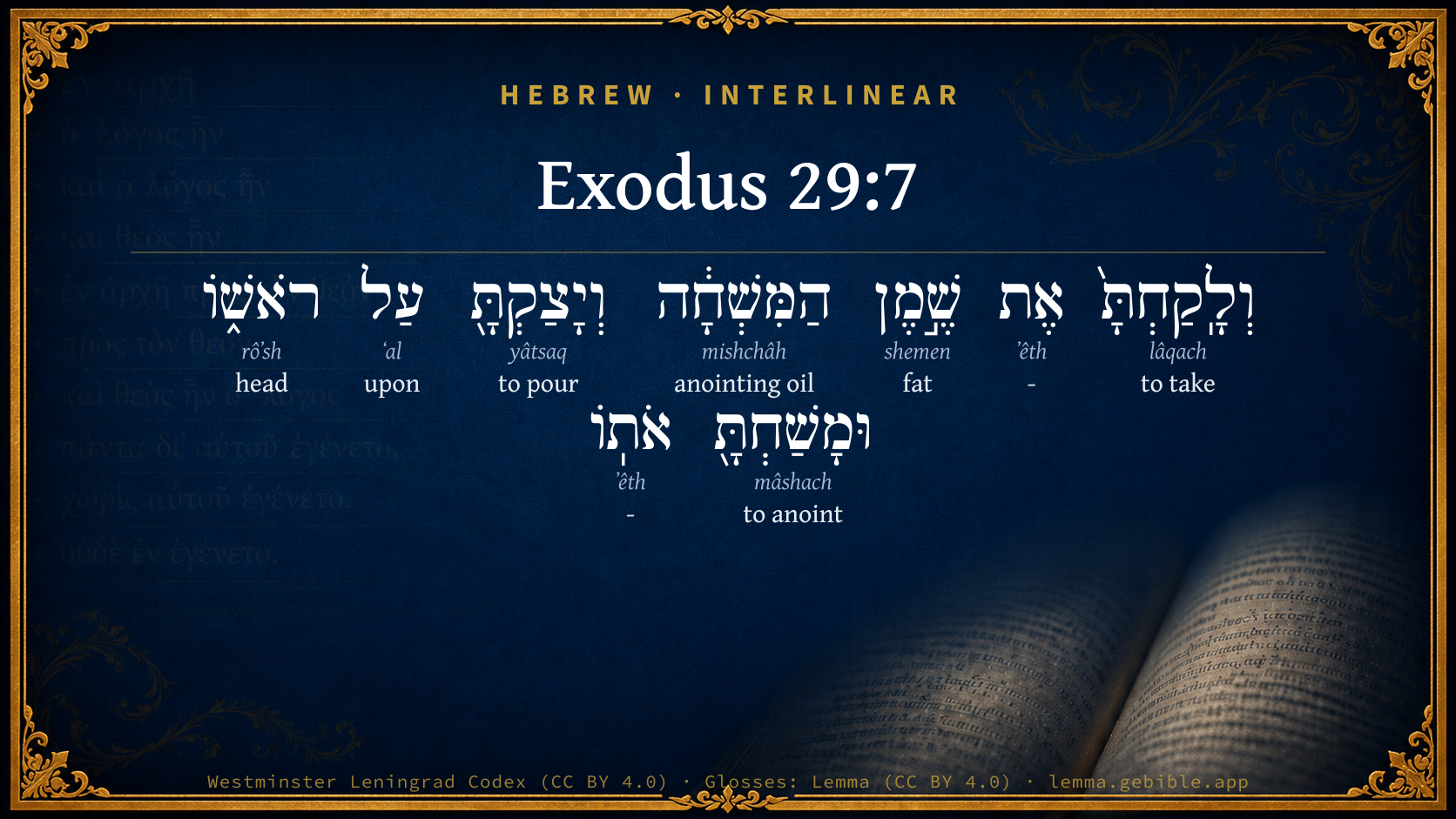
  1. וְלָֽקַחְתָּ֙ lâqach H3947 “and · to take” Conjunction + Verb, Qal, Sequential Perfect, 2nd Person, Masculine, Singular
  2. אֶת ʼêth H853 “-” Particle, Direct Object
  3. שֶׁ֣מֶן shemen H8081 “fat of” Noun, Common, Masculine, Singular, Construct
  4. וְיָצַקְתָּ֖ yâtsaq H3332 “and · to pour” Conjunction + Verb, Qal, Sequential Perfect, 2nd Person, Masculine, Singular
  5. עַל ʻal H5921 “upon” Preposition
  6. רֹאשׁ֑וֹ rôʼsh H7218 “head · his” Noun, Common, Masculine, Singular, Construct + Suffix, Personal, 3rd Person, Masculine, Singular
  7. וּמָשַׁחְתָּ֖ mâshach H4886 “and · to anoint” Conjunction + Verb, Qal, Sequential Perfect, 2nd Person, Masculine, Singular
  8. אֹתֽוֹ ʼêth H853 “- · him” Particle, Direct Object + Suffix, Personal, 3rd Person, Masculine, Singular

About this verse

These counts appear in no published source. They are computed here, from the morphology-tagged text and Lemma’s own curated glosses. What Lemma adds →

9
words
8
distinct lemmas
Pentateuch
section

Shared distinctive vocabulary

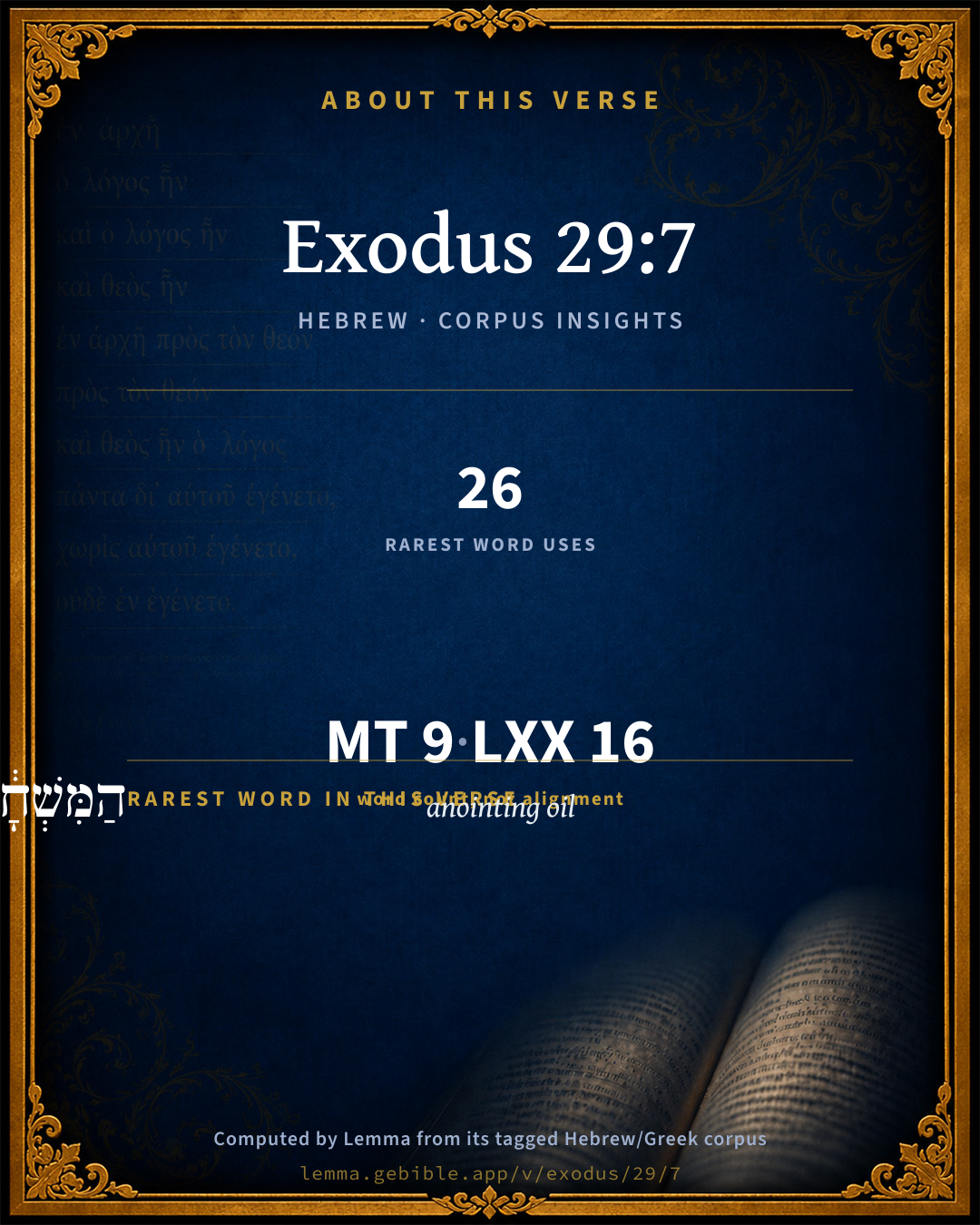
הַמִּשְׁחָ֔ה anointing oil H4888 occurs in 24 verses of the Hebrew Bible. Also found in:

Grammatical profile

  • 3 verbs
  • 3 nouns
  • 1 preposition
  • 2 particles

Verb forms

  • וְלָֽקַחְתָּ֙ Qal · Sequential Perfect
  • וְיָצַקְתָּ֖ Qal · Sequential Perfect
  • וּמָשַׁחְתָּ֖ Qal · Sequential Perfect

Hebrew & Septuagint length

In English translation the verse runs 16 words from the Hebrew and 20 from the Septuagint (LXX English) — closely comparable.

A rough comparison of the two English renderings, which tokenize alike — not a word-level alignment.

Word counts can differ between the Hebrew and the Greek without any difference in meaning — e.g. the Hebrew direct-object marker אֵת has no separate Greek word, and Greek often adds the article ὁ.

In the original languages it is 9 Hebrew tokens and 16 Greek tokens — but the two are counted differently (Hebrew bundles its prefixes and suffixes into one token; the Greek is in lemma form), so that isn’t a like-for-like length.

Cross-references

11

Topical passages linked to Exodus 29:7 in the Treasury of Scripture Knowledge — connected by theme and wording, ordered by reader-vote popularity; previews shown in the World English Bible.

  • Leviticus 21:10 "'He who is the high priest among his brothers, upon whose head the anointing oil is poured, and that is consecrated to put on the garments, shall not let the hair of his head hang loose, nor tear his clothes;
  • Numbers 35:25 and the congregation shall deliver the manslayer out of the hand of the avenger of blood, and the congregation shall restore him to his city of refuge, where he was fled: and he shall dwell therein until the death of the high priest, who was anointed with the holy oil.
  • Exodus 28:41 You shall put them on Aaron your brother, and on his sons with him, and shall anoint them, and consecrate them, and sanctify them, that they may minister to me in the priest's office.
  • Leviticus 10:7 You shall not go out from the door of the Tent of Meeting, lest you die; for the anointing oil of Yahweh is on you." They did according to the word of Moses.
  • Psalms 89:20 I have found David, my servant. I have anointed him with my holy oil,
  • Psalms 133:2 It is like the precious oil on the head, That ran down on the beard, Even Aaron's beard; That came down on the edge of his robes;
  • Isaiah 61:1 The Spirit of the Lord Yahweh is on me; because Yahweh has anointed me to preach good news to the humble; he has sent me to bind up the broken-hearted, to proclaim liberty to the captives, and the opening [of the prison] to those who are bound;
  • John 3:34 For he whom God has sent speaks the words of God; for God gives the Spirit without measure.
  • Exodus 30:23–31 "Also take fine spices: of liquid myrrh, five hundred shekels; and of fragrant cinnamon half as much, even two hundred and fifty; and of fragrant cane, two hundred and fifty;
  • Leviticus 8:10–12 Moses took the anointing oil, and anointed the tabernacle and all that was in it, and sanctified them.
  • 1 John 2:27 As for you, the anointing which you received from him remains in you, and you don't need for anyone to teach you. But as his anointing teaches you concerning all things, and is true, and is no lie, and even as it taught you, you will remain in him.

Cross-references courtesy of OpenBible.info (CC BY 4.0).

Hebrew and Greek witnesses Masoretic Hebrew ↔ Greek Septuagint

The same verse in the two great witnesses to the Old Testament, shown verse-for-verse.

These are two independent witnesses, not word-aligned to each other, and the Septuagint is shown in lemma (dictionary) form.

Hebrew Exodus 29:7 Masoretic · Westminster Leningrad Codex

וְלָֽקַחְתָּ֙ אֶת שֶׁ֣מֶן הַמִּשְׁחָ֔ה וְיָצַקְתָּ֖ עַל רֹאשׁ֑וֹ וּמָשַׁחְתָּ֖ אֹתֽוֹ

Then you shall take the anointing oil, and pour it on his head, and anoint him.

World English Bible · Public Domain

Greek LXX Exodus 29:7 Septuagint · lemma form

καί λαμβάνω ὁ ἔλαιον ὁ χρίσμα καί ἐπιχέω αὐτός ἐπί ὁ κεφαλή αὐτός καί χρίω αὐτός

And you shall take of the anointing oil, and you shall pour it on his head, and shall anoint him,

LXX2012 (modern English Septuagint) · Public Domain

Hebrew: Westminster Leningrad Codex (CC BY 4.0). Greek: Septuagint (public domain); English from LXX2012 (modern English Septuagint) (Public Domain). How the Septuagint differs from the Hebrew →

Targum (Aramaic paraphrase)

2

The Targum is the ancient Jewish Aramaic paraphrase of the Hebrew Scriptures — an interpretive translation, not the Hebrew text itself. Onkelos (literal) and Pseudo-Jonathan (expansive) render the Torah, and Jonathan the Prophets. Coverage is partial: where no permissively-licensed English translation exists for a verse, only the Aramaic is shown. This is verse-level text, not a word-by-word alignment to the Hebrew.

  1. Targum Onkelos Torah (Genesis–Deuteronomy)
    וְתִסַב יָת מִשְׁחָא דִרְבוּתָא וּתְרִיק עַל רֵישֵׁהּ וּתְרַבֵּהּ יָתֵהּ:

    (no public-domain English translation for this verse)

    Targum Onkelos — Aramaic: “Onkelos Genesis” (public domain); “Onkelos Exodus” (public domain); “Onkelos Leviticus” (public domain); “Onkelos Numbers” (public domain); “Onkelos Deuteronomy” (public domain). English: “Sefaria Community Translation” (CC0 1.0 (public-domain dedication)); “J.W. Etheridge. The Targums of Onkelos and Jonathan Ben Uzziel on the Pentateuch. London: Longmans, Green, 1862” (public domain). Text via Sefaria.

  2. Targum Pseudo-Jonathan Torah (Genesis–Deuteronomy)
    וְתִיסַב יַת מִשְׁחָא דִרְבוּתָא וְתָרִיק עַל רֵישֵׁיהּ וּתְרַבֵּי יָתֵיהּ

    And thou shalt take the anointing oil, and pour it upon his head and anoint him.

    Targum Pseudo-Jonathan — Aramaic: “Targum Jonathan on Genesis” (public domain); “Targum Jonathan on Exodus” (public domain); “Targum Jonathan on Leviticus” (public domain); “Targum Jonathan on Numbers” (public domain); “Targum Jonathan on Deuteronomy” (public domain). English: “The Targum of Jonathan ben Uzziel, trans. J. W. Etheridge, London, 1862” (public domain). Text via Sefaria.

Commentary

Notes on Exodus 29:7 from classic Christian and Jewish commentators (each source and its license shown beneath its notes). The classic Christian expositions comment on the surrounding passage and are grouped to its opening verse, so a note may address several verses; the Jewish commentaries on the Tanakh (Rashi and others) are per-verse, so they appear only where the commentator wrote on this verse.

Lemma curates 59 commentaries, every one of them public domain or Creative Commons licensed, each selected and text-cleaned for this edition rather than reprinted as found. About our sources →

Trapp's Complete Commentary

John Trapp

Exo 29:7 Then shalt thou take the anointing oil, and pour [it] upon his head, and anoint him.

Ver. 7. The Anointing oil.] Typing out that abundance of the Holy Spirit poured upon Christ, {Isa 61:1} and upon Christions. {1Jn 2:27 Psa 133:2}

John Trapp, A Commentary or Exposition upon All the Books of the Old and New Testament (1647–1656) — public domain. Text from a community e-Sword module.

Joseph Benson's Commentary

Exo 29:7. Thou shalt take the anointing oil — Emblematical of the Holy Spirit, Isa 61:1; and pour it upon his head — In token of the pouring out of that Spirit upon him to qualify him for his work, that the church might be filled with the sweet savour of his ministrations.

Joseph Benson's Commentary on the Old and New Testaments (1811–1818) — public domain. Text from a community e-Sword module.

Tyndale Open Study Notes

Tyndale Open Resources

29:7 The anointing oil empowered a person for a task through the Holy Spirit (see Isa 61:1).

Tyndale Open Study Notes — © Tyndale Open Resources, licensed CC BY-SA 4.0. Text via the HelloAO Bible API.

Adam Clarke's Commentary

Verse 7. Then shalt thou take the anointing oil] It appears, from Isa 61:1, that anointing with oil, in consecrating a person to any important office, whether civil or religious, was considered as an emblem of the communication of the gifts and graces of the Holy Spirit. This ceremony was used on three occasions, viz., the installation of prophets, priests, and kings, into their respective offices. But why should such an anointing be deemed necessary? Because the common sense of men taught them that all good, whether spiritual or secular, must come from God, its origin and cause. Hence it was taken for granted,

1. That no man could foretell events unless inspired by the Spirit of God. And therefore the prophet was anointed, to signify the communication of the Spirit of wisdom and knowledge.

2. That no person could offer an acceptable sacrifice to God for the sins of men, or profitably minister in holy things, unless enlightened, influenced, and directed by the Spirit of grace and holiness. Hence the priest was anointed, to signify his being Divinely qualified for the due performance of his sacred functions.

3. That no man could enact just and equitable laws, which should have the prosperity of the community and the welfare of the individual continually in view, or could use the power confided to him only for the suppression of vice and the encouragement of virtue, but that man who was ever under the inspiration of the Almighty.

Hence kings were inaugurated by anointing with oil. Two of these officers only exist in all civilized nations, the sacerdotal and regal; and in some countries the priest and king are still consecrated by anointing. In the Hebrew language משח mashach signifies to anoint, and משיח mashiach, the anointed person. But as no man was ever dignified by holding the three offices, so no person ever had the title mashiach, the anointed one, but Jesus the Christ. He alone is King of kings and Lord of lords: the king who governs the universe, and rules in the hearts of his followers; the prophet, to instruct men in the way wherein they should go; and the great high priest, to make atonement for their sins. Hence he is called the Messias, a corruption of the word המשיח hammashiach, THE anointed ONE, in Hebrew; which gave birth to ὁ Χριστος, ho Christos, which has precisely the same signification in Greek. Of him, Melchizedek, Abraham, Aaron, David, and others were illustrious types. But none of these had the title of THE MESSIAH, or THE ANOINTED of GOD. This does, and ever will, belong exclusively to JESUS the CHRIST.

Adam Clarke's Commentary on the Bible (1810–1826) — public domain. Text from a community e-Sword/MySword module.

Ellicott's Commentary for English Readers

(7) The anointing oil—i.e., the oil mentioned in Exo_25:6, and recently glanced at in Exo_28:41. On its composition see Exo_30:23-25.

Pour it upon his head.—As the ablution typified cleansing from sin, so the anointing was emblematic of the outpouring of Divine grace upon the person anointed. The pouring of the oil on Aaron’s head was perhaps to indicate the freeness and abundance with which God gives His grace to His servants. (Comp. Psa_133:2.)

Coats—i.e., tunics. (See Note 1 on Exo_28:40.)

The bonnets.—Rather, caps. (See Note 3 on Exo_28:40.)

The priest’s office shall be their’s for a perpetual statute.—That is, not only shall they individually be priests, but the office shall descend to their posterity, and so be theirs perpetually.

Thou shalt consecrate Aaron and his sons.—Heb., Thou shalt fill the hand of Aaron and the hand of his sons. Induction into an office was usually effected in the East by placing its insignia in the hand of the person appointed to it. Aaron and his sons were to be inducted by having a portion of the sacrifices placed in their hands (Exo_29:24).

A Bible Commentary for English Readers, edited by Charles John Ellicott (1878–1897) — public domain. Text from a community e-Sword module.

The Cambridge Bible for Schools and Colleges

gen. ed. J. J. S. Perowne

7. the anointing oil] see, for its ingredients and use, Exo_30:22-33. Here only the high priest is anointed, in accordance with the expression ‘anointed priest,’ by which he is distinguished from the ordinary priests (Lev_4:3; Lev_4:5; Lev_4:16; Lev_6:22). On some other passages in P in which the ordinary priests are represented as anointed, see on Exo_30:30.

The Cambridge Bible for Schools and Colleges (gen. ed. J. J. S. Perowne; Cambridge University Press, 1878–1918) — public domain. Text from a community e-Sword module.

John Gill's Exposition

Then thou shall take the anointing oil, After ordered to be made of principal spices, myrrh, cinnamon, calamus, cassia, and oil olive, Exo 30:23.

and pour it upon his head, and anoint him; this was done, according to Jarchi, in the form of the letter "chi" as before; the oil was put upon his head and between his eyebrows, and he joined them with his finger: Aben Ezra thinks this was done before the mitre was put upon his head, for upon the head was the oil only poured; but Nachmanides was of opinion that the mitre was so folded about the head that the middle of the head was open, and upon that the oil was poured; and so the Talmudists say (x) that his (the high priest's) hair was seen between the plate of gold and the mitre; but however this was, it seems plain from the text that this anointing was after the mitre was put on, and the priest habited with all his garments; and it is also as clear a case, that the ointment was poured on his head, which ran down to his beard, Psa 133:2, and I see no difficulty in supposing that the mitre and crown might be taken off again while the ceremony of anointing was performed. This unction denotes the investiture of Christ with his office in eternity, who is said to be anointed so early, Pro 8:22, and the donation of the Spirit to him in time, without measure; with which he is said to be anointed, both at his incarnation and at his baptism, and also at his ascension to heaven, and hence comes the name of the Messiah, which signifies anointed; and so his people, his priests, are anointed of God, with an unction from him, with the oil of grace, with the graces of the Spirit, which is necessary for their instruction, for the presentation of themselves to as an holy sacrifice, and to make them meet for the heavenly glory.

(x) T. Bab. Zebachim, fol. 19. 1.

John Gill's Exposition of the Whole Bible (1746–1763) — public domain (CC PDM 1.0). Text via the HelloAO Bible API.

Haydock's Catholic Bible Commentary

Pour, in the form of a cross or T, according to many of the Rabbin, &c. The inferior priests were anointed only on the hands. The Levites were sprinkled with oil, mixed with the blood of the victims. The custom of anointing prophets, priests, and kings, was peculiar to the Jews; as if to foreshow Christ, the great anointed of the Lord. (St. Augustine; Psalm xliv.; Daniel ix. 24.)

George Leo Haydock (1774–1849), Haydock's Catholic Family Bible and Commentary, 1859 edition — public domain. Excludes Psalms (Douay-Rheims chapter numbering differs from Protestant) and Deuterocanonical books (Catholic canon only).

Matthew Poole's English Annotations

Which signified the gifts and graces of the Holy Ghost, wherewith Christ; as, and the priests ought to be, replenished. See Isa 61:1. 1Jo 2:27. But here ariseth a difficulty; for this anointing is sometimes spoken of as peculiar to the high priest, as Lev 21:10, sometimes as common to all the priests, Exo 30:30; 40:14,15, which may be thus reconciled: the oil, was sprinkled upon all the priests, and their right ears, thumbs, and toes, and their garments, Exo 29:20,21; Le 8:30, but it was poured out upon the head only of the high priest, Psa 133:2, who herein was a type of Christ, who was

anointed above his fellows, Psa 45:7; Heb 1:9.

Matthew Poole's English Annotations on the Holy Bible (1683–1685) — public domain. Text from a community e-Sword/MySword module.

Whedon's Commentary on the Bible

Daniel D. Whedon

7. The anointing oil — The composition of which is described in Exo_30:23-25. Compare the allusion in Psa_133:2.

Daniel D. Whedon (gen. ed.), Commentary on the Old and New Testaments (1874–1909) — public domain. Text from a community e-Sword module.

The Pulpit Commentary

The Chrism or Anointing.

The anointing oil had been mentioned previously in Exo_25:6, when "spices" had been required from the congregation to form a portion of it. Its composition is given in Exo_30:23-25; a passage from which we gather that it was exceedingly rich and costly. And pour it upon his head. Compare Psa_133:2. While ablution is a rite common to many religions, the religious use of unction is peculiar to the Mosaic and the Christian. In the Mosaic it was applied to initiate into their office the prophet, the priest, and the king. In Christianity it was originally a rite by which sick persons were miraculously cured, from (Jam_5:14, Jam_5:15) which use it was afterwards extended by ecclesiastical authority to other important ceremonies. The typical meaning under Christianity is clear; the oil represents the Holy Spirit, and the anointing the outpouring of that Spirit on those who are the objects of it. Christ himself obtained his title of Christ (or Messiah), because he was "anointed with the Holy Ghost and with power". (Act_10:38) Under Mosaism this idea was, at most, latent. Unction was understood to mark

(1) Dignity, because the olive was the first of trees; (Jud_1:9:9) and

(2) Continuance, because oil preserves things for a long time from corruption. Unction with the holy oil of the sanctuary no doubt further signified consecration to God"s service. It was applied not only to the priests, but to the tabernacle, the ark, the table of shew-bread with its vessels, the seven branched candlestick, the altar of incense, the altar of burnt offering, and the laver, all of which thereupon became "most holy". (Exo_30:26-29)

The Pulpit Commentary (1880–1919), ed. H.D.M. Spence-Jones & Joseph S. Exell — public domain. Text from a community e-Sword module.

John Wesley's Explanatory Notes

The high priest was to be anointed with the holy anointing oil - That the church might be filled with the sweet favour of his administrations, and in token of the pouring out of the Spirit upon him, to qualify him for his work.

John Wesley, Explanatory Notes Upon the Whole Bible (1754–1765) — public domain. Text via the GEBible commentary corpus.

Rashi

Rabbi Shlomo Yitzchaki (Rashi)

ומשחת אתו AND THOU SHALT ANOINT HIM — This anointing also, was in the form of a X: he put a drop of oil on his head and another drop between his eyebrows and joined them with his finger into this shape (Keritot 5b).

Rashi on the Tanakh — English translations: “The Judaica Press complete Tanach with Rashi, translated by A. J. Rosenberg” (CC BY 4.0); “Pentateuch with Rashi's commentary by M. Rosenbaum and A.M. Silbermann, 1929-1934” (public domain); “The Metsudah Tanach series, Lakewood, N.J” (CC BY 4.0); and “The Book of Joshua, Metsudah Publications, 1997” (CC BY 4.0). Text via Sefaria.

Ramban (Nachmanides)

Rabbi Moshe ben Nachman (Ramban / Nachmanides)

THEN SHALT THOU TAKE THE ANOINTING OIL, AND POUR IT UPON HIS HEAD. Rabbi Abraham ibn Ezra wrote that this was before the setting of the mitre upon his head [mentioned in the preceding verse], for it is upon the head itself that Moses was to pour the oil. But this does not appear to me to be correct. For at the actual installation also, Scripture says, And he set the mitre upon his head etc., and afterwards it says, And Moses took the anointing oil, and anointed the Tabernacle, Verse 10. and subsequently it states, And he poured of the anointing oil upon Aaron’s head., Verse 12. But the correct interpretation is that he wound [the mitznepheth] around and around the head, but left the middle of the head uncovered, and it was on that place that he poured the oil. But if the anointing was upon the entire head as Rashi said, then [we must say] that the pouring of the oil was upon the place where the phylacteries lay, which was left uncovered, and from there he joined [the oil with his finger to the drop between his eyebrows] in the form of an X.

Ramban (Nachmanides) on the Tanakh — English translation: “Commentary on the Torah by Ramban (Nachmanides). Translated and annotated by Charles B. Chavel. New York, Shilo Pub. House, 1971-1976” (CC BY 4.0). Text via Sefaria.

Ibn Ezra

Rabbi Abraham ibn Ezra

And pour it on his head. This was done to Aharon alone, before the turban was placed upon him. Thus the oil was poured directly on his head in keeping with Tehillim 133:2, “Like goodly oil upon the head, descending upon the beard, the beard of Aharon”.

Ibn Ezra on the Tanakh — English translations: “Sefaria Community Translation” (CC0 1.0 (public-domain dedication)); “Yalkut, Sifsei Chachomim Chumash, Metsudah Publications, 2009” (CC BY 4.0); and “Commentary of Ibn Ezra on Isaiah - trans. by M. Friedlander, 1873” (public domain). Text via Sefaria.

Lesson kit

Teaching starters — assembled from the data on this page, not authored interpretation. Every prompt links to the verse data it draws on. Edit before teaching.

Exodus, in the Pentateuch, opens this verse with 9 words (8 distinct Hebrew lemmas). Its most distinctive word is mishchâh (“anointing oil”). A historical commentator’s framing appears above. Read the whole chapter for the surrounding context.

Discussion questions

  1. How does “anointing oil” (mishchâh) shape what this verse is saying?
  2. Exodus 25:6 shares the word «anointing oil» with this verse. How do the two illuminate each other?
  3. These translations render this verse differently; the difference is in the English rendering, not the original. What questions does that raise?
  4. The verb «וְלָֽקַחְתָּ֙» is Qal Sequential Perfect. How does its form color the action?
  5. Reading how Trapp's Complete Commentary and Joseph Benson's Commentary read this verse, where do the two commentators agree and where do they part?

Things to notice

Reading settings

Reading text

Shown beneath each verse's original-language words.

Old Testament
Old Testament edition

Read the OT as the Masoretic Hebrew (MT) or the Greek Septuagint (LXX).

English shown for the Greek Septuagint (in the Hebrew ↔ Greek comparison).

Comparing translations? Open the Compare panel on any verse page to stack up to four side by side.