
2 Kings 9:6

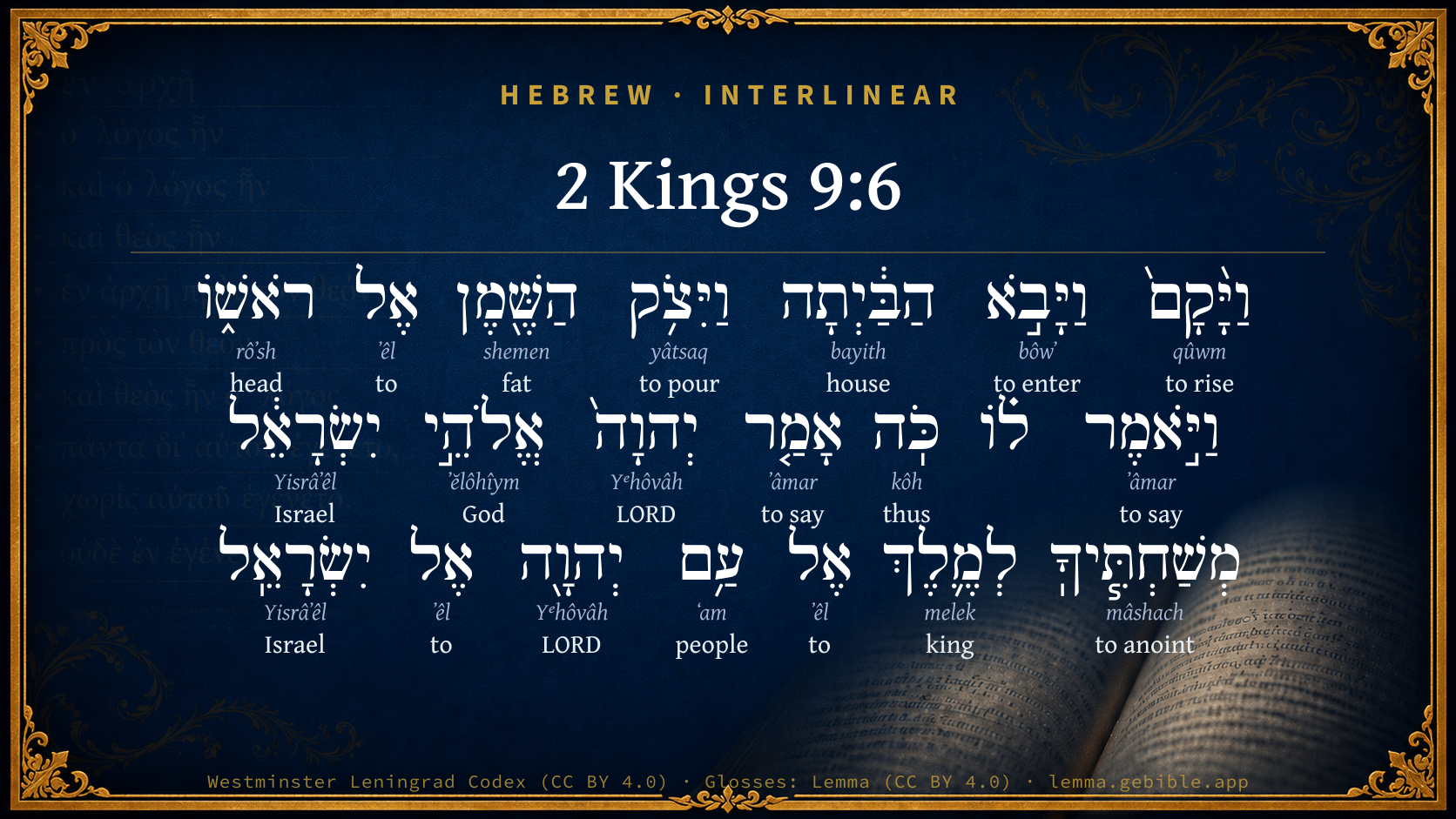
Hebrew (Westminster Leningrad Codex) 2 Kings 9:6 appears in the Hebrew Old Testament. The text above is from the Westminster Leningrad Codex. Each word links to its Strong’s number, a concise gloss, and parsing drawn from the Open Scriptures Hebrew Bible morphology. Click any word for its full Brown-Driver-Briggs (BDB) entry.
Download image
Cite this verse

2 Kings 9:6 (World English Bible). Public Domain. Lemma interlinear Bible study tool, https://lemma.gebible.app/v/2-kings/9/6.

Show BibTeX & RIS
BibTeX
RIS
English Translation
He arose, and went into the house; and he poured the oil on his head, and said to him, Thus says Yahweh, the God of Israel, I have anointed you king over the people of Yahweh, even over Israel.
World English Bible · Public Domain
Download a study sheet

One document with this verse’s original text, its word-by-word gloss line, the meaning frame, cross-references with their text, attributed commentary, and full source and license credits — printable, and it pastes into notes with its structure intact.

This verse Autodidact and up

Study sheet (.html) Plain text (.txt)

A passage Seminary Student

Up to 50 verses in one chapter. A passage sheet keeps up to 6 commentary sources and 12 cross-references per verse, in the order this page ranks them, and says so on the sheet whenever that leaves anything out. Ask for a single verse and you get the Autodidact verse sheet above.

Everything on this page stays free to read, with no account — the sheet is a download of what is already on screen, not access to it.

Want to remove ads? Support Godless Engineer
Compare translations 3

The same verse in 3 English versions, stacked beneath the original-language interlinear above. Click any original word for its lexicon entry.

Each is an independent rendering of the whole verse — the interlinear is not word-aligned to these translations.

Highlighted words mark where these versions differ — a whole-verse word diff, not a word-by-word alignment.

  • World English Bible Public Domain
    He arose, and went into the house; and he poured the oil on his head, and said to him, Thus says Yahweh, the God of Israel, I have anointed you king over the people of Yahweh, even over Israel.
  • King James Version Public Domain
    And he arose, and went into the house; and he poured the oil on his head, and said unto him, Thus saith the LORD God of Israel, I have anointed thee king over the people of the LORD, even over Israel.
  • unfoldingWord Literal Text CC BY-SA 4.0
    And he arose and came to the house. And he poured the oil on his head and said to him, “Thus says Yahweh, the God of Israel, ‘I have anointed you as king over the people of Yahweh, over Israel.

unfoldingWord Literal Text — © unfoldingWord, licensed CC BY-SA 4.0. Word-aligned USFM3 via Door43 (git.door43.org/unfoldingWord/en_ult).

Versions to compare (up to 4)

3 of 4 selected

Show all 18 translations

Every available English version of this verse, each an independent rendering of the whole verse.

  • World English Bible Public Domain
    He arose, and went into the house; and he poured the oil on his head, and said to him, Thus says Yahweh, the God of Israel, I have anointed you king over the people of Yahweh, even over Israel.
  • Berean Standard Bible Public Domain
    So Jehu got up and went into the house, where the young prophet poured the oil on his head and declared, “This is what the LORD, the God of Israel, says: ‘I anoint you king over the LORD’s people Israel.
  • Majority Standard Bible Public Domain
    So Jehu got up and went into the house, where the young prophet poured the oil on his head and declared, “This is what the LORD, the God of Israel, says: ‘I anoint you king over the LORD’s people Israel.
  • King James Version Public Domain
    And he arose, and went into the house; and he poured the oil on his head, and said unto him, Thus saith the LORD God of Israel, I have anointed thee king over the people of the LORD, even over Israel.
  • American Standard Version (1901) Public Domain
    And he arose, and went into the house; and he poured the oil on his head, and said unto him, Thus saith Jehovah, the God of Israel, I have anointed thee king over the people of Jehovah, even over Israel.
  • Revised Version (1885) Public Domain
    And he arose, and went into the house; and he poured the oil on his head, and said unto him, Thus saith the LORD, the God of Israel, I have anointed thee king over the people of the LORD, even over Israel.
  • Geneva Bible (1599) Public Domain
    And he arose, and went into the house, and he powred the oyle on his head and sayde vnto him, Thus sayth the Lord God of Israel, I haue anointed thee for King ouer the people of the Lord, euen ouer Israel.
  • Douay-Rheims (1899) Public Domain
    And he arose, and went into the chamber: and he poured the oil upon his head, and said: Thus saith the Lord God of Israel: I have anointed thee king over Israel, the people of the Lord.
  • Young's Literal Translation Public Domain
    And he riseth and cometh in to the house, and he poureth the oil on his head, and saith to him, `Thus said Jehovah, God of Israel, I have anointed thee for king unto the people of Jehovah, unto Israel,
  • Literal Standard Version CC BY-SA 4.0
    And he rises and comes into the house, and he pours the oil on his head, and says to him, “Thus said YHWH, God of Israel: I have anointed you for king to the people of YHWH, to Israel,
  • Unlocked Literal Bible CC BY-SA 4.0
    So Jehu arose and went into the house, and the prophet poured the oil on his head and said to Jehu, “Yahweh, the God of Israel, says this: 'I have anointed you king over the people of Yahweh, over Israel.
  • unfoldingWord Literal Text CC BY-SA 4.0
    And he arose and came to the house. And he poured the oil on his head and said to him, “Thus says Yahweh, the God of Israel, ‘I have anointed you as king over the people of Yahweh, over Israel.
  • Darby Bible Public Domain
    And he rose up and went into the house; and he poured the oil on his head, and said to him, Thus saith Jehovah the God of Israel: I have anointed thee king over the people of Jehovah, over Israel.
  • World Messianic Bible Public Domain
    He arose, and went into the house. Then he poured the oil on his head, and said to him, “The LORD, the God of Israel, says, ‘I have anointed you king over the people of the LORD, even over Israel.
  • Webster's Bible Public Domain
    And he arose, and went into the house; and he poured the oil on his head, and said to him, Thus saith the LORD God of Israel, I have anointed thee king over the people of the LORD, even over Israel.
  • Free Bible Version CC BY-SA 4.0
    Jehu got up and went inside, where the young prophet poured the olive oil on his head and announced to him, “This is what the Lord, the God of Israel, says: ‘I anoint you king over the Lord's people Israel.
  • Bible in Basic English Public Domain
    And he got up and went into the house; then he put the holy oil on his head and said to him, The Lord, the God of Israel, says, I have made you king over the people of the Lord, over Israel.
  • JPS Tanakh (1917) Public Domain
    And he arose, and went into the house; and he poured the oil on his head, and said unto him: 'Thus saith the LORD, the God of Israel: I have anointed thee king over the people of the LORD, even over Israel.

Literal Standard Version (2020), Covenant Press — licensed CC BY-SA 4.0. Text via the HelloAO Bible API (eBible.org). Unlocked Literal Bible (unfoldingWord) — licensed CC BY-SA 4.0. Text via the HelloAO Bible API (eBible.org). unfoldingWord Literal Text — © unfoldingWord, licensed CC BY-SA 4.0. Word-aligned USFM3 via Door43 (git.door43.org/unfoldingWord/en_ult). Free Bible Version, Dr. Jonathan Gallagher — licensed CC BY-SA 4.0. Text via the HelloAO Bible API (eBible.org).

Word by word

More ways to search: Search by grammar → Find every occurrence → Compare this word →

Practice this passage: Drill this verse → Learn its vocabulary →

וַיִּצֹ֥ק
yâtsaq
H3332
“and · to pour”
Conjunction + Verb, Qal, Sequential Imperfect, 3rd Person, Masculine, Singular
Part of Speech
Conjunction + Verb
Stem
Qal
Form
Sequential Imperfect
Person
3rd Person
Gender
Masculine
Number
Singular
Full BDB Definition

Origin: a primitive root

TWOT: 897

to pour, flow, cast, pour out - (Qal) - to pour, pour out - to cast - to flow - (Hiphil) to pour, pour out - (Hophal) - to be poured - cast, molten (participle) - being firmly established (participle)
  1. וַיָּ֨קָם֙ qûwm H6965 “and · to rise” Conjunction + Verb, Qal, Sequential Imperfect, 3rd Person, Masculine, Singular
  2. וַיָּבֹ֣א bôwʼ H935 “and · to enter” Conjunction + Verb, Qal, Sequential Imperfect, 3rd Person, Masculine, Singular
  3. הַבַּ֔יְתָה bayith H1004 “the · house · toward” Particle, Definite Article + Noun, Common, Masculine, Singular, Absolute + Suffix, Demonstrative
  4. הַשֶּׁ֖מֶן shemen H8081 “the · fat” Particle, Definite Article + Noun, Common, Masculine, Singular, Absolute
  5. אֶל ʼêl H413 “to” Preposition
  6. רֹאשׁ֑וֹ rôʼsh H7218 “head · his” Noun, Common, Masculine, Singular, Construct + Suffix, Personal, 3rd Person, Masculine, Singular
  7. וַיֹּ֣אמֶר ʼâmar H559 “and · to say” Conjunction + Verb, Qal, Sequential Imperfect, 3rd Person, Masculine, Singular
  8. כֹּֽה kôh H3541 “thus” Adverb
  9. אָמַ֤ר ʼâmar H559 “to say” Verb, Qal, Perfect, 3rd Person, Masculine, Singular
  10. יְהוָה֙ Yᵉhôvâh H3068 “LORD” Noun, Proper
  11. אֱלֹהֵ֣י ʼĕlôhîym H430 “God(s) of” Noun, Common, Masculine, Plural, Construct
  12. יִשְׂרָאֵ֔ל Yisrâʼêl H3478 “Israel” Noun, Proper
  13. מְשַׁחְתִּ֧יךָֽ mâshach H4886 “to anoint · you” Verb, Qal, Perfect, 1st Person, Common, Singular + Suffix, Personal, 2nd Person, Masculine, Singular
  14. לְמֶ֛לֶךְ melek H4428 “to/for · king” Preposition + Noun, Common, Masculine, Singular, Absolute
  15. אֶל ʼêl H413 “to” Preposition
  16. עַ֥ם ʻam H5971 “people of” Noun, Common, Masculine, Singular, Construct
  17. יְהוָ֖ה Yᵉhôvâh H3068 “LORD” Noun, Proper
  18. אֶל ʼêl H413 “to” Preposition
  19. יִשְׂרָאֵֽל Yisrâʼêl H3478 “Israel” Noun, Proper

About this verse

These counts appear in no published source. They are computed here, from the morphology-tagged text and Lemma’s own curated glosses. What Lemma adds →

21
words
15
distinct lemmas
Historical
section

Shared distinctive vocabulary

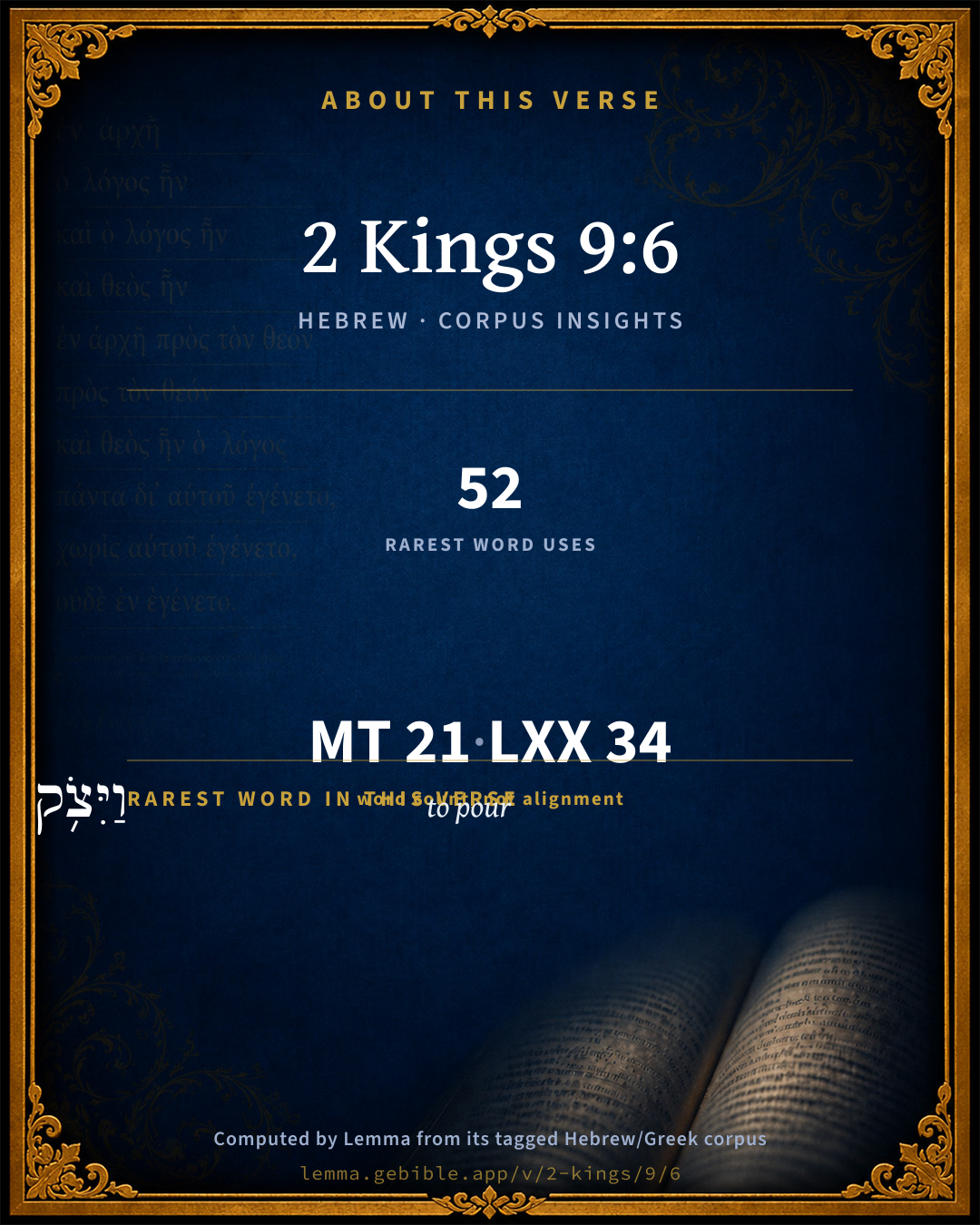
וַיִּצֹ֥ק to pour H3332 occurs in 49 verses of the Hebrew Bible. Also found in:

Grammatical profile

  • 6 verbs
  • 10 nouns
  • 4 prepositions
  • 1 adverb

Verb forms

  • וַיָּ֨קָם֙ Qal · Sequential Imperfect
  • וַיָּבֹ֣א Qal · Sequential Imperfect
  • וַיִּצֹ֥ק Qal · Sequential Imperfect
  • וַיֹּ֣אמֶר Qal · Sequential Imperfect
  • אָמַ֤ר Qal · Perfect
  • מְשַׁחְתִּ֧יךָֽ Qal · Perfect

Repetition

Words recur within this verse — often emphatic in Hebrew:

  • וַיֹּ֣אמֶר to say H559 ×2
  • יְהוָה֙ LORD H3068 ×2
  • יִשְׂרָאֵ֔ל Israel H3478 ×2
  • אֶל to H413 ×3

Hebrew & Septuagint length

In English translation the verse runs 39 words from the Hebrew and 43 from the Septuagint (LXX English) — closely comparable.

A rough comparison of the two English renderings, which tokenize alike — not a word-level alignment.

Word counts can differ between the Hebrew and the Greek without any difference in meaning — e.g. the Hebrew direct-object marker אֵת has no separate Greek word, and Greek often adds the article ὁ.

In the original languages it is 21 Hebrew tokens and 34 Greek tokens — but the two are counted differently (Hebrew bundles its prefixes and suffixes into one token; the Greek is in lemma form), so that isn’t a like-for-like length.

Cross-references

16

Topical passages linked to 2 Kings 9:6 in the Treasury of Scripture Knowledge — connected by theme and wording, ordered by reader-vote popularity; previews shown in the World English Bible.

  • 1 Kings 19:16 and Jehu the son of Nimshi shall you anoint to be king over Israel; and Elisha the son of Shaphat of Abel Meholah shall you anoint to be prophet in your room.
  • 2 Kings 9:3 Then take the vial of oil, and pour it on his head, and say, Thus says Yahweh, I have anointed you king over Israel. Then open the door, and flee, and don't wait.
  • 2 Chronicles 22:7 Now the destruction of Ahaziah was of God, in that he went to Joram: for when he was come, he went out with Jehoram against Jehu the son of Nimshi, whom Yahweh had anointed to cut off the house of Ahab.
  • 1 Kings 1:34 and let Zadok the priest and Nathan the prophet anoint him there king over Israel; and blow you the trumpet, and say, [Long] live king Solomon.
  • 1 Kings 3:8 Your servant is in the midst of your people which you have chosen, a great people, that can't be numbered nor counted for multitude.
  • 1 Kings 10:9 Blessed be Yahweh your God, who delighted in you, to set you on the throne of Israel: because Yahweh loved Israel forever, therefore made he you king, to do justice and righteousness.
  • 1 Kings 14:7 Go, tell Jeroboam, Thus says Yahweh, the God of Israel: Because I exalted you from among the people, and made you prince over my people Israel,
  • 1 Kings 16:2 Because I exalted you out of the dust, and made you prince over my people Israel, and you have walked in the way of Jeroboam, and have made my people Israel to sin, to provoke me to anger with their sins;
  • Psalms 2:6 "Yet I have set my king on my holy hill of Zion."
  • Psalms 75:6 For neither from the east, nor from the west, Nor yet from the south, comes exaltation.
  • Isaiah 45:1 Thus says Yahweh to his anointed, to Cyrus, whose right hand I have held, to subdue nations before him, and I will loose the loins of kings; to open the doors before him, and the gates shall not be shut:
  • Daniel 2:21 He changes the times and the seasons; he removes kings, and sets up kings; he gives wisdom to the wise, and knowledge to those who have understanding;
  • Daniel 4:17 The sentence is by the decree of the watchers, and the demand by the word of the holy ones; to the intent that the living may know that the Most High rules in the kingdom of men, and gives it to whoever he will, and sets up over it the lowest of men.
  • Daniel 4:32 and you shall be driven from men; and they dwelling shall be with the animals of the field; you shall be made to eat grass as oxen; and seven times shall pass over you; until you know that the Most High rules in the kingdom of men, and gives it to whoever he will.
  • Daniel 5:20–21 But when his heart was lifted up, and his spirit was hardened so that he dealt proudly, he was deposed from his kingly throne, and they took his glory from him:
  • Acts 23:18–19 So he took him, and brought him to the commanding officer, and said, "Paul, the prisoner, summoned me and asked me to bring this young man to you, who has something to tell you."

Cross-references courtesy of OpenBible.info (CC BY 4.0).

Hebrew and Greek witnesses Masoretic Hebrew ↔ Greek Septuagint

The same verse in the two great witnesses to the Old Testament, shown verse-for-verse.

These are two independent witnesses, not word-aligned to each other, and the Septuagint is shown in lemma (dictionary) form.

Hebrew 2 Kings 9:6 Masoretic · Westminster Leningrad Codex

וַיָּ֨קָם֙ וַיָּבֹ֣א הַבַּ֔יְתָה וַיִּצֹ֥ק הַשֶּׁ֖מֶן אֶל רֹאשׁ֑וֹ וַיֹּ֣אמֶר ל֗וֹ כֹּֽה אָמַ֤ר יְהוָה֙ אֱלֹהֵ֣י יִשְׂרָאֵ֔ל מְשַׁחְתִּ֧יךָֽ לְמֶ֛לֶךְ אֶל עַ֥ם יְהוָ֖ה אֶל יִשְׂרָאֵֽל

He arose, and went into the house; and he poured the oil on his head, and said to him, Thus says Yahweh, the God of Israel, I have anointed you king over the people of Yahweh, even over Israel.

World English Bible · Public Domain

Greek LXX 2 Kings 9:6 Septuagint · lemma form

καί ἀναἵστημι καί εἰςἔρχομαι εἰς ὁ οἶκος καί ἐπιχέω ὁ ἔλαιον ἐπί ὁ κεφαλή αὐτός καί εἶπον αὐτός ὅδε λέγω κύριος ὁ θεός ἰσραήλ χρίω σύ εἰς βασιλεύς ἐπί λαός κύριος ἐπί ὁ ἰσραήλ

And he arose, and went into the house: and he poured the oil upon his head, and said to him, Thus says the Lord God of Israel, I have anointed you to be king over the people of the Lord, even over Israel.

LXX2012 (modern English Septuagint) · Public Domain

Hebrew: Westminster Leningrad Codex (CC BY 4.0). Greek: Septuagint (public domain); English from LXX2012 (modern English Septuagint) (Public Domain). How the Septuagint differs from the Hebrew →

Targum (Aramaic paraphrase)

1

The Targum is the ancient Jewish Aramaic paraphrase of the Hebrew Scriptures — an interpretive translation, not the Hebrew text itself. Onkelos (literal) and Pseudo-Jonathan (expansive) render the Torah, and Jonathan the Prophets. Coverage is partial: where no permissively-licensed English translation exists for a verse, only the Aramaic is shown. This is verse-level text, not a word-by-word alignment to the Hebrew.

  1. Targum Jonathan Prophets (Joshua–Malachi)
    וְקָם וְעַל לְבֵיתָא וַאֲרִיק מִשְׁחָא עַל רֵישֵׁיהּ וַאֲמַר לֵיהּ כִּדְנַן אֲמַר יְיָ אֱלָהָא דְיִשְׂרָאֵל מְשַׁחְתָּךְ לְמֶהֱוֵי מַלְכָּא עַל עַמָא דַייָ עַל יִשְׂרָאֵל:

    (no public-domain English translation for this verse)

    Targum Jonathan — Aramaic: “Mikraot Gedolot” (public domain). English: “Sefaria Community Translation” (CC0 1.0 (public-domain dedication)); “London "Chaldee Paraphrase," 1871” (public domain). Text via Sefaria.

Commentary

Notes on 2 Kings 9:6 from classic Christian and Jewish commentators (each source and its license shown beneath its notes). The classic Christian expositions comment on the surrounding passage and are grouped to its opening verse, so a note may address several verses; the Jewish commentaries on the Tanakh (Rashi and others) are per-verse, so they appear only where the commentator wrote on this verse.

Lemma curates 59 commentaries, every one of them public domain or Creative Commons licensed, each selected and text-cleaned for this edition rather than reprinted as found. About our sources →

Trapp's Complete Commentary

John Trapp

2Ki 9:6 And he arose, and went into the house; and he poured the oil on his head, and said unto him, Thus saith the LORD God of Israel, I have anointed thee king over the people of the LORD, [even] over Israel.

Ver. 6. And he arose.] This, saith one, {a} showeth some piety toward God to have been in him, although it was soon overthrown by his vainglory.

{a} Dr Maier.

John Trapp, A Commentary or Exposition upon All the Books of the Old and New Testament (1647–1656) — public domain. Text from a community e-Sword module.

Joseph Benson's Commentary

2Ki 9:6. He arose and went into the house — That is, into an inner chamber in the house. And he poured the oil on his head — Thereby giving him, in God’s name both a right to the kingdom and the actual possession of it. The Israelites, it must be observed, were still by right and profession the people of God, though they worshipped other gods with him. And it belonged to him to appoint what ruler he pleased over them; which he now did by his prophet. Without this authority, if Jehu had taken the government upon him, he had been a usurper.

Joseph Benson's Commentary on the Old and New Testaments (1811–1818) — public domain. Text from a community e-Sword module.

Geneva Bible (1599)

Geneva Bible translators

This anointing was for Kings, Priests and Prophets, which were all figures of Messiah, in whom these three offices were accomplished.

Geneva Bible (1599) marginal notes — public domain. Text via Bolls.life.

Adam Clarke's Commentary

Verse 6. King over the people of the Lord] This pointed out to Jehu that he was to rule that people according to God's law; and consequently, that he was to restore the pure worship of the Most High in Israel.

Adam Clarke's Commentary on the Bible (1810–1826) — public domain. Text from a community e-Sword/MySword module.

Ellicott's Commentary for English Readers

(6) And he arose—i.e., Jehu arose.

Into the house.—The council of war was sitting in the court.

I have anointed thee.—The commission to Elijah (1Ki_19:16) was thus fulfilled by his successor.

Over the people of the Lord.—Israel being Jehovah’s people, Jehovah was Israel’s true king, and therefore it was within His sovereign right to appoint whom He would as His earthly representative. Reuss asserts that this account of the anointing of Jehu, like that of the anointing of Hazael (2Ki_8:13), is substituted in the present narration for what another document related of Elijah. This is pure conjecture. It is easier to suppose that Elijah had instructed his successor to carry out the commission intrusted to himself, although the narrative nowhere says so. He goes on to remark that there is no need to try to clear Elisha of the charge of being a revolutionary and a regicide, for that the new dynasty would make use of his name by way of legitimising itself, exactly as the houses of Kish and of Jesse made use of that of the prophet Samuel. This is being considerably wiser than our only authorities.

A Bible Commentary for English Readers, edited by Charles John Ellicott (1878–1897) — public domain. Text from a community e-Sword module.

The Cambridge Bible for Schools and Colleges

gen. ed. J. J. S. Perowne

6. went into the house] The council was sitting in the courtyard, a place which in Eastern houses can be kept somewhat private.

over the people of the Lord, even over Israel] Though the northern kingdom had cast aside the true worship of Jehovah, and followed readily in the ways of Jeroboam, yet the abundance of prophetic labour which was expended in Israel exceeds, as far as we learn from the Bible, that which was bestowed on the more faithful Judah. Israel is still the people of the Lord.

The Cambridge Bible for Schools and Colleges (gen. ed. J. J. S. Perowne; Cambridge University Press, 1878–1918) — public domain. Text from a community e-Sword module.

John Gill's Exposition

And thou shalt smite the house of Ahab thy master,.... For Jehu was one of Ahab's captains, as he was now one of his son's, as appears from Kg2 9:25, but this was to be no objection with him to the destroying of his house, as being an act of high treason, since he had an order for it from the King of kings, and Lord of lords; which otherwise would have seemed unlawful and criminal, and what follows will sufficiently vindicate the justice of God in it:

that I may avenge the blood of my servants the prophets, and the blood of all the servants of the Lord, at the hand of Jezebel; who killed the prophets of the Lord, and caused to be put to death Naboth the servant of the Lord, and now their blood was to be avenged on her and her son Joram, and all her family.

John Gill's Exposition of the Whole Bible (1746–1763) — public domain (CC PDM 1.0). Text via the HelloAO Bible API.

Matthew Poole's English Annotations

Into the house, i.e. into an inner chamber in the house, 2Ki 9:2.

He poured the oil on his head; thereby in God’s name letting him into the actual possession of the kingdom. For if Elijah did before this time anoint him, as some think, from 1Ki 19:16, that unction did only confer a remote right to the kingdom, as Samuel’s unction did to David, 1Sa 16:13. Though others think Elijah did perform that command by Elisha, to whom he left it in charge, and Elisha waited God’s time and command for the actual execution of it, which he received at this time.

Matthew Poole's English Annotations on the Holy Bible (1683–1685) — public domain. Text from a community e-Sword/MySword module.

Whedon's Commentary on the Bible

Daniel D. Whedon

6. Thus saith the Lord — Compare the following words of this prophet with the words of Ahijah in 1Ki_14:10-11, and of Elijah, 1Ki_21:21-24 and the notes on those passages.

Daniel D. Whedon (gen. ed.), Commentary on the Old and New Testaments (1874–1909) — public domain. Text from a community e-Sword module.

The Pulpit Commentary

And he (Jehu) arose, and went into the house. Jehu left his seat, rose up, and led the way, from the court, where he had probably been sitting with the other generals, into the house which adjoined the court. The messenger followed; and the two were together, alone. And he i.e. the messengerpoured the oil on his head as directed (ver. 3)and said unto him, Thus saith the Lord God of Israel; literally, Thus saith Jehovah, God of Israel. Jehovah"s name is emphatically put forward, in contrast with the name of Baal, as that of the true God of Israel; and appeal is made to Jehu, as to one whose God is Jehovah, and who will accept as authoritative a message emanating from him. I have anointed thee king over the people of the Lord, even over Israel; literally, over the people of Jehovah, over Israel. Practically, the people is, in the main, "the people of Baal", (2Ki_10:19-21) but theoretically and by covenant it is "the people of Jehovah his "peculiar people", (Deu_14:2) chosen by him out of all the nations of the earth to be his own.

The Pulpit Commentary (1880–1919), ed. H.D.M. Spence-Jones & Joseph S. Exell — public domain. Text from a community e-Sword module.

Lesson kit

Teaching starters — assembled from the data on this page, not authored interpretation. Every prompt links to the verse data it draws on. Edit before teaching.

2 Kings, in the Historical, opens this verse with 21 words (15 distinct Hebrew lemmas). Its most distinctive word is yâtsaq (“to pour”). A historical commentator’s framing appears above. Read the whole chapter for the surrounding context.

Discussion questions

  1. The word yâtsaq carries the sense “to pour.” How does it shape the verse?
  2. How does Genesis 28:18, which shares the word «to pour», read alongside this verse?
  3. What does the repetition of “to say” (2× in this one verse) do in this verse?
  4. These translations render this verse differently; the difference is in the English rendering, not the original. What questions does that raise?
  5. «וַיָּ֨קָם֙» is a Qal Sequential Imperfect verb. How does that grammatical form shape the action described?
  6. Compare how Trapp's Complete Commentary and Joseph Benson's Commentary read this verse. Where do they agree or differ?

Things to notice

Reading settings

Reading text

Shown beneath each verse's original-language words.

Old Testament
Old Testament edition

Read the OT as the Masoretic Hebrew (MT) or the Greek Septuagint (LXX).

English shown for the Greek Septuagint (in the Hebrew ↔ Greek comparison).

Comparing translations? Open the Compare panel on any verse page to stack up to four side by side.