Leviticus 7:10

Hebrew (Westminster Leningrad Codex) Leviticus 7:10 appears in the Hebrew Old Testament. The text above is from the Westminster Leningrad Codex. Each word links to its Strong’s number, a concise gloss, and parsing drawn from the Open Scriptures Hebrew Bible morphology. Click any word for its full Brown-Driver-Briggs (BDB) entry.
Download image
Cite this verse

Leviticus 7:10 (World English Bible). Public Domain. Lemma interlinear Bible study tool, https://lemma.gebible.app/v/leviticus/7/10.

Show BibTeX & RIS
BibTeX
RIS
English Translation
Every meal offering, mixed with oil or dry, belongs to all the sons of Aaron, one as well as another.
World English Bible · Public Domain
Highlights Full analysis ↓
Download a study sheet

One document with this verse’s original text, its word-by-word gloss line, the meaning frame, cross-references with their text, attributed commentary, and full source and license credits — printable, and it pastes into notes with its structure intact.

This verse Autodidact and up

Study sheet (.html) Plain text (.txt)

A passage Seminary Student

Up to 50 verses in one chapter. A passage sheet keeps up to 6 commentary sources and 12 cross-references per verse, in the order this page ranks them, and says so on the sheet whenever that leaves anything out. Ask for a single verse and you get the Autodidact verse sheet above.

Everything on this page stays free to read, with no account — the sheet is a download of what is already on screen, not access to it.

Want to remove ads? Support Godless Engineer
Compare translations 3

The same verse in 3 English versions, stacked beneath the original-language interlinear above. Click any original word for its lexicon entry.

Each is an independent rendering of the whole verse — the interlinear is not word-aligned to these translations.

Highlighted words mark where these versions differ — a whole-verse word diff, not a word-by-word alignment.

  • World English Bible Public Domain
    Every meal offering, mixed with oil or dry, belongs to all the sons of Aaron, one as well as another.
  • King James Version Public Domain
    And every meat offering, mingled with oil, and dry, shall all the sons of Aaron have, one as much as another.
  • unfoldingWord Literal Text CC BY-SA 4.0
    And every grain offering, mixed with oil or dry, shall be for all the sons of Aaron, each one as his brother.

unfoldingWord Literal Text — © unfoldingWord, licensed CC BY-SA 4.0. Word-aligned USFM3 via Door43 (git.door43.org/unfoldingWord/en_ult).

Versions to compare (up to 4)

3 of 4 selected

Show all 18 translations

Every available English version of this verse, each an independent rendering of the whole verse.

  • World English Bible Public Domain
    Every meal offering, mixed with oil or dry, belongs to all the sons of Aaron, one as well as another.
  • Berean Standard Bible Public Domain
    and every grain offering, whether dry or mixed with oil, belongs equally to all the sons of Aaron.
  • Majority Standard Bible Public Domain
    and every grain offering, whether dry or mixed with oil, belongs equally to all the sons of Aaron.
  • King James Version Public Domain
    And every meat offering, mingled with oil, and dry, shall all the sons of Aaron have, one as much as another.
  • American Standard Version (1901) Public Domain
    And every meal-offering, mingled with oil, or dry, shall all the sons of Aaron have, one as well as another.
  • Revised Version (1885) Public Domain
    And every meal offering, mingled with oil, or dry, shall all the sons of Aaron have, one as well as another.
  • Geneva Bible (1599) Public Domain
    And euery meate offering mingled with oyle, and that is dry, shall pertaine vnto all the sonnes of Aaron, to all alike.
  • Douay-Rheims (1899) Public Domain
    Whether they be tempered with oil, or dry, all the sons of Aaron shall have one as much as another.
  • Young's Literal Translation Public Domain
    and every present, mixed with oil or dry, is for all the sons of Aaron -- one as another.
  • Literal Standard Version CC BY-SA 4.0
    and every present, mixed with oil or dry, is for all the sons of Aaron—one as another.
  • Unlocked Literal Bible CC BY-SA 4.0
    Every grain offering, either dry or mixed with oil, will belong equally to all the descendants of Aaron.
  • unfoldingWord Literal Text CC BY-SA 4.0
    And every grain offering, mixed with oil or dry, shall be for all the sons of Aaron, each one as his brother.
  • Darby Bible Public Domain
    And every oblation, mingled with oil, and dry, shall all the sons of Aaron have, one as the other.
  • World Messianic Bible Public Domain
    Every meal offering, mixed with oil or dry, belongs to all the sons of Aaron, one as well as another.
  • Webster's Bible Public Domain
    And every meat-offering mingled with oil, and dry, shall all the sons of Aaron have, one as much as another.
  • Free Bible Version CC BY-SA 4.0
    and all grain offerings, whether they are mixed with olive oil or dry, they are for all of Aaron descendants.
  • Bible in Basic English Public Domain
    And every meal offering, mixed with oil or dry, is for all the sons of Aaron in equal measure.
  • JPS Tanakh (1917) Public Domain
    And every meal-offering, mingled with oil, or dry, shall all the sons of Aaron have, one as well as another.

Literal Standard Version (2020), Covenant Press — licensed CC BY-SA 4.0. Text via the HelloAO Bible API (eBible.org). Unlocked Literal Bible (unfoldingWord) — licensed CC BY-SA 4.0. Text via the HelloAO Bible API (eBible.org). unfoldingWord Literal Text — © unfoldingWord, licensed CC BY-SA 4.0. Word-aligned USFM3 via Door43 (git.door43.org/unfoldingWord/en_ult). Free Bible Version, Dr. Jonathan Gallagher — licensed CC BY-SA 4.0. Text via the HelloAO Bible API (eBible.org).

Word by word

More ways to search: Search by grammar → Find every occurrence → Compare this word →

Practice this passage: Drill this verse → Learn its vocabulary →

וַחֲרֵבָ֑ה
chârêb
H2720
“and · desolate”
Conjunction + Adjective, Adjective, Feminine, Singular, Absolute
Part of Speech
Conjunction + Adjective
Type
Adjective
Gender
Feminine
Number
Singular
State
Absolute
Full BDB Definition

Origin: from H2717

TWOT: 731a

waste, desolate, dry
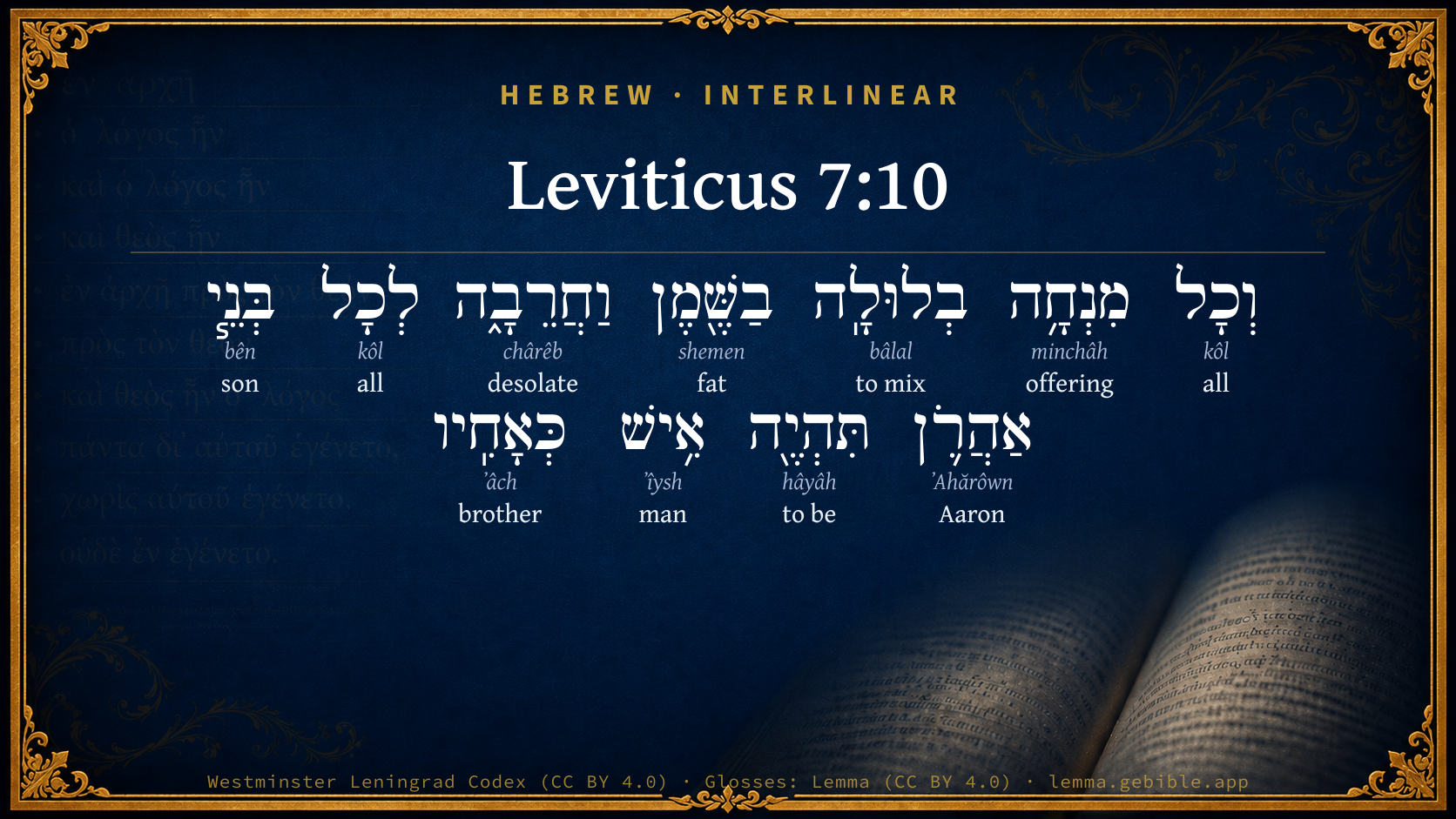
  1. וְכָל kôl H3605 “and · all of” Conjunction + Noun, Common, Masculine, Singular, Construct
  2. מִנְחָ֥ה minchâh H4503 “offering” Noun, Common, Feminine, Singular, Absolute
  3. בְלוּלָֽה bâlal H1101 “mixed” Verb, Qal, Participle Passive, Feminine, Singular, Absolute
  4. בַשֶּׁ֖מֶן shemen H8081 “in/at the · fat” Preposition, Determined + Noun, Common, Masculine, Singular, Absolute
  5. לְכָל kôl H3605 “to/for · all of” Preposition + Noun, Common, Masculine, Singular, Construct
  6. בְּנֵ֧י bên H1121 “sons of” Noun, Common, Masculine, Plural, Construct
  7. אַהֲרֹ֛ן ʼAhărôwn H175 “Aaron” Noun, Proper
  8. תִּהְיֶ֖ה hâyâh H1961 “to be” Verb, Qal, Imperfect, 3rd Person, Feminine, Singular
  9. אִ֥ישׁ ʼîysh H376 “man” Noun, Common, Masculine, Singular, Absolute
  10. כְּאָחִֽיו ʼâch H251 “like/as · brother · his” Preposition + Noun, Common, Masculine, Singular, Construct + Suffix, Personal, 3rd Person, Masculine, Singular

About this verse

These counts appear in no published source. They are computed here, from the morphology-tagged text and Lemma’s own curated glosses. What Lemma adds →

11
words
10
distinct lemmas
Pentateuch
section

Notable vocabulary

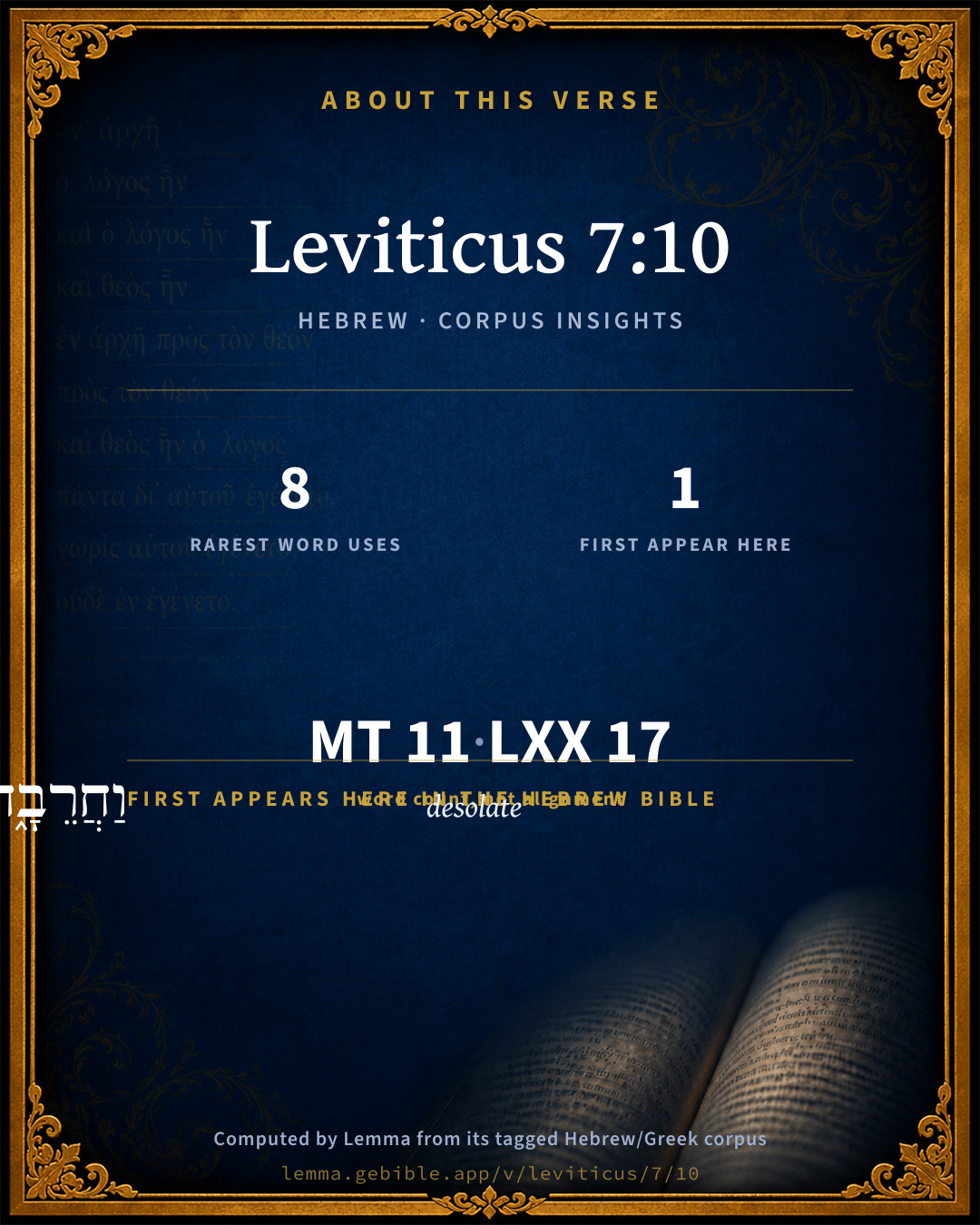
The rarest word here is וַחֲרֵבָ֑ה desolate H2720 — appearing just 8 times in the whole Hebrew Bible.

First appearance in Scripture

This word makes its first canonical appearance in the Hebrew Bible here:

  • וַחֲרֵבָ֑ה desolate H2720

Shared distinctive vocabulary

וַחֲרֵבָ֑ה desolate H2720 occurs in 8 verses of the Hebrew Bible. Also found in:

Grammatical profile

  • 2 verbs
  • 8 nouns
  • 1 adjective

Verb forms

  • בְלוּלָֽה Qal · Participle Passive
  • תִּהְיֶ֖ה Qal · Imperfect

Repetition

A word recurs within this verse — often emphatic in Hebrew:

  • וְכָל all H3605 ×2

Hebrew & Septuagint length

In English translation the verse runs 20 words from the Hebrew and 31 from the Septuagint (LXX English) — the Septuagint runs noticeably longer here. See the side-by-side →

A rough comparison of the two English renderings, which tokenize alike — not a word-level alignment.

Word counts can differ between the Hebrew and the Greek without any difference in meaning — e.g. the Hebrew direct-object marker אֵת has no separate Greek word, and Greek often adds the article ὁ.

In the original languages it is 11 Hebrew tokens and 17 Greek tokens — but the two are counted differently (Hebrew bundles its prefixes and suffixes into one token; the Greek is in lemma form), so that isn’t a like-for-like length.

Cross-references

2

Topical passages linked to Leviticus 7:10 in the Treasury of Scripture Knowledge — connected by theme and wording, ordered by reader-vote popularity; previews shown in the World English Bible.

  • 2 Corinthians 8:14 but for equality. Your abundance at this present time supplies their lack, that their abundance also may become a supply for your lack; that there may be equality.
  • Exodus 16:18 When they measured it with an omer, he who gathered much had nothing over, and he who gathered little had no lack. They gathered every man according to his eating.

Cross-references courtesy of OpenBible.info (CC BY 4.0).

Hebrew and Greek witnesses Masoretic Hebrew ↔ Greek Septuagint

The same verse in the two great witnesses to the Old Testament, shown verse-for-verse.

Here the Septuagint runs noticeably longer than the Hebrew — LXX2012 (modern English Septuagint) 31 words vs World English Bible 20. A rough length comparison of the two English translations, not a word-level alignment — read both below.

These are two independent witnesses, not word-aligned to each other, and the Septuagint is shown in lemma (dictionary) form.

Hebrew Leviticus 7:10 Masoretic · Westminster Leningrad Codex

וְכָל מִנְחָ֥ה בְלוּלָֽה בַשֶּׁ֖מֶן וַחֲרֵבָ֑ה לְכָל בְּנֵ֧י אַהֲרֹ֛ן תִּהְיֶ֖ה אִ֥ישׁ כְּאָחִֽיו

Every meal offering, mixed with oil or dry, belongs to all the sons of Aaron, one as well as another.

World English Bible · Public Domain

Greek LXX Leviticus 7:10 Septuagint · lemma form

καί πᾶς θυσία ἀναποιέω ἐν ἔλαιον καί μή ἀναποιέω πᾶς ὁ υἱός ἀαρών εἰμί ἕκαστος ὁ ἴσος

And whatever soul shall eat of the flesh of the sacrifice of the peace-offering which is the Lord's, and his uncleanness be upon him, that soul shall perish from his people.

LXX2012 (modern English Septuagint) · Public Domain

Hebrew: Westminster Leningrad Codex (CC BY 4.0). Greek: Septuagint (public domain); English from LXX2012 (modern English Septuagint) (Public Domain). How the Septuagint differs from the Hebrew →

Targum (Aramaic paraphrase)

2

The Targum is the ancient Jewish Aramaic paraphrase of the Hebrew Scriptures — an interpretive translation, not the Hebrew text itself. Onkelos (literal) and Pseudo-Jonathan (expansive) render the Torah, and Jonathan the Prophets. Coverage is partial: where no permissively-licensed English translation exists for a verse, only the Aramaic is shown. This is verse-level text, not a word-by-word alignment to the Hebrew.

  1. Targum Onkelos Torah (Genesis–Deuteronomy)
    וְכָל מִנְחָתָא דְפִילָא בִמְשַׁח וּדְלָא פִילָא לְכָל בְּנֵי אַהֲרֹן תְּהֵי גְבַר כַּאָחוֹהִי

    (no public-domain English translation for this verse)

    Targum Onkelos — Aramaic: “Onkelos Genesis” (public domain); “Onkelos Exodus” (public domain); “Onkelos Leviticus” (public domain); “Onkelos Numbers” (public domain); “Onkelos Deuteronomy” (public domain). English: “Sefaria Community Translation” (CC0 1.0 (public-domain dedication)); “J.W. Etheridge. The Targums of Onkelos and Jonathan Ben Uzziel on the Pentateuch. London: Longmans, Green, 1862” (public domain). Text via Sefaria.

  2. Targum Pseudo-Jonathan Torah (Genesis–Deuteronomy)
    וְכָל מִנְחָתָא פְּתִיכָא בִּמְשָׁח וּמְנַגְבָא לְכָל בְּנֵי אַהֲרן תְּהֵי גְבַר כְּאָחוֹי

    And every mincha mixed with oil, or which is dry, shall be for any of the sons of Aharon, a man as his brother.

    Targum Pseudo-Jonathan — Aramaic: “Targum Jonathan on Genesis” (public domain); “Targum Jonathan on Exodus” (public domain); “Targum Jonathan on Leviticus” (public domain); “Targum Jonathan on Numbers” (public domain); “Targum Jonathan on Deuteronomy” (public domain). English: “The Targum of Jonathan ben Uzziel, trans. J. W. Etheridge, London, 1862” (public domain). Text via Sefaria.

Commentary

Notes on Leviticus 7:10 from classic Christian and Jewish commentators (each source and its license shown beneath its notes). The classic Christian expositions comment on the surrounding passage and are grouped to its opening verse, so a note may address several verses; the Jewish commentaries on the Tanakh (Rashi and others) are per-verse, so they appear only where the commentator wrote on this verse.

Lemma curates 59 commentaries, every one of them public domain or Creative Commons licensed, each selected and text-cleaned for this edition rather than reprinted as found. About our sources →

Trapp's Complete Commentary

John Trapp

Lev 7:10 And every meat offering, mingled with oil, and dry, shall all the sons of Aaron have, one [as much] as another.

Ver. 10. Have, one as much as another.] In their father’s house was bread enough. "Put me, I pray thee, into one of the priest’s offices, that I may eat a piece of bread." {1Sa 2:36} This the Tirshatha would not suffer those turn-coats to do. {Ezr 2:63} But how hard put to it was that poor priest that answered young Pareus, asking him an alms, according to the custom of those times, Nos pauperi fratres, nos nihil habemus, an piscis, an caro, an panis, an misericordia habemus? {a}

{a} Vita Parei per Philipp. filium, primo oper. tomo praefixa.

John Trapp, A Commentary or Exposition upon All the Books of the Old and New Testament (1647–1656) — public domain. Text from a community e-Sword module.

Geneva Bible (1599)

Geneva Bible translators

Because it had no oil nor liquor.

Geneva Bible (1599) marginal notes — public domain. Text via Bolls.life.

Ellicott's Commentary for English Readers

(10) And every meat offering . . . and dry.—Better, but every meat offering . . . or dry. The only exception to the foregoing rule is the raw flour offering. That is, the voluntary offering of flour which was mingled with oil (Lev_2:1), or the poor man’s sin

offering, which, though resembling a meat offering, had no oil put upon it (see Lev_5:11), and the offering of jealousy (Num_5:15).

Shall all the sons of Aaron have.—That is, whether with or without oil, the remainder of this kind of raw offering is to be equally shared by all the priests.

One as much as another.—Literally, a man as his brother; that is, every man alike. From the expression man, which, as it will thus be seen, is used in the original but does not appear in the Authorised Version, the rule obtained in the time of Christ that neither a child nor woman, though of priestly descent, could partake of this offering; but a priest who was disqualified from officiating through a physical blemish had a share in it, as he comes under the designation of man.

A Bible Commentary for English Readers, edited by Charles John Ellicott (1878–1897) — public domain. Text from a community e-Sword module.

John Gill's Exposition

And every meat offering mingled with oil, and dry,.... Rather it should be rendered "or dry" (c); that is, as Jarchi interprets it, that has no oil in it; the meat offering in common, let it be dressed in what way soever, was mingled with oil; but in the poor man's offering for sin, which was as a meat offering, no oil was to be put upon it, Lev 5:11 but whether the offering was with or without oil, moist or dry, it

shall all the sons of Aaron have, one as much as another; it was to be equally divided among them; or a priest offering it at one time, was to have the same as another priest at another time; it was always alike, all that remained, except the handful that was burnt, was the priest's.

(c) "vel aridum", Junius & Tremellius, Piscator.

John Gill's Exposition of the Whole Bible (1746–1763) — public domain (CC PDM 1.0). Text via the HelloAO Bible API.

Matthew Poole's English Annotations

Dry, without oil, or drink-offering, as those Lev 5:1; Num 5:15.

One as much as another: the sense may be either,

1. That every priest shall have equal right to this, when the course of his ministration comes. But then there was no reason to make so great an alteration of the phrase, nor to make any distinction of the differing kinds of meatofferings, if in both they were to be the priest’s that offered them, as is expressed Lev 7:9, and here, as they say, intended. Or rather,

2. That these were to be equally divided among all the priests. And there was manifest reason for this difference, because these were in greater quantity than the former; and being raw, might more easily and commodiously be divided and reserved for the several priests to dress it in that way which each of them best liked.

Matthew Poole's English Annotations on the Holy Bible (1683–1685) — public domain. Text from a community e-Sword/MySword module.

John Wesley's Explanatory Notes

Dry - Without oil, or drink-offering, as those chap. v, 11, Num. v, 15. All the sons of Aaron - These were to be equally divided among all the priests. And there was manifest reason for this difference, because these were in greater quantity than the former; and being raw, might more easily be reserved for the several priests to dress it in that way which each of them liked.

John Wesley, Explanatory Notes Upon the Whole Bible (1754–1765) — public domain. Text via the GEBible commentary corpus.

Rashi

Rabbi Shlomo Yitzchaki (Rashi)

בלולה בשמן [AND EVERY MEAL OFFERING] MINGLED WITH OIL — This is the free-will meal-offering (Leviticus 2:1, 4, 5, 7);

וחרבה OR DRY — this is the meal-offering of the sinner (Leviticus 5:11) and the “meal-offering of jealousy” (Numbers 5:15) in which there was no oil.

Rashi on the Tanakh — English translations: “The Judaica Press complete Tanach with Rashi, translated by A. J. Rosenberg” (CC BY 4.0); “Pentateuch with Rashi's commentary by M. Rosenbaum and A.M. Silbermann, 1929-1934” (public domain); “The Metsudah Tanach series, Lakewood, N.J” (CC BY 4.0); and “The Book of Joshua, Metsudah Publications, 1997” (CC BY 4.0). Text via Sefaria.

Lesson kit

Teaching starters — assembled from the data on this page, not authored interpretation. Every prompt links to the verse data it draws on. Edit before teaching.

Leviticus, in the Pentateuch, opens this verse with 11 words (10 distinct Hebrew lemmas). Its most distinctive word is chârêb (“desolate”). The Greek Septuagint runs longer here. A historical commentator’s framing appears above. Read the whole chapter for the surrounding context.

Discussion questions

  1. What does “desolate” (chârêb) contribute to the verse as a whole?
  2. The word “desolate” first appears here in Scripture. What is being introduced at this debut?
  3. Proverbs 17:1 shares the word «desolate» with this verse. How do the two illuminate each other?
  4. “all” occurs 2× in this one verse. What is the effect of the repetition?
  5. Compared with the Hebrew, the Septuagint runs longer here. What questions does that raise?
  6. The translations on this page render this verse differently — a whole-verse word diff, not a word-by-word alignment. What might account for the different wordings?
  7. The verb «בְלוּלָֽה» is Qal Participle Passive. How does its form color the action?
  8. Reading how Trapp's Complete Commentary and Geneva Bible (1599) read this verse, where do the two commentators agree and where do they part?

Things to notice

Reading settings

Reading text

Shown beneath each verse's original-language words.

Old Testament
Old Testament edition

Read the OT as the Masoretic Hebrew (MT) or the Greek Septuagint (LXX).

English shown for the Greek Septuagint (in the Hebrew ↔ Greek comparison).

Comparing translations? Open the Compare panel on any verse page to stack up to four side by side.