
Ezekiel 16:13

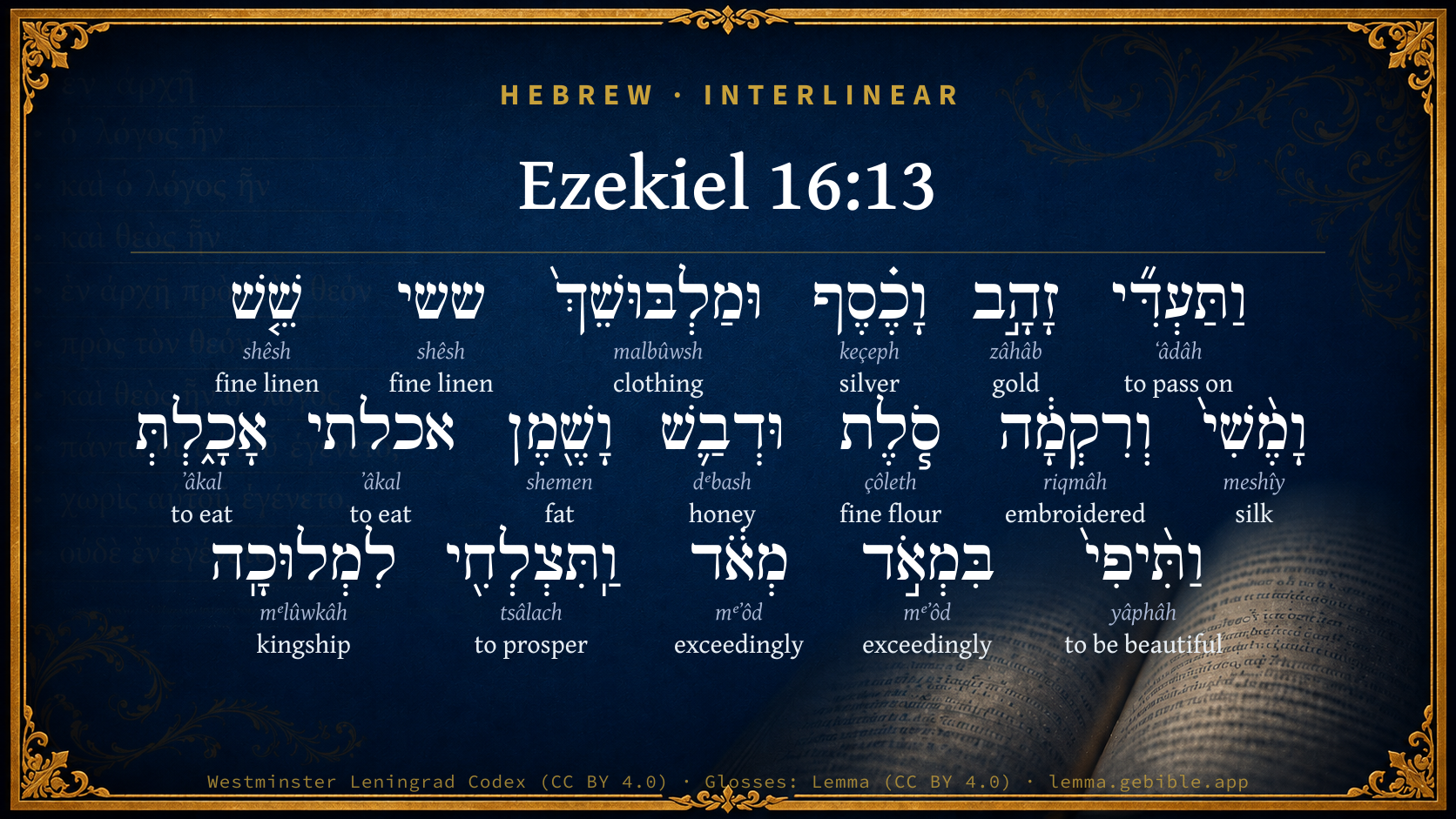
Hebrew (Westminster Leningrad Codex) Ezekiel 16:13 appears in the Hebrew Old Testament. The text above is from the Westminster Leningrad Codex. Each word links to its Strong’s number, a concise gloss, and parsing drawn from the Open Scriptures Hebrew Bible morphology. Click any word for its full Brown-Driver-Briggs (BDB) entry.
Download image
Cite this verse

Ezekiel 16:13 (World English Bible). Public Domain. Lemma interlinear Bible study tool, https://lemma.gebible.app/v/ezekiel/16/13.

Show BibTeX & RIS
BibTeX
RIS
English Translation
Thus was you decked with gold and silver; and your clothing was of fine linen, and silk, and embroidered work; you ate fine flour, and honey, and oil; and you were exceeding beautiful, and you did prosper to royal estate.
World English Bible · Public Domain
Download a study sheet

One document with this verse’s original text, its word-by-word gloss line, the meaning frame, cross-references with their text, attributed commentary, and full source and license credits — printable, and it pastes into notes with its structure intact.

This verse Autodidact and up

Study sheet (.html) Plain text (.txt)

A passage Seminary Student

Up to 50 verses in one chapter. A passage sheet keeps up to 6 commentary sources and 12 cross-references per verse, in the order this page ranks them, and says so on the sheet whenever that leaves anything out. Ask for a single verse and you get the Autodidact verse sheet above.

Everything on this page stays free to read, with no account — the sheet is a download of what is already on screen, not access to it.

Want to remove ads? Support Godless Engineer
Compare translations 3

The same verse in 3 English versions, stacked beneath the original-language interlinear above. Click any original word for its lexicon entry.

Each is an independent rendering of the whole verse — the interlinear is not word-aligned to these translations.

Highlighted words mark where these versions differ — a whole-verse word diff, not a word-by-word alignment.

  • World English Bible Public Domain
    Thus was you decked with gold and silver; and your clothing was of fine linen, and silk, and embroidered work; you ate fine flour, and honey, and oil; and you were exceeding beautiful, and you did prosper to royal estate.
  • King James Version Public Domain
    Thus wast thou decked with gold and silver; and thy raiment was of fine linen, and silk, and broidered work; thou didst eat fine flour, and honey, and oil: and thou wast exceeding beautiful, and thou didst prosper into a kingdom.
  • unfoldingWord Literal Text CC BY-SA 4.0
    So you were adorned with gold and silver, and you were dressed in fine linen, silk, and embroidered clothes; you ate fine flour, honey, and oil, and you were very beautiful, and you became a queen.

unfoldingWord Literal Text — © unfoldingWord, licensed CC BY-SA 4.0. Word-aligned USFM3 via Door43 (git.door43.org/unfoldingWord/en_ult).

Versions to compare (up to 4)

3 of 4 selected

Show all 18 translations

Every available English version of this verse, each an independent rendering of the whole verse.

  • World English Bible Public Domain
    Thus was you decked with gold and silver; and your clothing was of fine linen, and silk, and embroidered work; you ate fine flour, and honey, and oil; and you were exceeding beautiful, and you did prosper to royal estate.
  • Berean Standard Bible Public Domain
    So you were adorned with gold and silver, and your clothing was made of fine linen, silk, and embroidered cloth. You ate fine flour, honey, and oil. You became very beautiful and rose to be queen.
  • Majority Standard Bible Public Domain
    So you were adorned with gold and silver, and your clothing was made of fine linen, silk, and embroidered cloth. You ate fine flour, honey, and oil. You became very beautiful and rose to be queen.
  • King James Version Public Domain
    Thus wast thou decked with gold and silver; and thy raiment was of fine linen, and silk, and broidered work; thou didst eat fine flour, and honey, and oil: and thou wast exceeding beautiful, and thou didst prosper into a kingdom.
  • American Standard Version (1901) Public Domain
    Thus wast thou decked with gold and silver; and thy raiment was of fine linen, and silk, and broidered work; thou didst eat fine flour, and honey, and oil; and thou wast exceeding beautiful, and thou didst prosper unto royal estate.
  • Revised Version (1885) Public Domain
    Thus wast thou decked with gold and silver; and thy raiment was of fine linen, and silk, and broidered work; thou didst eat fine flour, and honey, and oil: and thou wast exceeding beautiful, and thou didst prosper unto royal estate.
  • Geneva Bible (1599) Public Domain
    Thus wast thou deckt with gold and siluer, and thy rayment was of fine linen, and silke, and broydred worke: thou didest eate fine floure, and honie and oyle, and thou wast very beautifull, and thou didest grow vp into a kingdome.
  • Douay-Rheims (1899) Public Domain
    And thou wast adorned with gold, and silver, and wast clothed with fine linen, and embroidered work, and many colours: thou didst eat fine hour, and honey, and oil, and wast made exceeding beautiful: and wast advanced to be a queen.
  • Young's Literal Translation Public Domain
    And thou dost put on gold and silver, And thy clothing `is' fine linen, And figured silk and embroidery, Fine flour, and honey, and oil thou hast eaten, And thou art very very beautiful, And dost go prosperously to the kingdom.
  • Literal Standard Version CC BY-SA 4.0
    And you put on gold and silver, || And your clothing [is] fine linen, || And figured silk and embroidery, || You have eaten fine flour, and honey, and oil, || And you are very, very beautiful, || And go prosperously to the kingdom.
  • Unlocked Literal Bible CC BY-SA 4.0
    So you were adorned with gold and silver, and you were dressed in fine linen, silk, and embroidered clothes; you ate fine flour, honey, and oil, and you were very beautiful, and you became a queen.
  • unfoldingWord Literal Text CC BY-SA 4.0
    So you were adorned with gold and silver, and you were dressed in fine linen, silk, and embroidered clothes; you ate fine flour, honey, and oil, and you were very beautiful, and you became a queen.
  • Darby Bible Public Domain
    Thus wast thou decked with gold and silver, and thy raiment was byssus, and silk, and embroidered work. Thou didst eat fine flour, and honey, and oil; and thou becamest exceedingly beautiful, and thou didst prosper into a kingdom.
  • World Messianic Bible Public Domain
    Thus you were decked with gold and silver. Your clothing was of fine linen, silk, and embroidered work. You ate fine flour, honey, and oil. You were exceedingly beautiful, and you prospered to royal estate.
  • Webster's Bible Public Domain
    Thus wast thou decked with gold and silver; and thy raiment was of fine linen, and silk, and broidered work; thou didst eat fine flour, and honey, and oil: and thou wast exceeding beautiful, and thou didst prosper into a kingdom.
  • Free Bible Version CC BY-SA 4.0
    You wore gold and silver jewelry, and your clothes were made of the finest linen, expensive fabric, and embroidered cloth. You ate bread made with the best flour, and honey and olive oil. You grew even more beautiful and became a queen.
  • Bible in Basic English Public Domain
    So you were made beautiful with gold and silver; and your clothing was of the best linen and silk and needlework; your food was the best meal and honey and oil: and you were very beautiful.
  • JPS Tanakh (1917) Public Domain
    Thus wast thou decked with gold and silver; and thy raiment was of fine linen, and silk, and richly woven work; thou didst eat fine flour, and honey, and oil; and thou didst wax exceeding beautiful, and thou wast meet for royal estate.

Literal Standard Version (2020), Covenant Press — licensed CC BY-SA 4.0. Text via the HelloAO Bible API (eBible.org). Unlocked Literal Bible (unfoldingWord) — licensed CC BY-SA 4.0. Text via the HelloAO Bible API (eBible.org). unfoldingWord Literal Text — © unfoldingWord, licensed CC BY-SA 4.0. Word-aligned USFM3 via Door43 (git.door43.org/unfoldingWord/en_ult). Free Bible Version, Dr. Jonathan Gallagher — licensed CC BY-SA 4.0. Text via the HelloAO Bible API (eBible.org).

Word by word

More ways to search: Search by grammar → Find every occurrence → Compare this word →

Practice this passage: Drill this verse → Learn its vocabulary →

וָמֶ֨שִׁי֙
meshîy
H4897
“and · silk”
Conjunction + Noun, Common, Masculine, Singular, Absolute
Part of Speech
Conjunction + Noun
Type
Common
Gender
Masculine
Number
Singular
State
Absolute
Full BDB Definition

Origin: from H4871

TWOT: 1256

a costly material for garment - perhaps silk
  1. וַתַּעְדִּ֞י ʻâdâh H5710 “and · to pass on” Conjunction + Verb, Qal, Sequential Imperfect, 2nd Person, Feminine, Singular
  2. זָהָ֣ב zâhâb H2091 “gold” Noun, Common, Masculine, Singular, Absolute
  3. וָכֶ֗סֶף keçeph H3701 “and · silver” Conjunction + Noun, Common, Masculine, Singular, Absolute
  4. וּמַלְבּוּשֵׁךְ֙ malbûwsh H4403 “and · clothing · your” Conjunction + Noun, Common, Masculine, Singular, Construct + Suffix, Personal, 2nd Person, Feminine, Singular
  5. ששי shêsh H8336 “fine linen” Noun, Common, Masculine, Singular, Absolute
  6. שֵׁ֤שׁ shêsh H8336 “fine linen” Adjective, Cardinal number, Feminine, Singular, Absolute
  7. וְרִקְמָ֔ה riqmâh H7553 “and · embroidered” Conjunction + Noun, Common, Feminine, Singular, Absolute
  8. סֹ֧לֶת çôleth H5560 “fine flour” Noun, Common, Feminine, Singular, Absolute
  9. וּדְבַ֛שׁ dᵉbash H1706 “and · honey” Conjunction + Noun, Common, Masculine, Singular, Absolute
  10. וָשֶׁ֖מֶן shemen H8081 “and · fat” Conjunction + Noun, Common, Masculine, Singular, Absolute
  11. אכלתי ʼâkal H398 “to eat” Verb, Qal, Perfect, 2nd Person, Feminine, Singular
  12. אָכָ֑לְתְּ ʼâkal H398 “to eat” Verb, Qal, Perfect, 2nd Person, Feminine, Singular
  13. וַתִּ֨יפִי֙ yâphâh H3302 “and · to be beautiful” Conjunction + Verb, Qal, Sequential Imperfect, 2nd Person, Feminine, Singular
  14. בִּמְאֹ֣ד mᵉʼôd H3966 “in/at · exceedingly” Preposition + Adverb
  15. מְאֹ֔ד mᵉʼôd H3966 “exceedingly” Adverb
  16. וַֽתִּצְלְחִ֖י tsâlach H6743 “and · to prosper” Conjunction + Verb, Qal, Sequential Imperfect, 2nd Person, Feminine, Singular
  17. לִמְלוּכָֽה mᵉlûwkâh H4410 “to/for · kingship” Preposition + Noun, Common, Feminine, Singular, Absolute

About this verse

These counts appear in no published source. They are computed here, from the morphology-tagged text and Lemma’s own curated glosses. What Lemma adds →

18
words
15
distinct lemmas
Prophets
section

Notable vocabulary

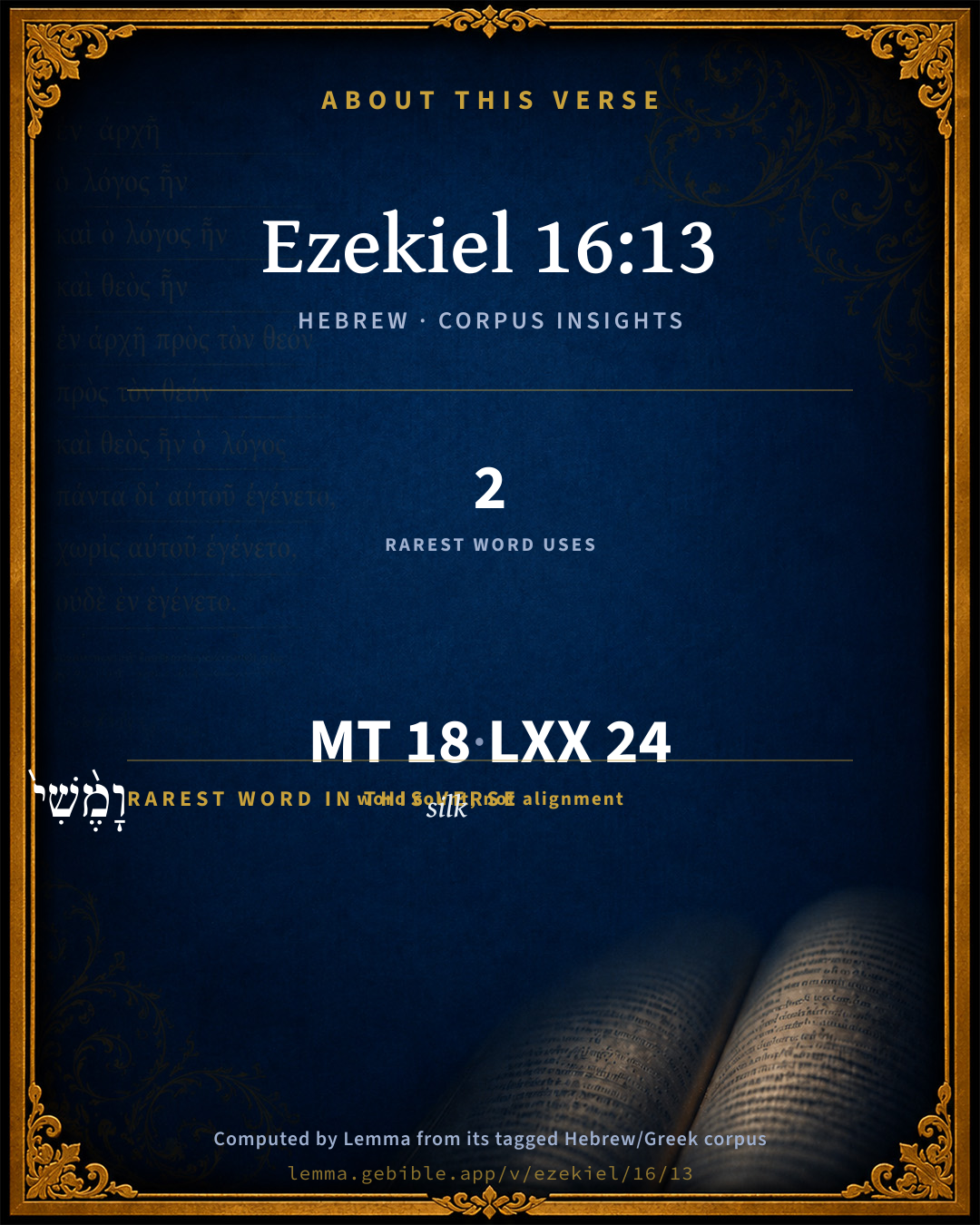
The rarest word here is וָמֶ֨שִׁי֙ silk H4897 — appearing just 2 times in the whole Hebrew Bible.

Shared distinctive vocabulary

וָמֶ֨שִׁי֙ silk H4897 occurs in 2 verses of the Hebrew Bible. Also found in:

Grammatical profile

  • 5 verbs
  • 10 nouns
  • 1 adjective
  • 2 adverbs

Verb forms

  • וַתַּעְדִּ֞י Qal · Sequential Imperfect
  • אכלתי Qal · Perfect
  • אָכָ֑לְתְּ Qal · Perfect
  • וַתִּ֨יפִי֙ Qal · Sequential Imperfect
  • וַֽתִּצְלְחִ֖י Qal · Sequential Imperfect

Repetition

Words recur within this verse — often emphatic in Hebrew:

  • ששי fine linen H8336 ×2
  • אכלתי to eat H398 ×2
  • בִּמְאֹ֣ד exceedingly H3966 ×2

Hebrew & Septuagint length

In English translation the verse runs 40 words from the Hebrew and 34 from the Septuagint (LXX English) — closely comparable.

A rough comparison of the two English renderings, which tokenize alike — not a word-level alignment.

Word counts can differ between the Hebrew and the Greek without any difference in meaning — e.g. the Hebrew direct-object marker אֵת has no separate Greek word, and Greek often adds the article ὁ.

In the original languages it is 18 Hebrew tokens and 24 Greek tokens — but the two are counted differently (Hebrew bundles its prefixes and suffixes into one token; the Greek is in lemma form), so that isn’t a like-for-like length.

Cross-references

20

Topical passages linked to Ezekiel 16:13 in the Treasury of Scripture Knowledge — connected by theme and wording, ordered by reader-vote popularity; previews shown in the World English Bible.

  • Deuteronomy 32:13–14 He made him ride on the high places of the earth, He ate the increase of the field; He made him to suck honey out of the rock, Oil out of the flinty rock;
  • 1 Kings 4:21 Solomon ruled over all the kingdoms from the River to the land of the Philistines, and to the border of Egypt: they brought tribute, and served Solomon all the days of his life.
  • Psalms 50:2 Out of Zion, the perfection of beauty, God shines forth.
  • Psalms 48:2 Beautiful in elevation, the joy of the whole earth, Is Mount Zion, on the north sides, The city of the great King.
  • Psalms 45:13–14 The princess inside is all glorious. Her clothing is interwoven with gold.
  • Ezekiel 16:19 My bread also which I gave you, fine flour, and oil, and honey, with which I fed you, you did even set it before them for a sweet savor; and [thus] it was, says the Lord Yahweh.
  • Genesis 17:6 I will make you exceeding fruitful, and I will make nations of you. Kings will come out of you.
  • Deuteronomy 8:8 a land of wheat and barley, and vines and fig trees and pomegranates; a land of olive trees and honey;
  • 1 Samuel 10:1 Then Samuel took the vial of oil, and poured it on his head, and kissed him, and said, Isn't it that Yahweh has anointed you to be prince over his inheritance?
  • 1 Samuel 12:12 When you saw that Nahash the king of the children of Ammon came against you, you said to me, No, but a king shall reign over us; when Yahweh your God was your king.
  • 2 Samuel 8:15 David reigned over all Israel; and David executed justice and righteousness to all his people.
  • Ezra 4:20 There have been mighty kings also over Jerusalem, who have ruled over all [the country] beyond the River; and tribute, custom, and toll, was paid to them.
  • Ezra 5:11 Thus they returned us answer, saying, We are the servants of the God of heaven and earth, and are building the house that was built these many years ago, which a great king of Israel built and finished.
  • Psalms 81:16 But he would have also fed them with the finest of the wheat. I will satisfy you with honey out of the rock."
  • Psalms 147:14 He makes peace in your borders. He fills you with the finest of the wheat.
  • Isaiah 64:11 Our holy and our beautiful house, where our fathers praised you, is burned with fire; and all our pleasant places are laid waste.
  • Jeremiah 13:20 Lift up your eyes, and see those who come from the north: where is the flock that was given you, your beautiful flock?
  • Lamentations 2:15 All that pass by clap their hands at you; They hiss and wag their head at the daughter of Jerusalem, [saying], Is this the city that men called The perfection of beauty, The joy of the whole earth?
  • Ezekiel 16:14–15 Your renown went forth among the nations for your beauty; for it was perfect, through my majesty which I had put on you, says the Lord Yahweh.
  • Hosea 2:5 For their mother has played the prostitute. She who conceived them has done shamefully; For she said, 'I will go after my lovers, Who give me my bread and my water, My wool and my flax, My oil and my drink.'

Cross-references courtesy of OpenBible.info (CC BY 4.0).

Hebrew and Greek witnesses Masoretic Hebrew ↔ Greek Septuagint

The same verse in the two great witnesses to the Old Testament, shown verse-for-verse.

These are two independent witnesses, not word-aligned to each other, and the Septuagint is shown in lemma (dictionary) form.

Hebrew Ezekiel 16:13 Masoretic · Westminster Leningrad Codex

וַתַּעְדִּ֞י זָהָ֣ב וָכֶ֗סֶף וּמַלְבּוּשֵׁךְ֙ ששי שֵׁ֤שׁ וָמֶ֨שִׁי֙ וְרִקְמָ֔ה סֹ֧לֶת וּדְבַ֛שׁ וָשֶׁ֖מֶן אכלתי אָכָ֑לְתְּ וַתִּ֨יפִי֙ בִּמְאֹ֣ד מְאֹ֔ד וַֽתִּצְלְחִ֖י לִמְלוּכָֽה

Thus was you decked with gold and silver; and your clothing was of fine linen, and silk, and embroidered work; you ate fine flour, and honey, and oil; and you were exceeding beautiful, and you did prosper to royal estate.

World English Bible · Public Domain

Greek LXX Ezekiel 16:13 Septuagint · lemma form

καί κοσμέω χρυσίον καί ἀργύριον καί ὁ περιβόλαιον σύ βύσσινος καί τρίχαπτος καί ποικίλος σεμίδαλις καί ἔλαιον καί μέλι ἐσθίω καί γίγνομαι καλός σφόδρα

So you were adorned with gold and silver; and your raiment was of fine linen, and silk, and variegated work: you did eat fine flour, and oil, and honey, and did become extremely beautiful.

LXX2012 (modern English Septuagint) · Public Domain

On this verse, The Cambridge Bible for Schools and Colleges discusses the Septuagint’s reading. Read the note in Commentary ↓

Hebrew: Westminster Leningrad Codex (CC BY 4.0). Greek: Septuagint (public domain); English from LXX2012 (modern English Septuagint) (Public Domain). How the Septuagint differs from the Hebrew →

Targum (Aramaic paraphrase)

1

The Targum is the ancient Jewish Aramaic paraphrase of the Hebrew Scriptures — an interpretive translation, not the Hebrew text itself. Onkelos (literal) and Pseudo-Jonathan (expansive) render the Torah, and Jonathan the Prophets. Coverage is partial: where no permissively-licensed English translation exists for a verse, only the Aramaic is shown. This is verse-level text, not a word-by-word alignment to the Hebrew.

  1. Targum Jonathan Prophets (Joshua–Malachi)
    וִיהָבֵית מַשְׁכְּנִי בֵּינֵיכוֹן מְתַקֵן בִּדְהַב וּכְסַף וִירִיעַת בּוּץ וְצִבְעוֹנִין וְצִיוּרִין וּמַנָא דְטַב כְּסוּלְתָא וְכִדְבַשׁ וְכִמְשַׁח אוֹכְלֵית יַתְכוֹן וַעֲתַרְתּוּן וּתְקֵיפְתּוּן לַחֲדָא וְאִצְלַחְתּוּן וּשְׁלֵיטְתּוּן בְּכָל מַלְכְּוָתָא:

    And I gave My tabernacle among you, affixed with gold and silver and linen and colored embroidered hangings, and manna as good as semolina and honey and oil I fed you, and I enriched you and strengthened you and made you prosper and have dominion over all kingdoms.

    Targum Jonathan — Aramaic: “Mikraot Gedolot” (public domain). English: “Sefaria Community Translation” (CC0 1.0 (public-domain dedication)); “London "Chaldee Paraphrase," 1871” (public domain). Text via Sefaria.

Commentary

Notes on Ezekiel 16:13 from classic Christian and Jewish commentators (each source and its license shown beneath its notes). The classic Christian expositions comment on the surrounding passage and are grouped to its opening verse, so a note may address several verses; the Jewish commentaries on the Tanakh (Rashi and others) are per-verse, so they appear only where the commentator wrote on this verse.

Lemma curates 59 commentaries, every one of them public domain or Creative Commons licensed, each selected and text-cleaned for this edition rather than reprinted as found. About our sources →

Trapp's Complete Commentary

John Trapp

Eze 16:13 Thus wast thou decked with gold and silver; and thy raiment [was of] fine linen, and silk, and broidered work; thou didst eat fine flour, and honey, and oil: and thou wast exceeding beautiful, and thou didst prosper into a kingdom.

Ver. 13. Thus wast thou decked with gold and silver.] Yea, with far better habiliments; for what is gold and silver but the guts and garbage of the earth? It was observed of Queen Elizabeth (as of her father before her), that she loved to go very richly arrayed. Her sister Queen Mary had, at her coronation, her head so laden with jewels, that she could hardly hold it up. King Richard II had one coat of gold and jewels valued at 30,000 marks. This was much, but nothing to the Church’s beauty and bravery, which yet was all but borrowed, as is said in the next verse.

Thou didst eat fine flour and honey,] i.e., The very best of the best. Thou didst eat of the fat, and drink of the sweet of my holy ordinances.

John Trapp, A Commentary or Exposition upon All the Books of the Old and New Testament (1647–1656) — public domain. Text from a community e-Sword module.

Joseph Benson's Commentary

Eze 16:13-14. Thus wast thou decked with gold, &c. — With ornaments the most costly and splendid. And thy raiment was of fine linen, &c. — Which was of the manufacture of Egypt, and one of the principal ornaments of women, as well as of great men. Thou didst eat fine flour, honey, and oil — Thy country afforded all manner of plenty and delicacies: see Deu 32:13-14. Thou wast exceeding beautiful — This may refer to the beauty of the buildings of Jerusalem, and in particular of the temple. And thou didst prosper into a kingdom — Thou didst increase in majesty and dominion, and became superior to the nations around. Bishop Newcome renders this clause, Thou didst prosper into a queen, that is, didst become the reigning city, the mistress of many subject provinces. And thy renown went forth, &c., for thy beauty — Through thy power and riches thou wast able to procure every thing beautiful and desirable, so that thou didst soon become famous among the heathen nations around; or, perhaps, the words may refer to the excellent laws by which they were governed, and the various privileges of their church and state, which rendered their nation more perfect in beauty than any other in the world. Indeed, we can name nothing that would be to the honour of a people, but it was found in Israel in David and Solomon’s time, when that kingdom was in its zenith of prosperity, power, and glory; piety, learning, wisdom, justice, victory, peace, wealth, were found there in perfection, and all sure to continue if they had kept close to God. It was perfect, saith God, through my comeliness, which I had put upon thee — That is, through the beauty of their holiness, as they were a people devoted to God. This was it that put a lustre upon all their other honours, and was indeed the perfection of their beauty. Observe, reader, sanctified souls are truly beautiful in God’s sight, and they themselves may take the comfort of it; but God must have all the glory, for whatever comeliness they have is that which God has put upon them.

Joseph Benson's Commentary on the Old and New Testaments (1811–1818) — public domain. Text from a community e-Sword module.

Jamieson, Fausset & Brown

Robert Jamieson, A. R. Fausset & David Brown

flour . . . honey . . . oil--These three mixed form the sweetest cakes; not dry bread and leeks as in Egypt. From raiment He passes to food (Deu 32:13-14).

exceeding beautiful-- Psa 48:2, the city; also, Psa 29:2, the temple.

prosper into a kingdom--exercising empire over surrounding nations.

Jamieson, Fausset & Brown — Commentary Critical and Explanatory on the Whole Bible (1871) — public domain (CC PDM 1.0). Text via the HelloAO Bible API.

Adam Clarke's Commentary

Verse 13. Thus wast thou decked, c.] The Targum understands all this of the tabernacle service, the book of the law, the sacerdotal vestments, c.

Thou didst prosper into a kingdom.] Here the figure explains itself: by this wretched infant, the low estate of the Jewish nation in its origin is pointed out by the growing up of this child into woman's estate, the increase and multiplication of the people by her being decked out and ornamented, her tabernacle service, and religious ordinances; by her betrothing and consequent marriage, the covenant which God made with the Jews; by her fornication and adulteries, their apostasy from God, and the establishment of idolatrous worship, with all its abominable rites; by her fornication and whoredoms with the Egyptians and Assyrians, the sinful alliances which the Jews made with those nations, and the incorporation of their idolatrous worship with that of Jehovah; by her lovers being brought against her, and stripping her naked, the delivery of the Jews into the hands of the Egyptians, Assyrians, and Chaldeans, who stripped them of all their excellencies, and at last carried them into captivity.

This is the key to the whole of this long chapter of metaphors; and the reader will do well to forget the figures, and look at the facts. The language and figures may in many places appear to us exceptionable: but these are quite in conformity to those times and places, and to every reader and hearer would appear perfectly appropriate, nor would engender either a thought or passion of an irregular or improper kind. Custom sanctions the mode, and prevents the abuse. Among naked savages irregular passions and propensities are not known to predominate above those in civilized life. And why? Because such sights are customary, and therefore in themselves innocent. And the same may be said of the language by which such states and circumstances of life are described. Had Ezekiel spoken in such language as would have been called chaste and unexceptionable among us, it would have appeared to his auditors as a strange dialect, and would have lost at least one half of its power and effect. Let this be the prophet's apology for the apparent indelicacy of his metaphors; and mine, for not entering into any particular discussion concerning them. See also on Eze 16:63.

Adam Clarke's Commentary on the Bible (1810–1826) — public domain. Text from a community e-Sword/MySword module.

John Calvin's Commentaries

If any one makes any inquiry about these various kinds of dresses, whether it was lawful for women to use so many ornaments, the answer is easy, that the Prophet here does not approve of what he relates, but uses a common image. We said that his only intention was to show that God could not have treated his people more freely; since in every way he had unfolded the incomparable treasures of his beneficence in adorning the Israelites. He now describes this in a metaphor, and under figures taken from the common practice everywhere received. It does not follow, therefore, that women ought to adorn themselves in this way. For we know that superfluous ornaments are temptations; and we know also the vanity of women, and their ambition to show themselves off, as the saying is: and we see how sharply this eager desire of women is blamed, especially by Isaiah. (Isaiah 3.) But it is sufficient to elicit what God wished to teach by these figures, namely, that he had not omitted any kind of liberality. Whence it follows, that the people’s ingratitude was the less excusable, as Ezekiel will immediately add. But before we proceed further, we must turn this instruction to our use. What has hitherto been said of the Israelites does not suit us, I confess, in all things: but yet there is some likeness between us and them. If we reflect upon our origin, we are all born children of wrath, all cursed, all Satan’s bondsmen, (Ephesians 2:3;) and although many have been well brought up, yet as to our spiritual state we are like infant children or the new-born babe, exposed and immersed in its own filth and corruption. For what can be found in man before his renewal but the curse of God? Hence we are such slaves of Satan, that God hates us, as it is said in Genesis, (Genesis 6:7,) I repent of having formed man; where he does not acknowledge his image in us, which is not only defiled by original sin, but is all but extinct, surely this is the height of deformity: and though we do not perceive what is said by our senses, yet we are sufficiently detestable before God and the angels. We have no cause, then, to please ourselves; nay, if we open our eyes, the foulness which I have mentioned will be sufficiently clear to us. Meanwhile, God so aided us that he truly fulfilled what Ezekiel relates. For although we were not freed from any external tyranny, yet God espoused us: then he adopted us into his Church: this was our greatest honor; this was more than royal dignity. We see, then, that this instruction is useful for us also at this time, if we only consider in what we are like the ancient people. I had almost omitted one point — the nourishment. God here not only reminds them that he had adorned the people with various kinds of clothing, and necklaces, and gems, and silver; but he adds also, you did eat fine flour, or fine meal, and honey and oil, and you was very beautiful, and proceeded prosperously, even to a kingdom. Here God again commends and extols his beneficence, because he not only clothed sumptuously his spouse of whom he speaks, but also fed her plentifully with the best, and sweetest, and most delicate food. He puts only three species: he makes no mention of will or flesh; but by fine flour he means that they lacked no delicacy: the oil and honey mean the same thing. This clause points out an accumulation of grace when he says that they progressed happily even to a kingdom: all God’s benefits could not be recounted: he says that his bride was not only magnificently clothed and delicately brought up, but that she proceeded even to the royal dignity. In the next verse he still reminds them of his benefits.

John Calvin's Commentaries (1540-1563) — public domain. Text from the Calvin Translation Society English edition (1840s-50s) via the Christian Classics Ethereal Library (ccel.org). Calvin's coverage is partial (roughly two-thirds of the Bible); uncommented books and verses are honest gaps, never fabricated. The 19th-century editor's footnotes and remarks are omitted so the notes are faithfully Calvin's own voice.

The Cambridge Bible for Schools and Colleges

gen. ed. J. J. S. Perowne

13. Her delicate fare and beauty.

fine flour] This was used in offerings at the altar (Eze_16:19), and was probably the food of persons of refinement and rank. Cf. Psa_81:16, “I should have fed them also with the finest of the wheat, and with honey out of the rock should I satisfy thee;” Psa_147:14; Deu_32:13-14.

exceeding beautiful] The beauty is less that of the mere city (Psa_48:2) than of the personified state or people (Eze_16:14).

prosper into a kingdom] Or, attain to royal estate. The reference is not to the mere historical fact that a monarchy arose in Israel under Saul or more permanently under David. It was Israel herself, personified as a woman, that attained to royalty, that is, to be an independent state among the states around, a queen among other queens. The words are wanting in LXX.

The Cambridge Bible for Schools and Colleges (gen. ed. J. J. S. Perowne; Cambridge University Press, 1878–1918) — public domain. Text from a community e-Sword module.

John Gill's Exposition

And thy renown went forth among the Heathen for thy beauty,.... Which consisted of the above things: with this compare Deu 6:4, Psa 48:2; the church's beauty lies in the righteousness of Christ imputed, to her; in the holiness of Christ reckoned unto her; in the blood of Christ being upon her, by which she is washed and cleansed, justified and pardoned; and in the graces of the Spirit of Christ implanted in her; and in the salvation of Christ she is interested in; and in the presence of Christ, which is the beauty of the Lord upon her; and in being in Gospel order, and having Gospel ordinances; see Psa 45:11;

for it was perfect through my comeliness, which I had put upon thee,

saith the Lord God; all the outward happiness and prosperity of the Israelites in the days of David and Solomon, or at other times, was not, as Kimchi observes, of themselves, but of the Lord: and so the comeliness of the saints and people of God is not of themselves; they are by nature black and deformed; they are defiled with original and actual sin; they are as an unclean, thing; they are corrupt, abominable, and loathsome; and as they have not their comeliness by nature, so not by art; as it is not native to them, it is not acquired by them; they do not obtain it by their humiliation, repentance, and services; these cannot remove their natural blackness and uncomeliness, or wash away their sins, and render them beautiful in the sight of God, Jer 13:23, Jer 2:22; but they have their comeliness from another, from Christ, who is altogether lovely; and from his righteousness, which is put on them; and so they are in him, and, through that, perfectly comely, a perfection of beauty, all fair, and without spot, even the fairest in the whole creation, complete in Christ, and perfect in him, Psa 50:2.

John Gill's Exposition of the Whole Bible (1746–1763) — public domain (CC PDM 1.0). Text via the HelloAO Bible API.

Albert Barnes' Notes on the Bible

Fine flour, and honey, and oil - These were the choicest kinds of food.

Into a kingdom - This part of the description refers to the reigns of David and Solomon, when the kingdom of Israel (still undivided) attained its highest pitch of grandeur.

Albert Barnes' Notes on the Bible (1834–1885) — public domain. Text from a community e-Sword/MySword module.

Haydock's Catholic Bible Commentary

Linen. Hebrew mossi, ver. 11. (Haydock) --- Chaldean understands these ornaments to pertain to the tabernacle, which was set up in the wilderness. --- Oil, enjoying a most fertile country, (Calmet) and the noblest sacrifices. (Haydock) --- And wast, &c. The kingdom had subsisted 1500 years. (Calmet) --- Septuagint omit this, for fear of giving umbrage to the Egyptians, according to St. Jerome, as if they could be ignorant of this circumstance. (Calmet) --- Grabe supplies, "thou wast directed to the kingdom." (Haydock)

George Leo Haydock (1774–1849), Haydock's Catholic Family Bible and Commentary, 1859 edition — public domain. Excludes Psalms (Douay-Rheims chapter numbering differs from Protestant) and Deuterocanonical books (Catholic canon only).

Matthew Poole's English Annotations

The prophet sums up all again, partly to aver the truth thereof, partly to bring it to her remembrance, and partly to affect her with thankfulness for what she had received, and with shame for what she had done.

Thou didst eat fine flour; it was the constant course of thy diet, to be provided thus with the choicest food, which thou didst not by scanty allowance taste of, but wast filled with: these were royal dainties, as Gen 49:20.

Thou wast exceeding beautiful; such diet, with the additional ornaments, would surely render a perfect beauty, and to such perfection did this espoused virgin grow.

Thou didst prosper; all affairs succeeded well, and events added to thy greatness.

A kingdom, not only compact in itself, but victorious over others; and so she was a mistress over kingdoms, as in David’s, Solomon’s, Jehoshaphat’s, and Hezekiah’s time.

Matthew Poole's English Annotations on the Holy Bible (1683–1685) — public domain. Text from a community e-Sword/MySword module.

Whedon's Commentary on the Bible

Daniel D. Whedon

13. Fine flour, and honey, and oil;… and thou didst prosper into a kingdom — There is a double meaning attached to the food mentioned, as it was used by princesses and also in the temple sacrifices. The dress and food of the bride “symbolized the ritual and cultus of Judaism.” Israel is personified as a beautiful woman arriving at royal honors in David’s time (Eze_16:19; Psa_81:16).

Daniel D. Whedon (gen. ed.), Commentary on the Old and New Testaments (1874–1909) — public domain. Text from a community e-Sword module.

The Pulpit Commentary

Thou didst eat fine flour, and honey, and oil. From the dress of the bride we pass to her luxuries in the way of food. The things named might, of course, be only chosen as the delicacies for which the land of Israel was famous, (Deu_32:13, Deu_32:14) which in the prophet"s own time were in demand in the markets of Tyre. (Eze_27:17) Cakes of flour and honey were in common use in various forms of Greek ritual, and are probably referred to in Jer_44:19, but in that of the (Lev_2:11) honey takes its place, side by side with leaven, as a thing forbidden. Thou didst grow into a kingdom. History crops out through the parable, and points to the stage which it has now reached, i.e. that of the magnificence of the kingdom under Solomon.

The Pulpit Commentary (1880–1919), ed. H.D.M. Spence-Jones & Joseph S. Exell — public domain. Text from a community e-Sword module.

unfoldingWord translationNotes

Door43 World Missions Community

General Information:

Yahweh continues to speak about Jerusalem as if the city were a young woman. The city represents the people who live there. (See: Metaphor and Metonymy)

you were adorned with gold and silver, and you were dressed in fine linen

This can be stated in active form. AT: "I adorned you with gold and silver, and dressed you in fine linen" (See: Active or Passive)

Your fame went out among the nations

"Many people in many nations knew who you were"

it was perfect

"your beauty was perfect"

translationWords

honey

oil

queen

nation

perfect

majesty

Lord Yahweh

declare

unfoldingWord translationNotes — © Distant Shores Media and the Door43 World Missions Community, licensed CC BY-SA 4.0. Source: git.door43.org/Door43/en_tn.

Rashi

Rabbi Shlomo Yitzchaki (Rashi)

And you adorned yourself with gold and silver [Jonathan renders:] And I placed My Tabernacle among you, adorned with gold, silver, curtains of linen, colored tapestries and embroidery, and mannawhich was as good as fine flour, honey and oil—I fed you, and you became exceedingly rich and strong, and you prospered and ruled over all the kingdoms.

fine flour, honey, and oil you ate The manna, which would change to any flavorto fine flour, honey, and oilyou ate. The Midrash Aggadah (Mid. Song 4:2) [points out that] thirteen items are enumerated here, and corresponding to them, the Holy One, blessed be He, ordered them to bring the thirteen items enumerated in the donation for the Tabernacle (Exod. 25:1-7). Nevertheless, He is destined to repay them in the future with thirteen items (Isa. 4:5f.): “And the Lord shall create over every dwelling of Mount Zion, etc. And a tabernacle shall be for shade by day from the heat, etc., from stream and from rain, etc.”

became exceedingly beautiful An expression of beauty.

Rashi on the Tanakh — English translations: “The Judaica Press complete Tanach with Rashi, translated by A. J. Rosenberg” (CC BY 4.0); “Pentateuch with Rashi's commentary by M. Rosenbaum and A.M. Silbermann, 1929-1934” (public domain); “The Metsudah Tanach series, Lakewood, N.J” (CC BY 4.0); and “The Book of Joshua, Metsudah Publications, 1997” (CC BY 4.0). Text via Sefaria.

Lesson kit

Teaching starters — assembled from the data on this page, not authored interpretation. Every prompt links to the verse data it draws on. Edit before teaching.

Ezekiel, in the Prophets, opens this verse with 18 words (15 distinct Hebrew lemmas). Its most distinctive word is meshîy (“silk”). A historical commentator’s framing appears above. Read the whole chapter for the surrounding context.

Discussion questions

  1. What does “silk” (meshîy) contribute to the verse as a whole?
  2. Ezekiel 16:10 shares the word «silk» with this verse. How do the two illuminate each other?
  3. “fine linen” occurs 2× in this one verse. What is the effect of the repetition?
  4. These translations render this verse differently; the difference is in the English rendering, not the original. What questions does that raise?
  5. The verb «וַתַּעְדִּ֞י» is Qal Sequential Imperfect. How does its form color the action?
  6. Reading how Trapp's Complete Commentary and Joseph Benson's Commentary read this verse, where do the two commentators agree and where do they part?

Things to notice

Reading settings

Reading text

Shown beneath each verse's original-language words.

Old Testament
Old Testament edition

Read the OT as the Masoretic Hebrew (MT) or the Greek Septuagint (LXX).

English shown for the Greek Septuagint (in the Hebrew ↔ Greek comparison).

Comparing translations? Open the Compare panel on any verse page to stack up to four side by side.