Leviticus 9:4

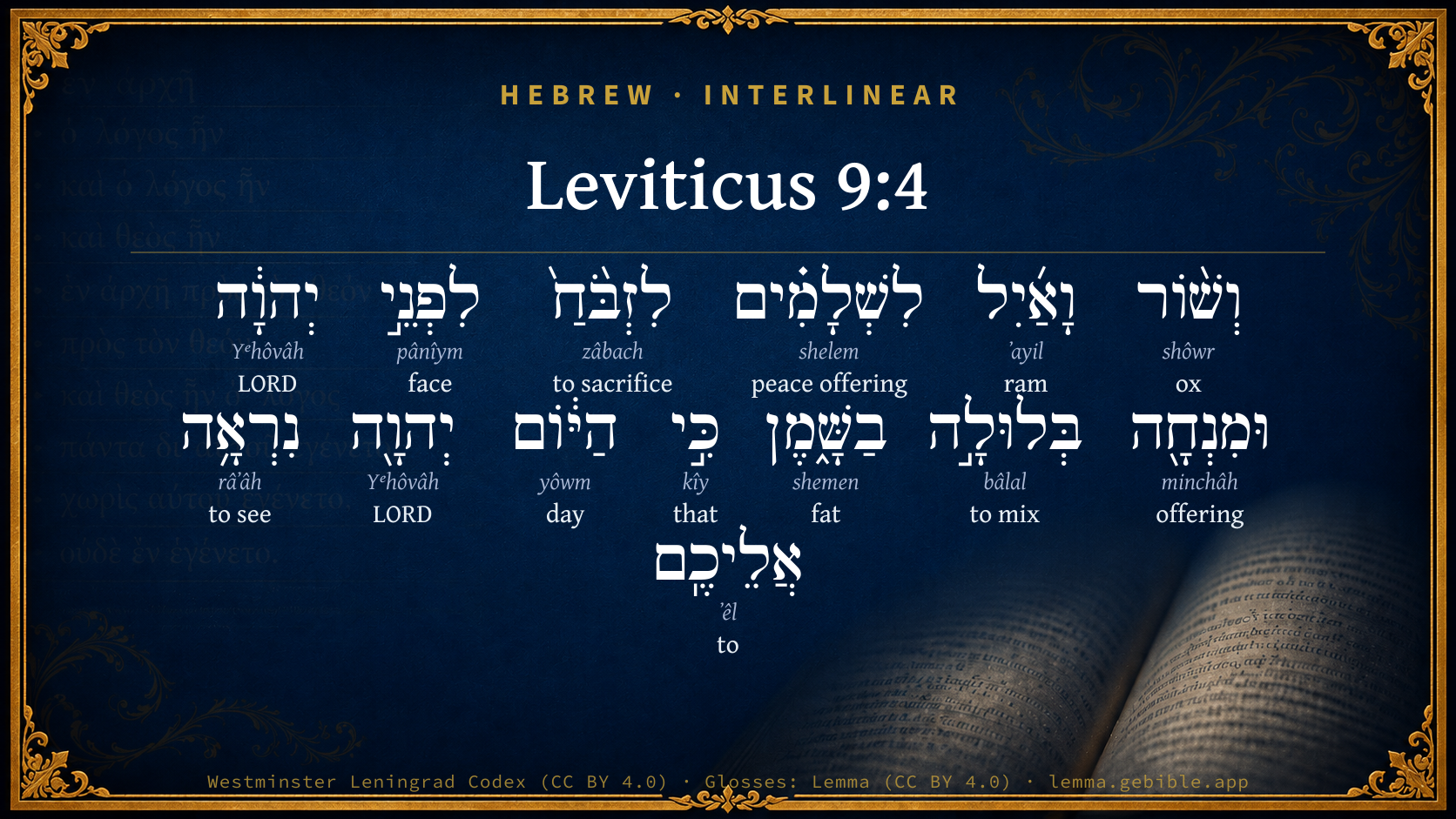
Hebrew (Westminster Leningrad Codex) Leviticus 9:4 appears in the Hebrew Old Testament. The text above is from the Westminster Leningrad Codex. Each word links to its Strong’s number, a concise gloss, and parsing drawn from the Open Scriptures Hebrew Bible morphology. Click any word for its full Brown-Driver-Briggs (BDB) entry.
Download image
Cite this verse

Leviticus 9:4 (World English Bible). Public Domain. Lemma interlinear Bible study tool, https://lemma.gebible.app/v/leviticus/9/4.

Show BibTeX & RIS
BibTeX
RIS
English Translation
and an ox and a ram for peace offerings, to sacrifice before Yahweh; and a meal offering mixed with oil: for today Yahweh appears to you.'"
World English Bible · Public Domain
Download a study sheet

One document with this verse’s original text, its word-by-word gloss line, the meaning frame, cross-references with their text, attributed commentary, and full source and license credits — printable, and it pastes into notes with its structure intact.

This verse Autodidact and up

Study sheet (.html) Plain text (.txt)

A passage Seminary Student

Up to 50 verses in one chapter. A passage sheet keeps up to 6 commentary sources and 12 cross-references per verse, in the order this page ranks them, and says so on the sheet whenever that leaves anything out. Ask for a single verse and you get the Autodidact verse sheet above.

Everything on this page stays free to read, with no account — the sheet is a download of what is already on screen, not access to it.

Want to remove ads? Support Godless Engineer
Compare translations 3

The same verse in 3 English versions, stacked beneath the original-language interlinear above. Click any original word for its lexicon entry.

Each is an independent rendering of the whole verse — the interlinear is not word-aligned to these translations.

Highlighted words mark where these versions differ — a whole-verse word diff, not a word-by-word alignment.

  • World English Bible Public Domain
    and an ox and a ram for peace offerings, to sacrifice before Yahweh; and a meal offering mixed with oil: for today Yahweh appears to you.'"
  • King James Version Public Domain
    Also a bullock and a ram for peace offerings, to sacrifice before the LORD; and a meat offering mingled with oil: for to day the LORD will appear unto you.
  • unfoldingWord Literal Text CC BY-SA 4.0
    and an ox and a ram for peace offerings to sacrifice to the face of Yahweh, and a grain offering mixed with oil, for today Yahweh will appear to you.’”

unfoldingWord Literal Text — © unfoldingWord, licensed CC BY-SA 4.0. Word-aligned USFM3 via Door43 (git.door43.org/unfoldingWord/en_ult).

Versions to compare (up to 4)

3 of 4 selected

Show all 18 translations

Every available English version of this verse, each an independent rendering of the whole verse.

  • World English Bible Public Domain
    and an ox and a ram for peace offerings, to sacrifice before Yahweh; and a meal offering mixed with oil: for today Yahweh appears to you.'"
  • Berean Standard Bible Public Domain
    an ox and a ram for a peace offering to sacrifice before the LORD, and a grain offering mixed with oil. For today the LORD will appear to you.’”
  • Majority Standard Bible Public Domain
    an ox and a ram for a peace offering to sacrifice before the LORD, and a grain offering mixed with oil. For today the LORD will appear to you.’”
  • King James Version Public Domain
    Also a bullock and a ram for peace offerings, to sacrifice before the LORD; and a meat offering mingled with oil: for to day the LORD will appear unto you.
  • American Standard Version (1901) Public Domain
    and an ox and a ram for peace-offerings, to sacrifice before Jehovah; and a meal-offering mingled with oil: for to-day Jehovah appeareth unto you.
  • Revised Version (1885) Public Domain
    and an ox and a ram for peace offerings, to sacrifice before the LORD; and a meal offering mingled with oil: for today the LORD appeareth unto you.
  • Geneva Bible (1599) Public Domain
    Also a bullock, and a ramme for peace offringes, to offer before the Lord, and a meate offring mingled with oyle: for to day the Lord will appeare vnto you.
  • Douay-Rheims (1899) Public Domain
    Also a bullock and a ram for peace offerings: and immolate them before the Lord, offering for the sacrifice of every one of them flour tempered with oil; for to day the Lord will appear to you.
  • Young's Literal Translation Public Domain
    and a bullock and a ram for peace-offerings, to sacrifice before Jehovah, and a present mixed with oil; for to-day Jehovah hath appeared unto you.'
  • Literal Standard Version CC BY-SA 4.0
    and a bullock and a ram for peace-offerings, to sacrifice before YHWH, and a present mixed with oil; for today YHWH has appeared to you.”
  • Unlocked Literal Bible CC BY-SA 4.0
    also take an ox and a ram for peace offerings to sacrifice before Yahweh, and a grain offering mixed with oil, because today Yahweh will appear to you.'”
  • unfoldingWord Literal Text CC BY-SA 4.0
    and an ox and a ram for peace offerings to sacrifice to the face of Yahweh, and a grain offering mixed with oil, for today Yahweh will appear to you.’”
  • Darby Bible Public Domain
    and a bullock and a ram for a peace-offering, to sacrifice before Jehovah; and an oblation mingled with oil; for to-day Jehovah will appear to you.
  • World Messianic Bible Public Domain
    and a bull and a ram for peace offerings, to sacrifice before the LORD; and a meal offering mixed with oil: for today the LORD appears to you.’”
  • Webster's Bible Public Domain
    Also a bullock and a ram for peace-offerings, to sacrifice before the LORD; and a meat-offering mingled with oil: for to-day the LORD will appear to you.
  • Free Bible Version CC BY-SA 4.0
    a bull and a ram as a peace offering to sacrifice before the Lord; and a grain offering mixed with olive oil. Do this because the Lord is going to reveal himself to you today.’”
  • Bible in Basic English Public Domain
    And an ox and a male sheep for peace-offerings, to be put to death before the Lord; and a meal offering mixed with oil: for this day you are to see the Lord.
  • JPS Tanakh (1917) Public Domain
    and an ox and a ram for peace-offerings, to sacrifice before the LORD; and a meal-offering mingled with oil; for to-day the LORD appeareth unto you.'

Literal Standard Version (2020), Covenant Press — licensed CC BY-SA 4.0. Text via the HelloAO Bible API (eBible.org). Unlocked Literal Bible (unfoldingWord) — licensed CC BY-SA 4.0. Text via the HelloAO Bible API (eBible.org). unfoldingWord Literal Text — © unfoldingWord, licensed CC BY-SA 4.0. Word-aligned USFM3 via Door43 (git.door43.org/unfoldingWord/en_ult). Free Bible Version, Dr. Jonathan Gallagher — licensed CC BY-SA 4.0. Text via the HelloAO Bible API (eBible.org).

Word by word

More ways to search: Search by grammar → Find every occurrence → Compare this word →

Practice this passage: Drill this verse → Learn its vocabulary →

בְּלוּלָ֣ה
bâlal
H1101
“mixed”
Verb, Qal, Participle Passive, Feminine, Singular, Absolute
Part of Speech
Verb
Stem
Qal
Form
Participle Passive
Gender
Feminine
Number
Singular
State
Absolute
Full BDB Definition

Origin: a primitive root

TWOT: 248

to mix, mingle, confuse, confound - (Qal) - to mingle, confuse - to mix - to give provender, feed (animals) - (Hithpoel) to mix oneself (among others) - (Hiphil) to fade away
  1. וְשׁ֨וֹר shôwr H7794 “and · ox” Conjunction + Noun, Common, Masculine, Singular, Absolute
  2. וָאַ֜יִל ʼayil H352 “and · ram” Conjunction + Noun, Common, Masculine, Singular, Absolute
  3. לִשְׁלָמִ֗ים shelem H8002 “to/for · peace offerings” Preposition + Noun, Common, Masculine, Plural, Absolute
  4. לִזְבֹּ֨חַ֙ zâbach H2076 “to sacrifice” Preposition + Verb, Qal, Infinitive Construct
  5. לִפְנֵ֣י pânîym H6440 “to/for · face(s) of” Preposition + Noun, Common, Both, Plural, Construct
  6. יְהוָ֔ה Yᵉhôvâh H3068 “LORD” Noun, Proper
  7. וּמִנְחָ֖ה minchâh H4503 “and · offering” Conjunction + Noun, Common, Feminine, Singular, Absolute
  8. בַשָּׁ֑מֶן shemen H8081 “in/at the · fat” Preposition, Determined + Noun, Common, Masculine, Singular, Absolute
  9. כִּ֣י kîy H3588 “that” Conjunction
  10. הַיּ֔וֹם yôwm H3117 “the · day” Particle, Definite Article + Noun, Common, Masculine, Singular, Absolute
  11. יְהוָ֖ה Yᵉhôvâh H3068 “LORD” Noun, Proper
  12. נִרְאָ֥ה râʼâh H7200 “to see” Verb, Niphal, Perfect, 3rd Person, Masculine, Singular
  13. אֲלֵיכֶֽם ʼêl H413 “to · you” Preposition + Suffix, Personal, 2nd Person, Masculine, Plural

About this verse

These counts appear in no published source. They are computed here, from the morphology-tagged text and Lemma’s own curated glosses. What Lemma adds →

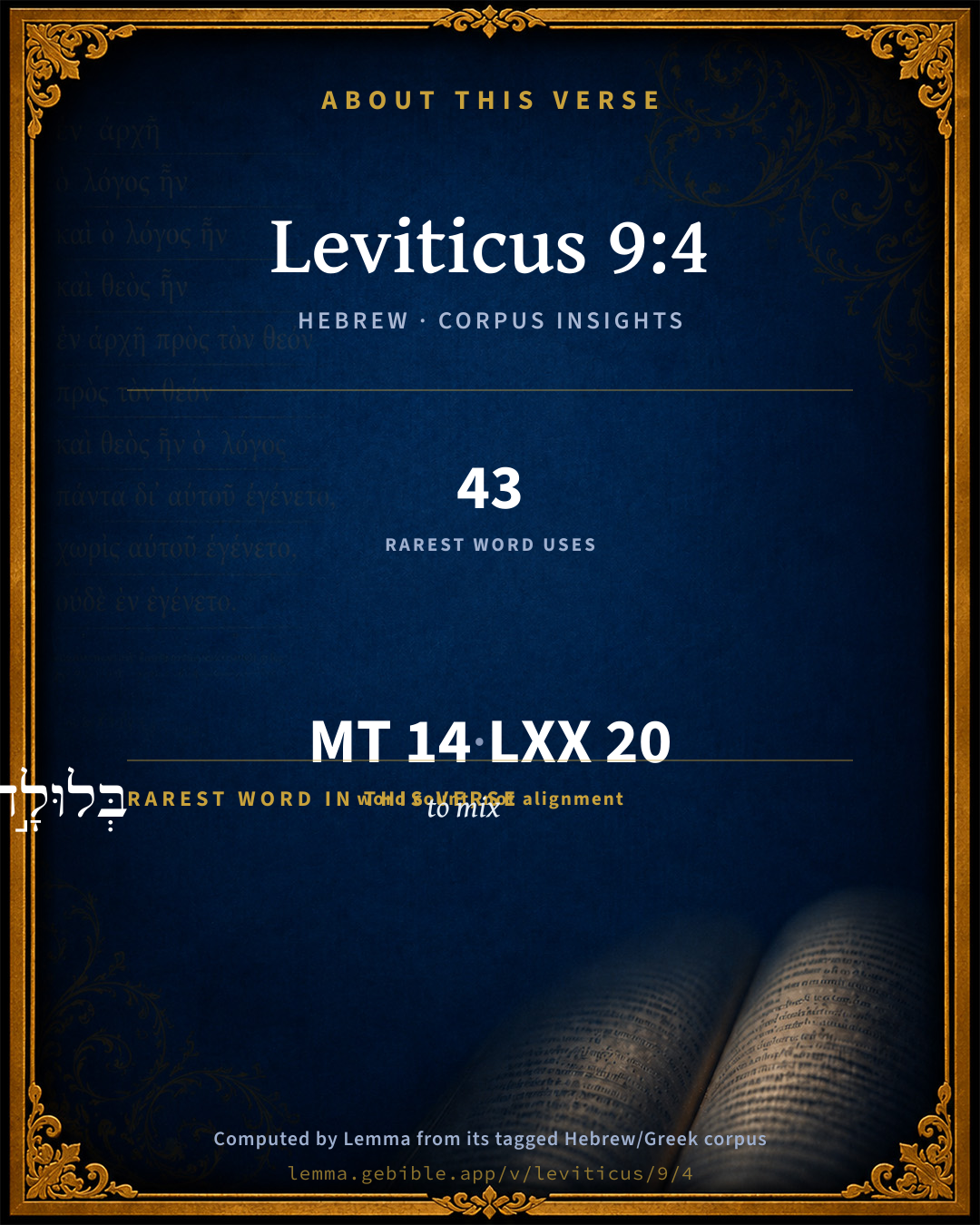
14
words
13
distinct lemmas
Pentateuch
section

Shared distinctive vocabulary

בְּלוּלָ֣ה to mix H1101 occurs in 41 verses of the Hebrew Bible. Also found in:

Grammatical profile

  • 3 verbs
  • 9 nouns
  • 1 preposition
  • 1 conjunction

Verb forms

  • לִזְבֹּ֨חַ֙ Qal · Infinitive Construct
  • בְּלוּלָ֣ה Qal · Participle Passive
  • נִרְאָ֥ה Niphal · Perfect

Repetition

A word recurs within this verse — often emphatic in Hebrew:

  • יְהוָ֔ה LORD H3068 ×2

Hebrew & Septuagint length

In English translation the verse runs 26 words from the Hebrew and 27 from the Septuagint (LXX English) — closely comparable.

A rough comparison of the two English renderings, which tokenize alike — not a word-level alignment.

Word counts can differ between the Hebrew and the Greek without any difference in meaning — e.g. the Hebrew direct-object marker אֵת has no separate Greek word, and Greek often adds the article ὁ.

In the original languages it is 14 Hebrew tokens and 20 Greek tokens — but the two are counted differently (Hebrew bundles its prefixes and suffixes into one token; the Greek is in lemma form), so that isn’t a like-for-like length.

Cross-references

14

Topical passages linked to Leviticus 9:4 in the Treasury of Scripture Knowledge — connected by theme and wording, ordered by reader-vote popularity; previews shown in the World English Bible.

  • Exodus 29:43 There I will meet with the children of Israel; and the place shall be sanctified by my glory.
  • Leviticus 9:6 Moses said, "This is the thing which Yahweh commanded that you should do: and the glory of Yahweh shall appear to you."
  • Leviticus 9:23 Moses and Aaron went into the Tent of Meeting, and came out, and blessed the people: and the glory of Yahweh appeared to all the people.
  • Ezekiel 43:2 Behold, the glory of the God of Israel came from the way of the east: and his voice was like the sound of many waters; and the earth shined with his glory.
  • Exodus 16:10 It happened, as Aaron spoke to the whole congregation of the children of Israel, that they looked toward the wilderness, and, behold, the glory of Yahweh appeared in the cloud.
  • Exodus 19:11 and be ready against the third day; for on the third day Yahweh will come down in the sight of all the people on Mount Sinai.
  • Exodus 24:16 The glory of Yahweh settled on Mount Sinai, and the cloud covered it six days. The seventh day he called to Moses out of the midst of the cloud.
  • Exodus 40:34–35 Then the cloud covered the tent of meeting, and the glory of Yahweh filled the tent.
  • Leviticus 2:1–3:17 "'When anyone offers an offering of a meal offering to Yahweh, his offering shall be of fine flour; and he shall pour oil on it, and put frankincense on it.
  • Leviticus 6:14–23 "'This is the law of the meal offering: the sons of Aaron shall offer it before Yahweh, before the altar.
  • Numbers 14:10 But all the congregation bade stone them with stones. The glory of Yahweh appeared in the tent of meeting to all the children of Israel.
  • Numbers 15:3–9 and will make an offering by fire to Yahweh, a burnt offering, or a sacrifice, to accomplish a vow, or as a freewill-offering, or in your set feasts, to make a sweet savor to Yahweh, of the herd, or of the flock;
  • Numbers 16:19 Korah assembled all the congregation against them to the door of the tent of meeting: and the glory of Yahweh appeared to all the congregation.
  • 1 Kings 8:10–12 It came to pass, when the priests were come out of the holy place, that the cloud filled the house of Yahweh,

Cross-references courtesy of OpenBible.info (CC BY 4.0).

Hebrew and Greek witnesses Masoretic Hebrew ↔ Greek Septuagint

The same verse in the two great witnesses to the Old Testament, shown verse-for-verse.

These are two independent witnesses, not word-aligned to each other, and the Septuagint is shown in lemma (dictionary) form.

Hebrew Leviticus 9:4 Masoretic · Westminster Leningrad Codex

וְשׁ֨וֹר וָאַ֜יִל לִשְׁלָמִ֗ים לִזְבֹּ֨חַ֙ לִפְנֵ֣י יְהוָ֔ה וּמִנְחָ֖ה בְּלוּלָ֣ה בַשָּׁ֑מֶן כִּ֣י הַיּ֔וֹם יְהוָ֖ה נִרְאָ֥ה אֲלֵיכֶֽם

and an ox and a ram for peace offerings, to sacrifice before Yahweh; and a meal offering mixed with oil: for today Yahweh appears to you.'"

World English Bible · Public Domain

Greek LXX Leviticus 9:4 Septuagint · lemma form

καί μόσχος καί κριός εἰς θυσία σωτήριον ἔναντι κύριος καί σεμίδαλις φυράω ἐν ἔλαιον ὅτι σήμερον κύριος ὁράω ἐν σύ

and a calf and a ram for a peace offering before the Lord, and fine flour mingled with oil, for today the Lord will appear among you.

LXX2012 (modern English Septuagint) · Public Domain

Hebrew: Westminster Leningrad Codex (CC BY 4.0). Greek: Septuagint (public domain); English from LXX2012 (modern English Septuagint) (Public Domain). How the Septuagint differs from the Hebrew →

Targum (Aramaic paraphrase)

2

The Targum is the ancient Jewish Aramaic paraphrase of the Hebrew Scriptures — an interpretive translation, not the Hebrew text itself. Onkelos (literal) and Pseudo-Jonathan (expansive) render the Torah, and Jonathan the Prophets. Coverage is partial: where no permissively-licensed English translation exists for a verse, only the Aramaic is shown. This is verse-level text, not a word-by-word alignment to the Hebrew.

  1. Targum Onkelos Torah (Genesis–Deuteronomy)
    וְתוֹר וּדְכַר לְנִכְסַת קוּדְשַׁיָא לְדַבָּחָא קֳדָם יְיָ וּמִנְחָתָא דְפִילָא בִמְשָׁח אֲרֵי יוֹמָא דֵין יְקָרָא דַיְיָ מִתְגְלִי לְכוֹן

    (no public-domain English translation for this verse)

    Targum Onkelos — Aramaic: “Onkelos Genesis” (public domain); “Onkelos Exodus” (public domain); “Onkelos Leviticus” (public domain); “Onkelos Numbers” (public domain); “Onkelos Deuteronomy” (public domain). English: “Sefaria Community Translation” (CC0 1.0 (public-domain dedication)); “J.W. Etheridge. The Targums of Onkelos and Jonathan Ben Uzziel on the Pentateuch. London: Longmans, Green, 1862” (public domain). Text via Sefaria.

  2. Targum Pseudo-Jonathan Torah (Genesis–Deuteronomy)
    וְתוֹר וְאִימְרָא לְנִכְסַת קוּדְשָׁא לְדַבְּחָא קֳדָם יְיָ מִן בִּגְלַל דְיִתְרְעִי בְּכוֹן וּמִנְחָתָא פְּתִיכָא בִּמְשַׁח זֵיתָא אֲרוּם יוֹמָא דֵין אִיקַר שְׁכִינְתָּא דַיְיָ מִתְגְלֵי לְכוֹן

    with a bullock and a lamb, for a hallowed oblation to sacrifice before the Lord, that He may be gracious to you; and a mincha mingled with oil of the olive. For this day will the glory of the Lord's Shekinah be revealed unto you.

    Targum Pseudo-Jonathan — Aramaic: “Targum Jonathan on Genesis” (public domain); “Targum Jonathan on Exodus” (public domain); “Targum Jonathan on Leviticus” (public domain); “Targum Jonathan on Numbers” (public domain); “Targum Jonathan on Deuteronomy” (public domain). English: “The Targum of Jonathan ben Uzziel, trans. J. W. Etheridge, London, 1862” (public domain). Text via Sefaria.

Commentary

Notes on Leviticus 9:4 from classic Christian and Jewish commentators (each source and its license shown beneath its notes). The classic Christian expositions comment on the surrounding passage and are grouped to its opening verse, so a note may address several verses; the Jewish commentaries on the Tanakh (Rashi and others) are per-verse, so they appear only where the commentator wrote on this verse.

Lemma curates 59 commentaries, every one of them public domain or Creative Commons licensed, each selected and text-cleaned for this edition rather than reprinted as found. About our sources →

Trapp's Complete Commentary

John Trapp

Lev 9:4 Also a bullock and a ram for peace offerings, to sacrifice before the LORD; and a meat offering mingled with oil: for to day the LORD will appear unto you.

Ver. 4. For today the Lord will appear unto you.] And he may not find you empty handed, unprepared. {See Trapp on "Exo 19:10"}

John Trapp, A Commentary or Exposition upon All the Books of the Old and New Testament (1647–1656) — public domain. Text from a community e-Sword module.

Joseph Benson's Commentary

Lev 9:4. The Lord will appear — Hebrew, Hath appeared. He speaks of the thing to come as if it were past, which is frequent in Scripture, to give them the more assurance of its taking place.

Joseph Benson's Commentary on the Old and New Testaments (1811–1818) — public domain. Text from a community e-Sword module.

Ellicott's Commentary for English Readers

(4) Also a bullock and a ram.—The elders were thus to bring on behalf of the people, (1) a he-goat for a sin offering; (2) a yearling calf and a yearling sheep for a burnt offering; and (3) an ox and a ram for a peace offering.

A meat offering mingled with oil.—The oil was to be added, as, with the exception of the small portion offered to the Lord, the meat offering was the perquisite of the officiating priests who partook of it, together with their share of the victims, and the cakes had to be made palatable for the sacerdotal repast. (See Lev_2:1.)

For to-day the Lord will appear unto you.—That is, prepare and sanctify yourselves with these sacrifices, for the Lord is to manifest himself in an especial manner to signify his approval of the inauguration of Aaron and his family to the priesthood.

A Bible Commentary for English Readers, edited by Charles John Ellicott (1878–1897) — public domain. Text from a community e-Sword module.

John Gill's Exposition

Also a bullock and a ram for peace offerings, to sacrifice before the Lord,.... An offering being made for the atonement of sin, and the gift of a whole burnt offering accepted by the Lord upon that, peace offerings were to be sacrificed thereupon; one part of which belonged to the Lord, as the fat and the blood; another part to the priest, as the shoulder and the breast; and the rest to the owners to make a feast with, expressive of the peace and joy which arise from the expiation and atonement of sin, by the great sacrifice of Christ, in commemoration of which a feast is kept by the Lord's people:

and a meat offering mingled with oil; with oil olive; each of these offerings are treated of in the preceding chapters, where an account is given of them, and the mystery of them explained:

for today the Lord will appear unto you; or "and today", as in Lev 9:6 so Noldius (e); for this is not observed as a reason why the sacrifices were to be offered, but as a promise of the divine appearance, as an encouragement thereunto; and may have special respect to some visible splendour and lustre of the divine glory more than ordinary; and particularly to the fire that should come out from before the Lord, and consume the sacrifice, Lev 9:24 and so Ben Gersom interprets it. And this being on the eighth day of the consecration of the priests, may lead our thoughts to the day when our great High Priest rose from the dead, the day after the seventh, or the Jewish sabbath, even on the eighth day, or first day of the week, on which he made frequent appearances to his disciples; see Mar 16:9.

(e) P. 395, No. 1340.

John Gill's Exposition of the Whole Bible (1746–1763) — public domain (CC PDM 1.0). Text via the HelloAO Bible API.

Haydock's Catholic Bible Commentary

Offering, &c. Hebrew simply, " and a flour-offering tempered with oil; for," &c. (Haydock) --- All these sacrifices were accompanied with an offering of this nature, as they were in imitation of a dinner presented to God. (Menochius) --- You. By the cloud, resting upon the tabernacle, or by fire proceeding thence. God will manifest his presence by miracles, ver. 24.

George Leo Haydock (1774–1849), Haydock's Catholic Family Bible and Commentary, 1859 edition — public domain. Excludes Psalms (Douay-Rheims chapter numbering differs from Protestant) and Deuterocanonical books (Catholic canon only).

Matthew Poole's English Annotations

See the fulfilling of this promise, Lev 9:24. Heb. hath appeared. He speaks of the thing to come as if it were past, which is frequent in Scripture, to give them the more assurance of the thing.

Matthew Poole's English Annotations on the Holy Bible (1683–1685) — public domain. Text from a community e-Sword/MySword module.

Whedon's Commentary on the Bible

Daniel D. Whedon

4. Peace offerings — Chaps. 3 and Lev_7:11-28, notes.

Meat offering — Chaps. 2, and Lev_6:14-23, notes. “Meal offering,” (R.V.)

For to-day the Lord will appear unto you — The term for contains the reason for all the sacrifices commanded in the preceding verses. Jehovah manifests himself only to those who obediently seek him in his ordinances. (Exo_29:42-43.) See also especially Joh_14:21, note. God can give to the believer an indubitable demonstration of his presence and favour without the manifestation of a visible form. The invisible God no man hath seen at any time; the only-begotten Son hath declared him. Joh_1:18, note. By reference to Lev_9:6; Lev_9:23 it appears that the promised manifestation is that of “the glory of Jehovah.” This was not constantly seen either by the people or by Moses. The sincere inquirer after God, who diligently gathers up and uses all his light, and follows un-hesitatingly wherever the truth leads, will attain an experimental and satisfactory assurance of the existence and forgiving grace of God in Jesus Christ. There is really no such thing as “honest scepticism.” Sacrifice, and Jehovah will appear. Obedience must precede the divine manifestation. See Joh_7:17, note. At the tomb of Lazarus Jesus said to Martha, “If thou wilt believe, thou shalt see the glory of God.” See Joh_11:40, note. The condition is essentially the same in both instances. Faith is the root of obedience; obedience is faith unfolded in action.

Daniel D. Whedon (gen. ed.), Commentary on the Old and New Testaments (1874–1909) — public domain. Text from a community e-Sword module.

John Wesley's Explanatory Notes

The Lord will appear - Hebrew. Hath appeared. He speaks of the thing to come as if it were past, which is frequent in scripture, to give them the more assurance of the thing.

John Wesley, Explanatory Notes Upon the Whole Bible (1754–1765) — public domain. Text via the GEBible commentary corpus.

Rashi

Rabbi Shlomo Yitzchaki (Rashi)

כי היום ה' נראה אליכם FOR TODAY THE LORD WILL APPEAR UNTO YOU to make His Shechinah rest upon your handiwork; on this account these sacrifices come (are to be brought) as an obligation for this day (cf. Sifra, Shemini, Mechilta d'Miluim 2 4).

Rashi on the Tanakh — English translations: “The Judaica Press complete Tanach with Rashi, translated by A. J. Rosenberg” (CC BY 4.0); “Pentateuch with Rashi's commentary by M. Rosenbaum and A.M. Silbermann, 1929-1934” (public domain); “The Metsudah Tanach series, Lakewood, N.J” (CC BY 4.0); and “The Book of Joshua, Metsudah Publications, 1997” (CC BY 4.0). Text via Sefaria.

Lesson kit

Teaching starters — assembled from the data on this page, not authored interpretation. Every prompt links to the verse data it draws on. Edit before teaching.

Leviticus, in the Pentateuch, opens this verse with 14 words (13 distinct Hebrew lemmas). Its most distinctive word is bâlal (“to mix”). A historical commentator’s framing appears above. Read the whole chapter for the surrounding context.

Discussion questions

  1. The word bâlal carries the sense “to mix.” How does it shape the verse?
  2. How does Genesis 11:7, which shares the word «to mix», read alongside this verse?
  3. What does the repetition of “LORD” (2× in this one verse) do in this verse?
  4. These translations render this verse differently; the difference is in the English rendering, not the original. What questions does that raise?
  5. «לִזְבֹּ֨חַ֙» is a Qal Infinitive Construct verb. How does that grammatical form shape the action described?
  6. Compare how Trapp's Complete Commentary and Joseph Benson's Commentary read this verse. Where do they agree or differ?

Things to notice

Reading settings

Reading text

Shown beneath each verse's original-language words.

Old Testament
Old Testament edition

Read the OT as the Masoretic Hebrew (MT) or the Greek Septuagint (LXX).

English shown for the Greek Septuagint (in the Hebrew ↔ Greek comparison).

Comparing translations? Open the Compare panel on any verse page to stack up to four side by side.